
INTRODUCTION TO BOND
Ramya B
Assistant Professor
B.com(PA)
Sri Ramakrishna College of Arts and Science
Coimbatore - 641 006
Tamil Nadu, India
1
Meaning & Definition
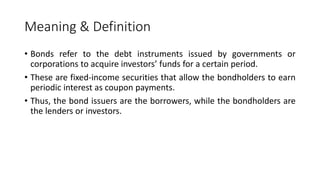
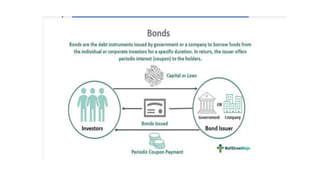
• Bonds refer to the debt instruments issued by governments or
corporations to acquire investors’ funds for a certain period.
• These are fixed-income securities that allow the bondholders to earn
periodic interest as coupon payments.
• Thus, the bond issuers are the borrowers, while the bondholders are
the lenders or investors.
Characteristics
• Issuer: The company or government (city, state, or national authority)
issuing debt instruments to borrow money from individuals and corporate
investors is termed as an issuer.
• Par Value: Every bond has a face value written on it, which is the amount a
bondholder is liable to receive on the maturity date.
• Market Value: It is the price at which the bonds trade in the secondary
market.
• Coupon: The rate of interest offered by the issuer on these debt securities
is termed the coupon rate . Also, the annual interest paid to the investors
is the coupon value.
• Coupon Date: The date on which the investors receive periodic interest
payment is the coupon date.
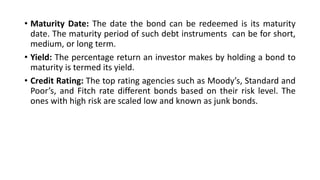
• Maturity Date: The date the bond can be redeemed is its maturity
date. The maturity period of such debt instruments can be for short,
medium, or long term.
• Yield: The percentage return an investor makes by holding a bond to
maturity is termed its yield.
• Credit Rating: The top rating agencies such as Moody’s, Standard and
Poor’s, and Fitch rate different bonds based on their risk level. The
ones with high risk are scaled low and known as junk bonds.
Types of Bonds
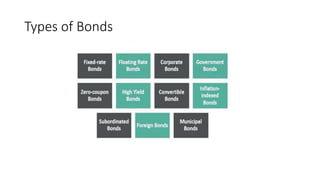
• Fixed-Rate: These instruments have coupon rates that remain constant throughout their life.
• Floating Rate: The coupon rates of these securities are linked to a reference interest rate,
such as the LIBOR (London Interbank Offered Rate) or U.S. Treasury Bill rate. Since these are
volatile, they are classified as floating. For example, the interest rate may be defined as U.S.
Treasury Bill rate + 0.25%. It gets recomputed on a periodical basis.
• Corporate: These are debt securities issued by the companies and sold to various investors.
They can be secured or unsecured. The backing for them depends on the payment ability of
the company, which in turn is linked to possible future earnings of the company from its
operations. These are the aspects looked in by the credit rating agencies before giving in their
confirmation.
• Government: These are issued by the national government promising to
make regular payments and repay the face value on maturity. The terms
on which the government can sell such securities depend on its
creditworthiness in the market.
• Municipal: These debt instruments are released by the nation, state, or
cities to raise finances for their upcoming or running projects. The income
from such securities is exempted from the state and federal tax liabilities.
• Zero-Coupon: They do not pay any periodical interest during their life.
Instead, they are usually issued at a discount to the par value, making it
an attractive investment.
• Foreign: These debt securities are issued by a foreign company in the
domestic market to raise funds in the domestic currency.
Factors that determine bond
• Is default likely? If markets fear the possibility of government debt
default, it is likely they will demand higher bond yields to compensate
for the risk.
• Private sector saving. If the private sector has high levels of savings,
there will tend to be a higher demand for bonds because they are a
good way to make use of savings, and yields will be relatively lower.
Savings tend to rise during periods of uncertainty and low growth.
• Prospects for economic growth. Bonds are an alternative to other
forms of investment like shares and private capital. If there is strong
economic growth, then the prospect for shares and private
investment improves, therefore bonds become relatively less
attractive and yields go up.
• Recession. Similarly, a recession tends to cause a fall in bond yields.
This is because, in times of uncertainty and negative growth, people
would rather have the security of government bonds – than more risky
company shares.
• Interest rates. If Central Banks cuts base interest rates, this will tend to
reduce bond yields as well. Lower interest rates on bank deposits make
people look for alternatives such as government bonds.
• Inflation. If markets fear inflation, then inflation has the capacity to
reduce the real value of the bond. If you borrow £1,000 now but have
inflation of 20% for the next 10 years, the £1,000 bond will rapidly
decrease in value. Therefore, higher inflation will reduce demand for
bonds and lead to higher bond yields.
Bond Valuation
• Bond valuation is a technique for determining the theoretical fair value
of a particular bond.
• Bond valuation includes calculating the present value of a bond's
future interest payments, also known as its cash flow, and the bond's
value upon maturity, also known as its face value or par value.
• Because a bond's par value and interest payments are fixed, an investor
uses bond valuation to determine what rate of return is required for a
bond investment to be worthwhile.

Bond.pptx .

  • 1.
    INTRODUCTION TO BOND RamyaB Assistant Professor B.com(PA) Sri Ramakrishna College of Arts and Science Coimbatore - 641 006 Tamil Nadu, India 1
  • 2.
    Meaning & Definition •Bonds refer to the debt instruments issued by governments or corporations to acquire investors’ funds for a certain period. • These are fixed-income securities that allow the bondholders to earn periodic interest as coupon payments. • Thus, the bond issuers are the borrowers, while the bondholders are the lenders or investors.
  • 4.
    Characteristics • Issuer: Thecompany or government (city, state, or national authority) issuing debt instruments to borrow money from individuals and corporate investors is termed as an issuer. • Par Value: Every bond has a face value written on it, which is the amount a bondholder is liable to receive on the maturity date. • Market Value: It is the price at which the bonds trade in the secondary market. • Coupon: The rate of interest offered by the issuer on these debt securities is termed the coupon rate . Also, the annual interest paid to the investors is the coupon value. • Coupon Date: The date on which the investors receive periodic interest payment is the coupon date.
  • 5.
    • Maturity Date:The date the bond can be redeemed is its maturity date. The maturity period of such debt instruments can be for short, medium, or long term. • Yield: The percentage return an investor makes by holding a bond to maturity is termed its yield. • Credit Rating: The top rating agencies such as Moody’s, Standard and Poor’s, and Fitch rate different bonds based on their risk level. The ones with high risk are scaled low and known as junk bonds.
  • 6.
  • 7.
    • Fixed-Rate: Theseinstruments have coupon rates that remain constant throughout their life. • Floating Rate: The coupon rates of these securities are linked to a reference interest rate, such as the LIBOR (London Interbank Offered Rate) or U.S. Treasury Bill rate. Since these are volatile, they are classified as floating. For example, the interest rate may be defined as U.S. Treasury Bill rate + 0.25%. It gets recomputed on a periodical basis. • Corporate: These are debt securities issued by the companies and sold to various investors. They can be secured or unsecured. The backing for them depends on the payment ability of the company, which in turn is linked to possible future earnings of the company from its operations. These are the aspects looked in by the credit rating agencies before giving in their confirmation.
  • 8.
    • Government: Theseare issued by the national government promising to make regular payments and repay the face value on maturity. The terms on which the government can sell such securities depend on its creditworthiness in the market. • Municipal: These debt instruments are released by the nation, state, or cities to raise finances for their upcoming or running projects. The income from such securities is exempted from the state and federal tax liabilities. • Zero-Coupon: They do not pay any periodical interest during their life. Instead, they are usually issued at a discount to the par value, making it an attractive investment. • Foreign: These debt securities are issued by a foreign company in the domestic market to raise funds in the domestic currency.
  • 9.
    Factors that determinebond • Is default likely? If markets fear the possibility of government debt default, it is likely they will demand higher bond yields to compensate for the risk. • Private sector saving. If the private sector has high levels of savings, there will tend to be a higher demand for bonds because they are a good way to make use of savings, and yields will be relatively lower. Savings tend to rise during periods of uncertainty and low growth. • Prospects for economic growth. Bonds are an alternative to other forms of investment like shares and private capital. If there is strong economic growth, then the prospect for shares and private investment improves, therefore bonds become relatively less attractive and yields go up.
  • 10.
    • Recession. Similarly,a recession tends to cause a fall in bond yields. This is because, in times of uncertainty and negative growth, people would rather have the security of government bonds – than more risky company shares. • Interest rates. If Central Banks cuts base interest rates, this will tend to reduce bond yields as well. Lower interest rates on bank deposits make people look for alternatives such as government bonds. • Inflation. If markets fear inflation, then inflation has the capacity to reduce the real value of the bond. If you borrow £1,000 now but have inflation of 20% for the next 10 years, the £1,000 bond will rapidly decrease in value. Therefore, higher inflation will reduce demand for bonds and lead to higher bond yields.
  • 11.
    Bond Valuation • Bondvaluation is a technique for determining the theoretical fair value of a particular bond. • Bond valuation includes calculating the present value of a bond's future interest payments, also known as its cash flow, and the bond's value upon maturity, also known as its face value or par value. • Because a bond's par value and interest payments are fixed, an investor uses bond valuation to determine what rate of return is required for a bond investment to be worthwhile.