8th edition
Steven P. Robbins
Mary Coulter

PowerPoint Presentation by Charlie Cook
Copyright © 2005 Prentice Hall, Inc.
All rights reserved.
LEARNING OUTLINE
Follow this Learning Outline as you read and study this chapter.

Techniques for Assessing the Environment
• List three different approaches to environmental
scanning.
• Explain what competitor intelligence is and ways that
managers can do it legally and ethically.
• Describe how managers can improve the effectiveness of
forecasting.

Techniques for Allocating Resources
• List the four techniques for allocating resources.
• Describe the different types of budgets.
• Tell what a Gantt chart does.
• Explain a load chart.

Copyright © 2005 Prentice Hall, Inc. All
rights reserved.

9–2
L E A R N I N G O U T L I N E (cont’d)
Follow this Learning Outline as you read and study this chapter.

Techniques for Allocating Resources (cont’d)
• Describe how a PERT network analysis works.
• Compute breakeven point.
• Describe how managers can use linear programming.

Contemporary Planning Techniques
• Explain why flexibility is so important to today’s planning
techniques.
• Describe project management.
• List the steps in the project planning process.
• Discuss why scenario planning has become an important
planning tool for managers.
Copyright © 2005 Prentice Hall, Inc. All
rights reserved.

9–3
Assessing the Environment
• Environmental Scanning
 The screening of large amounts of information to
anticipate and interpret change in the environment.
 Competitor Intelligence
 The

process by which organizations gather information
about their competitors
– Who they are?; what are they doing?

 Is

not spying but rather careful attention to readily
accessible information from employees, customers,
suppliers, the Internet, and competitors themselves.
 May involved reverse engineering of competing
products to discover technical innovations.

Copyright © 2005 Prentice Hall, Inc. All
rights reserved.

9–4
Assessing the Environment (cont’d)
• Environmental Scanning (cont’d)
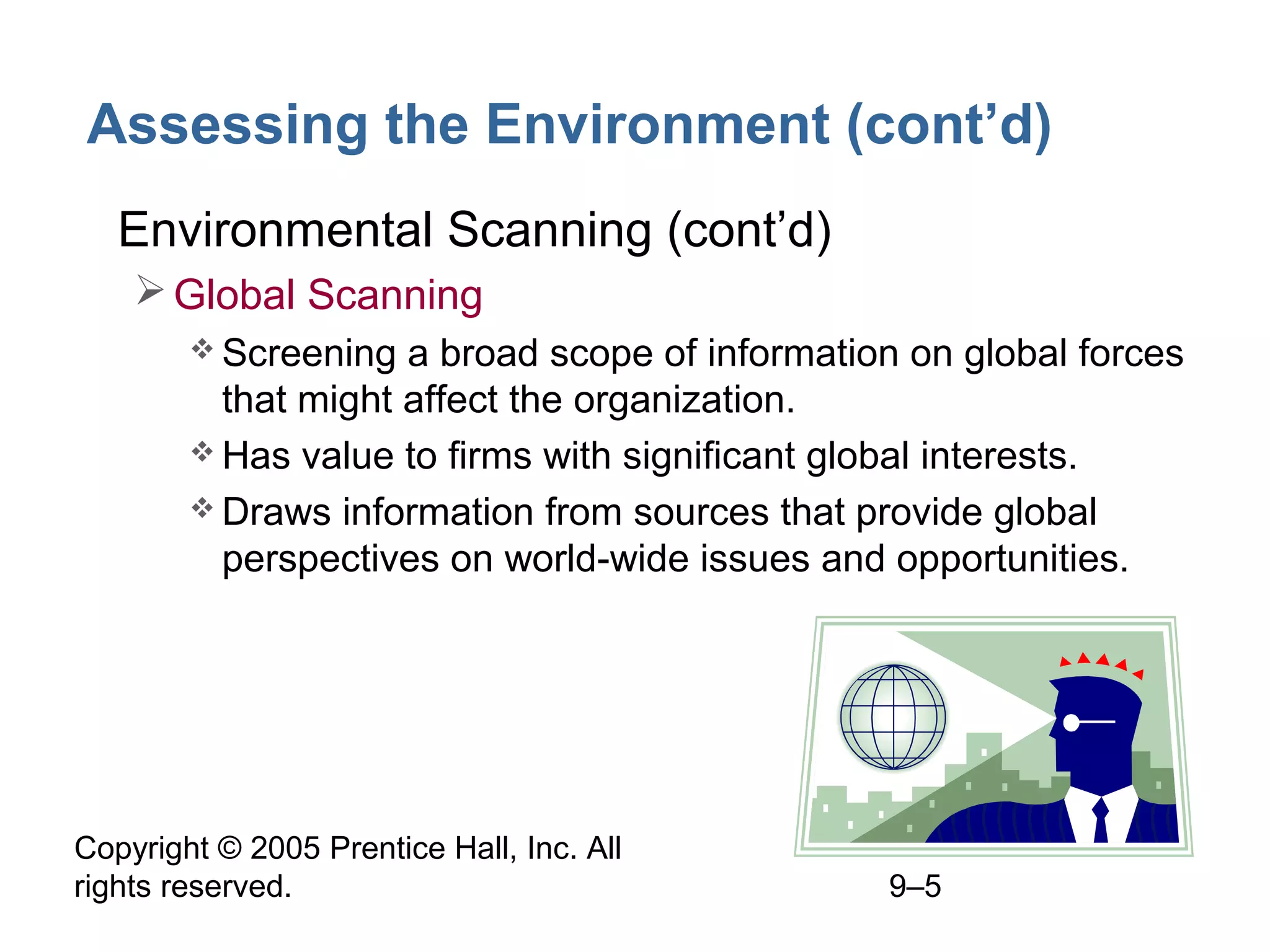
 Global Scanning
 Screening

a broad scope of information on global forces
that might affect the organization.
 Has value to firms with significant global interests.
 Draws information from sources that provide global
perspectives on world-wide issues and opportunities.

Copyright © 2005 Prentice Hall, Inc. All
rights reserved.

9–5
Assessing the Environment (cont’d)
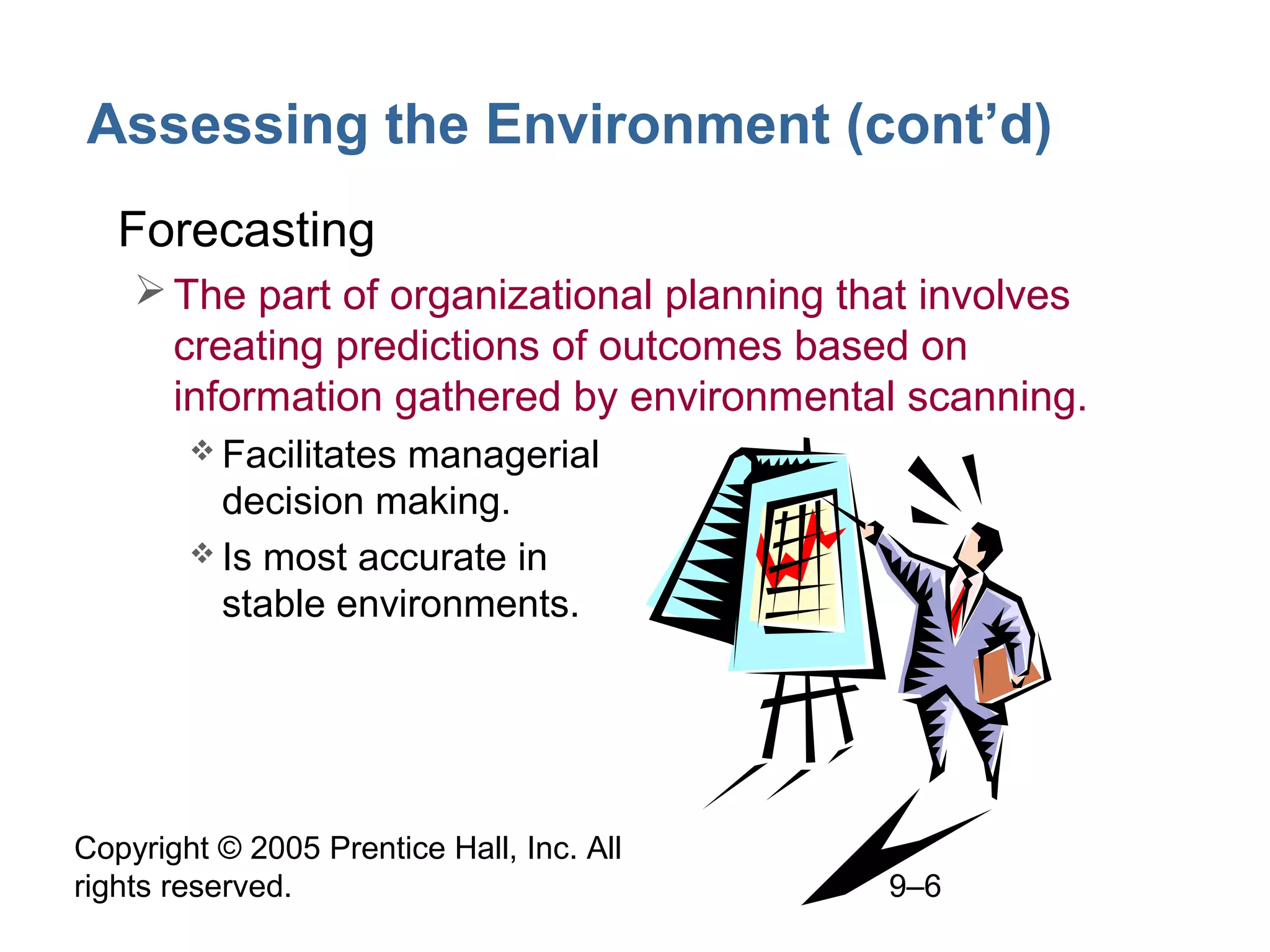
• Forecasting
 The part of organizational planning that involves
creating predictions of outcomes based on
information gathered by environmental scanning.
 Facilitates

managerial
decision making.
 Is most accurate in
stable environments.

Copyright © 2005 Prentice Hall, Inc. All
rights reserved.

9–6
Assessing the Environment (cont’d)
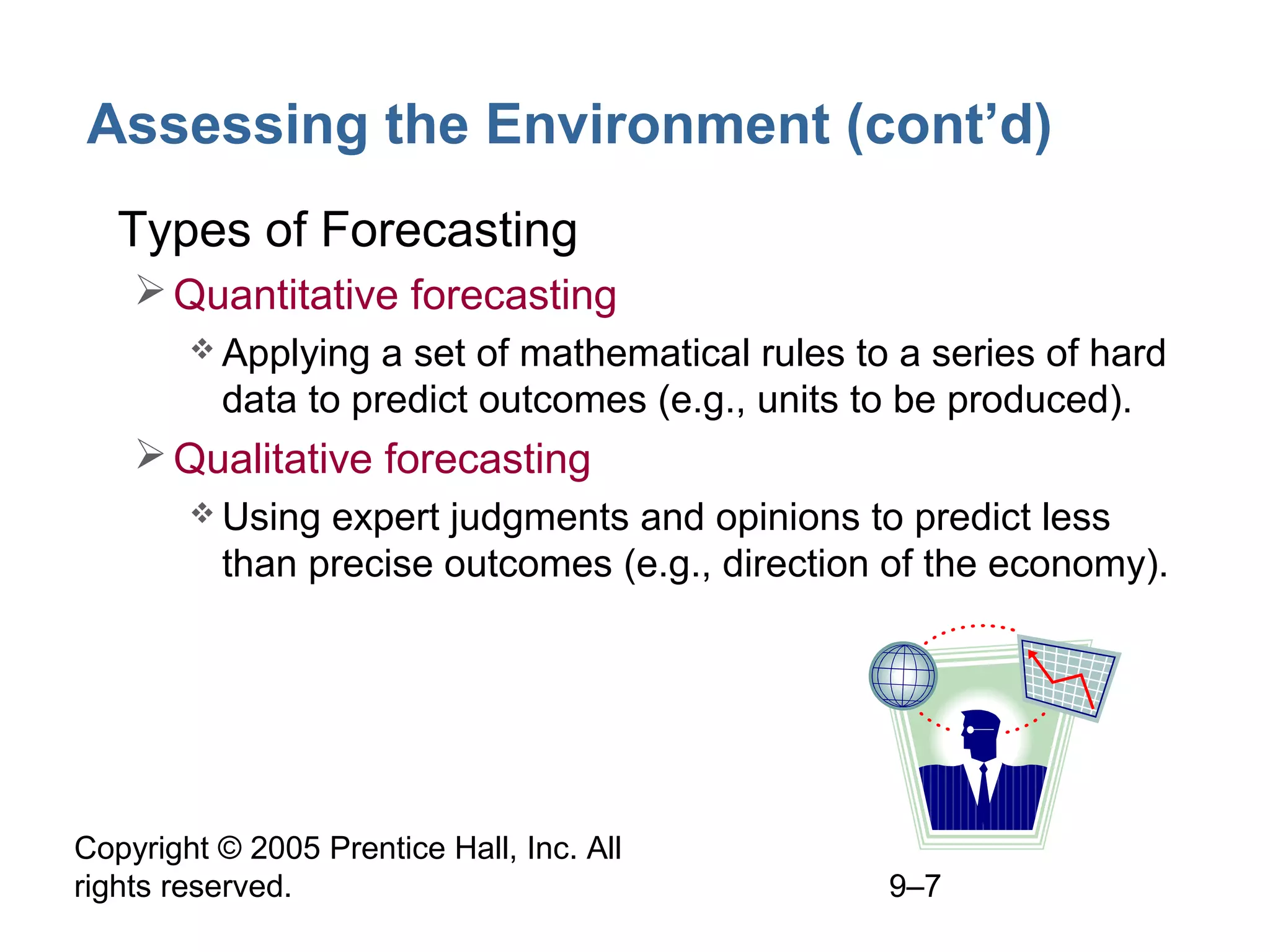
• Types of Forecasting
 Quantitative forecasting
 Applying

a set of mathematical rules to a series of hard
data to predict outcomes (e.g., units to be produced).

 Qualitative forecasting
 Using

expert judgments and opinions to predict less
than precise outcomes (e.g., direction of the economy).

Copyright © 2005 Prentice Hall, Inc. All
rights reserved.

9–7
Collaborative Planning, Forecasting, and
Replenishment (CPFR)
• CPFR Software
 A standardized way for organizations to use the
Internet to exchange data.

Copyright © 2005 Prentice Hall, Inc. All
rights reserved.

9–8
Making Forecasting More Effective
1. Use simple forecasting methods.
2. Compare each forecast with its corresponding “no
change” forecast.
3. Don’t rely on a single forecasting method.
4. Don’t assume that the turning points in a trend can
be accurately identified.
5. Shorten the time period covered by a forecast.
6. Remember that forecasting is a developed
managerial skill that supports decision making.
Copyright © 2005 Prentice Hall, Inc. All
rights reserved.

9–9
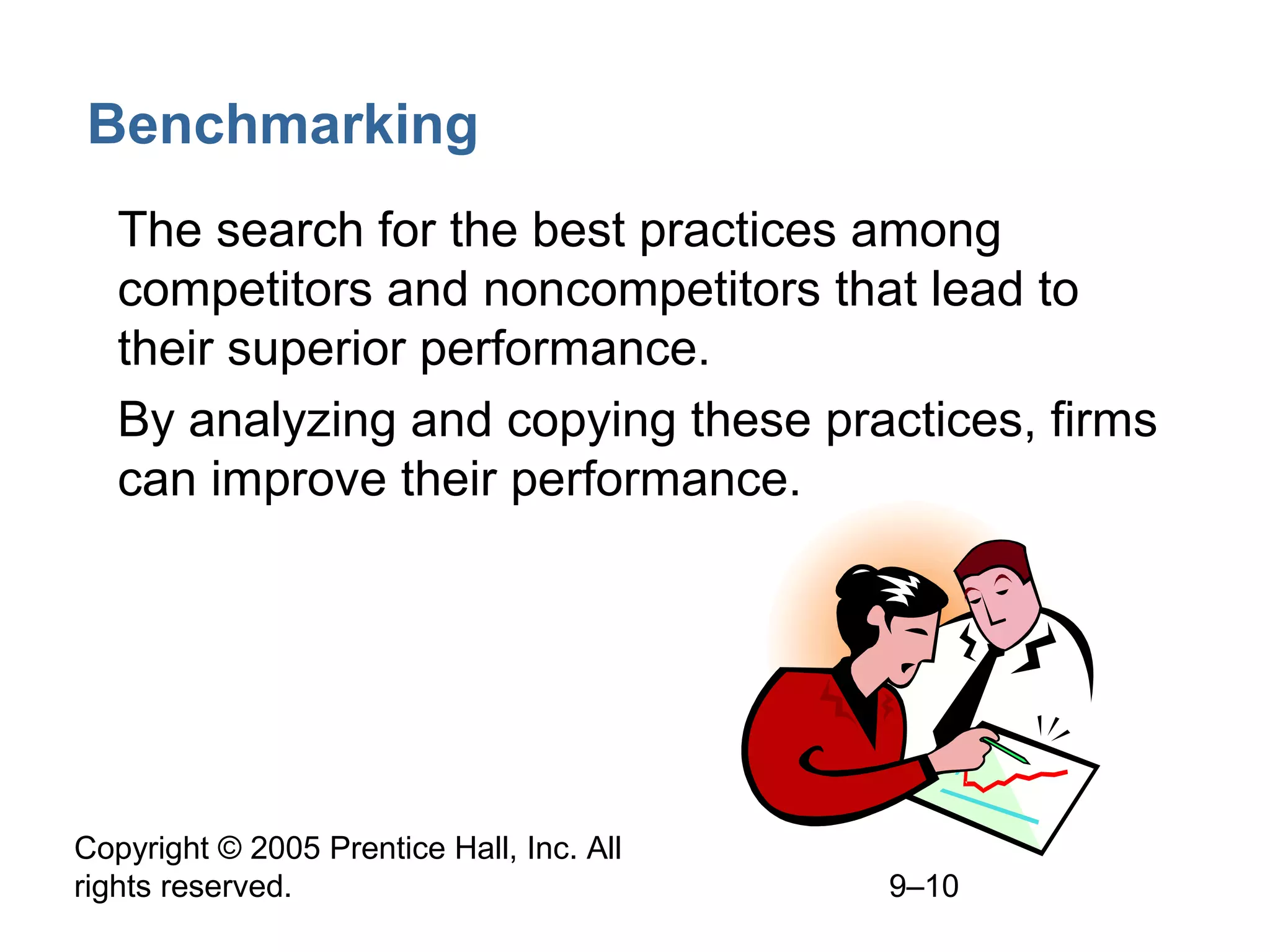
Benchmarking
• The search for the best practices among
competitors and noncompetitors that lead to
their superior performance.
• By analyzing and copying these practices, firms
can improve their performance.

Copyright © 2005 Prentice Hall, Inc. All
rights reserved.

9–10
The Benchmarking Process
1. Form a benchmarking team.
1. Identify what is to be benchmarked, select
comparison organizations, and to determine data
collection methods.

2. Collect internal and external data on work
methods.
3. Analyze data to identify performance gaps and
the cause of differences.
4. Prepare and implement and action plan to
meet or exceed the standards of others.
Copyright © 2005 Prentice Hall, Inc. All
rights reserved.

9–11
Allocating Resources
• Types of Resources
 The assets of the organization
 Financial:

debt, equity, and retained earnings
 Physical: buildings, equipment, and raw materials
 Human: experiences, skills, knowledge, and
competencies
 Intangible: brand names, patents, reputation,
trademarks, copyrights, and databases
 Structural/cultural: history, culture, work systems,
working relationships, trust, and policies
Copyright © 2005 Prentice Hall, Inc. All
rights reserved.

9–12
Allocating Resources: Budgeting
• Budgets
 Numerical plans for allocating resources (e.g.,
revenues, expenses, and capital expenditures).
 Used

to improve time, space, and use of material
resources.
 Are the most commonly used
and most widely applicable
planning technique for
organizations.

Copyright © 2005 Prentice Hall, Inc. All
rights reserved.

9–13
Allocating Resources: Scheduling
• Schedules
 Plans that allocate resources by detailing what
activities have to be done, the order in which they are
to be completed, who is to do each, and when they
are to be completed.
 Represent the coordination of various activities.

Copyright © 2005 Prentice Hall, Inc. All
rights reserved.

9–14
Allocating Resources: Charting
• Gantt Chart
 A bar graph with time on the horizontal axis and
activities to be accomplished on the vertical axis.
 Shows the expected and actual progress of various
tasks.

• Load Chart
 A modified Gantt chart that lists entire departments or
specific resources on the vertical axis.
 Allows managers to plan and control capacity
utilization.
Copyright © 2005 Prentice Hall, Inc. All
rights reserved.

9–15
Allocating Resources: Analysis
• Program Evaluation and Review Technique (PERT)
 A flow chart diagram that depicts the sequence of activities
needed to complete a project and the time or costs
associated with each activity.


Events: Endpoints for completion



Activities: time require for each activity



Slack time: The time that a completed activity waits for
another activity to finish so that they can begin jointly on
another activity



Critical path: the longest path of activities that allows all
tasks to be completed,

Copyright © 2005 Prentice Hall, Inc. All
rights reserved.

9–16
Allocating Resources: Analysis (cont’d)
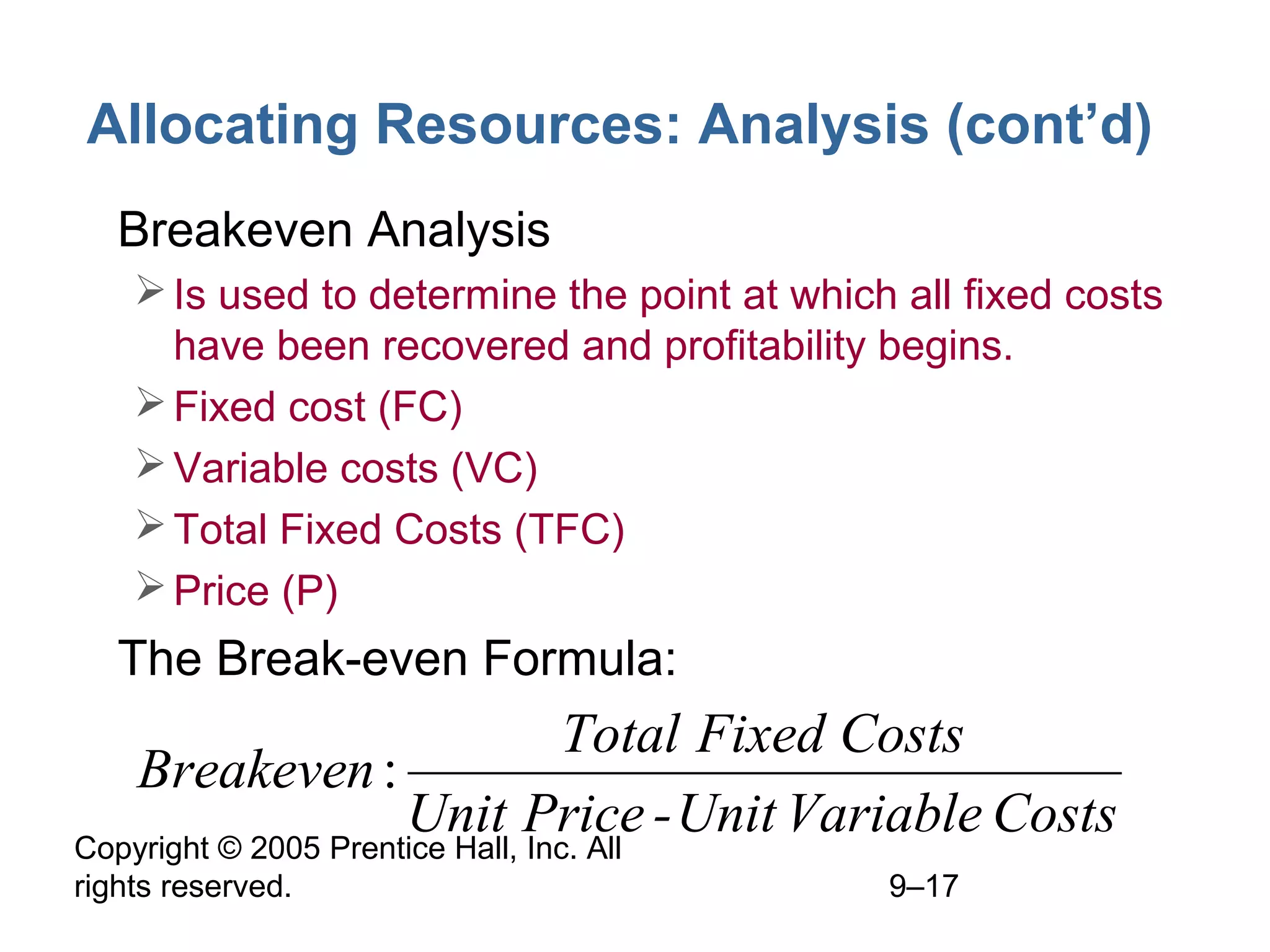
• Breakeven Analysis
 Is used to determine the point at which all fixed costs
have been recovered and profitability begins.
 Fixed cost (FC)
 Variable costs (VC)
 Total Fixed Costs (TFC)
 Price (P)

• The Break-even Formula:

Total Fixed Costs
Breakeven :
Unit Price - Unit Variable Costs
Copyright © 2005 Prentice Hall, Inc. All
rights reserved.

9–17
Allocating Resources: Analysis (cont’d)
• Linear Programming
 A technique that seeks to solve resource allocation
problems using the proportional relationships
between two variables.

Copyright © 2005 Prentice Hall, Inc. All
rights reserved.

9–18
Contemporary Planning Techniques
• Project
 A one-time-only set of activities that has a definite
beginning and ending point time.

• Project Management
 The task of getting a project’s activities done on time,
within budget, and according to specifications.
 Define

project goals
 Identify all required activities, materials, and labor
 Determine the sequence of completion

Copyright © 2005 Prentice Hall, Inc. All
rights reserved.

9–19
Contemporary Planning Techniques
• Scenario
 A consistent view of what the future is likely to be.

• Scenario Planning
 An attempt not try to predict the future but to reduce
uncertainty by playing out potential situations under
different specified conditions.

• Contingency Planning
 Developing scenarios that allow managers determine
in advance what their actions should be should a
considered event actually occur.
Copyright © 2005 Prentice Hall, Inc. All
rights reserved.

9–20

Management ch9 (2)

  • 1.
    8th edition Steven P.Robbins Mary Coulter PowerPoint Presentation by Charlie Cook Copyright © 2005 Prentice Hall, Inc. All rights reserved.
  • 2.
    LEARNING OUTLINE Follow thisLearning Outline as you read and study this chapter. Techniques for Assessing the Environment • List three different approaches to environmental scanning. • Explain what competitor intelligence is and ways that managers can do it legally and ethically. • Describe how managers can improve the effectiveness of forecasting. Techniques for Allocating Resources • List the four techniques for allocating resources. • Describe the different types of budgets. • Tell what a Gantt chart does. • Explain a load chart. Copyright © 2005 Prentice Hall, Inc. All rights reserved. 9–2
  • 3.
    L E AR N I N G O U T L I N E (cont’d) Follow this Learning Outline as you read and study this chapter. Techniques for Allocating Resources (cont’d) • Describe how a PERT network analysis works. • Compute breakeven point. • Describe how managers can use linear programming. Contemporary Planning Techniques • Explain why flexibility is so important to today’s planning techniques. • Describe project management. • List the steps in the project planning process. • Discuss why scenario planning has become an important planning tool for managers. Copyright © 2005 Prentice Hall, Inc. All rights reserved. 9–3
  • 4.
    Assessing the Environment •Environmental Scanning  The screening of large amounts of information to anticipate and interpret change in the environment.  Competitor Intelligence  The process by which organizations gather information about their competitors – Who they are?; what are they doing?  Is not spying but rather careful attention to readily accessible information from employees, customers, suppliers, the Internet, and competitors themselves.  May involved reverse engineering of competing products to discover technical innovations. Copyright © 2005 Prentice Hall, Inc. All rights reserved. 9–4
  • 5.
    Assessing the Environment(cont’d) • Environmental Scanning (cont’d)  Global Scanning  Screening a broad scope of information on global forces that might affect the organization.  Has value to firms with significant global interests.  Draws information from sources that provide global perspectives on world-wide issues and opportunities. Copyright © 2005 Prentice Hall, Inc. All rights reserved. 9–5
  • 6.
    Assessing the Environment(cont’d) • Forecasting  The part of organizational planning that involves creating predictions of outcomes based on information gathered by environmental scanning.  Facilitates managerial decision making.  Is most accurate in stable environments. Copyright © 2005 Prentice Hall, Inc. All rights reserved. 9–6
  • 7.
    Assessing the Environment(cont’d) • Types of Forecasting  Quantitative forecasting  Applying a set of mathematical rules to a series of hard data to predict outcomes (e.g., units to be produced).  Qualitative forecasting  Using expert judgments and opinions to predict less than precise outcomes (e.g., direction of the economy). Copyright © 2005 Prentice Hall, Inc. All rights reserved. 9–7
  • 8.
    Collaborative Planning, Forecasting,and Replenishment (CPFR) • CPFR Software  A standardized way for organizations to use the Internet to exchange data. Copyright © 2005 Prentice Hall, Inc. All rights reserved. 9–8
  • 9.
    Making Forecasting MoreEffective 1. Use simple forecasting methods. 2. Compare each forecast with its corresponding “no change” forecast. 3. Don’t rely on a single forecasting method. 4. Don’t assume that the turning points in a trend can be accurately identified. 5. Shorten the time period covered by a forecast. 6. Remember that forecasting is a developed managerial skill that supports decision making. Copyright © 2005 Prentice Hall, Inc. All rights reserved. 9–9
  • 10.
    Benchmarking • The searchfor the best practices among competitors and noncompetitors that lead to their superior performance. • By analyzing and copying these practices, firms can improve their performance. Copyright © 2005 Prentice Hall, Inc. All rights reserved. 9–10
  • 11.
    The Benchmarking Process 1.Form a benchmarking team. 1. Identify what is to be benchmarked, select comparison organizations, and to determine data collection methods. 2. Collect internal and external data on work methods. 3. Analyze data to identify performance gaps and the cause of differences. 4. Prepare and implement and action plan to meet or exceed the standards of others. Copyright © 2005 Prentice Hall, Inc. All rights reserved. 9–11
  • 12.
    Allocating Resources • Typesof Resources  The assets of the organization  Financial: debt, equity, and retained earnings  Physical: buildings, equipment, and raw materials  Human: experiences, skills, knowledge, and competencies  Intangible: brand names, patents, reputation, trademarks, copyrights, and databases  Structural/cultural: history, culture, work systems, working relationships, trust, and policies Copyright © 2005 Prentice Hall, Inc. All rights reserved. 9–12
  • 13.
    Allocating Resources: Budgeting •Budgets  Numerical plans for allocating resources (e.g., revenues, expenses, and capital expenditures).  Used to improve time, space, and use of material resources.  Are the most commonly used and most widely applicable planning technique for organizations. Copyright © 2005 Prentice Hall, Inc. All rights reserved. 9–13
  • 14.
    Allocating Resources: Scheduling •Schedules  Plans that allocate resources by detailing what activities have to be done, the order in which they are to be completed, who is to do each, and when they are to be completed.  Represent the coordination of various activities. Copyright © 2005 Prentice Hall, Inc. All rights reserved. 9–14
  • 15.
    Allocating Resources: Charting •Gantt Chart  A bar graph with time on the horizontal axis and activities to be accomplished on the vertical axis.  Shows the expected and actual progress of various tasks. • Load Chart  A modified Gantt chart that lists entire departments or specific resources on the vertical axis.  Allows managers to plan and control capacity utilization. Copyright © 2005 Prentice Hall, Inc. All rights reserved. 9–15
  • 16.
    Allocating Resources: Analysis •Program Evaluation and Review Technique (PERT)  A flow chart diagram that depicts the sequence of activities needed to complete a project and the time or costs associated with each activity.  Events: Endpoints for completion  Activities: time require for each activity  Slack time: The time that a completed activity waits for another activity to finish so that they can begin jointly on another activity  Critical path: the longest path of activities that allows all tasks to be completed, Copyright © 2005 Prentice Hall, Inc. All rights reserved. 9–16
  • 17.
    Allocating Resources: Analysis(cont’d) • Breakeven Analysis  Is used to determine the point at which all fixed costs have been recovered and profitability begins.  Fixed cost (FC)  Variable costs (VC)  Total Fixed Costs (TFC)  Price (P) • The Break-even Formula: Total Fixed Costs Breakeven : Unit Price - Unit Variable Costs Copyright © 2005 Prentice Hall, Inc. All rights reserved. 9–17
  • 18.
    Allocating Resources: Analysis(cont’d) • Linear Programming  A technique that seeks to solve resource allocation problems using the proportional relationships between two variables. Copyright © 2005 Prentice Hall, Inc. All rights reserved. 9–18
  • 19.
    Contemporary Planning Techniques •Project  A one-time-only set of activities that has a definite beginning and ending point time. • Project Management  The task of getting a project’s activities done on time, within budget, and according to specifications.  Define project goals  Identify all required activities, materials, and labor  Determine the sequence of completion Copyright © 2005 Prentice Hall, Inc. All rights reserved. 9–19
  • 20.
    Contemporary Planning Techniques •Scenario  A consistent view of what the future is likely to be. • Scenario Planning  An attempt not try to predict the future but to reduce uncertainty by playing out potential situations under different specified conditions. • Contingency Planning  Developing scenarios that allow managers determine in advance what their actions should be should a considered event actually occur. Copyright © 2005 Prentice Hall, Inc. All rights reserved. 9–20