PERFORMANCE
MANAGEMENT
Course Code: MGMT-4143
MANAGEMENT BY
OBJECTIVES (MBO)
Management by Objectives (MBO) is a strategic approach to enhance
the performance of an organization. It is a process where the goals of
the organization are defined and conveyed by the management to the
members of the organization with the intention to achieve each
objective.
An important step in the MBO approach is the monitoring and
evaluation of the performance and progress of each employee against
the established objectives.
Ideally, if the employees themselves are involved in setting goals and
deciding their course of action, they are more likely to fulfill their
obligations.
MANAGEMENT BY
OBJECTIVES (MBO)
Some employers use management by objectives (MBO) as the
primary appraisal method. Others use it to supplement a
graphic rating or other appraisal method. You could engage in
an informal MBO program with subordinates by jointly setting
goals and periodically providing feedback.
However, MBO generally refers to a comprehensive and formal
organization-wide goal setting and appraisal program. Here
goals cascade down by level and department, from company-
wide strategic goals to tactical day-to-day goals.
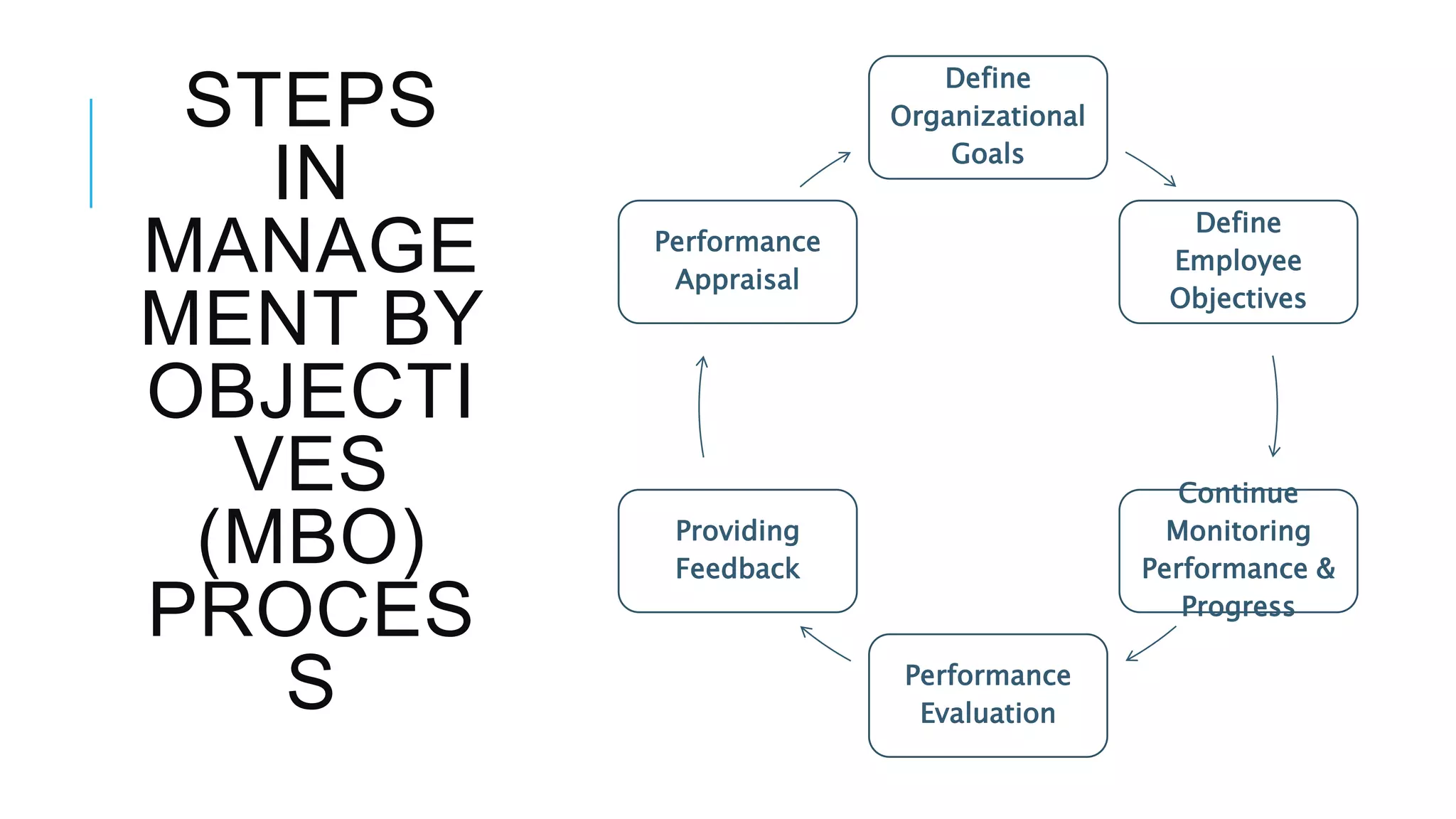
STEPS
IN
MANAGE
MENT BY
OBJECTI
VES
(MBO)
PROCES
S
Define
Organizational
Goals
Define
Employee
Objectives
Continue
Monitoring
Performance &
Progress
Performance
Evaluation
Providing
Feedback
Performance
Appraisal
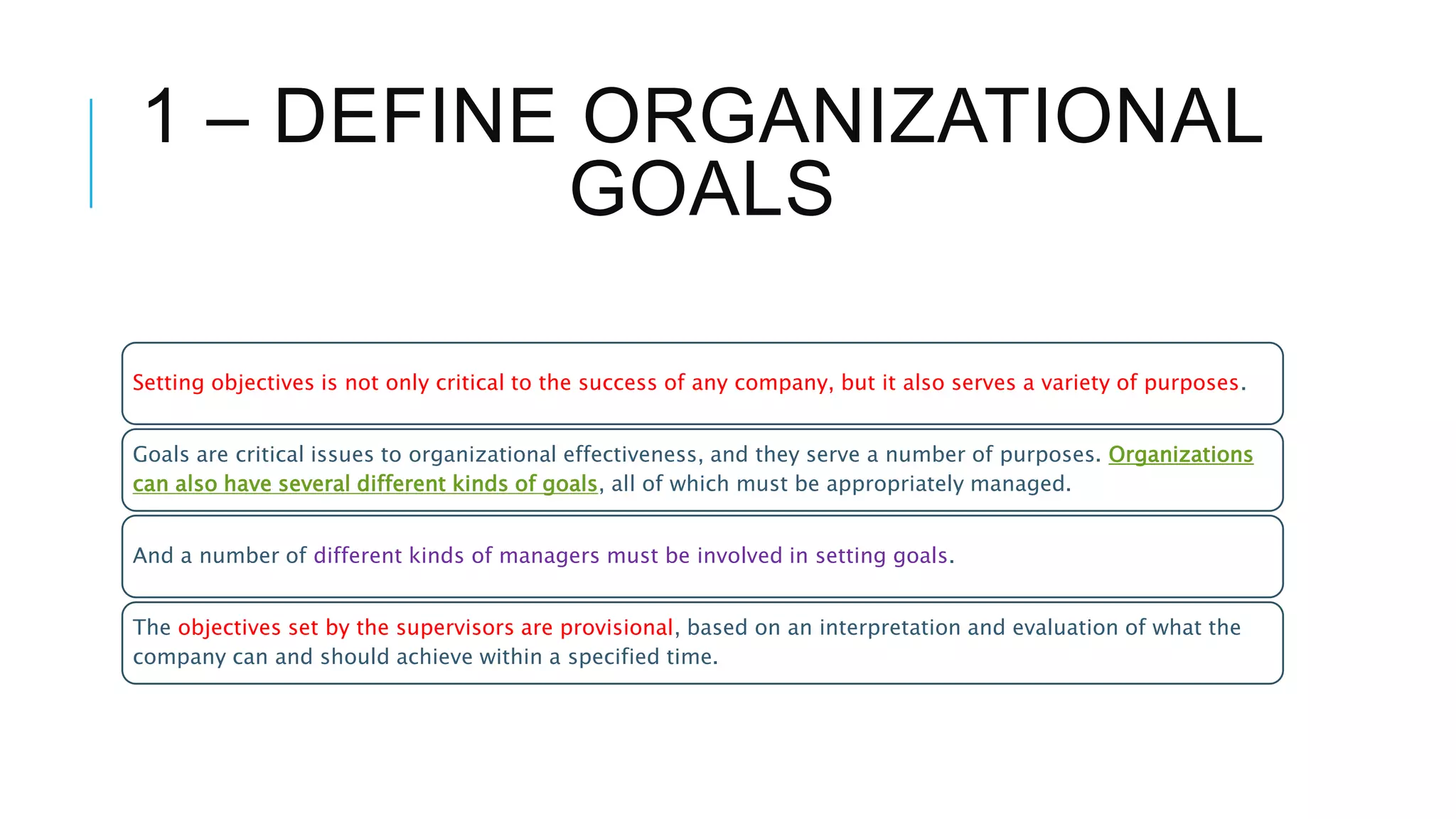
1 – DEFINE ORGANIZATIONAL
GOALS
Setting objectives is not only critical to the success of any company, but it also serves a variety of purposes.
Goals are critical issues to organizational effectiveness, and they serve a number of purposes. Organizations
can also have several different kinds of goals, all of which must be appropriately managed.
And a number of different kinds of managers must be involved in setting goals.
The objectives set by the supervisors are provisional, based on an interpretation and evaluation of what the
company can and should achieve within a specified time.
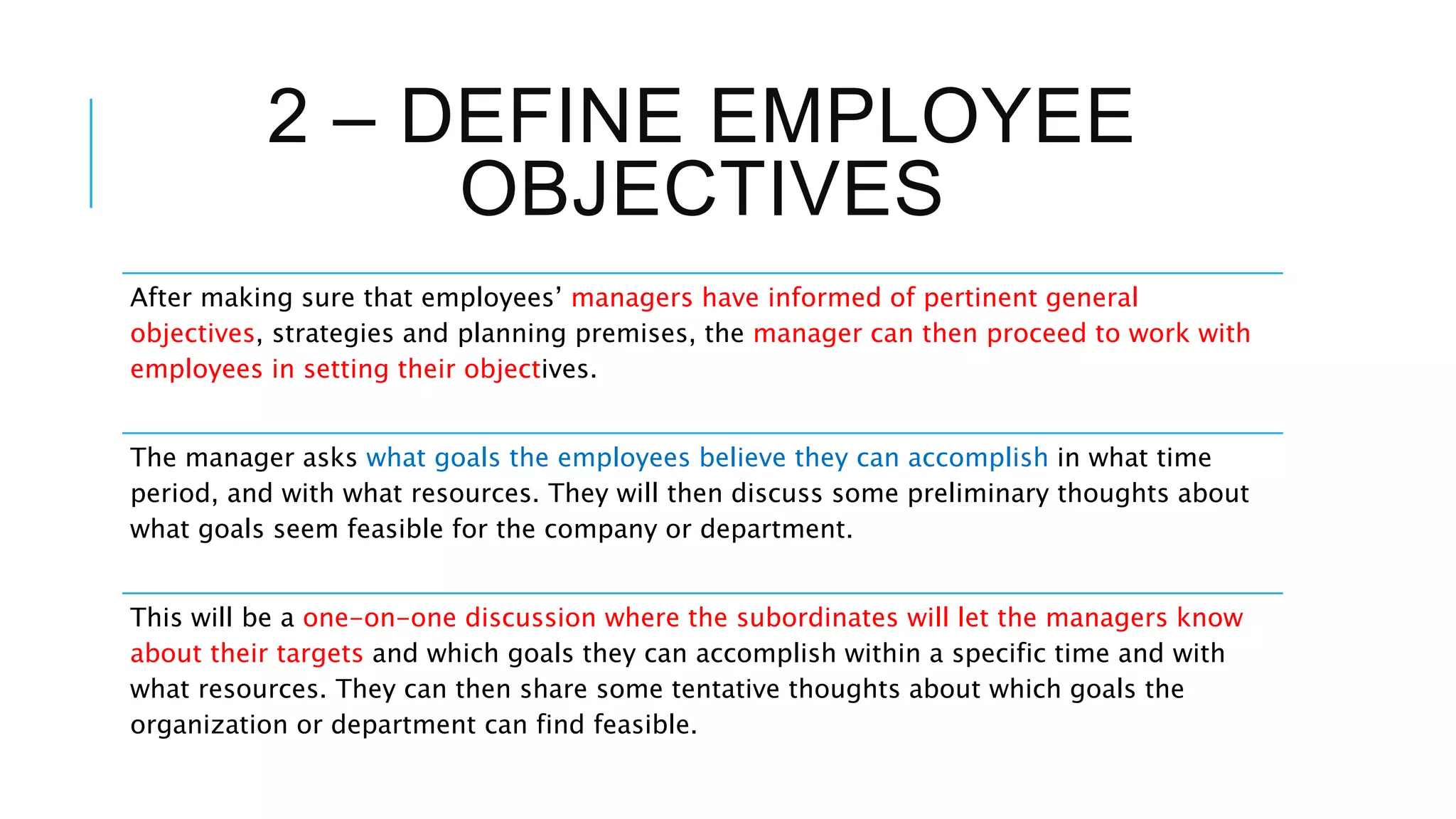
2 – DEFINE EMPLOYEE
OBJECTIVES
After making sure that employees’ managers have informed of pertinent general
objectives, strategies and planning premises, the manager can then proceed to work with
employees in setting their objectives.
The manager asks what goals the employees believe they can accomplish in what time
period, and with what resources. They will then discuss some preliminary thoughts about
what goals seem feasible for the company or department.
This will be a one-on-one discussion where the subordinates will let the managers know
about their targets and which goals they can accomplish within a specific time and with
what resources. They can then share some tentative thoughts about which goals the
organization or department can find feasible.
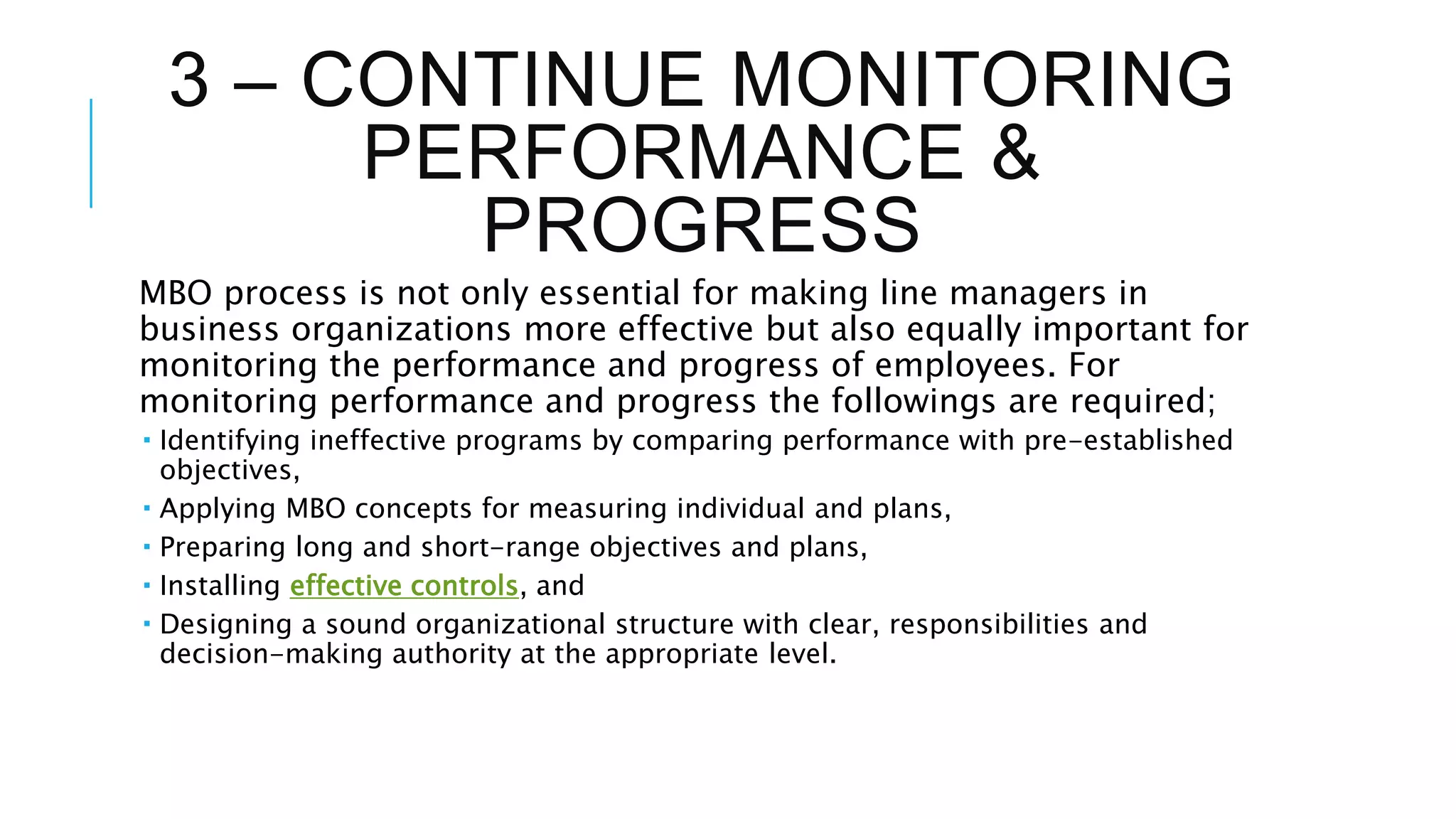
3 – CONTINUE MONITORING
PERFORMANCE &
PROGRESS
MBO process is not only essential for making line managers in
business organizations more effective but also equally important for
monitoring the performance and progress of employees. For
monitoring performance and progress the followings are required;
 Identifying ineffective programs by comparing performance with pre-established
objectives,
 Applying MBO concepts for measuring individual and plans,
 Preparing long and short-range objectives and plans,
 Installing effective controls, and
 Designing a sound organizational structure with clear, responsibilities and
decision-making authority at the appropriate level.
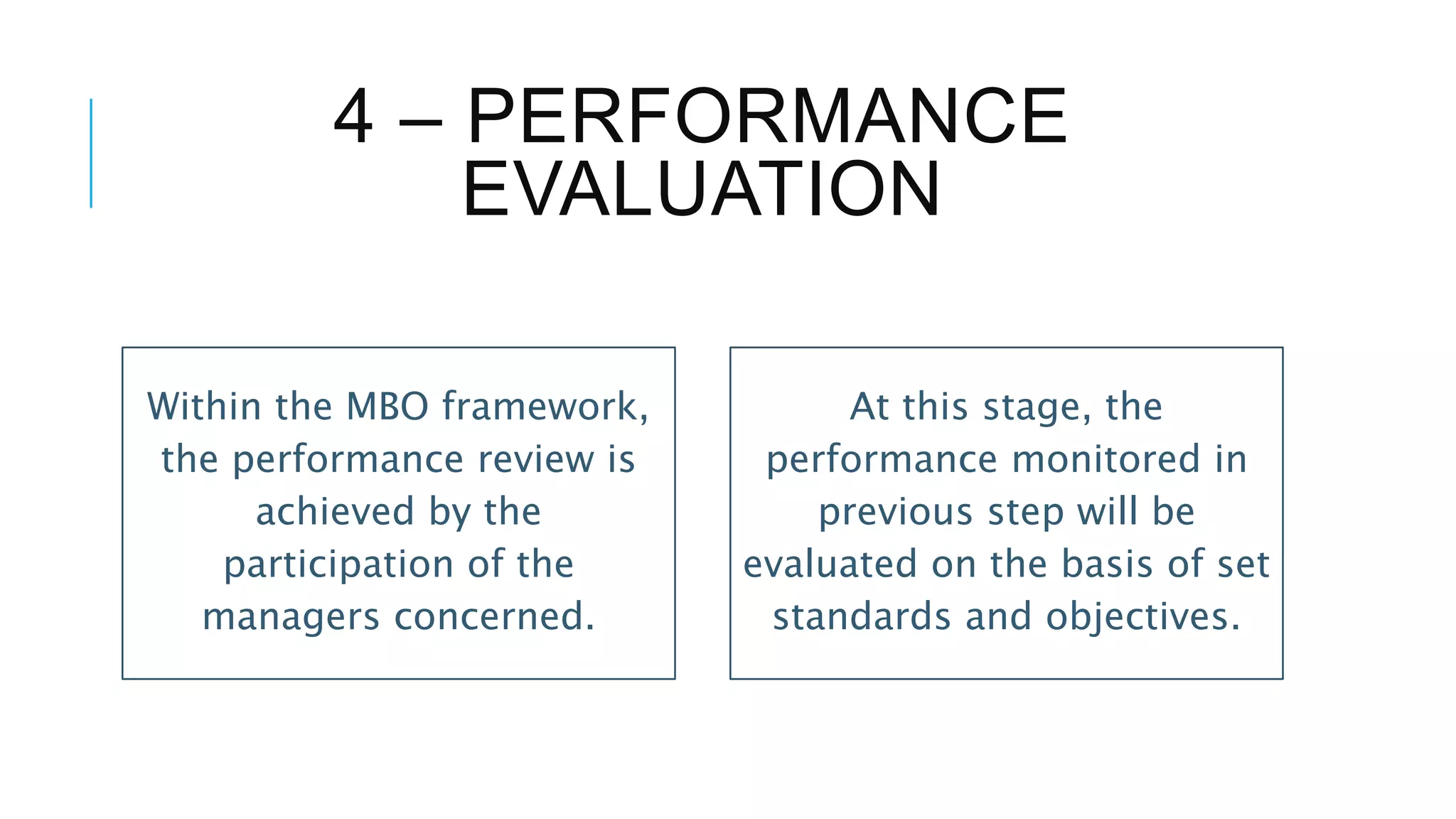
4 – PERFORMANCE
EVALUATION
Within the MBO framework,
the performance review is
achieved by the
participation of the
managers concerned.
At this stage, the
performance monitored in
previous step will be
evaluated on the basis of set
standards and objectives.
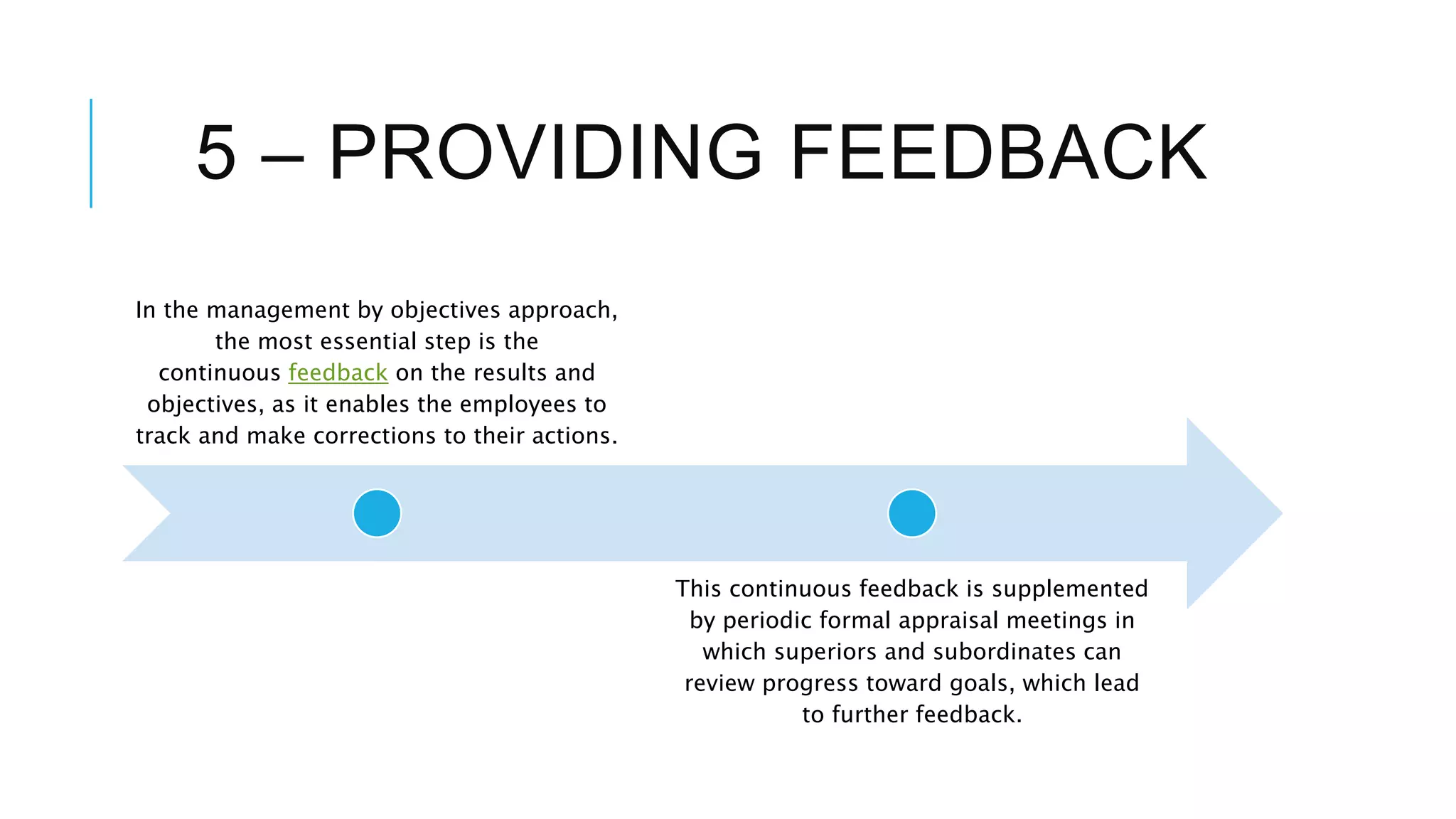
5 – PROVIDING FEEDBACK
In the management by objectives approach,
the most essential step is the
continuous feedback on the results and
objectives, as it enables the employees to
track and make corrections to their actions.
This continuous feedback is supplemented
by periodic formal appraisal meetings in
which superiors and subordinates can
review progress toward goals, which lead
to further feedback.
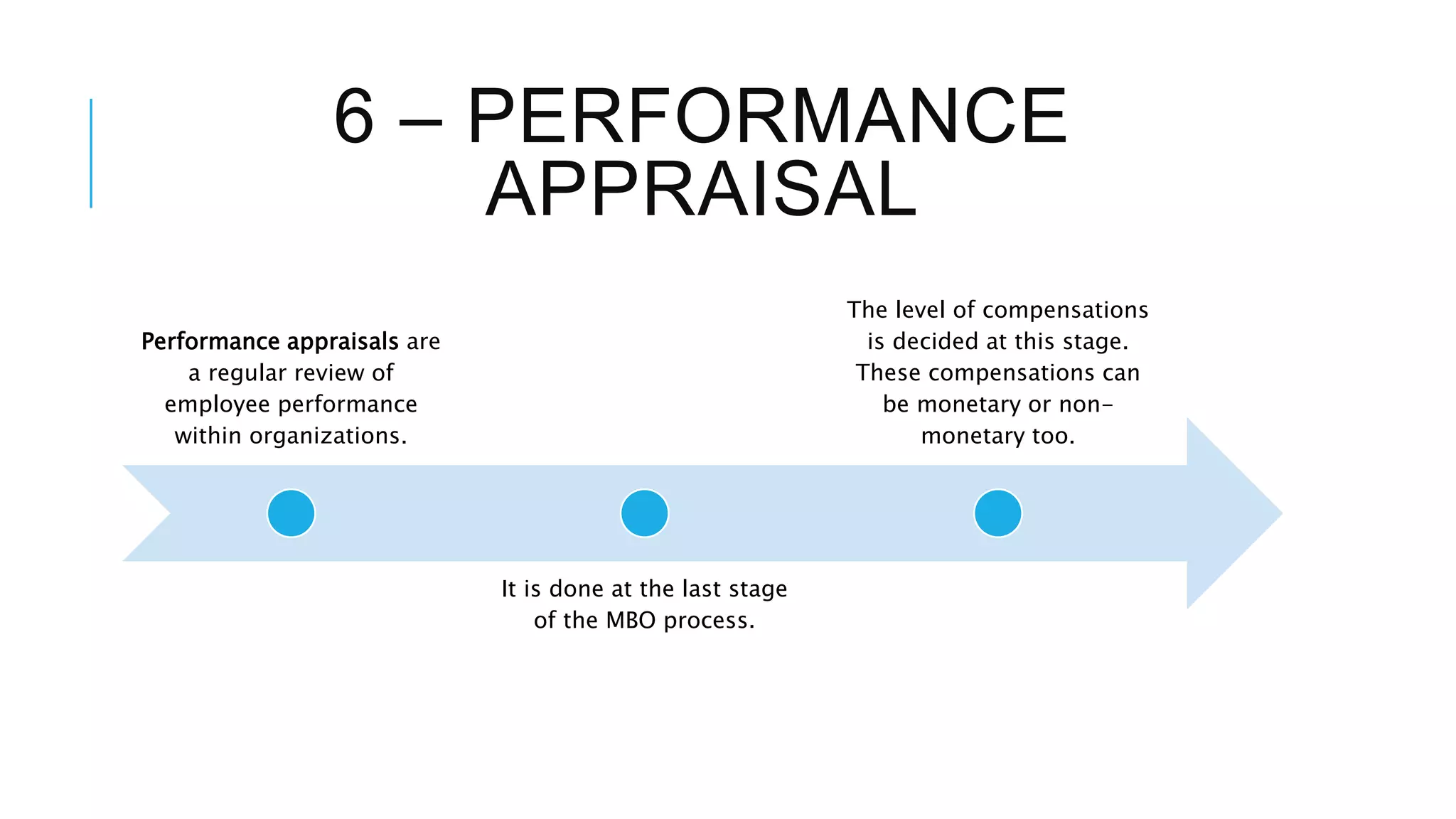
6 – PERFORMANCE
APPRAISAL
Performance appraisals are
a regular review of
employee performance
within organizations.
It is done at the last stage
of the MBO process.
The level of compensations
is decided at this stage.
These compensations can
be monetary or non-
monetary too.
BENEFITS OF MANAGEMENT
BY OBJECTIVES (MBO)
 Efficient Management & Increased Performance - The management is efficient when the team’s output is
higher than the input and resources they put into it. It is directly related the employee productivity or how
much time they take to meet their goals and objectives. Often productivity gets declined when there is no
proper structure aligned to fulfill organizational goals. Organizations that follow MBO are more productive
at their jobs and their efficiency increases, as employees are more clear about their goals which help them
plan and have a very clear structure to follow.
 Effective Planning - The purpose of planning is to develop a blueprint for growing a business. The better
the planning is, the easier it is for management to take action. Planning becomes quite easier with MBO.
Since employees are clear about the organizational objectives, therefore, they can develop a systematic
approach and plan to achieve those. MBO can greatly improve employee performance in the workplace.
Detailed planning leads to better performance and more profit.
 It provides the employees with a clear understanding of what is expected of them.
 The supervisors set goals for every member of the team, and every employee is provided with a list of
unique tasks.
 Managers help ensure that subordinates’ goals are related to the objectives of the organization.
 Transparency - Communication is the main pillar of any organization to sustain and thrive. The
communication process becomes more active between the management and the employees with this
management technique. The continuous flow of two-way communication brings more opportunities and
clarity in ambiguous roles by defining clear objectives to every team member. With MBO members of the
organization becomes aware of the roles others are playing. It helps subordinates to report to their
managers and also understand it better since the work assigned is mutually decided. Also since all the
members work towards the main organization goal, MBO gives an edge to understand it and
follow transparency in the process.
BENEFITS OF MANAGEMENT
BY OBJECTIVES (MBO)
 Reinforces Commitment - In an organization, we often see employees gradually lose
their job satisfaction and their sense of commitment. The reason behind this though has
diverse reasons but one of the major factors is lack of direction, lack of transparency
and miscommunication between the superior and subordinates. MBO reinforces the
involvement of every member by giving them the opportunity in planning and achieving
their company goals. Also, since everyone is assigned goals to reach the target,
therefore, it gives employees a sense of commitment.
 Goal Setting - It directs management and gives a road-map to follow. And it is better
when everyone in the organization is aware of the process or included to give their
perspectives and idea on the same. This also helps the employees to understand their
roles and tasks better. With MBO Strategic Model, goal-setting is done with mutual
participation of the management and the organization. Objectives are more likely to be
fulfilled by the employees as they actively participate in the goal-setting process and
also choose the actions to achieve those. It gives everyone in the team a clear goal and
perspective to keep the boat floating.
 Efficient Utilization of Human Resources - If you do not know how to utilize your human
resources, then you might do more harm to your business than you can imagine. Having
the best teams is not enough. The world is growing smarter, the digital transformations
are not only bringing us huge opportunities but also competition. So how do you sustain
in a hugely competitive market? One sure trick here is to utilize your resources to its
fullest potential. And you can also only do that by delegating tasks to individuals who
suit best the given role. With MBO, employees and managers collaborate on assigning
BENEFITS OF MANAGEMENT
BY OBJECTIVES (MBO)
 Minimizes Ambiguity - There is no role ambiguity since everyone is clear about
their job roles. Confusion of job roles or managing multiples tasks by specific
individuals in the team creates an imbalance in the overall management structure. It
also impacts performance and encourages a toxic work culture. Many employees
feel discouraged by not being able to understand the workflow or what is expected
of them. With MBO, the joint collaboration between the manager and the employees
clears the air and leaves room for everyone to thrive and understand their job roles
effectively.
 Sense of identity: MBO can give employees a greater sense of identification.
Employees feel proud that they are involved in the goals of the organization and
therefore become more productive employees. Everyone knows what role they play
within the organization.
 Career growth: Employees have the opportunity to further their careers.
Management takes a big interest in improving and enriching the skills of employees
and provides many opportunities for these trainings to happen. Performance
evaluations give employees feedback. It allows the employee to become stronger in
areas where they are struggling and shows them these areas.
LIMITATIONS OF
MANAGEMENT BY
OBJECTIVES (MBO)
Management by objectives often ignores the organization’s existing methods and working conditions.
More emphasis is given on goals and targets. The managers put constant pressure on the employees to accomplish their goals and forget
about the use of MBO for involvement, willingness to contribute, and growth of management.
The managers sometimes over-emphasize the target setting, as compared to operational issues, as a generator of success.
The MBO approach does not emphasize the significance of the context wherein the goals are set. The context encompasses everything from
resource availability and efficiency to relative buy-in from the leadership and stakeholders.
The MBO process increases comparisons between individuals at the workplace. Employees tend to depend on nasty politics and other
unproductive tasks to outshine their fellow workers. Employees do only what their superiors ask them to do. Their work lacks innovation,
creativity and sometimes also becomes monotonous.
Finally, there is a tendency for many managers to see management by objectives as a total system that can handle all management issues
once installed. The overdependence may impose problems on the MBO system that it is not prepared to tackle, and that frustrates any
potentially positive effects on the issues it is supposed to deal with.
EXAMPLES OF MANAGEMENT
BY OBJECTIVES (MBO)
Here are three examples of MBOs that you might experience in the workplace:
1. Human resources - Human resources would set one to three goals, such as
maintaining an employee satisfaction index of 85%. They would discuss how to make
this happen. Once HR has created a plan, they will speak with their employees.
Through feedback, they will figure out new ideas to help in achieving this goal. HR will
ensure employees are doing their part as well. HR will then monitor employee
performance to ensure the goal is benefiting the business.
2. Marketing - Marketing would set one to three goals. One of these might be to triple
social media following within one year. Once marketing decides on an action plan, they
would share this plan with employees and listen to their input about whether this plan
is realistic. They would also listen to the employees’ goals. Through feedback, they will
work with new ideas and make these objectives happen. Marketing will evaluate
performance and ensure the goal is being achieved.
3. Sales - The sales department might set a goal to achieve 30 new bookings per month.
Sales might decide this can be achieved by distributing fliers. Upon talking to
employees, they determine they have a better chance of achieving and even exceeding
their goal if pens are given out with the fliers. With feedback, they discover that the
flier-pen combination has landed the business 70 new bookings per month. Since they
have exceeded their goal, sales can focus on a new goal.

Lecture # 4.pptx

  • 1.
  • 2.
    MANAGEMENT BY OBJECTIVES (MBO) Managementby Objectives (MBO) is a strategic approach to enhance the performance of an organization. It is a process where the goals of the organization are defined and conveyed by the management to the members of the organization with the intention to achieve each objective. An important step in the MBO approach is the monitoring and evaluation of the performance and progress of each employee against the established objectives. Ideally, if the employees themselves are involved in setting goals and deciding their course of action, they are more likely to fulfill their obligations.
  • 3.
    MANAGEMENT BY OBJECTIVES (MBO) Someemployers use management by objectives (MBO) as the primary appraisal method. Others use it to supplement a graphic rating or other appraisal method. You could engage in an informal MBO program with subordinates by jointly setting goals and periodically providing feedback. However, MBO generally refers to a comprehensive and formal organization-wide goal setting and appraisal program. Here goals cascade down by level and department, from company- wide strategic goals to tactical day-to-day goals.
  • 4.
  • 5.
    1 – DEFINEORGANIZATIONAL GOALS Setting objectives is not only critical to the success of any company, but it also serves a variety of purposes. Goals are critical issues to organizational effectiveness, and they serve a number of purposes. Organizations can also have several different kinds of goals, all of which must be appropriately managed. And a number of different kinds of managers must be involved in setting goals. The objectives set by the supervisors are provisional, based on an interpretation and evaluation of what the company can and should achieve within a specified time.
  • 6.
    2 – DEFINEEMPLOYEE OBJECTIVES After making sure that employees’ managers have informed of pertinent general objectives, strategies and planning premises, the manager can then proceed to work with employees in setting their objectives. The manager asks what goals the employees believe they can accomplish in what time period, and with what resources. They will then discuss some preliminary thoughts about what goals seem feasible for the company or department. This will be a one-on-one discussion where the subordinates will let the managers know about their targets and which goals they can accomplish within a specific time and with what resources. They can then share some tentative thoughts about which goals the organization or department can find feasible.
  • 7.
    3 – CONTINUEMONITORING PERFORMANCE & PROGRESS MBO process is not only essential for making line managers in business organizations more effective but also equally important for monitoring the performance and progress of employees. For monitoring performance and progress the followings are required;  Identifying ineffective programs by comparing performance with pre-established objectives,  Applying MBO concepts for measuring individual and plans,  Preparing long and short-range objectives and plans,  Installing effective controls, and  Designing a sound organizational structure with clear, responsibilities and decision-making authority at the appropriate level.
  • 8.
    4 – PERFORMANCE EVALUATION Withinthe MBO framework, the performance review is achieved by the participation of the managers concerned. At this stage, the performance monitored in previous step will be evaluated on the basis of set standards and objectives.
  • 9.
    5 – PROVIDINGFEEDBACK In the management by objectives approach, the most essential step is the continuous feedback on the results and objectives, as it enables the employees to track and make corrections to their actions. This continuous feedback is supplemented by periodic formal appraisal meetings in which superiors and subordinates can review progress toward goals, which lead to further feedback.
  • 10.
    6 – PERFORMANCE APPRAISAL Performanceappraisals are a regular review of employee performance within organizations. It is done at the last stage of the MBO process. The level of compensations is decided at this stage. These compensations can be monetary or non- monetary too.
  • 11.
    BENEFITS OF MANAGEMENT BYOBJECTIVES (MBO)  Efficient Management & Increased Performance - The management is efficient when the team’s output is higher than the input and resources they put into it. It is directly related the employee productivity or how much time they take to meet their goals and objectives. Often productivity gets declined when there is no proper structure aligned to fulfill organizational goals. Organizations that follow MBO are more productive at their jobs and their efficiency increases, as employees are more clear about their goals which help them plan and have a very clear structure to follow.  Effective Planning - The purpose of planning is to develop a blueprint for growing a business. The better the planning is, the easier it is for management to take action. Planning becomes quite easier with MBO. Since employees are clear about the organizational objectives, therefore, they can develop a systematic approach and plan to achieve those. MBO can greatly improve employee performance in the workplace. Detailed planning leads to better performance and more profit.  It provides the employees with a clear understanding of what is expected of them.  The supervisors set goals for every member of the team, and every employee is provided with a list of unique tasks.  Managers help ensure that subordinates’ goals are related to the objectives of the organization.  Transparency - Communication is the main pillar of any organization to sustain and thrive. The communication process becomes more active between the management and the employees with this management technique. The continuous flow of two-way communication brings more opportunities and clarity in ambiguous roles by defining clear objectives to every team member. With MBO members of the organization becomes aware of the roles others are playing. It helps subordinates to report to their managers and also understand it better since the work assigned is mutually decided. Also since all the members work towards the main organization goal, MBO gives an edge to understand it and follow transparency in the process.
  • 12.
    BENEFITS OF MANAGEMENT BYOBJECTIVES (MBO)  Reinforces Commitment - In an organization, we often see employees gradually lose their job satisfaction and their sense of commitment. The reason behind this though has diverse reasons but one of the major factors is lack of direction, lack of transparency and miscommunication between the superior and subordinates. MBO reinforces the involvement of every member by giving them the opportunity in planning and achieving their company goals. Also, since everyone is assigned goals to reach the target, therefore, it gives employees a sense of commitment.  Goal Setting - It directs management and gives a road-map to follow. And it is better when everyone in the organization is aware of the process or included to give their perspectives and idea on the same. This also helps the employees to understand their roles and tasks better. With MBO Strategic Model, goal-setting is done with mutual participation of the management and the organization. Objectives are more likely to be fulfilled by the employees as they actively participate in the goal-setting process and also choose the actions to achieve those. It gives everyone in the team a clear goal and perspective to keep the boat floating.  Efficient Utilization of Human Resources - If you do not know how to utilize your human resources, then you might do more harm to your business than you can imagine. Having the best teams is not enough. The world is growing smarter, the digital transformations are not only bringing us huge opportunities but also competition. So how do you sustain in a hugely competitive market? One sure trick here is to utilize your resources to its fullest potential. And you can also only do that by delegating tasks to individuals who suit best the given role. With MBO, employees and managers collaborate on assigning
  • 13.
    BENEFITS OF MANAGEMENT BYOBJECTIVES (MBO)  Minimizes Ambiguity - There is no role ambiguity since everyone is clear about their job roles. Confusion of job roles or managing multiples tasks by specific individuals in the team creates an imbalance in the overall management structure. It also impacts performance and encourages a toxic work culture. Many employees feel discouraged by not being able to understand the workflow or what is expected of them. With MBO, the joint collaboration between the manager and the employees clears the air and leaves room for everyone to thrive and understand their job roles effectively.  Sense of identity: MBO can give employees a greater sense of identification. Employees feel proud that they are involved in the goals of the organization and therefore become more productive employees. Everyone knows what role they play within the organization.  Career growth: Employees have the opportunity to further their careers. Management takes a big interest in improving and enriching the skills of employees and provides many opportunities for these trainings to happen. Performance evaluations give employees feedback. It allows the employee to become stronger in areas where they are struggling and shows them these areas.
  • 14.
    LIMITATIONS OF MANAGEMENT BY OBJECTIVES(MBO) Management by objectives often ignores the organization’s existing methods and working conditions. More emphasis is given on goals and targets. The managers put constant pressure on the employees to accomplish their goals and forget about the use of MBO for involvement, willingness to contribute, and growth of management. The managers sometimes over-emphasize the target setting, as compared to operational issues, as a generator of success. The MBO approach does not emphasize the significance of the context wherein the goals are set. The context encompasses everything from resource availability and efficiency to relative buy-in from the leadership and stakeholders. The MBO process increases comparisons between individuals at the workplace. Employees tend to depend on nasty politics and other unproductive tasks to outshine their fellow workers. Employees do only what their superiors ask them to do. Their work lacks innovation, creativity and sometimes also becomes monotonous. Finally, there is a tendency for many managers to see management by objectives as a total system that can handle all management issues once installed. The overdependence may impose problems on the MBO system that it is not prepared to tackle, and that frustrates any potentially positive effects on the issues it is supposed to deal with.
  • 15.
    EXAMPLES OF MANAGEMENT BYOBJECTIVES (MBO) Here are three examples of MBOs that you might experience in the workplace: 1. Human resources - Human resources would set one to three goals, such as maintaining an employee satisfaction index of 85%. They would discuss how to make this happen. Once HR has created a plan, they will speak with their employees. Through feedback, they will figure out new ideas to help in achieving this goal. HR will ensure employees are doing their part as well. HR will then monitor employee performance to ensure the goal is benefiting the business. 2. Marketing - Marketing would set one to three goals. One of these might be to triple social media following within one year. Once marketing decides on an action plan, they would share this plan with employees and listen to their input about whether this plan is realistic. They would also listen to the employees’ goals. Through feedback, they will work with new ideas and make these objectives happen. Marketing will evaluate performance and ensure the goal is being achieved. 3. Sales - The sales department might set a goal to achieve 30 new bookings per month. Sales might decide this can be achieved by distributing fliers. Upon talking to employees, they determine they have a better chance of achieving and even exceeding their goal if pens are given out with the fliers. With feedback, they discover that the flier-pen combination has landed the business 70 new bookings per month. Since they have exceeded their goal, sales can focus on a new goal.