Ch 6
Performance Management
&
Rewards
Managing Organizational Performance
Impact of reward on individual performance
Influences on performance
High performance culture and work systems
Impact of reward on organizational performance
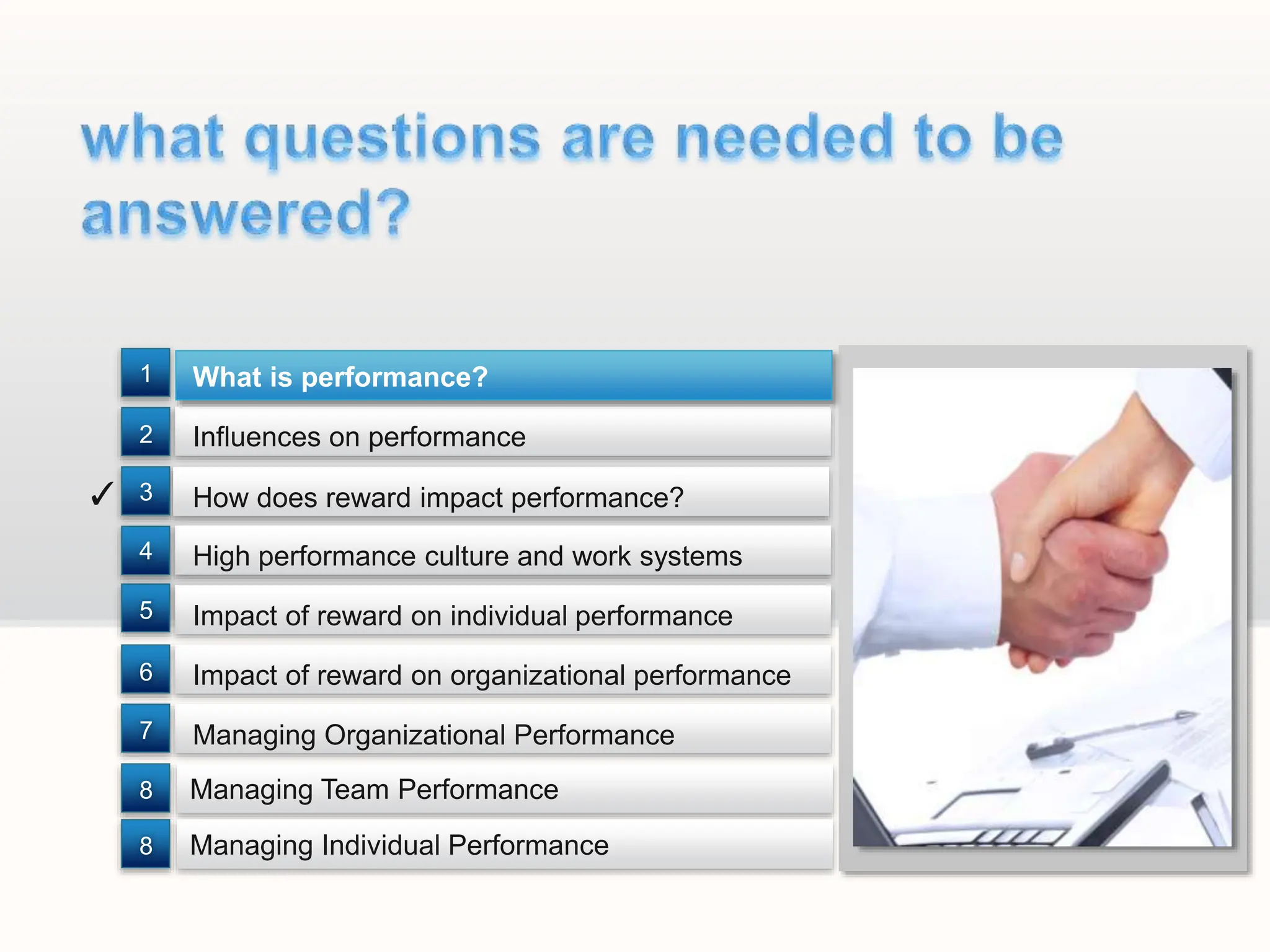
7
6
5
4
3
2
1
8 Managing Team Performance
8 Managing Individual Performance
What is performance?
How does reward impact performance?
✓
•Performance is getting the job done
•Producing the result that you aimed at
• Performance is a behaviour- the way
in which organizations, teams and
individuals get work done
What is performance?
Influences on performance
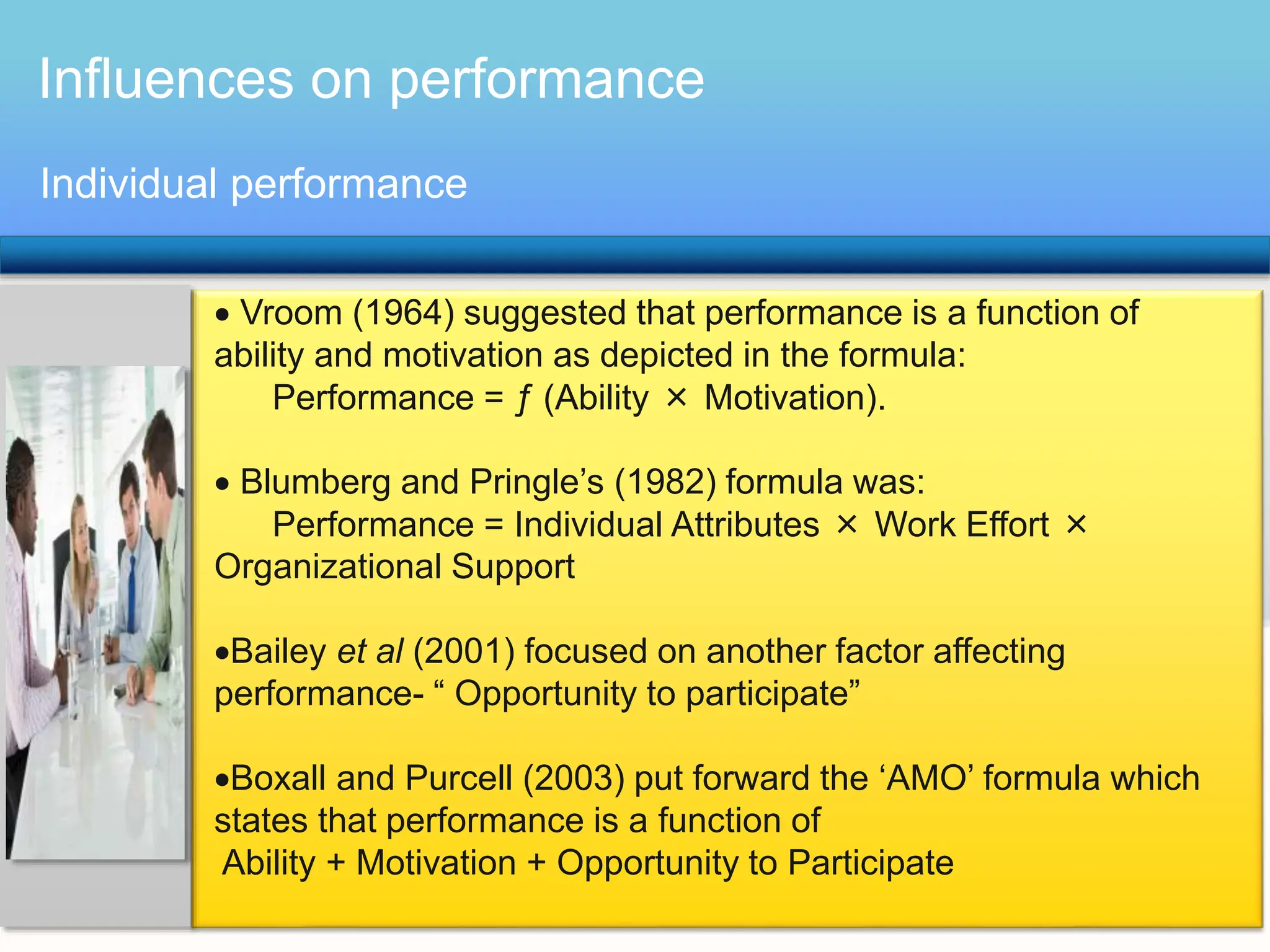
 Vroom (1964) suggested that performance is a function of
ability and motivation as depicted in the formula:
Performance = ƒ (Ability × Motivation).
 Blumberg and Pringle’s (1982) formula was:
Performance = Individual Attributes × Work Effort ×
Organizational Support
Bailey et al (2001) focused on another factor affecting
performance- “ Opportunity to participate”
Boxall and Purcell (2003) put forward the ‘AMO’ formula which
states that performance is a function of
Ability + Motivation + Opportunity to Participate
Individual performance
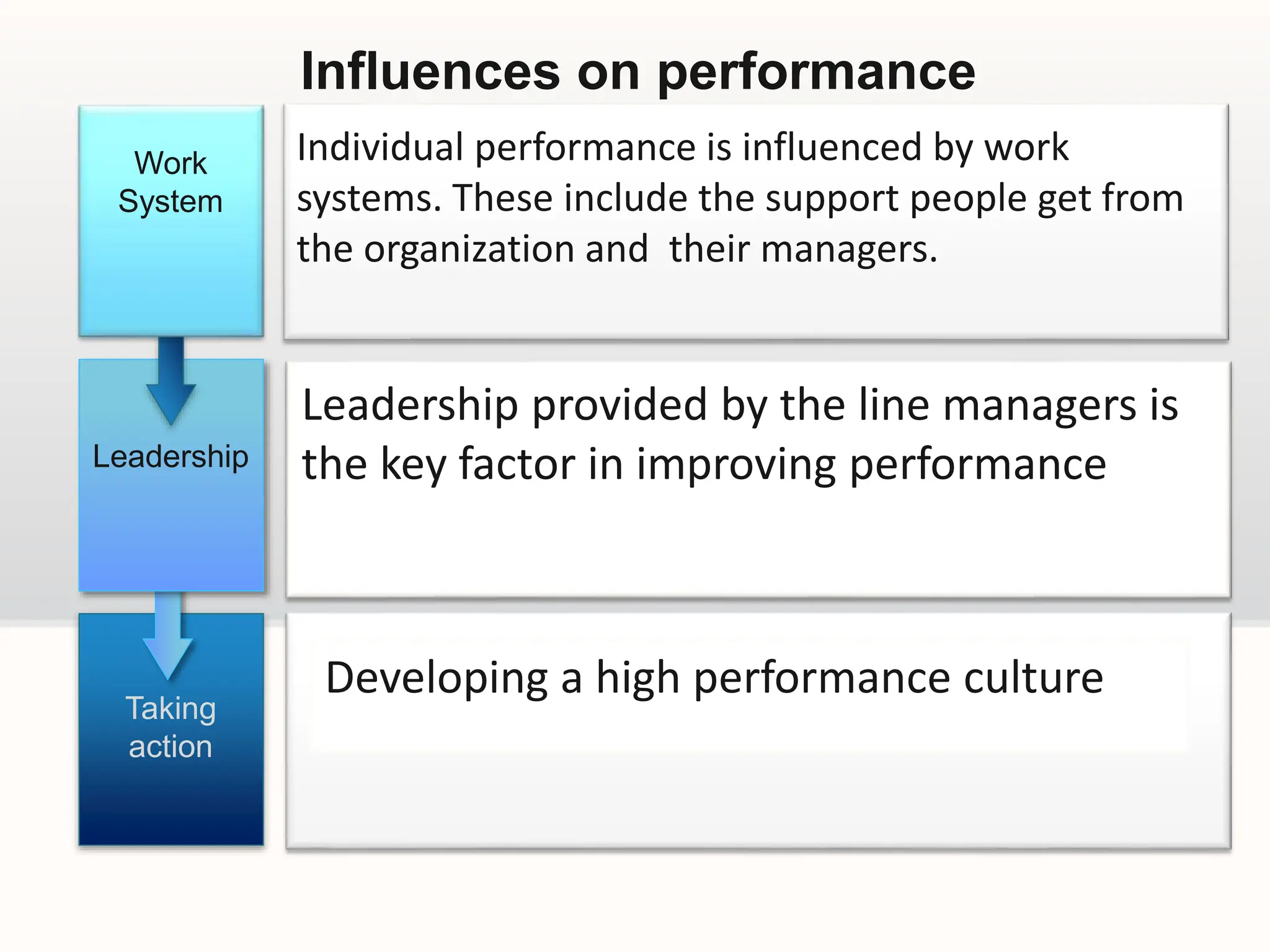
Individual performance is influenced by work
systems. These include the support people get from
the organization and their managers.
Leadership provided by the line managers is
the key factor in improving performance
Developing a high performance culture
Influences on performance
Work
System
Taking
action
Leadership
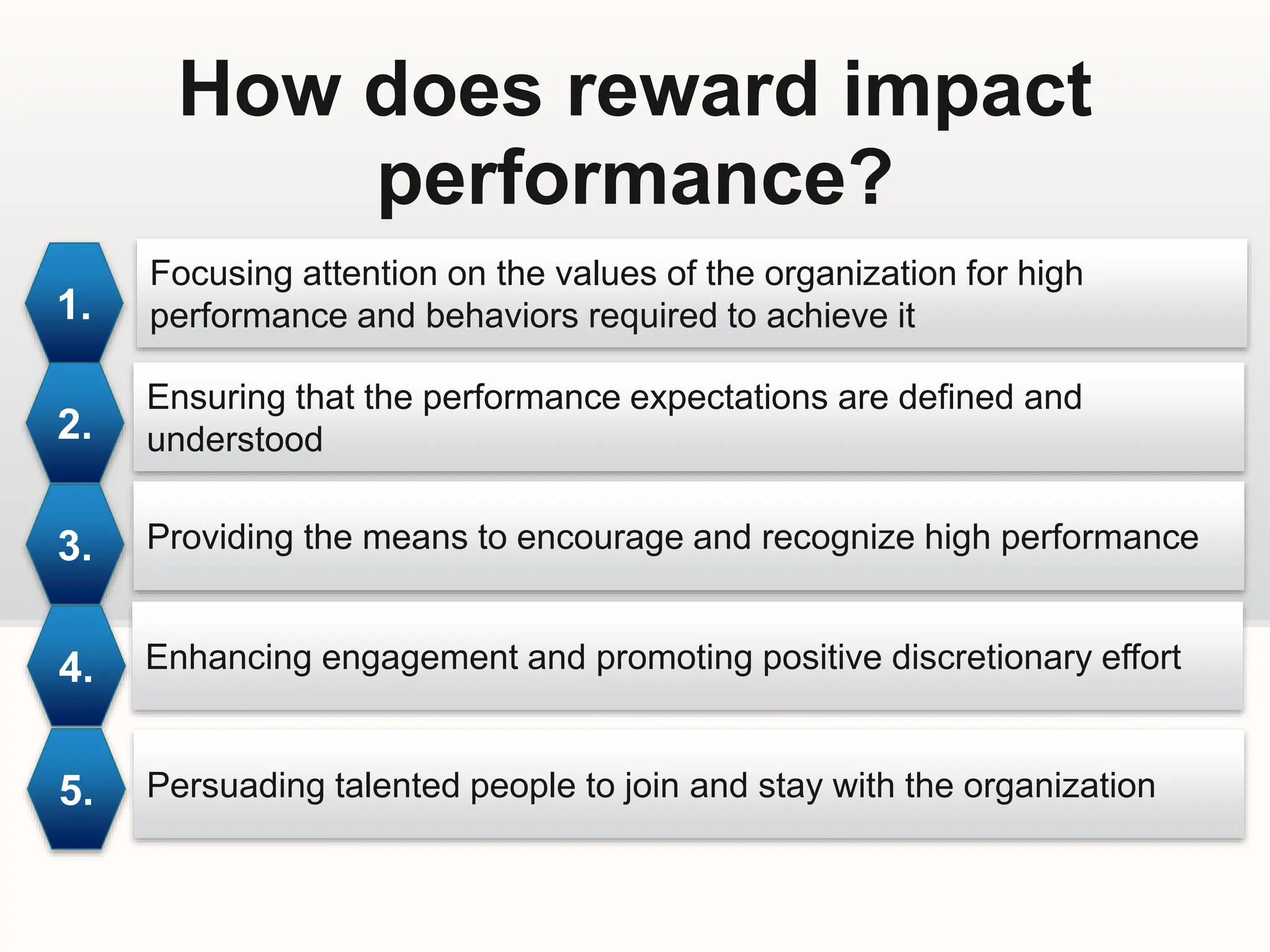
How does reward impact
performance?
1.
Focusing attention on the values of the organization for high
performance and behaviors required to achieve it
2.
3.
4.
5.
Ensuring that the performance expectations are defined and
understood
Providing the means to encourage and recognize high performance
Enhancing engagement and promoting positive discretionary effort
Persuading talented people to join and stay with the organization
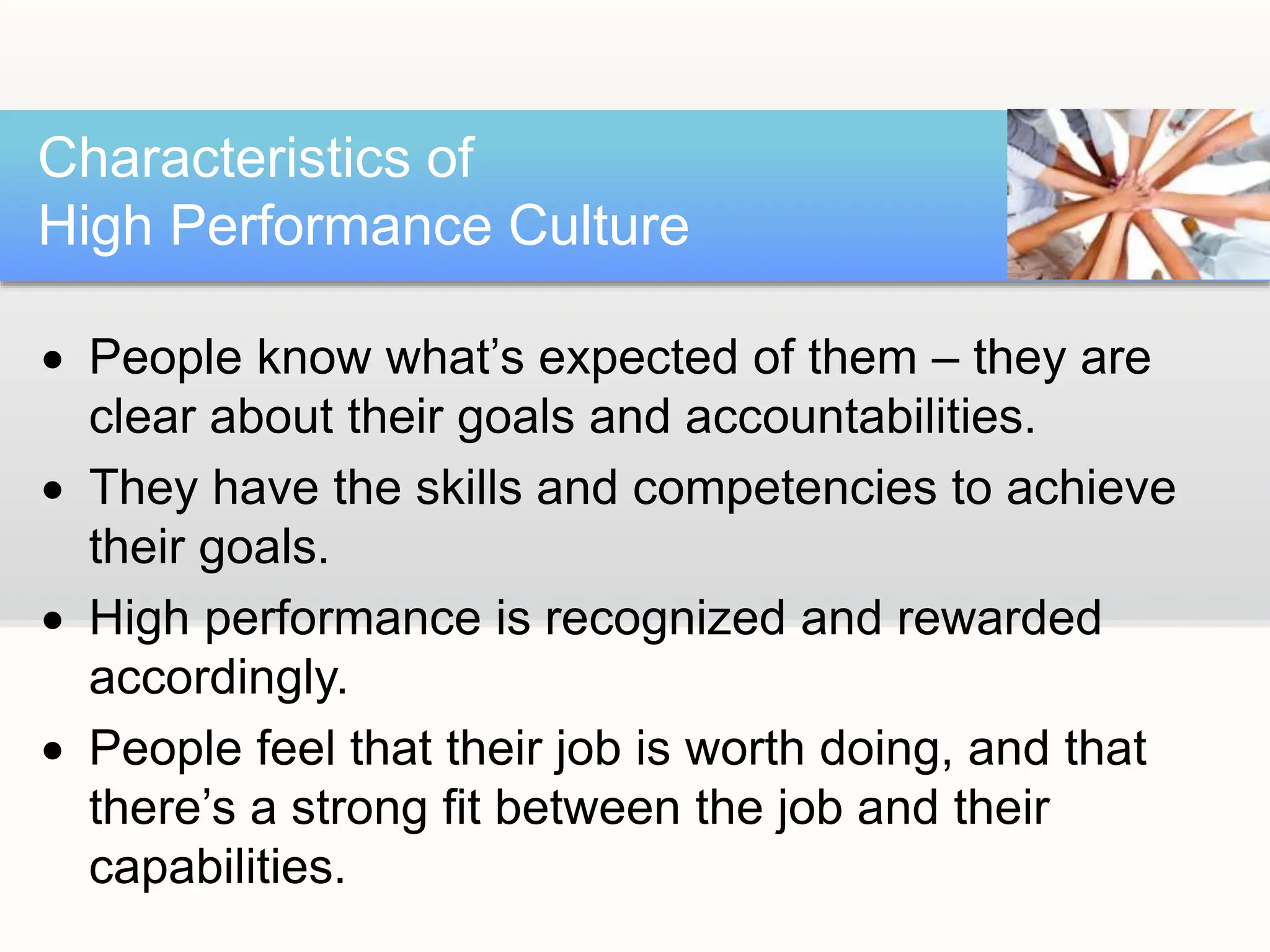
 People know what’s expected of them – they are
clear about their goals and accountabilities.
 They have the skills and competencies to achieve
their goals.
 High performance is recognized and rewarded
accordingly.
 People feel that their job is worth doing, and that
there’s a strong fit between the job and their
capabilities.
Characteristics of
High Performance Culture
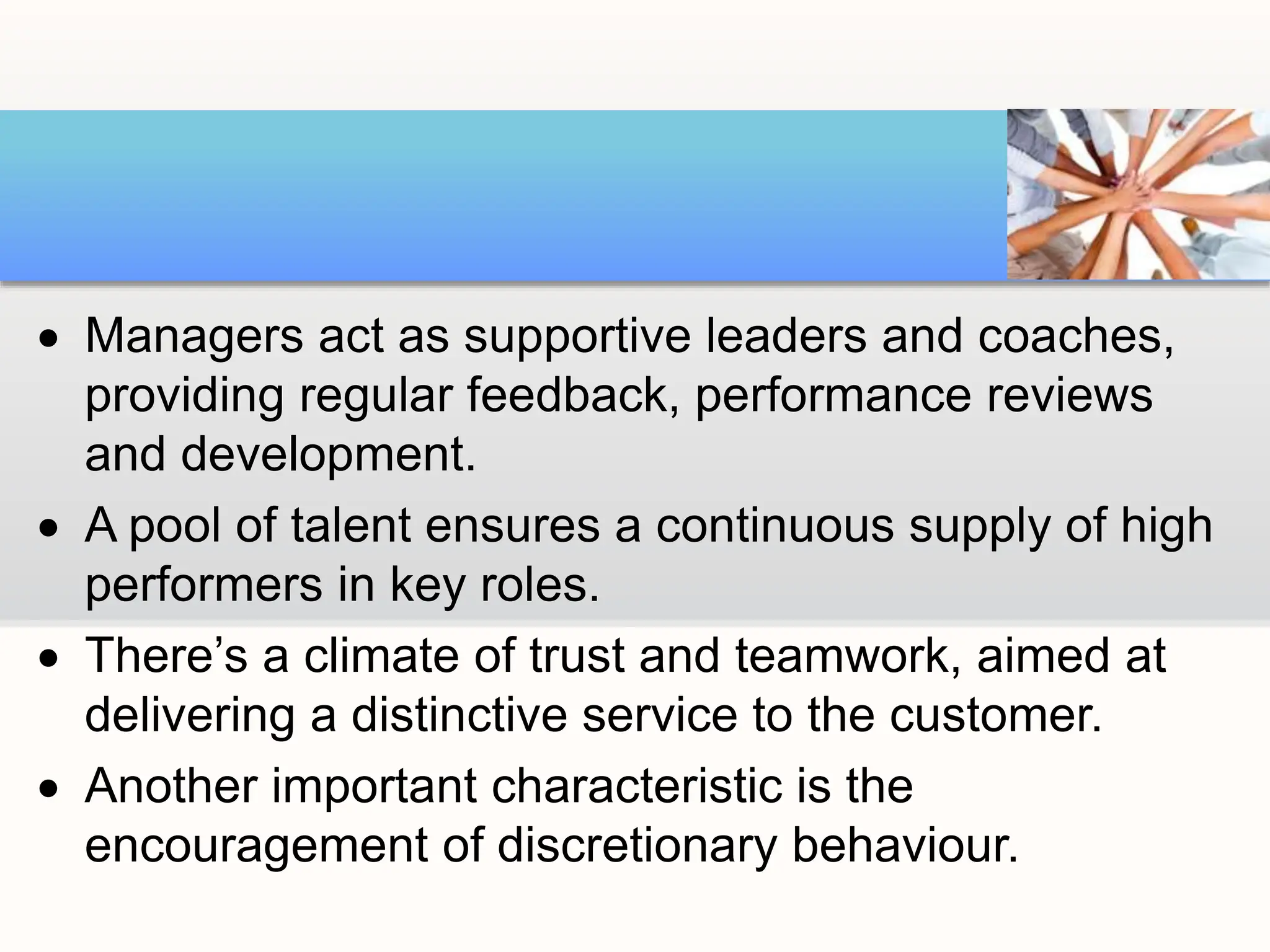
 Managers act as supportive leaders and coaches,
providing regular feedback, performance reviews
and development.
 A pool of talent ensures a continuous supply of high
performers in key roles.
 There’s a climate of trust and teamwork, aimed at
delivering a distinctive service to the customer.
 Another important characteristic is the
encouragement of discretionary behaviour.
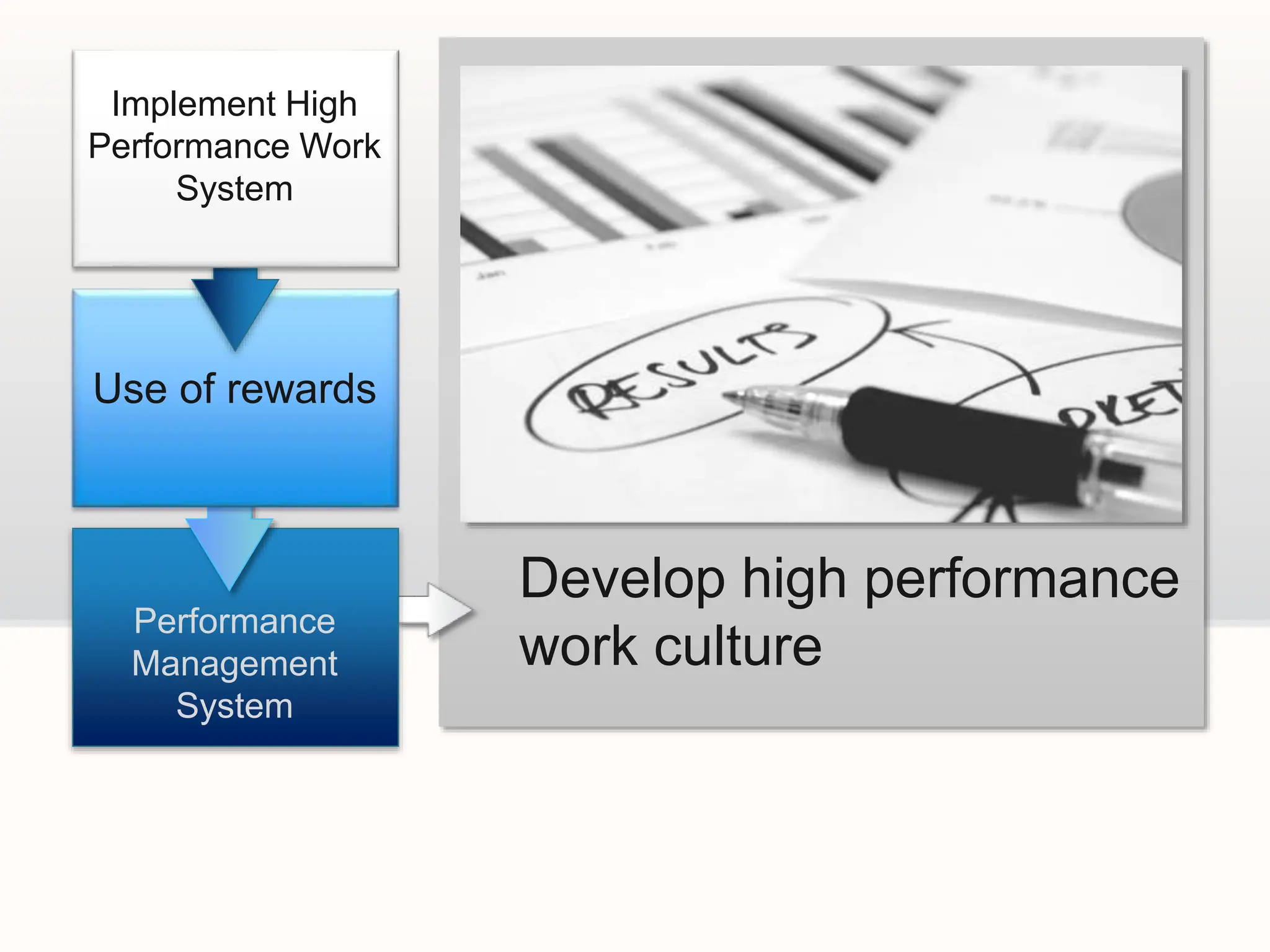
Develop high performance
work culture
Implement High
Performance Work
System
Performance
Management
System
Use of rewards
A high-performance work system can be
defined as a specific combination of HR
practices, work structures, and processes
that maximizes employee knowledge, skill,
commitment and flexibility. The key
concept is the “system”
High performance work system
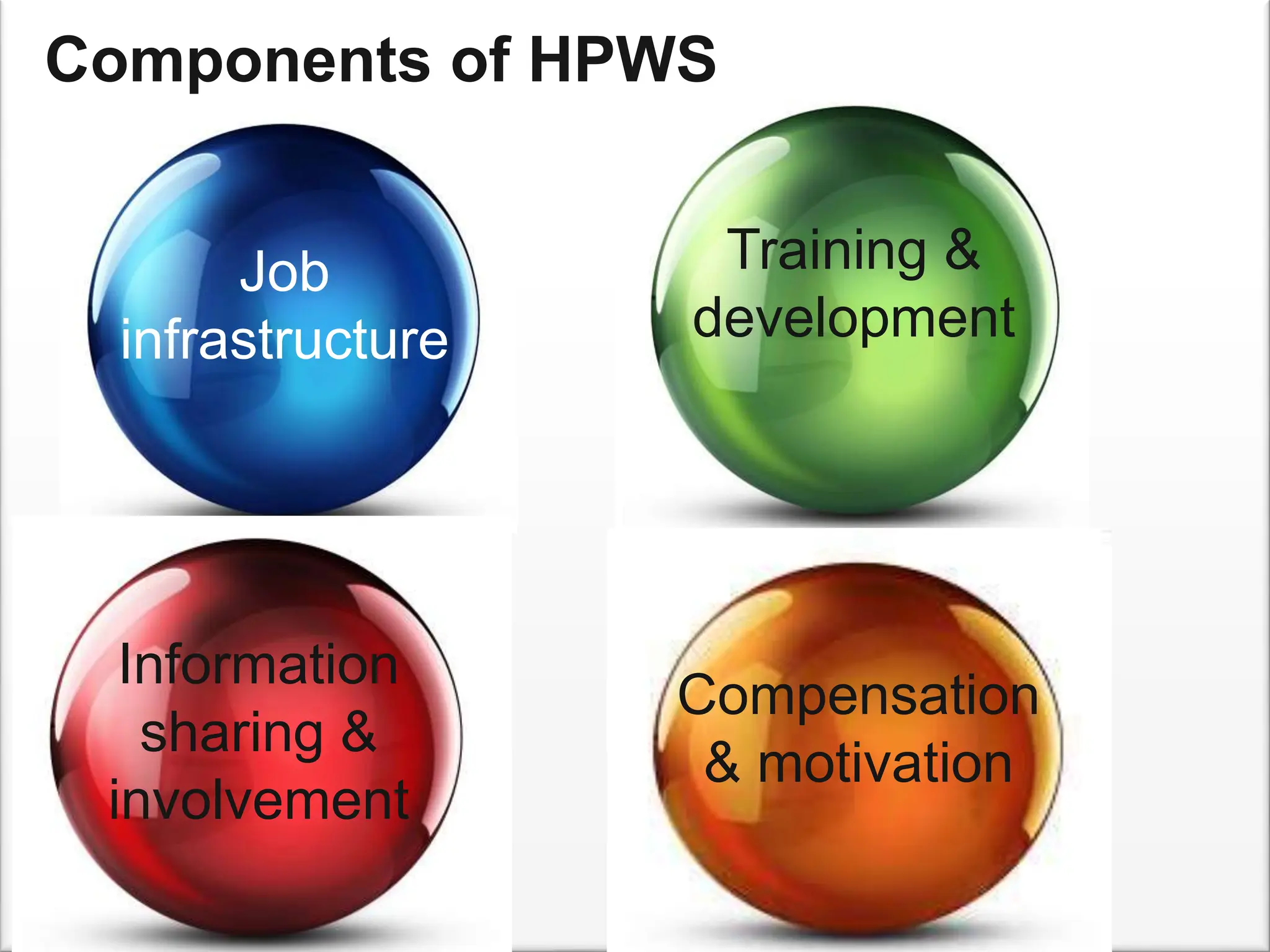
Job
infrastructure
Training &
development
Components of HPWS
Information
sharing &
involvement
Compensation
& motivation
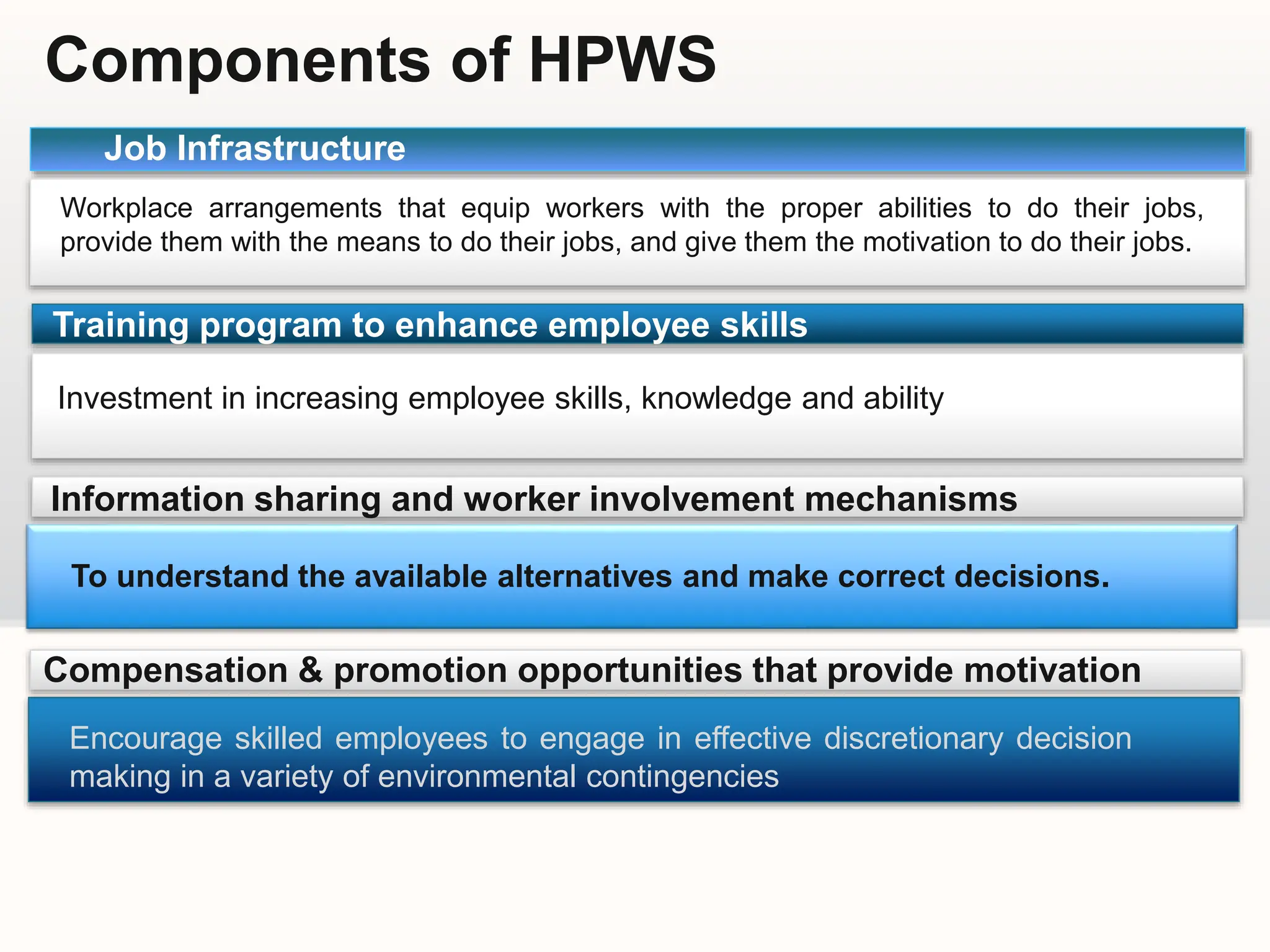
Components of HPWS
Workplace arrangements that equip workers with the proper abilities to do their jobs,
provide them with the means to do their jobs, and give them the motivation to do their jobs.
Job Infrastructure
Investment in increasing employee skills, knowledge and ability
Training program to enhance employee skills
To understand the available alternatives and make correct decisions.
Information sharing and worker involvement mechanisms
Compensation & promotion opportunities that provide motivation
Encourage skilled employees to engage in effective discretionary decision
making in a variety of environmental contingencies
Impact of reward on Individual
performace
Impact of reward on
organizational performance
 Extrinsic and Intrinsic rewards can motivate high
performance; though intrinsic rewards he can have a deeper
& long lasting effect.
 They can also convey the message that performance is
important and help to focus on specific aspects of
performance.
 Performance improvement can be achieved by
 Giving people the opportunity to perform
 Provide them knowledge and skill required
 Reward them by financial & non-financial means
Impact of reward on
Individual performace
Managing Organizational performance
The aim of managing organizational performance is to increase
organizational capacity of an organization to function effectively.
 Managing organizational performance includes five dimensions:
1. Creating visions for the future.
2. Planning – determining the present organizational state, and
developing strategies to improve that state.
3. Designing, developing and implementing improvement interventions.
4. redesigning and implementing measurement and evaluation
systems.
5. Putting cultural support systems in place to reward and reinforce
progress.
Implementing organizational performance management system which is
linked to the business strategy and support its achievement. They will focus
on delivering work and the working environment as ell as developing
individuals.
Managing Organizational performance
 Performance Prism:
A prism reflects light. It illustrates the hidden complexity of something as
simple as light. Similarly, performance prism illustrates the true complexity
of performance measurement and management. It is a thinking aid which
seeks to integrate 5 related perspectives and provide a structure to allow
executives to think through 5 fundamental questions:
1.Stakeholder satisfaction: Who are our stakeholders and what do they
want or need?
2.Stakeholder contribution: What do we want and need from our
stakeholders?
3.Strategies: What strategies do we put in place to satisfy these wants and
needs?
4.Processes: What processes do we put in place to satisfy these wants and
needs?
5.Capabilities: What capabilities- people, practices, technology and
infrastructure- do we need to put in place to allow us to operate our
processes more effectively and efficiently?
• Setting work objectives
– Project team agrees project plans that define what has to be done
– Who does it and specify individual expectations
– The standards expected and time scale
• Setting process objectives
– Interpersonal relationships
– The quality of participation and collaborative effort and decision making
– The team’s relationship with internal and external customers
– The capacity of the team to plan and control its activities
– The ability of the team and its members to adapt to new demands and situations
– The flexibility with which the team operates
– The effectiveness with which individual skills are used
– Quality of communication within the team and between other teams or individuals
Managing team performance
• Team performance reviews
– General feedback review
• Progress of the team as a whole
• Problems encountered by the team
• Helps and hindrances to the operation of the team
– Work review
• How well the team has functioned
• Review of the individual contribution made by each team member
• Discussion of any new problem encountered by individual team members
– Group problem solving
• Analysis of reasons for any shortfalls or other problems
• Agreement of what needs to be done to solve them and prevent their re-occurrence
– Update objectives
• Review of new opportunities, requirements or threats
• Amendment and updating of objectives and project plans
Managing team performance
Managing individual performance
• Performance Management Strategy
– Based on resource based view
– Strategic goal will be to create firms which are more intelligent and flexible than
their competitors by developing more talented staff and extending their skills
base
• Purpose of Performance Management
– Get better results from organization, teams and individuals
– Establishing shared understanding of what is to be achieved
– To manage and develop people to achieve the desired goal
– Enhance engagement by providing foundation upon which many intrinsic and
extrinsic rewards can be built
Managing individual performance
• Principles of Performance Management
– A management tool that helps managers to manage
– Driven by corporate purpose and values
– To obtain solutions that work
– Only interested in things you can do something about and get a visible
improvement
– Focus on changing behavior rather than paperwork
– It’s about how we manage people
– Performance management is what managers do
– Based on accepted principles but operates flexibly
– Focus on development not pay
– Success depends on what organization is and needs to be in its performance
culture
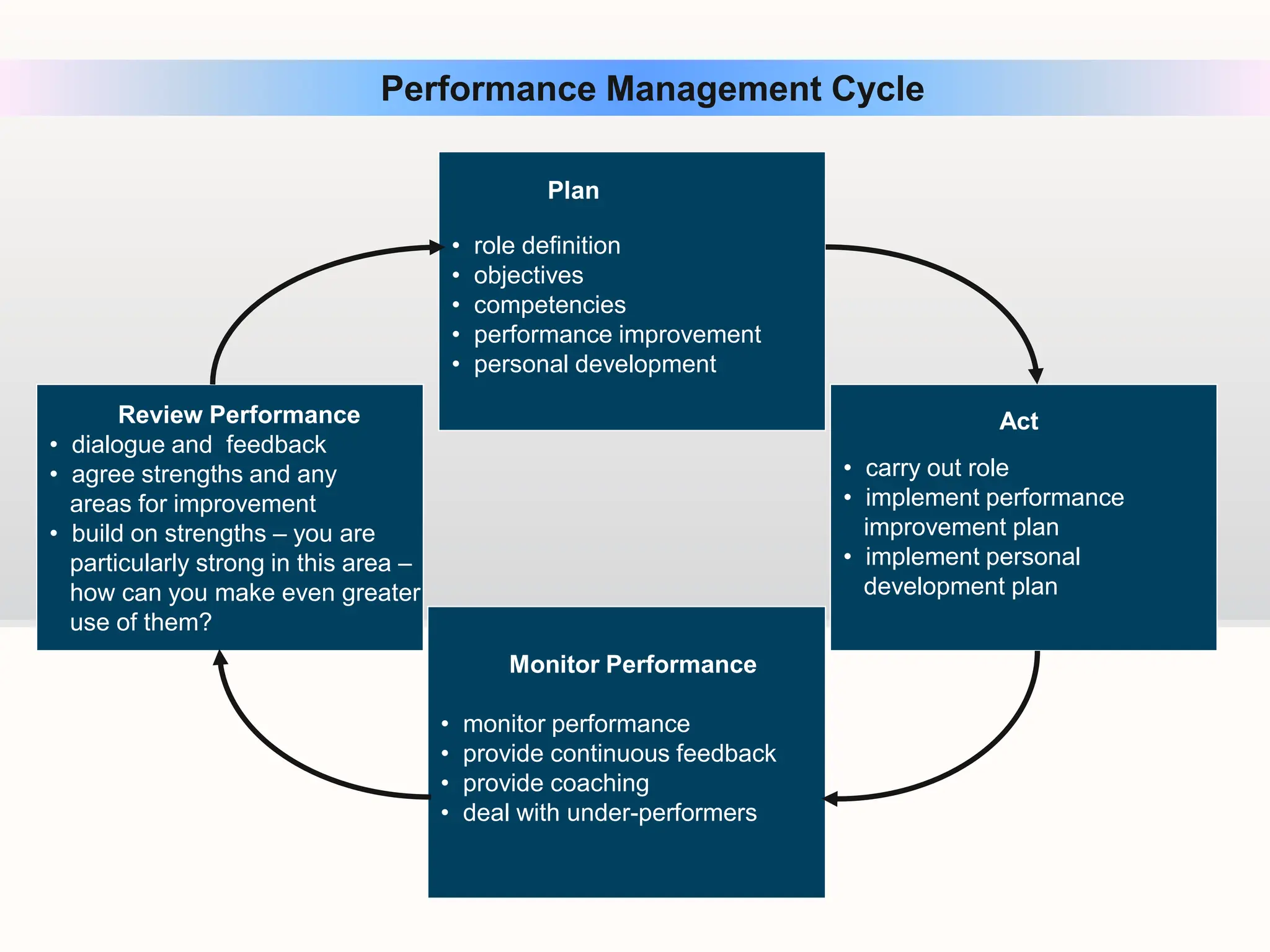
Plan
• role definition
• objectives
• competencies
• performance improvement
• personal development
Act
• carry out role
• implement performance
improvement plan
• implement personal
development plan
Monitor Performance
• monitor performance
• provide continuous feedback
• provide coaching
• deal with under-performers
Review Performance
• dialogue and feedback
• agree strengths and any
areas for improvement
• build on strengths – you are
particularly strong in this area –
how can you make even greater
use of them?
Performance Management Cycle
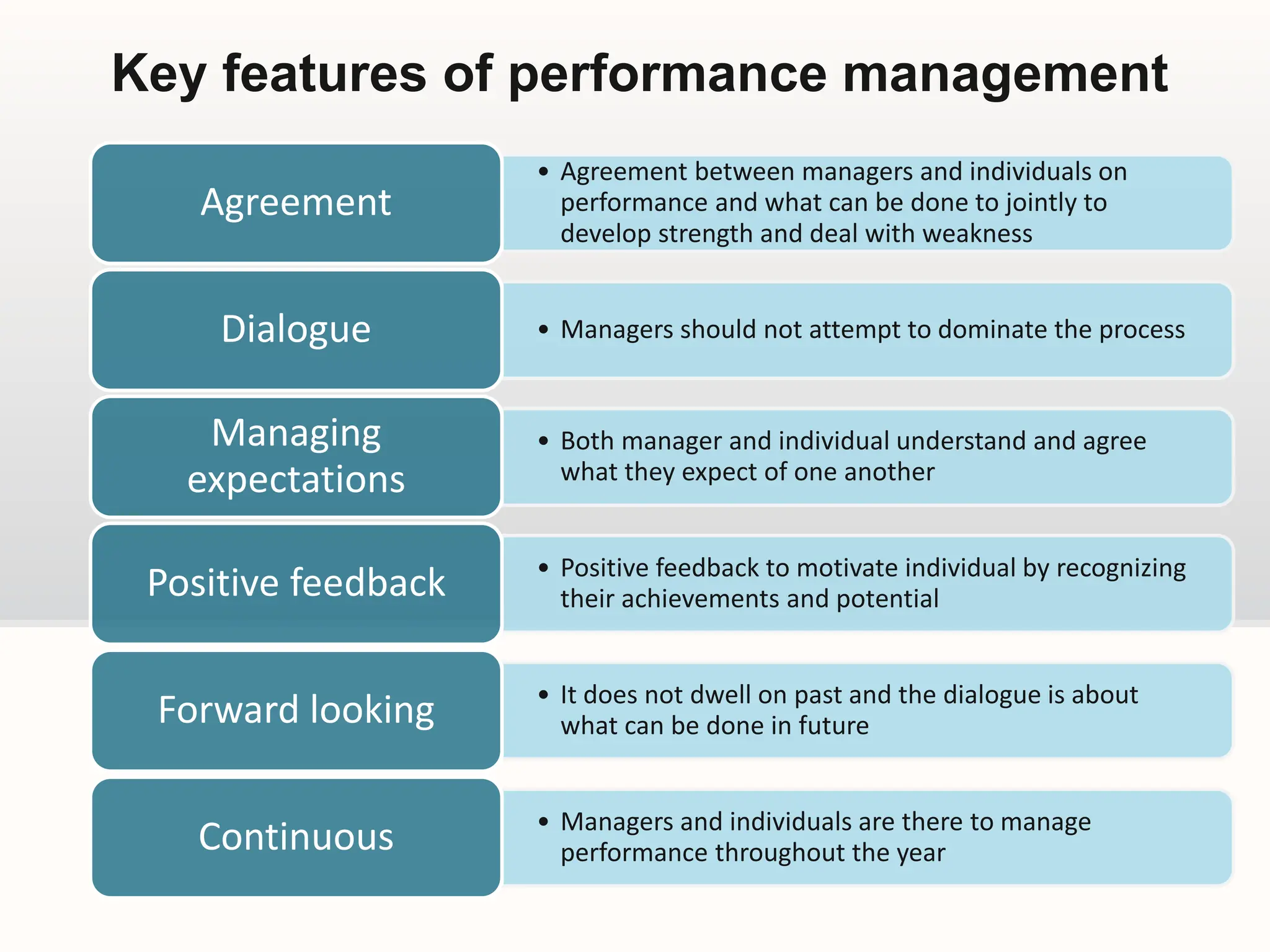
Key features of performance management
• Agreement between managers and individuals on
performance and what can be done to jointly to
develop strength and deal with weakness
Agreement
• Managers should not attempt to dominate the process
Dialogue
• Both manager and individual understand and agree
what they expect of one another
Managing
expectations
• Positive feedback to motivate individual by recognizing
their achievements and potential
Positive feedback
• It does not dwell on past and the dialogue is about
what can be done in future
Forward looking
• Managers and individuals are there to manage
performance throughout the year
Continuous
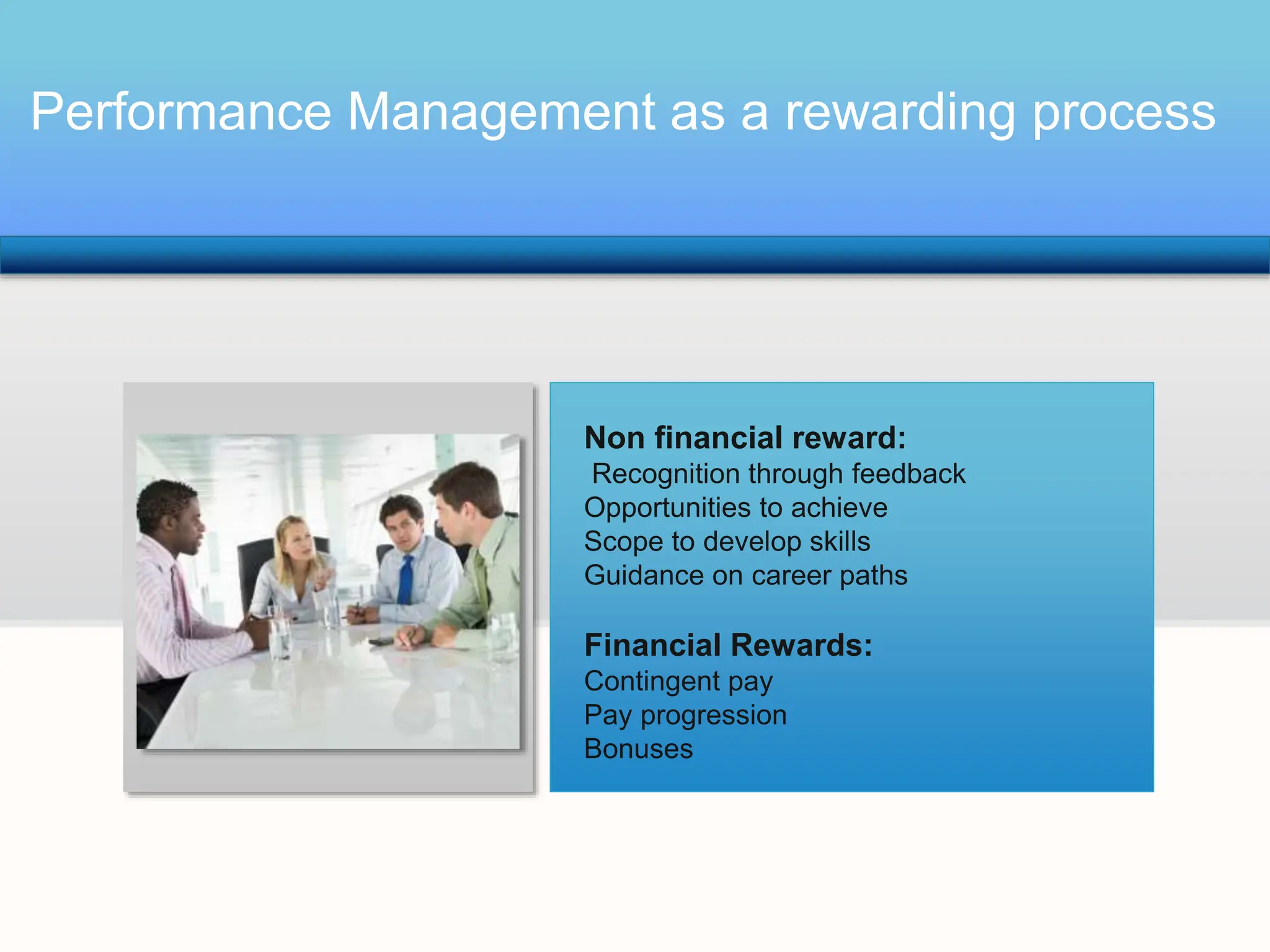
Performance Management as a rewarding process
Non financial reward:
Recognition through feedback
Opportunities to achieve
Scope to develop skills
Guidance on career paths
Financial Rewards:
Contingent pay
Pay progression
Bonuses
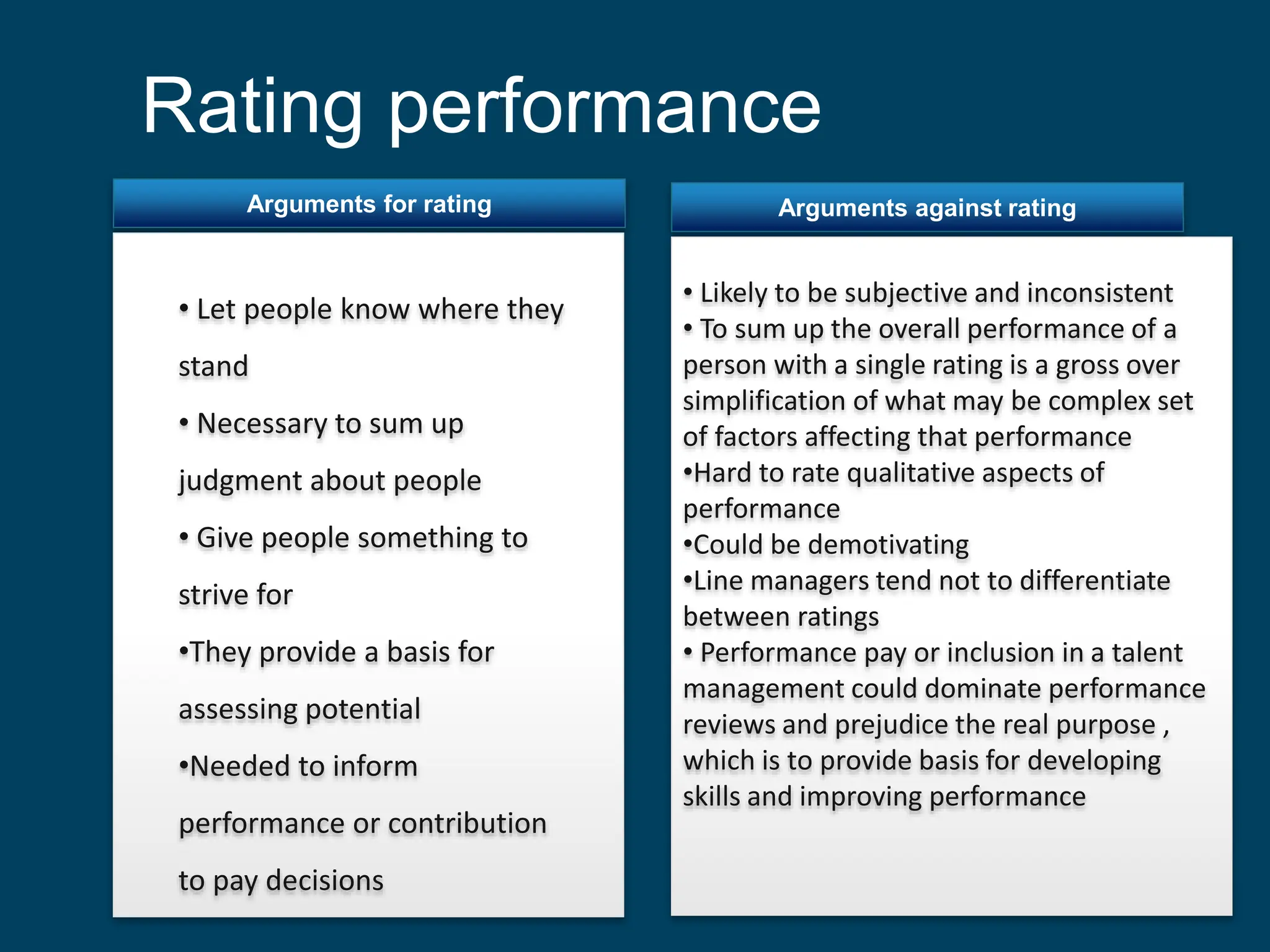
Arguments for rating
Templates
Arguments against rating
• Let people know where they
stand
• Necessary to sum up
judgment about people
• Give people something to
strive for
•They provide a basis for
assessing potential
•Needed to inform
performance or contribution
to pay decisions
• Likely to be subjective and inconsistent
• To sum up the overall performance of a
person with a single rating is a gross over
simplification of what may be complex set
of factors affecting that performance
•Hard to rate qualitative aspects of
performance
•Could be demotivating
•Line managers tend not to differentiate
between ratings
• Performance pay or inclusion in a talent
management could dominate performance
reviews and prejudice the real purpose ,
which is to provide basis for developing
skills and improving performance
Rating performance

ch 6.ppt performance based reward system

  • 1.
  • 2.
    Managing Organizational Performance Impactof reward on individual performance Influences on performance High performance culture and work systems Impact of reward on organizational performance 7 6 5 4 3 2 1 8 Managing Team Performance 8 Managing Individual Performance What is performance? How does reward impact performance? ✓
  • 3.
    •Performance is gettingthe job done •Producing the result that you aimed at • Performance is a behaviour- the way in which organizations, teams and individuals get work done What is performance?
  • 4.
    Influences on performance Vroom (1964) suggested that performance is a function of ability and motivation as depicted in the formula: Performance = ƒ (Ability × Motivation).  Blumberg and Pringle’s (1982) formula was: Performance = Individual Attributes × Work Effort × Organizational Support Bailey et al (2001) focused on another factor affecting performance- “ Opportunity to participate” Boxall and Purcell (2003) put forward the ‘AMO’ formula which states that performance is a function of Ability + Motivation + Opportunity to Participate Individual performance
  • 5.
    Individual performance isinfluenced by work systems. These include the support people get from the organization and their managers. Leadership provided by the line managers is the key factor in improving performance Developing a high performance culture Influences on performance Work System Taking action Leadership
  • 6.
    How does rewardimpact performance? 1. Focusing attention on the values of the organization for high performance and behaviors required to achieve it 2. 3. 4. 5. Ensuring that the performance expectations are defined and understood Providing the means to encourage and recognize high performance Enhancing engagement and promoting positive discretionary effort Persuading talented people to join and stay with the organization
  • 7.
     People knowwhat’s expected of them – they are clear about their goals and accountabilities.  They have the skills and competencies to achieve their goals.  High performance is recognized and rewarded accordingly.  People feel that their job is worth doing, and that there’s a strong fit between the job and their capabilities. Characteristics of High Performance Culture
  • 8.
     Managers actas supportive leaders and coaches, providing regular feedback, performance reviews and development.  A pool of talent ensures a continuous supply of high performers in key roles.  There’s a climate of trust and teamwork, aimed at delivering a distinctive service to the customer.  Another important characteristic is the encouragement of discretionary behaviour.
  • 9.
    Develop high performance workculture Implement High Performance Work System Performance Management System Use of rewards
  • 10.
    A high-performance worksystem can be defined as a specific combination of HR practices, work structures, and processes that maximizes employee knowledge, skill, commitment and flexibility. The key concept is the “system” High performance work system
  • 11.
    Job infrastructure Training & development Components ofHPWS Information sharing & involvement Compensation & motivation
  • 12.
    Components of HPWS Workplacearrangements that equip workers with the proper abilities to do their jobs, provide them with the means to do their jobs, and give them the motivation to do their jobs. Job Infrastructure Investment in increasing employee skills, knowledge and ability Training program to enhance employee skills To understand the available alternatives and make correct decisions. Information sharing and worker involvement mechanisms Compensation & promotion opportunities that provide motivation Encourage skilled employees to engage in effective discretionary decision making in a variety of environmental contingencies
  • 13.
    Impact of rewardon Individual performace Impact of reward on organizational performance
  • 14.
     Extrinsic andIntrinsic rewards can motivate high performance; though intrinsic rewards he can have a deeper & long lasting effect.  They can also convey the message that performance is important and help to focus on specific aspects of performance.  Performance improvement can be achieved by  Giving people the opportunity to perform  Provide them knowledge and skill required  Reward them by financial & non-financial means Impact of reward on Individual performace
  • 15.
    Managing Organizational performance Theaim of managing organizational performance is to increase organizational capacity of an organization to function effectively.  Managing organizational performance includes five dimensions: 1. Creating visions for the future. 2. Planning – determining the present organizational state, and developing strategies to improve that state. 3. Designing, developing and implementing improvement interventions. 4. redesigning and implementing measurement and evaluation systems. 5. Putting cultural support systems in place to reward and reinforce progress. Implementing organizational performance management system which is linked to the business strategy and support its achievement. They will focus on delivering work and the working environment as ell as developing individuals.
  • 16.
    Managing Organizational performance Performance Prism: A prism reflects light. It illustrates the hidden complexity of something as simple as light. Similarly, performance prism illustrates the true complexity of performance measurement and management. It is a thinking aid which seeks to integrate 5 related perspectives and provide a structure to allow executives to think through 5 fundamental questions: 1.Stakeholder satisfaction: Who are our stakeholders and what do they want or need? 2.Stakeholder contribution: What do we want and need from our stakeholders? 3.Strategies: What strategies do we put in place to satisfy these wants and needs? 4.Processes: What processes do we put in place to satisfy these wants and needs? 5.Capabilities: What capabilities- people, practices, technology and infrastructure- do we need to put in place to allow us to operate our processes more effectively and efficiently?
  • 17.
    • Setting workobjectives – Project team agrees project plans that define what has to be done – Who does it and specify individual expectations – The standards expected and time scale • Setting process objectives – Interpersonal relationships – The quality of participation and collaborative effort and decision making – The team’s relationship with internal and external customers – The capacity of the team to plan and control its activities – The ability of the team and its members to adapt to new demands and situations – The flexibility with which the team operates – The effectiveness with which individual skills are used – Quality of communication within the team and between other teams or individuals Managing team performance
  • 18.
    • Team performancereviews – General feedback review • Progress of the team as a whole • Problems encountered by the team • Helps and hindrances to the operation of the team – Work review • How well the team has functioned • Review of the individual contribution made by each team member • Discussion of any new problem encountered by individual team members – Group problem solving • Analysis of reasons for any shortfalls or other problems • Agreement of what needs to be done to solve them and prevent their re-occurrence – Update objectives • Review of new opportunities, requirements or threats • Amendment and updating of objectives and project plans Managing team performance
  • 19.
    Managing individual performance •Performance Management Strategy – Based on resource based view – Strategic goal will be to create firms which are more intelligent and flexible than their competitors by developing more talented staff and extending their skills base • Purpose of Performance Management – Get better results from organization, teams and individuals – Establishing shared understanding of what is to be achieved – To manage and develop people to achieve the desired goal – Enhance engagement by providing foundation upon which many intrinsic and extrinsic rewards can be built
  • 20.
    Managing individual performance •Principles of Performance Management – A management tool that helps managers to manage – Driven by corporate purpose and values – To obtain solutions that work – Only interested in things you can do something about and get a visible improvement – Focus on changing behavior rather than paperwork – It’s about how we manage people – Performance management is what managers do – Based on accepted principles but operates flexibly – Focus on development not pay – Success depends on what organization is and needs to be in its performance culture
  • 21.
    Plan • role definition •objectives • competencies • performance improvement • personal development Act • carry out role • implement performance improvement plan • implement personal development plan Monitor Performance • monitor performance • provide continuous feedback • provide coaching • deal with under-performers Review Performance • dialogue and feedback • agree strengths and any areas for improvement • build on strengths – you are particularly strong in this area – how can you make even greater use of them? Performance Management Cycle
  • 22.
    Key features ofperformance management • Agreement between managers and individuals on performance and what can be done to jointly to develop strength and deal with weakness Agreement • Managers should not attempt to dominate the process Dialogue • Both manager and individual understand and agree what they expect of one another Managing expectations • Positive feedback to motivate individual by recognizing their achievements and potential Positive feedback • It does not dwell on past and the dialogue is about what can be done in future Forward looking • Managers and individuals are there to manage performance throughout the year Continuous
  • 23.
    Performance Management asa rewarding process Non financial reward: Recognition through feedback Opportunities to achieve Scope to develop skills Guidance on career paths Financial Rewards: Contingent pay Pay progression Bonuses
  • 24.
    Arguments for rating Templates Argumentsagainst rating • Let people know where they stand • Necessary to sum up judgment about people • Give people something to strive for •They provide a basis for assessing potential •Needed to inform performance or contribution to pay decisions • Likely to be subjective and inconsistent • To sum up the overall performance of a person with a single rating is a gross over simplification of what may be complex set of factors affecting that performance •Hard to rate qualitative aspects of performance •Could be demotivating •Line managers tend not to differentiate between ratings • Performance pay or inclusion in a talent management could dominate performance reviews and prejudice the real purpose , which is to provide basis for developing skills and improving performance Rating performance