Managed Care & Case
   Management
     Medical Surgical
     Critical Thinking
            For
    Collaborative Care
Learning Objectives
• Explain the primary purpose of Managed Health Care
• Contrast the fee-for-service and capitated
  reimbursement systems for health care
• Compare the Health Maintenance Organization with
  the Preferred Provider Organization
• Delineate the overall goals of Case Management
• Explain the role of Case Management based on
  National Standards
• Identify at least three certifications for Case Managers
• Clarify the differences and similarities between case
  management and disease management
Managed Health Care
• A system that attempt to control cost by using select
  group of providers who have agreed to a set payment
  before delivering care
• Client care is outcome driven & managed by a
  utilization and or case management process
• Factors driving cost and quality
• Aging
• Purchaser pressure to contain costs
• Physician & consumer resistance to “tight”
  management and referral control
• Renewed emphasis on evidence-based practice
Managed Care
• Fee-for-service – hospital, physicians, and
  other health care providers were paid by
  health insurance companies on the basis of
  what the providers billed for their services
• MCOs standardize and control cost
• Health care providers receive a uniform
  amount of money for each client—capitated
  reimbursement
• MCO – HMO, PPO
Case Management
• The assumption the client need assistance using the health
  care system and its resources effectively
• Goals: By ANA
• To provide quality health care along a continuum of care
• To decrease fragmentation (and duplication) of care across
  health care settings
• To enhance the client’s quality of life
• To increase cost containment (thru appropriate use of
  resources)
• BY CMSA: To enhance an individual’s
  safety, productivity, satisfaction & quality of life
• To assure that appropriate services are generated in a
  timely and cost-effective manner
Process of Case Management
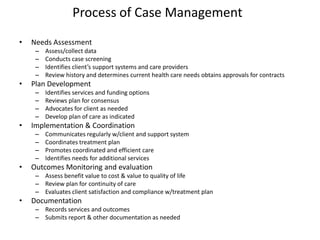
•   Needs Assessment
     –   Assess/collect data
     –   Conducts case screening
     –   Identifies client’s support systems and care providers
     –   Review history and determines current health care needs obtains approvals for contracts
•   Plan Development
     –   Identifies services and funding options
     –   Reviews plan for consensus
     –   Advocates for client as needed
     –   Develop plan of care as indicated
•   Implementation & Coordination
     –   Communicates regularly w/client and support system
     –   Coordinates treatment plan
     –   Promotes coordinated and efficient care
     –   Identifies needs for additional services
•   Outcomes Monitoring and evaluation
     – Assess benefit value to cost & value to quality of life
     – Review plan for continuity of care
     – Evaluates client satisfaction and compliance w/treatment plan
•   Documentation
     – Records services and outcomes
     – Submits report & other documentation as needed
Standards for Case Management Practice

• The standards describe
  responsibilities, delineate expectations, &
  define accountabilities:
• Roles includes:
  assessment, planning, facilitation, and
  advocacy
• Three certifications:
• CCM – certified case manager
• CDMS – certified disability management
  specialist
• A-CCC – advanced certification in continuity of
  care
Differentiations
• Disease management is across the
  continuum, system-based approach to care for
  populations of clients w/ chronic, complex
  illnesses; it uses case management as the
  process for providing care.

Managed care & case management

  • 1.
    Managed Care &Case Management Medical Surgical Critical Thinking For Collaborative Care
  • 2.
    Learning Objectives • Explainthe primary purpose of Managed Health Care • Contrast the fee-for-service and capitated reimbursement systems for health care • Compare the Health Maintenance Organization with the Preferred Provider Organization • Delineate the overall goals of Case Management • Explain the role of Case Management based on National Standards • Identify at least three certifications for Case Managers • Clarify the differences and similarities between case management and disease management
  • 3.
    Managed Health Care •A system that attempt to control cost by using select group of providers who have agreed to a set payment before delivering care • Client care is outcome driven & managed by a utilization and or case management process • Factors driving cost and quality • Aging • Purchaser pressure to contain costs • Physician & consumer resistance to “tight” management and referral control • Renewed emphasis on evidence-based practice
  • 4.
    Managed Care • Fee-for-service– hospital, physicians, and other health care providers were paid by health insurance companies on the basis of what the providers billed for their services • MCOs standardize and control cost • Health care providers receive a uniform amount of money for each client—capitated reimbursement • MCO – HMO, PPO
  • 5.
    Case Management • Theassumption the client need assistance using the health care system and its resources effectively • Goals: By ANA • To provide quality health care along a continuum of care • To decrease fragmentation (and duplication) of care across health care settings • To enhance the client’s quality of life • To increase cost containment (thru appropriate use of resources) • BY CMSA: To enhance an individual’s safety, productivity, satisfaction & quality of life • To assure that appropriate services are generated in a timely and cost-effective manner
  • 6.
    Process of CaseManagement • Needs Assessment – Assess/collect data – Conducts case screening – Identifies client’s support systems and care providers – Review history and determines current health care needs obtains approvals for contracts • Plan Development – Identifies services and funding options – Reviews plan for consensus – Advocates for client as needed – Develop plan of care as indicated • Implementation & Coordination – Communicates regularly w/client and support system – Coordinates treatment plan – Promotes coordinated and efficient care – Identifies needs for additional services • Outcomes Monitoring and evaluation – Assess benefit value to cost & value to quality of life – Review plan for continuity of care – Evaluates client satisfaction and compliance w/treatment plan • Documentation – Records services and outcomes – Submits report & other documentation as needed
  • 7.
    Standards for CaseManagement Practice • The standards describe responsibilities, delineate expectations, & define accountabilities: • Roles includes: assessment, planning, facilitation, and advocacy • Three certifications: • CCM – certified case manager • CDMS – certified disability management specialist • A-CCC – advanced certification in continuity of care
  • 8.
    Differentiations • Disease managementis across the continuum, system-based approach to care for populations of clients w/ chronic, complex illnesses; it uses case management as the process for providing care.