Michigan Primary Care
   Transformation
Demonstration Project


     June 13, 2012
      Webinar #10
Agenda

   Medicaid Payments
   Medicare Payments
   Care Managers
   MiPCT Committee
   Metrics


                        2
Doing the Impossible


                       3
Performance

   One year look back for quality scores
   Ongoing testing for patient registry data dumps
   Patient registry data utilized for distribution of
    funds
   Patient registry submission in time for 12.31.2012
    performance payments


                                                         4
Pay for Performance Data Source

   Claims Data: All participating health plans submit
    claims data to the Michigan Data Collaborative
    which can be used to calculate utilization and cost
    metrics.
   Claims data will be calculated for each Health Plan
    and aggregated across all contracted plans.
   Confidence intervals at 95% will be provided.


                                                          5
Pay for Performance Data Source

   MiPCT Quarterly Reports: The report will
    document updates to the MiPCT Implementation
    Plan and progress to date in developing PCMH
    infrastructure capabilities and carrying out MiPCT
    clinical initiatives.


                                                         6
Pay for Performance Data Source

   Self-Reported Data (SRD): MNO currently reports
    to BCBSM PGIP twice a year on each practice’s
    PCMH capabilities
   BCBSM applies accuracy, validity and inter-rater
    reliability checks and balances to the reports
   Financial penalties are imposed for inaccurate
    reporting of capabilities and are reflected
    proportionally on the distribution of funds


                                                       7
8
Pay for Performance:
         Six Month Metrics - Access
   Extended access:
    • 30% same day appointment (10 points)
   Appointments outside regular hours:
    • 8 hours/week (10 points)


                                             9
Pay for Performance:
          Six Month Metrics – eRegistry
1)   Practice has electronic registry
2)   Registry has interface capability
3)   Incorporates evidence-based care guidelines
4)   Identifies individual attributed practitioner
5)   Information available and used by the practice
     unit team at the point of care
6)   Used to generate communications to patients
     regarding gaps in care

                                                      10
Pay for Performance:
          Six Month Metrics - eRegistry
7.   Used to flag gaps in care
8.   Patient demographics
9.   Registry identifies and tracks care for patients
     with at least 2 of the following:
       diabetes
       asthma
       cardiovascular disease
       pediatric obesity


                                                        11
Pay for Performance:
          Six Month Metrics - eRegistry
   0 points for entire metric if no eRegistry
   1 point each for numbers 1-8
   Up to 2 points for number 9


                                                 12
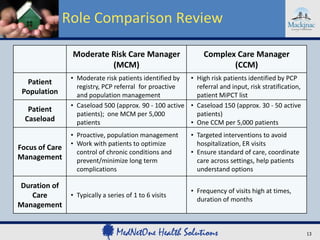
Role Comparison Review

                Moderate Risk Care Manager                     Complex Care Manager
                         (MCM)                                        (CCM)
                • Moderate risk patients identified by  • High risk patients identified by PCP
  Patient
                  registry, PCP referral for proactive    referral and input, risk stratification,
 Population       and population management               patient MiPCT list
                • Caseload 500 (approx. 90 - 100 active • Caseload 150 (approx. 30 - 50 active
   Patient
                  patients); one MCM per 5,000            patients)
  Caseload        patients                              • One CCM per 5,000 patients
                • Proactive, population management        • Targeted interventions to avoid
                • Work with patients to optimize            hospitalization, ER visits
Focus of Care
                  control of chronic conditions and       • Ensure standard of care, coordinate
Management        prevent/minimize long term                care across settings, help patients
                  complications                             understand options

Duration of
                                                          • Frequency of visits high at times,
   Care         • Typically a series of 1 to 6 visits
                                                            duration of months
Management


                                                                                                     13
Pay for Performance:
         Six Month Metrics - Care Manager
   Number of Moderate Care Managers hired/
    contracted by practices and/or PO
    • 10 points
   Number of Moderate Care Managers within PO
    that have completed the required training
    • 10 points


                                                 14
Patient Engagement


                     15
16
Pay for Performance:
         Six Month Metrics - Care Manager
   Number of Complex Care Managers hired/
    contracted by practices and/or PO
    • 10 points
   Number of Complex Care Managers within PO that
    have completed the required training
    • 10 points


                                                     17
Performance Incentive Process

   $3.00 PMPM paid into incentive pool*
   Performance incentive metrics are assessed and
    all funds paid out every 6 months
    • 1st period for April starters is 3 months
    • Payments will be made about 2 months after
      performance period ends
    • Payment range is 82% to 118 % of mean ($18.00 per
      member) or $14.76 to $21.24


                                                          18
Payment Distribution

   POs retain approved portion (not to exceed 20%)

   POs distribute remaining funds to participating
    practices.

    • Equally: a fixed dollar amount times the number of
               beneficiaries
                     or
    • Variable amounts: dollar amount is based on
       additional performance criteria including participation
      in workshops and collaborative events
                                                                 19
Care Managers

   Each practice has a Hybrid Care Manager assigned
    and actively engaged
   Dietitian, Certified Diabetes Educator, Behavior
    Health Specialist, Health Coach, Health Educator,
    Certified Asthma Educator, Pharmacist (as
    needed)


                                                        20
PDCM Codes and Fees
CODE                            SERVICE
G9001    Initial assessment
G9002    Individual face-to-face visit (per encounter)
98961    Group visit (2-4 patients) 30 minutes
98962    Group visit (5-8 patients) 30 minutes
98966    Telephone discussion 5-10 minutes
98967    Telephone discussion 11-20 minutes
98968    Telephone discussion 21+ minutes


                                                         21
Registration for CCM Workshop

   MiPCT moved to an open registration process for
    Complex Care Management (CCM) training
   CCMs and HCMs that have not previously
    registered online for the CCM course to the
    section of the MiPCT website entitled “CCM
    Online Registration page


                                                      22
23
PCMH CAHPS Survey
   To be collected on a representative sample of
    MiPCT and comparison beneficiaries
   Multi-modal (mail with phone follow-up)
   Content areas:
    • Access
    • Communication
    • Coordination
    • Comprehensiveness
    • Shared decision making
    • Self-management support
                                                    24
Adult Clinical Quality Metrics

 Diabetes: (ages18-75         years & type 1 or 2
 diabetes) HEDIS
     1.   A1C Test
     2.   Poor Control A1c>9
     3.   Control A1c< 8
     4.   LDL-C Test
     5.   LDL-C Controlled < 100 mg/dl
     6.   BP <140/90
     7.   Retinal Eye Exam
     8.   Nephropathy Screen or Evidence of Nephropathy*
 y


                                                           25
Adult Clinical Quality Metrics

   Asthma: Self-Management Plan or Asthma Action
    Plan (ages 5-50) Non HEDIS
   Hypertension: Controlled BP <140/90 (ages 18-85)
    HEDIS


                                                       26
Adult Clinical Quality Metrics

   Cardiovascular Disease (CVD): BP management
         <140/90 mmHg (ages 18-75) HEDIS
   CVD: LDL-C Management <100 mg/dl (ages 18-85)
    HEDIS
   Obesity: Adult BMI (Meaningful Use)


                                                    27
Adult Clinical Quality Metrics

   Tobacco: Percent Current Smokers (ages 13 and
    older) (non HEDIS)
   Breast Cancer Screening: (ages 40-69) HEDIS
   Cervical Cancer Screening: (ages 21-64) HEDIS
   Colorectal Cancer Screening: (ages 50-75) HEDIS
   Chlamydia Screening: (sexually active women
    ages 16-24) HEDIS


                                                      28
Pediatric Clinical Quality
        Measures
   Asthma: Self-Management Plan or Asthma
    Action Plan (ages 5-50) Non HEDIS
   Obesity: Child BMI (ages 2-17yrs) Meaningful
    Use
   Lead Screening: (Medicaid only) (Age 2) HEDIS**
   Tobacco Use: (ages 13 and older)
   Chlamydia Screening: (sexually active women
    ages 16–24) HEDIS


                                                      29
Pediatric Clinical Quality
        Measures
   Chlamydia Screening: (sexually active women
    ages 16–24) HEDIS
   Childhood Immunizations: Age 2 HEDIS**
   Childhood Immunizations: Adolescent Age 13
    HEDIS**
   Well Child Visits: 15 Months and 3-6 years HEDIS
   Well Child Visits: Adolescent (ages12-21) HEDIS


                                                       30
31
MNO Expectations

   Attendance at webinars
    • Share current information
    • Brief training moments
    • 100% practice representation
    • eMail addresses of physicians
    • Hold each other accountable and create buddy
      relationships
    • Create inter-professional collaborative care
      teams

                                                     32
Questions


            33

MiPCT Webinar 06/13/2012

  • 1.
    Michigan Primary Care Transformation Demonstration Project June 13, 2012 Webinar #10
  • 2.
    Agenda  Medicaid Payments  Medicare Payments  Care Managers  MiPCT Committee  Metrics 2
  • 3.
  • 4.
    Performance  One year look back for quality scores  Ongoing testing for patient registry data dumps  Patient registry data utilized for distribution of funds  Patient registry submission in time for 12.31.2012 performance payments 4
  • 5.
    Pay for PerformanceData Source  Claims Data: All participating health plans submit claims data to the Michigan Data Collaborative which can be used to calculate utilization and cost metrics.  Claims data will be calculated for each Health Plan and aggregated across all contracted plans.  Confidence intervals at 95% will be provided. 5
  • 6.
    Pay for PerformanceData Source  MiPCT Quarterly Reports: The report will document updates to the MiPCT Implementation Plan and progress to date in developing PCMH infrastructure capabilities and carrying out MiPCT clinical initiatives. 6
  • 7.
    Pay for PerformanceData Source  Self-Reported Data (SRD): MNO currently reports to BCBSM PGIP twice a year on each practice’s PCMH capabilities  BCBSM applies accuracy, validity and inter-rater reliability checks and balances to the reports  Financial penalties are imposed for inaccurate reporting of capabilities and are reflected proportionally on the distribution of funds 7
  • 8.
  • 9.
    Pay for Performance: Six Month Metrics - Access  Extended access: • 30% same day appointment (10 points)  Appointments outside regular hours: • 8 hours/week (10 points) 9
  • 10.
    Pay for Performance: Six Month Metrics – eRegistry 1) Practice has electronic registry 2) Registry has interface capability 3) Incorporates evidence-based care guidelines 4) Identifies individual attributed practitioner 5) Information available and used by the practice unit team at the point of care 6) Used to generate communications to patients regarding gaps in care 10
  • 11.
    Pay for Performance: Six Month Metrics - eRegistry 7. Used to flag gaps in care 8. Patient demographics 9. Registry identifies and tracks care for patients with at least 2 of the following: diabetes asthma cardiovascular disease pediatric obesity 11
  • 12.
    Pay for Performance: Six Month Metrics - eRegistry  0 points for entire metric if no eRegistry  1 point each for numbers 1-8  Up to 2 points for number 9 12
  • 13.
    Role Comparison Review Moderate Risk Care Manager Complex Care Manager (MCM) (CCM) • Moderate risk patients identified by • High risk patients identified by PCP Patient registry, PCP referral for proactive referral and input, risk stratification, Population and population management patient MiPCT list • Caseload 500 (approx. 90 - 100 active • Caseload 150 (approx. 30 - 50 active Patient patients); one MCM per 5,000 patients) Caseload patients • One CCM per 5,000 patients • Proactive, population management • Targeted interventions to avoid • Work with patients to optimize hospitalization, ER visits Focus of Care control of chronic conditions and • Ensure standard of care, coordinate Management prevent/minimize long term care across settings, help patients complications understand options Duration of • Frequency of visits high at times, Care • Typically a series of 1 to 6 visits duration of months Management 13
  • 14.
    Pay for Performance: Six Month Metrics - Care Manager  Number of Moderate Care Managers hired/ contracted by practices and/or PO • 10 points  Number of Moderate Care Managers within PO that have completed the required training • 10 points 14
  • 15.
  • 16.
  • 17.
    Pay for Performance: Six Month Metrics - Care Manager  Number of Complex Care Managers hired/ contracted by practices and/or PO • 10 points  Number of Complex Care Managers within PO that have completed the required training • 10 points 17
  • 18.
    Performance Incentive Process  $3.00 PMPM paid into incentive pool*  Performance incentive metrics are assessed and all funds paid out every 6 months • 1st period for April starters is 3 months • Payments will be made about 2 months after performance period ends • Payment range is 82% to 118 % of mean ($18.00 per member) or $14.76 to $21.24 18
  • 19.
    Payment Distribution  POs retain approved portion (not to exceed 20%)  POs distribute remaining funds to participating practices. • Equally: a fixed dollar amount times the number of beneficiaries or • Variable amounts: dollar amount is based on additional performance criteria including participation in workshops and collaborative events 19
  • 20.
    Care Managers  Each practice has a Hybrid Care Manager assigned and actively engaged  Dietitian, Certified Diabetes Educator, Behavior Health Specialist, Health Coach, Health Educator, Certified Asthma Educator, Pharmacist (as needed) 20
  • 21.
    PDCM Codes andFees CODE SERVICE G9001 Initial assessment G9002 Individual face-to-face visit (per encounter) 98961 Group visit (2-4 patients) 30 minutes 98962 Group visit (5-8 patients) 30 minutes 98966 Telephone discussion 5-10 minutes 98967 Telephone discussion 11-20 minutes 98968 Telephone discussion 21+ minutes 21
  • 22.
    Registration for CCMWorkshop  MiPCT moved to an open registration process for Complex Care Management (CCM) training  CCMs and HCMs that have not previously registered online for the CCM course to the section of the MiPCT website entitled “CCM Online Registration page 22
  • 23.
  • 24.
    PCMH CAHPS Survey  To be collected on a representative sample of MiPCT and comparison beneficiaries  Multi-modal (mail with phone follow-up)  Content areas: • Access • Communication • Coordination • Comprehensiveness • Shared decision making • Self-management support 24
  • 25.
    Adult Clinical QualityMetrics  Diabetes: (ages18-75 years & type 1 or 2 diabetes) HEDIS 1. A1C Test 2. Poor Control A1c>9 3. Control A1c< 8 4. LDL-C Test 5. LDL-C Controlled < 100 mg/dl 6. BP <140/90 7. Retinal Eye Exam 8. Nephropathy Screen or Evidence of Nephropathy* y 25
  • 26.
    Adult Clinical QualityMetrics  Asthma: Self-Management Plan or Asthma Action Plan (ages 5-50) Non HEDIS  Hypertension: Controlled BP <140/90 (ages 18-85) HEDIS 26
  • 27.
    Adult Clinical QualityMetrics  Cardiovascular Disease (CVD): BP management <140/90 mmHg (ages 18-75) HEDIS  CVD: LDL-C Management <100 mg/dl (ages 18-85) HEDIS  Obesity: Adult BMI (Meaningful Use) 27
  • 28.
    Adult Clinical QualityMetrics  Tobacco: Percent Current Smokers (ages 13 and older) (non HEDIS)  Breast Cancer Screening: (ages 40-69) HEDIS  Cervical Cancer Screening: (ages 21-64) HEDIS  Colorectal Cancer Screening: (ages 50-75) HEDIS  Chlamydia Screening: (sexually active women ages 16-24) HEDIS 28
  • 29.
    Pediatric Clinical Quality Measures  Asthma: Self-Management Plan or Asthma Action Plan (ages 5-50) Non HEDIS  Obesity: Child BMI (ages 2-17yrs) Meaningful Use  Lead Screening: (Medicaid only) (Age 2) HEDIS**  Tobacco Use: (ages 13 and older)  Chlamydia Screening: (sexually active women ages 16–24) HEDIS 29
  • 30.
    Pediatric Clinical Quality Measures  Chlamydia Screening: (sexually active women ages 16–24) HEDIS  Childhood Immunizations: Age 2 HEDIS**  Childhood Immunizations: Adolescent Age 13 HEDIS**  Well Child Visits: 15 Months and 3-6 years HEDIS  Well Child Visits: Adolescent (ages12-21) HEDIS 30
  • 31.
  • 32.
    MNO Expectations  Attendance at webinars • Share current information • Brief training moments • 100% practice representation • eMail addresses of physicians • Hold each other accountable and create buddy relationships • Create inter-professional collaborative care teams 32
  • 33.