(eBook PDF) A Case Manager's Study Guide 5th Edition
(eBook PDF) A Case Manager's Study Guide 5th Edition
(eBook PDF) A Case Manager's Study Guide 5th Edition
(eBook PDF) A Case Manager's Study Guide 5th Edition
(eBook PDF) A Case Manager's Study Guide 5th Edition
1.
(eBook PDF) ACase Manager's Study Guide 5th
Edition download
https://ebookluna.com/product/ebook-pdf-a-case-managers-study-
guide-5th-edition/
Download more ebook from https://ebookluna.com
2.
We believe theseproducts will be a great fit for you. Click
the link to download now, or visit ebookluna.com
to discover even more!
(eBook PDF) Medical Nutrition Therapy: A Case-Study Approach 5th Edition
https://ebookluna.com/product/ebook-pdf-medical-nutrition-therapy-a-case-
study-approach-5th-edition/
(eBook PDF) Planning Canada: A Case Study Approach
https://ebookluna.com/product/ebook-pdf-planning-canada-a-case-study-
approach/
(eBook PDF) Health Services Management: A Case Study Approach, Eleventh
Edition
https://ebookluna.com/product/ebook-pdf-health-services-management-a-case-
study-approach-eleventh-edition/
(eBook PDF) Master of Public Health Competencies: A Case Study Approach
https://ebookluna.com/product/ebook-pdf-master-of-public-health-
competencies-a-case-study-approach/
3.
Infectious Diseases: ACase Study Approach 1st Edition Jonathan Cho - eBook
PDF
https://ebookluna.com/download/infectious-diseases-a-case-study-approach-
ebook-pdf/
Fractured Minds: A Case-Study Approach to Clinical Neuropsychology 2nd
Edition - PDF Version
https://ebookluna.com/product/fractured-minds-a-case-study-approach-to-
clinical-neuropsychology-2nd-edition-pdf-version/
Medical Nutrition Therapy: A Case Study Approach 6th Edition Marcia
Nahikian Nelms - eBook PDF
https://ebookluna.com/download/medical-nutrition-therapy-a-case-study-
approach-ebook-pdf/
(eBook PDF) Criminal Investigation: An Illustrated Case Study Approach
https://ebookluna.com/product/ebook-pdf-criminal-investigation-an-
illustrated-case-study-approach/
Discovery of Oyu Tolgoi: A Case Study of Mineral and Geological Exploration
- eBook PDF
https://ebookluna.com/download/discovery-of-oyu-tolgoi-a-case-study-of-
mineral-and-geological-exploration-ebook-pdf/
6.
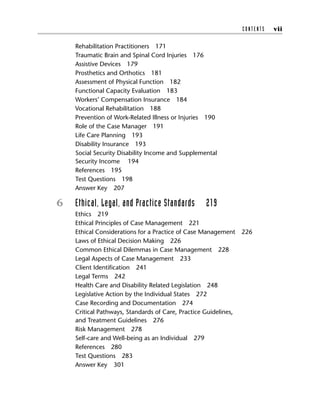
Rehabilitation Practitioners 171
TraumaticBrain and Spinal Cord Injuries 176
Assistive Devices 179
Prosthetics and Orthotics 181
Assessment of Physical Function 182
Functional Capacity Evaluation 183
Workers’ Compensation Insurance 184
Vocational Rehabilitation 188
Prevention of Work-Related Illness or Injuries 190
Role of the Case Manager 191
Life Care Planning 193
Disability Insurance 193
Social Security Disability Income and Supplemental
Security Income 194
References 195
Test Questions 198
Answer Key 207
6 Ethical, Legal, and Practice Standards 219
Ethics 219
Ethical Principles of Case Management 221
Ethical Considerations for a Practice of Case Management 226
Laws of Ethical Decision Making 226
Common Ethical Dilemmas in Case Management 228
Legal Aspects of Case Management 233
Client Identification 241
Legal Terms 242
Health Care and Disability Related Legislation 248
Legislative Action by the Individual States 272
Case Recording and Documentation 274
Critical Pathways, Standards of Care, Practice Guidelines,
and Treatment Guidelines 276
Risk Management 278
Self-care and Well-being as an Individual 279
References 280
Test Questions 283
Answer Key 301
C O N T E N T S vii
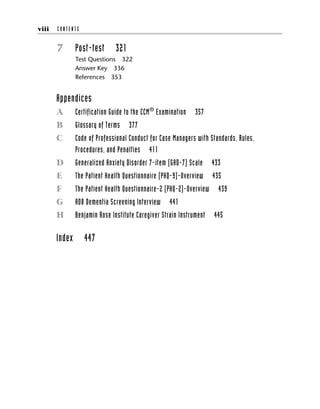
7.
7 Post-test 321
TestQuestions 322
Answer Key 336
References 353
Appendices
A Certification Guide to the CCM®
Examination 357
B Glossary of Terms 377
C Code of Professional Conduct for Case Managers with Standards, Rules,
Procedures, and Penalties 411
D Generalized Anxiety Disorder 7-item (GAD-7) Scale 433
E The Patient Health Questionnaire (PHQ-9)-Overview 435
F The Patient Health Questionnaire-2 (PHQ-2)-Overview 439
G AD8 Dementia Screening Interview 441
H Benjamin Rose Institute Caregiver Strain Instrument 445
Index 447
viii C O N T E N T S
8.
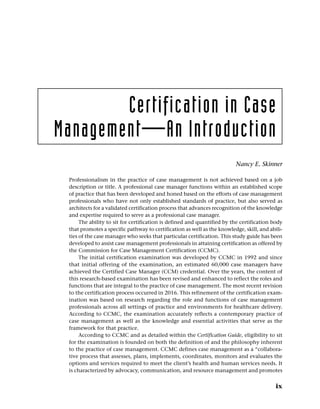
Certification in Case
Management—AnIntroduction
Nancy E. Skinner
Professionalism in the practice of case management is not achieved based on a job
description or title. A professional case manager functions within an established scope
of practice that has been developed and honed based on the efforts of case management
professionals who have not only established standards of practice, but also served as
architects for a validated certification process that advances recognition of the knowledge
and expertise required to serve as a professional case manager.
The ability to sit for certification is defined and quantified by the certification body
that promotes a specific pathway to certification as well as the knowledge, skill, and abili-
ties of the case manager who seeks that particular certification. This study guide has been
developed to assist case management professionals in attaining certification as offered by
the Commission for Case Management Certification (CCMC).
The initial certification examination was developed by CCMC in 1992 and since
that initial offering of the examination, an estimated 60,000 case managers have
achieved the Certified Case Manager (CCM) credential. Over the years, the content of
this research-based examination has been revised and enhanced to reflect the roles and
functions that are integral to the practice of case management. The most recent revision
to the certification process occurred in 2016. This refinement of the certification exam-
ination was based on research regarding the role and functions of case management
professionals across all settings of practice and environments for healthcare delivery.
According to CCMC, the examination accurately reflects a contemporary practice of
case management as well as the knowledge and essential activities that serve as the
framework for that practice.
According to CCMC and as detailed within the Certification Guide, eligibility to sit
for the examination is founded on both the definition of and the philosophy inherent
to the practice of case management. CCMC defines case management as a “collabora-
tive process that assesses, plans, implements, coordinates, monitors and evaluates the
options and services required to meet the client’s health and human services needs. It
is characterized by advocacy, communication, and resource management and promotes
ix
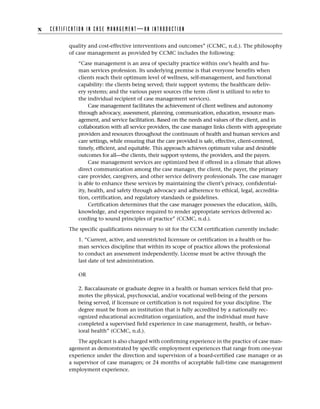
9.
quality and cost-effectiveinterventions and outcomes” (CCMC, n.d.). The philosophy
of case management as provided by CCMC includes the following:
“Case management is an area of specialty practice within one’s health and hu-
man services profession. Its underlying premise is that everyone benefits when
clients reach their optimum level of wellness, self-management, and functional
capability: the clients being served; their support systems; the healthcare deliv-
ery systems; and the various payer sources (the term client is utilized to refer to
the individual recipient of case management services).
Case management facilitates the achievement of client wellness and autonomy
through advocacy, assessment, planning, communication, education, resource man-
agement, and service facilitation. Based on the needs and values of the client, and in
collaboration with all service providers, the case manager links clients with appropriate
providers and resources throughout the continuum of health and human services and
care settings, while ensuring that the care provided is safe, effective, client-centered,
timely, efficient, and equitable. This approach achieves optimum value and desirable
outcomes for all—the clients, their support systems, the providers, and the payers.
Case management services are optimized best if offered in a climate that allows
direct communication among the case manager, the client, the payer, the primary
care provider, caregivers, and other service delivery professionals. The case manager
is able to enhance these services by maintaining the client’s privacy, confidential-
ity, health, and safety through advocacy and adherence to ethical, legal, accredita-
tion, certification, and regulatory standards or guidelines.
Certification determines that the case manager possesses the education, skills,
knowledge, and experience required to render appropriate services delivered ac-
cording to sound principles of practice” (CCMC, n.d.).
The specific qualifications necessary to sit for the CCM certification currently include:
1. “Current, active, and unrestricted licensure or certification in a health or hu-
man services discipline that within its scope of practice allows the professional
to conduct an assessment independently. License must be active through the
last date of test administration.
OR
2. Baccalaureate or graduate degree in a health or human services field that pro-
motes the physical, psychosocial, and/or vocational well-being of the persons
being served, if licensure or certification is not required for your discipline. The
degree must be from an institution that is fully accredited by a nationally rec-
ognized educational accreditation organization, and the individual must have
completed a supervised field experience in case management, health, or behav-
ioral health” (CCMC, n.d.).
The applicant is also charged with confirming experience in the practice of case man-
agement as demonstrated by specific employment experiences that range from one-year
experience under the direction and supervision of a board-certified case manager or as
a supervisor of case managers; or 24 months of acceptable full-time case management
employment experience.
x C E R T I F I C A T I O N I N C A S E M A N A G E M E N T — A N I N T R O D U C T I O N
10.
In addition todemonstrating professional background and duration of experience, the
applicant must be able to provide a detailed job description that validates the
provision
of case management interventions including:
• At least 30 percent of work time focused on the provision of case management
services
• Four of five core components of case management performed as a significant aspect
of his or her role with all eight essential activities consistently performed across
the continuum of care with direct client contact
• Case management experience achieved within the United States
Although other qualifications may be required to achieve eligibility, the previously
detailed requirements offered an overview of the majority of eligibility mandates.
The Certification Guide provides a listing of the eight essential activities associated with
a professional practice of case management. These activities include assessment, planning,
implementation coordination, monitoring, evaluation, outcomes, and general. Each of
these activities is provided in concert with direct client/patient contact.
The certification examination is based on the five core components or domains of
case management including:
1. Care Delivery and Reimbursement Methods
2. Psychosocial Concepts and Support Systems
3. Quality and Outcomes Evaluation and Measurements
4. Rehabilitation Concepts and Strategies
5. Ethical, Legal, and Practice Standards
Each of these five domains includes a number of subdomains that reflect the role and
function study that serves as the foundation for detailing aspects of the current practice of
case management. It is worth noting that currently an increased focus on ethics and quality
management has been identified as core components of current and contemporary practice.
Once eligibility is confirmed, the next step in the certification process is participation
and review of the knowledge required to successfully complete the examination. CCMC
currently details the examination as a multiple-choice test that includes 180 questions.
Of these questions, 150 are scored and 30 questions are tested to confirm validity for
inclusion in future exams. The 150 questions are drawn from a library of test questions
that may vary from person to person but comprehensively represent the domains and
subdomains of knowledge representative of a practice of case management.
Taking the first steps in moving toward certification may be daunting. Sitting in a test-
ing environment and reading questions on a computer screen and seeking to identify the
best answer can sometimes be a harrowing experience. Many potential certificants have
“test anxiety” that may prevent them from being successful in achieving board certifica-
tion. While a comprehensive review of this study guide is unable to remove the anxiety
associated with the test-taking process, the study guide does present comprehensive and
detailed information regarding the domains and subdomains that are covered within the
examination. Being armed with the knowledge necessary to successfully complete the
testing process is a primary step toward certification achievement.
In addition to this study guide and sample questions presented within this guide,
please review the definition and philosophy of case management as provided by CCMC,
the Glossary of Terms available on the CCMC website, and the Code of Professional Conduct
Certification in Case Management—An Introduction xi
11.
for Case Managerswith Standards, Rules, Procedures, and Penalties as adopted by the CCMC.
The Code is also available at www.ccmcertification.org. Each of these documents is in-
cluded within the Appendices of this book.
Another source of information that may support successful completion of the examina-
tion is the Standards of Practice for Case Management as presented by the Case Management
Society of America (CMSA) and CMSA’s Statement of Ethical Case Management Practice. Both
documents are available at the CMSA website, www.cmsa.org.
Prior to preparing to sit for the CCM examination, it is recommended that each can-
didate review any updates to examination components as detailed within the Certification
Guide to the CCM Examination. This guide is available at www.ccmcertifiction.org.
REFERENCE
Commission for Case Manager Certification (CCMC). (n.d.). Certification guide to the CCM®
examination.
Retrieved from https://ccmcertification.org/sites/default/files/docs/2017/cert_guide_-_6.12.17_new
_website_0.pdf. Reproduced with permission from the Commission for Case Manager Certification®
.
All rights reserved.
xii C E R T I F I C A T I O N I N C A S E M A N A G E M E N T — A N I N T R O D U C T I O N
12.
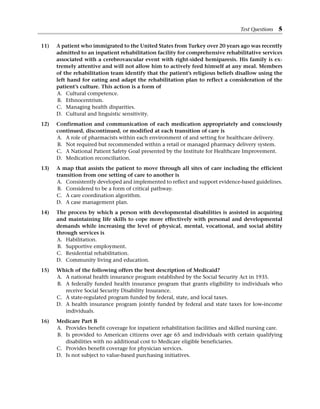
The following questionsare offered to assist you in targeting areas in which you may require
an additional focus in preparing to earn designation as a board-certified case manager as
presented by the Commission for Case Manager Certification (CCMC). To assist you in
responding to these questions or any of the sample questions offered within this guide,
consider the following test-taking techniques.
• Read each question twice. If you have a tendency to scan information, scanning
the question rather than understanding the specific “ask” within that question
is not recommended. Some questions may contain modifiers such as the words
not, never, always, or isn’t. If you do not read each unique word and any associated
modifier, the intent of the question may be misunderstood.
• Read all four answers before making a choice. Sometimes, the first answer may appear
to be correct and a subsequent answer may be even more accurate. The timeframe
for taking the examination is more than adequate and rushing through the exami-
nation without giving appropriate time to each question is never recommended.
• Questions that are lengthy and offer a significant narrative require an even greater
focus. Read the questions and all four answers and then review the question a
second time. The computer system may allow you to delete or cross out responses
that are inaccurate. If this option is available, cross out incorrect responses so that
you can focus on those answers that may be right and choose the one answer that
is most correct.
• If you are unable to decide between two answers, review each response in relation-
ship to the question rather than comparing each response to the other responses.
• The questions presented within the examination were developed by a group of
subject matter experts and validated within previously offered testing cycles. It
is important to remember that case management is more of an art than a science
and, as such, differing opinions may arise in response to both the questions of-
fered within the examination and the sample questions presented within this
study guide. Remember, in both instances, the answers identified as correct are
based on the authors of those questions. It is fruitless to argue or to lament when
you disagree with the response presented or the correct answer that was identified.
Instead, remember the content of the examination is the sole responsibility of the
Pretest
1
C
h
a
p
t
e
r
1
13.
certification body andthe answers they identify as correct are correct because they
have been identified as such.
• When in doubt regarding the correct response, the computer offers the capability
of striking out responses that you have identified as incorrect. Additionally, the
system will allow you to highlight the responses you believe are correct. Instruc-
tions regarding the specific capabilities of the computer system are available prior to
initiating the test. The time spent reviewing these instructions will not be deducted
from the time allotted to finish the examination.
• Since there is no penalty in this examination for an incorrect response, guess based
on your best judgment. If all else fails, choose the response with the most words.
2 C H A P T E R 1 P r e t e s t
14.
Test Questions
1) Theextent to which an individual’s behavior including taking medication, following a
diet, and/or executing lifestyle changes corresponds with agreed recommendations from
a healthcare provider is defined as
A. Patient activation.
B. Patient compliance.
C. Patient adherence.
D. Concordance.
2) Mrs. Brown has a history of 40 years of addiction to cigarette smoking. She was recently
diagnosed with stage 2 chronic obstructive pulmonary disease. With the support of her
significant other, she has stated that her current purchase of one pack of cigarettes will be
the last cigarettes she will ever buy and has been researching available smoking-cessation
support groups via the Internet. She also received a prescription for a medication that
might assist in advancing her ability to quit smoking. Her current actions represent which
stage of health behavioral change?
A. Precontemplation.
B. Contemplation.
C. Preparation.
D. Taking action.
3) Being of short stature, Mr. Jones utilizes a stepping stool and a reacher to gain access to
items on the top shelf of his kitchen cabinets. The tools he utilizes to gain access to nec-
essary items are an example of
A. Rehabilitative technology.
B. Universal design.
C. Adaptive devices.
D. Assistive devices.
4) The Patient Protection and Affordable Care Act more commonly referred to as the Af-
fordable Care Act (ACA) includes the extension of healthcare benefits to children up to
age 26 under a parent’s health plan. The ACA also prohibits the exclusion of preexisting
conditions from healthcare insurance policies and any increase in insurance premiums
based on health status or gender. In addition to advancing the opportunity to obtain
healthcare coverage, the ACA also supported the development of a National Quality
Strategy. A component of this strategy that seeks to reward providers for the delivery of
quality healthcare services is
A. A quality benchmarking database provided by the National Committee on Quality Assurance.
B. The reporting and associated financial impact of the Hospital Consumer Assessment of
Healthcare Providers and Systems surveys.
C. The utilization of payment provisions associated with the incidence of hospital-acquired
conditions.
D. Value-based purchasing.
3
15.
5) A casemanagement model that represents brief case management interventions in order
to empower the patient to identify his or her own needs and to offer the patient ancillary
or supportive services to meet those needs is
A. The integrated model of case management.
B. The strengths-based model of case management.
C. The engagement and empowerment model.
D. The brokerage model.
6) An important aspect of each case management evaluation is an assessment of the degree
to which a patient demonstrates the capacity to obtain, process, and understand basic
information and services needed to make appropriate health decisions. This is commonly
referred to as an evaluation of the patient’s
A. Literacy.
B. Health literacy.
C. Cultural-based understanding and competency.
D. Goal-based learning process.
7) The prospective payment model utilized to facilitate payment of Medicare claims for acute
care hospitalization was introduced in 1983 and was based on a fixed, predetermined
amount associated with the patient’s diagnosis rather than the type and number of services
provided. Following introduction of this reimbursement system, most hospitals developed
A. Risk management departments.
B. Case management models.
C. Targeted admission programs focused on diagnosis.
D. Transitional care programs.
8) A comprehensive process that matches human performance levels to the demands of a
specific job, work activity, or occupation while establishing the appropriate level of work
an injured employee can perform is
A. A work-hardening program.
B. A functional independence measure and evaluation.
C. A functional capacity evaluation.
D. An independent medical evaluation.
9) Clinical quality measures as defined by the Centers for Medicare and Medicaid Services
include
A. Specific and detailed national standards of care that represent the best clinical practice
across all practice settings.
B. Written, quantifiable, and time-sensitive statements of the expected results of healthcare
processes and procedures associated with the delivery of medically necessary care.
C. Tools developed to detail accountability associated with research, proximity, accuracy, and
adverse events.
D. Tools that assist in the measurement and tracking of the quality of healthcare services
with a focus on delivering care that is safe, timely, effective, efficient, equitable, and
patient centered.
10) Observation status is covered under Medicare
A. Part A.
B. Part B.
C. Part D.
D. Part E or a Medigap program.
4 C H A P T E R 1 P r e t e s t
16.
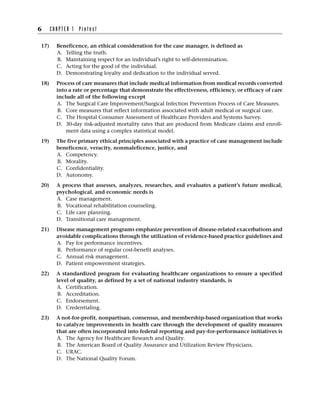
11) A patientwho immigrated to the United States from Turkey over 20 years ago was recently
admitted to an inpatient rehabilitation facility for comprehensive rehabilitative services
associated with a cerebrovascular event with right-sided hemiparesis. His family is ex-
tremely attentive and will not allow him to actively feed himself at any meal. Members
of the rehabilitation team identify that the patient’s religious beliefs disallow using the
left hand for eating and adapt the rehabilitation plan to reflect a consideration of the
patient’s culture. This action is a form of
A. Cultural competence.
B. Ethnocentrism.
C. Managing health disparities.
D. Cultural and linguistic sensitivity.
12) Confirmation and communication of each medication appropriately and consciously
continued, discontinued, or modified at each transition of care is
A. A role of pharmacists within each environment of and setting for healthcare delivery.
B. Not required but recommended within a retail or managed pharmacy delivery system.
C. A National Patient Safety Goal presented by the Institute for Healthcare Improvement.
D. Medication reconciliation.
13) A map that assists the patient to move through all sites of care including the efficient
transition from one setting of care to another is
A. Consistently developed and implemented to reflect and support evidence-based guidelines.
B. Considered to be a form of critical pathway.
C. A care coordination algorithm.
D. A case management plan.
14) The process by which a person with developmental disabilities is assisted in acquiring
and maintaining life skills to cope more effectively with personal and developmental
demands while increasing the level of physical, mental, vocational, and social ability
through services is
A. Habilitation.
B. Supportive employment.
C. Residential rehabilitation.
D. Community living and education.
15) Which of the following offers the best description of Medicaid?
A. A national health insurance program established by the Social Security Act in 1935.
B. A federally funded health insurance program that grants eligibility to individuals who
receive Social Security Disability Insurance.
C. A state-regulated program funded by federal, state, and local taxes.
D. A health insurance program jointly funded by federal and state taxes for low-income
individuals.
16) Medicare Part B
A. Provides benefit coverage for inpatient rehabilitation facilities and skilled nursing care.
B. Is provided to American citizens over age 65 and individuals with certain qualifying
disabilities with no additional cost to Medicare eligible beneficiaries.
C. Provides benefit coverage for physician services.
D. Is not subject to value-based purchasing initiatives.
Test Questions 5
17.
17) Beneficence, anethical consideration for the case manager, is defined as
A. Telling the truth.
B. Maintaining respect for an individual’s right to self-determination.
C. Acting for the good of the individual.
D. Demonstrating loyalty and dedication to the individual served.
18) Process of care measures that include medical information from medical records converted
into a rate or percentage that demonstrate the effectiveness, efficiency, or efficacy of care
include all of the following except
A. The Surgical Care Improvement/Surgical Infection Prevention Process of Care Measures.
B. Core measures that reflect information associated with adult medical or surgical care.
C. The Hospital Consumer Assessment of Healthcare Providers and Systems Survey.
D. 30-day risk-adjusted mortality rates that are produced from Medicare claims and enroll-
ment data using a complex statistical model.
19) The five primary ethical principles associated with a practice of case management include
beneficence, veracity, nonmaleficence, justice, and
A. Competency.
B. Morality.
C. Confidentiality.
D. Autonomy.
20) A process that assesses, analyzes, researches, and evaluates a patient’s future medical,
psychological, and economic needs is
A. Case management.
B. Vocational rehabilitation counseling.
C. Life care planning.
D. Transitional care management.
21) Disease management programs emphasize prevention of disease-related exacerbations and
avoidable complications through the utilization of evidence-based practice guidelines and
A. Pay for performance incentives.
B. Performance of regular cost-benefit analyses.
C. Annual risk management.
D. Patient empowerment strategies.
22) A standardized program for evaluating healthcare organizations to ensure a specified
level of quality, as defined by a set of national industry standards, is
A. Certification.
B. Accreditation.
C. Endorsement.
D. Credentialing.
23) A not-for-profit, nonpartisan, consensus, and membership-based organization that works
to catalyze improvements in health care through the development of quality measures
that are often incorporated into federal reporting and pay-for-performance initiatives is
A. The Agency for Healthcare Research and Quality.
B. The American Board of Quality Assurance and Utilization Review Physicians.
C. URAC.
D. The National Quality Forum.
6 C H A P T E R 1 P r e t e s t
18.
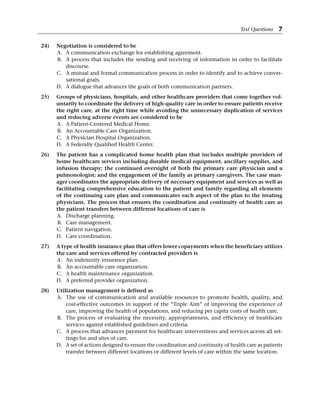
24) Negotiation isconsidered to be
A. A communication exchange for establishing agreement.
B. A process that includes the sending and receiving of information in order to facilitate
discourse.
C. A mutual and formal communication process in order to identify and to achieve conver-
sational goals.
D. A dialogue that advances the goals of both communication partners.
25) Groups of physicians, hospitals, and other healthcare providers that come together vol-
untarily to coordinate the delivery of high-quality care in order to ensure patients receive
the right care, at the right time while avoiding the unnecessary duplication of services
and reducing adverse events are considered to be
A. A Patient-Centered Medical Home.
B. An Accountable Care Organization.
C. A Physician Hospital Organization.
D. A Federally Qualified Health Center.
26) The patient has a complicated home health plan that includes multiple providers of
home healthcare services including durable medical equipment, ancillary supplies, and
infusion therapy; the continued oversight of both the primary care physician and a
pulmonologist; and the engagement of the family as primary caregivers. The case man-
ager coordinates the appropriate delivery of necessary equipment and services as well as
facilitating comprehensive education to the patient and family regarding all elements
of the continuing care plan and communicates each aspect of the plan to the treating
physicians. The process that ensures the coordination and continuity of health care as
the patient transfers between different locations of care is
A. Discharge planning.
B. Care management.
C. Patient navigation.
D. Care coordination.
27) A type of health insurance plan that offers lower copayments when the beneficiary utilizes
the care and services offered by contracted providers is
A. An indemnity insurance plan.
B. An accountable care organization.
C. A health maintenance organization.
D. A preferred provider organization.
28) Utilization management is defined as
A. The use of communication and available resources to promote health, quality, and
cost-effective outcomes in support of the “Triple Aim” of improving the experience of
care, improving the health of populations, and reducing per capita costs of health care.
B. The process of evaluating the necessity, appropriateness, and efficiency of healthcare
services against established guidelines and criteria.
C. A process that advances payment for healthcare interventions and services across all set-
tings for and sites of care.
D. A set of actions designed to ensure the coordination and continuity of health care as patients
transfer between different locations or different levels of care within the same location.
Test Questions 7
19.
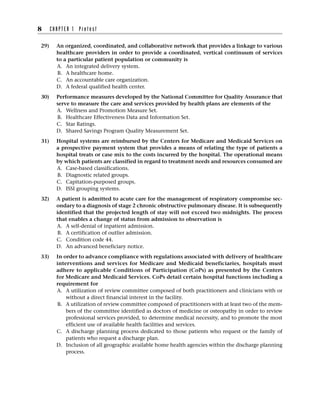
29) An organized,coordinated, and collaborative network that provides a linkage to various
healthcare providers in order to provide a coordinated, vertical continuum of services
to a particular patient population or community is
A. An integrated delivery system.
B. A healthcare home.
C. An accountable care organization.
D. A federal qualified health center.
30) Performance measures developed by the National Committee for Quality Assurance that
serve to measure the care and services provided by health plans are elements of the
A. Wellness and Promotion Measure Set.
B. Healthcare Effectiveness Data and Information Set.
C. Star Ratings.
D. Shared Savings Program Quality Measurement Set.
31) Hospital systems are reimbursed by the Centers for Medicare and Medicaid Services on
a prospective payment system that provides a means of relating the type of patients a
hospital treats or case mix to the costs incurred by the hospital. The operational means
by which patients are classified in regard to treatment needs and resources consumed are
A. Case-based classifications.
B. Diagnostic related groups.
C. Capitation-purposed groups.
D. ISSI grouping systems.
32) A patient is admitted to acute care for the management of respiratory compromise sec-
ondary to a diagnosis of stage 2 chronic obstructive pulmonary disease. It is subsequently
identified that the projected length of stay will not exceed two midnights. The process
that enables a change of status from admission to observation is
A. A self-denial of inpatient admission.
B. A certification of outlier admission.
C. Condition code 44.
D. An advanced beneficiary notice.
33) In order to advance compliance with regulations associated with delivery of healthcare
interventions and services for Medicare and Medicaid beneficiaries, hospitals must
adhere to applicable Conditions of Participation (CoPs) as presented by the Centers
for Medicare and Medicaid Services. CoPs detail certain hospital functions including a
requirement for
A. A utilization of review committee composed of both practitioners and clinicians with or
without a direct financial interest in the facility.
B. A utilization of review committee composed of practitioners with at least two of the mem-
bers of the committee identified as doctors of medicine or osteopathy in order to review
professional services provided, to determine medical necessity, and to promote the most
efficient use of available health facilities and services.
C. A discharge planning process dedicated to those patients who request or the family of
patients who request a discharge plan.
D. Inclusion of all geographic available home health agencies within the discharge planning
process.
8 C H A P T E R 1 P r e t e s t
treatment. On thewestern edge of Pelham Bay Park is Hutchinson's
River, flowing down into Eastchester Bay, and recalling the days of
the Salem witchcraft. Poor Anne Hutchinson fled here to escape
burning as a witch, and on City Island built a hut on a little cape still
called Anne Hook. She lived there peacefully for a year, harming
nobody and declining every invitation to stir from her humble abode.
One day a young girl went to visit Anne, but found the hut in ashes,
and before the door lay the poor woman, where she had been
tomahawked and scalped by the Indians. No one has built a house
on Anne Hook since, and many have been the tales told of ghostly
Indian revels on bleak and rainy nights around the site of the
burning hut. On the mainland were Indian villages, and here have
been found relics, and in 1899 there was exhumed the skeleton of
an Indian warrior.
EAST RIVER AND HELL GATE.
The Harlem River, flowing into the East River, divides Manhattan
from Ward's Island, and this, with Randall's Island to the north and
Blackwell's Island to the south, forms the group of East River
Islands upon which are the penal and charitable institutions of the
great city. The chief of these are on Blackwell's Island, a long,
narrow strip stretching nearly two miles in the centre of East River,
and barely more than two hundred yards wide. It covers one
hundred and twenty acres, and has the penitentiary, almshouses,
workhouses and hospitals, the spacious buildings being of granite
quarried there by the convicts. Over on the New York City shore is
the extensive Bellevue Hospital. In cases of vagrancy and minor
crimes, the offender is said to be sent up to the Island. Ward's
Island has a surface of two hundred acres, and here are the Lunatic
Asylum and Emigrant Hospital. Randall's Island has the institutions
for children and idiots, while upon Hart's Island, out in Long Island
Sound, are industrial schools and the pauper cemetery. The buildings
are all upon a most elaborate scale, and it costs over $2,000,000 for
their annual maintenance. A steamboat ride along East River, with
22.
these extensive establishmentsand their well-kept grounds passing
in review, is a most interesting suburban excursion.
The Long Island shore to the southward of Ward's Island is thrust
out in a way that curves and contracts the East River passage,
which, turning eastward just below where the Harlem River comes
in, goes through the famous Hell Gate to reach the Sound. Formerly,
the swift tidal currents boiled and eddied through this dangerous
pass, Hallett's Point, jutting out from Long Island, narrowing the
channel, and Pot Rock, Flood Rock, the Gridiron and other reefs
making navigation perilous. Many were the wrecks here, and
frequent ineffective efforts were made to improve the passage. The
Government finally undertook the work in 1866 under a
comprehensive plan projected by General Newton. His first task was
the removal of the Hallett's Point reef, a mass of rock projecting
three hundred feet into the stream and throwing the whole tidal
current coming in from the Sound against the great opposing rock
called the Gridiron. He first sunk a shaft upon the Point and
excavated the inland side so that it made a perpendicular wall which
was curved around, and designed for the future edge of the river.
From the shaft, tunnels were bored into the reef under the river in
radiating directions, being connected by concentric galleries. The
design was to remove as much rock as possible without letting the
water in from overhead, and then to blow the rocky roof and
supporting columns into fragments and remove them at leisure. This
work began in 1869, the shaft being sunk thirty-two feet below
mean low water and the tunnels drilled out, inclining downward
under the river. In 1876 the task was finished, and thousands of
separate dynamite blasts had been placed in the roof and supporting
columns, ready for the explosion on Sunday, September 24th. This
being the greatest artificial explosion ever attempted, there was
much trepidation shown in New York for fear of the shock, while
everywhere the keenest interest was taken in the result. The blast
was entirely successful, being discharged by General Newton's little
child, who touched the electric key. The calculation had been so
accurately made that the great reef was pulverized, and the
23.
fragments fell intothe spaces excavated beneath without causing
more than a slight tremor in the adjacent region. By a similar system
and more extensive work, Flood Rock was afterwards removed from
mid-channel, the second great blast reducing it to fragments, being
discharged in October, 1885. The terrors of Hell Gate are gone,
though the tide still flows swiftly through the strait.
THE BROOKLYN BRIDGE.
The growth of population on Long Island has caused various new
bridges and tunnels to be projected for crossing East River. One new
bridge is to cross at Blackwell's Island, with a pier on the island.
Another now nearly completed, and estimated to cost $10,000,000,
crosses from Grand Street to Broadway in Brooklyn. The Long Island
Railroad is arranging to bore a tunnel under East River, to be
operated by electricity, to bring its trains into New York. The East
River being the locality for most of the foreign shipping, the bridges
are at high elevations, the great Brooklyn Bridge, which crosses from
City Hall Park, being one hundred and thirty-five feet above the
water. Its massive piers are among the tallest structures about New
York, rising two hundred and sixty-eight feet. This, the largest
suspension bridge in the world, was begun in 1870 and opened for
traffic in 1885. The piers stand upon caissons sunk into the rocky
bed of the river, which is forty-five feet below the surface on the
Brooklyn side and ninety feet below on the New York side. Their
towers carry four sixteen-inch wire cables that sustain the bridge,
which is built eighty-five feet wide, giving ample accommodation for
two railways, two wagon roads also carrying electric cars, and a
wide raised footway in the centre. The bridge cost nearly
$15,000,000, the distance between the piers is about sixteen
hundred feet, and its entire length between the anchorages of the
cables is three thousand four hundred and seventy-five feet. The
cable anchorages are enormous masses, each containing about
thirty-five thousand cubic yards of solid masonry. The whole length
of the bridge and its elaborate approaches is considerably over a
24.
mile. Its projectorwas John A. Roebling, who died during the early
work, and its builder, his son Washington Roebling, who caught the
dreaded caisson disease while superintending labor under water,
and for years afterward an invalid, watched the progress of the later
work from his chamber window on Brooklyn Heights nearby. The
bridge has carried an enormous traffic, taxing its capacity to the
utmost, and its passengers average over a million a week. The view
from its raised footway is one of the most superb sights of New
York, disclosing both cities, and the extensive wharves and
commerce of East River, the Navy Yard just above, and for miles
over the surrounding region and down through the harbor to the
distant blue hills of Staten Island.
THE CITY OF CHURCHES.
The Borough of Brooklyn, which has grown from the overflow of
New York, whose people are said to go over there chiefly to sleep
or be buried, is popularly known as the City of Churches. A large
portion of the working population of the metropolis, as well as the
merchants and business men, make it their home and dormitory,
while there are beautiful cemeteries in the suburbs peopled largely
by dead New Yorkers. Greenwood, overlooking New York harbor
from Gowanus Heights in South Brooklyn, is regarded as one of the
finest American cemeteries. In no other city can be found such an
aggregation of churches, developed in a past generation, and under
the ministry of a regiment of distinguished clergymen, then led by
Beecher and Storrs, so that the popular title was well bestowed.
Brooklyn is entirely the growth of the nineteenth century, a growth
due to the inability of New York to spread, excepting far northward.
It stretches several miles along East River and three or four miles
inland, and grows rapidly. When the century began, however, it was
hard work to find three thousand people there, and, strangely
enough, they had to cross over to New York to go to church. Just
about the time old Peter Minuit was buying Manhattan from the
Indians, a band of Walloons first settled in Brooklyn. Their
25.
descendants drove cowsacross East River to Governor's Island to
graze, the Buttermilk Channel between them being then shallow
enough for fording, though it is now scoured out deep enough to
float the largest vessels, the docks located where the cows then
crossed now accommodating an enormous commerce. At first a little
ferry from Fulton Street to Peck Slip, New York, accommodated the
straggling village, and it has grown into more than a dozen steam
ferries of the largest capacity, which (besides the bridge) will carry
daily a half-million people across at one cent apiece, this fleet of
packet-boats being the greatest transporters of humanity in the
world.
The Indians called the region around Wallabout Bay, and Gowanus
Mercychawick, meaning the sandy place. When the Walloons came
along, they began settling on the shores of the bay, which they
called Waal-bogt, afterwards gradually changed to its present name
of Wallabout. In 1646 the town was organized by Governor Kieft as
Breuckelen, he appointing Jan Eversen Bout and Huyck Aertsen as
schepens or superintendents to preserve the peace and regulate
the community. During the Revolution the British prison-ships were
moored in the Wallabout, and it is estimated that eleven thousand
five hundred Americans, chiefly seamen, died upon them, the shores
of the bay being full of dead men's bones, which the tides for many
years washed out from the sand. In 1808 these bones were finally
collected and put in a vault near the Navy Yard, which had been
established on the bay. This is the chief naval station of the United
States, covering about eighty-eight acres, including all the available
space. There is attached a large naval hospital, while between the
two is the immense Wallabout Market, covering forty-five acres, the
largest in Brooklyn, its buildings being brick structures in the old
Dutch style.
Fulton Street is the chief highway of Brooklyn, beginning almost
under the shadow of the great Bridge. It is a broad and attractive
street, stretching six miles to the eastern edge of the city, and about
one mile from the river it passes the various city buildings, including
26.
the Post-office, Court-houseand Borough Hall, all handsome
structures. In front of the Borough Hall is a fine statue of Brooklyn's
most famous clergyman, Henry Ward Beecher. From Fulton Street
radiate several of the highways leading into the fashionable
residential quarter,—Brooklyn or Columbia Heights,—overlooking
East River, where the tree-bordered streets are lined with costly and
attractive dwellings. Here in Orange Street, in a very quiet spot, is
Brooklyn's most noted edifice, a plain, wide, unornamented brick
building, with the inscription, Plymouth Church, 1849. Here
preached for nearly forty years, until he died in 1887, Beecher, the
great Puritan, whose family was so noted. His father, Lyman Beecher,
like the son, fought slavery and intemperance in Boston, Litchfield
and Cincinnati, and was an impressive pulpit orator. The old man
was eccentric, however, and after being wrought up by the
excitement of preaching, is said to have gone home and let himself
down by playing on the fiddle and dancing a double-shuffle in the
parlor. He had thirteen children, nearly all famous, and has been
described as the father of more brains than any other man in
America. Four sons were clergymen and two daughters noted
authoresses. Henry Ward, who ruled Brooklyn, and Harriet, who
wrote Uncle Tom's Cabin, were among the great leaders of the anti-
slavery movement.
Clinton Street leaves Fulton a little beyond Orange, and passes
southward through Brooklyn Heights, being the chief street of the
fashionable district. Embowered in trees, handsome churches and
residences border it, and Pierrepont, Remsen, Montague and other
noted streets extend at right angles from it to the edge of the bluff,
where the Heights fall sharply off to the river. Here, at seventy feet
elevation, and overlooking the lower level of buildings and piers at
the water's edge, are the terraces where the finest residences are
located, having a magnificent outlook upon the harbor and New York
City beyond. The ships land their cargoes within almost a stone's
throw of the palaces. In this district there are several large
apartment-houses and various clubs, a statue of Alexander Hamilton
adorning the front of the Hamilton Club at Remsen and Clinton
27.
Streets. Upon RemsenStreet is another noted building, the
Congregational Church of the Pilgrims, a spacious graystone edifice
with towers, its most prominent tower and spire being a
commanding landmark for vessels sailing up New York Bay. There is
let into the outer wall of this church, about six feet above the
pavement, a small piece of the original Plymouth Rock whereon
the Pilgrims in 1620 landed in Massachusetts Bay—a dark, rough-
hewn fragment, projecting with irregular surface a few inches from
the wall. As an author, lecturer and preacher, the veteran pastor for
over a half-century, Dr. Richard Salter Storrs, acquired wide renown.
Upon Clinton Street is the elegant Pointed Gothic brownstone St.
Ann's Episcopal Church, famous for its choir, and on Montague Street
the Holy Trinity Church, its spire rising two hundred and seventy-five
feet. But almost everywhere are churches, there being about five
hundred in Brooklyn. The noted Pratt Institute is one of the best
known charities of the city, founded and endowed by Charles Pratt,
an oil prince, as a technical school, its spacious and well-equipped
buildings caring for thirty-four hundred students. The object of this
noble institution is to promote manual and industrial education, and
to inculcate habits of industry and thrift.
GREENWOOD CEMETERY AND PROSPECT PARK.
A border of tombs almost surrounds Brooklyn, for in the suburbs are
the great cemeteries which are the burial-places of both cities. In
lovely situations upon the surrounding hills are Greenwood, Cypress
Hills, Evergreen, Holy Cross, Calvary, Mount Olivet, The Citizens'
Union, Washington and other cemeteries, occupying many hundreds
of acres. Of these, the noted Greenwood is the chief, covering some
four hundred acres on Gowanus Heights, south of the city. This is a
high ridge dividing Brooklyn from the lowlands on the south side of
Long Island, and it has elevations giving charming views. The route
to it crosses various railroads leading to Coney Island, which is the
ultimate objective point of most Brooklyn lines of transit. A neat
lawn-bordered road leads up to the magnificent cemetery entrance
28.
on Fifth Avenue,an elaborate and much ornamental brownstone
structure rising into a central pinnacle over a hundred feet high. This
entrance covers two fine gateways, with representations of Gospel
scenes, the principal being the Raising of Lazarus and the
Resurrection. The grounds display great beauty, the ridgy, rounded
hills spreading in all directions, the surface being an alternation of
hills and vales, vaults terracing the hillsides, with elaborate
mausoleums above and frequent little lakes nestling in the pleasant
valleys. Vast sums have been expended on some of the grander
tombs, which are upon a scale of great magnificence. The attractive
rural names of the walks and avenues, the delicious flowers and
foliage, the balmy air, the lakes, valleys and points of beautiful
outlook giving grand views over New York Bay and the surrounding
country, make Greenwood a park as well as a cemetery, and it is
generally admitted to be without a peer. Many costly pantheons and
chapels cover the remains of well-known people, and one
mausoleum is a large marble church. A three-sided monument of
peculiar construction standing on a knoll marks the resting-place of
Samuel F. B. Morse, the telegrapher. Horace Greeley's tomb has his
bust in bronze on a pedestal. A colossal statue surmounts the grave
of the great De Witt Clinton, the Governor of New York who built the
Erie Canal and thus secured the commercial supremacy of the city.
The romantic career of Lola Montez ended in Greenwood.
Commodore Garrison, who was at one time Vanderbilt's rival in
steamship management, is interred in a mosque. The tomb of the
Steinways is a large granite building. A magnificent marble canopy
crowns the Scribner tomb, having beneath it an angel of mercy.
There is an appropriate monument to Roger Williams. Here are also
buried Elias Howe, the inventor of the sewing-machine, Peter
Cooper, Henry Ward Beecher, James Gordon Bennett, Henry George
and others of fame. The Firemen, the Pilots and the New York
Volunteers all have grand monuments, the statue sentinels of the
latter overlooking the bay. Among these magnificent sepulchres,
probably the most magnificent is that of Charlotte Canda, an heiress,
who died in early youth, her fortune being expended upon her tomb.
29.
There is ahigh lookout upon the eastern border of this attractive
place, where the flat land at the base of the ridge spreads for miles
away to the sea. The Coney Island hotels, by the ocean side, are
dim in the distance, and far over the water the Navesink Highlands
close the view beyond Sandy Hook. The many railroads leading to
Coney Island can be traced out, as on a map, across the level land.
Over on the western side of the cemetery is another lookout, having
a broad view of Brooklyn and the harbor, extending to the hills of
Staten Island and the distant Jersey lowlands beyond. This is the
verge of Gowanus Heights, with the busy commerce of the port
spread at its base. It is this magnificent scene which the marble
sentinels overlook who are guarding the Volunteers' Monument
erected by the city of New York.
Between Greenwood Cemetery and Prospect Park there are various
railways, all going to Coney Island, and also the Ocean Parkway,
leading thither, a splendid boulevard, two hundred feet wide, and
planted with six rows of trees, being flanked on either side by a
broad cycle-path. It is laid in a straight line from the southwestern
corner of the Park for three miles to the great seaside resort.
Prospect Park covers nearly a square mile on an elevated ridge on
the edge of Brooklyn, and it has great natural attractions which did
not need much change to improve the landscape, while the fine old
trees that have been there for centuries are in magnificent maturity.
Its woods and meadows, winding roads, lakes and views, combine
many charms. On Lookout Hill, rising two hundred feet, the most
commanding point, with a view almost entirely around the compass,
there is a monument on the slope in memory of the Maryland troops
who fell in the Revolutionary battle of Long Island, fought in August,
1776, on these heights. The Park is ornamented with several
statues, including one of Abraham Lincoln, and there is a bust of
John Howard Payne, the author of Home, Sweet Home. It has an
extensive lake, a deer preserve, children's playgrounds, and a
concert grove and promenade. The main entrance is a fine elliptical
plaza with a splendid fountain, and adorned by a Memorial Arch to
the Soldiers and Sailors of the Civil War, and a statue of James
30.
Stranahan, a venerablecitizen of Brooklyn, foremost in all its good
works, who died in 1898. The Brooklyn Institute, an academy of art
and science with a large membership, has a large building in the
Park.
CONEY ISLAND.
Pretty much all routes through Brooklyn, as already indicated, lead
to Coney Island, the barren strip of white sand, clinging to the
southern edge of Long Island, about ten miles from New York, which
is the objective point of the populace when in sweltering summer
weather they crave a breath of sea air. The antiquarians of the island
insist that it was the earliest portion of these adjacent coasts
discovered, and tell how Verrazani came along about 1529 and
found this sand-strip, and how Hudson, nearly a century later, held
conferences with the Indians on the island. But however that may
be, its wonderful development as a summer resort has only come
since the Civil War. It has a hard and gently-sloping beach facing the
Atlantic, and can be so easily and cheaply reached, by so many
routes on land and water, that it is no wonder, on hot afternoons and
holidays, the people of New York and Brooklyn go down there by the
hundreds of thousands. Coney Island is about five miles long, and
from a quarter-mile to a mile in width, being separated from the
adjacent low-lying mainland only by a little crooked creek and some
lagoons. It has two bays deeply indented behind it, Gravesend Bay
on the west and Sheepshead Bay on the east. The name is derived
from Cooney Island, meaning the Rabbit Island, rabbits having
been the chief inhabitants in earlier days. The Coney Island season
of about a hundred days, from June until September, is an almost
uninterrupted festival, and nothing can exceed the jollity on these
beaches, when a hot summer sun drives the people down to the
shore to seek relief and have a good time. They spread over the
miles of sand-strip, with scores of bands of music of varying merit in
full blast, minstrel shows, miniature theatres, Punch and Judy,
merry-go-rounds and carrousels, big snakes, fat women, giant,
31.
dwarf, midget andpugilistic exhibitions, shooting-galleries, concerts,
circuses, fortune-tellers, swings, toboggan slides, scenic railways,
and myriads of other attractions; lakes of beer on tap, with ample
liquids of greater strength; and everywhere a good-humoured
crowd, sight-seeing and enjoying themselves, eating, drinking, and
very numerously consuming the great Coney Island delicacy, clam-
chowder. To the clam, which is universal and popular, the visitors
pay special tribute. This famous bivalve is the Mya Arenaria of the
New England coast, said to have been for years the chief food of the
Pilgrim fathers. Being found in abundance in all the neighboring
waters, it is served in every style, according to taste. As the Coney
Island Song of the Clam has it:
Who better than I? in chowder or pie,
Baked, roasted, raw or fried?
I hold the key to society,
And am always welcome inside.
The long and narrow Coney Island sand-strip may be divided into
four distinctive sections—a succession of villages chiefly composed
of restaurants, lodging-houses and hotels, built along the edge of
the beach, and usually on a single road behind it. In the past
generation the rougher classes best knew its western end or
Norton's Point, a resort of long standing. The middle of the island is
a locality of higher grade—West Brighton Beach. Here great iron
piers project into the ocean, being availed of for steamboat landings,
restaurants and amusement places, while beneath are bathing
establishments. Electricity and fireworks are used extensively to add
to the attractions, and there is also a tall Observatory. The broad
Ocean Parkway, coming down from Prospect Park and Brooklyn,
terminates at West Brighton Beach. East of this is a partially vacant,
semi-marshy space, beyond which is Brighton Beach, there being a
roadway and elevated railroad connecting them. Brighton is the third
section, and about a half-mile farther east is the fourth and most
32.
exclusive section—Manhattan Beach.Here are the more elaborate
and costly Coney Island hotels. In all this district the power of the
ocean is shown in the effect of great storms, which wash away
roads, railways and buildings, and shift enormous amounts of the
sands from one locality, piling them up in front of another. Huge
hotels have had to be moved, in some cases bodily, a thousand feet
back inland from the ocean front, to save them, and immense
bulkheads constructed for protection; but sometimes the waves play
havoc with these. Very much of the money spent by the visitors has
to be devoted to saving the place and preventing the wreck of the
great buildings. But this does not worry the visitors so much as it
does the landlords. On a hot day the vast crowds arriving on the
trains are poured into the hotels, and swarm out upon the grounds
fronting them, where the bands play. Here the orchestras give
concerts to enormous audiences. The piazzas are filled with supper-
parties, the music amphitheatres are crowded, and thousands
saunter over the lawns. As evening advances, the blaze of electric
illumination and brilliancy of fireworks are added, and the music,
bustling crowds and general hilarity give the air of a splendid
festival. The bathing establishments are crowded, and many go into
the surf under the brilliant illumination. Not a tree will grow, so that
the view over the sea is unobstructed, and out in front is the
pathway of ocean commerce into New York harbor, with the
twinkling, guiding lights of Sandy Hook and its attendant lightships
beyond. What a guardian to the mariner is the lighthouse:
'Tis like a patient, faithful soul
That, having reached its saintly goal,
And seeing others far astray
In storms of darkness and dismay,
Shines out o'er life's tempestuous sea,
A beacon to some sheltered lee,—
The haven of eternity.
33.
The tall Observatory,on its airy steel framework, rises three hundred
feet to overlook the wonderful scene. When the top is reached, the
first impression made is by the dissonant clangor of the many bands
of music below, heard with singular clearness and much more
intensity of sound than on the ground. This discord ascends from all
sorts of structures, generally having flat pitch-and-gravel roofs,
forming a variegated carpet far below. Coney Island stretches along
the ocean's edge, with the lines of foaming surf slowly rolling in. To
the eastward, at Brighton and Manhattan Beaches, it bends
backward like a bow, with semicircular indentations where the sea
has made its inroads. To the westward, the curve of the beach is
reversed, and the extreme point of the island ends in a knob having
a distinctive hook bent back on the northern side. Behind the long
and narrow strip of sand there are patches of grass, and much
marsh and meadow, spreading away to the northward, and
meandering through the marsh can be traced the crooked little tidal
creek and series of lagoons separating Coney from the mainland. Far
away northward runs the broad tree-bordered Ocean Parkway, with
the hills of Prospect Park and the tombs and foliage of Greenwood
Cemetery hiding Brooklyn, and closing the view at the distant
horizon. Various railways stretch in the same direction, some
crossing the bogs on extended trestle-bridges. Many carriages are
moving and thousands of people walking about in the streets and
open spaces beneath us, while upon the ocean side the piers extend
out in front, with their steamboats sailing to or from the Narrows to
the northward, around the knob and hook at Norton's Point. Far
south over the water are the distant Navesink Highlands behind
Sandy Hook and the low adjacent New Jersey Coast, gradually
blending into the Staten Island hills to the westward. Around from
the south to the east is the broad and limitless expanse of ocean,
where, in the words of Heinrich Heine:
34.
The cloudlets arelazily sailing
O'er the blue Atlantic sea.
Far to the eastward, seen across the broad Jamaica Bay, are more
low sandy beaches, each with its popular resort, though all pale
before the crowning glories of Coney Island. There is Rockaway, with
its iron pier and railway connecting with the mainland to the
northeast, also Arverne and Edgemere, the distant cottage-studded
Long Beach, and the hazy sand-beaches of Far Rockaway. And as we
gaze over this wondrous scene down by the water side, the
freshening wind gives a pleasant foretaste of old ocean, and recalls
the invocation of Barry Cornwall:
The sea! the sea! the open sea!
The blue, the fresh, the ever free!
Without a mark, without a bound,
It runneth the earth's wide regions round.
I'm on the sea! I'm on the sea!
I am where I would ever be,
With the blue above, and the blue below,
And silence wheresoe'er I go.
I never was on the dull tame shore,
But I loved the great sea more and more.
35.
THE ENVIRONMENT OFLONG ISLAND SOUND.
IX.
THE ENVIRONMENT OF LONG ISLAND SOUND.
The Isle of Nassau—Captain Adraien Blok—Roodt Eylandt—Block Island—Great
South Bay—Great South Beach—Jamaica Bay—Hempstead Bay—Fire Island and
its Lighthouse—Shinnecock—Quogue-East Hampton—Lyman Beecher—John
Howard Payne—Garden City—Jericho—Elias Hicks—Flushing Bay—Throgg's Neck
—Willett's Point—Little Neck Bay—Great Neck—Sands Point—Harbor Hill—
William Cullen Bryant—Oyster Bay—Lloyds' Neck—Nathan Hale—Ronkonkoma
Lake—The Wampum Makers—Mamaroneck—Byram River—The Wooden-Nutmeg
State—Brother Jonathan—Greenwich—Old Put's Hill—Stamford—Colonel
Abraham Davenport—The Dark Day—Norwalk—Sasco Swamp—Fairfield—
Pequannock River—Bridgeport—Phineas T. Barnum—Joyce Heth—General Tom
Thumb—Jenny Lind—Old Stratford—Milford—New Haven—Quinnepiack—John
Davenport—Yale College—Killingworth—Elihu Yale—Steamboat Fulton—East and
West Rocks—The Regicides—Wallingford—James Hillhouse—Savin Rock—
Saybrook Point—Guilford—Connecticut River—The Sachem's Head—Thimble
Islands—Saybrook Platform—Old Saybrook—Thames River—New London—
Groton—Silas Deane—Fort Hill—Pequot Hill—Defeat of the Pequots—Pawcatuck
—Stonington—Watch Hill Point—Westerly—Orient Point—Plum Island—Plum Gut
—Shelter Island—The Gull Islands—The Horse Race—Fisher's Island—Gardiner's
Island—Lyon Gardiner—Captain Kidd and his Buried Treasures—Sag Harbor—
Montauk Indians—Money Pond—Fort Pond Bay—Montauk Point and its
Lighthouse—Ultima Thule—Isle of Manisees—Block Islanders—Whittier—Palatine
Wreck.
THE ISLE OF NASSAU.
36.
The first whiteman who sailed upon Long Island Sound was the
bluff old Dutch navigator, Captain Adraien Blok. Desirous of
adventure and spoil, he built upon the shore of the Battery, in 1614,
the first ship ever constructed at New York, a blunt-pointed Dutch
sloop-yacht of sixteen tons, which he named the Onrest. The four
little huts he had upon the shore to house his builders and crew
were among the first structures of the early Manhattan colony.
Fitting her out, he braved the terrors of the Hell Gate passage and
started on a voyage of discovery on Long Island Sound, which he
explored throughout. He found the mouth of the principal river of
New England, the Connecticut, and coasting around Point Judith,
entered Narragansett Bay, and cast anchor before an island with
such conspicuously red-clay shores that he called it Roodt Eylandt,
or the Red Island, on which Newport now stands. Then he ventured
out to sea and found the bluff shores of Block Island, to which he
gave his own name. Sated with exploration and loaded with spoil
exchanged with the Indians, he then returned to New York and told
of his wonderful adventures. His was the first vessel, manned by
white men, known to have sailed upon the Mediterranean of
America, as Long Island Sound is popularly called. This grand inland
sea is generally from twenty to thirty miles wide, and is enclosed by
Long Island, the ancient Isle of Nassau of the Dutch, stretching for
one hundred and thirty miles eastward from New York harbor, and
being likened to a fish lying upon the water. It has a generally bluff
northern shore along the Sound, and the southern coast, which is
low and level almost to the eastern extremity, lies nearly due east
and west, the island finally breaking into a chain of narrow
peninsulas and islands facing the rising sun. The southern border is
a continuous line of broad lagoons, separated from the Atlantic by
long and narrow sand-bars. The chief lagoon is the Great South Bay,
eighty miles long, fronted by the curious formation of the Great
South Beach, stretching its entire length, and from one to five miles
wide. Upon the outer beaches, and within the lagoons, are a
succession of noted seashore resorts. Eastward, beyond Jamaica Bay
and Rockaway, is Long Beach, and behind it Hempstead Bay. Then
come Jones' Beach and Oak Island, with Massapequa, Amityville and
37.
Lindenhurst behind them.Then we are at Babylon and Bayshore,
with the Great South Bay fronted by Fire Island, and beyond it the
long sand-strip of the Great South Beach. The famous lighthouse of
Fire Island, the guiding beacon to New York, one hundred and sixty-
eight feet high, is flanked by summer hotels, and its flashing electric
light of twenty-three million candlepower is the most powerful on
the Atlantic Coast. The Great South Bay spreads far eastward past
Patchogue to Moriches, and then comes Quogue and the Hamptons,
where the level land rises into the Shinnecock hills. At the eastern
extremity are Amagansett and Montauk. It is a long coast, fringed
with lights to point the mariner's way into New York harbor.
They tell us that when the Onrest came into the Sound there were
thirteen tribes of Indians on Long Island, and that it was the mint for
the aborigines, these tribes being the great makers of wampum, the
Indian money, for which its beaches and bays furnished the
materials. The Montauks, on the eastern end, were the most
formidable, and were usually carrying on wars with the Pequots,
across the Sound in New England. Out on Shinnecock Neck is the
reservation where live the small remnant of the Shinnecock tribe,
there being barely a hundred of them, each family in a little house
on a little farm it tills. Around Jamaica Bay once lived the Jameko
tribe, all now disappeared. At quaintly named Quogue, Daniel
Webster used to go fishing and bathing. The hill tops of the
Hamptons have perched upon them the picturesque old Dutch
windmills which are so attractive to the artists, and at East Hampton
still stands the venerable gabled house where lived Lyman Beecher
in his earlier ministry, and where his elder children, Catharine and
Edward Beecher, were born. Here also passed his boyhood, before
he began wandering over the earth, the author of Home, Sweet
Home, John Howard Payne, his father being the village
schoolmaster. Payne's quaint little shingled cottage is East
Hampton's most sacred memorial. The inhabitants of East Hampton
are so much in love with their healthy home, which dates from 1648,
that on its two hundred and fiftieth anniversary, celebrated in 1898,
the announcement was made that they like East Hampton in a thick
38.
fog better thanany other place in full sunshine. Eastward from
Jamaica, in the western centre of Long Island, are Creedmoor, the
noted rifle range, Hempstead, where the New York troops were
mobilized in 1898 for the Spanish War, and Garden City, the model
suburban town laid out by Alexander T. Stewart, containing a
handsome Episcopal Cathedral. Not far away is Hicksville, and to the
northward the ancient town of Jericho. This was a tract bought from
the Indians by Robert, the brother of Roger Williams, in 1650, which
afterwards became a place of Quaker settlement, and here lived and
preached for sixty years the famous Elias Hicks, the founder of one
of the Quaker sects. He was an opponent of war and of slavery, and
rode all over the country as a missionary preacher.
THE NORTHERN LONG ISLAND SHORE.
The steamboat entering Long Island Sound from New York, after
passing Hell Gate and crossing Flushing Bay, emerges from the strait
of East River between Throgg's Neck and Whitestone. Upon the end
of Throgg's Neck, the jutting point has the graystone ramparts and
surmounting earthworks of its ancient guardian, Fort Schuyler.
Thrust forward from the Long Island shore, as if to meet it, is the
protruding headland of Willett's Point, the Government torpedo
station. Here also is an old stone fort down by the waterside, with
the extensive ramparts of a modern fort on the bluff above. These
are the defensive works commanding the approach to New York
from Long Island Sound. In the neighboring havens are favorite
anchorages for yachts. Beyond are the expansive waters of the
Sound, and far off southward, thrust into the land, are the deep
recesses of Little Neck Bay, made famous by its clams, and protected
to the eastward by the curiously bifurcated peninsula of Great Neck.
The northern Long Island shore is very irregular, and rises into hills.
Bold peninsulas and deep bays form it, the surface being corrugated
into hillocks and valleys, and penetrated by narrow, shallow harbors.
The waves of the Sound have eroded the shores into steep and
often precipitous bluffs of gravel, sometimes rising a hundred feet
39.
above the water,where narrow beaches, strewn with boulders,
border them. At Sands Point is a great peninsula protruding in high
sandy bluffs, and behind it is the highest mountain on Long Island,
Harbor Hill, rising three hundred and fifty feet above the village of
Roslyn, at the head of the deeply indented Hempstead Harbor,
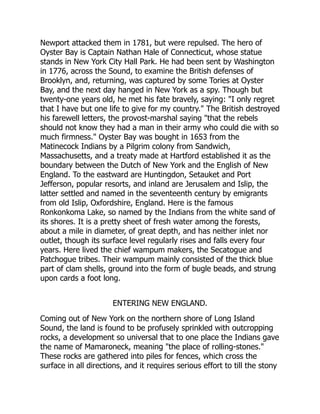
where lived at his home of Cedarmere, for many years, William
Cullen Bryant, who now sleeps in the little cemetery.
William Cullen Bryant at Cedarhurst,
Roslyn
Oyster Bay is deeply indented into the land to the eastward,
surrounded by villas and attractive homes, and beyond protrudes the
broad, high headland of Lloyds' Neck. This was strongly fortified by
the British in the Revolution, and King William IV., then the youthful
Duke of Clarence, was at one time an officer of the garrison. It was
attacked and captured by the Americans who came over from
Connecticut in 1779, the garrison being taken prisoners.
Subsequently the British again took possession, and the French from
40.
Newport attacked themin 1781, but were repulsed. The hero of
Oyster Bay is Captain Nathan Hale of Connecticut, whose statue
stands in New York City Hall Park. He had been sent by Washington
in 1776, across the Sound, to examine the British defenses of
Brooklyn, and, returning, was captured by some Tories at Oyster
Bay, and the next day hanged in New York as a spy. Though but
twenty-one years old, he met his fate bravely, saying: I only regret
that I have but one life to give for my country. The British destroyed
his farewell letters, the provost-marshal saying that the rebels
should not know they had a man in their army who could die with so
much firmness. Oyster Bay was bought in 1653 from the
Matinecock Indians by a Pilgrim colony from Sandwich,
Massachusetts, and a treaty made at Hartford established it as the
boundary between the Dutch of New York and the English of New
England. To the eastward are Huntingdon, Setauket and Port
Jefferson, popular resorts, and inland are Jerusalem and Islip, the
latter settled and named in the seventeenth century by emigrants
from old Islip, Oxfordshire, England. Here is the famous
Ronkonkoma Lake, so named by the Indians from the white sand of
its shores. It is a pretty sheet of fresh water among the forests,
about a mile in diameter, of great depth, and has neither inlet nor
outlet, though its surface level regularly rises and falls every four
years. Here lived the chief wampum makers, the Secatogue and
Patchogue tribes. Their wampum mainly consisted of the thick blue
part of clam shells, ground into the form of bugle beads, and strung
upon cards a foot long.
ENTERING NEW ENGLAND.
Coming out of New York on the northern shore of Long Island
Sound, the land is found to be profusely sprinkled with outcropping
rocks, a development so universal that to one place the Indians gave
the name of Mamaroneck, meaning the place of rolling-stones.
These rocks are gathered into piles for fences, which cross the
surface in all directions, and it requires serious effort to till the stony
41.
land. About twenty-fivemiles from New York is the Byram River, the
Connecticut boundary, the old saying being that New England
stretches from Quoddy Head to Byram River. This original Yankee
land, though the smallest section of the United States, has made the
deepest impress upon the American character. They have not
enjoyed the agricultural advantages of other sections, the bleak
climate, poor soil and lavish distribution of rocks and sterility making
farming hard work with meagre results, so that the chief Yankee
energy has been devoted to the development of manufactures,
literature, commerce and the fisheries; this wonderful race who have
had to practically live by their wits having admirably succeeded.
Crossing Byram River brings us into the Land of Steady Habits,
Connecticut, the Wooden-Nutmeg State, the special home of
Yankee Notions, which gave the country the original personation of
Brother Jonathan in Governor Jonathan Trumbull, who was so
useful to General Washington. Consulting him in many emergencies,
Washington was wont to remark, Let us hear what Brother
Jonathan says, a phrase finally popularly adopted by making him
the national impersonation.
Connecticut has the great Puritan College of the country—Yale—
ruled by the Congregationalists. It has varied manufactures, to which
its abundant water-powers contribute, and in which nearly all its
people are engaged, its methods being largely the inventions of its
own sons, of whom three are prominent—Eli Whitney of the cotton-
gin, Samuel Colt of the revolver, and Charles Goodyear of india-
rubber fame. When De Tocqueville was in America, he was much
impressed by the development of the inventive genius, education
and political force of the State, which he described as a little yellow
spot on the map, and at a dinner he proposed a toast, saying, in his
quaint, broken English: And now for my grand sentiment: Connect-
de-coot—de leetle yellow spot dat make de clock-peddler, de school-
master and de Senator; de first give you time, de second tell you
what to do with him, and de third make your law and civilization.
Connecticut gets more patents proportionately than any other State,
one to eight hundred inhabitants being annually granted; it makes
42.
clocks for allthe world, and leads in india-rubber and elastic goods,
in hardware and myriads of Yankee notions, besides being well in
the front for sewing-machines, arms and war material. It is named
after the chief New England river, and its rugged surface is
diversified by long ridges of hills and deep valleys, running generally
from north to south, being the prolongation of mountain ranges and
intervales that are beyond the northern border. The picturesque
Housatonic comes from the Massachusetts Berkshire hills down
through the western counties; the centre is crossed by the
Connecticut Valley, which has great fertility and beautiful scenery,
while in the eastern section the Quinnebaug River makes a deep
valley, and, flowing into the Thames, seeks the Sound at New
London. These many hills make many streams, all having water-
powers, around which cluster numerous busy factories.
The southwestern town of Connecticut is Greenwich, and in front
Greenwich Point is thrust out into the Sound, while, as the Yankee
land is entered by railway, on a high hill stands the Puritan outpost,
seen from afar—a stately graystone Congregational Church with its
tall spire. The ancient Greenwich village was built on the hillside at
Horse Neck, and it was here, in 1779, that General Putnam swiftly
galloped down the rude rocky stairway leading from the old church,
to get away from the British dragoons, on what has since been
known as Old Put's Hill, and they were too much astonished either
to chase or shoot him. Beyond is Stamford, a busy factory town,
where lived in the eighteenth century Colonel Abraham Davenport,
described as a man of stern integrity and generous benevolence.
He was a legislator, and when, on May 19, 1780, the memorable
Dark Day came in New England, some one, fearing it was the day
of judgment, proposed that the House adjourn. Davenport opposed
it, saying, The day of judgment is either approaching, or it is not; if
it is, I choose to be found doing my duty; I wish therefore that
candles may be brought. This scene has been immortalized by
Whittier. The town of Norwalk is beyond, another nest of busy mills,
spreading upward on the hill-slopes from the Sound. The original
settlers bought from the Indians in 1640 a tract extending one day's
43.
north walk fromthe Sound, and hence the name. Fine oysters are
gathered in the spacious bay, and the people make shoes and hats,
locks and door-knobs. On the lowlands to the eastward the Pequot
Indian nation, once ruling all this part of New England, the name
meaning the destroyers, was finally overpowered in 1637 by the
Colonial troops in the Sasco Swamp, now a cultivated farm, with
almost the only highly fertile land seen in the immediate region.
Most of the Pequots were captured and sold as slaves in the West
Indies. Beyond is tranquil Fairfield, embowered in trees and
introduced by a rubber-factory, its green-bordered streets lined with
cottages, and church-spires rising among the groves, while along the
shore it has the finest beach on Long Island Sound.
BRIDGEPORT, OLD STRATFORD AND MILFORD.
Pequannock, the dark river of the Indians, flows out of the hills to
an inlet of the Sound, where the enormous mills of the active city of
Bridgeport have gathered a population of over fifty thousand people,
in a hive containing some of the world's greatest establishments for
constructing sewing-machines and firearms, building carriages, and
making cutlery, corsets and soaps, while other goods also occupy
attention. The grand Seaside Park esplanade overlooks the harbor,
and towards the north the city stretches up the slopes into Golden
Hill, named from its glittering mica deposits, where magnificent
streets display splendid buildings. When the Pequots were
exterminated in 1637, colonists founded this town, gradually
crowding the Paugusset Indians, who owned the land, into a small
reservation on Golden Hill. The great establishments to-day are the
Wheeler and Wilson and Howe Sewing-Machine Works, Sharp's Rifle
Factory and the Union Metallic Cartridge Company; and Bridgeport is
also the headquarters of the chief American circus. The stately and
high-towered mansion of Waldemere fronts the park, and was the
home of Bridgeport's best-known townsman, the veteran showman,
Phineas T. Barnum. Born in Connecticut, at Bethel, in 1810, he died
at Bridgeport in 1891. He first developed the financial advantages of
44.
amusing the public,and possibly humbugging them on a grand
scale, and by working upon his oft-quoted theory that the people
liked to be humbugged, twice amassed a large fortune. In early life
he wandered over the country earning a precarious livelihood in
various occupations, and in Philadelphia in 1834 began his career as
a showman. He bought for $1000 a colored slave-woman, Joyce
Heth, represented to be the nurse of George Washington and one
hundred and sixty-one years old. From her exhibition his receipts
reached $1500 a week, and she died the next year. In 1842 he
began exhibiting Charles S. Stratton, General Tom Thumb, a native
of Bridgeport, born in 1832, whose size and growth were as usual
until his seventh month, when he had a stature of twenty-eight
inches, and ceased to grow. Barnum exhibited him in the United
States, France and England, and attracted world-wide notoriety.
Barnum started the American fashion of paying extravagant sums to
opera-singers, in 1849 engaging Jenny Lind to sing at one hundred
and fifty concerts in America for $1000 a night, the gross receipts of
a nine months' tour being $712,000. He subsequently had his
fortune swept away through endorsing $1,000,000 notes for a
manufacturing establishment that went down in the panic of 1857.
His fortunes were revived, however; he had museums in the leading
cities, and in his later life had the Greatest Show on Earth, which
set out every spring from Bridgeport. Tom Thumb in 1863 married
Lavinia Warren of Middleboro', Massachusetts, a dwarf like himself,
and he died in 1882.
To the eastward a short distance, and in sharp contrast with active
Bridgeport, is quiet old Stratford, with Stratford Point protruding in
front into the Sound, at the entrance of the stately and placid
Housatonic, which comes down through the meadowland just
beyond the village. Here there are neither watering-place hotel nor
busy factory to disturb the ancient order of things, encumber the
greensward, or encroach upon the sleepy and comfortable houses,
where one may dream away in the twilight, under the shade of
grand trees that are even older than the town. Stratford is much the
same now as when settled by a Puritan colony from Massachusetts
45.
in 1639, theleader and pastor being Adam Blackman, whom Cotton
Mather called a Nazarite purer than snow and whiter than milk.
Across the patches of marshland, adjoining the Housatonic, is
Milford, its half-mile-long stretch of village green neatly enclosed,
and its houses upon the bank of the silvery Wap-o-wang, back of
which spread the wide streets lined by rows of overarching elms. A
colony from Milford in England settled here in 1639 and soon
crowded the Indians off the land, establishing the primitive church,
which was the usual beginning of New England settlements. Then,
true to the American instinct, they proceeded to hold a convention,
the result being the adoption of the following platform:
Voted, That the earth is the Lord's and the fulness thereof.
Voted, That the earth is given to the saints.
Voted, That we are the saints.
They had a good deal of trouble afterwards, both with the Dutch
from New York and the Indians, but the saints ultimately possessed
the earth in peace, and their successors are now making straw hats
for the country.
THE CITY OF ELMS.
The city of New Haven, the most populous in Connecticut, having a
hundred thousand people, is built upon a plain, surrounded by hills,
at the head of a deep bay extending several miles northward from
Long Island Sound. The magnificent elms, arching over the streets
and the Public Green, and grandly rising in stately rows, make the
earliest and the deepest impression upon the visitor. In one of his
most eloquent passages, Henry Ward Beecher said that the elms of
New England are as much a part of her beauty as the columns of the
Parthenon were the glory of its architecture. The grand foliage-
arched avenues of New Haven are unsurpassed elsewhere, so that
they are the crowning glory as well as the constant care of the
townsfolk. Among the finest is the avenue separating the Yale
46.
College grounds fromthe Public Green—a magnificent Gothic aisle of
the richest foliage-covered interlacing boughs. The Indian name for
the region round about New Haven was Quinnepiack, and the placid
Quinnepiack River, coming from the northward, flows through a deep
valley past the towering East Rock into the harbor. Old John
Davenport was the leader and first pastor of the infant colony that
settled here. He was a powerful Anglican parish pastor of London
who had joined the Puritans, and in 1637 was forced to leave for
New England with many of his people. They spent a year in Boston,
but in April, 1638, sailed around Cape Cod to the Sound, and landed
at Quinnepiack, where they laid out a town plan with nine squares
for buildings, surrounding a large central square, the Public Green.
At the foundation, Davenport delivered a most impressive sermon
from the text, Wisdom hath builded her house; she hath hewn out
her seven pillars; and from this came the original scheme of
government for the colony by the seven leading church members,
who were known as the seven pillars. The colony got on well with
the Indians, who revered Davenport, calling him so big study man.
They bought the whole tract of one hundred and thirty square miles
from the Indians for thirteen coats. At first, however, they did not
prosper, their trading ventures proving unfortunate, and they
determined to abandon the place and remove elsewhere, selecting
Jamaica, and afterwards Galloway in Ireland. The ship carrying their
prospectors to Ireland sailed in January, 1647, but was never heard
from afterwards, save when, as the legend has it, the spectre of the
ship sailed into the harbor in the teeth of a head-wind, and when in
full view of the anxious people, it slowly melted into thin air and
vanished. Then they decided to remain, and getting on better, in
1665 united their plantation with that of Connecticut at Hartford,
under the condition that each should be a capital, a compact
observed until 1874, when Hartford was made the sole capital. The
British in July, 1779, attacked and partly burnt and plundered the
town, the Americans galling them by desultory attacks as they
passed through the streets. They captured Rev. Naphtali Daggett,
President of Yale College, musket in hand, and with repeated
bayonet-thrusts forced him to guide them. When he was wearied
47.
and sore fromwounds they asked, Will you fight again? He sturdily
answered, I rather believe I shall if I have an opportunity. Being
forced to pray for the King, he did it thus: O Lord, bless thy servant
King George, and grant him wisdom, for thou knowest, O Lord, he
needs it.
The great fame of New Haven comes from Yale College, having two
hundred and fifty instructors and over twenty-five hundred students,
the orthodox Congregational University of New England, which for
two centuries has exerted a most advantageous and widely diffused
influence upon the American intellectual character, and around it and
its multitude of buildings of every kind clusters the town. In the year
1700 ten clergymen planned to have a college in the colony of
Connecticut, and for the purpose contributed as many books as they
could spare for its library. In 1701 it was chartered, and began in a
very small way at Saybrook, at the mouth of Connecticut River,
during the first year having only one student. The pastor of the
adjacent village of Killingworth was placed in charge, and for several
years the students went there to him, though the commencements
were held at Saybrook, and in 1707 the college was located at
Saybrook. Subsequently, for a more convenient location, it was
removed to New Haven, the first commencement being held there in
1718, and its first building being named Yale College, in honor of
Elihu Yale, a native of the town, born in 1648, who went abroad, and
afterwards became Governor of the East India Company. He made at
different times gifts of books and money amounting to about five
hundred pounds sterling, the benefactions being of greater value
because of their timeliness. His name was afterwards adopted in the
incorporation of the university. Timothy Dwight and Theodore D.
Woolsey were perhaps the greatest Presidents of Yale, and among
its graduates were Jonathan Edwards, Eli Whitney, Samuel F. B.
Morse, Benjamin Silliman, Noah Webster, John C. Calhoun, J.
Fenimore Cooper, James Kent, William M. Evarts, John Pierpont and
Samuel J. Tilden. The College buildings are of various ages and
styles of architecture, the original ones being the plain Old Brick
Row on College Street, northwest of the Public Green, behind which
48.
what was formerlya large open space has been gradually covered
with more modern structures. The line of ancient buildings facing
the Green has a venerable and scholarly aspect, stretching broadly
across the greensward, fronted by noble elms arranged in quadruple
lines along the street. One of these houses, Connecticut Hall, was
built with money raised by a lottery, and from the proceeds of a
French prize-ship in the colonial wars, when Connecticut aided the
King by equipping a frigate. There are on the campus statues of the
first rector, Abraham Pierson, President Woolsey and Professor
Silliman. Various elaborate buildings are also upon adjacent grounds,
such as the Peabody Museum, the Sheffield Scientific School, of four
halls; the Divinity Halls, Observatory, Laboratory and Gymnasium,
while the entrance to the campus from the Public Green is by an
imposing tower-gateway known as Phelps Hall. The Peabody
Museum has one of the best natural-history collections in the
country, and the College Library approximates three hundred
thousand volumes. Besides the Academic Department, Yale has
schools of Science, Law, Medicine, Theology and the Fine Arts, and
its properties and endowments exceed $10,000,000, the grounds
occupying nine acres.
NEW HAVEN ATTRACTIONS.
But New Haven is much more than Yale College. It is a great hive of
industry, manufacturing all kinds of Yankee notions, with
agricultural machinery, corsets, scales, organs, pianos, carriages,
hardware and other things, and it has a large commerce along the
coast and with the West Indies. It was to New Haven that the first
steamboat navigating Long Island Sound went from New York in
March, 1815, the Fulton, which occupied eleven hours in going
there, and fifteen hours in returning two days later, being delayed by
fog, subsequently, however, making the trip in less time. This boat
was constructed by Robert Fulton, and carried a figure-head of him
on her bow. She was one hundred and thirty-four feet long, and of
three hundred and twenty-seven tons, built with a keel like a ship,
49.
having a sloopbow, and being rigged with one mast and sails to
accelerate her speed. She was managed by Elihu S. Bunker, and her
ability to pass through Hell Gate against a tide running six miles an
hour was regarded as one of the marvels of that time. The New York
Evening Post of March 25, 1815, describing her, said, We have been
assured that this establishment has cost $90,000, and we believe it
may with truth be affirmed that there is not in the whole world such
accommodations afloat as the Fulton affords. Indeed, it is hardly
possible to conceive that anything of the kind can exceed her in
elegance and convenience. Many were the races she had with the
packet-sloops that plied on the Sound and often beat her, when
the wind was fair.
There are tastefully adorned suburbs surrounding New Haven, where
the hills afford charming prospects. The two great attractions,
however, are the bold and impressive promontories known as the
East and West Rocks, which are high buttresses of trap rock, lifting
themselves from the plain on each side of the town in magnificent
opposition, and rising four hundred feet. The geologists say they
were driven up through the other strata, and some people think
these grim precipices in remote ages may have sentinelled the
outflow of the Connecticut River, between their broad and solid
bases, to the Sound. Each tremendous cliff is the termination of a
long mountain range coming down from the far North. The Green
Mountain prolongation, stretching through ridges southward from
Vermont, is represented in the West Rock, while the East Rock
terminates the Mount Tom range, through which the Connecticut
River breaks its passage in Massachusetts, and part of which rises a
thousand feet in the Blue Hills of Southington, which are the most
elevated portion of Connecticut. Thus projected out upon the plain,
almost to Long Island Sound, the summits of these two huge rocks
afford grand views. In the Judge's Cave, a small cleft in a group of
boulders on the West Rock, the three regicides, Goffe, Whalley and
Dixwell were in hiding for some time in 1661, and the three streets
leading out to this rock from the city are named after them. It is
recorded that a man living about a mile away took them food until
50.
one night acatamount looked in on them, and blazed his eyes in
such a frightful manner as greatly to terrify them. Dixwell's bones
repose upon the Public Green at the back of the Centre Church,
which stands in the row of three churches occupying the middle of
the Green that was the graveyard of colonial New Haven, and
Whalley is buried nearby.
There is a grand approach to the East Rock, which is elevated high
above the marshy valley of Mill River, winding about its base, and
upon the topmost crag is a noble monument reared to the soldiers
who fell in the Civil War. The whole surface of the East Rock is a
park, and upon the face of the cliff the perpendicular strata of
reddish-brown trap stand bolt upright. From this elevated outpost
there is a charming view over the town spreading upon the flat
plain, and the little harbor stretching down to the Sound; and
beyond, across the silvery waters, can be traced the hazy hills of
Long Island, twenty-five miles away. Two little crooked rivers come
out of the deep valleys on either side of the great rock, winding
through the town to the harbor, while all about, the country is dotted
with flourishing villages. Among them is Wallingford, to which the
railway leads northeast amid meadows and brickyards until it
reaches the high hill, whose church-towers watch over the
population, largely composed of plated-ware makers. When this
town was founded, John Davenport came out from New Haven and
preached the initial sermon from the appropriate text, My beloved
hath a vineyard on a very fruitful hill.
Hillhouse Avenue, a broad and beautiful elm-shaded street bordered
by fine mansions, leads out to the Sachem's Wood, which was the
home of the Hillhouses, of whom James Hillhouse was the great
Connecticut Senator after the Revolution. His remains repose in the
old Grove Street Burying-Ground, where rest many other famous
men of the Academic City, among them Timothy Dwight, Lyman
Beecher, Samuel F. B. Morse, Benjamin Silliman, Elbridge Gerry,
Roger Sherman, of whom Jefferson wrote that he never said a
foolish thing in his life, Eli Whitney, and Noah Webster, who, before
51.
he compiled hisfamous dictionary, had published the Elementary
Spelling Book, which had a sale of fifty millions of copies. The New
Haven City Hall, fronting the Green, is one of the finest municipal
buildings in New England. The three churches occupying the centre
of the Green are the North, the Centre, and Trinity churches, the first
two Congregationalist and the last Episcopal, the row presenting a
curiously quaint and ancient appearance. The favorite resort of the
people of New Haven is Savin Rock, a promontory four miles away,
pushing a rocky front to the Sound at the end of a long sandy
beach, and having a good view, being located westward from the
harbor entrance.
OLD SAYBROOK.
The Connecticut River flows into Long Island Sound thirty-three
miles east of New Haven at Saybrook Point. Between is the
venerable village of Guilford, where Fitz Greene Halleck was born,
and where the three regicides were also for some time hidden. Out
in front is the bold and picturesque Sachem's Head, which got its
name from a tragedy of the Pequot War in 1637. The Mohican chief
Uncas pursued a Pequot warrior out on this point, and shooting him,
put his head in the fork of an oak tree, where it remained many
years. The group of Thimble Islands are off shore, having been
repeatedly dug over by deluded individuals searching for the buried
treasures of Captain Kidd. Saybrook Point was the place of earliest
settlement in Connecticut. The first English patent for lands on these
coasts was granted to Lord Saye and Seal and Lord Brooke, and the
colony was given their double name. The original settlement was
planned with great care, as it was expected to become the home of
noted men, and a fort was built on an isolated hill at the river's
mouth. According to the British historian, it was to Saybrook that
Cromwell, Pym, Hampden and Haselrig, with their party of
malcontents, intended to emigrate when they were stopped by the
order of King Charles I. Had this migration been made, it might have
greatly changed the subsequent momentous events in England
52.
Welcome to ourwebsite – the ideal destination for book lovers and
knowledge seekers. With a mission to inspire endlessly, we offer a
vast collection of books, ranging from classic literary works to
specialized publications, self-development books, and children's
literature. Each book is a new journey of discovery, expanding
knowledge and enriching the soul of the reade
Our website is not just a platform for buying books, but a bridge
connecting readers to the timeless values of culture and wisdom. With
an elegant, user-friendly interface and an intelligent search system,
we are committed to providing a quick and convenient shopping
experience. Additionally, our special promotions and home delivery
services ensure that you save time and fully enjoy the joy of reading.
Let us accompany you on the journey of exploring knowledge and
personal growth!
ebookluna.com