Case Management
Objectives: Define case management Describe role of case manager Reasons for referral to case management How to obtain the best in case management Discuss other services offered by CM
Case Management Case management is the collaborative process of assessment, planning, facilitation and advocacy for options and services to meet an individual's health needs through communication and available resources to promote quality cost-effective outcomes.
Premise When an individual reaches the optimum level of wellness and functional capability… EVERYONE BENEFITS
Types of Case Management Telephonic On-site Combined Field Assignment (typical) Task Assignment (specific)
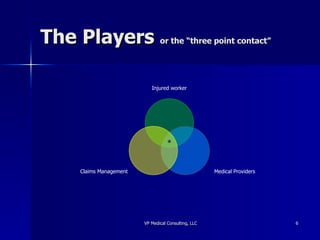
The Players  or the “three point contact” * Injured worker Medical Providers Claims Management
Goals: Achieve wellness through advocacy Communication Education Identification of resources Service facilitation Cost containment
Advocacy Active support of an idea or cause etc.; especially the act of pleading or arguing for something  Clear expression of support for the rights of another Representing the cause or interest of another, even if that cause or interest does not necessarily coincide with one's own beliefs, opinions, conclusions, or recommendations
Communication The exchange of information  The exchange of ideas, opinions and information through written or spoken words, symbols or actions  Reciprocal sharing with individuals of written, oral and non-verbal information according to a common set of rules (e.g. language).
Education The activities of educating or instructing; activities that impart knowledge or skill  Knowledge acquired by learning and instruction The profession of teaching
Identify Resources Assets available and anticipated for operations. They include people, equipment, facilities and other things used to plan, implement, and evaluate programs A source of supply or support, the means of meeting a need or deficiency, especially an economic or social need or deficiency
Facilitation A guided process of decision-making which  insures that all affected individuals and groups are involved in a meaningful way and that the decisions are based on their input and made to achieve their mutual interests.  Act of assisting or making easier the progress or improvement of something
Cost Containment A wide variety of strategies or methods whose primary goal is to control the rising cost of health care, thus making health care more affordable.  Features in a plan of benefits or in the administration of a plan designed to reduce or eliminate certain charges to the plan
Reasons for referral To obtain definitive diagnosis  Causal relationship of treatment is undetermined  Illusion of sufficient medical care without resolution  Long standing pre-existing conditions prolonging disability  Complicated diagnoses; diagnosis/prognosis without progress  Two or more conditions related or unrelated to the work injury  Claimants seeing several physicians or frequent emergency room visits  Need for medical reports and coordination of services for timely conclusion  To establish causal relationship between a work injury and current condition
Continued…. Prolonged conditions that may or may not need surgery  No medical reports  Conflicting reports and/or extended disability without apparent medical cause  Prolonged medical care when the injured worker is able to return to work  Documentation insufficient to return claimants to work or support disability  Jobs which are inappropriate to sustain attendance at work  Return to work difficulties because of unresolved medical conditions  To prevent employer and employee misunderstandings regarding return to work  Employment with a new company as disability continues  Claimants suspected of working while on workers' compensation disability
Goal:  Return to Work The major factor in returning to work is: Self-employment Good Management of WC claims Workers involvement If an employee is not involved there is a significant increase in the probability of their becoming disabled.
Qualities Available Experienced Certification Background in ortho/neuro/occ med Familiar with Job or Worksite Rapport with many specialists Familiar with WC laws-state specific
Outlining Expectations Tell them what you expect Insist they visit the job site at least once (no charge) Be proactive not reactive Next scheduled work day
Other Services Ergonomic Assessment  Life Care Planning (CNLCP vs. CLCP) Medicare Set-Aside Vocational Management
ISSUES Muscle strains “Limited use” or “minimal use” of limb Operations job description Company doctors Obtaining medical reports Communication-plant, PMA, TPA, etc. Employee vs. physician report
QUESTIONS?
THANK YOU! Victoria Powell RN, CCM, CNLCP, ALNC, CEAS II VP Medical Consulting, LLC Benton, Arkansas www.VP-Medical.com

Case Management

  • 1.
  • 2.
    Objectives: Define casemanagement Describe role of case manager Reasons for referral to case management How to obtain the best in case management Discuss other services offered by CM
  • 3.
    Case Management Casemanagement is the collaborative process of assessment, planning, facilitation and advocacy for options and services to meet an individual's health needs through communication and available resources to promote quality cost-effective outcomes.
  • 4.
    Premise When anindividual reaches the optimum level of wellness and functional capability… EVERYONE BENEFITS
  • 5.
    Types of CaseManagement Telephonic On-site Combined Field Assignment (typical) Task Assignment (specific)
  • 6.
    The Players or the “three point contact” * Injured worker Medical Providers Claims Management
  • 7.
    Goals: Achieve wellnessthrough advocacy Communication Education Identification of resources Service facilitation Cost containment
  • 8.
    Advocacy Active supportof an idea or cause etc.; especially the act of pleading or arguing for something Clear expression of support for the rights of another Representing the cause or interest of another, even if that cause or interest does not necessarily coincide with one's own beliefs, opinions, conclusions, or recommendations
  • 9.
    Communication The exchangeof information The exchange of ideas, opinions and information through written or spoken words, symbols or actions Reciprocal sharing with individuals of written, oral and non-verbal information according to a common set of rules (e.g. language).
  • 10.
    Education The activitiesof educating or instructing; activities that impart knowledge or skill Knowledge acquired by learning and instruction The profession of teaching
  • 11.
    Identify Resources Assetsavailable and anticipated for operations. They include people, equipment, facilities and other things used to plan, implement, and evaluate programs A source of supply or support, the means of meeting a need or deficiency, especially an economic or social need or deficiency
  • 12.
    Facilitation A guidedprocess of decision-making which insures that all affected individuals and groups are involved in a meaningful way and that the decisions are based on their input and made to achieve their mutual interests. Act of assisting or making easier the progress or improvement of something
  • 13.
    Cost Containment Awide variety of strategies or methods whose primary goal is to control the rising cost of health care, thus making health care more affordable. Features in a plan of benefits or in the administration of a plan designed to reduce or eliminate certain charges to the plan
  • 14.
    Reasons for referralTo obtain definitive diagnosis Causal relationship of treatment is undetermined Illusion of sufficient medical care without resolution Long standing pre-existing conditions prolonging disability Complicated diagnoses; diagnosis/prognosis without progress Two or more conditions related or unrelated to the work injury Claimants seeing several physicians or frequent emergency room visits Need for medical reports and coordination of services for timely conclusion To establish causal relationship between a work injury and current condition
  • 15.
    Continued…. Prolonged conditionsthat may or may not need surgery No medical reports Conflicting reports and/or extended disability without apparent medical cause Prolonged medical care when the injured worker is able to return to work Documentation insufficient to return claimants to work or support disability Jobs which are inappropriate to sustain attendance at work Return to work difficulties because of unresolved medical conditions To prevent employer and employee misunderstandings regarding return to work Employment with a new company as disability continues Claimants suspected of working while on workers' compensation disability
  • 16.
    Goal: Returnto Work The major factor in returning to work is: Self-employment Good Management of WC claims Workers involvement If an employee is not involved there is a significant increase in the probability of their becoming disabled.
  • 17.
    Qualities Available ExperiencedCertification Background in ortho/neuro/occ med Familiar with Job or Worksite Rapport with many specialists Familiar with WC laws-state specific
  • 18.
    Outlining Expectations Tellthem what you expect Insist they visit the job site at least once (no charge) Be proactive not reactive Next scheduled work day
  • 19.
    Other Services ErgonomicAssessment Life Care Planning (CNLCP vs. CLCP) Medicare Set-Aside Vocational Management
  • 20.
    ISSUES Muscle strains“Limited use” or “minimal use” of limb Operations job description Company doctors Obtaining medical reports Communication-plant, PMA, TPA, etc. Employee vs. physician report
  • 21.
  • 22.
    THANK YOU! VictoriaPowell RN, CCM, CNLCP, ALNC, CEAS II VP Medical Consulting, LLC Benton, Arkansas www.VP-Medical.com

Editor's Notes

  • #2 Workers compensation legislation was the first US no fault legislation. Before 1911, injured workers had to prove employer responsibility. However the average workers could not afford the cost of the case plus ongoing medical care. As industry grew, so did injuries. Today’s system of disability management and case management combined with preventive safety programs has evolved over a 30 year period, beginning with federal recommendations in 1972. Before nurse case managers, the system was fragmented and riddled with escalating medical costs. The job title of “workers’ compensation case manager” is the most common, but others exist, such as “disability management coordinator” or “injury management facilitator.” Whatever the name, the employment requirements are similar; the nurse case manager is present for the worker as “a means for achieving client wellness through advocacy, communication, education, identification of service resources, and service facilitation
  • #5 The Bureau of Labor Statistics’ 2002 figures show close to 5 million recorded cases of nonfatal workplace injuries and illnesses. The largest category of cases, 13%, included sprains, strains, and tears. This was followed by injuries to the back at 7%.3 Slips and falls, respiratory problems, highway incidents, and even dermatitis are examples of other recorded injuries. The toll in lost productivity was more than 1.4 million days away from work. 3 Enter the nurse. When a nurse case manager is involved, days away from work, or “lost time,” can be reduced without affecting quality of care. Care often is enhanced by the expertise the nurse brings to the case. Nurses who become case managers in workers’ compensation come from varied backgrounds. According to the Commission for Case Manager Certification, “Case management is not a profession in itself but rather an area of practice within one’s profession; it is collaborative and transdisciplinary in nature.” 4 Typically, nurses bring experience in occupational health, managed care, discharge planning, and home health to this position.
  • #6 A telephonic case manager contacts all involved parties by phone, letter, or fax. On-site case managers visit injured employees and their workplaces and attend physician and treatment appointments. The combined method applies both telephonic and on-site techniques. The telephonic approach relies on the cooperation of providers, the employer, and the injured worker. Often, the caseload is larger because the case manager doesn’t leave an office setting. To obtain the information necessary and achieve goals, a nurse case manager must possess a strong clinical background and use interpersonal skills that relate well telephonically. The on-site approach requires face-to-face interaction. The caseload may be lighter because of the demands of frequent travel and the need to attend appointments. Strong clinical skills also are important, and the nurse needs to be able to create successful relationships dealing directly with workers, employers, and providers. The combined method is just that: The caseload is a mixture of each type. Simpler, straightforward cases remain telephonic when the goals can be met in this manner. Files that are complex, possibly with catastrophic circumstances, may be managed with on-site visitation. Often, insurers use a combined approach to meet the varied needs of their clients.
  • #7 The nurse case manager is at the center and an active contributing member of three interacting groups. One group…claims management and is made up of a claims adjuster defense counsel, loss control, or underwriters. This is also where the employer is involved which may include safety manager, HR, team leader and more. Another team is the medical providers such as company physician, specialists, therapist, DME providers, etc. “ three-point contact,” the basis of your daily workflow. teams interact regularly. For example, the worker needs payment information and speaks with the adjuster. The adjuster calls the employer about weekly wages. The case manager obtains documentation from the provider on medical necessity and discusses authorizations with the adjuster. Most important, the case manager maintains consistent collaborative contact with the injured worker, employer, and provider to promote a safe and timely return to work. Communication and cooperation are essential, and the case manager is the link. If issues exist between employer and employee about when the employee should return to work, the case manager may be able to mediate. The case manager can expedite care and treatment and act as an advocate for the worker. The adjuster tries to determine causation, contributing factors, or compensability. This contact, performed within 24 to 48 hours of claim notification, is a requirement of many commercial insurers for their adjusters. 5 The nurse case manager’s “three-point contact” deals with other issues. Specifically, the goal of case management is to “assess barriers to return to work, communicate with the employer and provide education on the positive effects of returning the injured worker to work; address medical concerns that may prevent return to work; and coordinate the return to work process.” 6 A referral for case management can occur at any time during the life of a claim. Generally, sources of a referral are the employer, the claims adjuster, or the injured employee.
  • #9 Ronnie Godwin Empathy for the injured worker; to prevent litigation; doc won’t allow CM in exam room
  • #10 Employer could not accommodate light duty work and was supposedly off, but claimant reported in conversation that he had taken a part time job. He was getting paid by both the comp carrier and his new job. Oleta Lance-disabled husband and son and she is the caregiver
  • #11 Donna McWhorter-early on because of my experience I already knew she wasn’t going to be a candidate for surgery and she didn’t need to be at Conestoga; without me she would keep trying to come back and hurt her and the company in the long run.
  • #12 Guy got cut on machinery; diabetic, no health insurance; diabetes education and supplies
  • #13 Charles Gilpin-camped out on the step at Dr. Moore’s office and ended up having surgery same day. Out of towners that we do multiple tests and appts in single day.
  • #14 Nurse helping to identify what is compensable and what is not; Marie Juarrequi; guy was run over by forklift and had surgery six months ago; leg pain gone and pt states his neck and shoulders are killing him. Nurse tells doctor there is no mention of the shoulder or neck problem and was denied Dystonia-Debra Buroughs-hands numb even while off work after bilateral carpal tunnel surgery Price negotiations for DME equipment. Gym membership rather than physical therapy. DME rental versus rental. Savings on mileage, and lost time
  • #18 Reliable Good communication skills Flexibility Multi task and task oriented Knowledgeable about the work comp laws
  • #21 Primary doctors are not as familiar with our working environment-Conestoga recommended that they review the work environment. Going with the patient and explaining the environmental conditions and using the operational job description I really like the document you developed to send with the employee identifying work requirements along with pictures. Freda Love Human Resources Manager Kenly, NC  27542 Once the specialists get involved, getting appointments setup causes lost time Getting notes from the specialist are major issues.  - get nurse then the notes aren’t an issue  Communication breaks down a lot between PMA/Specialist/us(the employer) Employees don’t always tell you the same thing that the doctors note has.  Beverly Jacovitch Conestoga Wood I get frustrated with a return to work with dumb restrictions like" minimal use" or limited use" of a limb. –create your own return to work note ART form!! Holly Catlin Beavertown, PA 17813 Takes a few days to maybe one week to get them in.  The problem I have this year is with issues with muscle strains.  2-4 wks therapy, anti-inflam and rest-if not working then refer out; -while you are at it check to see if the injuries are coming from the same area, if so stop it before it develops by using ergonomic studies Gerald Ivy