

Doheny Eye Institute Grand Rounds Ying Pan, MD
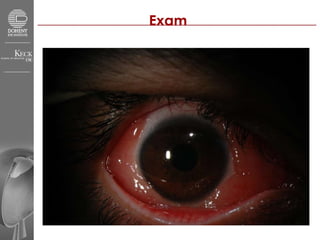
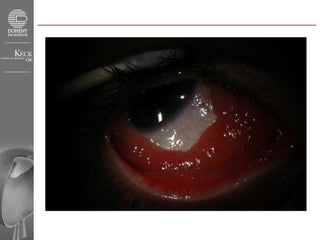
History of Present Illness CC: 8 months of  progressively enlarging growth in right eye   HPI:  24 year old Hispanic man from jail presented with increasing right eye redness since he was kicked in the eye 8 months ago.  +Ocular irritation and foreign body sensation, but denied discharge, bleeding, pain or changes in vision. His symptoms did not improve with  topical drops and ointments.
History POH:none PMH: none PSH: none   Meds: none NKDA SH: Jail for 1 year   FH: unremarkable   ROS: 10 LB weight loss, occasional night sweats
Exam VA: 20/25 OU Pupils: Round and reactive to light, no APD Motility: Full OU IOP (Tp): 12 OD , 15 OS CVF: Full OU
Exam
Exam


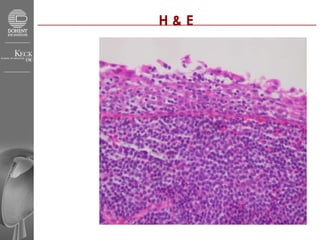
H & E
H & E
H & E
Immunohistochemical staining    CD 3 (T cell)  CD 20 (B cell)
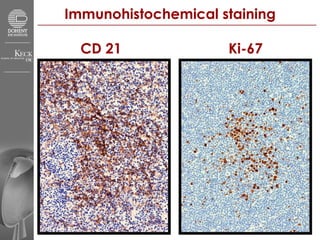
Immunohistochemical staining     CD 21  Ki-67
Mucosa-Associated Lymphatic Tissue characteristic arrangement of lymphoid tissues in the mucosa conjunctiva-associated lymphoid tissue  -minimal organized lymphatic tissue -small number of lymphocytes   -few mast cells & langerhans cells
MALT  Lymphoma spectrum from benign hyperplasia to malignant lymphoma   common site: gastrointestinal tract extraintestinal locations: tonsils, skin, breast, lung, orbit
Conjunctival MALT  Lymphoma Mainly occurs in the fifth to sixth decades   Bilateral involvement:   20%  Systemic disease: 30% 117 conjunctival lymphoid tumors  (Shields et al. Ophthalmology 2001)  unilateral disease: 11 of 64 (17%)  bilateral disease: 25 of 53  (47%)  Favorable prognosis  Minimally aggressive  Localize course Favorable response to treatment  Recurrence
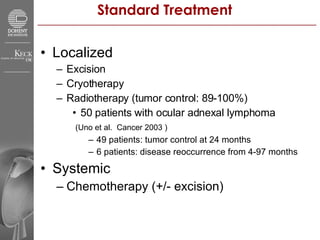
Standard Treatment  Localized Excision Cryotherapy Radiotherapy (tumor control: 89-100%) 50 patients with ocular adnexal lymphoma ( Uno et al.  Cancer 2003  ) 49 patients: tumor control at 24 months 6 patients: disease reoccurrence from 4-97 months Systemic Chemotherapy (+/- excision)
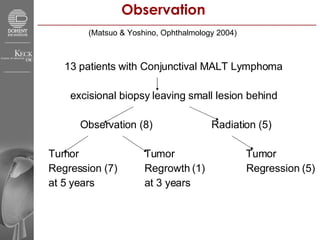
Observation  ( Matsuo & Yoshino, Ophthalmology 2004)   13 patients with Conjunctival MALT Lymphoma   excisional biopsy leaving small lesion behind Observation (8)  Radiation (5) Tumor   Tumor   Tumor Regression (7) Regrowth (1)    Regression (5) at 5 years at 3 years
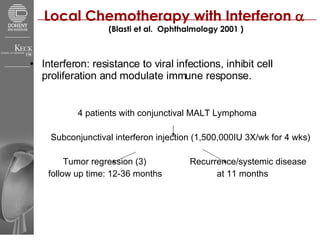
Local Chemotherapy with Interferon     ( Blasti et al.  Ophthalmology 2001  ) Interferon: resistance to viral infections, inhibit cell proliferation and modulate immune response. 4 patients with conjunctival MALT Lymphoma Subconjunctival interferon injection (1,500,000IU 3X/wk for 4 wks) Tumor regression (3) Recurrence/systemic disease follow up time: 12-36 months   at 11 months
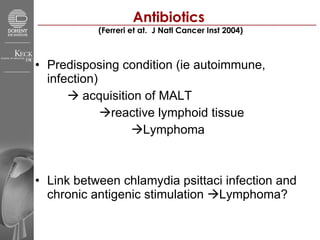
Antibiotics   ( Ferreri et at.  J Natl Cancer Inst 2004 ) Predisposing condition (ie autoimmune, infection)    acquisition of MALT  reactive lymphoid tissue  Lymphoma Link between  chlamydia psittaci infection and chronic antigenic stimulation   Lymphoma?
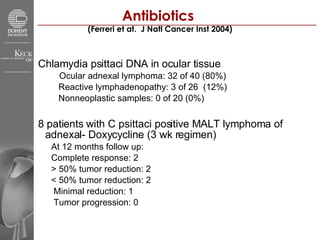
Antibiotics   ( Ferreri et at.  J Natl Cancer Inst 2004 ) Chlamydia psittaci DNA in ocular tissue Ocular adnexal lymphoma: 32 of 40 (80%) Reactive lymphadenopathy: 3 of 26  (12%) Nonneoplastic samples: 0 of 20 (0%) 8 patients with C psittaci positive MALT lymphoma of adnexal- Doxycycline (3 wk regimen) At 12 months follow up:  Complete response: 2 > 50% tumor reduction: 2 < 50% tumor reduction: 2 Minimal reduction: 1 Tumor progression: 0
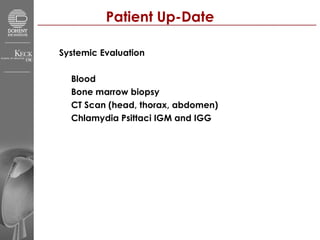
Patient Up-Date Systemic Evaluation Blood Bone marrow biopsy CT Scan (head, thorax, abdomen) Chlamydia Psittaci IGM and IGG
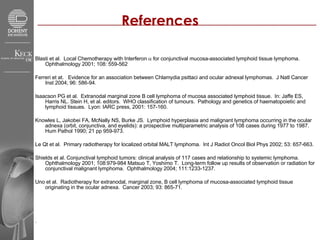
References Blasti et al.  Local Chemotherapy with Interferon    for conjunctival mucosa-associated lymphoid tissue lymphoma.  Ophthalmology 2001; 108: 559-562  Ferreri et at.  Evidence for an association between Chlamydia psittaci and ocular adnexal lymphomas.  J Natl Cancer Inst 2004; 96: 586-94.   Isaacson PG et al.  Extranodal marginal zone B cell lymphoma of mucosa associated lymphoid tissue.  In: Jaffe ES, Harris NL. Stein H, et al. editors.  WHO classification of tumours.  Pathology and genetics of haematopoietic and lymphoid tissues.  Lyon: IARC press, 2001: 157-160.   Knowles L, Jakobei FA, McNally NS, Burke JS.  Lymphoid hyperplasia and malignant lymphoma occurring in the ocular adnexa (orbit, conjunctiva, and eyelids): a prospective multiparametric analysis of 108 cases during 1977 to 1987.  Hum Pathol 1990; 21 pp 959-973. Le Qt et al.  Primary radiotherapy for localized orbital MALT lymphoma.  Int J Radiot Oncol Biol Phys 2002; 53: 657-663. Shields et al. Conjunctival lymphoid tumors: clinical analysis of 117 cases and relationship to systemic lymphoma. Ophthalmology 2001; 108:979-984 Matsuo T, Yoshimo T.  Long-term follow up results of observation or radiation for conjunctival malignant lymphoma.  Ophthalmology 2004; 111:1233-1237.   Uno et al.  Radiotherapy for extranodal, marginal zone, B cell lymphoma of mucosa-associated lymphoid tissue originating in the ocular adnexa.  Cancer 2003; 93: 865-71.       .

Conjunctival MALT Lymphoma

  • 1.
    Doheny Eye InstituteGrand Rounds Ying Pan, MD
  • 2.
    History of PresentIllness CC: 8 months of progressively enlarging growth in right eye HPI: 24 year old Hispanic man from jail presented with increasing right eye redness since he was kicked in the eye 8 months ago. +Ocular irritation and foreign body sensation, but denied discharge, bleeding, pain or changes in vision. His symptoms did not improve with topical drops and ointments.
  • 3.
    History POH:none PMH:none PSH: none Meds: none NKDA SH: Jail for 1 year FH: unremarkable ROS: 10 LB weight loss, occasional night sweats
  • 4.
    Exam VA: 20/25OU Pupils: Round and reactive to light, no APD Motility: Full OU IOP (Tp): 12 OD , 15 OS CVF: Full OU
  • 5.
  • 6.
  • 7.
  • 8.
  • 9.
  • 10.
  • 11.
  • 12.
  • 13.
    Immunohistochemical staining CD 3 (T cell) CD 20 (B cell)
  • 14.
  • 15.
    Mucosa-Associated Lymphatic Tissuecharacteristic arrangement of lymphoid tissues in the mucosa conjunctiva-associated lymphoid tissue -minimal organized lymphatic tissue -small number of lymphocytes -few mast cells & langerhans cells
  • 16.
    MALT Lymphomaspectrum from benign hyperplasia to malignant lymphoma common site: gastrointestinal tract extraintestinal locations: tonsils, skin, breast, lung, orbit
  • 17.
    Conjunctival MALT Lymphoma Mainly occurs in the fifth to sixth decades Bilateral involvement: 20% Systemic disease: 30% 117 conjunctival lymphoid tumors (Shields et al. Ophthalmology 2001) unilateral disease: 11 of 64 (17%) bilateral disease: 25 of 53 (47%) Favorable prognosis Minimally aggressive Localize course Favorable response to treatment Recurrence
  • 18.
    Standard Treatment Localized Excision Cryotherapy Radiotherapy (tumor control: 89-100%) 50 patients with ocular adnexal lymphoma ( Uno et al. Cancer 2003 ) 49 patients: tumor control at 24 months 6 patients: disease reoccurrence from 4-97 months Systemic Chemotherapy (+/- excision)
  • 19.
    Observation (Matsuo & Yoshino, Ophthalmology 2004) 13 patients with Conjunctival MALT Lymphoma excisional biopsy leaving small lesion behind Observation (8) Radiation (5) Tumor Tumor Tumor Regression (7) Regrowth (1) Regression (5) at 5 years at 3 years
  • 20.
    Local Chemotherapy withInterferon  ( Blasti et al. Ophthalmology 2001 ) Interferon: resistance to viral infections, inhibit cell proliferation and modulate immune response. 4 patients with conjunctival MALT Lymphoma Subconjunctival interferon injection (1,500,000IU 3X/wk for 4 wks) Tumor regression (3) Recurrence/systemic disease follow up time: 12-36 months at 11 months
  • 21.
    Antibiotics ( Ferreri et at. J Natl Cancer Inst 2004 ) Predisposing condition (ie autoimmune, infection)  acquisition of MALT  reactive lymphoid tissue  Lymphoma Link between chlamydia psittaci infection and chronic antigenic stimulation  Lymphoma?
  • 22.
    Antibiotics ( Ferreri et at. J Natl Cancer Inst 2004 ) Chlamydia psittaci DNA in ocular tissue Ocular adnexal lymphoma: 32 of 40 (80%) Reactive lymphadenopathy: 3 of 26 (12%) Nonneoplastic samples: 0 of 20 (0%) 8 patients with C psittaci positive MALT lymphoma of adnexal- Doxycycline (3 wk regimen) At 12 months follow up: Complete response: 2 > 50% tumor reduction: 2 < 50% tumor reduction: 2 Minimal reduction: 1 Tumor progression: 0
  • 23.
    Patient Up-Date SystemicEvaluation Blood Bone marrow biopsy CT Scan (head, thorax, abdomen) Chlamydia Psittaci IGM and IGG
  • 24.
    References Blasti etal. Local Chemotherapy with Interferon  for conjunctival mucosa-associated lymphoid tissue lymphoma. Ophthalmology 2001; 108: 559-562 Ferreri et at. Evidence for an association between Chlamydia psittaci and ocular adnexal lymphomas. J Natl Cancer Inst 2004; 96: 586-94.   Isaacson PG et al. Extranodal marginal zone B cell lymphoma of mucosa associated lymphoid tissue. In: Jaffe ES, Harris NL. Stein H, et al. editors. WHO classification of tumours. Pathology and genetics of haematopoietic and lymphoid tissues. Lyon: IARC press, 2001: 157-160.   Knowles L, Jakobei FA, McNally NS, Burke JS. Lymphoid hyperplasia and malignant lymphoma occurring in the ocular adnexa (orbit, conjunctiva, and eyelids): a prospective multiparametric analysis of 108 cases during 1977 to 1987. Hum Pathol 1990; 21 pp 959-973. Le Qt et al. Primary radiotherapy for localized orbital MALT lymphoma. Int J Radiot Oncol Biol Phys 2002; 53: 657-663. Shields et al. Conjunctival lymphoid tumors: clinical analysis of 117 cases and relationship to systemic lymphoma. Ophthalmology 2001; 108:979-984 Matsuo T, Yoshimo T. Long-term follow up results of observation or radiation for conjunctival malignant lymphoma. Ophthalmology 2004; 111:1233-1237.   Uno et al. Radiotherapy for extranodal, marginal zone, B cell lymphoma of mucosa-associated lymphoid tissue originating in the ocular adnexa. Cancer 2003; 93: 865-71.       .