MALABSOPTION IN CHILDREN
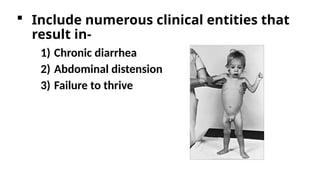
๏‚ง Include numerous clinical entities that
result in-
1) Chronic diarrhea
2) Abdominal distension
3) Failure to thrive
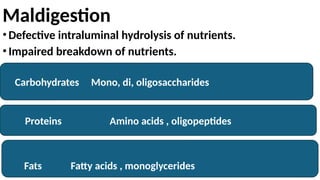
Maldigestion
โ€ขDefective intraluminal hydrolysis of nutrients.
โ€ขImpaired breakdown of nutrients.
Carbohydrates Mono, di, oligosaccharides
Proteins Amino acids , oligopeptides
Fats Fatty acids , monoglycerides
Malabsorption : Defective mucosal uptake and transport
of digested nutrients, vitamins, minerals.
โ€ขMechanisms of malabsorption :
โ€ข The integrated processes of digestion and absorption can be
described in three phases:
Luminal phase
Mucosal phase
Postabsorptive/Removal phase
โ€ข Disturbances of absorptive process can take place in any of
these three phases
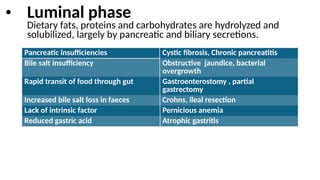
โ€ข Luminal phase
Dietary fats, proteins and carbohydrates are hydrolyzed and
solubilized, largely by pancreatic and biliary secretions.
Pancreatic insufficiencies Cystic fibrosis, Chronic pancreatitis
Bile salt insufficiency Obstructive jaundice, bacterial
overgrowth
Rapid transit of food through gut Gastroenterostomy , partial
gastrectomy
Increased bile salt loss in faeces Crohns, ileal resection
Lack of intrinsic factor Pernicious anemia
Reduced gastric acid Atrophic gastritis
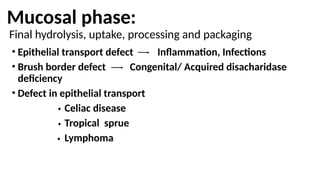
Mucosal phase:
Final hydrolysis, uptake, processing and packaging
โ€ข Epithelial transport defect Inflammation, Infections
โ€ข Brush border defect Congenital/ Acquired disacharidase
deficiency
โ€ข Defect in epithelial transport
Celiac disease
Tropical sprue
Lymphoma
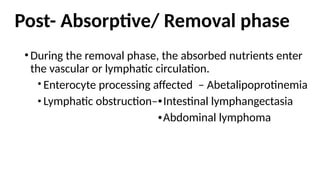
Post- Absorptive/ Removal phase
โ€ขDuring the removal phase, the absorbed nutrients enter
the vascular or lymphatic circulation.
Enterocyte processing affected โ€“ Abetalipoprotinemia
Lymphatic obstructionโ€“ Intestinal lymphangectasia
Abdominal lymphoma
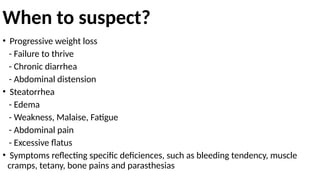
When to suspect?
โ€ข Progressive weight loss
- Failure to thrive
- Chronic diarrhea
- Abdominal distension
โ€ข Steatorrhea
- Edema
- Weakness, Malaise, Fatigue
- Abdominal pain
- Excessive flatus
โ€ข Symptoms reflecting specific deficiences, such as bleeding tendency, muscle
cramps, tetany, bone pains and parasthesias
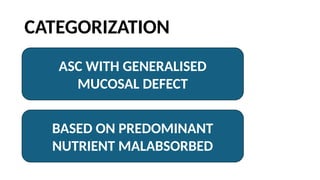
CATEGORIZATION
ASC WITH GENERALISED
MUCOSAL DEFECT
BASED ON PREDOMINANT
NUTRIENT MALABSORBED
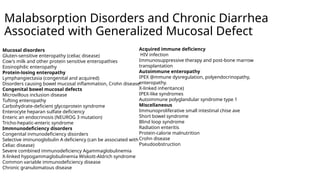
Malabsorption Disorders and Chronic Diarrhea
Associated with Generalized Mucosal Defect
Mucosal disorders
Gluten-sensitive enteropathy (celiac disease)
Cow's milk and other protein sensitive enteropathies
Eosinophilic enteropathy
Protein-losing enteropathy
Lymphangiectasia (congenital and acquired)
Disorders causing bowel mucosal inflammation, Crohn disease
Congenital bowel mucosal defects
Microvillous inclusion disease
Tufting enteropathy
Carbohydrate-deficient glycoprotein syndrome
Enterocyte heparan sulfate deficiency
Enteric an endocrinosis (NEUROG 3 mutation)
Tricho-hepatic-enteric syndrome
Immnunodeficiency disorders
Congenital inmunodeficiency disorders
Selective iminunoglobulin A deficiency (can be associated with
Celiac disease)
Severe combined immunodeficiency Agammaglobulinemia
X-linked hypogammaglobulinemia Wiskott-Aldrich syndrome
Common variable immunodeficiency disease
Chronic granulomatous disease
Acquired immune deficiency
HIV infectionโ€‹
Immunosuppressive therapy and post-bone marrowโ€‹
transplantationโ€‹
Autoimmune enteropathyโ€‹
IPEX @mmune dysregulation, polyendocrinopathy,
enteropathy.โ€‹
X-linked inheritance)
IPEX-like syndromesโ€‹
Autoimmune polyglandular syndrome type 1โ€‹
Miscellaneousโ€‹
Immunoproliferative small intestinal chise aveโ€‹
Short bowel syndromeโ€‹
Blind loop syndromeโ€‹
Radiation enteritisโ€‹
Protein-calorie malnutritionโ€‹
Crohn diseaseโ€‹
Pseudoobstructionโ€‹
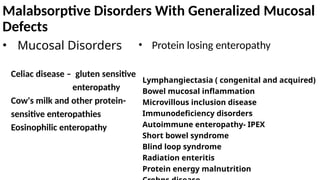
Malabsorptive Disorders With Generalized Mucosal
Defects
โ€ข Mucosal Disorders
Celiac disease โ€“ gluten sensitive
enteropathy
Cow's milk and other protein-
sensitive enteropathies
Eosinophilic enteropathy
โ€ข Protein losing enteropathy
Lymphangiectasia ( congenital and acquired)
Bowel mucosal inflammation
Microvillous inclusion disease
Immunodeficiency disorders
Autoimmune enteropathy- IPEX
Short bowel syndrome
Blind loop syndrome
Radiation enteritis
Protein energy malnutrition
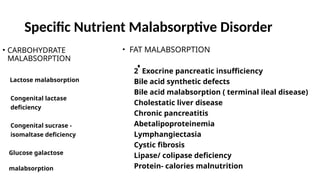
Specific Nutrient Malabsorptive Disorder
โ€ข CARBOHYDRATE
MALABSORPTION
Lactose malabsorption
Congenital lactase
deficiency
Congenital sucrase -
isomaltase deficiency
Glucose galactose
malabsorption
โ€ข FAT MALABSORPTION
2 Exocrine pancreatic insufficiency
Bile acid synthetic defects
Bile acid malabsorption ( terminal ileal disease)
Cholestatic liver disease
Chronic pancreatitis
Abetalipoproteinemia
Lymphangiectasia
Cystic fibrosis
Lipase/ colipase deficiency
Protein- calories malnutrition
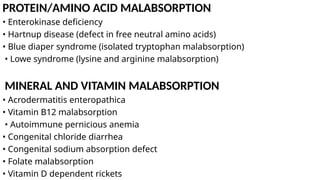
PROTEIN/ฮ‘ฮœฮ™ฮฮŸ ACID MALABSORPTION
โ€ข Enterokinase deficiency
โ€ข Hartnup disease (defect in free neutral amino acids)
โ€ข Blue diaper syndrome (isolated tryptophan malabsorption)
โ€ข Lowe syndrome (lysine and arginine malabsorption)
MINERAL AND VITAMIN MALABSORPTION
โ€ข Acrodermatitis enteropathica
โ€ข Vitamin B12 malabsorption
โ€ข Autoimmune pernicious anemia
โ€ข Congenital chloride diarrhea
โ€ข Congenital sodium absorption defect
โ€ข Folate malabsorption
โ€ข Vitamin D dependent rickets
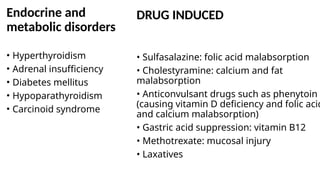
DRUG INDUCED
โ€ข Sulfasalazine: folic acid malabsorption
โ€ข Cholestyramine: calcium and fat
malabsorption
โ€ข Anticonvulsant drugs such as phenytoin
(causing vitamin D deficiency and folic acid
and calcium malabsorption)
โ€ข Gastric acid suppression: vitamin B12
โ€ข Methotrexate: mucosal injury
โ€ข Laxatives
Endocrine and
metabolic disorders
โ€ข Hyperthyroidism
โ€ข Adrenal insufficiency
โ€ข Diabetes mellitus
โ€ข Hypoparathyroidism
โ€ข Carcinoid syndrome
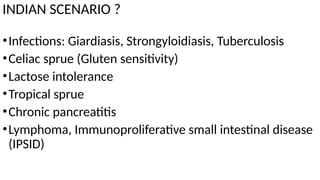
INDIAN SCENARIO ?
โ€ขInfections: Giardiasis, Strongyloidiasis, Tuberculosis
โ€ขCeliac sprue (Gluten sensitivity)
โ€ขLactose intolerance
โ€ขTropical sprue
โ€ขChronic pancreatitis
โ€ขLymphoma, Immunoproliferative small intestinal disease
(IPSID)
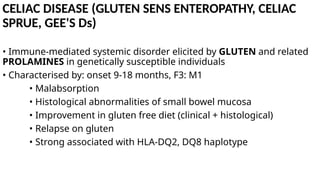
CELIAC DISEASE (GLUTEN SENS ENTEROPATHY, CELIAC
SPRUE, GEE'S Ds)
โ€ข Immune-mediated systemic disorder elicited by GLUTEN and related
PROLAMINES in genetically susceptible individuals
โ€ข Characterised by: onset 9-18 months, F3: M1
โ€ข Malabsorption
โ€ข Histological abnormalities of small bowel mucosa
โ€ข Improvement in gluten free diet (clinical + histological)
โ€ข Relapse on gluten
โ€ข Strong associated with HLA-DQ2, DQ8 haplotype
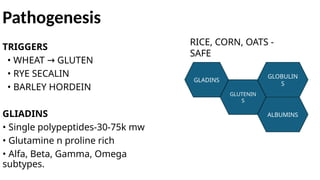
Pathogenesis
TRIGGERS
โ€ข WHEAT GLUTEN
โ†’
โ€ข RYE SECALIN
โ€ข BARLEY HORDEIN
GLIADINS
โ€ข Single polypeptides-30-75k mw
โ€ข Glutamine n proline rich
โ€ข Alfa, Beta, Gamma, Omega
subtypes.
RICE, CORN, OATS -
SAFE
GLADINS
GLUTENIN
S
GLOBULIN
S
ALBUMINS
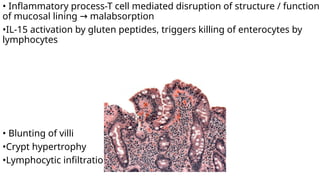
โ€ข Inflammatory process-T cell mediated disruption of structure / function
of mucosal lining malabsorption
โ†’
โ€ขIL-15 activation by gluten peptides, triggers killing of enterocytes by
lymphocytes
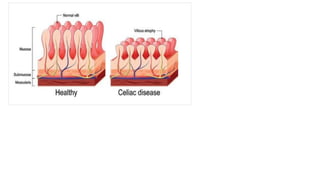
โ€ข Blunting of villi
โ€ขCrypt hypertrophy
โ€ขLymphocytic infiltration
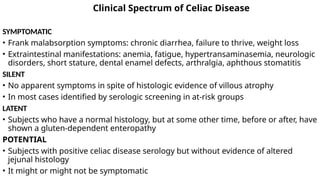
Clinical Spectrum of Celiac Disease
SYMPTOMATIC
โ€ข Frank malabsorption symptoms: chronic diarrhea, failure to thrive, weight loss
โ€ข Extraintestinal manifestations: anemia, fatigue, hypertransaminasemia, neurologic
disorders, short stature, dental enamel defects, arthralgia, aphthous stomatitis
SILENT
โ€ข No apparent symptoms in spite of histologic evidence of villous atrophy
โ€ข In most cases identified by serologic screening in at-risk groups
LATENT
โ€ข Subjects who have a normal histology, but at some other time, before or after, have
shown a gluten-dependent enteropathy
POTENTIAL
โ€ข Subjects with positive celiac disease serology but without evidence of altered
jejunal histology
โ€ข It might or might not be symptomatic
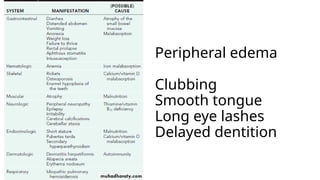
Peripheral edema
Clubbing
Smooth tongue
Long eye lashes
Delayed dentition
DIAGNOSIS
โ€ข Gold std - ESPGHAN CRITERIA (European society of pediatric
gastroent, hepatology and nutrition)
โœ“ Flat mucosa of GIT
โœ“ Unequivocal clinical response to gluten free diet
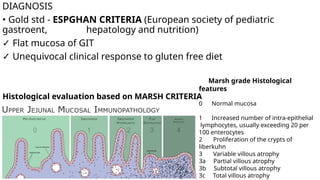
Histological evaluation based on MARSH CRITERIA
Marsh grade Histological
features
0 Normal mucosa
1 Increased number of intra-epithelial
lymphocytes, usually exceeding 20 per
100 enterocytes
2 Proliferation of the crypts of
liberkuhn
3 Variable villous atrophy
3ะฐ Partial villous atrophy
3b Subtotal villous atrophy
3c Total villous atrophy
SEROLOGY
โ€ข IgA ab to Tissue TRANSGLUTAMINASE (tTG): Sn, Sp 90-100%,
ELISA, ideal
โ€ข IgA ANTIENDOMYSIAL ANTIBODY - expensive
D/D-Villous changes in developing country cow milk protein
intolerance, tropical sprue, sev PEM, persistent GI infection
So always confirm by SEROLOGY +BIOPSY
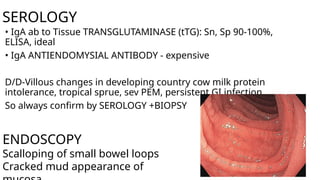
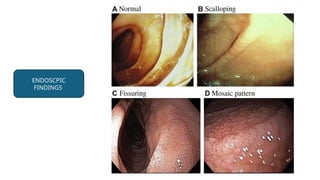
ENDOSCOPY
Scalloping of small bowel loops
Cracked mud appearance of
COMPLICATIONS
โ€ข Celiac crisis - severe dehydration, acidosis, shock
โ€ข Malignancy - lymphoma, adenocarcinoma
โ€ข Refractory sprue
โ€ข Ulceration / stricture
TREATMENT
โ€ข Lifelong strict adherence to GLUTEN FREE DIET (GFD)
โ€ข CODEX Alimentarius guidelines suggests - <20ppm
โ€ข Refractory - AZATHIOPRINE
โ€ข Family role - special recipes from locally available brown rice, corn, dal,
millets, ragi, soy flour, milk products meat products, fruits, vegetables,
pulses.
โ€ข Sensitize parents for growth charts, monitoring.
TROPICAL SPRUE
โ€ข Chronic systemic infection acquired in endemic tropical areas with abnormal small
bowel structure / function.
โ€ข West indies, Cuba, India , Sri Lanka etc
โ€ข Aetiology : persistent infection of small bowel by Klebsiella pneumoniae
E coli
Enterobacter cloacae
โ€ข Starts as an acute episode of diarrhea โ†’ takes longer to subside โ†’ excess flatus,
abdominal cramps followed by anorexia, weakness, FTT
โ€ข BLOOD: LOW levels of B12, A, E, D, K, folate, calcium
โ€ขD-XYLOSE test is positive
โ€ข Stearorrhea in 90% H2 breath test - POSITIVE (d/t bacterial
overgrowth)
โ€ข Barium meal - thickened small bowel
โ€ข Biopsy - thick basement membrane, triglyceride accumulation near to
surface epithelium [celiac - lipid droplets in enterocyte]
โ€ข Injury to entire small bowel (not proximal as in celiac sprue)
โ€ข No changes with GLUTEN FREE DIET
TREATMENT
โ€ข TETRACYCLINE/CO-TRIMOXAZOLE for 3-6months
โ€ข Deficiency correction-B12, folic acid
D-XYLOSE TEST
โ€ข Pentose sugar, passive diffusion in jejunum.
โ€ข Not metabolized in body
โ€ข Depends on mucosal integrity, absence of diarrhea
โ€ข Independent of bile salts, pancreatic enzyme, disaccharidases
โ€ข 8hr fast give 5g D-Xylose measure serum levels @ 1hr
โ†’ โ†’
urine levels @ 5 hr
Useful In:
Celiac disease
Tropical sprue
Whipple's disease
Crohns disease
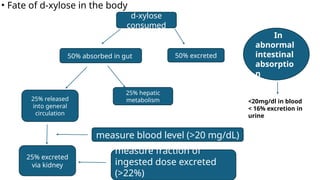
โ€ข Fate of d-xylose in the body
d-xylose
consumed
50% absorbed in gut
measure fraction of
ingested dose excreted
(>22%)
measure blood level (>20 mg/dL)
25% excreted
via kidney
25% released
into general
circulation
25% hepatic
metabolism
50% excreted
<20mg/dl in blood
< 16% excretion in
urine
In
abnormal
intestinal
absorptio
n
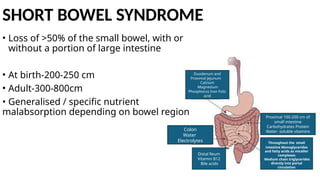
SHORT BOWEL SYNDROME
โ€ข Loss of >50% of the small bowel, with or
without a portion of large intestine
โ€ข At birth-200-250 cm
โ€ข Adult-300-800cm
โ€ข Generalised / specific nutrient
malabsorption depending on bowel region
Duodenum and
Proximal jejunum
Calcium
Magnesium
Phosphorus Iron Folic
acid
Throughout the small
intestine Monoglycerides
and fatty acids as miceller
complexes
Medium chain triglycerides
directly into portal
circulation
Proximal 100-200 cm of
small intestine
Carbohydrates Protein
Water- soluble vitamins
Distal lleum
Vitamin B12
Bile acids
Colon
Water
Electrolytes
Causes of Short Bowel Syndrome
CONGENITAL
โ€ข Congenital short bowel syndrome
โ€ข Multiple atresias
โ€ข Gastroschisis
BOWEL RESECTION
โ€ข Necrotizing enterocolitis
โ€ข Volvulus with or without malrotation
โ€ข Long segment Hirschsprung disease
โ€ข Meconium peritonitis
โ€ข Crohn disease
โ€ข Trauma
INTESTINAL ADAPTATION
โ€ข Hormonal : increased gastrin, enteroglucagon
โ€ข Nutrients: essential fatty acids, glutamine stimulate mucosal
โ†’
hyperplasia
โ€ข Growth factors: transforming growth factors (TGF) regulates
proliferation and turnover
TREATMENT
โ€ข Initial focus on fluid replenishment and correct electrolytes
โ€ข After stabilization - BOWEL REHABILITATION
โ€ข Continuous small volume enteral feeds, hydrolysed protein + mct oil
For gut stimulation and mucosal growth, inc pancreaticobiliary flow
โ€ข Concurrent parenteral support till max absorption is reached
โ€ข Start ASAP to avoid oral aversion
โ€ข 50% achieve enteral autonomy within 5yrs
โ€ข H2 blockers till 1 year
โ€ข Cholestyramine for explosive diarrhea + bile loss
โ€ข Antibiotics to control bacterial overgrowth
Surgical Treatment
โ€ข To slow intestinal transit, to increase mucosal surface area
โ€ข Small bowel transplant
Complications
โ€ข Cather related (long term), thrombosis, cirrhosis
โ€ข Sepsis
โ€ข Vit deficiency
โ€ข Steatorrhea hyperoxaluria renal stones
โ†’ โ†’
BLIND LOOP SYNDROME
โ€ข When the normal bacterial flora of the Small intestine proliferates abnormally to cause
significant derangement to the normal physiological processes of digestion and
absorption.
โ€ข Mechanism to prevent overgrowth is lost (acidic ph, stagnation, obstruction, anamolies)
โ€ข Achlorhydria, dysmotility, fistulae, and strictures, Chronic or high dose opioid therapy
โ€ข Loss of appetite
โ€ข Nausea
โ€ข Flatulence
โ€ข Diarrhea
โ€ข Fullness after a meal
โ€ข Fatty stools (steatorrhea)
โ€ข Unintentional weight loss
โ€ข Generalised weakness
โ€ข Vitamin B12 deficiency
โ€ข Folate deficiency
โ€ข Iron deficiency
โ€ข Vitamin E deficiency
TREATMENT
Tetracyclin,
Rifaximin,
metronidazole
Surgical management
INFLAMMATORY BOWEL DISEASE
โ€ข CROHNS > ULCERATIVE COLITIS, small BOWEL is predominantly
involved.
โ€ข Significant weight loss, growth failure, malabsorption 85% in crohns
โ†’
patients
โ€ข Excessive levels of proinflammatory cytokines are implicated in
causing anorexia
โ€ขmultiple nutritional deficiencies + negative nitrogen balance
โ€ข Optimizing nutritional status and growth are key priorities
โ€ข Osteopenia / osteoporosis, low vit D, Bile acid malabsorption
โ€ข Oral > enteral feeding (max weight gain)> parenteral
PROTEIN LOSING ENTEROPATHY
โ€ข Loss of proteins into GI TRACT
1) INFLAMED MUCOSA/ULCERATION- infection, IBD, Celiac, tropical sprue
2) LYPHATIC OBSTRUCTION-1, 2 intestinal lymphangiectasia, CHF,
Pericarditis
3) EPITHELIAL CELL DYSFUNCTION
Congenital disorders of glycosylation, Enterocyte heparin sulfate
deficiency
LYPHATIC OBSTRUCTION โ†’ Increase Lymphatic pressure, stasis โ†’ lymph
loss into GI tract including lymphocytes (lymphopenia), Ig, protein, lipids
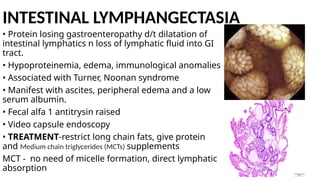
INTESTINAL LYMPHANGECTASIA
โ€ข Protein losing gastroenteropathy d/t dilatation of
intestinal lymphatics n loss of lymphatic fluid into GI
tract.
โ€ข Hypoproteinemia, edema, immunological anomalies
โ€ข Associated with Turner, Noonan syndrome
โ€ข Manifest with ascites, peripheral edema and a low
serum albumin.
โ€ข Fecal alfa 1 antitrysin raised
โ€ข Video capsule endoscopy
โ€ข TREATMENT-restrict long chain fats, give protein
and Medium chain triglycerides (MCTs) supplements
MCT - no need of micelle formation, direct lymphatic
absorption
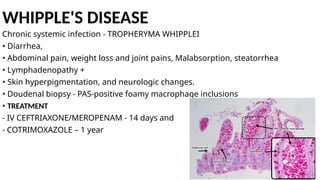
WHIPPLE'S DISEASE
Chronic systemic infection - TROPHERYMA WHIPPLEI
โ€ข Diarrhea,
โ€ข Abdominal pain, weight loss and joint pains, Malabsorption, steatorrhea
โ€ข Lymphadenopathy +
โ€ข Skin hyperpigmentation, and neurologic changes.
โ€ข Doudenal biopsy - PAS-positive foamy macrophage inclusions
โ€ข TREATMENT
- IV CEFTRIAXONE/MEROPENAM - 14 days and
- COTRIMOXAZOLE โ€“ 1 year
IMMUNODEFICIENCY DISORDERS
โ€ข Selective Iga Deficiency
โ€ข Agammaglobulinemia,
โ€ข Wiskott-aldrich Syndrome
โ€ข Common Variable Immunodeficiency Disease
(CVID)
โ€ข Severe Combined Immunodeficiency(SCID)
โ€ข Chronic Granulomatous Disease
Are complicated by
Chronic Rotavirus
Giardiasis
Bacterial Overgrowth,
Protein-losing Enteropathy
Villous Atropy
Secondary Disaccharidase
Deficiency
โ€ข HIV: Opportunistic infections by Cryptosporidium parvum, cytomegalovirus,
Mycobacterium avium-intracellulare, Isospora belli
โ€ข Cancer chemotherapy: damage the bowel mucosa, leading to secondary
malabsorption of disaccharides such as lactose.
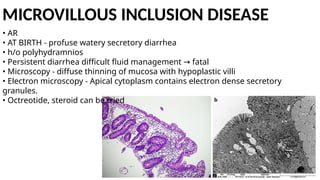
MICROVILLOUS INCLUSION DISEASE
โ€ข AR
โ€ข AT BIRTH - profuse watery secretory diarrhea
โ€ข h/o polyhydramnios
โ€ข Persistent diarrhea difficult fluid management fatal
โ†’
โ€ข Microscopy - diffuse thinning of mucosa with hypoplastic villi
โ€ข Electron microscopy - Apical cytoplasm contains electron dense secretory
granules.
โ€ข Octreotide, steroid can be tried
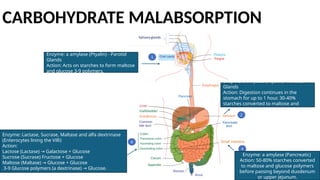
CARBOHYDRATE MALABSORPTION
Enzyme: a amylase (Ptyalin) - Parotid
Glands
Action: Acts on starches to form maltose
and glucose 3-9 polymers.
Enzyme: a amylase (Ptyalin) - Parotid
Glands
Action: Digestion continues in the
stomach for up to 1 hour. 30-40%
starches converted to maltose and
glucose polymers.
Enzyme: a amylase (Pancreatic)
Action: 50-80% starches converted
to maltose and glucose polymers
before passing beyond duodenum
or upper jejunum.
Enzyme: Lactase, Sucrase, Maltase and alfa dextrinase
(Enterocytes lining the Villi)
Action:
Lactose (Lactase) Galactose + Glucose
โ†’
Sucrose (Sucrase) Fructose + Glucose
Maltose (Maltase) Glucose + Glucose
โ†’
3-9 Glucose polymers (a dextrinase) Glucose.
โ†’
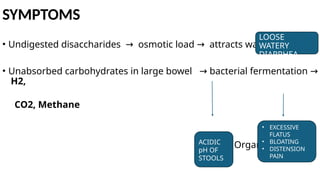
SYMPTOMS
โ€ข Undigested disaccharides osmotic load attracts water
โ†’ โ†’ โ†’
โ€ข Unabsorbed carbohydrates in large bowel bacterial fermentation
โ†’ โ†’
H2,
CO2, Methane
Organic acids
โ€ข EXCESSIVE
FLATUS
โ€ข BLOATING
โ€ข DISTENSION
PAIN
LOOSE
WATERY
DIARRHEA
ACIDIC
pH OF
STOOLS
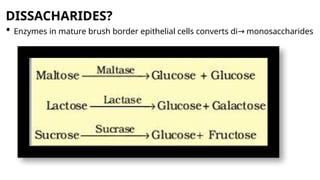
DISSACHARIDES?
โ€ข Enzymes in mature brush border epithelial cells converts di monosaccharides
โ†’
LACTASE DEFICIENCY
โ€ข Congenital lactase deficiency: very rare, <50 cases, LCT gene mutation
โ€ข Primary adult type - lactate:
โ€ข Physiologic decline in lactase activity that occurs following weaning in
most
mammals
โ€ข Peak lactase activity from term to 3 yr, after which levels gradually
decrease
with age and has ETHNIC variability
โ€ข Blacks > Asian > whites
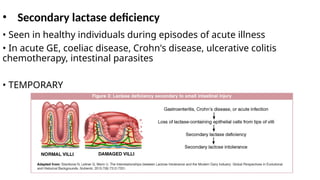
โ€ข Secondary lactase deficiency
โ€ข Seen in healthy individuals during episodes of acute illness
โ€ข In acute GE, coeliac disease, Crohn's disease, ulcerative colitis
chemotherapy, intestinal parasites
โ€ข TEMPORARY
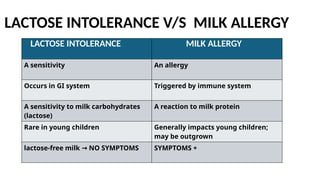
LACTOSE INTOLERANCE V/S MILK ALLERGY
LACTOSE INTOLERANCE MILK ALLERGY
A sensitivity An allergy
Occurs in GI system Triggered by immune system
A sensitivity to milk carbohydrates
(lactose)
A reaction to milk protein
Rare in young children Generally impacts young children;
may be outgrown
lactose-free milk NO SYMPTOMS
โ†’ SYMPTOMS +
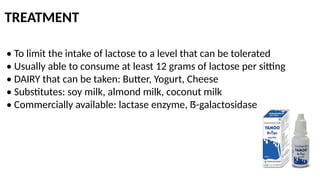
TREATMENT
โ€ข To limit the intake of lactose to a level that can be tolerated
โ€ข Usually able to consume at least 12 grams of lactose per sitting
โ€ข DAIRY that can be taken: Butter, Yogurt, Cheese
โ€ข Substitutes: soy milk, almond milk, coconut milk
โ€ข Commercially available: lactase enzyme, แบž-galactosidase
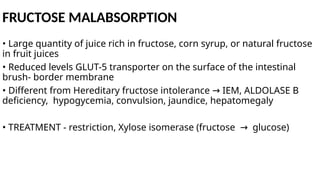
FRUCTOSE MALABSORPTION
โ€ข Large quantity of juice rich in fructose, corn syrup, or natural fructose
in fruit juices
โ€ข Reduced levels GLUT-5 transporter on the surface of the intestinal
brush- border membrane
โ€ข Different from Hereditary fructose intolerance IEM, ALDOLASE B
โ†’
deficiency, hypogycemia, convulsion, jaundice, hepatomegaly
โ€ข TREATMENT - restriction, Xylose isomerase (fructose glucose)
โ†’
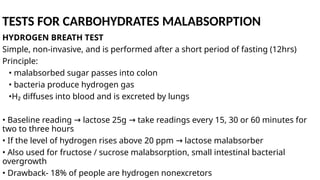
TESTS FOR CARBOHYDRATES MALABSORPTION
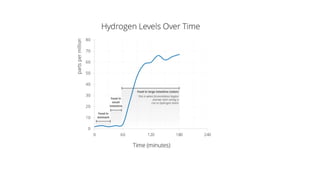
HYDROGEN BREATH TEST
Simple, non-invasive, and is performed after a short period of fasting (12hrs)
Principle:
โ€ข malabsorbed sugar passes into colon
โ€ข bacteria produce hydrogen gas
โ€ขHโ‚‚ diffuses into blood and is excreted by lungs
โ€ข Baseline reading lactose 25g take readings every 15, 30 or 60 minutes for
โ†’ โ†’
two to three hours
โ€ข If the level of hydrogen rises above 20 ppm lactose malabsorber
โ†’
โ€ข Also used for fructose / sucrose malabsorption, small intestinal bacterial
overgrowth
โ€ข Drawback- 18% of people are hydrogen nonexcretors
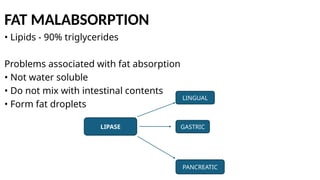
FAT MALABSORPTION
โ€ข Lipids - 90% triglycerides
Problems associated with fat absorption
โ€ข Not water soluble
โ€ข Do not mix with intestinal contents
โ€ข Form fat droplets
LIPASE
LINGUAL
GASTRIC
PANCREATIC
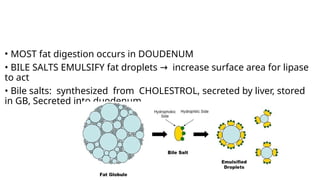
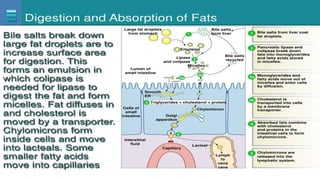
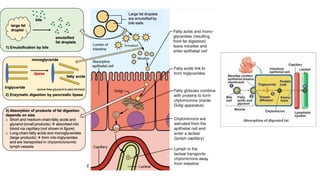
โ€ข MOST fat digestion occurs in DOUDENUM
โ€ข BILE SALTS EMULSIFY fat droplets increase surface area for lipase
โ†’
to act
โ€ข Bile salts: synthesized from CHOLESTROL, secreted by liver, stored
in GB, Secreted into duodenum
T
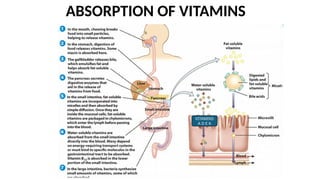
ABSORPTION OF VITAMINS
VITAMINS
A D E K
MECHANISMS OF FAT MALABSORPTION
โ€ข Pancreatic insufficiency
โ€ข Bile acid deficiency
โ€ข Small intestinal bacterial overgrowth
โ€ข Loss of absorptive surface area
โ€ข Defective enterocyte function
โ€ข Lymphatic disorders
CHRONIC PANCREATITIS
โ€ข Pancreatic exocrine insufficiency
โ€ข Destruction of acini n ducts by own proteolytic enzymes
โ€ข Obstructive, Calcific type
โ€ข Reduced secretion of digestive enzymes (LIPASES), bicarbonate
โ€ข Malabsorption of fat due to loss/inactivation of pancreatic enzymes Leads to
weight loss
โ€ข Bulky, oily stool - STEATORRHEA
โ€ข Fat soluble vitamin deficiency may occur in long-standing cases
โ€ข Edema/hypoproteinemia
โ€ข Due to malnutrition with decreased hepatic synthesis of albumin/serum proteins
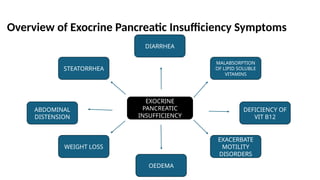
Overview of Exocrine Pancreatic Insufficiency Symptoms
MALABSORPTION
OF LIPID SOLUBLE
VITAMINS
EXOCRINE
PANCREATIC
INSUFFICIENCY
DEFICIENCY OF
VIT B12
EXACERBATE
MOTILITY
DISORDERS
OEDEMA
WEIGHT LOSS
ABDOMINAL
DISTENSION
STEATORRHEA
DIARRHEA
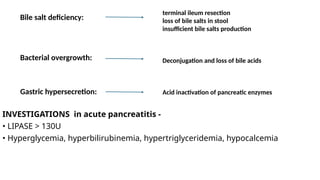
INVESTIGATIONS in acute pancreatitis -
โ€ข LIPASE > 130U
โ€ข Hyperglycemia, hyperbilirubinemia, hypertriglyceridemia, hypocalcemia
Bile salt deficiency:
terminal ileum resection
loss of bile salts in stool
insufficient bile salts production
Bacterial overgrowth: Deconjugation and loss of bile acids
Gastric hypersecretion: Acid inactivation of pancreatic enzymes
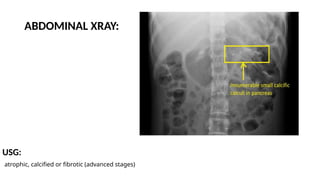
ABDOMINAL XRAY:
USG:
atrophic, calcified or fibrotic (advanced stages)
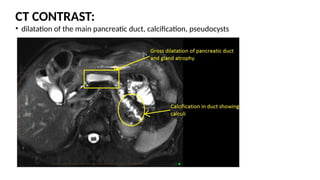
CT CONTRAST:
โ€ข dilatation of the main pancreatic duct, calcification, pseudocysts
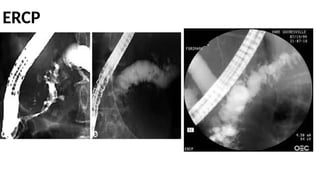
ERCP
CYSTIC FIBROSIS
โ€ข Multisystem disease, AR, most common lethal genetic disease in Caucasians
โ€ข Cystic fibrosis transmembrane conductance regulator (CFTR) - chromosome 7
โ€ข Most common F508 deletion- genotype
โ€ข Abnormality in CFTR blocks chloride transport, with inadequate hydration results in thick
secretion of exocrine glands.
Pancreatic insufficiency
Pancreatic enzymes stay in ducts and are activated intraductally
Autolysis of pancreas
Inflammation, calcification, plugging of ducts, fibrosis
Intestinal abnormality
Meconium ileus (15% newborns with CF)
Distal intestinal obstruction syndrome (DIOS)
Rectal prolapse
Recurrent Pancreatitis
Shrunken, cystic pancreas
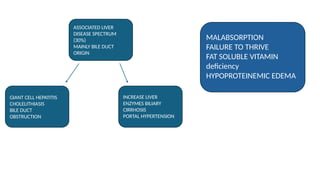
MALABSORPTION
FAILURE TO THRIVE
FAT SOLUBLE VITAMIN
deficiency
HYPOPROTEINEMIC EDEMA
INCREASE LIVER
ENZYMES BILIARY
CIRRHOSIS
PORTAL HYPERTENSION
GIANT CELL HEPATITIS
CHOLELITHIASIS
BILE DUCT
OBSTRUCTION
ASSOCIATED LIVER
DISEASE SPECTRUM
(30%)
MAINLY BILE DUCT
ORIGIN
INVESTIGATIONS
โ€ข SWEAT CHLORIDE TEST
โ€ข ANC USG: Hyperechoic meconium, dilated small bowels, GB can't be seen
properly
TREATMENT
โ€ข Proactive treatment of airway infection
โ€ข Pulmonary rehab
โ€ข10% N-Acetylcysteine enema
โ€ข Liver transplantation
โ€ข Cholecystectectomy
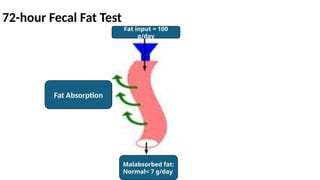
72-hour Fecal Fat Test
Fat Absorption
Fat input = 100
g/day
Malabsorbed fat:
Normal< 7 g/day
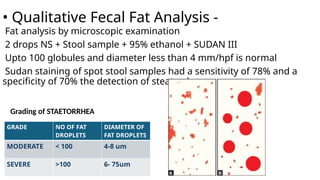
โ€ข Qualitative Fecal Fat Analysis -
Fat analysis by microscopic examination
2 drops NS + Stool sample + 95% ethanol + SUDAN III
Upto 100 globules and diameter less than 4 mm/hpf is normal
Sudan staining of spot stool samples had a sensitivity of 78% and a
specificity of 70% the detection of steatorrhea.
GRADE NO OF FAT
DROPLETS
DIAMETER OF
FAT DROPLETS
MODERATE < 100 4-8 um
SEVERE >100 6- 75um
Grading of STAETORRHEA
QUANTITATIVE FECAL FAT ANALYSIS
โ€ข Fecal Output Of Fat In Grams Per 24 Hours - GOLD STD
โ€ข Patients should consume 70 to 120 g/day of dietary fat.
โ€ข Estimation of daily stool weight for 3-5 days
Fecal fat excretion
โ€ข <7 g per day with a fat intake of 100 g - NORMAL
โ€ข > 7g is pathological
โ€ข >20 g in steatorrhea
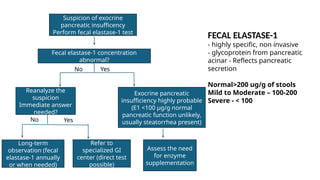
Suspicion of exocrine
pancreatic insufficency
Perform fecal elastase-1 test
Fecal elastase-1 concentration
abnormal?
Reanalyze the
suspicion
Immediate answer
needed?
Exocrine pancreatic
insufficiency highly probable
(E1 <100 ยตg/g normal
pancreatic function unlikely,
usually steatorrhea present)
Long-term
observation (fecal
elastase-1 annually
or when needed)
Refer to
specialized GI
center (direct test
possible)
Assess the need
for enzyme
supplementation
FECAL ELASTASE-1
- highly specific, non invasive
- glycoprotein from pancreatic
acinar - Reflects pancreatic
secretion
Normal>200 ug/g of stools
Mild to Moderate โ€“ 100-200
Severe - < 100
No
No Yes
Yes
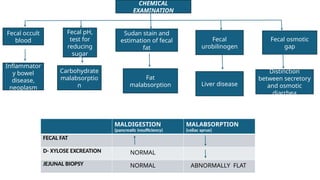
Fecal occult
blood
Inflammator
y bowel
disease,
neoplasm
Fecal pH,
test for
reducing
sugar
Sudan stain and
estimation of fecal
fat
CHEMICAL
EXAMINATION
Carbohydrate
malabsorptio
n
Fat
malabsorption Liver disease
Fecal
urobilinogen
Distinction
between secretory
and osmotic
diarrhea
Fecal osmotic
gap
MALDIGESTION
(pancreatic insufficiency)
MALABSORPTION
(celiac sprue)
FECAL FAT
D- XYLOSE EXCREATION NORMAL
JEJUNAL BIOPSY NORMAL ABNORMALLY FLAT
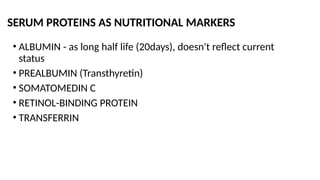
SERUM PROTEINS AS NUTRITIONAL MARKERS
โ€ข ALBUMIN - as long half life (20days), doesn't reflect current
status
โ€ข PREALBUMIN (Transthyretin)
โ€ข SOMATOMEDIN C
โ€ข RETINOL-BINDING PROTEIN
โ€ข TRANSFERRIN
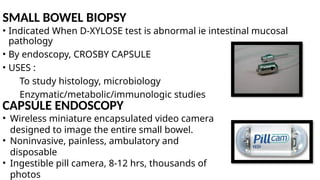
SMALL BOWEL BIOPSY
โ€ข Indicated When D-XYLOSE test is abnormal ie intestinal mucosal
pathology
โ€ข By endoscopy, CROSBY CAPSULE
โ€ข USES :
To study histology, microbiology
Enzymatic/metabolic/immunologic studies
CAPSULE ENDOSCOPY
โ€ข Wireless miniature encapsulated video camera
designed to image the entire small bowel.
โ€ข Noninvasive, painless, ambulatory and
disposable
โ€ข Ingestible pill camera, 8-12 hrs, thousands of
photos
ENDOSCPIC
FINDINGS
NUTRITIONAL CONSEQUENCES IN MALBSORPTION
โ€ข Always reduces the weight gain before it slows down growth
rate
โ€ข Loss of subcutaneous fat, muscle wasting
โ€ข Vit k hemorraghic manifestation d/t impaired gamma
โ†’
carboxylation (2,7,9,10)
โ€ข Crohns and celiac ds: anorexia > malabsorption
โ€ข Chronic inflammation, protein losing enteropathy low IGF-
โ†’
1 but NORMAL GH leading to growth failure
โ€ข 13 vitamins A, D, E, K (fat soluble)
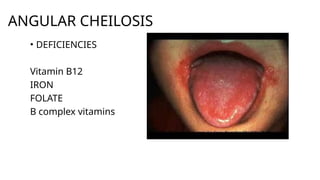
ANGULAR CHEILOSIS
โ€ข DEFICIENCIES
Vitamin B12
IRON
FOLATE
B complex vitamins
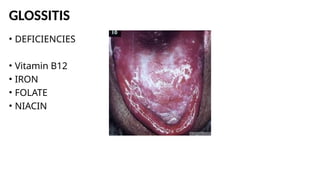
GLOSSITIS
โ€ข DEFICIENCIES
โ€ข Vitamin B12
โ€ข IRON
โ€ข FOLATE
โ€ข NIACIN
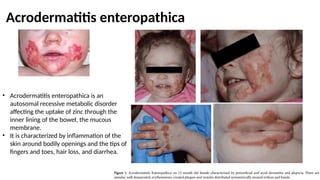
Acrodermatitis enteropathica
โ€ข Acrodermatitis enteropathica is an
autosomal recessive metabolic disorder
affecting the uptake of zinc through the
inner lining of the bowel, the mucous
membrane.
โ€ข It is characterized by inflammation of the
skin around bodily openings and the tips of
fingers and toes, hair loss, and diarrhea.
PROGNOSIS
โ€ข Prognosis primarily depends on the cause of malabsorption
โ€ข Reasonably good in most cases, if medical and diet therapy is
rigorously followed
โ€ข Infectious causes if treated adequately have excellent.
How Long is Therapy Necessary?
Most causes of malabsorption, except infections require
continuous supervision by a doctor and necessitate prolonged
therapy.
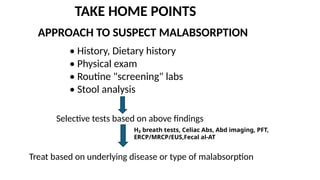
TAKE HOME POINTS
APPROACH TO SUSPECT MALABSORPTION
โ€ข History, Dietary history
โ€ข Physical exam
โ€ข Routine "screening" labs
โ€ข Stool analysis
Selective tests based on above findings
Hโ‚‚ breath tests, Celiac Abs, Abd imaging, PFT,
ERCP/MRCP/EUS,Fecal al-AT
Treat based on underlying disease or type of malabsorption
โ€ข Etiology of MALABSORPTON in tropical areas differs from that in
temperate countries
โ€ข Tropical sprue, tuberculosis a common cause of MAS in India
โ€ข Celiac disease and inflammatory bowel disorders are emerging
โ€ข Detailed history, physical examination mandatory
โ€ข The order of testing and choice of a particular test should be
individualized
โ€ขEmphasis should be put on defining an underlying disease entity
which then provides the basis for appropriate treatment.
REFERENCES
โ€ข Nelson textbook of paediatrics 21th edition
โ€ข Paediataric gastroenterology & hepatology - A RIYAZ
THANK YOU !

MALABSORPTION SYNDROMES IN PEDIATRICS POPULATION

  • 1.
  • 2.
    ๏‚ง Include numerousclinical entities that result in- 1) Chronic diarrhea 2) Abdominal distension 3) Failure to thrive
  • 3.
    Maldigestion โ€ขDefective intraluminal hydrolysisof nutrients. โ€ขImpaired breakdown of nutrients. Carbohydrates Mono, di, oligosaccharides Proteins Amino acids , oligopeptides Fats Fatty acids , monoglycerides
  • 4.
    Malabsorption : Defectivemucosal uptake and transport of digested nutrients, vitamins, minerals. โ€ขMechanisms of malabsorption : โ€ข The integrated processes of digestion and absorption can be described in three phases: Luminal phase Mucosal phase Postabsorptive/Removal phase โ€ข Disturbances of absorptive process can take place in any of these three phases
  • 5.
    โ€ข Luminal phase Dietaryfats, proteins and carbohydrates are hydrolyzed and solubilized, largely by pancreatic and biliary secretions. Pancreatic insufficiencies Cystic fibrosis, Chronic pancreatitis Bile salt insufficiency Obstructive jaundice, bacterial overgrowth Rapid transit of food through gut Gastroenterostomy , partial gastrectomy Increased bile salt loss in faeces Crohns, ileal resection Lack of intrinsic factor Pernicious anemia Reduced gastric acid Atrophic gastritis
  • 6.
    Mucosal phase: Final hydrolysis,uptake, processing and packaging โ€ข Epithelial transport defect Inflammation, Infections โ€ข Brush border defect Congenital/ Acquired disacharidase deficiency โ€ข Defect in epithelial transport Celiac disease Tropical sprue Lymphoma
  • 7.
    Post- Absorptive/ Removalphase โ€ขDuring the removal phase, the absorbed nutrients enter the vascular or lymphatic circulation. Enterocyte processing affected โ€“ Abetalipoprotinemia Lymphatic obstructionโ€“ Intestinal lymphangectasia Abdominal lymphoma
  • 8.
    When to suspect? โ€ขProgressive weight loss - Failure to thrive - Chronic diarrhea - Abdominal distension โ€ข Steatorrhea - Edema - Weakness, Malaise, Fatigue - Abdominal pain - Excessive flatus โ€ข Symptoms reflecting specific deficiences, such as bleeding tendency, muscle cramps, tetany, bone pains and parasthesias
  • 9.
    CATEGORIZATION ASC WITH GENERALISED MUCOSALDEFECT BASED ON PREDOMINANT NUTRIENT MALABSORBED
  • 10.
    Malabsorption Disorders andChronic Diarrhea Associated with Generalized Mucosal Defect Mucosal disorders Gluten-sensitive enteropathy (celiac disease) Cow's milk and other protein sensitive enteropathies Eosinophilic enteropathy Protein-losing enteropathy Lymphangiectasia (congenital and acquired) Disorders causing bowel mucosal inflammation, Crohn disease Congenital bowel mucosal defects Microvillous inclusion disease Tufting enteropathy Carbohydrate-deficient glycoprotein syndrome Enterocyte heparan sulfate deficiency Enteric an endocrinosis (NEUROG 3 mutation) Tricho-hepatic-enteric syndrome Immnunodeficiency disorders Congenital inmunodeficiency disorders Selective iminunoglobulin A deficiency (can be associated with Celiac disease) Severe combined immunodeficiency Agammaglobulinemia X-linked hypogammaglobulinemia Wiskott-Aldrich syndrome Common variable immunodeficiency disease Chronic granulomatous disease Acquired immune deficiency HIV infectionโ€‹ Immunosuppressive therapy and post-bone marrowโ€‹ transplantationโ€‹ Autoimmune enteropathyโ€‹ IPEX @mmune dysregulation, polyendocrinopathy, enteropathy.โ€‹ X-linked inheritance) IPEX-like syndromesโ€‹ Autoimmune polyglandular syndrome type 1โ€‹ Miscellaneousโ€‹ Immunoproliferative small intestinal chise aveโ€‹ Short bowel syndromeโ€‹ Blind loop syndromeโ€‹ Radiation enteritisโ€‹ Protein-calorie malnutritionโ€‹ Crohn diseaseโ€‹ Pseudoobstructionโ€‹
  • 11.
    Malabsorptive Disorders WithGeneralized Mucosal Defects โ€ข Mucosal Disorders Celiac disease โ€“ gluten sensitive enteropathy Cow's milk and other protein- sensitive enteropathies Eosinophilic enteropathy โ€ข Protein losing enteropathy Lymphangiectasia ( congenital and acquired) Bowel mucosal inflammation Microvillous inclusion disease Immunodeficiency disorders Autoimmune enteropathy- IPEX Short bowel syndrome Blind loop syndrome Radiation enteritis Protein energy malnutrition
  • 12.
    Specific Nutrient MalabsorptiveDisorder โ€ข CARBOHYDRATE MALABSORPTION Lactose malabsorption Congenital lactase deficiency Congenital sucrase - isomaltase deficiency Glucose galactose malabsorption โ€ข FAT MALABSORPTION 2 Exocrine pancreatic insufficiency Bile acid synthetic defects Bile acid malabsorption ( terminal ileal disease) Cholestatic liver disease Chronic pancreatitis Abetalipoproteinemia Lymphangiectasia Cystic fibrosis Lipase/ colipase deficiency Protein- calories malnutrition
  • 13.
    PROTEIN/ฮ‘ฮœฮ™ฮฮŸ ACID MALABSORPTION โ€ขEnterokinase deficiency โ€ข Hartnup disease (defect in free neutral amino acids) โ€ข Blue diaper syndrome (isolated tryptophan malabsorption) โ€ข Lowe syndrome (lysine and arginine malabsorption) MINERAL AND VITAMIN MALABSORPTION โ€ข Acrodermatitis enteropathica โ€ข Vitamin B12 malabsorption โ€ข Autoimmune pernicious anemia โ€ข Congenital chloride diarrhea โ€ข Congenital sodium absorption defect โ€ข Folate malabsorption โ€ข Vitamin D dependent rickets
  • 14.
    DRUG INDUCED โ€ข Sulfasalazine:folic acid malabsorption โ€ข Cholestyramine: calcium and fat malabsorption โ€ข Anticonvulsant drugs such as phenytoin (causing vitamin D deficiency and folic acid and calcium malabsorption) โ€ข Gastric acid suppression: vitamin B12 โ€ข Methotrexate: mucosal injury โ€ข Laxatives Endocrine and metabolic disorders โ€ข Hyperthyroidism โ€ข Adrenal insufficiency โ€ข Diabetes mellitus โ€ข Hypoparathyroidism โ€ข Carcinoid syndrome
  • 15.
    INDIAN SCENARIO ? โ€ขInfections:Giardiasis, Strongyloidiasis, Tuberculosis โ€ขCeliac sprue (Gluten sensitivity) โ€ขLactose intolerance โ€ขTropical sprue โ€ขChronic pancreatitis โ€ขLymphoma, Immunoproliferative small intestinal disease (IPSID)
  • 16.
    CELIAC DISEASE (GLUTENSENS ENTEROPATHY, CELIAC SPRUE, GEE'S Ds) โ€ข Immune-mediated systemic disorder elicited by GLUTEN and related PROLAMINES in genetically susceptible individuals โ€ข Characterised by: onset 9-18 months, F3: M1 โ€ข Malabsorption โ€ข Histological abnormalities of small bowel mucosa โ€ข Improvement in gluten free diet (clinical + histological) โ€ข Relapse on gluten โ€ข Strong associated with HLA-DQ2, DQ8 haplotype
  • 17.
    Pathogenesis TRIGGERS โ€ข WHEAT GLUTEN โ†’ โ€ขRYE SECALIN โ€ข BARLEY HORDEIN GLIADINS โ€ข Single polypeptides-30-75k mw โ€ข Glutamine n proline rich โ€ข Alfa, Beta, Gamma, Omega subtypes. RICE, CORN, OATS - SAFE GLADINS GLUTENIN S GLOBULIN S ALBUMINS
  • 18.
    โ€ข Inflammatory process-Tcell mediated disruption of structure / function of mucosal lining malabsorption โ†’ โ€ขIL-15 activation by gluten peptides, triggers killing of enterocytes by lymphocytes โ€ข Blunting of villi โ€ขCrypt hypertrophy โ€ขLymphocytic infiltration
  • 19.
    Clinical Spectrum ofCeliac Disease SYMPTOMATIC โ€ข Frank malabsorption symptoms: chronic diarrhea, failure to thrive, weight loss โ€ข Extraintestinal manifestations: anemia, fatigue, hypertransaminasemia, neurologic disorders, short stature, dental enamel defects, arthralgia, aphthous stomatitis SILENT โ€ข No apparent symptoms in spite of histologic evidence of villous atrophy โ€ข In most cases identified by serologic screening in at-risk groups LATENT โ€ข Subjects who have a normal histology, but at some other time, before or after, have shown a gluten-dependent enteropathy POTENTIAL โ€ข Subjects with positive celiac disease serology but without evidence of altered jejunal histology โ€ข It might or might not be symptomatic
  • 20.
  • 21.
    DIAGNOSIS โ€ข Gold std- ESPGHAN CRITERIA (European society of pediatric gastroent, hepatology and nutrition) โœ“ Flat mucosa of GIT โœ“ Unequivocal clinical response to gluten free diet Histological evaluation based on MARSH CRITERIA Marsh grade Histological features 0 Normal mucosa 1 Increased number of intra-epithelial lymphocytes, usually exceeding 20 per 100 enterocytes 2 Proliferation of the crypts of liberkuhn 3 Variable villous atrophy 3ะฐ Partial villous atrophy 3b Subtotal villous atrophy 3c Total villous atrophy
  • 22.
    SEROLOGY โ€ข IgA abto Tissue TRANSGLUTAMINASE (tTG): Sn, Sp 90-100%, ELISA, ideal โ€ข IgA ANTIENDOMYSIAL ANTIBODY - expensive D/D-Villous changes in developing country cow milk protein intolerance, tropical sprue, sev PEM, persistent GI infection So always confirm by SEROLOGY +BIOPSY ENDOSCOPY Scalloping of small bowel loops Cracked mud appearance of
  • 24.
    COMPLICATIONS โ€ข Celiac crisis- severe dehydration, acidosis, shock โ€ข Malignancy - lymphoma, adenocarcinoma โ€ข Refractory sprue โ€ข Ulceration / stricture
  • 25.
    TREATMENT โ€ข Lifelong strictadherence to GLUTEN FREE DIET (GFD) โ€ข CODEX Alimentarius guidelines suggests - <20ppm โ€ข Refractory - AZATHIOPRINE โ€ข Family role - special recipes from locally available brown rice, corn, dal, millets, ragi, soy flour, milk products meat products, fruits, vegetables, pulses. โ€ข Sensitize parents for growth charts, monitoring.
  • 26.
    TROPICAL SPRUE โ€ข Chronicsystemic infection acquired in endemic tropical areas with abnormal small bowel structure / function. โ€ข West indies, Cuba, India , Sri Lanka etc โ€ข Aetiology : persistent infection of small bowel by Klebsiella pneumoniae E coli Enterobacter cloacae โ€ข Starts as an acute episode of diarrhea โ†’ takes longer to subside โ†’ excess flatus, abdominal cramps followed by anorexia, weakness, FTT
  • 27.
    โ€ข BLOOD: LOWlevels of B12, A, E, D, K, folate, calcium โ€ขD-XYLOSE test is positive โ€ข Stearorrhea in 90% H2 breath test - POSITIVE (d/t bacterial overgrowth) โ€ข Barium meal - thickened small bowel โ€ข Biopsy - thick basement membrane, triglyceride accumulation near to surface epithelium [celiac - lipid droplets in enterocyte] โ€ข Injury to entire small bowel (not proximal as in celiac sprue) โ€ข No changes with GLUTEN FREE DIET TREATMENT โ€ข TETRACYCLINE/CO-TRIMOXAZOLE for 3-6months โ€ข Deficiency correction-B12, folic acid
  • 28.
    D-XYLOSE TEST โ€ข Pentosesugar, passive diffusion in jejunum. โ€ข Not metabolized in body โ€ข Depends on mucosal integrity, absence of diarrhea โ€ข Independent of bile salts, pancreatic enzyme, disaccharidases โ€ข 8hr fast give 5g D-Xylose measure serum levels @ 1hr โ†’ โ†’ urine levels @ 5 hr Useful In: Celiac disease Tropical sprue Whipple's disease Crohns disease
  • 29.
    โ€ข Fate ofd-xylose in the body d-xylose consumed 50% absorbed in gut measure fraction of ingested dose excreted (>22%) measure blood level (>20 mg/dL) 25% excreted via kidney 25% released into general circulation 25% hepatic metabolism 50% excreted <20mg/dl in blood < 16% excretion in urine In abnormal intestinal absorptio n
  • 30.
    SHORT BOWEL SYNDROME โ€ขLoss of >50% of the small bowel, with or without a portion of large intestine โ€ข At birth-200-250 cm โ€ข Adult-300-800cm โ€ข Generalised / specific nutrient malabsorption depending on bowel region Duodenum and Proximal jejunum Calcium Magnesium Phosphorus Iron Folic acid Throughout the small intestine Monoglycerides and fatty acids as miceller complexes Medium chain triglycerides directly into portal circulation Proximal 100-200 cm of small intestine Carbohydrates Protein Water- soluble vitamins Distal lleum Vitamin B12 Bile acids Colon Water Electrolytes
  • 31.
    Causes of ShortBowel Syndrome CONGENITAL โ€ข Congenital short bowel syndrome โ€ข Multiple atresias โ€ข Gastroschisis BOWEL RESECTION โ€ข Necrotizing enterocolitis โ€ข Volvulus with or without malrotation โ€ข Long segment Hirschsprung disease โ€ข Meconium peritonitis โ€ข Crohn disease โ€ข Trauma
  • 32.
    INTESTINAL ADAPTATION โ€ข Hormonal: increased gastrin, enteroglucagon โ€ข Nutrients: essential fatty acids, glutamine stimulate mucosal โ†’ hyperplasia โ€ข Growth factors: transforming growth factors (TGF) regulates proliferation and turnover
  • 33.
    TREATMENT โ€ข Initial focuson fluid replenishment and correct electrolytes โ€ข After stabilization - BOWEL REHABILITATION โ€ข Continuous small volume enteral feeds, hydrolysed protein + mct oil For gut stimulation and mucosal growth, inc pancreaticobiliary flow โ€ข Concurrent parenteral support till max absorption is reached โ€ข Start ASAP to avoid oral aversion โ€ข 50% achieve enteral autonomy within 5yrs โ€ข H2 blockers till 1 year โ€ข Cholestyramine for explosive diarrhea + bile loss โ€ข Antibiotics to control bacterial overgrowth
  • 34.
    Surgical Treatment โ€ข Toslow intestinal transit, to increase mucosal surface area โ€ข Small bowel transplant Complications โ€ข Cather related (long term), thrombosis, cirrhosis โ€ข Sepsis โ€ข Vit deficiency โ€ข Steatorrhea hyperoxaluria renal stones โ†’ โ†’
  • 35.
    BLIND LOOP SYNDROME โ€ขWhen the normal bacterial flora of the Small intestine proliferates abnormally to cause significant derangement to the normal physiological processes of digestion and absorption. โ€ข Mechanism to prevent overgrowth is lost (acidic ph, stagnation, obstruction, anamolies) โ€ข Achlorhydria, dysmotility, fistulae, and strictures, Chronic or high dose opioid therapy โ€ข Loss of appetite โ€ข Nausea โ€ข Flatulence โ€ข Diarrhea โ€ข Fullness after a meal โ€ข Fatty stools (steatorrhea) โ€ข Unintentional weight loss โ€ข Generalised weakness
  • 36.
    โ€ข Vitamin B12deficiency โ€ข Folate deficiency โ€ข Iron deficiency โ€ข Vitamin E deficiency TREATMENT Tetracyclin, Rifaximin, metronidazole Surgical management
  • 37.
    INFLAMMATORY BOWEL DISEASE โ€ขCROHNS > ULCERATIVE COLITIS, small BOWEL is predominantly involved. โ€ข Significant weight loss, growth failure, malabsorption 85% in crohns โ†’ patients โ€ข Excessive levels of proinflammatory cytokines are implicated in causing anorexia โ€ขmultiple nutritional deficiencies + negative nitrogen balance โ€ข Optimizing nutritional status and growth are key priorities โ€ข Osteopenia / osteoporosis, low vit D, Bile acid malabsorption โ€ข Oral > enteral feeding (max weight gain)> parenteral
  • 38.
    PROTEIN LOSING ENTEROPATHY โ€ขLoss of proteins into GI TRACT 1) INFLAMED MUCOSA/ULCERATION- infection, IBD, Celiac, tropical sprue 2) LYPHATIC OBSTRUCTION-1, 2 intestinal lymphangiectasia, CHF, Pericarditis 3) EPITHELIAL CELL DYSFUNCTION Congenital disorders of glycosylation, Enterocyte heparin sulfate deficiency LYPHATIC OBSTRUCTION โ†’ Increase Lymphatic pressure, stasis โ†’ lymph loss into GI tract including lymphocytes (lymphopenia), Ig, protein, lipids
  • 39.
    INTESTINAL LYMPHANGECTASIA โ€ข Proteinlosing gastroenteropathy d/t dilatation of intestinal lymphatics n loss of lymphatic fluid into GI tract. โ€ข Hypoproteinemia, edema, immunological anomalies โ€ข Associated with Turner, Noonan syndrome โ€ข Manifest with ascites, peripheral edema and a low serum albumin. โ€ข Fecal alfa 1 antitrysin raised โ€ข Video capsule endoscopy โ€ข TREATMENT-restrict long chain fats, give protein and Medium chain triglycerides (MCTs) supplements MCT - no need of micelle formation, direct lymphatic absorption
  • 40.
    WHIPPLE'S DISEASE Chronic systemicinfection - TROPHERYMA WHIPPLEI โ€ข Diarrhea, โ€ข Abdominal pain, weight loss and joint pains, Malabsorption, steatorrhea โ€ข Lymphadenopathy + โ€ข Skin hyperpigmentation, and neurologic changes. โ€ข Doudenal biopsy - PAS-positive foamy macrophage inclusions โ€ข TREATMENT - IV CEFTRIAXONE/MEROPENAM - 14 days and - COTRIMOXAZOLE โ€“ 1 year
  • 41.
    IMMUNODEFICIENCY DISORDERS โ€ข SelectiveIga Deficiency โ€ข Agammaglobulinemia, โ€ข Wiskott-aldrich Syndrome โ€ข Common Variable Immunodeficiency Disease (CVID) โ€ข Severe Combined Immunodeficiency(SCID) โ€ข Chronic Granulomatous Disease Are complicated by Chronic Rotavirus Giardiasis Bacterial Overgrowth, Protein-losing Enteropathy Villous Atropy Secondary Disaccharidase Deficiency โ€ข HIV: Opportunistic infections by Cryptosporidium parvum, cytomegalovirus, Mycobacterium avium-intracellulare, Isospora belli โ€ข Cancer chemotherapy: damage the bowel mucosa, leading to secondary malabsorption of disaccharides such as lactose.
  • 42.
    MICROVILLOUS INCLUSION DISEASE โ€ขAR โ€ข AT BIRTH - profuse watery secretory diarrhea โ€ข h/o polyhydramnios โ€ข Persistent diarrhea difficult fluid management fatal โ†’ โ€ข Microscopy - diffuse thinning of mucosa with hypoplastic villi โ€ข Electron microscopy - Apical cytoplasm contains electron dense secretory granules. โ€ข Octreotide, steroid can be tried
  • 43.
    CARBOHYDRATE MALABSORPTION Enzyme: aamylase (Ptyalin) - Parotid Glands Action: Acts on starches to form maltose and glucose 3-9 polymers. Enzyme: a amylase (Ptyalin) - Parotid Glands Action: Digestion continues in the stomach for up to 1 hour. 30-40% starches converted to maltose and glucose polymers. Enzyme: a amylase (Pancreatic) Action: 50-80% starches converted to maltose and glucose polymers before passing beyond duodenum or upper jejunum. Enzyme: Lactase, Sucrase, Maltase and alfa dextrinase (Enterocytes lining the Villi) Action: Lactose (Lactase) Galactose + Glucose โ†’ Sucrose (Sucrase) Fructose + Glucose Maltose (Maltase) Glucose + Glucose โ†’ 3-9 Glucose polymers (a dextrinase) Glucose. โ†’
  • 44.
    SYMPTOMS โ€ข Undigested disaccharidesosmotic load attracts water โ†’ โ†’ โ†’ โ€ข Unabsorbed carbohydrates in large bowel bacterial fermentation โ†’ โ†’ H2, CO2, Methane Organic acids โ€ข EXCESSIVE FLATUS โ€ข BLOATING โ€ข DISTENSION PAIN LOOSE WATERY DIARRHEA ACIDIC pH OF STOOLS
  • 45.
    DISSACHARIDES? โ€ข Enzymes inmature brush border epithelial cells converts di monosaccharides โ†’
  • 46.
    LACTASE DEFICIENCY โ€ข Congenitallactase deficiency: very rare, <50 cases, LCT gene mutation โ€ข Primary adult type - lactate: โ€ข Physiologic decline in lactase activity that occurs following weaning in most mammals โ€ข Peak lactase activity from term to 3 yr, after which levels gradually decrease with age and has ETHNIC variability โ€ข Blacks > Asian > whites
  • 47.
    โ€ข Secondary lactasedeficiency โ€ข Seen in healthy individuals during episodes of acute illness โ€ข In acute GE, coeliac disease, Crohn's disease, ulcerative colitis chemotherapy, intestinal parasites โ€ข TEMPORARY
  • 48.
    LACTOSE INTOLERANCE V/SMILK ALLERGY LACTOSE INTOLERANCE MILK ALLERGY A sensitivity An allergy Occurs in GI system Triggered by immune system A sensitivity to milk carbohydrates (lactose) A reaction to milk protein Rare in young children Generally impacts young children; may be outgrown lactose-free milk NO SYMPTOMS โ†’ SYMPTOMS +
  • 49.
    TREATMENT โ€ข To limitthe intake of lactose to a level that can be tolerated โ€ข Usually able to consume at least 12 grams of lactose per sitting โ€ข DAIRY that can be taken: Butter, Yogurt, Cheese โ€ข Substitutes: soy milk, almond milk, coconut milk โ€ข Commercially available: lactase enzyme, แบž-galactosidase
  • 50.
    FRUCTOSE MALABSORPTION โ€ข Largequantity of juice rich in fructose, corn syrup, or natural fructose in fruit juices โ€ข Reduced levels GLUT-5 transporter on the surface of the intestinal brush- border membrane โ€ข Different from Hereditary fructose intolerance IEM, ALDOLASE B โ†’ deficiency, hypogycemia, convulsion, jaundice, hepatomegaly โ€ข TREATMENT - restriction, Xylose isomerase (fructose glucose) โ†’
  • 51.
    TESTS FOR CARBOHYDRATESMALABSORPTION HYDROGEN BREATH TEST Simple, non-invasive, and is performed after a short period of fasting (12hrs) Principle: โ€ข malabsorbed sugar passes into colon โ€ข bacteria produce hydrogen gas โ€ขHโ‚‚ diffuses into blood and is excreted by lungs โ€ข Baseline reading lactose 25g take readings every 15, 30 or 60 minutes for โ†’ โ†’ two to three hours โ€ข If the level of hydrogen rises above 20 ppm lactose malabsorber โ†’ โ€ข Also used for fructose / sucrose malabsorption, small intestinal bacterial overgrowth โ€ข Drawback- 18% of people are hydrogen nonexcretors
  • 53.
    FAT MALABSORPTION โ€ข Lipids- 90% triglycerides Problems associated with fat absorption โ€ข Not water soluble โ€ข Do not mix with intestinal contents โ€ข Form fat droplets LIPASE LINGUAL GASTRIC PANCREATIC
  • 54.
    โ€ข MOST fatdigestion occurs in DOUDENUM โ€ข BILE SALTS EMULSIFY fat droplets increase surface area for lipase โ†’ to act โ€ข Bile salts: synthesized from CHOLESTROL, secreted by liver, stored in GB, Secreted into duodenum
  • 56.
  • 57.
  • 58.
    MECHANISMS OF FATMALABSORPTION โ€ข Pancreatic insufficiency โ€ข Bile acid deficiency โ€ข Small intestinal bacterial overgrowth โ€ข Loss of absorptive surface area โ€ข Defective enterocyte function โ€ข Lymphatic disorders
  • 59.
    CHRONIC PANCREATITIS โ€ข Pancreaticexocrine insufficiency โ€ข Destruction of acini n ducts by own proteolytic enzymes โ€ข Obstructive, Calcific type โ€ข Reduced secretion of digestive enzymes (LIPASES), bicarbonate โ€ข Malabsorption of fat due to loss/inactivation of pancreatic enzymes Leads to weight loss โ€ข Bulky, oily stool - STEATORRHEA โ€ข Fat soluble vitamin deficiency may occur in long-standing cases โ€ข Edema/hypoproteinemia โ€ข Due to malnutrition with decreased hepatic synthesis of albumin/serum proteins
  • 60.
    Overview of ExocrinePancreatic Insufficiency Symptoms MALABSORPTION OF LIPID SOLUBLE VITAMINS EXOCRINE PANCREATIC INSUFFICIENCY DEFICIENCY OF VIT B12 EXACERBATE MOTILITY DISORDERS OEDEMA WEIGHT LOSS ABDOMINAL DISTENSION STEATORRHEA DIARRHEA
  • 61.
    INVESTIGATIONS in acutepancreatitis - โ€ข LIPASE > 130U โ€ข Hyperglycemia, hyperbilirubinemia, hypertriglyceridemia, hypocalcemia Bile salt deficiency: terminal ileum resection loss of bile salts in stool insufficient bile salts production Bacterial overgrowth: Deconjugation and loss of bile acids Gastric hypersecretion: Acid inactivation of pancreatic enzymes
  • 62.
    ABDOMINAL XRAY: USG: atrophic, calcifiedor fibrotic (advanced stages)
  • 63.
    CT CONTRAST: โ€ข dilatationof the main pancreatic duct, calcification, pseudocysts
  • 64.
  • 65.
    CYSTIC FIBROSIS โ€ข Multisystemdisease, AR, most common lethal genetic disease in Caucasians โ€ข Cystic fibrosis transmembrane conductance regulator (CFTR) - chromosome 7 โ€ข Most common F508 deletion- genotype โ€ข Abnormality in CFTR blocks chloride transport, with inadequate hydration results in thick secretion of exocrine glands. Pancreatic insufficiency Pancreatic enzymes stay in ducts and are activated intraductally Autolysis of pancreas Inflammation, calcification, plugging of ducts, fibrosis Intestinal abnormality Meconium ileus (15% newborns with CF) Distal intestinal obstruction syndrome (DIOS) Rectal prolapse Recurrent Pancreatitis Shrunken, cystic pancreas
  • 66.
    MALABSORPTION FAILURE TO THRIVE FATSOLUBLE VITAMIN deficiency HYPOPROTEINEMIC EDEMA INCREASE LIVER ENZYMES BILIARY CIRRHOSIS PORTAL HYPERTENSION GIANT CELL HEPATITIS CHOLELITHIASIS BILE DUCT OBSTRUCTION ASSOCIATED LIVER DISEASE SPECTRUM (30%) MAINLY BILE DUCT ORIGIN
  • 67.
    INVESTIGATIONS โ€ข SWEAT CHLORIDETEST โ€ข ANC USG: Hyperechoic meconium, dilated small bowels, GB can't be seen properly TREATMENT โ€ข Proactive treatment of airway infection โ€ข Pulmonary rehab โ€ข10% N-Acetylcysteine enema โ€ข Liver transplantation โ€ข Cholecystectectomy
  • 68.
    72-hour Fecal FatTest Fat Absorption Fat input = 100 g/day Malabsorbed fat: Normal< 7 g/day
  • 69.
    โ€ข Qualitative FecalFat Analysis - Fat analysis by microscopic examination 2 drops NS + Stool sample + 95% ethanol + SUDAN III Upto 100 globules and diameter less than 4 mm/hpf is normal Sudan staining of spot stool samples had a sensitivity of 78% and a specificity of 70% the detection of steatorrhea. GRADE NO OF FAT DROPLETS DIAMETER OF FAT DROPLETS MODERATE < 100 4-8 um SEVERE >100 6- 75um Grading of STAETORRHEA
  • 70.
    QUANTITATIVE FECAL FATANALYSIS โ€ข Fecal Output Of Fat In Grams Per 24 Hours - GOLD STD โ€ข Patients should consume 70 to 120 g/day of dietary fat. โ€ข Estimation of daily stool weight for 3-5 days Fecal fat excretion โ€ข <7 g per day with a fat intake of 100 g - NORMAL โ€ข > 7g is pathological โ€ข >20 g in steatorrhea
  • 71.
    Suspicion of exocrine pancreaticinsufficency Perform fecal elastase-1 test Fecal elastase-1 concentration abnormal? Reanalyze the suspicion Immediate answer needed? Exocrine pancreatic insufficiency highly probable (E1 <100 ยตg/g normal pancreatic function unlikely, usually steatorrhea present) Long-term observation (fecal elastase-1 annually or when needed) Refer to specialized GI center (direct test possible) Assess the need for enzyme supplementation FECAL ELASTASE-1 - highly specific, non invasive - glycoprotein from pancreatic acinar - Reflects pancreatic secretion Normal>200 ug/g of stools Mild to Moderate โ€“ 100-200 Severe - < 100 No No Yes Yes
  • 72.
    Fecal occult blood Inflammator y bowel disease, neoplasm FecalpH, test for reducing sugar Sudan stain and estimation of fecal fat CHEMICAL EXAMINATION Carbohydrate malabsorptio n Fat malabsorption Liver disease Fecal urobilinogen Distinction between secretory and osmotic diarrhea Fecal osmotic gap MALDIGESTION (pancreatic insufficiency) MALABSORPTION (celiac sprue) FECAL FAT D- XYLOSE EXCREATION NORMAL JEJUNAL BIOPSY NORMAL ABNORMALLY FLAT
  • 73.
    SERUM PROTEINS ASNUTRITIONAL MARKERS โ€ข ALBUMIN - as long half life (20days), doesn't reflect current status โ€ข PREALBUMIN (Transthyretin) โ€ข SOMATOMEDIN C โ€ข RETINOL-BINDING PROTEIN โ€ข TRANSFERRIN
  • 74.
    SMALL BOWEL BIOPSY โ€ขIndicated When D-XYLOSE test is abnormal ie intestinal mucosal pathology โ€ข By endoscopy, CROSBY CAPSULE โ€ข USES : To study histology, microbiology Enzymatic/metabolic/immunologic studies CAPSULE ENDOSCOPY โ€ข Wireless miniature encapsulated video camera designed to image the entire small bowel. โ€ข Noninvasive, painless, ambulatory and disposable โ€ข Ingestible pill camera, 8-12 hrs, thousands of photos
  • 75.
  • 76.
    NUTRITIONAL CONSEQUENCES INMALBSORPTION โ€ข Always reduces the weight gain before it slows down growth rate โ€ข Loss of subcutaneous fat, muscle wasting โ€ข Vit k hemorraghic manifestation d/t impaired gamma โ†’ carboxylation (2,7,9,10) โ€ข Crohns and celiac ds: anorexia > malabsorption โ€ข Chronic inflammation, protein losing enteropathy low IGF- โ†’ 1 but NORMAL GH leading to growth failure โ€ข 13 vitamins A, D, E, K (fat soluble)
  • 77.
    ANGULAR CHEILOSIS โ€ข DEFICIENCIES VitaminB12 IRON FOLATE B complex vitamins
  • 78.
    GLOSSITIS โ€ข DEFICIENCIES โ€ข VitaminB12 โ€ข IRON โ€ข FOLATE โ€ข NIACIN
  • 79.
    Acrodermatitis enteropathica โ€ข Acrodermatitisenteropathica is an autosomal recessive metabolic disorder affecting the uptake of zinc through the inner lining of the bowel, the mucous membrane. โ€ข It is characterized by inflammation of the skin around bodily openings and the tips of fingers and toes, hair loss, and diarrhea.
  • 80.
    PROGNOSIS โ€ข Prognosis primarilydepends on the cause of malabsorption โ€ข Reasonably good in most cases, if medical and diet therapy is rigorously followed โ€ข Infectious causes if treated adequately have excellent. How Long is Therapy Necessary? Most causes of malabsorption, except infections require continuous supervision by a doctor and necessitate prolonged therapy.
  • 81.
    TAKE HOME POINTS APPROACHTO SUSPECT MALABSORPTION โ€ข History, Dietary history โ€ข Physical exam โ€ข Routine "screening" labs โ€ข Stool analysis Selective tests based on above findings Hโ‚‚ breath tests, Celiac Abs, Abd imaging, PFT, ERCP/MRCP/EUS,Fecal al-AT Treat based on underlying disease or type of malabsorption
  • 82.
    โ€ข Etiology ofMALABSORPTON in tropical areas differs from that in temperate countries โ€ข Tropical sprue, tuberculosis a common cause of MAS in India โ€ข Celiac disease and inflammatory bowel disorders are emerging โ€ข Detailed history, physical examination mandatory โ€ข The order of testing and choice of a particular test should be individualized โ€ขEmphasis should be put on defining an underlying disease entity which then provides the basis for appropriate treatment.
  • 83.
    REFERENCES โ€ข Nelson textbookof paediatrics 21th edition โ€ข Paediataric gastroenterology & hepatology - A RIYAZ
  • 84.