Making Maps A Visual Guide To Map Design For Gis 1st Edition John Krygier
Making Maps A Visual Guide To Map Design For Gis 1st Edition John Krygier
Making Maps A Visual Guide To Map Design For Gis 1st Edition John Krygier
Making Maps A Visual Guide To Map Design For Gis 1st Edition John Krygier
Making Maps A Visual Guide To Map Design For Gis 1st Edition John Krygier
1.
Making Maps AVisual Guide To Map Design For Gis
1st Edition John Krygier download
https://ebookbell.com/product/making-maps-a-visual-guide-to-map-
design-for-gis-1st-edition-john-krygier-2110398
Explore and download more ebooks at ebookbell.com
2.
Here are somerecommended products that we believe you will be
interested in. You can click the link to download.
Making Maps A Visual Guide To Map Design For Gis John Krygier And
Denis Wood
https://ebookbell.com/product/making-maps-a-visual-guide-to-map-
design-for-gis-john-krygier-and-denis-wood-11120610
Making Maps Second Edition A Visual Guide To Map Design For Gis 2nd
John Krygier
https://ebookbell.com/product/making-maps-second-edition-a-visual-
guide-to-map-design-for-gis-2nd-john-krygier-2395576
Making A Mass Institution Indianapolis And The American High School
Kyle P Steele
https://ebookbell.com/product/making-a-mass-institution-indianapolis-
and-the-american-high-school-kyle-p-steele-51903084
The Averaged American Surveys Citizens And The Making Of A Mass Public
Sarah E Igo Sarah Elizabeth Igo
https://ebookbell.com/product/the-averaged-american-surveys-citizens-
and-the-making-of-a-mass-public-sarah-e-igo-sarah-elizabeth-
igo-57160798
3.
The Making OfA Periphery How Island Southeast Asia Became A Mass
Exporter Of Labor Columbia Studies In International And Global History
Bosma
https://ebookbell.com/product/the-making-of-a-periphery-how-island-
southeast-asia-became-a-mass-exporter-of-labor-columbia-studies-in-
international-and-global-history-bosma-51911688
Making Growth Happen In India A Road Map For Policy Success 1st
Edition V Kumaraswamy
https://ebookbell.com/product/making-growth-happen-in-india-a-road-
map-for-policy-success-1st-edition-v-kumaraswamy-51307166
Healing Herbal Teas A Complete Guide To Making Delicious Healthful
Beverages Brigitte Mars
https://ebookbell.com/product/healing-herbal-teas-a-complete-guide-to-
making-delicious-healthful-beverages-brigitte-mars-48670152
A Good Moms Guide To Making Bad Choices Jamilah Mapp Erica Dickerson
https://ebookbell.com/product/a-good-moms-guide-to-making-bad-choices-
jamilah-mapp-erica-dickerson-50279154
London The Selden Map And The Making Of A Global City 15491689 Robert
K Batchelor
https://ebookbell.com/product/london-the-selden-map-and-the-making-of-
a-global-city-15491689-robert-k-batchelor-51439678
12.
the guilford press
newyork / london
making
maps
john krygier
denis wood
a visual guide to
map design for gis
This book isdedicated to, and in
memory of, David Woodward,
map designer and scholar
15.
x
Key concepts thatshape the geographic
framework upon which your map will be
constructed.
Arranging your map, its title, and
other components.
4Map-Making Tools
A diversity of map-making tools enables
you to make a diversity of maps.
3Mappable Data
Making maps requires data. Locating and
processing data is a vital step in the map-
making process.
What exactly is a map, and why are maps and
map making so powerful?
What are you trying to do with your map?
Your intentions for your map shape the
way you make it.
3
25
51
73
91
125
1
5
6
2
Geographic Framework
Map Layout
It’s a Map
Why Are You Making Your Map?
16.
xi
10Type on Maps
Theeffective use of type on maps.
9Map Symbolization
Matching visual marks to your data.
Adding depth and order to your map by
manipulating its visual elements.
Simplifying point, line, and area data for
a more effective map.
The effective use of color on maps.
11Color on Maps
Evaluating your map to make
it perfect.
12Finishing Your Map
145
161
195
233
255
277
7
8
Intellectual and Visual Hierarchies
Map Generalization and Classification
Index 292
3
1
It’s a Map
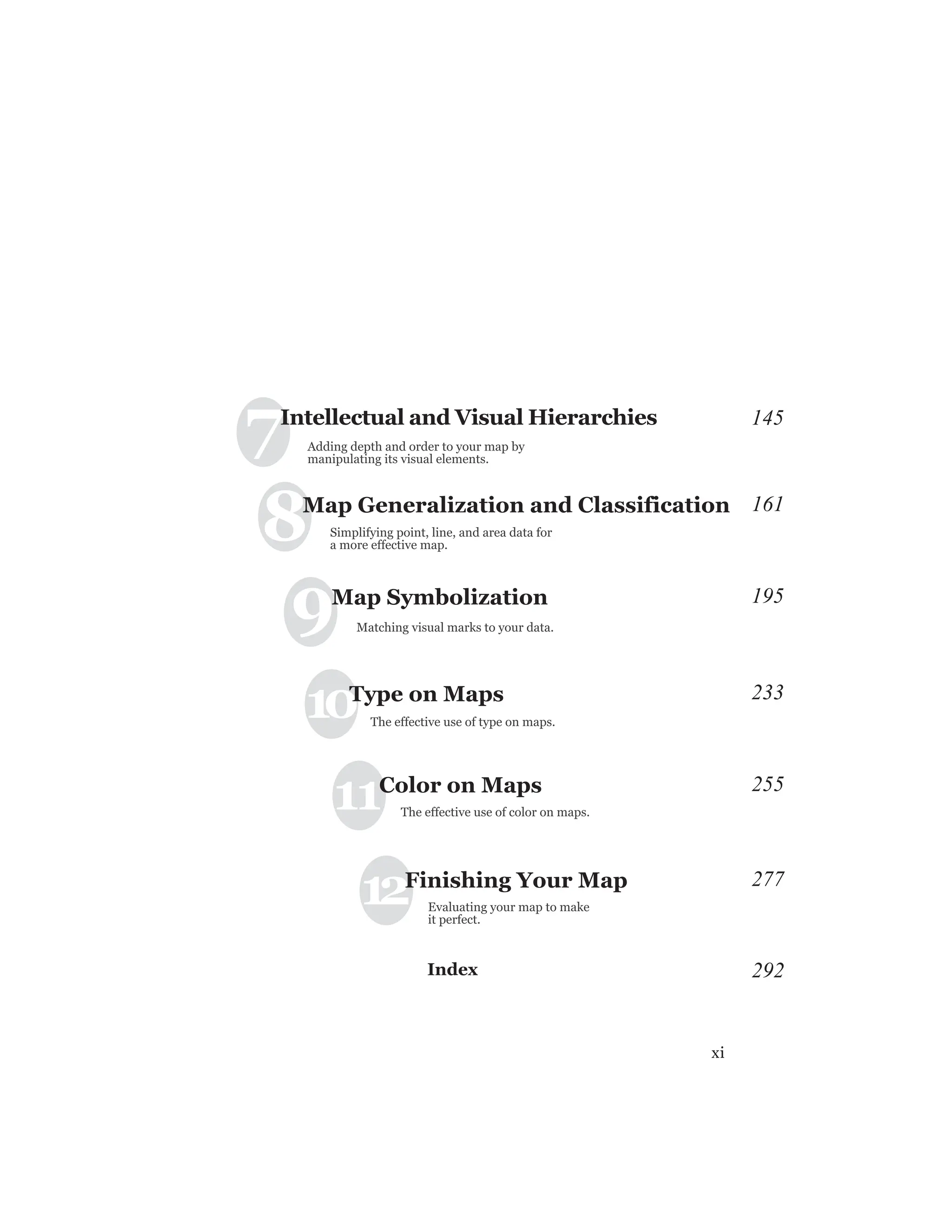
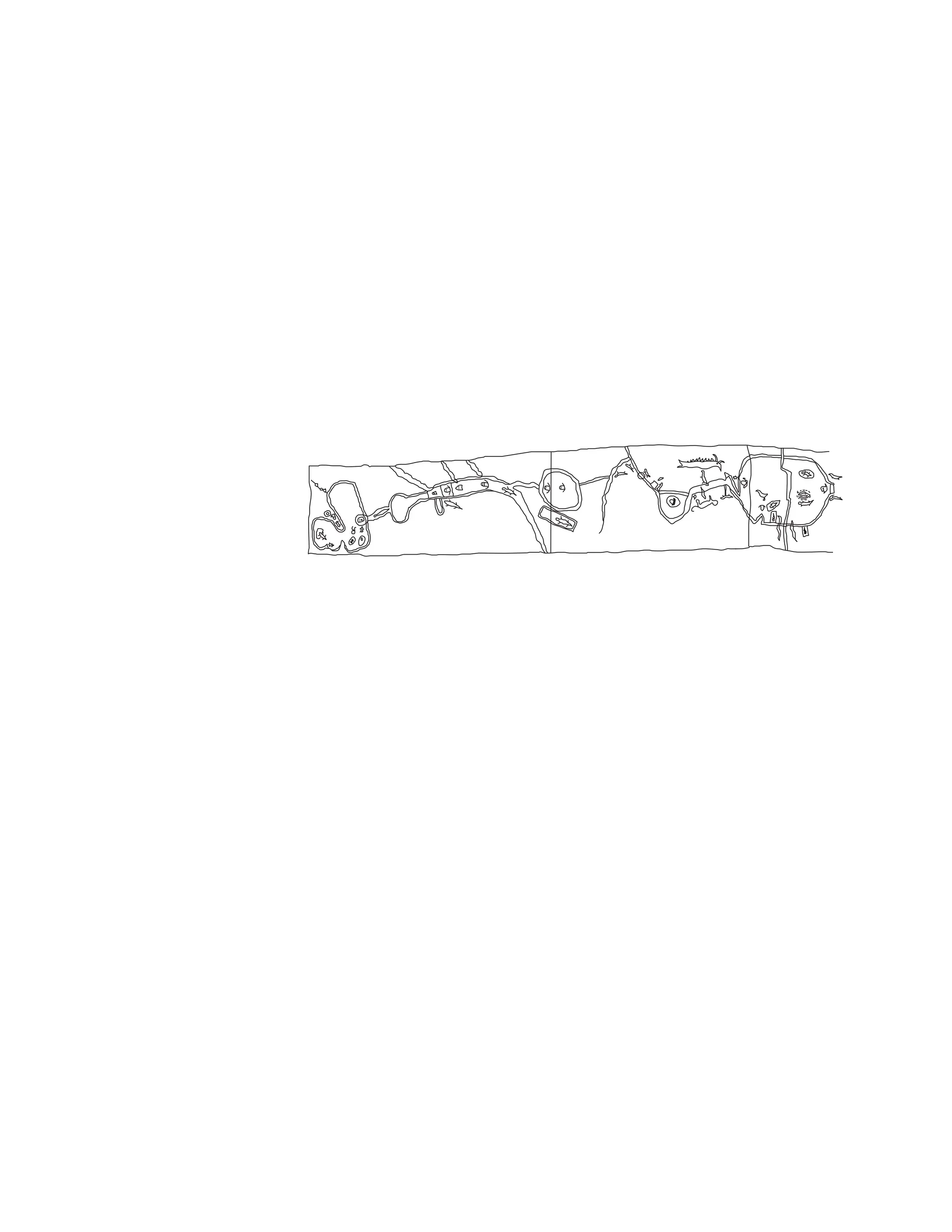
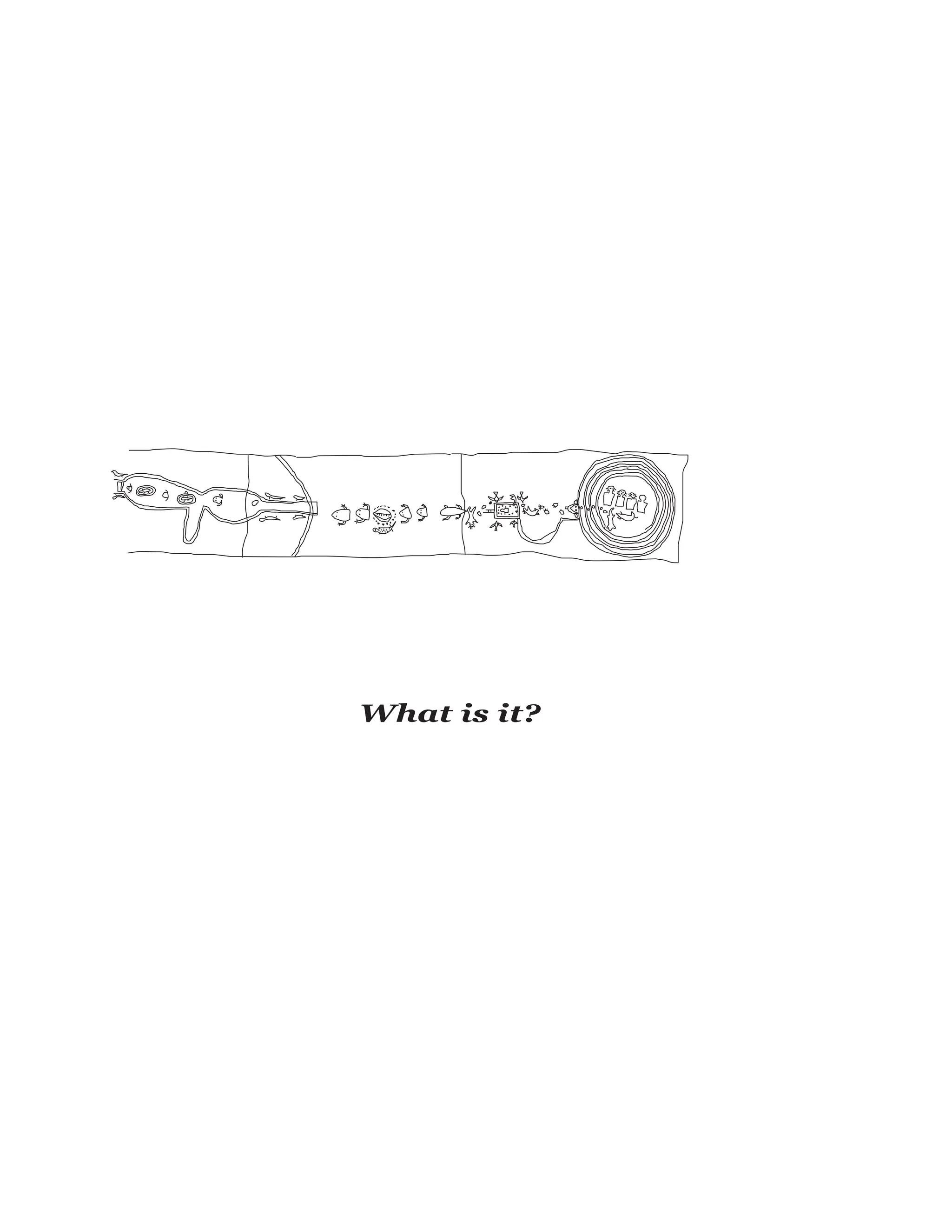
Ojibwe(Native American) ca. 1820
Maps are a powerful way of thinking about the earth.
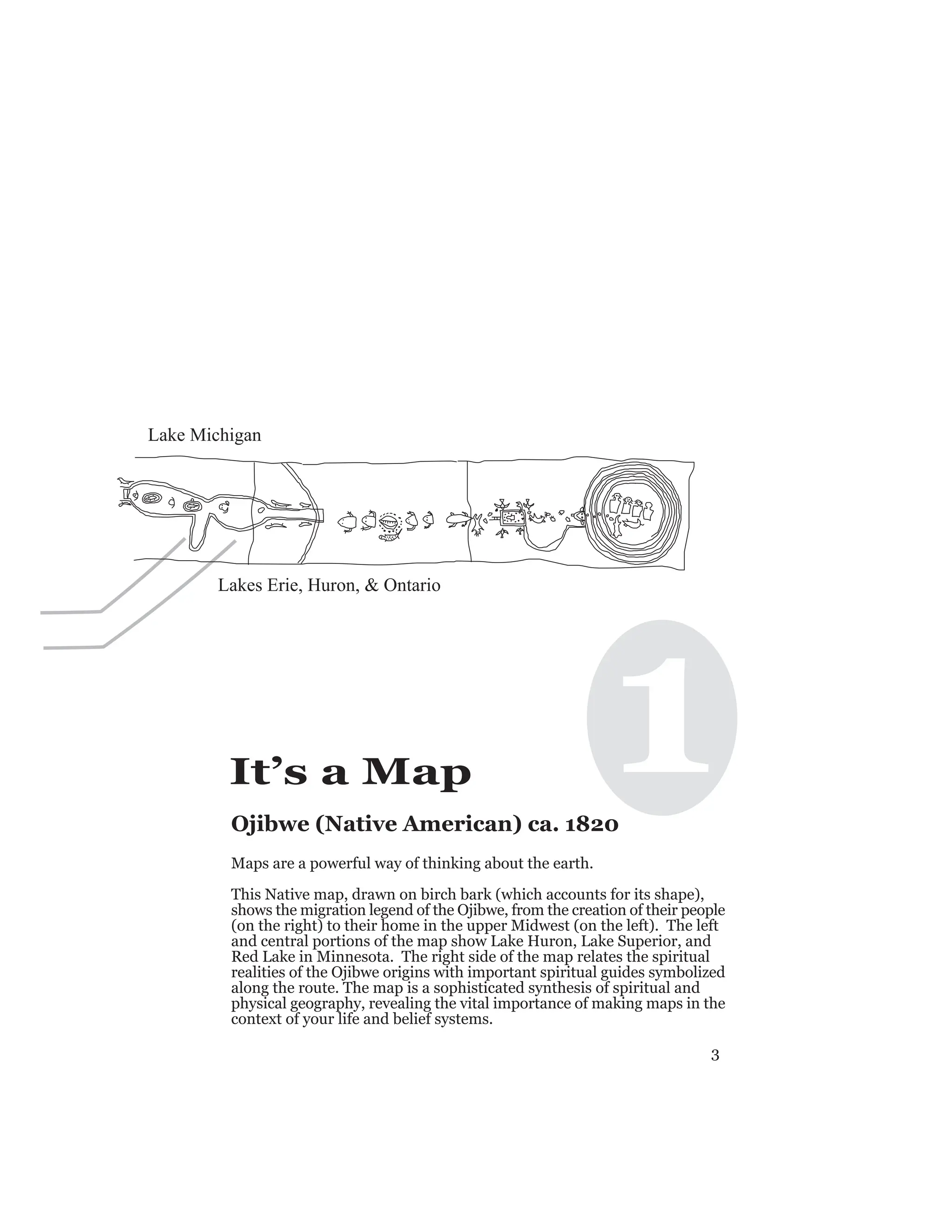
This Native map, drawn on birch bark (which accounts for its shape),
shows the migration legend of the Ojibwe, from the creation of their people
(on the right) to their home in the upper Midwest (on the left). The left
and central portions of the map show Lake Huron, Lake Superior, and
Red Lake in Minnesota. The right side of the map relates the spiritual
realities of the Ojibwe origins with important spiritual guides symbolized
along the route. The map is a sophisticated synthesis of spiritual and
physical geography, revealing the vital importance of making maps in the
context of your life and belief systems.
Lake Michigan
Lakes Erie, Huron, & Ontario
21.
4
GIS
Technological Changes
Geographic InformationSystems (GIS)
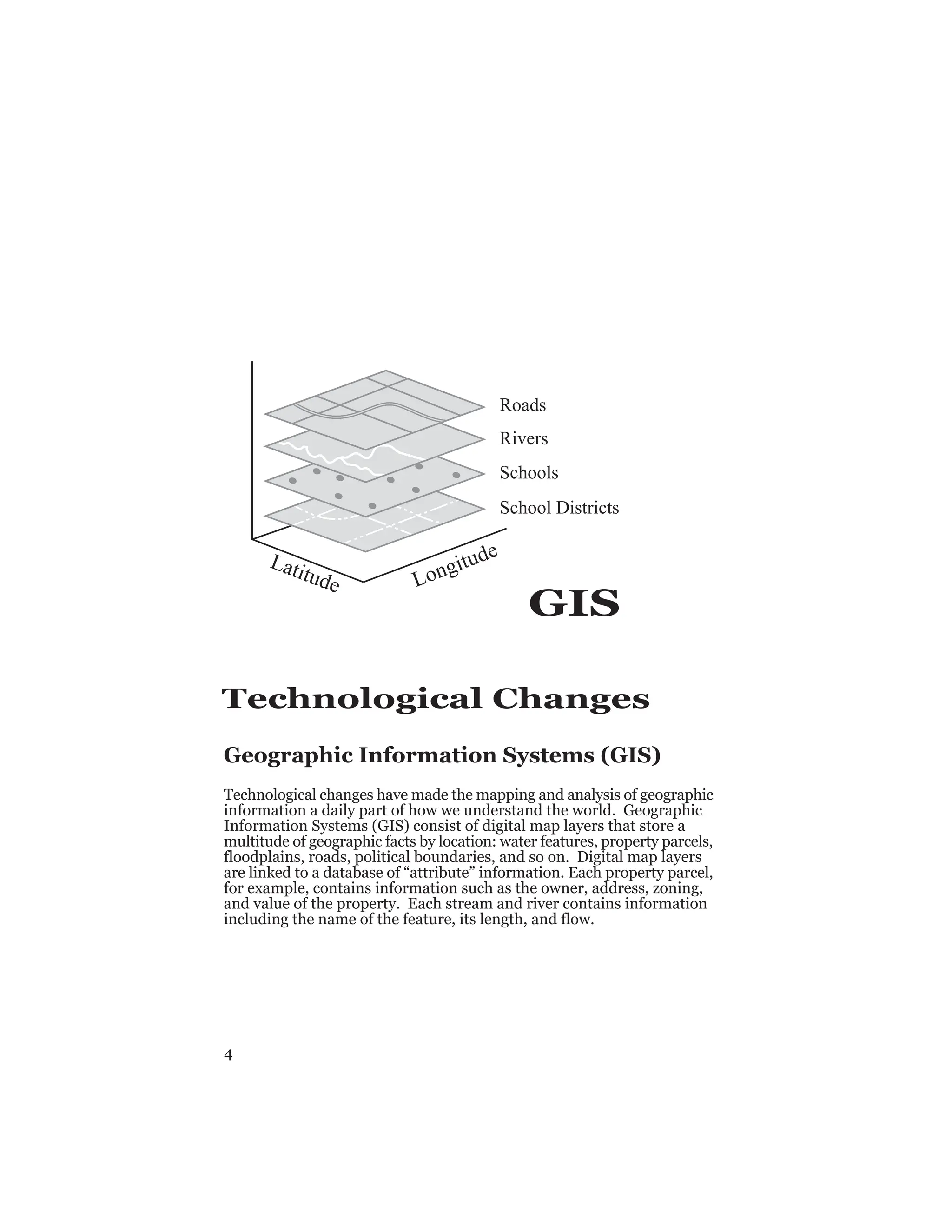
Technological changes have made the mapping and analysis of geographic
information a daily part of how we understand the world. Geographic
Information Systems (GIS) consist of digital map layers that store a
multitude of geographic facts by location: water features, property parcels,
floodplains, roads, political boundaries, and so on. Digital map layers
are linked to a database of “attribute” information. Each property parcel,
for example, contains information such as the owner, address, zoning,
and value of the property. Each stream and river contains information
including the name of the feature, its length, and flow.
Latitude Longitude
Roads
Rivers
Schools
School Districts
22.
5
1981 2003
Native Forest
PinePlantation
Pine - Mix
Pine Plantation Prep
Logged - Cleared
Other: Some Canopy
Other: No Canopy
Study Area
Forest change in Tennessee
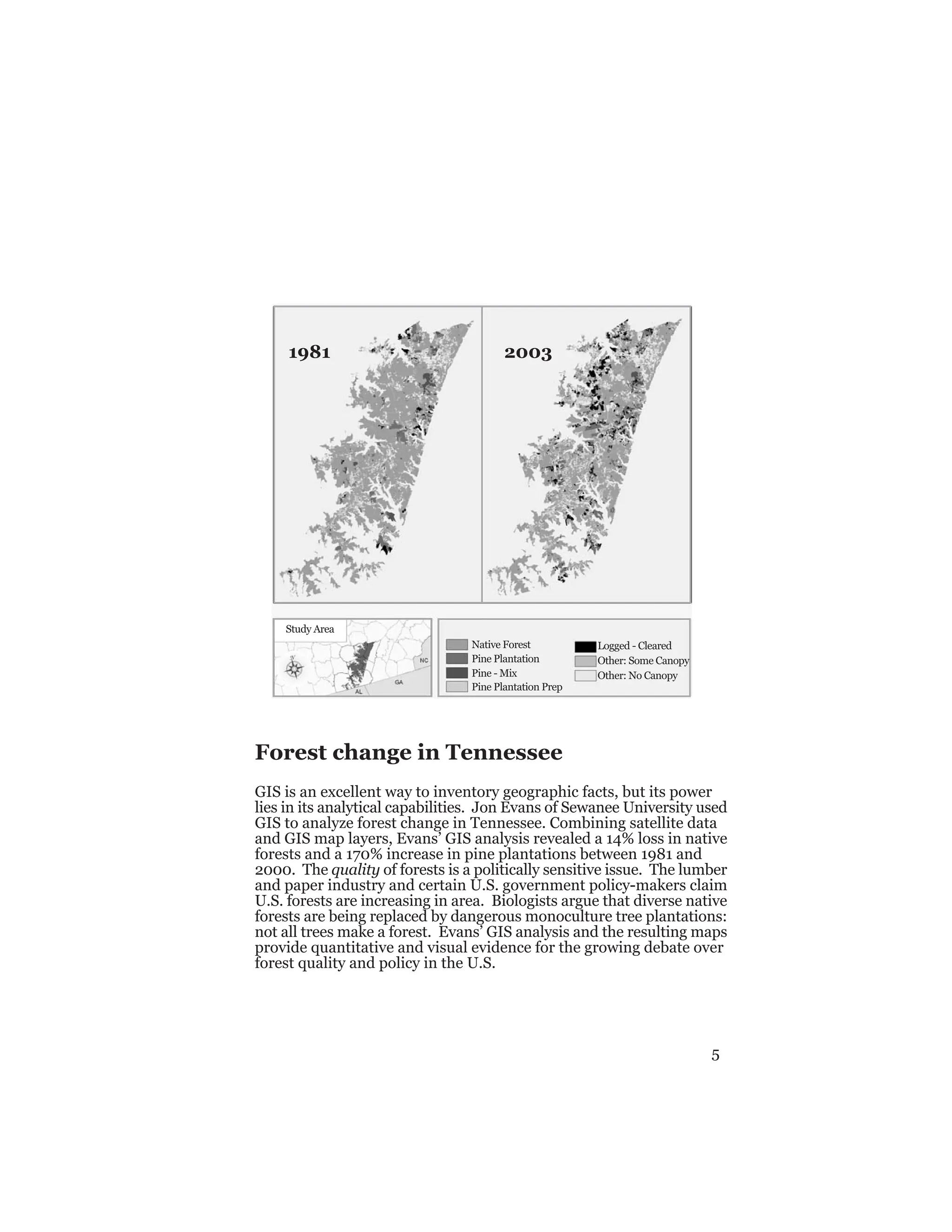
GIS is an excellent way to inventory geographic facts, but its power
lies in its analytical capabilities. Jon Evans of Sewanee University used
GIS to analyze forest change in Tennessee. Combining satellite data
and GIS map layers, Evans’ GIS analysis revealed a 14% loss in native
forests and a 170% increase in pine plantations between 1981 and
2000. The quality of forests is a politically sensitive issue. The lumber
and paper industry and certain U.S. government policy-makers claim
U.S. forests are increasing in area. Biologists argue that diverse native
forests are being replaced by dangerous monoculture tree plantations:
not all trees make a forest. Evans’ GIS analysis and the resulting maps
provide quantitative and visual evidence for the growing debate over
forest quality and policy in the U.S.
23.
6
Maps Kill!
Military targetingmaps
Maps have long been used to fight wars, win battles, and kill people.
Targeting maps help to fine-tune bombing during military campaigns,
to destroy certain select targets and people and not others. Royal Air
Force pilots are briefed with a terrain model prior to a bombing mission
during World War II (top). Geographic Information Systems – and
maps of bombing targets – are at the core of strategizing and planning
bombing missions for the war in Iraq (bottom).
24.
7
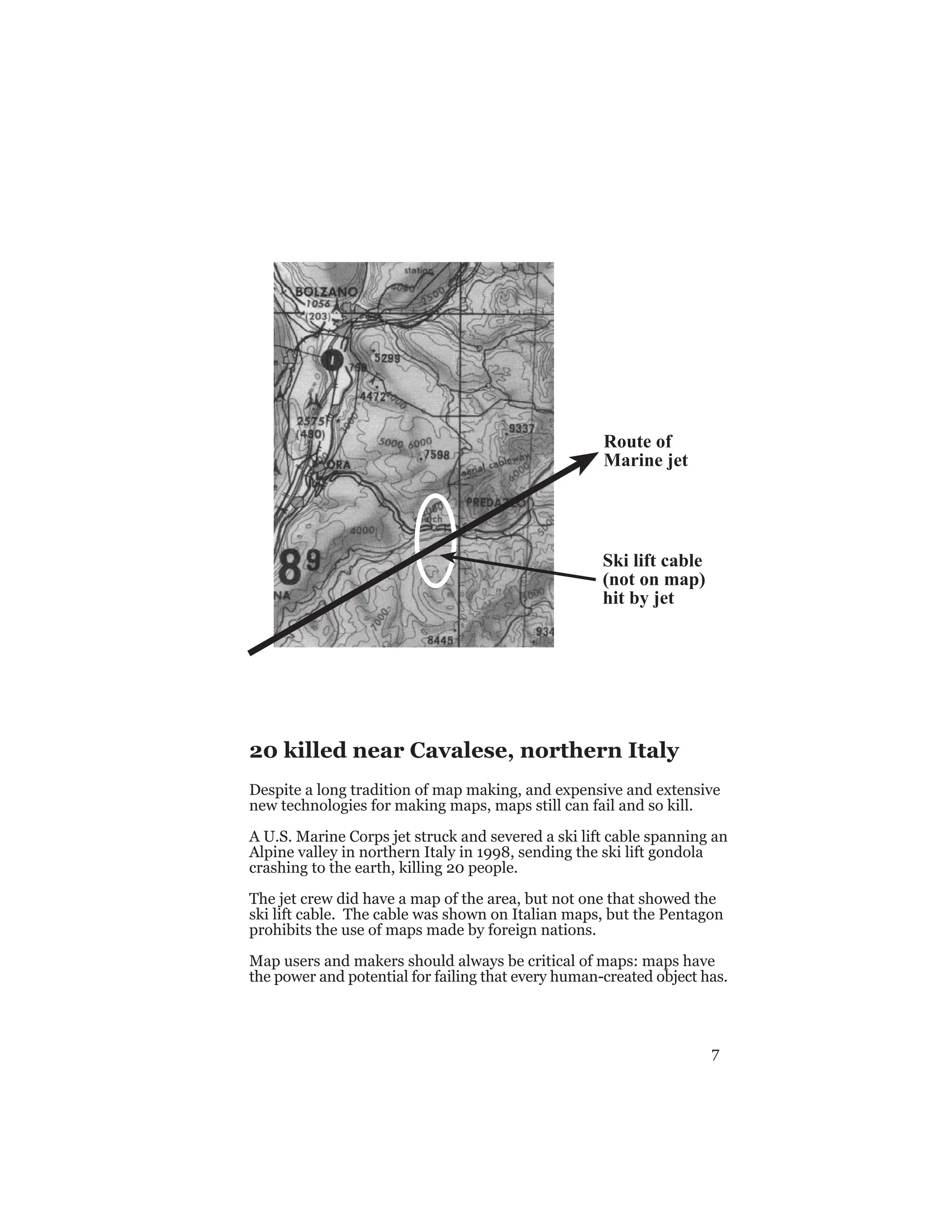
Route of
Marine jet
Skilift cable
(not on map)
hit by jet
20 killed near Cavalese, northern Italy
Despite a long tradition of map making, and expensive and extensive
new technologies for making maps, maps still can fail and so kill.
A U.S. Marine Corps jet struck and severed a ski lift cable spanning an
Alpine valley in northern Italy in 1998, sending the ski lift gondola
crashing to the earth, killing 20 people.
The jet crew did have a map of the area, but not one that showed the
ski lift cable. The cable was shown on Italian maps, but the Pentagon
prohibits the use of maps made by foreign nations.
Map users and makers should always be critical of maps: maps have
the power and potential for failing that every human-created object has.
25.
8
Discoveries with Maps
Mapsgenerate new understanding
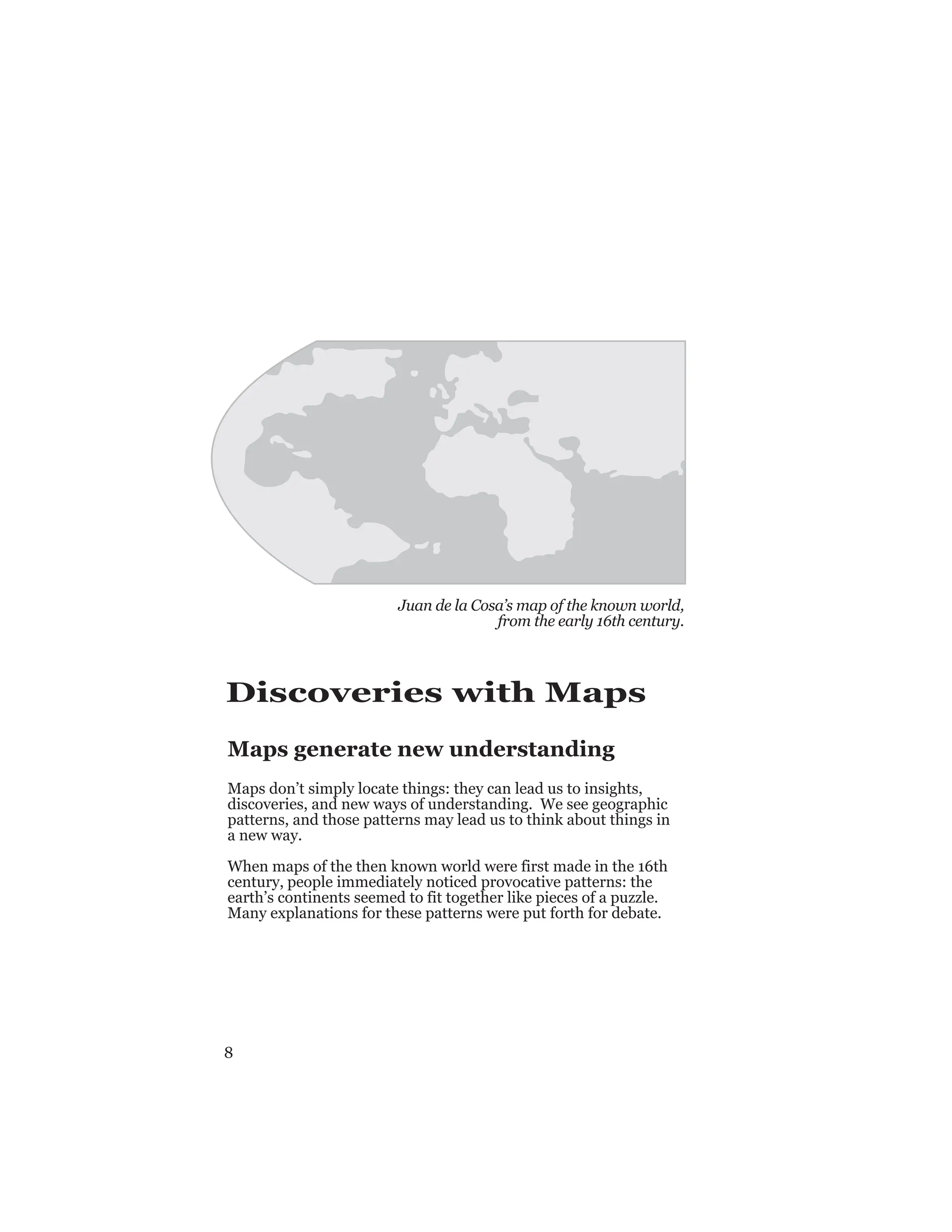
Maps don’t simply locate things: they can lead us to insights,
discoveries, and new ways of understanding. We see geographic
patterns, and those patterns may lead us to think about things in
a new way.
When maps of the then known world were first made in the 16th
century, people immediately noticed provocative patterns: the
earth’s continents seemed to fit together like pieces of a puzzle.
Many explanations for these patterns were put forth for debate.
Juan de la Cosa’s map of the known world,
from the early 16th century.
26.
9
Plate tectonics
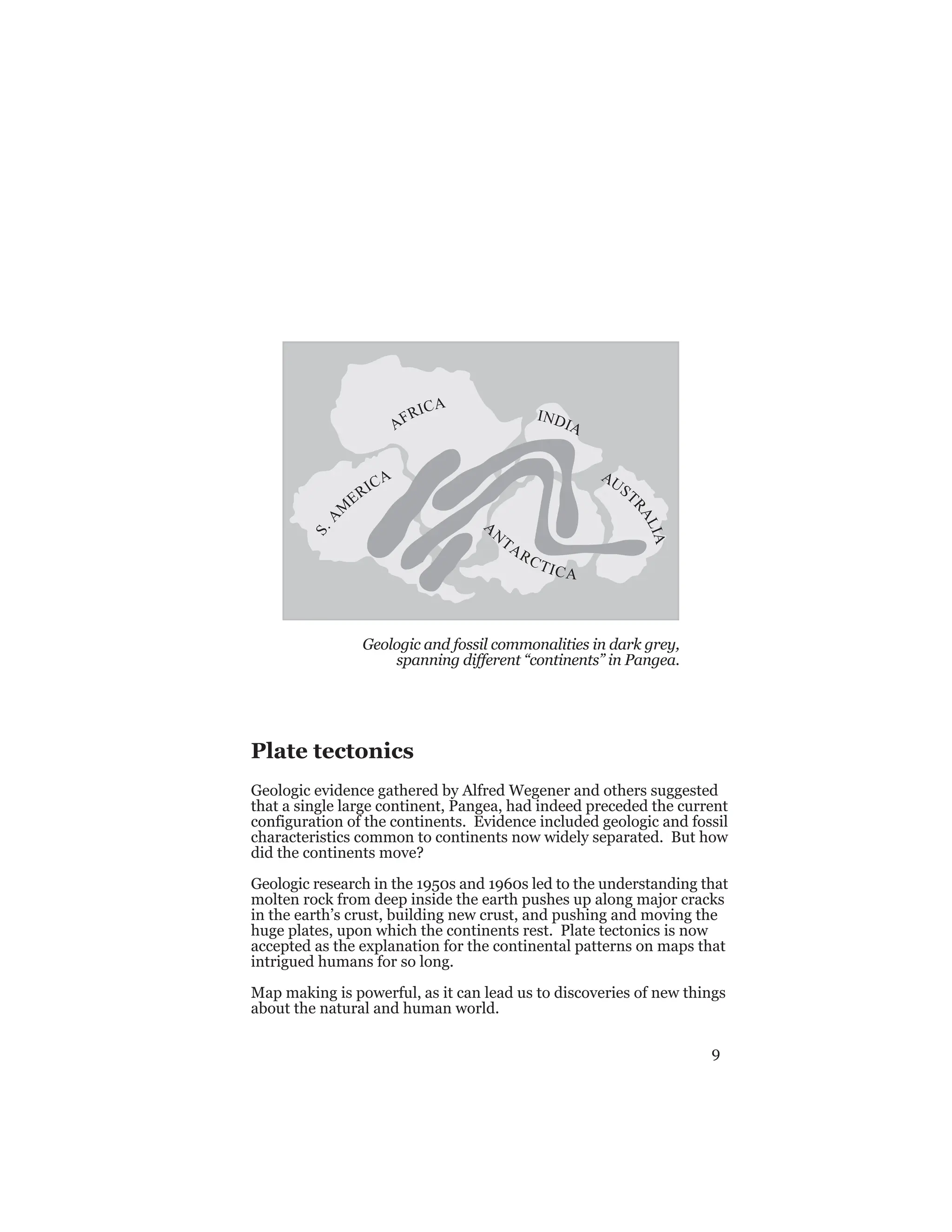
Geologic evidencegathered by Alfred Wegener and others suggested
that a single large continent, Pangea, had indeed preceded the current
configuration of the continents. Evidence included geologic and fossil
characteristics common to continents now widely separated. But how
did the continents move?
Geologic research in the 1950s and 1960s led to the understanding that
molten rock from deep inside the earth pushes up along major cracks
in the earth’s crust, building new crust, and pushing and moving the
huge plates, upon which the continents rest. Plate tectonics is now
accepted as the explanation for the continental patterns on maps that
intrigued humans for so long.
Map making is powerful, as it can lead us to discoveries of new things
about the natural and human world.
Geologic and fossil commonalities in dark grey,
spanning different “continents” in Pangea.
AFRICA
S
.
A
M
ERICA
INDIA
AUST
R
A
L
I
A
A
N
TARCTICA
27.
10
Thinking Visually withMaps
HIV patients in rural Tennessee
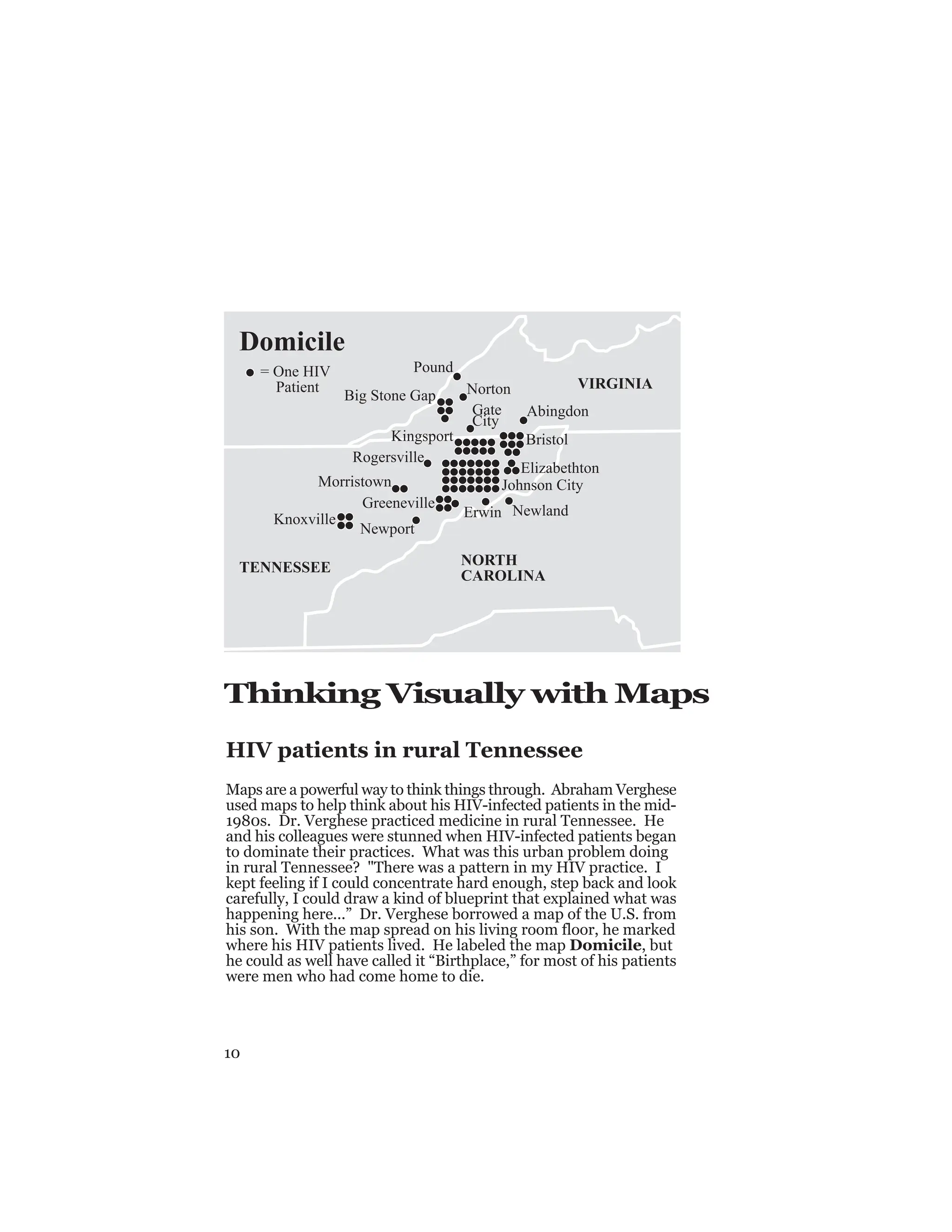
Maps are a powerful way to think things through. Abraham Verghese
used maps to help think about his HIV-infected patients in the mid-
1980s. Dr. Verghese practiced medicine in rural Tennessee. He
and his colleagues were stunned when HIV-infected patients began
to dominate their practices. What was this urban problem doing
in rural Tennessee? "There was a pattern in my HIV practice. I
kept feeling if I could concentrate hard enough, step back and look
carefully, I could draw a kind of blueprint that explained what was
happening here...” Dr. Verghese borrowed a map of the U.S. from
his son. With the map spread on his living room floor, he marked
where his HIV patients lived. He labeled the map Domicile, but
he could as well have called it “Birthplace,” for most of his patients
were men who had come home to die.
Pound
Norton
Big Stone Gap
Abingdon
Bristol
Elizabethton
Johnson City
Newland
Erwin
Greeneville
Gate
City
Kingsport
Rogersville
Morristown
Newport
Knoxville
VIRGINIA
NORTH
CAROLINA
TENNESSEE
Domicile
= One HIV
Patient
28.
11
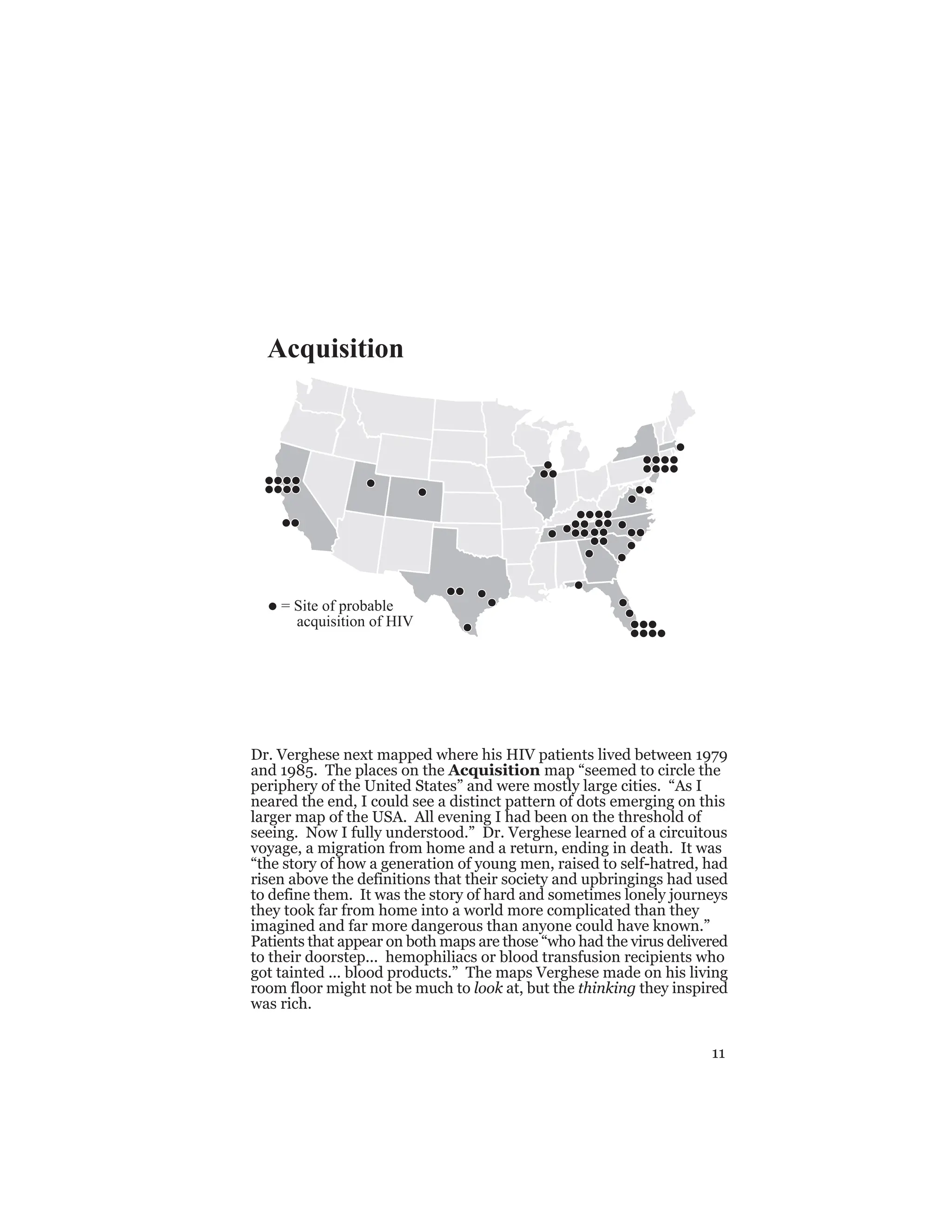
Dr. Verghese nextmapped where his HIV patients lived between 1979
and 1985. The places on the Acquisition map “seemed to circle the
periphery of the United States” and were mostly large cities. “As I
neared the end, I could see a distinct pattern of dots emerging on this
larger map of the USA. All evening I had been on the threshold of
seeing. Now I fully understood.” Dr. Verghese learned of a circuitous
voyage, a migration from home and a return, ending in death. It was
“the story of how a generation of young men, raised to self-hatred, had
risen above the definitions that their society and upbringings had used
to define them. It was the story of hard and sometimes lonely journeys
they took far from home into a world more complicated than they
imagined and far more dangerous than anyone could have known.”
Patients that appear on both maps are those “who had the virus delivered
to their doorstep... hemophiliacs or blood transfusion recipients who
got tainted ... blood products.” The maps Verghese made on his living
room floor might not be much to look at, but the thinking they inspired
was rich.
= Site of probable
acquisition of HIV
Acquisition
29.
12
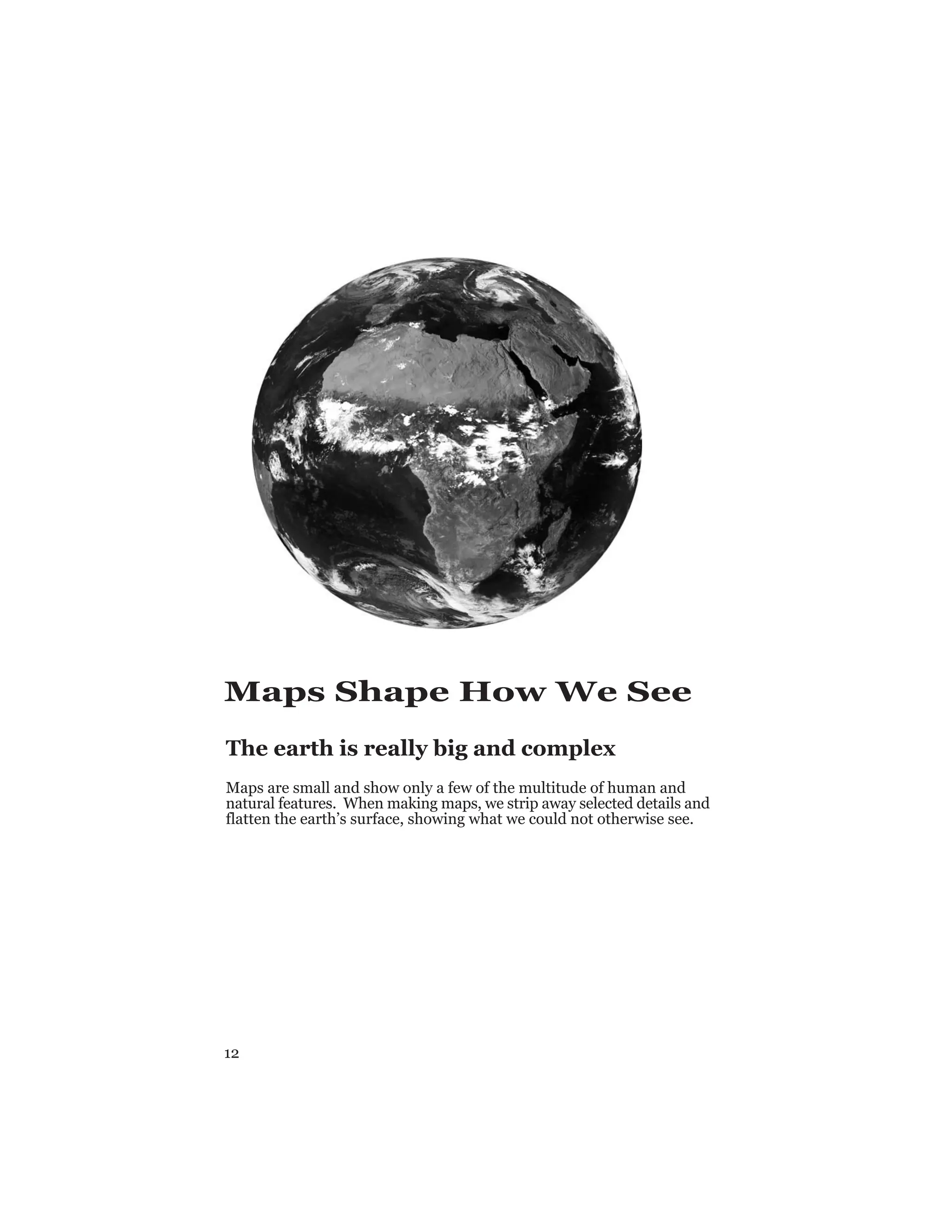
Maps Shape HowWe See
The earth is really big and complex
Maps are small and show only a few of the multitude of human and
natural features. When making maps, we strip away selected details and
flatten the earth’s surface, showing what we could not otherwise see.
30.
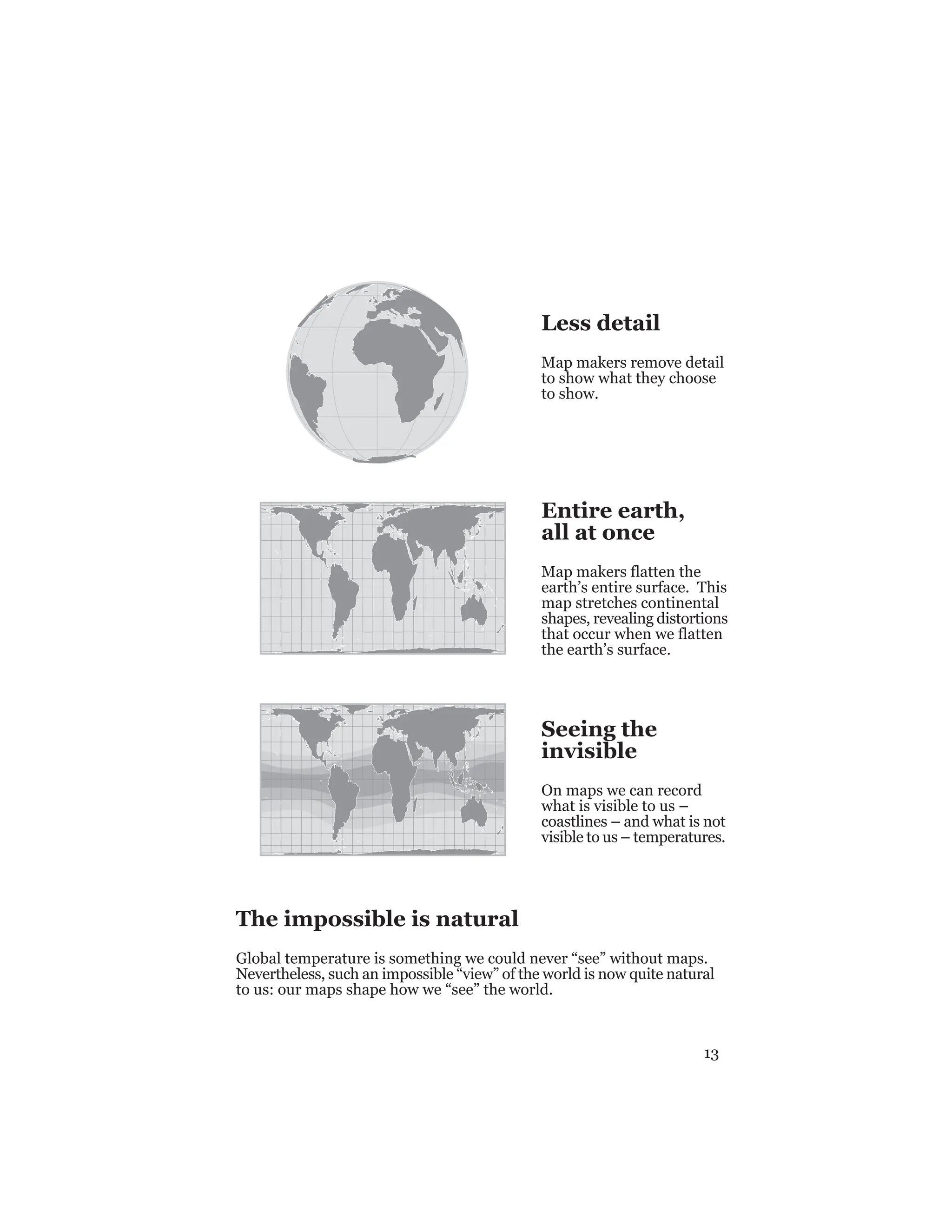
13
The impossible isnatural
Global temperature is something we could never “see” without maps.
Nevertheless, such an impossible “view” of the world is now quite natural
to us: our maps shape how we “see” the world.
Less detail
Map makers remove detail
to show what they choose
to show.
Entire earth,
all at once
Map makers flatten the
earth’s entire surface. This
map stretches continental
shapes, revealing distortions
that occur when we flatten
the earth’s surface.
Seeing the
invisible
On maps we can record
what is visible to us –
coastlines – and what is not
visible to us – temperatures.
31.
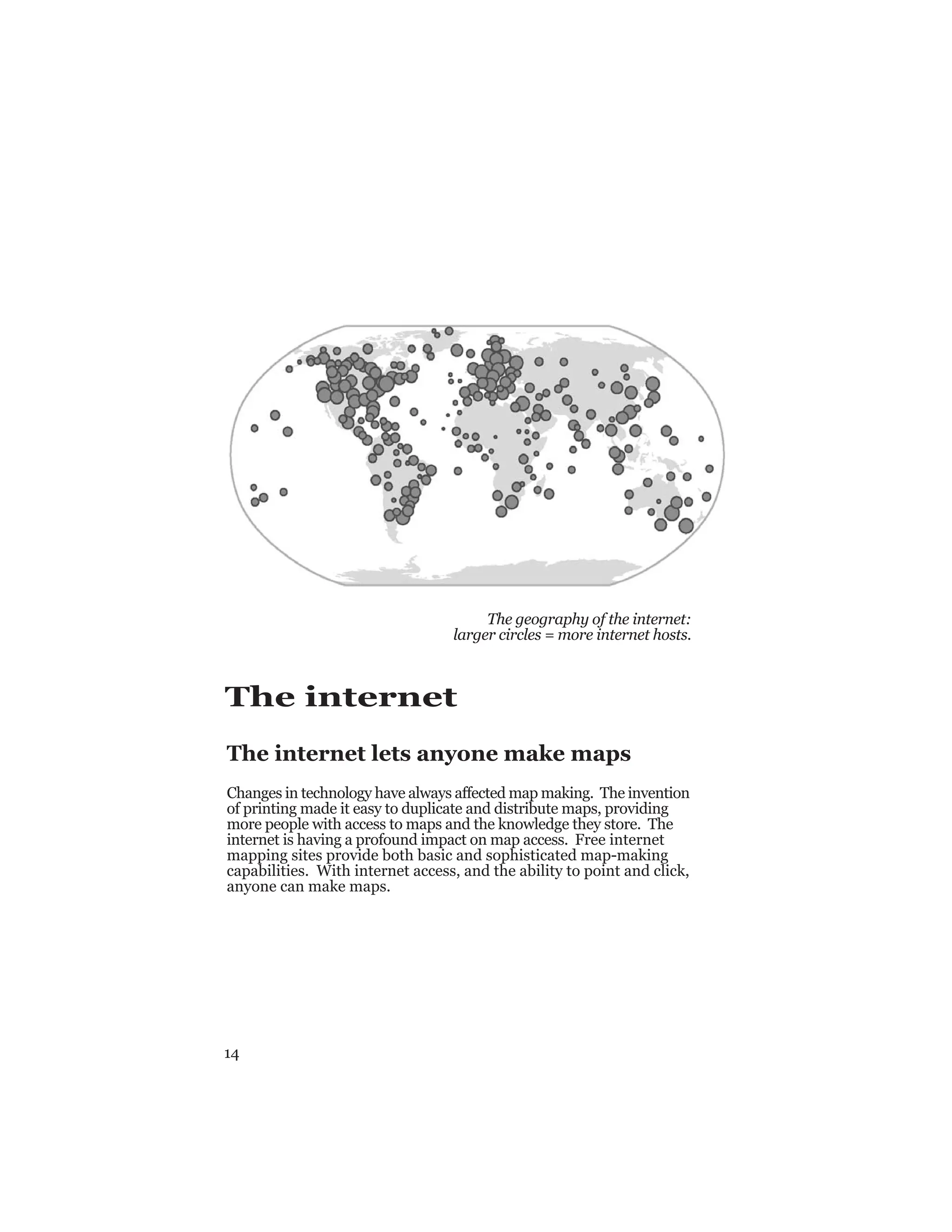
14
The internet
The internetlets anyone make maps
Changes in technology have always affected map making. The invention
of printing made it easy to duplicate and distribute maps, providing
more people with access to maps and the knowledge they store. The
internet is having a profound impact on map access. Free internet
mapping sites provide both basic and sophisticated map-making
capabilities. With internet access, and the ability to point and click,
anyone can make maps.
The geography of the internet:
larger circles = more internet hosts.
32.
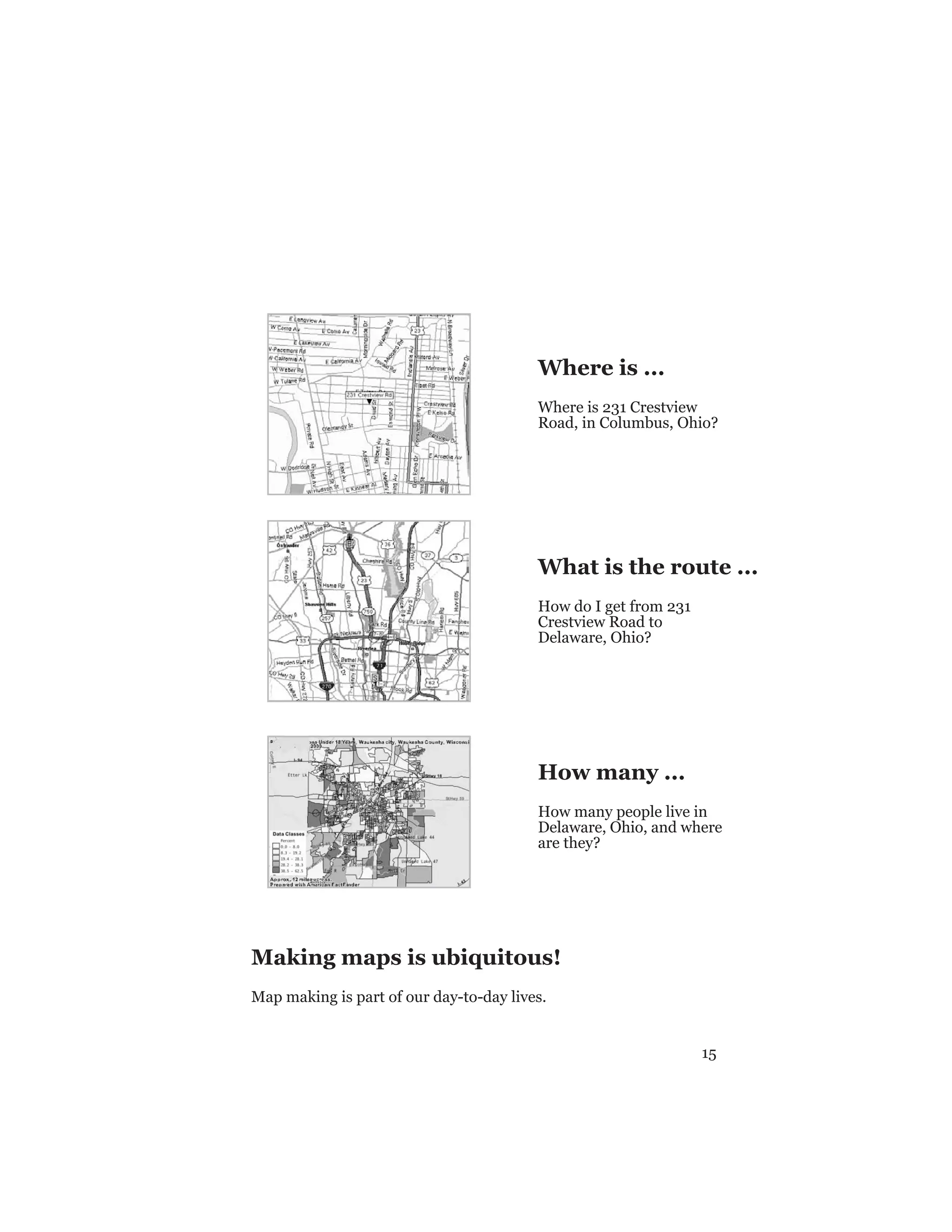
15
Making maps isubiquitous!
Map making is part of our day-to-day lives.
Where is ...
Where is 231 Crestview
Road, in Columbus, Ohio?
What is the route ...
How do I get from 231
Crestview Road to
Delaware, Ohio?
How many ...
How many people live in
Delaware, Ohio, and where
are they?
33.
16
What Is aMap?
A graphic statement that locates facts
Graphic: A visual display of marks which stand for something else. An
airplane shape on a map implies an airport.
Statement: To put forth information, a formal embodiment of facts or
assertions.
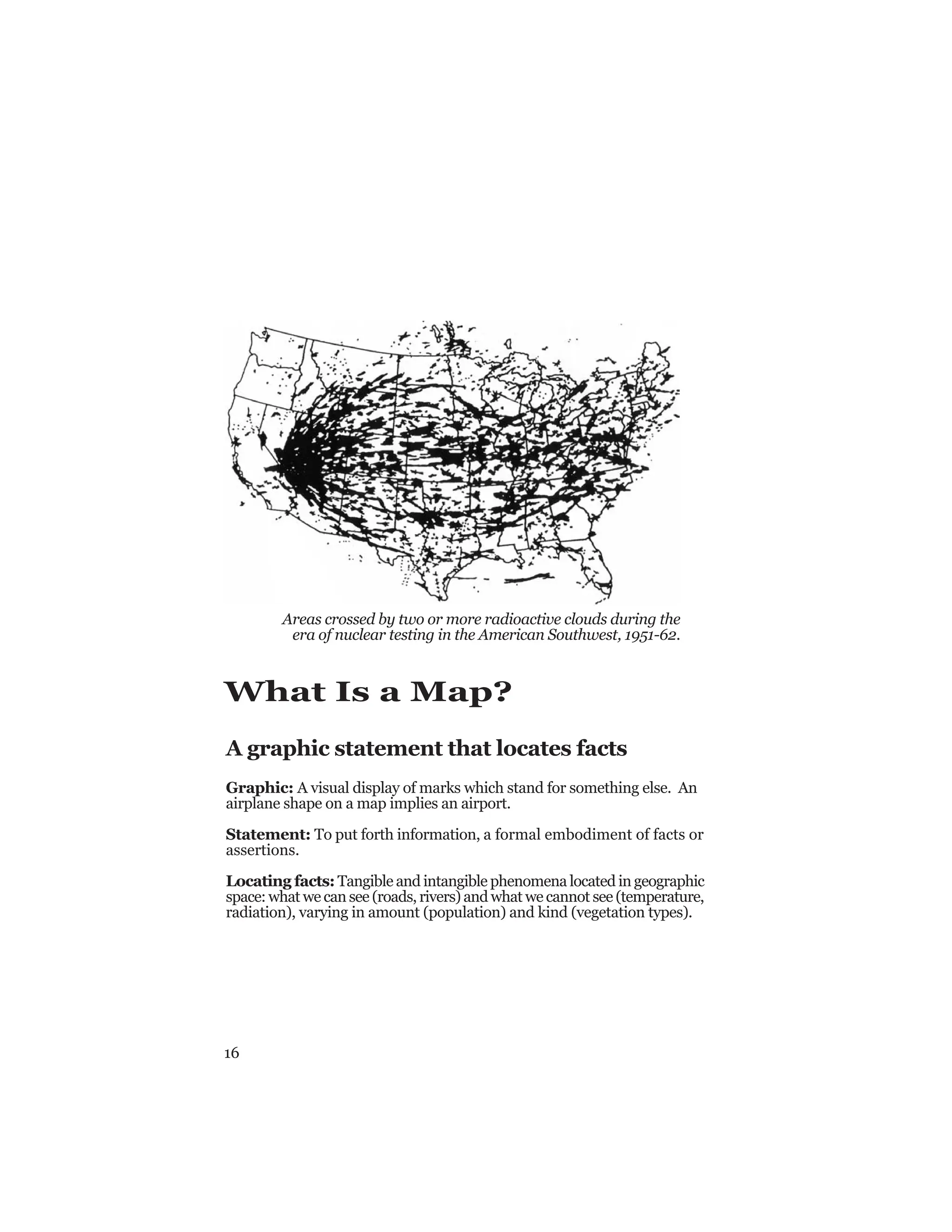
Locating facts: Tangible and intangible phenomena located in geographic
space: what we can see (roads, rivers) and what we cannot see (temperature,
radiation), varying in amount (population) and kind (vegetation types).
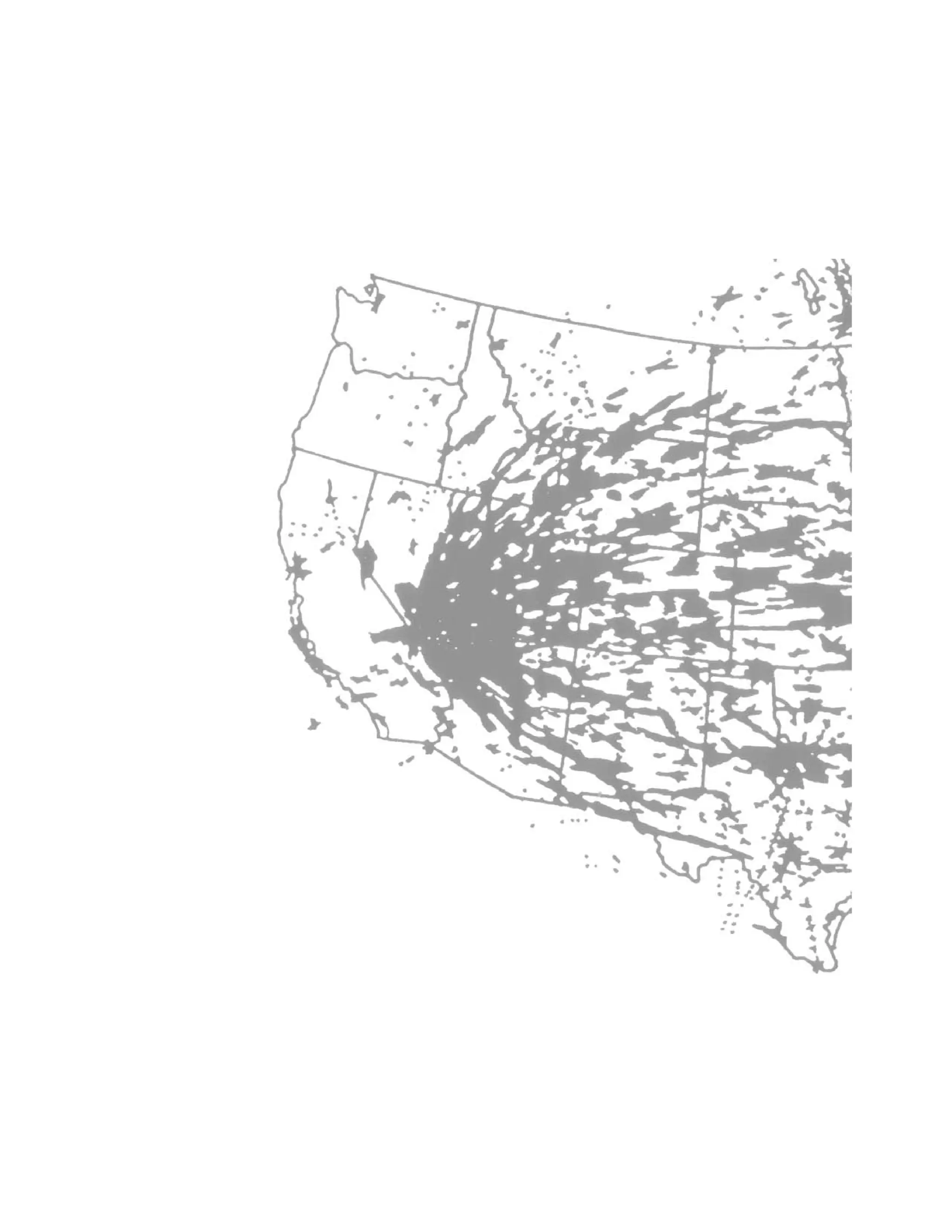
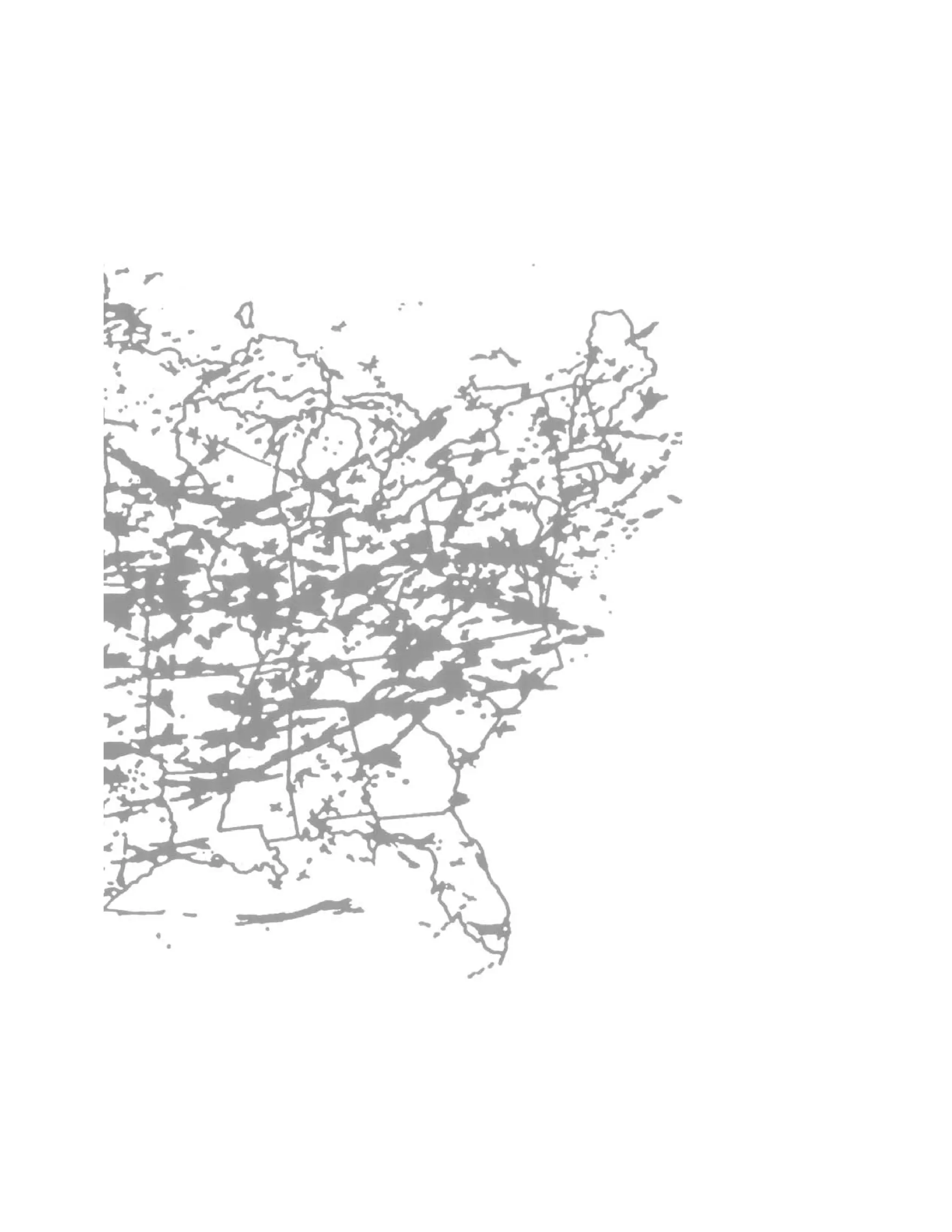
Areas crossed by two or more radioactive clouds during the
era of nuclear testing in the American Southwest, 1951-62.
34.
17
Making Maps
How doyou make a map?
Why are you making your map? What are you intending to do with
it? Who is your audience? Are they experts or novices? Young or old?
What should the map assert? What do you want your map to communicate
to those who see it? You must decide why you are making the map before
you make it. Chapter 2.
Mappable data: Given your purpose, what data do you need? Roads?
Rivers? Coastlines? Population? Toxin levels in wells? Number of deer
per county? Some data are free and easy to find. Other data exist, but at
a cost. The facts you need may not exist at all, and you may have to collect
them yourself or pay someone to do so. Locating and processing mappable
data can be among the most expensive and time-consuming parts of making
maps. Chapter 3.
Map-making tools: Which tools will you use to make your map? Internet
map-making sites are free but limited in data and map-making capabilities.
Geographical Information System (GIS) software is more sophisticated and
flexiblebutexpensivetopurchaseandmoredifficulttouse. Selectappropriate
map-making tools based on the kind of map you want to make: you cannot
make every map using internet sites, but you don’t need GIS for every map
either. Chapter 4.
Map design: Given the reason you are making the map, mappable data,
and map-making tools, how do you make a map that fulfills your goals - a
map that works? Key issues include the geographic framework, map layout,
intellectual and visual hierarchies, map generalization and classification,
map symbolization, and the use of type and color. Chapters 5-12.
35.
18
“Who died andmade you the map police?”
Jill. Home Improvement. (TV, 1991)
“Is that the same map?” Jincey asked. She pointed to the large
map of the world that hung, rolled up for the summer, above the
blackboard behind Miss Dove. “Is China still orange?”
“It is a new map,” Miss Dove said. “China is purple.”
“I liked the old map,” Jincey said. “I liked the old world.”
“Cartography is a fluid art,” said Miss Dove.
Frances Gray Patton. Good Morning, Miss Dove. (1954)
36.
19
more information...
Three excellentbooks situate mapping in its broader human context:
Daniel Dorling and David Fairbairn, Mapping (Longman, 1997);
Mark Monmonier, How to Lie with Maps (2nd ed., University of
Chicago Press, 1996); and Denis Wood, The Power of Maps (Guilford
Press, 1992). Check out the journal Cartographic Perspectives;
published by the North American Cartographic Information Society.
This book draws from numerous texts, which can be consulted for
more information: Borden Dent, Cartography: Thematic Map
Design (5th ed., McGraw-Hill, 1998); Alan MacEachren, Some
Truth with Maps (Association of American Geographers, 1994);
and Phillip and Juliana Muehrcke, Map Use (4th ed., JP Publications,
1998). Also consulted were M.J. Kraak and F.J. Ormeling,
Cartography: Visualization of Spatial Data (Longman, 1996);
Arthur Robinson et al., Elements of Cartography (6th ed., Wiley,
1995); and Terry Slocum et al., Thematic Cartography and
Visualization (2nd ed., Prentice Hall, 2003). These folks are the
map police.
An older generation of mapping textbooks are worth looking at:
F.J. Monkhouse and H.R. Wilkinson, Maps and Diagrams
(Methuen, 1952); J.S. Keates, Cartographic Design and Production
(Wiley, 1973); and two wonderful textbooks by Erwin Raisz: General
Cartography (McGraw-Hill, 1938) and Principles of Cartography
(McGraw-Hill, 1962).
The most comprehensive overview of academic research on mapping
is Alan MacEachren, How Maps Work (Guilford Press, 1995).
Sources: The Ojibwe map (pp. xii, 1-3) redrawn from Selwyn Dewdney, The Sacred
Scrolls of the Southern Ojibway (University of Toronto Press, 1975). The forest
change map (p. 5) is courtesy of Jon Evans. The RAF terrain model image (p. 6)
is from the Geographical Review, Oct. 1946. The Iraq military targeting map
(p. 6) was found floating on the internet. The Cavalese map (p. 7) is courtesy of the
Harvard Map Library, Harvard University. AIDS data (pp. 10-11) from Abraham
Verghese, My Own Country: A Doctor’s Story (Vintage, 1994) and “Urbs in Rure:
Human Immunodeficiency Virus Infection in Rural Tennessee” (Journal of Infectious
Diseases, 160:6). The internet hosts map (p. 14) is based on one from Matrix Net
Systems. Internet road maps from Mapsonus.com, and U.S. Census map from the
U.S. Census American Factfinder. The radioactive cloud map is from Richard L.
Miller, Under the Cloud: The Decades of Nuclear Testing (Two-Sixty Press, 1999).
Lake Ontario
Lake Ontario
LakeOntario
Lake Erie
Lake Erie
Lake Erie
Lake
Lake
Lake
Huron
Huron
Huron
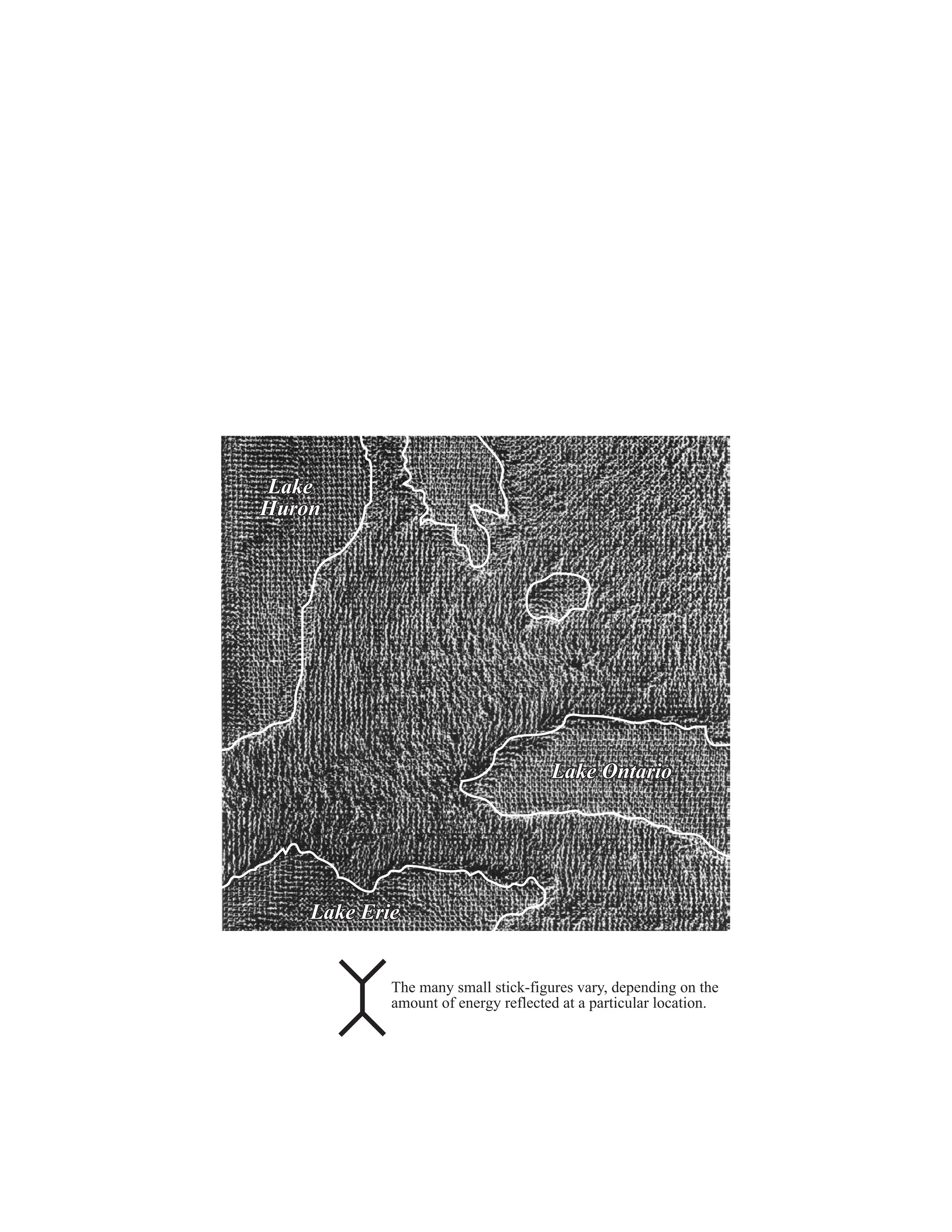
The many small stick-figures vary, depending on the
amount of energy reflected at a particular location.
42.
25
2
Why Are You
MakingYour Map?
Maps look like what they are supposed to do. Each mark on
this map is a complex symbol representing five different types of energy
reflected from the earth’s surface. The map shows an area in Ontario,
including parts of Lakes Huron, Erie, and Ontario. Most people won’t
be able to make much sense out of this map, but to expert earth scientists
the complex symbols and specialist subject matter are necessary.
43.
26
2
Why Are You
MakingYour Map?
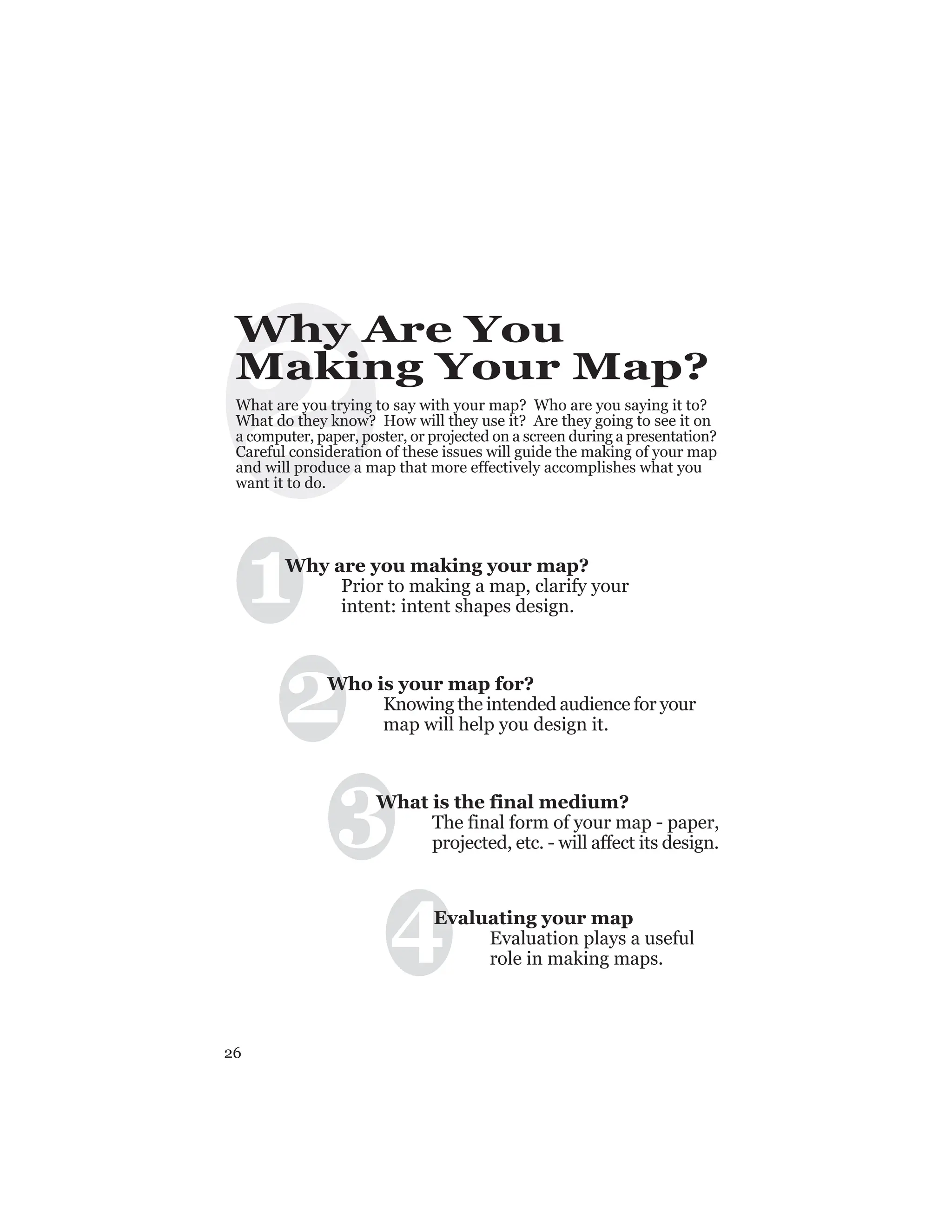
What are you trying to say with your map? Who are you saying it to?
What do they know? How will they use it? Are they going to see it on
a computer, paper, poster, or projected on a screen during a presentation?
Careful consideration of these issues will guide the making of your map
and will produce a map that more effectively accomplishes what you
want it to do.
1
2
3
4
Why are you making your map?
Prior to making a map, clarify your
intent: intent shapes design.
Who is your map for?
Knowing the intended audience for your
map will help you design it.
What is the final medium?
The final form of your map - paper,
projected, etc. - will affect its design.
Evaluating your map
Evaluation plays a useful
role in making maps.
44.
27
1Why are youmaking your map?
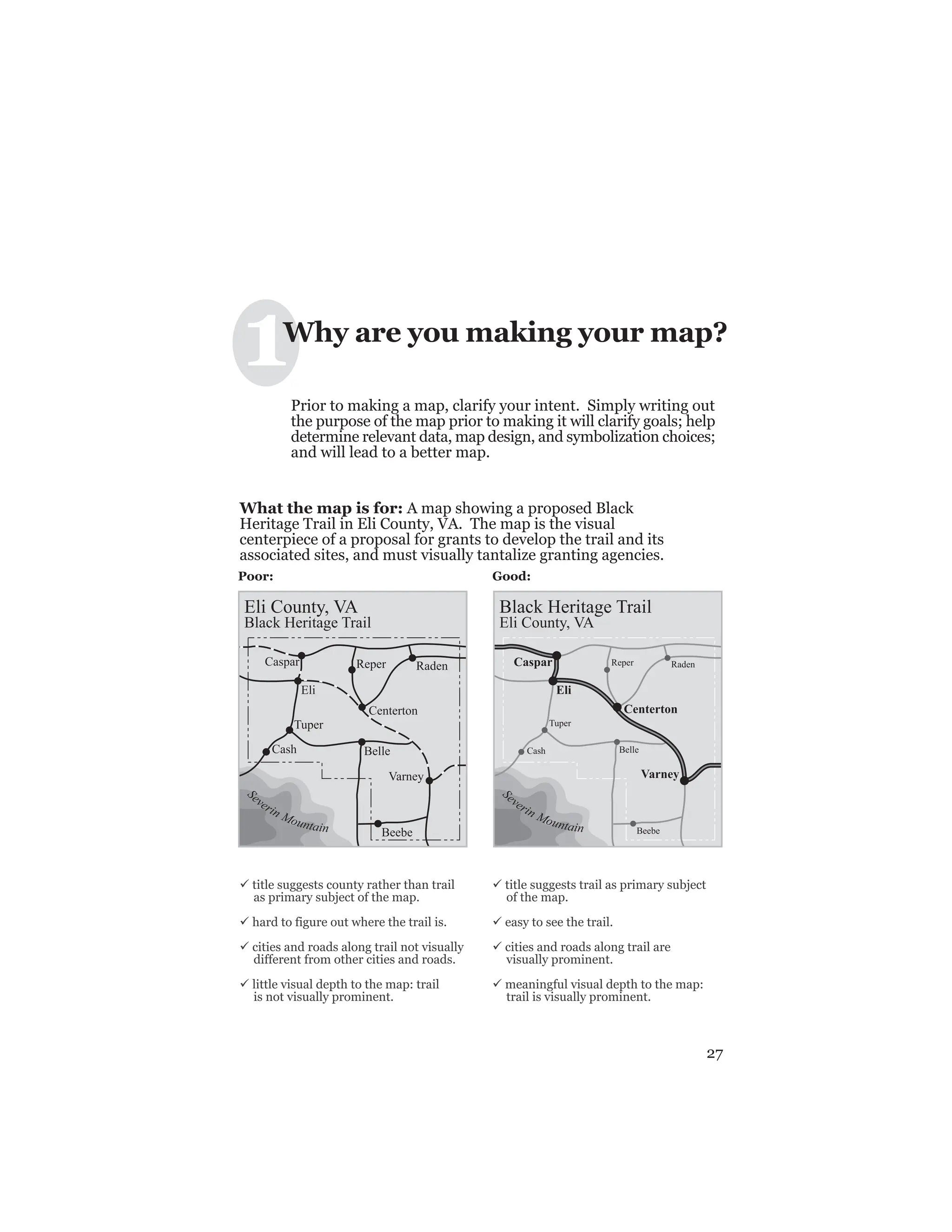
Prior to making a map, clarify your intent. Simply writing out
the purpose of the map prior to making it will clarify goals; help
determine relevant data, map design, and symbolization choices;
and will lead to a better map.
What the map is for: A map showing a proposed Black
Heritage Trail in Eli County, VA. The map is the visual
centerpiece of a proposal for grants to develop the trail and its
associated sites, and must visually tantalize granting agencies.
Poor: Good:
ü title suggests county rather than trail
as primary subject of the map.
ü hard to figure out where the trail is.
ü cities and roads along trail not visually
different from other cities and roads.
ü little visual depth to the map: trail
is not visually prominent.
ü title suggests trail as primary subject
of the map.
ü easy to see the trail.
ü cities and roads along trail are
visually prominent.
ü meaningful visual depth to the map:
trail is visually prominent.
Eli County, VA
Black Heritage Trail
Raden
Caspar
Tuper
Centerton
Belle
Varney
Eli
Beebe
Cash
Reper
S
everin Mountain
Black Heritage Trail
Eli County, VA
Raden
Caspar
Tuper
Centerton
Belle
Varney
Eli
Beebe
Cash
Reper
S
everin Mountain
45.
28
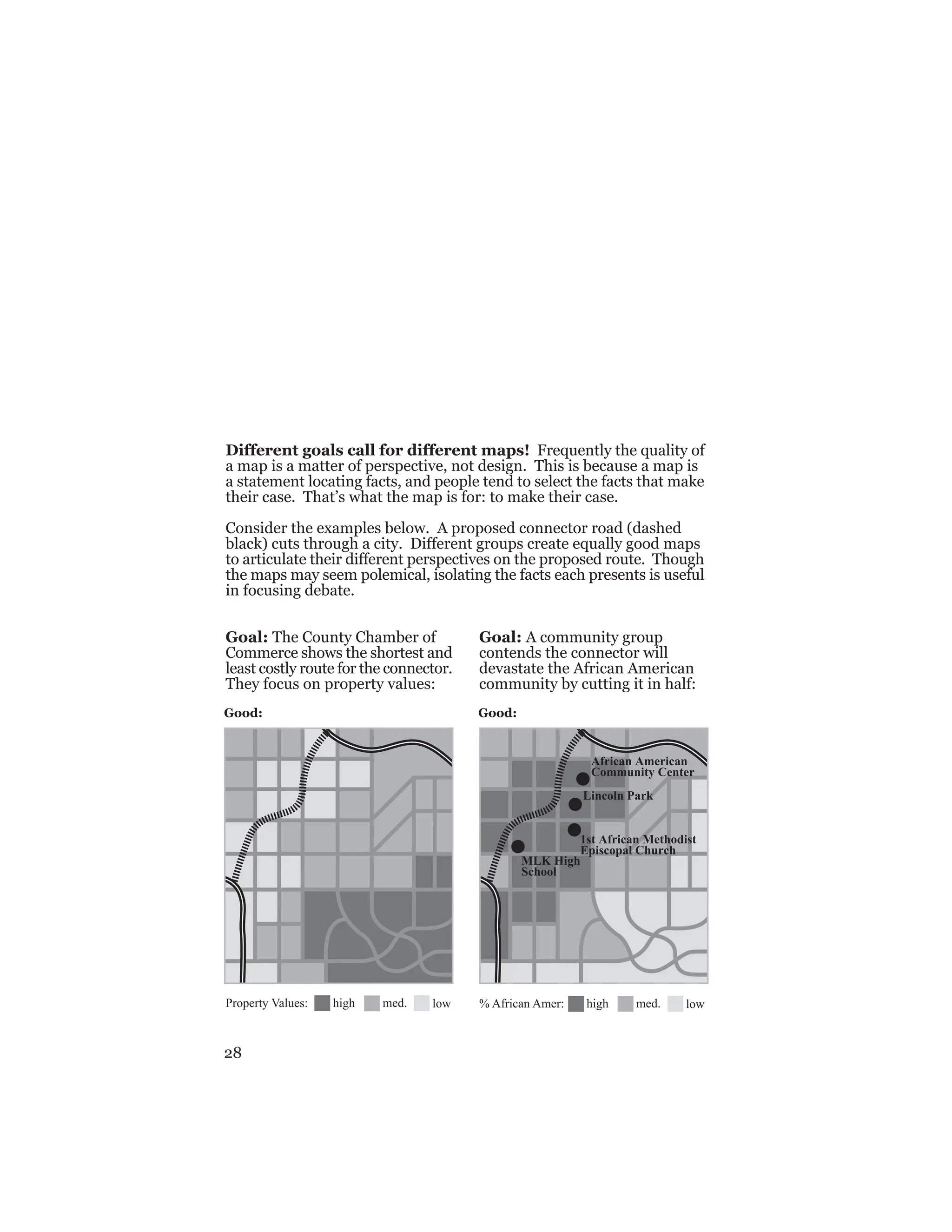
Goal: The CountyChamber of
Commerce shows the shortest and
least costly route for the connector.
They focus on property values:
Good: Good:
Different goals call for different maps! Frequently the quality of
a map is a matter of perspective, not design. This is because a map is
a statement locating facts, and people tend to select the facts that make
their case. That’s what the map is for: to make their case.
Consider the examples below. A proposed connector road (dashed
black) cuts through a city. Different groups create equally good maps
to articulate their different perspectives on the proposed route. Though
the maps may seem polemical, isolating the facts each presents is useful
in focusing debate.
low
med.
high
Property Values: low
med.
high
% African Amer:
Goal: A community group
contends the connector will
devastate the African American
community by cutting it in half:
African American
Community Center
1st African Methodist
Episcopal Church
Lincoln Park
MLK High
School
46.
29
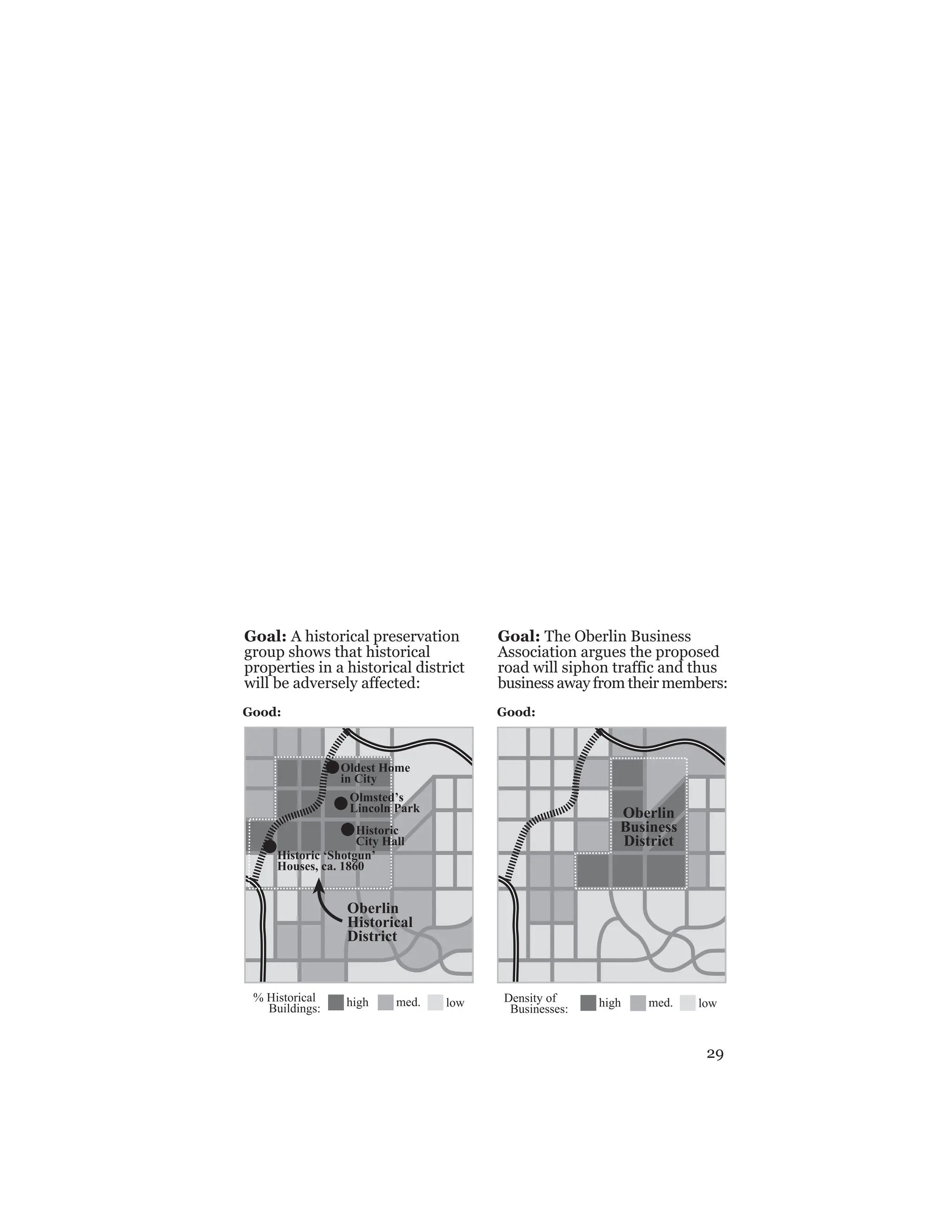
Good: Good:
low
med.
high
% Historical
Buildings:low
med.
high
Density of
Businesses:
Goal: A historical preservation
group shows that historical
properties in a historical district
will be adversely affected:
Goal: The Oberlin Business
Association argues the proposed
road will siphon traffic and thus
business away from their members:
Historic ‘Shotgun’
Houses, ca. 1860
Oberlin
Business
District
Oldest Home
in City
Historic
City Hall
Olmsted’s
Lincoln Park
Oberlin
Historical
District
47.
30
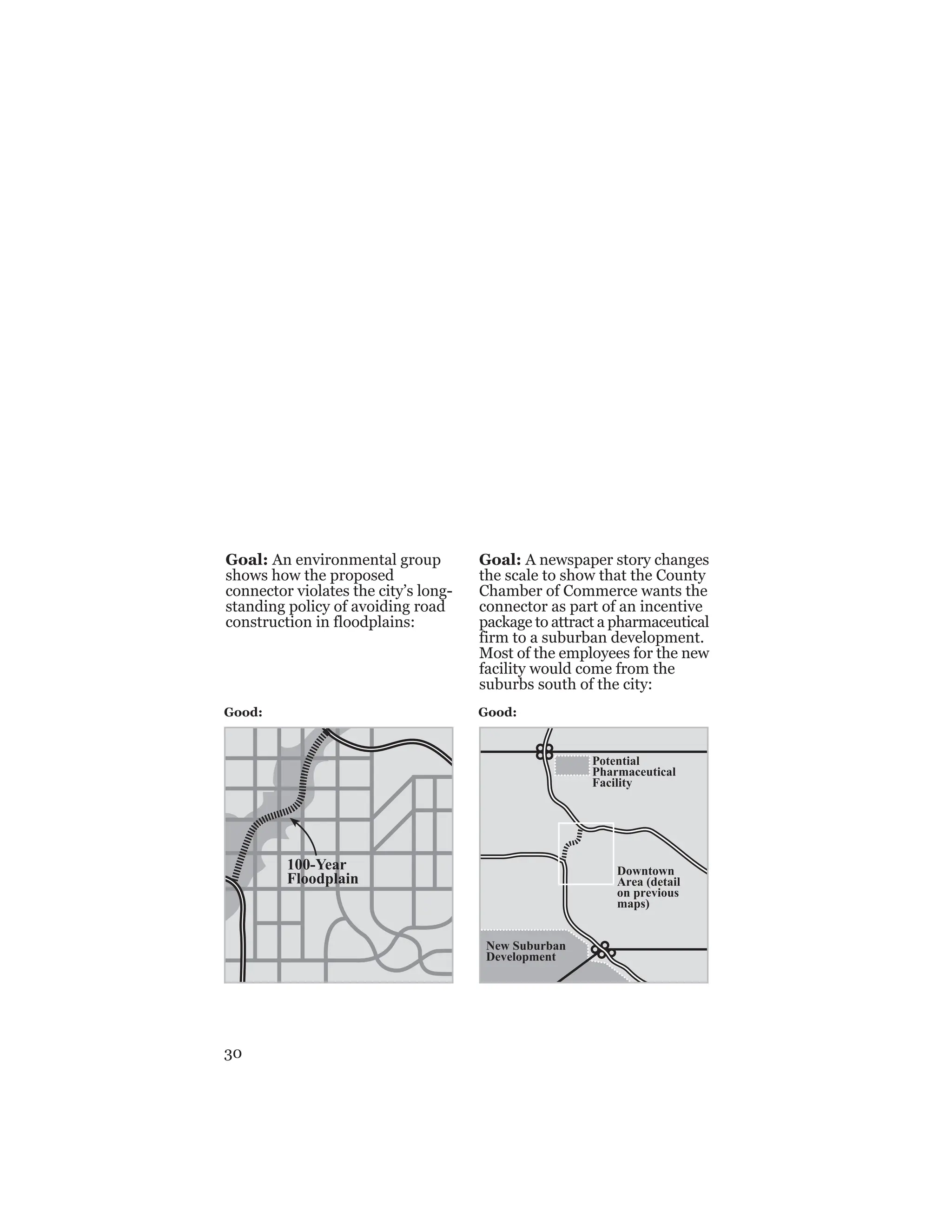
Goal: An environmentalgroup
shows how the proposed
connector violates the city’s long-
standing policy of avoiding road
construction in floodplains:
Good: Good:
Goal: A newspaper story changes
the scale to show that the County
Chamber of Commerce wants the
connector as part of an incentive
package to attract a pharmaceutical
firm to a suburban development.
Most of the employees for the new
facility would come from the
suburbs south of the city:
Potential
Pharmaceutical
Facility
Downtown
Area (detail
on previous
maps)
New Suburban
Development
100-Year
Floodplain
48.
31
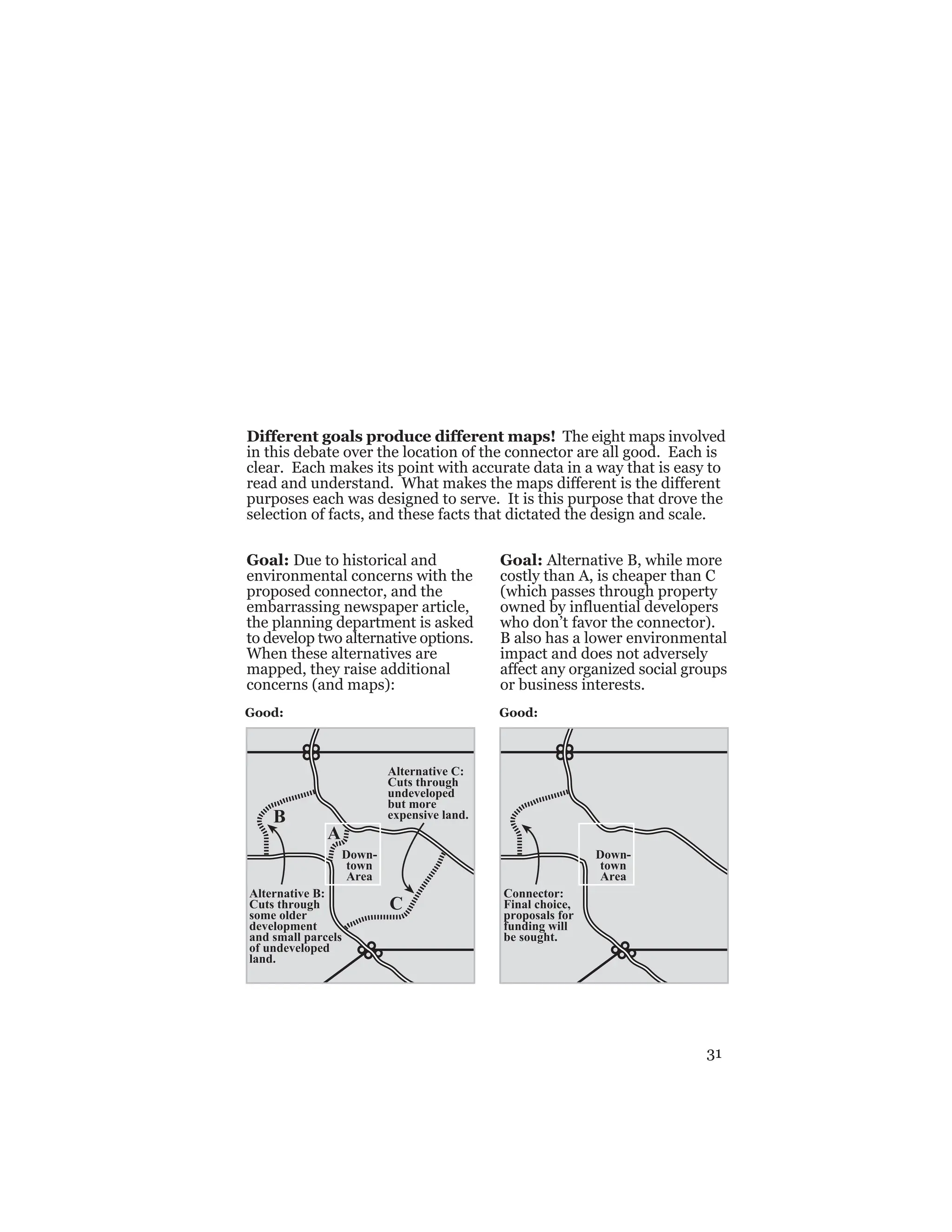
Good: Good:
Different goalsproduce different maps! The eight maps involved
in this debate over the location of the connector are all good. Each is
clear. Each makes its point with accurate data in a way that is easy to
read and understand. What makes the maps different is the different
purposes each was designed to serve. It is this purpose that drove the
selection of facts, and these facts that dictated the design and scale.
Goal: Due to historical and
environmental concerns with the
proposed connector, and the
embarrassing newspaper article,
the planning department is asked
to develop two alternative options.
When these alternatives are
mapped, they raise additional
concerns (and maps):
Goal: Alternative B, while more
costly than A, is cheaper than C
(which passes through property
owned by influential developers
who don’t favor the connector).
B also has a lower environmental
impact and does not adversely
affect any organized social groups
or business interests.
Down-
town
Area
A
B
C
Alternative B:
Cuts through
some older
development
and small parcels
of undeveloped
land.
Alternative C:
Cuts through
undeveloped
but more
expensive land.
Down-
town
Area
Connector:
Final choice,
proposals for
funding will
be sought.
49.
32
33
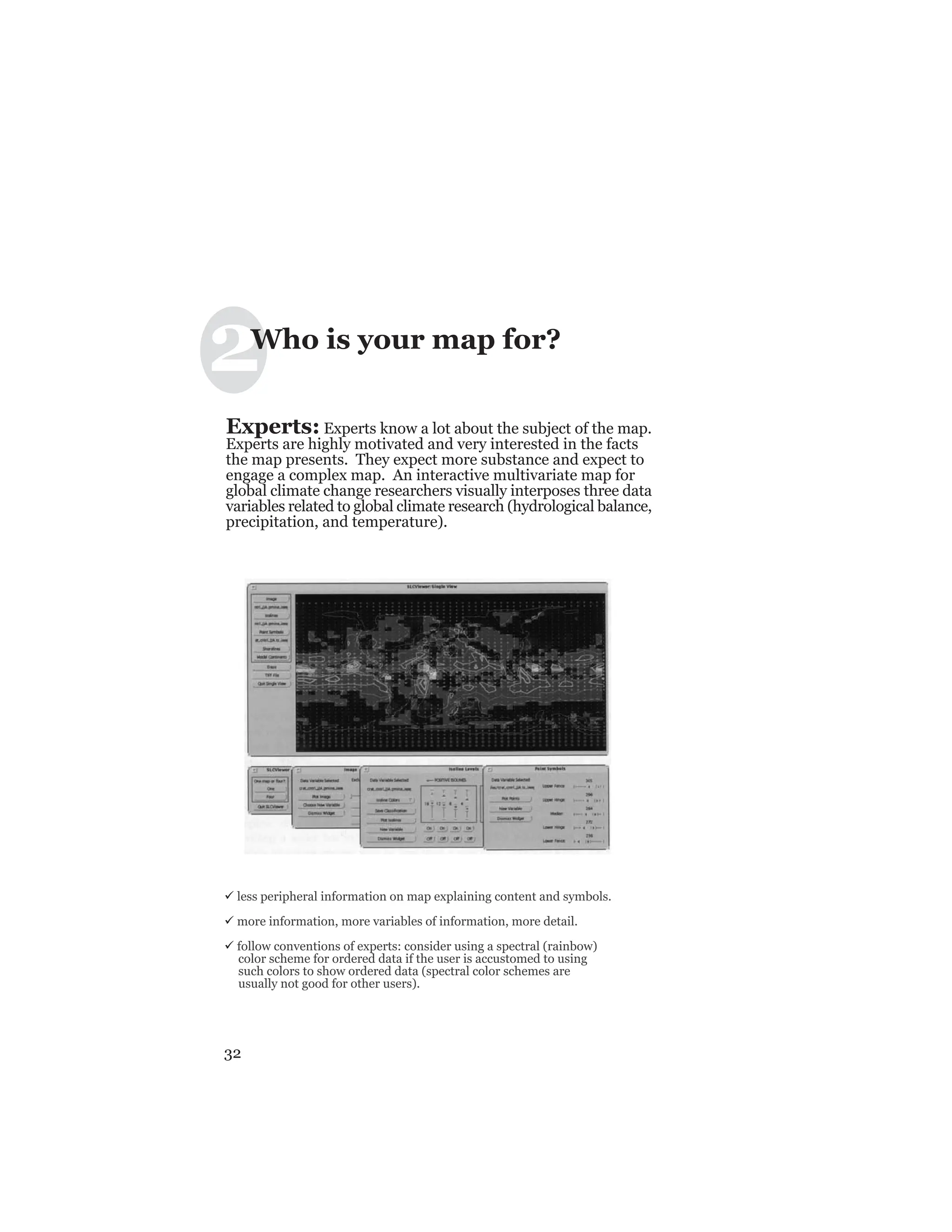
Experts: Experts knowa lot about the subject of the map.
Experts are highly motivated and very interested in the facts
the map presents. They expect more substance and expect to
engage a complex map. An interactive multivariate map for
global climate change researchers visually interposes three data
variables related to global climate research (hydrological balance,
precipitation, and temperature).
ü less peripheral information on map explaining content and symbols.
ü more information, more variables of information, more detail.
ü follow conventions of experts: consider using a spectral (rainbow)
color scheme for ordered data if the user is accustomed to using
such colors to show ordered data (spectral color schemes are
usually not good for other users).
2Who is your map for?
50.
33
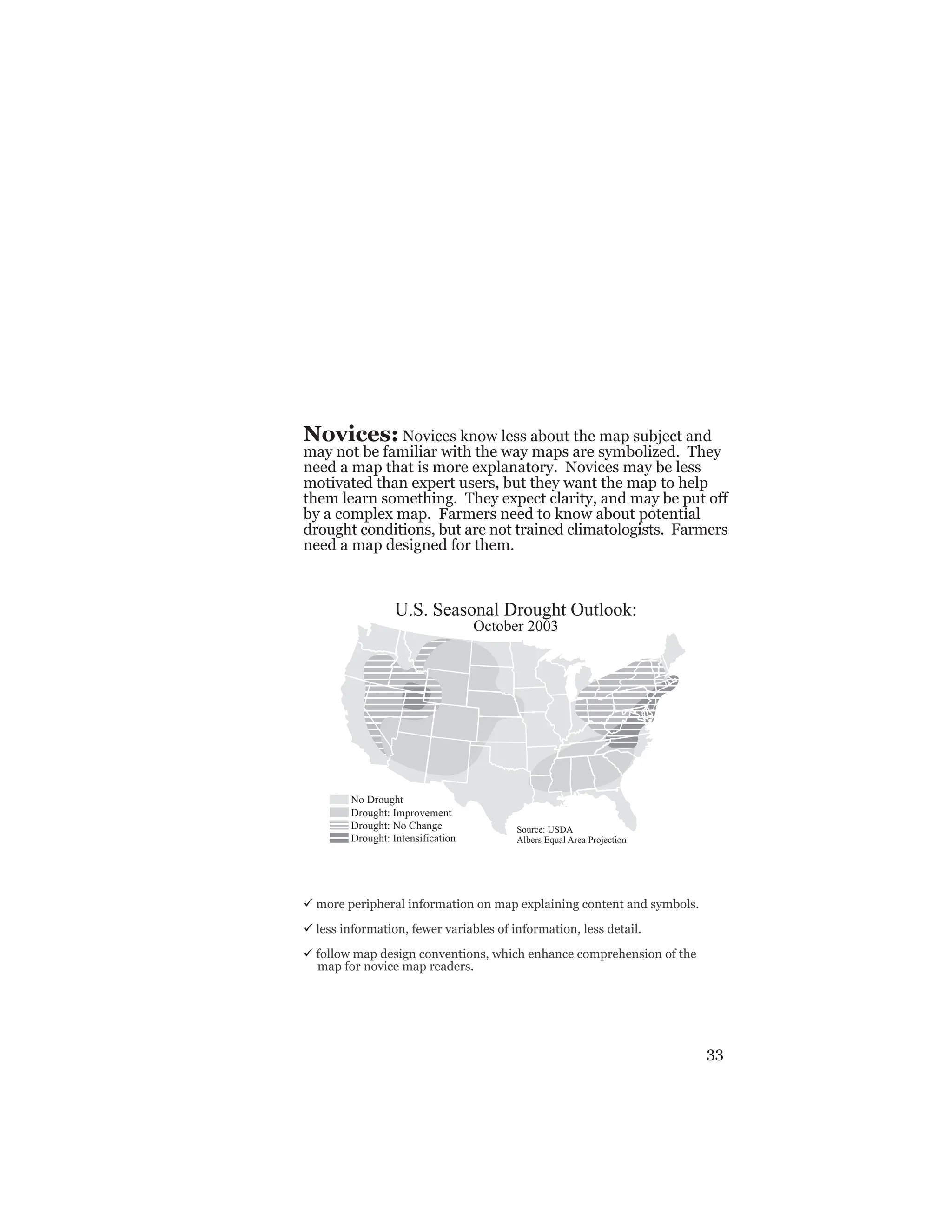
Novices: Novices knowless about the map subject and
may not be familiar with the way maps are symbolized. They
need a map that is more explanatory. Novices may be less
motivated than expert users, but they want the map to help
them learn something. They expect clarity, and may be put off
by a complex map. Farmers need to know about potential
drought conditions, but are not trained climatologists. Farmers
need a map designed for them.
ü more peripheral information on map explaining content and symbols.
ü less information, fewer variables of information, less detail.
ü follow map design conventions, which enhance comprehension of the
map for novice map readers.
No Drought
Drought: Intensification
Drought: Improvement
Drought: No Change
U.S. Seasonal Drought Outlook:
October 2003
Source: USDA
Albers Equal Area Projection
51.
34
It is vitalto determine the final medium your map will be presented
on before making your map. Many maps today are made on
computer monitors, but the monitor is not the final medium: paper,
a slide to be projected on the wall, projected with a computer, or
a poster are common end products. What looks great on your
computer will probably not look so great when printed or projected.
ü your map may be designed for the internet. Com-
pared to paper, computer monitors provide less
area and lower resolution, suggesting design
modifications including larger symbols and type,
and fewer data.
Computer monitor
Black and white, on paper
Color, on paper
Projected
ü while color is always an option with computers,
color may not be an option for your final map:
color is expensive to print, and many publications
require black-and-white maps.
ü color is created differently on computer monitors
and printers. Test your colors on the printer your
final map will be printed on, and adjust colors on
the computer so they look good when printed.
ü maps projected on a screen using slides or a
computer projector require design adjustments,
such as larger type and symbols and more intense
colors, so that the map is legible from a distance.
Posters
ü similar to projected maps, maps in poster form
require attention to the typical viewing distance:
some posters are to be viewed from a short
distance, others from a long distance, and some
require both long and short viewing distances.
3What is the final medium?
52.
35
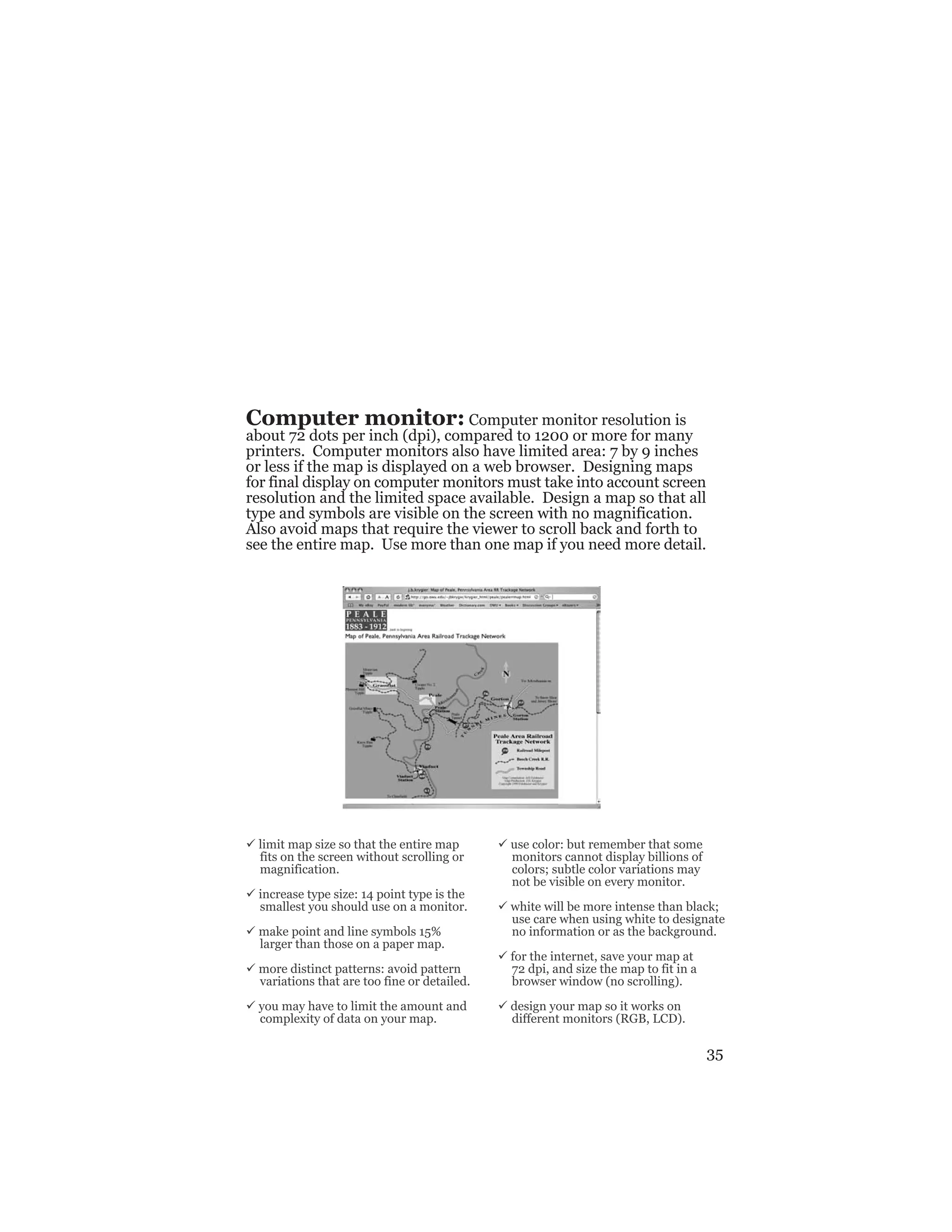
Computer monitor: Computermonitor resolution is
about 72 dots per inch (dpi), compared to 1200 or more for many
printers. Computer monitors also have limited area: 7 by 9 inches
or less if the map is displayed on a web browser. Designing maps
for final display on computer monitors must take into account screen
resolution and the limited space available. Design a map so that all
type and symbols are visible on the screen with no magnification.
Also avoid maps that require the viewer to scroll back and forth to
see the entire map. Use more than one map if you need more detail.
ü limit map size so that the entire map
fits on the screen without scrolling or
magnification.
ü increase type size: 14 point type is the
smallest you should use on a monitor.
ü make point and line symbols 15%
larger than those on a paper map.
ü more distinct patterns: avoid pattern
variations that are too fine or detailed.
ü you may have to limit the amount and
complexity of data on your map.
ü use color: but remember that some
monitors cannot display billions of
colors; subtle color variations may
not be visible on every monitor.
ü white will be more intense than black;
use care when using white to designate
no information or as the background.
ü for the internet, save your map at
72 dpi, and size the map to fit in a
browser window (no scrolling).
ü design your map so it works on
different monitors (RGB, LCD).
53.
36
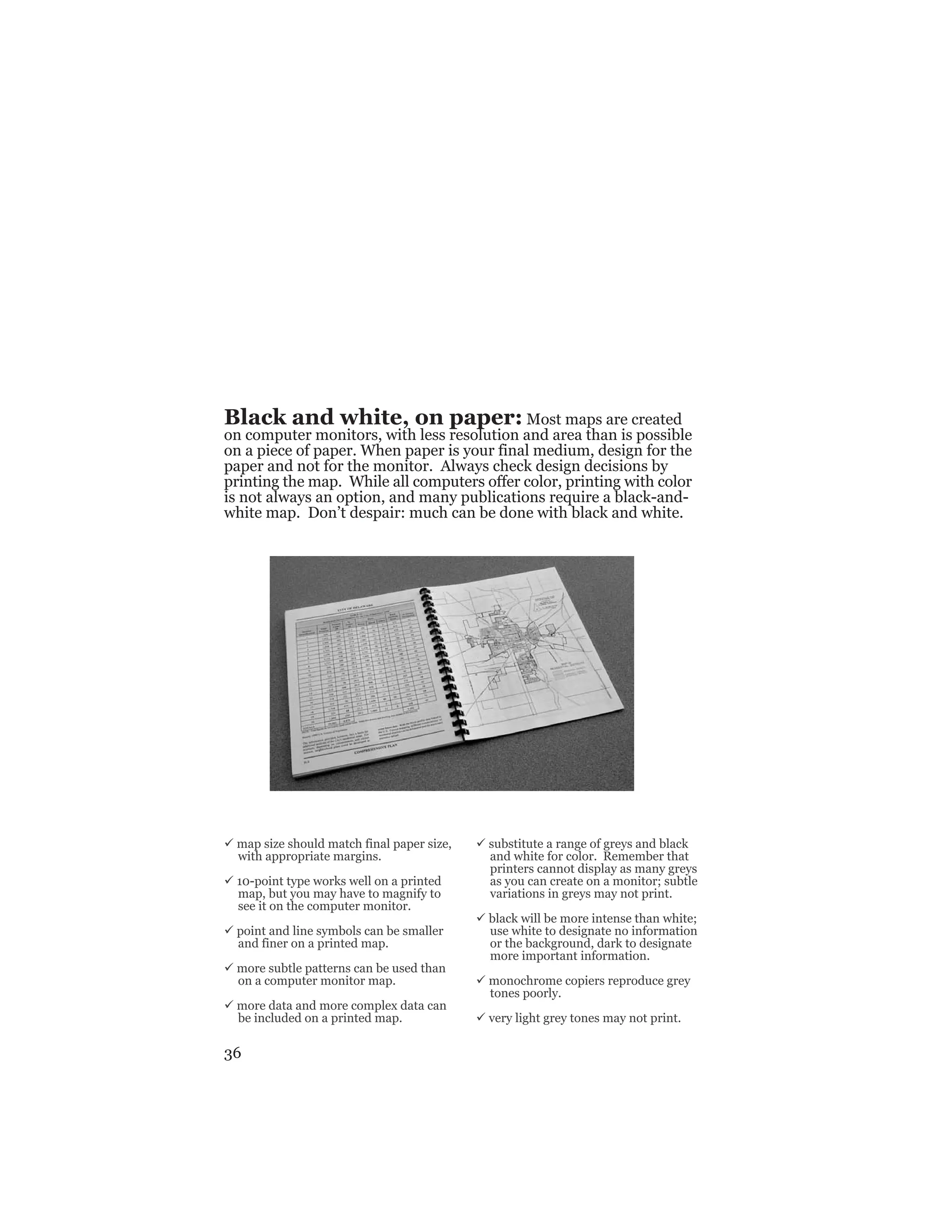
Black and white,on paper: Most maps are created
on computer monitors, with less resolution and area than is possible
on a piece of paper. When paper is your final medium, design for the
paper and not for the monitor. Always check design decisions by
printing the map. While all computers offer color, printing with color
is not always an option, and many publications require a black-and-
white map. Don’t despair: much can be done with black and white.
ü map size should match final paper size,
with appropriate margins.
ü 10-point type works well on a printed
map, but you may have to magnify to
see it on the computer monitor.
ü point and line symbols can be smaller
and finer on a printed map.
ü more subtle patterns can be used than
on a computer monitor map.
ü more data and more complex data can
be included on a printed map.
ü substitute a range of greys and black
and white for color. Remember that
printers cannot display as many greys
as you can create on a monitor; subtle
variations in greys may not print.
ü black will be more intense than white;
use white to designate no information
or the background, dark to designate
more important information.
ü monochrome copiers reproduce grey
tones poorly.
ü very light grey tones may not print.
54.
37
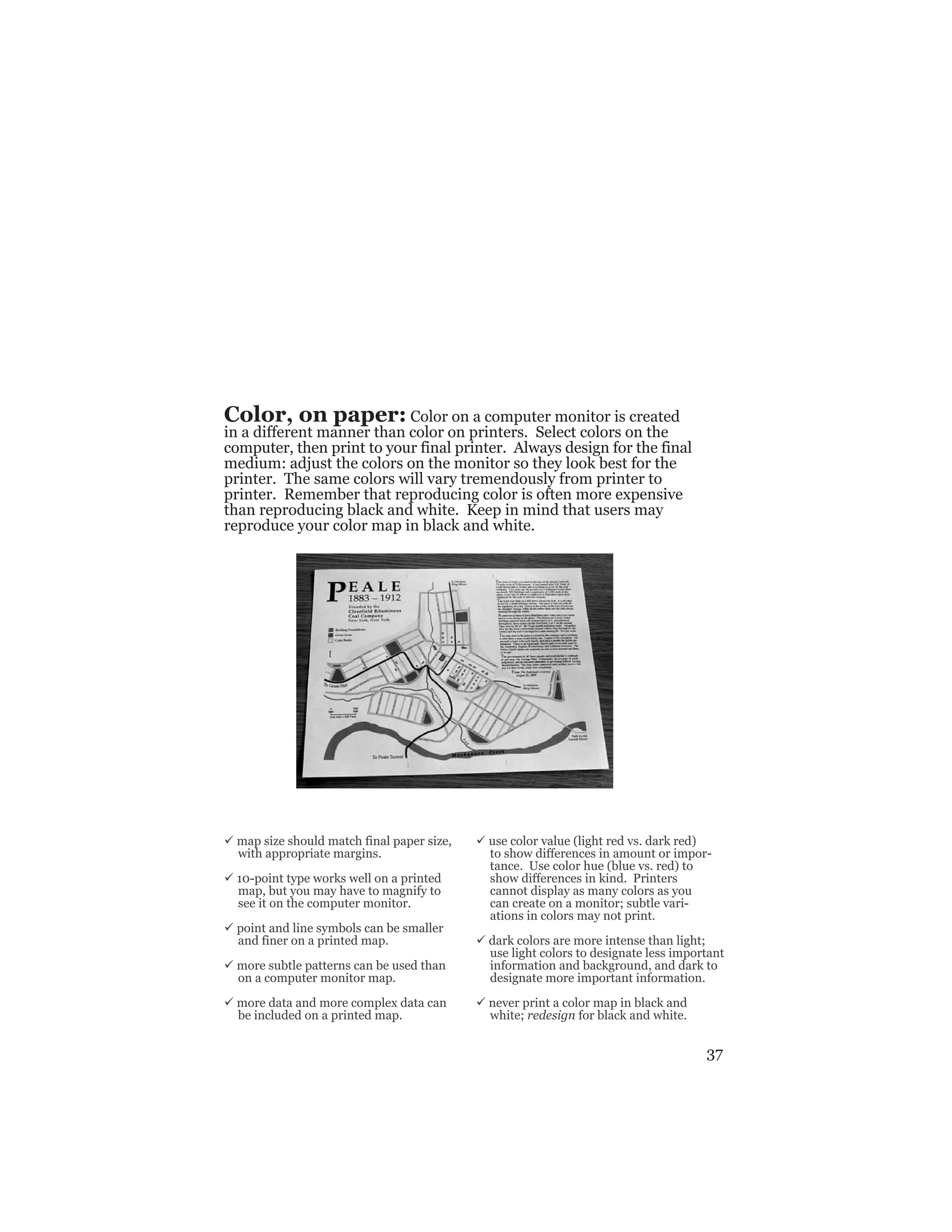
Color, on paper:Color on a computer monitor is created
in a different manner than color on printers. Select colors on the
computer, then print to your final printer. Always design for the final
medium: adjust the colors on the monitor so they look best for the
printer. The same colors will vary tremendously from printer to
printer. Remember that reproducing color is often more expensive
than reproducing black and white. Keep in mind that users may
reproduce your color map in black and white.
ü map size should match final paper size,
with appropriate margins.
ü 10-point type works well on a printed
map, but you may have to magnify to
see it on the computer monitor.
ü point and line symbols can be smaller
and finer on a printed map.
ü more subtle patterns can be used than
on a computer monitor map.
ü more data and more complex data can
be included on a printed map.
ü use color value (light red vs. dark red)
to show differences in amount or impor-
tance. Use color hue (blue vs. red) to
show differences in kind. Printers
cannot display as many colors as you
can create on a monitor; subtle vari-
ations in colors may not print.
ü dark colors are more intense than light;
use light colors to designate less important
information and background, and dark to
designate more important information.
ü never print a color map in black and
white; redesign for black and white.
Vol. IV No.96 August 30, 1851. Pages 145-167 PG # 38405
Vol. IV No. 97 September 6, 1851. Pages 169-183 PG # 38433
Vol. IV No. 98 September 13, 1851. Pages 185-200 PG # 38491
Vol. IV No. 99 September 20, 1851. Pages 201-216 PG # 38574
Vol. IV No. 100 September 27, 1851. Pages 217-246 PG # 38656
Vol. IV No. 101 October 4, 1851. Pages 249-264 PG # 38701
Vol. IV No. 102 October 11, 1851. Pages 265-287 PG # 38773
Vol. IV No. 103 October 18, 1851. Pages 289-303 PG # 38864
Vol. IV No. 104 October 25, 1851. Pages 305-333 PG # 38926
Vol. IV No. 105 November 1, 1851. Pages 337-359 PG # 39076
Vol. IV No. 106 November 8, 1851. Pages 361-374 PG # 39091
Vol. IV No. 107 November 15, 1851. Pages 377-396 PG # 39135
Vol. IV No. 108 November 22, 1851. Pages 401-414 PG # 39197
Vol. IV No. 109 November 29, 1851. Pages 417-430 PG # 39233
Vol. IV No. 110 December 6, 1851. Pages 433-460 PG # 39338
Vol. IV No. 111 December 13, 1851. Pages 465-478 PG # 39393
Vol. IV No. 112 December 20, 1851. Pages 481-494 PG # 39438
Vol. IV No. 113 December 27, 1851. Pages 497-510 PG # 39503
Notes and Queries Vol. V.
Vol., No., Date, Year, Pages, PG #
Vol. V No. 114 January 3, 1852. Pages 1-19 PG # 40171
Vol. V No. 115 January 10, 1852. Pages 25-45 PG # 40582
Vol. V No. 116 January 17, 1852. Pages 49-70 PG # 40642
Index
Vol., Dates, Year, PG #
Vol I. Index. [Nov. 1849-May 1850] PG # 13536
INDEX TO THE SECOND VOLUME. MAY-DEC., 1850 PG # 13571
INDEX TO THE THIRD VOLUME. JAN.-JUNE, 1851 PG # 26770
INDEX TO THE FOURTH VOLUME. JULY-DEC., 1851 PG # 40166
57.
*** END OFTHE PROJECT GUTENBERG EBOOK NOTES AND
QUERIES, VOL. V, NUMBER 117, JANUARY 24, 1852 ***
Updated editions will replace the previous one—the old editions
will be renamed.
Creating the works from print editions not protected by U.S.
copyright law means that no one owns a United States
copyright in these works, so the Foundation (and you!) can copy
and distribute it in the United States without permission and
without paying copyright royalties. Special rules, set forth in the
General Terms of Use part of this license, apply to copying and
distributing Project Gutenberg™ electronic works to protect the
PROJECT GUTENBERG™ concept and trademark. Project
Gutenberg is a registered trademark, and may not be used if
you charge for an eBook, except by following the terms of the
trademark license, including paying royalties for use of the
Project Gutenberg trademark. If you do not charge anything for
copies of this eBook, complying with the trademark license is
very easy. You may use this eBook for nearly any purpose such
as creation of derivative works, reports, performances and
research. Project Gutenberg eBooks may be modified and
printed and given away—you may do practically ANYTHING in
the United States with eBooks not protected by U.S. copyright
law. Redistribution is subject to the trademark license, especially
commercial redistribution.
START: FULL LICENSE
PLEASE READ THISBEFORE YOU DISTRIBUTE OR USE THIS WORK
To protect the Project Gutenberg™ mission of promoting the
free distribution of electronic works, by using or distributing this
work (or any other work associated in any way with the phrase
“Project Gutenberg”), you agree to comply with all the terms of
the Full Project Gutenberg™ License available with this file or
online at www.gutenberg.org/license.
Section 1. General Terms of Use and
Redistributing Project Gutenberg™
electronic works
1.A. By reading or using any part of this Project Gutenberg™
electronic work, you indicate that you have read, understand,
agree to and accept all the terms of this license and intellectual
property (trademark/copyright) agreement. If you do not agree
to abide by all the terms of this agreement, you must cease
using and return or destroy all copies of Project Gutenberg™
electronic works in your possession. If you paid a fee for
obtaining a copy of or access to a Project Gutenberg™
electronic work and you do not agree to be bound by the terms
of this agreement, you may obtain a refund from the person or
entity to whom you paid the fee as set forth in paragraph 1.E.8.
1.B. “Project Gutenberg” is a registered trademark. It may only
be used on or associated in any way with an electronic work by
people who agree to be bound by the terms of this agreement.
There are a few things that you can do with most Project
Gutenberg™ electronic works even without complying with the
full terms of this agreement. See paragraph 1.C below. There
are a lot of things you can do with Project Gutenberg™
electronic works if you follow the terms of this agreement and
help preserve free future access to Project Gutenberg™
electronic works. See paragraph 1.E below.
60.
1.C. The ProjectGutenberg Literary Archive Foundation (“the
Foundation” or PGLAF), owns a compilation copyright in the
collection of Project Gutenberg™ electronic works. Nearly all the
individual works in the collection are in the public domain in the
United States. If an individual work is unprotected by copyright
law in the United States and you are located in the United
States, we do not claim a right to prevent you from copying,
distributing, performing, displaying or creating derivative works
based on the work as long as all references to Project
Gutenberg are removed. Of course, we hope that you will
support the Project Gutenberg™ mission of promoting free
access to electronic works by freely sharing Project Gutenberg™
works in compliance with the terms of this agreement for
keeping the Project Gutenberg™ name associated with the
work. You can easily comply with the terms of this agreement
by keeping this work in the same format with its attached full
Project Gutenberg™ License when you share it without charge
with others.
1.D. The copyright laws of the place where you are located also
govern what you can do with this work. Copyright laws in most
countries are in a constant state of change. If you are outside
the United States, check the laws of your country in addition to
the terms of this agreement before downloading, copying,
displaying, performing, distributing or creating derivative works
based on this work or any other Project Gutenberg™ work. The
Foundation makes no representations concerning the copyright
status of any work in any country other than the United States.
1.E. Unless you have removed all references to Project
Gutenberg:
1.E.1. The following sentence, with active links to, or other
immediate access to, the full Project Gutenberg™ License must
appear prominently whenever any copy of a Project
Gutenberg™ work (any work on which the phrase “Project
61.
Gutenberg” appears, orwith which the phrase “Project
Gutenberg” is associated) is accessed, displayed, performed,
viewed, copied or distributed:
This eBook is for the use of anyone anywhere in the United
States and most other parts of the world at no cost and
with almost no restrictions whatsoever. You may copy it,
give it away or re-use it under the terms of the Project
Gutenberg License included with this eBook or online at
www.gutenberg.org. If you are not located in the United
States, you will have to check the laws of the country
where you are located before using this eBook.
1.E.2. If an individual Project Gutenberg™ electronic work is
derived from texts not protected by U.S. copyright law (does not
contain a notice indicating that it is posted with permission of
the copyright holder), the work can be copied and distributed to
anyone in the United States without paying any fees or charges.
If you are redistributing or providing access to a work with the
phrase “Project Gutenberg” associated with or appearing on the
work, you must comply either with the requirements of
paragraphs 1.E.1 through 1.E.7 or obtain permission for the use
of the work and the Project Gutenberg™ trademark as set forth
in paragraphs 1.E.8 or 1.E.9.
1.E.3. If an individual Project Gutenberg™ electronic work is
posted with the permission of the copyright holder, your use and
distribution must comply with both paragraphs 1.E.1 through
1.E.7 and any additional terms imposed by the copyright holder.
Additional terms will be linked to the Project Gutenberg™
License for all works posted with the permission of the copyright
holder found at the beginning of this work.
1.E.4. Do not unlink or detach or remove the full Project
Gutenberg™ License terms from this work, or any files
62.
containing a partof this work or any other work associated with
Project Gutenberg™.
1.E.5. Do not copy, display, perform, distribute or redistribute
this electronic work, or any part of this electronic work, without
prominently displaying the sentence set forth in paragraph 1.E.1
with active links or immediate access to the full terms of the
Project Gutenberg™ License.
1.E.6. You may convert to and distribute this work in any binary,
compressed, marked up, nonproprietary or proprietary form,
including any word processing or hypertext form. However, if
you provide access to or distribute copies of a Project
Gutenberg™ work in a format other than “Plain Vanilla ASCII” or
other format used in the official version posted on the official
Project Gutenberg™ website (www.gutenberg.org), you must,
at no additional cost, fee or expense to the user, provide a copy,
a means of exporting a copy, or a means of obtaining a copy
upon request, of the work in its original “Plain Vanilla ASCII” or
other form. Any alternate format must include the full Project
Gutenberg™ License as specified in paragraph 1.E.1.
1.E.7. Do not charge a fee for access to, viewing, displaying,
performing, copying or distributing any Project Gutenberg™
works unless you comply with paragraph 1.E.8 or 1.E.9.
1.E.8. You may charge a reasonable fee for copies of or
providing access to or distributing Project Gutenberg™
electronic works provided that:
• You pay a royalty fee of 20% of the gross profits you derive
from the use of Project Gutenberg™ works calculated using the
method you already use to calculate your applicable taxes. The
fee is owed to the owner of the Project Gutenberg™ trademark,
but he has agreed to donate royalties under this paragraph to
the Project Gutenberg Literary Archive Foundation. Royalty
63.
payments must bepaid within 60 days following each date on
which you prepare (or are legally required to prepare) your
periodic tax returns. Royalty payments should be clearly marked
as such and sent to the Project Gutenberg Literary Archive
Foundation at the address specified in Section 4, “Information
about donations to the Project Gutenberg Literary Archive
Foundation.”
• You provide a full refund of any money paid by a user who
notifies you in writing (or by e-mail) within 30 days of receipt
that s/he does not agree to the terms of the full Project
Gutenberg™ License. You must require such a user to return or
destroy all copies of the works possessed in a physical medium
and discontinue all use of and all access to other copies of
Project Gutenberg™ works.
• You provide, in accordance with paragraph 1.F.3, a full refund of
any money paid for a work or a replacement copy, if a defect in
the electronic work is discovered and reported to you within 90
days of receipt of the work.
• You comply with all other terms of this agreement for free
distribution of Project Gutenberg™ works.
1.E.9. If you wish to charge a fee or distribute a Project
Gutenberg™ electronic work or group of works on different
terms than are set forth in this agreement, you must obtain
permission in writing from the Project Gutenberg Literary
Archive Foundation, the manager of the Project Gutenberg™
trademark. Contact the Foundation as set forth in Section 3
below.
1.F.
1.F.1. Project Gutenberg volunteers and employees expend
considerable effort to identify, do copyright research on,
transcribe and proofread works not protected by U.S. copyright
64.
law in creatingthe Project Gutenberg™ collection. Despite these
efforts, Project Gutenberg™ electronic works, and the medium
on which they may be stored, may contain “Defects,” such as,
but not limited to, incomplete, inaccurate or corrupt data,
transcription errors, a copyright or other intellectual property
infringement, a defective or damaged disk or other medium, a
computer virus, or computer codes that damage or cannot be
read by your equipment.
1.F.2. LIMITED WARRANTY, DISCLAIMER OF DAMAGES - Except
for the “Right of Replacement or Refund” described in
paragraph 1.F.3, the Project Gutenberg Literary Archive
Foundation, the owner of the Project Gutenberg™ trademark,
and any other party distributing a Project Gutenberg™ electronic
work under this agreement, disclaim all liability to you for
damages, costs and expenses, including legal fees. YOU AGREE
THAT YOU HAVE NO REMEDIES FOR NEGLIGENCE, STRICT
LIABILITY, BREACH OF WARRANTY OR BREACH OF CONTRACT
EXCEPT THOSE PROVIDED IN PARAGRAPH 1.F.3. YOU AGREE
THAT THE FOUNDATION, THE TRADEMARK OWNER, AND ANY
DISTRIBUTOR UNDER THIS AGREEMENT WILL NOT BE LIABLE
TO YOU FOR ACTUAL, DIRECT, INDIRECT, CONSEQUENTIAL,
PUNITIVE OR INCIDENTAL DAMAGES EVEN IF YOU GIVE
NOTICE OF THE POSSIBILITY OF SUCH DAMAGE.
1.F.3. LIMITED RIGHT OF REPLACEMENT OR REFUND - If you
discover a defect in this electronic work within 90 days of
receiving it, you can receive a refund of the money (if any) you
paid for it by sending a written explanation to the person you
received the work from. If you received the work on a physical
medium, you must return the medium with your written
explanation. The person or entity that provided you with the
defective work may elect to provide a replacement copy in lieu
of a refund. If you received the work electronically, the person
or entity providing it to you may choose to give you a second
opportunity to receive the work electronically in lieu of a refund.
65.
If the secondcopy is also defective, you may demand a refund
in writing without further opportunities to fix the problem.
1.F.4. Except for the limited right of replacement or refund set
forth in paragraph 1.F.3, this work is provided to you ‘AS-IS’,
WITH NO OTHER WARRANTIES OF ANY KIND, EXPRESS OR
IMPLIED, INCLUDING BUT NOT LIMITED TO WARRANTIES OF
MERCHANTABILITY OR FITNESS FOR ANY PURPOSE.
1.F.5. Some states do not allow disclaimers of certain implied
warranties or the exclusion or limitation of certain types of
damages. If any disclaimer or limitation set forth in this
agreement violates the law of the state applicable to this
agreement, the agreement shall be interpreted to make the
maximum disclaimer or limitation permitted by the applicable
state law. The invalidity or unenforceability of any provision of
this agreement shall not void the remaining provisions.
1.F.6. INDEMNITY - You agree to indemnify and hold the
Foundation, the trademark owner, any agent or employee of the
Foundation, anyone providing copies of Project Gutenberg™
electronic works in accordance with this agreement, and any
volunteers associated with the production, promotion and
distribution of Project Gutenberg™ electronic works, harmless
from all liability, costs and expenses, including legal fees, that
arise directly or indirectly from any of the following which you
do or cause to occur: (a) distribution of this or any Project
Gutenberg™ work, (b) alteration, modification, or additions or
deletions to any Project Gutenberg™ work, and (c) any Defect
you cause.
Section 2. Information about the Mission
of Project Gutenberg™
66.
Project Gutenberg™ issynonymous with the free distribution of
electronic works in formats readable by the widest variety of
computers including obsolete, old, middle-aged and new
computers. It exists because of the efforts of hundreds of
volunteers and donations from people in all walks of life.
Volunteers and financial support to provide volunteers with the
assistance they need are critical to reaching Project
Gutenberg™’s goals and ensuring that the Project Gutenberg™
collection will remain freely available for generations to come. In
2001, the Project Gutenberg Literary Archive Foundation was
created to provide a secure and permanent future for Project
Gutenberg™ and future generations. To learn more about the
Project Gutenberg Literary Archive Foundation and how your
efforts and donations can help, see Sections 3 and 4 and the
Foundation information page at www.gutenberg.org.
Section 3. Information about the Project
Gutenberg Literary Archive Foundation
The Project Gutenberg Literary Archive Foundation is a non-
profit 501(c)(3) educational corporation organized under the
laws of the state of Mississippi and granted tax exempt status
by the Internal Revenue Service. The Foundation’s EIN or
federal tax identification number is 64-6221541. Contributions
to the Project Gutenberg Literary Archive Foundation are tax
deductible to the full extent permitted by U.S. federal laws and
your state’s laws.
The Foundation’s business office is located at 809 North 1500
West, Salt Lake City, UT 84116, (801) 596-1887. Email contact
links and up to date contact information can be found at the
Foundation’s website and official page at
www.gutenberg.org/contact
67.
Section 4. Informationabout Donations to
the Project Gutenberg Literary Archive
Foundation
Project Gutenberg™ depends upon and cannot survive without
widespread public support and donations to carry out its mission
of increasing the number of public domain and licensed works
that can be freely distributed in machine-readable form
accessible by the widest array of equipment including outdated
equipment. Many small donations ($1 to $5,000) are particularly
important to maintaining tax exempt status with the IRS.
The Foundation is committed to complying with the laws
regulating charities and charitable donations in all 50 states of
the United States. Compliance requirements are not uniform
and it takes a considerable effort, much paperwork and many
fees to meet and keep up with these requirements. We do not
solicit donations in locations where we have not received written
confirmation of compliance. To SEND DONATIONS or determine
the status of compliance for any particular state visit
www.gutenberg.org/donate.
While we cannot and do not solicit contributions from states
where we have not met the solicitation requirements, we know
of no prohibition against accepting unsolicited donations from
donors in such states who approach us with offers to donate.
International donations are gratefully accepted, but we cannot
make any statements concerning tax treatment of donations
received from outside the United States. U.S. laws alone swamp
our small staff.
Please check the Project Gutenberg web pages for current
donation methods and addresses. Donations are accepted in a
number of other ways including checks, online payments and
68.
credit card donations.To donate, please visit:
www.gutenberg.org/donate.
Section 5. General Information About
Project Gutenberg™ electronic works
Professor Michael S. Hart was the originator of the Project
Gutenberg™ concept of a library of electronic works that could
be freely shared with anyone. For forty years, he produced and
distributed Project Gutenberg™ eBooks with only a loose
network of volunteer support.
Project Gutenberg™ eBooks are often created from several
printed editions, all of which are confirmed as not protected by
copyright in the U.S. unless a copyright notice is included. Thus,
we do not necessarily keep eBooks in compliance with any
particular paper edition.
Most people start at our website which has the main PG search
facility: www.gutenberg.org.
This website includes information about Project Gutenberg™,
including how to make donations to the Project Gutenberg
Literary Archive Foundation, how to help produce our new
eBooks, and how to subscribe to our email newsletter to hear
about new eBooks.
69.
Welcome to ourwebsite – the perfect destination for book lovers and
knowledge seekers. We believe that every book holds a new world,
offering opportunities for learning, discovery, and personal growth.
That’s why we are dedicated to bringing you a diverse collection of
books, ranging from classic literature and specialized publications to
self-development guides and children's books.
More than just a book-buying platform, we strive to be a bridge
connecting you with timeless cultural and intellectual values. With an
elegant, user-friendly interface and a smart search system, you can
quickly find the books that best suit your interests. Additionally,
our special promotions and home delivery services help you save time
and fully enjoy the joy of reading.
Join us on a journey of knowledge exploration, passion nurturing, and
personal growth every day!
ebookbell.com




![Vol. IV No. 96 August 30, 1851. Pages 145-167 PG # 38405
Vol. IV No. 97 September 6, 1851. Pages 169-183 PG # 38433
Vol. IV No. 98 September 13, 1851. Pages 185-200 PG # 38491
Vol. IV No. 99 September 20, 1851. Pages 201-216 PG # 38574
Vol. IV No. 100 September 27, 1851. Pages 217-246 PG # 38656
Vol. IV No. 101 October 4, 1851. Pages 249-264 PG # 38701
Vol. IV No. 102 October 11, 1851. Pages 265-287 PG # 38773
Vol. IV No. 103 October 18, 1851. Pages 289-303 PG # 38864
Vol. IV No. 104 October 25, 1851. Pages 305-333 PG # 38926
Vol. IV No. 105 November 1, 1851. Pages 337-359 PG # 39076
Vol. IV No. 106 November 8, 1851. Pages 361-374 PG # 39091
Vol. IV No. 107 November 15, 1851. Pages 377-396 PG # 39135
Vol. IV No. 108 November 22, 1851. Pages 401-414 PG # 39197
Vol. IV No. 109 November 29, 1851. Pages 417-430 PG # 39233
Vol. IV No. 110 December 6, 1851. Pages 433-460 PG # 39338
Vol. IV No. 111 December 13, 1851. Pages 465-478 PG # 39393
Vol. IV No. 112 December 20, 1851. Pages 481-494 PG # 39438
Vol. IV No. 113 December 27, 1851. Pages 497-510 PG # 39503
Notes and Queries Vol. V.
Vol., No., Date, Year, Pages, PG #
Vol. V No. 114 January 3, 1852. Pages 1-19 PG # 40171
Vol. V No. 115 January 10, 1852. Pages 25-45 PG # 40582
Vol. V No. 116 January 17, 1852. Pages 49-70 PG # 40642
Index
Vol., Dates, Year, PG #
Vol I. Index. [Nov. 1849-May 1850] PG # 13536
INDEX TO THE SECOND VOLUME. MAY-DEC., 1850 PG # 13571
INDEX TO THE THIRD VOLUME. JAN.-JUNE, 1851 PG # 26770
INDEX TO THE FOURTH VOLUME. JULY-DEC., 1851 PG # 40166](https://image.slidesharecdn.com/1055199-250526223143-8bbb0f04/75/Making-Maps-A-Visual-Guide-To-Map-Design-For-Gis-1st-Edition-John-Krygier-56-2048.jpg)