Dr. Julie A. Evans
Project Tomorrow
@JulieEvans_PT
Dr. Kari Stubbs
BrainPOP
@KariStubbs
March 16, 2017
PREP WORK!
www.brainpop.com - sign in to your student account
Click on “enter code” at top of page
Here is your quiz code: CTDigital2
WELCOME TO THIS WORKSHOP!
Dr. Julie A. Evans
Chief Executive Officer
Project Tomorrow
@JulieEvans_PT
Dr. Kari Stubbs
Vice President
BrainPOP
@KariStubbs
GETTING TO KNOW EACH OTHER
Tweet with us! #CTDigital #CUE17
@JulieEvans_PT @KariStubbs
@SpeakUpEd @BrainPOP
WORKSHOP TOPICS
 What does “critical thinking” really mean?
 Best ways to help students develop those skills
 Leveraging digital tools for skill development
 Assessing competencies
 Additional resources for you
 Questions, comments, ideas
WORKSHOP TOPICS
 What does “critical thinking” really mean?
 Best ways to help students develop those skills
 Leveraging digital tools for skill development
 Assessing competencies
 Additional resources for you
 Questions, comments, ideas
 What does “critical thinking” really mean?
What does that term mean to you?
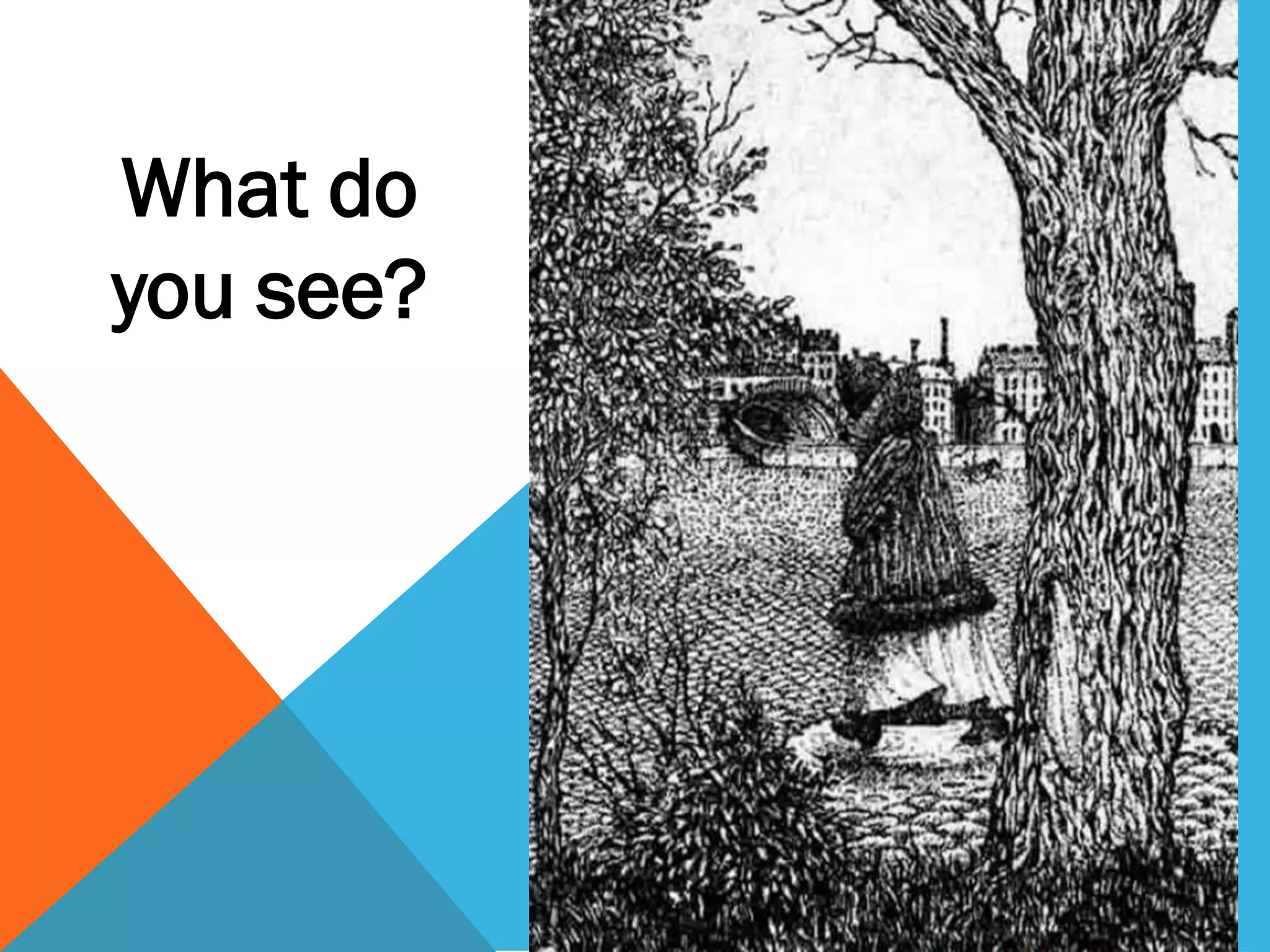
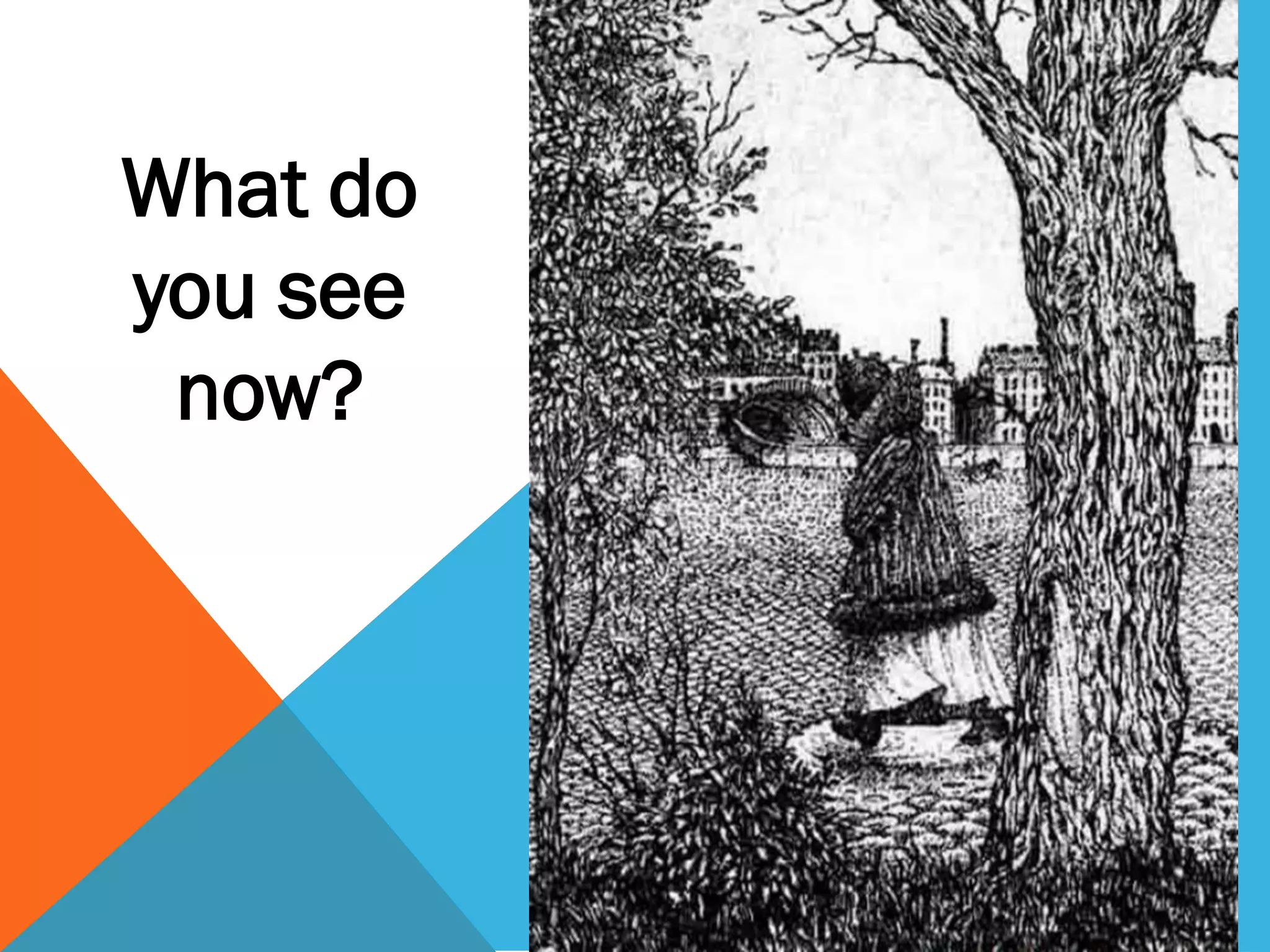
What do
you see?
 What does “critical thinking” really mean?
“Critical thinking is the intellectually disciplined
process of actively and skillfully conceptualizing,
applying, analyzing, synthesizing, and/or evaluating
information gathered from, or generated by,
observation, experience, reflection, reasoning, or
communication, as a guide to belief and action.”
Source:
Scriven & Paul, 8th Annual International
Conference on Critical Thinking and
Education Reform, 1987
 What does “critical thinking” really mean?
“Critical thinking is the intellectually disciplined
process of actively and skillfully conceptualizing,
applying, analyzing, synthesizing, and/or evaluating
information gathered from, or generated by,
observation, experience, reflection, reasoning, or
communication, as a guide to belief and action.”
Source:
Scriven & Paul, 8th Annual International
Conference on Critical Thinking and
Education Reform, 1987
 What does “critical thinking” really mean?
“Critical thinking is the intellectually disciplined
process of actively and skillfully conceptualizing,
applying, analyzing, synthesizing, and/or evaluating
information gathered from, or generated by,
observation, experience, reflection, reasoning, or
communication, as a guide to belief and action.”
Source:
Scriven & Paul, 8th Annual International
Conference on Critical Thinking and
Education Reform, 1987
 What does “critical thinking” really mean?
“Critical thinking is the intellectually disciplined
process of actively and skillfully conceptualizing,
applying, analyzing, synthesizing, and/or evaluating
information gathered from, or generated by,
observation, experience, reflection, reasoning, or
communication, as a guide to belief and action.”
Source:
Scriven & Paul, 8th Annual International
Conference on Critical Thinking and
Education Reform, 1987
WHY IS CRITICAL THINKING IMPORTANT TODAY?
1. Information intensive society and economy
2. Accelerating pace of change
3. Employability
WHY IS CRITICAL THINKING IMPORTANT TODAY?
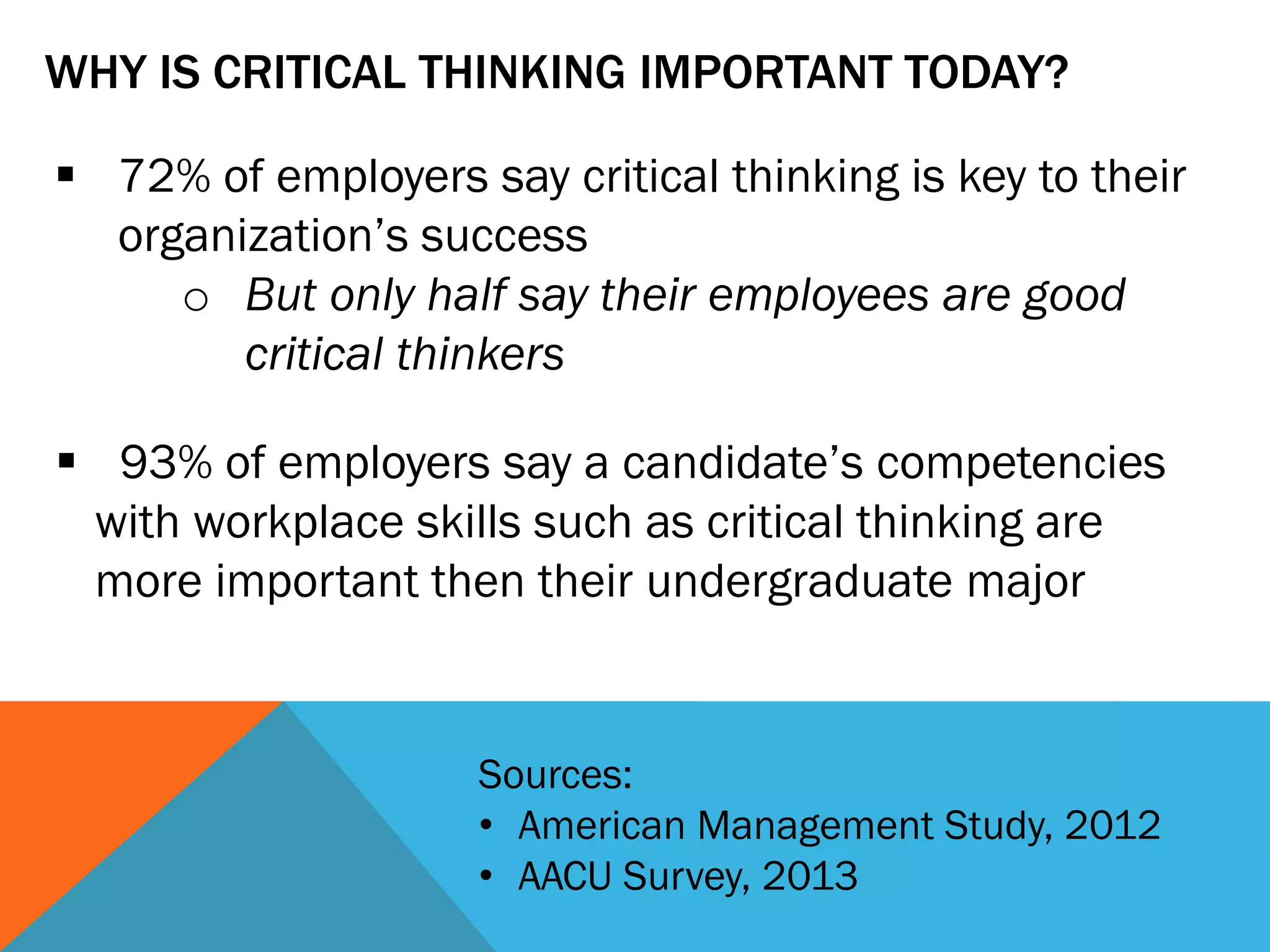
 72% of employers say critical thinking is key to their
organization’s success
o But only half say their employees are good
critical thinkers
 93% of employers say a candidate’s competencies
with workplace skills such as critical thinking are
more important then their undergraduate major
Sources:
• American Management Study, 2012
• AACU Survey, 2013
QUIZ RESULTS
How important is critical
thinking for today’s students?
Most important
skills students
need to master for
future success
% Parents
who agree
% District
Admin who
agree
%
Community
Members
who agree
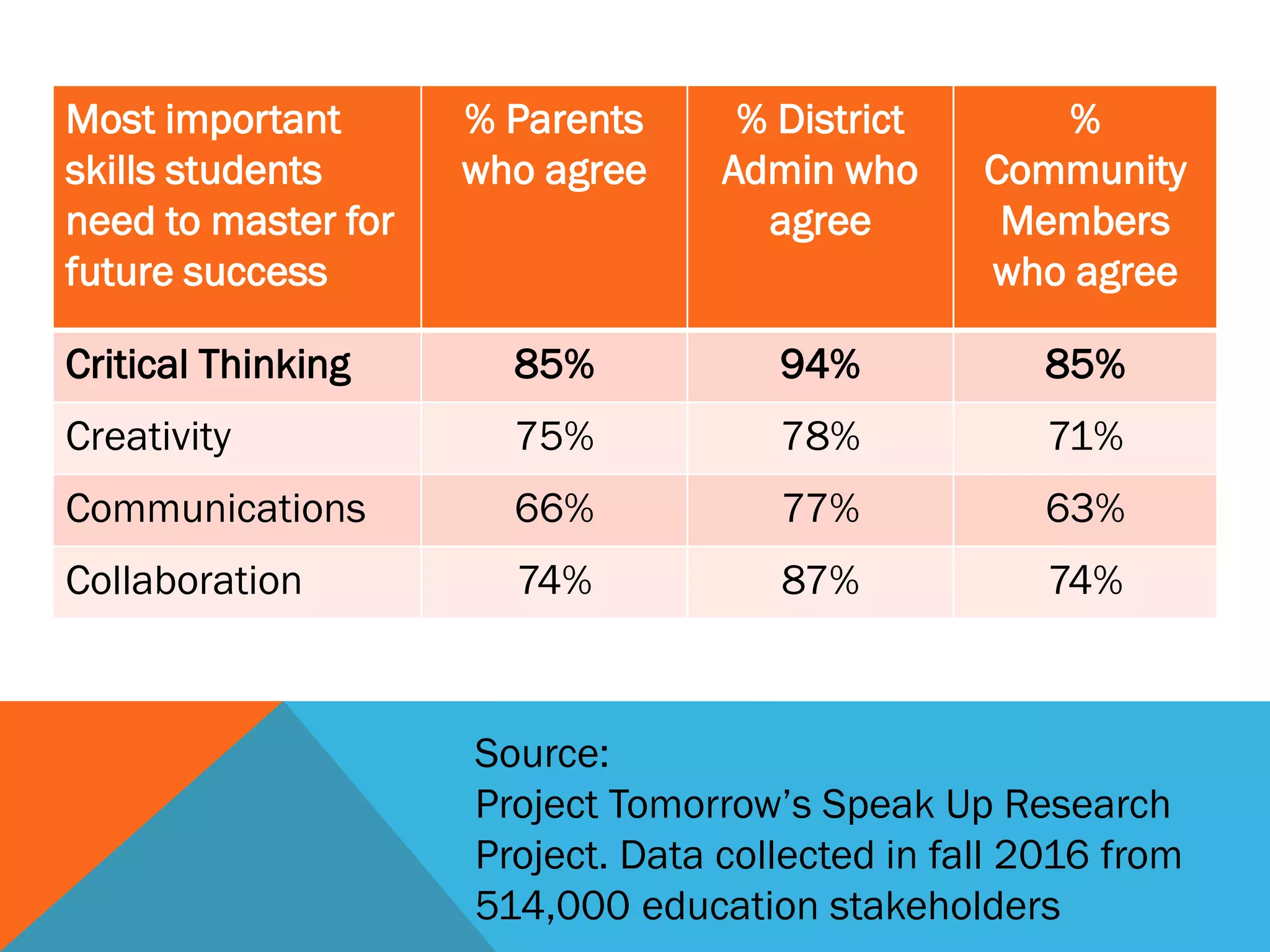
Critical Thinking 85% 94% 85%
Creativity 75% 78% 71%
Communications 66% 77% 63%
Collaboration 74% 87% 74%
Source:
Project Tomorrow’s Speak Up Research
Project. Data collected in fall 2016 from
514,000 education stakeholders
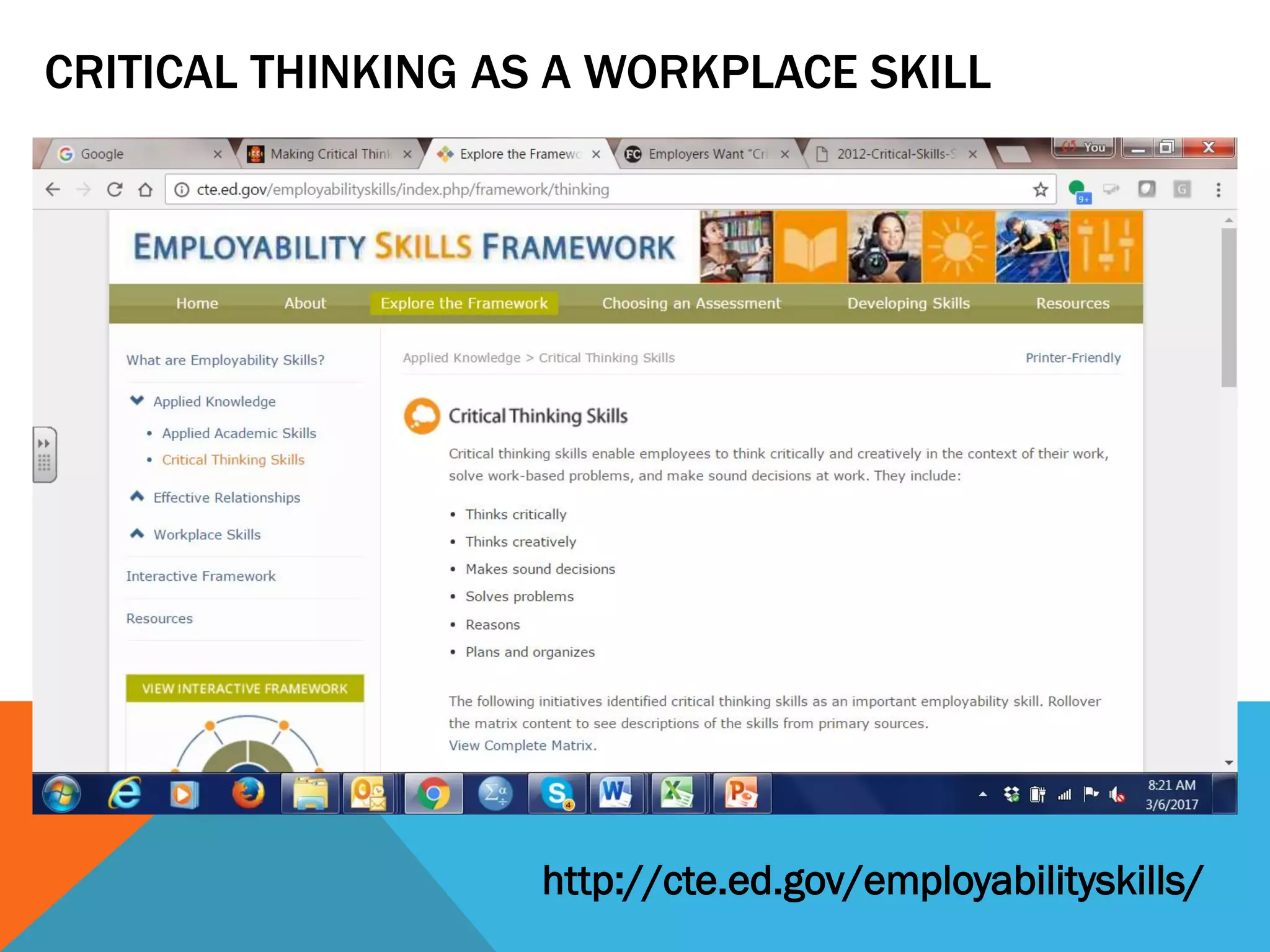
CRITICAL THINKING AS A WORKPLACE SKILL
http://cte.ed.gov/employabilityskills/
WHY IS CRITICAL THINKING IMPORTANT TODAY?
 75% of employers want education institutions to
place a higher emphasis on these students’ skills:
o Critical thinking
o Complex problem solving
o Written and oral communications
o Applying knowledge in real world
situations
Source:
• AACU Survey, 2013
WORKSHOP TOPICS
 What does “critical thinking” really mean?
 Best ways to help students develop those skills
 Leveraging digital tools for skill development
 Assessing competencies
 Additional resources for you
 Questions, comments, ideas
QUIZ RESULTS
What are the best ways for
students to develop workplace
skills?
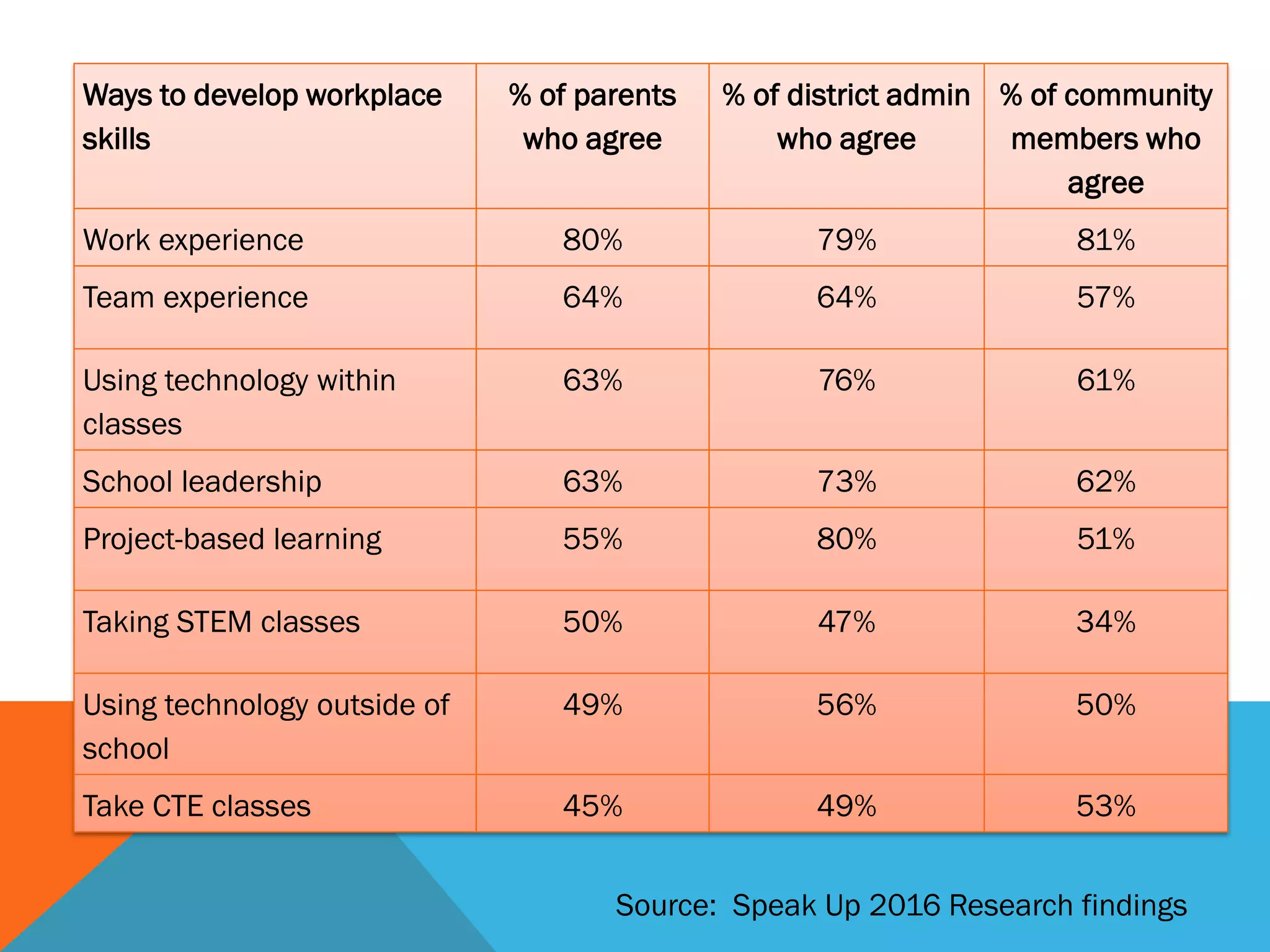
Ways to develop workplace
skills
% of parents
who agree
% of district admin
who agree
% of community
members who
agree
Work experience 80% 79% 81%
Team experience 64% 64% 57%
Using technology within
classes
63% 76% 61%
School leadership 63% 73% 62%
Project-based learning 55% 80% 51%
Taking STEM classes 50% 47% 34%
Using technology outside of
school
49% 56% 50%
Take CTE classes 45% 49% 53%
Source: Speak Up 2016 Research findings
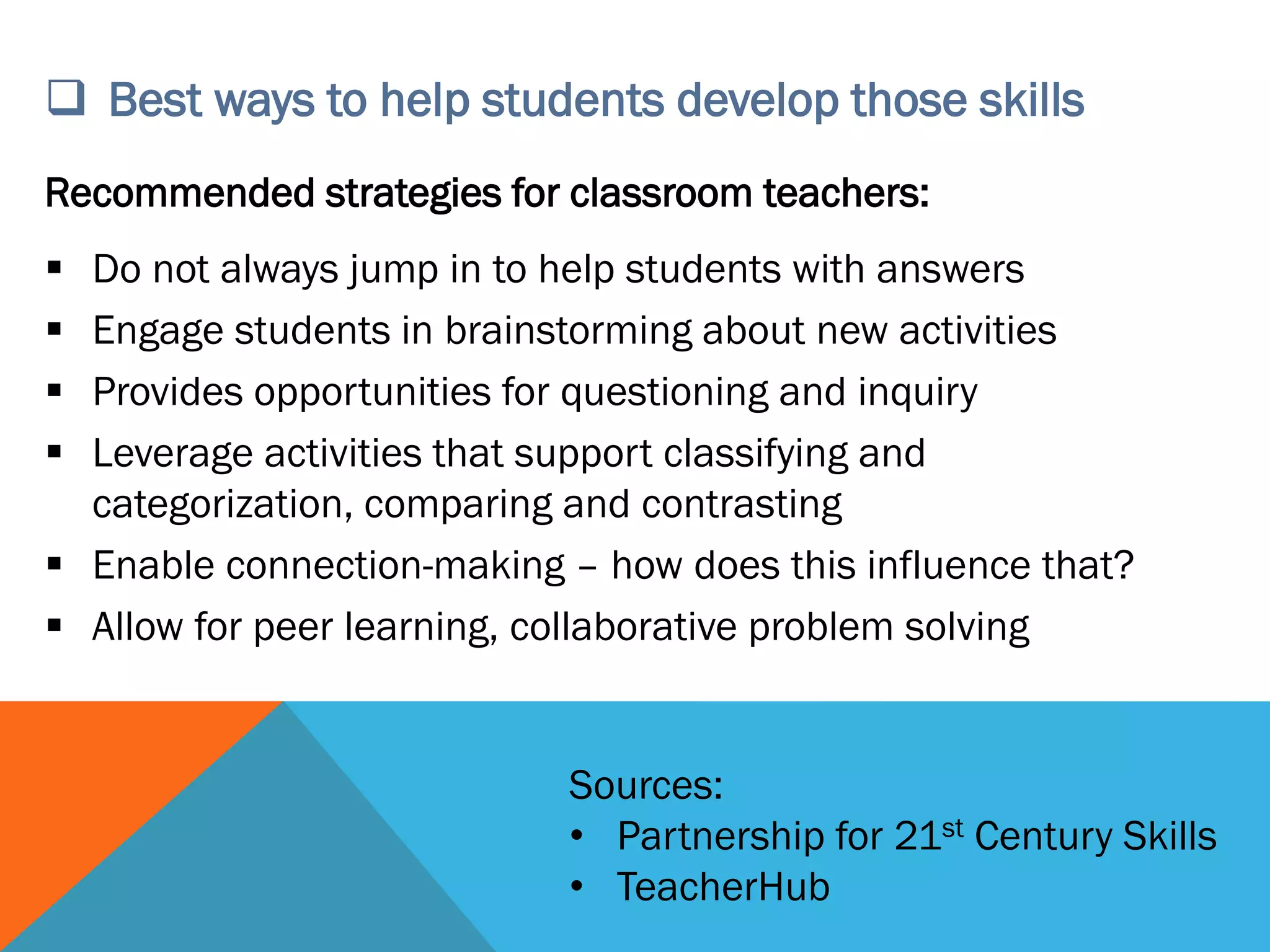
 Best ways to help students develop those skills
Recommended strategies for classroom teachers:
 Do not always jump in to help students with answers
 Engage students in brainstorming about new activities
 Provides opportunities for questioning and inquiry
 Leverage activities that support classifying and
categorization, comparing and contrasting
 Enable connection-making – how does this influence that?
 Allow for peer learning, collaborative problem solving
Sources:
• Partnership for 21st Century Skills
• TeacherHub
 How digital tools can support your efforts in the
classroom
Let’s think about:
 Reflection activities
 Peer review activities
 Digital storytelling
 Content creation
 Small group activities
 Discussion forums
Source:
• Northwestern University Education Blog
WORKSHOP TOPICS
 What does “critical thinking” really mean?
 Best ways to help students develop those skills
 Leveraging digital tools for skill development
 Assessing competencies
 Additional resources for you
 Questions, comments, ideas
CRITICAL THINKING SKILL DEVELOPMENT
Our focus today:
 Categorization and classification activities
 Making connections between ideas and concepts
 Creating content as a way to apply knowledge to create
new meaning
 Inquiry activities and self-reflection that document thinking
processes
CRITICAL THINKING SKILL DEVELOPMENT
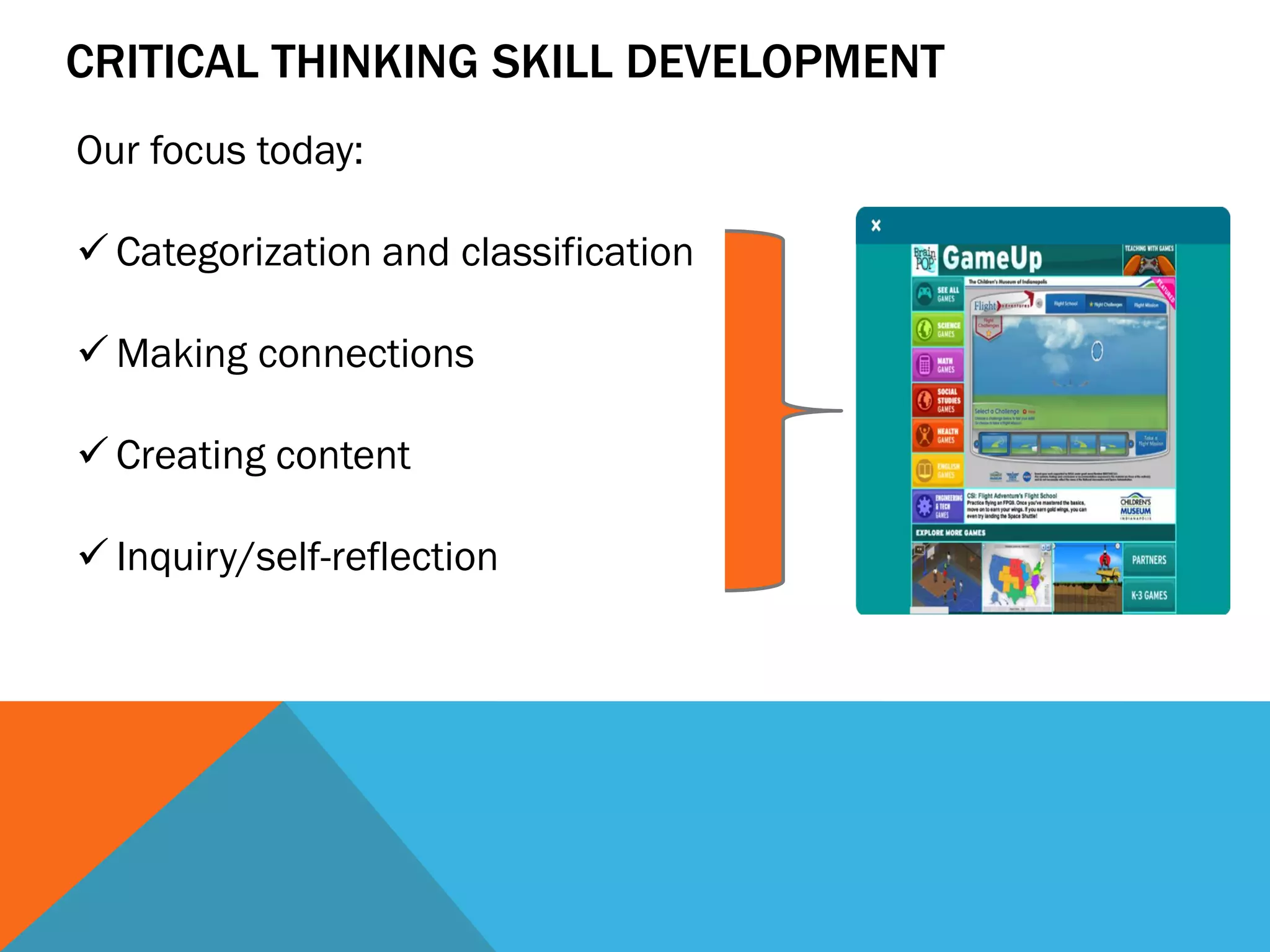
Our focus today:
 Categorization and classification
 Making connections
 Creating content
 Inquiry/self-reflection
© 2015 BrainPOP. All rights reserved. For information on BrainPOP trademarks & copyrights, visit
brainpop.com/trademarks.
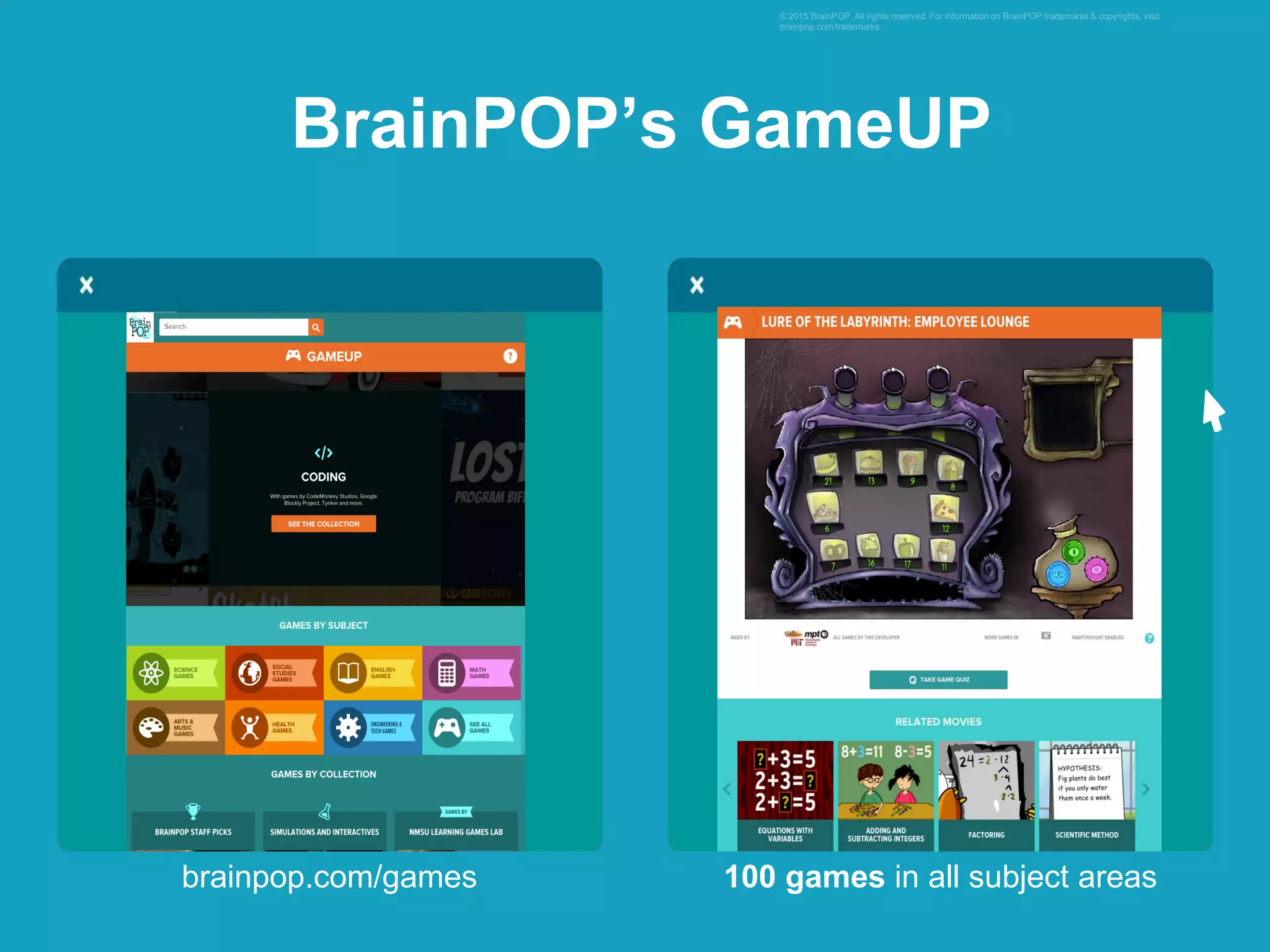
BrainPOP’s GameUP
brainpop.com/games 100 games in all subject areas
CRITICAL THINKING SKILL DEVELOPMENT
 Categorization and classification activities
Why important?
o Requires close observation
o Facilitates identification of features and attributes
o Sorting process exercises how to discover, understand and apply
rules to a problem
o Comparison amplifies understanding of differences and similarities
© 2015 BrainPOP. All rights reserved. For information on BrainPOP trademarks & copyrights, visit
brainpop.com/trademarks.
© 2015 BrainPOP. All rights reserved. For information on BrainPOP trademarks & copyrights, visit
brainpop.com/trademarks.
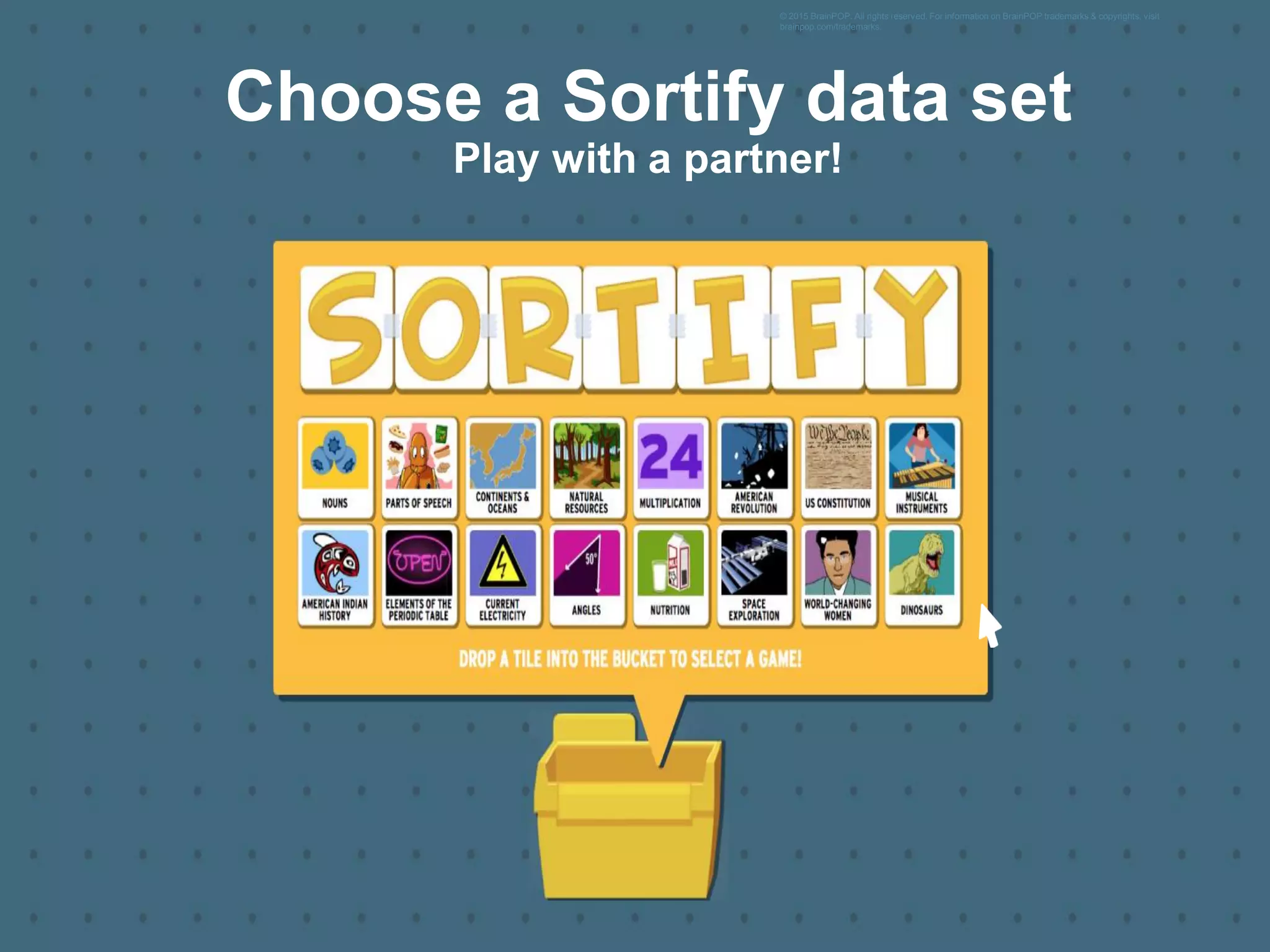
Choose a Sortify data set
Play with a partner!
CRITICAL THINKING SKILL DEVELOPMENT
 Making connections between ideas and concepts
Why important?
o Seeing patterns is a key first step in the process
o As children get older, move from the concrete patterns to making
connections between abstract concepts
o Basis for creativity – finding novel connections and alignments
beyond what we see
o Develops cognitive flexibility
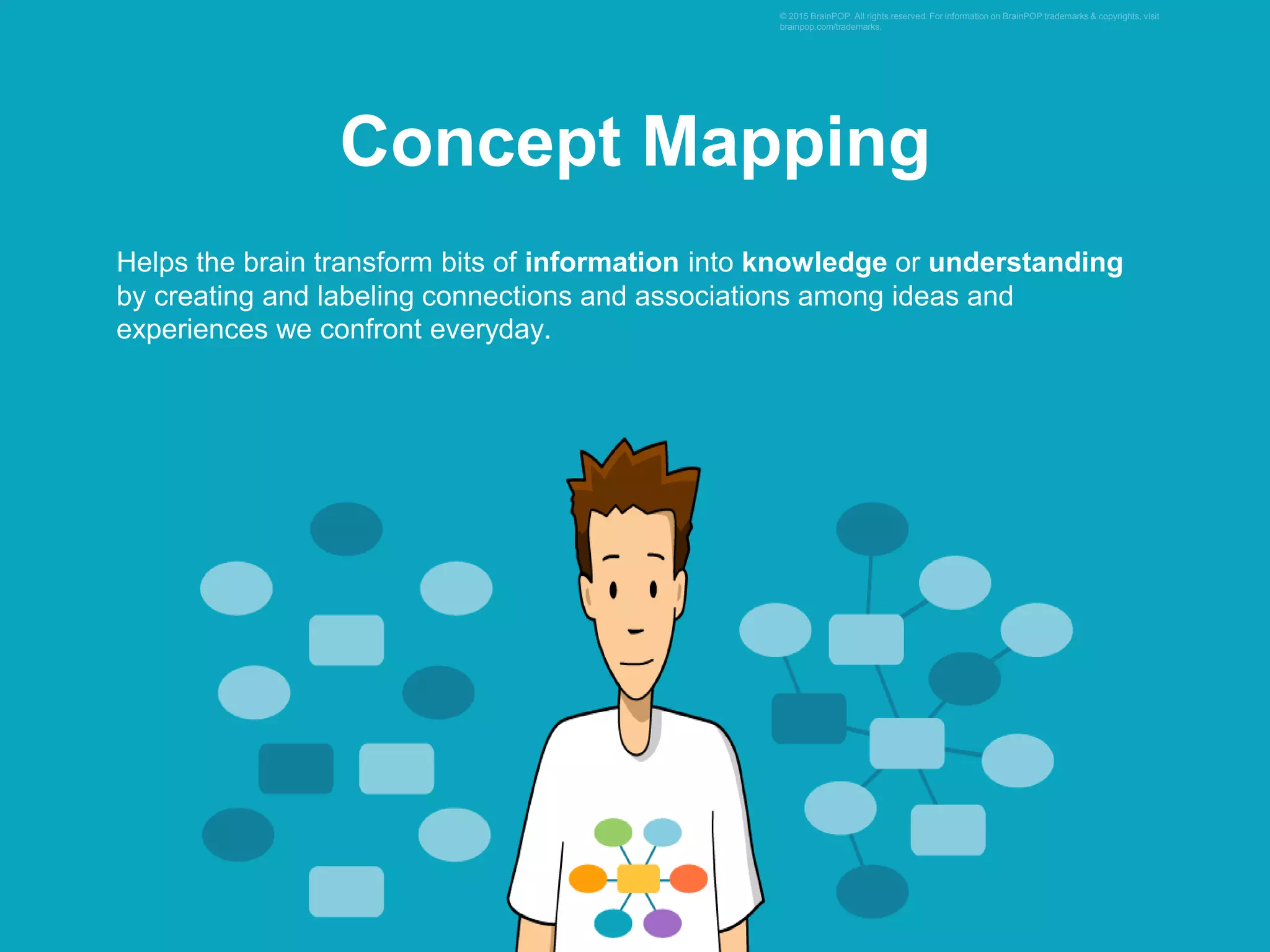
Helps the brain transform bits of information into knowledge or understanding
by creating and labeling connections and associations among ideas and
experiences we confront everyday.
© 2015 BrainPOP. All rights reserved. For information on BrainPOP trademarks & copyrights, visit
brainpop.com/trademarks.
Concept Mapping
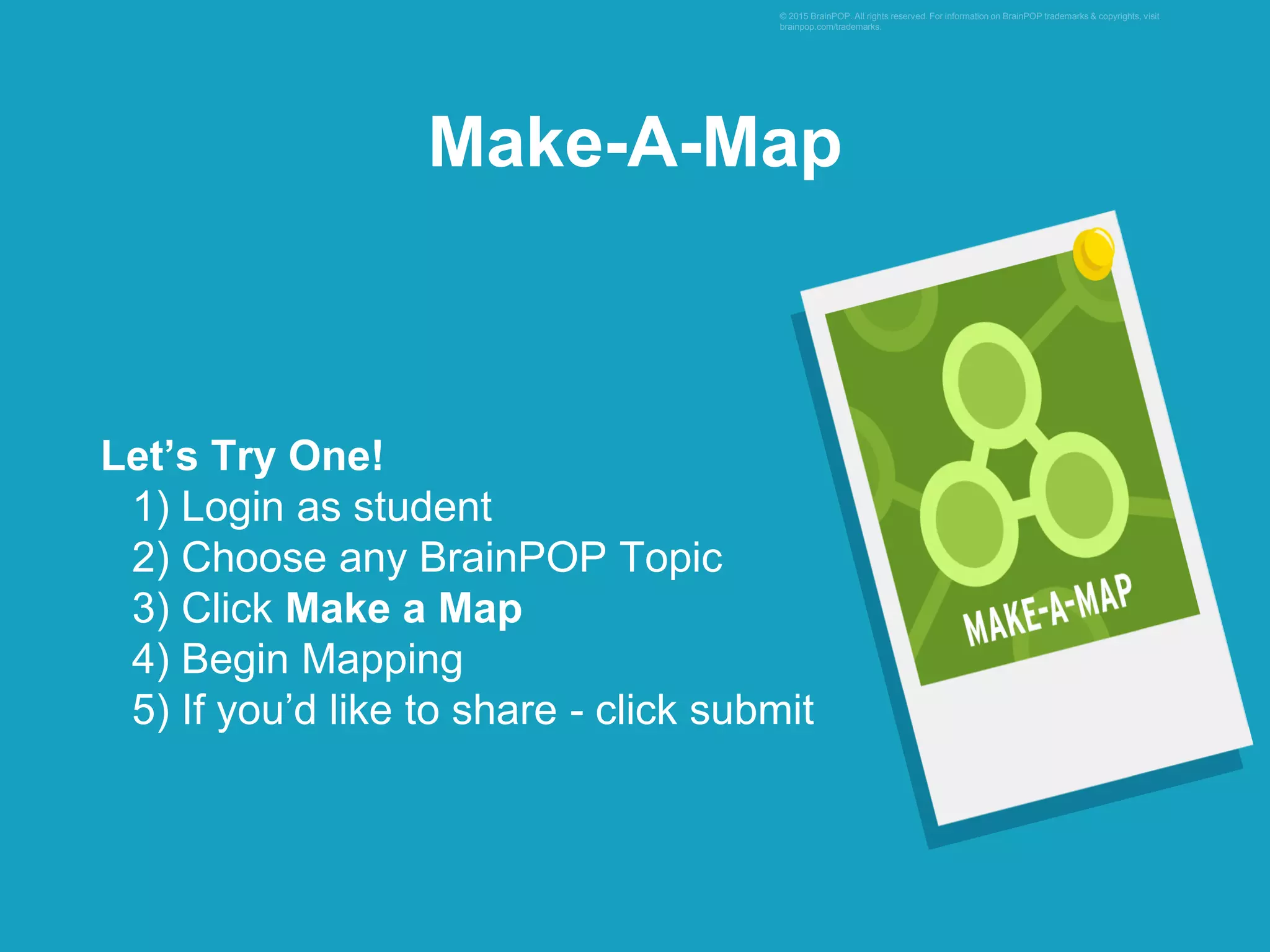
Let’s Try One!
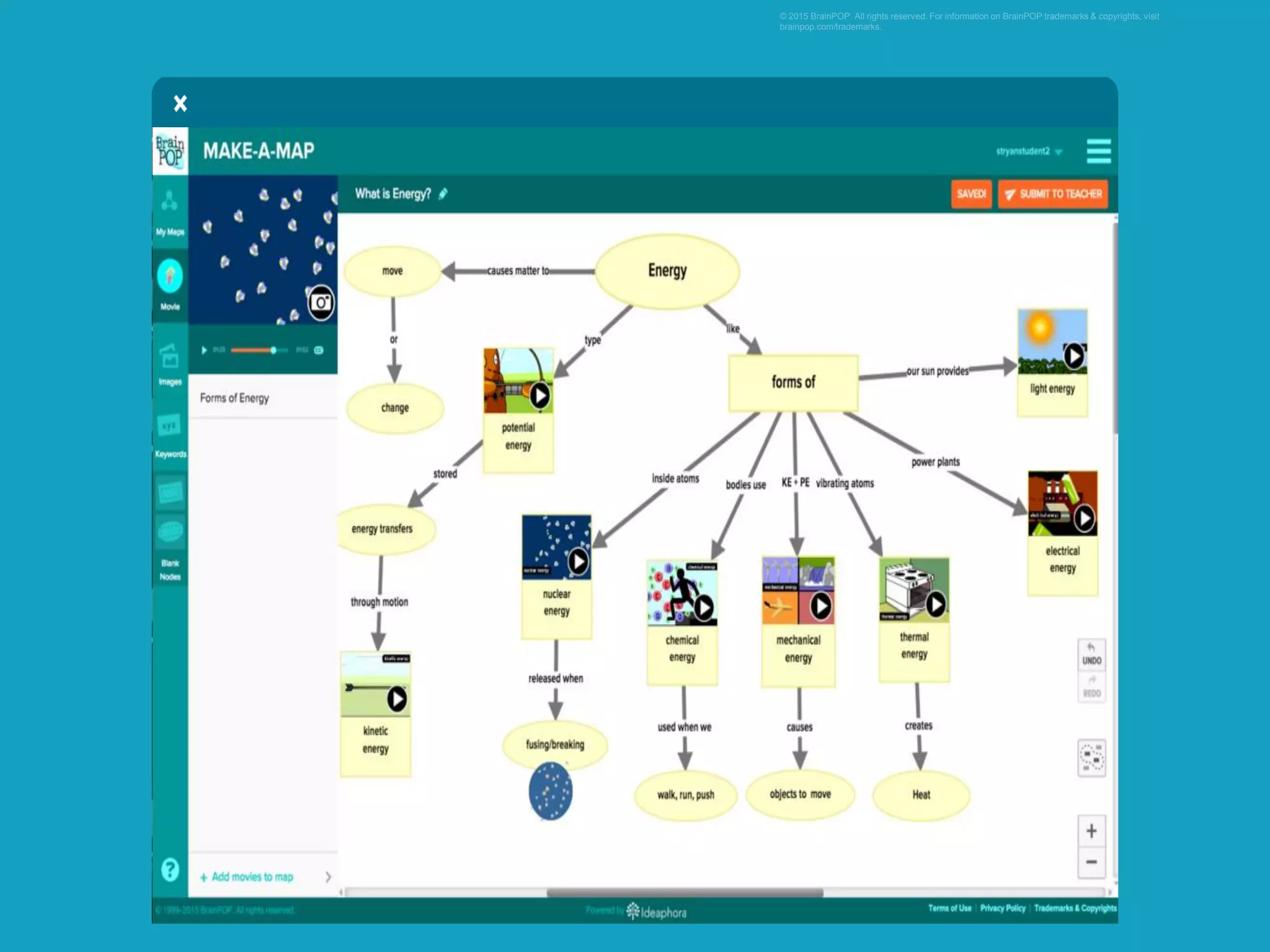
1) Login as student
2) Choose any BrainPOP Topic
3) Click Make a Map
4) Begin Mapping
5) If you’d like to share - click submit
© 2015 BrainPOP. All rights reserved. For information on BrainPOP trademarks & copyrights, visit
brainpop.com/trademarks.
Make-A-Map
CRITICAL THINKING SKILL DEVELOPMENT
 Creating content as a way to apply knowledge to create
new meaning
Why important?
o Process of synthesis and interpretation with an audience in mind
o Promotes new questions, i.e., what is appropriate representation of
these ideas, how can I tell the story of my ideas?
o Applying knowledge to get beyond self
o Development of authentic learning experiences
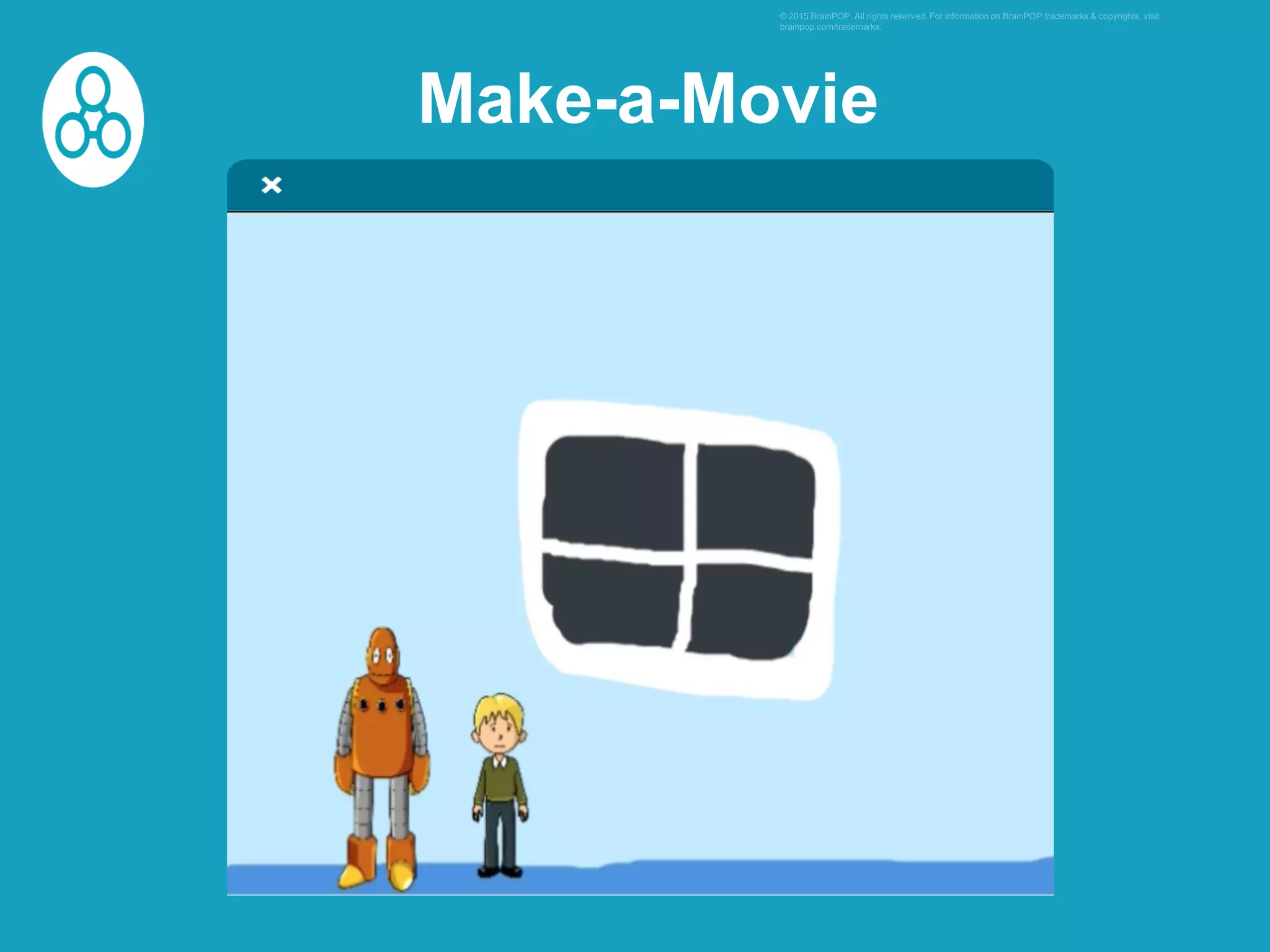
Make-a-Movie
© 2015 BrainPOP. All rights reserved. For information on BrainPOP trademarks & copyrights, visit
brainpop.com/trademarks.
© 2015 BrainPOP. All rights reserved. For information on BrainPOP trademarks & copyrights, visit
brainpop.com/trademarks.
CRITICAL THINKING SKILL DEVELOPMENT
 Inquiry activities and self-reflection that document thinking
processes
Why important?
o Critical thinking = evaluative thinking
o Learning that is active, persistent, self-directed
o Provides an emotionally supportive learning environment
o Promotes development of a growth mindset through self-reflection
• addition
• division
• multiplication
• subtraction
• factoring
• hypothesizing
• stats
• isolated variable
• deductive reasoning
© 2015 BrainPOP. All rights reserved. For information on BrainPOP trademarks & copyrights, visit
brainpop.com/trademarks.
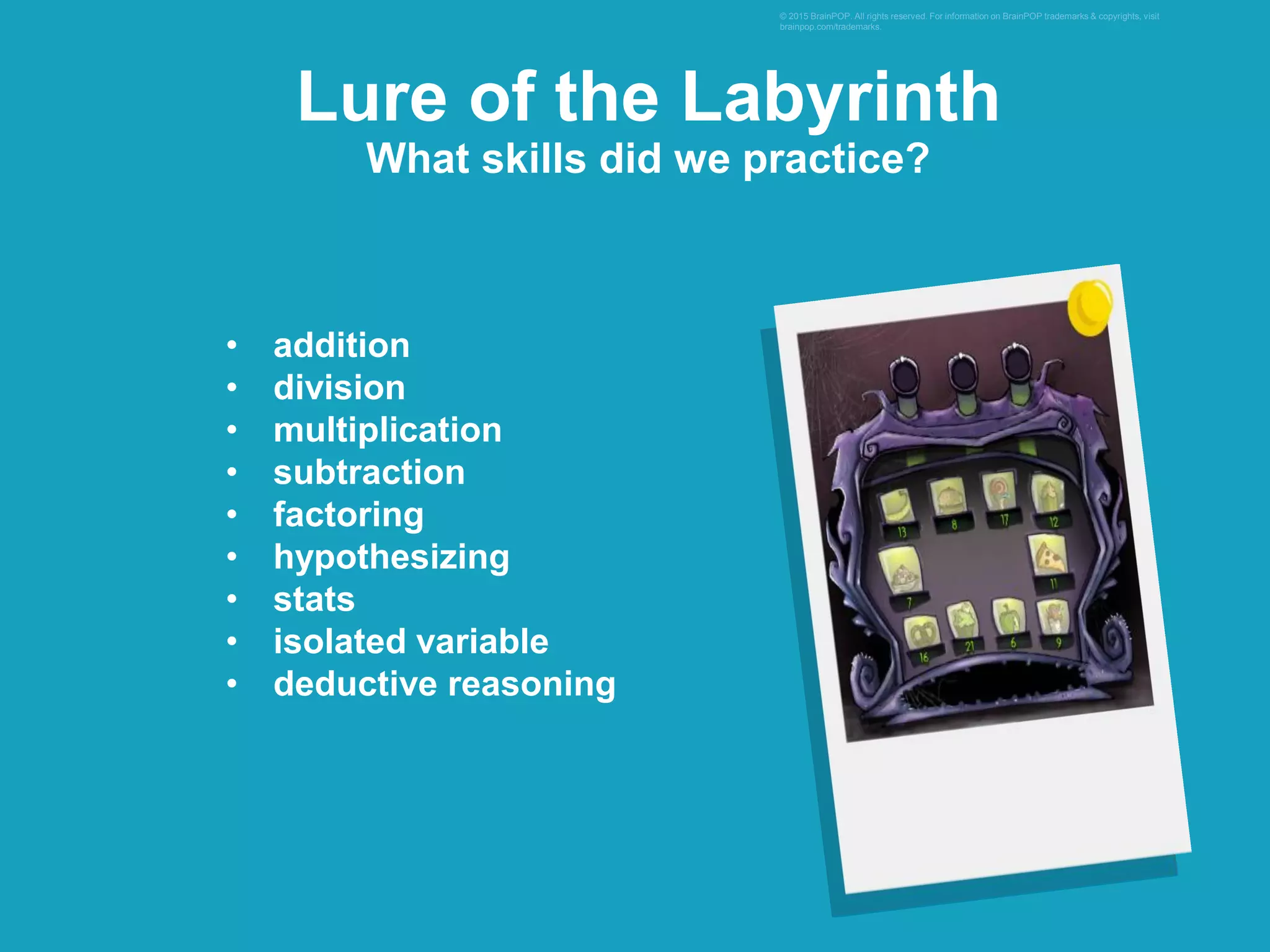
Lure of the Labyrinth
What skills did we practice?
WORKSHOP TOPICS
 What does “critical thinking” really mean?
 Best ways to help students develop those skills
 Leveraging digital tools for skill development
 Assessing competencies
 Additional resources for you
 Questions, comments, ideas
 Assessing competencies
How do you assess critical
thinking competency?
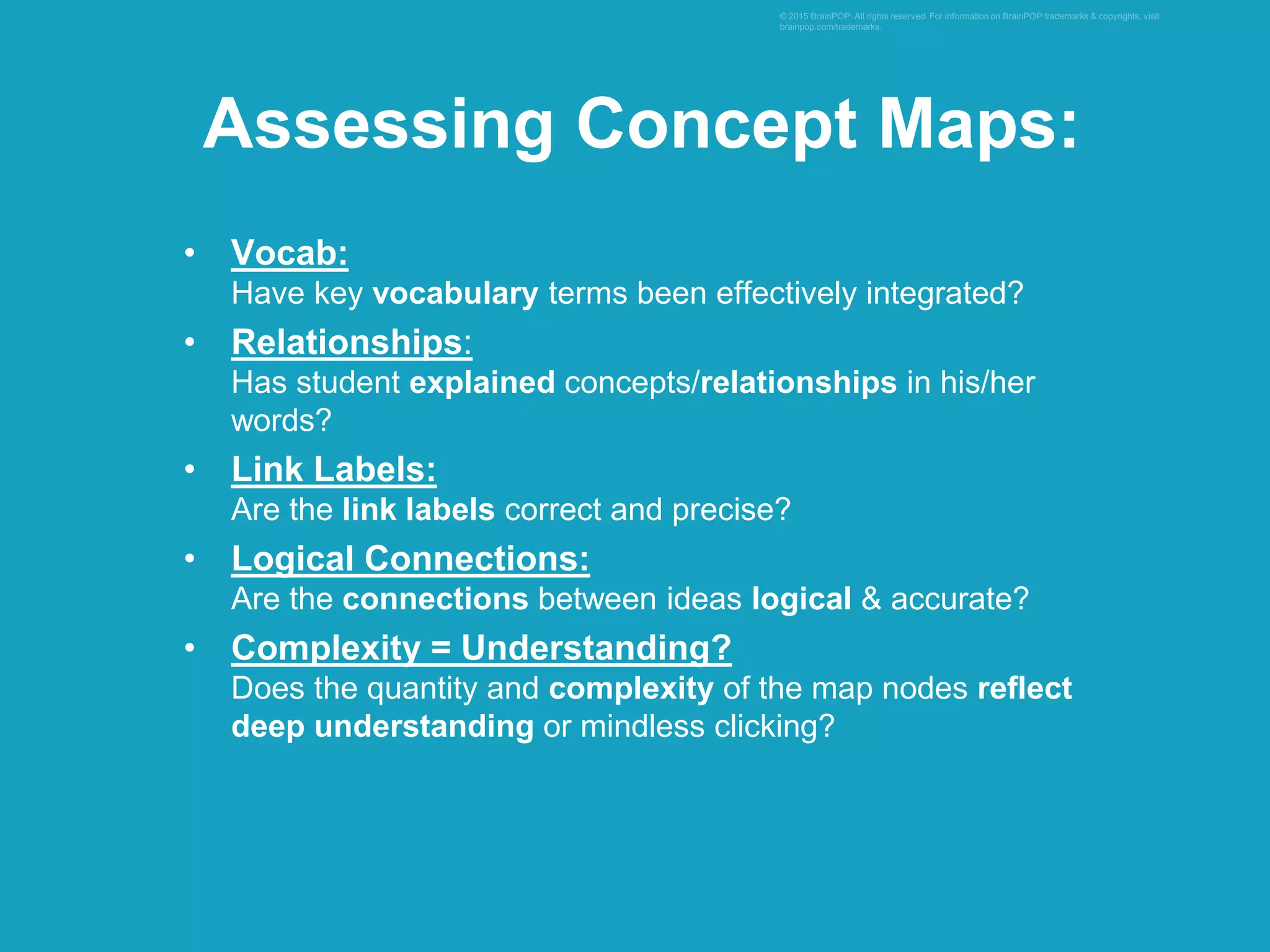
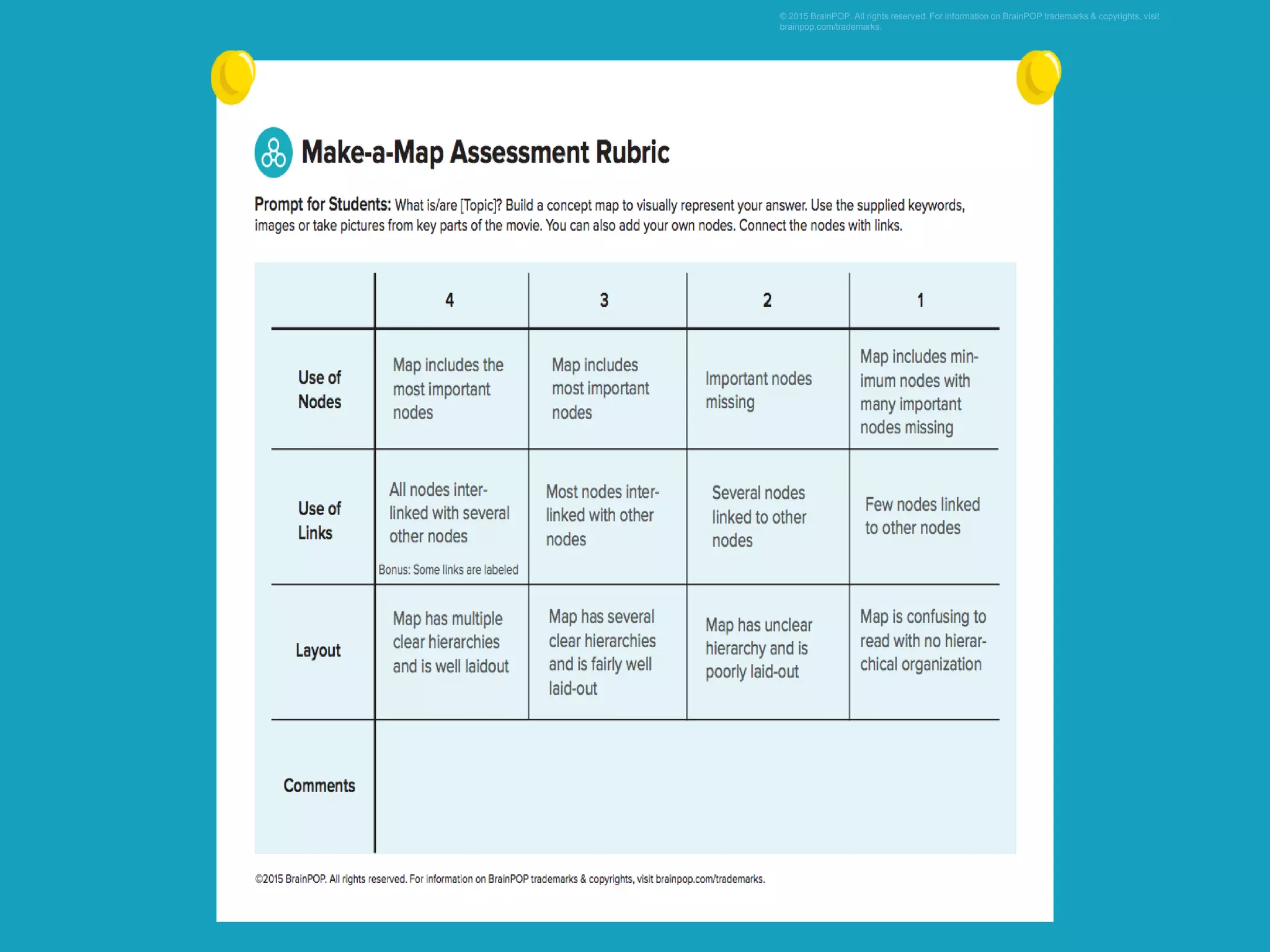
• Vocab:
Have key vocabulary terms been effectively integrated?
• Relationships:
Has student explained concepts/relationships in his/her
words?
• Link Labels:
Are the link labels correct and precise?
• Logical Connections:
Are the connections between ideas logical & accurate?
• Complexity = Understanding?
Does the quantity and complexity of the map nodes reflect
deep understanding or mindless clicking?
© 2015 BrainPOP. All rights reserved. For information on BrainPOP trademarks & copyrights, visit
brainpop.com/trademarks.
Assessing Concept Maps:
© 2015 BrainPOP. All rights reserved. For information on BrainPOP trademarks & copyrights, visit
brainpop.com/trademarks.
© 2015 BrainPOP. All rights reserved. For information on BrainPOP trademarks & copyrights, visit
brainpop.com/trademarks.
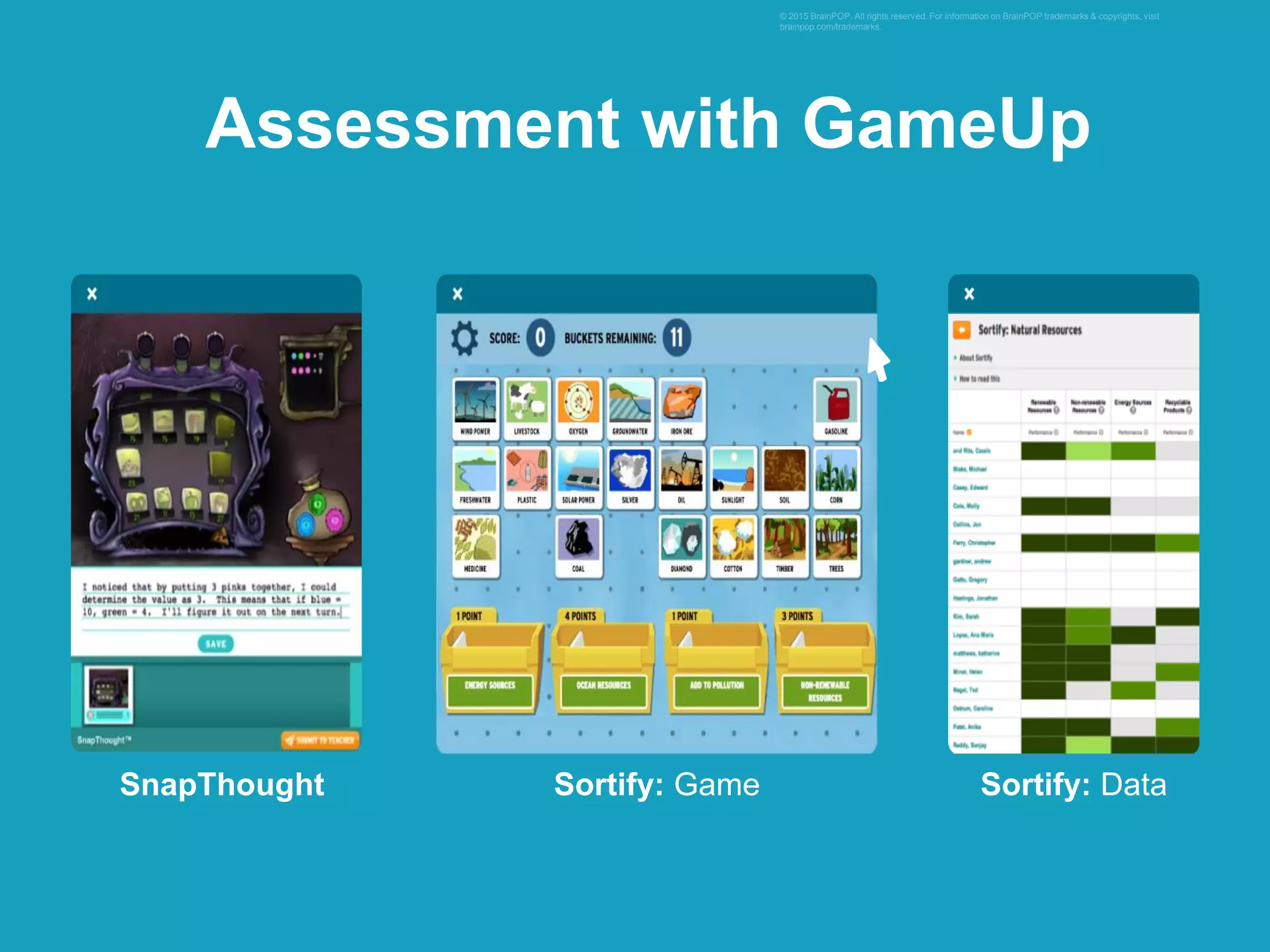
SnapThought
© 2015 BrainPOP. All rights reserved. For information on BrainPOP trademarks & copyrights, visit
brainpop.com/trademarks.
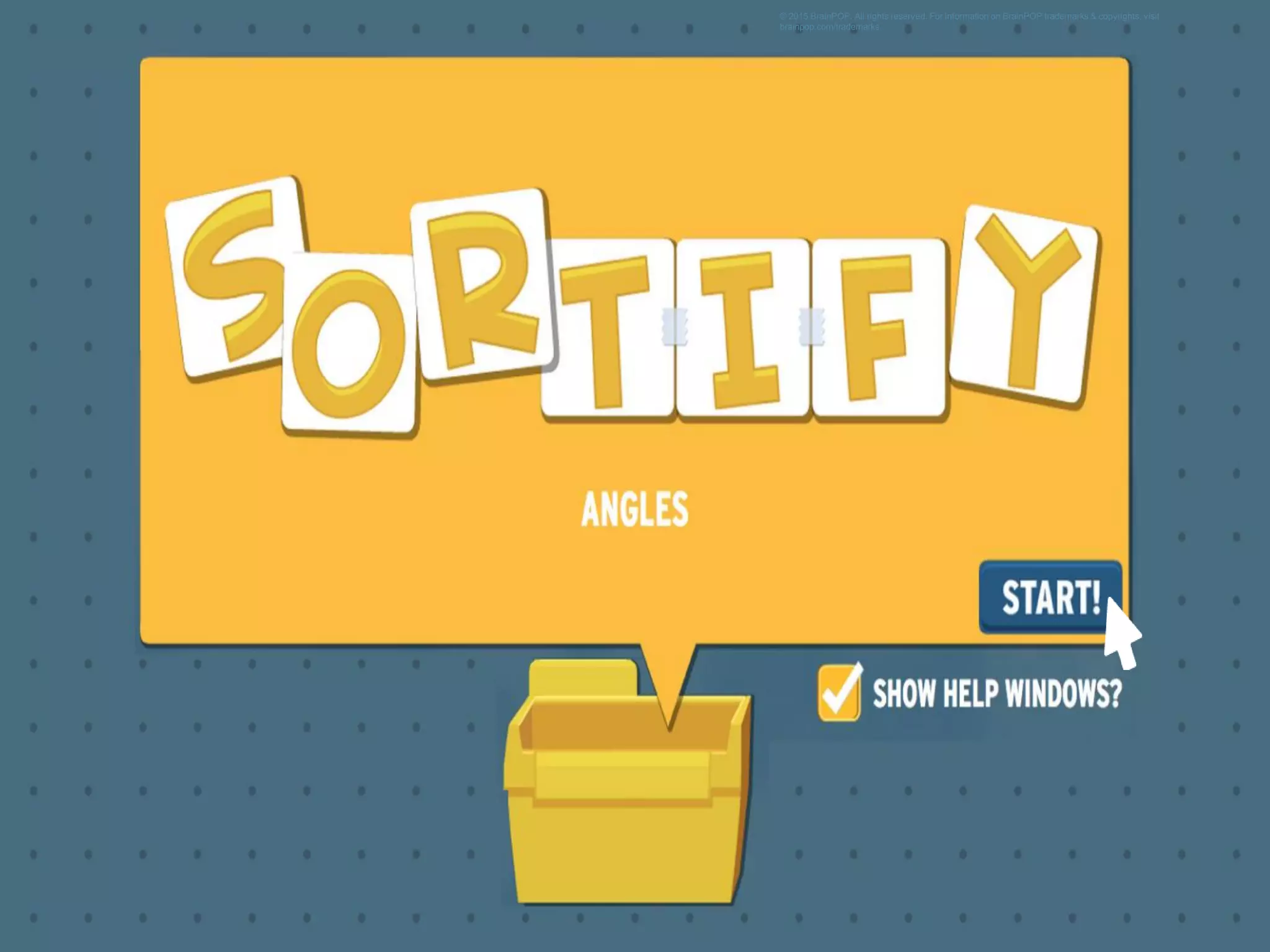
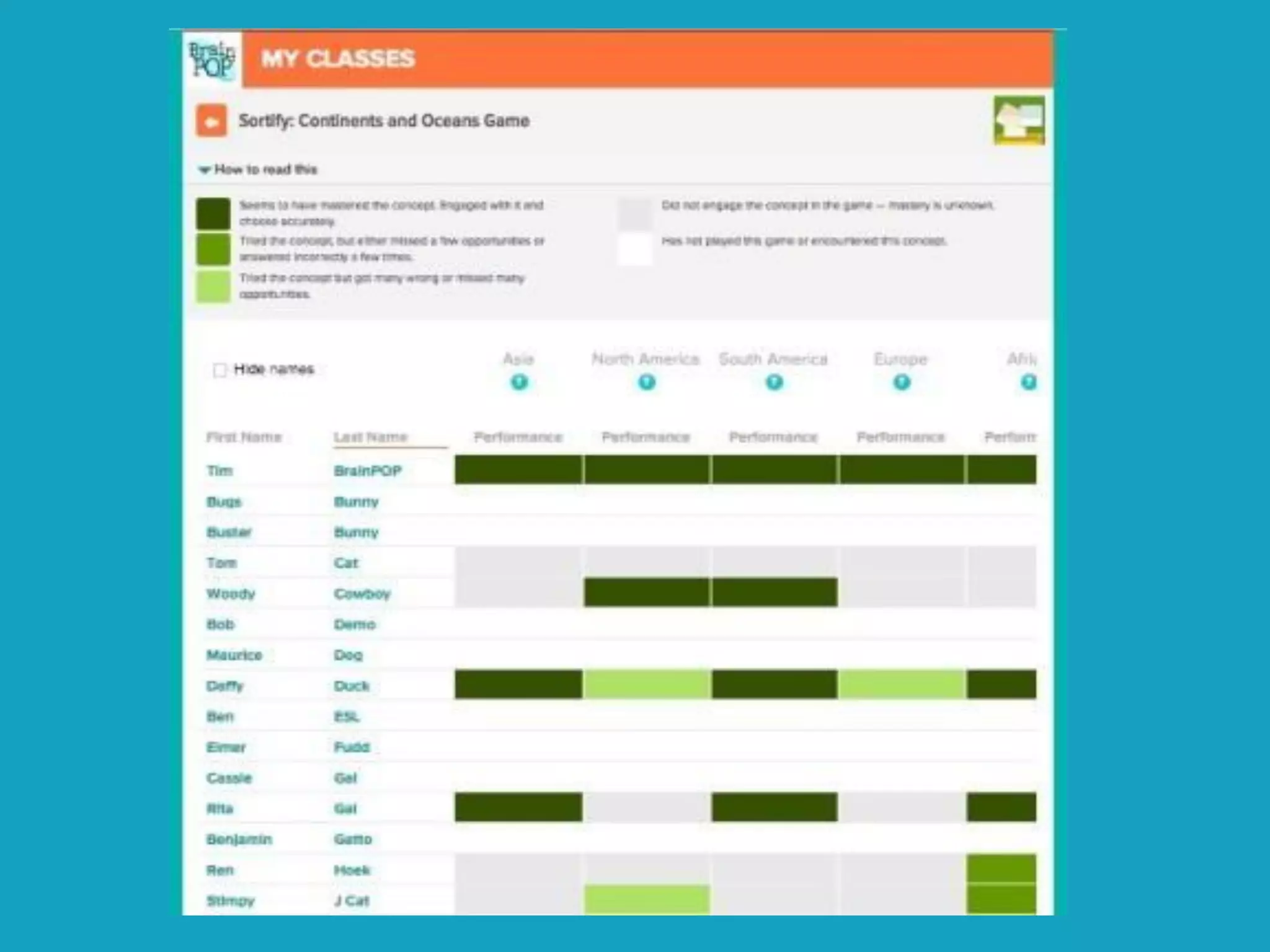
Sortify: Game
Assessment with GameUp
Sortify: Data
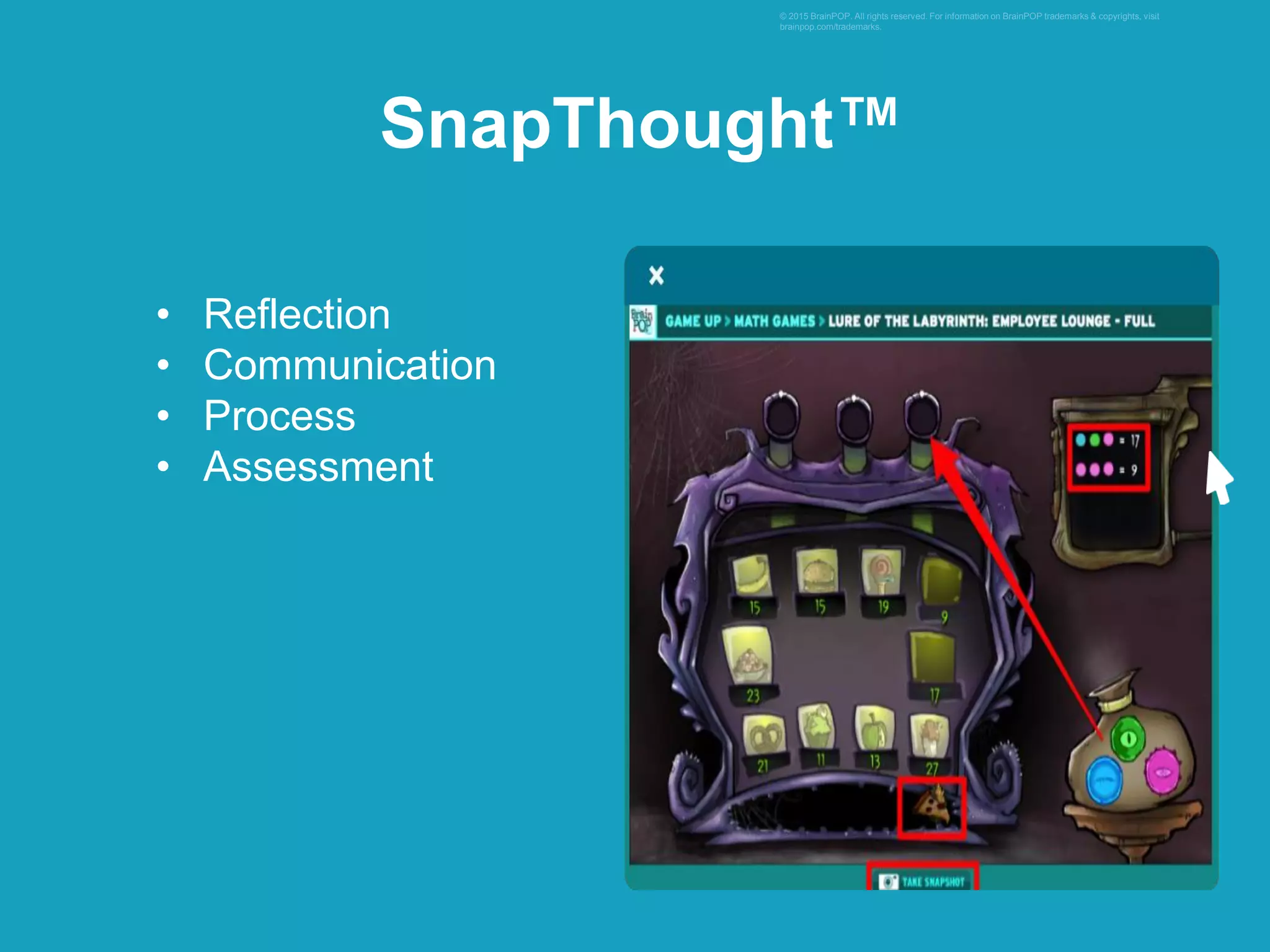
• Reflection
• Communication
• Process
• Assessment
© 2015 BrainPOP. All rights reserved. For information on BrainPOP trademarks & copyrights, visit
brainpop.com/trademarks.
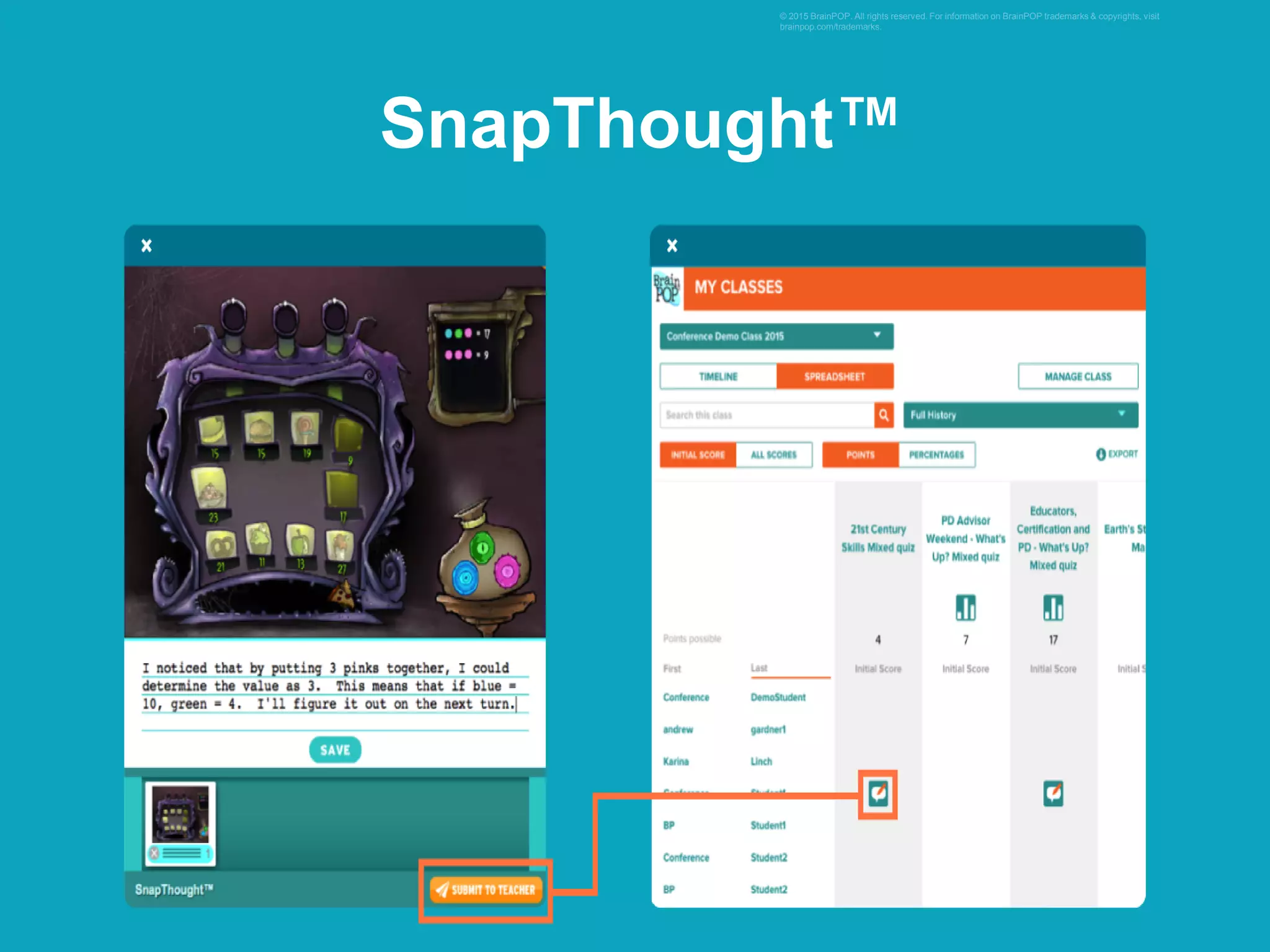
SnapThought™
© 2015 BrainPOP. All rights reserved. For information on BrainPOP trademarks & copyrights, visit
brainpop.com/trademarks.
SnapThought™
© 2015 BrainPOP. All rights reserved. For information on BrainPOP trademarks & copyrights, visit
brainpop.com/trademarks.
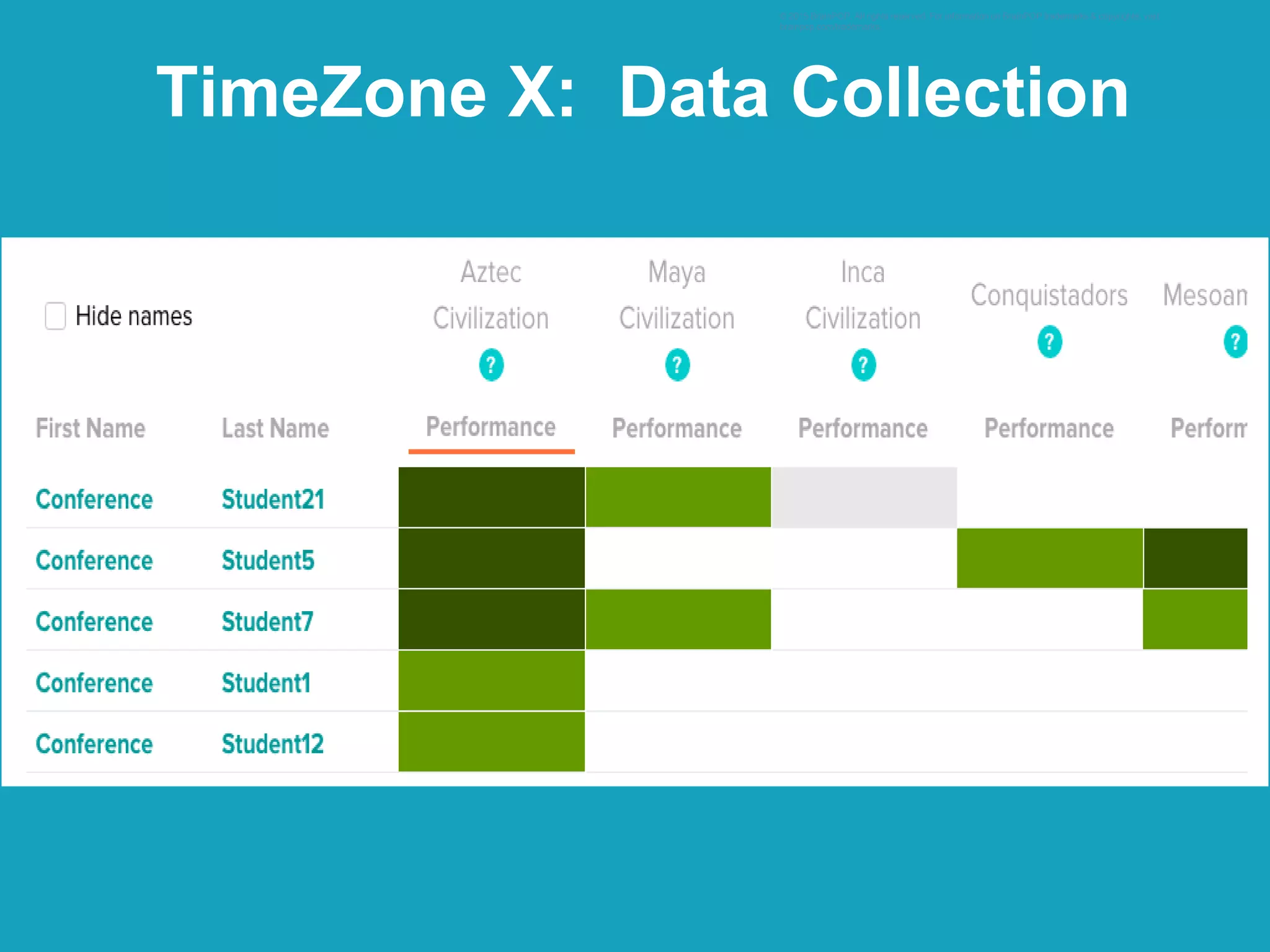
TimeZone X: Data Collection
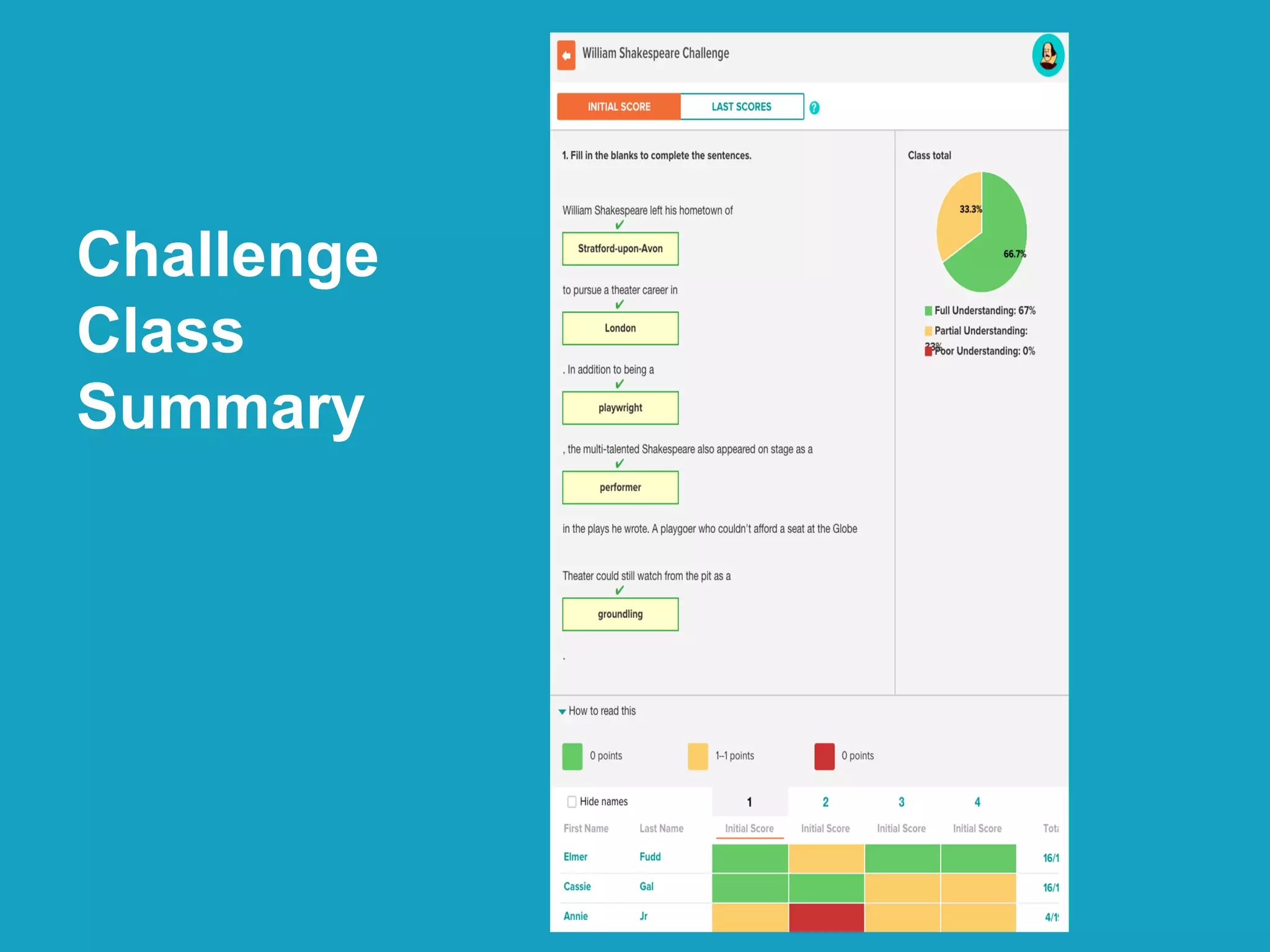
Challenge
Class
Summary
© 2015 BrainPOP. All rights reserved. For information on BrainPOP trademarks & copyrights, visit
brainpop.com/trademarks.
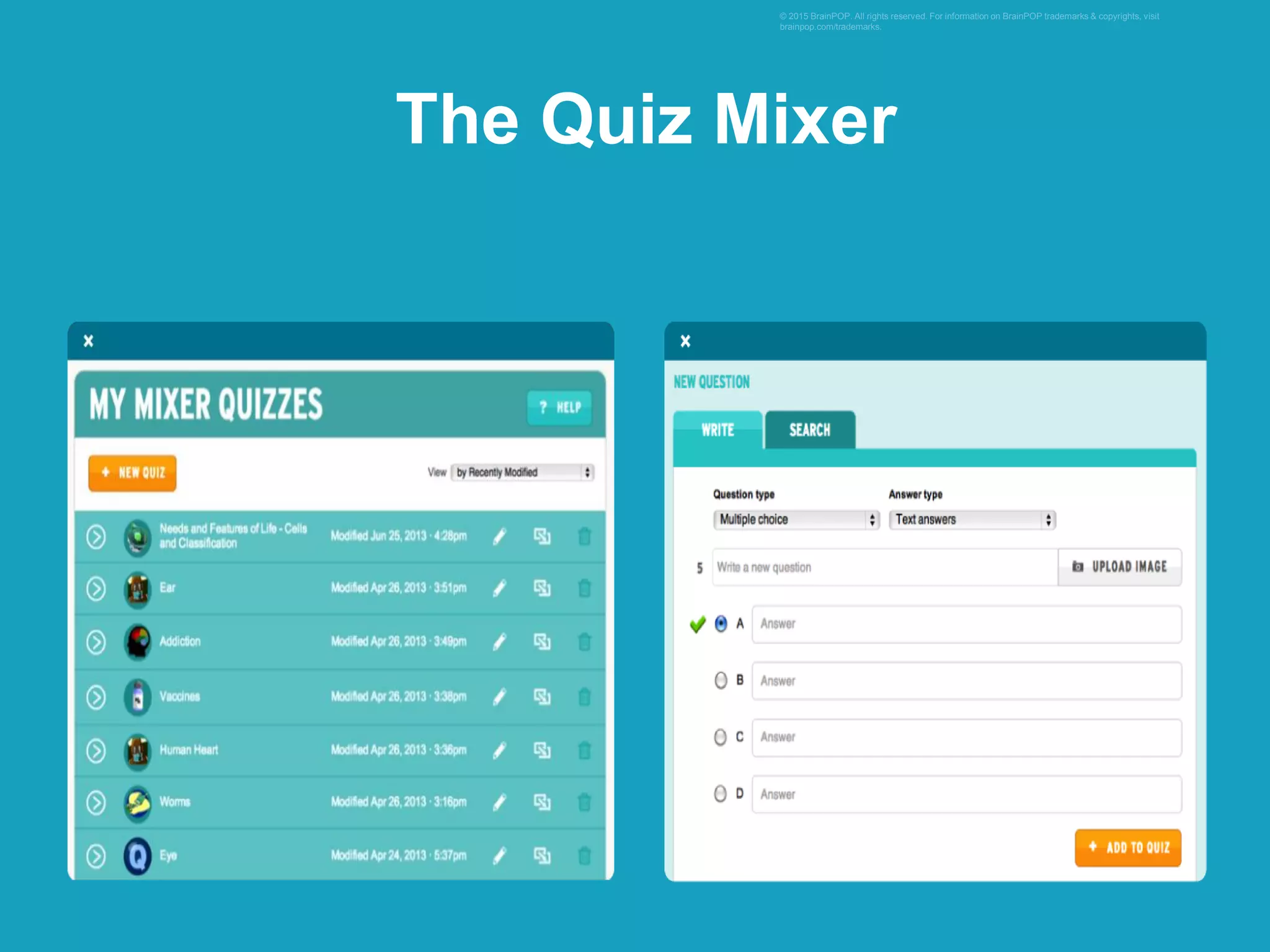
The Quiz Mixer
© 2015 BrainPOP. All rights reserved. For information on BrainPOP trademarks & copyrights, visit
brainpop.com/trademarks.
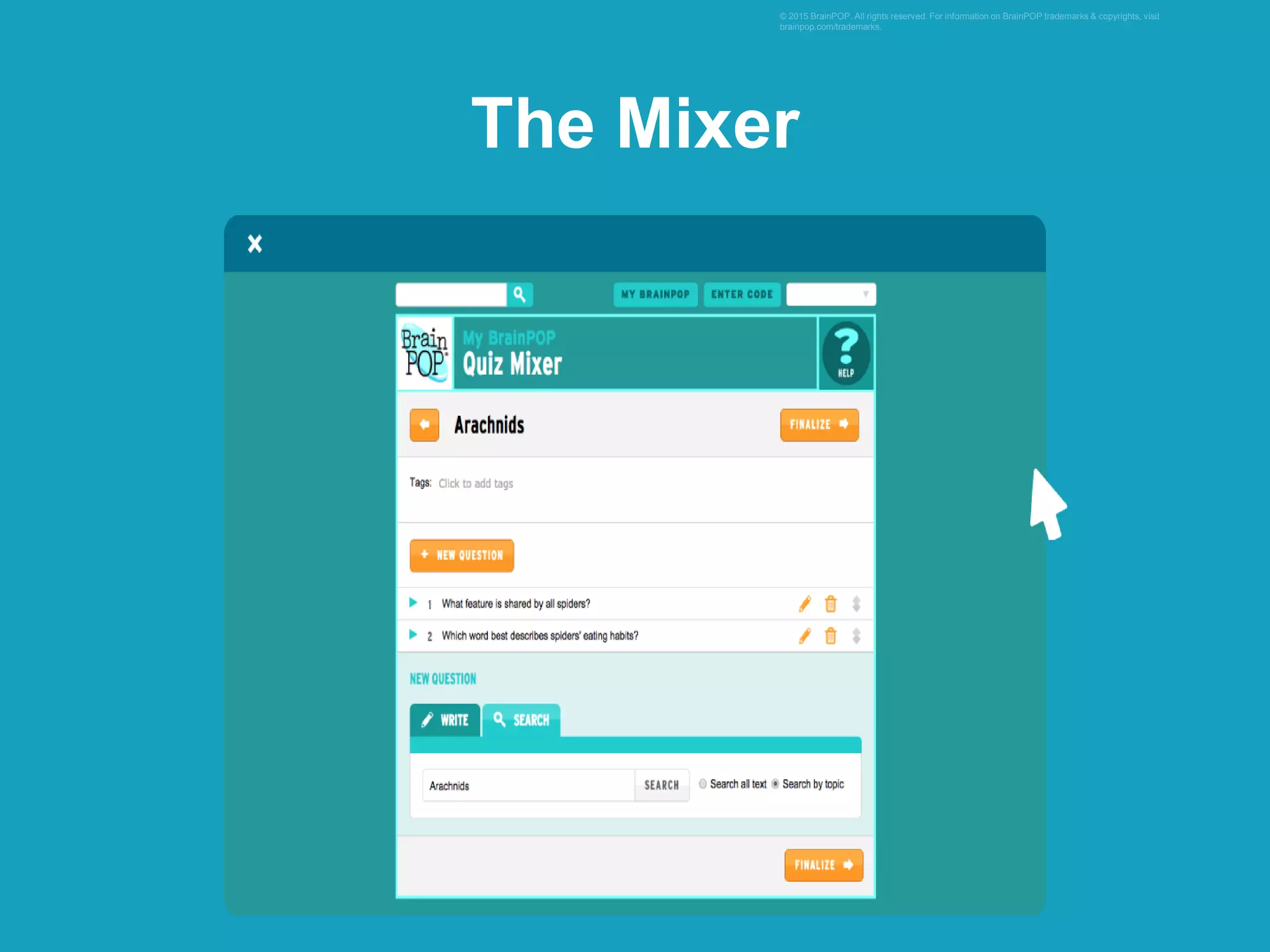
The Mixer
WORKSHOP TOPICS
 What does “critical thinking” really mean?
 Best ways to help students develop those skills
 Leveraging digital tools for skill development
 Assessing competencies
 Additional resources for you
 Questions, comments, ideas
ADDITIONAL RESOURCES
www.tomorrow.org/speakup/MakingCriticalThinkingReal_SXSWedu2017.html
o Additional readings on critical thinking
o Links to games and activities from BrainPOP
o Copy of this workshop presentation
Link to sign up for extended trial of MyBrainPOP -
http://bpopne.ws/mbptrial
bit.ly/CTDigitalResources
What do
you see
now?
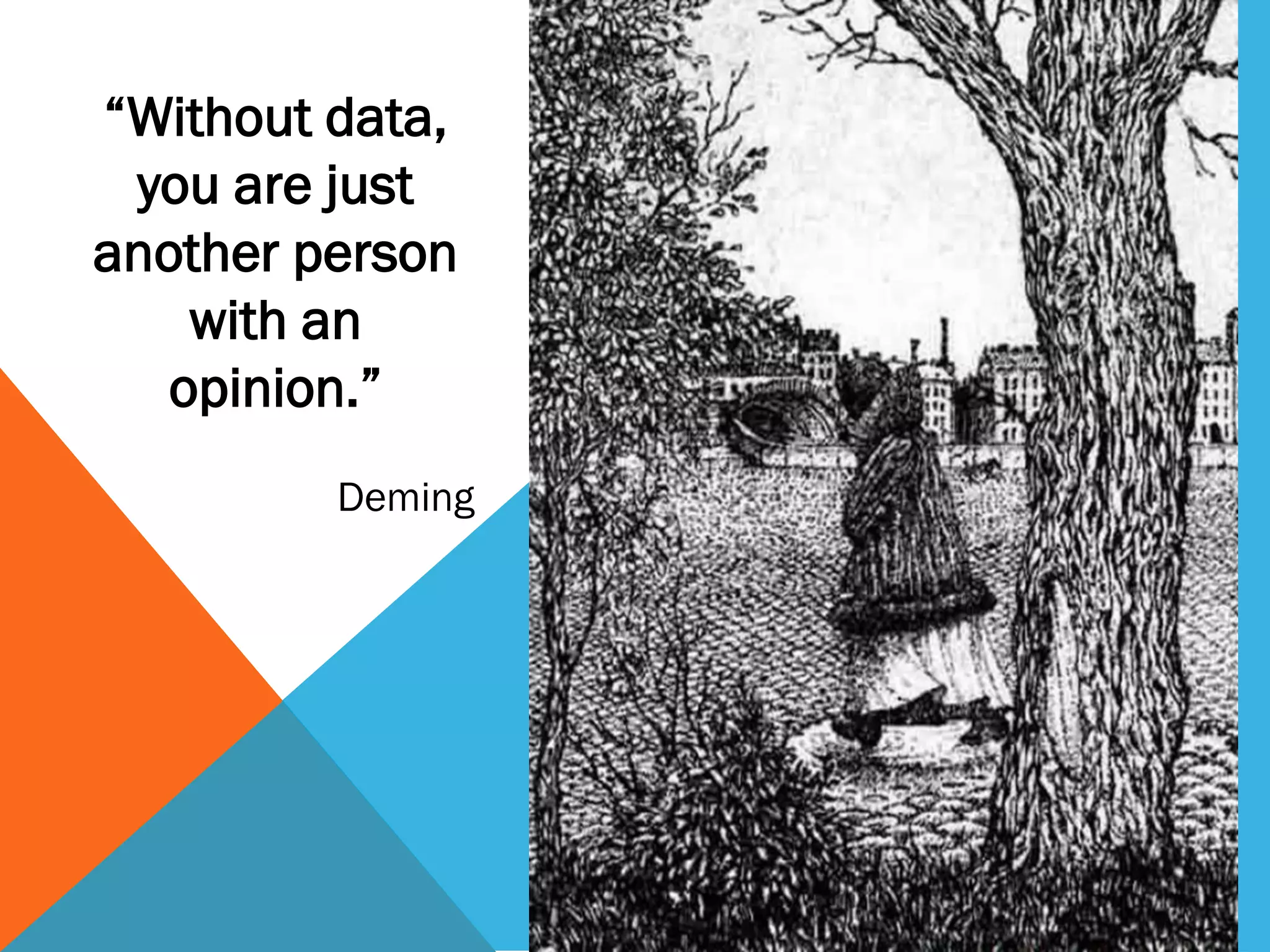
“Without data,
you are just
another person
with an
opinion.”
Deming
Getting beyond opinion, myth and anecdote when
planning for effective technology use to help students
develop essential skills . . .
1. Tap into the Speak Up reports and infographics
2. Have your class, school and district participate in
the Speak Up Research Project
1. Tap into the Speak Up reports and infographics
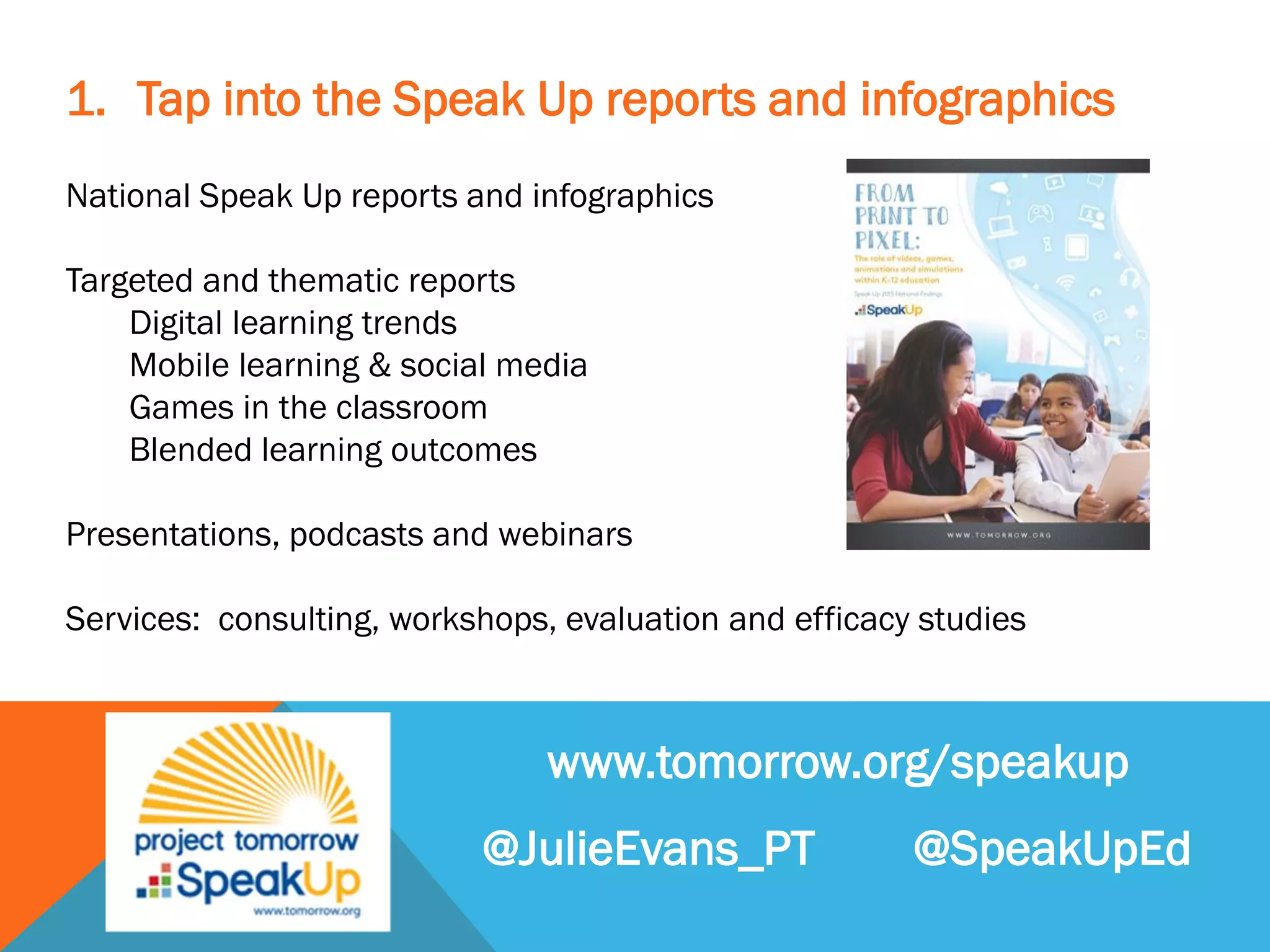
National Speak Up reports and infographics
Targeted and thematic reports
Digital learning trends
Mobile learning & social media
Games in the classroom
Blended learning outcomes
Presentations, podcasts and webinars
Services: consulting, workshops, evaluation and efficacy studies
www.tomorrow.org/speakup
@JulieEvans_PT @SpeakUpEd
2. Have your class, school and district participate in
the Speak Up Research Project
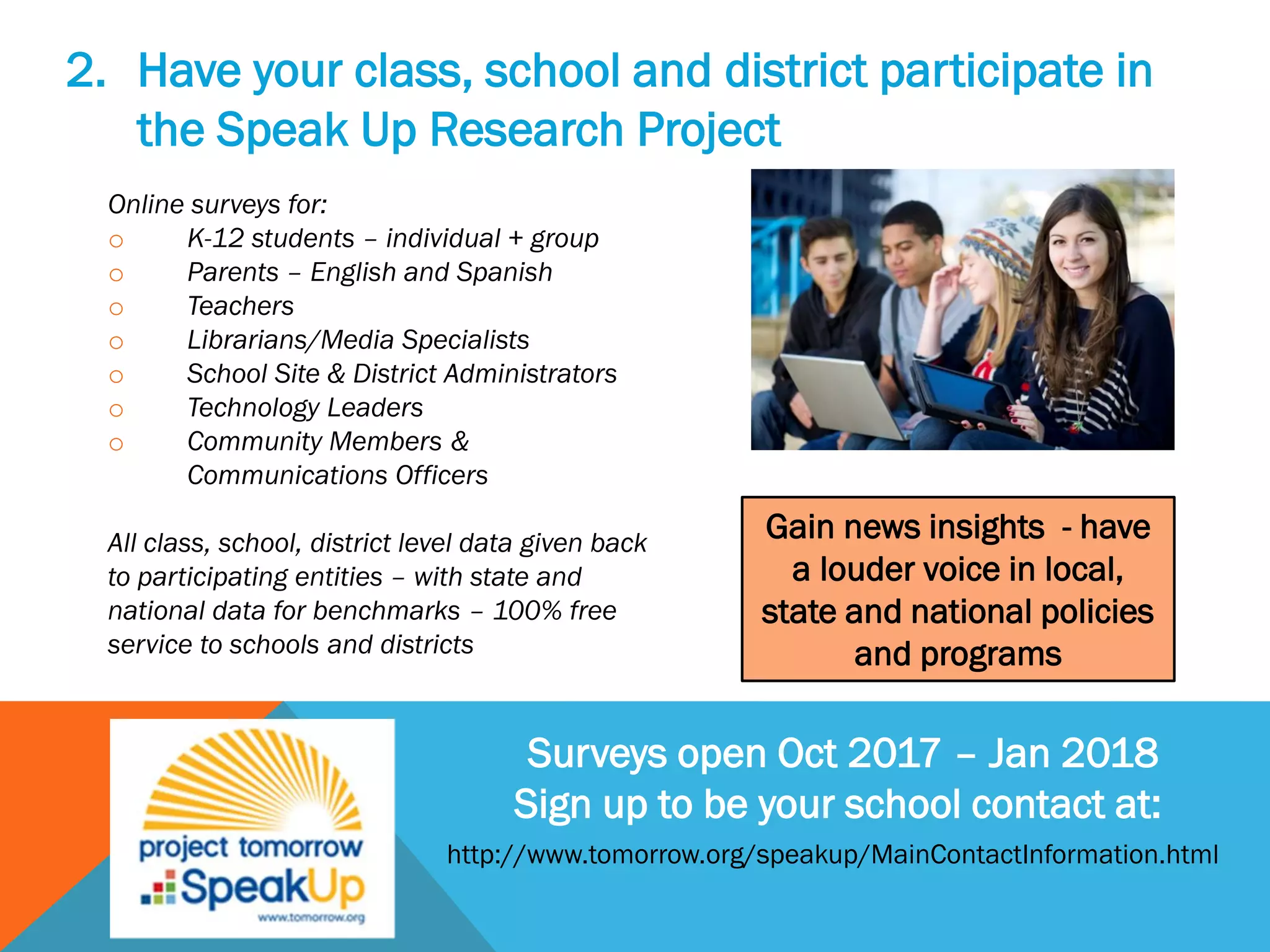
Online surveys for:
o K-12 students – individual + group
o Parents – English and Spanish
o Teachers
o Librarians/Media Specialists
o School Site & District Administrators
o Technology Leaders
o Community Members &
Communications Officers
All class, school, district level data given back
to participating entities – with state and
national data for benchmarks – 100% free
service to schools and districts
Surveys open Oct 2017 – Jan 2018
Sign up to be your school contact at:
Gain news insights - have
a louder voice in local,
state and national policies
and programs
http://www.tomorrow.org/speakup/MainContactInformation.html
2. Have your local teacher preparation program
participate in the Speak Up Research Project
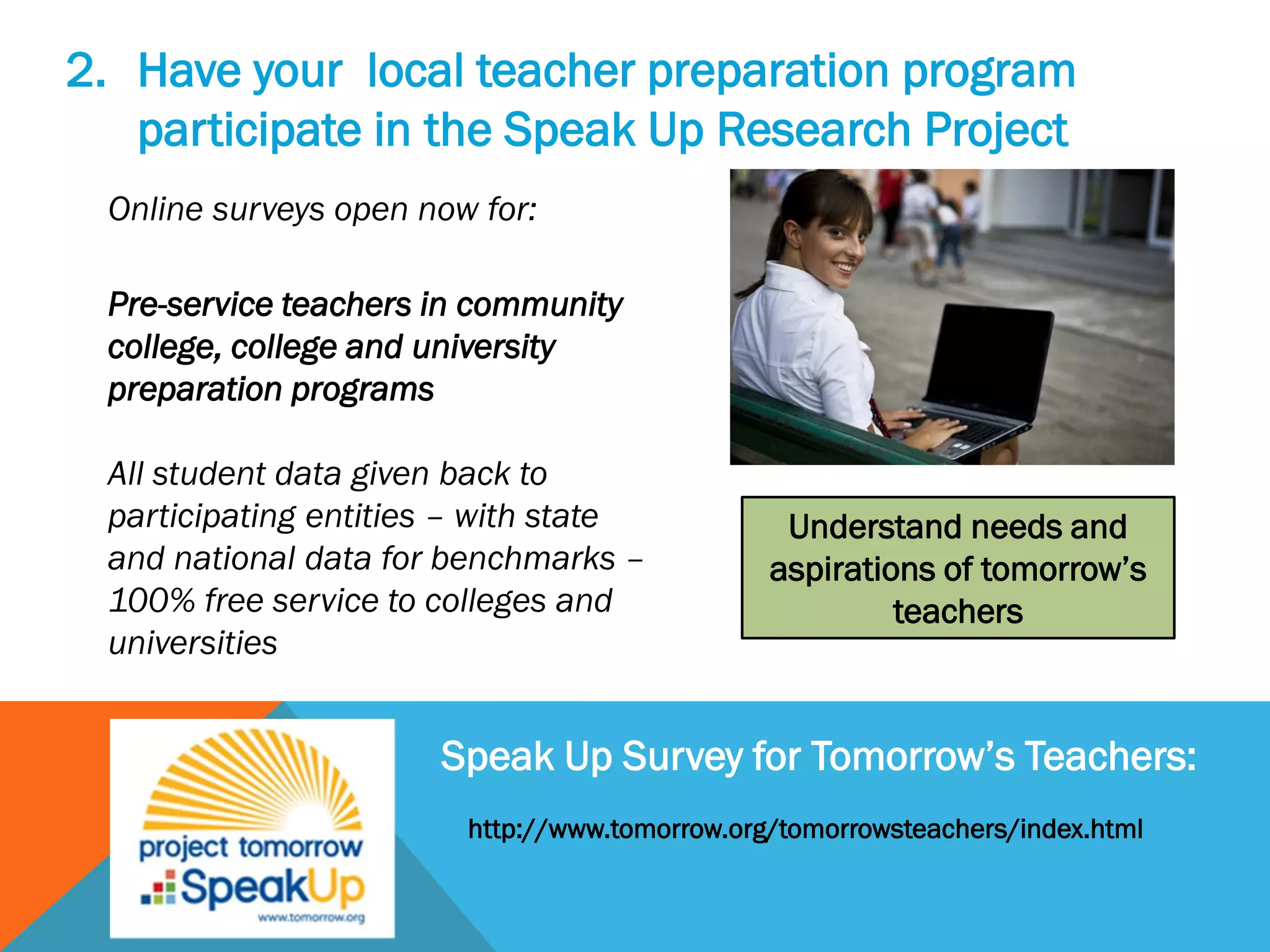
Online surveys open now for:
Pre-service teachers in community
college, college and university
preparation programs
All student data given back to
participating entities – with state
and national data for benchmarks –
100% free service to colleges and
universities
Speak Up Survey for Tomorrow’s Teachers:
Understand needs and
aspirations of tomorrow’s
teachers
http://www.tomorrow.org/tomorrowsteachers/index.html
Dr. Julie A. Evans
Project Tomorrow
@JulieEvans_PT
Dr. Kari Stubbs
BrainPOP
@KariStubbs
March 16, 2017
Thank you for joining us today!

Making Critical Thinking Real with Digital Content - CUE 2017

  • 1.
    Dr. Julie A.Evans Project Tomorrow @JulieEvans_PT Dr. Kari Stubbs BrainPOP @KariStubbs March 16, 2017
  • 2.
    PREP WORK! www.brainpop.com -sign in to your student account Click on “enter code” at top of page Here is your quiz code: CTDigital2
  • 3.
    WELCOME TO THISWORKSHOP! Dr. Julie A. Evans Chief Executive Officer Project Tomorrow @JulieEvans_PT Dr. Kari Stubbs Vice President BrainPOP @KariStubbs
  • 4.
    GETTING TO KNOWEACH OTHER
  • 5.
    Tweet with us!#CTDigital #CUE17 @JulieEvans_PT @KariStubbs @SpeakUpEd @BrainPOP
  • 6.
    WORKSHOP TOPICS  Whatdoes “critical thinking” really mean?  Best ways to help students develop those skills  Leveraging digital tools for skill development  Assessing competencies  Additional resources for you  Questions, comments, ideas
  • 7.
    WORKSHOP TOPICS  Whatdoes “critical thinking” really mean?  Best ways to help students develop those skills  Leveraging digital tools for skill development  Assessing competencies  Additional resources for you  Questions, comments, ideas
  • 8.
     What does“critical thinking” really mean? What does that term mean to you?
  • 10.
  • 11.
     What does“critical thinking” really mean? “Critical thinking is the intellectually disciplined process of actively and skillfully conceptualizing, applying, analyzing, synthesizing, and/or evaluating information gathered from, or generated by, observation, experience, reflection, reasoning, or communication, as a guide to belief and action.” Source: Scriven & Paul, 8th Annual International Conference on Critical Thinking and Education Reform, 1987
  • 12.
     What does“critical thinking” really mean? “Critical thinking is the intellectually disciplined process of actively and skillfully conceptualizing, applying, analyzing, synthesizing, and/or evaluating information gathered from, or generated by, observation, experience, reflection, reasoning, or communication, as a guide to belief and action.” Source: Scriven & Paul, 8th Annual International Conference on Critical Thinking and Education Reform, 1987
  • 13.
     What does“critical thinking” really mean? “Critical thinking is the intellectually disciplined process of actively and skillfully conceptualizing, applying, analyzing, synthesizing, and/or evaluating information gathered from, or generated by, observation, experience, reflection, reasoning, or communication, as a guide to belief and action.” Source: Scriven & Paul, 8th Annual International Conference on Critical Thinking and Education Reform, 1987
  • 14.
     What does“critical thinking” really mean? “Critical thinking is the intellectually disciplined process of actively and skillfully conceptualizing, applying, analyzing, synthesizing, and/or evaluating information gathered from, or generated by, observation, experience, reflection, reasoning, or communication, as a guide to belief and action.” Source: Scriven & Paul, 8th Annual International Conference on Critical Thinking and Education Reform, 1987
  • 15.
    WHY IS CRITICALTHINKING IMPORTANT TODAY? 1. Information intensive society and economy 2. Accelerating pace of change 3. Employability
  • 16.
    WHY IS CRITICALTHINKING IMPORTANT TODAY?  72% of employers say critical thinking is key to their organization’s success o But only half say their employees are good critical thinkers  93% of employers say a candidate’s competencies with workplace skills such as critical thinking are more important then their undergraduate major Sources: • American Management Study, 2012 • AACU Survey, 2013
  • 17.
    QUIZ RESULTS How importantis critical thinking for today’s students?
  • 18.
    Most important skills students needto master for future success % Parents who agree % District Admin who agree % Community Members who agree Critical Thinking 85% 94% 85% Creativity 75% 78% 71% Communications 66% 77% 63% Collaboration 74% 87% 74% Source: Project Tomorrow’s Speak Up Research Project. Data collected in fall 2016 from 514,000 education stakeholders
  • 19.
    CRITICAL THINKING ASA WORKPLACE SKILL http://cte.ed.gov/employabilityskills/
  • 20.
    WHY IS CRITICALTHINKING IMPORTANT TODAY?  75% of employers want education institutions to place a higher emphasis on these students’ skills: o Critical thinking o Complex problem solving o Written and oral communications o Applying knowledge in real world situations Source: • AACU Survey, 2013
  • 21.
    WORKSHOP TOPICS  Whatdoes “critical thinking” really mean?  Best ways to help students develop those skills  Leveraging digital tools for skill development  Assessing competencies  Additional resources for you  Questions, comments, ideas
  • 22.
    QUIZ RESULTS What arethe best ways for students to develop workplace skills?
  • 23.
    Ways to developworkplace skills % of parents who agree % of district admin who agree % of community members who agree Work experience 80% 79% 81% Team experience 64% 64% 57% Using technology within classes 63% 76% 61% School leadership 63% 73% 62% Project-based learning 55% 80% 51% Taking STEM classes 50% 47% 34% Using technology outside of school 49% 56% 50% Take CTE classes 45% 49% 53% Source: Speak Up 2016 Research findings
  • 24.
     Best waysto help students develop those skills Recommended strategies for classroom teachers:  Do not always jump in to help students with answers  Engage students in brainstorming about new activities  Provides opportunities for questioning and inquiry  Leverage activities that support classifying and categorization, comparing and contrasting  Enable connection-making – how does this influence that?  Allow for peer learning, collaborative problem solving Sources: • Partnership for 21st Century Skills • TeacherHub
  • 25.
     How digitaltools can support your efforts in the classroom Let’s think about:  Reflection activities  Peer review activities  Digital storytelling  Content creation  Small group activities  Discussion forums Source: • Northwestern University Education Blog
  • 26.
    WORKSHOP TOPICS  Whatdoes “critical thinking” really mean?  Best ways to help students develop those skills  Leveraging digital tools for skill development  Assessing competencies  Additional resources for you  Questions, comments, ideas
  • 27.
    CRITICAL THINKING SKILLDEVELOPMENT Our focus today:  Categorization and classification activities  Making connections between ideas and concepts  Creating content as a way to apply knowledge to create new meaning  Inquiry activities and self-reflection that document thinking processes
  • 28.
    CRITICAL THINKING SKILLDEVELOPMENT Our focus today:  Categorization and classification  Making connections  Creating content  Inquiry/self-reflection
  • 29.
    © 2015 BrainPOP.All rights reserved. For information on BrainPOP trademarks & copyrights, visit brainpop.com/trademarks. BrainPOP’s GameUP brainpop.com/games 100 games in all subject areas
  • 30.
    CRITICAL THINKING SKILLDEVELOPMENT  Categorization and classification activities Why important? o Requires close observation o Facilitates identification of features and attributes o Sorting process exercises how to discover, understand and apply rules to a problem o Comparison amplifies understanding of differences and similarities
  • 31.
    © 2015 BrainPOP.All rights reserved. For information on BrainPOP trademarks & copyrights, visit brainpop.com/trademarks.
  • 32.
    © 2015 BrainPOP.All rights reserved. For information on BrainPOP trademarks & copyrights, visit brainpop.com/trademarks. Choose a Sortify data set Play with a partner!
  • 33.
    CRITICAL THINKING SKILLDEVELOPMENT  Making connections between ideas and concepts Why important? o Seeing patterns is a key first step in the process o As children get older, move from the concrete patterns to making connections between abstract concepts o Basis for creativity – finding novel connections and alignments beyond what we see o Develops cognitive flexibility
  • 34.
    Helps the braintransform bits of information into knowledge or understanding by creating and labeling connections and associations among ideas and experiences we confront everyday. © 2015 BrainPOP. All rights reserved. For information on BrainPOP trademarks & copyrights, visit brainpop.com/trademarks. Concept Mapping
  • 35.
    Let’s Try One! 1)Login as student 2) Choose any BrainPOP Topic 3) Click Make a Map 4) Begin Mapping 5) If you’d like to share - click submit © 2015 BrainPOP. All rights reserved. For information on BrainPOP trademarks & copyrights, visit brainpop.com/trademarks. Make-A-Map
  • 36.
    CRITICAL THINKING SKILLDEVELOPMENT  Creating content as a way to apply knowledge to create new meaning Why important? o Process of synthesis and interpretation with an audience in mind o Promotes new questions, i.e., what is appropriate representation of these ideas, how can I tell the story of my ideas? o Applying knowledge to get beyond self o Development of authentic learning experiences
  • 37.
    Make-a-Movie © 2015 BrainPOP.All rights reserved. For information on BrainPOP trademarks & copyrights, visit brainpop.com/trademarks.
  • 38.
    © 2015 BrainPOP.All rights reserved. For information on BrainPOP trademarks & copyrights, visit brainpop.com/trademarks.
  • 39.
    CRITICAL THINKING SKILLDEVELOPMENT  Inquiry activities and self-reflection that document thinking processes Why important? o Critical thinking = evaluative thinking o Learning that is active, persistent, self-directed o Provides an emotionally supportive learning environment o Promotes development of a growth mindset through self-reflection
  • 40.
    • addition • division •multiplication • subtraction • factoring • hypothesizing • stats • isolated variable • deductive reasoning © 2015 BrainPOP. All rights reserved. For information on BrainPOP trademarks & copyrights, visit brainpop.com/trademarks. Lure of the Labyrinth What skills did we practice?
  • 41.
    WORKSHOP TOPICS  Whatdoes “critical thinking” really mean?  Best ways to help students develop those skills  Leveraging digital tools for skill development  Assessing competencies  Additional resources for you  Questions, comments, ideas
  • 42.
     Assessing competencies Howdo you assess critical thinking competency?
  • 43.
    • Vocab: Have keyvocabulary terms been effectively integrated? • Relationships: Has student explained concepts/relationships in his/her words? • Link Labels: Are the link labels correct and precise? • Logical Connections: Are the connections between ideas logical & accurate? • Complexity = Understanding? Does the quantity and complexity of the map nodes reflect deep understanding or mindless clicking? © 2015 BrainPOP. All rights reserved. For information on BrainPOP trademarks & copyrights, visit brainpop.com/trademarks. Assessing Concept Maps:
  • 44.
    © 2015 BrainPOP.All rights reserved. For information on BrainPOP trademarks & copyrights, visit brainpop.com/trademarks.
  • 45.
    © 2015 BrainPOP.All rights reserved. For information on BrainPOP trademarks & copyrights, visit brainpop.com/trademarks.
  • 46.
    SnapThought © 2015 BrainPOP.All rights reserved. For information on BrainPOP trademarks & copyrights, visit brainpop.com/trademarks. Sortify: Game Assessment with GameUp Sortify: Data
  • 47.
    • Reflection • Communication •Process • Assessment © 2015 BrainPOP. All rights reserved. For information on BrainPOP trademarks & copyrights, visit brainpop.com/trademarks. SnapThought™
  • 48.
    © 2015 BrainPOP.All rights reserved. For information on BrainPOP trademarks & copyrights, visit brainpop.com/trademarks. SnapThought™
  • 50.
    © 2015 BrainPOP.All rights reserved. For information on BrainPOP trademarks & copyrights, visit brainpop.com/trademarks. TimeZone X: Data Collection
  • 51.
  • 52.
    © 2015 BrainPOP.All rights reserved. For information on BrainPOP trademarks & copyrights, visit brainpop.com/trademarks. The Quiz Mixer
  • 53.
    © 2015 BrainPOP.All rights reserved. For information on BrainPOP trademarks & copyrights, visit brainpop.com/trademarks. The Mixer
  • 54.
    WORKSHOP TOPICS  Whatdoes “critical thinking” really mean?  Best ways to help students develop those skills  Leveraging digital tools for skill development  Assessing competencies  Additional resources for you  Questions, comments, ideas
  • 55.
    ADDITIONAL RESOURCES www.tomorrow.org/speakup/MakingCriticalThinkingReal_SXSWedu2017.html o Additionalreadings on critical thinking o Links to games and activities from BrainPOP o Copy of this workshop presentation Link to sign up for extended trial of MyBrainPOP - http://bpopne.ws/mbptrial bit.ly/CTDigitalResources
  • 56.
  • 57.
    “Without data, you arejust another person with an opinion.” Deming
  • 58.
    Getting beyond opinion,myth and anecdote when planning for effective technology use to help students develop essential skills . . . 1. Tap into the Speak Up reports and infographics 2. Have your class, school and district participate in the Speak Up Research Project
  • 59.
    1. Tap intothe Speak Up reports and infographics National Speak Up reports and infographics Targeted and thematic reports Digital learning trends Mobile learning & social media Games in the classroom Blended learning outcomes Presentations, podcasts and webinars Services: consulting, workshops, evaluation and efficacy studies www.tomorrow.org/speakup @JulieEvans_PT @SpeakUpEd
  • 60.
    2. Have yourclass, school and district participate in the Speak Up Research Project Online surveys for: o K-12 students – individual + group o Parents – English and Spanish o Teachers o Librarians/Media Specialists o School Site & District Administrators o Technology Leaders o Community Members & Communications Officers All class, school, district level data given back to participating entities – with state and national data for benchmarks – 100% free service to schools and districts Surveys open Oct 2017 – Jan 2018 Sign up to be your school contact at: Gain news insights - have a louder voice in local, state and national policies and programs http://www.tomorrow.org/speakup/MainContactInformation.html
  • 61.
    2. Have yourlocal teacher preparation program participate in the Speak Up Research Project Online surveys open now for: Pre-service teachers in community college, college and university preparation programs All student data given back to participating entities – with state and national data for benchmarks – 100% free service to colleges and universities Speak Up Survey for Tomorrow’s Teachers: Understand needs and aspirations of tomorrow’s teachers http://www.tomorrow.org/tomorrowsteachers/index.html
  • 63.
    Dr. Julie A.Evans Project Tomorrow @JulieEvans_PT Dr. Kari Stubbs BrainPOP @KariStubbs March 16, 2017 Thank you for joining us today!