Imperial College London, 2 Sept. 2010


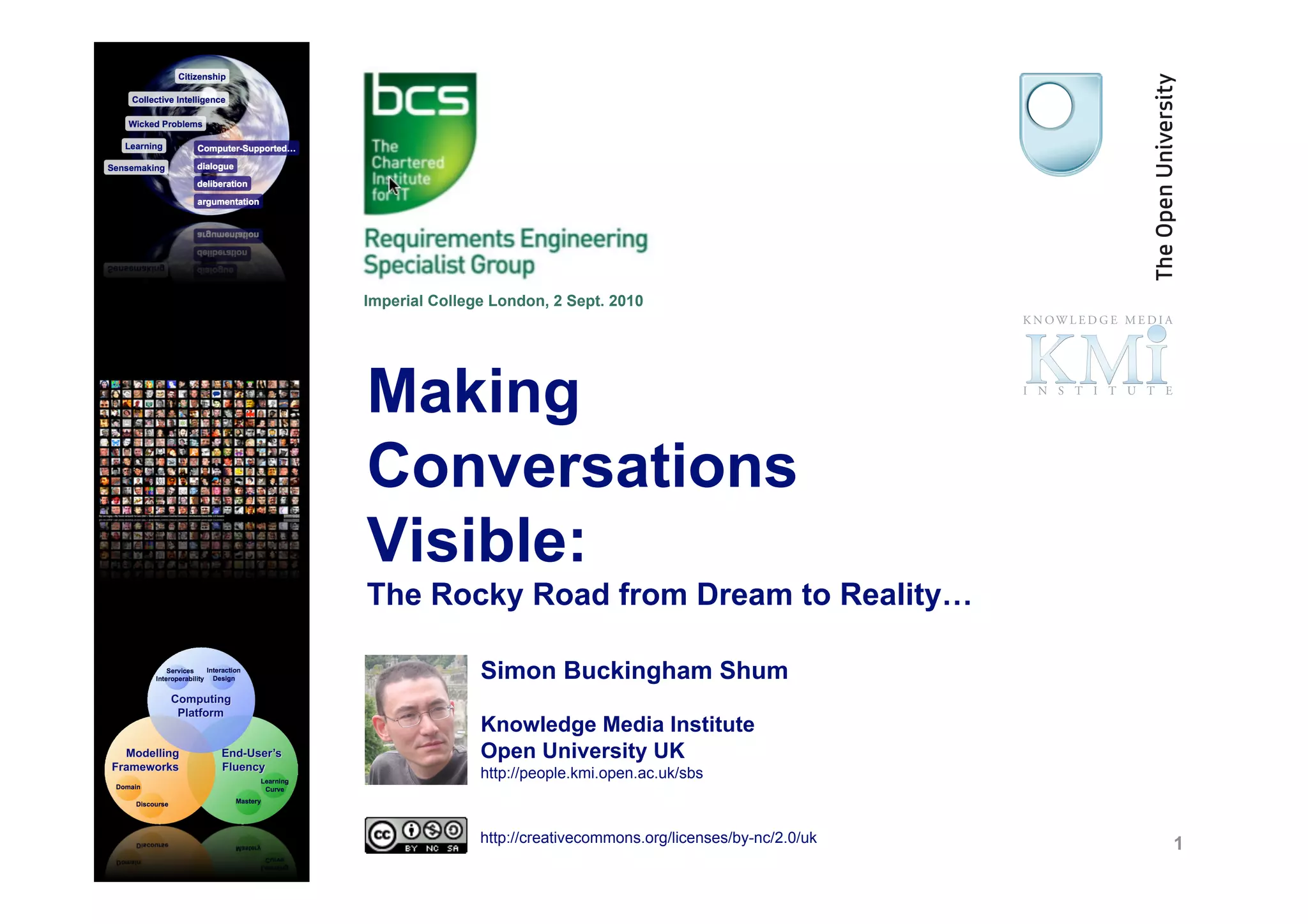
Making
Conversations
Visible:
The Rocky Road from Dream to Reality…

               Simon Buckingham Shum

               Knowledge Media Institute
               Open University UK
               http://people.kmi.open.ac.uk/sbs


               http://creativecommons.org/licenses/by-nc/2.0/uk   1
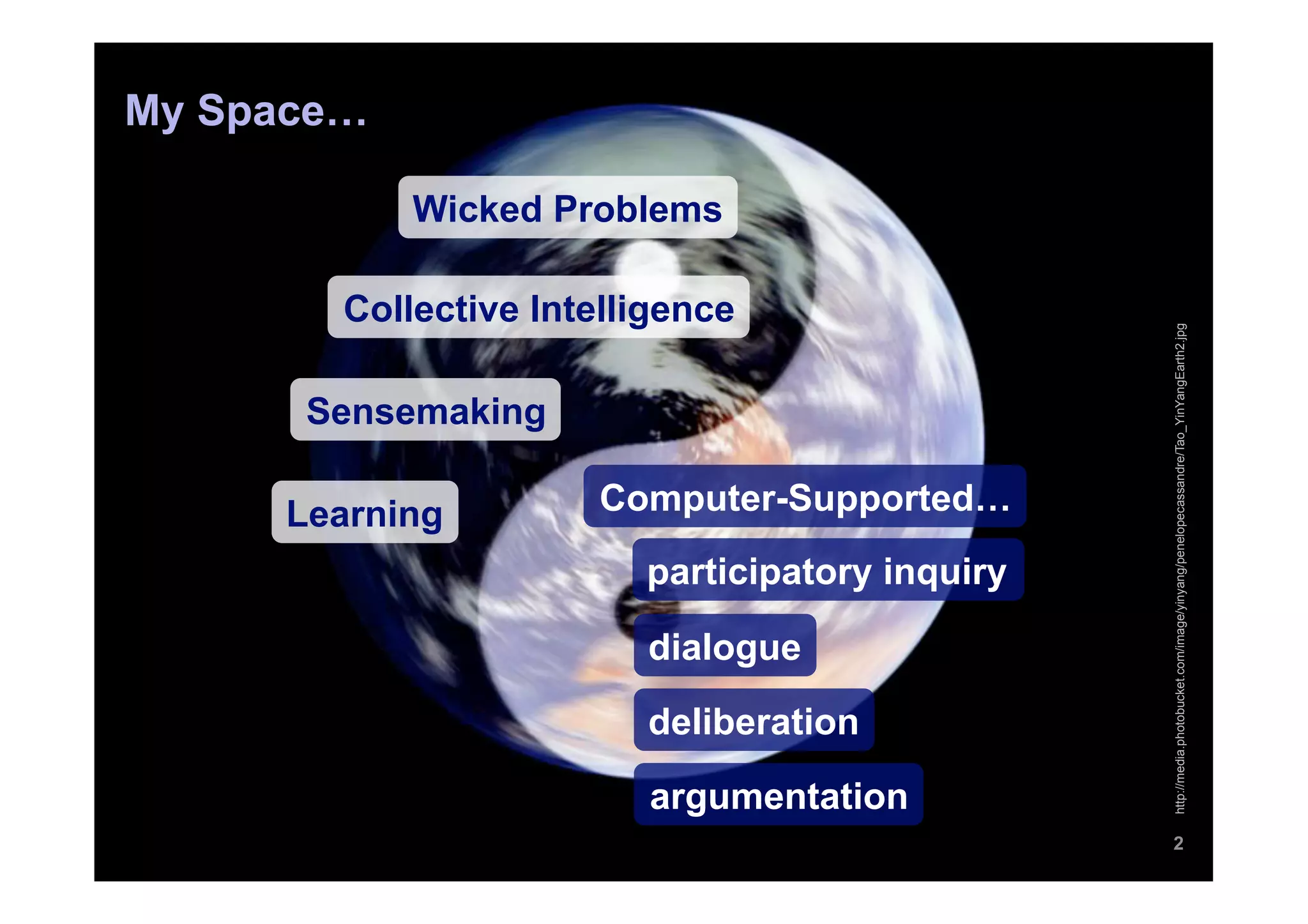
My Space…

            Wicked Problems

        Collective Intelligence


                                                 http://media.photobucket.com/image/yinyang/penelopecassandre/Tao_YinYangEarth2.jpg
      Sensemaking

     Learning          Computer-Supported…
                         participatory inquiry

                         dialogue

                         deliberation
                         argumentation
                                                    2
the journey

              3
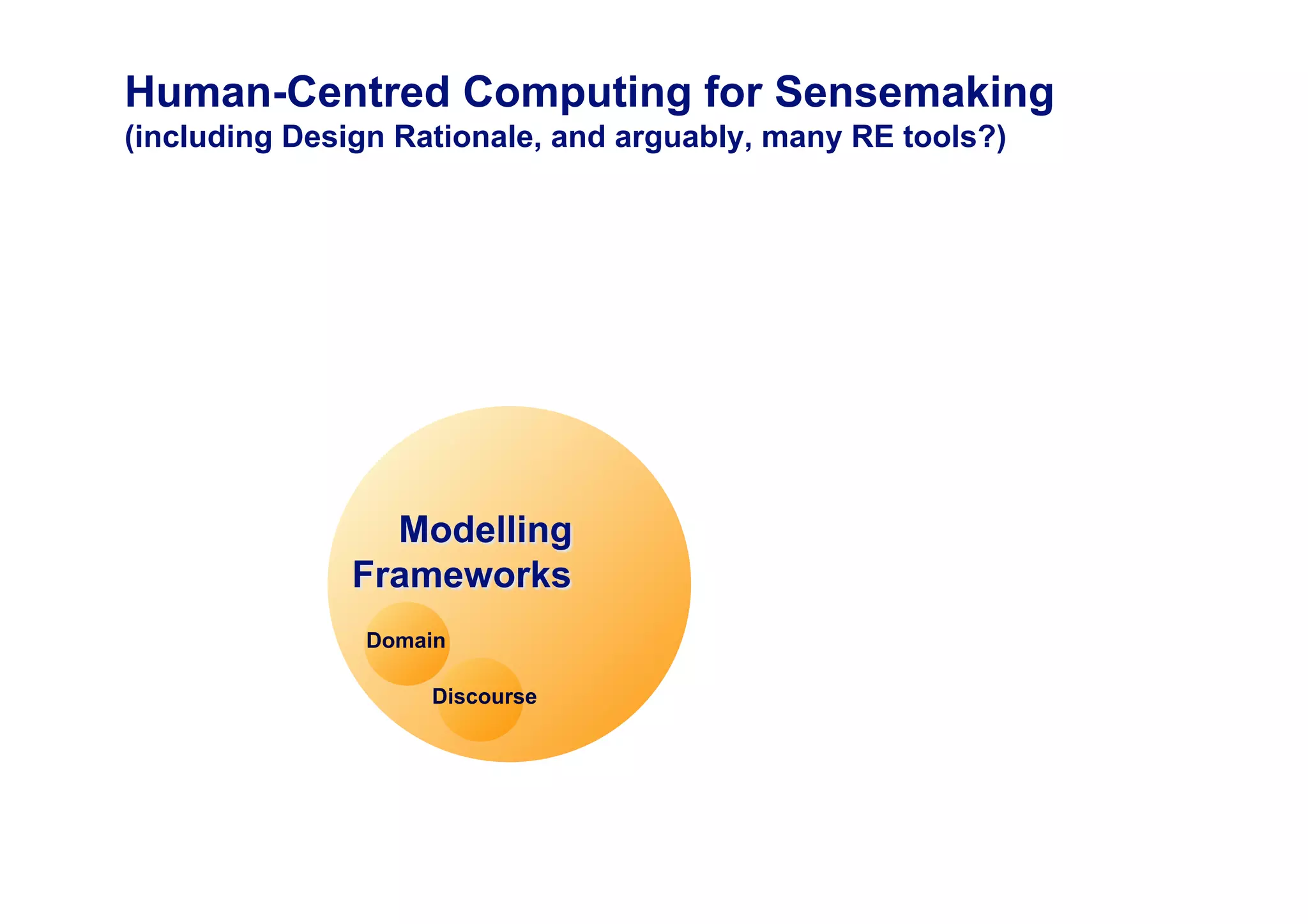
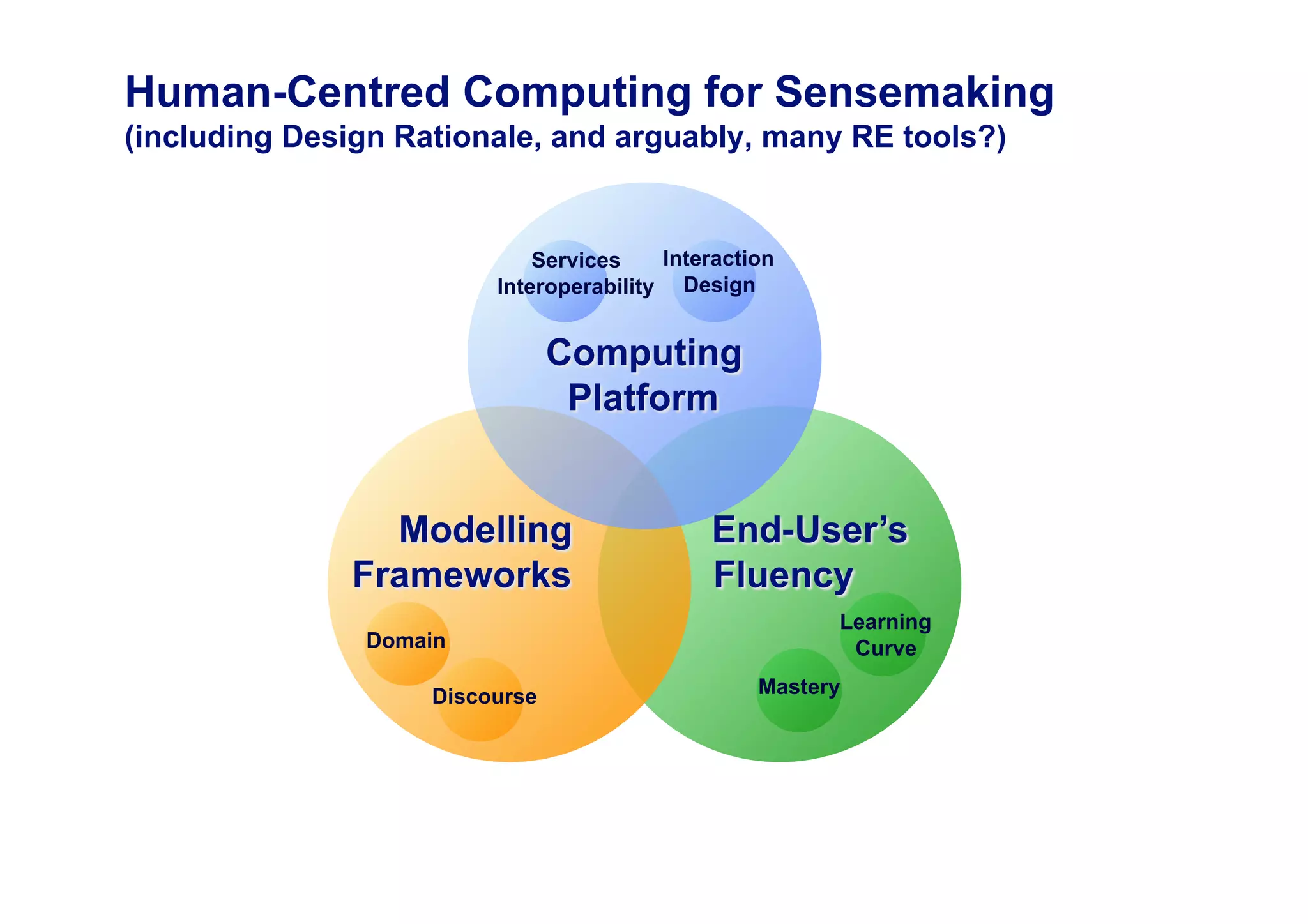
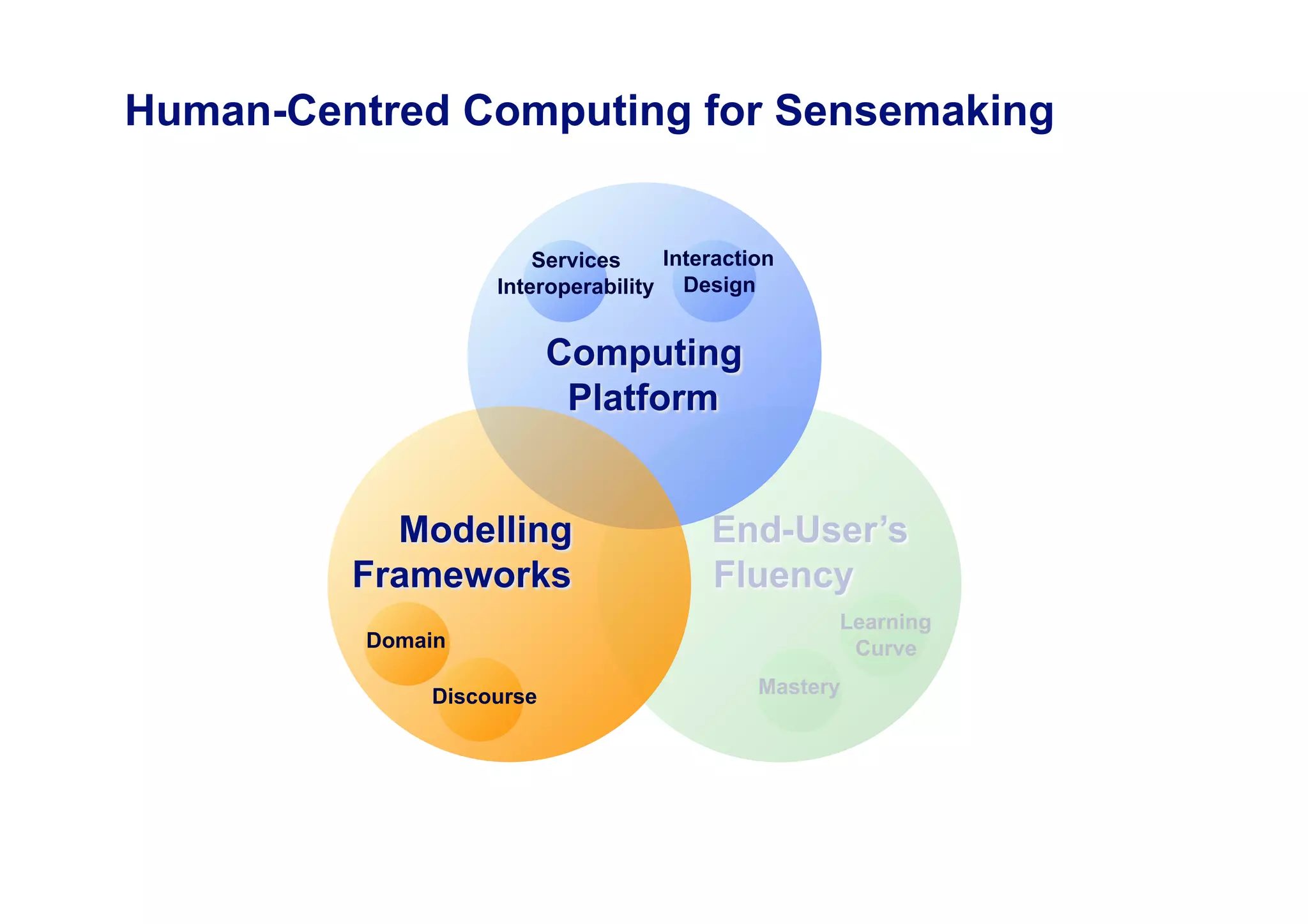
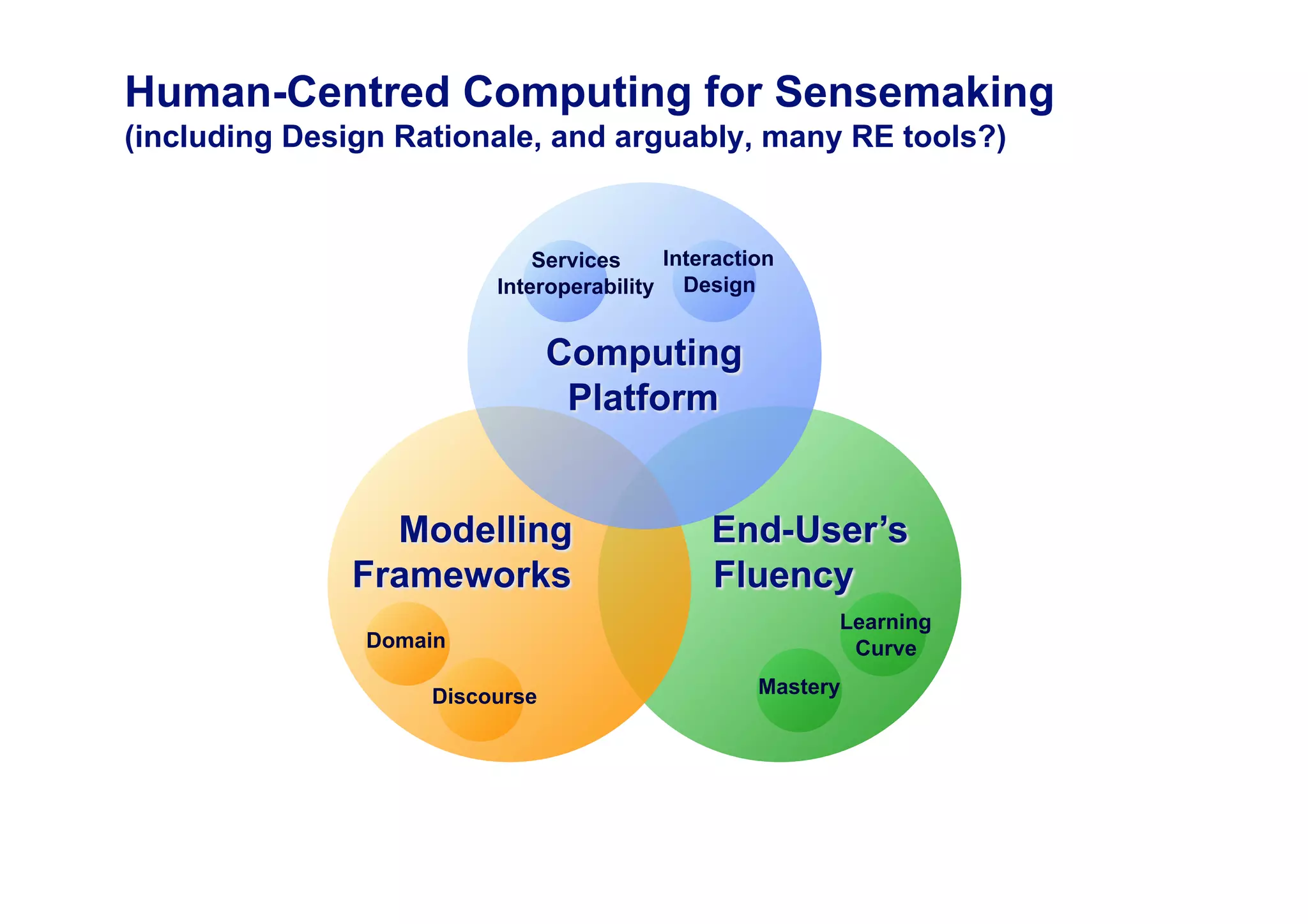
Human-Centred Computing for Sensemaking
(including Design Rationale, and arguably, many RE tools?)


               Domain

                    Discourse
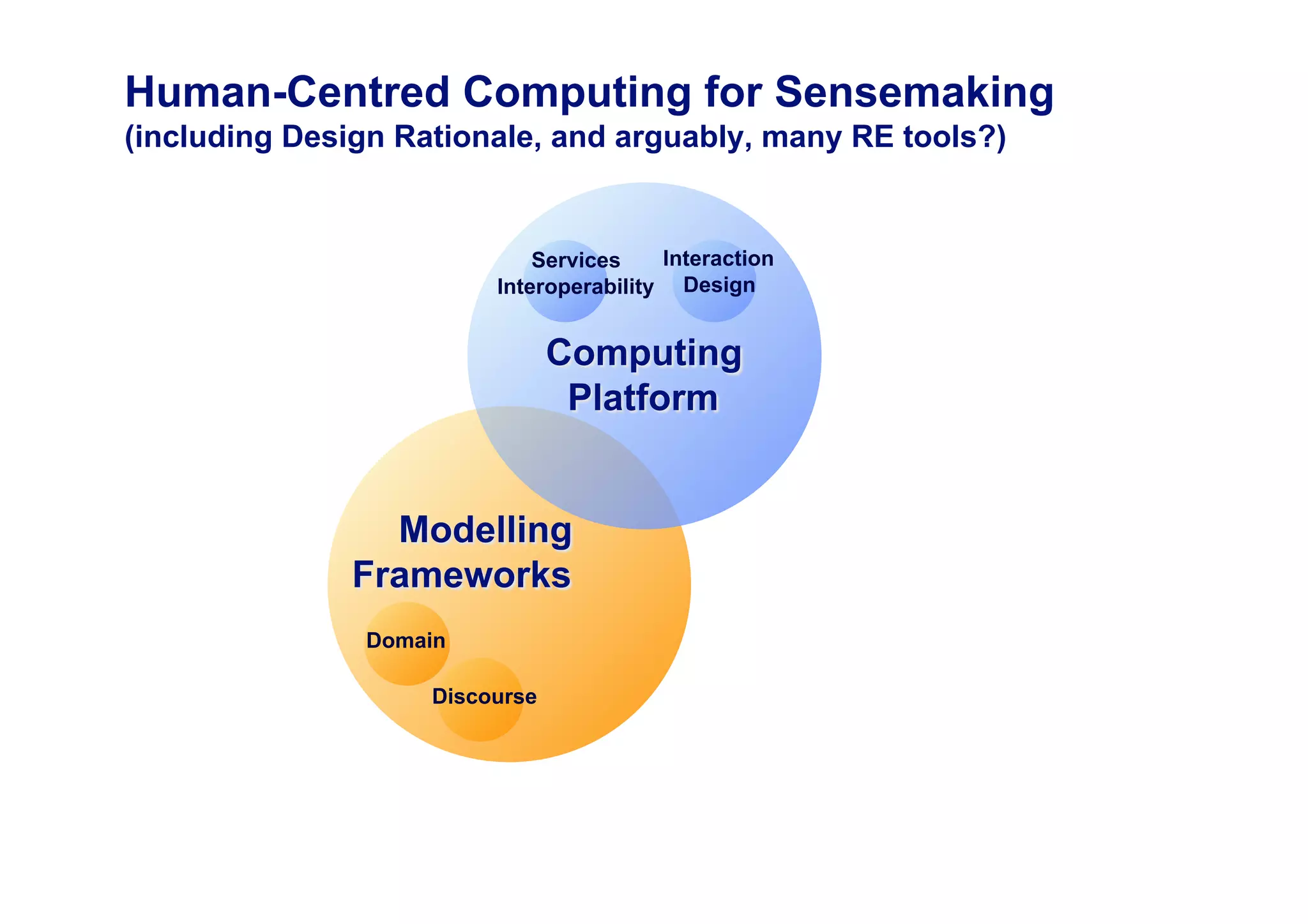
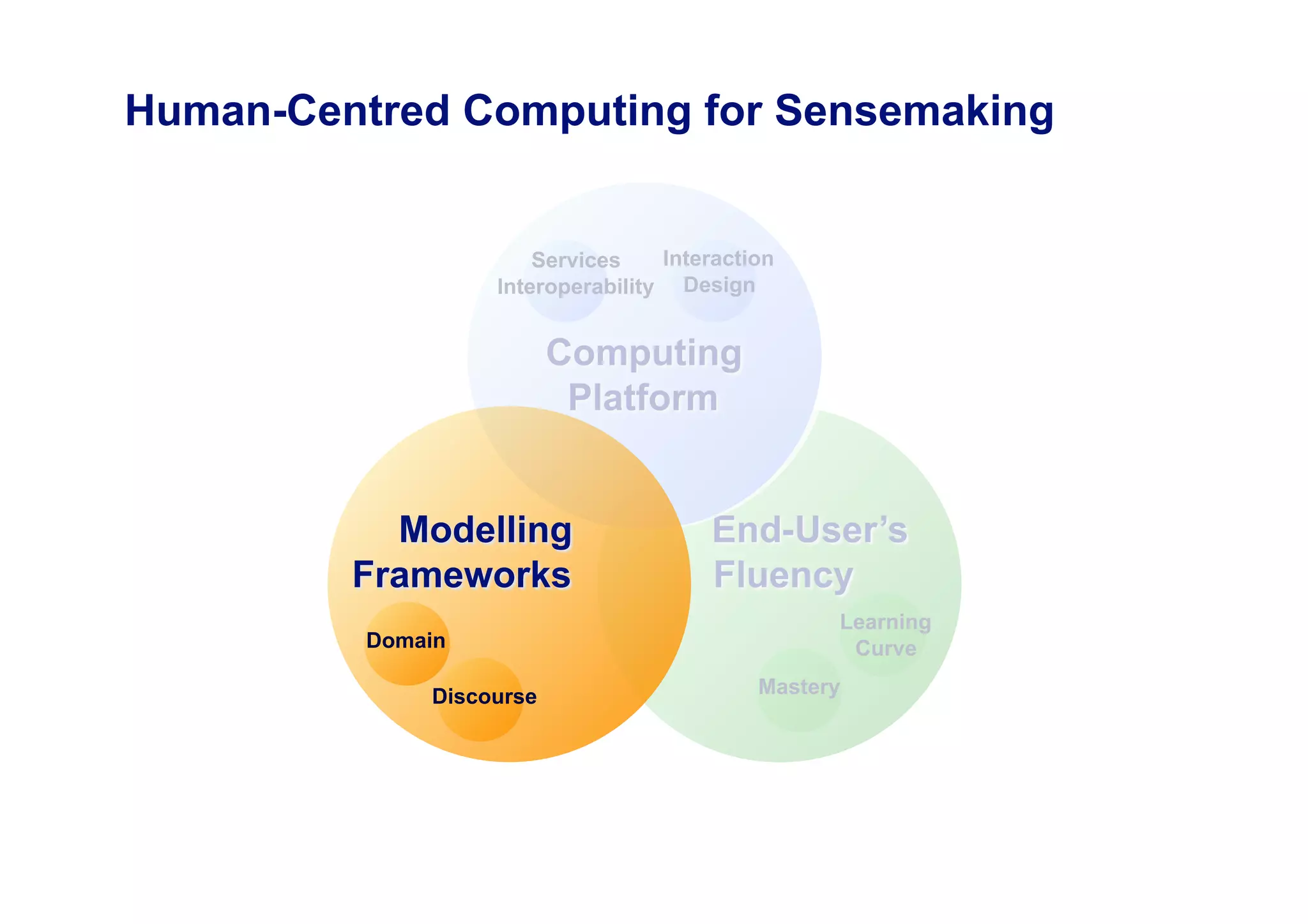
Human-Centred Computing for Sensemaking
(including Design Rationale, and arguably, many RE tools?)


                             Services    Interaction
                         Interoperability Design


               Domain

                    Discourse
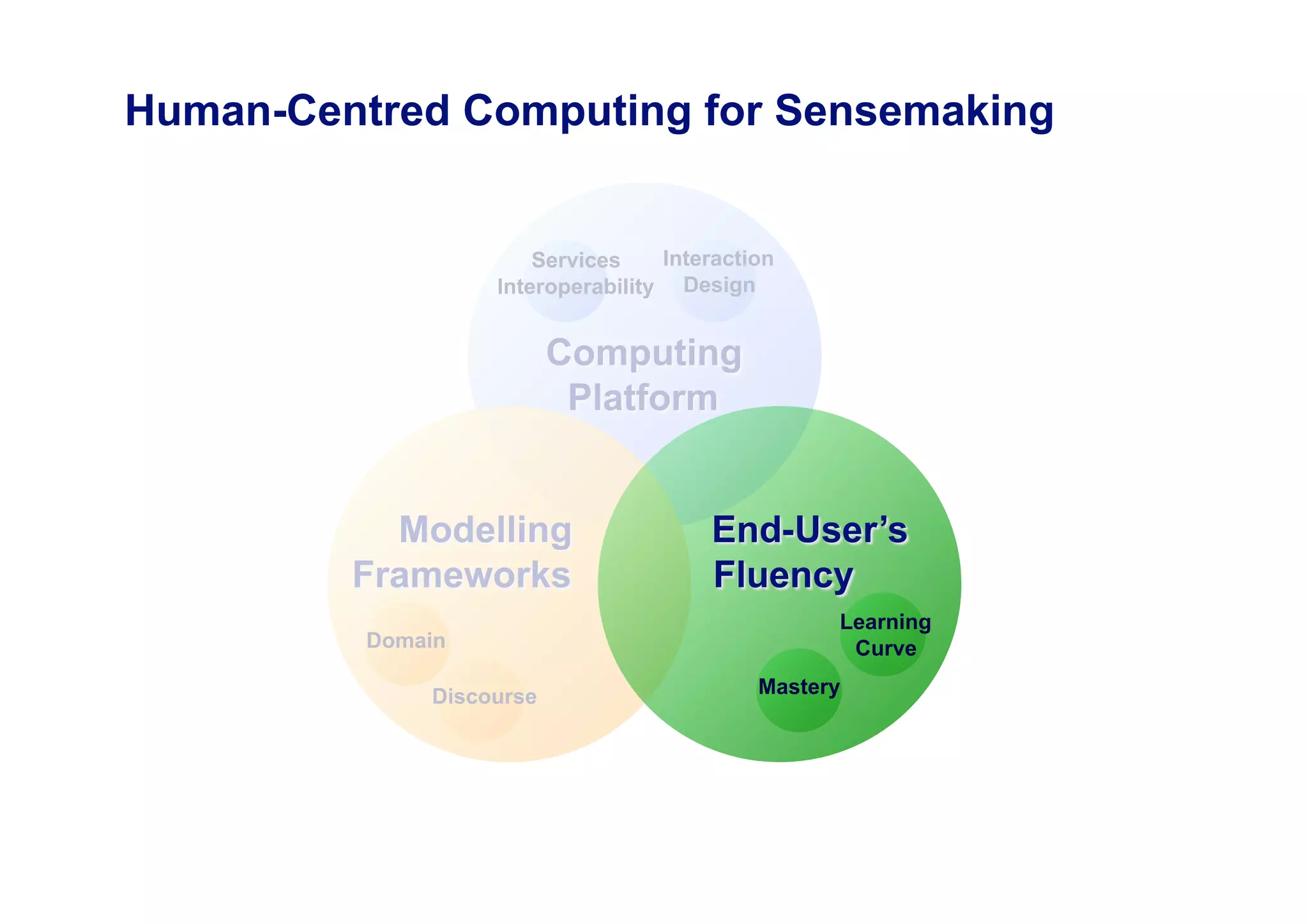
Human-Centred Computing for Sensemaking
(including Design Rationale, and arguably, many RE tools?)


                             Services    Interaction
                         Interoperability Design


                                                        Learning
               Domain                                    Curve

                    Discourse                     Mastery
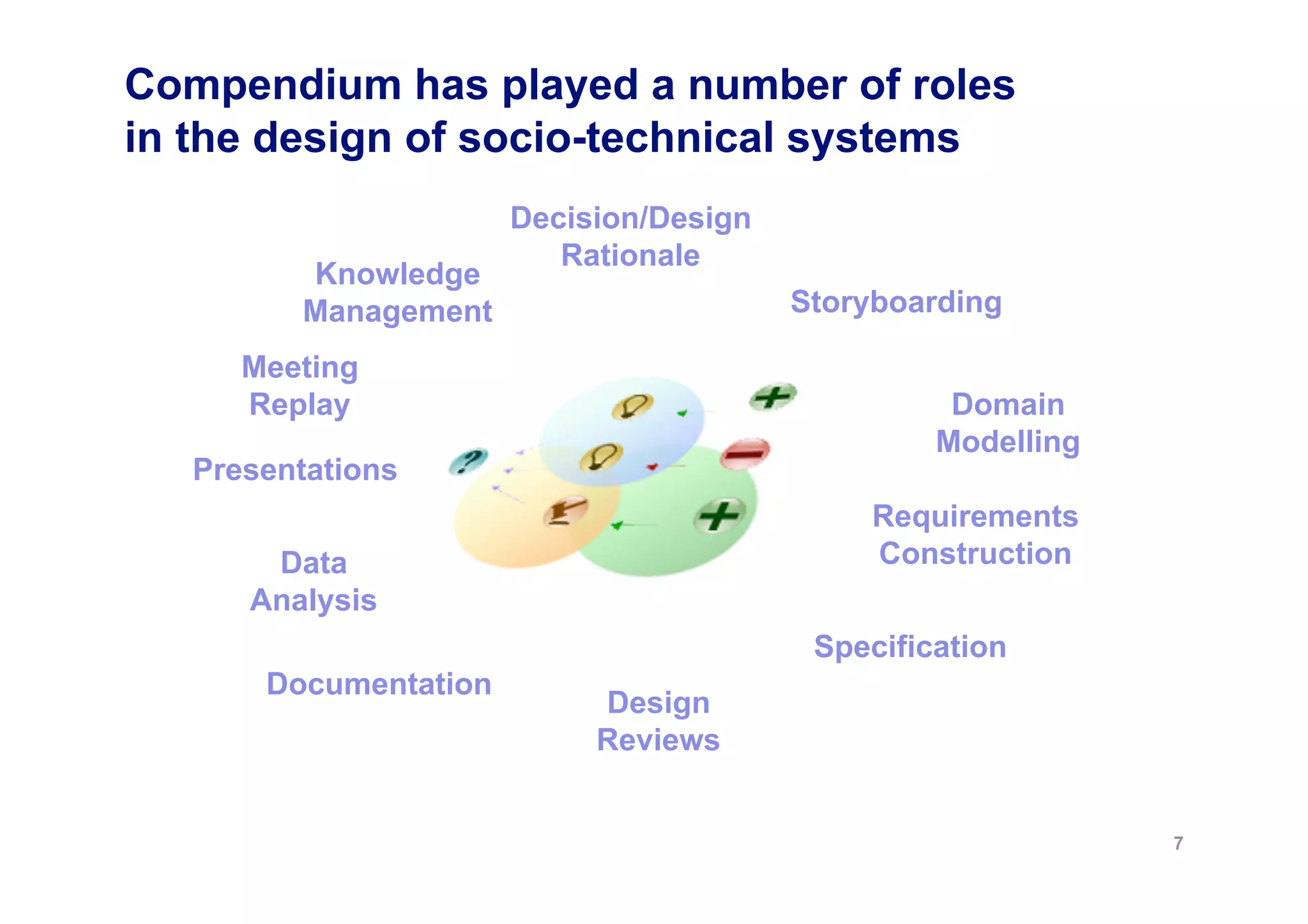
Compendium has played a number of roles
in the design of socio-technical systems
                       Decision/Design
                          Rationale
         Knowledge
         Management                      Storyboarding

      Meeting
      Replay                                       Domain
                                                  Modelling
   Presentations
                                              Requirements
       Data                                   Construction
      Analysis
                                          Specification
       Documentation
                            Design
                            Reviews


                                                              7
Human-Centred Computing for Sensemaking


                       Services    Interaction
                   Interoperability Design


                                                  Learning
          Domain                                   Curve

              Discourse                     Mastery
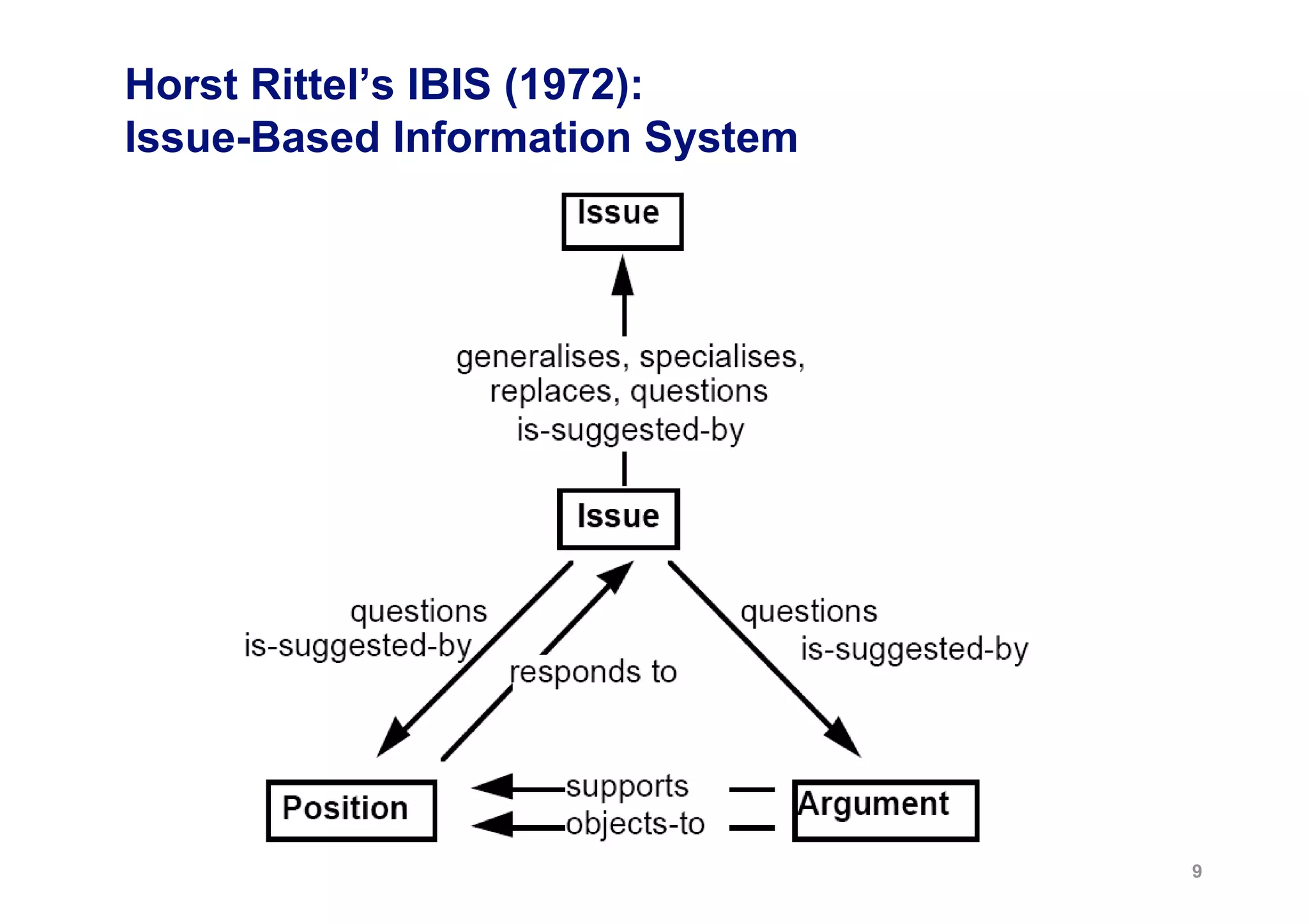
Horst Rittel’s IBIS (1972):
Issue-Based Information System


                                 9
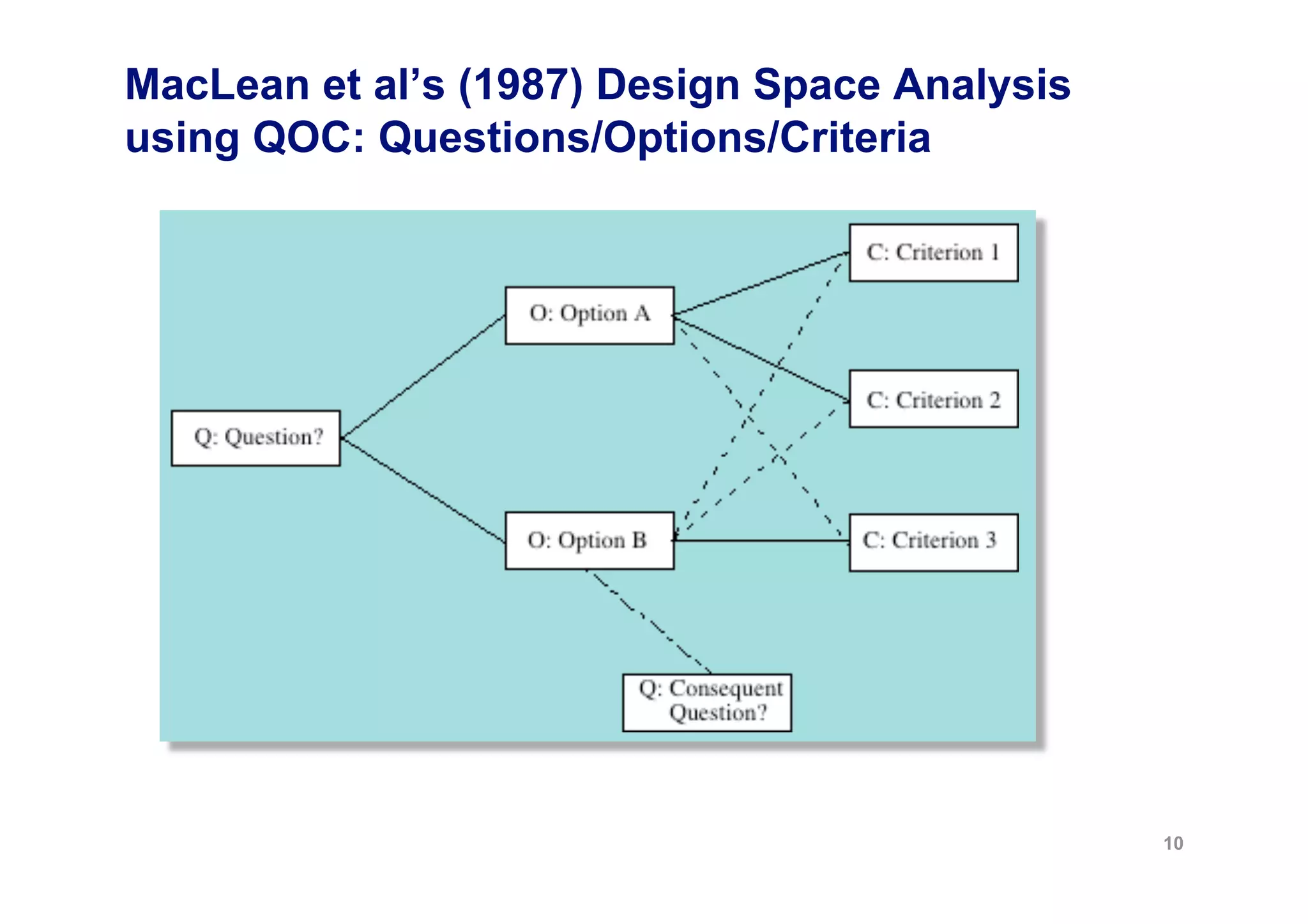
MacLean et al’s (1987) Design Space Analysis
using QOC: Questions/Options/Criteria


                                               10
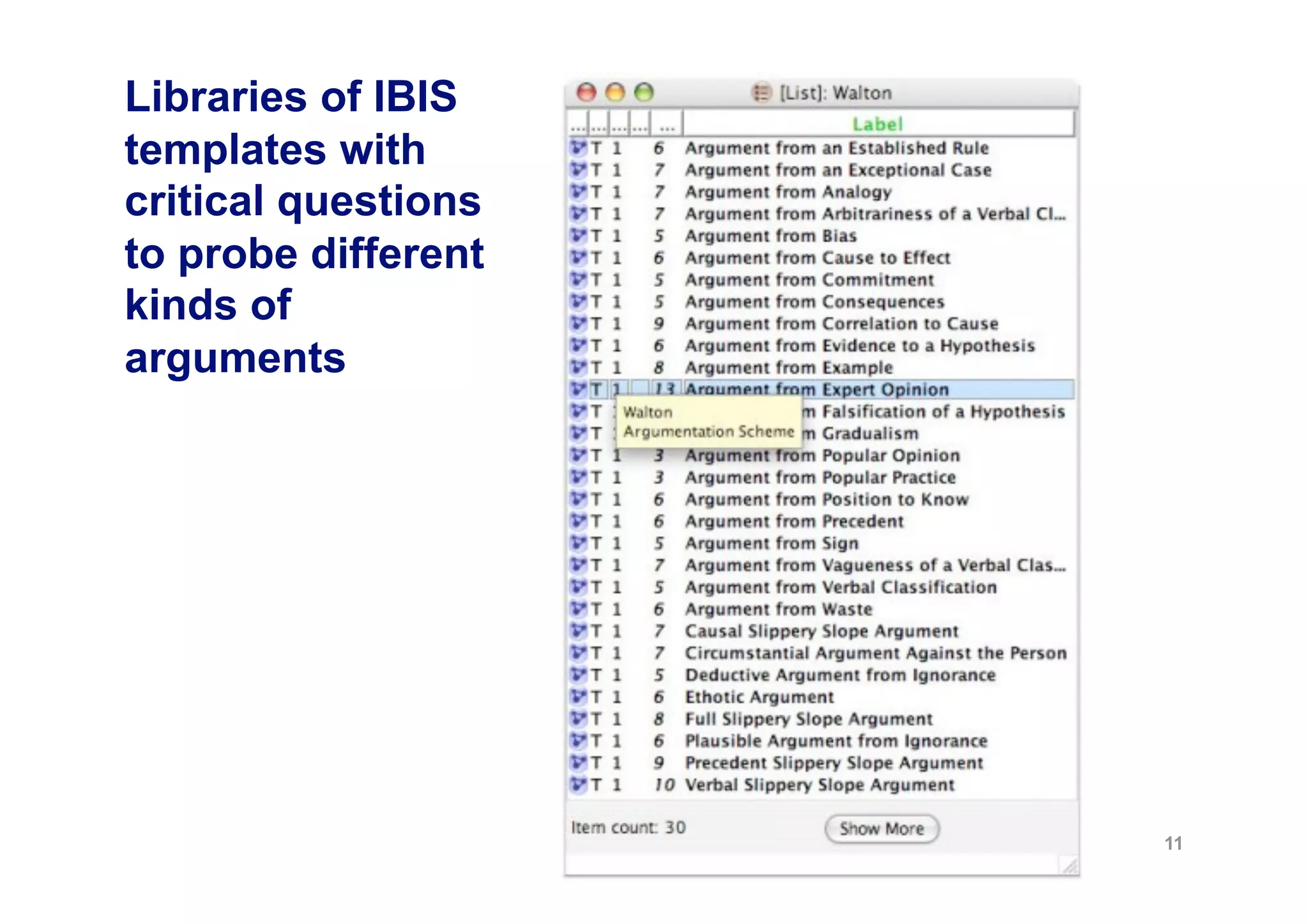
Libraries of IBIS
templates with
critical questions
to probe different
kinds of
arguments


                     11
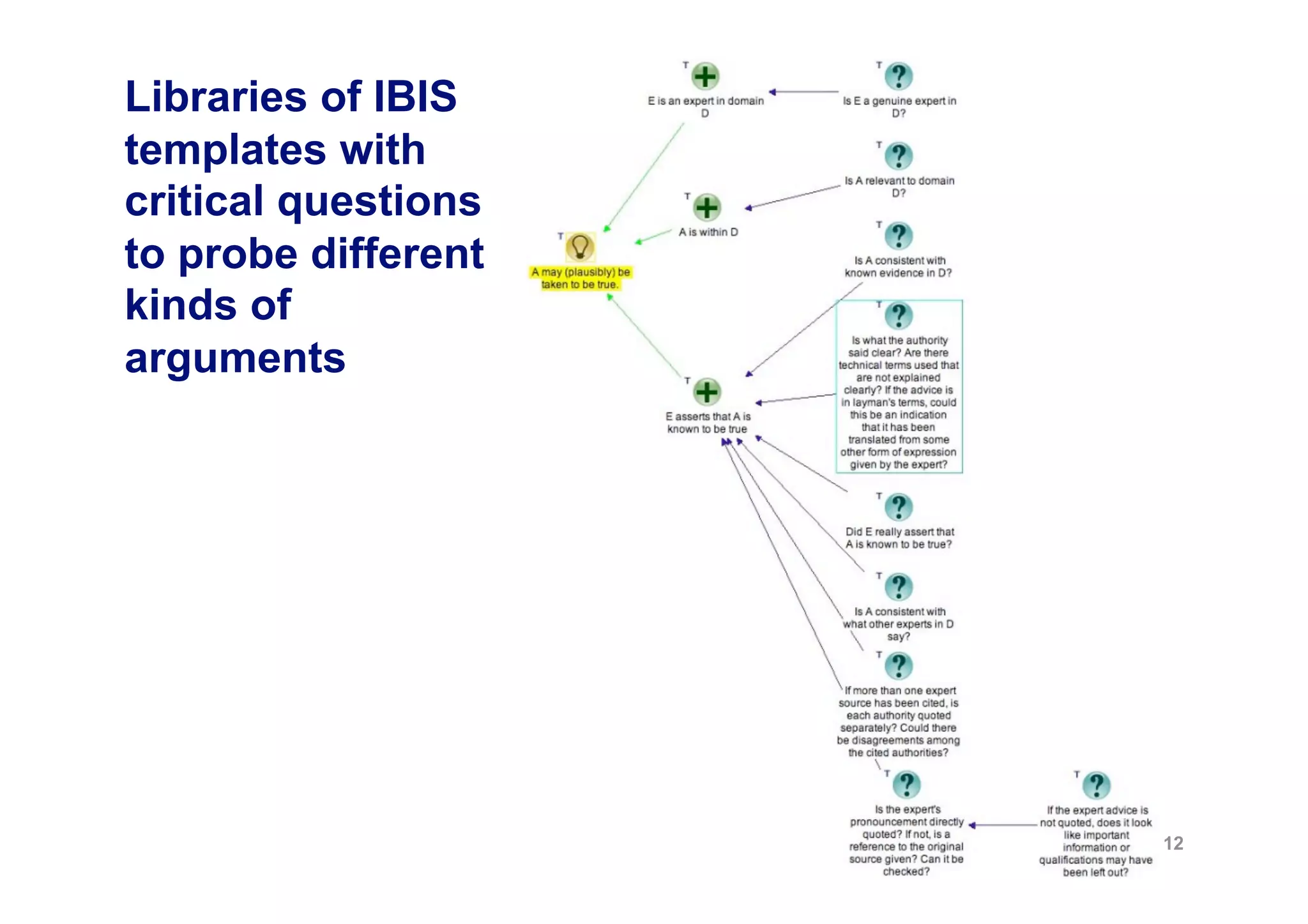
Libraries of IBIS
templates with
critical questions
to probe different
kinds of
arguments


                     12
Human-Centred Computing for Sensemaking


                       Services    Interaction
                   Interoperability Design


                                                  Learning
          Domain                                   Curve

              Discourse                     Mastery
Compendium
             “it’s like Excel, but for knowledge”

  http://compendium.open.ac.uk/institute


   Originally motivated by the requirement at NYNEX
Science & Technology, for a tool capable of integrating
formal organisational/system modelling with qualitative,
   narrative accounts from workplace ethnographers

                                                           14
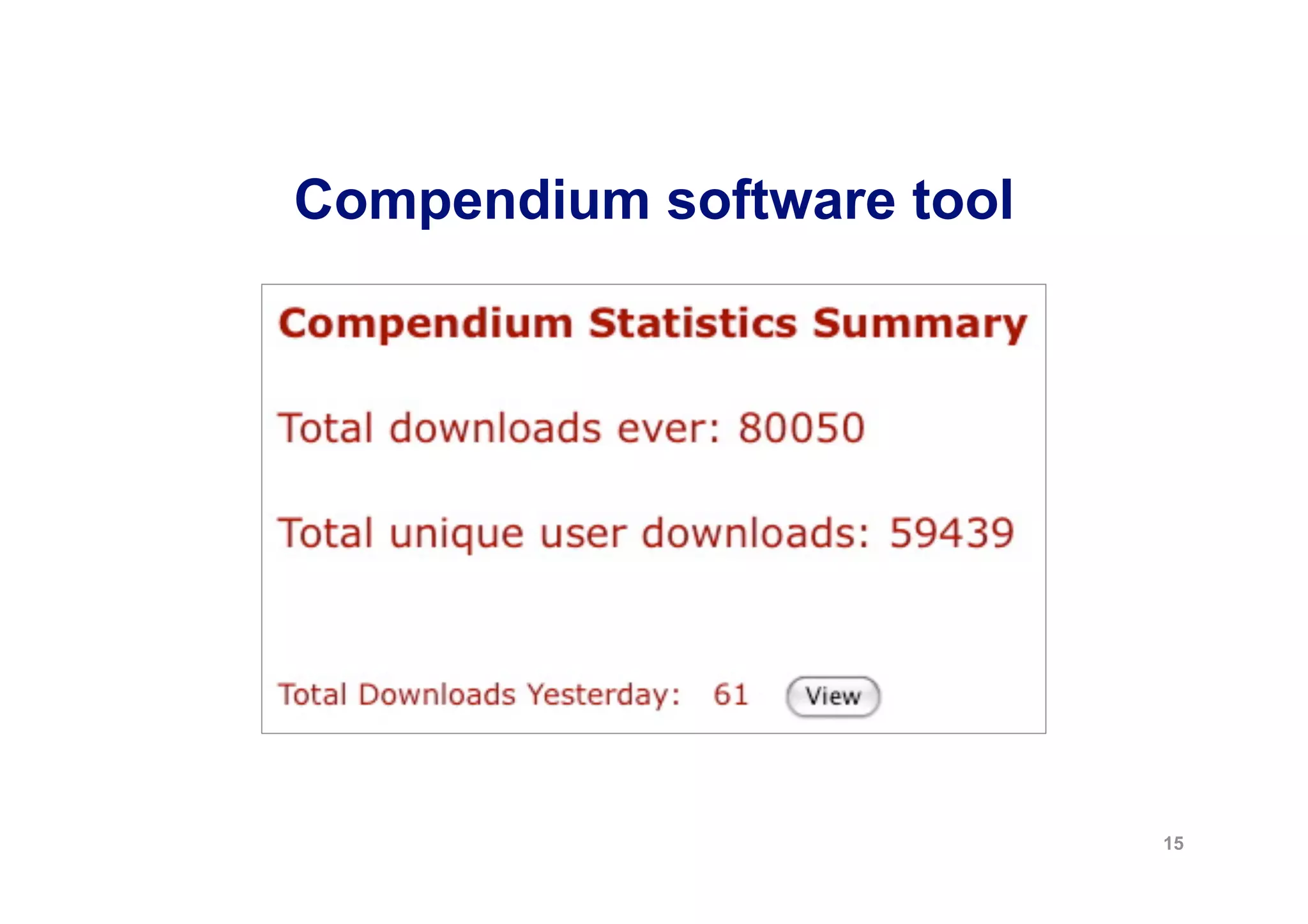
Compendium software tool


                           15
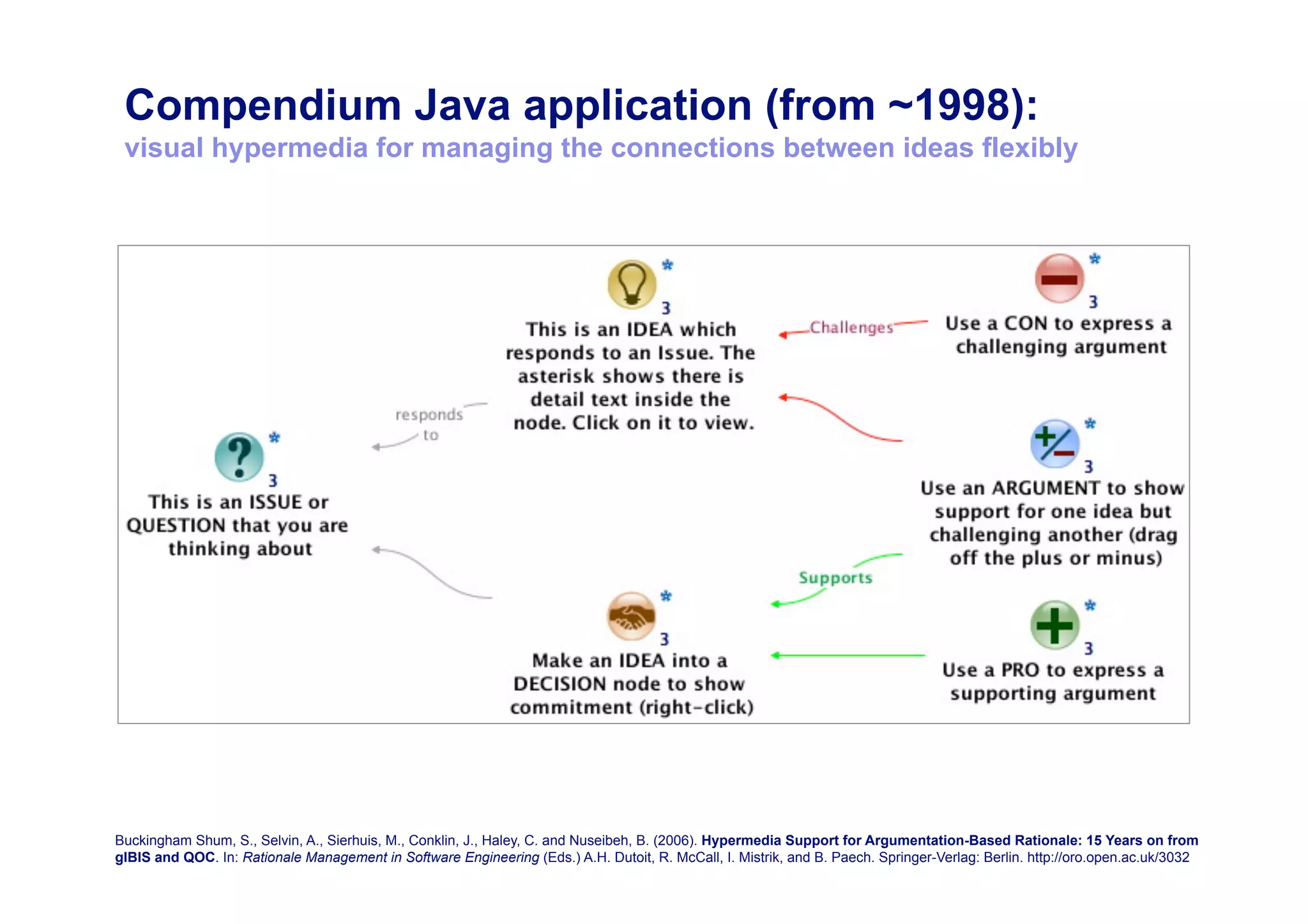
Compendium Java application (from ~1998):
 visual hypermedia for managing the connections between ideas flexibly


Buckingham Shum, S., Selvin, A., Sierhuis, M., Conklin, J., Haley, C. and Nuseibeh, B. (2006). Hypermedia Support for Argumentation-Based Rationale: 15 Years on16       from
gIBIS and QOC. In: Rationale Management in Software Engineering (Eds.) A.H. Dutoit, R. McCall, I. Mistrik, and B. Paech. Springer-Verlag: Berlin. http://oro.open.ac.uk/3032
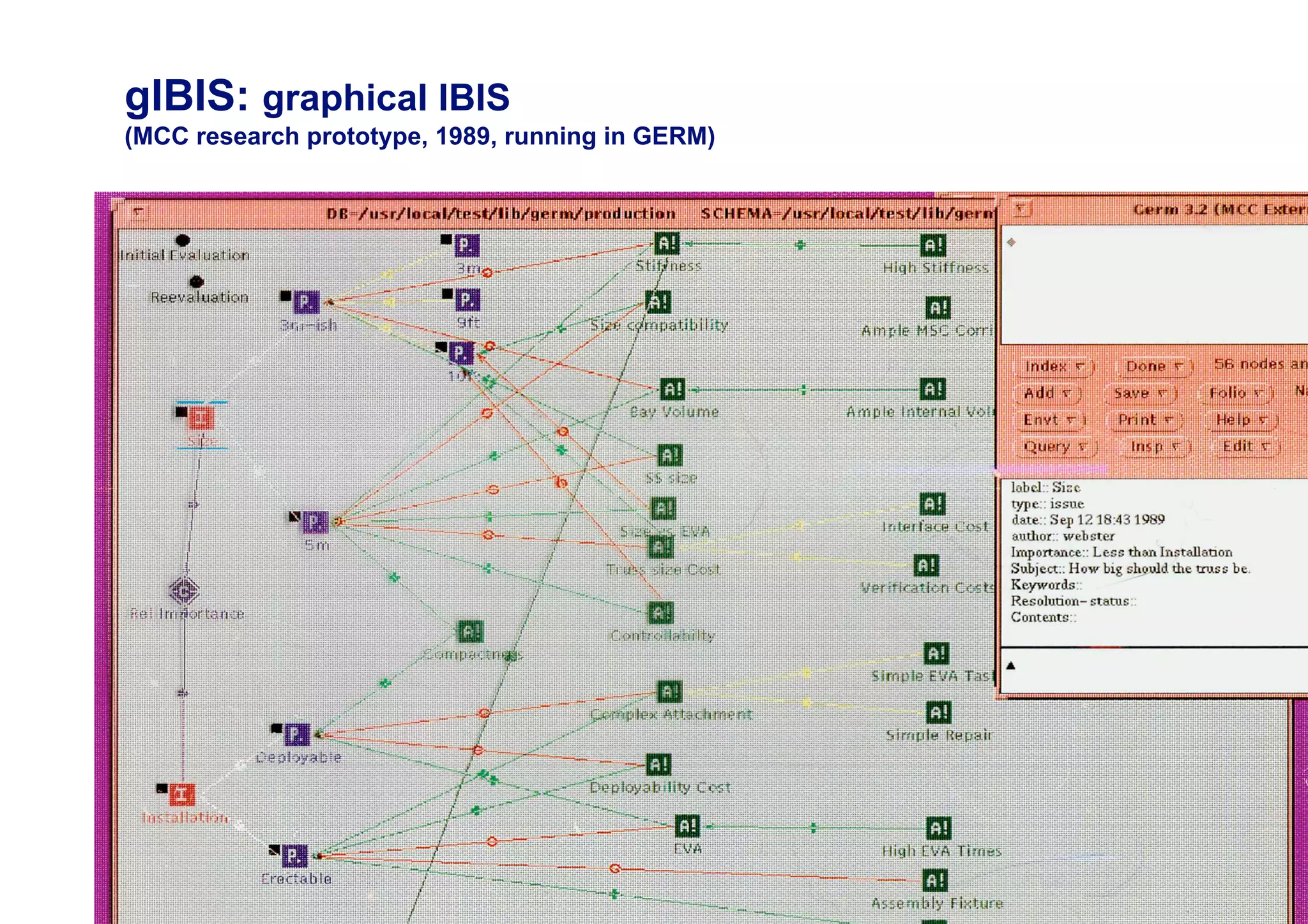
gIBIS: graphical IBIS
(MCC research prototype, 1989, running in GERM)


                                                  17
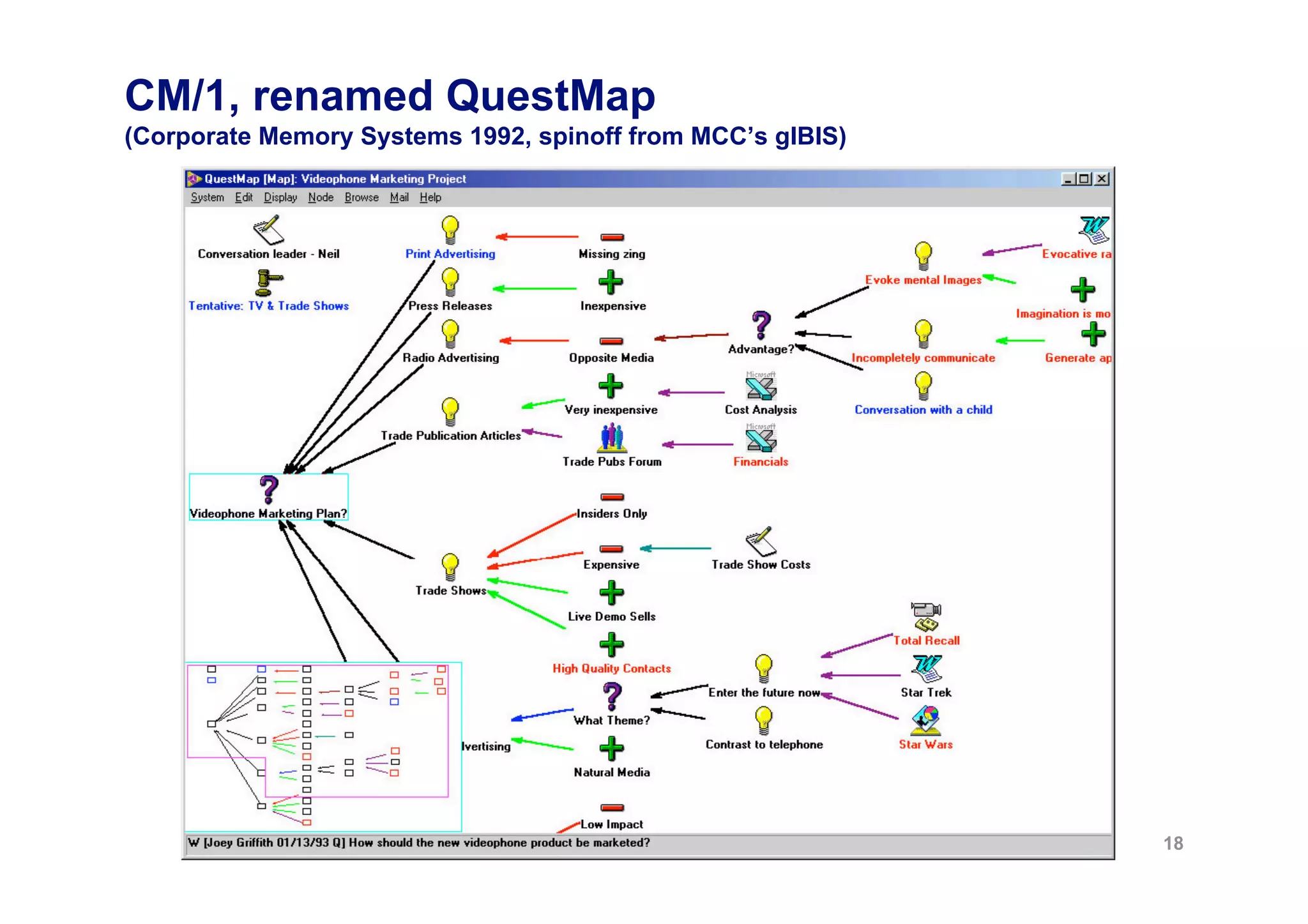
CM/1, renamed QuestMap
(Corporate Memory Systems 1992, spinoff from MCC’s gIBIS)


                                                            18
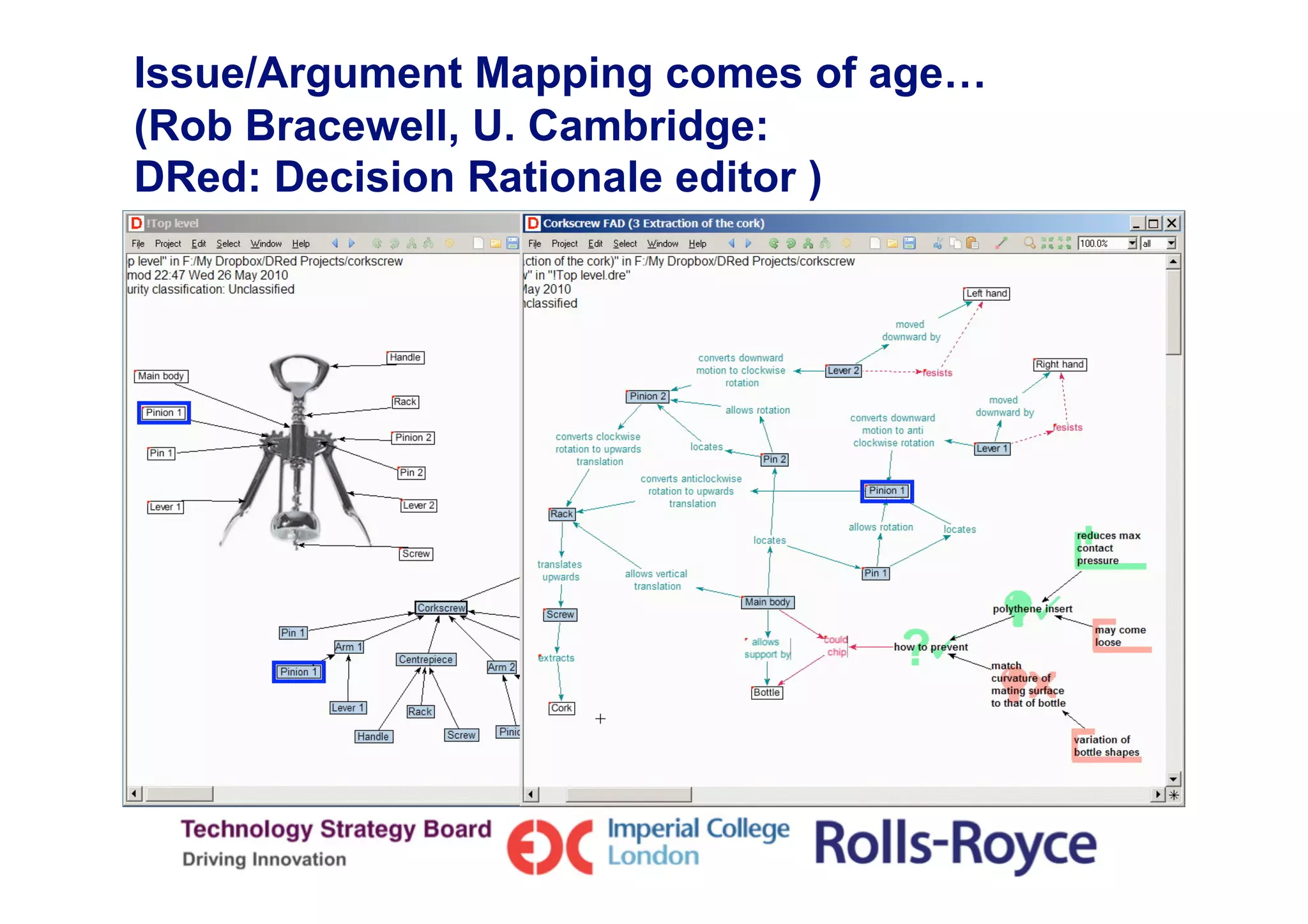
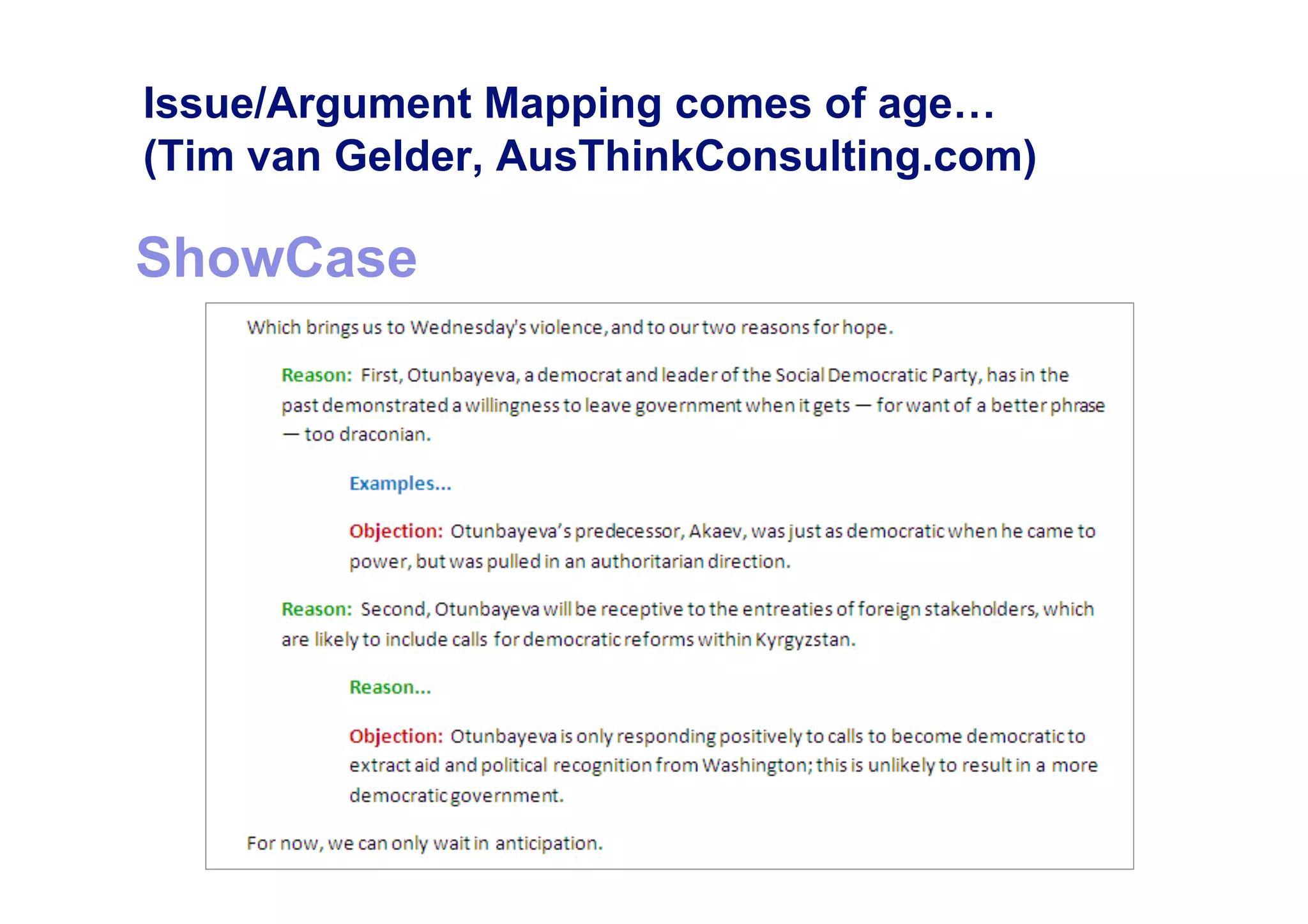
Issue/Argument Mapping comes of age…
(Rob Bracewell, U. Cambridge:
DRed: Decision Rationale editor )
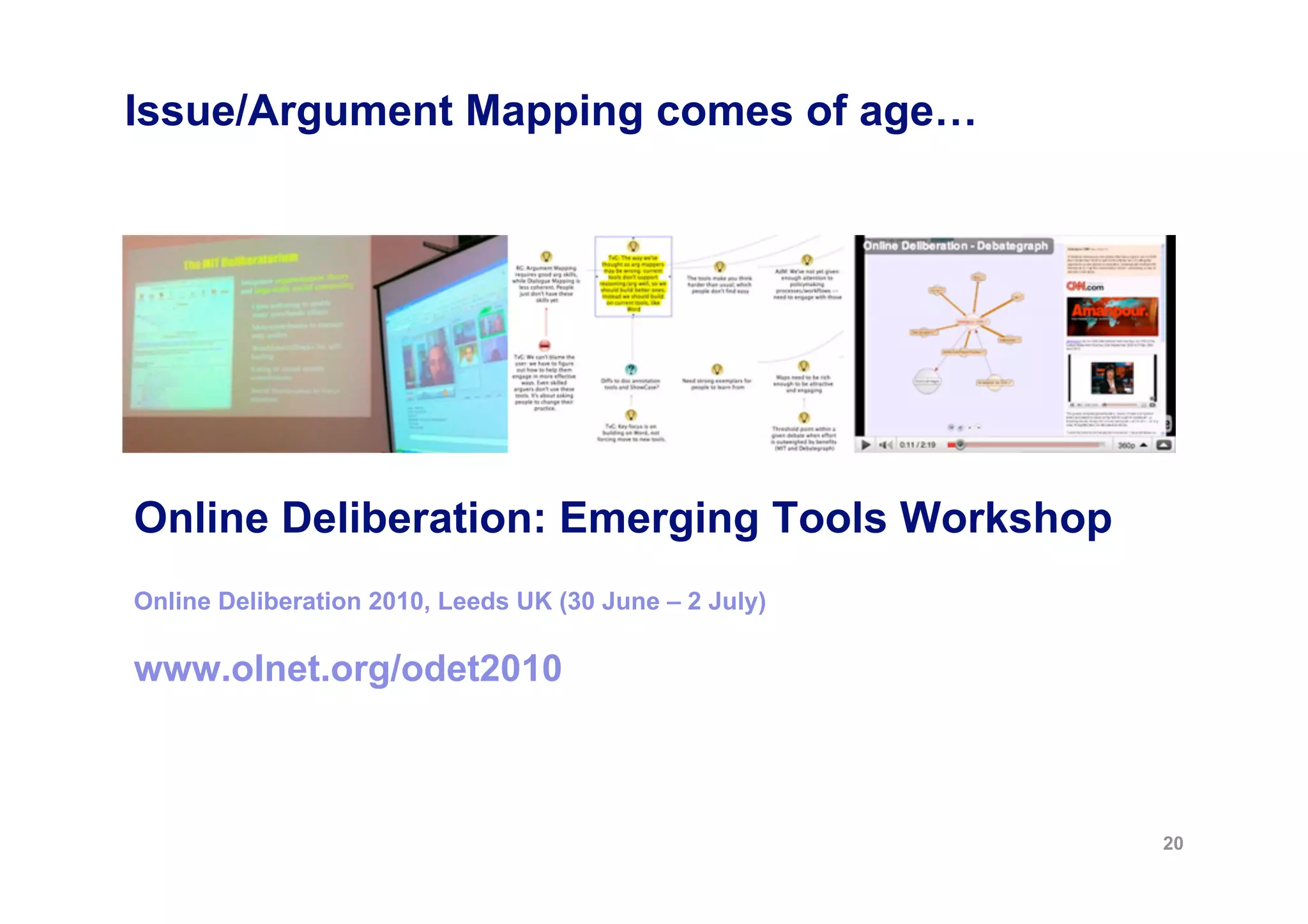
Issue/Argument Mapping comes of age…


Online Deliberation: Emerging Tools Workshop
Online Deliberation 2010, Leeds UK (30 June – 2 July)

www.olnet.org/odet2010


                                                        20
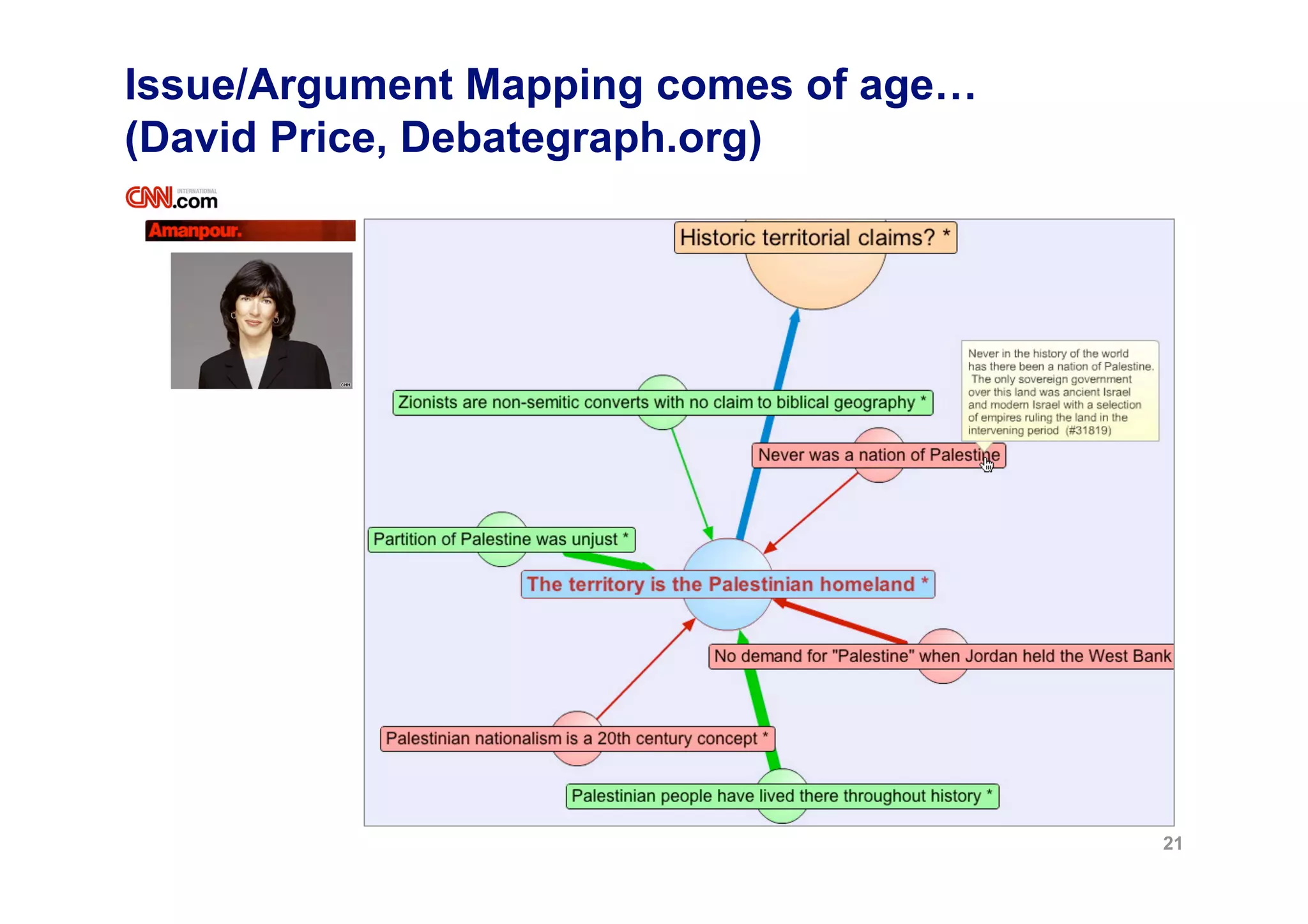
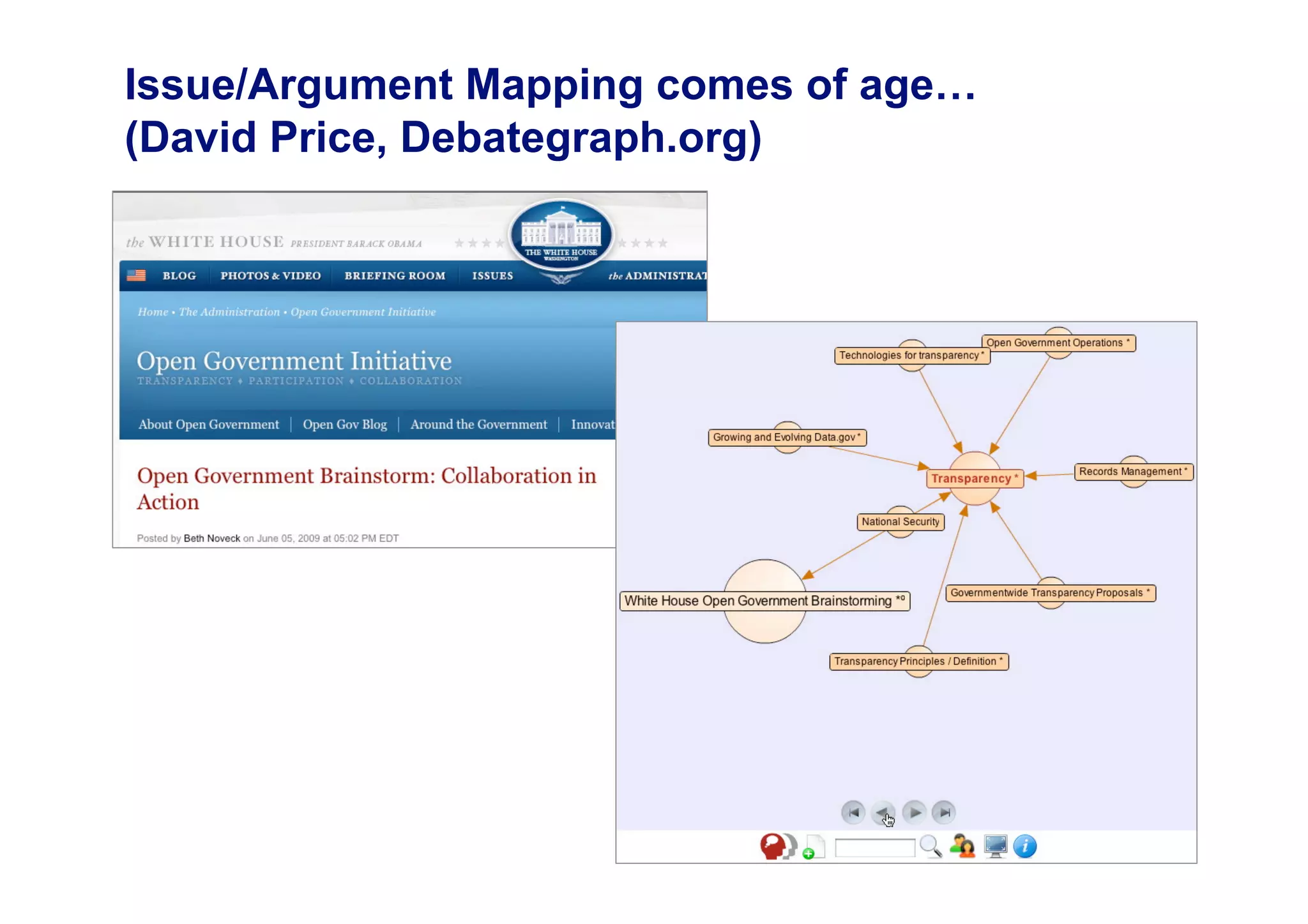
Issue/Argument Mapping comes of age…
(David Price, Debategraph.org)


                                       21
Issue/Argument Mapping comes of age…
(David Price, Debategraph.org)


                                       22
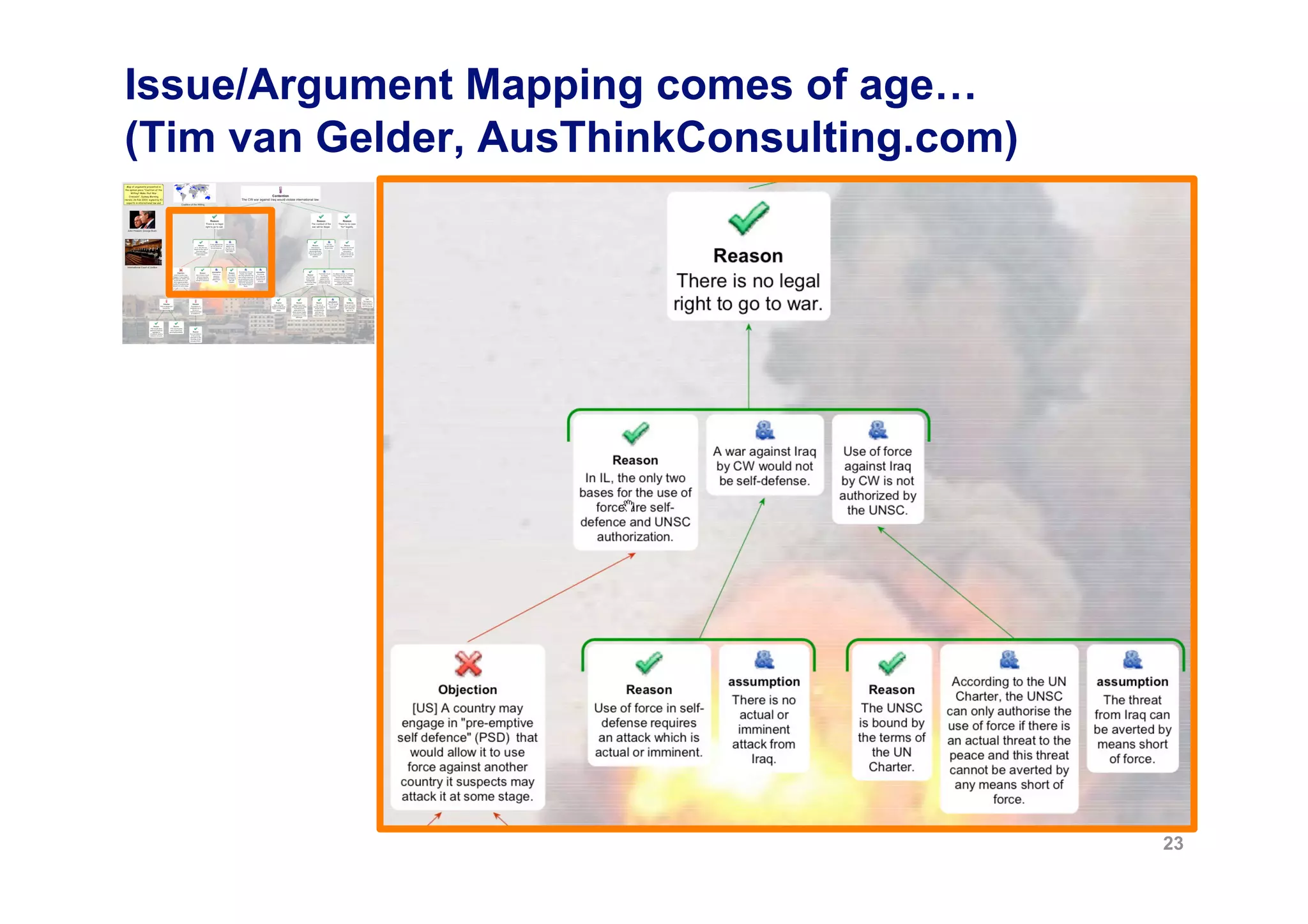
Issue/Argument Mapping comes of age…
(Tim van Gelder, AusThinkConsulting.com)


                                           23
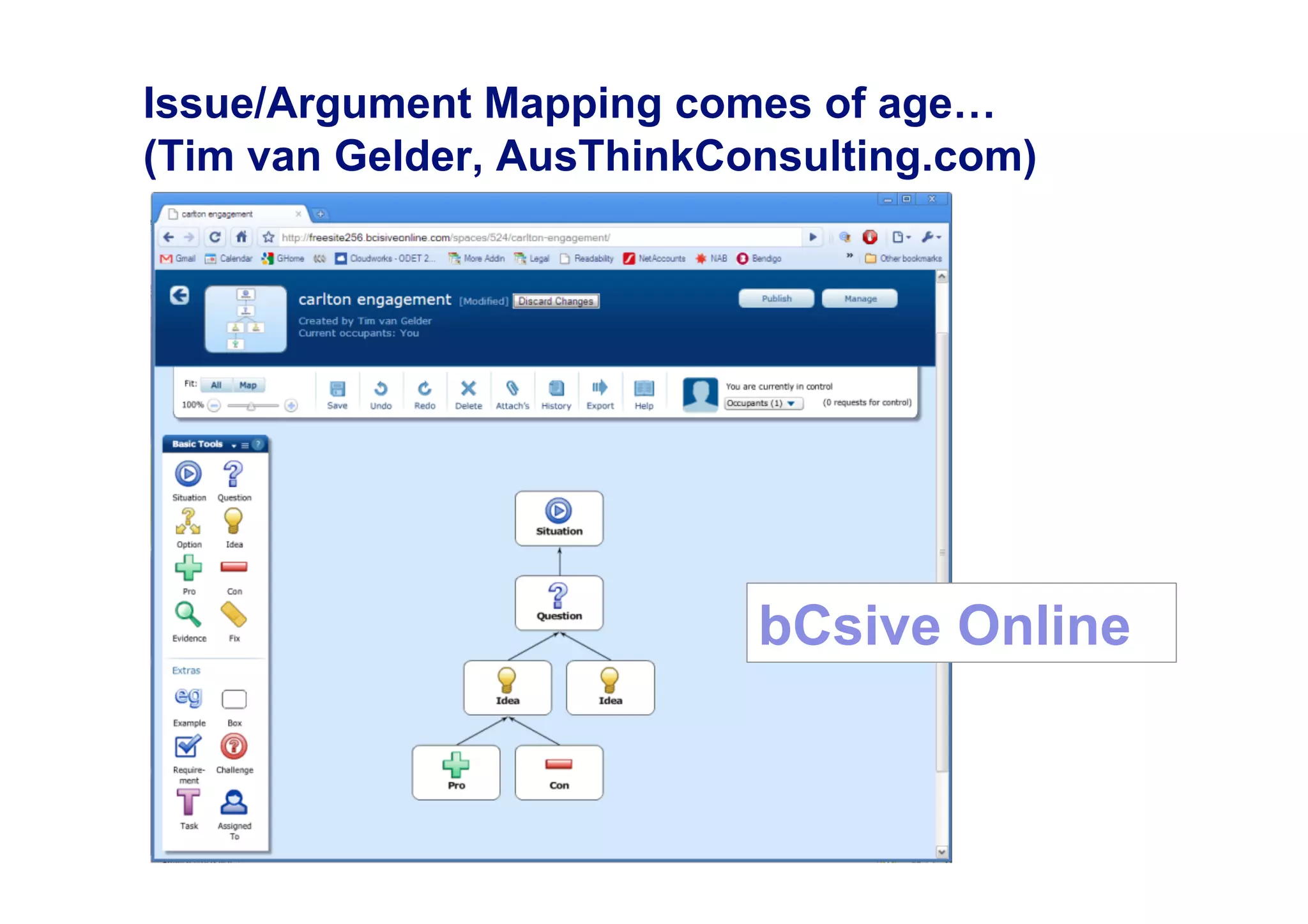
Issue/Argument Mapping comes of age…
(Tim van Gelder, AusThinkConsulting.com)


                           bCsive Online
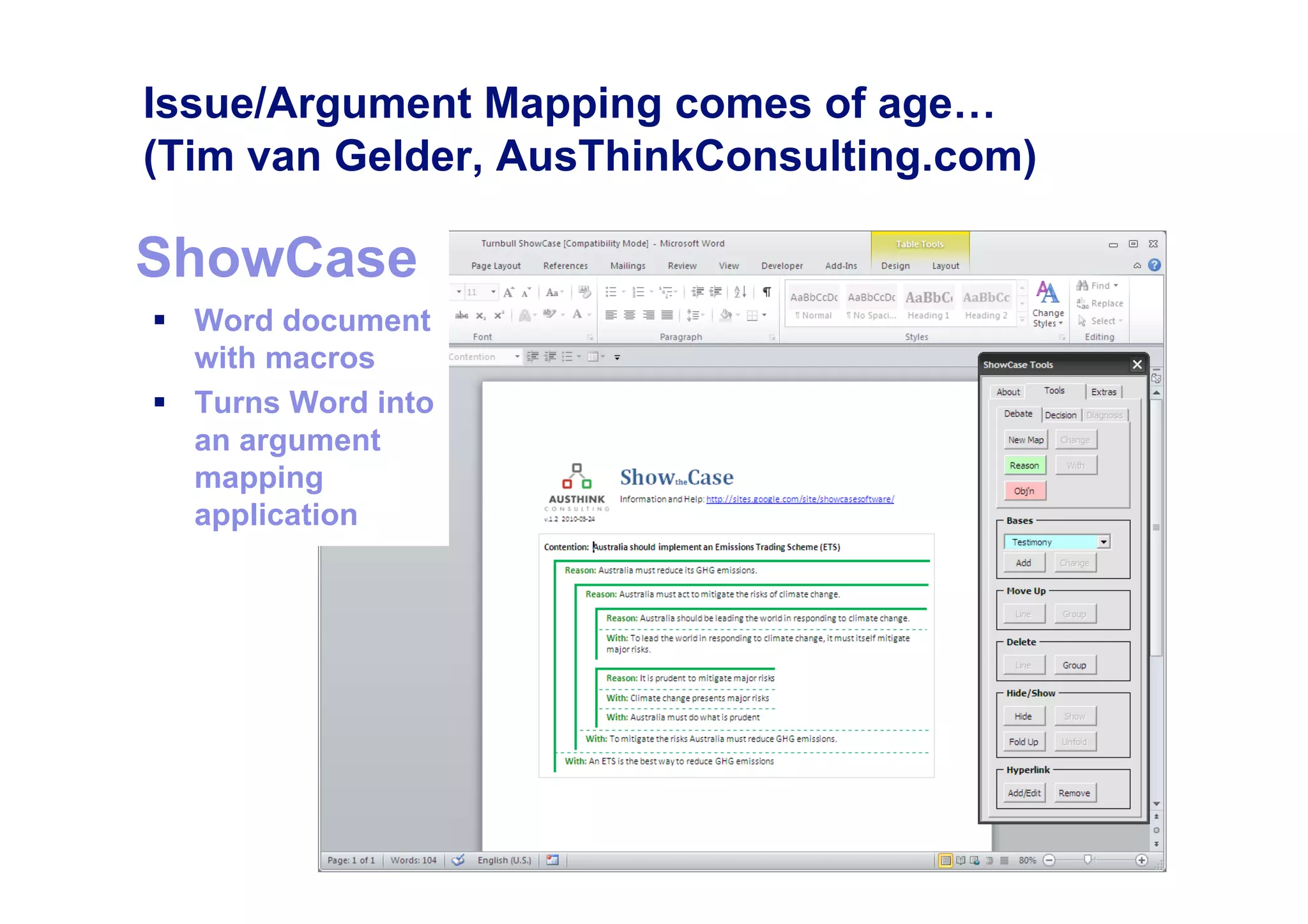
Issue/Argument Mapping comes of age…
(Tim van Gelder, AusThinkConsulting.com)

ShowCase
  Word document
   with macros
  Turns Word into
   an argument
   mapping
   application
Issue/Argument Mapping comes of age…
(Tim van Gelder, AusThinkConsulting.com)

ShowCase
Using Compendium to map
    and automatically index
  replayable video conferences


  CoAKTinG Project: www.aktors.org/coakting

     Memetic Project: www.memetic-vre.net

e-Dance project: kmi.open.ac.uk/projects/e-dance
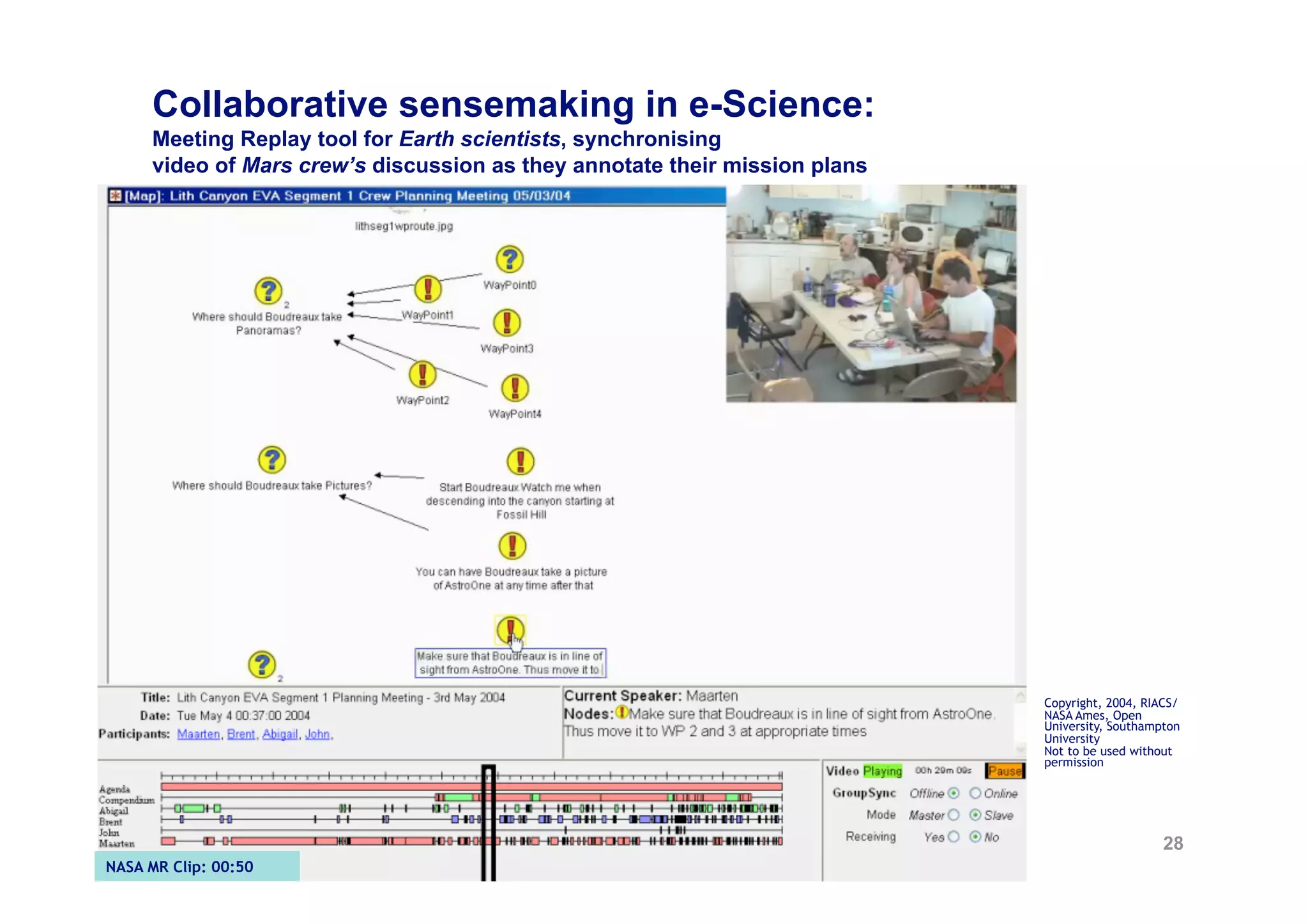
Collaborative sensemaking in e-Science:
     Meeting Replay tool for Earth scientists, synchronising
     video of Mars crew’s discussion as they annotate their mission plans


                                                                            Copyright, 2004, RIACS/
                                                                            NASA Ames, Open
                                                                            University, Southampton
                                                                            University
                                                                            Not to be used without
                                                                            permission


                                                                                                28
NASA MR Clip: 00:50
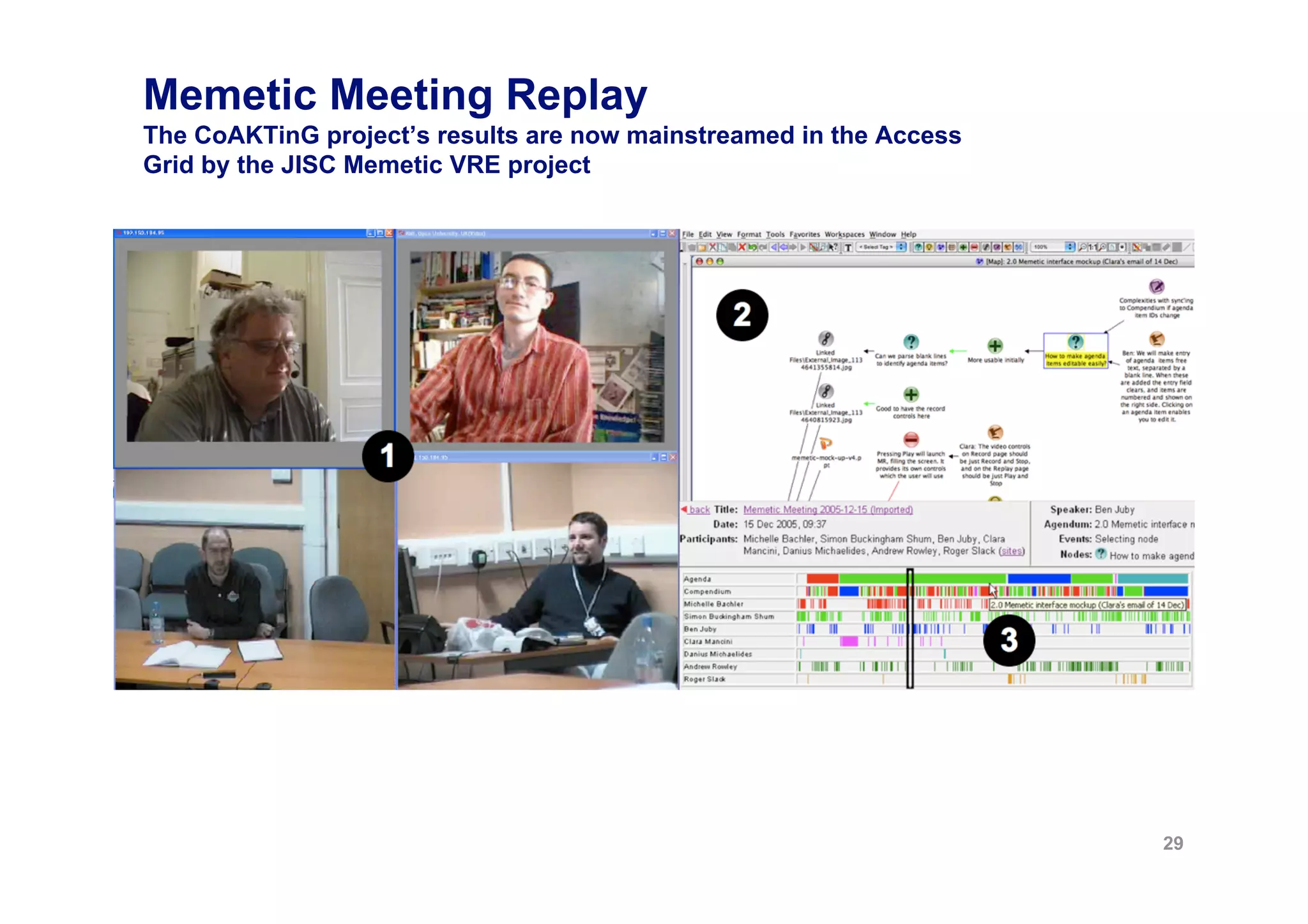
Memetic Meeting Replay
The CoAKTinG project’s results are now mainstreamed in the Access
Grid by the JISC Memetic VRE project


                                                                    29
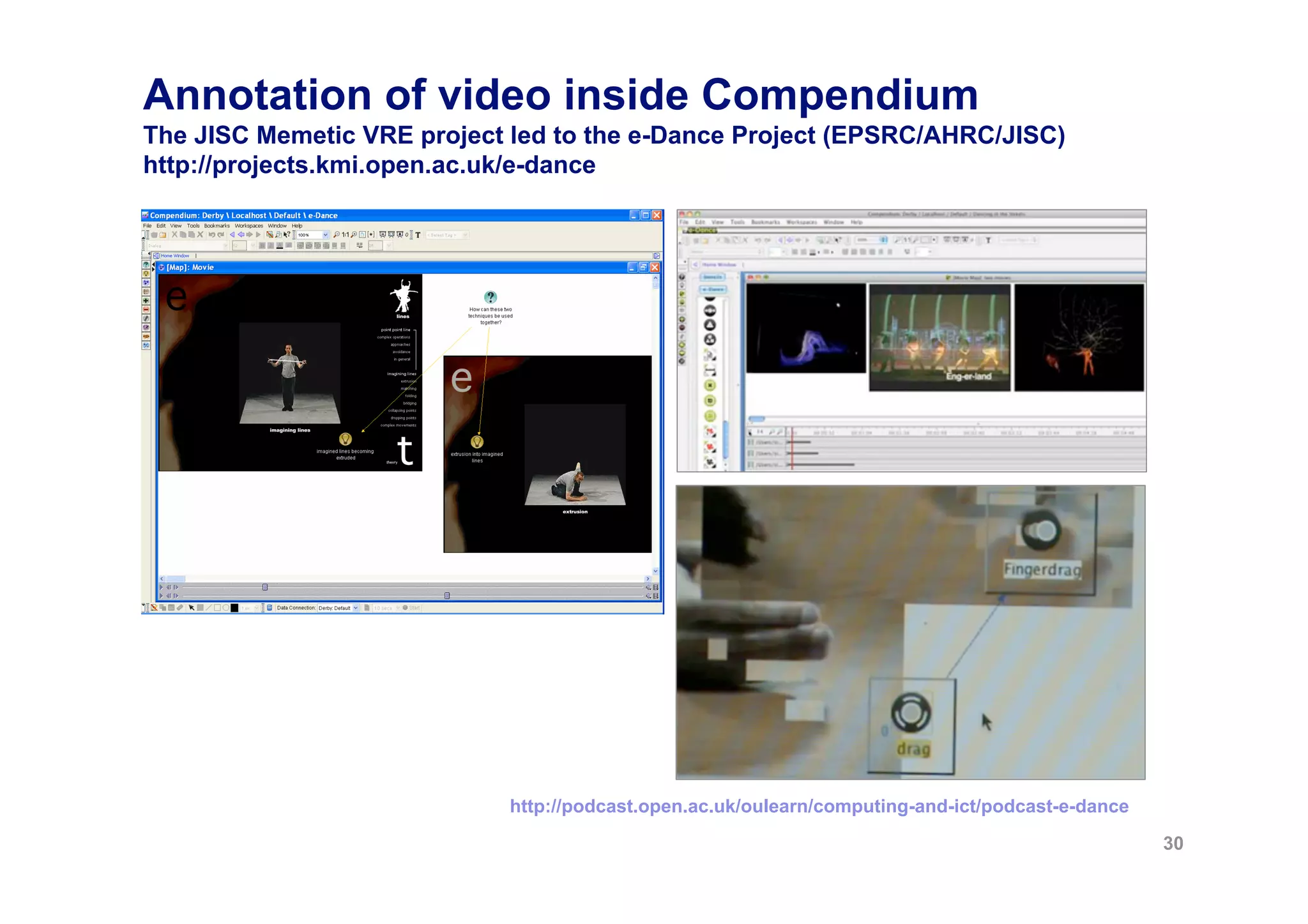
Annotation of video inside Compendium
The JISC Memetic VRE project led to the e-Dance Project (EPSRC/AHRC/JISC)
http://projects.kmi.open.ac.uk/e-dance


                             http://podcast.open.ac.uk/oulearn/computing-and-ict/podcast-e-dance

                                                                                                   30
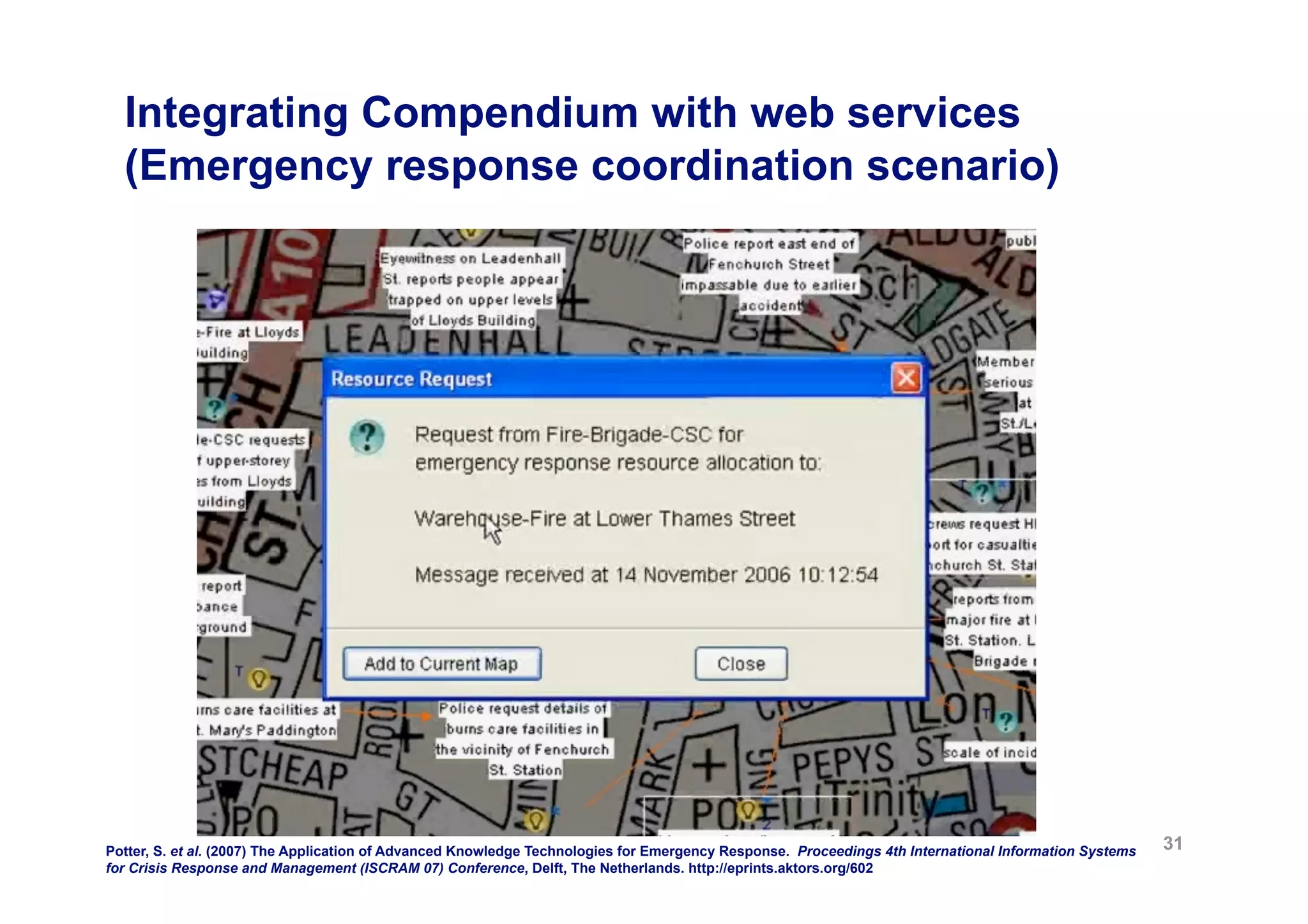
Integrating Compendium with web services
  (Emergency response coordination scenario)


Potter, S. et al. (2007) The Application of Advanced Knowledge Technologies for Emergency Response. Proceedings 4th International Information Systems   31
for Crisis Response and Management (ISCRAM 07) Conference, Delft, The Netherlands. http://eprints.aktors.org/602
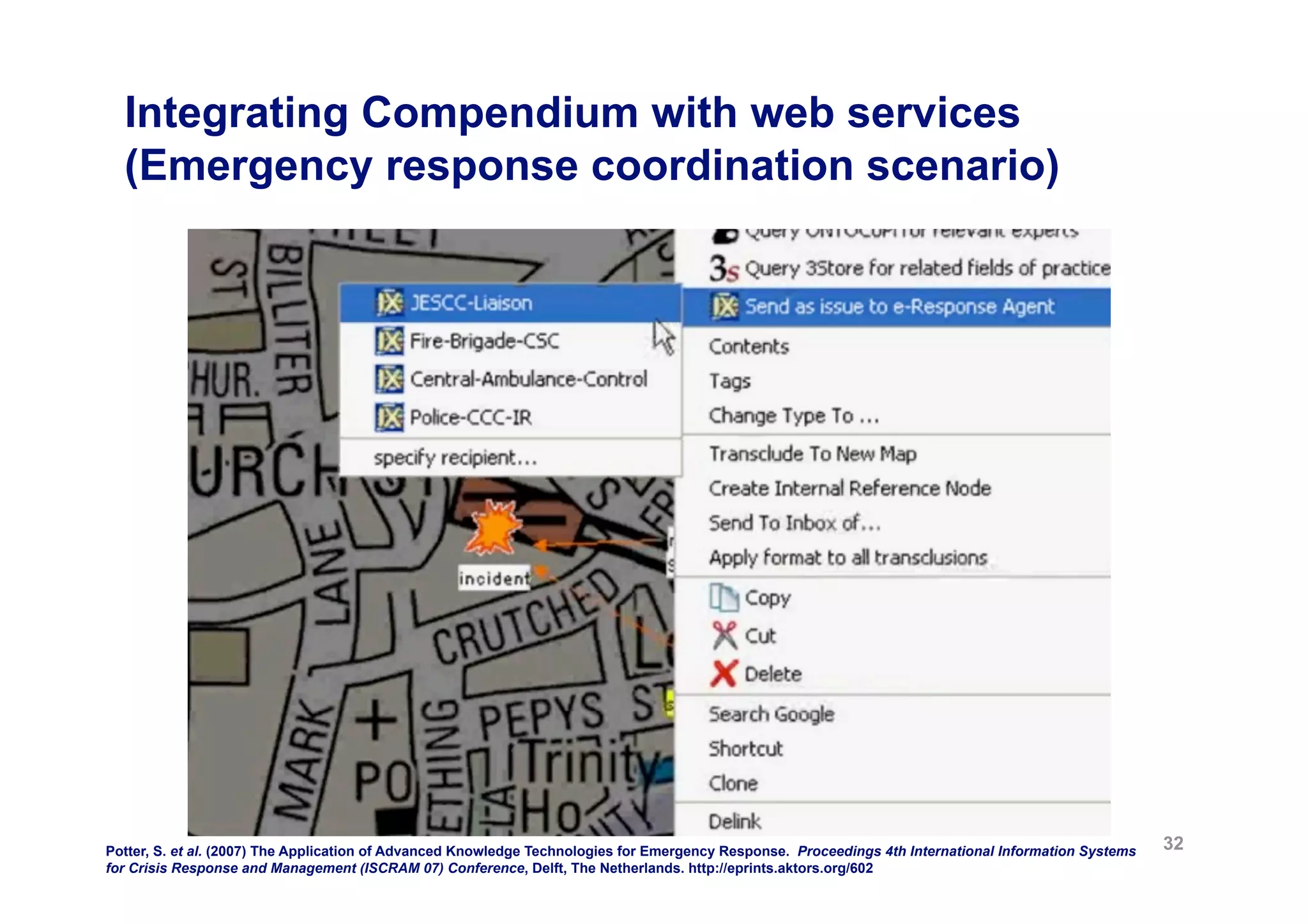
Integrating Compendium with web services
  (Emergency response coordination scenario)


Potter, S. et al. (2007) The Application of Advanced Knowledge Technologies for Emergency Response. Proceedings 4th International Information Systems   32
for Crisis Response and Management (ISCRAM 07) Conference, Delft, The Netherlands. http://eprints.aktors.org/602
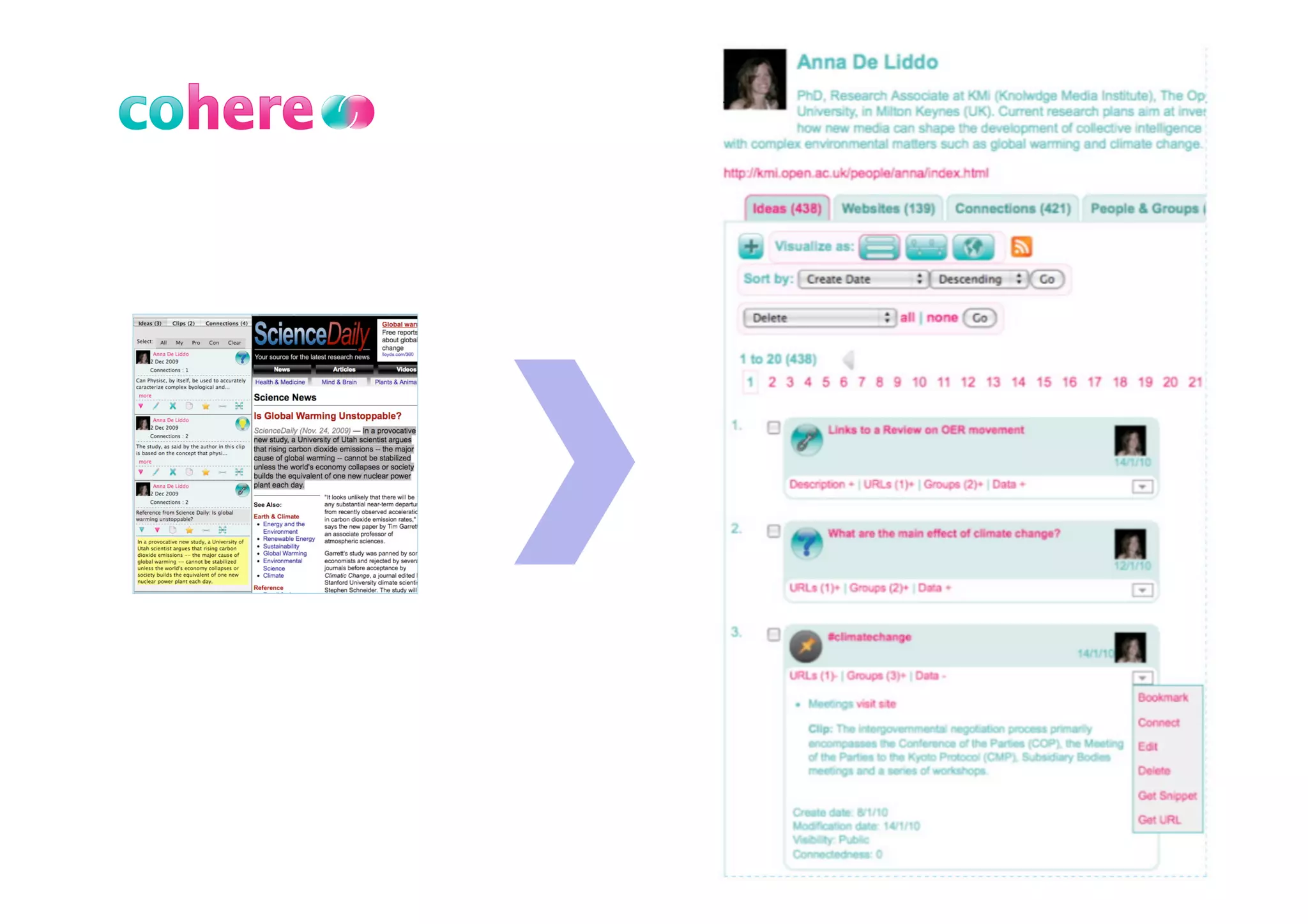
web annotation for sensemaking

 (A winner in the Mozilla/MacArthur Foundation
    Jetpack for Learning Design Challenge)


    http://cohere.open.ac.uk
                                                 33
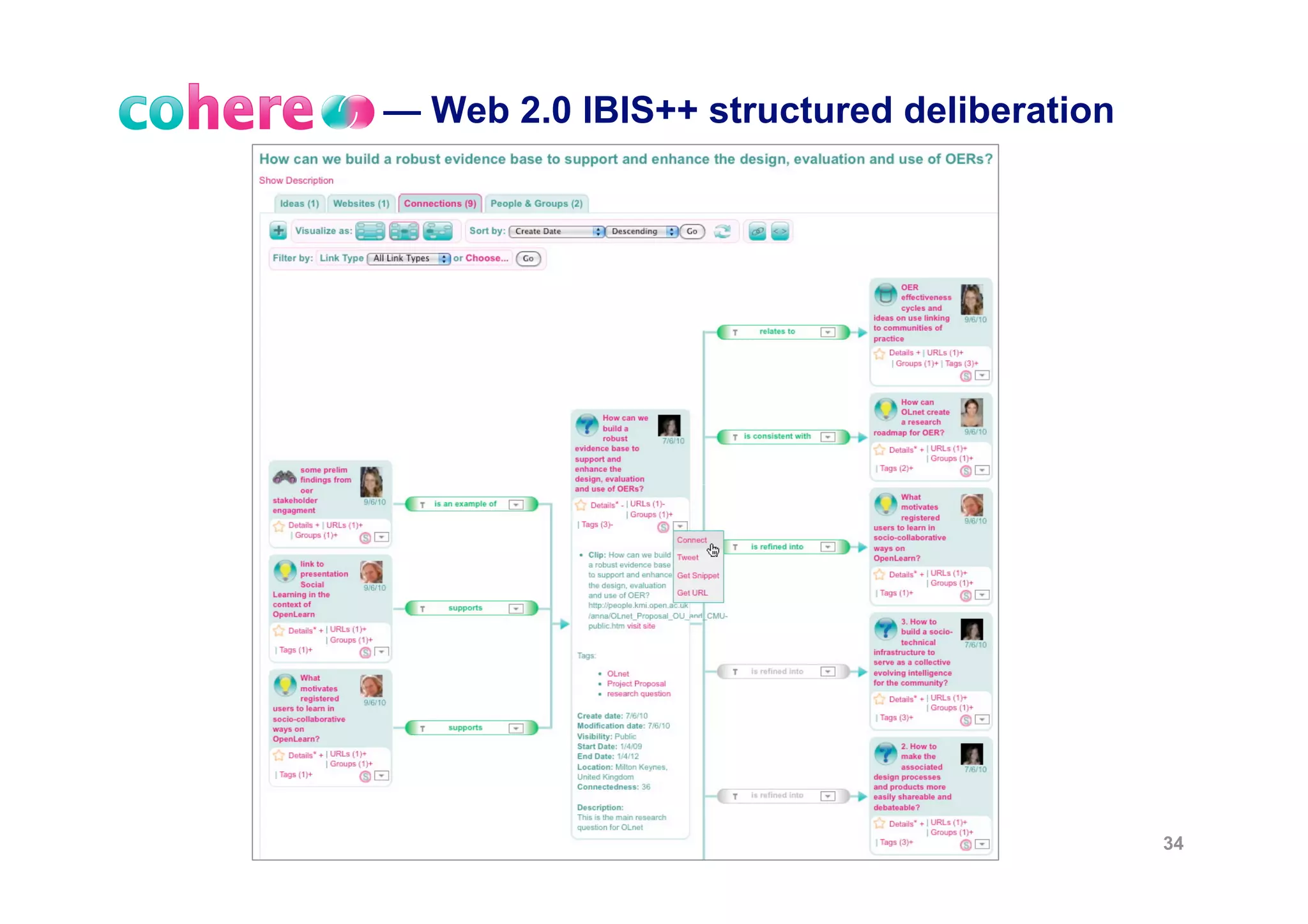
— Web 2.0 IBIS++ structured deliberation


                                           34
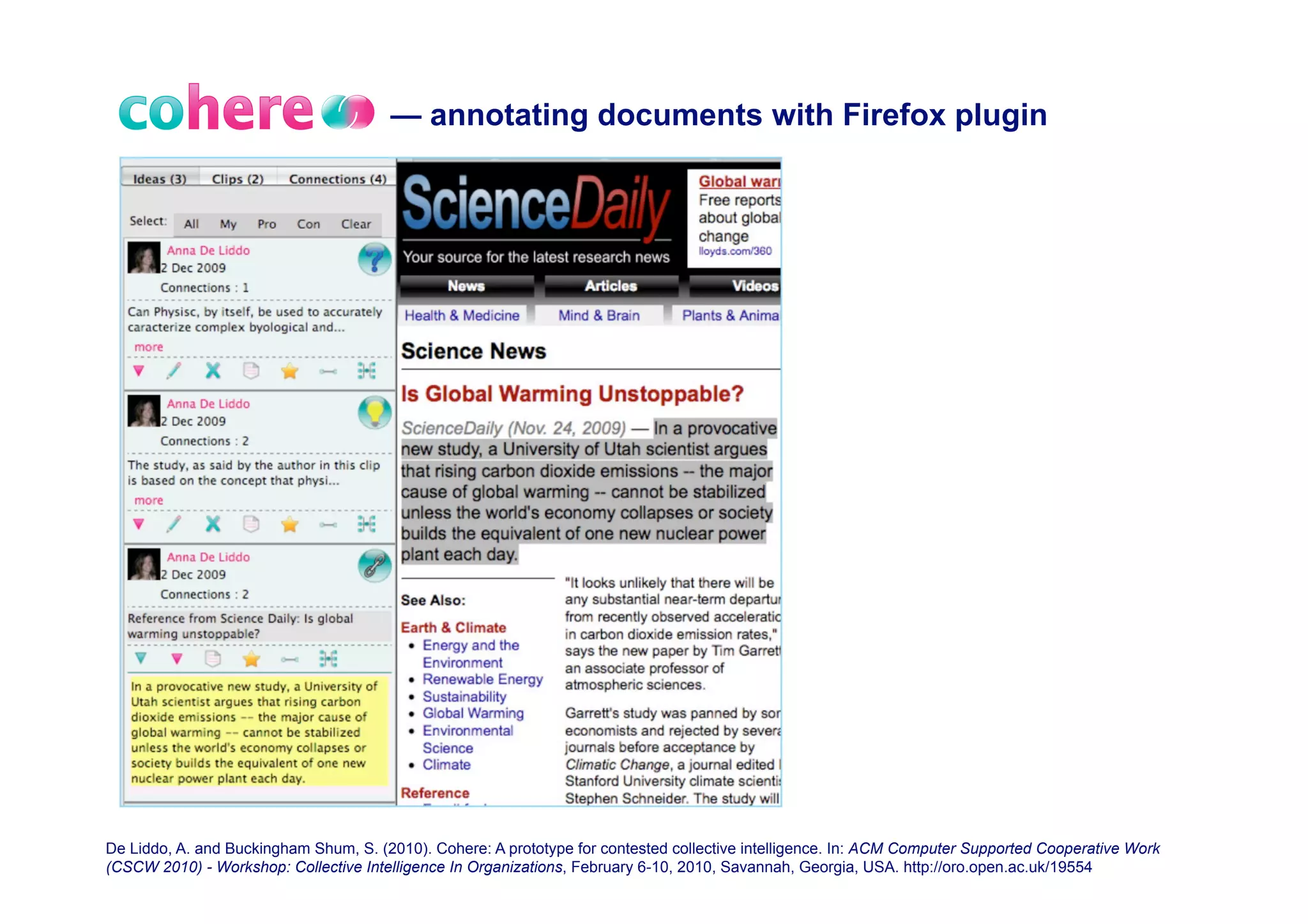
— annotating documents with Firefox plugin


De Liddo, A. and Buckingham Shum, S. (2010). Cohere: A prototype for contested collective intelligence. In: ACM Computer Supported Cooperative Work 35
(CSCW 2010) - Workshop: Collective Intelligence In Organizations, February 6-10, 2010, Savannah, Georgia, USA. http://oro.open.ac.uk/19554
36
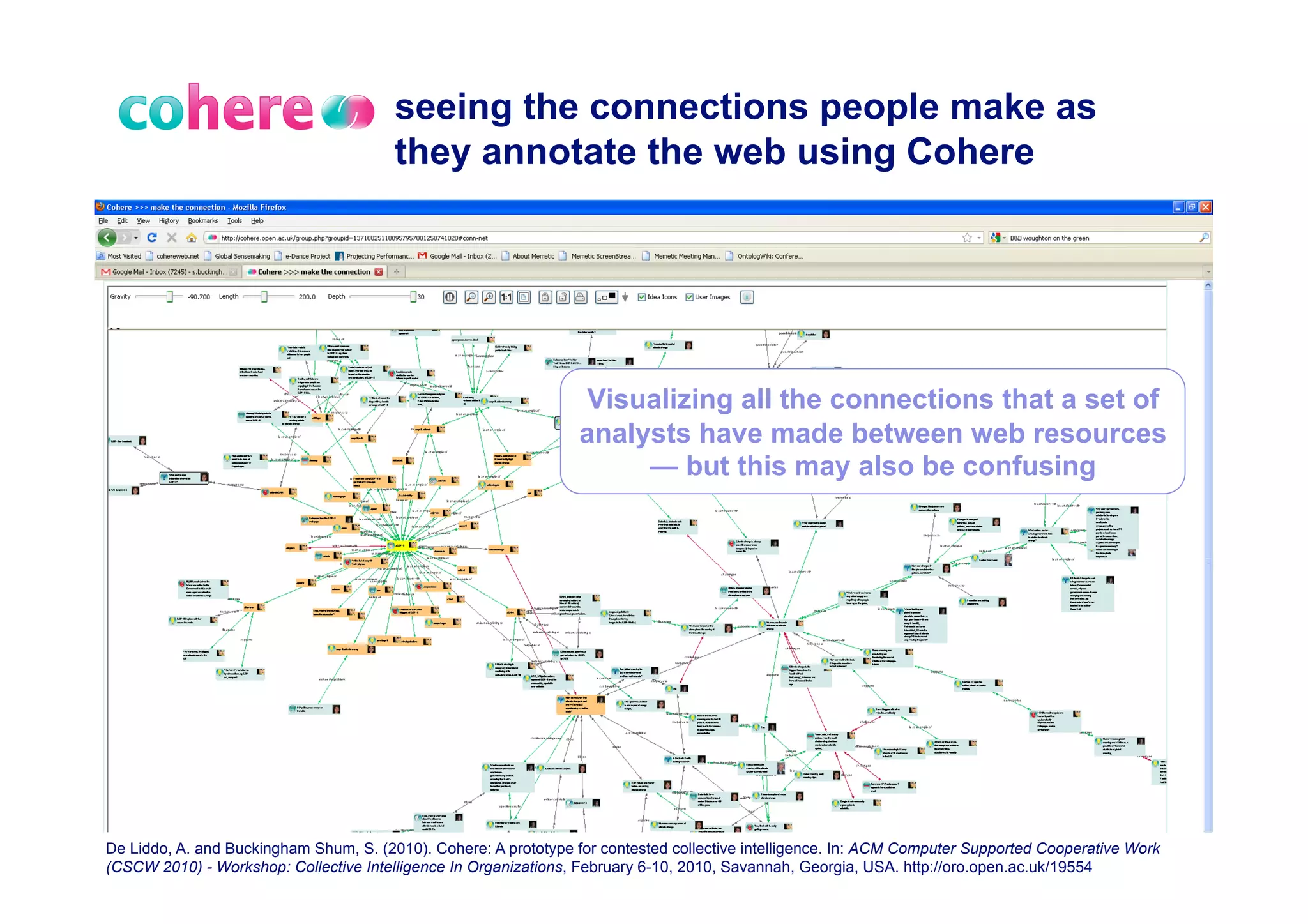
seeing the connections people make as
                                        they annotate the web using Cohere


                                                                   Visualizing all the connections that a set of
                                                                  analysts have made between web resources
                                                                       — but this may also be confusing


De Liddo, A. and Buckingham Shum, S. (2010). Cohere: A prototype for contested collective intelligence. In: ACM Computer Supported Cooperative Work
(CSCW 2010) - Workshop: Collective Intelligence In Organizations, February 6-10, 2010, Savannah, Georgia, USA. http://oro.open.ac.uk/19554
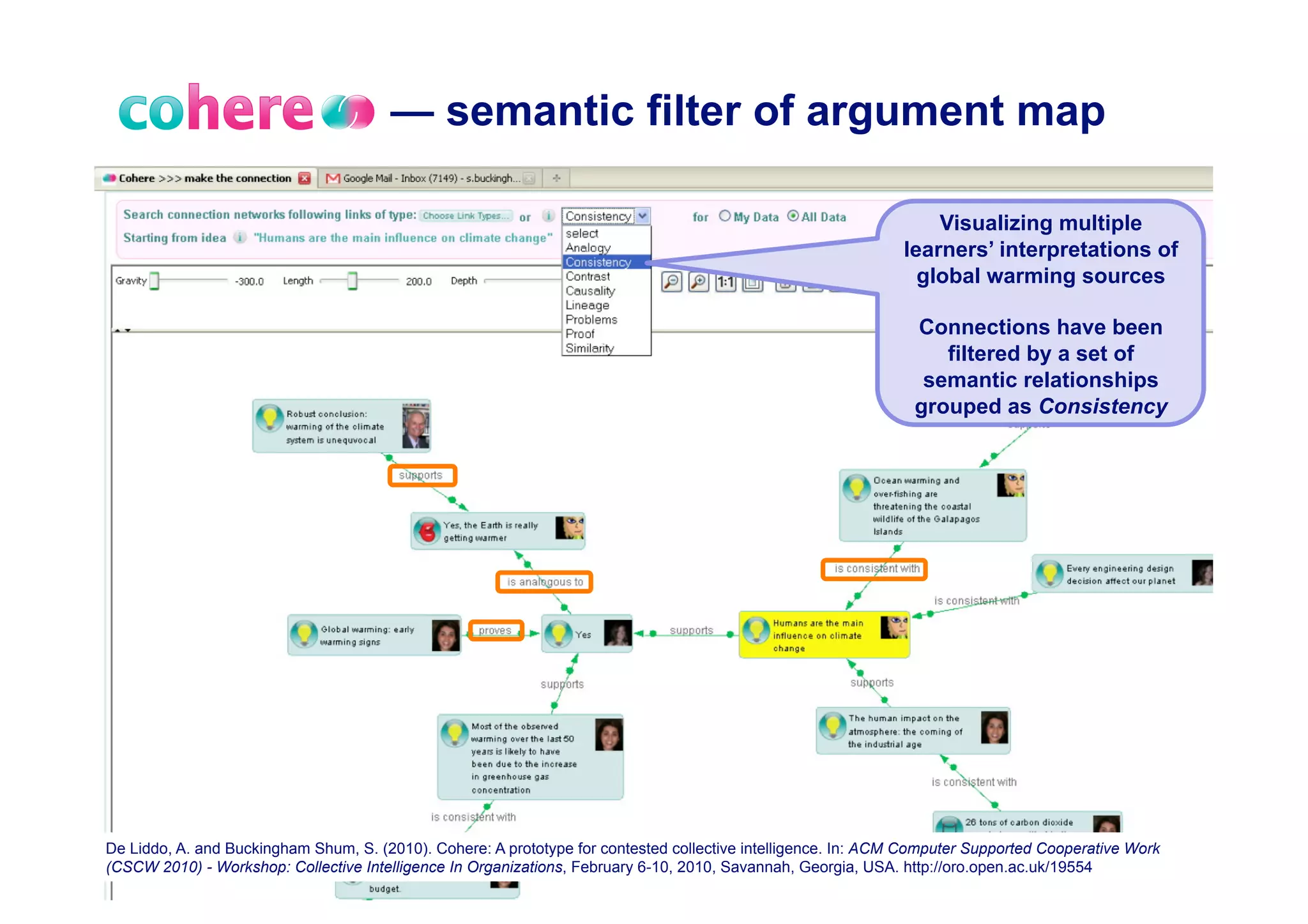
— semantic filter of argument map

                                                                                                                   Visualizing multiple
                                                                                                               learners’ interpretations of
                                                                                                                 global warming sources

                                                                                                                Connections have been
                                                                                                                   filtered by a set of
                                                                                                                 semantic relationships
                                                                                                                grouped as Consistency


De Liddo, A. and Buckingham Shum, S. (2010). Cohere: A prototype for contested collective intelligence. In: ACM Computer Supported Cooperative Work
(CSCW 2010) - Workshop: Collective Intelligence In Organizations, February 6-10, 2010, Savannah, Georgia, USA. http://oro.open.ac.uk/19554
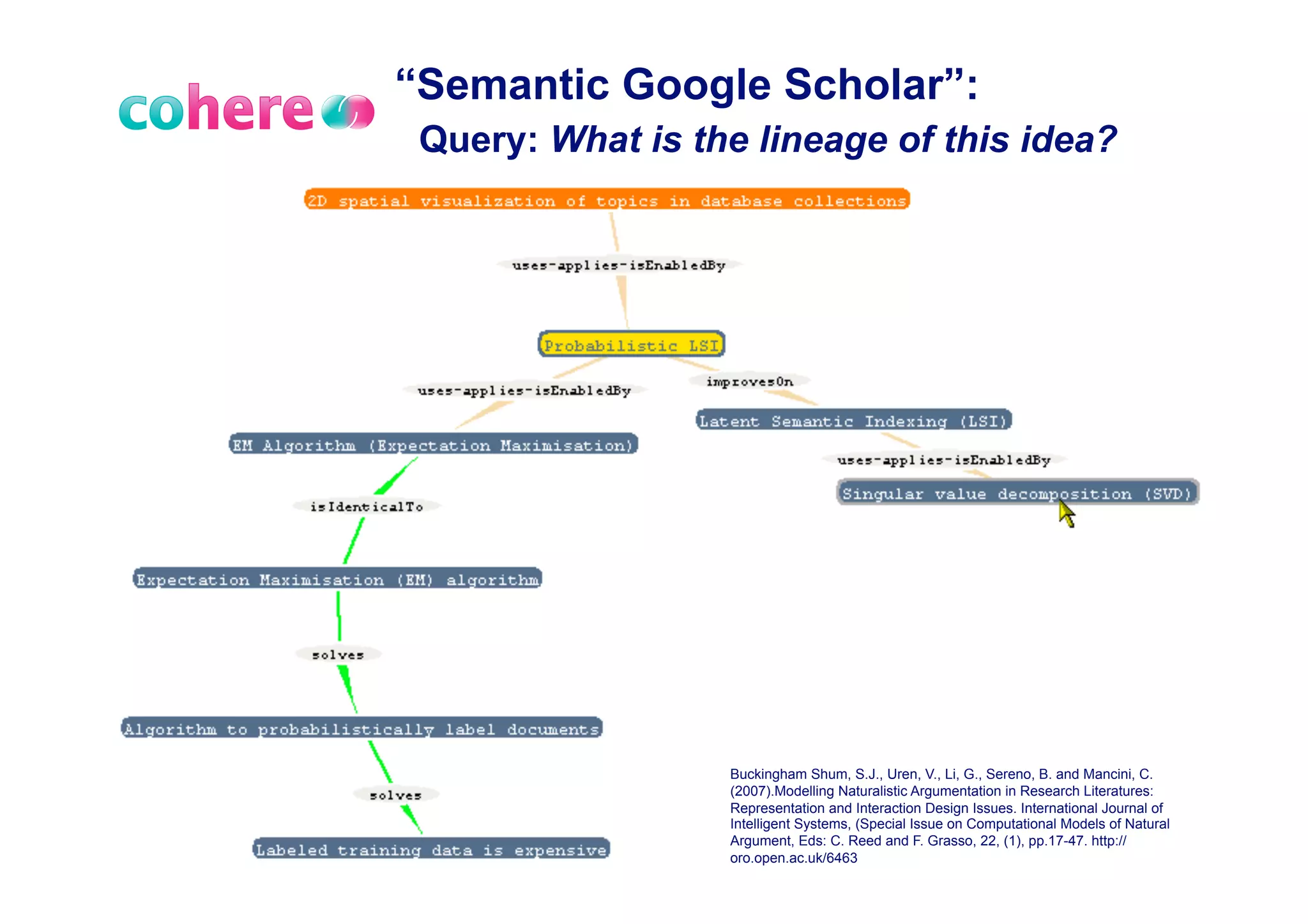
“Semantic Google Scholar”:
 Query: What is the lineage of this idea?


                  Buckingham Shum, S.J., Uren, V., Li, G., Sereno, B. and Mancini, C.
                  (2007).Modelling Naturalistic Argumentation in Research Literatures:
                  Representation and Interaction Design Issues. International Journal of
                  Intelligent Systems, (Special Issue on Computational Models of Natural
                  Argument, Eds: C. Reed and F. Grasso, 22, (1), pp.17-47. http://       39
                  oro.open.ac.uk/6463
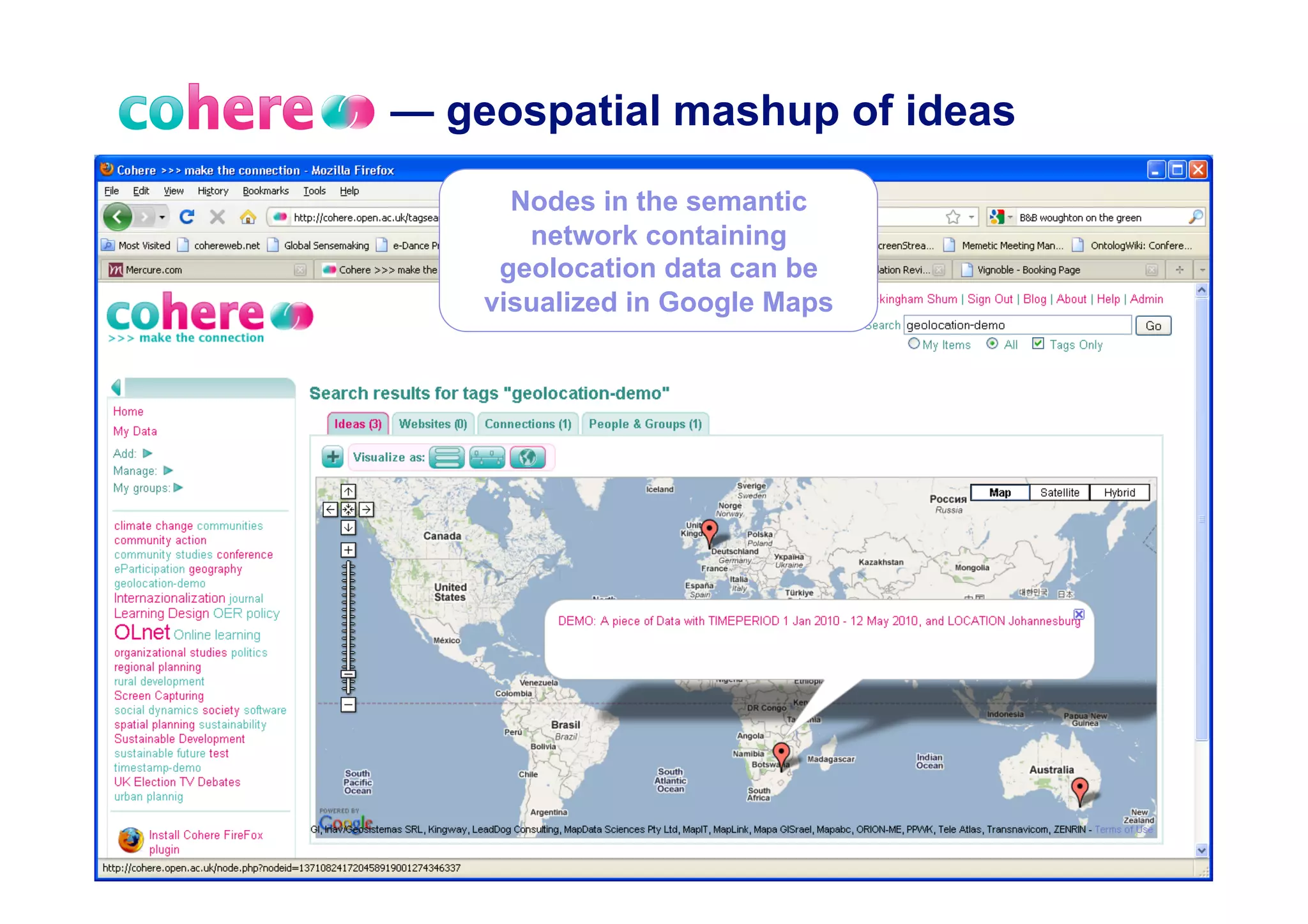
— geospatial mashup of ideas
      Nodes in the semantic
       network containing
     geolocation data can be
    visualized in Google Maps
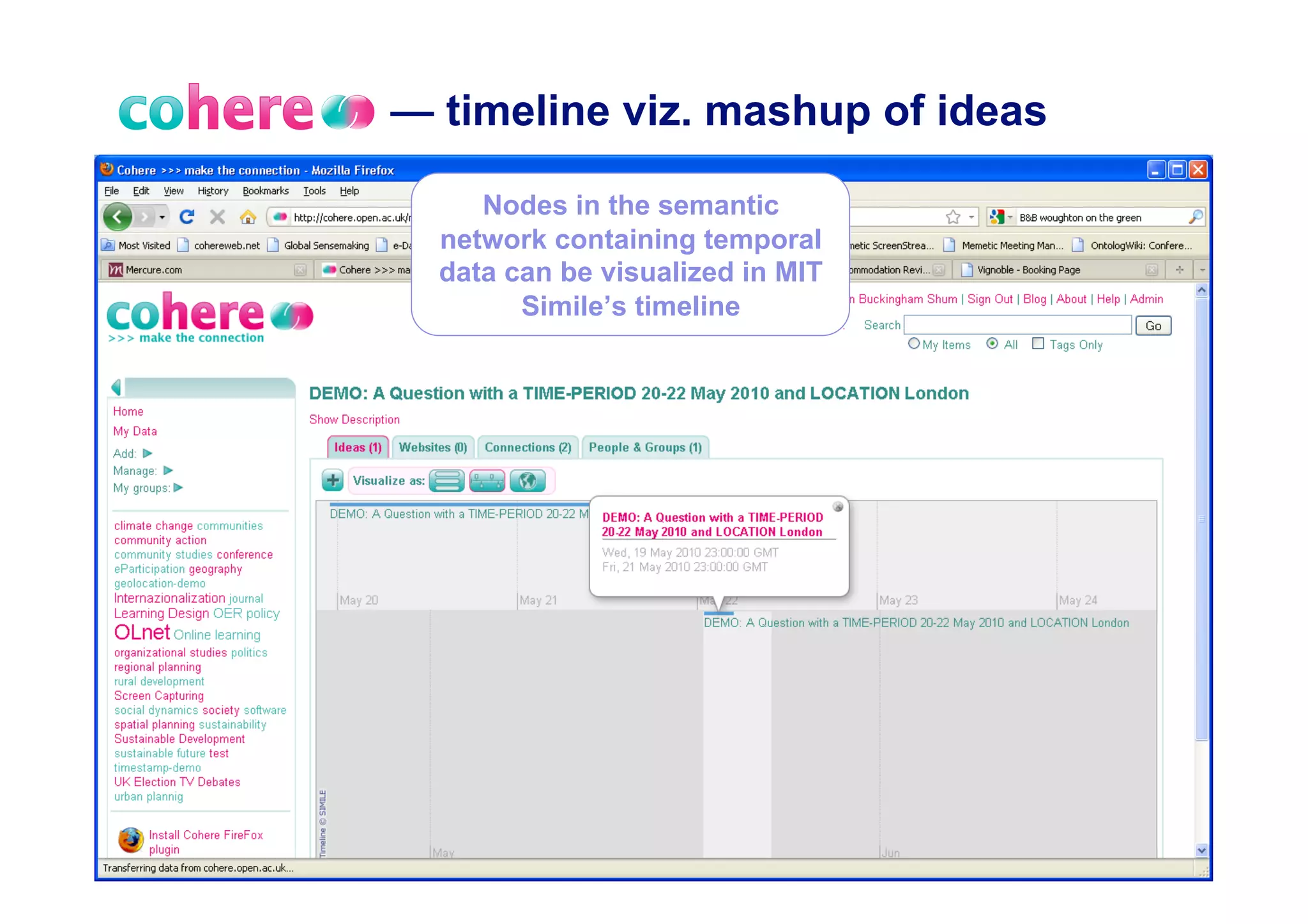
— timeline viz. mashup of ideas

     Nodes in the semantic
  network containing temporal
  data can be visualized in MIT
        Simile’s timeline
Human-Centred Computing for Sensemaking


                       Services    Interaction
                   Interoperability Design


                                                  Learning
          Domain                                   Curve

              Discourse                     Mastery
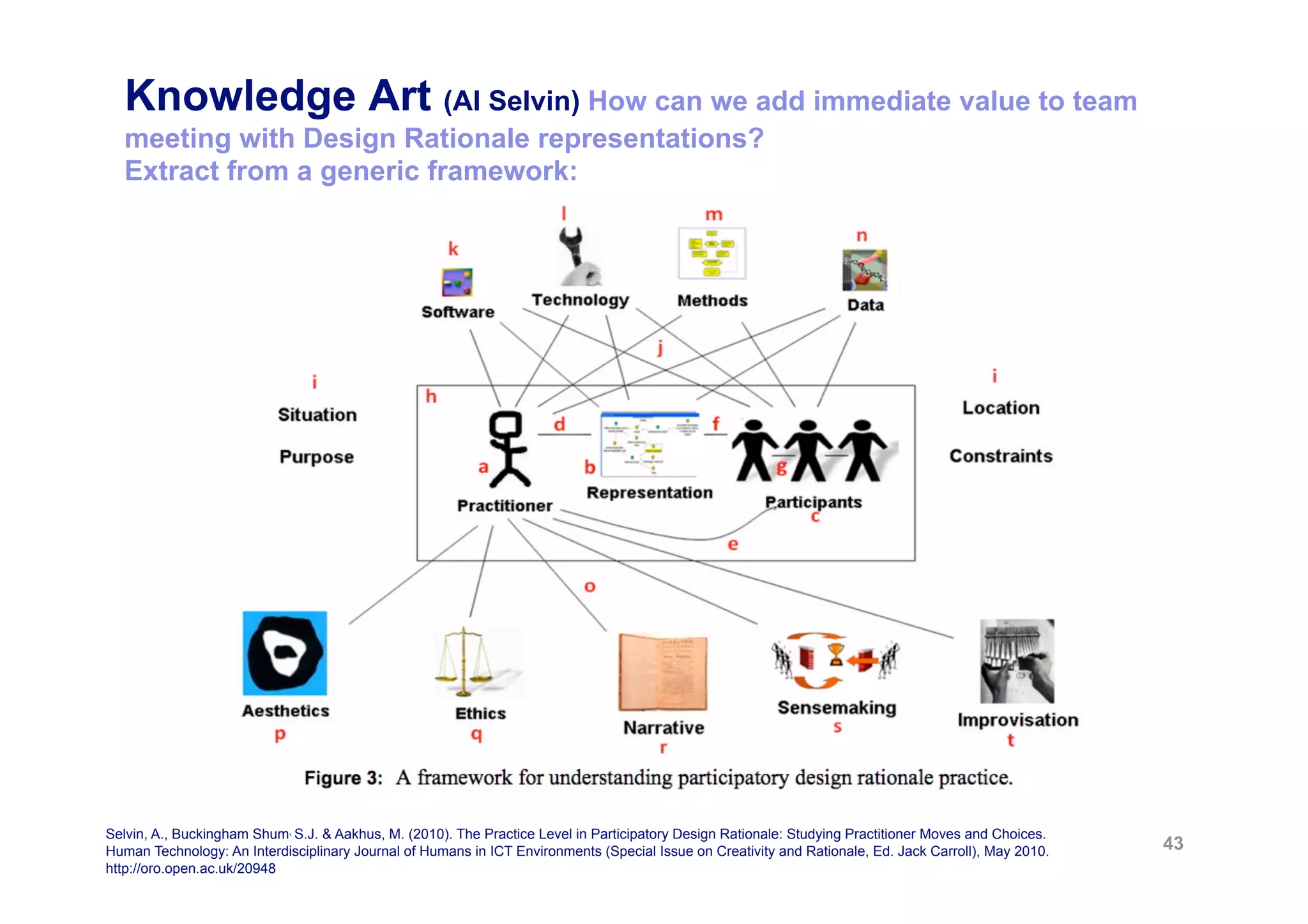
Knowledge Art (Al Selvin) How can we add immediate value to team
  meeting with Design Rationale representations?
  Extract from a generic framework:


Selvin, A., Buckingham Shum, S.J. & Aakhus, M. (2010). The Practice Level in Participatory Design Rationale: Studying Practitioner Moves and Choices.
Human Technology: An Interdisciplinary Journal of Humans in ICT Environments (Special Issue on Creativity and Rationale, Ed. Jack Carroll), May 2010.   43
http://oro.open.ac.uk/20948
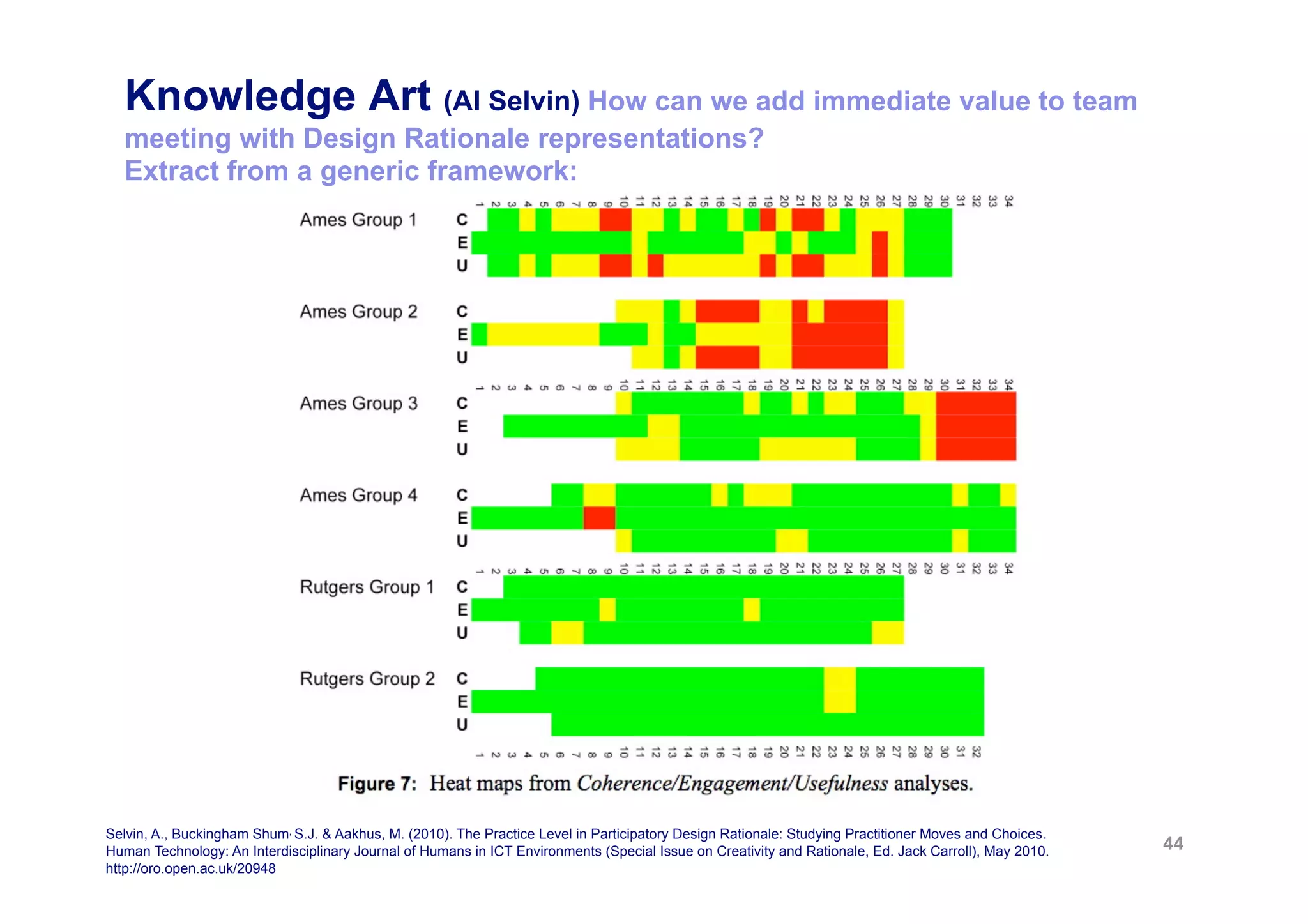
Knowledge Art (Al Selvin) How can we add immediate value to team
  meeting with Design Rationale representations?
  Extract from a generic framework:


Selvin, A., Buckingham Shum, S.J. & Aakhus, M. (2010). The Practice Level in Participatory Design Rationale: Studying Practitioner Moves and Choices.
Human Technology: An Interdisciplinary Journal of Humans in ICT Environments (Special Issue on Creativity and Rationale, Ed. Jack Carroll), May 2010.   44
http://oro.open.ac.uk/20948
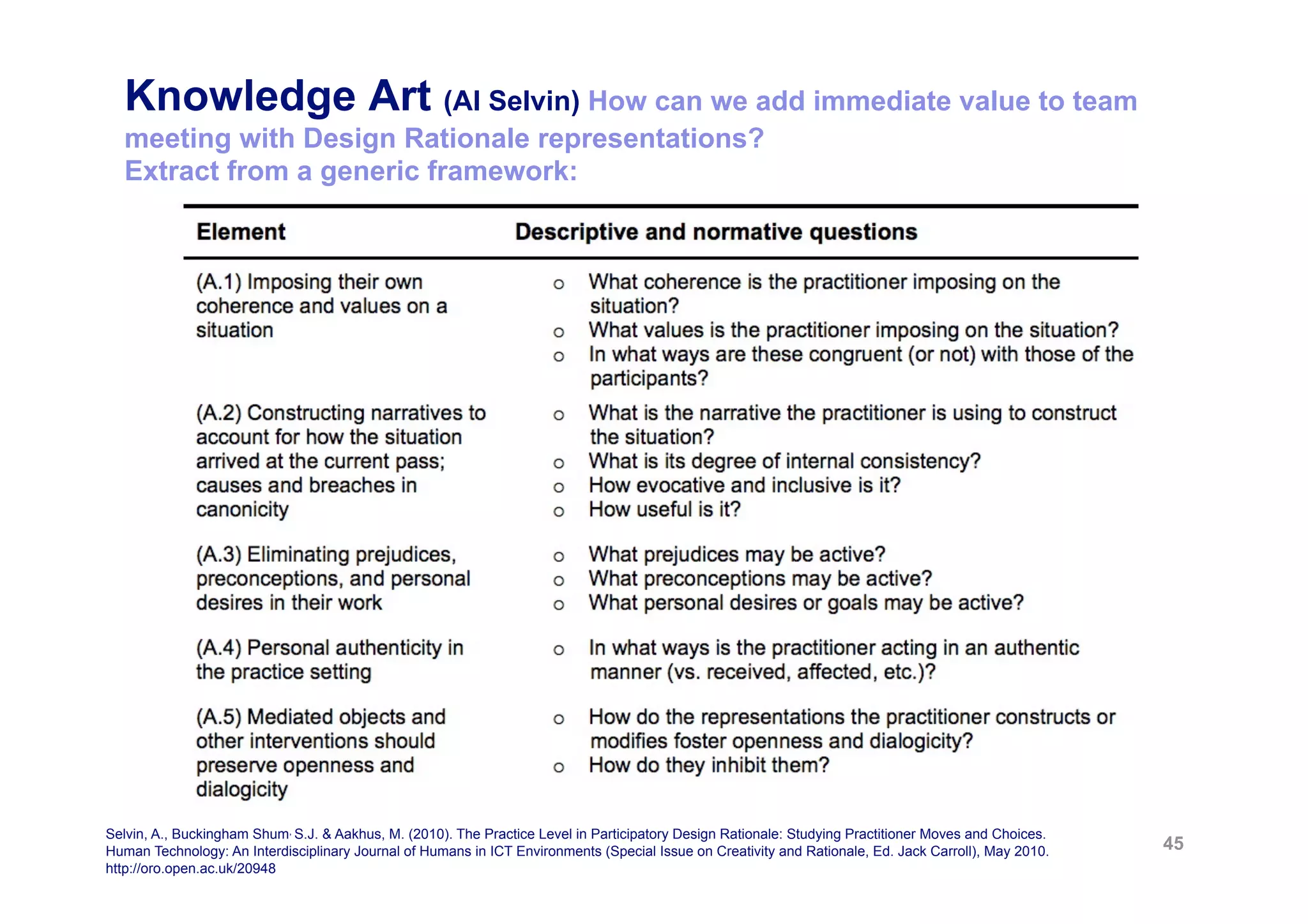
Knowledge Art (Al Selvin) How can we add immediate value to team
  meeting with Design Rationale representations?
  Extract from a generic framework:


Selvin, A., Buckingham Shum, S.J. & Aakhus, M. (2010). The Practice Level in Participatory Design Rationale: Studying Practitioner Moves and Choices.
Human Technology: An Interdisciplinary Journal of Humans in ICT Environments (Special Issue on Creativity and Rationale, Ed. Jack Carroll), May 2010.   45
http://oro.open.ac.uk/20948
Human-Centred Computing for Sensemaking
(including Design Rationale, and arguably, many RE tools?)


                             Services    Interaction
                         Interoperability Design


                                                        Learning
               Domain                                    Curve

                    Discourse                     Mastery
Dialogue Mapping
        (Jeff Conklin)


Facilitating real time discussion
   by mapping contributions

                                    47
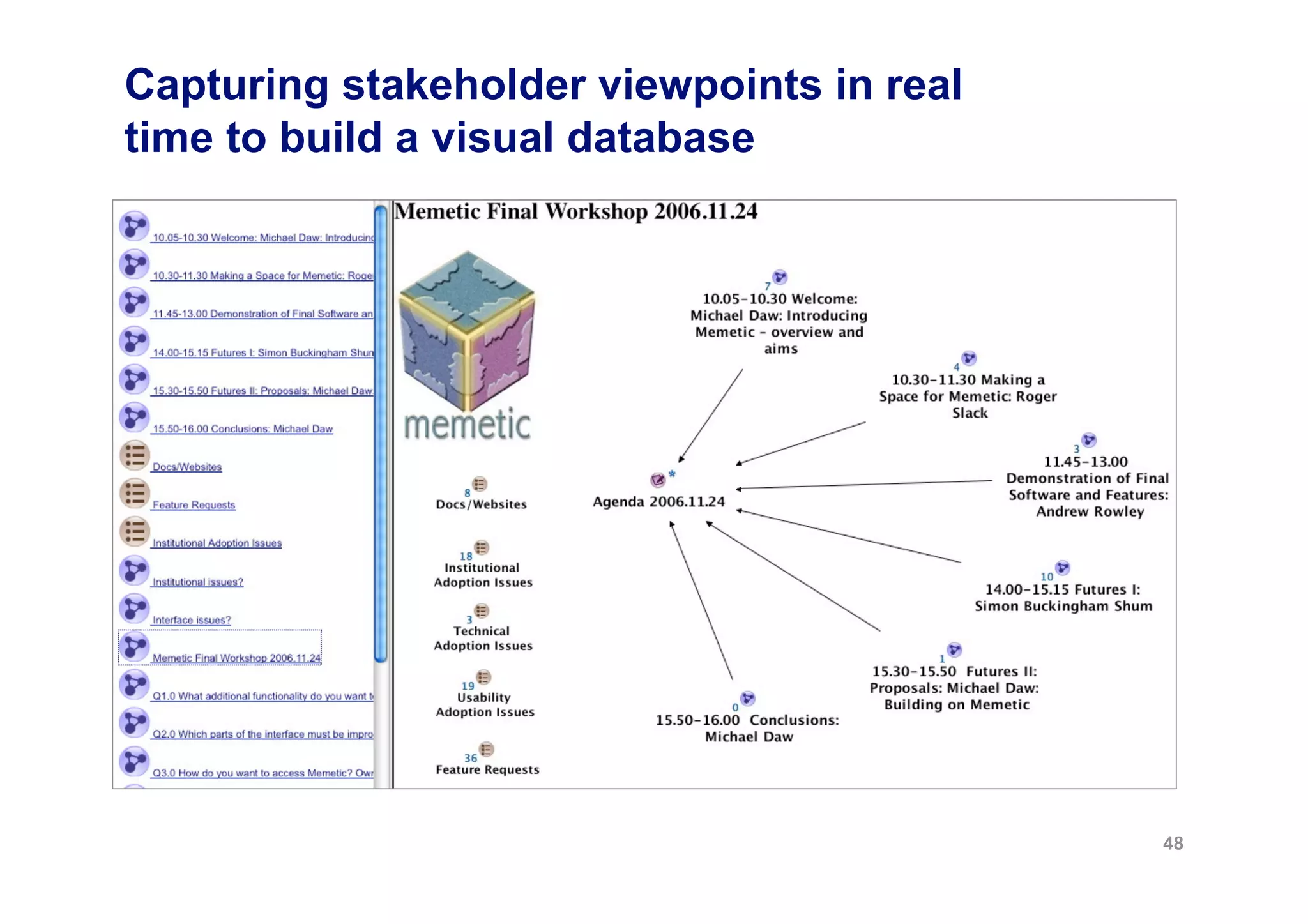
Capturing stakeholder viewpoints in real
time to build a visual database


                                           48
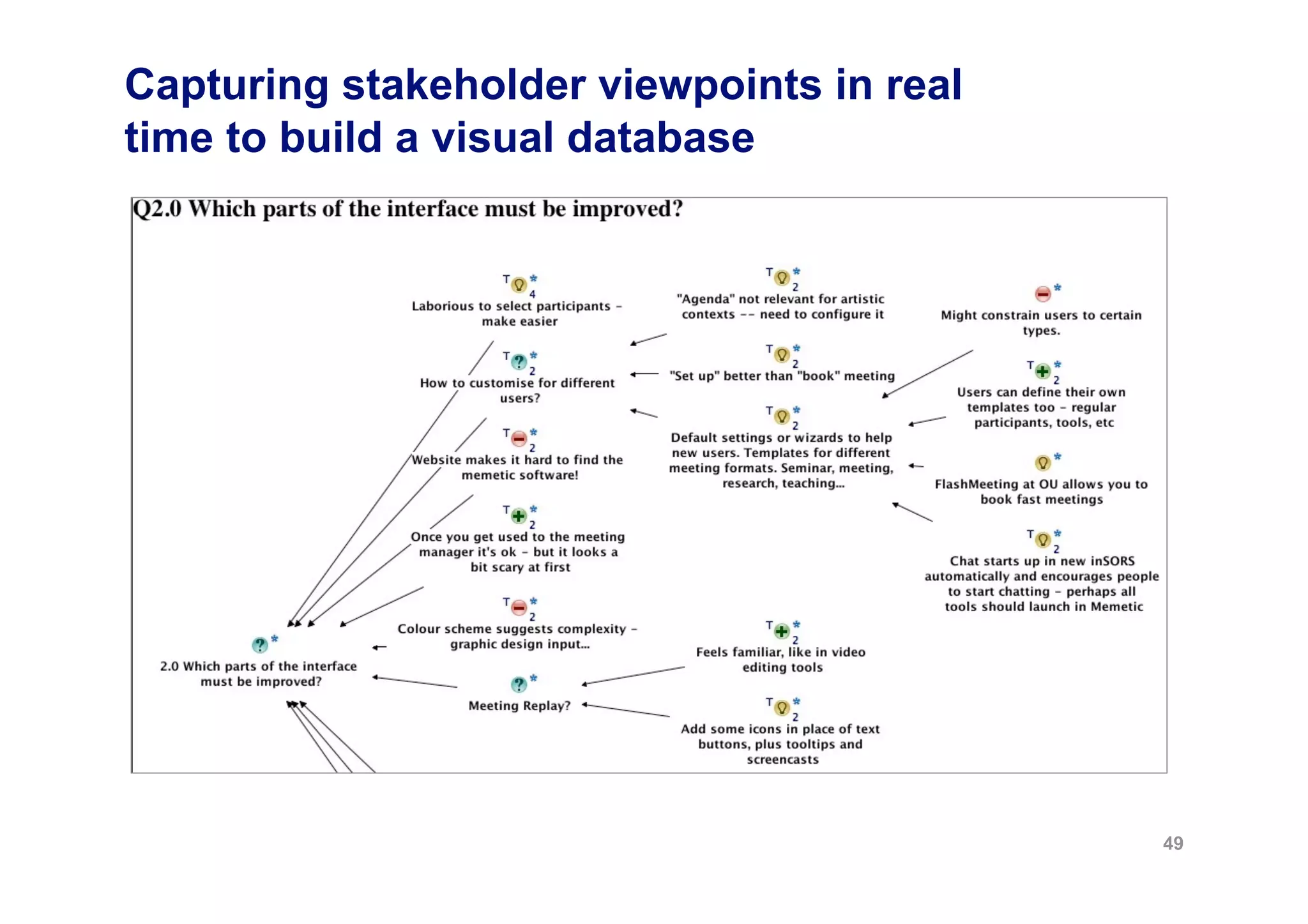
Capturing stakeholder viewpoints in real
time to build a visual database


                                           49
Ways to cope with overwhelming complexity…


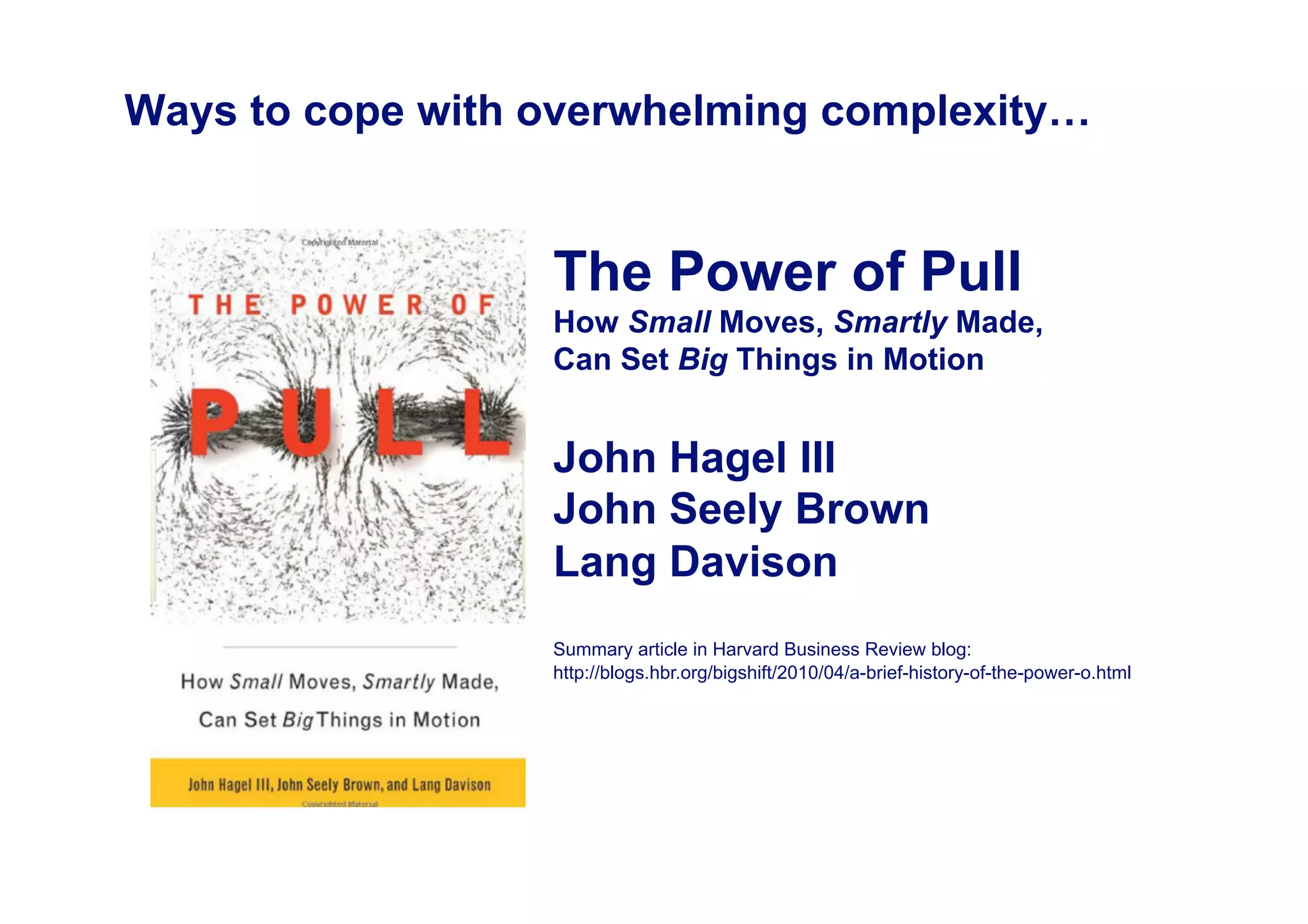
                  The Power of Pull
                  How Small Moves, Smartly Made,
                  Can Set Big Things in Motion


                  John Hagel III
                  John Seely Brown
                  Lang Davison
                  Summary article in Harvard Business Review blog:
                  http://blogs.hbr.org/bigshift/2010/04/a-brief-history-of-the-power-o.html
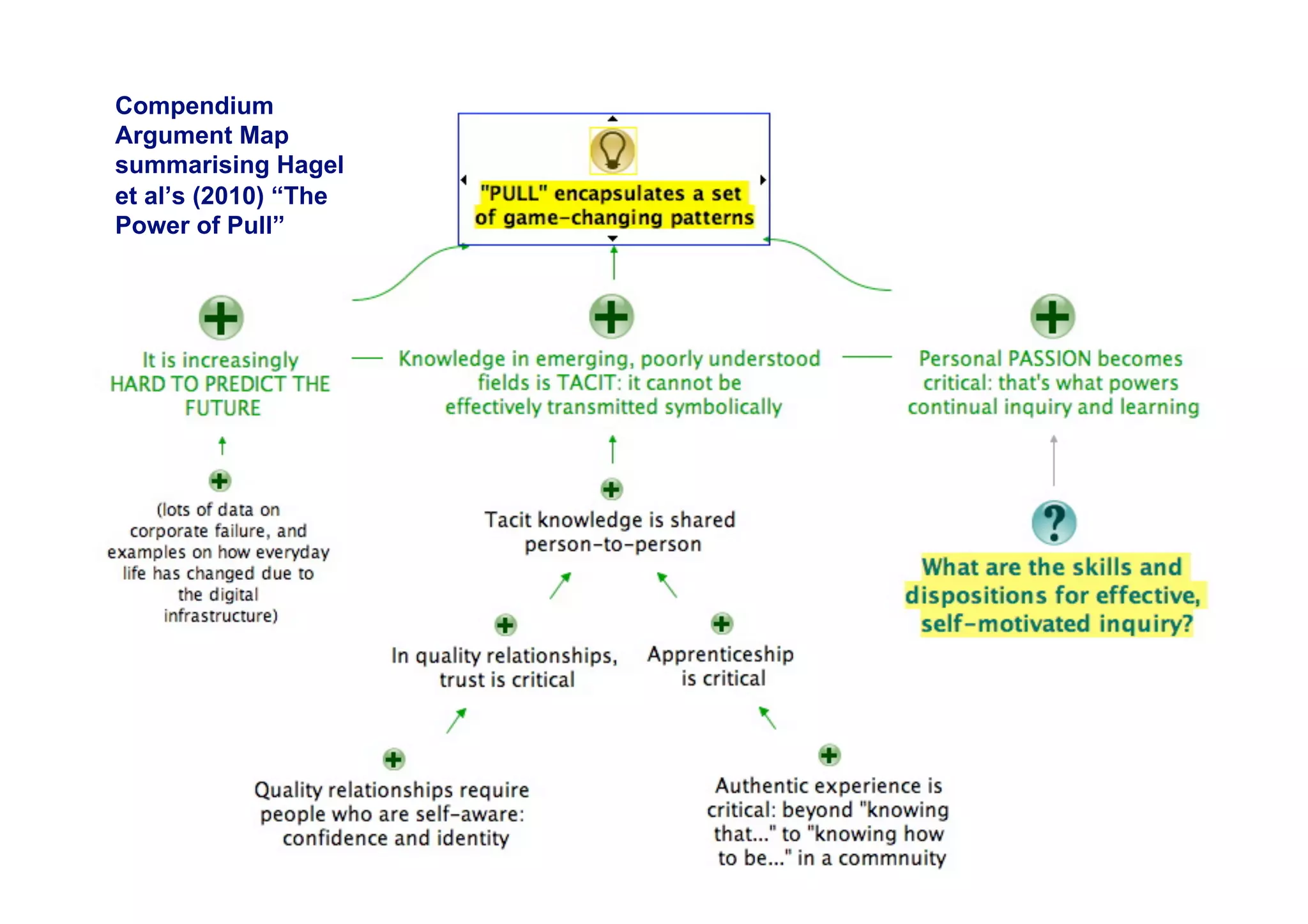
Compendium
Argument Map
summarising Hagel
et al’s (2010) “The
Power of Pull”


                      51
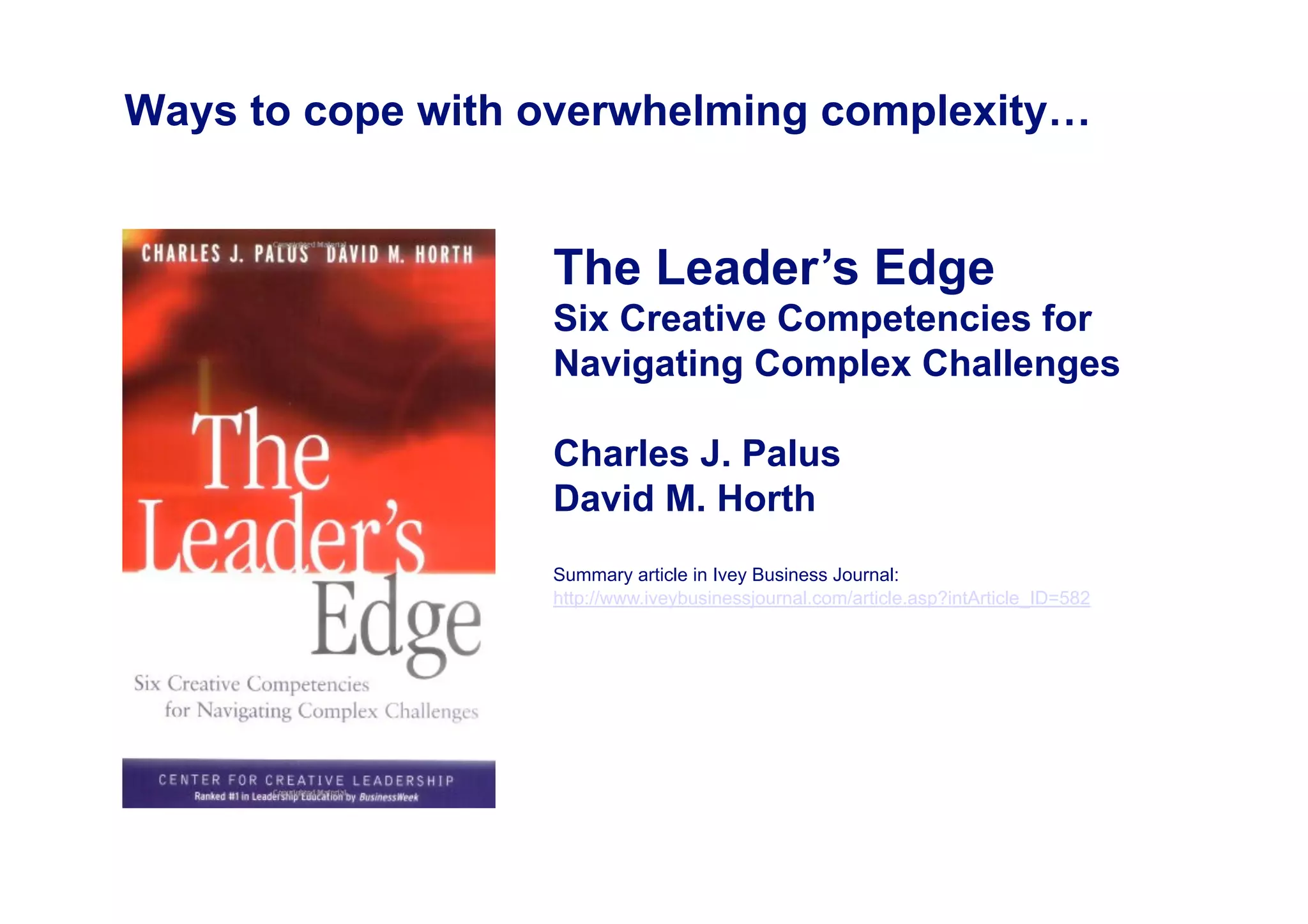
Ways to cope with overwhelming complexity…


                  The Leader’s Edge
                  Six Creative Competencies for
                  Navigating Complex Challenges

                  Charles J. Palus
                  David M. Horth
                  Summary article in Ivey Business Journal:
                  http://www.iveybusinessjournal.com/article.asp?intArticle_ID=582
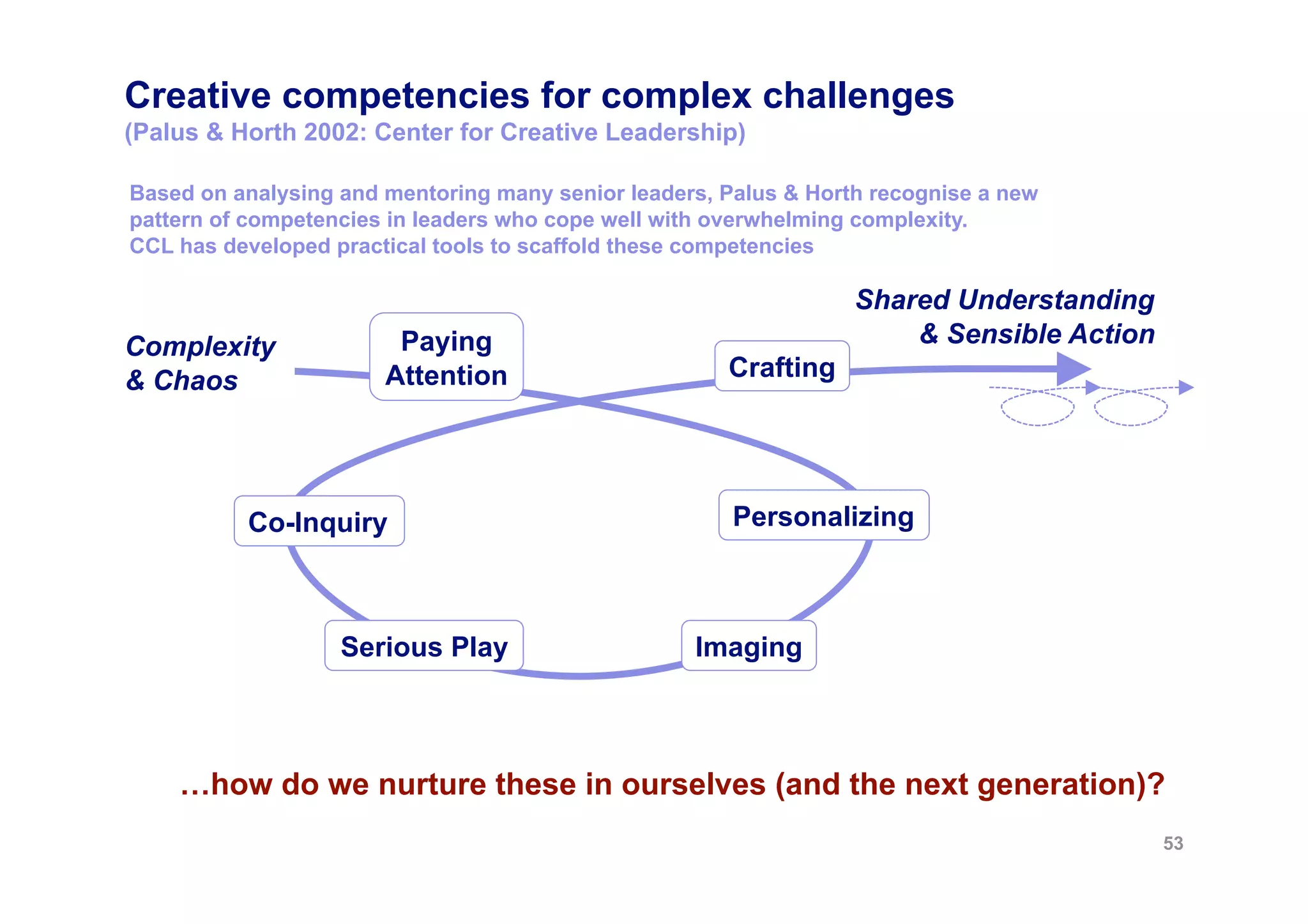
Creative competencies for complex challenges
(Palus & Horth 2002: Center for Creative Leadership)

Based on analysing and mentoring many senior leaders, Palus & Horth recognise a new
pattern of competencies in leaders who cope well with overwhelming complexity.
CCL has developed practical tools to scaffold these competencies

                                                                  Shared Understanding
Complexity              Paying                                        & Sensible Action
& Chaos                Attention                      Crafting


          Co-Inquiry                                   Personalizing


                   Serious Play                    Imaging


    …how do we nurture these in ourselves (and the next generation)?
                                                                                          53
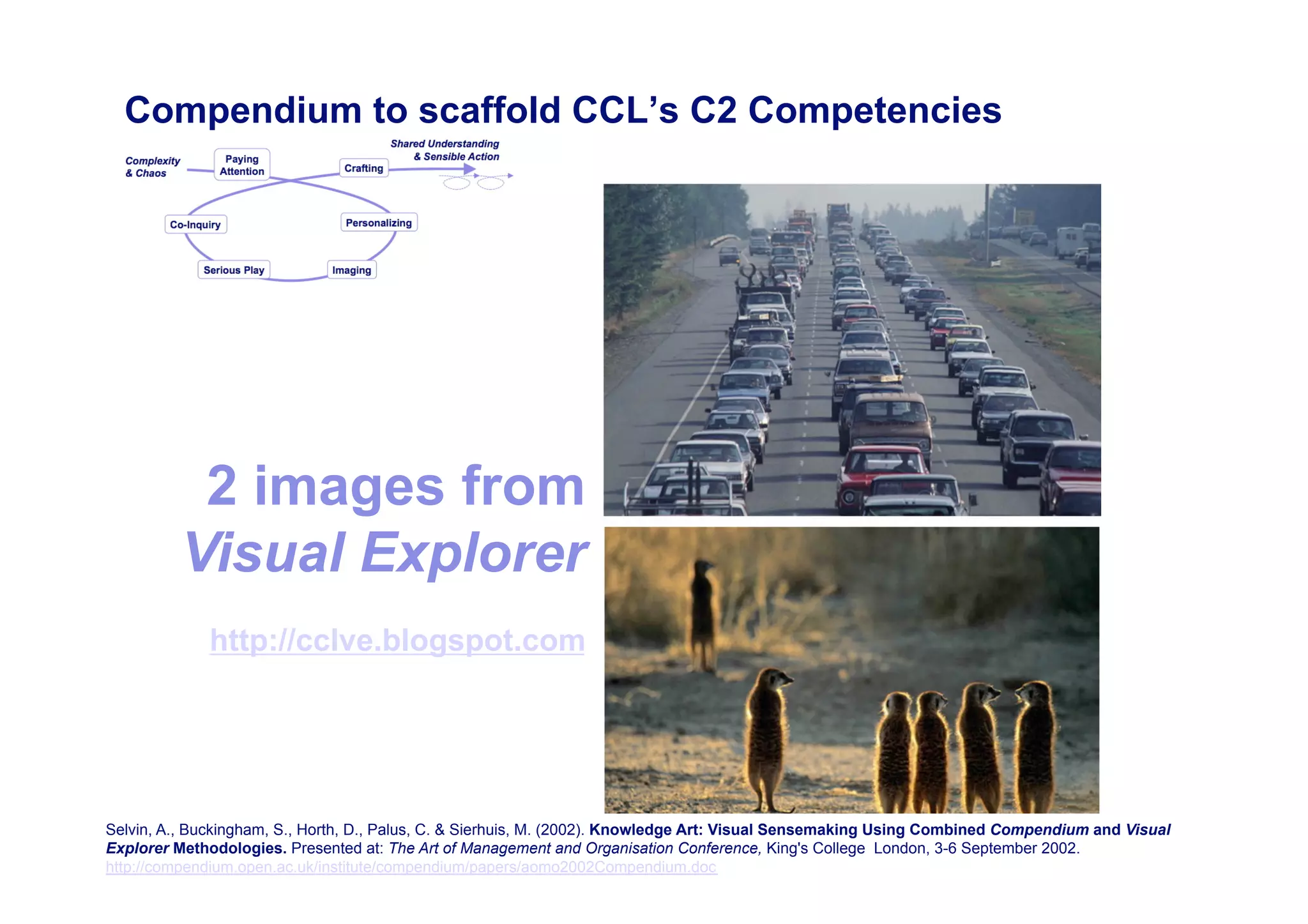
Compendium to scaffold CCL’s C2 Competencies


          2 images from
         Visual Explorer
             http://cclve.blogspot.com


Selvin, A., Buckingham, S., Horth, D., Palus, C. & Sierhuis, M. (2002). Knowledge Art: Visual Sensemaking Using Combined Compendium and Visual
Explorer Methodologies. Presented at: The Art of Management and Organisation Conference, King's College London, 3-6 September 2002.          54
http://compendium.open.ac.uk/institute/compendium/papers/aomo2002Compendium.doc
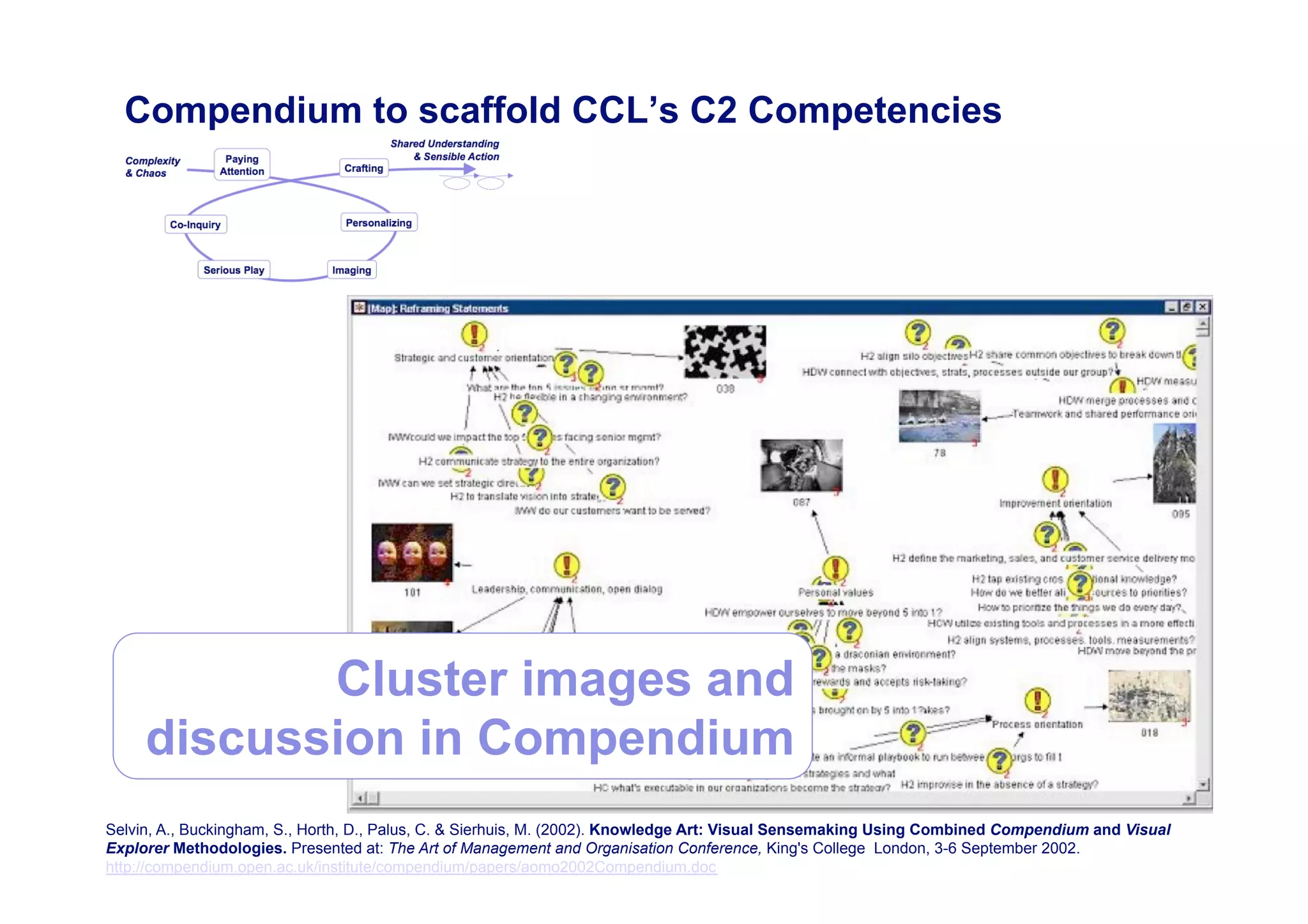
Compendium to scaffold CCL’s C2 Competencies


            Cluster images and
     discussion in Compendium
Selvin, A., Buckingham, S., Horth, D., Palus, C. & Sierhuis, M. (2002). Knowledge Art: Visual Sensemaking Using Combined Compendium and Visual
Explorer Methodologies. Presented at: The Art of Management and Organisation Conference, King's College London, 3-6 September 2002.          55
http://compendium.open.ac.uk/institute/compendium/papers/aomo2002Compendium.doc
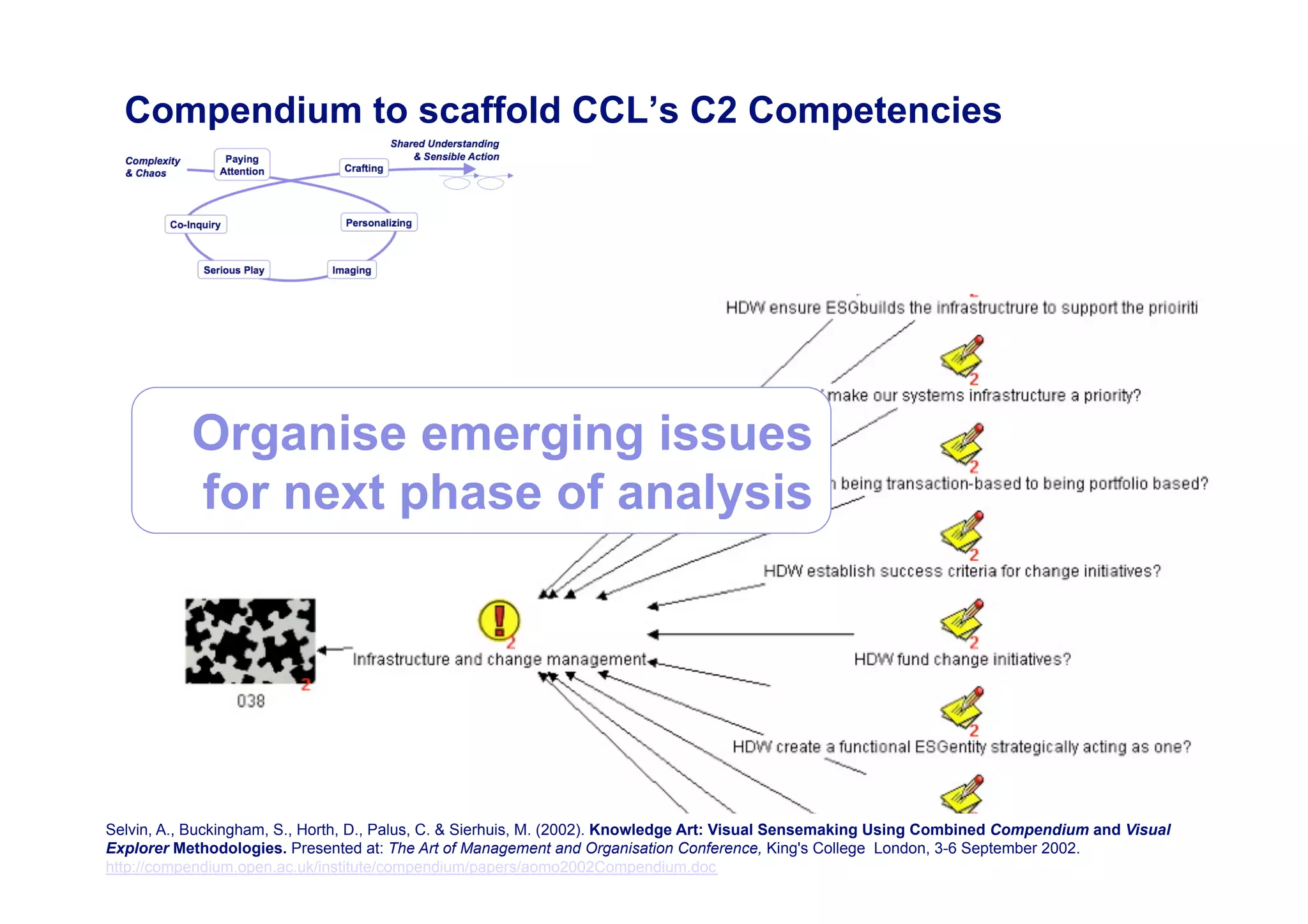
Compendium to scaffold CCL’s C2 Competencies


           Organise emerging issues
           for next phase of analysis


Selvin, A., Buckingham, S., Horth, D., Palus, C. & Sierhuis, M. (2002). Knowledge Art: Visual Sensemaking Using Combined Compendium and Visual
Explorer Methodologies. Presented at: The Art of Management and Organisation Conference, King's College London, 3-6 September 2002.          56
http://compendium.open.ac.uk/institute/compendium/papers/aomo2002Compendium.doc
Conversational Modelling
(Al Selvin & Maarten Sierhuis)


 Facilitating real time discussion by
modelling with IBIS templates + other
          visual languages
                                        57
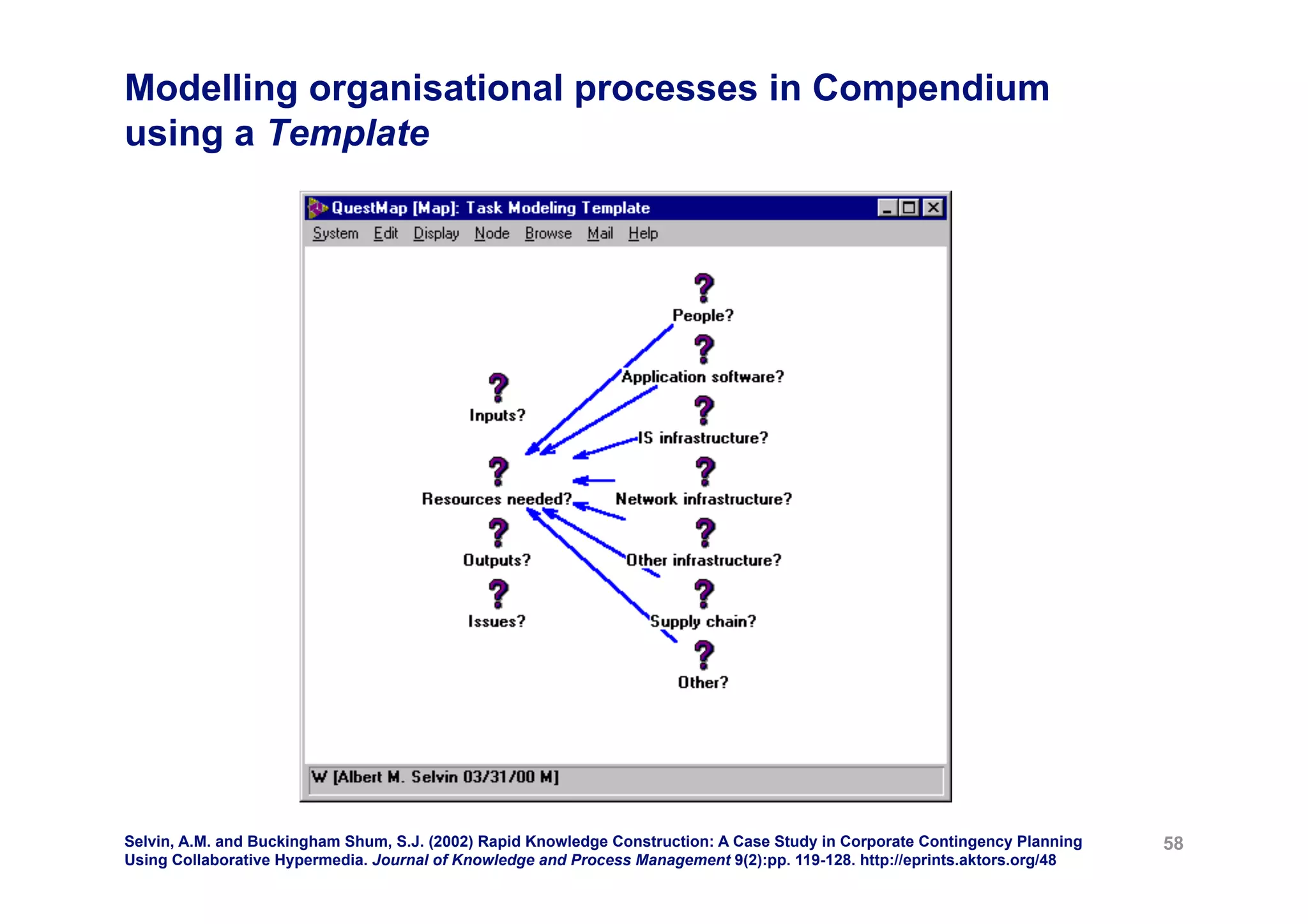
Modelling organisational processes in Compendium
using a Template


Selvin, A.M. and Buckingham Shum, S.J. (2002) Rapid Knowledge Construction: A Case Study in Corporate Contingency Planning   58
Using Collaborative Hypermedia. Journal of Knowledge and Process Management 9(2):pp. 119-128. http://eprints.aktors.org/48
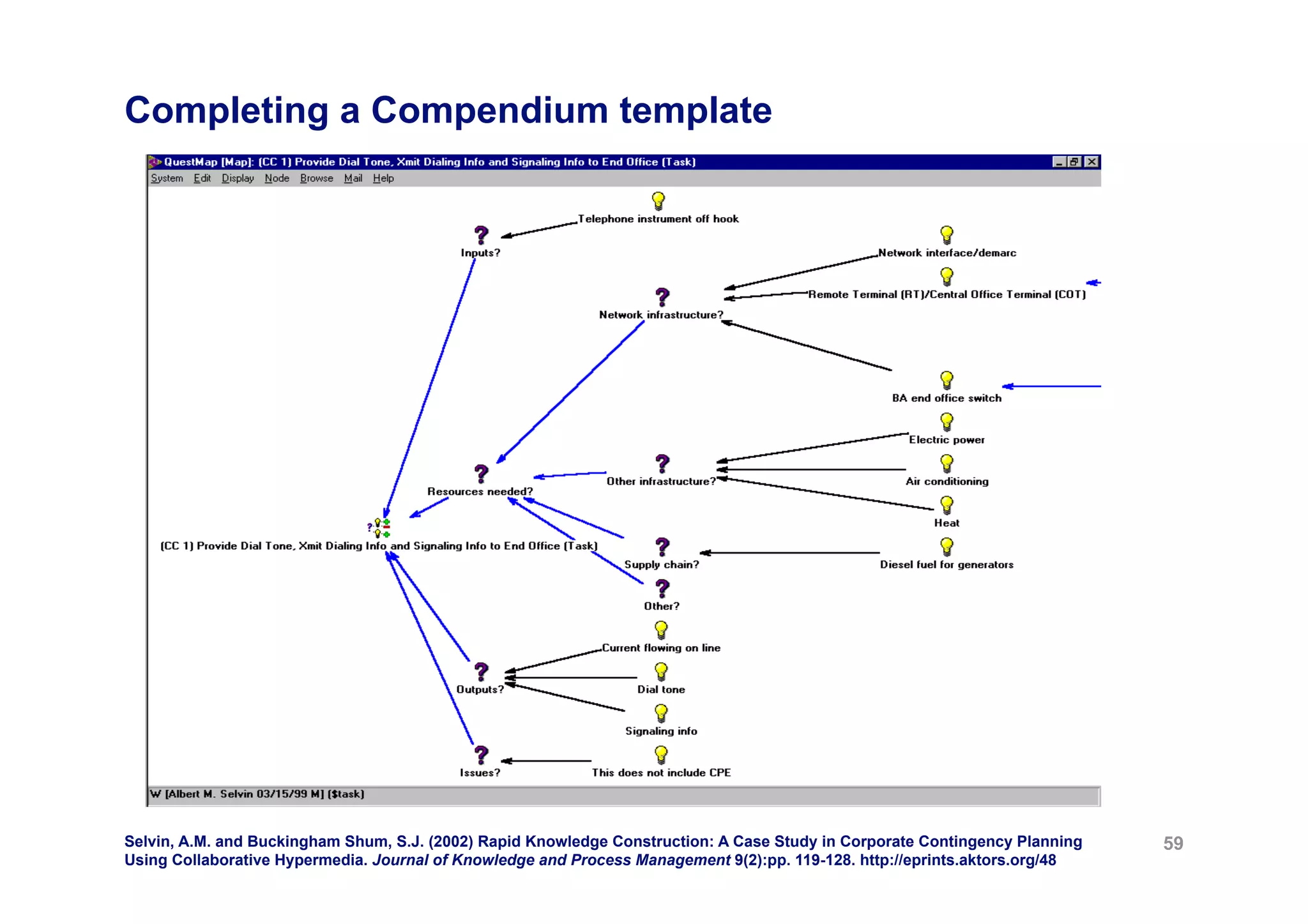
Completing a Compendium template


Selvin, A.M. and Buckingham Shum, S.J. (2002) Rapid Knowledge Construction: A Case Study in Corporate Contingency Planning   59
Using Collaborative Hypermedia. Journal of Knowledge and Process Management 9(2):pp. 119-128. http://eprints.aktors.org/48
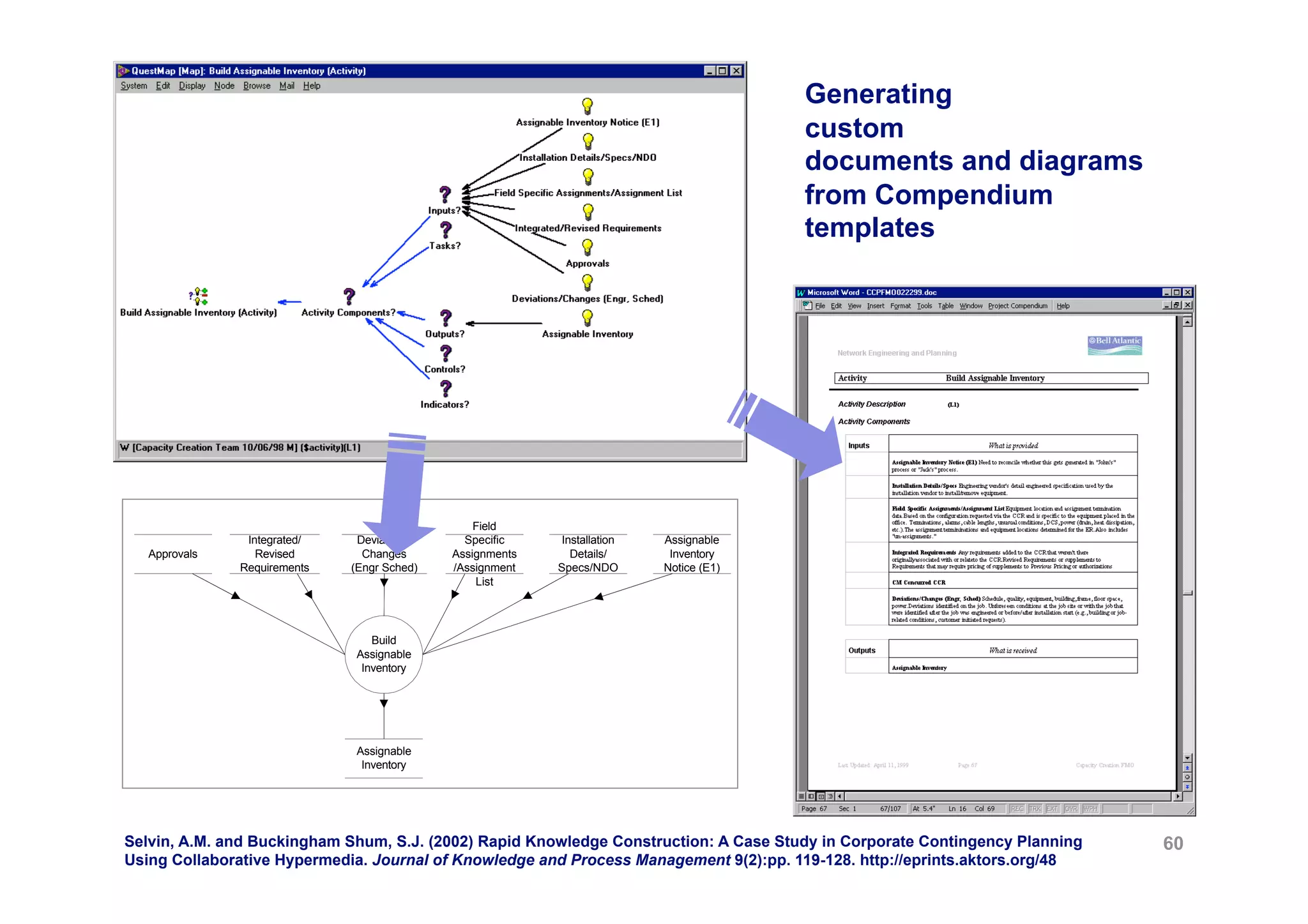
Generating
                                                                                        custom
                                                                                        documents and diagrams
                                                                                        from Compendium
                                                                                        templates


                                                 Field
                Integrated/    Deviations/     Specific    Installation   Assignable
   Approvals      Revised       Changes      Assignments     Details/      Inventory
               Requirements   (Engr Sched)   /Assignment   Specs/NDO      Notice (E1)
                                                 List


                                 Build
                              Assignable
                               Inventory


                              Assignable
                               Inventory


Selvin, A.M. and Buckingham Shum, S.J. (2002) Rapid Knowledge Construction: A Case Study in Corporate Contingency Planning   60
Using Collaborative Hypermedia. Journal of Knowledge and Process Management 9(2):pp. 119-128. http://eprints.aktors.org/48
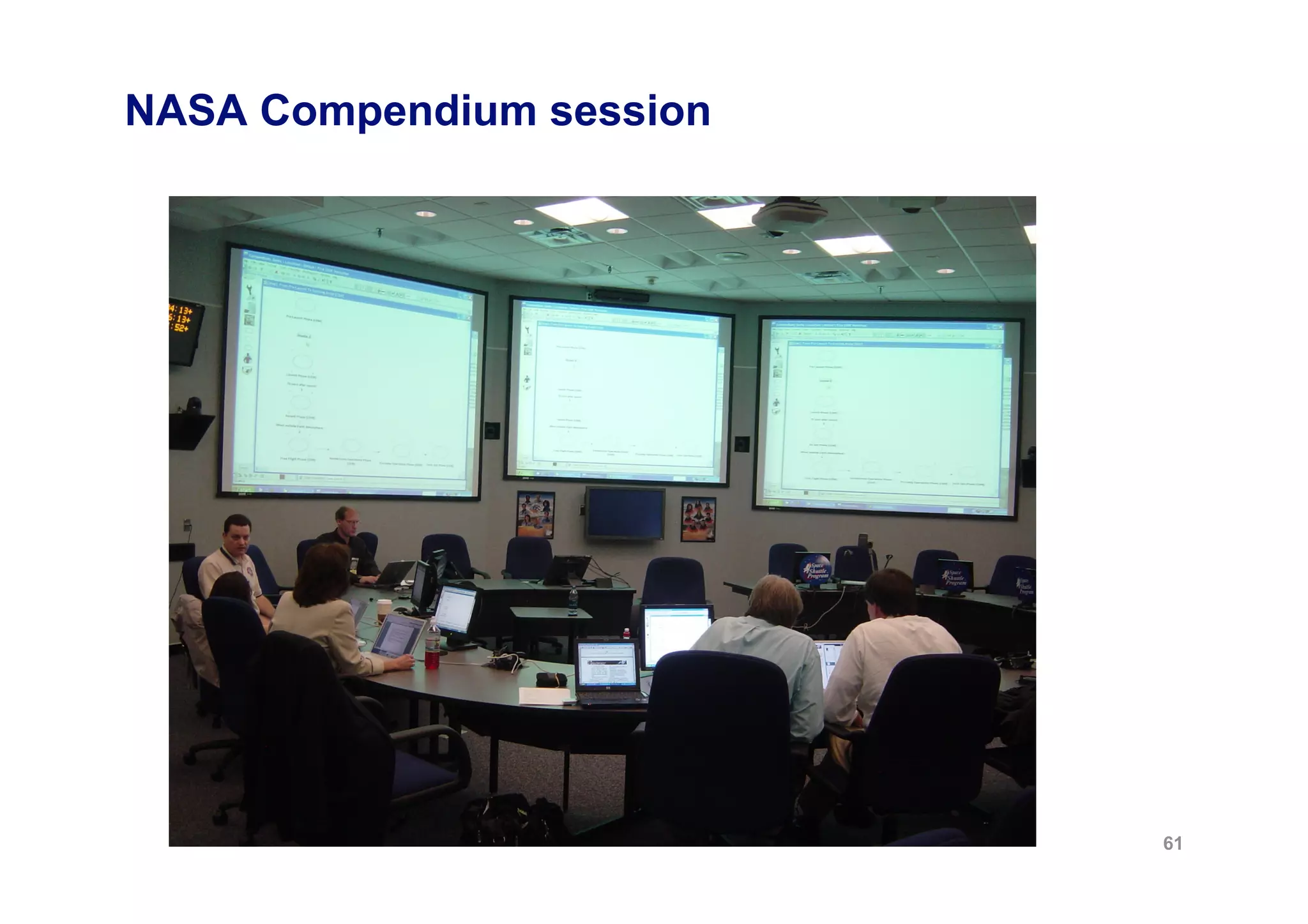
NASA Compendium session


                          61
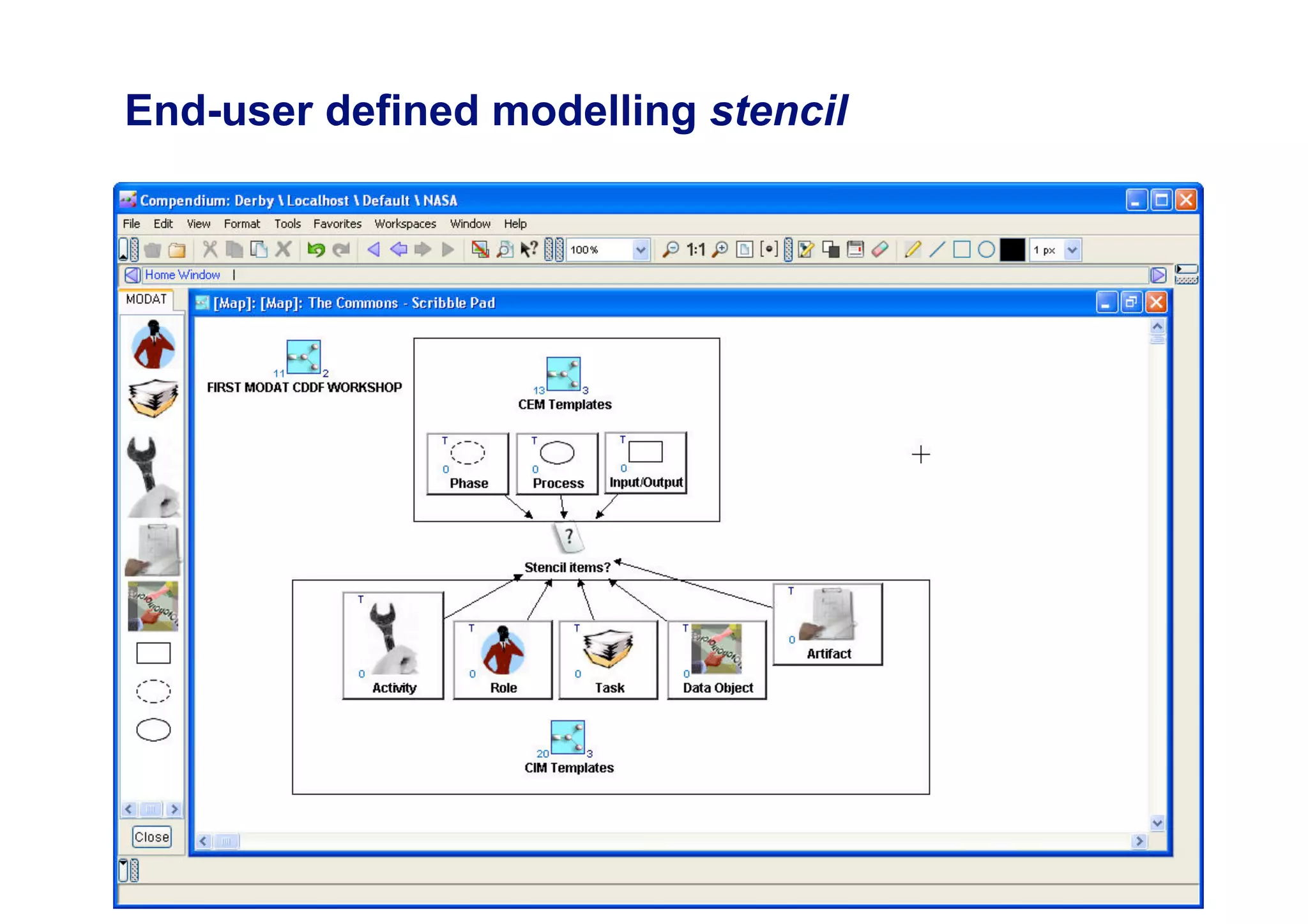
End-user defined modelling stencil


                                     62
Using Compendium for personnel recovery
               planning

           Example of Conversational Modelling:
 real time dialogue mapping combined with model driven
                     templates (AI+IA)


 Co-OPR Project (with Austin Tate): http://www.aiai.ed.ac.uk/project/co-opr
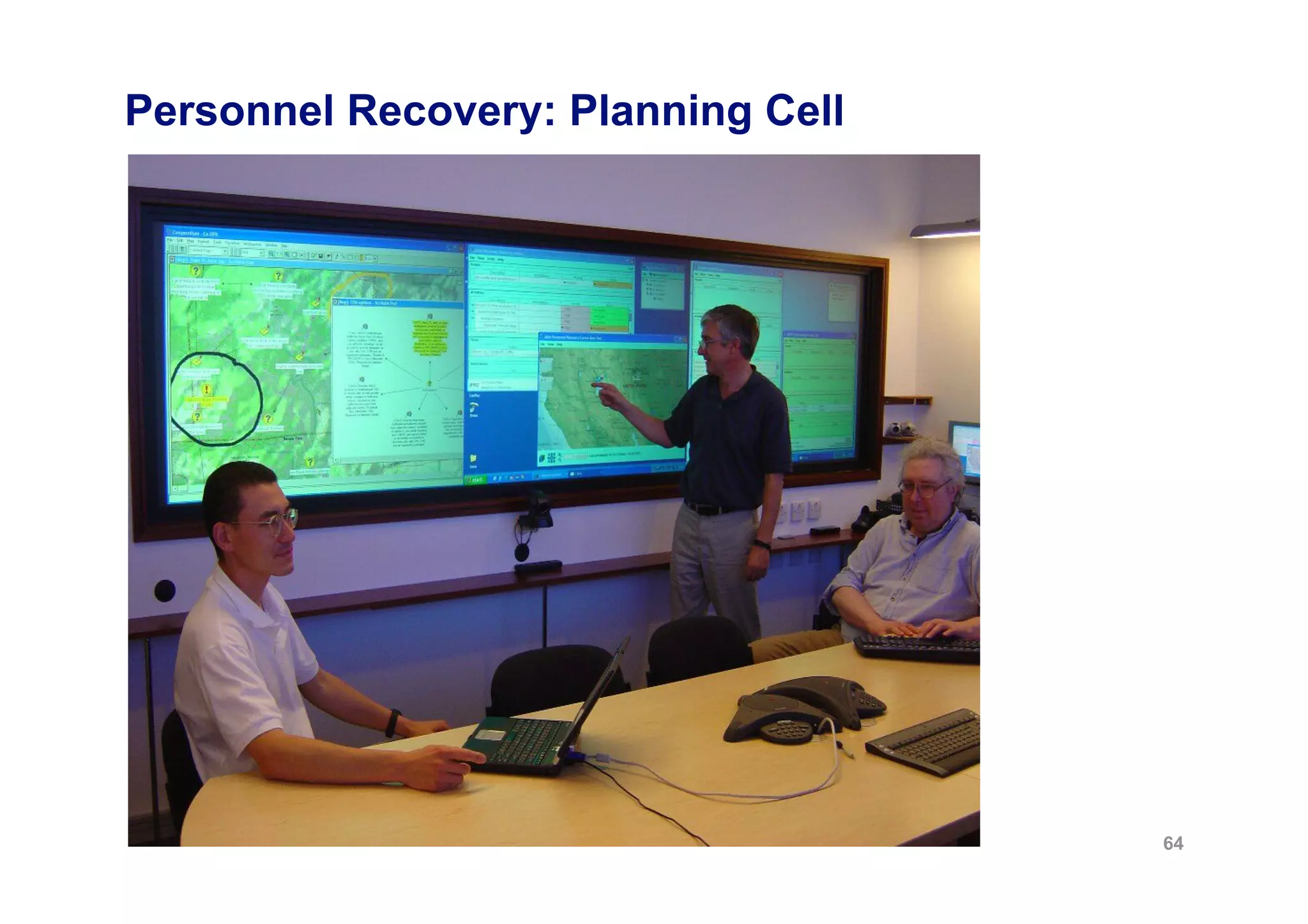
Personnel Recovery: Planning Cell


                                    64
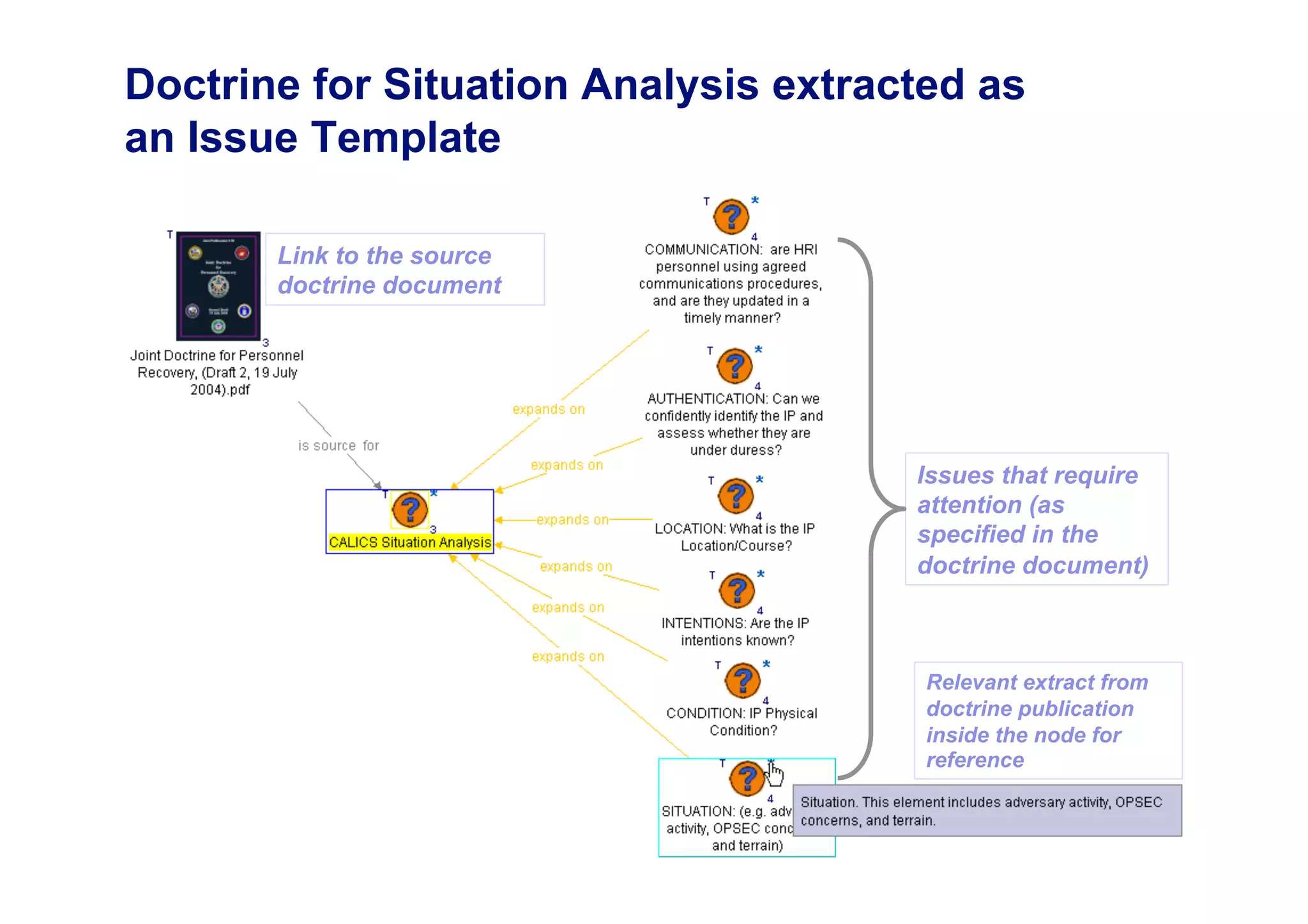
Doctrine for Situation Analysis extracted as
an Issue Template

       Link to the source
       doctrine document


                                      Issues that require
                                      attention (as
                                      specified in the
                                      doctrine document)


                                       Relevant extract from
                                       doctrine publication
                                       inside the node for
                                       reference
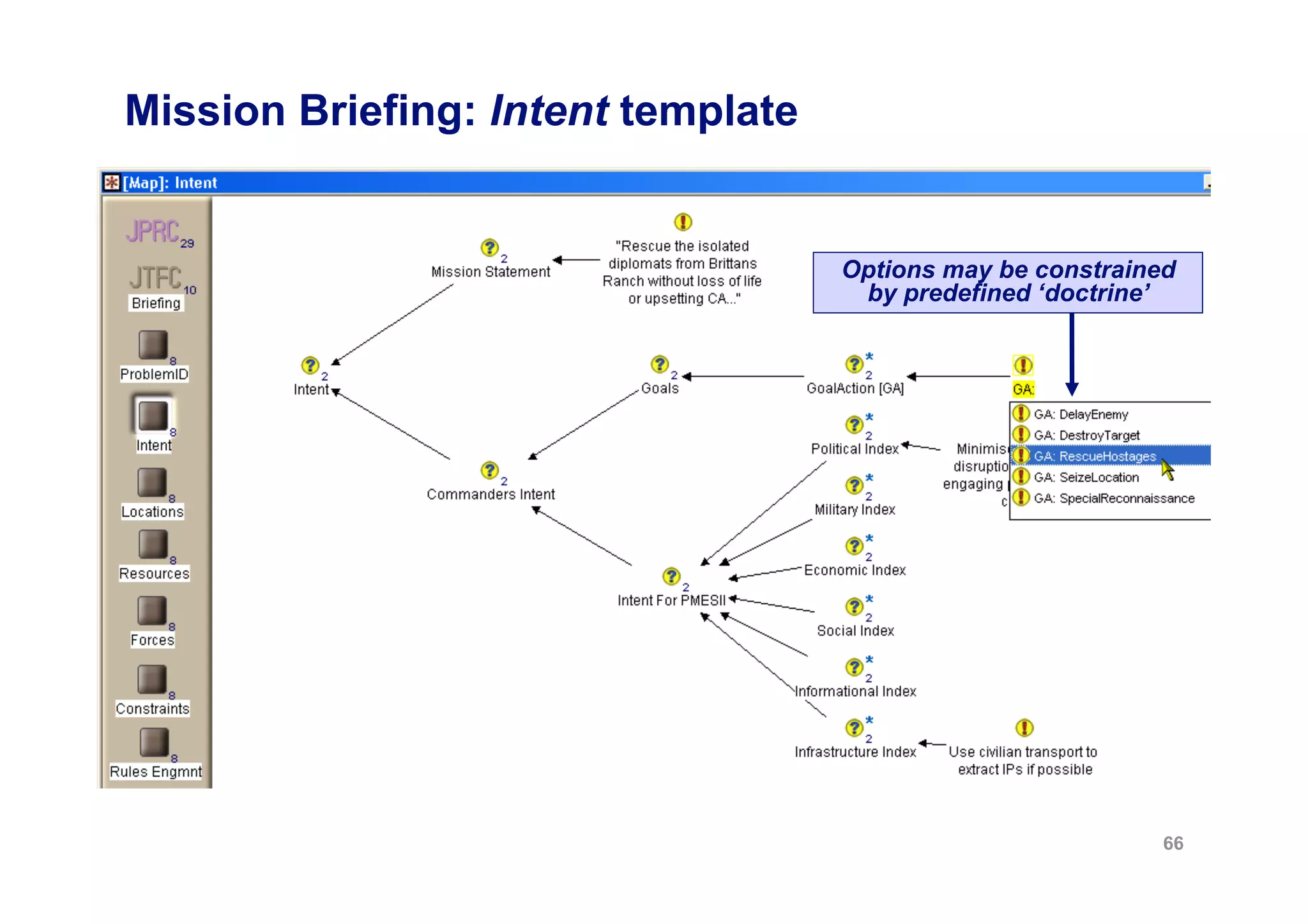
Mission Briefing: Intent template


                                    Options may be constrained
                                     by predefined ‘doctrine’


                                                             66
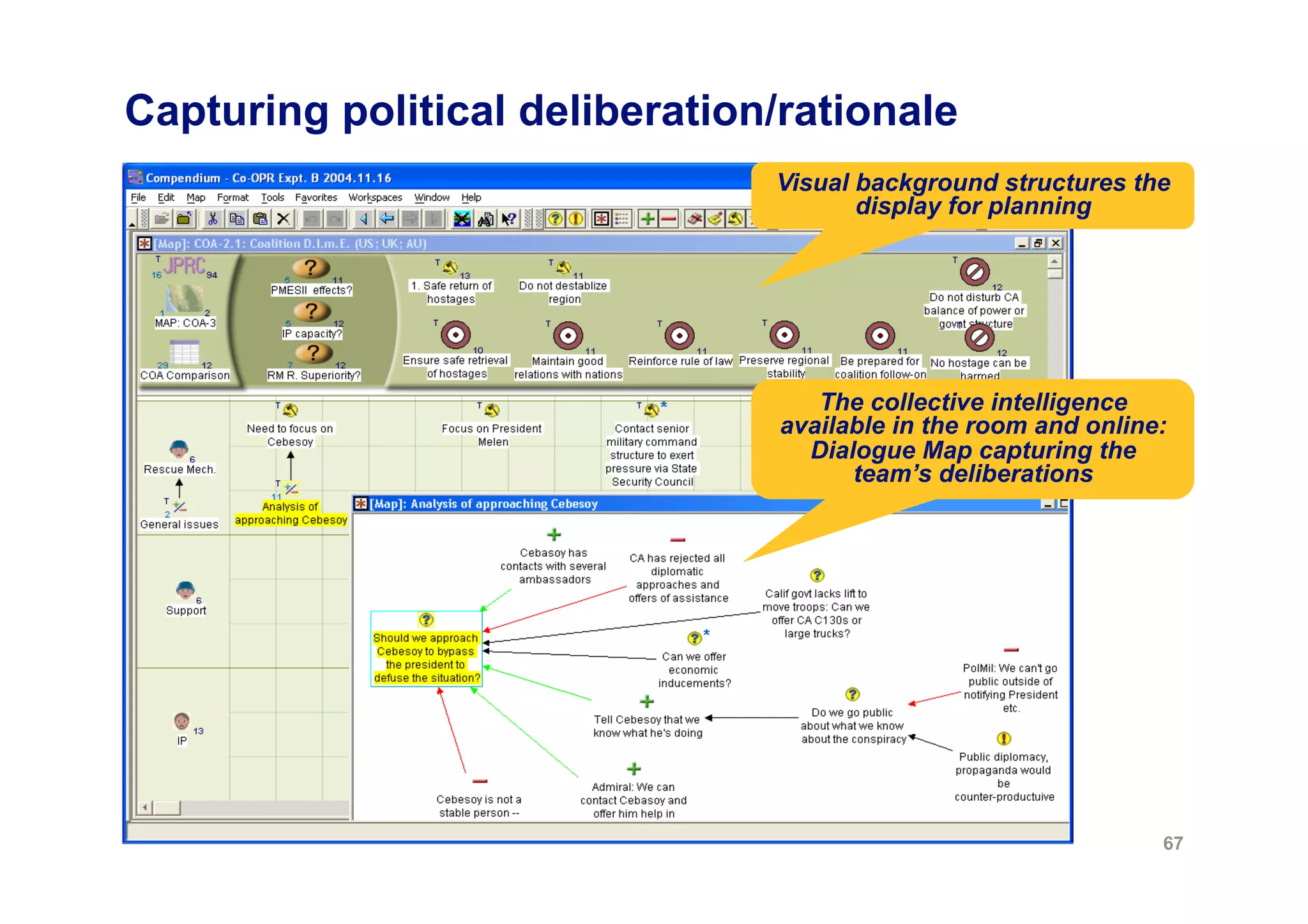
Capturing political deliberation/rationale
                                Visual background structures the
                                       display for planning


                                    The collective intelligence
                                 available in the room and online:
                                   Dialogue Map capturing the
                                       team’s deliberations


                                                                 67
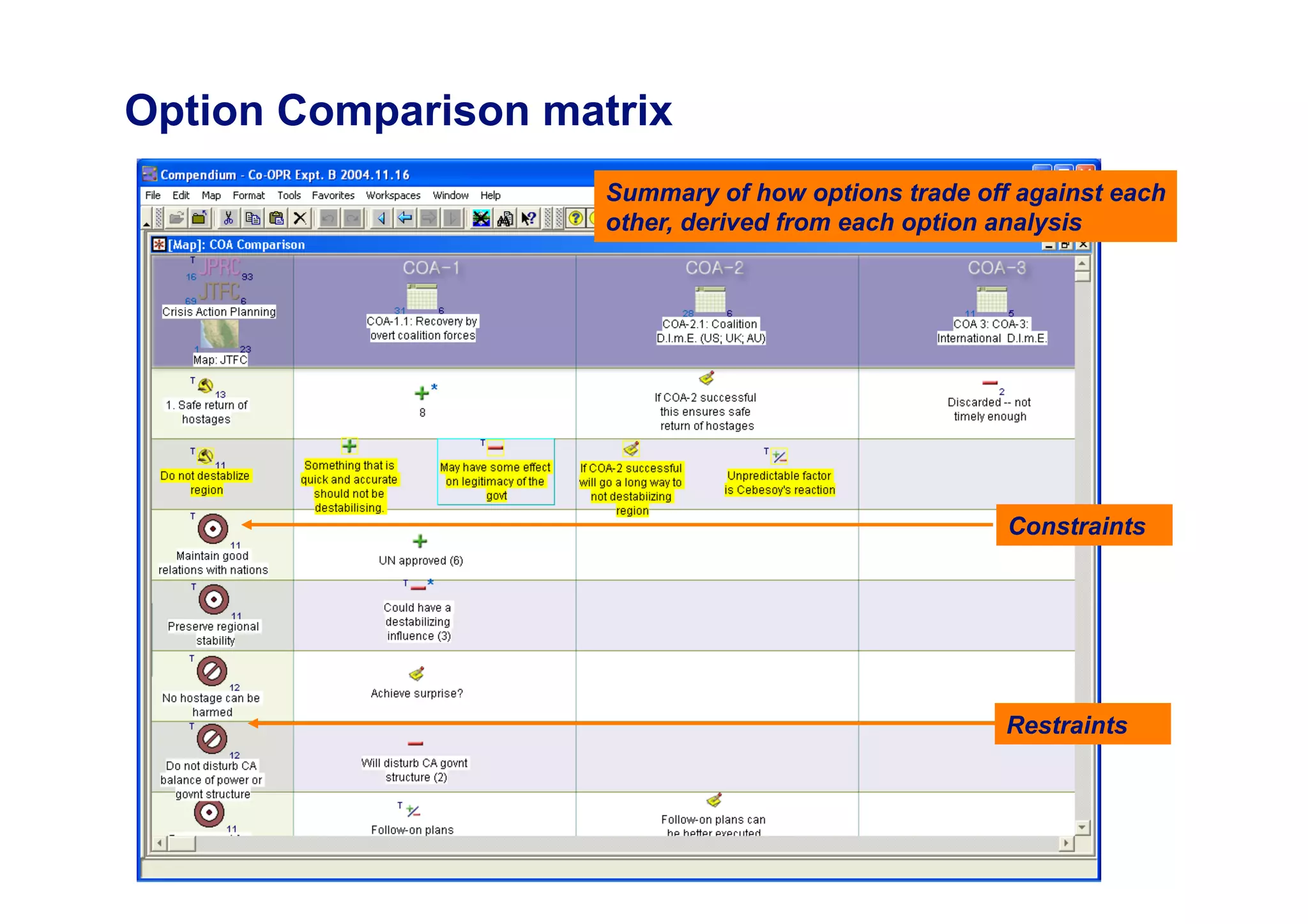
Option Comparison matrix
                     Summary of how options trade off against each
                     other, derived from each option analysis


                                                     Constraints


                                                     Restraints
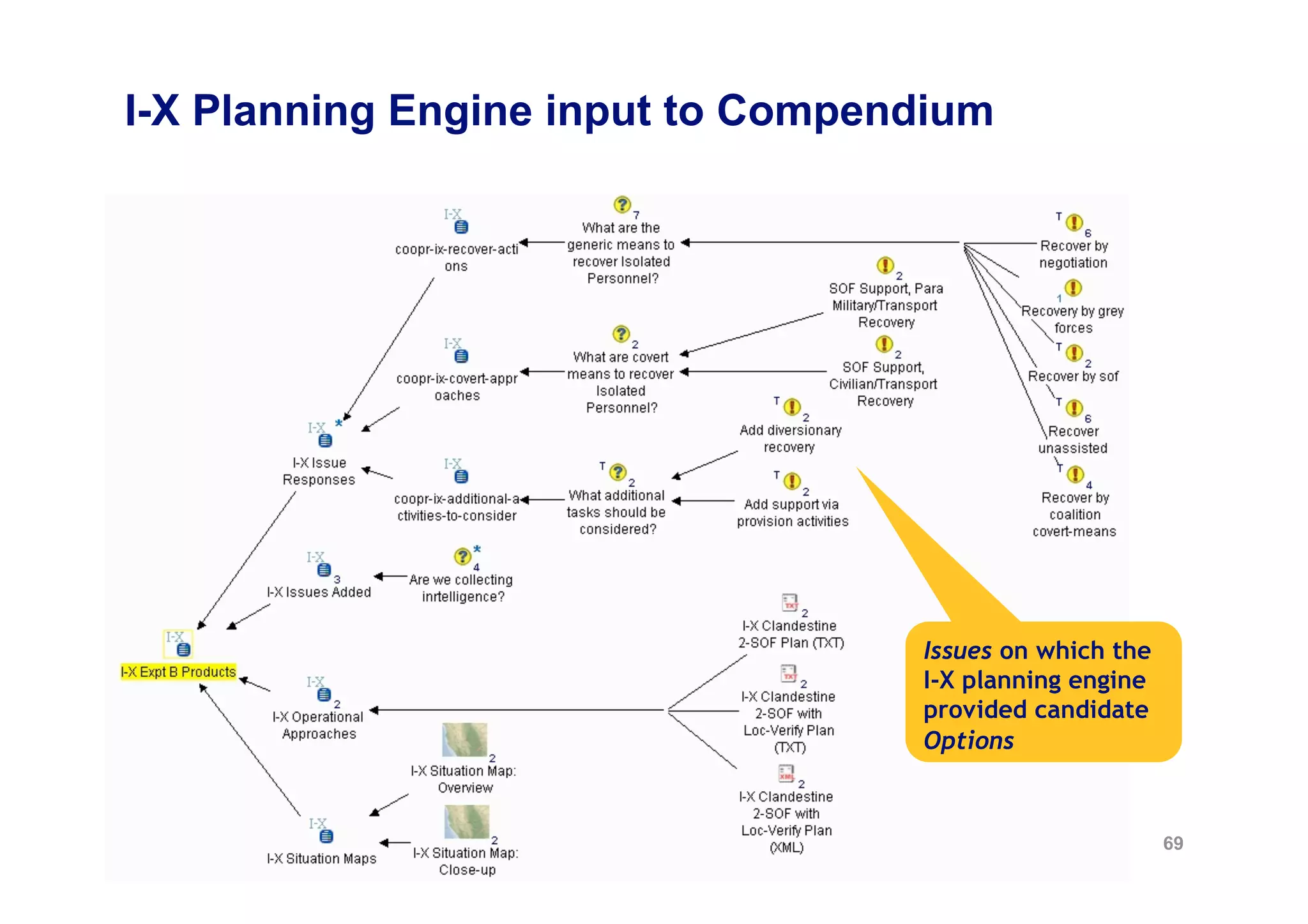
I-X Planning Engine input to Compendium


                                   Issues on which the
                                   I-X planning engine
                                   provided candidate
                                   Options


                                                         69
Large scale NASA e-science field trials:

  Interoperability with other databases, software
          agents and collaboration tools


                              www.kmi.open.ac.uk/projects/coakting/nasa

Clancey, W.J., Sierhuis, M., Alena, R., Berrios, D., Dowding, J., Graham, J.S., Tyree, K.S., Hirsh, R.L.,
Garry, W.B., Semple, A., Buckingham Shum, S.J., Shadbolt, N. and Rupert, S. (2005). “Automating
CapCom Using Mobile Agents and Robotic Assistants.” 1st Space Exploration Conference, American
Institute of Aeronautics and Astronautics, 31 Jan-1 Feb, 2005, Orlando, FL. Available from: AIAA
Meeting Papers on Disc [CD-ROM]: Reston, VA, and as Advanced Knowledge Technologies ePrint 375:
http://eprints.aktors.org/375
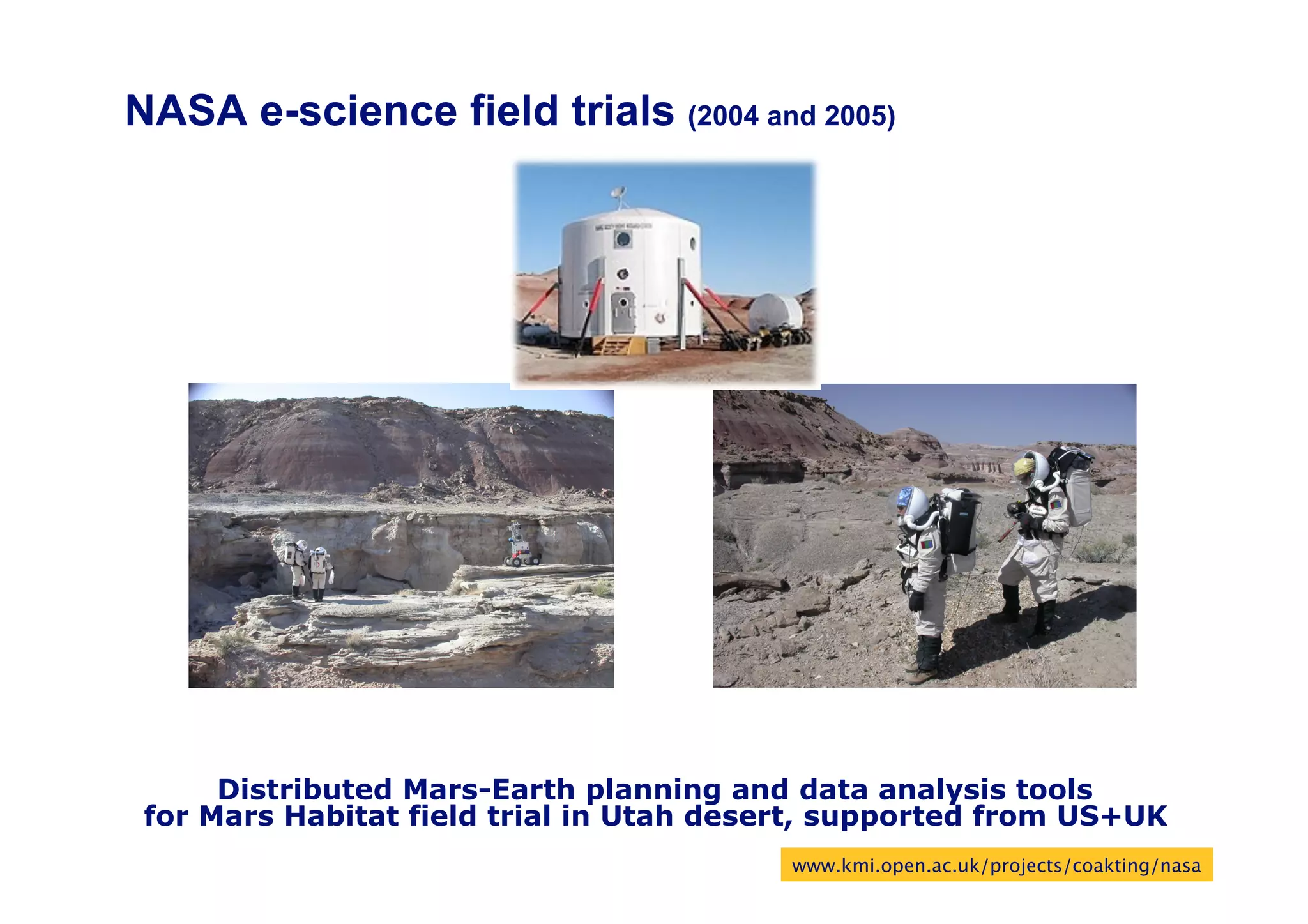
NASA e-science field trials (2004 and 2005)


      Distributed Mars-Earth planning and data analysis tools
 for Mars Habitat field trial in Utah desert, supported from US+UK
                                          www.kmi.open.ac.uk/projects/coakting/nasa
                                                                                 71
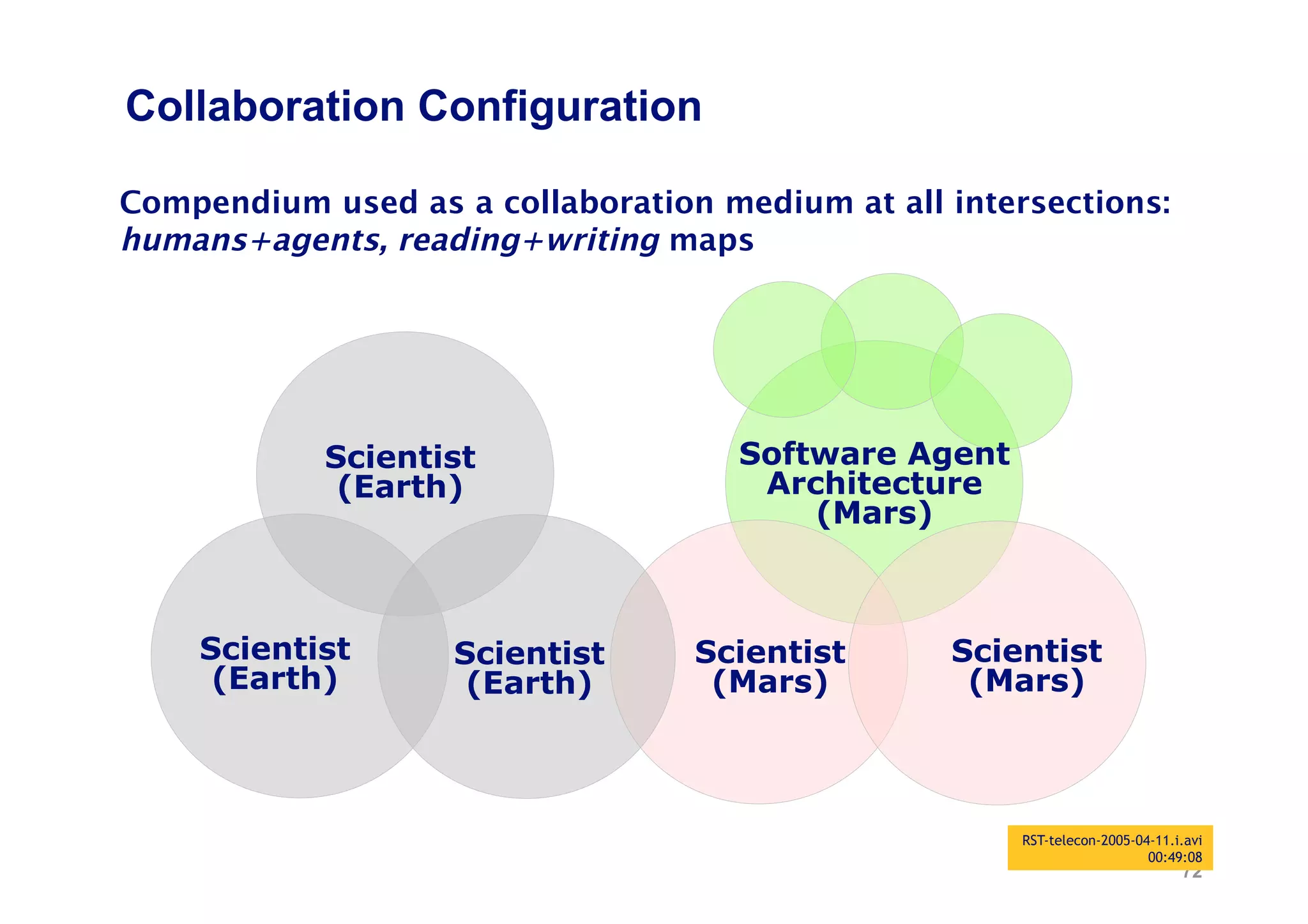
Collaboration Configuration

Compendium used as a collaboration medium at all intersections:
humans+agents, reading+writing maps


            Scientist                Software Agent
             (Earth)                  Architecture
                                         (Mars)


    Scientist       Scientist     Scientist      Scientist
     (Earth)         (Earth)       (Mars)         (Mars)


                                                      RST-telecon-2005-04-11.i.avi
                                                                         00:49:08
                                                                              72
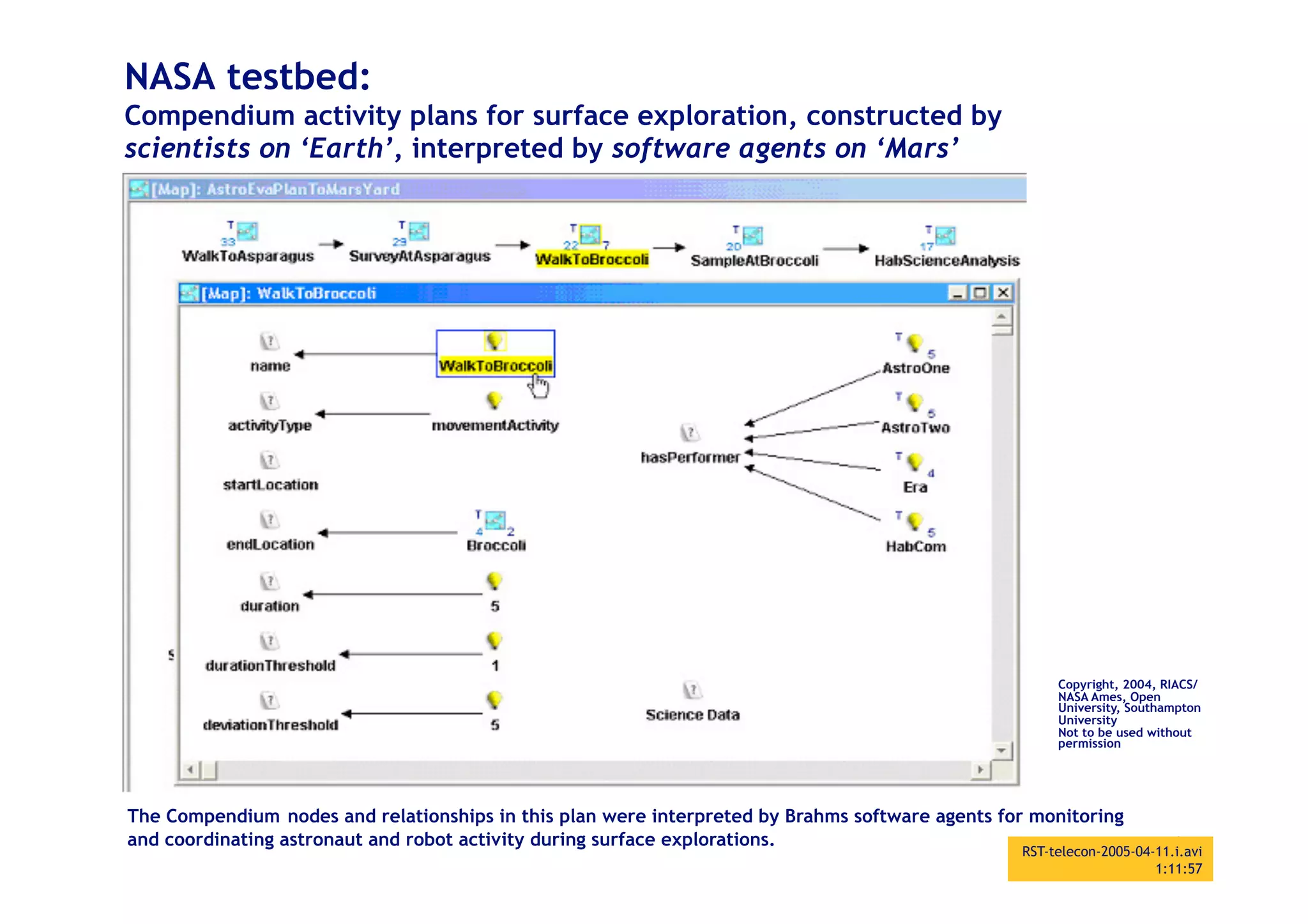
NASA testbed:
Compendium activity plans for surface exploration, constructed by
scientists on ‘Earth’, interpreted by software agents on ‘Mars’


                                                                                                      Copyright, 2004, RIACS/
                                                                                                      NASA Ames, Open
                                                                                                      University, Southampton
                                                                                                      University
                                                                                                      Not to be used without
                                                                                                      permission


The Compendium nodes and relationships in this plan were interpreted by Brahms software agents for monitoring
and coordinating astronaut and robot activity during surface explorations.
                                           73
                                                                                                 RST-telecon-2005-04-11.i.avi
                                                                                                                     1:11:57
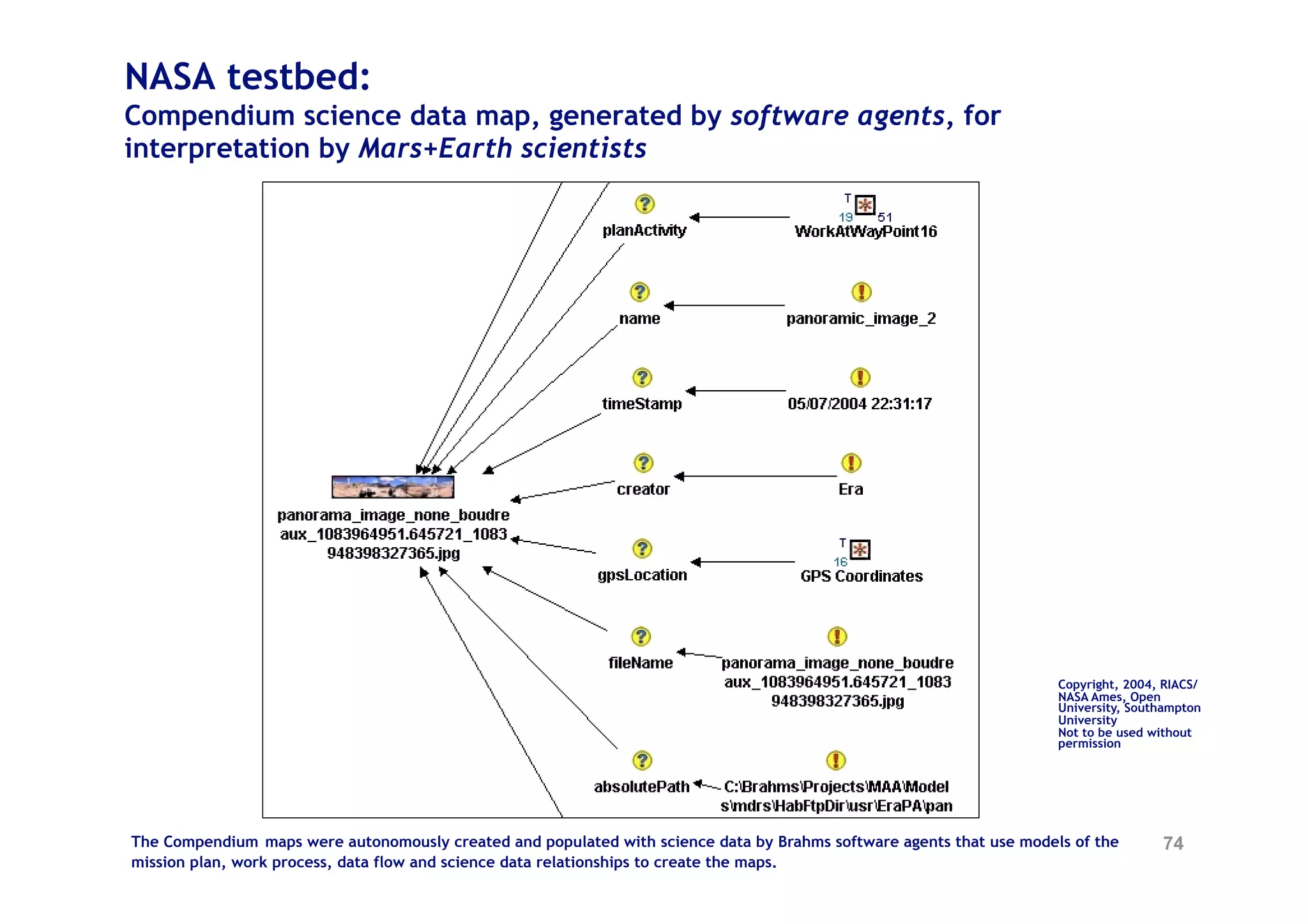
NASA testbed:
Compendium science data map, generated by software agents, for
interpretation by Mars+Earth scientists


                                                                                                                      Copyright, 2004, RIACS/
                                                                                                                      NASA Ames, Open
                                                                                                                      University, Southampton
                                                                                                                      University
                                                                                                                      Not to be used without
                                                                                                                      permission


The Compendium maps were autonomously created and populated with science data by Brahms software agents that use models of the        74
mission plan, work process, data flow and science data relationships to create the maps.
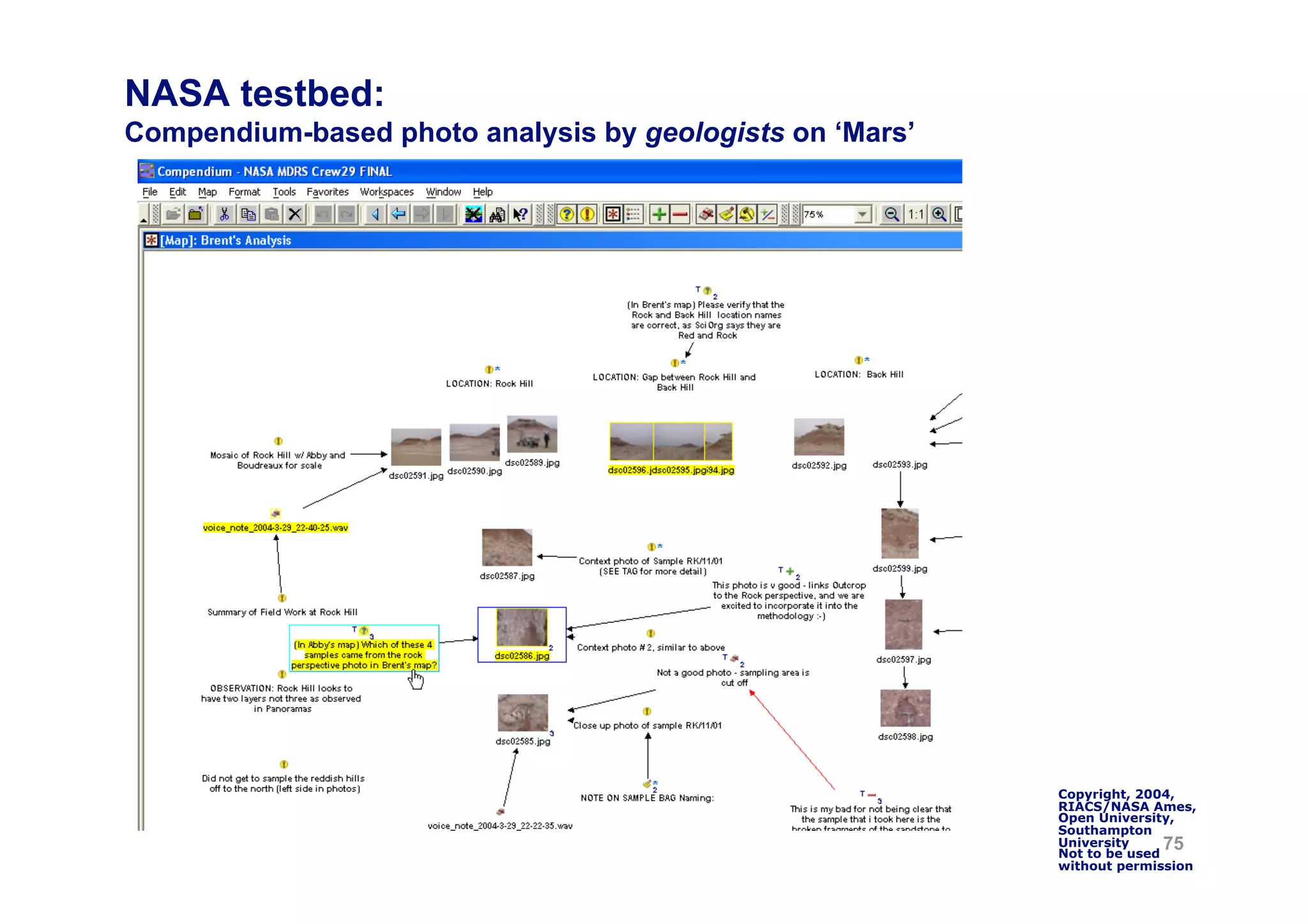
NASA testbed:
Compendium-based photo analysis by geologists on ‘Mars’


                                                          Copyright, 2004,
                                                          RIACS/NASA Ames,
                                                          Open University,
                                                          Southampton
                                                          University
                                                          Not to be used
                                                                         75
                                                          without permission
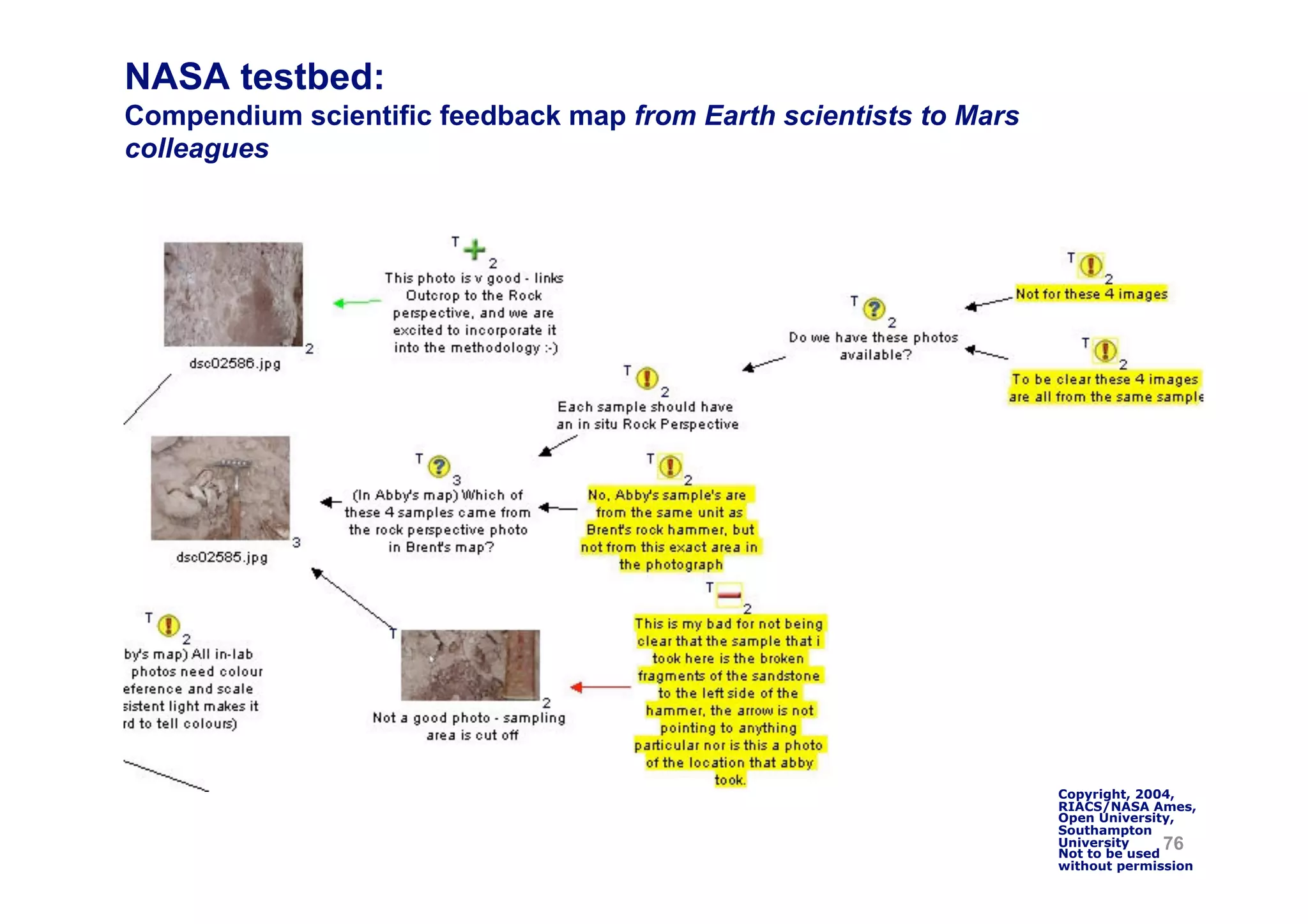
NASA testbed:
Compendium scientific feedback map from Earth scientists to Mars
colleagues


                                                                   Copyright, 2004,
                                                                   RIACS/NASA Ames,
                                                                   Open University,
                                                                   Southampton
                                                                   University
                                                                   Not to be used
                                                                                  76
                                                                   without permission
Reqts Eng
= sensemaking in
complex adaptive
    systems?
                   77
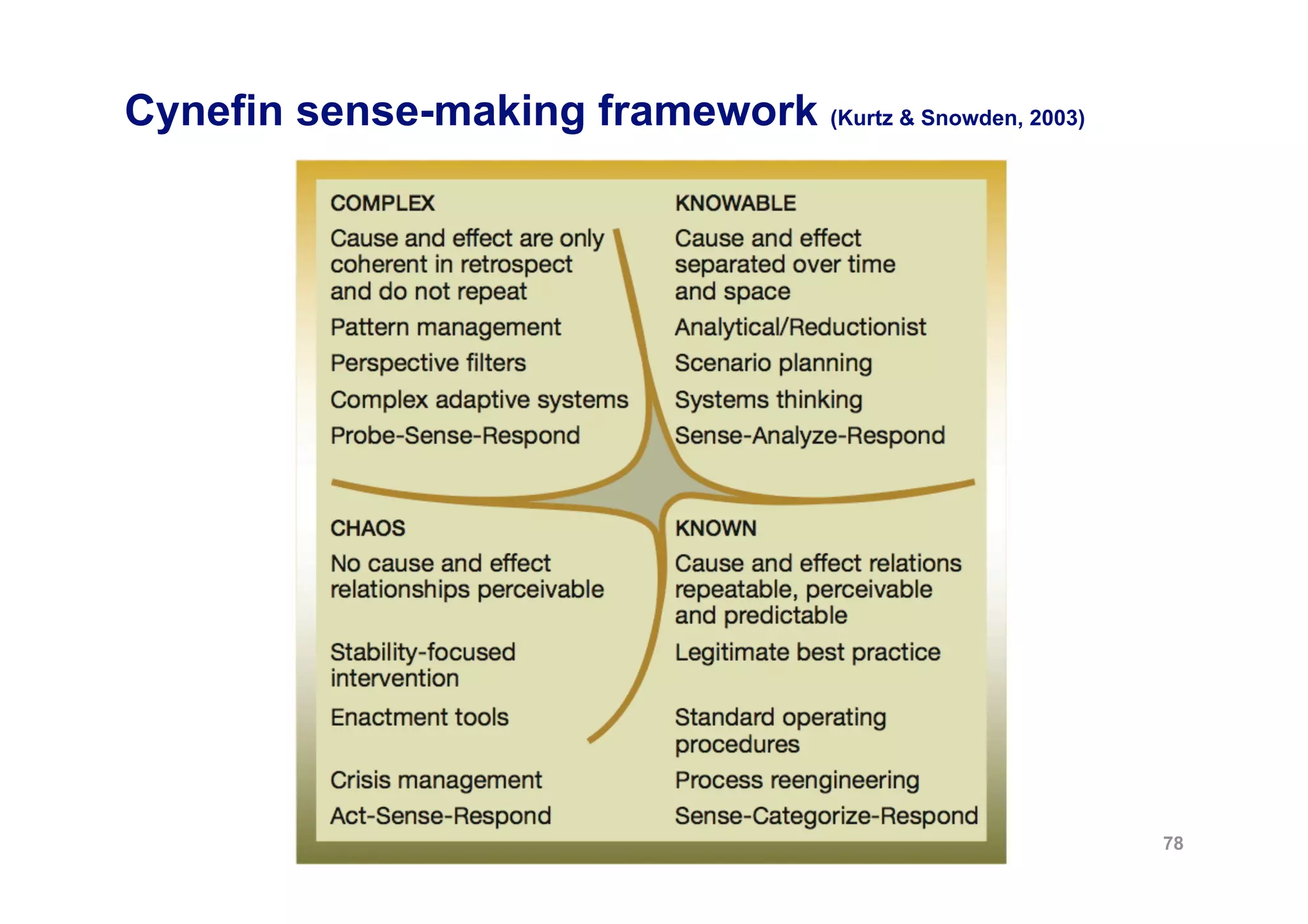
Cynefin sense-making framework (Kurtz & Snowden, 2003)


                                                         78
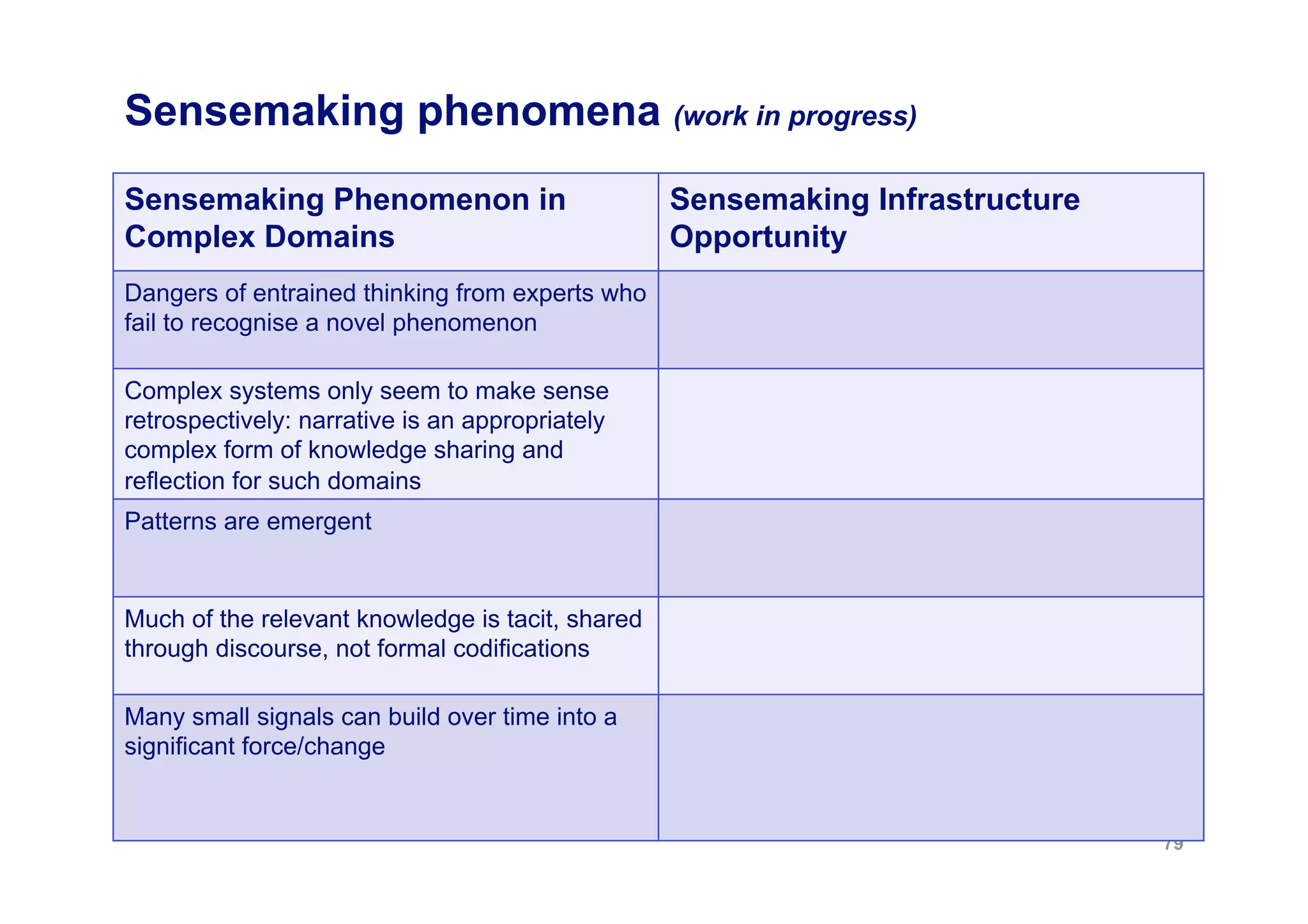
Sensemaking phenomena (work in progress)
Sensemaking Phenomenon in                         Sensemaking Infrastructure
Complex Domains                                   Opportunity
Dangers of entrained thinking from experts who
fail to recognise a novel phenomenon

Complex systems only seem to make sense
retrospectively: narrative is an appropriately
complex form of knowledge sharing and
reflection for such domains
Patterns are emergent


Much of the relevant knowledge is tacit, shared
through discourse, not formal codifications

Many small signals can build over time into a
significant force/change


                                                                               79
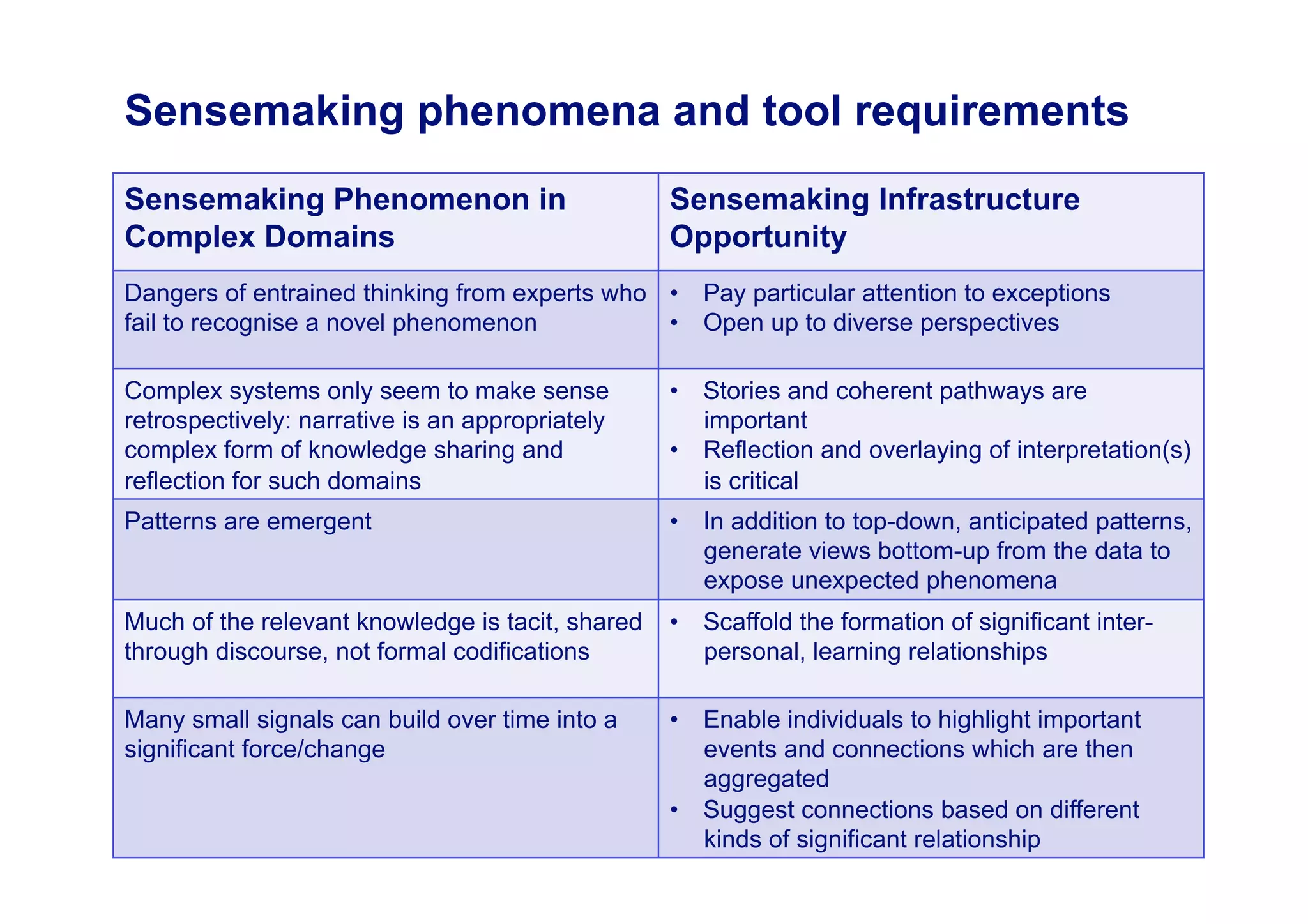
Sensemaking phenomena and tool requirements
Sensemaking Phenomenon in                         Sensemaking Infrastructure
Complex Domains                                   Opportunity
Dangers of entrained thinking from experts who •  Pay particular attention to exceptions
fail to recognise a novel phenomenon           •  Open up to diverse perspectives

Complex systems only seem to make sense           •  Stories and coherent pathways are
retrospectively: narrative is an appropriately       important
complex form of knowledge sharing and             •  Reflection and overlaying of interpretation(s)
reflection for such domains                          is critical
Patterns are emergent                             •  In addition to top-down, anticipated patterns,
                                                     generate views bottom-up from the data to
                                                     expose unexpected phenomena
Much of the relevant knowledge is tacit, shared   •  Scaffold the formation of significant inter-
through discourse, not formal codifications          personal, learning relationships

Many small signals can build over time into a     •  Enable individuals to highlight important
significant force/change                             events and connections which are then
                                                     aggregated
                                                  •  Suggest connections based on different
                                                     kinds of significant relationship              80
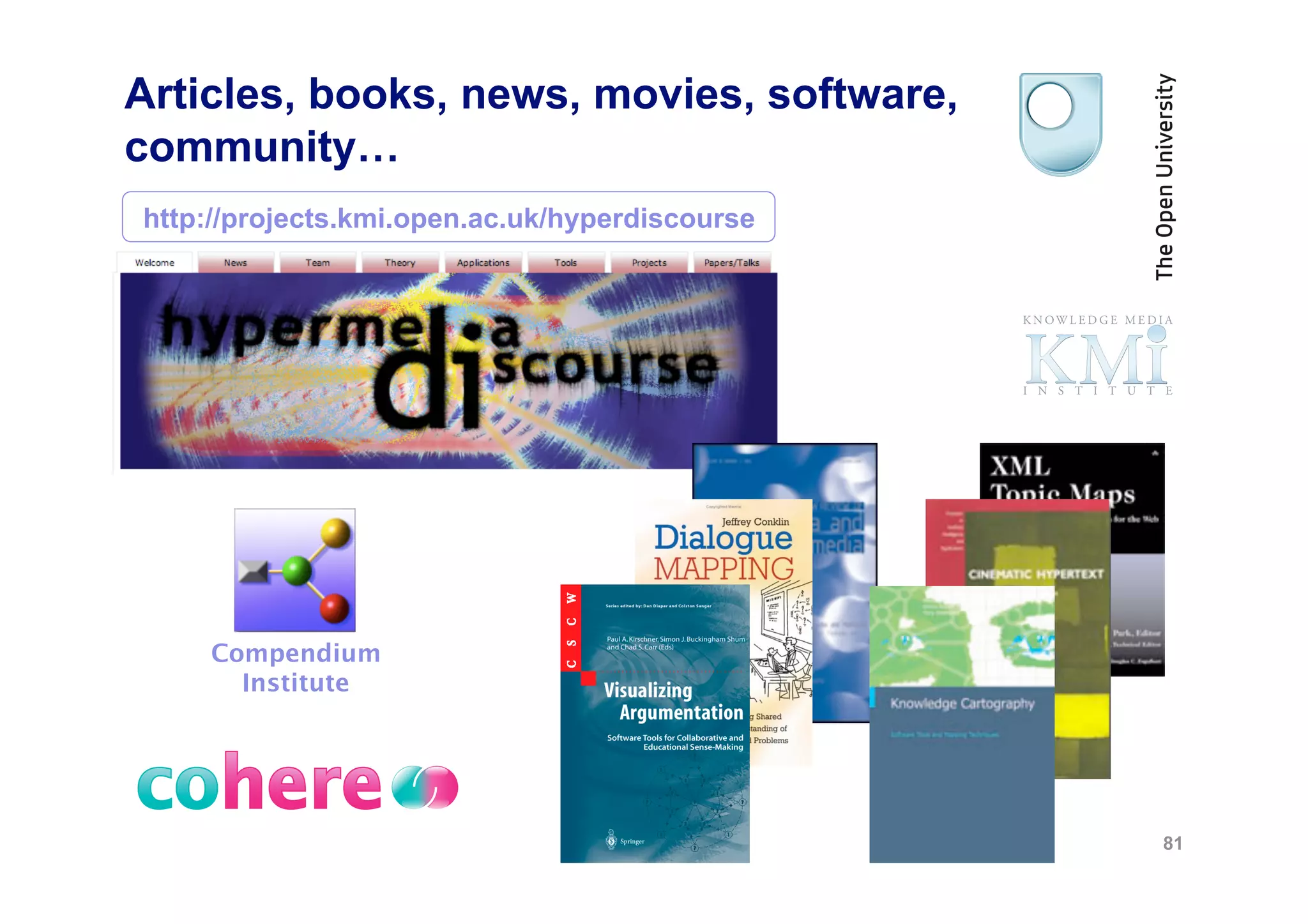
Articles, books, news, movies, software,
community…
http://projects.kmi.open.ac.uk/hyperdiscourse


     Compendium

       Institute


                                                81
Milestone publications in
    human-centred
design rationale research


                            82
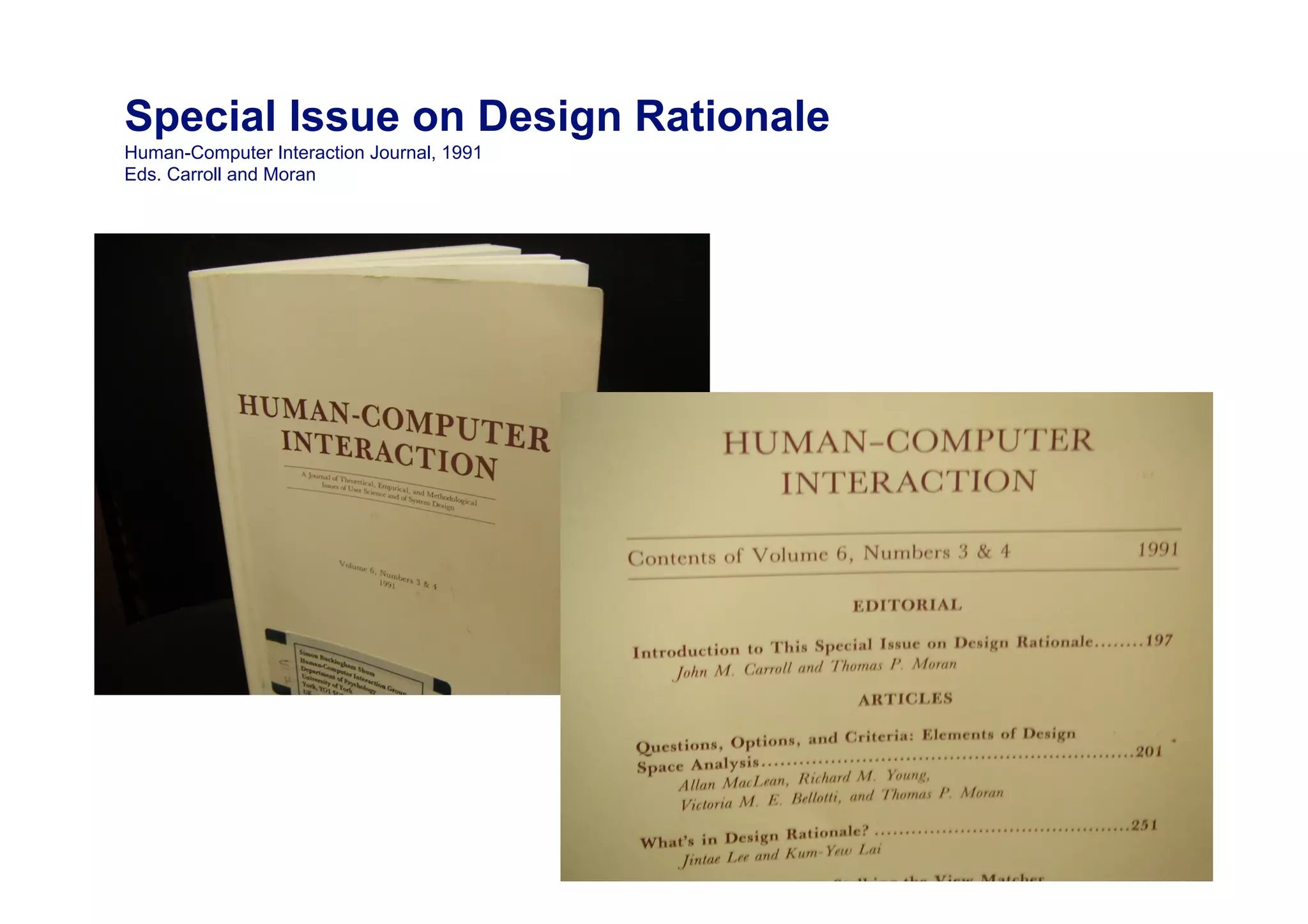
Special Issue on Design Rationale
Human-Computer Interaction Journal, 1991
Eds. Carroll and Moran


                                           83
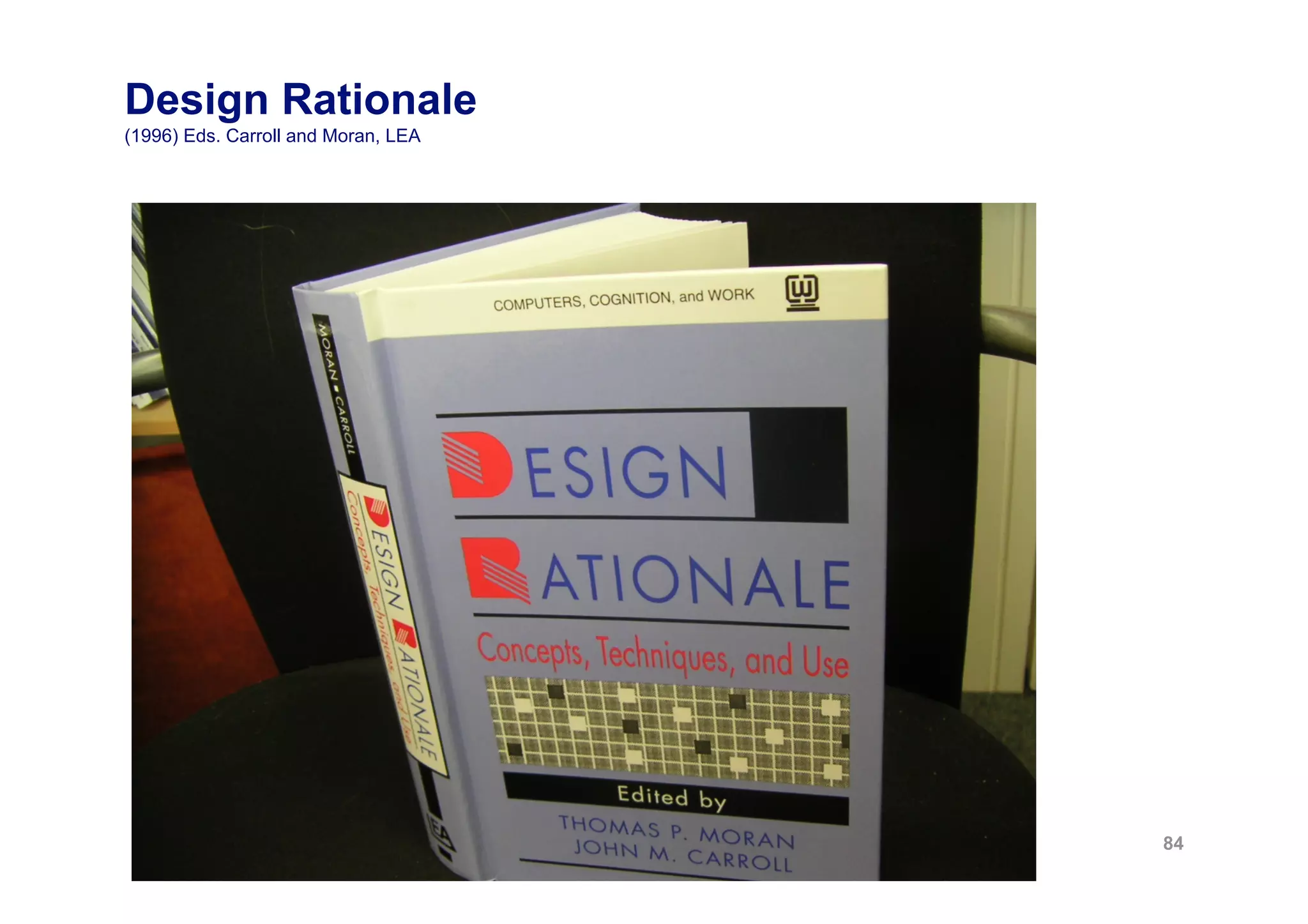
Design Rationale
(1996) Eds. Carroll and Moran, LEA


                                     84
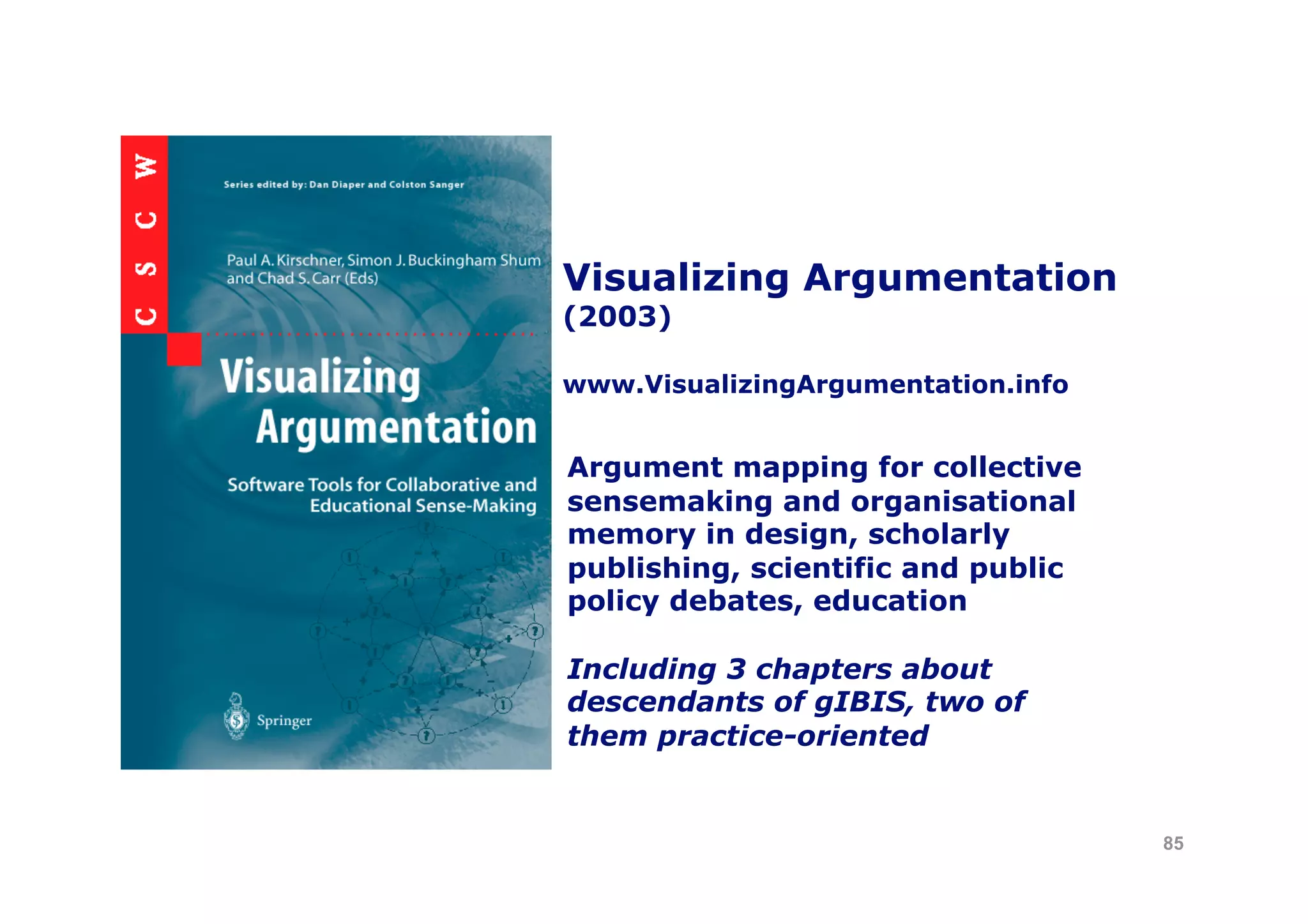
Visualizing Argumentation
(2003)

www.VisualizingArgumentation.info


Argument mapping for collective
sensemaking and organisational
memory in design, scholarly
publishing, scientific and public
policy debates, education

Including 3 chapters about
descendants of gIBIS, two of
them practice-oriented


                                    85
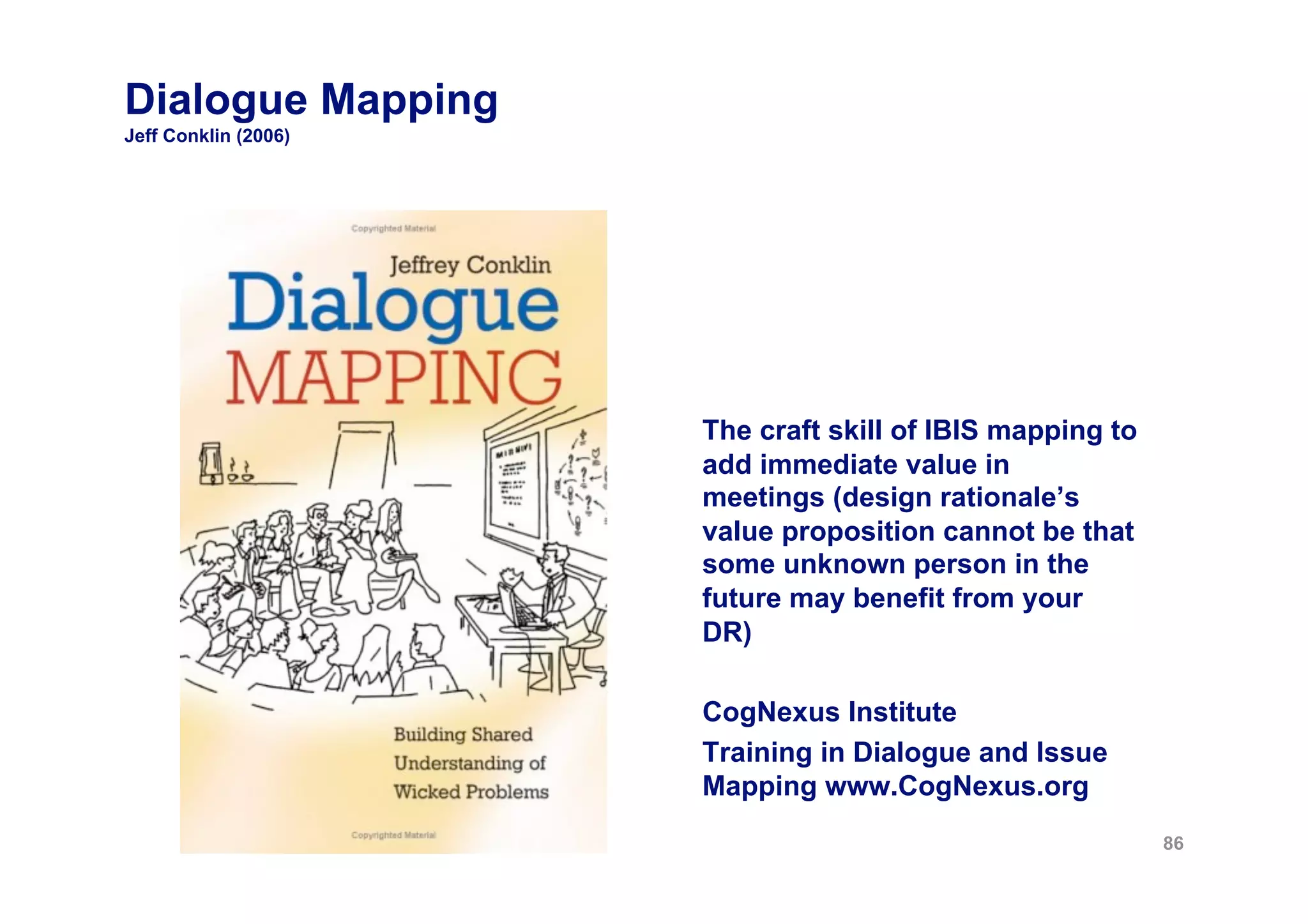
Dialogue Mapping
Jeff Conklin (2006)


                      The craft skill of IBIS mapping to
                      add immediate value in
                      meetings (design rationale’s
                      value proposition cannot be that
                      some unknown person in the
                      future may benefit from your
                      DR)

                      CogNexus Institute
                      Training in Dialogue and Issue
                      Mapping www.CogNexus.org
                                                           86
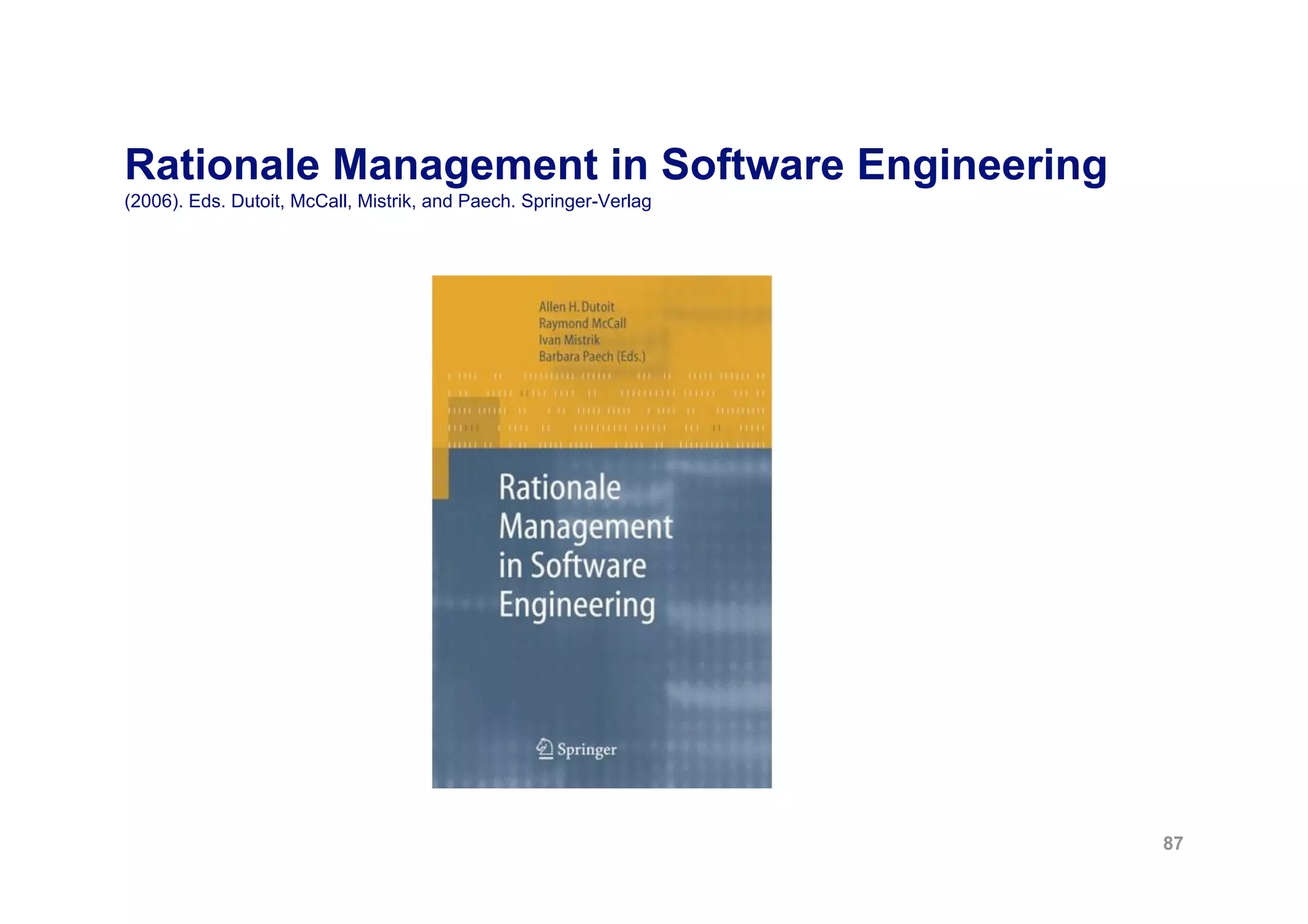
Rationale Management in Software Engineering
(2006). Eds. Dutoit, McCall, Mistrik, and Paech. Springer-Verlag


                                                                   87
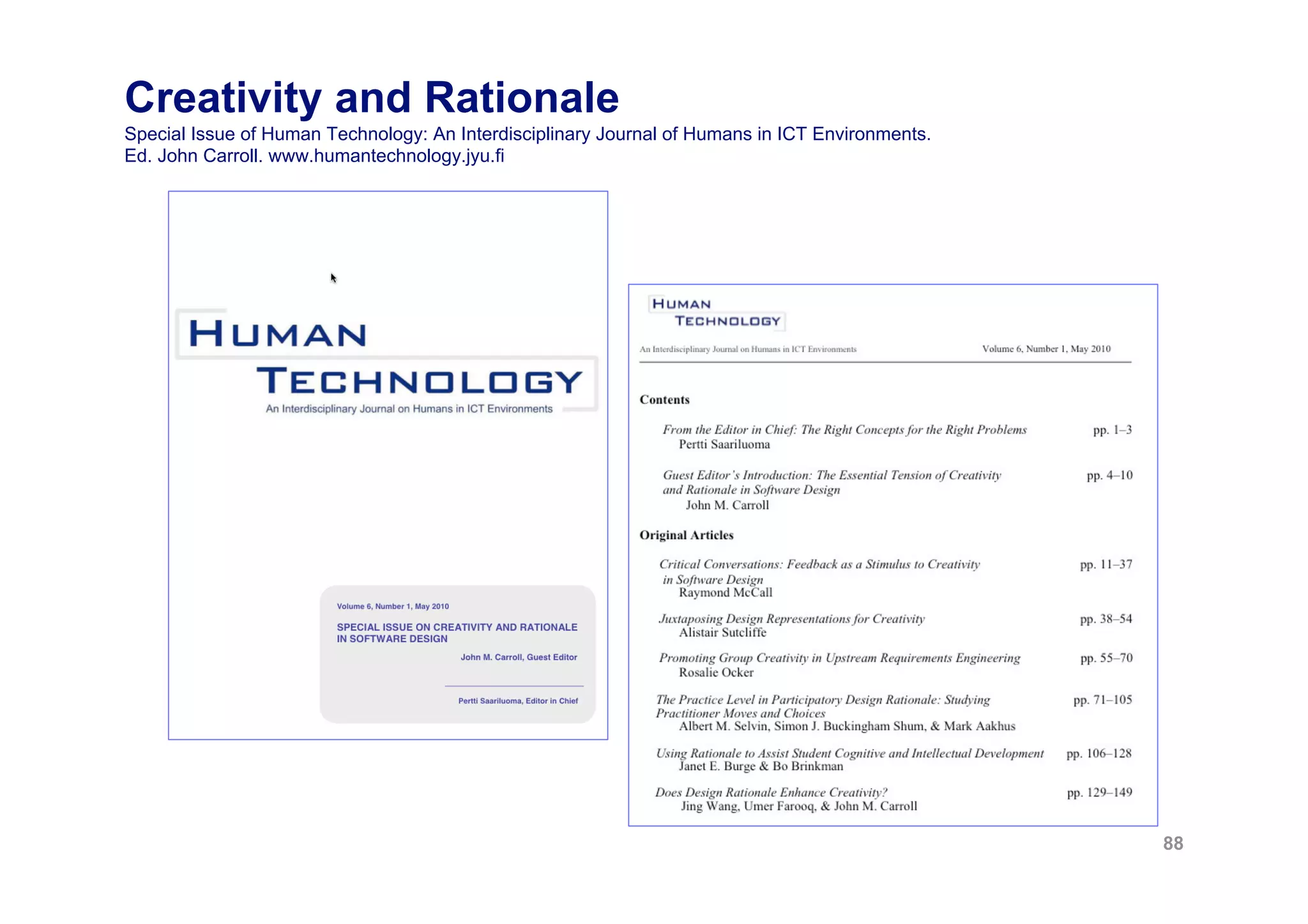
Creativity and Rationale
Special Issue of Human Technology: An Interdisciplinary Journal of Humans in ICT Environments.
Ed. John Carroll. www.humantechnology.jyu.fi


                                                                                                 88

Making Conversations Visible

  • 1.
    Imperial College London,2 Sept. 2010 Making Conversations Visible: The Rocky Road from Dream to Reality… Simon Buckingham Shum Knowledge Media Institute Open University UK http://people.kmi.open.ac.uk/sbs http://creativecommons.org/licenses/by-nc/2.0/uk 1
  • 2.
    My Space… Wicked Problems Collective Intelligence http://media.photobucket.com/image/yinyang/penelopecassandre/Tao_YinYangEarth2.jpg Sensemaking Learning Computer-Supported… participatory inquiry dialogue deliberation argumentation 2
  • 3.
  • 4.
    Human-Centred Computing forSensemaking (including Design Rationale, and arguably, many RE tools?) Domain Discourse
  • 5.
    Human-Centred Computing forSensemaking (including Design Rationale, and arguably, many RE tools?) Services Interaction Interoperability Design Domain Discourse
  • 6.
    Human-Centred Computing forSensemaking (including Design Rationale, and arguably, many RE tools?) Services Interaction Interoperability Design Learning Domain Curve Discourse Mastery
  • 7.
    Compendium has playeda number of roles in the design of socio-technical systems Decision/Design Rationale Knowledge Management Storyboarding Meeting Replay Domain Modelling Presentations Requirements Data Construction Analysis Specification Documentation Design Reviews 7
  • 8.
    Human-Centred Computing forSensemaking Services Interaction Interoperability Design Learning Domain Curve Discourse Mastery
  • 9.
    Horst Rittel’s IBIS(1972): Issue-Based Information System 9
  • 10.
    MacLean et al’s(1987) Design Space Analysis using QOC: Questions/Options/Criteria 10
  • 11.
    Libraries of IBIS templateswith critical questions to probe different kinds of arguments 11
  • 12.
    Libraries of IBIS templateswith critical questions to probe different kinds of arguments 12
  • 13.
    Human-Centred Computing forSensemaking Services Interaction Interoperability Design Learning Domain Curve Discourse Mastery
  • 14.
    Compendium “it’s like Excel, but for knowledge” http://compendium.open.ac.uk/institute Originally motivated by the requirement at NYNEX Science & Technology, for a tool capable of integrating formal organisational/system modelling with qualitative, narrative accounts from workplace ethnographers 14
  • 15.
  • 16.
    Compendium Java application(from ~1998): visual hypermedia for managing the connections between ideas flexibly Buckingham Shum, S., Selvin, A., Sierhuis, M., Conklin, J., Haley, C. and Nuseibeh, B. (2006). Hypermedia Support for Argumentation-Based Rationale: 15 Years on16 from gIBIS and QOC. In: Rationale Management in Software Engineering (Eds.) A.H. Dutoit, R. McCall, I. Mistrik, and B. Paech. Springer-Verlag: Berlin. http://oro.open.ac.uk/3032
  • 17.
    gIBIS: graphical IBIS (MCCresearch prototype, 1989, running in GERM) 17
  • 18.
    CM/1, renamed QuestMap (CorporateMemory Systems 1992, spinoff from MCC’s gIBIS) 18
  • 19.
    Issue/Argument Mapping comesof age… (Rob Bracewell, U. Cambridge: DRed: Decision Rationale editor )
  • 20.
    Issue/Argument Mapping comesof age… Online Deliberation: Emerging Tools Workshop Online Deliberation 2010, Leeds UK (30 June – 2 July) www.olnet.org/odet2010 20
  • 21.
    Issue/Argument Mapping comesof age… (David Price, Debategraph.org) 21
  • 22.
    Issue/Argument Mapping comesof age… (David Price, Debategraph.org) 22
  • 23.
    Issue/Argument Mapping comesof age… (Tim van Gelder, AusThinkConsulting.com) 23
  • 24.
    Issue/Argument Mapping comesof age… (Tim van Gelder, AusThinkConsulting.com) bCsive Online
  • 25.
    Issue/Argument Mapping comesof age… (Tim van Gelder, AusThinkConsulting.com) ShowCase   Word document with macros   Turns Word into an argument mapping application
  • 26.
    Issue/Argument Mapping comesof age… (Tim van Gelder, AusThinkConsulting.com) ShowCase
  • 27.
    Using Compendium tomap and automatically index replayable video conferences CoAKTinG Project: www.aktors.org/coakting Memetic Project: www.memetic-vre.net e-Dance project: kmi.open.ac.uk/projects/e-dance
  • 28.
    Collaborative sensemaking ine-Science: Meeting Replay tool for Earth scientists, synchronising video of Mars crew’s discussion as they annotate their mission plans Copyright, 2004, RIACS/ NASA Ames, Open University, Southampton University Not to be used without permission 28 NASA MR Clip: 00:50
  • 29.
    Memetic Meeting Replay TheCoAKTinG project’s results are now mainstreamed in the Access Grid by the JISC Memetic VRE project 29
  • 30.
    Annotation of videoinside Compendium The JISC Memetic VRE project led to the e-Dance Project (EPSRC/AHRC/JISC) http://projects.kmi.open.ac.uk/e-dance http://podcast.open.ac.uk/oulearn/computing-and-ict/podcast-e-dance 30
  • 31.
    Integrating Compendium withweb services (Emergency response coordination scenario) Potter, S. et al. (2007) The Application of Advanced Knowledge Technologies for Emergency Response. Proceedings 4th International Information Systems 31 for Crisis Response and Management (ISCRAM 07) Conference, Delft, The Netherlands. http://eprints.aktors.org/602
  • 32.
    Integrating Compendium withweb services (Emergency response coordination scenario) Potter, S. et al. (2007) The Application of Advanced Knowledge Technologies for Emergency Response. Proceedings 4th International Information Systems 32 for Crisis Response and Management (ISCRAM 07) Conference, Delft, The Netherlands. http://eprints.aktors.org/602
  • 33.
    web annotation forsensemaking (A winner in the Mozilla/MacArthur Foundation Jetpack for Learning Design Challenge) http://cohere.open.ac.uk 33
  • 34.
    — Web 2.0IBIS++ structured deliberation 34
  • 35.
    — annotating documentswith Firefox plugin De Liddo, A. and Buckingham Shum, S. (2010). Cohere: A prototype for contested collective intelligence. In: ACM Computer Supported Cooperative Work 35 (CSCW 2010) - Workshop: Collective Intelligence In Organizations, February 6-10, 2010, Savannah, Georgia, USA. http://oro.open.ac.uk/19554
  • 36.
  • 37.
    seeing the connectionspeople make as they annotate the web using Cohere Visualizing all the connections that a set of analysts have made between web resources — but this may also be confusing De Liddo, A. and Buckingham Shum, S. (2010). Cohere: A prototype for contested collective intelligence. In: ACM Computer Supported Cooperative Work (CSCW 2010) - Workshop: Collective Intelligence In Organizations, February 6-10, 2010, Savannah, Georgia, USA. http://oro.open.ac.uk/19554
  • 38.
    — semantic filterof argument map Visualizing multiple learners’ interpretations of global warming sources Connections have been filtered by a set of semantic relationships grouped as Consistency De Liddo, A. and Buckingham Shum, S. (2010). Cohere: A prototype for contested collective intelligence. In: ACM Computer Supported Cooperative Work (CSCW 2010) - Workshop: Collective Intelligence In Organizations, February 6-10, 2010, Savannah, Georgia, USA. http://oro.open.ac.uk/19554
  • 39.
    “Semantic Google Scholar”: Query: What is the lineage of this idea? Buckingham Shum, S.J., Uren, V., Li, G., Sereno, B. and Mancini, C. (2007).Modelling Naturalistic Argumentation in Research Literatures: Representation and Interaction Design Issues. International Journal of Intelligent Systems, (Special Issue on Computational Models of Natural Argument, Eds: C. Reed and F. Grasso, 22, (1), pp.17-47. http:// 39 oro.open.ac.uk/6463
  • 40.
    — geospatial mashupof ideas Nodes in the semantic network containing geolocation data can be visualized in Google Maps
  • 41.
    — timeline viz.mashup of ideas Nodes in the semantic network containing temporal data can be visualized in MIT Simile’s timeline
  • 42.
    Human-Centred Computing forSensemaking Services Interaction Interoperability Design Learning Domain Curve Discourse Mastery
  • 43.
    Knowledge Art (AlSelvin) How can we add immediate value to team meeting with Design Rationale representations? Extract from a generic framework: Selvin, A., Buckingham Shum, S.J. & Aakhus, M. (2010). The Practice Level in Participatory Design Rationale: Studying Practitioner Moves and Choices. Human Technology: An Interdisciplinary Journal of Humans in ICT Environments (Special Issue on Creativity and Rationale, Ed. Jack Carroll), May 2010. 43 http://oro.open.ac.uk/20948
  • 44.
    Knowledge Art (AlSelvin) How can we add immediate value to team meeting with Design Rationale representations? Extract from a generic framework: Selvin, A., Buckingham Shum, S.J. & Aakhus, M. (2010). The Practice Level in Participatory Design Rationale: Studying Practitioner Moves and Choices. Human Technology: An Interdisciplinary Journal of Humans in ICT Environments (Special Issue on Creativity and Rationale, Ed. Jack Carroll), May 2010. 44 http://oro.open.ac.uk/20948
  • 45.
    Knowledge Art (AlSelvin) How can we add immediate value to team meeting with Design Rationale representations? Extract from a generic framework: Selvin, A., Buckingham Shum, S.J. & Aakhus, M. (2010). The Practice Level in Participatory Design Rationale: Studying Practitioner Moves and Choices. Human Technology: An Interdisciplinary Journal of Humans in ICT Environments (Special Issue on Creativity and Rationale, Ed. Jack Carroll), May 2010. 45 http://oro.open.ac.uk/20948
  • 46.
    Human-Centred Computing forSensemaking (including Design Rationale, and arguably, many RE tools?) Services Interaction Interoperability Design Learning Domain Curve Discourse Mastery
  • 47.
    Dialogue Mapping (Jeff Conklin) Facilitating real time discussion by mapping contributions 47
  • 48.
    Capturing stakeholder viewpointsin real time to build a visual database 48
  • 49.
    Capturing stakeholder viewpointsin real time to build a visual database 49
  • 50.
    Ways to copewith overwhelming complexity… The Power of Pull How Small Moves, Smartly Made, Can Set Big Things in Motion John Hagel III John Seely Brown Lang Davison Summary article in Harvard Business Review blog: http://blogs.hbr.org/bigshift/2010/04/a-brief-history-of-the-power-o.html
  • 51.
    Compendium Argument Map summarising Hagel etal’s (2010) “The Power of Pull” 51
  • 52.
    Ways to copewith overwhelming complexity… The Leader’s Edge Six Creative Competencies for Navigating Complex Challenges Charles J. Palus David M. Horth Summary article in Ivey Business Journal: http://www.iveybusinessjournal.com/article.asp?intArticle_ID=582
  • 53.
    Creative competencies forcomplex challenges (Palus & Horth 2002: Center for Creative Leadership) Based on analysing and mentoring many senior leaders, Palus & Horth recognise a new pattern of competencies in leaders who cope well with overwhelming complexity. CCL has developed practical tools to scaffold these competencies Shared Understanding Complexity Paying & Sensible Action & Chaos Attention Crafting Co-Inquiry Personalizing Serious Play Imaging …how do we nurture these in ourselves (and the next generation)? 53
  • 54.
    Compendium to scaffoldCCL’s C2 Competencies 2 images from Visual Explorer http://cclve.blogspot.com Selvin, A., Buckingham, S., Horth, D., Palus, C. & Sierhuis, M. (2002). Knowledge Art: Visual Sensemaking Using Combined Compendium and Visual Explorer Methodologies. Presented at: The Art of Management and Organisation Conference, King's College London, 3-6 September 2002. 54 http://compendium.open.ac.uk/institute/compendium/papers/aomo2002Compendium.doc
  • 55.
    Compendium to scaffoldCCL’s C2 Competencies Cluster images and discussion in Compendium Selvin, A., Buckingham, S., Horth, D., Palus, C. & Sierhuis, M. (2002). Knowledge Art: Visual Sensemaking Using Combined Compendium and Visual Explorer Methodologies. Presented at: The Art of Management and Organisation Conference, King's College London, 3-6 September 2002. 55 http://compendium.open.ac.uk/institute/compendium/papers/aomo2002Compendium.doc
  • 56.
    Compendium to scaffoldCCL’s C2 Competencies Organise emerging issues for next phase of analysis Selvin, A., Buckingham, S., Horth, D., Palus, C. & Sierhuis, M. (2002). Knowledge Art: Visual Sensemaking Using Combined Compendium and Visual Explorer Methodologies. Presented at: The Art of Management and Organisation Conference, King's College London, 3-6 September 2002. 56 http://compendium.open.ac.uk/institute/compendium/papers/aomo2002Compendium.doc
  • 57.
    Conversational Modelling (Al Selvin& Maarten Sierhuis) Facilitating real time discussion by modelling with IBIS templates + other visual languages 57
  • 58.
    Modelling organisational processesin Compendium using a Template Selvin, A.M. and Buckingham Shum, S.J. (2002) Rapid Knowledge Construction: A Case Study in Corporate Contingency Planning 58 Using Collaborative Hypermedia. Journal of Knowledge and Process Management 9(2):pp. 119-128. http://eprints.aktors.org/48
  • 59.
    Completing a Compendiumtemplate Selvin, A.M. and Buckingham Shum, S.J. (2002) Rapid Knowledge Construction: A Case Study in Corporate Contingency Planning 59 Using Collaborative Hypermedia. Journal of Knowledge and Process Management 9(2):pp. 119-128. http://eprints.aktors.org/48
  • 60.
    Generating custom documents and diagrams from Compendium templates Field Integrated/ Deviations/ Specific Installation Assignable Approvals Revised Changes Assignments Details/ Inventory Requirements (Engr Sched) /Assignment Specs/NDO Notice (E1) List Build Assignable Inventory Assignable Inventory Selvin, A.M. and Buckingham Shum, S.J. (2002) Rapid Knowledge Construction: A Case Study in Corporate Contingency Planning 60 Using Collaborative Hypermedia. Journal of Knowledge and Process Management 9(2):pp. 119-128. http://eprints.aktors.org/48
  • 61.
  • 62.
  • 63.
    Using Compendium forpersonnel recovery planning Example of Conversational Modelling: real time dialogue mapping combined with model driven templates (AI+IA) Co-OPR Project (with Austin Tate): http://www.aiai.ed.ac.uk/project/co-opr
  • 64.
  • 65.
    Doctrine for SituationAnalysis extracted as an Issue Template Link to the source doctrine document Issues that require attention (as specified in the doctrine document) Relevant extract from doctrine publication inside the node for reference
  • 66.
    Mission Briefing: Intenttemplate Options may be constrained by predefined ‘doctrine’ 66
  • 67.
    Capturing political deliberation/rationale Visual background structures the display for planning The collective intelligence available in the room and online: Dialogue Map capturing the team’s deliberations 67
  • 68.
    Option Comparison matrix Summary of how options trade off against each other, derived from each option analysis Constraints Restraints
  • 69.
    I-X Planning Engineinput to Compendium Issues on which the I-X planning engine provided candidate Options 69
  • 70.
    Large scale NASAe-science field trials: Interoperability with other databases, software agents and collaboration tools www.kmi.open.ac.uk/projects/coakting/nasa Clancey, W.J., Sierhuis, M., Alena, R., Berrios, D., Dowding, J., Graham, J.S., Tyree, K.S., Hirsh, R.L., Garry, W.B., Semple, A., Buckingham Shum, S.J., Shadbolt, N. and Rupert, S. (2005). “Automating CapCom Using Mobile Agents and Robotic Assistants.” 1st Space Exploration Conference, American Institute of Aeronautics and Astronautics, 31 Jan-1 Feb, 2005, Orlando, FL. Available from: AIAA Meeting Papers on Disc [CD-ROM]: Reston, VA, and as Advanced Knowledge Technologies ePrint 375: http://eprints.aktors.org/375
  • 71.
    NASA e-science fieldtrials (2004 and 2005) Distributed Mars-Earth planning and data analysis tools for Mars Habitat field trial in Utah desert, supported from US+UK www.kmi.open.ac.uk/projects/coakting/nasa 71
  • 72.
    Collaboration Configuration Compendium usedas a collaboration medium at all intersections: humans+agents, reading+writing maps Scientist Software Agent (Earth) Architecture (Mars) Scientist Scientist Scientist Scientist (Earth) (Earth) (Mars) (Mars) RST-telecon-2005-04-11.i.avi 00:49:08 72
  • 73.
    NASA testbed: Compendium activityplans for surface exploration, constructed by scientists on ‘Earth’, interpreted by software agents on ‘Mars’ Copyright, 2004, RIACS/ NASA Ames, Open University, Southampton University Not to be used without permission The Compendium nodes and relationships in this plan were interpreted by Brahms software agents for monitoring and coordinating astronaut and robot activity during surface explorations. 73 RST-telecon-2005-04-11.i.avi 1:11:57
  • 74.
    NASA testbed: Compendium sciencedata map, generated by software agents, for interpretation by Mars+Earth scientists Copyright, 2004, RIACS/ NASA Ames, Open University, Southampton University Not to be used without permission The Compendium maps were autonomously created and populated with science data by Brahms software agents that use models of the 74 mission plan, work process, data flow and science data relationships to create the maps.
  • 75.
    NASA testbed: Compendium-based photoanalysis by geologists on ‘Mars’ Copyright, 2004, RIACS/NASA Ames, Open University, Southampton University Not to be used 75 without permission
  • 76.
    NASA testbed: Compendium scientificfeedback map from Earth scientists to Mars colleagues Copyright, 2004, RIACS/NASA Ames, Open University, Southampton University Not to be used 76 without permission
  • 77.
    Reqts Eng = sensemakingin complex adaptive systems? 77
  • 78.
    Cynefin sense-making framework(Kurtz & Snowden, 2003) 78
  • 79.
    Sensemaking phenomena (workin progress) Sensemaking Phenomenon in Sensemaking Infrastructure Complex Domains Opportunity Dangers of entrained thinking from experts who fail to recognise a novel phenomenon Complex systems only seem to make sense retrospectively: narrative is an appropriately complex form of knowledge sharing and reflection for such domains Patterns are emergent Much of the relevant knowledge is tacit, shared through discourse, not formal codifications Many small signals can build over time into a significant force/change 79
  • 80.
    Sensemaking phenomena andtool requirements Sensemaking Phenomenon in Sensemaking Infrastructure Complex Domains Opportunity Dangers of entrained thinking from experts who •  Pay particular attention to exceptions fail to recognise a novel phenomenon •  Open up to diverse perspectives Complex systems only seem to make sense •  Stories and coherent pathways are retrospectively: narrative is an appropriately important complex form of knowledge sharing and •  Reflection and overlaying of interpretation(s) reflection for such domains is critical Patterns are emergent •  In addition to top-down, anticipated patterns, generate views bottom-up from the data to expose unexpected phenomena Much of the relevant knowledge is tacit, shared •  Scaffold the formation of significant inter- through discourse, not formal codifications personal, learning relationships Many small signals can build over time into a •  Enable individuals to highlight important significant force/change events and connections which are then aggregated •  Suggest connections based on different kinds of significant relationship 80
  • 81.
    Articles, books, news,movies, software, community… http://projects.kmi.open.ac.uk/hyperdiscourse Compendium
 Institute 81
  • 82.
    Milestone publications in human-centred design rationale research 82
  • 83.
    Special Issue onDesign Rationale Human-Computer Interaction Journal, 1991 Eds. Carroll and Moran 83
  • 84.
    Design Rationale (1996) Eds.Carroll and Moran, LEA 84
  • 85.
    Visualizing Argumentation (2003) www.VisualizingArgumentation.info Argument mappingfor collective sensemaking and organisational memory in design, scholarly publishing, scientific and public policy debates, education Including 3 chapters about descendants of gIBIS, two of them practice-oriented 85
  • 86.
    Dialogue Mapping Jeff Conklin(2006) The craft skill of IBIS mapping to add immediate value in meetings (design rationale’s value proposition cannot be that some unknown person in the future may benefit from your DR) CogNexus Institute Training in Dialogue and Issue Mapping www.CogNexus.org 86
  • 87.
    Rationale Management inSoftware Engineering (2006). Eds. Dutoit, McCall, Mistrik, and Paech. Springer-Verlag 87
  • 88.
    Creativity and Rationale SpecialIssue of Human Technology: An Interdisciplinary Journal of Humans in ICT Environments. Ed. John Carroll. www.humantechnology.jyu.fi 88