



Living Labs
    As a way to motivate codesign with communities


Dr. Mariana Salgado
Head of the MBA in User Centered Design
Laurea University of Applied Sciences
Fellow resercher @LINKS
Twitter: Salgado
                         Skype: mariana.salgado

    Slideshare: http://www.slideshare.net/marianasalgado
        Scribd: http://www.scribd.com/salgadomariana

          http://laurea.academia.edu/MarianaSalgado/
     http://www.researchgate.net/profile/Mariana_Salgado


               http://pinatasdigitales.wordpress.com/

IXDA Buenos Aires- ICOM -Open Design- Learning Network for Sustainability-
File exhibit- Museum3.0- museologia porto- Hyväsiskot- 3 nubes- P2P foundation-
Sustainable Design Network- Vihreat- Global Museums – Alternative Design Capital
What is a Living Lab?
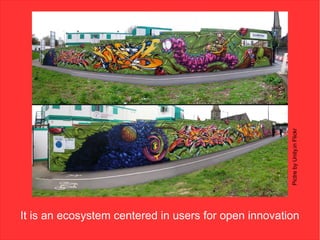
Pictre by Unity.in Flickr
It is an ecosystem centered in users for open innovation
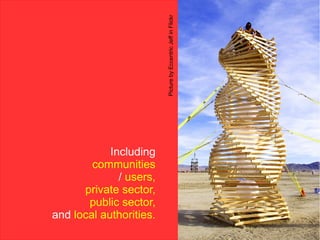
Picture by Eccentric Jeff in Flickr
            Including
        communities
              / users,
      private sector,
       public sector,
and local authorities.
Picture by anikaviro in Flickr
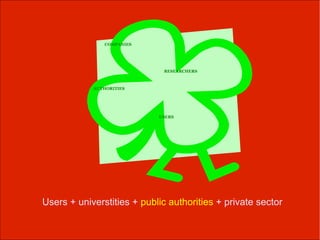
Cuadruple Helix: authorities, companies,
        universities and users.
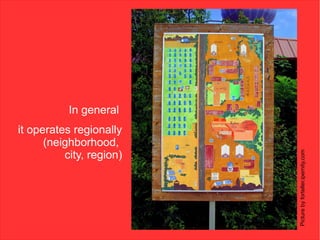
In general
it operates regionally
      (neighborhood,
          city, region)


                          Picture by forteller.ipernity.com
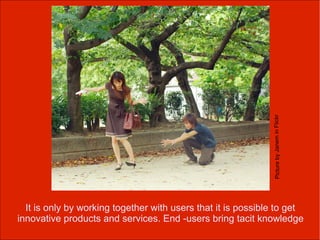
Picture by Janem in Flickr
  It is only by working together with users that it is possible to get
innovative products and services. End -users bring tacit knowledge
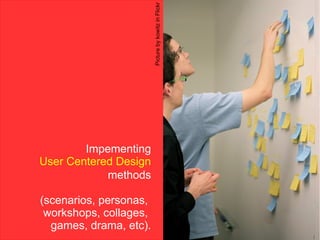
Picture by kowitz in Flickr
        Impementing
User Centered Design
            methods

(scenarios, personas,
 workshops, collages,
  games, drama, etc).
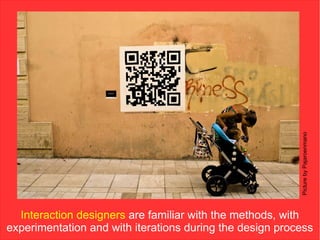
Picture by Pajaroenmano
  Interaction designers are familiar with the methods, with
experimentation and with iterations during the design process
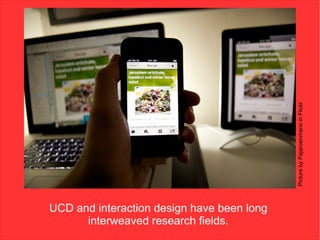
Picture by Pajaroenmano in Flickr
UCD and interaction design have been long
      interweaved research fields.
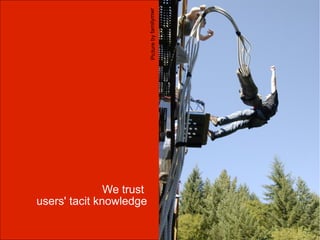
Picture by familymwr


               We trust
users' tacit knowledge
Why Living Labs?
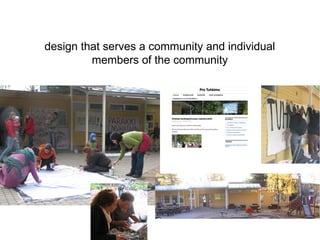
design that serves a community and individual
         members of the community
He
                                    lsi
                                       nk
                                         iL
                                           ivi
                                               ng
                                                  La
                                                    b


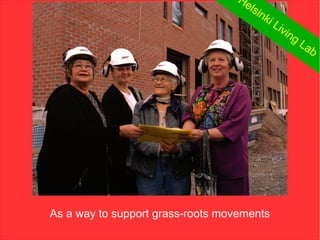
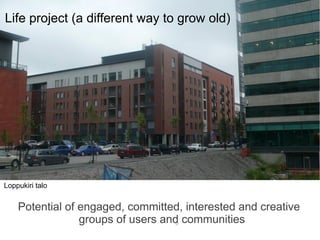
As a way to support grass-roots movements
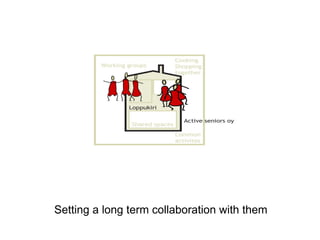
Setting a long term collaboration with them
Life project (a different way to grow old)


Loppukiri talo


    Potential of engaged, committed, interested and creative
                 groups of users and communities
                                   17
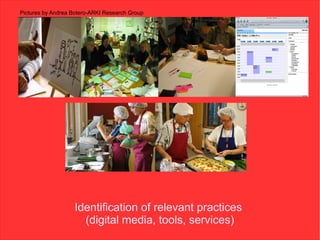
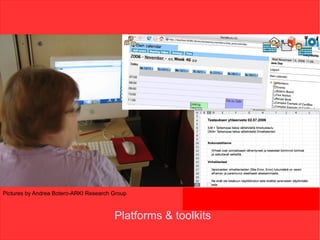
Pictures by Andrea Botero-ARKI Research Group


                   Identification of relevant practices
                     (digital media, tools, services)
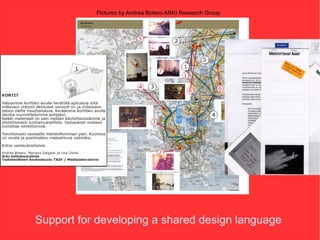
Pictures by Andrea Botero-ARKI Research Group


Support for developing a shared design language
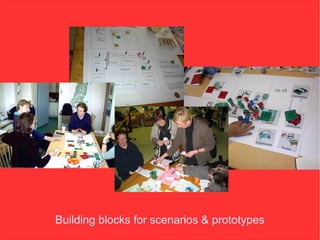
Building blocks for scenarios & prototypes
Pictures by Andrea Botero-ARKI Research Group


                                        Platforms & toolkits
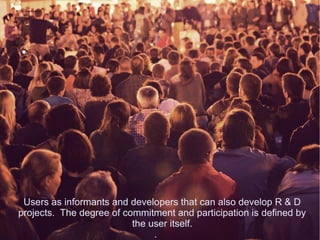
Users as informants and developers that can also develop R & D
projects. The degree of commitment and participation is defined by
                          the user itself.
                               .
Picturire by CEA in Flickr
    Living Labs provide an arena
   for supporting different ways of
                codesign
with clients, consumers, and citizens.
They could fill a gap if there is not enough local, regional, or
national capacity for making citizens participate in the development


                                                       of public and
                                                       private
                                                       services and
                                                       products.


Picture by anikaviro
Picture by dalbera
They can be seen as intermediate organizations to support the
           involvement of users in R&D projects.
      They challenge the obstacles of previous models
       based on the development of technology.
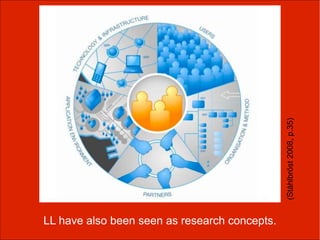
(Ståhlbröst 2008, p.35)
LL have also been seen as research concepts.
COMPANIES


                             RESEARCHERS


            AUTHORITIES


                            USERS


Users + universtities + public authorities + private sector
Picture by shoehorn99 in Flickr
    Codesign and
      cocreation
across disciplines
What do Living Labs support?
La
                                                                         ur
                                                                            ea
                                                                               Liv
                                                                                  ing
                                                                                        La
                                                                                          b


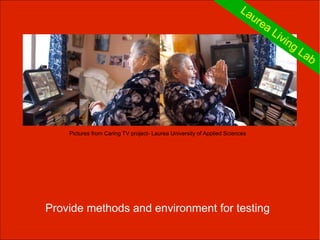
    Pictures from Caring TV project- Laurea University of Applied Sciences


Provide methods and environment for testing
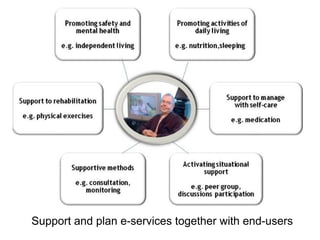
Support and plan e-services together with end-users
Map users' needs


                   Picture by Mike Eng
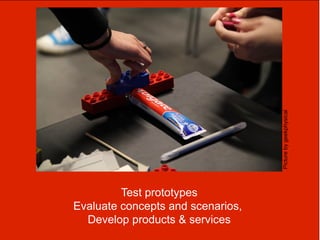
Picture by geekphysical
         Test prototypes
Evaluate concepts and scenarios,
  Develop products & services
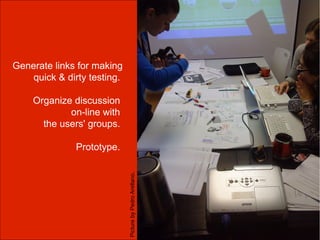
Generate links for making
    quick & dirty testing.

    Organize discussion
            on-line with
      the users' groups.

              Prototype.
                             Picture by Pedro Arellano.
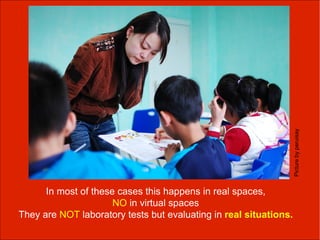
Picture by peruisay
      In most of these cases this happens in real spaces,
                      NO in virtual spaces
They are NOT laboratory tests but evaluating in real situations.
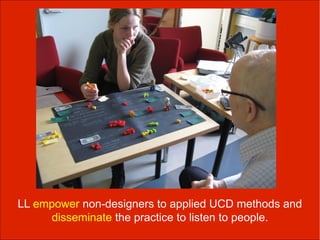
LL empower non-designers to applied UCD methods and
     disseminate the practice to listen to people.
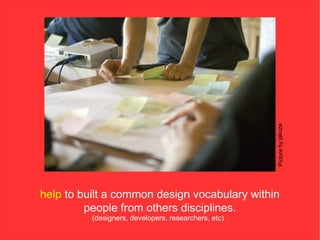
Picture by jakuza
help to built a common design vocabulary within
         people from others disciplines.
          (designers, developers, researchers, etc)
Why Living Labs in Finland?
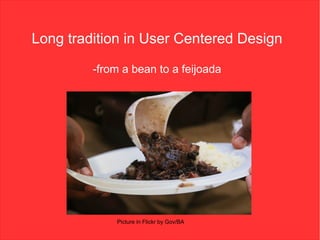
Long tradition in User Centered Design

         -from a bean to a feijoada


             Picture in Flickr by Gov/BA
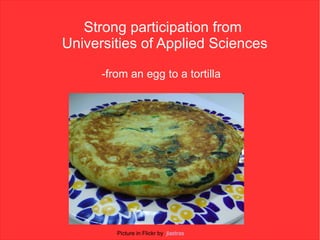
Strong participation from
Universities of Applied Sciences

      -from an egg to a tortilla


         Picture in Flickr by jlastras
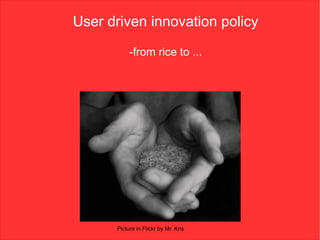
User driven innovation policy

           -from rice to ...


      Picture in Flickr by Mr. Kris
Public Funding
-from corn to popcorn


                        Picture in Flickr by Ayelie
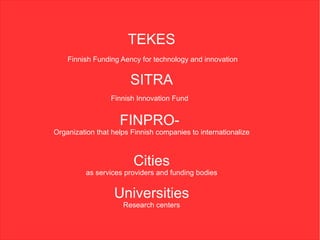
TEKES
    Finnish Funding Aency for technology and innovation


                       SITRA
                 Finnish Innovation Fund


                    FINPRO-
Organization that helps Finnish companies to internationalize


                        Cities
          as services providers and funding bodies


                  Universities
                     Research centers
Why Living Labs in Argentina?
Urban lab
                           Metropolitan Center of Design +
                                  Research group
                                     + starts ups

(COFECYT-DETEM: Consejo Federal de Ciencia y Tecnología- Projectos de desarrollo tecnológico municipal)
Can it be something else?
Yes!

Picture by sean dreilinger
l
                        ita
                    ap
                   C
                    n
                 ig
              es
             D
             d
           or
          W
     ki
      n
   si
 el
H


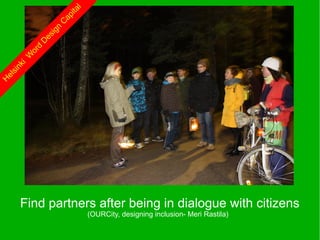
      Find partners after being in dialogue with citizens
                               (OURCity, designing inclusion- Meri Rastila)
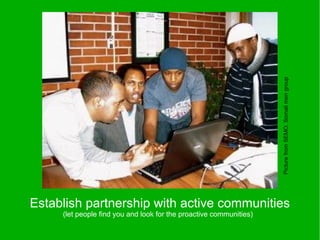
Picture from SEMO, Somali men group
Establish partnership with active communities
     (let people find you and look for the proactive communities)
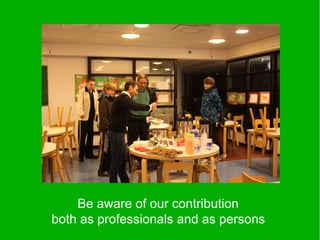
Be aware of our contribution
both as professionals and as persons
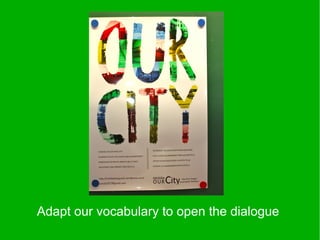
Adapt our vocabulary to open the dialogue
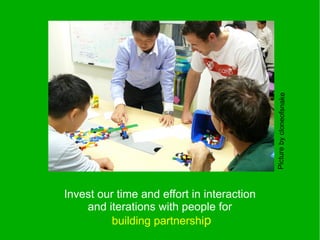
Picture by cloneofsnake
Invest our time and effort in interaction
    and iterations with people for
          building partnership
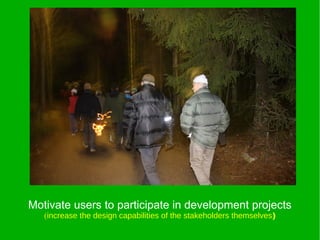
Motivate users to participate in development projects
   (increase the design capabilities of the stakeholders themselves)
Enlarge collaboration networks
(World design capital + Alternative Design Capital)
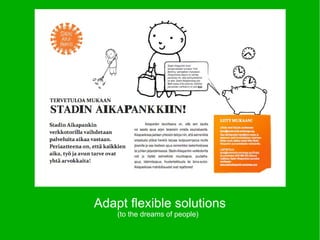
Adapt flexible solutions
    (to the dreams of people)
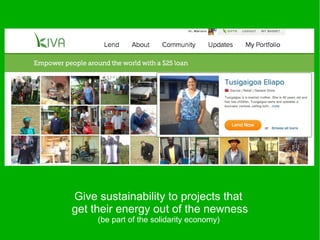
Give sustainability to projects that
get their energy out of the newness
     (be part of the solidarity economy)
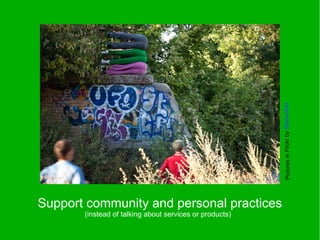
Pictures in Flickr by StefanKaz
Support community and personal practices
       (instead of talking about services or products)
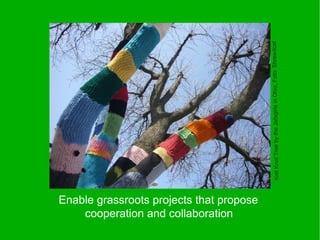
Knit Knot Tree by the Jafagirls in Ohio, Foto: Shrewdcat
Enable grassroots projects that propose
    cooperation and collaboration
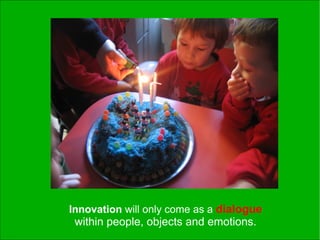
Innovation will only come as a dialogue
 within people, objects and emotions.
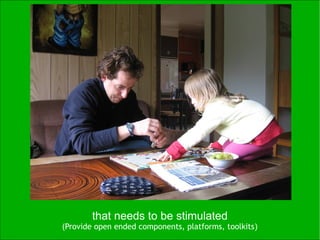
that needs to be stimulated
(Provide open ended components, platforms, toolkits)
Kiitos!

                                   Gracias!

                                  THANKS!


Please, do not use the pictures in this presentation without acknowledging the sources


                         mariana.salgado@iki.fi
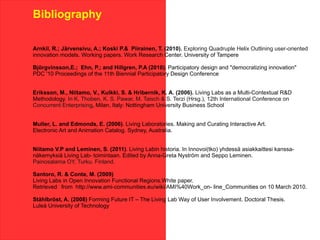
Bibliography

Arnkil, R.; Järvensivu, A.; Koski P.& Piirainen, T. (2010). Exploring Quadruple Helix Outlining user-oriented
innovation models. Working papers. Work Research Center. University of Tampere

Björgvinsson,E.; Ehn, P.; and Hillgren, P.A (2010). Participatory design and "democratizing innovation"
PDC '10 Proceedings of the 11th Biennial Participatory Design Conference


Eriksson, M., Niitamo, V., Kulkki, S. & Hribernik, K. A. (2006). Living Labs as a Multi-Contextual R&D
Methodology. In K. Thoben, K. S. Pawar, M. Taisch & S. Terzi (Hrsg.), 12th International Conference on
Concurrent Enterprising, Milan, Italy: Nottingham University Business School


Muller, L. and Edmonds, E. (2006). Living Laboratories. Making and Curating Interactive Art.
Electronic Art and Animation Catalog. Sydney, Australia.


Niitamo V.P and Leminen, S. (2011). Living Labin historia. In Innovoi(tko) yhdessä asiakkaittesi kanssa-
näkemyksiä Living Lab- toimintaan. Edited by Anna-Greta Nyström and Seppo Leminen.
Painosalama OY, Turku. Finland.

Santoro, R. & Conte, M. (2009)
Living Labs in Open Innovation Functional Regions.White paper.
Retrieved from http://www.ami-communities.eu/wiki/AMI%40Work_on- line_Communities on 10 March 2010.

Ståhlbröst, A. (2008) Forming Future IT – The Living Lab Way of User Involvement. Doctoral Thesis.
Luleå University of Technology
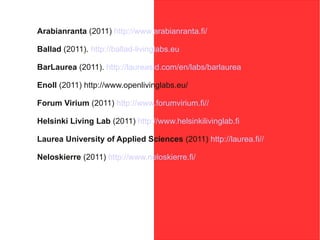
Arabianranta (2011) http://www.arabianranta.fi/

Ballad (2011). http://ballad-livinglabs.eu

BarLaurea (2011). http://laureasid.com/en/labs/barlaurea

Enoll (2011) http://www.openlivinglabs.eu/

Forum Virium (2011) http://www.forumvirium.fi//

Helsinki Living Lab (2011) http://www.helsinkilivinglab.fi

Laurea University of Applied Sciences (2011) http://laurea.fi//

Neloskierre (2011) http://www.neloskierre.fi/

ISA11 - Mariana Salgado - Living Labs and Interaction Design

  • 1.
    Living Labs As a way to motivate codesign with communities Dr. Mariana Salgado Head of the MBA in User Centered Design Laurea University of Applied Sciences Fellow resercher @LINKS
  • 2.
    Twitter: Salgado Skype: mariana.salgado Slideshare: http://www.slideshare.net/marianasalgado Scribd: http://www.scribd.com/salgadomariana http://laurea.academia.edu/MarianaSalgado/ http://www.researchgate.net/profile/Mariana_Salgado http://pinatasdigitales.wordpress.com/ IXDA Buenos Aires- ICOM -Open Design- Learning Network for Sustainability- File exhibit- Museum3.0- museologia porto- Hyväsiskot- 3 nubes- P2P foundation- Sustainable Design Network- Vihreat- Global Museums – Alternative Design Capital
  • 3.
    What is aLiving Lab?
  • 4.
    Pictre by Unity.inFlickr It is an ecosystem centered in users for open innovation
  • 5.
    Picture by EccentricJeff in Flickr Including communities / users, private sector, public sector, and local authorities.
  • 6.
    Picture by anikaviroin Flickr Cuadruple Helix: authorities, companies, universities and users.
  • 7.
    In general it operatesregionally (neighborhood, city, region) Picture by forteller.ipernity.com
  • 8.
    Picture by Janemin Flickr It is only by working together with users that it is possible to get innovative products and services. End -users bring tacit knowledge
  • 9.
    Picture by kowitzin Flickr Impementing User Centered Design methods (scenarios, personas, workshops, collages, games, drama, etc).
  • 10.
    Picture by Pajaroenmano Interaction designers are familiar with the methods, with experimentation and with iterations during the design process
  • 11.
    Picture by Pajaroenmanoin Flickr UCD and interaction design have been long interweaved research fields.
  • 12.
    Picture by familymwr We trust users' tacit knowledge
  • 13.
  • 14.
    design that servesa community and individual members of the community
  • 15.
    He lsi nk iL ivi ng La b As a way to support grass-roots movements
  • 16.
    Setting a longterm collaboration with them
  • 17.
    Life project (adifferent way to grow old) Loppukiri talo Potential of engaged, committed, interested and creative groups of users and communities 17
  • 18.
    Pictures by AndreaBotero-ARKI Research Group Identification of relevant practices (digital media, tools, services)
  • 19.
    Pictures by AndreaBotero-ARKI Research Group Support for developing a shared design language
  • 20.
    Building blocks forscenarios & prototypes
  • 21.
    Pictures by AndreaBotero-ARKI Research Group Platforms & toolkits
  • 22.
    Users as informantsand developers that can also develop R & D projects. The degree of commitment and participation is defined by the user itself. .
  • 23.
    Picturire by CEAin Flickr Living Labs provide an arena for supporting different ways of codesign with clients, consumers, and citizens.
  • 24.
    They could filla gap if there is not enough local, regional, or national capacity for making citizens participate in the development of public and private services and products. Picture by anikaviro
  • 25.
    Picture by dalbera Theycan be seen as intermediate organizations to support the involvement of users in R&D projects. They challenge the obstacles of previous models based on the development of technology.
  • 26.
    (Ståhlbröst 2008, p.35) LLhave also been seen as research concepts.
  • 27.
    COMPANIES RESEARCHERS AUTHORITIES USERS Users + universtities + public authorities + private sector
  • 28.
    Picture by shoehorn99in Flickr Codesign and cocreation across disciplines
  • 29.
    What do LivingLabs support?
  • 30.
    La ur ea Liv ing La b Pictures from Caring TV project- Laurea University of Applied Sciences Provide methods and environment for testing
  • 31.
    Support and plane-services together with end-users
  • 32.
    Map users' needs Picture by Mike Eng
  • 33.
    Picture by geekphysical Test prototypes Evaluate concepts and scenarios, Develop products & services
  • 34.
    Generate links formaking quick & dirty testing. Organize discussion on-line with the users' groups. Prototype. Picture by Pedro Arellano.
  • 35.
    Picture by peruisay In most of these cases this happens in real spaces, NO in virtual spaces They are NOT laboratory tests but evaluating in real situations.
  • 36.
    LL empower non-designersto applied UCD methods and disseminate the practice to listen to people.
  • 37.
    Picture by jakuza helpto built a common design vocabulary within people from others disciplines. (designers, developers, researchers, etc)
  • 38.
    Why Living Labsin Finland?
  • 39.
    Long tradition inUser Centered Design -from a bean to a feijoada Picture in Flickr by Gov/BA
  • 40.
    Strong participation from Universitiesof Applied Sciences -from an egg to a tortilla Picture in Flickr by jlastras
  • 41.
    User driven innovationpolicy -from rice to ... Picture in Flickr by Mr. Kris
  • 42.
    Public Funding -from cornto popcorn Picture in Flickr by Ayelie
  • 43.
    TEKES Finnish Funding Aency for technology and innovation SITRA Finnish Innovation Fund FINPRO- Organization that helps Finnish companies to internationalize Cities as services providers and funding bodies Universities Research centers
  • 44.
    Why Living Labsin Argentina?
  • 45.
    Urban lab Metropolitan Center of Design + Research group + starts ups (COFECYT-DETEM: Consejo Federal de Ciencia y Tecnología- Projectos de desarrollo tecnológico municipal)
  • 46.
    Can it besomething else?
  • 47.
  • 48.
    l ita ap C n ig es D d or W ki n si el H Find partners after being in dialogue with citizens (OURCity, designing inclusion- Meri Rastila)
  • 49.
    Picture from SEMO,Somali men group Establish partnership with active communities (let people find you and look for the proactive communities)
  • 50.
    Be aware ofour contribution both as professionals and as persons
  • 51.
    Adapt our vocabularyto open the dialogue
  • 52.
    Picture by cloneofsnake Investour time and effort in interaction and iterations with people for building partnership
  • 53.
    Motivate users toparticipate in development projects (increase the design capabilities of the stakeholders themselves)
  • 54.
    Enlarge collaboration networks (Worlddesign capital + Alternative Design Capital)
  • 55.
    Adapt flexible solutions (to the dreams of people)
  • 56.
    Give sustainability toprojects that get their energy out of the newness (be part of the solidarity economy)
  • 57.
    Pictures in Flickrby StefanKaz Support community and personal practices (instead of talking about services or products)
  • 58.
    Knit Knot Treeby the Jafagirls in Ohio, Foto: Shrewdcat Enable grassroots projects that propose cooperation and collaboration
  • 59.
    Innovation will onlycome as a dialogue within people, objects and emotions.
  • 60.
    that needs tobe stimulated (Provide open ended components, platforms, toolkits)
  • 61.
    Kiitos! Gracias! THANKS! Please, do not use the pictures in this presentation without acknowledging the sources mariana.salgado@iki.fi
  • 62.
    Bibliography Arnkil, R.; Järvensivu,A.; Koski P.& Piirainen, T. (2010). Exploring Quadruple Helix Outlining user-oriented innovation models. Working papers. Work Research Center. University of Tampere Björgvinsson,E.; Ehn, P.; and Hillgren, P.A (2010). Participatory design and "democratizing innovation" PDC '10 Proceedings of the 11th Biennial Participatory Design Conference Eriksson, M., Niitamo, V., Kulkki, S. & Hribernik, K. A. (2006). Living Labs as a Multi-Contextual R&D Methodology. In K. Thoben, K. S. Pawar, M. Taisch & S. Terzi (Hrsg.), 12th International Conference on Concurrent Enterprising, Milan, Italy: Nottingham University Business School Muller, L. and Edmonds, E. (2006). Living Laboratories. Making and Curating Interactive Art. Electronic Art and Animation Catalog. Sydney, Australia. Niitamo V.P and Leminen, S. (2011). Living Labin historia. In Innovoi(tko) yhdessä asiakkaittesi kanssa- näkemyksiä Living Lab- toimintaan. Edited by Anna-Greta Nyström and Seppo Leminen. Painosalama OY, Turku. Finland. Santoro, R. & Conte, M. (2009) Living Labs in Open Innovation Functional Regions.White paper. Retrieved from http://www.ami-communities.eu/wiki/AMI%40Work_on- line_Communities on 10 March 2010. Ståhlbröst, A. (2008) Forming Future IT – The Living Lab Way of User Involvement. Doctoral Thesis. Luleå University of Technology
  • 63.
    Arabianranta (2011) http://www.arabianranta.fi/ Ballad(2011). http://ballad-livinglabs.eu BarLaurea (2011). http://laureasid.com/en/labs/barlaurea Enoll (2011) http://www.openlivinglabs.eu/ Forum Virium (2011) http://www.forumvirium.fi// Helsinki Living Lab (2011) http://www.helsinkilivinglab.fi Laurea University of Applied Sciences (2011) http://laurea.fi// Neloskierre (2011) http://www.neloskierre.fi/