W3C Semantic Web for Health Care and Life Sciences Interest Group
Scientific Discourse task group
http://esw.w3.org/topic/HCLSIG/SWANSIOC


Supporting Sensemaking by Modelling
Discourse as Hypermedia Networks

Simon Buckingham Shum
Knowledge Media Institute
The Open University
Milton Keynes, UK

http://people.kmi.open.ac.uk/sbs
http://compendium.open.ac.uk/institute
http://projects.kmi.open.ac.uk/scholonto
http://projects.kmi.open.ac.uk/hyperdiscourse
                                                                    1
Acknowledgements


                   2
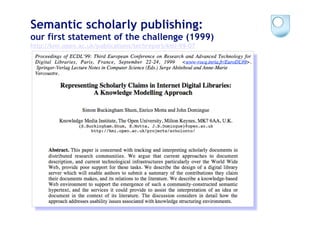
Semantic scholarly publishing:
our first statement of the challenge (1999)
http://kmi.open.ac.uk/publications/techreport/kmi-99-07
The question we used to ask in 2001 at
the start of the ScholOnto project


  In 2010, will we still be publishing scientific results

  primarily as prose papers, or will a complementary

  infrastructure emerge that exploits the power of

  the social, semantic web to model the literature as

  a network of claims and arguments?


                                                             4
modelling
schemes: IBIS

                5
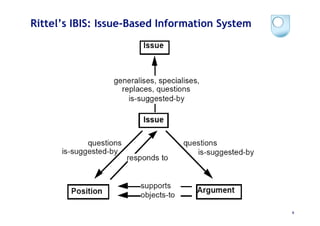
Rittel’s IBIS: Issue-Based Information System


                                                6
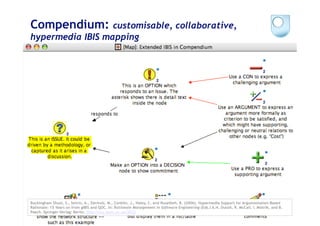
Compendium:       customisable, collaborative,
hypermedia IBIS mapping


Buckingham Shum, S., Selvin, A., Sierhuis, M., Conklin, J., Haley, C. and Nuseibeh, B. (2006). Hypermedia Support for Argumentation-Based
Rationale: 15 Years on from gIBIS and QOC. In: Rationale Management in Software Engineering (Eds.) A.H. Dutoit, R. McCall, I. Mistrik, and B.   7
Paech. Springer-Verlag: Berlin. http://oro.open.ac.uk/3032
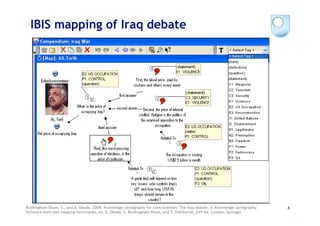
IBIS mapping of Iraq debate


Buckingham Shum, S., and A. Okada. 2008. Knowledge cartography for controversies: The Iraq debate. In Knowledge cartography:   8
Software tools and mapping techniques, ed. A. Okada, S. Buckingham Shum, and T. Sherborne, 249–66. London: Springer.
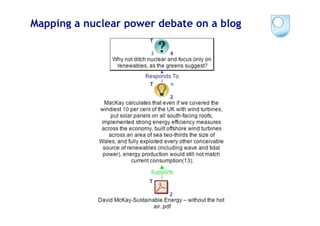
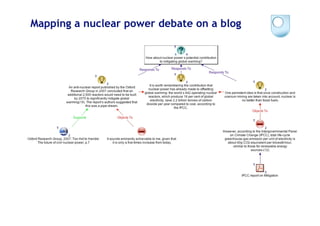
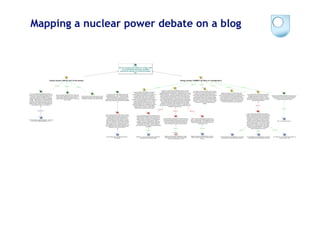
Mapping a nuclear power debate on a blog
Latest developments


  IBIS RDF Schema (Danny Ayers)
  http://www.schemaweb.info/webservices/rest/GetRDFByID.aspx?id=4


  Work now under way to integrate the leading IBIS
   deliberation tools: see the ESSENCE project
  http://events.kmi.open.ac.uk/essence/tools


                                                                    12
modelling
schemes:
ScholOnto
            13
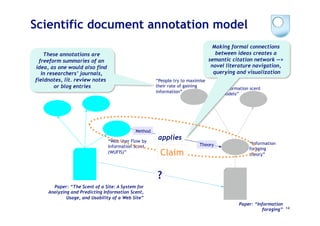
Scientific document annotation model
                                                                                Making formal connections
    These annotations are                                                         between ideas creates a
  freeform summaries of an                                                     semantic citation network —>
idea, as one would also find                                                    novel literature navigation,
   in researchers’ journals,                                                     querying and visualization
fieldnotes, lit. review notes                        “People try to maximise
         or blog entries                             their rate of gaining
                                                                                    “Information scent
                                                     information”                   models”


                                            Method

                                “Web User Flow by
                                                      applies
                                                                         Theory                 “Information
                                Information Scent                                               foraging
                                (WUFIS)”               Claim                                    theory”


                                                     ?
       Paper: “The Scent of a Site: A System for
     Analyzing and Predicting Information Scent,
             Usage, and Usability of a Web Site”
                                                                                           Paper: “Information
                                                                                                     foraging” 14
ScholOnto schema
  Connecting freeform tags with naturalistic connections (“dialects”)
  grounded in a formal set of relations (from semiotics and coherence relations)


Mancini, C. and Buckingham Shum, S.J. (2006). Modelling Discourse in Contested Domains: A Semiotic and Cognitive Framework.   15
International Journal of Human Computer Studies, 64, (11), pp.1154-1171. [PrePrint: http://oro.open.ac.uk/6441]
polarity
                  source                 type                   comparativeness


                   Cognitive Coherence Relations


Mancini, C. and Buckingham Shum, S.J. (2006). Modelling Discourse in Contested Domains: A Semiotic and Cognitive Framework.   16
International Journal of Human Computer Studies, 64, (11), pp.1154-1171. [PrePrint: http://oro.open.ac.uk/6441]
Semantic Web formats


  ScholOnto RDF Schema:
  http://projects.kmi.open.ac.uk/scholonto/resources/Scholonto2.rdfs


  Cohere API serves: RDF, XML, JSON
  http://cohere.open.ac.uk/help/code-doc/Cohere-API/_apilib.php.html


  Cohere accepts RDF uploads:
  http://cohere.open.ac.uk/help/rdf.php


                                                                       17
discourse annotation
   and search tools


                       18
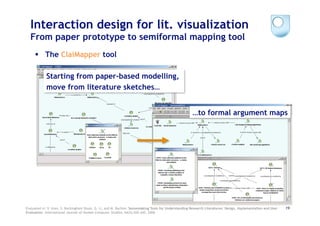
Interaction design for lit. visualization
  From paper prototype to semiformal mapping tool
       The ClaiMapper tool

            Starting from paper-based modelling,
            move from literature sketches…


                                                                                                      …to formal argument maps


Evaluated in: V. Uren, S. Buckingham Shum, G. Li, and M. Bachler. Sensemaking Tools for Understanding Research Literatures: Design, Implementation and User   19
Evaluation. International Journal of Human Computer Studies, 64(5):420–445, 2006
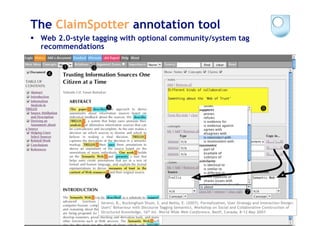
The ClaimSpotter annotation tool
  Web 2.0-style tagging with optional community/system tag
   recommendations


                   Sereno, B., Buckingham Shum, S. and Motta, E. (2007). Formalization, User Strategy and Interaction Design:
                   Users’ Behaviour with Discourse Tagging Semantics. Workshop on Social and Collaborative Construction 20
                                                                                                                        of
                   Structured Knowledge, 16th Int. World Wide Web Conference, Banff, Canada; 8-12 May 2007.
Cohere: semantically filtering a focal
 Idea by “contrasting” connections


Buckingham Shum, Simon (2008). Cohere: Towards Web 2.0 Argumentation. In: Proc. COMMA'08: 2nd International Conference on
Computational Models of Argument, 28-30 May 2008, Toulouse, France. IOS Press [PrePrint: http://oro.open.ac.uk/10421]       21
Cohere: semantically filtering a focal
 Idea by “contrasting” connections


Buckingham Shum, Simon (2008). Cohere: Towards Web 2.0 Argumentation. In: Proc. COMMA'08: 2nd International Conference on
Computational Models of Argument, 28-30 May 2008, Toulouse, France. IOS Press [PrePrint: http://oro.open.ac.uk/10421]       22
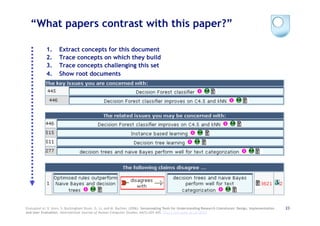
“What papers contrast with this paper?”

            1.      Extract concepts for this document
            2.      Trace concepts on which they build
            3.      Trace concepts challenging this set
            4.      Show root documents


Evaluated in: V. Uren, S. Buckingham Shum, G. Li, and M. Bachler, (2006). Sensemaking Tools for Understanding Research Literatures: Design, Implementation   23
and User Evaluation. International Journal of Human Computer Studies, 64(5):420–445. http://oro.open.ac.uk/2954
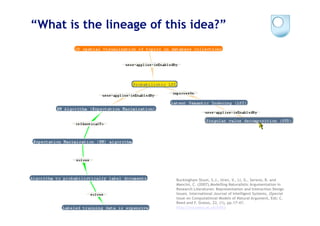
“What is the lineage of this idea?”


                          Buckingham Shum, S.J., Uren, V., Li, G., Sereno, B. and
                          Mancini, C. (2007).Modelling Naturalistic Argumentation in
                          Research Literatures: Representation and Interaction Design
                          Issues. International Journal of Intelligent Systems, (Special
                          Issue on Computational Models of Natural Argument, Eds: C.
                          Reed and F. Grasso, 22, (1), pp.17-47.
                          http://oro.open.ac.uk/6463                                     24
Latest developments

Neil Benn’s Doctoral Dissertation, KMi:

“Modelling Scholarly Debate: Conceptual Foundations for
Knowledge Domain Analysis Technology” (under revision)
http://people.kmi.open.ac.uk/sbs/2009/07/modelling-scholarly-debate-neil-benn-phd

Benn, N., Buckingham Shum, S. Domingue, J. and Mancini, C. (2008). Ontological Foundations for Scholarly
Debate Mapping Technology. 2nd International Conference on Computational Models of Argument (COMMA ‘08),
28-30 May, 2008, Toulouse, France. IOS Press. http://oro.open.ac.uk/11939


Embedding discourse relationships into SocialLearn, a social
media platform for learning and sensemaking:
www.open.ac.uk/sociallearn

and in Open Learning Network, a social media platform for
building the evidence base in an emerging field:
www.olnet.org
                                                                                                           25
http://projects.kmi.open.ac.uk/hyperdiscourse   


   Compendium Institute


                                                    26

Supporting Sensemaking by Modelling Discourse as Hypermedia Networks

  • 1.
    W3C Semantic Webfor Health Care and Life Sciences Interest Group Scientific Discourse task group http://esw.w3.org/topic/HCLSIG/SWANSIOC Supporting Sensemaking by Modelling Discourse as Hypermedia Networks Simon Buckingham Shum Knowledge Media Institute The Open University Milton Keynes, UK http://people.kmi.open.ac.uk/sbs http://compendium.open.ac.uk/institute http://projects.kmi.open.ac.uk/scholonto http://projects.kmi.open.ac.uk/hyperdiscourse 1
  • 2.
  • 3.
    Semantic scholarly publishing: ourfirst statement of the challenge (1999) http://kmi.open.ac.uk/publications/techreport/kmi-99-07
  • 4.
    The question weused to ask in 2001 at the start of the ScholOnto project   In 2010, will we still be publishing scientific results primarily as prose papers, or will a complementary infrastructure emerge that exploits the power of the social, semantic web to model the literature as a network of claims and arguments? 4
  • 5.
  • 6.
    Rittel’s IBIS: Issue-BasedInformation System 6
  • 7.
    Compendium: customisable, collaborative, hypermedia IBIS mapping Buckingham Shum, S., Selvin, A., Sierhuis, M., Conklin, J., Haley, C. and Nuseibeh, B. (2006). Hypermedia Support for Argumentation-Based Rationale: 15 Years on from gIBIS and QOC. In: Rationale Management in Software Engineering (Eds.) A.H. Dutoit, R. McCall, I. Mistrik, and B. 7 Paech. Springer-Verlag: Berlin. http://oro.open.ac.uk/3032
  • 8.
    IBIS mapping ofIraq debate Buckingham Shum, S., and A. Okada. 2008. Knowledge cartography for controversies: The Iraq debate. In Knowledge cartography: 8 Software tools and mapping techniques, ed. A. Okada, S. Buckingham Shum, and T. Sherborne, 249–66. London: Springer.
  • 9.
    Mapping a nuclearpower debate on a blog
  • 10.
    Mapping a nuclearpower debate on a blog
  • 11.
    Mapping a nuclearpower debate on a blog
  • 12.
    Latest developments   IBISRDF Schema (Danny Ayers) http://www.schemaweb.info/webservices/rest/GetRDFByID.aspx?id=4   Work now under way to integrate the leading IBIS deliberation tools: see the ESSENCE project http://events.kmi.open.ac.uk/essence/tools 12
  • 13.
  • 14.
    Scientific document annotationmodel Making formal connections These annotations are between ideas creates a freeform summaries of an semantic citation network —> idea, as one would also find novel literature navigation, in researchers’ journals, querying and visualization fieldnotes, lit. review notes “People try to maximise or blog entries their rate of gaining “Information scent information” models” Method “Web User Flow by applies Theory “Information Information Scent foraging (WUFIS)” Claim theory” ? Paper: “The Scent of a Site: A System for Analyzing and Predicting Information Scent, Usage, and Usability of a Web Site” Paper: “Information foraging” 14
  • 15.
    ScholOnto schema Connecting freeform tags with naturalistic connections (“dialects”) grounded in a formal set of relations (from semiotics and coherence relations) Mancini, C. and Buckingham Shum, S.J. (2006). Modelling Discourse in Contested Domains: A Semiotic and Cognitive Framework. 15 International Journal of Human Computer Studies, 64, (11), pp.1154-1171. [PrePrint: http://oro.open.ac.uk/6441]
  • 16.
    polarity source type comparativeness Cognitive Coherence Relations Mancini, C. and Buckingham Shum, S.J. (2006). Modelling Discourse in Contested Domains: A Semiotic and Cognitive Framework. 16 International Journal of Human Computer Studies, 64, (11), pp.1154-1171. [PrePrint: http://oro.open.ac.uk/6441]
  • 17.
    Semantic Web formats  ScholOnto RDF Schema: http://projects.kmi.open.ac.uk/scholonto/resources/Scholonto2.rdfs   Cohere API serves: RDF, XML, JSON http://cohere.open.ac.uk/help/code-doc/Cohere-API/_apilib.php.html   Cohere accepts RDF uploads: http://cohere.open.ac.uk/help/rdf.php 17
  • 18.
    discourse annotation and search tools 18
  • 19.
    Interaction design forlit. visualization From paper prototype to semiformal mapping tool   The ClaiMapper tool Starting from paper-based modelling, move from literature sketches… …to formal argument maps Evaluated in: V. Uren, S. Buckingham Shum, G. Li, and M. Bachler. Sensemaking Tools for Understanding Research Literatures: Design, Implementation and User 19 Evaluation. International Journal of Human Computer Studies, 64(5):420–445, 2006
  • 20.
    The ClaimSpotter annotationtool   Web 2.0-style tagging with optional community/system tag recommendations Sereno, B., Buckingham Shum, S. and Motta, E. (2007). Formalization, User Strategy and Interaction Design: Users’ Behaviour with Discourse Tagging Semantics. Workshop on Social and Collaborative Construction 20 of Structured Knowledge, 16th Int. World Wide Web Conference, Banff, Canada; 8-12 May 2007.
  • 21.
    Cohere: semantically filteringa focal Idea by “contrasting” connections Buckingham Shum, Simon (2008). Cohere: Towards Web 2.0 Argumentation. In: Proc. COMMA'08: 2nd International Conference on Computational Models of Argument, 28-30 May 2008, Toulouse, France. IOS Press [PrePrint: http://oro.open.ac.uk/10421] 21
  • 22.
    Cohere: semantically filteringa focal Idea by “contrasting” connections Buckingham Shum, Simon (2008). Cohere: Towards Web 2.0 Argumentation. In: Proc. COMMA'08: 2nd International Conference on Computational Models of Argument, 28-30 May 2008, Toulouse, France. IOS Press [PrePrint: http://oro.open.ac.uk/10421] 22
  • 23.
    “What papers contrastwith this paper?” 1.  Extract concepts for this document 2.  Trace concepts on which they build 3.  Trace concepts challenging this set 4.  Show root documents Evaluated in: V. Uren, S. Buckingham Shum, G. Li, and M. Bachler, (2006). Sensemaking Tools for Understanding Research Literatures: Design, Implementation 23 and User Evaluation. International Journal of Human Computer Studies, 64(5):420–445. http://oro.open.ac.uk/2954
  • 24.
    “What is thelineage of this idea?” Buckingham Shum, S.J., Uren, V., Li, G., Sereno, B. and Mancini, C. (2007).Modelling Naturalistic Argumentation in Research Literatures: Representation and Interaction Design Issues. International Journal of Intelligent Systems, (Special Issue on Computational Models of Natural Argument, Eds: C. Reed and F. Grasso, 22, (1), pp.17-47. http://oro.open.ac.uk/6463 24
  • 25.
    Latest developments Neil Benn’sDoctoral Dissertation, KMi: “Modelling Scholarly Debate: Conceptual Foundations for Knowledge Domain Analysis Technology” (under revision) http://people.kmi.open.ac.uk/sbs/2009/07/modelling-scholarly-debate-neil-benn-phd Benn, N., Buckingham Shum, S. Domingue, J. and Mancini, C. (2008). Ontological Foundations for Scholarly Debate Mapping Technology. 2nd International Conference on Computational Models of Argument (COMMA ‘08), 28-30 May, 2008, Toulouse, France. IOS Press. http://oro.open.ac.uk/11939 Embedding discourse relationships into SocialLearn, a social media platform for learning and sensemaking: www.open.ac.uk/sociallearn and in Open Learning Network, a social media platform for building the evidence base in an emerging field: www.olnet.org 25
  • 26.