
@SimonTanner
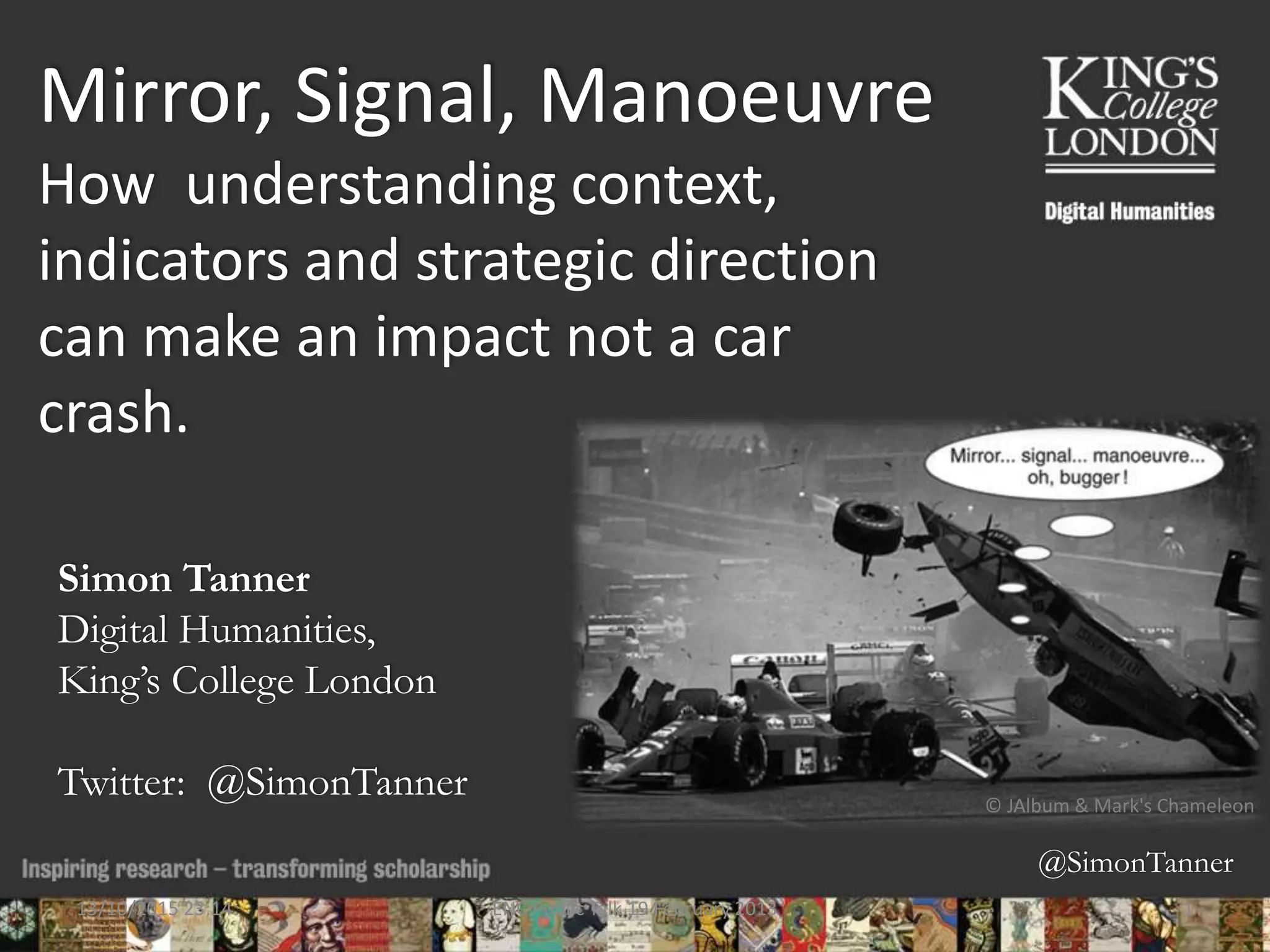
Mirror, Signal, Manoeuvre
How understanding context,
indicators and strategic direction
can make an impact not a car
crash.
Simon Tanner
Digital Humanities,
King’s College London
Twitter: @SimonTanner
13/10/2015 23:14 ENC Public Talk 19 February 2013 1
© JAlbum & Mark's Chameleon
Mirror: understanding context
Signal: choosing your indicators
Manoeuvre: deciding strategic direction
& values
Mirror, Signal, Manoeuvre
@SimonTanner
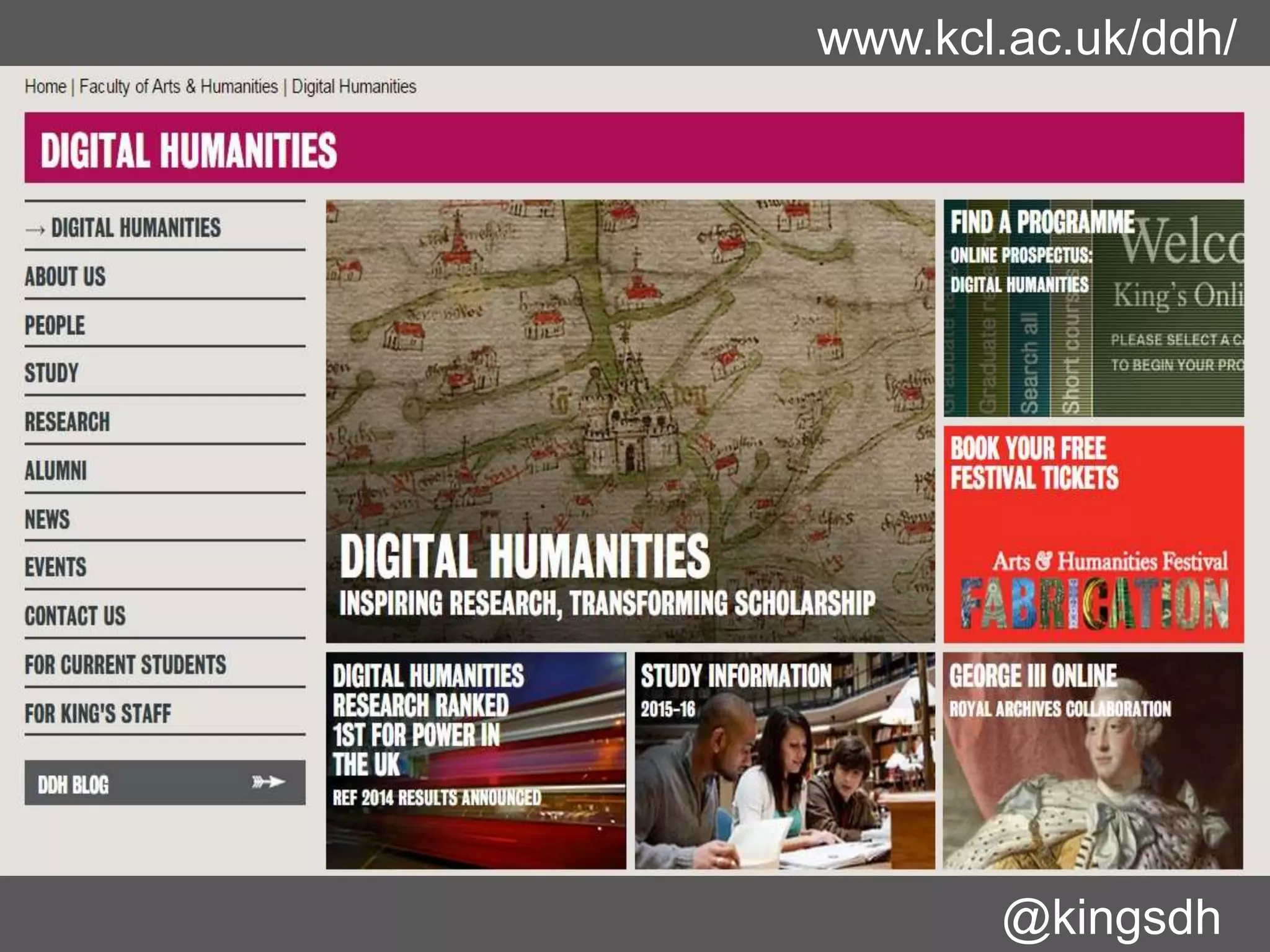
www.kcl.ac.uk/ddh/
@kingsdh
http://www.youtube.com/watch?v=tp4y-_VoXdA
Digital Humanities methods for historical analysis of
Irish Immigrants in 19th Century London, England
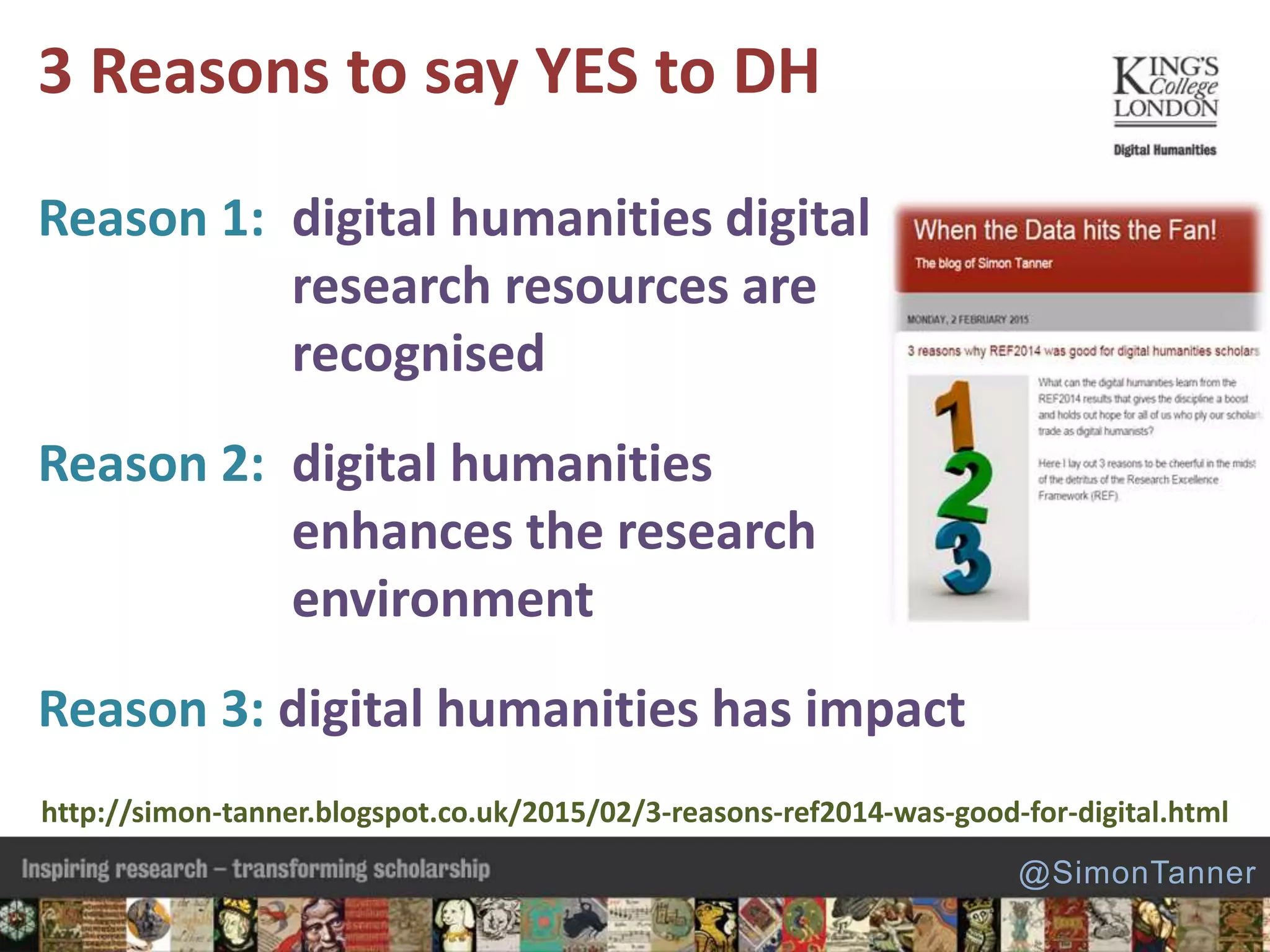
Reason 1: digital humanities digital
research resources are
recognised
Reason 2: digital humanities
enhances the research
environment
Reason 3: digital humanities has impact
3 Reasons to say YES to DH
http://simon-tanner.blogspot.co.uk/2015/02/3-reasons-ref2014-was-good-for-digital.html
@SimonTanner
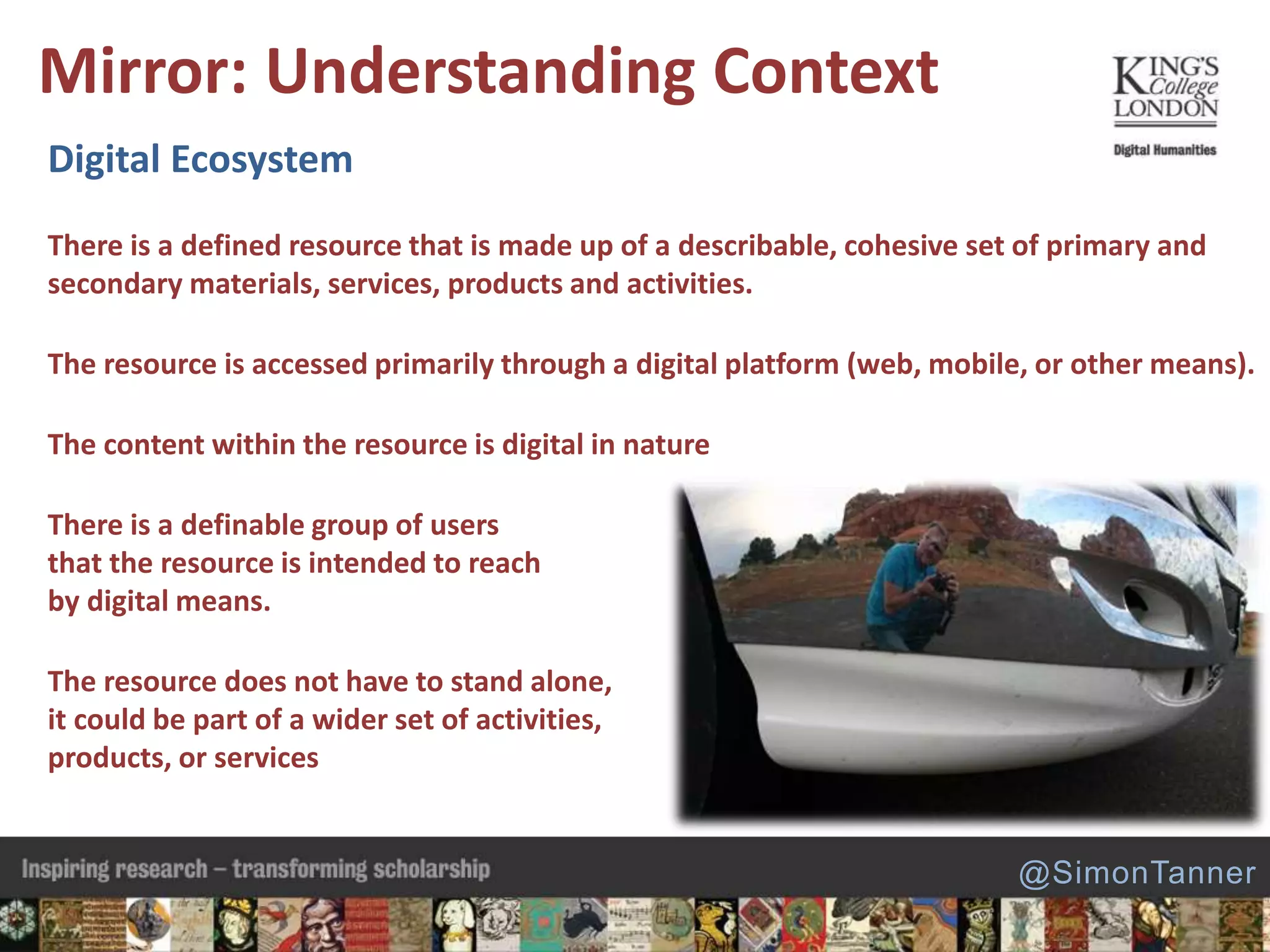
Digital Ecosystem
There is a defined resource that is made up of a describable, cohesive set of primary and
secondary materials, services, products and activities.
The resource is accessed primarily through a digital platform (web, mobile, or other means).
The content within the resource is digital in nature
There is a definable group of users
that the resource is intended to reach
by digital means.
The resource does not have to stand alone,
it could be part of a wider set of activities,
products, or services
Mirror: Understanding Context
@SimonTanner
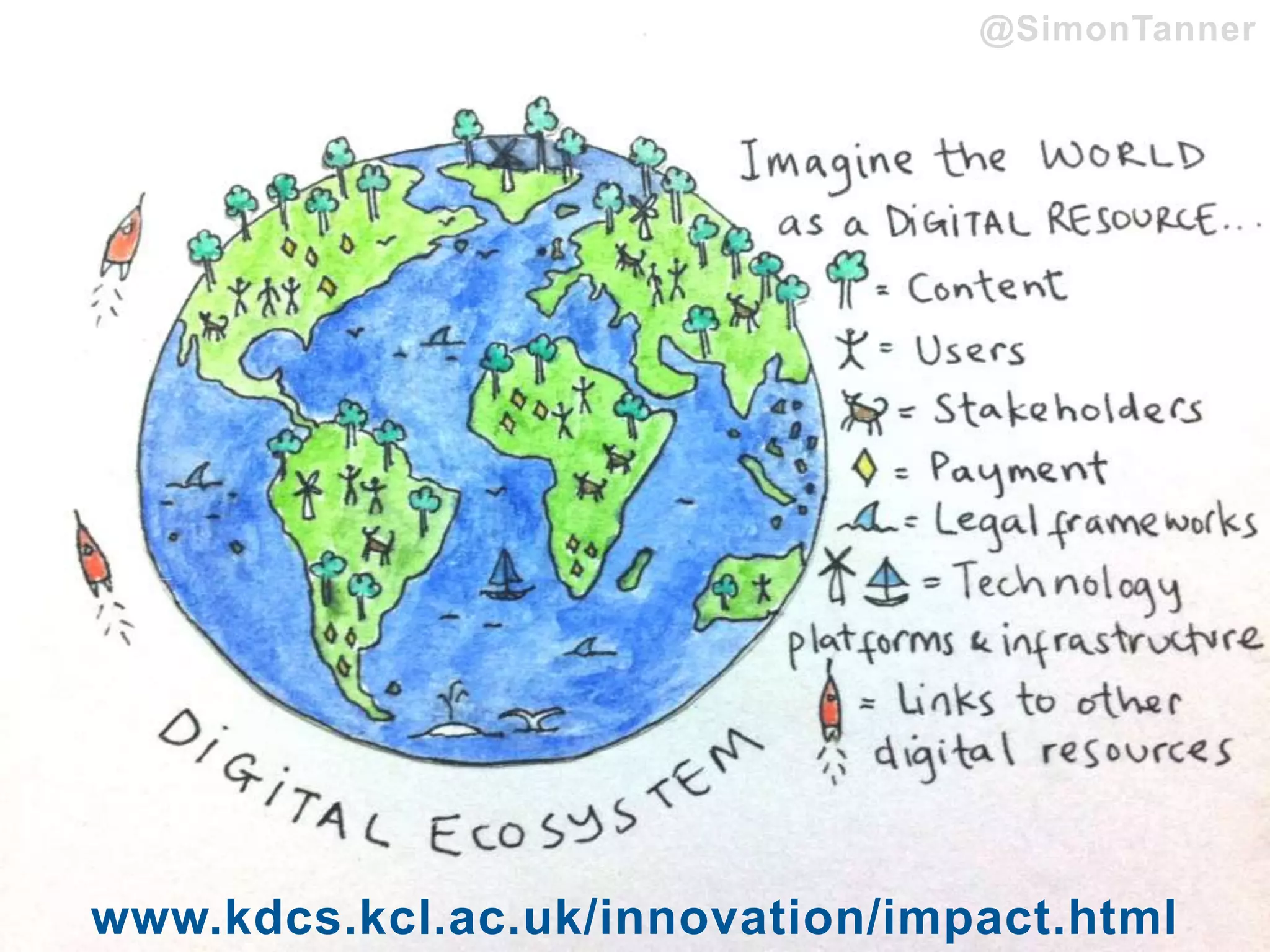
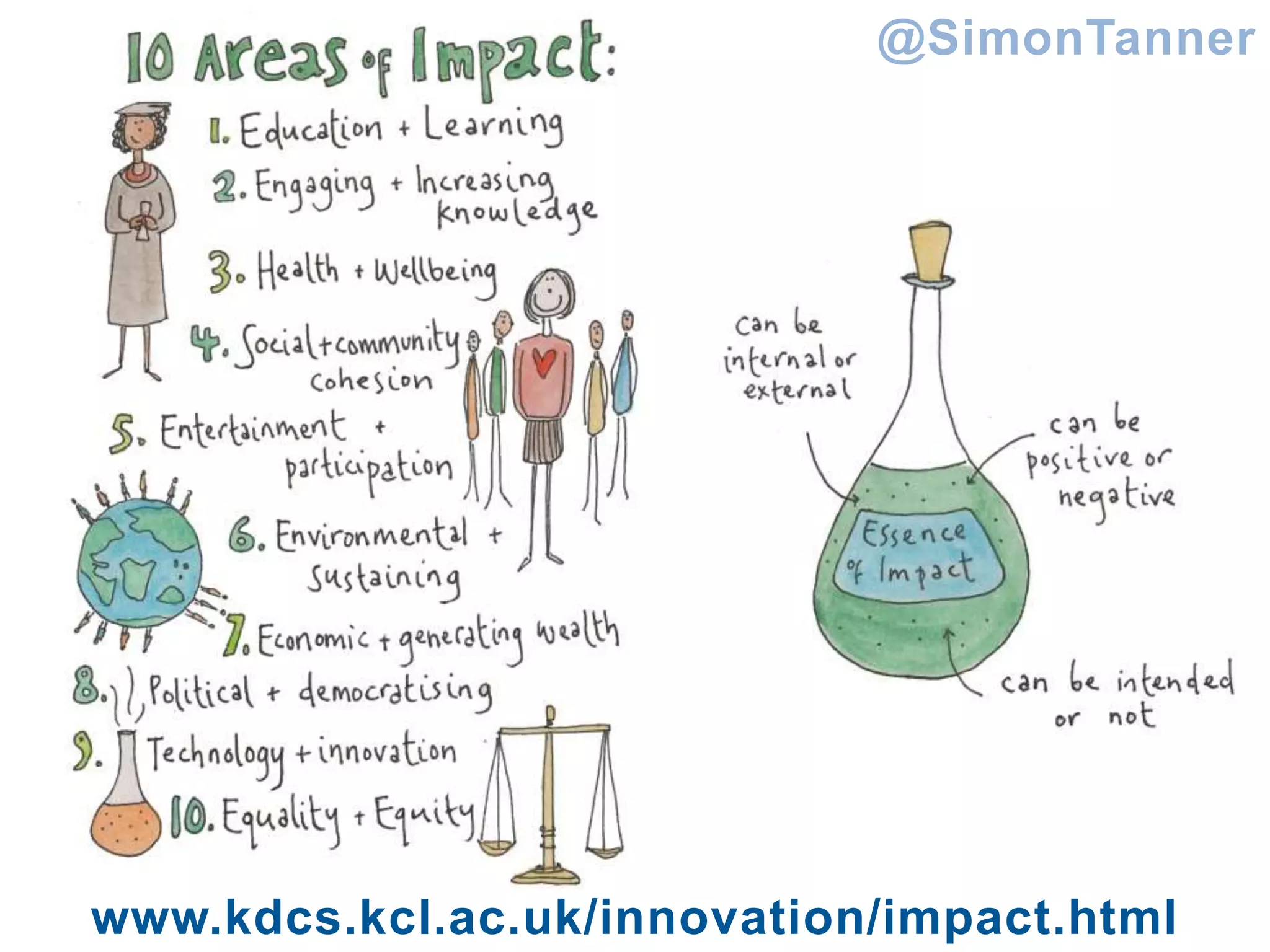
www.kdcs.kcl.ac.uk/innovation/impact.html
@SimonTanner
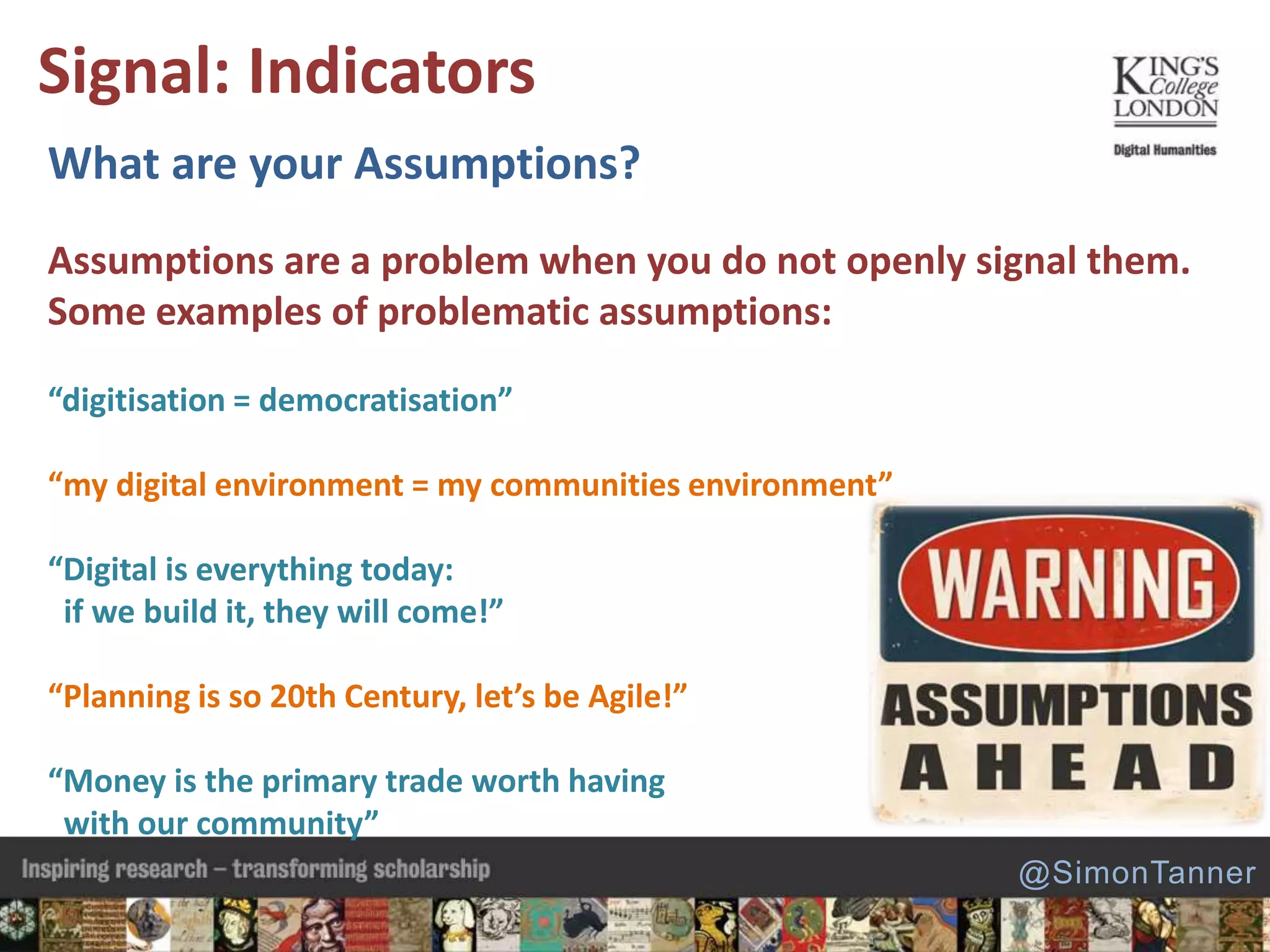
What are your Assumptions?
Assumptions are a problem when you do not openly signal them.
Some examples of problematic assumptions:
“digitisation = democratisation”
“my digital environment = my communities environment”
“Digital is everything today:
if we build it, they will come!”
“Planning is so 20th Century, let’s be Agile!”
“Money is the primary trade worth having
with our community”
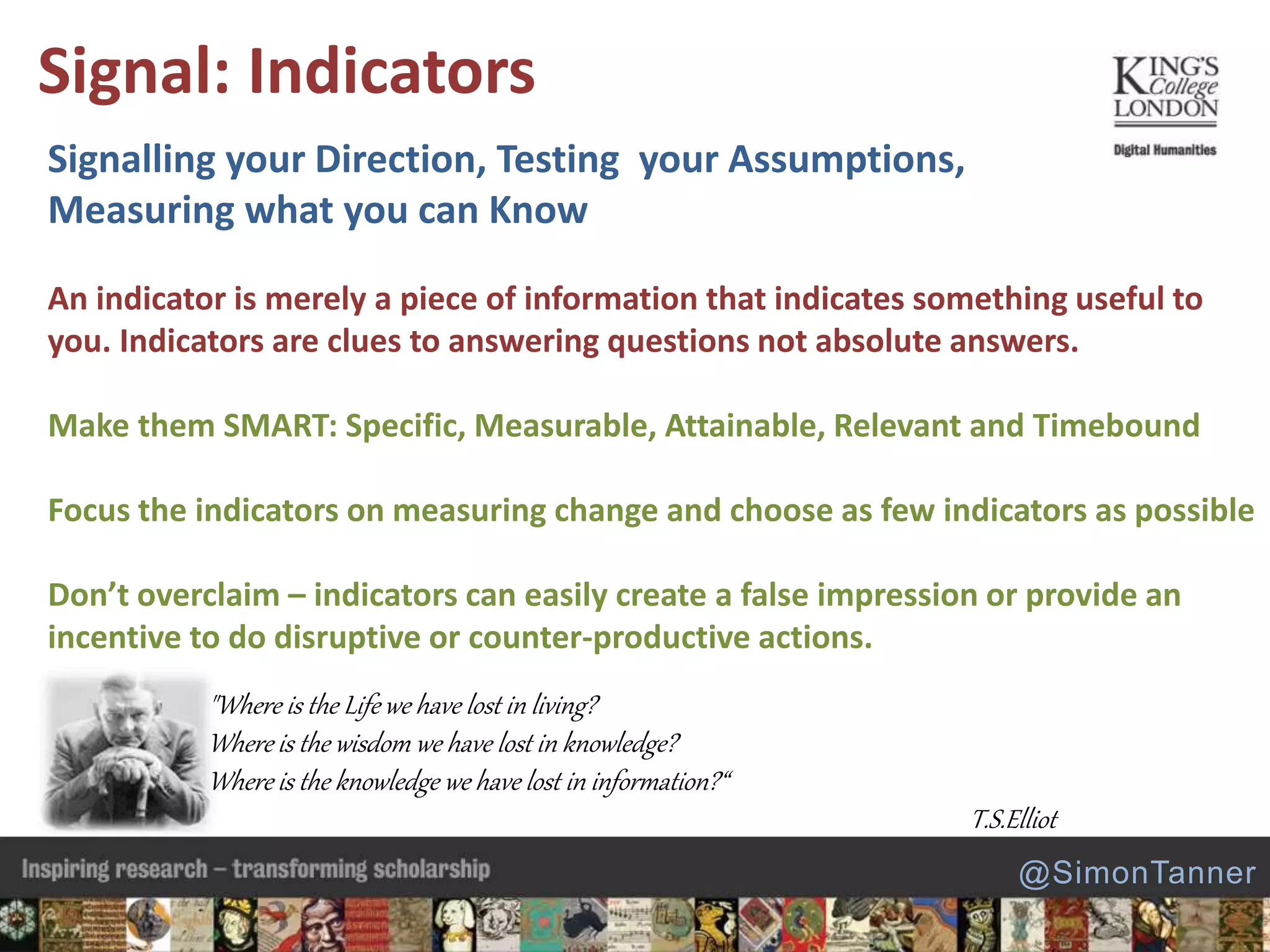
Signal: Indicators
@SimonTanner
Signalling your Direction, Testing your Assumptions,
Measuring what you can Know
An indicator is merely a piece of information that indicates something useful to
you. Indicators are clues to answering questions not absolute answers.
Make them SMART: Specific, Measurable, Attainable, Relevant and Timebound
Focus the indicators on measuring change and choose as few indicators as possible
Don’t overclaim – indicators can easily create a false impression or provide an
incentive to do disruptive or counter-productive actions.
Signal: Indicators
@SimonTanner
"Where is the Life we have lost in living?
Where is the wisdom we have lost in knowledge?
Where is the knowledge we have lost in information?“
T.S.Elliot
@SimonTanner
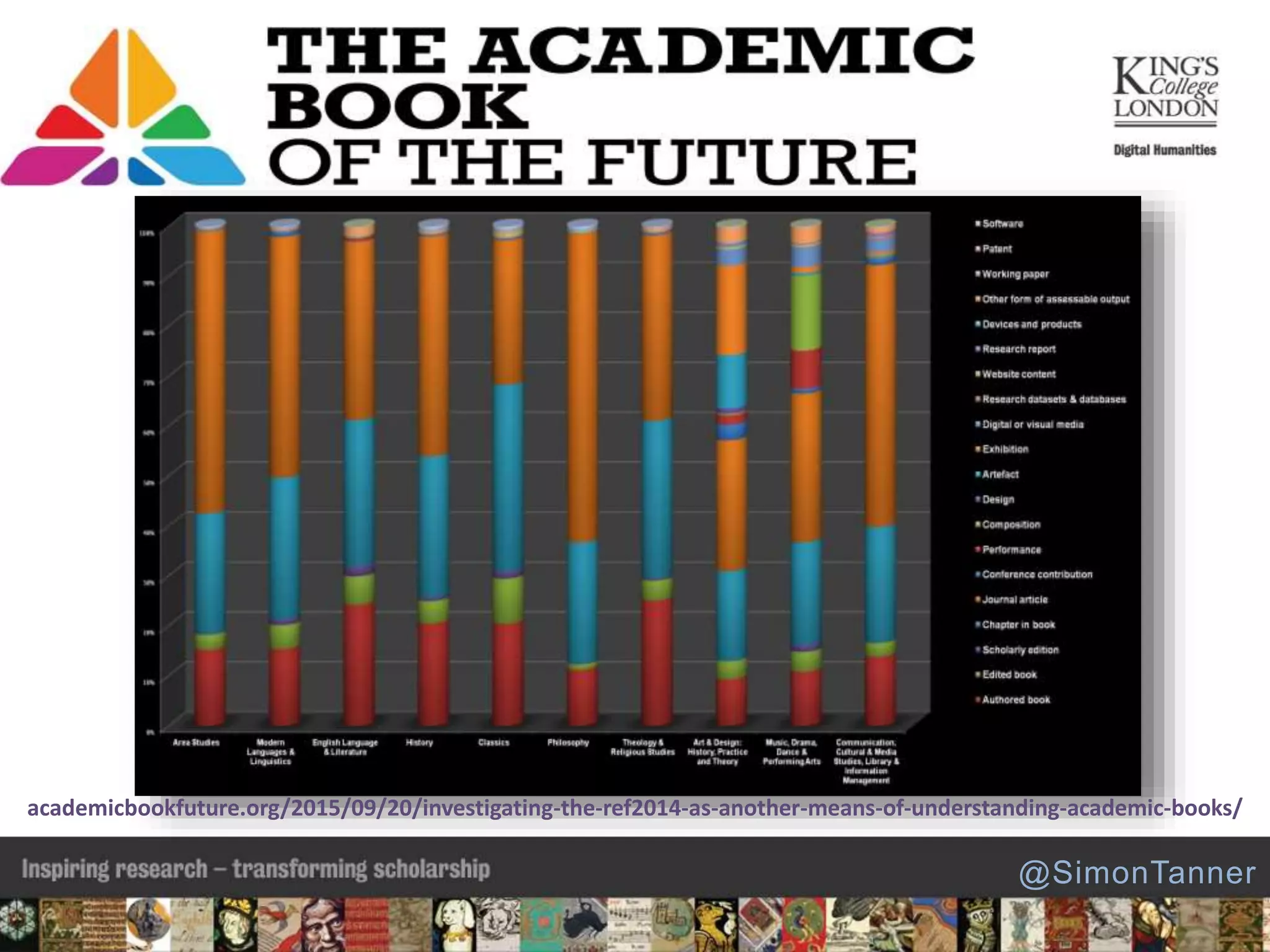
academicbookfuture.org/2015/09/20/investigating-the-ref2014-as-another-means-of-understanding-academic-books/
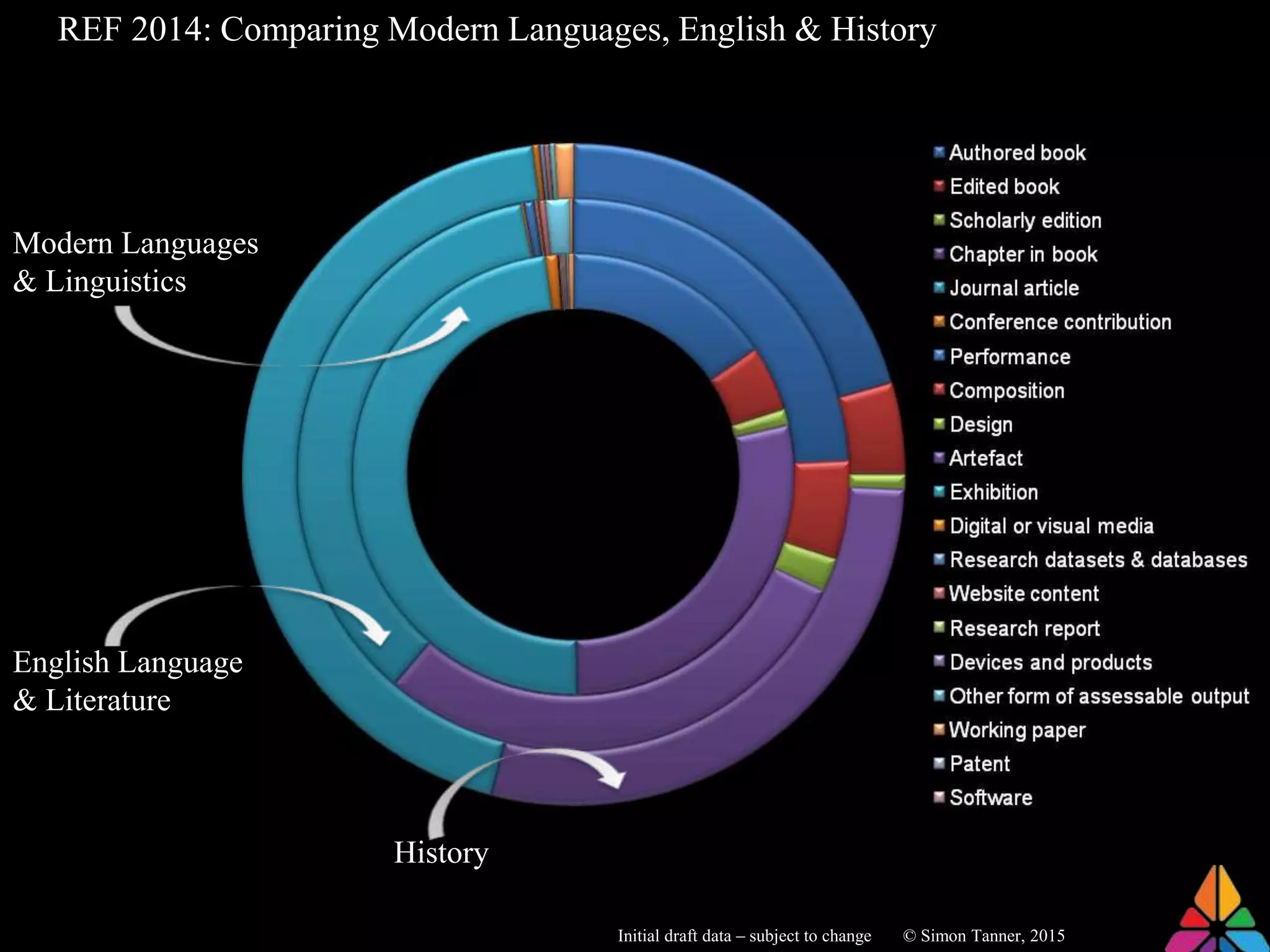
REF 2014: Comparing Modern Languages, English & History
Modern Languages
& Linguistics
English Language
& Literature
History
Initial draft data – subject to change © Simon Tanner, 2015
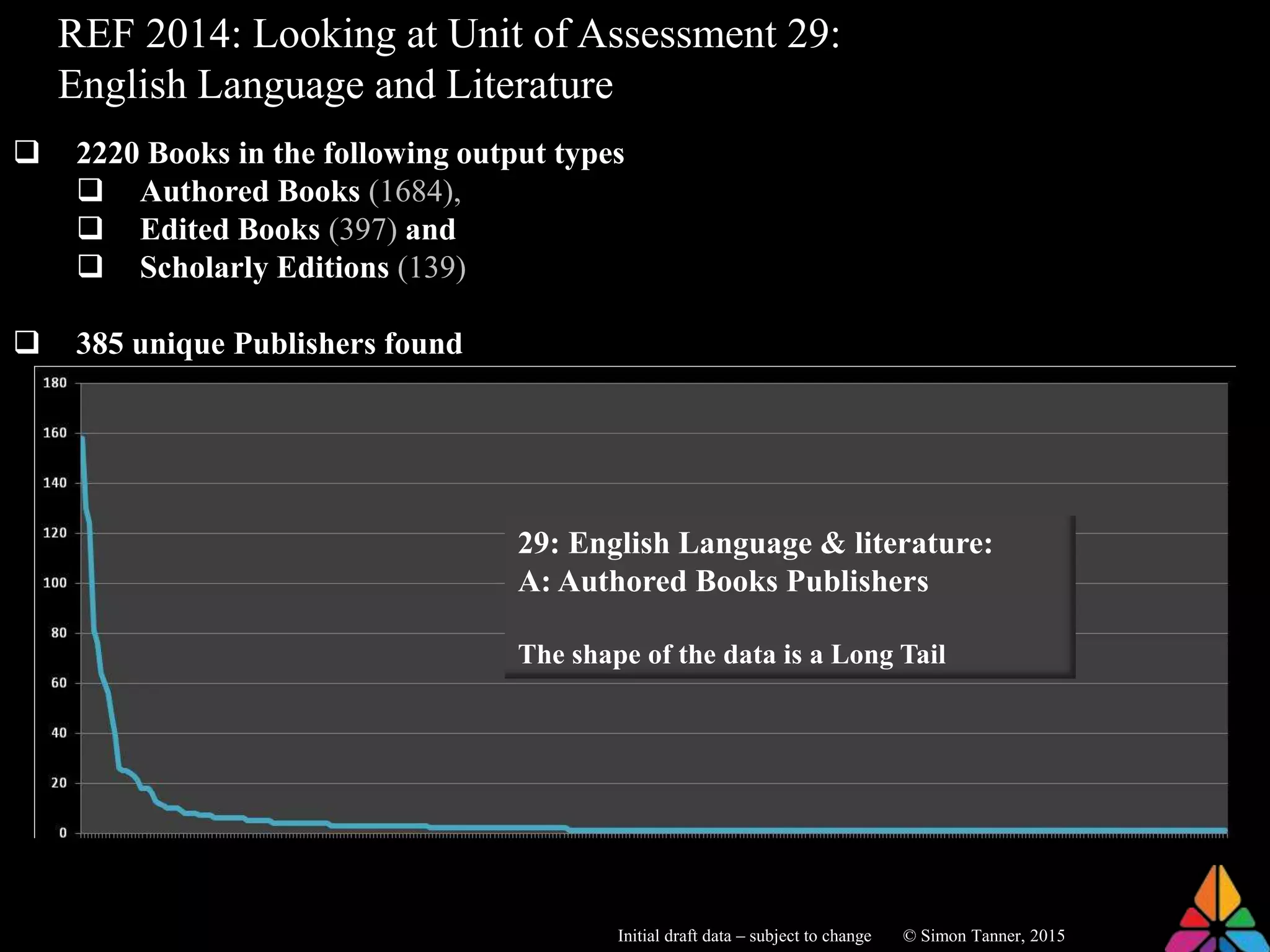
REF 2014: Looking at Unit of Assessment 29:
English Language and Literature
 2220 Books in the following output types
 Authored Books (1684),
 Edited Books (397) and
 Scholarly Editions (139)
 385 unique Publishers found
Initial draft data – subject to change © Simon Tanner, 2015
29: English Language & literature:
A: Authored Books Publishers
The shape of the data is a Long Tail
REF 2014: Looking at Unit of Assessment 29:
English Language and Literature
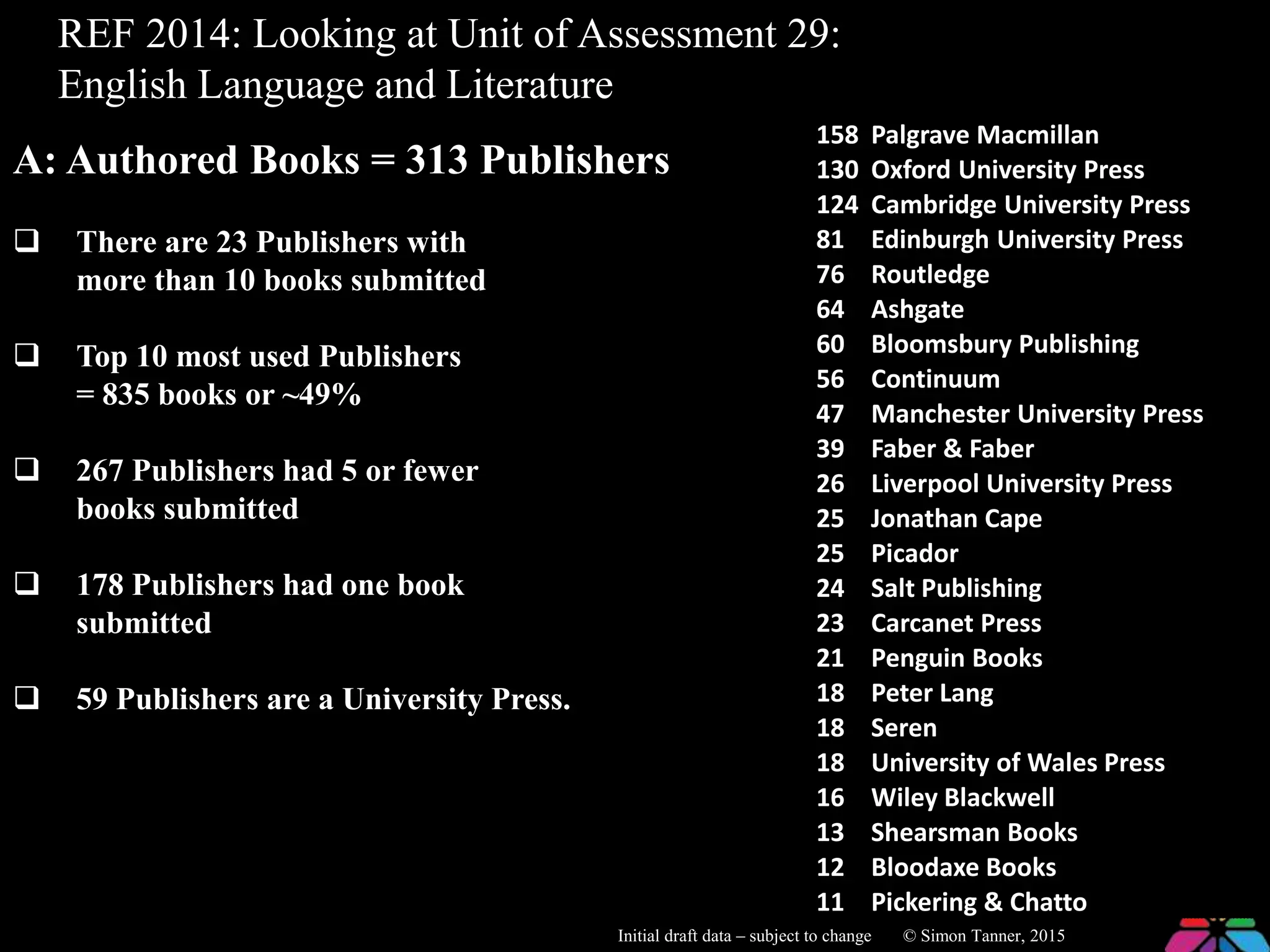
A: Authored Books = 313 Publishers
 There are 23 Publishers with
more than 10 books submitted
 Top 10 most used Publishers
= 835 books or ~49%
 267 Publishers had 5 or fewer
books submitted
 178 Publishers had one book
submitted
 59 Publishers are a University Press.
Initial draft data – subject to change © Simon Tanner, 2015
158 Palgrave Macmillan
130 Oxford University Press
124 Cambridge University Press
81 Edinburgh University Press
76 Routledge
64 Ashgate
60 Bloomsbury Publishing
56 Continuum
47 Manchester University Press
39 Faber & Faber
26 Liverpool University Press
25 Jonathan Cape
25 Picador
24 Salt Publishing
23 Carcanet Press
21 Penguin Books
18 Peter Lang
18 Seren
18 University of Wales Press
16 Wiley Blackwell
13 Shearsman Books
12 Bloodaxe Books
11 Pickering & Chatto
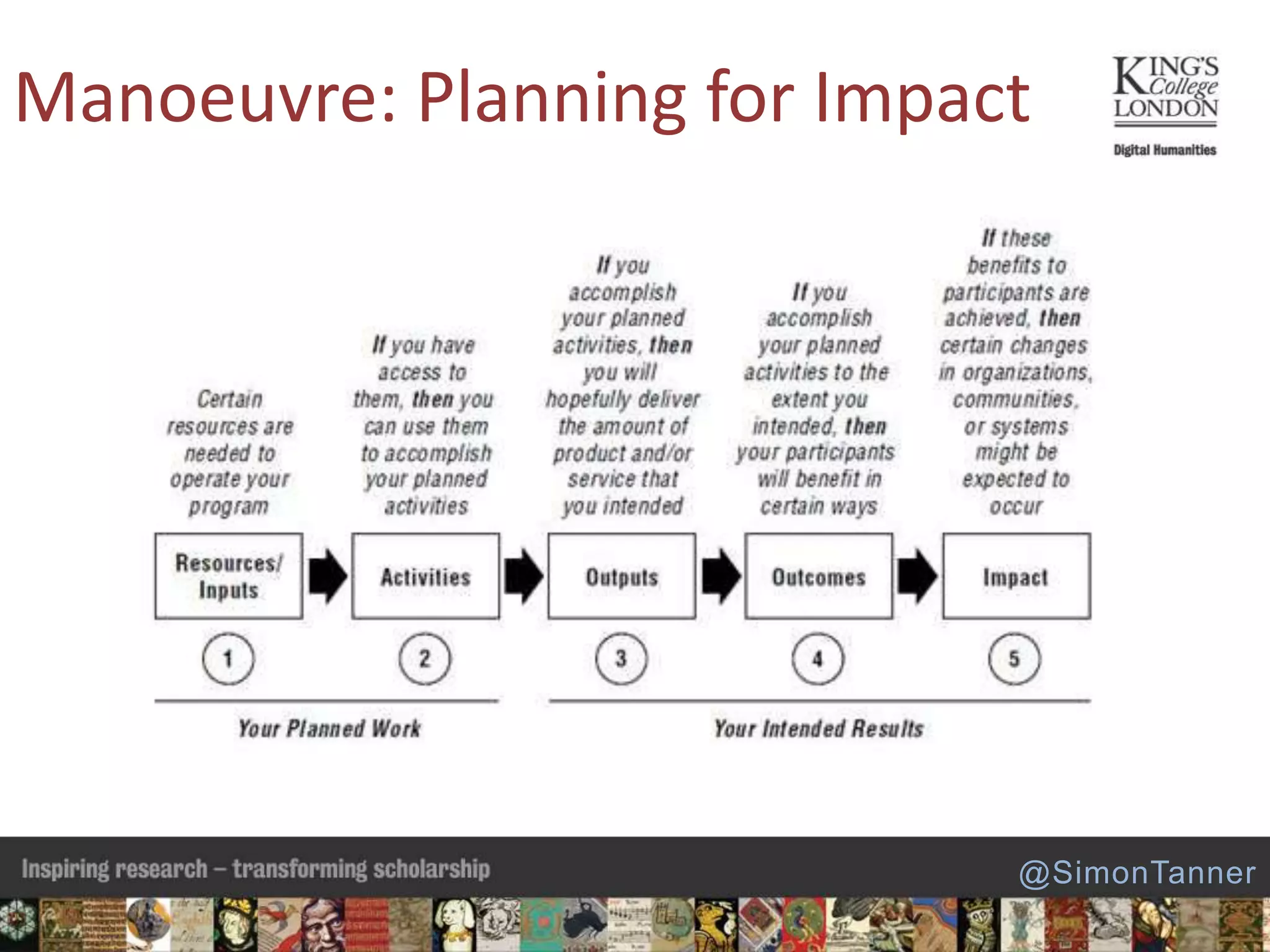
Manoeuvre: Planning for Impact
@SimonTanner
@SimonTanner@SimonTanner
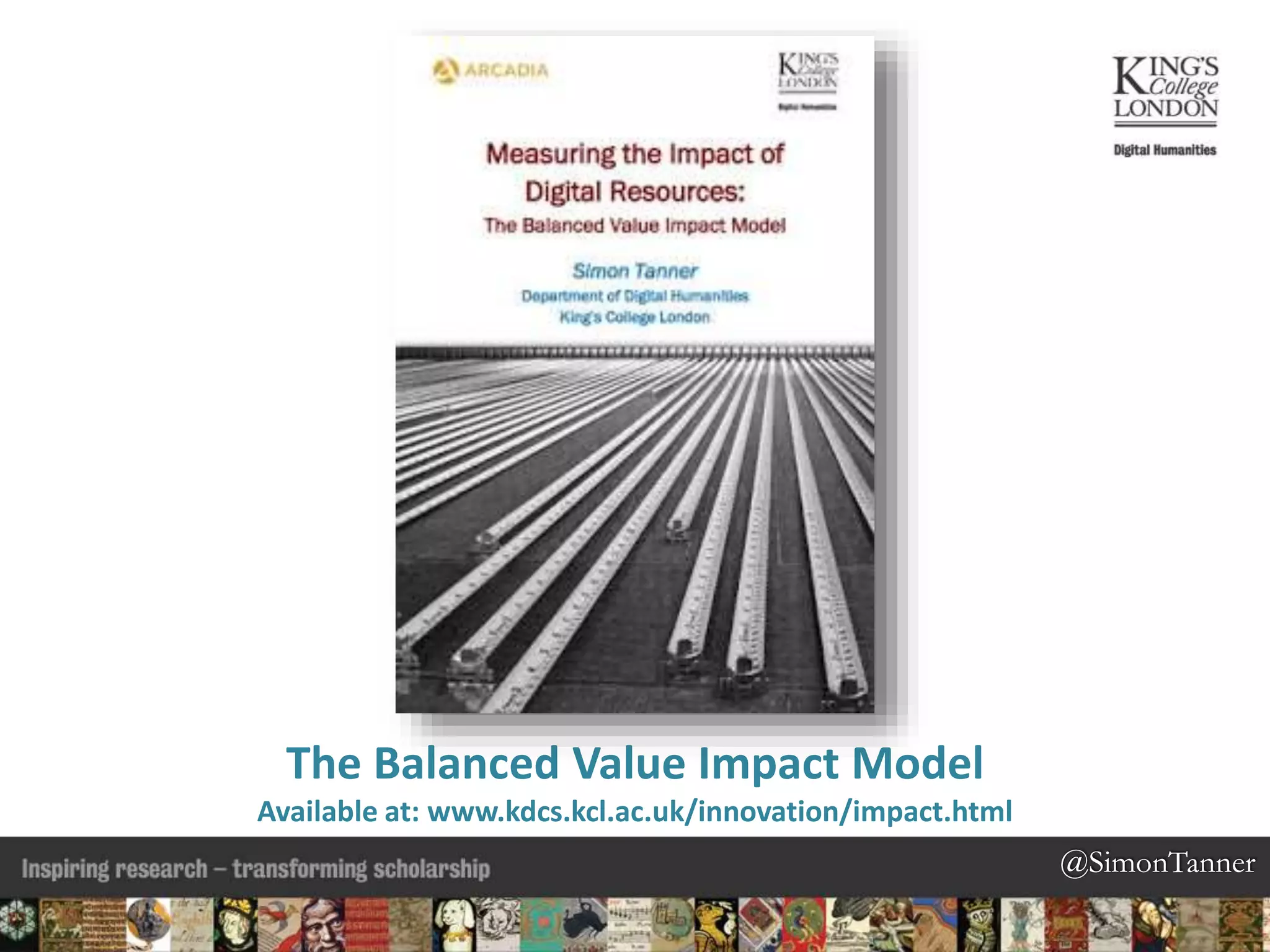
The Balanced Value Impact Model
Available at: www.kdcs.kcl.ac.uk/innovation/impact.html
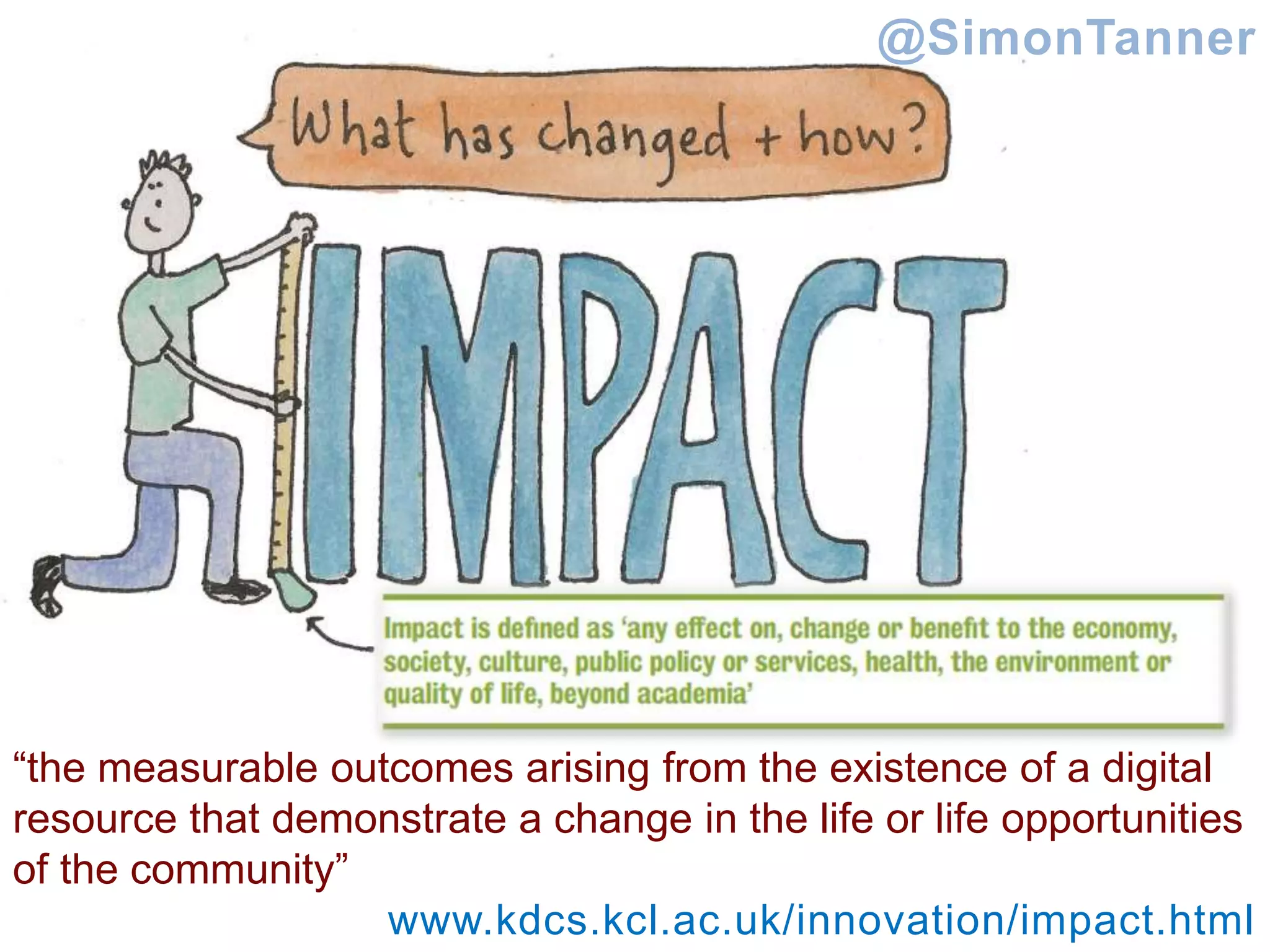
“the measurable outcomes arising from the existence of a digital
resource that demonstrate a change in the life or life opportunities
of the community”
www.kdcs.kcl.ac.uk/innovation/impact.html
@SimonTanner
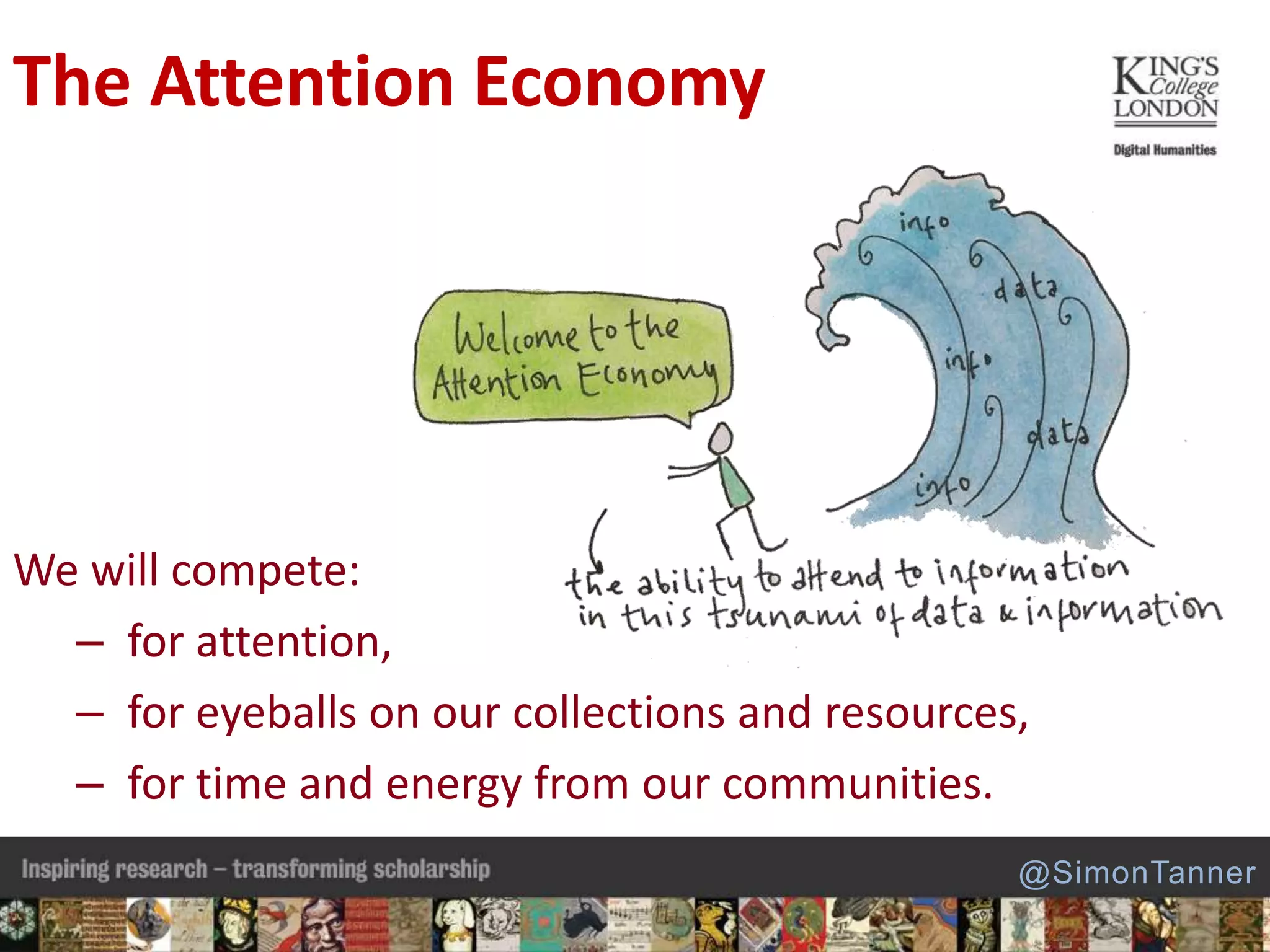
The Attention Economy
We will compete:
– for attention,
– for eyeballs on our collections and resources,
– for time and energy from our communities.
@SimonTanner
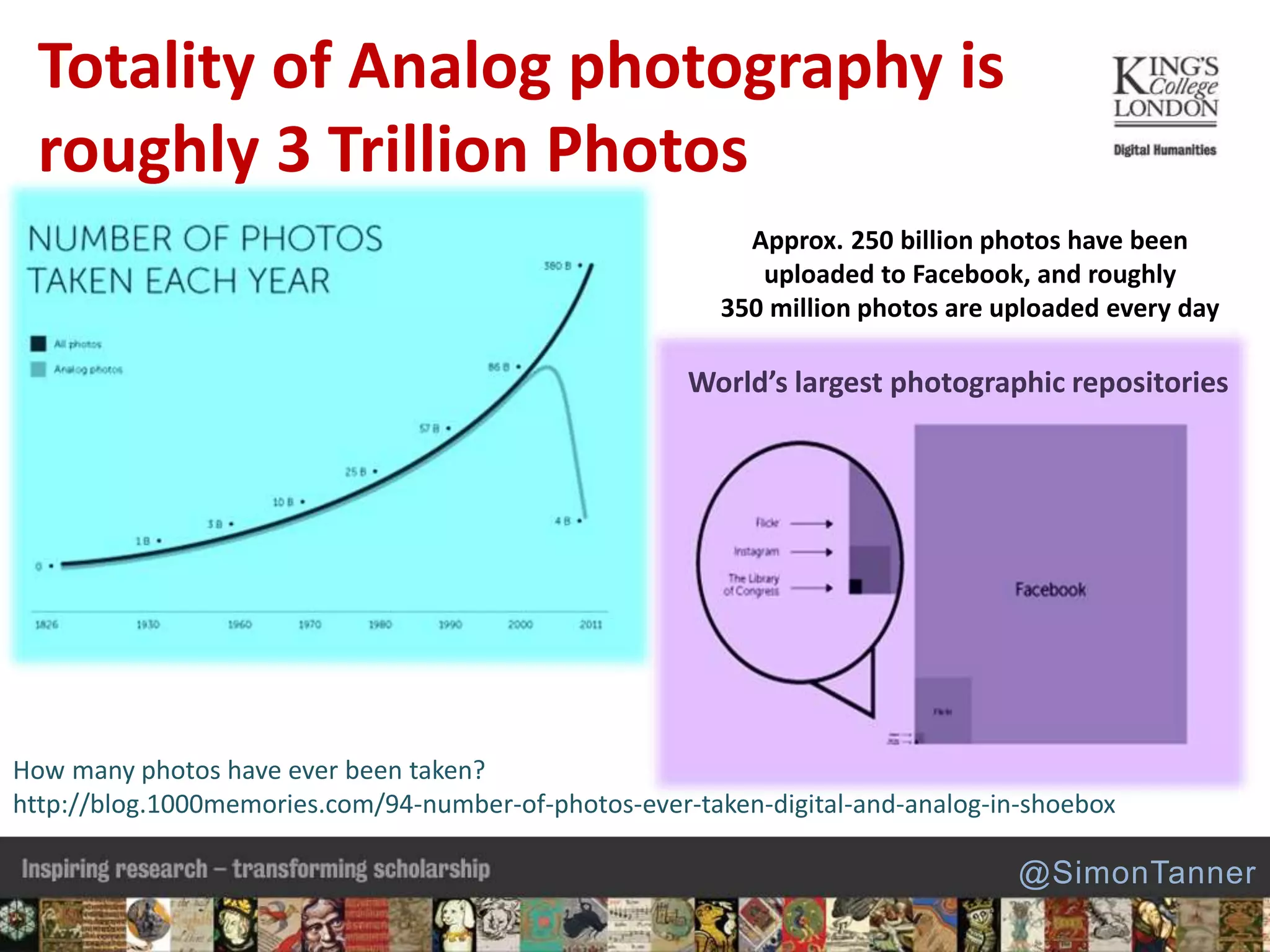
How many photos have ever been taken?
http://blog.1000memories.com/94-number-of-photos-ever-taken-digital-and-analog-in-shoebox
Totality of Analog photography is
roughly 3 Trillion Photos
Approx. 250 billion photos have been
uploaded to Facebook, and roughly
350 million photos are uploaded every day
World’s largest photographic repositories
@SimonTanner
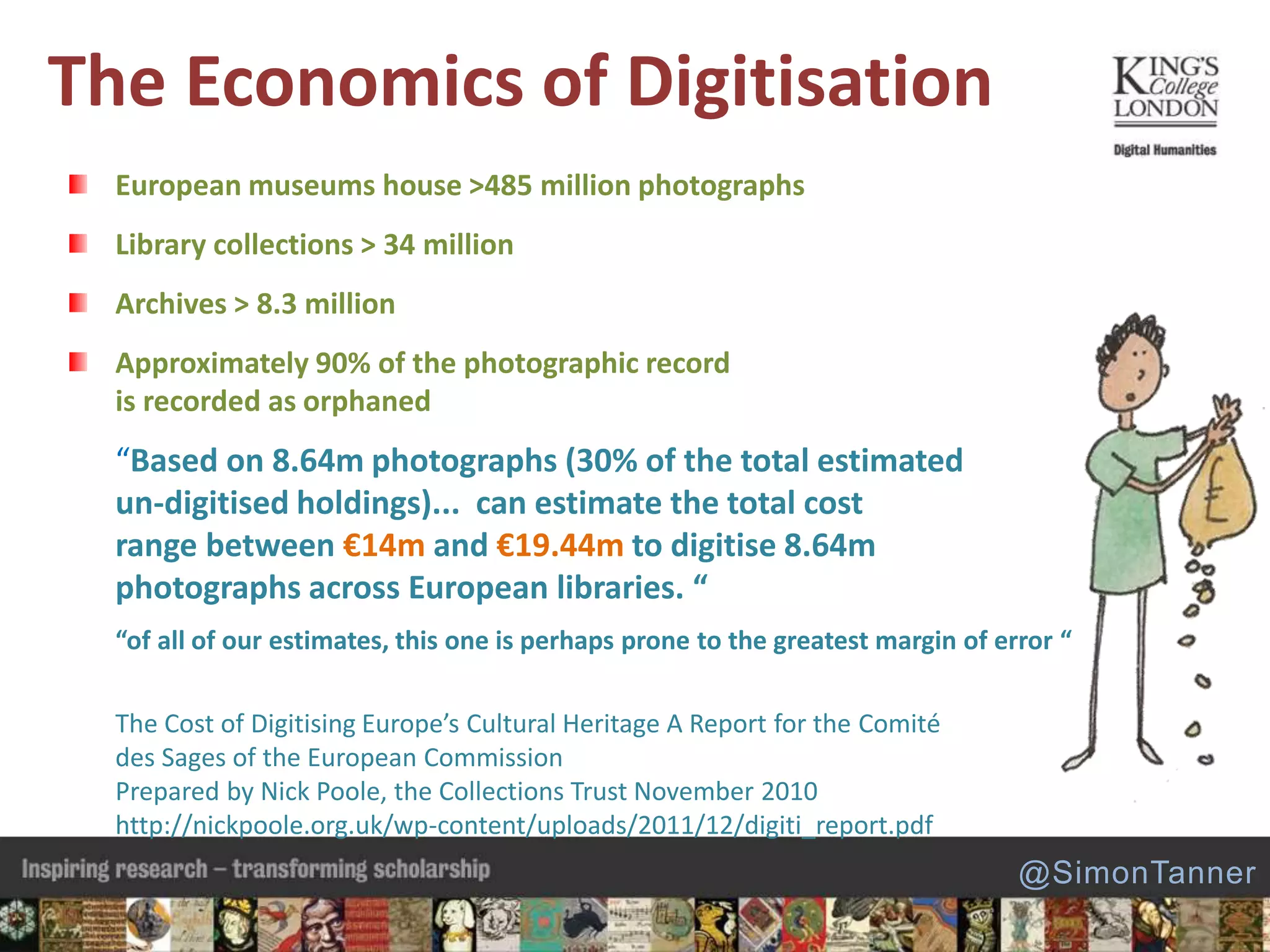
The Economics of Digitisation
European museums house >485 million photographs
Library collections > 34 million
Archives > 8.3 million
Approximately 90% of the photographic record
is recorded as orphaned
“Based on 8.64m photographs (30% of the total estimated
un-digitised holdings)... can estimate the total cost
range between €14m and €19.44m to digitise 8.64m
photographs across European libraries. “
“of all of our estimates, this one is perhaps prone to the greatest margin of error “
The Cost of Digitising Europe’s Cultural Heritage A Report for the Comité
des Sages of the European Commission
Prepared by Nick Poole, the Collections Trust November 2010
http://nickpoole.org.uk/wp-content/uploads/2011/12/digiti_report.pdf
@SimonTanner
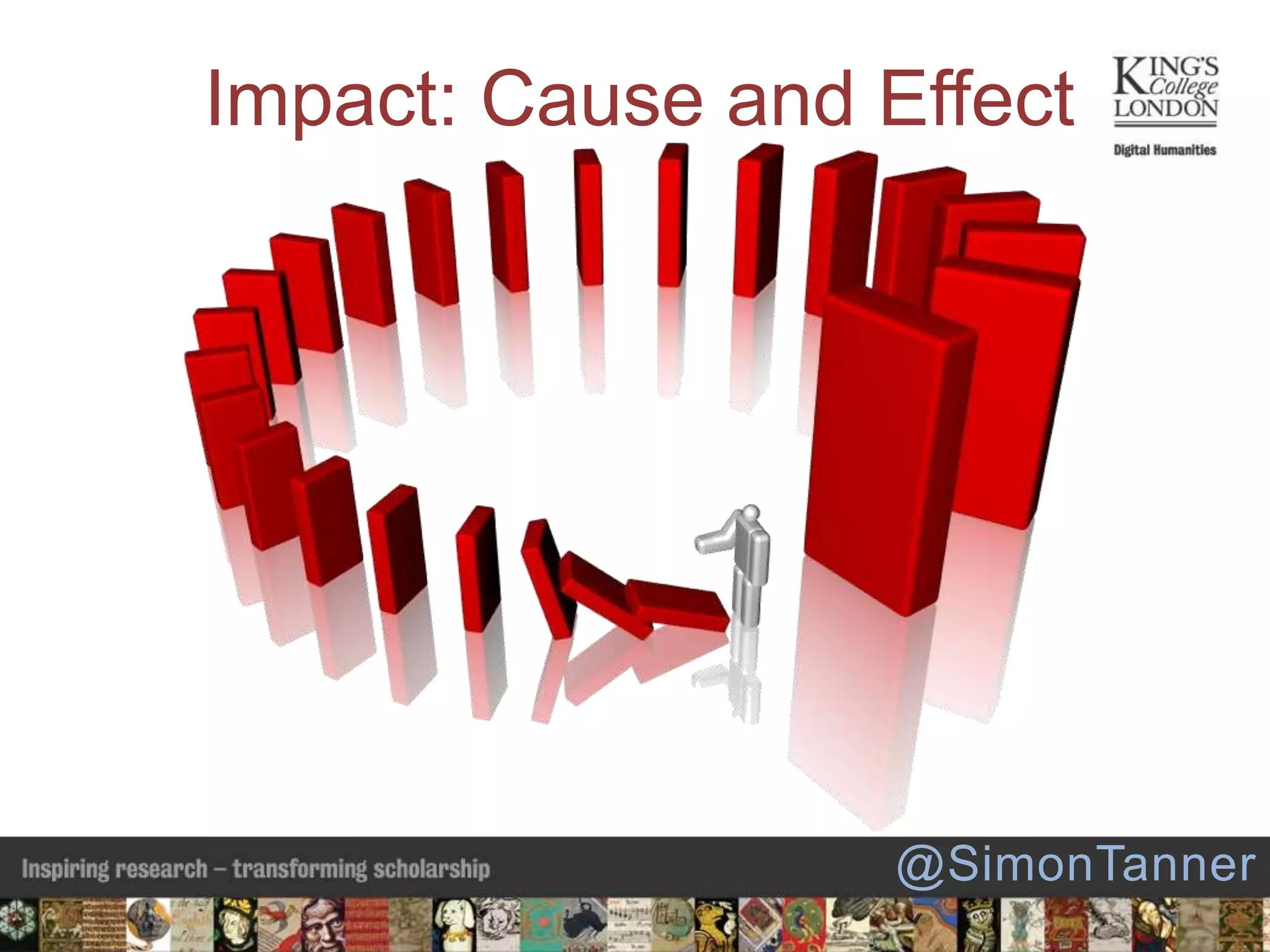
Impact: Cause and Effect
@SimonTanner
www.kdcs.kcl.ac.uk/innovation/impact.html
@SimonTanner
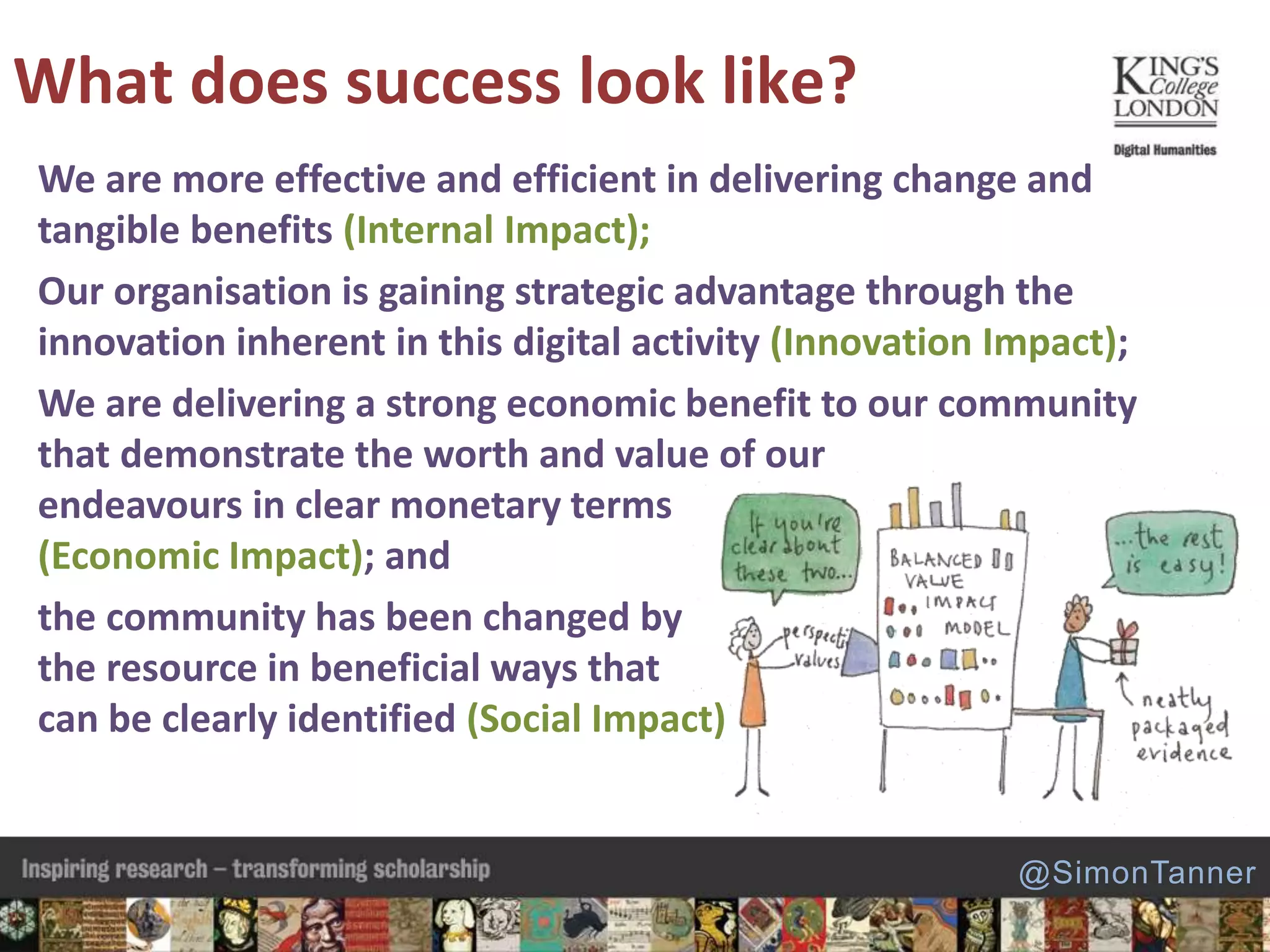
We are more effective and efficient in delivering change and
tangible benefits (Internal Impact);
Our organisation is gaining strategic advantage through the
innovation inherent in this digital activity (Innovation Impact);
We are delivering a strong economic benefit to our community
that demonstrate the worth and value of our
endeavours in clear monetary terms
(Economic Impact); and
the community has been changed by
the resource in beneficial ways that
can be clearly identified (Social Impact)
What does success look like?
@SimonTanner
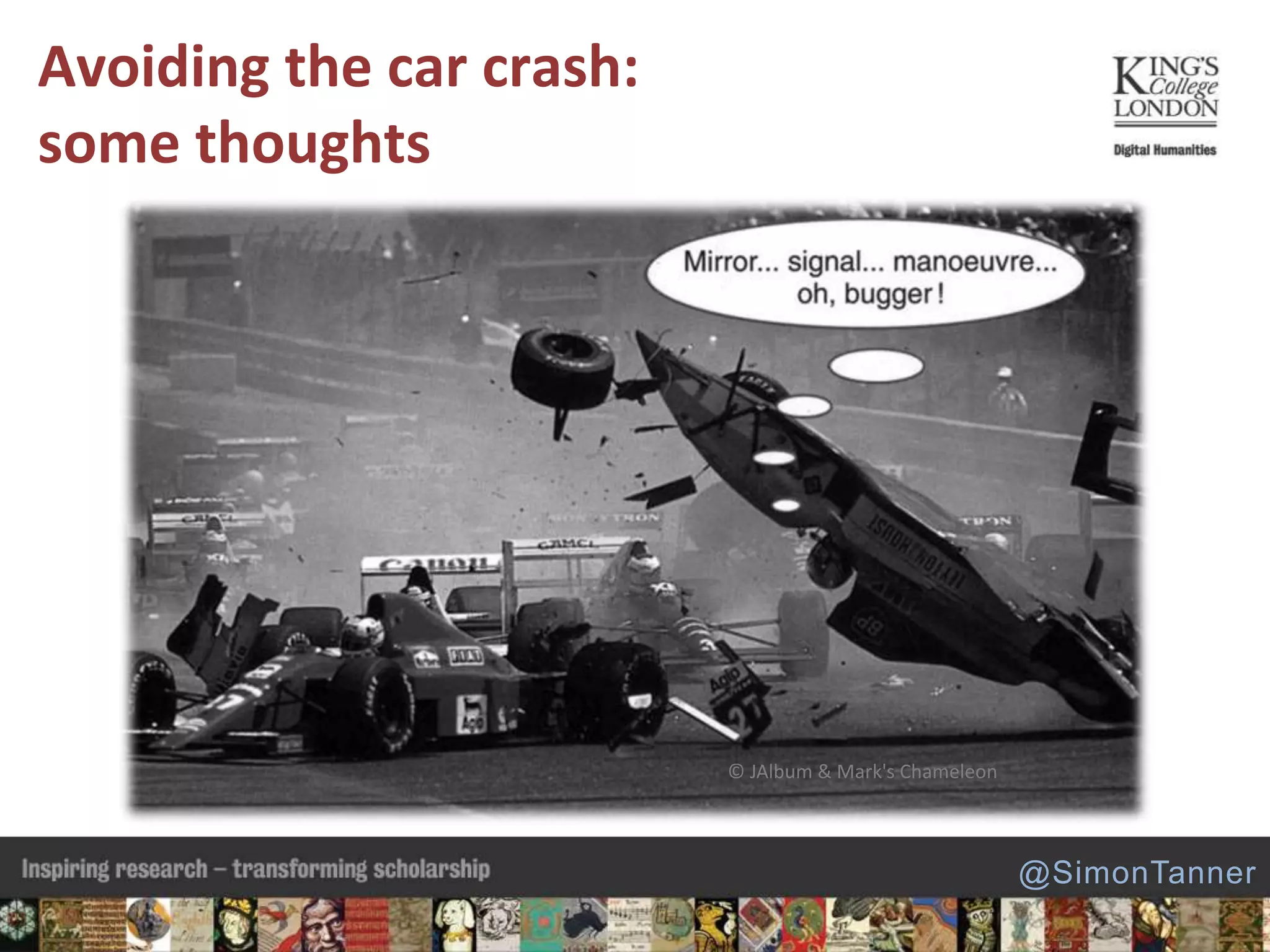
Avoiding the car crash:
some thoughts
@SimonTanner
© JAlbum & Mark's Chameleon
STANDARDS!
You happy Polly?
@SimonTanner
“Michelle Pickover, curator of manuscripts at the
University of the Witwatersrand in South Africa,
argues that ‘Cyberspace is not an uncontested domain.
The digital medium contains an ideological base – it is a site of struggle.’
The real challenges in collection digitisation in national memory institutions,
she argues, are not technological or technical
but social and political.
Librarians and archivists are ‘agents of social change’ who,
through their appraisal, selection, arrangement and retention of material,
are able to become active participants in the production of social memory,
and who, by the nature of their work, cannot help but
‘privilege certain narratives and silence or marginalise others’
Kahn, R and Tanner, S (2014) Building Futures: The Role of Digital Collections in
Shaping National Identity in Africa (chapter in African Studies in the Digital Age)
Democratisation & Contested Spaces
@SimonTanner
How do we genuinely offer democratisation in a
digital domain when people are struggling to:
Be
Belong
Build identity
Be Recognised
Believed
Understood
Understand
Heard
Democratisation & Contested Spaces
@SimonTanner
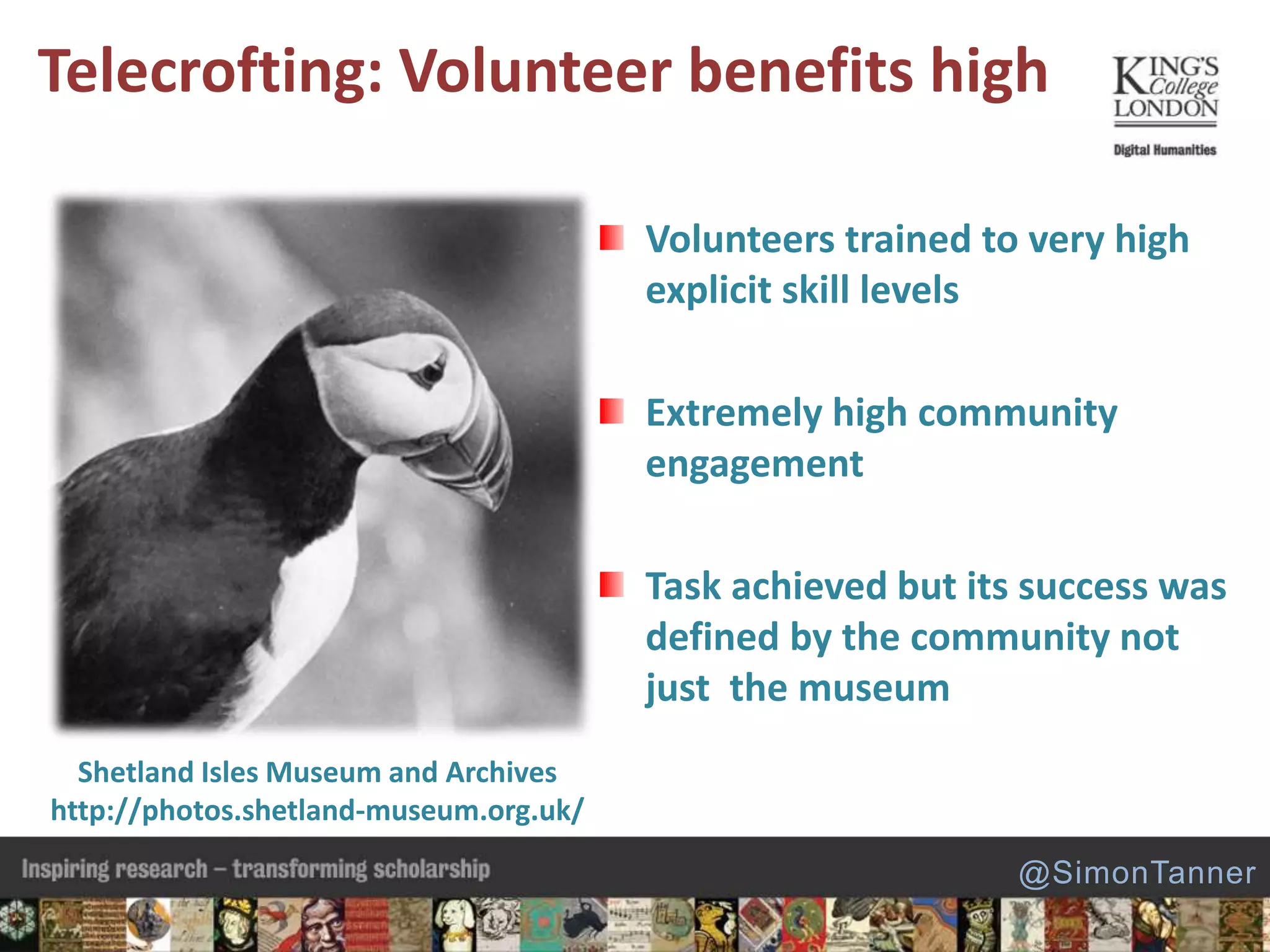
Telecrofting: Volunteer benefits high
Shetland Isles Museum and Archives
http://photos.shetland-museum.org.uk/
Volunteers trained to very high
explicit skill levels
Extremely high community
engagement
Task achieved but its success was
defined by the community not
just the museum
@SimonTanner
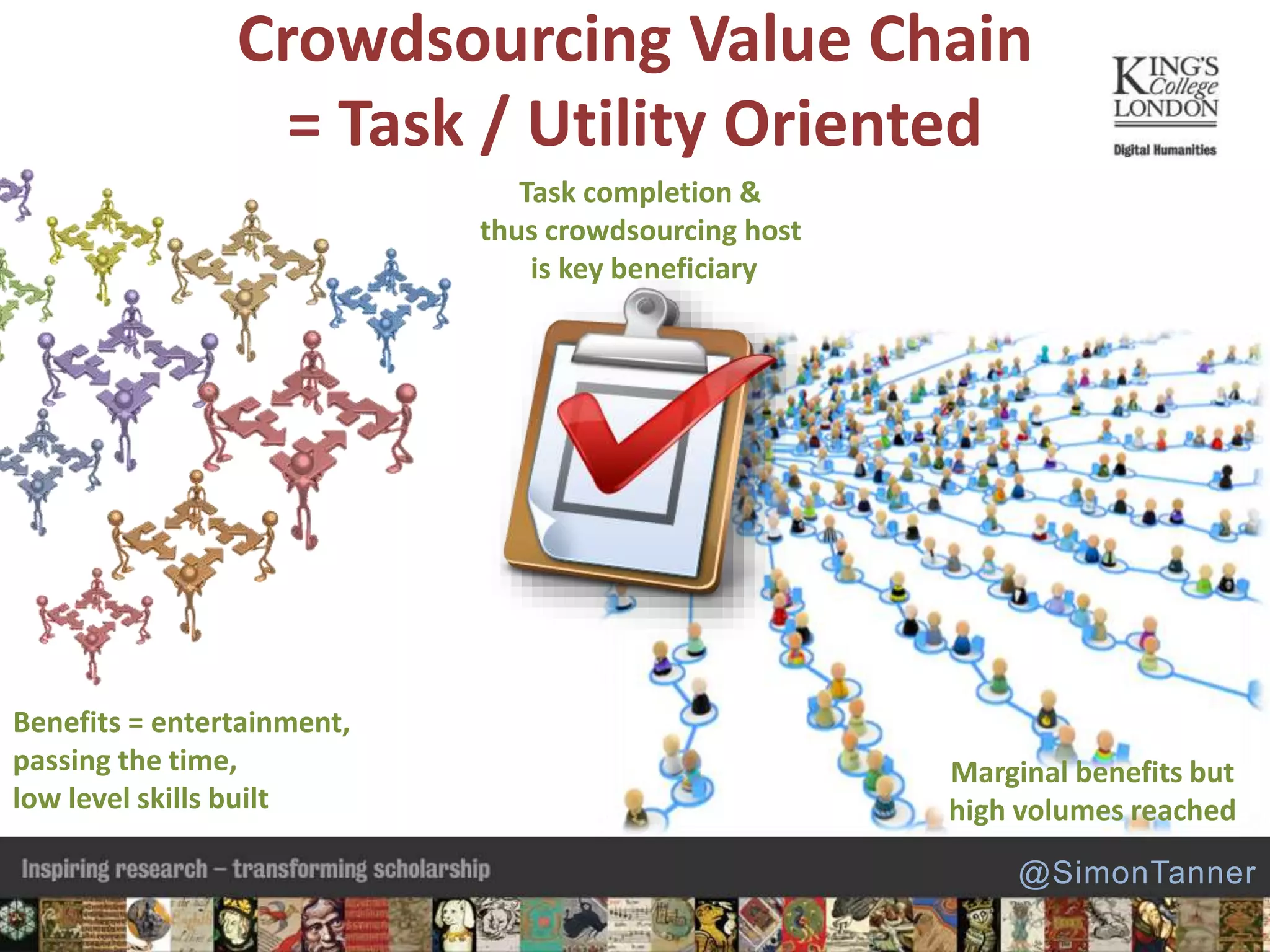
Crowdsourcing Value Chain
= Task / Utility Oriented
Benefits = entertainment,
passing the time,
low level skills built
Task completion &
thus crowdsourcing host
is key beneficiary
Marginal benefits but
high volumes reached
@SimonTanner
Challenge – find your telecrofters
If crowdsourcing is so great why are there so few projects?
Volunteers have a much higher engagement,
develop a much higher skills base and thus see more
chance their lives can be changed in beneficial ways
Personalise the crowd,
reach out to individuals,
build genuine relationships and listen
The task is not everything – look beyond
mere utility
Crowdsourcing is Dead: Long Live Citizen Humanities!
http://simon-tanner.blogspot.co.uk/2015/09/crowdsourcing-is-dead-long-live-citizen.html
@SimonTanner
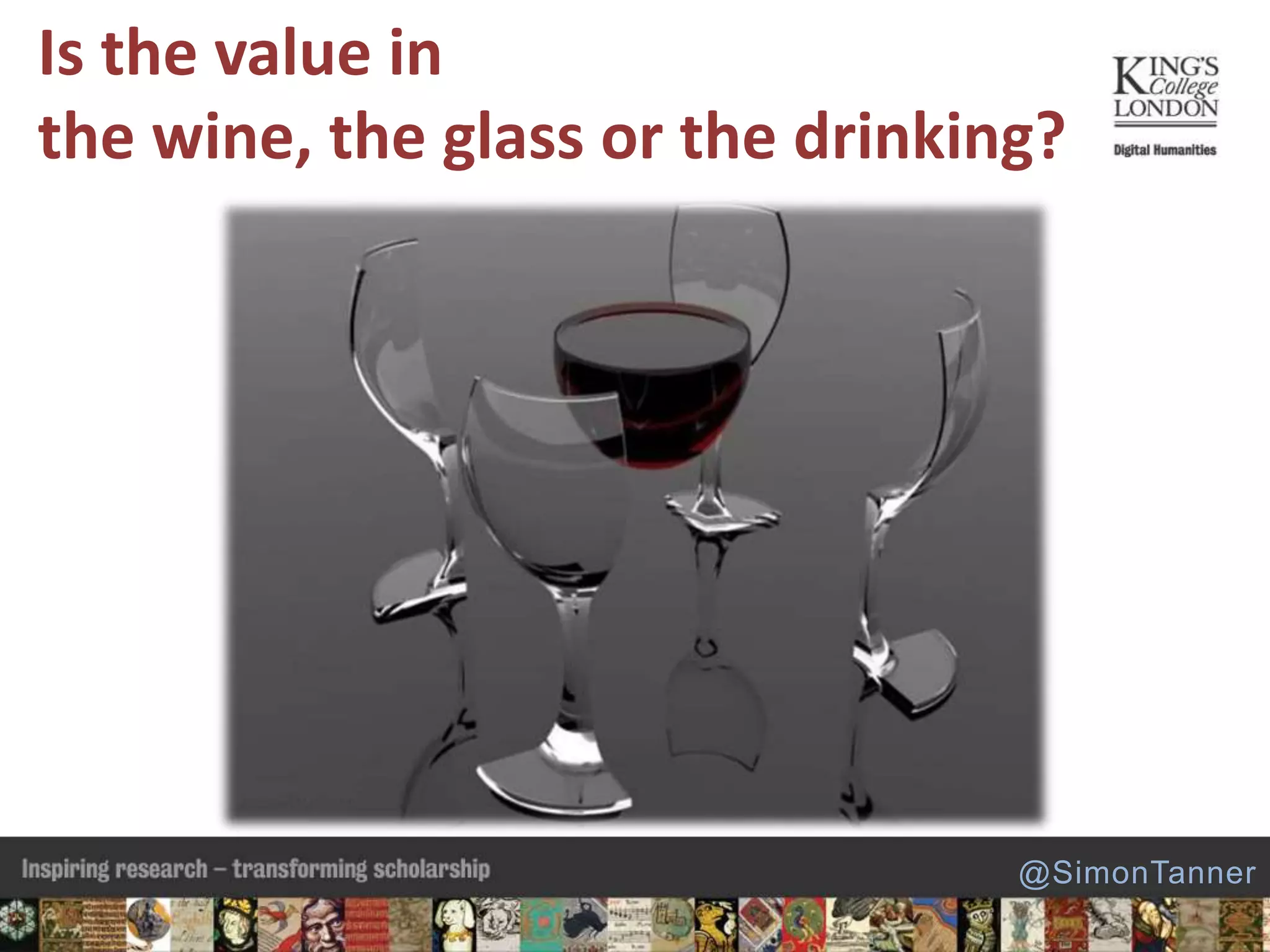
Is the value in
the wine, the glass or the drinking?
@SimonTanner
Vote on Twitter with the hashtag:
Wine/Content = #dcdc15wine
Glass/Infrastructure = #dcdc15glass
Drinking/Access = #dcdc15drink
Results after lunch today, cheers!
Your Vote: Is the value in
the wine, the glass or the drinking?
@SimonTanner

Mirror, Signal, Manoeuvre How  understanding context, indicators and strategic direction can make an impact not a car crash.

  • 1.
    @SimonTanner Mirror, Signal, Manoeuvre Howunderstanding context, indicators and strategic direction can make an impact not a car crash. Simon Tanner Digital Humanities, King’s College London Twitter: @SimonTanner 13/10/2015 23:14 ENC Public Talk 19 February 2013 1 © JAlbum & Mark's Chameleon
  • 2.
    Mirror: understanding context Signal:choosing your indicators Manoeuvre: deciding strategic direction & values Mirror, Signal, Manoeuvre @SimonTanner
  • 3.
  • 4.
    http://www.youtube.com/watch?v=tp4y-_VoXdA Digital Humanities methodsfor historical analysis of Irish Immigrants in 19th Century London, England
  • 5.
    Reason 1: digitalhumanities digital research resources are recognised Reason 2: digital humanities enhances the research environment Reason 3: digital humanities has impact 3 Reasons to say YES to DH http://simon-tanner.blogspot.co.uk/2015/02/3-reasons-ref2014-was-good-for-digital.html @SimonTanner
  • 6.
    Digital Ecosystem There isa defined resource that is made up of a describable, cohesive set of primary and secondary materials, services, products and activities. The resource is accessed primarily through a digital platform (web, mobile, or other means). The content within the resource is digital in nature There is a definable group of users that the resource is intended to reach by digital means. The resource does not have to stand alone, it could be part of a wider set of activities, products, or services Mirror: Understanding Context @SimonTanner
  • 7.
  • 8.
    What are yourAssumptions? Assumptions are a problem when you do not openly signal them. Some examples of problematic assumptions: “digitisation = democratisation” “my digital environment = my communities environment” “Digital is everything today: if we build it, they will come!” “Planning is so 20th Century, let’s be Agile!” “Money is the primary trade worth having with our community” Signal: Indicators @SimonTanner
  • 9.
    Signalling your Direction,Testing your Assumptions, Measuring what you can Know An indicator is merely a piece of information that indicates something useful to you. Indicators are clues to answering questions not absolute answers. Make them SMART: Specific, Measurable, Attainable, Relevant and Timebound Focus the indicators on measuring change and choose as few indicators as possible Don’t overclaim – indicators can easily create a false impression or provide an incentive to do disruptive or counter-productive actions. Signal: Indicators @SimonTanner "Where is the Life we have lost in living? Where is the wisdom we have lost in knowledge? Where is the knowledge we have lost in information?“ T.S.Elliot
  • 10.
  • 11.
    REF 2014: ComparingModern Languages, English & History Modern Languages & Linguistics English Language & Literature History Initial draft data – subject to change © Simon Tanner, 2015
  • 12.
    REF 2014: Lookingat Unit of Assessment 29: English Language and Literature  2220 Books in the following output types  Authored Books (1684),  Edited Books (397) and  Scholarly Editions (139)  385 unique Publishers found Initial draft data – subject to change © Simon Tanner, 2015 29: English Language & literature: A: Authored Books Publishers The shape of the data is a Long Tail
  • 13.
    REF 2014: Lookingat Unit of Assessment 29: English Language and Literature A: Authored Books = 313 Publishers  There are 23 Publishers with more than 10 books submitted  Top 10 most used Publishers = 835 books or ~49%  267 Publishers had 5 or fewer books submitted  178 Publishers had one book submitted  59 Publishers are a University Press. Initial draft data – subject to change © Simon Tanner, 2015 158 Palgrave Macmillan 130 Oxford University Press 124 Cambridge University Press 81 Edinburgh University Press 76 Routledge 64 Ashgate 60 Bloomsbury Publishing 56 Continuum 47 Manchester University Press 39 Faber & Faber 26 Liverpool University Press 25 Jonathan Cape 25 Picador 24 Salt Publishing 23 Carcanet Press 21 Penguin Books 18 Peter Lang 18 Seren 18 University of Wales Press 16 Wiley Blackwell 13 Shearsman Books 12 Bloodaxe Books 11 Pickering & Chatto
  • 14.
    Manoeuvre: Planning forImpact @SimonTanner
  • 15.
    @SimonTanner@SimonTanner The Balanced ValueImpact Model Available at: www.kdcs.kcl.ac.uk/innovation/impact.html
  • 16.
    “the measurable outcomesarising from the existence of a digital resource that demonstrate a change in the life or life opportunities of the community” www.kdcs.kcl.ac.uk/innovation/impact.html @SimonTanner
  • 17.
    The Attention Economy Wewill compete: – for attention, – for eyeballs on our collections and resources, – for time and energy from our communities. @SimonTanner
  • 18.
    How many photoshave ever been taken? http://blog.1000memories.com/94-number-of-photos-ever-taken-digital-and-analog-in-shoebox Totality of Analog photography is roughly 3 Trillion Photos Approx. 250 billion photos have been uploaded to Facebook, and roughly 350 million photos are uploaded every day World’s largest photographic repositories @SimonTanner
  • 19.
    The Economics ofDigitisation European museums house >485 million photographs Library collections > 34 million Archives > 8.3 million Approximately 90% of the photographic record is recorded as orphaned “Based on 8.64m photographs (30% of the total estimated un-digitised holdings)... can estimate the total cost range between €14m and €19.44m to digitise 8.64m photographs across European libraries. “ “of all of our estimates, this one is perhaps prone to the greatest margin of error “ The Cost of Digitising Europe’s Cultural Heritage A Report for the Comité des Sages of the European Commission Prepared by Nick Poole, the Collections Trust November 2010 http://nickpoole.org.uk/wp-content/uploads/2011/12/digiti_report.pdf @SimonTanner
  • 20.
    Impact: Cause andEffect @SimonTanner
  • 21.
  • 22.
    We are moreeffective and efficient in delivering change and tangible benefits (Internal Impact); Our organisation is gaining strategic advantage through the innovation inherent in this digital activity (Innovation Impact); We are delivering a strong economic benefit to our community that demonstrate the worth and value of our endeavours in clear monetary terms (Economic Impact); and the community has been changed by the resource in beneficial ways that can be clearly identified (Social Impact) What does success look like? @SimonTanner
  • 23.
    Avoiding the carcrash: some thoughts @SimonTanner © JAlbum & Mark's Chameleon
  • 24.
  • 25.
    “Michelle Pickover, curatorof manuscripts at the University of the Witwatersrand in South Africa, argues that ‘Cyberspace is not an uncontested domain. The digital medium contains an ideological base – it is a site of struggle.’ The real challenges in collection digitisation in national memory institutions, she argues, are not technological or technical but social and political. Librarians and archivists are ‘agents of social change’ who, through their appraisal, selection, arrangement and retention of material, are able to become active participants in the production of social memory, and who, by the nature of their work, cannot help but ‘privilege certain narratives and silence or marginalise others’ Kahn, R and Tanner, S (2014) Building Futures: The Role of Digital Collections in Shaping National Identity in Africa (chapter in African Studies in the Digital Age) Democratisation & Contested Spaces @SimonTanner
  • 26.
    How do wegenuinely offer democratisation in a digital domain when people are struggling to: Be Belong Build identity Be Recognised Believed Understood Understand Heard Democratisation & Contested Spaces @SimonTanner
  • 27.
    Telecrofting: Volunteer benefitshigh Shetland Isles Museum and Archives http://photos.shetland-museum.org.uk/ Volunteers trained to very high explicit skill levels Extremely high community engagement Task achieved but its success was defined by the community not just the museum @SimonTanner
  • 28.
    Crowdsourcing Value Chain =Task / Utility Oriented Benefits = entertainment, passing the time, low level skills built Task completion & thus crowdsourcing host is key beneficiary Marginal benefits but high volumes reached @SimonTanner
  • 29.
    Challenge – findyour telecrofters If crowdsourcing is so great why are there so few projects? Volunteers have a much higher engagement, develop a much higher skills base and thus see more chance their lives can be changed in beneficial ways Personalise the crowd, reach out to individuals, build genuine relationships and listen The task is not everything – look beyond mere utility Crowdsourcing is Dead: Long Live Citizen Humanities! http://simon-tanner.blogspot.co.uk/2015/09/crowdsourcing-is-dead-long-live-citizen.html @SimonTanner
  • 30.
    Is the valuein the wine, the glass or the drinking? @SimonTanner
  • 31.
    Vote on Twitterwith the hashtag: Wine/Content = #dcdc15wine Glass/Infrastructure = #dcdc15glass Drinking/Access = #dcdc15drink Results after lunch today, cheers! Your Vote: Is the value in the wine, the glass or the drinking? @SimonTanner