MAJOR HISTOCOMPATIBILITY COMPLEX
Departmentof Biotechnology
Schoolof Biotechnology& GeneticEngineering
BharathidasanUniversity,Tiruchirapalli-620024
SEMINARPRESENTED
ON
GUIDED BY:
Dr.M.Muthuselvam
Assistant professor
Dept of Biotechnology
SUMITTED BY:
M.Manikandan
M.sc.Biotechnology
SUB: Immunology
Contents..
 Introduction
 Definition
 Histroy
 Types of MHC molecule
 Structure of MHC molecule
 HLA (Human leukocyte antigen)
 H-2 Complex (MHC molecule of mouse)
 Function of MHC molecule
 Summary
 References
Introduction
 Major Histocompatibility complex (MHC) is set of surface proteins
located on the cell membrance of nucleated cells.
 It plays more important wrok to identify the antigen between self and
non self body,intracellular recognization and responsible for antigen
presentation.
 Histo refers to tissue. compatibility refers to living together
harmoniously.
 MHC molecules always recognize only T lymphocytes. The two
types of MHC are worked in immunity. T helper(Th) cell recognized
by MHC molecules II ,and T cytotoxic (Tc) cells are recognized by
MHC I molecules.
Definition
“ Major Histocompatibility Complex is membrance attached
protein which wrok on recognization of antigen between self
and non self body and antigen presentation”.
Histroy
 Peter Gorer (1930) found that four group of MHC molecues
he used the blood sample of mice to identified the blood
group antigen which designated by I to IV group of MHC.
 Georg Snell, Jean Dausset and Bariy received noble prize in
1980 for their contribution to the discovery of MHC molecule.
Major Histocompatibility complex
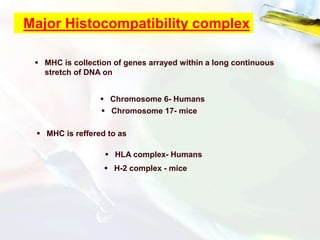
 MHC is collection of genes arrayed within a long continuous
stretch of DNA on
 Chromosome 6- Humans
 Chromosome 17- mice
 MHC is reffered to as
 HLA complex- Humans
 H-2 complex - mice
Classes of MHC Molecules
 The MHC molecules are classified in to four classes namely:
1. Class I MHC molecules
2 . Class II MHC molecules
3. Class III MHC molecules
4 . Class IV MHC molecules
Class I MHC Molecules
 Class I MHC (45KD) molecule are a group of major Histocompatibility
antigen.
 They are present on the surface of all nucleated cells except nervous
tissue and platelets.
 It present antigen to Tc cells.
 It bind with CD-8 adhesion molecules of Tc cells.
 It brings about cell mediated immune response.
Structure of class I MHC Molecule
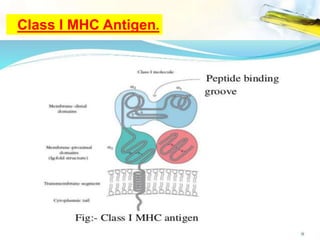
 It consists two polypeptide chains namely α chain and β2-microglobulin.
 α chain which is non covalently attached with β2 microglobuline.α chain
contain a transmembrance glycoprotein which is encoded by A,B and C
gene of grouped HLA.
 α chain is organized by three domains such α 1,α 2 and α 3 each domain
containing 90 amino acids sequences.
 Β2 microglobuline is similar in size of α 3 and it dose not contain
transmembrane proteins.
 When the antigen is internalized ateond processed inside by proteosome
(ubiquitin,cytosolic degradation),the peptides are produced.
 Peptide is further loaded on the groove of MHC I molecule from
endoplasmic reticulum.
Class I MHC Antigen.
Class II MHC Molecule
 Class II MHC molecule are present on the surface of antigen presenting
cell and cell which engulfed the foreign antigen.
 It binds with the exogenous (endocytic degradation) antigens.
 It binds with CD4 adhesion molecules Th cells.
 It also consist of two polypeptide chains namely α chain and β chain.
 Antigen is processed inside the endosome and peptide is further loaded
on groove of MHC II molecule.
Structure of MHC II Molecule
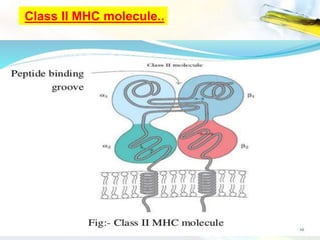
 The class II MHC molecule consists of two polypeptide chain namely α
chain (33kDa) and β (28kDa) chain.
 The both chain are attached noncovelantly.
 Each chain contains two units. The two units of α chain are called α1 and
α2. the two domains of β chains are called β1 and β2.
 Β2 and α2 are transmembrane domains anchoring the MHC to plasma
membrane.
 The α1 and β1 domains jointly bear a peptide binding groove.
Class II MHC molecule..
Class III MHC Molecule
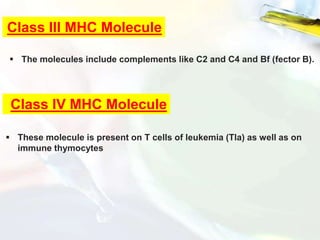
 The molecules include complements like C2 and C4 and Bf (fector B).
Class IV MHC Molecule
 These molecule is present on T cells of leukemia (Tla) as well as on
immune thymocytes
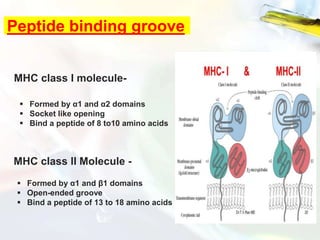
Peptide binding groove
MHC class I molecule-
 Formed by α1 and α2 domains
 Socket like opening
 Bind a peptide of 8 to10 amino acids
MHC class II Molecule -
 Formed by α1 and β1 domains
 Open-ended groove
 Bind a peptide of 13 to 18 amino acids
HLA- Human leukocyte Antigen
 HLA is the human leukocyte antigen.
 HLA is the MHC molecules present in human beings
 HLA is a set of surface protein present on the surface of all nucleated
cells.They are responsible for graft rejection, adaptive immunity,
defense against infection, some time it is expressed on cancer cell
destruction, certain autoimmune diseases and certain complements.
 MHC is the general term referring to the cell surface
Antigen of vertebrates.
Major Histocompatibility complex
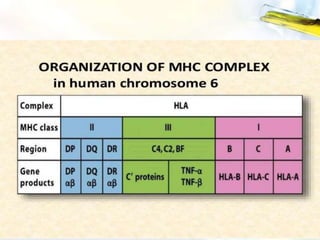
 MHC is collection of genes arrayed within a long continuous
stretch of DNA on
 Chromosome 6- Humans
 Chromosome 17- mice
 MHC is reffered to as
 HLA complex- Humans
 H-2 complex - mice
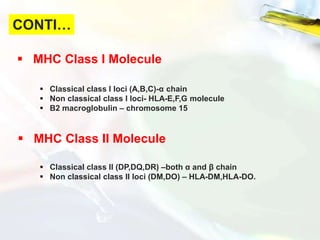
 MHC Class I Molecule
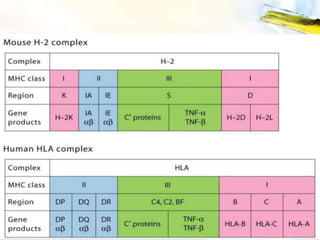
 Classical class I loci (A,B,C)-α chain
 Non classical class I loci- HLA-E,F,G molecule
 Β2 macroglobulin – chromosome 15
 MHC Class II Molecule
 Classical class II (DP,DQ,DR) –both α and β chain
 Non classical class II loci (DM,DO) – HLA-DM,HLA-DO.
CONTI…
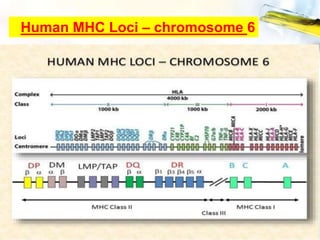
Human MHC Loci – chromosome 6
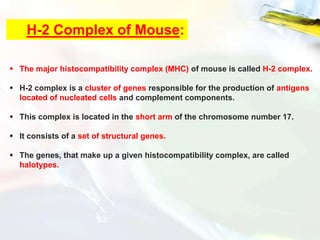
H-2 Complex of Mouse:
 The major histocompatibility complex (MHC) of mouse is called H-2 complex.
 H-2 complex is a cluster of genes responsible for the production of antigens
located of nucleated cells and complement components.
 This complex is located in the short arm of the chromosome number 17.
 It consists of a set of structural genes.
 The genes, that make up a given histocompatibility complex, are called
halotypes.
Function of MHC Molecules
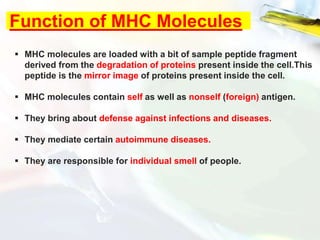
 MHC molecules are loaded with a bit of sample peptide fragment
derived from the degradation of proteins present inside the cell.This
peptide is the mirror image of proteins present inside the cell.
 MHC molecules contain self as well as nonself (foreign) antigen.
 They bring about defense against infections and diseases.
 They mediate certain autoimmune diseases.
 They are responsible for individual smell of people.
Summary:
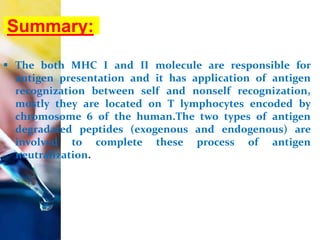
 The both MHC I and II molecule are responsible for
antigen presentation and it has application of antigen
recognization between self and nonself recognization,
mostly they are located on T lymphocytes encoded by
chromosome 6 of the human.The two types of antigen
degradated peptides (exogenous and endogenous) are
involved to complete these process of antigen
neutralization.
References:
 Fatima Dulsy & Arumugam N.,Immunology(2013) fourth edition, saras
publication, camp road periavilai,Kanyakumari. Page NO 481-502.2
 Kuby Janis, Immunology (2003), Fifth edition, W.H.Freeman &
company, Newyork, NY 10010.
 Wikipedia from google search engine.
 https://www.biosciencenotes.com/major-histocompatibility-
complex-mhc/
 https://microbenotes.com/major-histocompatibility-complex-mhc-types-and-
importance/
 https://www.slideshare.net/Prasannjeetsaha/major-histocompatibility-
complex-78885656
 https://slideplayer.com/slide/1664422/
“THANK YOU FOR
YOUR
ATTENTION”

MAJOR HISTOCOMPATIBILITY COMPLEX M.MANIKANDAN.pptx

  • 1.
    MAJOR HISTOCOMPATIBILITY COMPLEX DepartmentofBiotechnology Schoolof Biotechnology& GeneticEngineering BharathidasanUniversity,Tiruchirapalli-620024 SEMINARPRESENTED ON GUIDED BY: Dr.M.Muthuselvam Assistant professor Dept of Biotechnology SUMITTED BY: M.Manikandan M.sc.Biotechnology SUB: Immunology
  • 2.
    Contents..  Introduction  Definition Histroy  Types of MHC molecule  Structure of MHC molecule  HLA (Human leukocyte antigen)  H-2 Complex (MHC molecule of mouse)  Function of MHC molecule  Summary  References
  • 3.
    Introduction  Major Histocompatibilitycomplex (MHC) is set of surface proteins located on the cell membrance of nucleated cells.  It plays more important wrok to identify the antigen between self and non self body,intracellular recognization and responsible for antigen presentation.  Histo refers to tissue. compatibility refers to living together harmoniously.  MHC molecules always recognize only T lymphocytes. The two types of MHC are worked in immunity. T helper(Th) cell recognized by MHC molecules II ,and T cytotoxic (Tc) cells are recognized by MHC I molecules.
  • 4.
    Definition “ Major HistocompatibilityComplex is membrance attached protein which wrok on recognization of antigen between self and non self body and antigen presentation”.
  • 5.
    Histroy  Peter Gorer(1930) found that four group of MHC molecues he used the blood sample of mice to identified the blood group antigen which designated by I to IV group of MHC.  Georg Snell, Jean Dausset and Bariy received noble prize in 1980 for their contribution to the discovery of MHC molecule.
  • 6.
    Major Histocompatibility complex MHC is collection of genes arrayed within a long continuous stretch of DNA on  Chromosome 6- Humans  Chromosome 17- mice  MHC is reffered to as  HLA complex- Humans  H-2 complex - mice
  • 7.
    Classes of MHCMolecules  The MHC molecules are classified in to four classes namely: 1. Class I MHC molecules 2 . Class II MHC molecules 3. Class III MHC molecules 4 . Class IV MHC molecules
  • 8.
    Class I MHCMolecules  Class I MHC (45KD) molecule are a group of major Histocompatibility antigen.  They are present on the surface of all nucleated cells except nervous tissue and platelets.  It present antigen to Tc cells.  It bind with CD-8 adhesion molecules of Tc cells.  It brings about cell mediated immune response.
  • 9.
    Structure of classI MHC Molecule  It consists two polypeptide chains namely α chain and β2-microglobulin.  α chain which is non covalently attached with β2 microglobuline.α chain contain a transmembrance glycoprotein which is encoded by A,B and C gene of grouped HLA.  α chain is organized by three domains such α 1,α 2 and α 3 each domain containing 90 amino acids sequences.  Β2 microglobuline is similar in size of α 3 and it dose not contain transmembrane proteins.  When the antigen is internalized ateond processed inside by proteosome (ubiquitin,cytosolic degradation),the peptides are produced.  Peptide is further loaded on the groove of MHC I molecule from endoplasmic reticulum.
  • 10.
    Class I MHCAntigen.
  • 11.
    Class II MHCMolecule  Class II MHC molecule are present on the surface of antigen presenting cell and cell which engulfed the foreign antigen.  It binds with the exogenous (endocytic degradation) antigens.  It binds with CD4 adhesion molecules Th cells.  It also consist of two polypeptide chains namely α chain and β chain.  Antigen is processed inside the endosome and peptide is further loaded on groove of MHC II molecule.
  • 12.
    Structure of MHCII Molecule  The class II MHC molecule consists of two polypeptide chain namely α chain (33kDa) and β (28kDa) chain.  The both chain are attached noncovelantly.  Each chain contains two units. The two units of α chain are called α1 and α2. the two domains of β chains are called β1 and β2.  Β2 and α2 are transmembrane domains anchoring the MHC to plasma membrane.  The α1 and β1 domains jointly bear a peptide binding groove.
  • 13.
    Class II MHCmolecule..
  • 14.
    Class III MHCMolecule  The molecules include complements like C2 and C4 and Bf (fector B). Class IV MHC Molecule  These molecule is present on T cells of leukemia (Tla) as well as on immune thymocytes
  • 15.
    Peptide binding groove MHCclass I molecule-  Formed by α1 and α2 domains  Socket like opening  Bind a peptide of 8 to10 amino acids MHC class II Molecule -  Formed by α1 and β1 domains  Open-ended groove  Bind a peptide of 13 to 18 amino acids
  • 16.
    HLA- Human leukocyteAntigen  HLA is the human leukocyte antigen.  HLA is the MHC molecules present in human beings  HLA is a set of surface protein present on the surface of all nucleated cells.They are responsible for graft rejection, adaptive immunity, defense against infection, some time it is expressed on cancer cell destruction, certain autoimmune diseases and certain complements.  MHC is the general term referring to the cell surface Antigen of vertebrates.
  • 17.
    Major Histocompatibility complex MHC is collection of genes arrayed within a long continuous stretch of DNA on  Chromosome 6- Humans  Chromosome 17- mice  MHC is reffered to as  HLA complex- Humans  H-2 complex - mice
  • 19.
     MHC ClassI Molecule  Classical class I loci (A,B,C)-α chain  Non classical class I loci- HLA-E,F,G molecule  Β2 macroglobulin – chromosome 15  MHC Class II Molecule  Classical class II (DP,DQ,DR) –both α and β chain  Non classical class II loci (DM,DO) – HLA-DM,HLA-DO. CONTI…
  • 20.
    Human MHC Loci– chromosome 6
  • 21.
    H-2 Complex ofMouse:  The major histocompatibility complex (MHC) of mouse is called H-2 complex.  H-2 complex is a cluster of genes responsible for the production of antigens located of nucleated cells and complement components.  This complex is located in the short arm of the chromosome number 17.  It consists of a set of structural genes.  The genes, that make up a given histocompatibility complex, are called halotypes.
  • 23.
    Function of MHCMolecules  MHC molecules are loaded with a bit of sample peptide fragment derived from the degradation of proteins present inside the cell.This peptide is the mirror image of proteins present inside the cell.  MHC molecules contain self as well as nonself (foreign) antigen.  They bring about defense against infections and diseases.  They mediate certain autoimmune diseases.  They are responsible for individual smell of people.
  • 24.
    Summary:  The bothMHC I and II molecule are responsible for antigen presentation and it has application of antigen recognization between self and nonself recognization, mostly they are located on T lymphocytes encoded by chromosome 6 of the human.The two types of antigen degradated peptides (exogenous and endogenous) are involved to complete these process of antigen neutralization.
  • 25.
    References:  Fatima Dulsy& Arumugam N.,Immunology(2013) fourth edition, saras publication, camp road periavilai,Kanyakumari. Page NO 481-502.2  Kuby Janis, Immunology (2003), Fifth edition, W.H.Freeman & company, Newyork, NY 10010.  Wikipedia from google search engine.  https://www.biosciencenotes.com/major-histocompatibility- complex-mhc/  https://microbenotes.com/major-histocompatibility-complex-mhc-types-and- importance/  https://www.slideshare.net/Prasannjeetsaha/major-histocompatibility- complex-78885656  https://slideplayer.com/slide/1664422/
  • 26.