

Mainframe
Resource
Intelligence
by CA Technologies
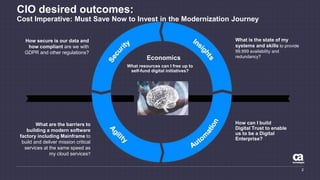
CIO desired outcomes:
Cost Imperative: Must Save Now to Invest in the Modernization Journey
2
What are the barriers to
building a modern software
factory including Mainframe to
build and deliver mission critical
services at the same speed as
my cloud services?
What is the state of my
systems and skills to provide
99.999 availability and
redundancy?
How can I build
Digital Trust to enable
us to be a Digital
Enterprise?
How secure is our data and
how compliant are we with
GDPR and other regulations?
What resources can I free up to
self-fund digital initiatives?
Economics
3
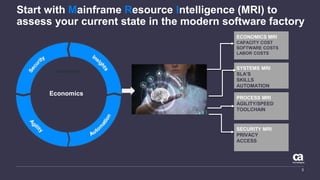
Economics
PROCESS MRI
AGILITY/SPEED
TOOLCHAIN
ECONOMICS MRI
CAPACITY COST
SOFTWARE COSTS
LABOR COSTS
SYSTEMS MRI
SLA’S
SKILLS
AUTOMATION
Start with Mainframe Resource Intelligence (MRI) to
assess your current state in the modern software factory
Economics
SECURITY MRI
PRIVACY
ACCESS
4
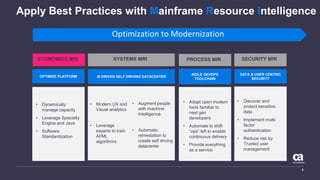
Apply Best Practices with Mainframe Resource Intelligence
Optimization to Modernization
AI DRIVEN SELF DRIVING DATACENTER
AGILE DEVOPS
TOOLCHAIN
ECONOMICS MRI
DATA & USER CENTRIC
SECURITY
OPTIMIZE PLATFORM
PROCESS MRI SECURITY MRISYSTEMS MRI
• Dynamically
manage capacity
• Leverage Specialty
Engine and Java
• Software
Standardization
• Modern UX and
Visual analytics
• Leverage
experts to train
AI/ML
algorithms
• Augment people
with machine
Intelligence
• Automatic
remediation to
create self driving
datacenter
• Adopt open modern
tools familiar to
next gen
developers
• Automate to shift
“ops” left to enable
continuous delivery
• Provide everything
as a service
• Discover and
protect sensitive
data
• Implement multi-
factor
authentication
• Reduce risk by
Trusted user
management
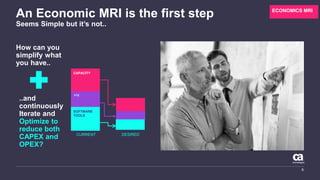
An Economic MRI is the first step
Seems Simple but it’s not..
5
How can you
simplify what
you have..
..and
continuously
Iterate and
Optimize to
reduce both
CAPEX and
OPEX?
FTE
CAPACITY
CURRENT DESIRED
SOFTWARE
TOOLS
ECONOMICS MRI
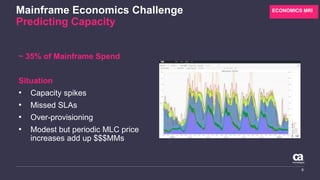
Mainframe Economics Challenge
Predicting Capacity
6
~ 35% of Mainframe Spend
Situation
• Capacity spikes
• Missed SLAs
• Over-provisioning
• Modest but periodic MLC price
increases add up $$$MMs
ECONOMICS MRI
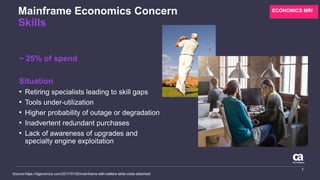
Mainframe Economics Concern
Skills
~ 25% of spend
Situation
• Retiring specialists leading to skill gaps
• Tools under-utilization
• Higher probability of outage or degradation
• Inadvertent redundant purchases
• Lack of awareness of upgrades and
specialty engine exploitation
Source:https://diginomica.com/2017/07/20/mainframe-still-matters-skills-crisis-attached/
7
ECONOMICS MRI
Vendor 1
• Xxxxx
• Xxxxx
• xxxxx
Vendor 2
• Xxxxx
• Xxxxx
• xxxxx
Vendor 3
• Xxxxx
• Xxxxx
• xxxxx
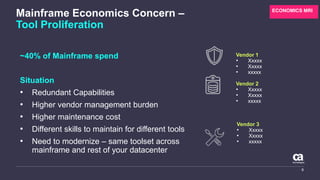
Mainframe Economics Concern –
Tool Proliferation
8
~40% of Mainframe spend
Situation
• Redundant Capabilities
• Higher vendor management burden
• Higher maintenance cost
• Different skills to maintain for different tools
• Need to modernize – same toolset across
mainframe and rest of your datacenter
ECONOMICS MRI
9
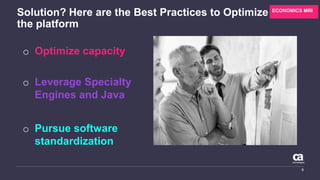
Solution? Here are the Best Practices to Optimize
the platform
o Optimize capacity
o Leverage Specialty
Engines and Java
o Pursue software
standardization
ECONOMICS MRI
Don’t panic
Let’s delight
your CFO
With an economics MRI
that exposes hidden
opportunities to save and
invest wisely
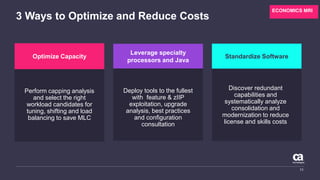
3 Ways to Optimize and Reduce Costs
11
Deploy tools to the fullest
with feature & zIIP
exploitation, upgrade
analysis, best practices
and configuration
consultation
Perform capping analysis
and select the right
workload candidates for
tuning, shifting and load
balancing to save MLC
Discover redundant
capabilities and
systematically analyze
consolidation and
modernization to reduce
license and skills costs
Optimize Capacity
Leverage specialty
processors and Java
Standardize Software
ECONOMICS MRI
12
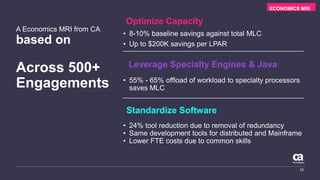
A Economics MRI from CA
based on
Across 500+
Engagements
12
• 8-10% baseline savings against total MLC
• Up to $200K savings per LPAR
• 55% - 65% offload of workload to specialty processors
saves MLC
• 24% tool reduction due to removal of redundancy
• Same development tools for distributed and Mainframe
• Lower FTE costs due to common skills
Optimize Capacity
Standardize Software
Leverage Specialty Engines & Java
ECONOMICS MRI
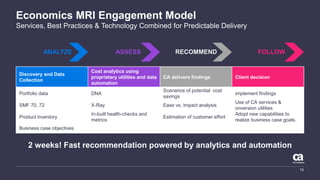
Economics MRI Engagement Model
Services, Best Practices & Technology Combined for Predictable Delivery
13
Discovery and Data
Collection
Cost analytics using
proprietary utilities and data
automation
CA delivers findings Client decision
Portfolio data DNA
Scenarios of potential cost
savings
implement findings
SMF 70, 72 X-Ray Ease vs. impact analysis
Use of CA services &
onversion utilities
Product inventory
In-built health-checks and
metrics
Estimation of customer effort
Adopt new capabilities to
realize business case goals.
Business case objectives
ANALYZE ASSESS RECOMMEND FOLLOW
2 weeks! Fast recommendation powered by analytics and automation
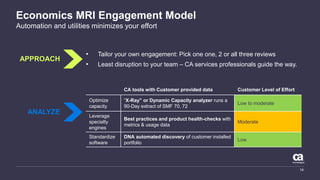
Economics MRI Engagement Model
Automation and utilities minimizes your effort
14
• Tailor your own engagement: Pick one one, 2 or all three reviews
• Least disruption to your team – CA services professionals guide the way.
ANALYZE
CA tools with Customer provided data Customer Level of Effort
Optimize
capacity
“X-Ray” or Dynamic Capacity analyzer runs a
90-Day extract of SMF 70, 72
Low to moderate
Leverage
specialty
engines
Best practices and product health-checks with
metrics & usage data
Moderate
Standardize
software
DNA automated discovery of customer installed
portfolio
Low
APPROACH
Your peers
are doing this..
16
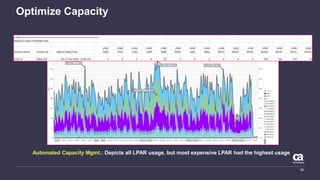
Automated Capacity Mgmt.: Depicts all LPAR usage, but most expensive LPAR had the highest usage
Optimize Capacity
17
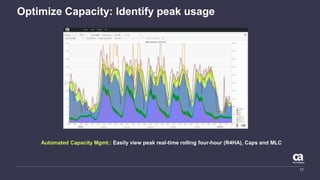
Optimize Capacity: Identify peak usage
Automated Capacity Mgmt.: Easily view peak real-time rolling four-hour (R4HA), Caps and MLC
18
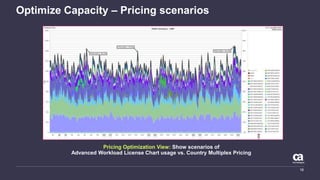
Optimize Capacity – Pricing scenarios
Pricing Optimization View: Show scenarios of
Advanced Workload License Chart usage vs. Country Multiplex Pricing
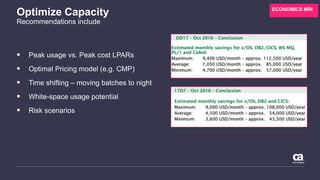
Optimize Capacity
Recommendations include
 Peak usage vs. Peak cost LPARs
 Optimal Pricing model (e.g. CMP)
 Time shifting – moving batches to night
 White-space usage potential
 Risk scenarios
ECONOMICS MRI
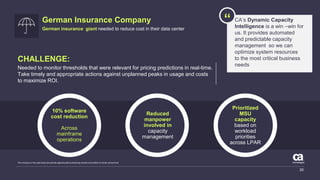
CA’s Dynamic Capacity
Intelligence is a win –win for
us. It provides automated
and predictable capacity
management so we can
optimize system resources
to the most critical business
needs
CHALLENGE:
Needed to monitor thresholds that were relevant for pricing predictions in real-time.
Take timely and appropriate actions against unplanned peaks in usage and costs
to maximize ROI.
German Insurance Company
German insurance giant needed to reduce cost in their data center
20
10% software
cost reduction
Across
mainframe
operations
Reduced
manpower
involved in
capacity
management
Prioritized
MSU
capacity
based on
workload
priorities
across LPAR
The company in this case study has policies against publicly endorsing vendors and prefers to remain anonymous.
“
21
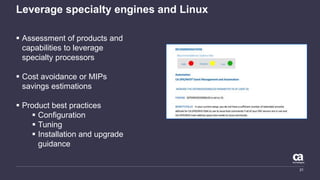
Leverage specialty engines and Linux
 Assessment of products and
capabilities to leverage
specialty processors
 Cost avoidance or MIPs
savings estimations
 Product best practices
 Configuration
 Tuning
 Installation and upgrade
guidance
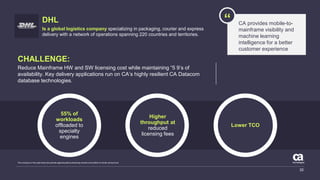
CHALLENGE:
Reduce Mainframe HW and SW licensing cost while maintaining “5 9’s of
availability. Key delivery applications run on CA’s highly resilient CA Datacom
database technologies.
DHL
Is a global logistics company specializing in packaging, courier and express
delivery with a network of operations spanning 220 countries and territories.
22
CA provides mobile-to-
mainframe visibility and
machine learning
intelligence for a better
customer experience
55% of
workloads
offloaded to
specialty
engines
Higher
throughput at
reduced
licensing fees
Lower TCO
The company in this case study has policies against publicly endorsing vendors and prefers to remain anonymous.
“
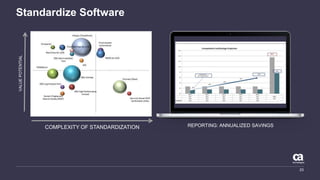
Standardize Software
23
COMPLEXITY OF STANDARDIZATION
VALUEPOTENTIAL
REPORTING: ANNUALIZED SAVINGS
CA’s approach is way
ahead of other
intelligence engines
which aren’t real time
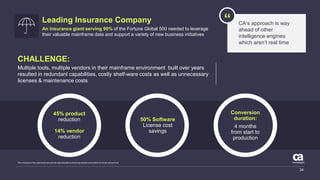
CHALLENGE:
Multiple tools, multiple vendors in their mainframe environment built over years
resulted in redundant capabilities, costly shelf-ware costs as well as unnecessary
licenses & maintenance costs
Leading Insurance Company
An insurance giant serving 90% of the Fortune Global 500 needed to leverage
their valuable mainframe data and support a variety of new business initiatives
24
45% product
reduction
14% vendor
reduction
50% Software
License cost
savings
Conversion
duration:
4 months
from start to
production
The company in this case study has policies against publicly endorsing vendors and prefers to remain anonymous.
“
 Tell your CA Account Director
 Tell us about your concerns and overall
business challenge
CONTACT US!
 Provide a list of your vendors, tools, & current
capacity status
 Jointly determine the type of review for maximum
near term benefit
PARTNERING FOR SUCCESS
 Get your saving assessment from CA
 Determine next steps for implementation
 Feel confident that CA’s there for you
today and tomorrow
CELEBRATE

Mainframe MRI from CA Technologies

  • 1.
  • 2.
    CIO desired outcomes: CostImperative: Must Save Now to Invest in the Modernization Journey 2 What are the barriers to building a modern software factory including Mainframe to build and deliver mission critical services at the same speed as my cloud services? What is the state of my systems and skills to provide 99.999 availability and redundancy? How can I build Digital Trust to enable us to be a Digital Enterprise? How secure is our data and how compliant are we with GDPR and other regulations? What resources can I free up to self-fund digital initiatives? Economics
  • 3.
    3 Economics PROCESS MRI AGILITY/SPEED TOOLCHAIN ECONOMICS MRI CAPACITYCOST SOFTWARE COSTS LABOR COSTS SYSTEMS MRI SLA’S SKILLS AUTOMATION Start with Mainframe Resource Intelligence (MRI) to assess your current state in the modern software factory Economics SECURITY MRI PRIVACY ACCESS
  • 4.
    4 Apply Best Practiceswith Mainframe Resource Intelligence Optimization to Modernization AI DRIVEN SELF DRIVING DATACENTER AGILE DEVOPS TOOLCHAIN ECONOMICS MRI DATA & USER CENTRIC SECURITY OPTIMIZE PLATFORM PROCESS MRI SECURITY MRISYSTEMS MRI • Dynamically manage capacity • Leverage Specialty Engine and Java • Software Standardization • Modern UX and Visual analytics • Leverage experts to train AI/ML algorithms • Augment people with machine Intelligence • Automatic remediation to create self driving datacenter • Adopt open modern tools familiar to next gen developers • Automate to shift “ops” left to enable continuous delivery • Provide everything as a service • Discover and protect sensitive data • Implement multi- factor authentication • Reduce risk by Trusted user management
  • 5.
    An Economic MRIis the first step Seems Simple but it’s not.. 5 How can you simplify what you have.. ..and continuously Iterate and Optimize to reduce both CAPEX and OPEX? FTE CAPACITY CURRENT DESIRED SOFTWARE TOOLS ECONOMICS MRI
  • 6.
    Mainframe Economics Challenge PredictingCapacity 6 ~ 35% of Mainframe Spend Situation • Capacity spikes • Missed SLAs • Over-provisioning • Modest but periodic MLC price increases add up $$$MMs ECONOMICS MRI
  • 7.
    Mainframe Economics Concern Skills ~25% of spend Situation • Retiring specialists leading to skill gaps • Tools under-utilization • Higher probability of outage or degradation • Inadvertent redundant purchases • Lack of awareness of upgrades and specialty engine exploitation Source:https://diginomica.com/2017/07/20/mainframe-still-matters-skills-crisis-attached/ 7 ECONOMICS MRI
  • 8.
    Vendor 1 • Xxxxx •Xxxxx • xxxxx Vendor 2 • Xxxxx • Xxxxx • xxxxx Vendor 3 • Xxxxx • Xxxxx • xxxxx Mainframe Economics Concern – Tool Proliferation 8 ~40% of Mainframe spend Situation • Redundant Capabilities • Higher vendor management burden • Higher maintenance cost • Different skills to maintain for different tools • Need to modernize – same toolset across mainframe and rest of your datacenter ECONOMICS MRI
  • 9.
    9 Solution? Here arethe Best Practices to Optimize the platform o Optimize capacity o Leverage Specialty Engines and Java o Pursue software standardization ECONOMICS MRI
  • 10.
    Don’t panic Let’s delight yourCFO With an economics MRI that exposes hidden opportunities to save and invest wisely
  • 11.
    3 Ways toOptimize and Reduce Costs 11 Deploy tools to the fullest with feature & zIIP exploitation, upgrade analysis, best practices and configuration consultation Perform capping analysis and select the right workload candidates for tuning, shifting and load balancing to save MLC Discover redundant capabilities and systematically analyze consolidation and modernization to reduce license and skills costs Optimize Capacity Leverage specialty processors and Java Standardize Software ECONOMICS MRI
  • 12.
    12 A Economics MRIfrom CA based on Across 500+ Engagements 12 • 8-10% baseline savings against total MLC • Up to $200K savings per LPAR • 55% - 65% offload of workload to specialty processors saves MLC • 24% tool reduction due to removal of redundancy • Same development tools for distributed and Mainframe • Lower FTE costs due to common skills Optimize Capacity Standardize Software Leverage Specialty Engines & Java ECONOMICS MRI
  • 13.
    Economics MRI EngagementModel Services, Best Practices & Technology Combined for Predictable Delivery 13 Discovery and Data Collection Cost analytics using proprietary utilities and data automation CA delivers findings Client decision Portfolio data DNA Scenarios of potential cost savings implement findings SMF 70, 72 X-Ray Ease vs. impact analysis Use of CA services & onversion utilities Product inventory In-built health-checks and metrics Estimation of customer effort Adopt new capabilities to realize business case goals. Business case objectives ANALYZE ASSESS RECOMMEND FOLLOW 2 weeks! Fast recommendation powered by analytics and automation
  • 14.
    Economics MRI EngagementModel Automation and utilities minimizes your effort 14 • Tailor your own engagement: Pick one one, 2 or all three reviews • Least disruption to your team – CA services professionals guide the way. ANALYZE CA tools with Customer provided data Customer Level of Effort Optimize capacity “X-Ray” or Dynamic Capacity analyzer runs a 90-Day extract of SMF 70, 72 Low to moderate Leverage specialty engines Best practices and product health-checks with metrics & usage data Moderate Standardize software DNA automated discovery of customer installed portfolio Low APPROACH
  • 15.
  • 16.
    16 Automated Capacity Mgmt.:Depicts all LPAR usage, but most expensive LPAR had the highest usage Optimize Capacity
  • 17.
    17 Optimize Capacity: Identifypeak usage Automated Capacity Mgmt.: Easily view peak real-time rolling four-hour (R4HA), Caps and MLC
  • 18.
    18 Optimize Capacity –Pricing scenarios Pricing Optimization View: Show scenarios of Advanced Workload License Chart usage vs. Country Multiplex Pricing
  • 19.
    Optimize Capacity Recommendations include Peak usage vs. Peak cost LPARs  Optimal Pricing model (e.g. CMP)  Time shifting – moving batches to night  White-space usage potential  Risk scenarios ECONOMICS MRI
  • 20.
    CA’s Dynamic Capacity Intelligenceis a win –win for us. It provides automated and predictable capacity management so we can optimize system resources to the most critical business needs CHALLENGE: Needed to monitor thresholds that were relevant for pricing predictions in real-time. Take timely and appropriate actions against unplanned peaks in usage and costs to maximize ROI. German Insurance Company German insurance giant needed to reduce cost in their data center 20 10% software cost reduction Across mainframe operations Reduced manpower involved in capacity management Prioritized MSU capacity based on workload priorities across LPAR The company in this case study has policies against publicly endorsing vendors and prefers to remain anonymous. “
  • 21.
    21 Leverage specialty enginesand Linux  Assessment of products and capabilities to leverage specialty processors  Cost avoidance or MIPs savings estimations  Product best practices  Configuration  Tuning  Installation and upgrade guidance
  • 22.
    CHALLENGE: Reduce Mainframe HWand SW licensing cost while maintaining “5 9’s of availability. Key delivery applications run on CA’s highly resilient CA Datacom database technologies. DHL Is a global logistics company specializing in packaging, courier and express delivery with a network of operations spanning 220 countries and territories. 22 CA provides mobile-to- mainframe visibility and machine learning intelligence for a better customer experience 55% of workloads offloaded to specialty engines Higher throughput at reduced licensing fees Lower TCO The company in this case study has policies against publicly endorsing vendors and prefers to remain anonymous. “
  • 23.
    Standardize Software 23 COMPLEXITY OFSTANDARDIZATION VALUEPOTENTIAL REPORTING: ANNUALIZED SAVINGS
  • 24.
    CA’s approach isway ahead of other intelligence engines which aren’t real time CHALLENGE: Multiple tools, multiple vendors in their mainframe environment built over years resulted in redundant capabilities, costly shelf-ware costs as well as unnecessary licenses & maintenance costs Leading Insurance Company An insurance giant serving 90% of the Fortune Global 500 needed to leverage their valuable mainframe data and support a variety of new business initiatives 24 45% product reduction 14% vendor reduction 50% Software License cost savings Conversion duration: 4 months from start to production The company in this case study has policies against publicly endorsing vendors and prefers to remain anonymous. “
  • 25.
     Tell yourCA Account Director  Tell us about your concerns and overall business challenge CONTACT US!  Provide a list of your vendors, tools, & current capacity status  Jointly determine the type of review for maximum near term benefit PARTNERING FOR SUCCESS  Get your saving assessment from CA  Determine next steps for implementation  Feel confident that CA’s there for you today and tomorrow CELEBRATE

Editor's Notes

  • #2 Find the low-hanging opportunities first and then tackle the more complex transformations Identify and eliminate redundant tools and shelf-ware Establish culture of proactive planning – avoid last minute surprises that lead to capacity buys Look for ways to increase productivity – by tapping new capabilities, automation Introduce modern tooling to avoid reduce reliance on specialized skills Find the low-hanging opportunities first and then tackle the more complex transformations Identify and eliminate redundant tools and shelf-ware Establish culture of proactive planning – avoid last minute surprises that lead to capacity buys Look for ways to increase productivity – by tapping new capabilities, automation Introduce modern tooling to avoid reduce reliance on specialized skills
  • #6 Find the low-hanging opportunities first and then tackle the more complex transformations Identify and eliminate redundant tools and shelf-ware Establish culture of proactive planning – avoid last minute surprises that lead to capacity buys Look for ways to increase productivity – by tapping new capabilities, automation Introduce modern tooling to avoid reduce reliance on specialized skills Find the low-hanging opportunities first and then tackle the more complex transformations Identify and eliminate redundant tools and shelf-ware Establish culture of proactive planning – avoid last minute surprises that lead to capacity buys Look for ways to increase productivity – by tapping new capabilities, automation Introduce modern tooling to avoid reduce reliance on specialized skills
  • #14 Newest capability in our cost optimization portfolio.
  • #21 The company in this case study has policies against publicly endorsing vendors and prefers to remain anonymous. Protect data privacy Zions Bank – CAW Presentation https://www.youtube.com/watch?v=mr9wpgjICGY&list=PLO7SodxCJyn6OXtHI1kPoLkKmfDKIxDdt&index=81 CA Data Content Discovery Customer Use Case CA Data Content Discovery scans the mainframe data infrastructure to identify the location of sensitive data, and classifies the data based on sensitivity level so the appropriate business decisions can be made to secure, encrypt, archive or delete the data identified. One of the first customers for CA DCD was a large Western US National Bank who originally purchased the solution to discover Payment Card Industry data (PCI DSS) on their mainframe – which as a bank has a lot of. They needed to meet audit and compliance requirements quickly, protect their customers highly sensitive data, and keep their operations running smoothly. In their first 100 scans, the customer surprisingly found that over 5% of their scanned datasets contained Payment Card Industry data and Personally Identifiable Information in places not expected. And once the bank knew the location of the PCI and PII data in their mainframe infrastructure, they were able to take the second action and secure it appropriately. With the initial success of the solution, the bank has since found a variety of other search uses for the tool: The customer is executing DCD in development and scanning production data to have proactive insights sooner They are currently running scans against user datasets The customer is leveraging customer classifiers with scan info that is customized to their business to find PCI/PII data The customer is automating the scans by setting up jobs in batch and scheduling them, to combine effective security and business agility Increased risk assessment through automated non-manual efforts Improved business agility by automating and scheduling scans Complete flexibility by customizing classifiers Additional Data Content Discovery Customers: EOY FY17 – 34 customers licensed, 1 installed Additional DCD customers (yet to install) Broadridge Morgan Stanley Department of Justice Department of Education Metlife Licensed EMEA DCD customers (yet to install) AXA DWP Bank Lufthansa Airplus & Technik Raiffeisen e-force GmbH
  • #23 The company in this case study has policies against publicly endorsing vendors and prefers to remain anonymous. Protect data privacy Zions Bank – CAW Presentation https://www.youtube.com/watch?v=mr9wpgjICGY&list=PLO7SodxCJyn6OXtHI1kPoLkKmfDKIxDdt&index=81 CA Data Content Discovery Customer Use Case CA Data Content Discovery scans the mainframe data infrastructure to identify the location of sensitive data, and classifies the data based on sensitivity level so the appropriate business decisions can be made to secure, encrypt, archive or delete the data identified. One of the first customers for CA DCD was a large Western US National Bank who originally purchased the solution to discover Payment Card Industry data (PCI DSS) on their mainframe – which as a bank has a lot of. They needed to meet audit and compliance requirements quickly, protect their customers highly sensitive data, and keep their operations running smoothly. In their first 100 scans, the customer surprisingly found that over 5% of their scanned datasets contained Payment Card Industry data and Personally Identifiable Information in places not expected. And once the bank knew the location of the PCI and PII data in their mainframe infrastructure, they were able to take the second action and secure it appropriately. With the initial success of the solution, the bank has since found a variety of other search uses for the tool: The customer is executing DCD in development and scanning production data to have proactive insights sooner They are currently running scans against user datasets The customer is leveraging customer classifiers with scan info that is customized to their business to find PCI/PII data The customer is automating the scans by setting up jobs in batch and scheduling them, to combine effective security and business agility Increased risk assessment through automated non-manual efforts Improved business agility by automating and scheduling scans Complete flexibility by customizing classifiers Additional Data Content Discovery Customers: EOY FY17 – 34 customers licensed, 1 installed Additional DCD customers (yet to install) Broadridge Morgan Stanley Department of Justice Department of Education Metlife Licensed EMEA DCD customers (yet to install) AXA DWP Bank Lufthansa Airplus & Technik Raiffeisen e-force GmbH
  • #25 The company in this case study has policies against publicly endorsing vendors and prefers to remain anonymous. Protect data privacy Zions Bank – CAW Presentation https://www.youtube.com/watch?v=mr9wpgjICGY&list=PLO7SodxCJyn6OXtHI1kPoLkKmfDKIxDdt&index=81 CA Data Content Discovery Customer Use Case CA Data Content Discovery scans the mainframe data infrastructure to identify the location of sensitive data, and classifies the data based on sensitivity level so the appropriate business decisions can be made to secure, encrypt, archive or delete the data identified. One of the first customers for CA DCD was a large Western US National Bank who originally purchased the solution to discover Payment Card Industry data (PCI DSS) on their mainframe – which as a bank has a lot of. They needed to meet audit and compliance requirements quickly, protect their customers highly sensitive data, and keep their operations running smoothly. In their first 100 scans, the customer surprisingly found that over 5% of their scanned datasets contained Payment Card Industry data and Personally Identifiable Information in places not expected. And once the bank knew the location of the PCI and PII data in their mainframe infrastructure, they were able to take the second action and secure it appropriately. With the initial success of the solution, the bank has since found a variety of other search uses for the tool: The customer is executing DCD in development and scanning production data to have proactive insights sooner They are currently running scans against user datasets The customer is leveraging customer classifiers with scan info that is customized to their business to find PCI/PII data The customer is automating the scans by setting up jobs in batch and scheduling them, to combine effective security and business agility Increased risk assessment through automated non-manual efforts Improved business agility by automating and scheduling scans Complete flexibility by customizing classifiers Additional Data Content Discovery Customers: EOY FY17 – 34 customers licensed, 1 installed Additional DCD customers (yet to install) Broadridge Morgan Stanley Department of Justice Department of Education Metlife Licensed EMEA DCD customers (yet to install) AXA DWP Bank Lufthansa Airplus & Technik Raiffeisen e-force GmbH