The Future: Digital/Print Library Hybrids
 Stephen Abram, MLS
 Maine, Thorndike Press, Dec. 5, 2012
Funding is Attitudinal … Support versus Commitment
Deer in headlamps slide here.
Positioning the Library in The Right Minds

    Reading not Books
    Librarians not Libraries
    Questions not Answers
    Knowledge not Information
    Community and Learning not Warehouses
    Measurements not Statistics
    Members or Students or Faculty not Users
    Full Intellectual Access not Physical Access
    Professional Consultative Service not Servant or mere efficient and effective
      service


6
Library Megatrends
Content Fragmentation
Digitization’s real impact – non-fiction

Format – living in all worlds

            Print,

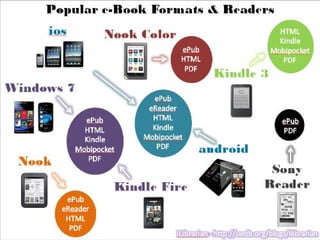
            ePUB, PDF, Kindle, etc. etc.

            CD, DVD, USB, etc. etc.

            Streaming

            Licenses, Open Access, Creative Commons, etc. etc.

eBooks

eJournals

eContent

Copyright Issues (NatGeo, Tasini, TPP, SOPA, etc. etc.)

Author Lawsuits
Beyond Text

Text
Graphics & Charts
Formulae
Pictures
Maps
Video
Audio
Gamification
Deep Data Mining
Assessments
Etc. etc.
Walled Gardens

ILS
CMS
Cloud(s)
Device dependencies
Formats (e.g. Kindle)
Amazon
Apple


ADVICE . . .
Learning Object Diversification

Textbooks
eLearning
Learning Management Systems
Cohort Learning Environments
Presentation Systems
Virtual Conference Environment
Personal Learning Environments
Collaboration Software
MOOCs
End User Fragmentation

Teens / Post-Millennials
Millennials
Other demographics
Business versus Consumer
The Device Divide
Mobility
Search Fragmentation

Consumer Search
Specialized Search
Professional Search
Semantic, Sentiment, Suggestion Search etc.
Mobile search
Social search
Augmented Reality
SEO
SMO
Content Spam
Geo-location
Technology Fragmentation

Feature Phones
Smartphones
Tablets
Laptops
Desktops
Gaming stations
Television
E-Readers
Internet of Things
Browsers
16
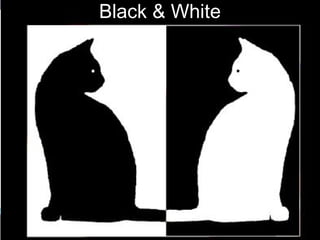
Black and White

The polarization of discussion
Dogmatic vs. Professional positions on: eBooks,
access, copyright, etc.
Black & White
Recognize key shifts
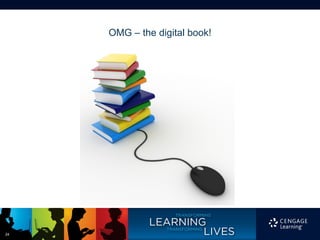
OMG – the digital book!


24
Trends Differ Slightly by Library Sector

Public Libraries
Academic Research Libraries
Community College Libraries
School Libraries
Specialized Libraries
Consortia
Public Libraries

Strategic alignment – social, economic, demographic
Recommendations (LibraryThing for Libraries, BiblioCommons, Book
Psychic)
Community Glue
Economic Impact
Programs
Partnerships
Education and Learning
Audience in
Segmentation
Academic Research Libraries
eLearning
Repositories
Content Archipelagos
LibGuides
Patron-driven acquisitions
Information Fluency
Demarcation between Undergrad, Grad and Faculty/Staff strategies
Copyright compliance
E-Coursepacks and e-Reserves
Strategic budgeting
Partnerships
Community College and Undergrad

Information Literacy
Distance education and eLearning
Textbooks, Reserves, Coursepacks, e-all
MOOCs
Mobility
Collections for new degrees and certifications
School Libraries

Common Core
21st Century Learning
Future of the Textbook
Scaffolded Information Literacy / Fluency
Filters
Staff and Faculty relationships
Classroom pages
Specialized Libraries

Intranets
MS SharePoint
Relationship building
Embedded Librarianship
Consortia

DPLA
Library Renewal
EveryLibrary Advocacy PAC
OCLC Linked Data
3M e-books
CALIFA / Douglas County initiatives
Cloud initiatives
So what is the answer?
Where are the real pain points?
Grocery Stores
Grocery Stores
Grocery Stores
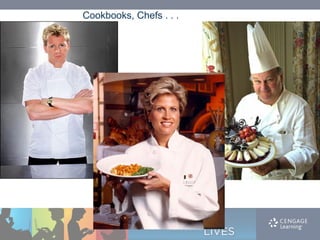
Cookbooks, Chefs . . .
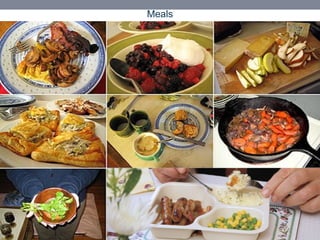
Meals
Let’s think
Think: Are you thinking food, courses,
days, weekly plan, or nutrition overall?
What is a meal in library end-user community or research, education and
learning terms?
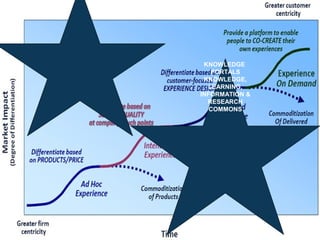
KNOWLEDGE
   PORTALS
 KNOWLEDGE,
  LEARNING,
INFORMATION &
  RESEARCH
   COMMONS
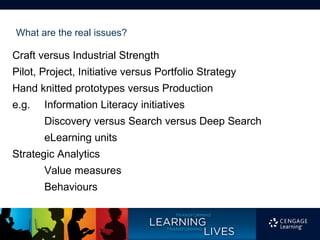
What are the real issues?

Craft versus Industrial Strength
Pilot, Project, Initiative versus Portfolio Strategy
Hand knitted prototypes versus Production
e.g.   Information Literacy initiatives
       Discovery versus Search versus Deep Search
       eLearning units
Strategic Analytics
       Value measures
       Behaviours
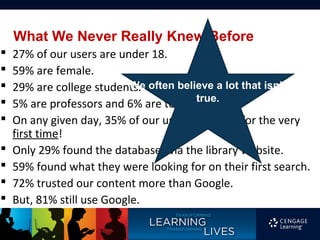
What We Never Really Knew Before
   27% of our users are under 18.
   59% are female.
   29% are college students. often believe a lot that isn’t
                            We
                                        true.
   5% are professors and 6% are teachers.
   On any given day, 35% of our users are there for the very
    first time!
   Only 29% found the databases via the library website.
   59% found what they were looking for on their first search.
   72% trusted our content more than Google.
   But, 81% still use Google.
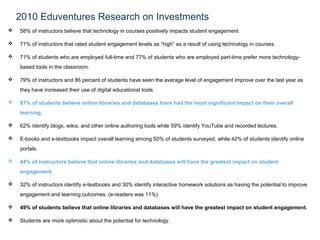
2010 Eduventures Research on Investments
   58% of instructors believe that technology in courses positively impacts student engagement.

   71% of instructors that rated student engagement levels as “high” as a result of using technology in courses.

   71% of students who are employed full-time and 77% of students who are employed part-time prefer more technology-
    based tools in the classroom.

   79% of instructors and 86 percent of students have seen the average level of engagement improve over the last year as
    they have increased their use of digital educational tools.

   87% of students believe online libraries and databases have had the most significant impact on their overall

    learning.

   62% identify blogs, wikis, and other online authoring tools while 59% identify YouTube and recorded lectures.

   E-books and e-textbooks impact overall learning among 50% of students surveyed, while 42% of students identify online

    portals.

   44% of instructors believe that online libraries and databases will have the greatest impact on student
    engagement.

   32% of instructors identify e-textbooks and 30% identify interactive homework solutions as having the potential to improve
    engagement and learning outcomes. (e-readers was 11%)

   49% of students believe that online libraries and databases will have the greatest impact on student engagement.

   Students are more optimistic about the potential for technology.
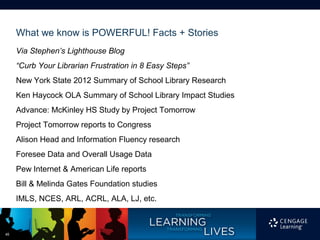
What we know is POWERFUL! Facts + Stories
     Via Stephen’s Lighthouse Blog
     “Curb Your Librarian Frustration in 8 Easy Steps”
     New York State 2012 Summary of School Library Research
     Ken Haycock OLA Summary of School Library Impact Studies
     Advance: McKinley HS Study by Project Tomorrow
     Project Tomorrow reports to Congress
     Alison Head and Information Fluency research
     Foresee Data and Overall Usage Data
     Pew Internet & American Life reports
     Bill & Melinda Gates Foundation studies
     IMLS, NCES, ARL, ACRL, ALA, LJ, etc.


45
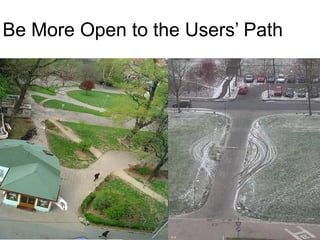
Be More Open to the Users’ Path
What Would You Attempt If
You Knew You Would Not
Fail?
My Humble Recommendations

 Focus on the user, I mean really
 Pilot and experiment with mobile social cohorts
 Classes (mobile training or extended learning)
 Reading cohorts and book clubs
 Member, Researcher and Learner driven strategies first
 Associations, Consortia and Collaboratives
 Fundraising
 Reorganize for simplicity and flexibility
 Teams (business or sport)
My Humble Recommendations

 Actively lobby and educate to ensure that the emerging mobile
  ecosystem supports the values and principles of librarianship for
  balance in the rights of end users for use, access, learning and
  research.
 Support vendors and laws to be as agnostic as possible by
  ensuring that, as far as possible your services and content
  offerings support the widest range of devices, formats, browsers,
  and platforms.
Get to where the user is.
eLearning, Mobile, Distant, Virtual


Tools
My Humble Recommendations

 Design for frictionless access using such
 opportunities as geo-IP and mobile ready websites
 Test everything in all browsers – mobile or not – all
 devices.
 Invest in usability research aimed at the user
 experience and test and learn from it and share your
 learning.
 Don’t prioritize the librarian experience first
 Watch key developments in major publishing spaces
 – retail, video, kiddy lit, textbooks, e-learning, fiction,
 etc. Spot the differences and opportunities
My Personal Hobby Horses

 This is an evolution not a revolution
 The REAL revolution was the Internet and the Web.
 The hybrid ecology is winning in the near term for
 operating systems and content formats.
 This is good since competition drives innovation and
 we’re in a Renaissance not an end game right now.
 Engage in critical thinking not raw criticism. Be
 constructive.
 Critical thinking is not part of dogma or religious fervor
 or fan boy behavior.
My Personal Hobby Horses
 This is an evolution not a revolution
 Perfectionism will not move us forward at this
 juncture.
 Really understand the digital divide and remove your
 economic and social class blinkers
 Get real about teens and Boomers
 Get over library obsession with statistics and
 comprehensiveness.
 Get excellent at real measurements, sampling and
 understanding impact and satisfaction. (Analytics,
 Foresee, Pew)
My Personal Hobby Horses

 This is an evolution not a revolution
 We need to revisit the concept of preservation,
 archives, repositories, and conservation from
 an access and linked data view.
 Check out new publishing models like
 Flipboard.
 Watch for emerging book enhancements and
 other features that will challenge library
 metadata, selection policies, preservation, and
 collection development.
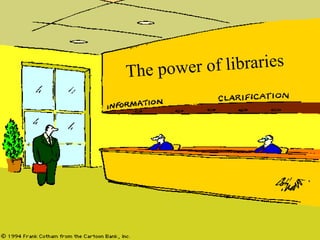
The power of libraries
A Third Path
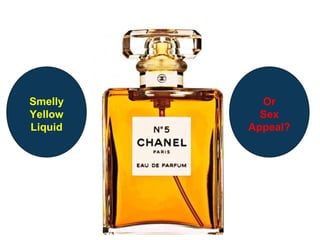
Smelly     Or
Yellow     Sex
Liquid   Appeal?
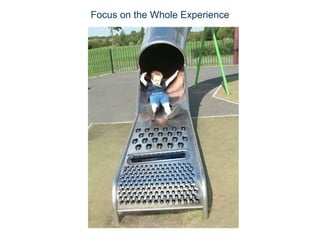
Focus on the Whole Experience
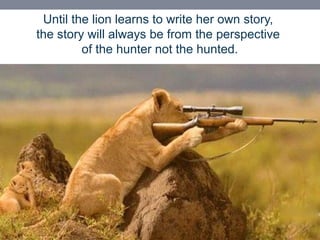
Until the lion learns to write her own story,
the story will always be from the perspective
         of the hunter not the hunted.
Stephen Abram, MLS, FSLA
VP strategic partnerships and markets
               Cengage Learning (Gale)
                    Cel: 416-669-4855
        stephen.abram@cengage.com
           Stephen’s Lighthouse Blog
       http://stephenslighthouse.com
 Facebook, Pinterest: Stephen Abram
     LinkedIn / Plaxo: Stephen Abram
                     Twitter: @sabram
           SlideShare: StephenAbram1

Maine directors

  • 1.
    The Future: Digital/PrintLibrary Hybrids Stephen Abram, MLS Maine, Thorndike Press, Dec. 5, 2012
  • 4.
    Funding is Attitudinal… Support versus Commitment
  • 5.
    Deer in headlampsslide here.
  • 6.
    Positioning the Libraryin The Right Minds Reading not Books Librarians not Libraries Questions not Answers Knowledge not Information Community and Learning not Warehouses Measurements not Statistics Members or Students or Faculty not Users Full Intellectual Access not Physical Access Professional Consultative Service not Servant or mere efficient and effective service 6
  • 7.
  • 8.
    Content Fragmentation Digitization’s realimpact – non-fiction Format – living in all worlds Print, ePUB, PDF, Kindle, etc. etc. CD, DVD, USB, etc. etc. Streaming Licenses, Open Access, Creative Commons, etc. etc. eBooks eJournals eContent Copyright Issues (NatGeo, Tasini, TPP, SOPA, etc. etc.) Author Lawsuits
  • 9.
    Beyond Text Text Graphics &Charts Formulae Pictures Maps Video Audio Gamification Deep Data Mining Assessments Etc. etc.
  • 10.
    Walled Gardens ILS CMS Cloud(s) Device dependencies Formats(e.g. Kindle) Amazon Apple ADVICE . . .
  • 11.
    Learning Object Diversification Textbooks eLearning LearningManagement Systems Cohort Learning Environments Presentation Systems Virtual Conference Environment Personal Learning Environments Collaboration Software MOOCs
  • 12.
    End User Fragmentation Teens/ Post-Millennials Millennials Other demographics Business versus Consumer The Device Divide Mobility
  • 13.
    Search Fragmentation Consumer Search SpecializedSearch Professional Search Semantic, Sentiment, Suggestion Search etc. Mobile search Social search Augmented Reality SEO SMO Content Spam Geo-location
  • 14.
    Technology Fragmentation Feature Phones Smartphones Tablets Laptops Desktops Gamingstations Television E-Readers Internet of Things Browsers
  • 16.
  • 17.
    Black and White Thepolarization of discussion Dogmatic vs. Professional positions on: eBooks, access, copyright, etc.
  • 18.
  • 23.
  • 24.
    OMG – thedigital book! 24
  • 25.
    Trends Differ Slightlyby Library Sector Public Libraries Academic Research Libraries Community College Libraries School Libraries Specialized Libraries Consortia
  • 26.
    Public Libraries Strategic alignment– social, economic, demographic Recommendations (LibraryThing for Libraries, BiblioCommons, Book Psychic) Community Glue Economic Impact Programs Partnerships Education and Learning Audience in Segmentation
  • 27.
    Academic Research Libraries eLearning Repositories ContentArchipelagos LibGuides Patron-driven acquisitions Information Fluency Demarcation between Undergrad, Grad and Faculty/Staff strategies Copyright compliance E-Coursepacks and e-Reserves Strategic budgeting Partnerships
  • 28.
    Community College andUndergrad Information Literacy Distance education and eLearning Textbooks, Reserves, Coursepacks, e-all MOOCs Mobility Collections for new degrees and certifications
  • 29.
    School Libraries Common Core 21stCentury Learning Future of the Textbook Scaffolded Information Literacy / Fluency Filters Staff and Faculty relationships Classroom pages
  • 30.
  • 31.
    Consortia DPLA Library Renewal EveryLibrary AdvocacyPAC OCLC Linked Data 3M e-books CALIFA / Douglas County initiatives Cloud initiatives
  • 32.
    So what isthe answer? Where are the real pain points?
  • 34.
  • 35.
  • 36.
  • 37.
  • 38.
  • 39.
  • 40.
    Let’s think Think: Areyou thinking food, courses, days, weekly plan, or nutrition overall? What is a meal in library end-user community or research, education and learning terms?
  • 41.
    KNOWLEDGE PORTALS KNOWLEDGE, LEARNING, INFORMATION & RESEARCH COMMONS
  • 42.
    What are thereal issues? Craft versus Industrial Strength Pilot, Project, Initiative versus Portfolio Strategy Hand knitted prototypes versus Production e.g. Information Literacy initiatives Discovery versus Search versus Deep Search eLearning units Strategic Analytics Value measures Behaviours
  • 43.
    What We NeverReally Knew Before  27% of our users are under 18.  59% are female.  29% are college students. often believe a lot that isn’t We true.  5% are professors and 6% are teachers.  On any given day, 35% of our users are there for the very first time!  Only 29% found the databases via the library website.  59% found what they were looking for on their first search.  72% trusted our content more than Google.  But, 81% still use Google.
  • 44.
    2010 Eduventures Researchon Investments  58% of instructors believe that technology in courses positively impacts student engagement.  71% of instructors that rated student engagement levels as “high” as a result of using technology in courses.  71% of students who are employed full-time and 77% of students who are employed part-time prefer more technology- based tools in the classroom.  79% of instructors and 86 percent of students have seen the average level of engagement improve over the last year as they have increased their use of digital educational tools.  87% of students believe online libraries and databases have had the most significant impact on their overall learning.  62% identify blogs, wikis, and other online authoring tools while 59% identify YouTube and recorded lectures.  E-books and e-textbooks impact overall learning among 50% of students surveyed, while 42% of students identify online portals.  44% of instructors believe that online libraries and databases will have the greatest impact on student engagement.  32% of instructors identify e-textbooks and 30% identify interactive homework solutions as having the potential to improve engagement and learning outcomes. (e-readers was 11%)  49% of students believe that online libraries and databases will have the greatest impact on student engagement.  Students are more optimistic about the potential for technology.
  • 45.
    What we knowis POWERFUL! Facts + Stories Via Stephen’s Lighthouse Blog “Curb Your Librarian Frustration in 8 Easy Steps” New York State 2012 Summary of School Library Research Ken Haycock OLA Summary of School Library Impact Studies Advance: McKinley HS Study by Project Tomorrow Project Tomorrow reports to Congress Alison Head and Information Fluency research Foresee Data and Overall Usage Data Pew Internet & American Life reports Bill & Melinda Gates Foundation studies IMLS, NCES, ARL, ACRL, ALA, LJ, etc. 45
  • 48.
    Be More Opento the Users’ Path
  • 49.
    What Would YouAttempt If You Knew You Would Not Fail?
  • 50.
    My Humble Recommendations Focus on the user, I mean really  Pilot and experiment with mobile social cohorts  Classes (mobile training or extended learning)  Reading cohorts and book clubs  Member, Researcher and Learner driven strategies first  Associations, Consortia and Collaboratives  Fundraising  Reorganize for simplicity and flexibility  Teams (business or sport)
  • 51.
    My Humble Recommendations Actively lobby and educate to ensure that the emerging mobile ecosystem supports the values and principles of librarianship for balance in the rights of end users for use, access, learning and research.  Support vendors and laws to be as agnostic as possible by ensuring that, as far as possible your services and content offerings support the widest range of devices, formats, browsers, and platforms.
  • 52.
    Get to wherethe user is. eLearning, Mobile, Distant, Virtual Tools
  • 53.
    My Humble Recommendations Design for frictionless access using such opportunities as geo-IP and mobile ready websites  Test everything in all browsers – mobile or not – all devices.  Invest in usability research aimed at the user experience and test and learn from it and share your learning.  Don’t prioritize the librarian experience first  Watch key developments in major publishing spaces – retail, video, kiddy lit, textbooks, e-learning, fiction, etc. Spot the differences and opportunities
  • 54.
    My Personal HobbyHorses  This is an evolution not a revolution  The REAL revolution was the Internet and the Web.  The hybrid ecology is winning in the near term for operating systems and content formats.  This is good since competition drives innovation and we’re in a Renaissance not an end game right now.  Engage in critical thinking not raw criticism. Be constructive.  Critical thinking is not part of dogma or religious fervor or fan boy behavior.
  • 55.
    My Personal HobbyHorses  This is an evolution not a revolution  Perfectionism will not move us forward at this juncture.  Really understand the digital divide and remove your economic and social class blinkers  Get real about teens and Boomers  Get over library obsession with statistics and comprehensiveness.  Get excellent at real measurements, sampling and understanding impact and satisfaction. (Analytics, Foresee, Pew)
  • 56.
    My Personal HobbyHorses  This is an evolution not a revolution  We need to revisit the concept of preservation, archives, repositories, and conservation from an access and linked data view.  Check out new publishing models like Flipboard.  Watch for emerging book enhancements and other features that will challenge library metadata, selection policies, preservation, and collection development.
  • 57.
    The power oflibraries
  • 58.
  • 61.
    Smelly Or Yellow Sex Liquid Appeal?
  • 62.
    Focus on theWhole Experience
  • 64.
    Until the lionlearns to write her own story, the story will always be from the perspective of the hunter not the hunted.
  • 66.
    Stephen Abram, MLS,FSLA VP strategic partnerships and markets Cengage Learning (Gale) Cel: 416-669-4855 stephen.abram@cengage.com Stephen’s Lighthouse Blog http://stephenslighthouse.com Facebook, Pinterest: Stephen Abram LinkedIn / Plaxo: Stephen Abram Twitter: @sabram SlideShare: StephenAbram1

Editor's Notes

  • #5 WENDY Support is there, not commitment. There is a lot that people don’t know about libraries. Support is only marginally related to use. Don’t focus on users. Perceptions of the librarian are highly relevant to support. “Passionate librarians” who are involved in the community make a difference. The library occupies a clear position as a provider of practical answers and information. This is a crowded space. Reposition. Belief that the library is a transformational force in people’s lives is directly related to their level of funding support. Increasing support may not necessarily mean a trade-off with financial support for other public services. Elected officials are supportive… but not committed to increased funding. Identifying and engaging super supporters and probable supporters is critical.