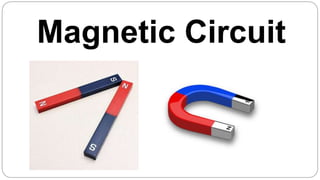
Magnetic Circuit
Magnet
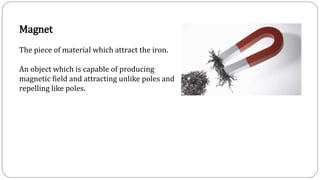
The piece of material which attract the iron.

An object which is capable of producing
magnetic field and attracting unlike poles and
repelling like poles.
Type of Magnet
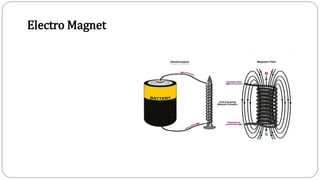
Electro Magnet
Working Principle of Electromagnets
Normally, the atoms in the nail are
oriented in random directions, and
individual magnetic fields cancel each
other out. Under the influence of electric
current, these atoms are reoriented to
start pointing in the same direction. All
these individual magnetic fields together
create a strong magnetic field. As the
current flow increases, this degree of
reorientation also increases, resulting in
a stronger magnetic field. Once all the
particles are reoriented perfectly in the
same direction, increasing the current
flow will not affect the magnetic field. At
this point, the magnet is said to be
saturated.
Properties of magnets:
These are the magnet's main qualities:
1. Magnets attract ferromagnetic materials.
2. The magnet's similar poles repel each other, whereas the opposite poles
attract one other.
3. A hung magnet always comes to rest facing north-south.
4. The magnet's poles are arranged in pairs. i.e. magnetic monopole doesn't
exist.
Properties of magnetic field lines:
•They form closed loops.
•They never intersect each other.
•The magnetic field lines are crowded
near the pole where the field is strong
and spread apart from each other
where the field is weak.
•They flow from the south pole to the
north pole within a magnet and north
pole to south pole in outside.
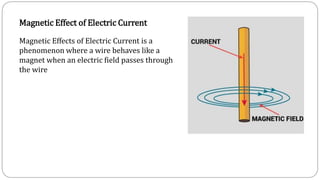
Magnetic Effect of Electric Current
Magnetic Effects of Electric Current is a
phenomenon where a wire behaves like a
magnet when an electric field passes through
the wire
Magnetic Circuits – Basic Laws in Magnetic Circuits:
Magnetic Flux
• Magnetic flux is produced due to the flow of current in a
wire (or) conductor.
Right hand Thumb Rule:
 it is used to determine the direction of magnetic field
around a current carrying wire.
 This rule states that “When an electrical current passes
through a straight wire that is held by the right hand with the
thumb pointing upwards and the fingers curling up the wore,
the thumb points in the direction of the conventional current,
and the fingers point in the direction of magnetic field.
  is the representation of magnetic flux.
 Weber is the unit of magnetic flux.
1 weber = 108 field lines on area of 1 m2
1 field line = 1 maxwell
1 Weber = 108 Maxwell
1 Maxwell = 10-8 web.
1. Magnetic Flux
The number of magnetic lines of forces set up in a magnetic circuit is
called Magnetic Flux. It is analogous to electric current I in an electric circuit.
Its SI unit is Weber (Wb) and its CGS unit is Maxwell.
It is denoted by φ.
2. Flux Density/ Magnetic field Density/ Magnetic induction
 The amount of flux passing through a unit area at right angles to
the magnetic field lines is called as flux density (B).
 Unit = Weber/meter2 or Tesla or Newton-meters per ampere
(Nm/A)
 The CGS Unit of B is gauss 1 Gauss = 10-4 Tesla.
3. Magnetomotive Force (M.M.F.):
The current flowing in an electric circuit is due to
the existence of electromotive force similarly
magnetomotive force (MMF) is required to drive
the magnetic flux in the magnetic circuit.
Definition - The magnetic pressure, which sets up
the magnetic flux in a magnetic circuit is called
Magnetomotive Force.
MMF = N*I
Where N= no of turns I = Current flowing in the coil
SI unit of MMF is Ampere-turn (AT).
CGS unit = Gilbert (Gb)
1Gb = 0.79 AT or 10/4 , 1 AT = 1.2 Gb
The strength of the MMF is equivalent to the product of the current around
the turns and the number of turns of the coil.
F = NI
Where, N – numbers of turns of inductive coil
I – current
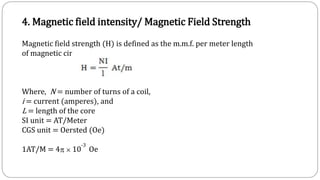
4. Magnetic field intensity/ Magnetic Field Strength
Magnetic field strength (H) is defined as the m.m.f. per meter length
of magnetic circuit i.e.,
Where, N = number of turns of a coil,
i = current (amperes), and
L = length of the core
SI unit = AT/Meter
CGS unit = Oersted (Oe)
1AT/M = 4  10
-3
Oe
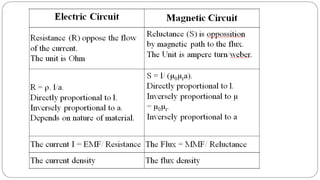
4. Permeability
A property of magnetic material which indicates the ability of
magnetic circuit to carry electromagnetic flux
It is the ratio of flux density to the magnetic field strength
Henry per meter (H/m) or Newton per ampere squared
(N⋅A−2). Or Weber/AT meter
 = How good Magnetic material
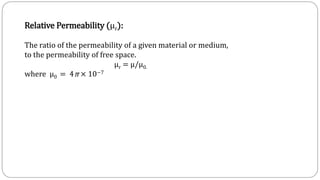
Relative Permeability (μr):
The ratio of the permeability of a given material or medium,
to the permeability of free space.
μr = μ/μ0.
where μ0 = 4π × 10−7
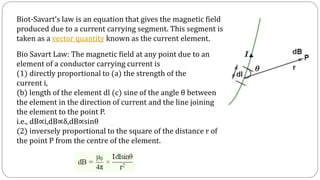
Biot-Savart’s law is an equation that gives the magnetic field
produced due to a current carrying segment. This segment is
taken as a vector quantity known as the current element.
Bio Savart Law: The magnetic field at any point due to an
element of a conductor carrying current is
(1) directly proportional to (a) the strength of the
current i,
(b) length of the element dl (c) sine of the angle θ between
the element in the direction of current and the line joining
the element to the point P.
i.e., dB∝i,dB∝δ,dB∝sinθ
(2) inversely proportional to the square of the distance r of
the point P from the centre of the element.
Ampere’s Circuital Law:
Ampere’s circuital law states that the line integral of the magnetic
field surrounding closed loop equals the number of time the algebraic
sum of current passing through the loop.
Force on a conductor carrying current in a magnetic
field:-
Ampere suggested that if a current carrying conductor produces
a magnetic field and exerts a force on a magnet, then a magnet
should also exert a force on a current carrying conductor.
Magnetic Circuits – Basic Laws in Magnetic Circuits:
Fleming’s left hand rule
• it is applicable for electric motors
 Fore finger represents the direction of magnetic field.
 Middle finger represents the direction of current
 Thumb represents the direction of force
Magnetic Circuits – Basic Laws in Magnetic Circuits:
Fleming’s Right hand rule
• it is applicable for generators
• if the thumb, fore-finger and middle finger of right
hand are stretched perpendicular to each other then,
 Fore finger represents direction of magnetic field.
 middle finger represents the direction of current.
 Thumb represents the direction of force.
Magnetic Circuits – Basic Laws in Magnetic Circuits:
Faraday’s Laws
Faraday’s First Law
• Whenever a conductor is placed in a varying magnetic field, EMF
is induced which is called induced EMF.
• if the conductor circuit is closed, the current will also circulate
through the circuit and this current is called induced current.
Magnetic Circuits – Basic Laws in Magnetic Circuits:
Faraday’s Laws
Faraday’s Second Law
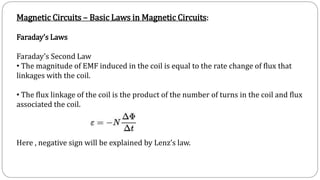
• The magnitude of EMF induced in the coil is equal to the rate change of flux that
linkages with the coil.
• The flux linkage of the coil is the product of the number of turns in the coil and flux
associated the coil.
Here , negative sign will be explained by Lenz’s law.
Magnetic Circuits – Basic Laws in Magnetic Circuits:
Lenz’s Laws
•The direction of the induced current in the coil will be always in such a way as to
oppose the change which produces current.
 it is just a small addition to faraday’s law.
 Negative sign shows opposition.
Magnetic Circuits – Iron Losses & BH Curve:
B-H Curve
• it shows the relationship between the intensity of
magnetization and magnetic field Density.
Magnetic Circuits – Iron Losses & BH Curve:
Retentivity
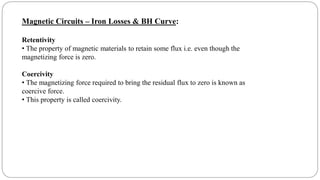
• The property of magnetic materials to retain some flux i.e. even though the
magnetizing force is zero.
Coercivity
• The magnetizing force required to bring the residual flux to zero is known as
coercive force.
• This property is called coercivity.
Magnetic Circuits – Iron Losses & BH Curve:
Hysteresis Loss
• it is due to reversal of magnetization of transformer core whenever it is subjected to
alternating nature of magnetic force.
• Whenever a magnetic material is subjected to alternating force, the domain pre-sent in the
magnetic material will change their orientation after every half cycle.
• The power consumed by the magnetic domains to change their orientation after every half
cycle is called hysteresis loss.
• it is dissipated in the form of heat.
Magnetic Circuits – Iron Losses & BH Curve:
Eddy Current
• When an alternating magnetic field is applied to a magnetic
material, an EMF is induced. In the material itself according
to Faraday’s law of electromagnetic induction
• Since the magnetic material is a conducting materials, these
EMFS circulate current within the body of the material.
• These circulating current are called Eddy currents. They will
occur when the conductor experiences a changing magnetic
field.

magnetic Circuit.pptx

  • 1.
  • 2.
    Magnet The piece ofmaterial which attract the iron. An object which is capable of producing magnetic field and attracting unlike poles and repelling like poles.
  • 3.
  • 4.
  • 5.
    Working Principle ofElectromagnets Normally, the atoms in the nail are oriented in random directions, and individual magnetic fields cancel each other out. Under the influence of electric current, these atoms are reoriented to start pointing in the same direction. All these individual magnetic fields together create a strong magnetic field. As the current flow increases, this degree of reorientation also increases, resulting in a stronger magnetic field. Once all the particles are reoriented perfectly in the same direction, increasing the current flow will not affect the magnetic field. At this point, the magnet is said to be saturated.
  • 6.
    Properties of magnets: Theseare the magnet's main qualities: 1. Magnets attract ferromagnetic materials. 2. The magnet's similar poles repel each other, whereas the opposite poles attract one other. 3. A hung magnet always comes to rest facing north-south. 4. The magnet's poles are arranged in pairs. i.e. magnetic monopole doesn't exist.
  • 7.
    Properties of magneticfield lines: •They form closed loops. •They never intersect each other. •The magnetic field lines are crowded near the pole where the field is strong and spread apart from each other where the field is weak. •They flow from the south pole to the north pole within a magnet and north pole to south pole in outside.
  • 8.
    Magnetic Effect ofElectric Current Magnetic Effects of Electric Current is a phenomenon where a wire behaves like a magnet when an electric field passes through the wire
  • 9.
    Magnetic Circuits –Basic Laws in Magnetic Circuits: Magnetic Flux • Magnetic flux is produced due to the flow of current in a wire (or) conductor. Right hand Thumb Rule:  it is used to determine the direction of magnetic field around a current carrying wire.  This rule states that “When an electrical current passes through a straight wire that is held by the right hand with the thumb pointing upwards and the fingers curling up the wore, the thumb points in the direction of the conventional current, and the fingers point in the direction of magnetic field.   is the representation of magnetic flux.  Weber is the unit of magnetic flux.
  • 13.
    1 weber =108 field lines on area of 1 m2 1 field line = 1 maxwell 1 Weber = 108 Maxwell 1 Maxwell = 10-8 web. 1. Magnetic Flux The number of magnetic lines of forces set up in a magnetic circuit is called Magnetic Flux. It is analogous to electric current I in an electric circuit. Its SI unit is Weber (Wb) and its CGS unit is Maxwell. It is denoted by φ.
  • 14.
    2. Flux Density/Magnetic field Density/ Magnetic induction  The amount of flux passing through a unit area at right angles to the magnetic field lines is called as flux density (B).  Unit = Weber/meter2 or Tesla or Newton-meters per ampere (Nm/A)  The CGS Unit of B is gauss 1 Gauss = 10-4 Tesla.
  • 18.
    3. Magnetomotive Force(M.M.F.): The current flowing in an electric circuit is due to the existence of electromotive force similarly magnetomotive force (MMF) is required to drive the magnetic flux in the magnetic circuit. Definition - The magnetic pressure, which sets up the magnetic flux in a magnetic circuit is called Magnetomotive Force. MMF = N*I Where N= no of turns I = Current flowing in the coil SI unit of MMF is Ampere-turn (AT). CGS unit = Gilbert (Gb) 1Gb = 0.79 AT or 10/4 , 1 AT = 1.2 Gb
  • 19.
    The strength ofthe MMF is equivalent to the product of the current around the turns and the number of turns of the coil. F = NI Where, N – numbers of turns of inductive coil I – current
  • 20.
    4. Magnetic fieldintensity/ Magnetic Field Strength Magnetic field strength (H) is defined as the m.m.f. per meter length of magnetic circuit i.e., Where, N = number of turns of a coil, i = current (amperes), and L = length of the core SI unit = AT/Meter CGS unit = Oersted (Oe) 1AT/M = 4  10 -3 Oe
  • 21.
    4. Permeability A propertyof magnetic material which indicates the ability of magnetic circuit to carry electromagnetic flux It is the ratio of flux density to the magnetic field strength Henry per meter (H/m) or Newton per ampere squared (N⋅A−2). Or Weber/AT meter  = How good Magnetic material
  • 22.
    Relative Permeability (μr): Theratio of the permeability of a given material or medium, to the permeability of free space. μr = μ/μ0. where μ0 = 4π × 10−7
  • 25.
    Biot-Savart’s law isan equation that gives the magnetic field produced due to a current carrying segment. This segment is taken as a vector quantity known as the current element. Bio Savart Law: The magnetic field at any point due to an element of a conductor carrying current is (1) directly proportional to (a) the strength of the current i, (b) length of the element dl (c) sine of the angle θ between the element in the direction of current and the line joining the element to the point P. i.e., dB∝i,dB∝δ,dB∝sinθ (2) inversely proportional to the square of the distance r of the point P from the centre of the element.
  • 27.
    Ampere’s Circuital Law: Ampere’scircuital law states that the line integral of the magnetic field surrounding closed loop equals the number of time the algebraic sum of current passing through the loop.
  • 28.
    Force on aconductor carrying current in a magnetic field:- Ampere suggested that if a current carrying conductor produces a magnetic field and exerts a force on a magnet, then a magnet should also exert a force on a current carrying conductor.
  • 29.
    Magnetic Circuits –Basic Laws in Magnetic Circuits: Fleming’s left hand rule • it is applicable for electric motors  Fore finger represents the direction of magnetic field.  Middle finger represents the direction of current  Thumb represents the direction of force
  • 34.
    Magnetic Circuits –Basic Laws in Magnetic Circuits: Fleming’s Right hand rule • it is applicable for generators • if the thumb, fore-finger and middle finger of right hand are stretched perpendicular to each other then,  Fore finger represents direction of magnetic field.  middle finger represents the direction of current.  Thumb represents the direction of force.
  • 35.
    Magnetic Circuits –Basic Laws in Magnetic Circuits: Faraday’s Laws Faraday’s First Law • Whenever a conductor is placed in a varying magnetic field, EMF is induced which is called induced EMF. • if the conductor circuit is closed, the current will also circulate through the circuit and this current is called induced current.
  • 36.
    Magnetic Circuits –Basic Laws in Magnetic Circuits: Faraday’s Laws Faraday’s Second Law • The magnitude of EMF induced in the coil is equal to the rate change of flux that linkages with the coil. • The flux linkage of the coil is the product of the number of turns in the coil and flux associated the coil. Here , negative sign will be explained by Lenz’s law.
  • 37.
    Magnetic Circuits –Basic Laws in Magnetic Circuits: Lenz’s Laws •The direction of the induced current in the coil will be always in such a way as to oppose the change which produces current.  it is just a small addition to faraday’s law.  Negative sign shows opposition.
  • 38.
    Magnetic Circuits –Iron Losses & BH Curve: B-H Curve • it shows the relationship between the intensity of magnetization and magnetic field Density.
  • 39.
    Magnetic Circuits –Iron Losses & BH Curve: Retentivity • The property of magnetic materials to retain some flux i.e. even though the magnetizing force is zero. Coercivity • The magnetizing force required to bring the residual flux to zero is known as coercive force. • This property is called coercivity.
  • 40.
    Magnetic Circuits –Iron Losses & BH Curve: Hysteresis Loss • it is due to reversal of magnetization of transformer core whenever it is subjected to alternating nature of magnetic force. • Whenever a magnetic material is subjected to alternating force, the domain pre-sent in the magnetic material will change their orientation after every half cycle. • The power consumed by the magnetic domains to change their orientation after every half cycle is called hysteresis loss. • it is dissipated in the form of heat.
  • 41.
    Magnetic Circuits –Iron Losses & BH Curve: Eddy Current • When an alternating magnetic field is applied to a magnetic material, an EMF is induced. In the material itself according to Faraday’s law of electromagnetic induction • Since the magnetic material is a conducting materials, these EMFS circulate current within the body of the material. • These circulating current are called Eddy currents. They will occur when the conductor experiences a changing magnetic field.