Brain Resuscitation And Magnesiumby- Dr. RAJ KUMAR DHAUGODA FROM NEPAL- MBBS, MD IN FAMILY MEDICINE – MEDICAL SCIENTIST AND DIALECTICAL MATERIALIST
Some philosophical statement of great scientistsAll truths are easy to understand once they are discovered. The point is to discover them –Galileo GalilieEinstein believed that deep truths about the workings of the universe would always be "as simple as possible”Philosopher and scientist Bruno said “The truth is objective reality, and not dependent on the thought of person or society or group or so called followers idealistic philosophy or bible.”
Family medicineFamily medicine is the medical specialty which provides continuing, comprehensive health care for the individual and family. It is a specialty in breadth that integrates the philosophical, biological, clinical and behavioral sciences.The scope of family medicine encompasses all ages, both sexes, each organ system and every disease entity.It has patient center approach rather than disease center.
Quality healthcare in family medicineQuality healthcare in family medicine is the achievement of optimal physical and mental health through accessible, safe, cost-effective care that is based on best evidence, responsive to the needs and preferences of patients and populations, and respectful of patients’ families, personal values, and beliefs. 
Family Medicine, Scope and Philosophical StatementFamily medicine is the natural evolution of historical medical practice. The first physicians were generalists. For thousands of years, generalists provided all of the medical care available. They diagnosed and treated illnesses, performed surgery, and delivered babies. As medical knowledge expanded and technology advanced, many physicians chose to limit their practices to specific, defined areas of medicine.
Family Medicine, Scope and Philosophical StatementFamily medicine is a three-dimensional specialty, incorporating (1) knowledge, (2) skill and(3) process. Although knowledge and skill may be shared with other specialties, the family medicine process is unique. At the center of this process is the patient-physician relationship with the patient viewed in the context of the family.
IN SUMMARYThe family physician of today is rooted in the historical generalist tradition. The specialty is three dimensional, combining knowledge and skill with a unique process. The patient-physician relationship in the context of the family is central to this process and distinguishes family medicine from other specialties. Above all, the scope of family medicine is dynamic, expanding, and evolutionary.
PHILOSOPHYPhilosophy :-is the way of looking or understanding of universe and its contents. It may be idealistic, metaphysics and dialectical materialistic philosophy. It  depends upon the answer of the question to the existence of  matter in this universe is               primary(dialectical materialism)or secondary to consciousness(idealism)  or  undecided  one( metaphysical philosophy).
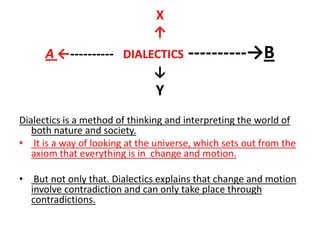
X↑A ←----------DIALECTICS----------->B      ↓YDialectics is a method of thinking and interpreting the world of both nature and society. It is a way of looking at the universe, which sets out from the axiom that everything is in  change and motion. But not only that. Dialectics explains that change and motion involve contradiction and can only take place through contradictions.
Dialectical logicThe dialectics is a science of the forms of our thinking Dialectics is the method of reasoning which aims to understand things concretely in all their movement, change and interconnection, with their opposite and contradictory sides in unity.
FORMAL /DIALECTICAL CONCEPT(A=A ) , (A≠ A )It is definitely true that the right Philosophy or right scientific thought, which is more scientific and more practical, can have more clear and true concept regarding a particular subject or system.According to the theory of dialectics, there is nothing stable except change and development.  So our present medical concept in our society, should be changed towards more scientific and practical form, from which we can solve the problem regarding health as far as possibleby present existing concept( formal logic) we are not able to solve health problem in our practice mostly. 
DEVELOPMENT OF SCIENTIFIC COGNITIONThe powerful inductive force for developing of scientific cognition is the laws of dialectics. Dialectics is the area where conscious, intentional coincidence of the inductive and the deductive moments takes place, the two constituting indissolubly linked, and, mutually assuming moments of question/enquiry investigation for breakthrough thinking E.g.Dialectics teaches us for making questions or breakthrough thinking on rationality and effectiveness of current systems, events, knowledge, practices and problems. For an example the so called advanced modern medicine, following a critical analysis of its ineffectiveness on treating so many diseases and its philosophy, and making a better options for previous metaphysical philosophy, with evidence bases and scientific philosophical grounded.All truths are easy to understand once they are discovered. The point is to discover them –Galileo Galilie
The definition of Health given by WHO (developed by metaphysical groups of health experts in 1948), “IS NOT A OBJECTIVE REALITY AND VERY VERY NARROW AND UNSCIENTIFIC, BUT ALSO JUST OPPOSITE OF REALITY”.This is a sort of development of scientific cognition, a scientific abstract which may be real concrete, after multiaxial methodological analysis of current medical practices and its background philosophy.It’s an ascent of scientific abstract to scientific concrete concept. This might be a new concrete concept, and inevitably brings changes in the field of management of Health and Disease in the world. 
The wrong WHO definition of HealthHealth is a state of complete physical, mental and social well-being and not merely the absence of disease or infirmity. This definition of health given by WHO, has not modified since 1948.  Health is not a absolute phenomena, so the lack of operational value and the problem created by use of the word "complete”- according to dialectical law ,Nature is a state of motion and change According to Angels, “All nature from the smallest thing to the biggest, from grains of sand to sun, from the primary living cell (protista) to man, has its existence in internal coming into being and going out of being, in a ceaseless flux, in unresting motion and change. So health cannot be a complete or absolute thing.
The wrong WHO definition of Health“The phrase absence of disease or infirmity” is also a great fundamental problem in the definition of health by WHO .this last phrase says that concept of absolute health and health is taken as isolated form from disease side, which is opposite to reality. Health never can be isolated from disease. if there is no disease in a man there shouldn’t be existence of  health  simultaneously , it is possible the detachment of health and disease only after death of a person.According to dialectical law (Contradictions inherent in Nature) everything or system in the universe and its contents there should be opposite system or things simultaneously and they are interchangeable, contradicted in nature.
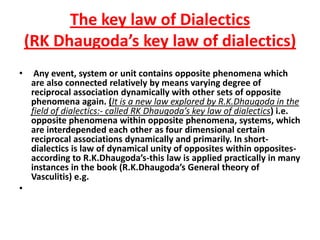
The key law of Dialectics(RK Dhaugoda’s key law of dialectics)  Any event, system or unit contains opposite phenomena which are also connected relatively by means varying degree of reciprocal association dynamically with other sets of opposite phenomena again. (It is a new law explored by R.K.Dhaugoda in the field of dialectics:- called RK Dhaugoda’s key law of dialectics) i.e. opposite phenomena within opposite phenomena, systems, which are interdepended each other as four dimensional certain reciprocal associations dynamically and primarily. In short-dialectics is law of dynamical unity of opposites within opposites-according to R.K.Dhaugoda’s-this law is applied practically in many instances in the book (R.K.Dhaugoda’s General theory of Vasculitis) e.g.  
EXAMLES OF KEY LAW OF DIALECTICSThe health and disease are opposite phenomena, are connected dynamically with another opposite phenomena i.e. dialectical materialistic thought / practice and idealistic thought and practice of an individual.  Dialectical materialistic thought and practice with positive self esteem↑││Health ←----------------------------------------------------->Disease││↓Idealistic thought and practice of an individual with low self esteem
EXAMLES OF KEY LAW OF DIALECTICSThe health and disease are opposite phenomena, are connected dynamically with another opposite phenomena i.e. stress factors(cytokines-TNF-alpha) and anti-stress factor ( intracellular anti-stress factor) of an individual. Intracellular anti-stress factor↑││Health ←----------------------------------------------------->Disease││↓TNF-alpha 
EXAMLES OF KEY LAW OF DIALECTICSlikewise day and night are opposites  related with other sets of opposite phenomena, rotation of Earth from west to east in its own axis, and sun arise from east / sets from west. Rotation of earth from west to east in its own axis↑││Day←---------------------------------------------------------------->Night││↓                           Sun arise from east and sets from west 
THE NEW DEFINITION OF HEALTHThus the scientific definition of health comes from this key law of dialectics, i.e.slide no. 17 and 18 Health is defined as “the  relative dynamically balance   state of optimum level of dialectic materialistic thought and practice in relation to idealistic thought and practice of an individual with positive self esteem; and relative reciprocal association of intracellular level of ANTI-STRESS ELEMENT in relation to stress factors(TNF-alpha) in  the body of an individual”.                                           BY-RK DHAUGODA
NEW DEFINITION OF DISEASEThe definition of disease should be opposite that of definition of health. Disease  is just opposite of health, hence disease is defined as “the relative low level of dialectical materialistic thought and practice, as compare to idealistic thought and practice; and the relative unbalanced intracellular  ANTI-STRESS ELEMENT  in comparison to stress factors(TNF-alpha) in the body of an individual with low self esteem”.BY- RK DHAUGODAThe World Health Organization has not defined disease yet.
By combining these two definition of health and disease –it essentially comes the definition of Immunity. “Immunity is defined as relatively physiologic balance of anti-stress factor (antibodies ) in comparison to  INNER STRESS FACTOR ( TNF-alpha ) and OUTER stress factors(  microbes, pollutants,radiation,virus,oxidising agents, mechanical forces, altered bio-mechanical, HORMONE ENZYMES CELL GROWTH , mental tortures, fear ,anxiety; and increased awareness on natural/body laws ( dialectical - materialistically ) as well as mental laws ( psychologically -positive self steam)”. by- RK DHAUGODAThe World Health Organization has not defined immunity also.
a lot of problems in the management of world health effectivelyWHO is the co-coordinator or contractor or organizer or monitor or authority of world health, hasn’t define immunity and disease officially yet. That’s why there are a lot of problems in the management of world health effectively. WHO has defined health in 1948, and has not updated up to now, That’s why, WHO definition of health is a non- realistic , impracticable and unscientific one.  
The role of magnesium in Brain -Resuscitationby- Dr. RAJ KUMAR DHAUGODA FROM NEPAL- MBBS, MD IN FAMILY MEDICINE – MEDICAL SCIENTIST AND DIALECTICAL MATERIALIST
AbstractThe approach to the patient with global Hypoxic Ischemic brain injury is a difficult task, by using current drugs like –barbiturates, super oxide dismutase, nimodipine, dizocilpine etc, separately gives the incomplete results and not fully satisfactory result. It is necessary to ongoing research & correlation of newer knowledge for newer more effective drugs( magnesium compound) or techniques e.g. gene therapy, stem cell therapy etc.It is cleared that we understand most of the patho-physiology of hypoxic ischemic brain injury in advanced level. But we have not found such satisfactory drugs to prevent neuronal death or recover ischemic brain injury so far. Calcium channel blockers & barbiturates have been used for years but they did not show effective out come.  Hence our medical knowledge, our researches should be correlated and as well as critical evaluation of literature and their scientific analysis to find out the newer, effective, cost effective agent, which may act all the steps of pathogenesis of neuronal damage due to Hypoxic ischemic brain injur
ABSTRACT-count.. Magnesium has versatile physiological and pharmacological actions. It protects the cell injury in various steps or by multi directional physiological action. Theoretically magnesium attenuates all the biochemical changes during hypoxic- ischemic brain injuries, e.g. ATP depletion, acidosis, Excitatory amino acid (glutamate stimulation) or NMDA / non- NMDA receptor stimulation, increase calcium metabolism, phospholipid hydrolysis, leukotriens prostaglandin formation, oxygen radical formation, protein synthesis depletion, alteration of gene expression and Inflammation. These facts are proved by various clinical trials done in various medical institutes. And it is tried to here dialectical analysis of benefits of magnesium compounds in hypoxic-ischemic brain injury, in dialecticalformat, that is using of R.K.Dhaugoda’s key law of dialectics and R.K.Dhaugoda’s general theory of vasculitis showing that magnesium is the master / key / ideal drug for brain resuscitation.
Key wordshypoxic-ischemic brain injury (H-I brain injury)magnesium, NMDA-receptor, cerebral edema, vasculitis, TNF-alpha,dialectical materialism (philosophy as methodology),RKDHAUGODA’S key law of dialectics.
Clinical features of H-I Encephalopathy  Neonatal seizure - over stimulation of excited neurons and reciprocal membrane depolarization Resp. depression, poor suck - impaired action of neurotransmitters in brain stem.Coma - Metabolic disrupt of reticular activating systemBrain edema - Disturbed - ability to pump water act of hugely- breakdown of blood brain barriers. Patho-physiology of Hypoxic- Ischemia Brain Injury and chemical changes            Main 3 mechanism –                                                  -Hypoxic- hypoxic (decreased O2 concentration)                                                   -Anemic hypoxia (decreased O2 delivery)                                                    -Ischemia hypoxia (decreased Blood flow)Global Ischemia - results from inadequate blood flow.                                        E.g. during cardiac arrest.Or sever hypoxia, severe hypotension, severe birth asphyxia .Focal Ischemia - Results from local disruption of Blood supply e.g. ischemia / stroke, vascular anomalies.   
Biochemical changesDuring Hypoxic- Ischemic Brain injury. ATP depletion,acidosis Excitatory amino acid (glutamate stimulation) or NMDA / non- NMDA receptor stimulation, increase calcium metabolism, phospholipid hydrolysis leukotriens prostaglandin formation, oxygen radical formation protein synthesis depletion, alteration of gene expression andIncreased cytokine production and Inflammation.
current practices of Brain resuscitation  1.Barbiturates: -         Decrease seizure         Decrease intracranial pressure        There is some evidence of giving thiopentone 120 mg / kg IV after 30 & 60 minutes of post ischemia, outcome is ameliorates of brain damage, After global ischemia in monkeys.2.Super oxide dismustase: -Dimutation reaction of super oxide radical 3.Calcium channel Antagonist:          Nimodipine shows increase survival rate up to 12 months after global cerebral ischemia. 4.Glutamate Antagonists:                    E.g. dizocilpine maleate _(NMDA receptor antagonist)       5.Nitric oxide syntheses inhibitors:                    No satisfactory out came has been reported with N-omega -nitro –L-arginine. 6.Hypothermia:              In the global ischemia, the temperature out came is that hyperthermia. (During intra and post ischemic period)The approach to the patient with global Hypoxic Ischemic brain injury is a difficult task, by using above drugs separately gives the incomplete results and not fully satisfactory result
Physiological Role of Magnesium It is required in the activation of more than 300 enzymes. Magnesium is an anti-stress agent.Physiological calcium antagonist.NMDA receptor blocker: (NMDA -receptor is activated in H- I brain injury).The main biological role of Mg++ in mammalian cell is involved with anion charge neutralization. Mg++ particularly found in association with organics polyphosphates such as nucleotide triphosphate and nucleotide diphosphate (eg. ATP4-.Mg++ and ADP3-.Mg++) The second messenger system - Regulation by Mg++Ion channel. Regulation by Mg++ (Electrolyte Regulation)Magnesium has also vasodilatation action which increases cerebral blood flow increase perfusion in ischemic brain, Magnesium has also anti-platelet action, causing decrease in microthrombi formationMagnesium is a potent anti-inflammatory agent-which decreases the cerebral inflammation and edema drasticallyMagnesium needs in cellular protein synthesis.
discussion(By above patho-physiology of Hypoxic- ischemic brain injury & role of magnesium in brain injury) Magnesium is the master agent due to its versatile physiological and pharmacological actions. It protects the cell injury in various steps or by multi directional physiological action of magnesium.Theoretically magnesium attenuates all the biochemical changes during hypoxic- ischemic brain injuries, e.g. ATP depletion, acidosis, Excitatory amino acid (glutamate stimulation) or NMDA / non- NMDA receptor stimulation, increase calcium metabolism, phospholipid hydrolysis, leukotriens prostaglandin formation, oxygen radical formation, protein synthesis depletion, alteration of gene expression and Inflammation.
magnesium is the master / key / ideal drug for brain resuscitation-evidences Randomized controlled trial of MgSO4 infusion for severe Birth asphyxia- paed. Int 2002, Oct 44(5) 505-9)(Ichiba H, Tamai H, Negioh H & colleages)- magnesium study group Department of paed Osaka, (PMID- 12225549). 250mg/kg/day for 3days is both safe and able to improve out come in infants with severe birth ASPHYXIA. 2.	Effects of magnesium sulphate on Brain damage by complete global brain ischemic (Dept of Anesthesiology & Resuscitology, Okamaya university med. School).By Okawa M. (Masui 1992 mar- 14(3): 341-55 (PMID- 1560573). Result- is the magnesium therapy is very useful for cerebral resuscitation    after cardiac arrest3.	Magnesium as a Neuroprotective agent on cerebral ischemia. By C.C. Ionita , J.F. kirmani, A.R. Xavier et al. Current medicinal chemistry- CNS agents, Dec 2004, vol-4 No-4, page 215- 228(8).“ Experimental stroke models and pilot clinical studies have provided encouraging data regarding the neuro protective role of Mg++ in acute ischemic stroke observations from subarachnoid hemorrhage (SAH) animal models have suggested Mg++ have neuro protective action.
Research-evidences       4.	Magnesium sulphate for Brain injury: -         (National Institute of Neurological disorders and stroke) (Clinical trials. Gov.)       Result: - Magnesium sulphate has Neuro protective role in Brain injury.        5.	Magnesium therapy and recovery of function in experimental model of Brain injury and Neuro degenerative disease. By Hoane MR (PMID 15577099)- The role of Mg++ in brain injury has been well established.       Result: - Mg++ therapy is effective in facilitating Recovery function and exhibits very robust & unique effects.       6.  Magnesium is a potent anti-inflammatory agent-which decreases the cerebral inflammation and edema drastically(Mazur A, Maier JA, Rock E, Gueux E, Nowacki W, Rayssiguier Y; Arch BiochemBiophys. 2006 Apr 19) 
References  Mark c. Rogers, David G Nichols, Text book of Pediatric intensive Care, 3rd edition, 1999, chapter 20, theories of Brain Resuscitation, by Steven E. Haun, Jeffrey R. Kirsch & Michael Dean, page 699-733).(Ref-Mortha H. Stipunik, Biochemistry and physiological aspect of Human nutrition, chapter 29, page 671 - 684, WB Sauder Company, 2000)Mazur A, Maier JA, Rock E, Gueux E, Nowacki W, Rayssiguier Y; Arch BiochemBiophys. 2006 Apr 19.Effects of magnesium sulphate on Brain damage by complete global brain ischemic (Dept of Anesthesiology & Resuscitology, Okamaya university med. School).By Okawa M. (Masui 1992 mar- 14(3): 341-55 (PMID- 1560573). Result- is the magnesium therapy is very useful for cerebral resuscitation    after cardiac arrestMagnesium as a Neuroprotective agent on cerebral ischemia. By C.C. Ionita , J.F. kirmani, A.R. Xavier et al. Current medicinal chemistry- CNS agents, Dec 2004, vol-4 No-4, page 215- 228(8).“ Experimental stroke models and pilot clinical studies have provided encouraging data regarding the neuro protective role of Mg++ in acute ischemic stroke observations from subarachnoid hemorrhage (SAH) animal models have suggested Mg++ have neuro protective action.Magnesium therapy and recovery of function in experimental model of Brain injury and Neuro degenerative disease. By Hoane MR (PMID 15577099)- The role of Mg++ in brain injury has been well established.Result: - Mg++ therapy is effective in facilitating Recovery function and exhibits very robust & unique effects. Philosophy and Methodology of Present-Day Science, Source: Supplement of the Progress of Theoretical Physics, No. 50, 1971. Randomized controlled trial of MgSO4 infusion for severe Birth asphyxia- paed. Int 2002, Oct 44(5) 505-9)(Ichiba H, Tamai H, Negioh H & colleages)- magnesium study group Department of paed Osaka, (PMID- 12225549). 250mg/kg/day for 3days is both safe and able to improve out come in infants with severe birth ASPHYXIA.Lenin’s collected works, volume 38, page 221-222) RKDHAUGODA’S GENERAL THEORY OF VASCULITIS- BOOK I AND II ,BY DR. RAJ KUMAR DHAUGODA ( ON PRESS ) www.drdhaugoda.blogspot.com Dialectical Materialism- by A. Spirkin.Magnesium sulphate for Brain injury: -(National Institute of Neurological disorders and stroke) (Clinical trials. Gov.)Result: - Magnesium sulphate has Neuro protective role in Brain injury. 

Brain Resuscitation

  • 1.
    Brain Resuscitation AndMagnesiumby- Dr. RAJ KUMAR DHAUGODA FROM NEPAL- MBBS, MD IN FAMILY MEDICINE – MEDICAL SCIENTIST AND DIALECTICAL MATERIALIST
  • 2.
    Some philosophical statementof great scientistsAll truths are easy to understand once they are discovered. The point is to discover them –Galileo GalilieEinstein believed that deep truths about the workings of the universe would always be "as simple as possible”Philosopher and scientist Bruno said “The truth is objective reality, and not dependent on the thought of person or society or group or so called followers idealistic philosophy or bible.”
  • 3.
    Family medicineFamily medicineis the medical specialty which provides continuing, comprehensive health care for the individual and family. It is a specialty in breadth that integrates the philosophical, biological, clinical and behavioral sciences.The scope of family medicine encompasses all ages, both sexes, each organ system and every disease entity.It has patient center approach rather than disease center.
  • 4.
    Quality healthcare infamily medicineQuality healthcare in family medicine is the achievement of optimal physical and mental health through accessible, safe, cost-effective care that is based on best evidence, responsive to the needs and preferences of patients and populations, and respectful of patients’ families, personal values, and beliefs. 
  • 5.
    Family Medicine, Scopeand Philosophical StatementFamily medicine is the natural evolution of historical medical practice. The first physicians were generalists. For thousands of years, generalists provided all of the medical care available. They diagnosed and treated illnesses, performed surgery, and delivered babies. As medical knowledge expanded and technology advanced, many physicians chose to limit their practices to specific, defined areas of medicine.
  • 6.
    Family Medicine, Scopeand Philosophical StatementFamily medicine is a three-dimensional specialty, incorporating (1) knowledge, (2) skill and(3) process. Although knowledge and skill may be shared with other specialties, the family medicine process is unique. At the center of this process is the patient-physician relationship with the patient viewed in the context of the family.
  • 7.
    IN SUMMARYThe familyphysician of today is rooted in the historical generalist tradition. The specialty is three dimensional, combining knowledge and skill with a unique process. The patient-physician relationship in the context of the family is central to this process and distinguishes family medicine from other specialties. Above all, the scope of family medicine is dynamic, expanding, and evolutionary.
  • 8.
    PHILOSOPHYPhilosophy :-is theway of looking or understanding of universe and its contents. It may be idealistic, metaphysics and dialectical materialistic philosophy. It depends upon the answer of the question to the existence of matter in this universe is primary(dialectical materialism)or secondary to consciousness(idealism) or undecided one( metaphysical philosophy).
  • 9.
    X↑A ←----------DIALECTICS----------->B ↓YDialectics is a method of thinking and interpreting the world of both nature and society. It is a way of looking at the universe, which sets out from the axiom that everything is in change and motion. But not only that. Dialectics explains that change and motion involve contradiction and can only take place through contradictions.
  • 10.
    Dialectical logicThe dialecticsis a science of the forms of our thinking Dialectics is the method of reasoning which aims to understand things concretely in all their movement, change and interconnection, with their opposite and contradictory sides in unity.
  • 11.
    FORMAL /DIALECTICAL CONCEPT(A=A) , (A≠ A )It is definitely true that the right Philosophy or right scientific thought, which is more scientific and more practical, can have more clear and true concept regarding a particular subject or system.According to the theory of dialectics, there is nothing stable except change and development. So our present medical concept in our society, should be changed towards more scientific and practical form, from which we can solve the problem regarding health as far as possibleby present existing concept( formal logic) we are not able to solve health problem in our practice mostly. 
  • 12.
    DEVELOPMENT OF SCIENTIFICCOGNITIONThe powerful inductive force for developing of scientific cognition is the laws of dialectics. Dialectics is the area where conscious, intentional coincidence of the inductive and the deductive moments takes place, the two constituting indissolubly linked, and, mutually assuming moments of question/enquiry investigation for breakthrough thinking E.g.Dialectics teaches us for making questions or breakthrough thinking on rationality and effectiveness of current systems, events, knowledge, practices and problems. For an example the so called advanced modern medicine, following a critical analysis of its ineffectiveness on treating so many diseases and its philosophy, and making a better options for previous metaphysical philosophy, with evidence bases and scientific philosophical grounded.All truths are easy to understand once they are discovered. The point is to discover them –Galileo Galilie
  • 13.
    The definition ofHealth given by WHO (developed by metaphysical groups of health experts in 1948), “IS NOT A OBJECTIVE REALITY AND VERY VERY NARROW AND UNSCIENTIFIC, BUT ALSO JUST OPPOSITE OF REALITY”.This is a sort of development of scientific cognition, a scientific abstract which may be real concrete, after multiaxial methodological analysis of current medical practices and its background philosophy.It’s an ascent of scientific abstract to scientific concrete concept. This might be a new concrete concept, and inevitably brings changes in the field of management of Health and Disease in the world. 
  • 14.
    The wrong WHOdefinition of HealthHealth is a state of complete physical, mental and social well-being and not merely the absence of disease or infirmity. This definition of health given by WHO, has not modified since 1948. Health is not a absolute phenomena, so the lack of operational value and the problem created by use of the word "complete”- according to dialectical law ,Nature is a state of motion and change According to Angels, “All nature from the smallest thing to the biggest, from grains of sand to sun, from the primary living cell (protista) to man, has its existence in internal coming into being and going out of being, in a ceaseless flux, in unresting motion and change. So health cannot be a complete or absolute thing.
  • 15.
    The wrong WHOdefinition of Health“The phrase absence of disease or infirmity” is also a great fundamental problem in the definition of health by WHO .this last phrase says that concept of absolute health and health is taken as isolated form from disease side, which is opposite to reality. Health never can be isolated from disease. if there is no disease in a man there shouldn’t be existence of health simultaneously , it is possible the detachment of health and disease only after death of a person.According to dialectical law (Contradictions inherent in Nature) everything or system in the universe and its contents there should be opposite system or things simultaneously and they are interchangeable, contradicted in nature.
  • 16.
    The key lawof Dialectics(RK Dhaugoda’s key law of dialectics)  Any event, system or unit contains opposite phenomena which are also connected relatively by means varying degree of reciprocal association dynamically with other sets of opposite phenomena again. (It is a new law explored by R.K.Dhaugoda in the field of dialectics:- called RK Dhaugoda’s key law of dialectics) i.e. opposite phenomena within opposite phenomena, systems, which are interdepended each other as four dimensional certain reciprocal associations dynamically and primarily. In short-dialectics is law of dynamical unity of opposites within opposites-according to R.K.Dhaugoda’s-this law is applied practically in many instances in the book (R.K.Dhaugoda’s General theory of Vasculitis) e.g.  
  • 17.
    EXAMLES OF KEYLAW OF DIALECTICSThe health and disease are opposite phenomena, are connected dynamically with another opposite phenomena i.e. dialectical materialistic thought / practice and idealistic thought and practice of an individual.  Dialectical materialistic thought and practice with positive self esteem↑││Health ←----------------------------------------------------->Disease││↓Idealistic thought and practice of an individual with low self esteem
  • 18.
    EXAMLES OF KEYLAW OF DIALECTICSThe health and disease are opposite phenomena, are connected dynamically with another opposite phenomena i.e. stress factors(cytokines-TNF-alpha) and anti-stress factor ( intracellular anti-stress factor) of an individual. Intracellular anti-stress factor↑││Health ←----------------------------------------------------->Disease││↓TNF-alpha 
  • 19.
    EXAMLES OF KEYLAW OF DIALECTICSlikewise day and night are opposites related with other sets of opposite phenomena, rotation of Earth from west to east in its own axis, and sun arise from east / sets from west. Rotation of earth from west to east in its own axis↑││Day←---------------------------------------------------------------->Night││↓ Sun arise from east and sets from west 
  • 20.
    THE NEW DEFINITIONOF HEALTHThus the scientific definition of health comes from this key law of dialectics, i.e.slide no. 17 and 18 Health is defined as “the relative dynamically balance state of optimum level of dialectic materialistic thought and practice in relation to idealistic thought and practice of an individual with positive self esteem; and relative reciprocal association of intracellular level of ANTI-STRESS ELEMENT in relation to stress factors(TNF-alpha) in the body of an individual”.  BY-RK DHAUGODA
  • 21.
    NEW DEFINITION OFDISEASEThe definition of disease should be opposite that of definition of health. Disease is just opposite of health, hence disease is defined as “the relative low level of dialectical materialistic thought and practice, as compare to idealistic thought and practice; and the relative unbalanced intracellular ANTI-STRESS ELEMENT in comparison to stress factors(TNF-alpha) in the body of an individual with low self esteem”.BY- RK DHAUGODAThe World Health Organization has not defined disease yet.
  • 22.
    By combining thesetwo definition of health and disease –it essentially comes the definition of Immunity. “Immunity is defined as relatively physiologic balance of anti-stress factor (antibodies ) in comparison to INNER STRESS FACTOR ( TNF-alpha ) and OUTER stress factors( microbes, pollutants,radiation,virus,oxidising agents, mechanical forces, altered bio-mechanical, HORMONE ENZYMES CELL GROWTH , mental tortures, fear ,anxiety; and increased awareness on natural/body laws ( dialectical - materialistically ) as well as mental laws ( psychologically -positive self steam)”. by- RK DHAUGODAThe World Health Organization has not defined immunity also.
  • 23.
    a lot ofproblems in the management of world health effectivelyWHO is the co-coordinator or contractor or organizer or monitor or authority of world health, hasn’t define immunity and disease officially yet. That’s why there are a lot of problems in the management of world health effectively. WHO has defined health in 1948, and has not updated up to now, That’s why, WHO definition of health is a non- realistic , impracticable and unscientific one.  
  • 24.
    The role ofmagnesium in Brain -Resuscitationby- Dr. RAJ KUMAR DHAUGODA FROM NEPAL- MBBS, MD IN FAMILY MEDICINE – MEDICAL SCIENTIST AND DIALECTICAL MATERIALIST
  • 25.
    AbstractThe approach tothe patient with global Hypoxic Ischemic brain injury is a difficult task, by using current drugs like –barbiturates, super oxide dismutase, nimodipine, dizocilpine etc, separately gives the incomplete results and not fully satisfactory result. It is necessary to ongoing research & correlation of newer knowledge for newer more effective drugs( magnesium compound) or techniques e.g. gene therapy, stem cell therapy etc.It is cleared that we understand most of the patho-physiology of hypoxic ischemic brain injury in advanced level. But we have not found such satisfactory drugs to prevent neuronal death or recover ischemic brain injury so far. Calcium channel blockers & barbiturates have been used for years but they did not show effective out come. Hence our medical knowledge, our researches should be correlated and as well as critical evaluation of literature and their scientific analysis to find out the newer, effective, cost effective agent, which may act all the steps of pathogenesis of neuronal damage due to Hypoxic ischemic brain injur
  • 26.
    ABSTRACT-count.. Magnesium hasversatile physiological and pharmacological actions. It protects the cell injury in various steps or by multi directional physiological action. Theoretically magnesium attenuates all the biochemical changes during hypoxic- ischemic brain injuries, e.g. ATP depletion, acidosis, Excitatory amino acid (glutamate stimulation) or NMDA / non- NMDA receptor stimulation, increase calcium metabolism, phospholipid hydrolysis, leukotriens prostaglandin formation, oxygen radical formation, protein synthesis depletion, alteration of gene expression and Inflammation. These facts are proved by various clinical trials done in various medical institutes. And it is tried to here dialectical analysis of benefits of magnesium compounds in hypoxic-ischemic brain injury, in dialecticalformat, that is using of R.K.Dhaugoda’s key law of dialectics and R.K.Dhaugoda’s general theory of vasculitis showing that magnesium is the master / key / ideal drug for brain resuscitation.
  • 27.
    Key wordshypoxic-ischemic braininjury (H-I brain injury)magnesium, NMDA-receptor, cerebral edema, vasculitis, TNF-alpha,dialectical materialism (philosophy as methodology),RKDHAUGODA’S key law of dialectics.
  • 28.
    Clinical features ofH-I Encephalopathy  Neonatal seizure - over stimulation of excited neurons and reciprocal membrane depolarization Resp. depression, poor suck - impaired action of neurotransmitters in brain stem.Coma - Metabolic disrupt of reticular activating systemBrain edema - Disturbed - ability to pump water act of hugely- breakdown of blood brain barriers. Patho-physiology of Hypoxic- Ischemia Brain Injury and chemical changes Main 3 mechanism – -Hypoxic- hypoxic (decreased O2 concentration) -Anemic hypoxia (decreased O2 delivery) -Ischemia hypoxia (decreased Blood flow)Global Ischemia - results from inadequate blood flow. E.g. during cardiac arrest.Or sever hypoxia, severe hypotension, severe birth asphyxia .Focal Ischemia - Results from local disruption of Blood supply e.g. ischemia / stroke, vascular anomalies.   
  • 29.
    Biochemical changesDuring Hypoxic-Ischemic Brain injury. ATP depletion,acidosis Excitatory amino acid (glutamate stimulation) or NMDA / non- NMDA receptor stimulation, increase calcium metabolism, phospholipid hydrolysis leukotriens prostaglandin formation, oxygen radical formation protein synthesis depletion, alteration of gene expression andIncreased cytokine production and Inflammation.
  • 30.
    current practices ofBrain resuscitation  1.Barbiturates: - Decrease seizure Decrease intracranial pressure There is some evidence of giving thiopentone 120 mg / kg IV after 30 & 60 minutes of post ischemia, outcome is ameliorates of brain damage, After global ischemia in monkeys.2.Super oxide dismustase: -Dimutation reaction of super oxide radical 3.Calcium channel Antagonist: Nimodipine shows increase survival rate up to 12 months after global cerebral ischemia. 4.Glutamate Antagonists: E.g. dizocilpine maleate _(NMDA receptor antagonist) 5.Nitric oxide syntheses inhibitors: No satisfactory out came has been reported with N-omega -nitro –L-arginine. 6.Hypothermia: In the global ischemia, the temperature out came is that hyperthermia. (During intra and post ischemic period)The approach to the patient with global Hypoxic Ischemic brain injury is a difficult task, by using above drugs separately gives the incomplete results and not fully satisfactory result
  • 31.
    Physiological Role ofMagnesium It is required in the activation of more than 300 enzymes. Magnesium is an anti-stress agent.Physiological calcium antagonist.NMDA receptor blocker: (NMDA -receptor is activated in H- I brain injury).The main biological role of Mg++ in mammalian cell is involved with anion charge neutralization. Mg++ particularly found in association with organics polyphosphates such as nucleotide triphosphate and nucleotide diphosphate (eg. ATP4-.Mg++ and ADP3-.Mg++) The second messenger system - Regulation by Mg++Ion channel. Regulation by Mg++ (Electrolyte Regulation)Magnesium has also vasodilatation action which increases cerebral blood flow increase perfusion in ischemic brain, Magnesium has also anti-platelet action, causing decrease in microthrombi formationMagnesium is a potent anti-inflammatory agent-which decreases the cerebral inflammation and edema drasticallyMagnesium needs in cellular protein synthesis.
  • 32.
    discussion(By above patho-physiologyof Hypoxic- ischemic brain injury & role of magnesium in brain injury) Magnesium is the master agent due to its versatile physiological and pharmacological actions. It protects the cell injury in various steps or by multi directional physiological action of magnesium.Theoretically magnesium attenuates all the biochemical changes during hypoxic- ischemic brain injuries, e.g. ATP depletion, acidosis, Excitatory amino acid (glutamate stimulation) or NMDA / non- NMDA receptor stimulation, increase calcium metabolism, phospholipid hydrolysis, leukotriens prostaglandin formation, oxygen radical formation, protein synthesis depletion, alteration of gene expression and Inflammation.
  • 33.
    magnesium is themaster / key / ideal drug for brain resuscitation-evidences Randomized controlled trial of MgSO4 infusion for severe Birth asphyxia- paed. Int 2002, Oct 44(5) 505-9)(Ichiba H, Tamai H, Negioh H & colleages)- magnesium study group Department of paed Osaka, (PMID- 12225549). 250mg/kg/day for 3days is both safe and able to improve out come in infants with severe birth ASPHYXIA. 2. Effects of magnesium sulphate on Brain damage by complete global brain ischemic (Dept of Anesthesiology & Resuscitology, Okamaya university med. School).By Okawa M. (Masui 1992 mar- 14(3): 341-55 (PMID- 1560573). Result- is the magnesium therapy is very useful for cerebral resuscitation after cardiac arrest3. Magnesium as a Neuroprotective agent on cerebral ischemia. By C.C. Ionita , J.F. kirmani, A.R. Xavier et al. Current medicinal chemistry- CNS agents, Dec 2004, vol-4 No-4, page 215- 228(8).“ Experimental stroke models and pilot clinical studies have provided encouraging data regarding the neuro protective role of Mg++ in acute ischemic stroke observations from subarachnoid hemorrhage (SAH) animal models have suggested Mg++ have neuro protective action.
  • 34.
    Research-evidences 4. Magnesium sulphate for Brain injury: - (National Institute of Neurological disorders and stroke) (Clinical trials. Gov.) Result: - Magnesium sulphate has Neuro protective role in Brain injury. 5. Magnesium therapy and recovery of function in experimental model of Brain injury and Neuro degenerative disease. By Hoane MR (PMID 15577099)- The role of Mg++ in brain injury has been well established. Result: - Mg++ therapy is effective in facilitating Recovery function and exhibits very robust & unique effects.  6. Magnesium is a potent anti-inflammatory agent-which decreases the cerebral inflammation and edema drastically(Mazur A, Maier JA, Rock E, Gueux E, Nowacki W, Rayssiguier Y; Arch BiochemBiophys. 2006 Apr 19) 
  • 35.
    References  Mark c. Rogers,David G Nichols, Text book of Pediatric intensive Care, 3rd edition, 1999, chapter 20, theories of Brain Resuscitation, by Steven E. Haun, Jeffrey R. Kirsch & Michael Dean, page 699-733).(Ref-Mortha H. Stipunik, Biochemistry and physiological aspect of Human nutrition, chapter 29, page 671 - 684, WB Sauder Company, 2000)Mazur A, Maier JA, Rock E, Gueux E, Nowacki W, Rayssiguier Y; Arch BiochemBiophys. 2006 Apr 19.Effects of magnesium sulphate on Brain damage by complete global brain ischemic (Dept of Anesthesiology & Resuscitology, Okamaya university med. School).By Okawa M. (Masui 1992 mar- 14(3): 341-55 (PMID- 1560573). Result- is the magnesium therapy is very useful for cerebral resuscitation after cardiac arrestMagnesium as a Neuroprotective agent on cerebral ischemia. By C.C. Ionita , J.F. kirmani, A.R. Xavier et al. Current medicinal chemistry- CNS agents, Dec 2004, vol-4 No-4, page 215- 228(8).“ Experimental stroke models and pilot clinical studies have provided encouraging data regarding the neuro protective role of Mg++ in acute ischemic stroke observations from subarachnoid hemorrhage (SAH) animal models have suggested Mg++ have neuro protective action.Magnesium therapy and recovery of function in experimental model of Brain injury and Neuro degenerative disease. By Hoane MR (PMID 15577099)- The role of Mg++ in brain injury has been well established.Result: - Mg++ therapy is effective in facilitating Recovery function and exhibits very robust & unique effects. Philosophy and Methodology of Present-Day Science, Source: Supplement of the Progress of Theoretical Physics, No. 50, 1971. Randomized controlled trial of MgSO4 infusion for severe Birth asphyxia- paed. Int 2002, Oct 44(5) 505-9)(Ichiba H, Tamai H, Negioh H & colleages)- magnesium study group Department of paed Osaka, (PMID- 12225549). 250mg/kg/day for 3days is both safe and able to improve out come in infants with severe birth ASPHYXIA.Lenin’s collected works, volume 38, page 221-222) RKDHAUGODA’S GENERAL THEORY OF VASCULITIS- BOOK I AND II ,BY DR. RAJ KUMAR DHAUGODA ( ON PRESS ) www.drdhaugoda.blogspot.com Dialectical Materialism- by A. Spirkin.Magnesium sulphate for Brain injury: -(National Institute of Neurological disorders and stroke) (Clinical trials. Gov.)Result: - Magnesium sulphate has Neuro protective role in Brain injury.