“VORTEX BLADELESS WIND TURBINE’’
Nagargoje Vaibhavraj
Dhanwat Akshay
A Presentation On
Guide
Prof.S.S. Kawade
Mechanical Engineering Department
IOK College Of Engineering
Pune 412208
[2018-19]
By
Sathe Shubhangi
Nagargoje Suraj
CONTENTS
 Introduction
 Literature Review
 Objectives
 Vortex Shedding
 Working Steps
 Components
 Working process
 Applications
 References
INTRODUCTION
 Wind power has become a useful source of energy over the past few decades as larger,
more efficient turbine designs have produced ever-increasing amounts of power.
 The most common type of wind turbine is the three-bladed upwind Horizontal-axis
Wind turbine (HAWT) and Vertical-axis Wind Turbine (VAWT).
 In HAWT and VAWT wind power generation, transportation is increasingly
challenging because of the size of the components and its larger size can cause the life
of birds and it is very costly.
 The wide variety of designs reflects ongoing commercial, technological, and inventive
interests in harvesting wind resources.
 Latest in the series of modification is a technological leap forward and a revolution in
wind energy is a more efficient, cost-effective, and environmentally friendly way to
produce energy and that is called Bladeless Windmills which works on the Principle of
Vortex Shedding.
 This Bladeless turbines will generate electricity for 40 percent lesser in cost compared
with bladed wind turbines.
Literature review
 Saurav Bobde,Sameer Jadhav, Study of Vortex Induced Vibrations for Harvesting
Energy; IJIRST – International Journal for Innovative Research in Science &
Technology| Volume 2 | Issue 11 | April 2016.
 Antonio Barrero-Gil, Santiago Pindado, Sergio Avila; Extracting energy from Vortex-
Induced Vibrations: A parametric study; Universidad Politecnica de Madrid, Plaza
Cardenal Cisneros 3, E-28040 Madrid, Svain.
OBJECTIVES
 To increase the efficiency of wind power generation.
 To produce clean energy to meet the increasing demands.
 To make the wind energy economical and efficient.
 Development of the project so that it can be used on domestic purposes.
 To reduce the manufacturing cost of the turbine.
Vortex Shedding
 Vortex shedding is a widely occurring phenomenon applicable to nearly any bluff (non
streamlined) body submerged in a fluid flow.
 At some point along the bodies’ surface, separation of the boundary layer will occur,
depending on the exact surface geometry.
 This separated layer, which bounds the wake and free stream, will tend to cause fluid
rotation, since its outer side, in contact with the free stream, moves faster than its inner side,
in contact with the wake.
 . It is this rotation which then results in the formation of individual vortices, which are then
shed from the rear of the body and travel down the wake.
 a pattern of periodic, alternating vortex shedding will occur in the flow behind the body,
which is referred to as a vortex street.
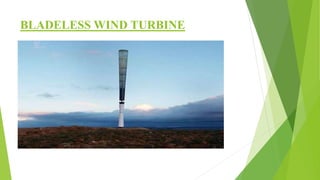
BLADELESS WIND TURBINE
WORKING STEPS
 Selection of the calculation parameters.
 Calculate the force and power generate from vortex.
 Selection of material required.
 Manufacturing of model.
 Testing of model on building of in open place.
 Documentation
List Of Component
 Mild Steel base square frame for structure.
 Mild steel round bar for vertical support.
 Nylon pipe or flexible pipe for vortex support.
 Reinforced Glass fiber thin sheet as a vortex.
 Rack and Pinion assembly.
 Power Generator.
 LED Light.
Advantages
 No gears and bearings, reduces manufacturing and maintenance drastically.
 No lubricants needed, noise less, more environmental friendly.
 It reduces foundation at the bottom by 50%.
 Cost of energy production is 40% less than the conventional turbines
 Birds can fly around them without fear of being sucked in.
 We can put large number vortex bladeless turbine units in an area when compared to
convention wind turbines
Disadvantages
 The efficiency of the energy absorbed from the wind is comparatively less than that of
the conventional wind turbine.
 The requirement of control systems for controlling the oscillation to meet the natural
frequency of the mast and control of the frequency at higher velocity winds. The height
of the mast can be increased based on the output required.
Application
 Industries
 Farms
 Schools
 Houses
 Off-Grid Power for Rail Signaling
 Off-grid Lighting
REFERANCES
[1] Harshith K, Blayan Santhosh Fernandes, Shreerama P R, Thilak Raj “Bladeless wind
power generation”, International Journal for Scientific Research & Development| Vol.
4, Issue 03, 2016
[2] World watch Institute, “Renewables 2005:”Global Status Report” prepared for, the
Renewable Energy Policy Network, Washington DC, 2005.
[3] Williamson C.H. and Govardhan, R., “Vortex-Induced Vibration”, Journal of Fluid
Mech, 36:413- 55.doi:10.1146/annurev.fluid.36.050802.122128, 200
[4] Common concerns about wind power Published May 2011 by the Centre for
Sustainable Energy ISBN 978-0-9568981-1-1
[5] Application of Vortex Induced Vibration Energy Generation Technologies to the
Offshore Oil and Gas Platform, Aerospace, Industrial, Mechatronic Vol:8,No:7
THANK YOU…

Vortex bladless

  • 1.
    “VORTEX BLADELESS WINDTURBINE’’ Nagargoje Vaibhavraj Dhanwat Akshay A Presentation On Guide Prof.S.S. Kawade Mechanical Engineering Department IOK College Of Engineering Pune 412208 [2018-19] By Sathe Shubhangi Nagargoje Suraj
  • 2.
    CONTENTS  Introduction  LiteratureReview  Objectives  Vortex Shedding  Working Steps  Components  Working process  Applications  References
  • 3.
    INTRODUCTION  Wind powerhas become a useful source of energy over the past few decades as larger, more efficient turbine designs have produced ever-increasing amounts of power.  The most common type of wind turbine is the three-bladed upwind Horizontal-axis Wind turbine (HAWT) and Vertical-axis Wind Turbine (VAWT).  In HAWT and VAWT wind power generation, transportation is increasingly challenging because of the size of the components and its larger size can cause the life of birds and it is very costly.  The wide variety of designs reflects ongoing commercial, technological, and inventive interests in harvesting wind resources.  Latest in the series of modification is a technological leap forward and a revolution in wind energy is a more efficient, cost-effective, and environmentally friendly way to produce energy and that is called Bladeless Windmills which works on the Principle of Vortex Shedding.  This Bladeless turbines will generate electricity for 40 percent lesser in cost compared with bladed wind turbines.
  • 4.
    Literature review  SauravBobde,Sameer Jadhav, Study of Vortex Induced Vibrations for Harvesting Energy; IJIRST – International Journal for Innovative Research in Science & Technology| Volume 2 | Issue 11 | April 2016.  Antonio Barrero-Gil, Santiago Pindado, Sergio Avila; Extracting energy from Vortex- Induced Vibrations: A parametric study; Universidad Politecnica de Madrid, Plaza Cardenal Cisneros 3, E-28040 Madrid, Svain.
  • 5.
    OBJECTIVES  To increasethe efficiency of wind power generation.  To produce clean energy to meet the increasing demands.  To make the wind energy economical and efficient.  Development of the project so that it can be used on domestic purposes.  To reduce the manufacturing cost of the turbine.
  • 6.
    Vortex Shedding  Vortexshedding is a widely occurring phenomenon applicable to nearly any bluff (non streamlined) body submerged in a fluid flow.  At some point along the bodies’ surface, separation of the boundary layer will occur, depending on the exact surface geometry.  This separated layer, which bounds the wake and free stream, will tend to cause fluid rotation, since its outer side, in contact with the free stream, moves faster than its inner side, in contact with the wake.  . It is this rotation which then results in the formation of individual vortices, which are then shed from the rear of the body and travel down the wake.  a pattern of periodic, alternating vortex shedding will occur in the flow behind the body, which is referred to as a vortex street.
  • 7.
  • 8.
    WORKING STEPS  Selectionof the calculation parameters.  Calculate the force and power generate from vortex.  Selection of material required.  Manufacturing of model.  Testing of model on building of in open place.  Documentation
  • 9.
    List Of Component Mild Steel base square frame for structure.  Mild steel round bar for vertical support.  Nylon pipe or flexible pipe for vortex support.  Reinforced Glass fiber thin sheet as a vortex.  Rack and Pinion assembly.  Power Generator.  LED Light.
  • 10.
    Advantages  No gearsand bearings, reduces manufacturing and maintenance drastically.  No lubricants needed, noise less, more environmental friendly.  It reduces foundation at the bottom by 50%.  Cost of energy production is 40% less than the conventional turbines  Birds can fly around them without fear of being sucked in.  We can put large number vortex bladeless turbine units in an area when compared to convention wind turbines
  • 11.
    Disadvantages  The efficiencyof the energy absorbed from the wind is comparatively less than that of the conventional wind turbine.  The requirement of control systems for controlling the oscillation to meet the natural frequency of the mast and control of the frequency at higher velocity winds. The height of the mast can be increased based on the output required.
  • 12.
    Application  Industries  Farms Schools  Houses  Off-Grid Power for Rail Signaling  Off-grid Lighting
  • 13.
    REFERANCES [1] Harshith K,Blayan Santhosh Fernandes, Shreerama P R, Thilak Raj “Bladeless wind power generation”, International Journal for Scientific Research & Development| Vol. 4, Issue 03, 2016 [2] World watch Institute, “Renewables 2005:”Global Status Report” prepared for, the Renewable Energy Policy Network, Washington DC, 2005. [3] Williamson C.H. and Govardhan, R., “Vortex-Induced Vibration”, Journal of Fluid Mech, 36:413- 55.doi:10.1146/annurev.fluid.36.050802.122128, 200 [4] Common concerns about wind power Published May 2011 by the Centre for Sustainable Energy ISBN 978-0-9568981-1-1 [5] Application of Vortex Induced Vibration Energy Generation Technologies to the Offshore Oil and Gas Platform, Aerospace, Industrial, Mechatronic Vol:8,No:7
  • 14.