Multi-antenna DVB-H receiver
      Andy Dewilde, IMEC
      MADUF, March 20, 2007
2

 Research focus


Study on impact of a multi-antenna DVB-H receiver
     on reception performance and
     battery power consumption
3

 Outline


 DVB-H system overview


 System modelling for simulation

 Results

 Conclusions
4

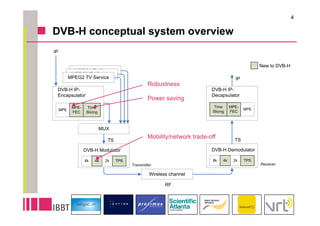
DVB-H conceptual system overview


                Robustness

                Power saving


                Mobility/network trade-off
5

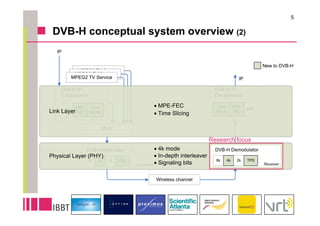
DVB-H conceptual system overview (2)


                             Research focus
6
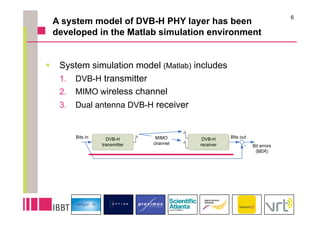
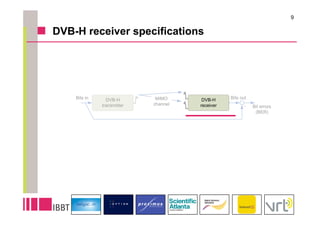
 A system model of DVB-H PHY layer has been
 developed in the Matlab simulation environment


  System simulation model (Matlab) includes
   1.  DVB-H transmitter
   2.  MIMO wireless channel
   3.  Dual antenna DVB-H receiver
7

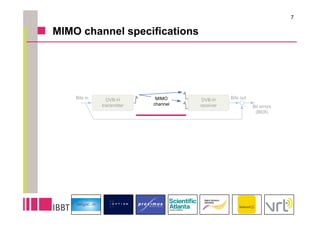
MIMO channel specifications
8

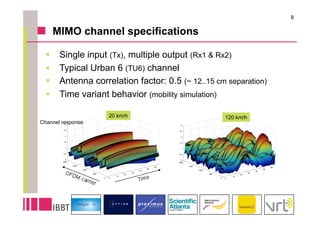
       MIMO channel specifications

       Single input (Tx), multiple output (Rx1 & Rx2)
       Typical Urban 6 (TU6) channel
       Antenna correlation factor: 0.5 (~ 12..15 cm separation)
       Time variant behavior (mobility simulation)

                     20 km/h                        120 km/h
Channel response
9

DVB-H receiver specifications
10

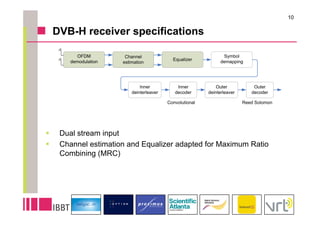
     DVB-H receiver specifications


     Dual stream input
     Channel estimation and Equalizer adapted for Maximum Ratio
      Combining (MRC)
11
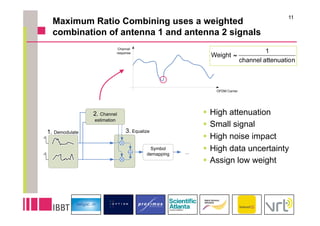
Maximum Ratio Combining uses a weighted
combination of antenna 1 and antenna 2 signals


                                  High attenuation
                                  Small signal
                                  High noise impact
                                  High data uncertainty
                                  Assign low weight
12
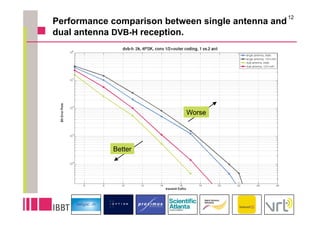
Performance comparison between single antenna and
dual antenna DVB-H reception.


                            Worse


            Better
13
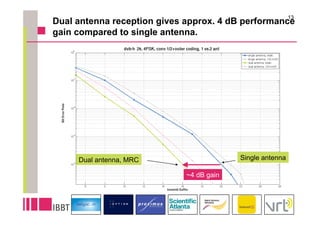
Dual antenna reception gives approx. 4 dB performance
gain compared to single antenna.


     Dual antenna, MRC                    Single antenna

                             ~4 dB gain
14
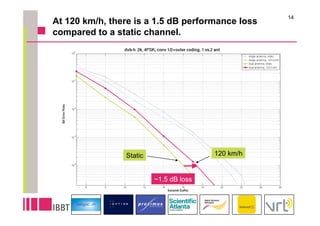
At 120 km/h, there is a 1.5 dB performance loss
compared to a static channel.


                Static                  120 km/h


                         ~1.5 dB loss
15
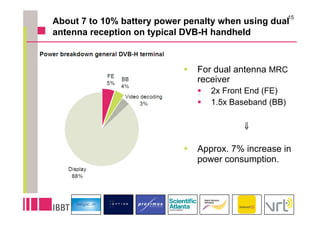
About 7 to 10% battery power penalty when using dual
antenna reception on typical DVB-H handheld


                              For dual antenna MRC
                               receiver
                                 2x Front End (FE)
                                 1.5x Baseband (BB)

                                          ⇓

                              Approx. 7% increase in
                               power consumption.
16

 Conclusions


 Standard compliant DVB-H model has been developed

 Dual antenna DVB-H reception has been simulated

 With a typical channel, approx. 4 dB gain is achieved in
  receiver performance (before MPE-FEC)…

 … and gives an increase of about 7% in battery power
  consumption on general DVB-H handheld.

Maduf04 Multi Antenna Dvb H Receiver Andy De Wilde

  • 1.
    Multi-antenna DVB-H receiver Andy Dewilde, IMEC MADUF, March 20, 2007
  • 2.
    2 Research focus Studyon impact of a multi-antenna DVB-H receiver   on reception performance and   battery power consumption
  • 3.
    3 Outline  DVB-H systemoverview  System modelling for simulation  Results  Conclusions
  • 4.
    4 DVB-H conceptual systemoverview Robustness Power saving Mobility/network trade-off
  • 5.
    5 DVB-H conceptual systemoverview (2) Research focus
  • 6.
    6 A systemmodel of DVB-H PHY layer has been developed in the Matlab simulation environment   System simulation model (Matlab) includes 1.  DVB-H transmitter 2.  MIMO wireless channel 3.  Dual antenna DVB-H receiver
  • 7.
  • 8.
    8 MIMO channel specifications   Single input (Tx), multiple output (Rx1 & Rx2)   Typical Urban 6 (TU6) channel   Antenna correlation factor: 0.5 (~ 12..15 cm separation)   Time variant behavior (mobility simulation) 20 km/h 120 km/h Channel response
  • 9.
  • 10.
    10 DVB-H receiver specifications   Dual stream input   Channel estimation and Equalizer adapted for Maximum Ratio Combining (MRC)
  • 11.
    11 Maximum Ratio Combininguses a weighted combination of antenna 1 and antenna 2 signals  High attenuation  Small signal  High noise impact  High data uncertainty  Assign low weight
  • 12.
    12 Performance comparison betweensingle antenna and dual antenna DVB-H reception. Worse Better
  • 13.
    13 Dual antenna receptiongives approx. 4 dB performance gain compared to single antenna. Dual antenna, MRC Single antenna ~4 dB gain
  • 14.
    14 At 120 km/h,there is a 1.5 dB performance loss compared to a static channel. Static 120 km/h ~1.5 dB loss
  • 15.
    15 About 7 to10% battery power penalty when using dual antenna reception on typical DVB-H handheld   For dual antenna MRC receiver   2x Front End (FE)   1.5x Baseband (BB) ⇓   Approx. 7% increase in power consumption.
  • 16.
    16 Conclusions  Standard compliantDVB-H model has been developed  Dual antenna DVB-H reception has been simulated  With a typical channel, approx. 4 dB gain is achieved in receiver performance (before MPE-FEC)…  … and gives an increase of about 7% in battery power consumption on general DVB-H handheld.