MacroeconomicsMacroeconomics
Chapter3:Chapter3: UnemploymentUnemployment
Arts, Sciences & TechnologyArts, Sciences & Technology
University In LebanonUniversity In Lebanon
Dr. Ramzi ALHALABYDr. Ramzi ALHALABY
SPRING 2014SPRING 2014
THE LABOR FORCETHE LABOR FORCE
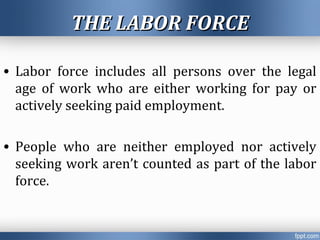
• Labor force includes all persons over the legal
age of work who are either working for pay or
actively seeking paid employment.
• People who are neither employed nor actively
seeking work aren’t counted as part of the labor
force.
THE LABOR FORCETHE LABOR FORCE
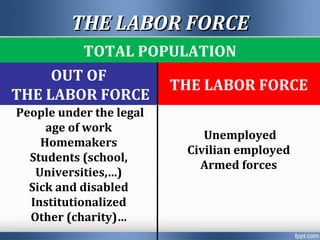
TOTAL POPULATION
OUT OF
THE LABOR FORCE
THE LABOR FORCE
People under the legal
age of work
Homemakers
Students (school,
Universities,…)
Sick and disabled
Institutionalized
Other (charity)…
Unemployed
Civilian employed
Armed forces
LABOR-FORCE PARTICIPATION RATELABOR-FORCE PARTICIPATION RATE
• The labor force expands as the birth rate
and immigration increase.
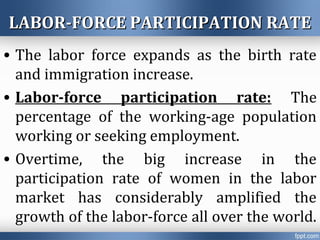
• Labor-force participation rate: The
percentage of the working-age population
working or seeking employment.
• Overtime, the big increase in the
participation rate of women in the labor
market has considerably amplified the
growth of the labor-force all over the world.
UNEMPLOYMENTUNEMPLOYMENT
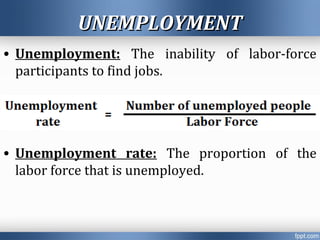
• Unemployment: The inability of labor-force
participants to find jobs.
• Unemployment rate: The proportion of the
labor force that is unemployed.
UNEMPLOYMENT RATEUNEMPLOYMENT RATE
• Unemployment isn’t experienced equally by:
– Age: youth people / high unemployment rate
– Race/ethnicity/religion: minority groups /
high unemployment rate
– Sex: women have generally a higher
unemployment rate than men.
– Education: higher education / low
unemployment rate
OKUN’S LAWOKUN’S LAW
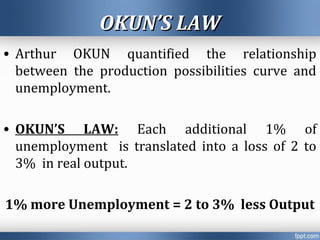
• Arthur OKUN quantified the relationship
between the production possibilities curve and
unemployment.
• OKUN’S LAW: Each additional 1% of
unemployment is translated into a loss of 2 to
3% in real output.
1% more Unemployment = 2 to 3% less Output
PRODUCTION POSSIBILITIESPRODUCTION POSSIBILITIES
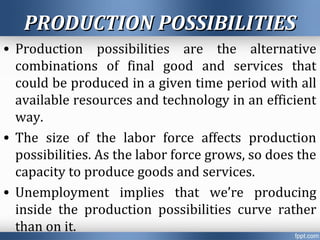
• Production possibilities are the alternative
combinations of final good and services that
could be produced in a given time period with all
available resources and technology in an efficient
way.
• The size of the labor force affects production
possibilities. As the labor force grows, so does the
capacity to produce goods and services.
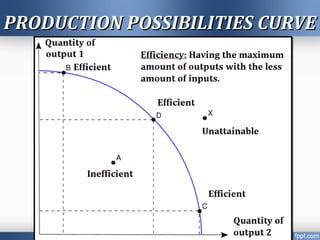
• Unemployment implies that we’re producing
inside the production possibilities curve rather
than on it.
PRODUCTION POSSIBILITIES CURVEPRODUCTION POSSIBILITIES CURVE
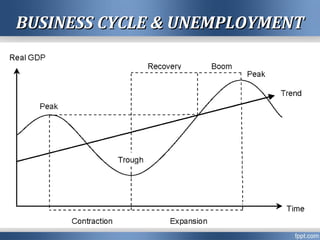
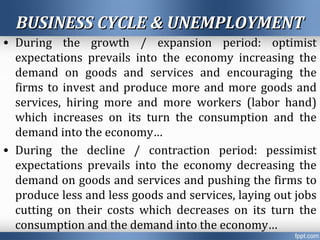
BUSINESS CYCLE & UNEMPLOYMENTBUSINESS CYCLE & UNEMPLOYMENT
• During the growth / expansion period: optimist
expectations prevails into the economy increasing the
demand on goods and services and encouraging the
firms to invest and produce more and more goods and
services, hiring more and more workers (labor hand)
which increases on its turn the consumption and the
demand into the economy…
• During the decline / contraction period: pessimist
expectations prevails into the economy decreasing the
demand on goods and services and pushing the firms to
produce less and less goods and services, laying out jobs
cutting on their costs which decreases on its turn the
consumption and the demand into the economy…
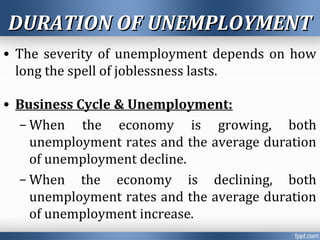
DURATION OF UNEMPLOYMENTDURATION OF UNEMPLOYMENT
• The severity of unemployment depends on how
long the spell of joblessness lasts.
• Business Cycle & Unemployment:
– When the economy is growing, both
unemployment rates and the average duration
of unemployment decline.
– When the economy is declining, both
unemployment rates and the average duration
of unemployment increase.
UNDERUNEMPLOYMENTUNDERUNEMPLOYMENT
• Underunemployment: People seeking full-time
paid employment who work only part-time or are
employed at jobs below their capability.
• Discouraged worker: An individual who isn’t
actively seeking employment but would look for
or accept a job if one were available.
HUMAN COST OF UNEMPLOYMENTHUMAN COST OF UNEMPLOYMENT
• The human cost of unemployment includes not
only financial losses but social, physical and
psychological costs as well.
• Unemployment is distributed unevenly;
minorities, teenagers, and the less educated have
much higher rates of unemployment. Also hurt
are discouraged workers – those who’ve stopped
looking for work at part-time or menial jobs
because they can’t find full-time jobs equal to
their training or potential.
HUMAN COST OF UNEMPLOYMENTHUMAN COST OF UNEMPLOYMENT
Unemployment increases:
• Anxieties
• Nervous disorders
• Reduction of life expectancy
• Suicide rate
• Crime rates
• Premarital births
• Divorces rate
• Child abuse …
FULL EMPLOYMENTFULL EMPLOYMENT
Full employment ≠ Zero unemployment rate
• Several reasons in fact make some degree of
unemployment inevitable and even desirable into
the economy.
• Between these reasons: Seasonal unemployment,
Frictional unemployment, structural
unemployment,…
SEASONAL UNEMPLOYMENTSEASONAL UNEMPLOYMENT
• Seasonal unemployment:Seasonal unemployment: Unemployment due
to seasonal changes in employment or labor
supply.
• E.g.E.g.:: working into a ski station, working into a
summer camp, harvesting agriculture products,
building houses,…
• Unemployment may arise from the supply side
into the labor market. E.g.: Teenage
unemployment rate during the summer / student
jobs,…
FRICTIONAL UNEMPLOYMENTFRICTIONAL UNEMPLOYMENT
• Frictional unemployment: Brief periods of
unemployment experienced by people moving
between jobs or into the labor market.
• The job-search period gives an opportunity to
find out what kind of jobs are available, what
skills they require and what they pay.
Accordingly a brief period of search may benefit
labor market entrants and the larger economy to
find better and most suitable jobs.
FRICTIONAL UNEMPLOYMENTFRICTIONAL UNEMPLOYMENT
3 Factors distinguish frictional unemployment:
1.Enough jobs exist for those who are frictionally
unemployed = There’s adequate demand for
labor.
2.Frictionally unemployed people have the skills
required for available jobs.
3.The period of job search is relatively short.
• Full employment should include at least 2 to 3%
due to frictional unemployment.
STRUCTURAL UNEMPLOYMENTSTRUCTURAL UNEMPLOYMENT
• Structural unemployment:Structural unemployment: unemployment
caused by a mismatch between the skills (or
location) of job seekers and the requirements (or
location) of available jobs.
• E.g.: Having skills in the steel industry while
other skills (computer software, biotechnology,
…) are required.
• Incompatible with any notion of full
employment
STRUCTURAL UNEMPLOYMENTSTRUCTURAL UNEMPLOYMENT
• Structural unemployment:Structural unemployment: unemployment
caused by a mismatch between the skills (or
location) of job seekers and the requirements (or
location) of available jobs.
• E.g.: Having skills in the steel industry while
other skills (computer software, biotechnology,
…) are required.
• Incompatible with any notion of full
employment
NATURAL RATE OF UNEMPLOYMENTNATURAL RATE OF UNEMPLOYMENT
• The natural rate of unemployment (NARU):The natural rate of unemployment (NARU):
the unemployment rate that will naturally
prevails into the economy if it was in a situation
of full employment.
NARU = Structural unemployment + Frictional
Unemployment
CYCLICAL UNEMPLOYMENTCYCLICAL UNEMPLOYMENT
• Cyclical unemployment:Cyclical unemployment: Unemployment
attributable to a lack of job vacancies that is to an
inadequate level of aggregate demand.
• An inadequate level of demand for goods and
services and thus for labor exists into the
economy. The economy must grow at least as
fast as the labor force to avoid cyclical
unemployment (real GDP growth).
• E.g.: Contraction period into the business cycle/
Great depression of 1930.
INFLATIONARY PRESSURESINFLATIONARY PRESSURES
• Rising prices are a signal that employment isRising prices are a signal that employment is
nearing capacity.nearing capacity.
• As the economy approaches its production
possibilities, labor and other resources would
become increasingly scarce => wages and the
prices will start to rise.
• Dilemma between 2 economic goals reducing the
inflation and reducing unemployment.
MINIMUM WAGE / PRICE FLOORMINIMUM WAGE / PRICE FLOOR
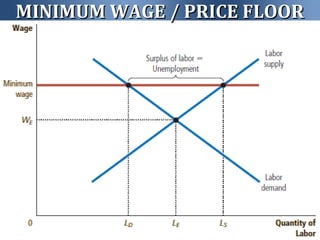
• Unemployment from a Wage above the Equilibrium
Level. In this labor market, the wage at which supply and
demand balance is WE. At this equilibrium wage, the
quantity of labor supplied and the quantity of labor
demanded both equal LE. By contrast, If the wage is
forced to remain above the equilibrium level, perhaps
because of a minimum wage law, the quantity of labor
supplied rises to LS, and the quantity of labor demanded
falls to LD. The resulting surplus of labor, LS – LD,
represents unemployment.
MINIMUM WAGE / PRICE FLOORMINIMUM WAGE / PRICE FLOOR
• One reason for unemployment is the time it takes
workers to search for jobs that best suit their tastes
and skills. This frictional unemployment is increased as
a result of unemployment insurance, a government
policy designed to protect workers’ incomes.
• A second reason our economy always has some
unemployment is minimum-wage laws. By raising the
wage of unskilled and inexperienced workers above the
equilibrium level, minimum wage laws raise the quantity
of labor supplied and reduce the quantity demanded.
The resulting surplus of labor represents
unemployment.
UNEMPLOYMENT MAIN REASONSUNEMPLOYMENT MAIN REASONS
• A third reason for unemployment is the market
power of unions. When unions push the wages in
unionized industries above the equilibrium level, they
create a surplus of labor.
• A fourth reason for unemployment is suggested by
the theory of efficiency wages. According to this
theory, firms find it profitable to pay wages above the
equilibrium level. High wages can improve worker
health, lower worker turnover, raise worker quality, and
increase worker effort.

Macroeconomics chapter 3

  • 1.
    MacroeconomicsMacroeconomics Chapter3:Chapter3: UnemploymentUnemployment Arts, Sciences& TechnologyArts, Sciences & Technology University In LebanonUniversity In Lebanon Dr. Ramzi ALHALABYDr. Ramzi ALHALABY SPRING 2014SPRING 2014
  • 2.
    THE LABOR FORCETHELABOR FORCE • Labor force includes all persons over the legal age of work who are either working for pay or actively seeking paid employment. • People who are neither employed nor actively seeking work aren’t counted as part of the labor force.
  • 3.
    THE LABOR FORCETHELABOR FORCE TOTAL POPULATION OUT OF THE LABOR FORCE THE LABOR FORCE People under the legal age of work Homemakers Students (school, Universities,…) Sick and disabled Institutionalized Other (charity)… Unemployed Civilian employed Armed forces
  • 4.
    LABOR-FORCE PARTICIPATION RATELABOR-FORCEPARTICIPATION RATE • The labor force expands as the birth rate and immigration increase. • Labor-force participation rate: The percentage of the working-age population working or seeking employment. • Overtime, the big increase in the participation rate of women in the labor market has considerably amplified the growth of the labor-force all over the world.
  • 5.
    UNEMPLOYMENTUNEMPLOYMENT • Unemployment: Theinability of labor-force participants to find jobs. • Unemployment rate: The proportion of the labor force that is unemployed.
  • 6.
    UNEMPLOYMENT RATEUNEMPLOYMENT RATE •Unemployment isn’t experienced equally by: – Age: youth people / high unemployment rate – Race/ethnicity/religion: minority groups / high unemployment rate – Sex: women have generally a higher unemployment rate than men. – Education: higher education / low unemployment rate
  • 7.
    OKUN’S LAWOKUN’S LAW •Arthur OKUN quantified the relationship between the production possibilities curve and unemployment. • OKUN’S LAW: Each additional 1% of unemployment is translated into a loss of 2 to 3% in real output. 1% more Unemployment = 2 to 3% less Output
  • 8.
    PRODUCTION POSSIBILITIESPRODUCTION POSSIBILITIES •Production possibilities are the alternative combinations of final good and services that could be produced in a given time period with all available resources and technology in an efficient way. • The size of the labor force affects production possibilities. As the labor force grows, so does the capacity to produce goods and services. • Unemployment implies that we’re producing inside the production possibilities curve rather than on it.
  • 9.
  • 10.
    BUSINESS CYCLE &UNEMPLOYMENTBUSINESS CYCLE & UNEMPLOYMENT
  • 11.
    BUSINESS CYCLE &UNEMPLOYMENTBUSINESS CYCLE & UNEMPLOYMENT • During the growth / expansion period: optimist expectations prevails into the economy increasing the demand on goods and services and encouraging the firms to invest and produce more and more goods and services, hiring more and more workers (labor hand) which increases on its turn the consumption and the demand into the economy… • During the decline / contraction period: pessimist expectations prevails into the economy decreasing the demand on goods and services and pushing the firms to produce less and less goods and services, laying out jobs cutting on their costs which decreases on its turn the consumption and the demand into the economy…
  • 12.
    DURATION OF UNEMPLOYMENTDURATIONOF UNEMPLOYMENT • The severity of unemployment depends on how long the spell of joblessness lasts. • Business Cycle & Unemployment: – When the economy is growing, both unemployment rates and the average duration of unemployment decline. – When the economy is declining, both unemployment rates and the average duration of unemployment increase.
  • 13.
    UNDERUNEMPLOYMENTUNDERUNEMPLOYMENT • Underunemployment: Peopleseeking full-time paid employment who work only part-time or are employed at jobs below their capability. • Discouraged worker: An individual who isn’t actively seeking employment but would look for or accept a job if one were available.
  • 14.
    HUMAN COST OFUNEMPLOYMENTHUMAN COST OF UNEMPLOYMENT • The human cost of unemployment includes not only financial losses but social, physical and psychological costs as well. • Unemployment is distributed unevenly; minorities, teenagers, and the less educated have much higher rates of unemployment. Also hurt are discouraged workers – those who’ve stopped looking for work at part-time or menial jobs because they can’t find full-time jobs equal to their training or potential.
  • 15.
    HUMAN COST OFUNEMPLOYMENTHUMAN COST OF UNEMPLOYMENT Unemployment increases: • Anxieties • Nervous disorders • Reduction of life expectancy • Suicide rate • Crime rates • Premarital births • Divorces rate • Child abuse …
  • 16.
    FULL EMPLOYMENTFULL EMPLOYMENT Fullemployment ≠ Zero unemployment rate • Several reasons in fact make some degree of unemployment inevitable and even desirable into the economy. • Between these reasons: Seasonal unemployment, Frictional unemployment, structural unemployment,…
  • 17.
    SEASONAL UNEMPLOYMENTSEASONAL UNEMPLOYMENT •Seasonal unemployment:Seasonal unemployment: Unemployment due to seasonal changes in employment or labor supply. • E.g.E.g.:: working into a ski station, working into a summer camp, harvesting agriculture products, building houses,… • Unemployment may arise from the supply side into the labor market. E.g.: Teenage unemployment rate during the summer / student jobs,…
  • 18.
    FRICTIONAL UNEMPLOYMENTFRICTIONAL UNEMPLOYMENT •Frictional unemployment: Brief periods of unemployment experienced by people moving between jobs or into the labor market. • The job-search period gives an opportunity to find out what kind of jobs are available, what skills they require and what they pay. Accordingly a brief period of search may benefit labor market entrants and the larger economy to find better and most suitable jobs.
  • 19.
    FRICTIONAL UNEMPLOYMENTFRICTIONAL UNEMPLOYMENT 3Factors distinguish frictional unemployment: 1.Enough jobs exist for those who are frictionally unemployed = There’s adequate demand for labor. 2.Frictionally unemployed people have the skills required for available jobs. 3.The period of job search is relatively short. • Full employment should include at least 2 to 3% due to frictional unemployment.
  • 20.
    STRUCTURAL UNEMPLOYMENTSTRUCTURAL UNEMPLOYMENT •Structural unemployment:Structural unemployment: unemployment caused by a mismatch between the skills (or location) of job seekers and the requirements (or location) of available jobs. • E.g.: Having skills in the steel industry while other skills (computer software, biotechnology, …) are required. • Incompatible with any notion of full employment
  • 21.
    STRUCTURAL UNEMPLOYMENTSTRUCTURAL UNEMPLOYMENT •Structural unemployment:Structural unemployment: unemployment caused by a mismatch between the skills (or location) of job seekers and the requirements (or location) of available jobs. • E.g.: Having skills in the steel industry while other skills (computer software, biotechnology, …) are required. • Incompatible with any notion of full employment
  • 22.
    NATURAL RATE OFUNEMPLOYMENTNATURAL RATE OF UNEMPLOYMENT • The natural rate of unemployment (NARU):The natural rate of unemployment (NARU): the unemployment rate that will naturally prevails into the economy if it was in a situation of full employment. NARU = Structural unemployment + Frictional Unemployment
  • 23.
    CYCLICAL UNEMPLOYMENTCYCLICAL UNEMPLOYMENT •Cyclical unemployment:Cyclical unemployment: Unemployment attributable to a lack of job vacancies that is to an inadequate level of aggregate demand. • An inadequate level of demand for goods and services and thus for labor exists into the economy. The economy must grow at least as fast as the labor force to avoid cyclical unemployment (real GDP growth). • E.g.: Contraction period into the business cycle/ Great depression of 1930.
  • 24.
    INFLATIONARY PRESSURESINFLATIONARY PRESSURES •Rising prices are a signal that employment isRising prices are a signal that employment is nearing capacity.nearing capacity. • As the economy approaches its production possibilities, labor and other resources would become increasingly scarce => wages and the prices will start to rise. • Dilemma between 2 economic goals reducing the inflation and reducing unemployment.
  • 25.
    MINIMUM WAGE /PRICE FLOORMINIMUM WAGE / PRICE FLOOR • Unemployment from a Wage above the Equilibrium Level. In this labor market, the wage at which supply and demand balance is WE. At this equilibrium wage, the quantity of labor supplied and the quantity of labor demanded both equal LE. By contrast, If the wage is forced to remain above the equilibrium level, perhaps because of a minimum wage law, the quantity of labor supplied rises to LS, and the quantity of labor demanded falls to LD. The resulting surplus of labor, LS – LD, represents unemployment.
  • 26.
    MINIMUM WAGE /PRICE FLOORMINIMUM WAGE / PRICE FLOOR
  • 27.
    • One reasonfor unemployment is the time it takes workers to search for jobs that best suit their tastes and skills. This frictional unemployment is increased as a result of unemployment insurance, a government policy designed to protect workers’ incomes. • A second reason our economy always has some unemployment is minimum-wage laws. By raising the wage of unskilled and inexperienced workers above the equilibrium level, minimum wage laws raise the quantity of labor supplied and reduce the quantity demanded. The resulting surplus of labor represents unemployment. UNEMPLOYMENT MAIN REASONSUNEMPLOYMENT MAIN REASONS
  • 28.
    UNEMPLOYMENT MAIN REASONSUNEMPLOYMENTMAIN REASONS • A third reason for unemployment is the market power of unions. When unions push the wages in unionized industries above the equilibrium level, they create a surplus of labor. • A fourth reason for unemployment is suggested by the theory of efficiency wages. According to this theory, firms find it profitable to pay wages above the equilibrium level. High wages can improve worker health, lower worker turnover, raise worker quality, and increase worker effort.

Editor's Notes

  • #4 To understand unemployment, we must distinguish the labor force from the larger population. Only people who are above the legal age of work, working (employed) or spending time looking for a job (unemployed) are participants in the labor force. People neither working nor looking for work are outside labor force.