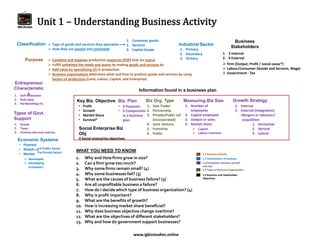
Purpose  Combine and organise productive resources (FOP) that are scarce
 Fulfill unlimited the needs and wants by making goods and services by
 Add value by specializing (2) in production
 Business organisations determine what and how to produce goods and services by using
factors of production (Land, Labour, Capital, and Enterprise)
 Firm (Output, Profit / social cause*)
 Labour/Consumer (Goods and Services, Wage)
 Government - Tax
Industrial Sector
1. Primary
2. Secondary
3. Tertiary
Types of Govt.
Support
1. Grants
2. Taxes
3. Premise discount and etc.
1. Self-motivated
2. Risk-taker
3. Hardworking etc.
Entrepreneur
Characteristic
s
WHAT YOU NEED TO KNOW
1. Why and How firms grow in size?
2. Can a firm grow too much?
3. Why some firms remain small? (4)
4. Why some businesses fail? (3)
5. What are the causes of business failure? (3)
6. Are all unprofitable business a failure?
7. How do I decide which type of business organization? (4)
8. Why is profit important?
9. What are the benefits of growth?
10. How is increasing market share beneficial?
11. Why does business objective change overtime?
12. What are the objectives of different stakeholders?
13. Why and how do government support businesses?
Business
Stakeholders
1. 3 Internal
2. 4 External
Classification  Type of goods and services they specialize
 How they are owned and controlled
1. Consumer goods
2. Services
3. Capital Goods
Economic Systems
• Planned
• Mixed
• Market
Public Sector
Private Sector
 Developed
 Developing
economics
1.1 Business Activity
1.2 Classification of business
1.3 Enterprise, business growth
and size
1.4 Types of Business Organisation
1.5 Business and Stakeholder
Objectives
Key Biz. Objective
• Profit
• Growth
• Market Share
• Survival*
Biz. Plan
• 4 Purposes
• 6 Components
in a business
plan
Measuring Biz Size
1. Number of
employees
2. Capital employed
3. Output or sales
4. Market share
Growth Strategy
1. Internal
2. External (integration)
- Mergers or takeover/
acquisition
1. Horizontal
2. Vertical
3. Lateral
Biz Org. Type
1. Sole Trader
2. Partnership
3. Private/Public Ltd
(incorporated)
4. Joint Venture
5. Franchise
6. Public
Social Enterprise Biz
Obj
4 Social enterprise objectives
 Capital
 Labour Intensive
Information found in a business plan
www.igbizstudies.online
Unit 1 – Understanding Business Activity
Motivating
Workers
 Functions
 Elements WHAT YOU NEED TO KNOW
1. What quality must a good
manager have? (4)
2. Which leadership styles are
best?
3. Why must managers
delegate task?
4. Why/When is reducing
workforce necessary?
5. What is effective
communication and why is
it important?
6. Which communication
methods should you
choose?
7. Why do communication
breakdown occur?
Organizational
Structure
Trade Union
Theories of
Motivation
Methods of
Motivation
Job
Satisfaction
 Wages
 Work hours
 Holidays
 Safe and Clean
environment
 Challenging/Interesti
ng Task
 Teamwork
 Promotion
 Job security
 Responsibility
 Feedback
 Bonus
 Job status
 Social relationship
1. Job Enlargement
2. Job Rotation
3. Job Enrichment
4. Teamworking
1. Hierarchy (Tall/Flat)
2. Chain of command
3. Span of control (narrow/wide)
4. Delegation
 Roles and Responsibilities
Role of Management
 Leadership Styles
 Functions 1. Planning
2. Organization
3. Co-ordination
4. Commanding
5. Controlling
1. Autocratic
2. Democratic
3. Laissez-faire
 Ownership, Delegation, Authority,
Responsibility, Accountability
 Roles & Functions
1. Wages & Fringe benefits, Holidays
2. Rights and Job safety and decision making
3. Better working hours condition, overtime, bonus
4. Skills upgrade, Training and education
5. Industrial action & Legislation lobby
Recruitment
Process
1. Job Vacancy
2. Job Analysis
3. Person Specification
4. Job Advertisement
5. Shortlisting
6. Interview
7. Job offer
8. Contract
Employment
Terms
 Full-time/Part-time
 Benefit employer/employee?
 Dismissal, Misconduct,
Incompetence, Redundancy
 Legal Control - Rights and
discrimination, min wage, age
Training Methods
1. Induction
2. On-TJ
3. Off-TJ
4. In-house
5. External Course
6. Vocation/Profession
al training
Communications
 Internal/External
 Vertical/Horizontal
 Communication source/way
 Methods of Communications
 Communication Barriers
 Stakeholders (Internal/External) – refer Unit 1
 Vertical/Horizontal
 One/two-way
 Formal/informal
 Restricted/Open
 Verbal – Telephone, Meetings, Teleconferencing
 Written – Email, Memo, Newsletter
 Visual – Presentation, Video, Charts
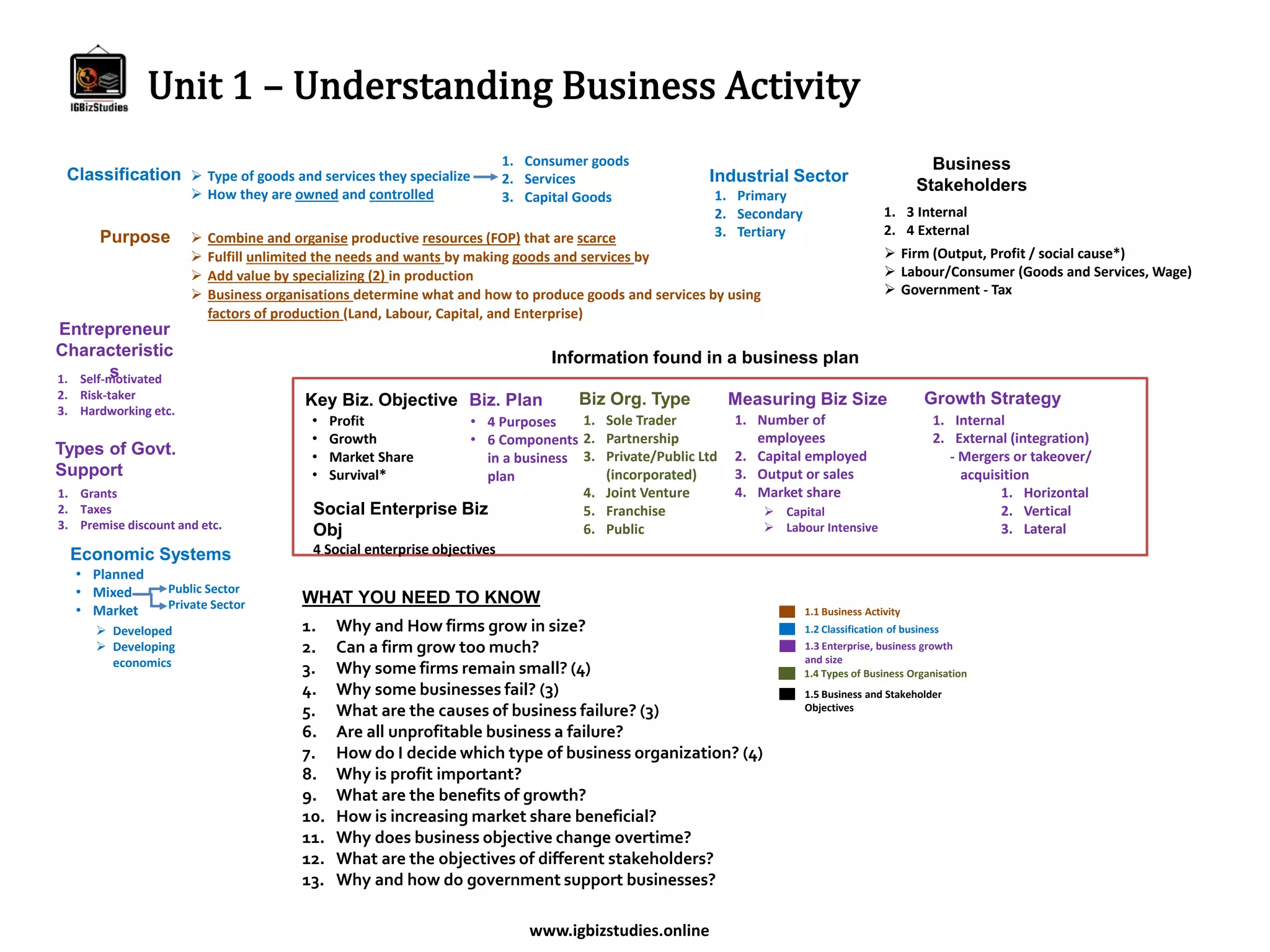
Unit 2 – People in Business
www.igbizstudies.online
2.1 Motivating Workers
2.2 Organization and Management
2.3 Recruitment, selection and
training
2.4 Internal and External Communication
1. Taylor
2. Maslow
3. Herzberg
4. McGregor
1. Financial
2. Non-Financial
 Centralized
 Decentralized
Rightsizing workforce
Redundancy vs Dismissal
Regulations
1. Discrimination
2. Minimum Wage
3. Health & Safety
Functions of
Marketing
Marketing
Objective
Marketing Mix
Market
Changes
Market
Research
Marketing
Strategy
 Identifying consumer needs and wants
 Satisfying consumer needs and wants
 Anticipating changes in customer needs and wants
 Creating and maintaining customer loyalty
 Generating revenues and profits
 Raise awareness of product or organization
 Improve image, design and quality of product/organisztion
 Develop and introduce new product
 Maintain or increase market share, sales and profit
 Access new markets (home or abroad)
 Develop customer loyalty and repeat sales
Niche/Mass
Markets
 Market Trends  Demand side
 Supply sideShort/Long Term
1. Price (price)
2. Income (non-price)
3. Tastes
4. Social attitudes
5. Seasonal
6. Population
7. Advertising
8. Availability of variety
9. Spending patterns
10. Technology
WHAT YOU NEED TO KNOW
1. Why do business compete? (5)
2. What do business compete on? (2)
3. How do firms compete effectively? (8)
4. How accurate can market research be?
5. What pricing strategy shall I use? (6)
6. What distribution strategy shall I use?
7. What are the challenges access markets
abroad?And how to overcome it?
8. What are the examples of legal control
for marketing?
SWOT
 Competition Cause
• Economic Growth
• Rising incomes
• New technology
• Savvy consumers
 Competitive
Environment
• More differentiated product
• High exp in product dev and
marketing
• New firms in market
• More innovation in product
and production
• Freq change in product
features and pric – price war
• Freq change in market share
Market
Segmentation
1. Income
2. Age
3. Lifestyle
4. Location
5. Gender
6. Socio-economic
group
7. Etc…
1. Primary Research
2. Secondary Research
3. Sampling
(Random/Quota)
Target
Market/Population
 Product
 Price
 Place
 Promotion
 Product Lifecycle
 Brand name, image, Loyalty
 Cost-based (1)
 Competition (2)
 Demand-based (5)
 Advertising
• Above (10) /Below-the-line (7)
• Persuasive/Informative
• Technology
 Marketing strategy objectives
 Marketing budget
 PED
 Technology
Legal
Controls
 Competition Factors
1. Customer base
2. Sales revenue
3. Market share
4. Image
5. Profits
Unit 3 – Marketing
3.1 Marketing, competition and the customer
3.2 Market Research
3.3 Marketing Mix
3.4 Marketing Strategy
 Qualitative vs. Quantitative
 Market/Product-Based
1. Face-to-Face
2. Online/Telephone
3. Postal
4. Focus Group
1. Govt. Stats
2. Market Report
 5 Channels of Distribution
1. Sales
2. Market Share
3. Niche Market
4. Status Quo
5. Exit Market
Marketing Plan
www.igbizstudies.online
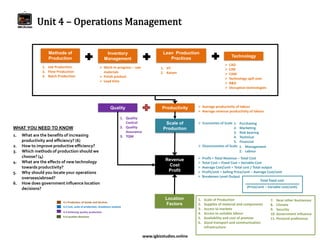
WHAT YOU NEED TO KNOW
1. What are the benefits of increasing
productivity and efficiency? (6)
2. How to improve productive efficiency?
3. Which methods of production should we
choose? (4)
4. What are the effects of new technology
towards productivity?
5. Why should you locate your operations
overseas/abroad?
6. How does government influence location
decisions?
Productivity  Average productivity of labour
 Average revenue productivity of labour
Lean Production
Practices
Inventory
Management
Technology
 Work-in-progress – raw
materials
 Finish product
 Lead time
1. JIT
2. Kaizen
Methods of
Production
1. Job Production
2. Flow Production
3. Batch Production
 CAD
 CIM
 CAM
 Technology spill over
 R&D
 Disruptive technologies
Quality
Revenue
Cost
Profit
 Profit = Total Revenue – Total Cost
 Total Cost = Fixed Cost + Variable Cost
 Average Cost/unit = Total cost / Total output
 Profit/unit = Selling Price/unit – Average Cost/unit
 Breakeven Level Output
Total fixed cost
(Price/unit – Variable cost/unit)
Scale of
Production
 Economies of Scale
 Diseconomies of Scale
1. Purchasing
2. Marketing
3. Risk bearing
4. Technical
5. Financial
1. Management
2. Labour
Location
Factors
1. Scale of Production
2. Supplies of material and components
3. Access to markets
4. Access to suitable labour
5. Availability and cost of premise
6. Good transport and communication
infrastructure
7. Near other businesses
8. Climate
9. Security
10. Government influence
11. Personal preference
Unit 4 – Operations Management
4.1 Production of Goods and Services
4.2 Cost, scale of production, breakeven analysis
4.3 Achieving quality production
4.4 Location decisions
1. Quality
Control
2. Quality
Assurance
3. TQM
www.igbizstudies.online
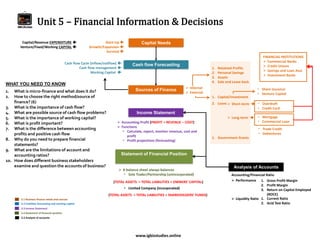
WHAT YOU NEED TO KNOW
1. What is micro-finance and what does it do?
2. How to choose the right method/source of
finance? (6)
3. What is the importance of cash flow?
4. What are possible source of cash flow problems?
5. What is the importance of working capital?
6. What is profit important?
7. What is the difference between accounting
profits and positive cash flow
8. Why do you need to prepare financial
statements?
9. What are the limitations of account and
accounting ratios?
10. How does different business stakeholders
examine and question the accounts of business?
Capital NeedsStart-Up 
Growth/Expansion 
Survival 
Capital/Revenue EXPENDITURE 
Venture/Fixed/Working CAPITAL 
Cash flow ForecastingCash flow Cycle (inflow/outflow) 
Cash flow management 
Working Capital 
Sources of Finance
FINANCIAL INSTITUTIONS
 Commercial Banks
 Credit Unions
 Savings and Loan Assc
 Investment Banks
 Internal
 External
1. Retained Profits
2. Personal Savings
3. Assets
4. Sale and Lease back
1. Capital/Investment
2. Loans
1. Government Grants
• Share issuance
• Venture Capital
 Short-term 
 Long-term 
• Overdraft
• Credit Card
• Mortgage
• Commercial Loan
• Trade Credit
• Debentures
Income Statement
 Accounting Profit (PROFIT = REVENUE – COST)
 Functions
• Calculate, report, monitor revenue, cost and
profit
• Profit projections (forecasting)
Statement of Financial Position
 A balance sheet always balances
• Sole Trader/Partnership (unincorporated)
• Limited Company (incorporated)
(TOTAL ASSETS = TOTAL LIABILITIES + OWNERS’ CAPITAL)
(TOTAL ASSETS = TOTAL LIABILITIES + SHAREHOLDERS’ FUNDS)
Analysis of Accounts
Accounting/Financial Ratio
 Performance
 Liquidity Ratio
1. Gross Profit Margin
2. Profit Margin
3. Return on Capital Employed
(ROCE)
1. Current Ratio
2. Acid Test Ratio
Unit 5 – Financial Information & Decisions
5.1 Business finance needs and sources
5.2 Cashflow forecasting and working capital
5.3 Income Statement
5.4 Statement of financial position
5.5 Analysis of accounts
www.igbizstudies.online
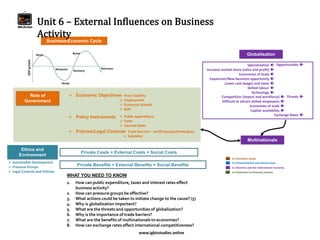
WHAT YOU NEED TO KNOW
1. How can public expenditure, taxes and interest rates effect
business activity?
2. How can pressure groups be effective?
3. What actions could be taken to initiate change to the cause? (5)
4. Why is globalization important?
5. What are the threats and opportunities of globalization?
6. Why is the importance of trade barriers?
7. What are the benefits of multinationals to economies?
8. How can exchange rates effect international competitiveness?
Business/Economic Cycle
Ethics and
Environment
Private Costs + External Costs = Social Costs
Private Benefits + External Benefits = Social Benefits
 Sustainable Development
 Pressure Groups
 Legal Controls and Policies
Globalisation
Opportunities 
Threats 
Exchange Rates 
Specialization 
Increase market share (sales and profit) 
Economies of Scale 
Expansion/New business opportunity 
Lower cost (wage) and taxes 
Skilled labour 
Technology 
Competition (import and workforce) 
Difficult to attract skilled employees 
Economies of scale 
Capital availability 
Role of
Government
 Economic Objectives
 Policy Instruments
 Policies/Legal Controls
 Price Stability
 Employment
 Economic Growth
 BOP
 Public expenditure
 Taxes
 Interest Rates
 Trade barriers – tariffs/quotas/embargoes
 Subsidies
Multinationals
Unit 6 – External Influences on Business
Activity
6.1 Economic Issues
6.2 Environmental and ethical issues
6.3 Business and the international economy
6.4 Statement of financial position
www.igbizstudies.online

O'Levels & IGCSE Business Studies Mind Map

  • 1.
    Purpose  Combineand organise productive resources (FOP) that are scarce  Fulfill unlimited the needs and wants by making goods and services by  Add value by specializing (2) in production  Business organisations determine what and how to produce goods and services by using factors of production (Land, Labour, Capital, and Enterprise)  Firm (Output, Profit / social cause*)  Labour/Consumer (Goods and Services, Wage)  Government - Tax Industrial Sector 1. Primary 2. Secondary 3. Tertiary Types of Govt. Support 1. Grants 2. Taxes 3. Premise discount and etc. 1. Self-motivated 2. Risk-taker 3. Hardworking etc. Entrepreneur Characteristic s WHAT YOU NEED TO KNOW 1. Why and How firms grow in size? 2. Can a firm grow too much? 3. Why some firms remain small? (4) 4. Why some businesses fail? (3) 5. What are the causes of business failure? (3) 6. Are all unprofitable business a failure? 7. How do I decide which type of business organization? (4) 8. Why is profit important? 9. What are the benefits of growth? 10. How is increasing market share beneficial? 11. Why does business objective change overtime? 12. What are the objectives of different stakeholders? 13. Why and how do government support businesses? Business Stakeholders 1. 3 Internal 2. 4 External Classification  Type of goods and services they specialize  How they are owned and controlled 1. Consumer goods 2. Services 3. Capital Goods Economic Systems • Planned • Mixed • Market Public Sector Private Sector  Developed  Developing economics 1.1 Business Activity 1.2 Classification of business 1.3 Enterprise, business growth and size 1.4 Types of Business Organisation 1.5 Business and Stakeholder Objectives Key Biz. Objective • Profit • Growth • Market Share • Survival* Biz. Plan • 4 Purposes • 6 Components in a business plan Measuring Biz Size 1. Number of employees 2. Capital employed 3. Output or sales 4. Market share Growth Strategy 1. Internal 2. External (integration) - Mergers or takeover/ acquisition 1. Horizontal 2. Vertical 3. Lateral Biz Org. Type 1. Sole Trader 2. Partnership 3. Private/Public Ltd (incorporated) 4. Joint Venture 5. Franchise 6. Public Social Enterprise Biz Obj 4 Social enterprise objectives  Capital  Labour Intensive Information found in a business plan www.igbizstudies.online Unit 1 – Understanding Business Activity
  • 2.
    Motivating Workers  Functions  ElementsWHAT YOU NEED TO KNOW 1. What quality must a good manager have? (4) 2. Which leadership styles are best? 3. Why must managers delegate task? 4. Why/When is reducing workforce necessary? 5. What is effective communication and why is it important? 6. Which communication methods should you choose? 7. Why do communication breakdown occur? Organizational Structure Trade Union Theories of Motivation Methods of Motivation Job Satisfaction  Wages  Work hours  Holidays  Safe and Clean environment  Challenging/Interesti ng Task  Teamwork  Promotion  Job security  Responsibility  Feedback  Bonus  Job status  Social relationship 1. Job Enlargement 2. Job Rotation 3. Job Enrichment 4. Teamworking 1. Hierarchy (Tall/Flat) 2. Chain of command 3. Span of control (narrow/wide) 4. Delegation  Roles and Responsibilities Role of Management  Leadership Styles  Functions 1. Planning 2. Organization 3. Co-ordination 4. Commanding 5. Controlling 1. Autocratic 2. Democratic 3. Laissez-faire  Ownership, Delegation, Authority, Responsibility, Accountability  Roles & Functions 1. Wages & Fringe benefits, Holidays 2. Rights and Job safety and decision making 3. Better working hours condition, overtime, bonus 4. Skills upgrade, Training and education 5. Industrial action & Legislation lobby Recruitment Process 1. Job Vacancy 2. Job Analysis 3. Person Specification 4. Job Advertisement 5. Shortlisting 6. Interview 7. Job offer 8. Contract Employment Terms  Full-time/Part-time  Benefit employer/employee?  Dismissal, Misconduct, Incompetence, Redundancy  Legal Control - Rights and discrimination, min wage, age Training Methods 1. Induction 2. On-TJ 3. Off-TJ 4. In-house 5. External Course 6. Vocation/Profession al training Communications  Internal/External  Vertical/Horizontal  Communication source/way  Methods of Communications  Communication Barriers  Stakeholders (Internal/External) – refer Unit 1  Vertical/Horizontal  One/two-way  Formal/informal  Restricted/Open  Verbal – Telephone, Meetings, Teleconferencing  Written – Email, Memo, Newsletter  Visual – Presentation, Video, Charts Unit 2 – People in Business www.igbizstudies.online 2.1 Motivating Workers 2.2 Organization and Management 2.3 Recruitment, selection and training 2.4 Internal and External Communication 1. Taylor 2. Maslow 3. Herzberg 4. McGregor 1. Financial 2. Non-Financial  Centralized  Decentralized Rightsizing workforce Redundancy vs Dismissal Regulations 1. Discrimination 2. Minimum Wage 3. Health & Safety
  • 3.
    Functions of Marketing Marketing Objective Marketing Mix Market Changes Market Research Marketing Strategy Identifying consumer needs and wants  Satisfying consumer needs and wants  Anticipating changes in customer needs and wants  Creating and maintaining customer loyalty  Generating revenues and profits  Raise awareness of product or organization  Improve image, design and quality of product/organisztion  Develop and introduce new product  Maintain or increase market share, sales and profit  Access new markets (home or abroad)  Develop customer loyalty and repeat sales Niche/Mass Markets  Market Trends  Demand side  Supply sideShort/Long Term 1. Price (price) 2. Income (non-price) 3. Tastes 4. Social attitudes 5. Seasonal 6. Population 7. Advertising 8. Availability of variety 9. Spending patterns 10. Technology WHAT YOU NEED TO KNOW 1. Why do business compete? (5) 2. What do business compete on? (2) 3. How do firms compete effectively? (8) 4. How accurate can market research be? 5. What pricing strategy shall I use? (6) 6. What distribution strategy shall I use? 7. What are the challenges access markets abroad?And how to overcome it? 8. What are the examples of legal control for marketing? SWOT  Competition Cause • Economic Growth • Rising incomes • New technology • Savvy consumers  Competitive Environment • More differentiated product • High exp in product dev and marketing • New firms in market • More innovation in product and production • Freq change in product features and pric – price war • Freq change in market share Market Segmentation 1. Income 2. Age 3. Lifestyle 4. Location 5. Gender 6. Socio-economic group 7. Etc… 1. Primary Research 2. Secondary Research 3. Sampling (Random/Quota) Target Market/Population  Product  Price  Place  Promotion  Product Lifecycle  Brand name, image, Loyalty  Cost-based (1)  Competition (2)  Demand-based (5)  Advertising • Above (10) /Below-the-line (7) • Persuasive/Informative • Technology  Marketing strategy objectives  Marketing budget  PED  Technology Legal Controls  Competition Factors 1. Customer base 2. Sales revenue 3. Market share 4. Image 5. Profits Unit 3 – Marketing 3.1 Marketing, competition and the customer 3.2 Market Research 3.3 Marketing Mix 3.4 Marketing Strategy  Qualitative vs. Quantitative  Market/Product-Based 1. Face-to-Face 2. Online/Telephone 3. Postal 4. Focus Group 1. Govt. Stats 2. Market Report  5 Channels of Distribution 1. Sales 2. Market Share 3. Niche Market 4. Status Quo 5. Exit Market Marketing Plan www.igbizstudies.online
  • 4.
    WHAT YOU NEEDTO KNOW 1. What are the benefits of increasing productivity and efficiency? (6) 2. How to improve productive efficiency? 3. Which methods of production should we choose? (4) 4. What are the effects of new technology towards productivity? 5. Why should you locate your operations overseas/abroad? 6. How does government influence location decisions? Productivity  Average productivity of labour  Average revenue productivity of labour Lean Production Practices Inventory Management Technology  Work-in-progress – raw materials  Finish product  Lead time 1. JIT 2. Kaizen Methods of Production 1. Job Production 2. Flow Production 3. Batch Production  CAD  CIM  CAM  Technology spill over  R&D  Disruptive technologies Quality Revenue Cost Profit  Profit = Total Revenue – Total Cost  Total Cost = Fixed Cost + Variable Cost  Average Cost/unit = Total cost / Total output  Profit/unit = Selling Price/unit – Average Cost/unit  Breakeven Level Output Total fixed cost (Price/unit – Variable cost/unit) Scale of Production  Economies of Scale  Diseconomies of Scale 1. Purchasing 2. Marketing 3. Risk bearing 4. Technical 5. Financial 1. Management 2. Labour Location Factors 1. Scale of Production 2. Supplies of material and components 3. Access to markets 4. Access to suitable labour 5. Availability and cost of premise 6. Good transport and communication infrastructure 7. Near other businesses 8. Climate 9. Security 10. Government influence 11. Personal preference Unit 4 – Operations Management 4.1 Production of Goods and Services 4.2 Cost, scale of production, breakeven analysis 4.3 Achieving quality production 4.4 Location decisions 1. Quality Control 2. Quality Assurance 3. TQM www.igbizstudies.online
  • 5.
    WHAT YOU NEEDTO KNOW 1. What is micro-finance and what does it do? 2. How to choose the right method/source of finance? (6) 3. What is the importance of cash flow? 4. What are possible source of cash flow problems? 5. What is the importance of working capital? 6. What is profit important? 7. What is the difference between accounting profits and positive cash flow 8. Why do you need to prepare financial statements? 9. What are the limitations of account and accounting ratios? 10. How does different business stakeholders examine and question the accounts of business? Capital NeedsStart-Up  Growth/Expansion  Survival  Capital/Revenue EXPENDITURE  Venture/Fixed/Working CAPITAL  Cash flow ForecastingCash flow Cycle (inflow/outflow)  Cash flow management  Working Capital  Sources of Finance FINANCIAL INSTITUTIONS  Commercial Banks  Credit Unions  Savings and Loan Assc  Investment Banks  Internal  External 1. Retained Profits 2. Personal Savings 3. Assets 4. Sale and Lease back 1. Capital/Investment 2. Loans 1. Government Grants • Share issuance • Venture Capital  Short-term   Long-term  • Overdraft • Credit Card • Mortgage • Commercial Loan • Trade Credit • Debentures Income Statement  Accounting Profit (PROFIT = REVENUE – COST)  Functions • Calculate, report, monitor revenue, cost and profit • Profit projections (forecasting) Statement of Financial Position  A balance sheet always balances • Sole Trader/Partnership (unincorporated) • Limited Company (incorporated) (TOTAL ASSETS = TOTAL LIABILITIES + OWNERS’ CAPITAL) (TOTAL ASSETS = TOTAL LIABILITIES + SHAREHOLDERS’ FUNDS) Analysis of Accounts Accounting/Financial Ratio  Performance  Liquidity Ratio 1. Gross Profit Margin 2. Profit Margin 3. Return on Capital Employed (ROCE) 1. Current Ratio 2. Acid Test Ratio Unit 5 – Financial Information & Decisions 5.1 Business finance needs and sources 5.2 Cashflow forecasting and working capital 5.3 Income Statement 5.4 Statement of financial position 5.5 Analysis of accounts www.igbizstudies.online
  • 6.
    WHAT YOU NEEDTO KNOW 1. How can public expenditure, taxes and interest rates effect business activity? 2. How can pressure groups be effective? 3. What actions could be taken to initiate change to the cause? (5) 4. Why is globalization important? 5. What are the threats and opportunities of globalization? 6. Why is the importance of trade barriers? 7. What are the benefits of multinationals to economies? 8. How can exchange rates effect international competitiveness? Business/Economic Cycle Ethics and Environment Private Costs + External Costs = Social Costs Private Benefits + External Benefits = Social Benefits  Sustainable Development  Pressure Groups  Legal Controls and Policies Globalisation Opportunities  Threats  Exchange Rates  Specialization  Increase market share (sales and profit)  Economies of Scale  Expansion/New business opportunity  Lower cost (wage) and taxes  Skilled labour  Technology  Competition (import and workforce)  Difficult to attract skilled employees  Economies of scale  Capital availability  Role of Government  Economic Objectives  Policy Instruments  Policies/Legal Controls  Price Stability  Employment  Economic Growth  BOP  Public expenditure  Taxes  Interest Rates  Trade barriers – tariffs/quotas/embargoes  Subsidies Multinationals Unit 6 – External Influences on Business Activity 6.1 Economic Issues 6.2 Environmental and ethical issues 6.3 Business and the international economy 6.4 Statement of financial position www.igbizstudies.online