














Omer Shahzad
MB-12-08

Zeshan Ahmad
MB-12-09

M. Saleem
MB-12-23
Ali Asghar
MB-12-34

Babar Chaudhary
MB-12-54
Omer Shahzad
MB-12-08

M. Saleem
MB-12-23
Ali Asghar
MB-12-34

Babar Chaudhary
MB-12-54
Unemployment
An economic condition marked by the fact that individuals
who were actively looking for jobs within the past four
weeks still remain unhired, unemployment represents one of
the world’s biggest problems. As work plays an important
role in every person’s life, unemployment can cause serious
problems as many individuals would feel socially excluded,
apart from the financial problem.
Who is unemployed?
A person is unemployed if
he or she is on temporary
layoff , is looking for a job
or is waiting for start of new
job.
Employed, Unemployed, Not in the
Labor Force
Employed: A person is considered employed if he or she has spent most
of the previous week working at a paid job.

Unemployed: A person is unemployed if he or she is on temporary
layoff, is looking for a job, or is waiting for the start date of a new job.
Not in the Labor Force: A person who fits neither of these categories,
such as a full-time student, homemaker, or retiree, is not in the labor
force.
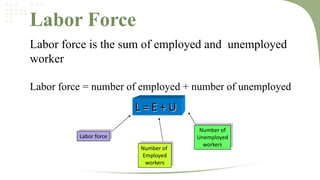
Labor Force
Labor force is the sum of employed and unemployed
worker
Labor force = number of employed + number of unemployed

L=E+U
Labor force
Number of
Employed
workers

Number of
Unemployed
workers
Unemployment Rate
Unemployment rate is the percentage of the labor force that
is unemployed:

Unemployment rate = (number of unemployed / labor force) X 100
Natural rate of unemployment
The economy’s natural rate of unemployment refers to
the amount of unemployment that the economy normally
experiences.
OR

The average rate of unemployment around which the
economy fluctuates.
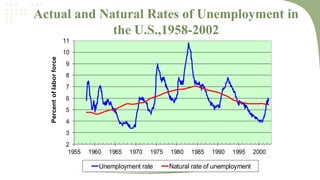
Actual and Natural Rates of Unemployment in
the U.S.,1958-2002
11
Percent of labor force

10
9
8

7
6
5
4
3
2
1955

1960

1965

1970

1975

Unemployment rate

1980

1985

1990

1995

Natural rate of unemployment

2000
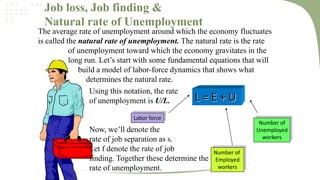
Job loss, Job finding &
Natural rate of Unemployment
The average rate of unemployment around which the economy fluctuates
is called the natural rate of unemployment. The natural rate is the rate
of unemployment toward which the economy gravitates in the
long run. Let’s start with some fundamental equations that will
build a model of labor-force dynamics that shows what
determines the natural rate.
Using this notation, the rate
L=E+U
of unemployment is U/L.
Labor force

Now, we’ll denote the
rate of job separation as s.
Let f denote the rate of job
finding. Together these determine the
rate of unemployment.

Number of
Unemployed
workers
Number of
Employed
workers
Labor Force dynamics
(Model)

Determine the natural
rate of unemployment
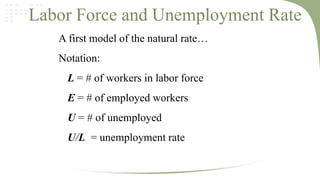
Labor Force and Unemployment Rate
A first model of the natural rate…
Notation:
L = # of workers in labor force
E = # of employed workers
U = # of unemployed
U/L = unemployment rate
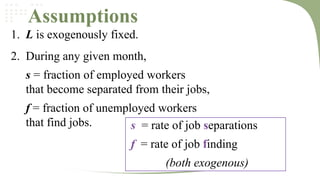
Assumptions
1. L is exogenously fixed.
2. During any given month,
s = fraction of employed workers
that become separated from their jobs,
f = fraction of unemployed workers
that find jobs.
s = rate of job separations

f = rate of job finding
(both exogenous)
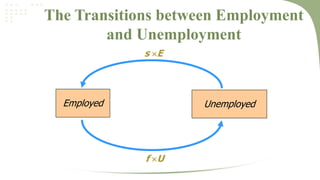
The Transitions between Employment
and Unemployment
s E

Employed

Unemployed

f U
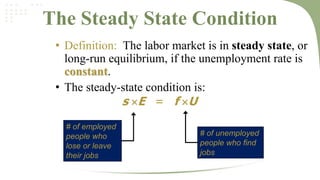
The Steady State Condition
• Definition: The labor market is in steady state, or
long-run equilibrium, if the unemployment rate is
constant.
• The steady-state condition is:
s E = f U
# of employed
people who
lose or leave
their jobs

# of unemployed
people who find
jobs
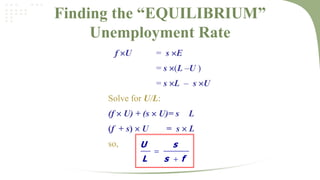
Finding the “EQUILIBRIUM”
Unemployment Rate
f U

= s E
= s (L –U )
= s L – s U

Solve for U/L:
(f  U) + (s  U)= s

(f + s)  U
so,

U
L

L

= sL


s
s f
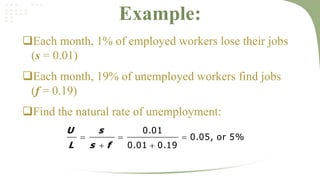
Example:
Each month, 1% of employed workers lose their jobs
(s = 0.01)
Each month, 19% of unemployed workers find jobs
(f = 0.19)

Find the natural rate of unemployment:
U
L



s
s f



0.01
0.01  0.19

 0.05, or 5%
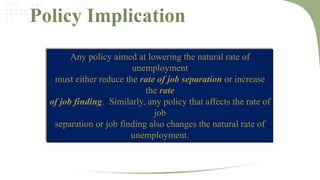
Policy Implication
Any policy aimed at lowering the natural rate of
unemployment
must either reduce the rate of job separation or increase
the rate
of job finding. Similarly, any policy that affects the rate of
job
separation or job finding also changes the natural rate of
unemployment.
Zeshan Ahmad
MB-12-09
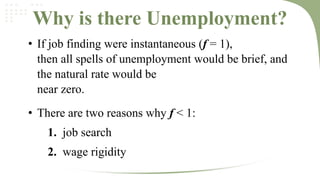
Why is there Unemployment?
• If job finding were instantaneous (f = 1),
then all spells of unemployment would be brief, and
the natural rate would be
near zero.

• There are two reasons why f < 1:
1. job search

2. wage rigidity
Frictional Unemployment
Frictional unemployment is the time period between jobs when a worker
is searching for, or moving from one job to another. It is sometimes
called search unemployment.
Frictional unemployment exists because both jobs and workers
are heterogeneous, workers have different preferences and abilities and job
have different attributes.
Frictional Unemployment occurs when there is a

Shift among Industriesindustrial shift
Shift among sectors sectoral shift
Shifting demand of labor among industries and regions called Sectorial
shift.
Shift among Industries
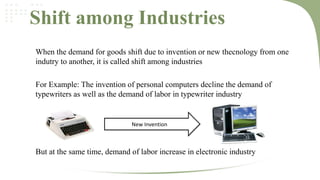
When the demand for goods shift due to invention or new thecnology from one
indutry to another, it is called shift among industries
For Example: The invention of personal computers decline the demand of
typewriters as well as the demand of labor in typewriter industry

New Invention

But at the same time, demand of labor increase in electronic industry
Shift among region
Different regions produce different goods in a country. Sometimes, due
to some economic factors demand of labor increase in one sector of the
country and decrease in another sector of the country, and labor shift
from one region to another region
Some major sectorial shifts occur in the world
Late 1800s: decline of agriculture,
increase in manufacturing
Late 1900s: relative decline of manufacturing, increase in service
sector
1970s: energy crisis caused a shift in demand away from gas guzzlers
toward smaller cars.
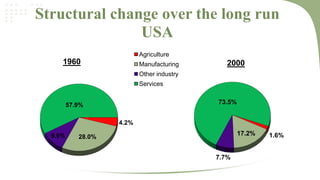
Structural change over the long run
USA
Agriculture

1960

Manufacturing

2000

Other industry
Services

73.5%

57.9%
4.2%
9.9%

17.2%

28.0%

7.7%

1.6%
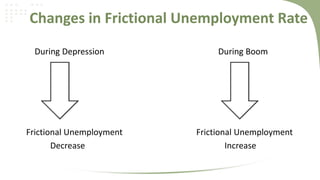
Changes in Frictional Unemployment Rate
During Depression

Frictional Unemployment
Decrease

During Boom

Frictional Unemployment
Increase
Effects of Frictional Unemployment
Frictional Unemployment is not as harmful for the economy as
other kind of unemployment
According to some Economists frictional Unemployment is
actually a benefit for the economy It provide the opportunity for
the companies to find the best qualified workers
Public Policy & Frictional
Unemployment
Govt. polices that decrease the frictional unemployment:
Provide information about jobs vacancies and workers
Retaining programs
Govt. polices that increase the frictional unemployment:
Unemployment insurance
Unemployment Insurance
Unemployment Insurance provide
of his or her
former wage to the unemployed person for
weeks
Unemployment Insurance increase frictional
unemployment because it reduce
It reduce the opportunity cost of being unemployed
The urgency of finding work
Rate of job finding
Case Study
A study conducted during
for checking the effects of
unemployment insurance
Unemployed workers divied into two group. One group offered
$
Bouns if they find the new job in weeks
The result shows that Average unemployment period for
controlled group was
weeks as compared to the
weeks for other group. It means that bouns decrease the
average period of unemployment by 7%.
Study shows that incentive provided by unemployment
insurance effects the rate of job finding.
Benefits of Unemployment Insurance

By allowing workers more time to search, UI
may lead to better matches between
jobs and workers, which would lead to greater
productivity and higher incomes.
Unemployment Insurance Benefits
Provided in developed countries
Eligibility excludes new entrants to the labor force
and those giving up job voluntarily
Raises aggregate demand and contributes toward
early recovery of an economy from recession
Omer Shahzad
MB-12-08

M. Saleem
MB-12-23
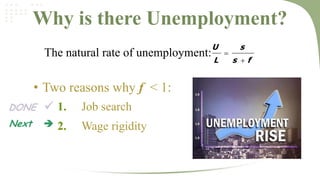
Why is there Unemployment?
The natural rate of unemployment:

• Two reasons why f < 1:
DONE

 1.

Job search

Next



Wage rigidity

2.

U
L



s
s f
Real Wage Rigidity
 Wage rigidity is the failure of wages to adjust to a
level at which labor supply equals labor demand.
 Real wages bring equilibrium among labor supply
and labor demand while wages are kept flexible.
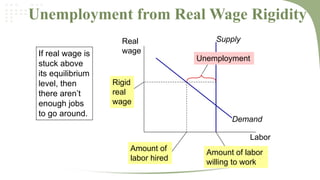
Unemployment from Real Wage Rigidity
If real wage is
stuck above
its equilibrium
level, then
there aren’t
enough jobs
to go around.

Real
wage

Supply

Unemployment
Rigid
real
wage
Demand
Labor
Amount of
labor hired

Amount of labor
willing to work
Unemployment from Real Wage Rigidity
If real wage is
stuck above
its equilibrium
level, then
there aren’t
enough jobs
to go around.

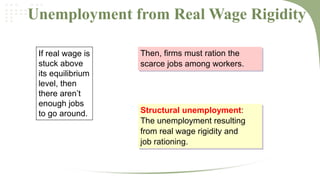
Then, firms must ration the
scarce jobs among workers.

Structural unemployment:
The unemployment resulting
from real wage rigidity and
job rationing.
Reasons for Wage Rigidity
1. Minimum wage laws

2. Labor unions
3. Efficiency wages
The Minimum Wage Law
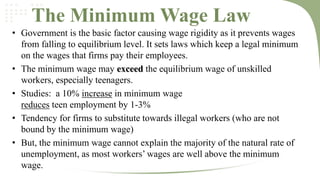
• Government is the basic factor causing wage rigidity as it prevents wages
from falling to equilibrium level. It sets laws which keep a legal minimum
on the wages that firms pay their employees.
• The minimum wage may exceed the equilibrium wage of unskilled
workers, especially teenagers.
• Studies: a 10% increase in minimum wage
reduces teen employment by 1-3%
• Tendency for firms to substitute towards illegal workers (who are not
bound by the minimum wage)
• But, the minimum wage cannot explain the majority of the natural rate of
unemployment, as most workers’ wages are well above the minimum
wage.
The Minimum Wage Law
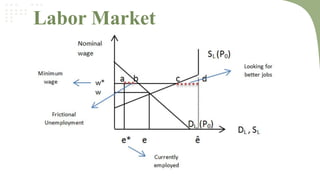
It is enacted in almost every country so that forces
cannot drive it down too low.
When wages are pushed up to the level of
w*, unemployment to the extent bc is created, since
supply exceeds demand.
In addition, there is also unemployment to the extent of
cd, which is due to people looking for better jobs
Labor Market
Omer Shahzad
MB-12-08

M. Saleem
MB-12-23
Ali Asghar
MB-12-34
Reasons for Wage Rigidity
DONE

 1. Minimum wage laws

Next



2. Labor unions
Labor Unions
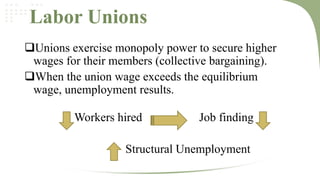
Unions exercise monopoly power to secure higher
wages for their members (collective bargaining).
When the union wage exceeds the equilibrium
wage, unemployment results.
Workers hired

Job finding

Structural Unemployment
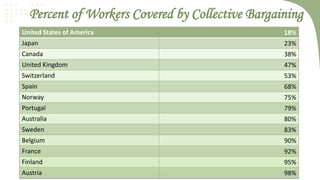
Percent of Workers Covered by Collective Bargaining
United States of America

18%

Japan

23%

Canada

38%

United Kingdom

47%

Switzerland

53%

Spain

68%

Norway

75%

Portugal

79%

Australia

80%

Sweden

83%

Belgium

90%

France

92%

Finland

95%

Austria

98%
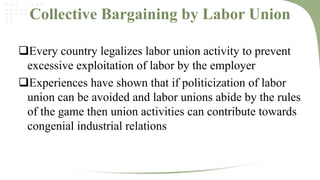
Collective Bargaining by Labor Union
Every country legalizes labor union activity to prevent
excessive exploitation of labor by the employer
Experiences have shown that if politicization of labor
union can be avoided and labor unions abide by the rules
of the game then union activities can contribute towards
congenial industrial relations
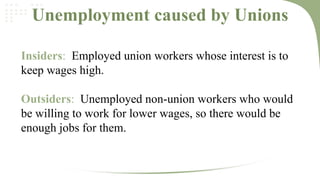
Unemployment caused by Unions
Insiders: Employed union workers whose interest is to
keep wages high.
Outsiders: Unemployed non-union workers who would
be willing to work for lower wages, so there would be
enough jobs for them.
Methods of Resolving Conflicts
Reasons for Wage Rigidity
DONE

 1. Minimum wage laws

DONE

 2. Labor unions

Next



3. Efficiency wages
Efficiency Wage Theory
High wages make workers
more productive
Views of Efficiency wage theory
• Economists have proposed various
theories to explain how wages affect workers
productivity:
Theories of Efficiency Wage
 Wages influence nutrition
 High wages reduces labor turnover
 Low wages allow best employees to take job
elsewhere
 High wage improves worker effort
These theories share a common theme:
A firm operates more efficiently if it pays its workers
a high wage,the firm may find it profitable to keep
wages above the level that balances supply and
demand.
The result of this higher-than-equilibrium wage is a
lower rate of job finding and greater unemployment
Omer Shahzad
MB-12-08

M. Saleem
MB-12-23
Ali Asghar
MB-12-34

Babar Chaudhary
MB-12-54
Labor Market experience in Europe
Unemployment rate in European countries has risen
substantially e.g.
For France & Germany employment rate was 2% in 1960 and recent
rate is more than 10%.

What is the cause of rising unemployment in
Europe….???
The problem can b traced by the interaction b/w long standing
policy e.g. generous benefits for unemployed workers and a more
recent shock e.g. technologically driven fall in the demand of
unskilled workers.
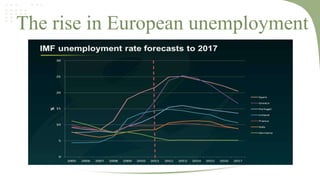
The rise in European unemployment
Reasons for unemployment
1. Long-term generous programs, For
example, Social Insurance Welfare State
2. Rising demand for skilled workers
3. Labour unions
4. Demand for high wages
REMEDIES
1.Reduce benefit for unemployed
2.Acceptance of low wage jobs
3.Get off the Dole.
EUROPEAN MARKET UNEMPLOYMENT
VARIATIONS(OVERVIEW)
Europe is not a single market.it is sum of different markets
having difference in
 Culture
 Language
 Traditions
 Policies & Institutions
These variations provide a useful perspective on the cause
of unemployment.(focus is on international difference)
Facts and Differences…
 Unemployment rate varies from country to country e.g.
o In 2008 when U.E rate in U.S was 6.5% then at the same
time it was 2.4% in Switzerland and 11.3% in Spain.
 U.E rate has two types
o Unemployed for less then a year
o Unemployed for more then a year
Facts and differences(continued)
 Long-term U.E rate shows more variability's
from country to county then short-term
 Policies e.g. U.E is higher in the nation with
more generous U.E insurance etc.
 Role of unions varies from country to country
Remedies:
 The combination of generous payments to the
unemployment with assistance at helping them
find new jobs.
 The role of unions should be revised.
The rise of European Leisure.
 People in Europe work fewer hours then in U.S.A’s.
 Typical Americans work many more hours then the
typical residents of western European countries.
 Europeans retire in early age.
• Difference in work hours reflects two facts:
o U.S.A’s do more work per year. Europeans enjoys more
holydays.
o More potential workers employed in USA.
Continued…
o Role of union in Europe is more stronger in Europe
and it pushes towards shorter working hours.
o Preferences: (the main difference)
 Europeans increase productivity to increase leisure
 Americans increase productivity to increase
money. They decrease leisure to increase money.
 Simply, Europeans have more taste for leisure.
Conclusion…
 Unemployment represents wasted resources.
 unemployed workers are wasting themselves.
 People should accept low wage job rather then unemployment
 Zero unemployment is not possible at all.
 U.E insurance, the dole, minimum wage law and other programs
that support U.E should be revised again.
 Govt. should provide assistance and proper training in finding the
job.
 The policies of labour market have strong effect on the rate of
unemployment these should be choose wisely.
Macro economics

Macro economics

  • 3.
    Omer Shahzad MB-12-08 Zeshan Ahmad MB-12-09 M.Saleem MB-12-23 Ali Asghar MB-12-34 Babar Chaudhary MB-12-54
  • 4.
    Omer Shahzad MB-12-08 M. Saleem MB-12-23 AliAsghar MB-12-34 Babar Chaudhary MB-12-54
  • 5.
    Unemployment An economic conditionmarked by the fact that individuals who were actively looking for jobs within the past four weeks still remain unhired, unemployment represents one of the world’s biggest problems. As work plays an important role in every person’s life, unemployment can cause serious problems as many individuals would feel socially excluded, apart from the financial problem.
  • 6.
    Who is unemployed? Aperson is unemployed if he or she is on temporary layoff , is looking for a job or is waiting for start of new job.
  • 7.
    Employed, Unemployed, Notin the Labor Force Employed: A person is considered employed if he or she has spent most of the previous week working at a paid job. Unemployed: A person is unemployed if he or she is on temporary layoff, is looking for a job, or is waiting for the start date of a new job. Not in the Labor Force: A person who fits neither of these categories, such as a full-time student, homemaker, or retiree, is not in the labor force.
  • 8.
    Labor Force Labor forceis the sum of employed and unemployed worker Labor force = number of employed + number of unemployed L=E+U Labor force Number of Employed workers Number of Unemployed workers
  • 9.
    Unemployment Rate Unemployment rateis the percentage of the labor force that is unemployed: Unemployment rate = (number of unemployed / labor force) X 100
  • 10.
    Natural rate ofunemployment The economy’s natural rate of unemployment refers to the amount of unemployment that the economy normally experiences. OR The average rate of unemployment around which the economy fluctuates.
  • 11.
    Actual and NaturalRates of Unemployment in the U.S.,1958-2002 11 Percent of labor force 10 9 8 7 6 5 4 3 2 1955 1960 1965 1970 1975 Unemployment rate 1980 1985 1990 1995 Natural rate of unemployment 2000
  • 12.
    Job loss, Jobfinding & Natural rate of Unemployment The average rate of unemployment around which the economy fluctuates is called the natural rate of unemployment. The natural rate is the rate of unemployment toward which the economy gravitates in the long run. Let’s start with some fundamental equations that will build a model of labor-force dynamics that shows what determines the natural rate. Using this notation, the rate L=E+U of unemployment is U/L. Labor force Now, we’ll denote the rate of job separation as s. Let f denote the rate of job finding. Together these determine the rate of unemployment. Number of Unemployed workers Number of Employed workers
  • 13.
    Labor Force dynamics (Model) Determinethe natural rate of unemployment
  • 14.
    Labor Force andUnemployment Rate A first model of the natural rate… Notation: L = # of workers in labor force E = # of employed workers U = # of unemployed U/L = unemployment rate
  • 15.
    Assumptions 1. L isexogenously fixed. 2. During any given month, s = fraction of employed workers that become separated from their jobs, f = fraction of unemployed workers that find jobs. s = rate of job separations f = rate of job finding (both exogenous)
  • 16.
    The Transitions betweenEmployment and Unemployment s E Employed Unemployed f U
  • 17.
    The Steady StateCondition • Definition: The labor market is in steady state, or long-run equilibrium, if the unemployment rate is constant. • The steady-state condition is: s E = f U # of employed people who lose or leave their jobs # of unemployed people who find jobs
  • 18.
    Finding the “EQUILIBRIUM” UnemploymentRate f U = s E = s (L –U ) = s L – s U Solve for U/L: (f  U) + (s  U)= s (f + s)  U so, U L L = sL  s s f
  • 19.
    Example: Each month, 1%of employed workers lose their jobs (s = 0.01) Each month, 19% of unemployed workers find jobs (f = 0.19) Find the natural rate of unemployment: U L  s s f  0.01 0.01  0.19  0.05, or 5%
  • 20.
    Policy Implication Any policyaimed at lowering the natural rate of unemployment must either reduce the rate of job separation or increase the rate of job finding. Similarly, any policy that affects the rate of job separation or job finding also changes the natural rate of unemployment.
  • 21.
  • 22.
    Why is thereUnemployment? • If job finding were instantaneous (f = 1), then all spells of unemployment would be brief, and the natural rate would be near zero. • There are two reasons why f < 1: 1. job search 2. wage rigidity
  • 23.
    Frictional Unemployment Frictional unemploymentis the time period between jobs when a worker is searching for, or moving from one job to another. It is sometimes called search unemployment. Frictional unemployment exists because both jobs and workers are heterogeneous, workers have different preferences and abilities and job have different attributes. Frictional Unemployment occurs when there is a Shift among Industriesindustrial shift Shift among sectors sectoral shift Shifting demand of labor among industries and regions called Sectorial shift.
  • 24.
    Shift among Industries Whenthe demand for goods shift due to invention or new thecnology from one indutry to another, it is called shift among industries For Example: The invention of personal computers decline the demand of typewriters as well as the demand of labor in typewriter industry New Invention But at the same time, demand of labor increase in electronic industry
  • 25.
    Shift among region Differentregions produce different goods in a country. Sometimes, due to some economic factors demand of labor increase in one sector of the country and decrease in another sector of the country, and labor shift from one region to another region Some major sectorial shifts occur in the world Late 1800s: decline of agriculture, increase in manufacturing Late 1900s: relative decline of manufacturing, increase in service sector 1970s: energy crisis caused a shift in demand away from gas guzzlers toward smaller cars.
  • 26.
    Structural change overthe long run USA Agriculture 1960 Manufacturing 2000 Other industry Services 73.5% 57.9% 4.2% 9.9% 17.2% 28.0% 7.7% 1.6%
  • 27.
    Changes in FrictionalUnemployment Rate During Depression Frictional Unemployment Decrease During Boom Frictional Unemployment Increase
  • 28.
    Effects of FrictionalUnemployment Frictional Unemployment is not as harmful for the economy as other kind of unemployment According to some Economists frictional Unemployment is actually a benefit for the economy It provide the opportunity for the companies to find the best qualified workers
  • 29.
    Public Policy &Frictional Unemployment Govt. polices that decrease the frictional unemployment: Provide information about jobs vacancies and workers Retaining programs Govt. polices that increase the frictional unemployment: Unemployment insurance
  • 30.
    Unemployment Insurance Unemployment Insuranceprovide of his or her former wage to the unemployed person for weeks Unemployment Insurance increase frictional unemployment because it reduce It reduce the opportunity cost of being unemployed The urgency of finding work Rate of job finding
  • 31.
    Case Study A studyconducted during for checking the effects of unemployment insurance Unemployed workers divied into two group. One group offered $ Bouns if they find the new job in weeks The result shows that Average unemployment period for controlled group was weeks as compared to the weeks for other group. It means that bouns decrease the average period of unemployment by 7%. Study shows that incentive provided by unemployment insurance effects the rate of job finding.
  • 32.
    Benefits of UnemploymentInsurance By allowing workers more time to search, UI may lead to better matches between jobs and workers, which would lead to greater productivity and higher incomes.
  • 33.
    Unemployment Insurance Benefits Providedin developed countries Eligibility excludes new entrants to the labor force and those giving up job voluntarily Raises aggregate demand and contributes toward early recovery of an economy from recession
  • 34.
  • 35.
    Why is thereUnemployment? The natural rate of unemployment: • Two reasons why f < 1: DONE  1. Job search Next  Wage rigidity 2. U L  s s f
  • 36.
    Real Wage Rigidity Wage rigidity is the failure of wages to adjust to a level at which labor supply equals labor demand.  Real wages bring equilibrium among labor supply and labor demand while wages are kept flexible.
  • 37.
    Unemployment from RealWage Rigidity If real wage is stuck above its equilibrium level, then there aren’t enough jobs to go around. Real wage Supply Unemployment Rigid real wage Demand Labor Amount of labor hired Amount of labor willing to work
  • 38.
    Unemployment from RealWage Rigidity If real wage is stuck above its equilibrium level, then there aren’t enough jobs to go around. Then, firms must ration the scarce jobs among workers. Structural unemployment: The unemployment resulting from real wage rigidity and job rationing.
  • 39.
    Reasons for WageRigidity 1. Minimum wage laws 2. Labor unions 3. Efficiency wages
  • 40.
    The Minimum WageLaw • Government is the basic factor causing wage rigidity as it prevents wages from falling to equilibrium level. It sets laws which keep a legal minimum on the wages that firms pay their employees. • The minimum wage may exceed the equilibrium wage of unskilled workers, especially teenagers. • Studies: a 10% increase in minimum wage reduces teen employment by 1-3% • Tendency for firms to substitute towards illegal workers (who are not bound by the minimum wage) • But, the minimum wage cannot explain the majority of the natural rate of unemployment, as most workers’ wages are well above the minimum wage.
  • 41.
    The Minimum WageLaw It is enacted in almost every country so that forces cannot drive it down too low. When wages are pushed up to the level of w*, unemployment to the extent bc is created, since supply exceeds demand. In addition, there is also unemployment to the extent of cd, which is due to people looking for better jobs
  • 42.
  • 43.
  • 44.
    Reasons for WageRigidity DONE  1. Minimum wage laws Next  2. Labor unions
  • 45.
    Labor Unions Unions exercisemonopoly power to secure higher wages for their members (collective bargaining). When the union wage exceeds the equilibrium wage, unemployment results. Workers hired Job finding Structural Unemployment
  • 46.
    Percent of WorkersCovered by Collective Bargaining United States of America 18% Japan 23% Canada 38% United Kingdom 47% Switzerland 53% Spain 68% Norway 75% Portugal 79% Australia 80% Sweden 83% Belgium 90% France 92% Finland 95% Austria 98%
  • 47.
    Collective Bargaining byLabor Union Every country legalizes labor union activity to prevent excessive exploitation of labor by the employer Experiences have shown that if politicization of labor union can be avoided and labor unions abide by the rules of the game then union activities can contribute towards congenial industrial relations
  • 48.
    Unemployment caused byUnions Insiders: Employed union workers whose interest is to keep wages high. Outsiders: Unemployed non-union workers who would be willing to work for lower wages, so there would be enough jobs for them.
  • 49.
  • 50.
    Reasons for WageRigidity DONE  1. Minimum wage laws DONE  2. Labor unions Next  3. Efficiency wages
  • 51.
    Efficiency Wage Theory Highwages make workers more productive
  • 52.
    Views of Efficiencywage theory • Economists have proposed various theories to explain how wages affect workers productivity:
  • 53.
    Theories of EfficiencyWage  Wages influence nutrition  High wages reduces labor turnover  Low wages allow best employees to take job elsewhere  High wage improves worker effort
  • 54.
    These theories sharea common theme: A firm operates more efficiently if it pays its workers a high wage,the firm may find it profitable to keep wages above the level that balances supply and demand. The result of this higher-than-equilibrium wage is a lower rate of job finding and greater unemployment
  • 55.
    Omer Shahzad MB-12-08 M. Saleem MB-12-23 AliAsghar MB-12-34 Babar Chaudhary MB-12-54
  • 56.
  • 57.
    Labor Market experiencein Europe Unemployment rate in European countries has risen substantially e.g. For France & Germany employment rate was 2% in 1960 and recent rate is more than 10%. What is the cause of rising unemployment in Europe….??? The problem can b traced by the interaction b/w long standing policy e.g. generous benefits for unemployed workers and a more recent shock e.g. technologically driven fall in the demand of unskilled workers.
  • 58.
    The rise inEuropean unemployment
  • 59.
    Reasons for unemployment 1.Long-term generous programs, For example, Social Insurance Welfare State 2. Rising demand for skilled workers 3. Labour unions 4. Demand for high wages
  • 60.
    REMEDIES 1.Reduce benefit forunemployed 2.Acceptance of low wage jobs 3.Get off the Dole.
  • 61.
    EUROPEAN MARKET UNEMPLOYMENT VARIATIONS(OVERVIEW) Europeis not a single market.it is sum of different markets having difference in  Culture  Language  Traditions  Policies & Institutions These variations provide a useful perspective on the cause of unemployment.(focus is on international difference)
  • 62.
    Facts and Differences… Unemployment rate varies from country to country e.g. o In 2008 when U.E rate in U.S was 6.5% then at the same time it was 2.4% in Switzerland and 11.3% in Spain.  U.E rate has two types o Unemployed for less then a year o Unemployed for more then a year
  • 63.
    Facts and differences(continued) Long-term U.E rate shows more variability's from country to county then short-term  Policies e.g. U.E is higher in the nation with more generous U.E insurance etc.  Role of unions varies from country to country
  • 64.
    Remedies:  The combinationof generous payments to the unemployment with assistance at helping them find new jobs.  The role of unions should be revised.
  • 65.
    The rise ofEuropean Leisure.  People in Europe work fewer hours then in U.S.A’s.  Typical Americans work many more hours then the typical residents of western European countries.  Europeans retire in early age. • Difference in work hours reflects two facts: o U.S.A’s do more work per year. Europeans enjoys more holydays. o More potential workers employed in USA.
  • 66.
    Continued… o Role ofunion in Europe is more stronger in Europe and it pushes towards shorter working hours. o Preferences: (the main difference)  Europeans increase productivity to increase leisure  Americans increase productivity to increase money. They decrease leisure to increase money.  Simply, Europeans have more taste for leisure.
  • 67.
    Conclusion…  Unemployment representswasted resources.  unemployed workers are wasting themselves.  People should accept low wage job rather then unemployment  Zero unemployment is not possible at all.  U.E insurance, the dole, minimum wage law and other programs that support U.E should be revised again.  Govt. should provide assistance and proper training in finding the job.  The policies of labour market have strong effect on the rate of unemployment these should be choose wisely.

Editor's Notes

  • #43 When price is fixed, both DL and SL depend on the nominal wage. Increase in nominal wage with price fixed will provide incentive for increased supply of labor. This is why DL is downward sloping while SL is upward sloping. If market is allowed to operate freely, nominal wage will be determined at w and employment at e. At this stage everyone who wants to work at the going wage w is employed. Thus, there is no unemployment. However in a broader sense there is unemployment to the extent of ê as these people are looking for a better pay.