Unemployment Chapter 6
The Labor Force The  labor-force participation rate  is the percentage of the population working or seeking employment.
The Labor Force The  labor force  includes all persons over age sixteen who are either working for pay or actively seeking paid employment. People who are not employed or are not actively seeking work are not considered part of the labor force.
The Labor Force The  labor-force participation rate  is the percentage of the population working or seeking employment.
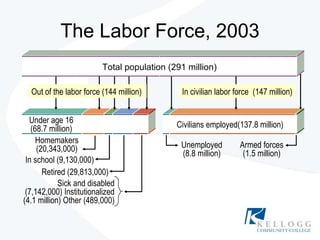
The Labor Force, 2003 Sick and disabled (7,142,000) Institutionalized (4.1 million) Other (489,000) In school (9,130,000) Retired (29,813,000) Unemployed(8.8 million) Civilians employed(137.8 million) Armed forces (1.5 million) Out of the labor force (144 million)  In civilian labor force  (147 million) Under age 16 (68.7 million) Total population (291 million) Homemakers (20,343,000)
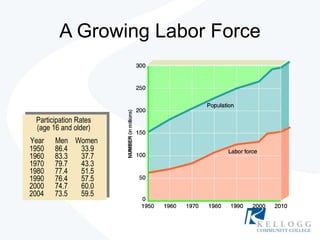
A Growing Labor Force Participation Rates (age 16 and older) Men Women 86.4 83.3 79.7 77.4 76.4 74.7 Year 1950 1960 1970 1980 1990 2000 33.9 37.7 43.3 51.5 57.5 60.0 73.5 2004 59.5
Growth of Production Possibilities Production is limited by two factors: The availability of factors of production. Technological know-how.
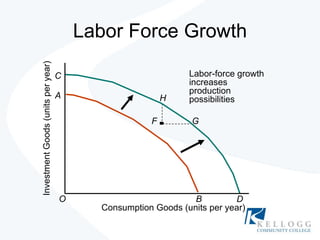
Production Possibilities A growing labor force creates long-run economic growth. Economic growth  is an increase in output (real GDP); an expansion of production possibilities.
Institutional Constraints Production possibilities in any year depend on available resources and technology and on how we choose to restrict their use. The size of labor force is limited by participation rates and social regulation.
Labor Force Growth C D Labor-force growth increases production possibilities H G F Consumption Goods (units per year) B A Investment Goods (units per year)  O
Unemployment To make full use of available production capacity, the labor force must be fully employed. Unemployment   is the inability of labor-force participants to find jobs. See “In the News” How Unemployment Affects the Family, pg. 114.
Okun’s Law Okun’s Law  asserts that 1% more unemployment is estimated to equal 2 percent less output.
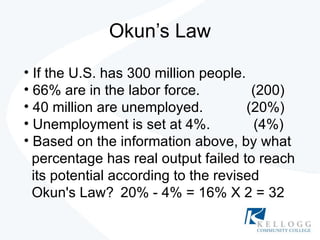
Okun’s Law If the U.S. has 300 million people. 66% are in the labor force.  40 million are unemployed.  Unemployment is set at 4%.  Based on the information above, by what  percentage has real output failed to reach  its potential according to the revised  Okun's Law?
Okun’s Law If the U.S. has 300 million people. 66% are in the labor force.  (200) 40 million are unemployed.  (20%) Unemployment is set at 4%.  (4%) Based on the information above, by what  percentage has real output failed to reach  its potential according to the revised  Okun's Law?   20% - 4% = 16% X 2 = 32
Measuring Unemployment U.S. Census Bureau surveys about 60,000 households a month to determine how many people are actually unemployed. A person is considered unemployed if he or she is not employed and is actively seeking a job.
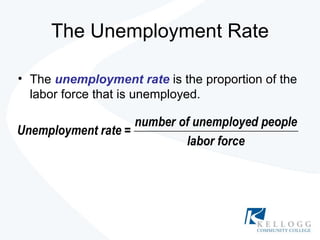
The Unemployment Rate The  unemployment rate  is the proportion of the labor force that is unemployed.
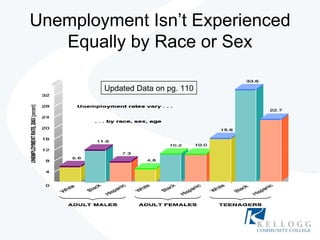
Unemployment Isn’t Experienced Equally by Race or Sex Updated Data on pg. 110
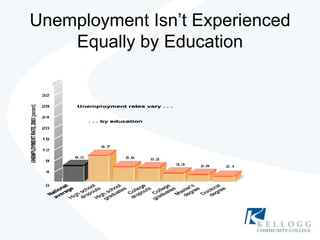
Unemployment Isn’t Experienced Equally by Education
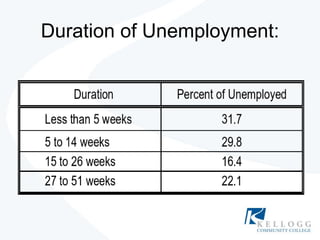
Duration of Unemployment When the economy is growing, both unemployment rates and the average duration of unemployment decline.
Duration of Unemployment:
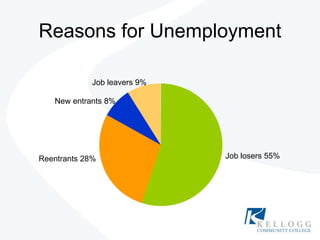
Reasons for Unemployment How long a person remains unemployed is affected by the nature of the joblessness. Job leavers Job losers Reentrants New entrants
Reasons for Unemployment Job losers 55% Reentrants 28% New entrants 8% Job leavers 9%
Discouraged Workers A  discouraged worker  is an individual who is not actively seeking employment but would look for or accept a job if one were available. Discouraged workers are not counted as part of the unemployment problem after they give up looking for a job.
Underemployment Underemployed workers represent labor resources that are not being fully utilized. Underemployment   exists when people seeking full-time paid employment work only part time or are employed at jobs below their capability.
The Phantom Unemployed Some of the people who are counted as unemployed probably should not be. Many people report that they are actively seeking work when they have little interest in finding a job.
The Phantom Unemployed Public policy encourages this behavior by requiring most welfare and unemployment benefit receivers to provide evidence that they are looking for work.
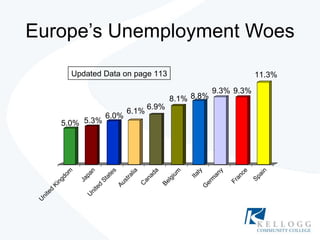
Europe’s Unemployment Woes Unemployment levels in Europe are much higher than those of the U.S. Analysts blame both sluggish economic growth and high unemployment benefits.
Europe’s Unemployment Woes Updated Data on page 113 United Kingdom Japan United States Australia Canada Belgium Italy Germany France Spain 5.0% 5.3% 6.9% 9.3% 8.1% 8.8% 9.3% 11.3% 6.0% 6.1%
The Human Costs The most visible impact of unemployment on individuals is loss of income The human cost of unemployment includes social, physical, and psychological costs as well.
Defining Full Employment Full  employment is not the same as  zero  unemployment.
Seasonal Unemployment Seasonal unemployment  is the unemployment due to seasonal changes in employment or labor supply. At the end of each season, thousands of workers must go searching for new jobs, experiencing seasonal unemployment in the process.
Frictional Unemployment Frictional unemployment   is the brief periods of unemployment experienced by people moving between jobs or into the labor market.
Frictional Unemployment Frictional unemployment differs from other unemployment in three ways: There is an adequate demand for the labor of the frictionally unemployed. The frictionally unemployed have the skills required for existing jobs. The job-search period will be relatively short.
Structural Unemployment Structural unemployment  is the unemployment caused by a mismatch between the skills (or location) of job seekers and the requirements (or location) of available jobs.
Cyclical Unemployment Cyclical unemployment  is the unemployment attributable to the lack of job vacancies – i.e., to an inadequate level of aggregate demand.
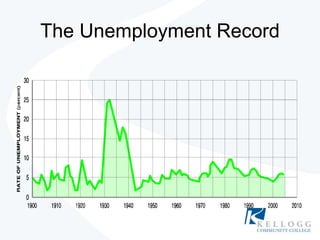
The Unemployment Record
The Full-Employment Goal In the Employment Act of 1946, Congress committed the federal government to pursue a goal of “maximum” employment. Congress didn’t specify what the rate of unemployment should be.
The Full-Employment Goal A full employment goal presumably means avoiding as much cyclical and structural unemployment as possible, while keeping frictional unemployment reasonably low.
Inflationary Pressures In the early 1960s, the council of economic advisors concluded that rising prices are a signal that employment is nearing capacity. The Council placed  full  employment at 4% — below that, prices begin rising.
Changes in Structural Unemployment During 1970s and early 1980s the 4% unemployment goal was considered too high.
Redefining Full Employment Critics suggested that structural barriers to full employment had gotten worse. More youth and women. Liberal transfer payments. Structural changes in demand.
Redefining Full Employment In 1983, the Reagan administration concluded  that the “inflation-threshold” unemployment rate was between six and seven percent.
The “Natural” Rate of Unemployment The  natural rate of unemployment  is the long-term rate of unemployment determined by structural forces in labor and product markets. The “natural” rate of unemployment consists of frictional and structural components only.
Congressional Targets The Full Employment and Balanced Growth Act of 1978 (Humphrey-Hawkins Act) set 4% unemployment rate and 3% inflation as a national goal.
The Historical Record During the Great Depression as many as one-fourth of the labor force was unemployed. Unemployment rates fell dramatically during World War II — the civilian unemployment rate reached 1.2 percent.
The Historical Record Since 1950, unemployment rate has fluctuated from a low of 2.8 percent during the Korean War (1953) to a high of 10.8 percent during the 1981-82 recession.  It is over 15 percent in our state and over 9 percent nationally.
The Historical Record From 1982 to 1989, unemployment fell, but shot up again in the 1990-91 recession. Unemployment fell steadily during the last half of the 1990s. The unemployment rate rose sharply in late 2001.
Unemployment End of Chapter 6

Chap006 4 (2010)

  • 1.
  • 2.
    The Labor ForceThe labor-force participation rate is the percentage of the population working or seeking employment.
  • 3.
    The Labor ForceThe labor force includes all persons over age sixteen who are either working for pay or actively seeking paid employment. People who are not employed or are not actively seeking work are not considered part of the labor force.
  • 4.
    The Labor ForceThe labor-force participation rate is the percentage of the population working or seeking employment.
  • 5.
    The Labor Force,2003 Sick and disabled (7,142,000) Institutionalized (4.1 million) Other (489,000) In school (9,130,000) Retired (29,813,000) Unemployed(8.8 million) Civilians employed(137.8 million) Armed forces (1.5 million) Out of the labor force (144 million) In civilian labor force (147 million) Under age 16 (68.7 million) Total population (291 million) Homemakers (20,343,000)
  • 6.
    A Growing LaborForce Participation Rates (age 16 and older) Men Women 86.4 83.3 79.7 77.4 76.4 74.7 Year 1950 1960 1970 1980 1990 2000 33.9 37.7 43.3 51.5 57.5 60.0 73.5 2004 59.5
  • 7.
    Growth of ProductionPossibilities Production is limited by two factors: The availability of factors of production. Technological know-how.
  • 8.
    Production Possibilities Agrowing labor force creates long-run economic growth. Economic growth is an increase in output (real GDP); an expansion of production possibilities.
  • 9.
    Institutional Constraints Productionpossibilities in any year depend on available resources and technology and on how we choose to restrict their use. The size of labor force is limited by participation rates and social regulation.
  • 10.
    Labor Force GrowthC D Labor-force growth increases production possibilities H G F Consumption Goods (units per year) B A Investment Goods (units per year) O
  • 11.
    Unemployment To makefull use of available production capacity, the labor force must be fully employed. Unemployment is the inability of labor-force participants to find jobs. See “In the News” How Unemployment Affects the Family, pg. 114.
  • 12.
    Okun’s Law Okun’sLaw asserts that 1% more unemployment is estimated to equal 2 percent less output.
  • 13.
    Okun’s Law Ifthe U.S. has 300 million people. 66% are in the labor force. 40 million are unemployed. Unemployment is set at 4%. Based on the information above, by what percentage has real output failed to reach its potential according to the revised Okun's Law?
  • 14.
    Okun’s Law Ifthe U.S. has 300 million people. 66% are in the labor force. (200) 40 million are unemployed. (20%) Unemployment is set at 4%. (4%) Based on the information above, by what percentage has real output failed to reach its potential according to the revised Okun's Law? 20% - 4% = 16% X 2 = 32
  • 15.
    Measuring Unemployment U.S.Census Bureau surveys about 60,000 households a month to determine how many people are actually unemployed. A person is considered unemployed if he or she is not employed and is actively seeking a job.
  • 16.
    The Unemployment RateThe unemployment rate is the proportion of the labor force that is unemployed.
  • 17.
    Unemployment Isn’t ExperiencedEqually by Race or Sex Updated Data on pg. 110
  • 18.
  • 19.
    Duration of UnemploymentWhen the economy is growing, both unemployment rates and the average duration of unemployment decline.
  • 20.
  • 21.
    Reasons for UnemploymentHow long a person remains unemployed is affected by the nature of the joblessness. Job leavers Job losers Reentrants New entrants
  • 22.
    Reasons for UnemploymentJob losers 55% Reentrants 28% New entrants 8% Job leavers 9%
  • 23.
    Discouraged Workers A discouraged worker is an individual who is not actively seeking employment but would look for or accept a job if one were available. Discouraged workers are not counted as part of the unemployment problem after they give up looking for a job.
  • 24.
    Underemployment Underemployed workersrepresent labor resources that are not being fully utilized. Underemployment exists when people seeking full-time paid employment work only part time or are employed at jobs below their capability.
  • 25.
    The Phantom UnemployedSome of the people who are counted as unemployed probably should not be. Many people report that they are actively seeking work when they have little interest in finding a job.
  • 26.
    The Phantom UnemployedPublic policy encourages this behavior by requiring most welfare and unemployment benefit receivers to provide evidence that they are looking for work.
  • 27.
    Europe’s Unemployment WoesUnemployment levels in Europe are much higher than those of the U.S. Analysts blame both sluggish economic growth and high unemployment benefits.
  • 28.
    Europe’s Unemployment WoesUpdated Data on page 113 United Kingdom Japan United States Australia Canada Belgium Italy Germany France Spain 5.0% 5.3% 6.9% 9.3% 8.1% 8.8% 9.3% 11.3% 6.0% 6.1%
  • 29.
    The Human CostsThe most visible impact of unemployment on individuals is loss of income The human cost of unemployment includes social, physical, and psychological costs as well.
  • 30.
    Defining Full EmploymentFull employment is not the same as zero unemployment.
  • 31.
    Seasonal Unemployment Seasonalunemployment is the unemployment due to seasonal changes in employment or labor supply. At the end of each season, thousands of workers must go searching for new jobs, experiencing seasonal unemployment in the process.
  • 32.
    Frictional Unemployment Frictionalunemployment is the brief periods of unemployment experienced by people moving between jobs or into the labor market.
  • 33.
    Frictional Unemployment Frictionalunemployment differs from other unemployment in three ways: There is an adequate demand for the labor of the frictionally unemployed. The frictionally unemployed have the skills required for existing jobs. The job-search period will be relatively short.
  • 34.
    Structural Unemployment Structuralunemployment is the unemployment caused by a mismatch between the skills (or location) of job seekers and the requirements (or location) of available jobs.
  • 35.
    Cyclical Unemployment Cyclicalunemployment is the unemployment attributable to the lack of job vacancies – i.e., to an inadequate level of aggregate demand.
  • 36.
  • 37.
    The Full-Employment GoalIn the Employment Act of 1946, Congress committed the federal government to pursue a goal of “maximum” employment. Congress didn’t specify what the rate of unemployment should be.
  • 38.
    The Full-Employment GoalA full employment goal presumably means avoiding as much cyclical and structural unemployment as possible, while keeping frictional unemployment reasonably low.
  • 39.
    Inflationary Pressures Inthe early 1960s, the council of economic advisors concluded that rising prices are a signal that employment is nearing capacity. The Council placed full employment at 4% — below that, prices begin rising.
  • 40.
    Changes in StructuralUnemployment During 1970s and early 1980s the 4% unemployment goal was considered too high.
  • 41.
    Redefining Full EmploymentCritics suggested that structural barriers to full employment had gotten worse. More youth and women. Liberal transfer payments. Structural changes in demand.
  • 42.
    Redefining Full EmploymentIn 1983, the Reagan administration concluded that the “inflation-threshold” unemployment rate was between six and seven percent.
  • 43.
    The “Natural” Rateof Unemployment The natural rate of unemployment is the long-term rate of unemployment determined by structural forces in labor and product markets. The “natural” rate of unemployment consists of frictional and structural components only.
  • 44.
    Congressional Targets TheFull Employment and Balanced Growth Act of 1978 (Humphrey-Hawkins Act) set 4% unemployment rate and 3% inflation as a national goal.
  • 45.
    The Historical RecordDuring the Great Depression as many as one-fourth of the labor force was unemployed. Unemployment rates fell dramatically during World War II — the civilian unemployment rate reached 1.2 percent.
  • 46.
    The Historical RecordSince 1950, unemployment rate has fluctuated from a low of 2.8 percent during the Korean War (1953) to a high of 10.8 percent during the 1981-82 recession. It is over 15 percent in our state and over 9 percent nationally.
  • 47.
    The Historical RecordFrom 1982 to 1989, unemployment fell, but shot up again in the 1990-91 recession. Unemployment fell steadily during the last half of the 1990s. The unemployment rate rose sharply in late 2001.
  • 48.