THE CIRCULAR FLOW
OF ECONOMY
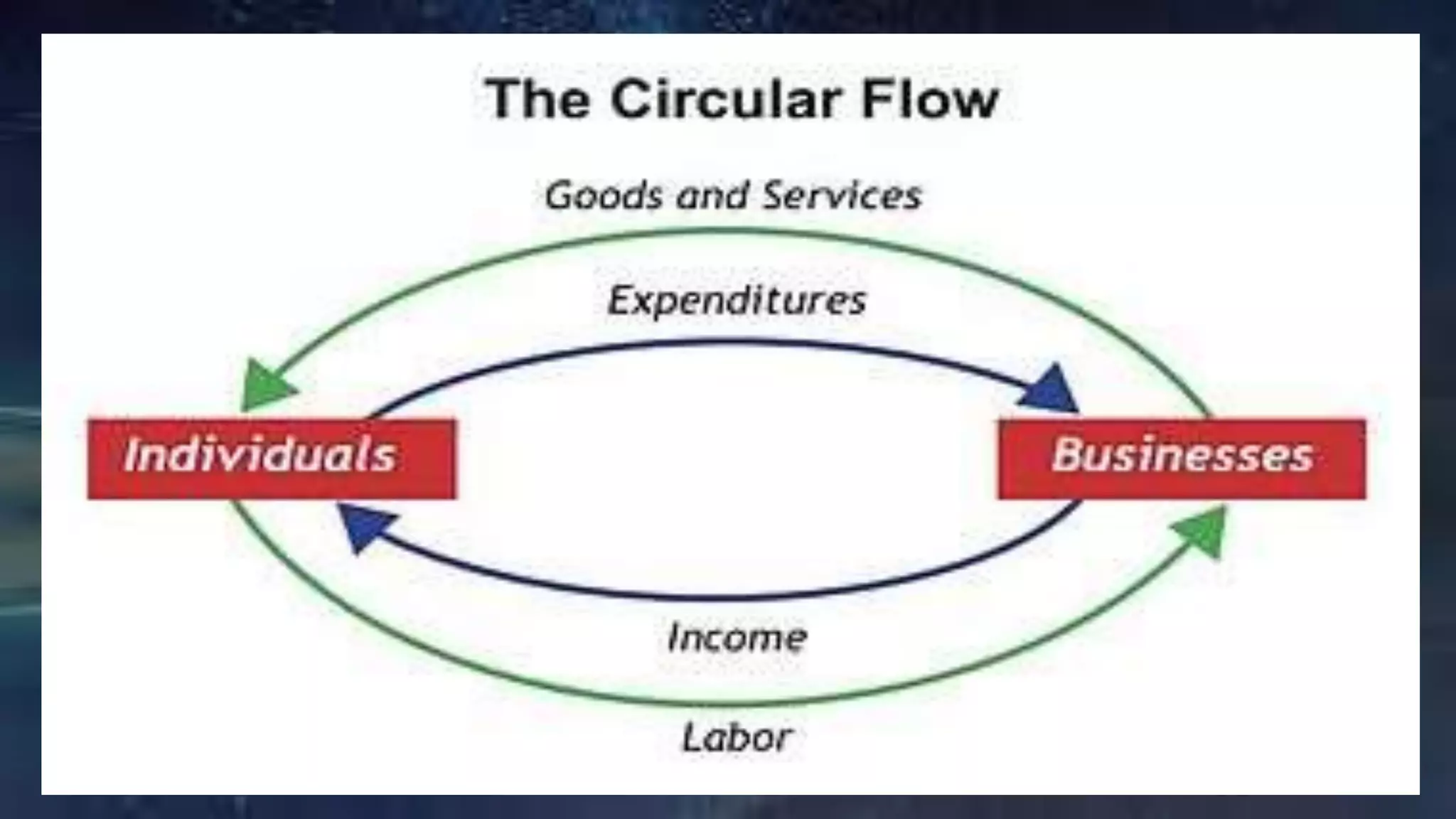
is a model showing the
basic economic relationships within a market
economy. In the circular flow of the economy,
money is used to purchase goods and services.
Goods and services flow through
the economy in one direction while
money flows in the opposite direction.
• In any society, economic activity is done with the use of money.
The household sector (consumer) spends money on goods and
services produced by the business sector.
Business sector (producer) spends money on payment for the
resources owned by the household sector.
Law of scarcity
simply notes that economic resources
(land, labor, capital, and talent) are limited,
not infinite. This assumption is easily
verifiable by noting that if resources were
infinite, everything should be free; as it is
not, scarcity must exist.
Some examples of scarcity include:
The gasoline shortage in the 1970's.
After poor weather, corn crops did not grow resulting in a scarcity of
food for people and animals and ethanol for fuel.
Over-fishing can result in a scarcity of a type of fish.
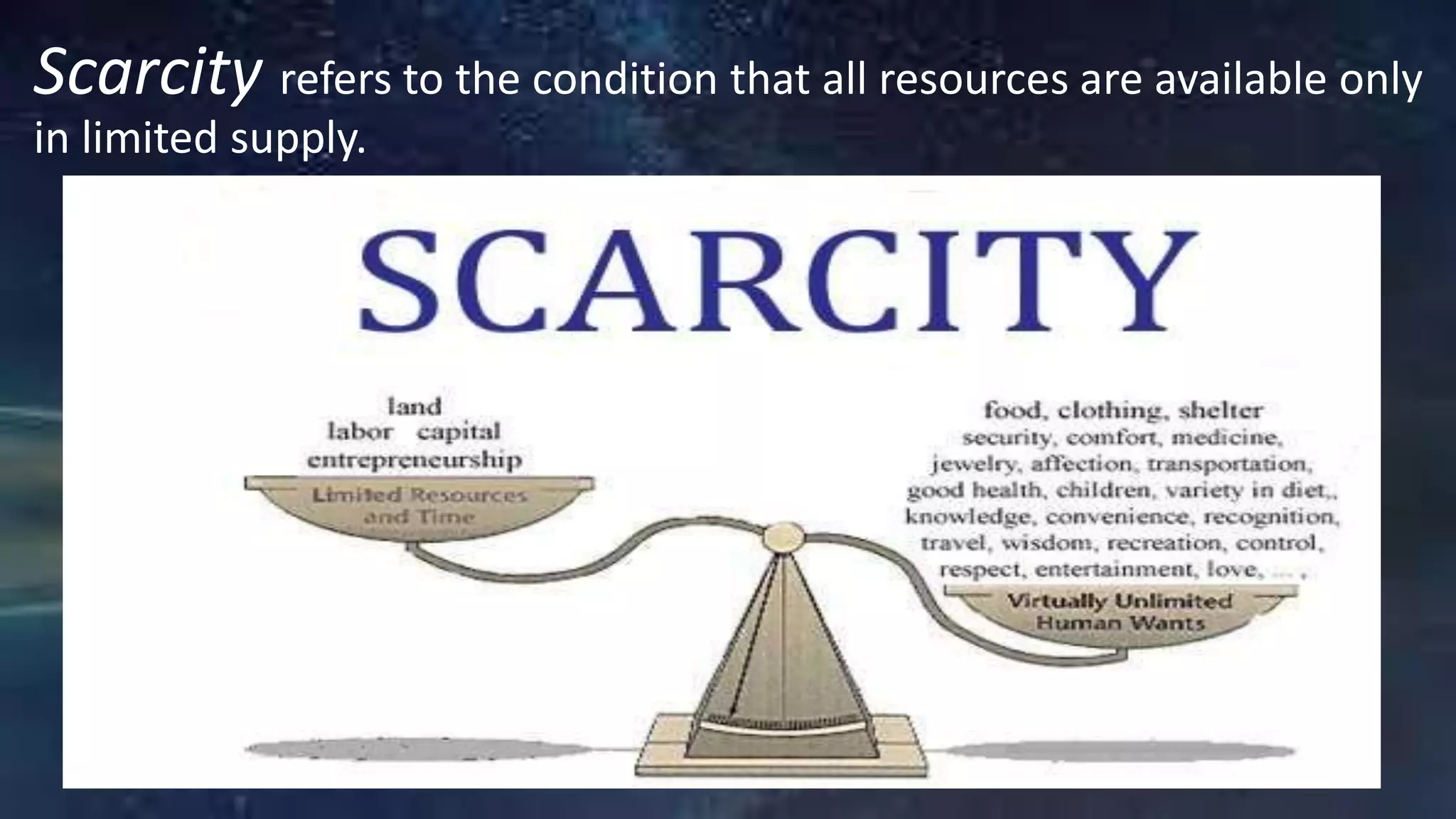
Scarcity refers to the condition that all resources are available only
in limited supply.
Law of scarcity states that goods are scarce because there
are not enough resources to produce all the goods that the
people want to consume.
The main problem relating to the proper allocation of
the resources are explained as follows:
1. What to produce?
-The first concern is related with what to produce? The
problems such as what to produce are to be produced and in
what quantities arise directly from the scarcity of resources.
Production must meet the maximum social need as it is the first
priority. The social norms and values should guide to maximize
social satisfaction. The problem of what to produce and how
much to produce depends on the necessity of the citizens of the
country.
2. How to produce ?
-The second concern is related to the method of
production. In some cases, labor may play a major role. It is
called labor-intensive technology. It is called capital-intensive.
Labor intensive method creates more jobs favoring more
employment. Capital-intensive production goes for a large
volume of production. The right decision depends on the current
state of the economy.
3. For whom to produce?
-It can be expressed as how to distribute society is total
product among its different units? Or, how the total national
product distributed among the different factors of production or
among the different individuals and families? The distribution of
the output of society among its various members must be
determined.
4. Balance in Development
-While allocating the resource, a nation must give the
priority to maintain the sector balance in development.
The balance between rural and urban, consumer goods
and exported goods, balance in the sector of
development (primary, secondary, tertiary sector).
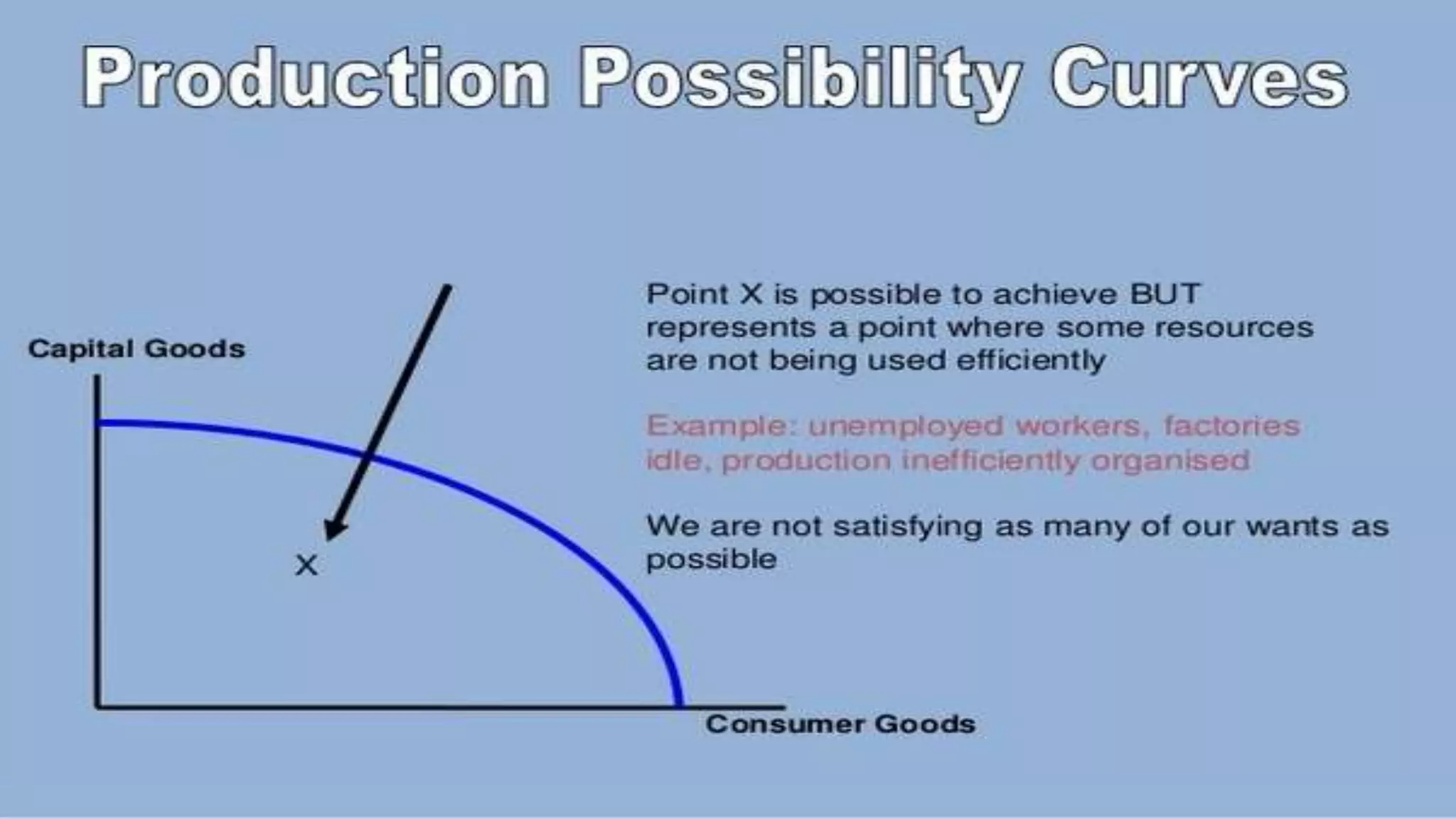
Production Possibilities
Frontier/ Curve (PPC)
is a curve which shows various combinations of the amounts of two
goods which can be produced within the given resources and
technology/a graphical representation showing all the possible options
of output for two products that can be produced using all factors of
production, where the given resources are fully and efficiently utilized
per unit time. A PPF illustrates several economic concepts, such
as allocative efficiency, economies of scale, opportunity cost (or
marginal rate of transformation), productive efficiency, and scarcity of
resources (the fundamental economic problem that all societies face).
(Wikipedia.com)
Production Possibilities
Frontier/ Curve (PPC)
A production possibilities boundary or frontier shows
the combination of two goods that can be efficient
produced by using all the resources. It illustrates three
concepts: scarcity, choice, and opportunity. (Gabay, Bon
kristoffer, et.al)
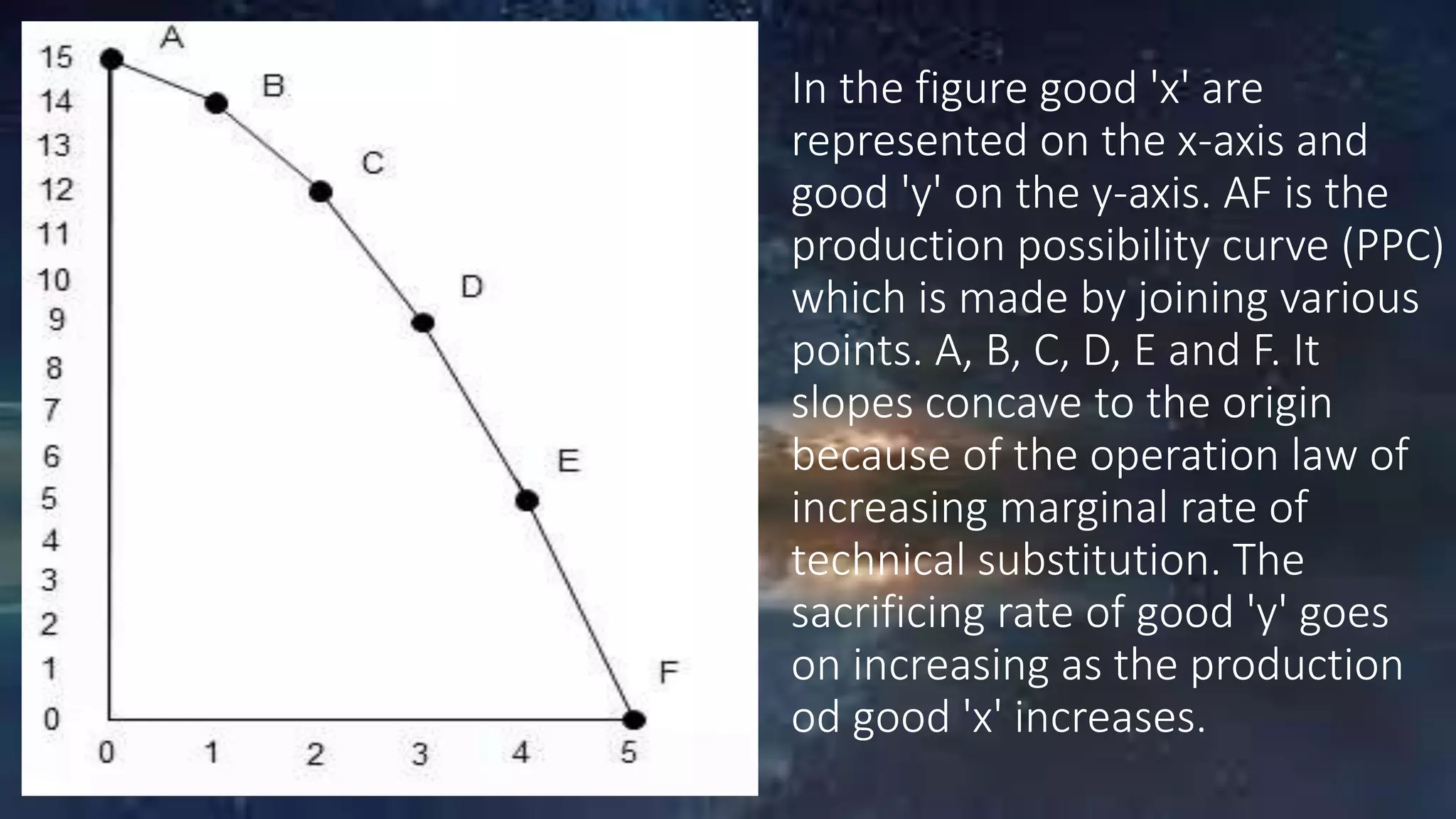
In the figure good 'x' are
represented on the x-axis and
good 'y' on the y-axis. AF is the
production possibility curve (PPC)
which is made by joining various
points. A, B, C, D, E and F. It
slopes concave to the origin
because of the operation law of
increasing marginal rate of
technical substitution. The
sacrificing rate of good 'y' goes
on increasing as the production
od good 'x' increases.
Shifting of PPC
-The PPC shifts left-hand side and right-hand side.
The right hand side shift PPC indicates an increase in
production and left-hand side decrease in the
production. Some of the reasons for shifting PPC are as
below:
Change in resources
When the supply of raw material increases the production also increases so the
PPC shift upward. And if decreases than PPC shift downward.
Change in the efficiency of labour
When the efficiency of labour increases by any means the production can be
increased with the PPC shift upward. And if decreases then PPC shifts downward.
Change in Technology
When the advance technology is used instead of traditional technology in the
production prices the production capacity increase & PPC shift upward. And if the
traditional technology is used instead of advanced technology then the PPC curve shift
downward.
Change in Investment
When the investment increase in the production the production also increases so,
the PPC shifts upward. And when investment decreases PPC curve slopes downward.
IS THERE ANY QUESTIONS/
CLARIFICATIONS ABOUT MY REPORT?

The Circular Flow of Economy

  • 1.
    THE CIRCULAR FLOW OFECONOMY is a model showing the basic economic relationships within a market economy. In the circular flow of the economy, money is used to purchase goods and services. Goods and services flow through the economy in one direction while money flows in the opposite direction.
  • 2.
    • In anysociety, economic activity is done with the use of money. The household sector (consumer) spends money on goods and services produced by the business sector. Business sector (producer) spends money on payment for the resources owned by the household sector.
  • 4.
    Law of scarcity simplynotes that economic resources (land, labor, capital, and talent) are limited, not infinite. This assumption is easily verifiable by noting that if resources were infinite, everything should be free; as it is not, scarcity must exist.
  • 5.
    Some examples ofscarcity include: The gasoline shortage in the 1970's. After poor weather, corn crops did not grow resulting in a scarcity of food for people and animals and ethanol for fuel. Over-fishing can result in a scarcity of a type of fish.
  • 6.
    Scarcity refers tothe condition that all resources are available only in limited supply.
  • 7.
    Law of scarcitystates that goods are scarce because there are not enough resources to produce all the goods that the people want to consume. The main problem relating to the proper allocation of the resources are explained as follows:
  • 8.
    1. What toproduce? -The first concern is related with what to produce? The problems such as what to produce are to be produced and in what quantities arise directly from the scarcity of resources. Production must meet the maximum social need as it is the first priority. The social norms and values should guide to maximize social satisfaction. The problem of what to produce and how much to produce depends on the necessity of the citizens of the country.
  • 9.
    2. How toproduce ? -The second concern is related to the method of production. In some cases, labor may play a major role. It is called labor-intensive technology. It is called capital-intensive. Labor intensive method creates more jobs favoring more employment. Capital-intensive production goes for a large volume of production. The right decision depends on the current state of the economy.
  • 10.
    3. For whomto produce? -It can be expressed as how to distribute society is total product among its different units? Or, how the total national product distributed among the different factors of production or among the different individuals and families? The distribution of the output of society among its various members must be determined.
  • 11.
    4. Balance inDevelopment -While allocating the resource, a nation must give the priority to maintain the sector balance in development. The balance between rural and urban, consumer goods and exported goods, balance in the sector of development (primary, secondary, tertiary sector).
  • 12.
    Production Possibilities Frontier/ Curve(PPC) is a curve which shows various combinations of the amounts of two goods which can be produced within the given resources and technology/a graphical representation showing all the possible options of output for two products that can be produced using all factors of production, where the given resources are fully and efficiently utilized per unit time. A PPF illustrates several economic concepts, such as allocative efficiency, economies of scale, opportunity cost (or marginal rate of transformation), productive efficiency, and scarcity of resources (the fundamental economic problem that all societies face). (Wikipedia.com)
  • 13.
    Production Possibilities Frontier/ Curve(PPC) A production possibilities boundary or frontier shows the combination of two goods that can be efficient produced by using all the resources. It illustrates three concepts: scarcity, choice, and opportunity. (Gabay, Bon kristoffer, et.al)
  • 15.
    In the figuregood 'x' are represented on the x-axis and good 'y' on the y-axis. AF is the production possibility curve (PPC) which is made by joining various points. A, B, C, D, E and F. It slopes concave to the origin because of the operation law of increasing marginal rate of technical substitution. The sacrificing rate of good 'y' goes on increasing as the production od good 'x' increases.
  • 16.
    Shifting of PPC -ThePPC shifts left-hand side and right-hand side. The right hand side shift PPC indicates an increase in production and left-hand side decrease in the production. Some of the reasons for shifting PPC are as below:
  • 17.
    Change in resources Whenthe supply of raw material increases the production also increases so the PPC shift upward. And if decreases than PPC shift downward. Change in the efficiency of labour When the efficiency of labour increases by any means the production can be increased with the PPC shift upward. And if decreases then PPC shifts downward. Change in Technology When the advance technology is used instead of traditional technology in the production prices the production capacity increase & PPC shift upward. And if the traditional technology is used instead of advanced technology then the PPC curve shift downward. Change in Investment When the investment increase in the production the production also increases so, the PPC shifts upward. And when investment decreases PPC curve slopes downward.
  • 18.
    IS THERE ANYQUESTIONS/ CLARIFICATIONS ABOUT MY REPORT?