


Presented by Aaron Elias
TMA CME Road Show
Dollars and Sense
CONTINUED SHIFT FROM VOLUME TO VALUE
MACRA and the Merit-Based Incentive
Payment System (MIPS)
TMA: CME Summer Road Show Dollars and Sense Page 1
Fact of the Day
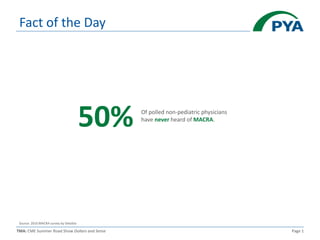
50% Of polled non-pediatric physicians
have never heard of MACRA.
Source: 2016 MACRA survey by Deloitte
TMA: CME Summer Road Show Dollars and Sense Page 2
Topics
1
2
3
4
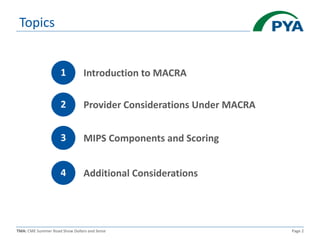
Introduction to MACRA
Provider Considerations Under MACRA
MIPS Components and Scoring
Additional Considerations
Introduction to MACRA
TMA: CME Summer Road Show Dollars and Sense Page 4
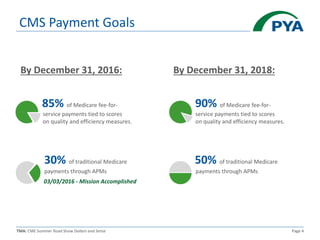
CMS Payment Goals
30% of traditional Medicare
payments through APMs
50% of traditional Medicare
payments through APMs
85% of Medicare fee-for-
service payments tied to scores
on quality and efficiency measures.
90% of Medicare fee-for-
service payments tied to scores
on quality and efficiency measures.
03/03/2016 - Mission Accomplished
By December 31, 2016: By December 31, 2018:
TMA: CME Summer Road Show Dollars and Sense Page 5
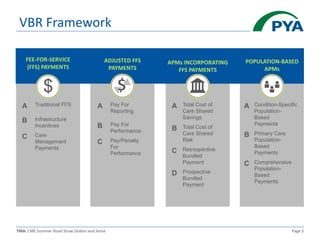
VBR Framework
FEE-FOR-SERVICE
(FFS) PAYMENTS
POPULATION-BASED
APMs
ADJUSTED FFS
PAYMENTS
APMs INCORPORATING
FFS PAYMENTS
$
$
Bank
A Pay For
Reporting
B Pay For
Performance
C Pay/Penalty
For
Performance
A Total Cost of
Care Shared
Savings
B Total Cost of
Care Shared
Risk
C Retrospective
Bundled
Payment
D Prospective
Bundled
Payment
A Condition-Specific
Population-
Based
Payments
B Primary Care
Population-
Based
Payments
C Comprehensive
Population-
Based
Payments
A Traditional FFS
B Infrastructure
Incentives
C Care
Management
Payments
TMA: CME Summer Road Show Dollars and Sense Page 6
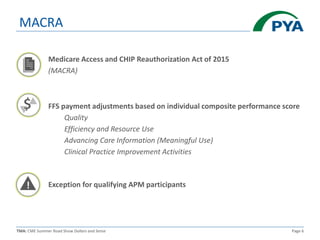
Medicare Access and CHIP Reauthorization Act of 2015
(MACRA)
FFS payment adjustments based on individual composite performance score
Quality
Efficiency and Resource Use
Advancing Care Information (Meaningful Use)
Clinical Practice Improvement Activities
Exception for qualifying APM participants!
MACRA
TMA: CME Summer Road Show Dollars and Sense Page 7
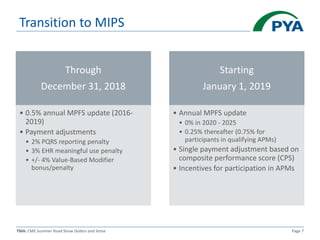
Transition to MIPS
Through
December 31, 2018
• 0.5% annual MPFS update (2016-
2019)
• Payment adjustments
• 2% PQRS reporting penalty
• 3% EHR meaningful use penalty
• +/- 4% Value-Based Modifier
bonus/penalty
Starting
January 1, 2019
• Annual MPFS update
• 0% in 2020 - 2025
• 0.25% thereafter (0.75% for
participants in qualifying APMs)
• Single payment adjustment based on
composite performance score (CPS)
• Incentives for participation in APMs
TMA: CME Summer Road Show Dollars and Sense Page 8
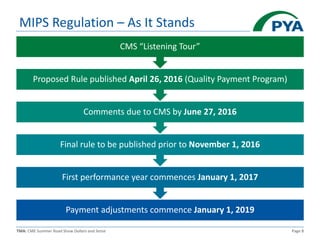
MIPS Regulation – As It Stands
Payment adjustments commence January 1, 2019
First performance year commences January 1, 2017
Final rule to be published prior to November 1, 2016
Comments due to CMS by June 27, 2016
Proposed Rule published April 26, 2016 (Quality Payment Program)
CMS “Listening Tour”
Provider Considerations Under MACRA
MIPS and Advanced APM Eligibility
TMA: CME Summer Road Show Dollars and Sense Page 10
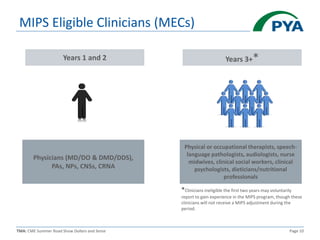
*Clinicians ineligible the first two years may voluntarily
report to gain experience in the MIPS program, though these
clinicians will not receive a MIPS adjustment during the
period.
Years 1 and 2 Years 3+*
Physicians (MD/DO & DMD/DDS),
PAs, NPs, CNSs, CRNA
Physical or occupational therapists, speech-
language pathologists, audiologists, nurse
midwives, clinical social workers, clinical
psychologists, dieticians/nutritional
professionals
MIPS Eligible Clinicians (MECs)
TMA: CME Summer Road Show Dollars and Sense Page 11
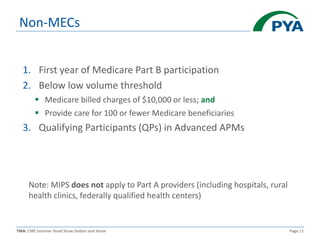
Non-MECs
1. First year of Medicare Part B participation
2. Below low volume threshold
 Medicare billed charges of $10,000 or less; and
 Provide care for 100 or fewer Medicare beneficiaries
3. Qualifying Participants (QPs) in Advanced APMs
Note: MIPS does not apply to Part A providers (including hospitals, rural
health clinics, federally qualified health centers)
TMA: CME Summer Road Show Dollars and Sense Page 12
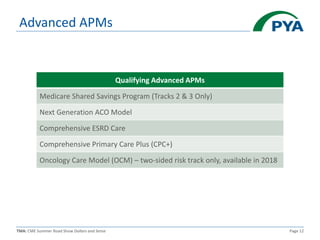
Advanced APMs
Qualifying Advanced APMs
Medicare Shared Savings Program (Tracks 2 & 3 Only)
Next Generation ACO Model
Comprehensive ESRD Care
Comprehensive Primary Care Plus (CPC+)
Oncology Care Model (OCM) – two-sided risk track only, available in 2018
TMA: CME Summer Road Show Dollars and Sense Page 13
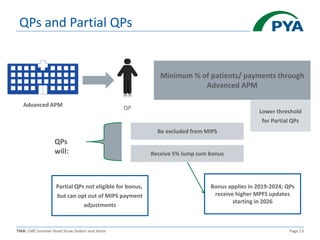
Be excluded from MIPS
Minimum % of patients/ payments through
Advanced APM
Receive 5% lump sum bonus
Bonus applies in 2019-2024; QPs
receive higher MPFS updates
starting in 2026
QPs
will:
QPAdvanced APM
Lower threshold
for Partial QPs
Partial QPs not eligible for bonus,
but can opt out of MIPS payment
adjustments
QPs and Partial QPs
TMA: CME Summer Road Show Dollars and Sense Page 14
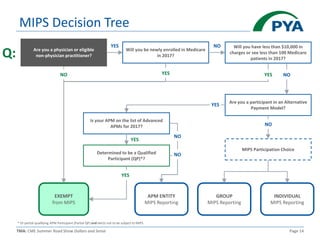
MIPS Decision Tree
Are you a physician or eligible
non-physician practitioner?Q:
NO
YES
Will you be newly enrolled in Medicare
in 2017?
Will you have less than $10,000 in
charges or see less than 100 Medicare
patients in 2017?
Are you a participant in an Alternative
Payment Model?
MIPS Participation Choice
Is your APM on the list of Advanced
APMs for 2017?
GROUP
MIPS Reporting
INDIVIDUAL
MIPS Reporting
Determined to be a Qualified
Participant (QP)*?
APM ENTITY
MIPS Reporting
EXEMPT
from MIPS
* Or partial qualifying APM Participant (Partial QP) and elects not to be subject to MIPS
NO
YES NO
YES
YES
YES
NO
NO
NO
YES
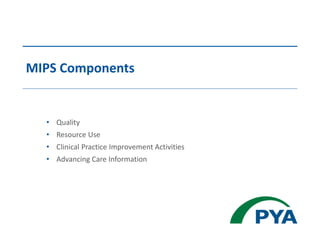
• Quality
• Resource Use
• Clinical Practice Improvement Activities
• Advancing Care Information
MIPS Components
TMA: CME Summer Road Show Dollars and Sense Page 16
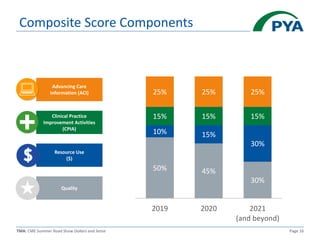
Composite Score Components
50% 45%
30%
10% 15%
30%
15% 15% 15%
25% 25% 25%
2019 2020 2021
(and beyond)
Quality
Resource Use
($)
Clinical Practice
Improvement Activities
(CPIA)
Advancing Care
Information (ACI)
TMA: CME Summer Road Show Dollars and Sense Page 17
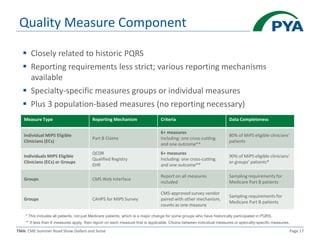
Quality Measure Component
 Closely related to historic PQRS
 Reporting requirements less strict; various reporting mechanisms
available
 Specialty-specific measures groups or individual measures
 Plus 3 population-based measures (no reporting necessary)
Measure Type Reporting Mechanism Criteria Data Completeness
Individual MIPS Eligible
Clinicians (ECs)
Part B Claims
6+ measures
Including: one cross-cutting
and one outcome**
80% of MIPS eligible clinicians’
patients
Individuals MIPS Eligible
Clinicians (ECs) or Groups
QCDR
Qualified Registry
EHR
6+ measures
Including: one cross-cutting
and one outcome**
90% of MIPS eligible clinicians’
or groups’ patients*
Groups CMS Web Interface
Report on all measures
included
Sampling requirements for
Medicare Part B patients
Groups CAHPS for MIPS Survey
CMS-approved survey vendor
paired with other mechanism,
counts as one measure
Sampling requirements for
Medicare Part B patients
* This includes all patients, not just Medicare patients, which is a major change for some groups who have historically participated in PQRS.
** If less than 6 measures apply, then report on each measure that is applicable. Choice between individual measures or specialty-specific measures.
TMA: CME Summer Road Show Dollars and Sense Page 18
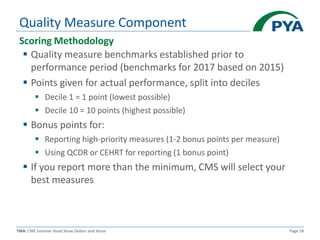
Quality Measure Component
 Quality measure benchmarks established prior to
performance period (benchmarks for 2017 based on 2015)
 Points given for actual performance, split into deciles
 Decile 1 = 1 point (lowest possible)
 Decile 10 = 10 points (highest possible)
 Bonus points for:
 Reporting high-priority measures (1-2 bonus points per measure)
 Using QCDR or CEHRT for reporting (1 bonus point)
 If you report more than the minimum, CMS will select your
best measures
Scoring Methodology
TMA: CME Summer Road Show Dollars and Sense Page 19
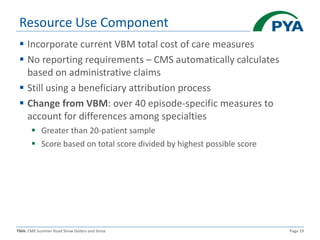
Resource Use Component
 Incorporate current VBM total cost of care measures
 No reporting requirements – CMS automatically calculates
based on administrative claims
 Still using a beneficiary attribution process
 Change from VBM: over 40 episode-specific measures to
account for differences among specialties
 Greater than 20-patient sample
 Score based on total score divided by highest possible score
TMA: CME Summer Road Show Dollars and Sense Page 20
Resource Use Component
 Resource use benchmarks set during the actual performance
year (benchmarks for 2017 based on 2017 actual)
 Points given for actual performance, split into deciles:
 Decile 1 (highest cost) = 1 point
 Decile 10 (lowest cost) = 10 points
 Average of points for all applicable resource measures
Scoring Methodology
TMA: CME Summer Road Show Dollars and Sense Page 21
Resource Use Component
 Measures development (for future years)
 CMS to develop new classification codes in 2016-17
 Care episode groups
 Patient condition groups
 Patient relationship categories
 Beginning January 1, 2018, claims must include new codes as
appropriate
TMA: CME Summer Road Show Dollars and Sense Page 22
CPIA Component
 Clinical Practice Improvement Activities
 Activities weighted as either “high” or “medium”
 Eight different subcategories of activities, plus participation in an APM
•Same day appointments
•After-hours access to
clinician advice
•Use of tele-health services
•Collect patient experience
and satisfaction data
Expanded Practice
Access
•Monitoring health
conditions
•Participation in qualified
data registries
•Participate in Million Hearts
•Participate in research for
targeted patient populations
Population
Management
•Timely communication of
test results
•Implement regular care
coordination training
•Develop care plans for at-
risk patients
Care Coordination
•Establishment of care plans
•Use of shared decision-
making mechanisms
•Use group visits for common
chronic conditions
Beneficiary
Engagement
•Use of clinical and surgical
checklists
•Practice assessments
•Use decision support and
protocols
Patient Safety
Practice Assessment
•See new and follow-up
Medicaid patients in a
timely manner
•Use QCDR to screen for
social determinants of
health
Achieving Health
Equity
•Participate in humanitarian
volunteer work
•Participate in Disaster
Medical Assistance Teams
Emergency
Response and
Preparedness
•Engage patients with
behavioral health conditions
•Offer behavioral health
services
Integrated
Behavioral and
Mental Health
TMA: CME Summer Road Show Dollars and Sense Page 23
CPIA Component
 Maximum score = 60 points
 Medium weight = 10 points
 High weight = 20 points
 Exceptions:
 Small groups (<=15 professionals), HPSA, etc., must only report on two
activities (30 points given for any activity)
 APM participants start with 30 points
 Patient-Centered Medical Homes automatically receive 60 point max
Scoring Methodology
TMA: CME Summer Road Show Dollars and Sense Page 24
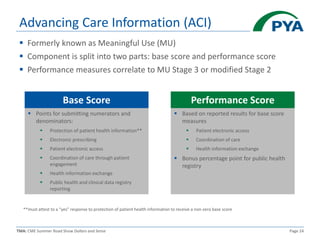
Advancing Care Information (ACI)
 Formerly known as Meaningful Use (MU)
 Component is split into two parts: base score and performance score
 Performance measures correlate to MU Stage 3 or modified Stage 2
**must attest to a “yes” response to protection of patient health information to receive a non-zero base score
 Points for submitting numerators and
denominators:
 Protection of patient health information**
 Electronic prescribing
 Patient electronic access
 Coordination of care through patient
engagement
 Health information exchange
 Public health and clinical data registry
reporting
 Based on reported results for base score
measures
 Patient electronic access
 Coordination of care
 Health information exchange
 Bonus percentage point for public health
registry
Performance ScoreBase Score
TMA: CME Summer Road Show Dollars and Sense Page 25
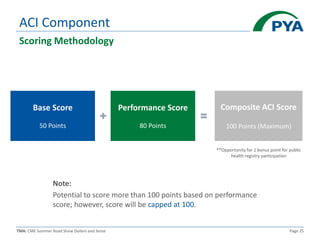
ACI Component
Scoring Methodology
Base Score
50 Points
Performance Score
80 Points
Composite ACI Score
100 Points (Maximum)
**Opportunity for 1 bonus point for public
health registry participation
Note:
Potential to score more than 100 points based on performance
score; however, score will be capped at 100.
TMA: CME Summer Road Show Dollars and Sense Page 26
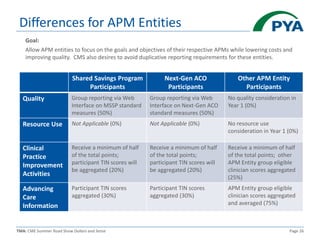
Differences for APM Entities
Shared Savings Program
Participants
Next-Gen ACO
Participants
Other APM Entity
Participants
Quality Group reporting via Web
Interface on MSSP standard
measures (50%)
Group reporting via Web
Interface on Next-Gen ACO
standard measures (50%)
No quality consideration in
Year 1 (0%)
Resource Use Not Applicable (0%) Not Applicable (0%) No resource use
consideration in Year 1 (0%)
Clinical
Practice
Improvement
Activities
Receive a minimum of half
of the total points;
participant TIN scores will
be aggregated (20%)
Receive a minimum of half
of the total points;
participant TIN scores will
be aggregated (20%)
Receive a minimum of half
of the total points; other
APM Entity group eligible
clinician scores aggregated
(25%)
Advancing
Care
Information
Participant TIN scores
aggregated (30%)
Participant TIN scores
aggregated (30%)
APM Entity group eligible
clinician scores aggregated
and averaged (75%)
Goal:
Allow APM entities to focus on the goals and objectives of their respective APMs while lowering costs and
improving quality. CMS also desires to avoid duplicative reporting requirements for these entities.
MIPS Composite Performance Score
Calculation of CPS and Other Factors
TMA: CME Summer Road Show Dollars and Sense Page 28
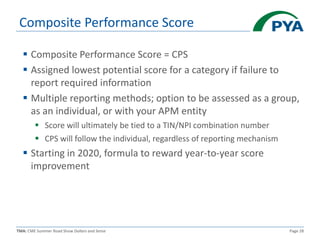
Composite Performance Score
 Composite Performance Score = CPS
 Assigned lowest potential score for a category if failure to
report required information
 Multiple reporting methods; option to be assessed as a group,
as an individual, or with your APM entity
 Score will ultimately be tied to a TIN/NPI combination number
 CPS will follow the individual, regardless of reporting mechanism
 Starting in 2020, formula to reward year-to-year score
improvement
TMA: CME Summer Road Show Dollars and Sense Page 29
Composite Performance Score
 CMS to provide Eligible Clinicians (ECs) with regular
performance feedback reports
 Beginning 07/01/17, ECs to receive confidential feedback on quality
and resource use measures
 Beginning 07/01/18, ECs to receive patient claims data
 CMS to establish informal review process; limits on
administrative and judicial review
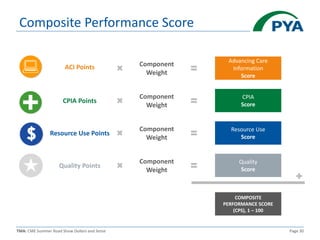
 CMS to calculate CPS of 1 to 100 for each EP at conclusion of
performance period
TMA: CME Summer Road Show Dollars and Sense Page 30
Composite Performance Score
Quality
Score
Resource Use
Score
CPIA
Score
Advancing Care
Information
Score
Component
Weight
Component
Weight
Component
Weight
Component
Weight
ACI Points
CPIA Points
Resource Use Points
Quality Points
COMPOSITE
PERFORMANCE SCORE
(CPS), 1 – 100
TMA: CME Summer Road Show Dollars and Sense Page 31
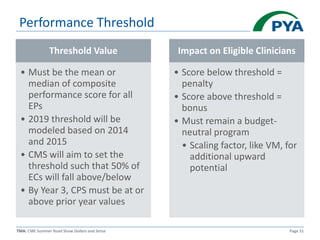
Performance Threshold
Threshold Value
• Must be the mean or
median of composite
performance score for all
EPs
• 2019 threshold will be
modeled based on 2014
and 2015
• CMS will aim to set the
threshold such that 50% of
ECs will fall above/below
• By Year 3, CPS must be at or
above prior year values
Impact on Eligible Clinicians
• Score below threshold =
penalty
• Score above threshold =
bonus
• Must remain a budget-
neutral program
• Scaling factor, like VM, for
additional upward
potential
TMA: CME Summer Road Show Dollars and Sense Page 32
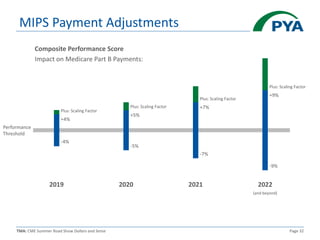
MIPS Payment Adjustments
2019 2022
(and beyond)
2020 2021
+4%
-4%
+5%
-5%
+7%
-7%
+9%
-9%
Plus: Scaling Factor
Composite Performance Score
Impact on Medicare Part B Payments:
Performance
Threshold
Additional Considerations
Moving Forward Under MACRA
TMA: CME Summer Road Show Dollars and Sense Page 34
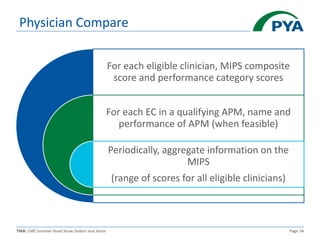
Physician Compare
For each eligible clinician, MIPS composite
score and performance category scores
For each EC in a qualifying APM, name and
performance of APM (when feasible)
Periodically, aggregate information on the
MIPS
(range of scores for all eligible clinicians)
TMA: CME Summer Road Show Dollars and Sense Page 35
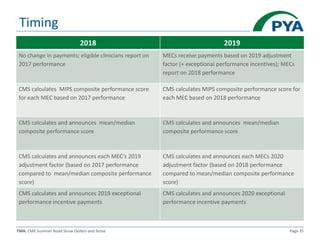
Timing
2018 2019
No change in payments; eligible clinicians report on
2017 performance
MECs receive payments based on 2019 adjustment
factor (+ exceptional performance incentives); MECs
report on 2018 performance
CMS calculates MIPS composite performance score
for each MEC based on 2017 performance
CMS calculates MIPS composite performance score for
each MEC based on 2018 performance
CMS calculates and announces mean/median
composite performance score
CMS calculates and announces mean/median
composite performance score
CMS calculates and announces each MEC’s 2019
adjustment factor (based on 2017 performance
compared to mean/median composite performance
score)
CMS calculates and announces each MECs 2020
adjustment factor (based on 2018 performance
compared to mean/median composite performance
score)
CMS calculates and announces 2019 exceptional
performance incentive payments
CMS calculates and announces 2020 exceptional
performance incentive payments
TMA: CME Summer Road Show Dollars and Sense Page 36
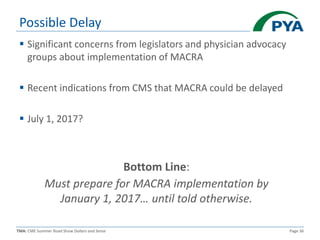
Possible Delay
 Significant concerns from legislators and physician advocacy
groups about implementation of MACRA
 Recent indications from CMS that MACRA could be delayed
 July 1, 2017?
Bottom Line:
Must prepare for MACRA implementation by
January 1, 2017… until told otherwise.
Information in this presentation was
from the Notice for Proposed
Rulemaking (NPRM) on MIPS and
APMs published on April 26, 2016. The
final rule is expected to be released
Fall 2016.
Thank You
Note:
PERSHING YOAKLEY & ASSOCIATES, P.C.
800.270.9629 | www.pyapc.com
AARON ELIAS, MSHA
Consulting Senior
aelias@pyapc.com
(404) 266-9876
‐ “Simple is better”
‐ Advisory practice focused on value transformation and strategy
‐ Analytic focus

MACRA and the Merit-Based Incentive Payment System (MIPS)

  • 1.
    Presented by AaronElias TMA CME Road Show Dollars and Sense CONTINUED SHIFT FROM VOLUME TO VALUE MACRA and the Merit-Based Incentive Payment System (MIPS)
  • 2.
    TMA: CME SummerRoad Show Dollars and Sense Page 1 Fact of the Day 50% Of polled non-pediatric physicians have never heard of MACRA. Source: 2016 MACRA survey by Deloitte
  • 3.
    TMA: CME SummerRoad Show Dollars and Sense Page 2 Topics 1 2 3 4 Introduction to MACRA Provider Considerations Under MACRA MIPS Components and Scoring Additional Considerations
  • 4.
  • 5.
    TMA: CME SummerRoad Show Dollars and Sense Page 4 CMS Payment Goals 30% of traditional Medicare payments through APMs 50% of traditional Medicare payments through APMs 85% of Medicare fee-for- service payments tied to scores on quality and efficiency measures. 90% of Medicare fee-for- service payments tied to scores on quality and efficiency measures. 03/03/2016 - Mission Accomplished By December 31, 2016: By December 31, 2018:
  • 6.
    TMA: CME SummerRoad Show Dollars and Sense Page 5 VBR Framework FEE-FOR-SERVICE (FFS) PAYMENTS POPULATION-BASED APMs ADJUSTED FFS PAYMENTS APMs INCORPORATING FFS PAYMENTS $ $ Bank A Pay For Reporting B Pay For Performance C Pay/Penalty For Performance A Total Cost of Care Shared Savings B Total Cost of Care Shared Risk C Retrospective Bundled Payment D Prospective Bundled Payment A Condition-Specific Population- Based Payments B Primary Care Population- Based Payments C Comprehensive Population- Based Payments A Traditional FFS B Infrastructure Incentives C Care Management Payments
  • 7.
    TMA: CME SummerRoad Show Dollars and Sense Page 6 Medicare Access and CHIP Reauthorization Act of 2015 (MACRA) FFS payment adjustments based on individual composite performance score Quality Efficiency and Resource Use Advancing Care Information (Meaningful Use) Clinical Practice Improvement Activities Exception for qualifying APM participants! MACRA
  • 8.
    TMA: CME SummerRoad Show Dollars and Sense Page 7 Transition to MIPS Through December 31, 2018 • 0.5% annual MPFS update (2016- 2019) • Payment adjustments • 2% PQRS reporting penalty • 3% EHR meaningful use penalty • +/- 4% Value-Based Modifier bonus/penalty Starting January 1, 2019 • Annual MPFS update • 0% in 2020 - 2025 • 0.25% thereafter (0.75% for participants in qualifying APMs) • Single payment adjustment based on composite performance score (CPS) • Incentives for participation in APMs
  • 9.
    TMA: CME SummerRoad Show Dollars and Sense Page 8 MIPS Regulation – As It Stands Payment adjustments commence January 1, 2019 First performance year commences January 1, 2017 Final rule to be published prior to November 1, 2016 Comments due to CMS by June 27, 2016 Proposed Rule published April 26, 2016 (Quality Payment Program) CMS “Listening Tour”
  • 10.
    Provider Considerations UnderMACRA MIPS and Advanced APM Eligibility
  • 11.
    TMA: CME SummerRoad Show Dollars and Sense Page 10 *Clinicians ineligible the first two years may voluntarily report to gain experience in the MIPS program, though these clinicians will not receive a MIPS adjustment during the period. Years 1 and 2 Years 3+* Physicians (MD/DO & DMD/DDS), PAs, NPs, CNSs, CRNA Physical or occupational therapists, speech- language pathologists, audiologists, nurse midwives, clinical social workers, clinical psychologists, dieticians/nutritional professionals MIPS Eligible Clinicians (MECs)
  • 12.
    TMA: CME SummerRoad Show Dollars and Sense Page 11 Non-MECs 1. First year of Medicare Part B participation 2. Below low volume threshold  Medicare billed charges of $10,000 or less; and  Provide care for 100 or fewer Medicare beneficiaries 3. Qualifying Participants (QPs) in Advanced APMs Note: MIPS does not apply to Part A providers (including hospitals, rural health clinics, federally qualified health centers)
  • 13.
    TMA: CME SummerRoad Show Dollars and Sense Page 12 Advanced APMs Qualifying Advanced APMs Medicare Shared Savings Program (Tracks 2 & 3 Only) Next Generation ACO Model Comprehensive ESRD Care Comprehensive Primary Care Plus (CPC+) Oncology Care Model (OCM) – two-sided risk track only, available in 2018
  • 14.
    TMA: CME SummerRoad Show Dollars and Sense Page 13 Be excluded from MIPS Minimum % of patients/ payments through Advanced APM Receive 5% lump sum bonus Bonus applies in 2019-2024; QPs receive higher MPFS updates starting in 2026 QPs will: QPAdvanced APM Lower threshold for Partial QPs Partial QPs not eligible for bonus, but can opt out of MIPS payment adjustments QPs and Partial QPs
  • 15.
    TMA: CME SummerRoad Show Dollars and Sense Page 14 MIPS Decision Tree Are you a physician or eligible non-physician practitioner?Q: NO YES Will you be newly enrolled in Medicare in 2017? Will you have less than $10,000 in charges or see less than 100 Medicare patients in 2017? Are you a participant in an Alternative Payment Model? MIPS Participation Choice Is your APM on the list of Advanced APMs for 2017? GROUP MIPS Reporting INDIVIDUAL MIPS Reporting Determined to be a Qualified Participant (QP)*? APM ENTITY MIPS Reporting EXEMPT from MIPS * Or partial qualifying APM Participant (Partial QP) and elects not to be subject to MIPS NO YES NO YES YES YES NO NO NO YES
  • 16.
    • Quality • ResourceUse • Clinical Practice Improvement Activities • Advancing Care Information MIPS Components
  • 17.
    TMA: CME SummerRoad Show Dollars and Sense Page 16 Composite Score Components 50% 45% 30% 10% 15% 30% 15% 15% 15% 25% 25% 25% 2019 2020 2021 (and beyond) Quality Resource Use ($) Clinical Practice Improvement Activities (CPIA) Advancing Care Information (ACI)
  • 18.
    TMA: CME SummerRoad Show Dollars and Sense Page 17 Quality Measure Component  Closely related to historic PQRS  Reporting requirements less strict; various reporting mechanisms available  Specialty-specific measures groups or individual measures  Plus 3 population-based measures (no reporting necessary) Measure Type Reporting Mechanism Criteria Data Completeness Individual MIPS Eligible Clinicians (ECs) Part B Claims 6+ measures Including: one cross-cutting and one outcome** 80% of MIPS eligible clinicians’ patients Individuals MIPS Eligible Clinicians (ECs) or Groups QCDR Qualified Registry EHR 6+ measures Including: one cross-cutting and one outcome** 90% of MIPS eligible clinicians’ or groups’ patients* Groups CMS Web Interface Report on all measures included Sampling requirements for Medicare Part B patients Groups CAHPS for MIPS Survey CMS-approved survey vendor paired with other mechanism, counts as one measure Sampling requirements for Medicare Part B patients * This includes all patients, not just Medicare patients, which is a major change for some groups who have historically participated in PQRS. ** If less than 6 measures apply, then report on each measure that is applicable. Choice between individual measures or specialty-specific measures.
  • 19.
    TMA: CME SummerRoad Show Dollars and Sense Page 18 Quality Measure Component  Quality measure benchmarks established prior to performance period (benchmarks for 2017 based on 2015)  Points given for actual performance, split into deciles  Decile 1 = 1 point (lowest possible)  Decile 10 = 10 points (highest possible)  Bonus points for:  Reporting high-priority measures (1-2 bonus points per measure)  Using QCDR or CEHRT for reporting (1 bonus point)  If you report more than the minimum, CMS will select your best measures Scoring Methodology
  • 20.
    TMA: CME SummerRoad Show Dollars and Sense Page 19 Resource Use Component  Incorporate current VBM total cost of care measures  No reporting requirements – CMS automatically calculates based on administrative claims  Still using a beneficiary attribution process  Change from VBM: over 40 episode-specific measures to account for differences among specialties  Greater than 20-patient sample  Score based on total score divided by highest possible score
  • 21.
    TMA: CME SummerRoad Show Dollars and Sense Page 20 Resource Use Component  Resource use benchmarks set during the actual performance year (benchmarks for 2017 based on 2017 actual)  Points given for actual performance, split into deciles:  Decile 1 (highest cost) = 1 point  Decile 10 (lowest cost) = 10 points  Average of points for all applicable resource measures Scoring Methodology
  • 22.
    TMA: CME SummerRoad Show Dollars and Sense Page 21 Resource Use Component  Measures development (for future years)  CMS to develop new classification codes in 2016-17  Care episode groups  Patient condition groups  Patient relationship categories  Beginning January 1, 2018, claims must include new codes as appropriate
  • 23.
    TMA: CME SummerRoad Show Dollars and Sense Page 22 CPIA Component  Clinical Practice Improvement Activities  Activities weighted as either “high” or “medium”  Eight different subcategories of activities, plus participation in an APM •Same day appointments •After-hours access to clinician advice •Use of tele-health services •Collect patient experience and satisfaction data Expanded Practice Access •Monitoring health conditions •Participation in qualified data registries •Participate in Million Hearts •Participate in research for targeted patient populations Population Management •Timely communication of test results •Implement regular care coordination training •Develop care plans for at- risk patients Care Coordination •Establishment of care plans •Use of shared decision- making mechanisms •Use group visits for common chronic conditions Beneficiary Engagement •Use of clinical and surgical checklists •Practice assessments •Use decision support and protocols Patient Safety Practice Assessment •See new and follow-up Medicaid patients in a timely manner •Use QCDR to screen for social determinants of health Achieving Health Equity •Participate in humanitarian volunteer work •Participate in Disaster Medical Assistance Teams Emergency Response and Preparedness •Engage patients with behavioral health conditions •Offer behavioral health services Integrated Behavioral and Mental Health
  • 24.
    TMA: CME SummerRoad Show Dollars and Sense Page 23 CPIA Component  Maximum score = 60 points  Medium weight = 10 points  High weight = 20 points  Exceptions:  Small groups (<=15 professionals), HPSA, etc., must only report on two activities (30 points given for any activity)  APM participants start with 30 points  Patient-Centered Medical Homes automatically receive 60 point max Scoring Methodology
  • 25.
    TMA: CME SummerRoad Show Dollars and Sense Page 24 Advancing Care Information (ACI)  Formerly known as Meaningful Use (MU)  Component is split into two parts: base score and performance score  Performance measures correlate to MU Stage 3 or modified Stage 2 **must attest to a “yes” response to protection of patient health information to receive a non-zero base score  Points for submitting numerators and denominators:  Protection of patient health information**  Electronic prescribing  Patient electronic access  Coordination of care through patient engagement  Health information exchange  Public health and clinical data registry reporting  Based on reported results for base score measures  Patient electronic access  Coordination of care  Health information exchange  Bonus percentage point for public health registry Performance ScoreBase Score
  • 26.
    TMA: CME SummerRoad Show Dollars and Sense Page 25 ACI Component Scoring Methodology Base Score 50 Points Performance Score 80 Points Composite ACI Score 100 Points (Maximum) **Opportunity for 1 bonus point for public health registry participation Note: Potential to score more than 100 points based on performance score; however, score will be capped at 100.
  • 27.
    TMA: CME SummerRoad Show Dollars and Sense Page 26 Differences for APM Entities Shared Savings Program Participants Next-Gen ACO Participants Other APM Entity Participants Quality Group reporting via Web Interface on MSSP standard measures (50%) Group reporting via Web Interface on Next-Gen ACO standard measures (50%) No quality consideration in Year 1 (0%) Resource Use Not Applicable (0%) Not Applicable (0%) No resource use consideration in Year 1 (0%) Clinical Practice Improvement Activities Receive a minimum of half of the total points; participant TIN scores will be aggregated (20%) Receive a minimum of half of the total points; participant TIN scores will be aggregated (20%) Receive a minimum of half of the total points; other APM Entity group eligible clinician scores aggregated (25%) Advancing Care Information Participant TIN scores aggregated (30%) Participant TIN scores aggregated (30%) APM Entity group eligible clinician scores aggregated and averaged (75%) Goal: Allow APM entities to focus on the goals and objectives of their respective APMs while lowering costs and improving quality. CMS also desires to avoid duplicative reporting requirements for these entities.
  • 28.
    MIPS Composite PerformanceScore Calculation of CPS and Other Factors
  • 29.
    TMA: CME SummerRoad Show Dollars and Sense Page 28 Composite Performance Score  Composite Performance Score = CPS  Assigned lowest potential score for a category if failure to report required information  Multiple reporting methods; option to be assessed as a group, as an individual, or with your APM entity  Score will ultimately be tied to a TIN/NPI combination number  CPS will follow the individual, regardless of reporting mechanism  Starting in 2020, formula to reward year-to-year score improvement
  • 30.
    TMA: CME SummerRoad Show Dollars and Sense Page 29 Composite Performance Score  CMS to provide Eligible Clinicians (ECs) with regular performance feedback reports  Beginning 07/01/17, ECs to receive confidential feedback on quality and resource use measures  Beginning 07/01/18, ECs to receive patient claims data  CMS to establish informal review process; limits on administrative and judicial review  CMS to calculate CPS of 1 to 100 for each EP at conclusion of performance period
  • 31.
    TMA: CME SummerRoad Show Dollars and Sense Page 30 Composite Performance Score Quality Score Resource Use Score CPIA Score Advancing Care Information Score Component Weight Component Weight Component Weight Component Weight ACI Points CPIA Points Resource Use Points Quality Points COMPOSITE PERFORMANCE SCORE (CPS), 1 – 100
  • 32.
    TMA: CME SummerRoad Show Dollars and Sense Page 31 Performance Threshold Threshold Value • Must be the mean or median of composite performance score for all EPs • 2019 threshold will be modeled based on 2014 and 2015 • CMS will aim to set the threshold such that 50% of ECs will fall above/below • By Year 3, CPS must be at or above prior year values Impact on Eligible Clinicians • Score below threshold = penalty • Score above threshold = bonus • Must remain a budget- neutral program • Scaling factor, like VM, for additional upward potential
  • 33.
    TMA: CME SummerRoad Show Dollars and Sense Page 32 MIPS Payment Adjustments 2019 2022 (and beyond) 2020 2021 +4% -4% +5% -5% +7% -7% +9% -9% Plus: Scaling Factor Plus: Scaling Factor Plus: Scaling Factor Plus: Scaling Factor Composite Performance Score Impact on Medicare Part B Payments: Performance Threshold
  • 34.
  • 35.
    TMA: CME SummerRoad Show Dollars and Sense Page 34 Physician Compare For each eligible clinician, MIPS composite score and performance category scores For each EC in a qualifying APM, name and performance of APM (when feasible) Periodically, aggregate information on the MIPS (range of scores for all eligible clinicians)
  • 36.
    TMA: CME SummerRoad Show Dollars and Sense Page 35 Timing 2018 2019 No change in payments; eligible clinicians report on 2017 performance MECs receive payments based on 2019 adjustment factor (+ exceptional performance incentives); MECs report on 2018 performance CMS calculates MIPS composite performance score for each MEC based on 2017 performance CMS calculates MIPS composite performance score for each MEC based on 2018 performance CMS calculates and announces mean/median composite performance score CMS calculates and announces mean/median composite performance score CMS calculates and announces each MEC’s 2019 adjustment factor (based on 2017 performance compared to mean/median composite performance score) CMS calculates and announces each MECs 2020 adjustment factor (based on 2018 performance compared to mean/median composite performance score) CMS calculates and announces 2019 exceptional performance incentive payments CMS calculates and announces 2020 exceptional performance incentive payments
  • 37.
    TMA: CME SummerRoad Show Dollars and Sense Page 36 Possible Delay  Significant concerns from legislators and physician advocacy groups about implementation of MACRA  Recent indications from CMS that MACRA could be delayed  July 1, 2017? Bottom Line: Must prepare for MACRA implementation by January 1, 2017… until told otherwise.
  • 38.
    Information in thispresentation was from the Notice for Proposed Rulemaking (NPRM) on MIPS and APMs published on April 26, 2016. The final rule is expected to be released Fall 2016. Thank You Note:
  • 39.
    PERSHING YOAKLEY &ASSOCIATES, P.C. 800.270.9629 | www.pyapc.com AARON ELIAS, MSHA Consulting Senior aelias@pyapc.com (404) 266-9876 ‐ “Simple is better” ‐ Advisory practice focused on value transformation and strategy ‐ Analytic focus

Editor's Notes

  • #21 New classification codes – generate data by which to properly measure a provider’s efficiency (1) care episode – what are the patient’s clinical problems at the time services furnished? (2) patient condition - what’s the patient’s clinical history and (3) patient relationship – define and distinguish the provider’s role in the patient’s care. ICD-10 is a snapshot, these codes are a place on a continuum. Less than three years away
  • #37 Exactly how the program will be implemented – what will be the first performance period – is left to CMS’ discretion. What we do know is that the first adjustment factors have to be calculated by December 2018 and applied in 2019. Working back from that, it seems likely CMS will require reporting in 2018 on 2017 performance. Here, we offer our best guess on how CMS will bring this program on line.