MEDICARE PART A What is it? Who pays for it? How much does it cost? How do I sign up?
Who Pays Part A premium comes from the payroll tax paid by employers, or Premiums from voluntary enrollees
Eligibility Persons age 65 and over eligible for Social Security or Railroad Retirement on their own record or that of a spouse Persons age 65 and over who have worked for federal, state or local governments long enough to earn the minimum quarters of coverage or who become eligible through a special “transitional provision.” Persons age 65 and over who are not eligible for Social Security or Railroad Retirement benefits, but who pay for Part A coverage  Disabled individuals who have received 24 months of Social Security Disability Benefits Persons with end-stage renal (kidney) disease  Persons with Lou Gehrig’s Disease
Who determines eligibility? Social Security Administration Railroad Retirement Board
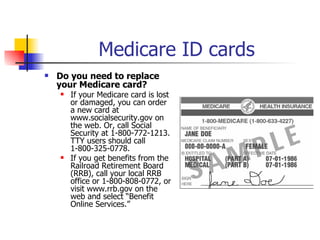
Medicare ID cards Do you need to replace your Medicare card? If your Medicare card is lost or damaged, you can order a new card at www.socialsecurity.gov on the web. Or, call Social Security at 1-800-772-1213. TTY users should call 1-800-325-0778.  If you get benefits from the Railroad Retirement Board (RRB), call your local RRB office or 1-800-808-0772, or visit www.rrb.gov on the web and select “Benefit Online Services.”
Enrollees Automatically eligible persons Voluntary enrollees
Automatically Eligible Persons Those entitled to and receiving Social Security cash benefits through early  retirement , or disability, based on employee Social Security contributions, and widow(er)s and spouses of persons who qualify for Social Security cash benefits  are automatically enrolled in Medicare Part A upon turning 65. Those eligible for, but not receiving, Social Security cash benefits upon turning 65  MUST APPLY  for cash benefits, or for hospital insurance (Part A) to receive them.
Voluntary Enrollees Persons age 65 and older who did not pay Social Security contributions may apply for Part A.  The premium for people who have between 30 and 40 quarters of covered employment is $233 per month - If less than 30 quarters, the premium is $423 per month Must be enrolled in Part B Disabled persons who lose Medicare because their status as disabled ended solely because their earnings exceeded “substantial gainful activity limits” may now purchase Parts A and B coverage.
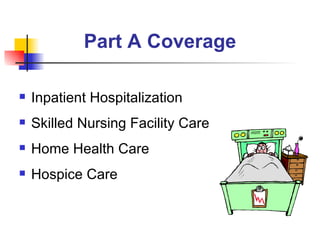
Part A Coverage Inpatient Hospitalization Skilled Nursing Facility Care Home Health Care Hospice Care
Inpatient hospital coverage The beneficiary pays a deductible of $1024 per benefit period.  A benefit period begins the day you receive inpatient hospital care and ends after an individual has been out of the hospital or skilled nursing facility for 60 consecutive days The beneficiary co-insurance of $256 for days 61-90 The beneficiary pays coinsurance of $512 a day  for the 91st through the 150th day. The beneficiary   pays   all costs for the first three pints of blood you get as an inpatient, then 20% of the Medicare-approved amount for additional pints of blood (unless donated to replace what’s used).
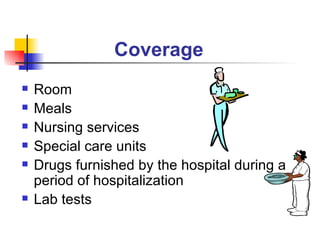
Coverage Room Meals Nursing services Special care units Drugs furnished by the hospital during a period of hospitalization Lab tests
Coverage ( cont.d) X-rays billed by the hospital Medical supplies (casts, surgical dressings) Use of medical appliances such as a wheelchair Operating and recovery room costs Rehabilitation services Blood transfusions  Medical social services
Coverage (cont.d) Emergency Care -  Psychiatric care -Lifetime benefit of 190 days of inpatient care received at a participating psychiatric hospital Alcoholism and drug dependency in a Medicare certified facility
Care Outside of United States Not covered, except: Beneficiary is in the US when an emergency occurs and a Canadian or Mexican hospital is closer than the nearest  US hospital that could provide the needed emergency service Beneficiary is in Canada traveling by the most direct route to or from Alaska and another state and an emergency occurs requiring emergency or hospital care
Skilled Nursing Facility Care Physician certifies you need skilled nursing or skilled rehabilitation services - required and received on a daily basis Medicare certified facility Three consecutive day hospital stay precedes transfer to a skilled nursing care facility (excludes day of discharge) Admitted within 30 days after leaving the hospital Medicare pays 100% for days 1-20 Medicare beneficiary pays  $128 per day for days 21–100 each benefit period Medicare beneficiary pays a ll costs for each day after day 100 in the benefit period
Skilled Care Skilled nursing care –  services that can be performed only by, or under the supervision of, licensed nursing personnel (registered nurses or licensed practical nurses) Skilled rehabilitation services (PT- OT -speech)
Skilled Care Is Not Custodial care  Part A will not pay if skilled care is not done on a DAILY basis
Special Issues for SNF Coverage Patient has to show significant rehabilitation potential and  steady improvement Services can only be provided in a SNF
Home Health Care Skilled care is needed part-time or on an intermittent basis , including physical therapy, or speech therapy   Confined to home but not necessarily bedridden Physician determines plan of care Agency participates in Medicare One predictable skilled care need every 60 days. Medicare beneficiary pays  $0 for home health care services Medicare beneficiary pays 20% of the Medicare-approved amount for durable medical equipment
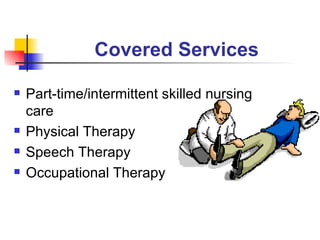
Covered Services Part-time/intermittent skilled nursing care Physical Therapy Speech Therapy Occupational Therapy
Other Covered Services   If you require a skilled care service, you may also get: Home Health Aides Medical Social Services Medical supplies and equipment Injectable drugs for osteoporosis
Hospice Care Eligible for Medicare Part A Certification by physician and hospice medical director that person is terminally ill Receives care from Hospice instead of Medicare Care provided by Medicare certified provider Medicare beneficiary  pays   a copayment of up to $5 for outpatient prescription drugs and 5% of the Medicare-approved amount for inpatient respite care (short-term care given by another caregiver, so the usual caregiver can rest).
Covered Services Nursing Services Medical Social Services Counseling, including bereavement counseling Physician services Home health aides
Covered Services (cont’d)  Medical supplies including drugs and biologicals needed to manage a terminal illness Physical therapy Speech therapy Short-term respite care Medical equipment Dietary Counseling
Where to go for Help Medicare.gov Publications: Compare Care - Nursing Home Brochure – 11075 Medicare & You 2007 - 10050   Medicare Coverage Outside of the U.S. - 11037   Guide to Choosing a Nursing Home - 02174   Medicare and Home Health Care - 10969   Medicare Coverage of Skilled Nursing Facility Care - 10153   Medicare Hospice Benefits - 02154   Medicare Limits on Therapy Services - 10988
Remember If aging isn’t  your issue now  it soon will be …

Medicare Part A

  • 1.
    MEDICARE PART AWhat is it? Who pays for it? How much does it cost? How do I sign up?
  • 2.
    Who Pays PartA premium comes from the payroll tax paid by employers, or Premiums from voluntary enrollees
  • 3.
    Eligibility Persons age65 and over eligible for Social Security or Railroad Retirement on their own record or that of a spouse Persons age 65 and over who have worked for federal, state or local governments long enough to earn the minimum quarters of coverage or who become eligible through a special “transitional provision.” Persons age 65 and over who are not eligible for Social Security or Railroad Retirement benefits, but who pay for Part A coverage Disabled individuals who have received 24 months of Social Security Disability Benefits Persons with end-stage renal (kidney) disease Persons with Lou Gehrig’s Disease
  • 4.
    Who determines eligibility?Social Security Administration Railroad Retirement Board
  • 5.
    Medicare ID cardsDo you need to replace your Medicare card? If your Medicare card is lost or damaged, you can order a new card at www.socialsecurity.gov on the web. Or, call Social Security at 1-800-772-1213. TTY users should call 1-800-325-0778. If you get benefits from the Railroad Retirement Board (RRB), call your local RRB office or 1-800-808-0772, or visit www.rrb.gov on the web and select “Benefit Online Services.”
  • 6.
    Enrollees Automatically eligiblepersons Voluntary enrollees
  • 7.
    Automatically Eligible PersonsThose entitled to and receiving Social Security cash benefits through early retirement , or disability, based on employee Social Security contributions, and widow(er)s and spouses of persons who qualify for Social Security cash benefits are automatically enrolled in Medicare Part A upon turning 65. Those eligible for, but not receiving, Social Security cash benefits upon turning 65 MUST APPLY for cash benefits, or for hospital insurance (Part A) to receive them.
  • 8.
    Voluntary Enrollees Personsage 65 and older who did not pay Social Security contributions may apply for Part A. The premium for people who have between 30 and 40 quarters of covered employment is $233 per month - If less than 30 quarters, the premium is $423 per month Must be enrolled in Part B Disabled persons who lose Medicare because their status as disabled ended solely because their earnings exceeded “substantial gainful activity limits” may now purchase Parts A and B coverage.
  • 9.
    Part A CoverageInpatient Hospitalization Skilled Nursing Facility Care Home Health Care Hospice Care
  • 10.
    Inpatient hospital coverageThe beneficiary pays a deductible of $1024 per benefit period. A benefit period begins the day you receive inpatient hospital care and ends after an individual has been out of the hospital or skilled nursing facility for 60 consecutive days The beneficiary co-insurance of $256 for days 61-90 The beneficiary pays coinsurance of $512 a day for the 91st through the 150th day. The beneficiary pays all costs for the first three pints of blood you get as an inpatient, then 20% of the Medicare-approved amount for additional pints of blood (unless donated to replace what’s used).
  • 11.
    Coverage Room MealsNursing services Special care units Drugs furnished by the hospital during a period of hospitalization Lab tests
  • 12.
    Coverage ( cont.d)X-rays billed by the hospital Medical supplies (casts, surgical dressings) Use of medical appliances such as a wheelchair Operating and recovery room costs Rehabilitation services Blood transfusions Medical social services
  • 13.
    Coverage (cont.d) EmergencyCare - Psychiatric care -Lifetime benefit of 190 days of inpatient care received at a participating psychiatric hospital Alcoholism and drug dependency in a Medicare certified facility
  • 14.
    Care Outside ofUnited States Not covered, except: Beneficiary is in the US when an emergency occurs and a Canadian or Mexican hospital is closer than the nearest US hospital that could provide the needed emergency service Beneficiary is in Canada traveling by the most direct route to or from Alaska and another state and an emergency occurs requiring emergency or hospital care
  • 15.
    Skilled Nursing FacilityCare Physician certifies you need skilled nursing or skilled rehabilitation services - required and received on a daily basis Medicare certified facility Three consecutive day hospital stay precedes transfer to a skilled nursing care facility (excludes day of discharge) Admitted within 30 days after leaving the hospital Medicare pays 100% for days 1-20 Medicare beneficiary pays $128 per day for days 21–100 each benefit period Medicare beneficiary pays a ll costs for each day after day 100 in the benefit period
  • 16.
    Skilled Care Skillednursing care – services that can be performed only by, or under the supervision of, licensed nursing personnel (registered nurses or licensed practical nurses) Skilled rehabilitation services (PT- OT -speech)
  • 17.
    Skilled Care IsNot Custodial care Part A will not pay if skilled care is not done on a DAILY basis
  • 18.
    Special Issues forSNF Coverage Patient has to show significant rehabilitation potential and steady improvement Services can only be provided in a SNF
  • 19.
    Home Health CareSkilled care is needed part-time or on an intermittent basis , including physical therapy, or speech therapy Confined to home but not necessarily bedridden Physician determines plan of care Agency participates in Medicare One predictable skilled care need every 60 days. Medicare beneficiary pays $0 for home health care services Medicare beneficiary pays 20% of the Medicare-approved amount for durable medical equipment
  • 20.
    Covered Services Part-time/intermittentskilled nursing care Physical Therapy Speech Therapy Occupational Therapy
  • 21.
    Other Covered Services If you require a skilled care service, you may also get: Home Health Aides Medical Social Services Medical supplies and equipment Injectable drugs for osteoporosis
  • 22.
    Hospice Care Eligiblefor Medicare Part A Certification by physician and hospice medical director that person is terminally ill Receives care from Hospice instead of Medicare Care provided by Medicare certified provider Medicare beneficiary pays a copayment of up to $5 for outpatient prescription drugs and 5% of the Medicare-approved amount for inpatient respite care (short-term care given by another caregiver, so the usual caregiver can rest).
  • 23.
    Covered Services NursingServices Medical Social Services Counseling, including bereavement counseling Physician services Home health aides
  • 24.
    Covered Services (cont’d) Medical supplies including drugs and biologicals needed to manage a terminal illness Physical therapy Speech therapy Short-term respite care Medical equipment Dietary Counseling
  • 25.
    Where to gofor Help Medicare.gov Publications: Compare Care - Nursing Home Brochure – 11075 Medicare & You 2007 - 10050 Medicare Coverage Outside of the U.S. - 11037 Guide to Choosing a Nursing Home - 02174 Medicare and Home Health Care - 10969 Medicare Coverage of Skilled Nursing Facility Care - 10153 Medicare Hospice Benefits - 02154 Medicare Limits on Therapy Services - 10988
  • 26.
    Remember If agingisn’t your issue now it soon will be …