The Medicare Access and CHIP Reauthorization Act of 2015 (“MACRA”) will
fundamentally change how physicians and other clinicians are reimbursed under
the Medicare Physician Fee Schedule. Because the passage of MACRA
permanently repealed the Sustainable Growth Rate formula for determining
Medicare payments, a new framework for payment was established geared
toward rewarding clinicians for value over volume.
The major provision of MACRA is the Quality Payment Program which
incorporates quality measurements into payments by establishing the Merit-
Based Incentive Payment System (“MIPS”) as the new program for certain
Medicare-participating clinicians, and also establishes incentives for participation
in certain Alternative Payment Models (“APMs”).
While the new payment model associated with MACRA does not begin until
2019, the data used in the calculation will be generated in 2017 – that is why
the new Quality Payment Program essentially begins now. This guide provides
you with 5 Steps that will get you ready for MIPS.
Remember, the MIPS program is designed as budget neutral; it will pay bonuses
to high performers and penalize low performers. Payment adjustments are
determined on a relative basis, not on a fixed performance score. If you do not
report, you will receive the 4% negative payment adjustment.
5 Steps to Get Ready for MIPS Transition Year 2017
VantagePoint
THOUGHT LEADERSHIP FROM VANTAGEPOINT HEALTHCARE ADVISORS
The MIPS program will
pay bonuses to high
performers and penalize
low performers. If you do
not report, you will receive
the 4% negative payment
adjustment.
This article details how you
can ensure eligibility and
take best advantage of
what the program offers.
Step 1:
HOW WILL YOU BE
REPORTING FOR MIPS?
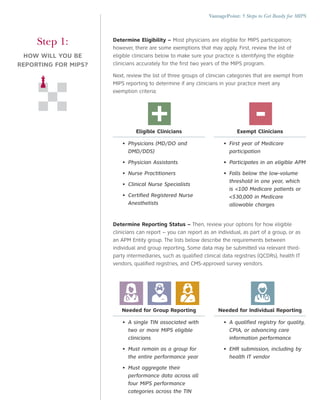
Determine Eligibility – Most physicians are eligible for MIPS participation;
however, there are some exemptions that may apply. First, review the list of
eligible clinicians below to make sure your practice is identifying the eligible
clinicians accurately for the first two years of the MIPS program.
Next, review the list of three groups of clinician categories that are exempt from
MIPS reporting to determine if any clinicians in your practice meet any
exemption criteria:
Determine Reporting Status – Then, review your options for how eligible
clinicians can report – you can report as an individual, as part of a group, or as
an APM Entity group. The lists below describe the requirements between
individual and group reporting. Some data may be submitted via relevant third-
party intermediaries, such as qualified clinical data registries (QCDRs), health IT
vendors, qualified registries, and CMS-approved survey vendors.
Eligible Clinicians
• Physicians (MD/DO and
DMD/DDS)
• Physician Assistants
• Nurse Practitioners
• Clinical Nurse Specialists
• Certified Registered Nurse
Anesthetists
Exempt Clinicians
• First year of Medicare
participation
• Participates in an eligible APM
• Falls below the low-volume
threshold in one year, which
is <100 Medicare patients or
<$30,000 in Medicare
allowable charges
VantagePoint: 5 Steps to Get Ready for MIPS
Step 1:
HOW WILL YOU BE
REPORTING FOR MIPS?
++ -
Needed for Group Reporting
• A single TIN associated with
two or more MIPS eligible
clinicians
• Must remain as a group for
the entire performance year
• Must aggregate their
performance data across all
four MIPS performance
categories across the TIN
Needed for Individual Reporting
• A qualified registry for quality,
CPIA, or advancing care
information performance
• EHR submission, including by
health IT vendor
Reviewing your current data results and reports is critical. Analyze your Physician
Quality Reporting System (“PQRS”) results, your Meaningful Use performance
reports and any other performance data you have to identify those areas of
good performance. Also review any performance improvement activities you are
working on because they may count toward your Improvement Activity score.
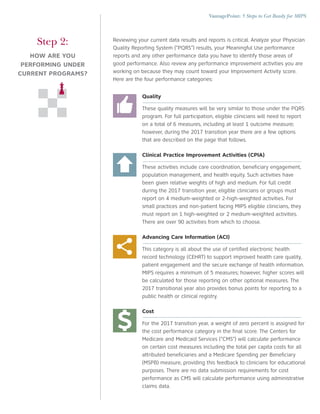
Here are the four performance categories:
VantagePoint: 5 Steps to Get Ready for MIPS
Step 2:
HOW ARE YOU
PERFORMING UNDER
CURRENT PROGRAMS?
Quality
These quality measures will be very similar to those under the PQRS
program. For full participation, eligible clinicians will need to report
on a total of 6 measures, including at least 1 outcome measure;
however, during the 2017 transition year there are a few options
that are described on the page that follows.
Clinical Practice Improvement Activities (CPIA)
These activities include care coordination, beneficiary engagement,
population management, and health equity. Such activities have
been given relative weights of high and medium. For full credit
during the 2017 transition year, eligible clinicians or groups must
report on 4 medium-weighted or 2-high-weighted activities. For
small practices and non-patient facing MIPS eligible clinicians, they
must report on 1 high-weighted or 2 medium-weighted activities.
There are over 90 activities from which to choose.
Advancing Care Information (ACI)
This category is all about the use of certified electronic health
record technology (CEHRT) to support improved health care quality,
patient engagement and the secure exchange of health information.
MIPS requires a minimum of 5 measures; however, higher scores will
be calculated for those reporting on other optional measures. The
2017 transitional year also provides bonus points for reporting to a
public health or clinical registry.
Cost
For the 2017 transition year, a weight of zero percent is assigned for
the cost performance category in the final score. The Centers for
Medicare and Medicaid Services (“CMS”) will calculate performance
on certain cost measures including the total per capita costs for all
attributed beneficiaries and a Medicare Spending per Beneficiary
(MSPB) measure, providing this feedback to clinicians for educational
purposes. There are no data submission requirements for cost
performance as CMS will calculate performance using administrative
claims data.
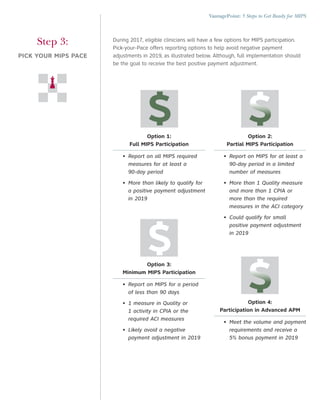
During 2017, eligible clinicians will have a few options for MIPS participation.
Pick-your-Pace offers reporting options to help avoid negative payment
adjustments in 2019, as illustrated below. Although, full implementation should
be the goal to receive the best positive payment adjustment.
VantagePoint: 5 Steps to Get Ready for MIPS
Step 3:
PICK YOUR MIPS PACE
Option 1:
Full MIPS Participation
• Report on all MIPS required
measures for at least a
90-day period
• More than likely to qualify for
a positive payment adjustment
in 2019
Option 2:
Partial MIPS Participation
• Report on MIPS for at least a
90-day period in a limited
number of measures
• More than 1 Quality measure
and more than 1 CPIA or
more than the required
measures in the ACI category
• Could qualify for small
positive payment adjustment
in 2019
Option 3:
Minimum MIPS Participation
• Report on MIPS for a period
of less than 90 days
• 1 measure in Quality or
1 activity in CPIA or the
required ACI measures
• Likely avoid a negative
payment adjustment in 2019
Option 4:
Participation in Advanced APM
• Meet the volume and payment
requirements and receive a
5% bonus payment in 2019
For the 2017 transition year, you will
need to select your MIPS measures
(depending upon the Pick-your-Pace
option) based on your current areas of
good performance. Each year your
MIPS measures can change so be sure
to select the measures that will earn
you or your group the most points.
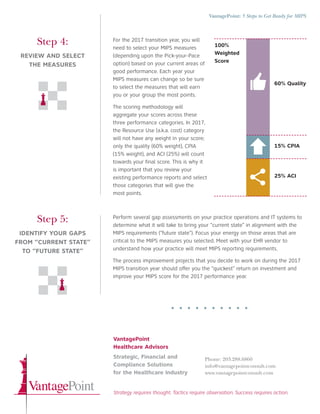
The scoring methodology will
aggregate your scores across these
three performance categories. In 2017,
the Resource Use (a.k.a. cost) category
will not have any weight in your score;
only the quality (60% weight), CPIA
(15% weight), and ACI (25%) will count
towards your final score. This is why it
is important that you review your
existing performance reports and select
those categories that will give the
most points.
Perform several gap assessments on your practice operations and IT systems to
determine what it will take to bring your “current state” in alignment with the
MIPS requirements (“future state”). Focus your energy on those areas that are
critical to the MIPS measures you selected. Meet with your EHR vendor to
understand how your practice will meet MIPS reporting requirements.
The process improvement projects that you decide to work on during the 2017
MIPS transition year should offer you the “quickest” return on investment and
improve your MIPS score for the 2017 performance year.
• • • • • • • • • •
VantagePoint: 5 Steps to Get Ready for MIPS
VantagePoint
Healthcare Advisors
Strategic, Financial and
Compliance Solutions
for the Healthcare Industry
Strategy requires thought. Tactics require observation. Success requires action.
Phone: 203.288.6860
info@vantagepointconsult.com
www.vantagepointconsult.com
Step 5:
IDENTIFY YOUR GAPS
FROM “CURRENT STATE”
TO “FUTURE STATE”
Step 4:
REVIEW AND SELECT
THE MEASURES
60% Quality
100%
Weighted
Score
15% CPIA
25% ACI

5 Steps to MIPS

  • 1.
    The Medicare Accessand CHIP Reauthorization Act of 2015 (“MACRA”) will fundamentally change how physicians and other clinicians are reimbursed under the Medicare Physician Fee Schedule. Because the passage of MACRA permanently repealed the Sustainable Growth Rate formula for determining Medicare payments, a new framework for payment was established geared toward rewarding clinicians for value over volume. The major provision of MACRA is the Quality Payment Program which incorporates quality measurements into payments by establishing the Merit- Based Incentive Payment System (“MIPS”) as the new program for certain Medicare-participating clinicians, and also establishes incentives for participation in certain Alternative Payment Models (“APMs”). While the new payment model associated with MACRA does not begin until 2019, the data used in the calculation will be generated in 2017 – that is why the new Quality Payment Program essentially begins now. This guide provides you with 5 Steps that will get you ready for MIPS. Remember, the MIPS program is designed as budget neutral; it will pay bonuses to high performers and penalize low performers. Payment adjustments are determined on a relative basis, not on a fixed performance score. If you do not report, you will receive the 4% negative payment adjustment. 5 Steps to Get Ready for MIPS Transition Year 2017 VantagePoint THOUGHT LEADERSHIP FROM VANTAGEPOINT HEALTHCARE ADVISORS The MIPS program will pay bonuses to high performers and penalize low performers. If you do not report, you will receive the 4% negative payment adjustment. This article details how you can ensure eligibility and take best advantage of what the program offers. Step 1: HOW WILL YOU BE REPORTING FOR MIPS?
  • 2.
    Determine Eligibility –Most physicians are eligible for MIPS participation; however, there are some exemptions that may apply. First, review the list of eligible clinicians below to make sure your practice is identifying the eligible clinicians accurately for the first two years of the MIPS program. Next, review the list of three groups of clinician categories that are exempt from MIPS reporting to determine if any clinicians in your practice meet any exemption criteria: Determine Reporting Status – Then, review your options for how eligible clinicians can report – you can report as an individual, as part of a group, or as an APM Entity group. The lists below describe the requirements between individual and group reporting. Some data may be submitted via relevant third- party intermediaries, such as qualified clinical data registries (QCDRs), health IT vendors, qualified registries, and CMS-approved survey vendors. Eligible Clinicians • Physicians (MD/DO and DMD/DDS) • Physician Assistants • Nurse Practitioners • Clinical Nurse Specialists • Certified Registered Nurse Anesthetists Exempt Clinicians • First year of Medicare participation • Participates in an eligible APM • Falls below the low-volume threshold in one year, which is <100 Medicare patients or <$30,000 in Medicare allowable charges VantagePoint: 5 Steps to Get Ready for MIPS Step 1: HOW WILL YOU BE REPORTING FOR MIPS? ++ - Needed for Group Reporting • A single TIN associated with two or more MIPS eligible clinicians • Must remain as a group for the entire performance year • Must aggregate their performance data across all four MIPS performance categories across the TIN Needed for Individual Reporting • A qualified registry for quality, CPIA, or advancing care information performance • EHR submission, including by health IT vendor
  • 3.
    Reviewing your currentdata results and reports is critical. Analyze your Physician Quality Reporting System (“PQRS”) results, your Meaningful Use performance reports and any other performance data you have to identify those areas of good performance. Also review any performance improvement activities you are working on because they may count toward your Improvement Activity score. Here are the four performance categories: VantagePoint: 5 Steps to Get Ready for MIPS Step 2: HOW ARE YOU PERFORMING UNDER CURRENT PROGRAMS? Quality These quality measures will be very similar to those under the PQRS program. For full participation, eligible clinicians will need to report on a total of 6 measures, including at least 1 outcome measure; however, during the 2017 transition year there are a few options that are described on the page that follows. Clinical Practice Improvement Activities (CPIA) These activities include care coordination, beneficiary engagement, population management, and health equity. Such activities have been given relative weights of high and medium. For full credit during the 2017 transition year, eligible clinicians or groups must report on 4 medium-weighted or 2-high-weighted activities. For small practices and non-patient facing MIPS eligible clinicians, they must report on 1 high-weighted or 2 medium-weighted activities. There are over 90 activities from which to choose. Advancing Care Information (ACI) This category is all about the use of certified electronic health record technology (CEHRT) to support improved health care quality, patient engagement and the secure exchange of health information. MIPS requires a minimum of 5 measures; however, higher scores will be calculated for those reporting on other optional measures. The 2017 transitional year also provides bonus points for reporting to a public health or clinical registry. Cost For the 2017 transition year, a weight of zero percent is assigned for the cost performance category in the final score. The Centers for Medicare and Medicaid Services (“CMS”) will calculate performance on certain cost measures including the total per capita costs for all attributed beneficiaries and a Medicare Spending per Beneficiary (MSPB) measure, providing this feedback to clinicians for educational purposes. There are no data submission requirements for cost performance as CMS will calculate performance using administrative claims data.
  • 4.
    During 2017, eligibleclinicians will have a few options for MIPS participation. Pick-your-Pace offers reporting options to help avoid negative payment adjustments in 2019, as illustrated below. Although, full implementation should be the goal to receive the best positive payment adjustment. VantagePoint: 5 Steps to Get Ready for MIPS Step 3: PICK YOUR MIPS PACE Option 1: Full MIPS Participation • Report on all MIPS required measures for at least a 90-day period • More than likely to qualify for a positive payment adjustment in 2019 Option 2: Partial MIPS Participation • Report on MIPS for at least a 90-day period in a limited number of measures • More than 1 Quality measure and more than 1 CPIA or more than the required measures in the ACI category • Could qualify for small positive payment adjustment in 2019 Option 3: Minimum MIPS Participation • Report on MIPS for a period of less than 90 days • 1 measure in Quality or 1 activity in CPIA or the required ACI measures • Likely avoid a negative payment adjustment in 2019 Option 4: Participation in Advanced APM • Meet the volume and payment requirements and receive a 5% bonus payment in 2019
  • 5.
    For the 2017transition year, you will need to select your MIPS measures (depending upon the Pick-your-Pace option) based on your current areas of good performance. Each year your MIPS measures can change so be sure to select the measures that will earn you or your group the most points. The scoring methodology will aggregate your scores across these three performance categories. In 2017, the Resource Use (a.k.a. cost) category will not have any weight in your score; only the quality (60% weight), CPIA (15% weight), and ACI (25%) will count towards your final score. This is why it is important that you review your existing performance reports and select those categories that will give the most points. Perform several gap assessments on your practice operations and IT systems to determine what it will take to bring your “current state” in alignment with the MIPS requirements (“future state”). Focus your energy on those areas that are critical to the MIPS measures you selected. Meet with your EHR vendor to understand how your practice will meet MIPS reporting requirements. The process improvement projects that you decide to work on during the 2017 MIPS transition year should offer you the “quickest” return on investment and improve your MIPS score for the 2017 performance year. • • • • • • • • • • VantagePoint: 5 Steps to Get Ready for MIPS VantagePoint Healthcare Advisors Strategic, Financial and Compliance Solutions for the Healthcare Industry Strategy requires thought. Tactics require observation. Success requires action. Phone: 203.288.6860 info@vantagepointconsult.com www.vantagepointconsult.com Step 5: IDENTIFY YOUR GAPS FROM “CURRENT STATE” TO “FUTURE STATE” Step 4: REVIEW AND SELECT THE MEASURES 60% Quality 100% Weighted Score 15% CPIA 25% ACI