

KMGMA Fall Conference
September 22, 2016
The March To MIPS
The March To MIPS Page 1
Session Objectives
 Maintain audience consciousness
 Define “value-based reimbursement”
 Review MACRA legislation
 Provide deep dive into MIPS proposed rule
 Convey sense of urgency
The March To MIPS Page 2
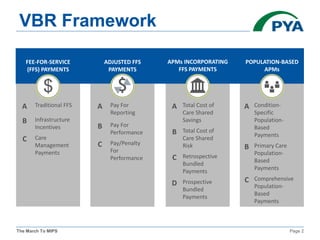
VBR Framework
FEE-FOR-SERVICE
(FFS) PAYMENTS
POPULATION-BASED
APMs
ADJUSTED FFS
PAYMENTS
APMs INCORPORATING
FFS PAYMENTS
$
$
Bank
A Pay For
Reporting
B Pay For
Performance
C Pay/Penalty
For
Performance
A Total Cost of
Care Shared
Savings
B Total Cost of
Care Shared
Risk
C Retrospective
Bundled
Payments
D Prospective
Bundled
Payments
A Condition-
Specific
Population-
Based
Payments
B Primary Care
Population-
Based
Payments
C Comprehensive
Population-
Based
Payments
A Traditional FFS
B Infrastructure
Incentives
C Care
Management
Payments
The March To MIPS Page 3
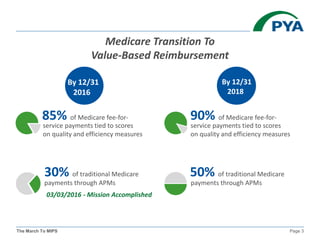
Medicare Transition To
Value-Based Reimbursement
By 12/31
2016
By 12/31
2018
30% of traditional Medicare
payments through APMs
50% of traditional Medicare
payments through APMs
85% of Medicare fee-for-
service payments tied to scores
on quality and efficiency measures
90% of Medicare fee-for-
service payments tied to scores
on quality and efficiency measures
03/03/2016 - Mission Accomplished
The March To MIPS Page 4
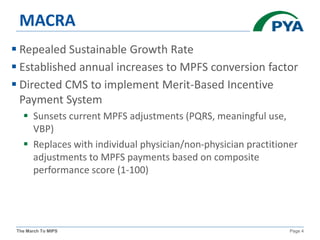
MACRA
 Repealed Sustainable Growth Rate
 Established annual increases to MPFS conversion factor
 Directed CMS to implement Merit-Based Incentive
Payment System
 Sunsets current MPFS adjustments (PQRS, meaningful use,
VBP)
 Replaces with individual physician/non-physician practitioner
adjustments to MPFS payments based on composite
performance score (1-100)
The March To MIPS Page 5
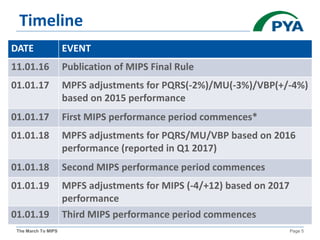
Timeline
DATE EVENT
11.01.16 Publication of MIPS Final Rule
01.01.17 MPFS adjustments for PQRS(-2%)/MU(-3%)/VBP(+/-4%)
based on 2015 performance
01.01.17 First MIPS performance period commences*
01.01.18 MPFS adjustments for PQRS/MU/VBP based on 2016
performance (reported in Q1 2017)
01.01.18 Second MIPS performance period commences
01.01.19 MPFS adjustments for MIPS (-4/+12) based on 2017
performance
01.01.19 Third MIPS performance period commences
The March To MIPS Page 6
Physician Awareness
 Deloitte 2016 Survey of U.S. Physicians
 50% of non-pediatrician physicians had never heard of MACRA
 32% recognized the name, but not familiar with details
 21% of self-employed physicians reported some level of
familiarity
 9% of employed physicians reported the same
The March To MIPS Page 7
MIPS-Eligible Clinicians
Years 1 and 2 Years 3+
Physicians (MD/DO & DMD/DDS),
PAs, NPs, CNSs, CRNA
Physical or occupational therapists, speech-
language pathologists, audiologists, nurse
midwives, clinical social workers, clinical
psychologists, dieticians/nutritional
professionals
The March To MIPS Page 8
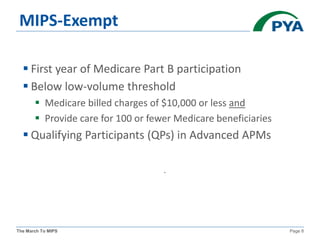
MIPS-Exempt
 First year of Medicare Part B participation
 Below low-volume threshold
 Medicare billed charges of $10,000 or less and
 Provide care for 100 or fewer Medicare beneficiaries
 Qualifying Participants (QPs) in Advanced APMs
.
The March To MIPS Page 9
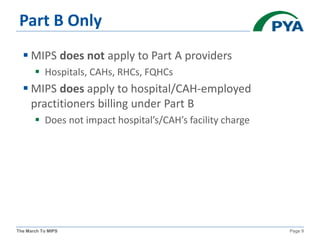
Part B Only
 MIPS does not apply to Part A providers
 Hospitals, CAHs, RHCs, FQHCs
 MIPS does apply to hospital/CAH-employed
practitioners billing under Part B
 Does not impact hospital’s/CAH’s facility charge
The March To MIPS Page 10
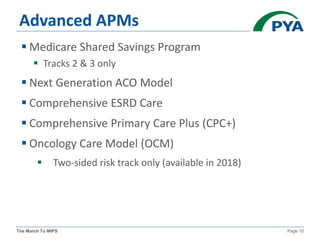
Advanced APMs
 Medicare Shared Savings Program
 Tracks 2 & 3 only
 Next Generation ACO Model
 Comprehensive ESRD Care
 Comprehensive Primary Care Plus (CPC+)
 Oncology Care Model (OCM)
 Two-sided risk track only (available in 2018)
The March To MIPS Page 11
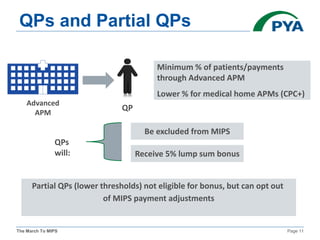
QPs and Partial QPs
Be excluded from MIPS
Minimum % of patients/payments
through Advanced APM
Lower % for medical home APMs (CPC+)
Receive 5% lump sum bonus
QPs
will:
QP
Advanced
APM
Partial QPs (lower thresholds) not eligible for bonus, but can opt out
of MIPS payment adjustments
The March To MIPS Page 12
2017 CPS Components
Quality - 50%
Resource Use - 10%
Advancing Care
Information - 25%
Clinical Practice
Improvement Activities -
15%
The March To MIPS Page 13
2018 CPS Components
Quality - 45%
Resource Use - 15%
Advancing Care
Information - 25%
Clinical Practice
Improvement Activities -
15%
The March To MIPS Page 14
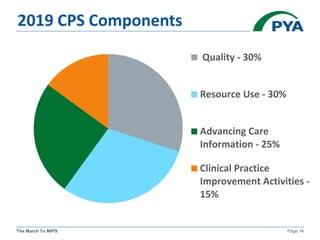
2019 CPS Components
Quality - 30%
Resource Use - 30%
Advancing Care
Information - 25%
Clinical Practice
Improvement Activities -
15%
The March To MIPS Page 15
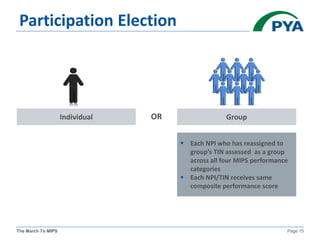
Participation Election
Individual Group
 Each NPI who has reassigned to
group’s TIN assessed as a group
across all four MIPS performance
categories
 Each NPI/TIN receives same
composite performance score
OR
The March To MIPS Page 16
Hedging Bets
 If group (TIN) reports, clinician (NPI) may also report
individually for the same performance year
 In adjustment year, CMS will assign the higher CPS (group
or individual) to NPI’s services billed under that TIN
 If NPI bills under multiple TINs during performance
year, CPS for that NPI/TIN will apply in adjustment
year
The March To MIPS Page 17
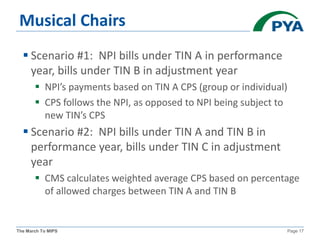
Musical Chairs
 Scenario #1: NPI bills under TIN A in performance
year, bills under TIN B in adjustment year
 NPI’s payments based on TIN A CPS (group or individual)
 CPS follows the NPI, as opposed to NPI being subject to
new TIN’s CPS
 Scenario #2: NPI bills under TIN A and TIN B in
performance year, bills under TIN C in adjustment
year
 CMS calculates weighted average CPS based on percentage
of allowed charges between TIN A and TIN B
The March To MIPS Page 18
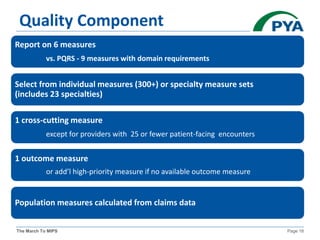
Quality Component
Report on 6 measures
vs. PQRS - 9 measures with domain requirements
Select from individual measures (300+) or specialty measure sets
(includes 23 specialties)
1 cross-cutting measure
except for providers with 25 or fewer patient-facing encounters
1 outcome measure
or add’l high-priority measure if no available outcome measure
Population measures calculated from claims data
The March To MIPS Page 19
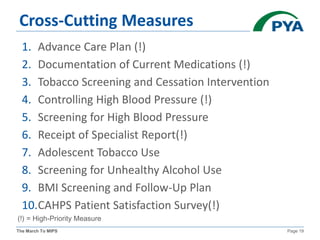
Cross-Cutting Measures
1. Advance Care Plan (!)
2. Documentation of Current Medications (!)
3. Tobacco Screening and Cessation Intervention
4. Controlling High Blood Pressure (!)
5. Screening for High Blood Pressure
6. Receipt of Specialist Report(!)
7. Adolescent Tobacco Use
8. Screening for Unhealthy Alcohol Use
9. BMI Screening and Follow-Up Plan
10.CAHPS Patient Satisfaction Survey(!)
(!) = High-Priority Measure
The March To MIPS Page 20
Quality Score Calculation
The March To MIPS Page 21
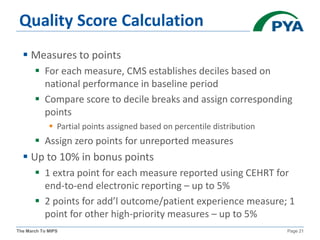
Quality Score Calculation
 Measures to points
 For each measure, CMS establishes deciles based on
national performance in baseline period
 Compare score to decile breaks and assign corresponding
points
 Partial points assigned based on percentile distribution
 Assign zero points for unreported measures
 Up to 10% in bonus points
 1 extra point for each measure reported using CEHRT for
end-to-end electronic reporting – up to 5%
 2 points for add’l outcome/patient experience measure; 1
point for other high-priority measures – up to 5%
The March To MIPS Page 22
Point Assignment Based on Deciles
The March To MIPS Page 23
The March To MIPS Page 24
Resource Use Component
 Utilize two current VM Program measures
 Total per capita cost for all attributed beneficiaries
 Medicare spending per beneficiary
 Replace VM Program’s four condition-specific
measures with episode-based efficiency measures
 41 proposed clinical condition/treatment episodes
The March To MIPS Page 25
The March To MIPS Page 26
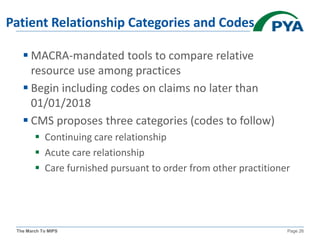
Patient Relationship Categories and Codes
 MACRA-mandated tools to compare relative
resource use among practices
 Begin including codes on claims no later than
01/01/2018
 CMS proposes three categories (codes to follow)
 Continuing care relationship
 Acute care relationship
 Care furnished pursuant to order from other practitioner
The March To MIPS Page 27
CPIA Component
 Minimum selection of one CPIA activity (from 90+ proposed
activities) with additional credit for more activities
 Full credit for patient-centered medical home
 Minimum half credit for APM participation
The March To MIPS Page 28
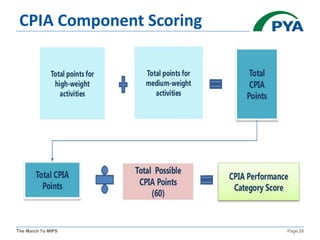
CPIA Component Scoring
The March To MIPS Page 29
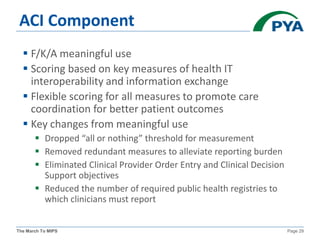
ACI Component
 F/K/A meaningful use
 Scoring based on key measures of health IT
interoperability and information exchange
 Flexible scoring for all measures to promote care
coordination for better patient outcomes
 Key changes from meaningful use
 Dropped “all or nothing” threshold for measurement
 Removed redundant measures to alleviate reporting burden
 Eliminated Clinical Provider Order Entry and Clinical Decision
Support objectives
 Reduced the number of required public health registries to
which clinicians must report
The March To MIPS Page 30
Base Score (50 points)
The March To MIPS Page 31
Performance Score (80 points)
The March To MIPS Page 32
Composite Score
Bonus Point relates to reporting to public heath registries
The March To MIPS Page 33
APM Scoring Standard
 Applies to participants in MIPS APMs (other than QPs)
 Advanced APMs
 Track 1 MSSP ACO
 Oncology Care Model (one-sided model)
 Avoid multiple reporting requirements
 Applies to all NPIs participating in APM as of last day
of performance period
 NPI’s APM CPS trumps all other CPS (group or
individual)
The March To MIPS Page 34
Applying the APM Scoring Standard
 Component weighting
 50% quality
 30% advancing care information
 20% clinical practice improvement activities
 Quality component score based on APM
performance measures
 For ACI and CPIA components, each ACO participant
(TIN) reports as group
 CMS calculates APM’s scores for these components based
on the weighted mean average of TINs’ scores
 Weighting based on # of clinicians billing under each TIN
The March To MIPS Page 35
Data Submission Options
Quality and Resource Use
 Claims
 QCDR
 Qualified Registry
 EHR Vendors
 Administrative Claims
(No submission required)
Individual Reporting Group Reporting
 Administrative Claims
(No submission required)
 QCDR
 Qualified Registry
 EHR Vendors
 CMS Web Interface (groups of
25 or more)
 CAHPS for MIPS Survey
 Administrative Claims
(No submission required)
 Administrative Claims
(No submission required)
Quality
Resource Use
The March To MIPS Page 36
Data Submission Options
Advancing Care Information and CPIA
 Attestation
 QCDR
 Qualified Registry
 EHR Vendors
Individual Reporting Group Reporting
 Attestation
 QCDR
 Qualified Registry
 EHR Vendors
 Administrative Claims
(No submission required)
 Attestation
 QCDR
 Qualified Registry
 EHR Vendors
 CMS Web Interface (groups of
25+)
 Attestation
 QCDR
 Qualified Registry
 EHR Vendors
 Administrative Claims
(No submission required)
Advancing
care
information
CPIA
The March To MIPS Page 37
Performance Threshold
Mean or median of composite performance score for
all MIPS-eligible clinicians for period
prior to performance period
Score below threshold = penalty
Score above threshold = bonus
The March To MIPS Page 38
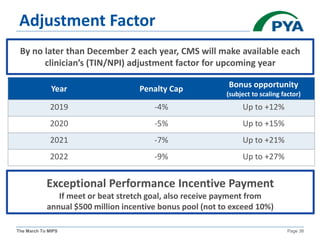
Adjustment Factor
Year Penalty Cap Bonus opportunity
(subject to scaling factor)
2019 -4% Up to +12%
2020 -5% Up to +15%
2021 -7% Up to +21%
2022 -9% Up to +27%
Exceptional Performance Incentive Payment
If meet or beat stretch goal, also receive payment from
annual $500 million incentive bonus pool (not to exceed 10%)
By no later than December 2 each year, CMS will make available each
clinician’s (TIN/NPI) adjustment factor for upcoming year
The March To MIPS Page 39
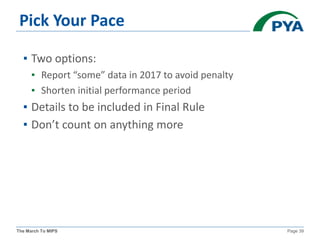
Pick Your Pace
▪ Two options:
▪ Report “some” data in 2017 to avoid penalty
▪ Shorten initial performance period
▪ Details to be included in Final Rule
▪ Don’t count on anything more
The March To MIPS Page 40
Reputational Impact
▪ Each clinician’s composite and component scores
published on Physician Compare website
▪ MIPS-based decision-making
▪ Individual patients
▪ Provider networks
▪ Medical staff credentialing
▪ Professional liability insurance
▪ Others?
The March to MIPS Page 41
Thank You!
• 20+ years as healthcare transactional
and regulatory attorney
• Consulting practice focused on value
transformation
• Believer in “simple”
Martie Ross, JD
Principal, Pershing Yoakley & Associates
mross@pyapc.com

The March to MIPS

  • 1.
    KMGMA Fall Conference September22, 2016 The March To MIPS
  • 2.
    The March ToMIPS Page 1 Session Objectives  Maintain audience consciousness  Define “value-based reimbursement”  Review MACRA legislation  Provide deep dive into MIPS proposed rule  Convey sense of urgency
  • 3.
    The March ToMIPS Page 2 VBR Framework FEE-FOR-SERVICE (FFS) PAYMENTS POPULATION-BASED APMs ADJUSTED FFS PAYMENTS APMs INCORPORATING FFS PAYMENTS $ $ Bank A Pay For Reporting B Pay For Performance C Pay/Penalty For Performance A Total Cost of Care Shared Savings B Total Cost of Care Shared Risk C Retrospective Bundled Payments D Prospective Bundled Payments A Condition- Specific Population- Based Payments B Primary Care Population- Based Payments C Comprehensive Population- Based Payments A Traditional FFS B Infrastructure Incentives C Care Management Payments
  • 4.
    The March ToMIPS Page 3 Medicare Transition To Value-Based Reimbursement By 12/31 2016 By 12/31 2018 30% of traditional Medicare payments through APMs 50% of traditional Medicare payments through APMs 85% of Medicare fee-for- service payments tied to scores on quality and efficiency measures 90% of Medicare fee-for- service payments tied to scores on quality and efficiency measures 03/03/2016 - Mission Accomplished
  • 5.
    The March ToMIPS Page 4 MACRA  Repealed Sustainable Growth Rate  Established annual increases to MPFS conversion factor  Directed CMS to implement Merit-Based Incentive Payment System  Sunsets current MPFS adjustments (PQRS, meaningful use, VBP)  Replaces with individual physician/non-physician practitioner adjustments to MPFS payments based on composite performance score (1-100)
  • 6.
    The March ToMIPS Page 5 Timeline DATE EVENT 11.01.16 Publication of MIPS Final Rule 01.01.17 MPFS adjustments for PQRS(-2%)/MU(-3%)/VBP(+/-4%) based on 2015 performance 01.01.17 First MIPS performance period commences* 01.01.18 MPFS adjustments for PQRS/MU/VBP based on 2016 performance (reported in Q1 2017) 01.01.18 Second MIPS performance period commences 01.01.19 MPFS adjustments for MIPS (-4/+12) based on 2017 performance 01.01.19 Third MIPS performance period commences
  • 7.
    The March ToMIPS Page 6 Physician Awareness  Deloitte 2016 Survey of U.S. Physicians  50% of non-pediatrician physicians had never heard of MACRA  32% recognized the name, but not familiar with details  21% of self-employed physicians reported some level of familiarity  9% of employed physicians reported the same
  • 8.
    The March ToMIPS Page 7 MIPS-Eligible Clinicians Years 1 and 2 Years 3+ Physicians (MD/DO & DMD/DDS), PAs, NPs, CNSs, CRNA Physical or occupational therapists, speech- language pathologists, audiologists, nurse midwives, clinical social workers, clinical psychologists, dieticians/nutritional professionals
  • 9.
    The March ToMIPS Page 8 MIPS-Exempt  First year of Medicare Part B participation  Below low-volume threshold  Medicare billed charges of $10,000 or less and  Provide care for 100 or fewer Medicare beneficiaries  Qualifying Participants (QPs) in Advanced APMs .
  • 10.
    The March ToMIPS Page 9 Part B Only  MIPS does not apply to Part A providers  Hospitals, CAHs, RHCs, FQHCs  MIPS does apply to hospital/CAH-employed practitioners billing under Part B  Does not impact hospital’s/CAH’s facility charge
  • 11.
    The March ToMIPS Page 10 Advanced APMs  Medicare Shared Savings Program  Tracks 2 & 3 only  Next Generation ACO Model  Comprehensive ESRD Care  Comprehensive Primary Care Plus (CPC+)  Oncology Care Model (OCM)  Two-sided risk track only (available in 2018)
  • 12.
    The March ToMIPS Page 11 QPs and Partial QPs Be excluded from MIPS Minimum % of patients/payments through Advanced APM Lower % for medical home APMs (CPC+) Receive 5% lump sum bonus QPs will: QP Advanced APM Partial QPs (lower thresholds) not eligible for bonus, but can opt out of MIPS payment adjustments
  • 13.
    The March ToMIPS Page 12 2017 CPS Components Quality - 50% Resource Use - 10% Advancing Care Information - 25% Clinical Practice Improvement Activities - 15%
  • 14.
    The March ToMIPS Page 13 2018 CPS Components Quality - 45% Resource Use - 15% Advancing Care Information - 25% Clinical Practice Improvement Activities - 15%
  • 15.
    The March ToMIPS Page 14 2019 CPS Components Quality - 30% Resource Use - 30% Advancing Care Information - 25% Clinical Practice Improvement Activities - 15%
  • 16.
    The March ToMIPS Page 15 Participation Election Individual Group  Each NPI who has reassigned to group’s TIN assessed as a group across all four MIPS performance categories  Each NPI/TIN receives same composite performance score OR
  • 17.
    The March ToMIPS Page 16 Hedging Bets  If group (TIN) reports, clinician (NPI) may also report individually for the same performance year  In adjustment year, CMS will assign the higher CPS (group or individual) to NPI’s services billed under that TIN  If NPI bills under multiple TINs during performance year, CPS for that NPI/TIN will apply in adjustment year
  • 18.
    The March ToMIPS Page 17 Musical Chairs  Scenario #1: NPI bills under TIN A in performance year, bills under TIN B in adjustment year  NPI’s payments based on TIN A CPS (group or individual)  CPS follows the NPI, as opposed to NPI being subject to new TIN’s CPS  Scenario #2: NPI bills under TIN A and TIN B in performance year, bills under TIN C in adjustment year  CMS calculates weighted average CPS based on percentage of allowed charges between TIN A and TIN B
  • 19.
    The March ToMIPS Page 18 Quality Component Report on 6 measures vs. PQRS - 9 measures with domain requirements Select from individual measures (300+) or specialty measure sets (includes 23 specialties) 1 cross-cutting measure except for providers with 25 or fewer patient-facing encounters 1 outcome measure or add’l high-priority measure if no available outcome measure Population measures calculated from claims data
  • 20.
    The March ToMIPS Page 19 Cross-Cutting Measures 1. Advance Care Plan (!) 2. Documentation of Current Medications (!) 3. Tobacco Screening and Cessation Intervention 4. Controlling High Blood Pressure (!) 5. Screening for High Blood Pressure 6. Receipt of Specialist Report(!) 7. Adolescent Tobacco Use 8. Screening for Unhealthy Alcohol Use 9. BMI Screening and Follow-Up Plan 10.CAHPS Patient Satisfaction Survey(!) (!) = High-Priority Measure
  • 21.
    The March ToMIPS Page 20 Quality Score Calculation
  • 22.
    The March ToMIPS Page 21 Quality Score Calculation  Measures to points  For each measure, CMS establishes deciles based on national performance in baseline period  Compare score to decile breaks and assign corresponding points  Partial points assigned based on percentile distribution  Assign zero points for unreported measures  Up to 10% in bonus points  1 extra point for each measure reported using CEHRT for end-to-end electronic reporting – up to 5%  2 points for add’l outcome/patient experience measure; 1 point for other high-priority measures – up to 5%
  • 23.
    The March ToMIPS Page 22 Point Assignment Based on Deciles
  • 24.
    The March ToMIPS Page 23
  • 25.
    The March ToMIPS Page 24 Resource Use Component  Utilize two current VM Program measures  Total per capita cost for all attributed beneficiaries  Medicare spending per beneficiary  Replace VM Program’s four condition-specific measures with episode-based efficiency measures  41 proposed clinical condition/treatment episodes
  • 26.
    The March ToMIPS Page 25
  • 27.
    The March ToMIPS Page 26 Patient Relationship Categories and Codes  MACRA-mandated tools to compare relative resource use among practices  Begin including codes on claims no later than 01/01/2018  CMS proposes three categories (codes to follow)  Continuing care relationship  Acute care relationship  Care furnished pursuant to order from other practitioner
  • 28.
    The March ToMIPS Page 27 CPIA Component  Minimum selection of one CPIA activity (from 90+ proposed activities) with additional credit for more activities  Full credit for patient-centered medical home  Minimum half credit for APM participation
  • 29.
    The March ToMIPS Page 28 CPIA Component Scoring
  • 30.
    The March ToMIPS Page 29 ACI Component  F/K/A meaningful use  Scoring based on key measures of health IT interoperability and information exchange  Flexible scoring for all measures to promote care coordination for better patient outcomes  Key changes from meaningful use  Dropped “all or nothing” threshold for measurement  Removed redundant measures to alleviate reporting burden  Eliminated Clinical Provider Order Entry and Clinical Decision Support objectives  Reduced the number of required public health registries to which clinicians must report
  • 31.
    The March ToMIPS Page 30 Base Score (50 points)
  • 32.
    The March ToMIPS Page 31 Performance Score (80 points)
  • 33.
    The March ToMIPS Page 32 Composite Score Bonus Point relates to reporting to public heath registries
  • 34.
    The March ToMIPS Page 33 APM Scoring Standard  Applies to participants in MIPS APMs (other than QPs)  Advanced APMs  Track 1 MSSP ACO  Oncology Care Model (one-sided model)  Avoid multiple reporting requirements  Applies to all NPIs participating in APM as of last day of performance period  NPI’s APM CPS trumps all other CPS (group or individual)
  • 35.
    The March ToMIPS Page 34 Applying the APM Scoring Standard  Component weighting  50% quality  30% advancing care information  20% clinical practice improvement activities  Quality component score based on APM performance measures  For ACI and CPIA components, each ACO participant (TIN) reports as group  CMS calculates APM’s scores for these components based on the weighted mean average of TINs’ scores  Weighting based on # of clinicians billing under each TIN
  • 36.
    The March ToMIPS Page 35 Data Submission Options Quality and Resource Use  Claims  QCDR  Qualified Registry  EHR Vendors  Administrative Claims (No submission required) Individual Reporting Group Reporting  Administrative Claims (No submission required)  QCDR  Qualified Registry  EHR Vendors  CMS Web Interface (groups of 25 or more)  CAHPS for MIPS Survey  Administrative Claims (No submission required)  Administrative Claims (No submission required) Quality Resource Use
  • 37.
    The March ToMIPS Page 36 Data Submission Options Advancing Care Information and CPIA  Attestation  QCDR  Qualified Registry  EHR Vendors Individual Reporting Group Reporting  Attestation  QCDR  Qualified Registry  EHR Vendors  Administrative Claims (No submission required)  Attestation  QCDR  Qualified Registry  EHR Vendors  CMS Web Interface (groups of 25+)  Attestation  QCDR  Qualified Registry  EHR Vendors  Administrative Claims (No submission required) Advancing care information CPIA
  • 38.
    The March ToMIPS Page 37 Performance Threshold Mean or median of composite performance score for all MIPS-eligible clinicians for period prior to performance period Score below threshold = penalty Score above threshold = bonus
  • 39.
    The March ToMIPS Page 38 Adjustment Factor Year Penalty Cap Bonus opportunity (subject to scaling factor) 2019 -4% Up to +12% 2020 -5% Up to +15% 2021 -7% Up to +21% 2022 -9% Up to +27% Exceptional Performance Incentive Payment If meet or beat stretch goal, also receive payment from annual $500 million incentive bonus pool (not to exceed 10%) By no later than December 2 each year, CMS will make available each clinician’s (TIN/NPI) adjustment factor for upcoming year
  • 40.
    The March ToMIPS Page 39 Pick Your Pace ▪ Two options: ▪ Report “some” data in 2017 to avoid penalty ▪ Shorten initial performance period ▪ Details to be included in Final Rule ▪ Don’t count on anything more
  • 41.
    The March ToMIPS Page 40 Reputational Impact ▪ Each clinician’s composite and component scores published on Physician Compare website ▪ MIPS-based decision-making ▪ Individual patients ▪ Provider networks ▪ Medical staff credentialing ▪ Professional liability insurance ▪ Others?
  • 42.
    The March toMIPS Page 41 Thank You! • 20+ years as healthcare transactional and regulatory attorney • Consulting practice focused on value transformation • Believer in “simple” Martie Ross, JD Principal, Pershing Yoakley & Associates mross@pyapc.com