




Understanding MACRA’s Strategic and
Compliance Considerations
May 25, 2017
Bruce A. Johnson, Shareholder
Cybil G. Roehrenbeck, Counsel
Marissa R. Urban, Associate
Agenda
 MACRA Payment Reform
– Merit-Based Incentive Payment System (MIPS)
– Alternative Payment Models (APM)
 Compliance and operational considerations
 Strategic considerations, options and ideas
 Q&A
2
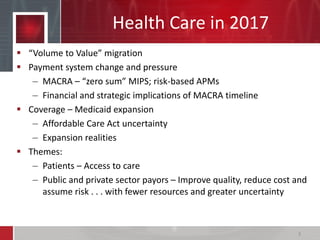
Health Care in 2017
 “Volume to Value” migration
 Payment system change and pressure
– MACRA – “zero sum” MIPS; risk-based APMs
– Financial and strategic implications of MACRA timeline
 Coverage – Medicaid expansion
– Affordable Care Act uncertainty
– Expansion realities
 Themes:
– Patients – Access to care
– Public and private sector payors – Improve quality, reduce cost and
assume risk . . . with fewer resources and greater uncertainty
3
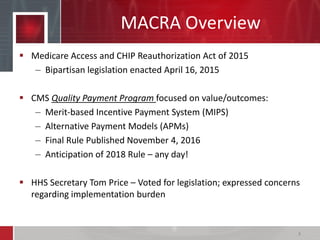
MACRA Overview
4
 Medicare Access and CHIP Reauthorization Act of 2015
– Bipartisan legislation enacted April 16, 2015
 CMS Quality Payment Program focused on value/outcomes:
– Merit-based Incentive Payment System (MIPS)
– Alternative Payment Models (APMs)
– Final Rule Published November 4, 2016
– Anticipation of 2018 Rule – any day!
 HHS Secretary Tom Price – Voted for legislation; expressed concerns
regarding implementation burden
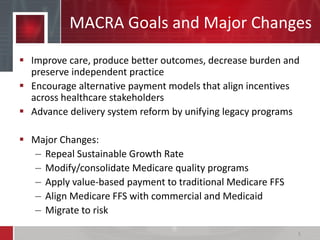
MACRA Goals and Major Changes
 Improve care, produce better outcomes, decrease burden and
preserve independent practice
 Encourage alternative payment models that align incentives
across healthcare stakeholders
 Advance delivery system reform by unifying legacy programs
 Major Changes:
– Repeal Sustainable Growth Rate
– Modify/consolidate Medicare quality programs
– Apply value-based payment to traditional Medicare FFS
– Align Medicare FFS with commercial and Medicaid
– Migrate to risk
5
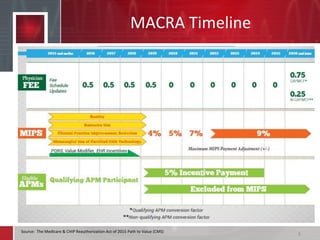
MACRA Timeline
6Source: The Medicare & CHIP Reauthorization Act of 2015 Path to Value (CMS)
MACRA Overview -- Merit-Based Incentive
Payment System (MIPS)
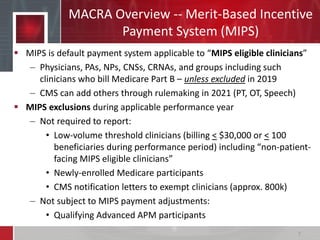
 MIPS is default payment system applicable to “MIPS eligible clinicians”
– Physicians, PAs, NPs, CNSs, CRNAs, and groups including such
clinicians who bill Medicare Part B – unless excluded in 2019
– CMS can add others through rulemaking in 2021 (PT, OT, Speech)
 MIPS exclusions during applicable performance year
– Not required to report:
• Low-volume threshold clinicians (billing < $30,000 or < 100
beneficiaries during performance period) including “non-patient-
facing MIPS eligible clinicians”
• Newly-enrolled Medicare participants
• CMS notification letters to exempt clinicians (approx. 800k)
– Not subject to MIPS payment adjustments:
• Qualifying Advanced APM participants
7
MACRA Overview -- MIPS
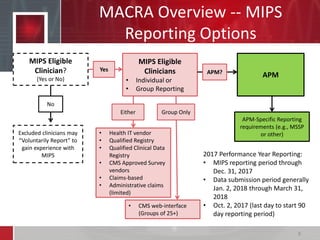
Reporting Options
8
No
Excluded clinicians may
“Voluntarily Report” to
gain experience with
MIPS
MIPS Eligible
Clinicians
• Individual or
• Group Reporting
MIPS Eligible
Clinician?
(Yes or No)
Yes
• Health IT vendor
• Qualified Registry
• Qualified Clinical Data
Registry
• CMS Approved Survey
vendors
• Claims-based
• Administrative claims
(limited)
• CMS web-interface
(Groups of 25+)
Either Group Only
APM
APM-Specific Reporting
requirements (e.g., MSSP
or other)
APM?
2017 Performance Year Reporting:
• MIPS reporting period through
Dec. 31, 2017
• Data submission period generally
Jan. 2, 2018 through March 31,
2018
• Oct. 2, 2017 (last day to start 90
day reporting period)
MACRA Overview -- MIPS
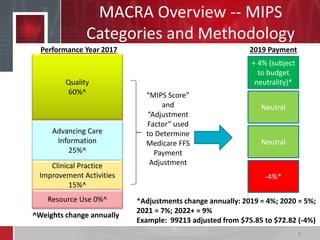
Categories and Methodology
9
Quality
60%^
Advancing Care
Information
25%^
Clinical Practice
Improvement Activities
15%^
Resource Use 0%^
Performance Year 2017
“MIPS Score”
and
“Adjustment
Factor” used
to Determine
Medicare FFS
Payment
Adjustment
-4%*
Neutral
Neutral
+ 4% (subject
to budget
neutrality)*
2019 Payment
^Weights change annually
*Adjustments change annually: 2019 = 4%; 2020 = 5%;
2021 = 7%; 2022+ = 9%
Example: 99213 adjusted from $75.85 to $72.82 (-4%)
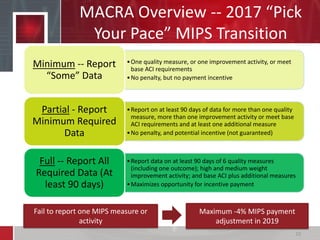
MACRA Overview -- 2017 “Pick
Your Pace” MIPS Transition
10
•One quality measure, or one improvement activity, or meet
base ACI requirements
•No penalty, but no payment incentive
Minimum -- Report
“Some” Data
•Report on at least 90 days of data for more than one quality
measure, more than one improvement activity or meet base
ACI requirements and at least one additional measure
•No penalty, and potential incentive (not guaranteed)
Partial - Report
Minimum Required
Data
•Report data on at least 90 days of 6 quality measures
(including one outcome); high and medium weight
improvement activity; and base ACI plus additional measures
•Maximizes opportunity for incentive payment
Full -- Report All
Required Data (At
least 90 days)
Fail to report one MIPS measure or
activity
Maximum -4% MIPS payment
adjustment in 2019
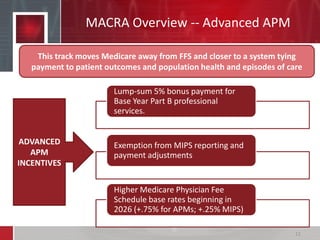
MACRA Overview -- Advanced APM
11
This track moves Medicare away from FFS and closer to a system tying
payment to patient outcomes and population health and episodes of care
Lump-sum 5% bonus payment for
Base Year Part B professional
services.
Exemption from MIPS reporting and
payment adjustments
Higher Medicare Physician Fee
Schedule base rates beginning in
2026 (+.75% for APMs; +.25% MIPS)
ADVANCED
APM
INCENTIVES
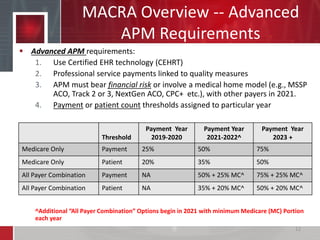
MACRA Overview -- Advanced
APM Requirements
 Advanced APM requirements:
1. Use Certified EHR technology (CEHRT)
2. Professional service payments linked to quality measures
3. APM must bear financial risk or involve a medical home model (e.g., MSSP
ACO, Track 2 or 3, NextGen ACO, CPC+ etc.), with other payers in 2021.
4. Payment or patient count thresholds assigned to particular year
^Additional “All Payer Combination” Options begin in 2021 with minimum Medicare (MC) Portion
each year
12
Threshold
Payment Year
2019-2020
Payment Year
2021-2022^
Payment Year
2023 +
Medicare Only Payment 25% 50% 75%
Medicare Only Patient 20% 35% 50%
All Payer Combination Payment NA 50% + 25% MC^ 75% + 25% MC^
All Payer Combination Patient NA 35% + 20% MC^ 50% + 20% MC^
MACRA Compliance and
Operational Considerations
13
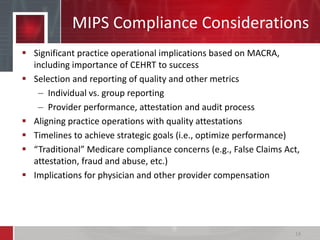
MIPS Compliance Considerations
 Significant practice operational implications based on MACRA,
including importance of CEHRT to success
 Selection and reporting of quality and other metrics
– Individual vs. group reporting
– Provider performance, attestation and audit process
 Aligning practice operations with quality attestations
 Timelines to achieve strategic goals (i.e., optimize performance)
 “Traditional” Medicare compliance concerns (e.g., False Claims Act,
attestation, fraud and abuse, etc.)
 Implications for physician and other provider compensation
14
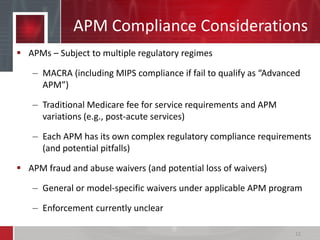
 APMs – Subject to multiple regulatory regimes
– MACRA (including MIPS compliance if fail to qualify as “Advanced
APM”)
– Traditional Medicare fee for service requirements and APM
variations (e.g., post-acute services)
– Each APM has its own complex regulatory compliance requirements
(and potential pitfalls)
 APM fraud and abuse waivers (and potential loss of waivers)
– General or model-specific waivers under applicable APM program
– Enforcement currently unclear
APM Compliance Considerations
15
APM Compliance Considerations
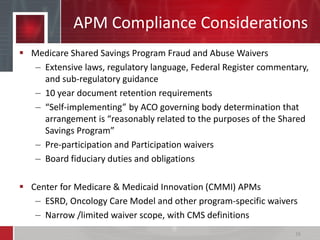
 Medicare Shared Savings Program Fraud and Abuse Waivers
– Extensive laws, regulatory language, Federal Register commentary,
and sub-regulatory guidance
– 10 year document retention requirements
– “Self-implementing” by ACO governing body determination that
arrangement is “reasonably related to the purposes of the Shared
Savings Program”
– Pre-participation and Participation waivers
– Board fiduciary duties and obligations
 Center for Medicare & Medicaid Innovation (CMMI) APMs
– ESRD, Oncology Care Model and other program-specific waivers
– Narrow /limited waiver scope, with CMS definitions
16
MACRA Operational/
Contractual Implications
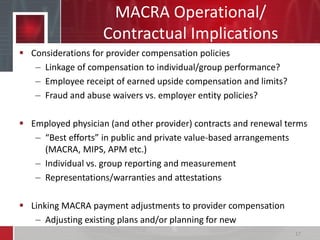
 Considerations for provider compensation policies
– Linkage of compensation to individual/group performance?
– Employee receipt of earned upside compensation and limits?
– Fraud and abuse waivers vs. employer entity policies?
 Employed physician (and other provider) contracts and renewal terms
– “Best efforts” in public and private value-based arrangements
(MACRA, MIPS, APM etc.)
– Individual vs. group reporting and measurement
– Representations/warranties and attestations
 Linking MACRA payment adjustments to provider compensation
– Adjusting existing plans and/or planning for new
17
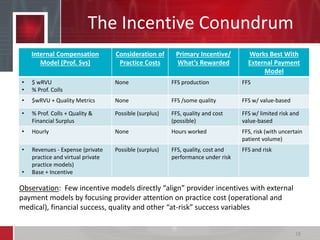
The Incentive Conundrum
Internal Compensation
Model (Prof. Svs)
Consideration of
Practice Costs
Primary Incentive/
What’s Rewarded
Works Best With
External Payment
Model
• $ wRVU
• % Prof. Colls
None FFS production FFS
• $wRVU + Quality Metrics None FFS /some quality FFS w/ value-based
• % Prof. Colls + Quality &
Financial Surplus
Possible (surplus) FFS, quality and cost
(possible)
FFS w/ limited risk and
value-based
• Hourly None Hours worked FFS, risk (with uncertain
patient volume)
• Revenues - Expense (private
practice and virtual private
practice models)
• Base + Incentive
Possible (surplus) FFS, quality, cost and
performance under risk
FFS and risk
18
Observation: Few incentive models directly “align” provider incentives with external
payment models by focusing provider attention on practice cost (operational and
medical), financial success, quality and other “at-risk” success variables
MACRA Employed Physician
Compensation Implications
 Lag time issues
– MIPS and APM performance year is 2 years prior to payment year
• Existing employees
• New hires (with legacy performance that follows them)
• Acquisition due diligence and post-acquisition comp plan
 MIPS/APM +/- and FMV requirements (Stark, AKS etc.)
 Valuation and FMV considerations
– External surveys lag 1+ years
– In-exact – personally performed, wRVU modifiers etc.
– “Personal performance” under value-based arrangements
19
MACRA Strategic Implications
20
MACRA Goals and Changes
 Improve care, produce better outcomes, decrease burden and
preserve independent practice
 Encourage adoption of Alternative Payment Models that align
incentives across healthcare stakeholders
 Major Changes:
– Replace Sustainable Growth Rate with financial carrots and
sticks
– Apply value-based payment to traditional Medicare FFS
– Align Medicare FFS with commercial and Medicaid
– Migrate to and succeed under at-risk arrangements (APM)
21
Strategy
22
strat·e·gy
noun
 A plan of action or policy designed to achieve a major or overall aim
 A careful plan or method for achieving a particular goal usually over a
long period of time
MACRA strategy
 Goals and current position will influence available options and
strategies
 MACRA timelines and requirements are critical to strategic decision-
making
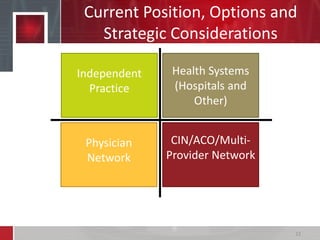
Current Position, Options and
Strategic Considerations
23
Independent
Practice
Physician
Network
Health Systems
(Hospitals and
Other)
CIN/ACO/Multi-
Provider Network
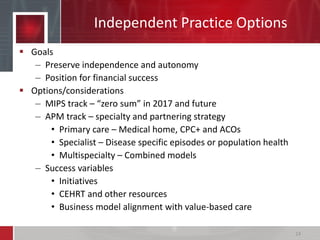
Independent Practice Options
 Goals
– Preserve independence and autonomy
– Position for financial success
 Options/considerations
– MIPS track – “zero sum” in 2017 and future
– APM track – specialty and partnering strategy
• Primary care – Medical home, CPC+ and ACOs
• Specialist – Disease specific episodes or population health
• Multispecialty – Combined models
– Success variables
• Initiatives
• CEHRT and other resources
• Business model alignment with value-based care
24
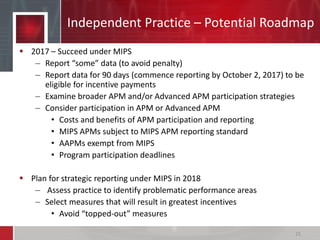
Independent Practice – Potential Roadmap
 2017 – Succeed under MIPS
– Report “some” data (to avoid penalty)
– Report data for 90 days (commence reporting by October 2, 2017) to be
eligible for incentive payments
– Examine broader APM and/or Advanced APM participation strategies
– Consider participation in APM or Advanced APM
• Costs and benefits of APM participation and reporting
• MIPS APMs subject to MIPS APM reporting standard
• AAPMs exempt from MIPS
• Program participation deadlines
 Plan for strategic reporting under MIPS in 2018
– Assess practice to identify problematic performance areas
– Select measures that will result in greatest incentives
• Avoid “topped-out” measures
25
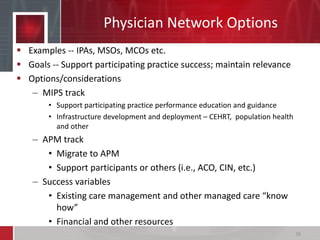
Physician Network Options
 Examples -- IPAs, MSOs, MCOs etc.
 Goals -- Support participating practice success; maintain relevance
 Options/considerations
– MIPS track
• Support participating practice performance education and guidance
• Infrastructure development and deployment – CEHRT, population health
and other
– APM track
• Migrate to APM
• Support participants or others (i.e., ACO, CIN, etc.)
– Success variables
• Existing care management and other managed care “know
how”
• Financial and other resources
26
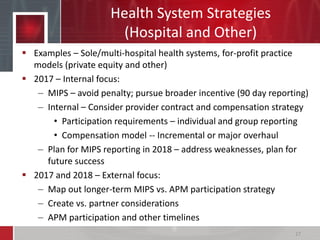
Health System Strategies
(Hospital and Other)
 Examples – Sole/multi-hospital health systems, for-profit practice
models (private equity and other)
 2017 – Internal focus:
– MIPS – avoid penalty; pursue broader incentive (90 day reporting)
– Internal – Consider provider contract and compensation strategy
• Participation requirements – individual and group reporting
• Compensation model -- Incremental or major overhaul
– Plan for MIPS reporting in 2018 – address weaknesses, plan for
future success
 2017 and 2018 – External focus:
– Map out longer-term MIPS vs. APM participation strategy
– Create vs. partner considerations
– APM participation and other timelines
27
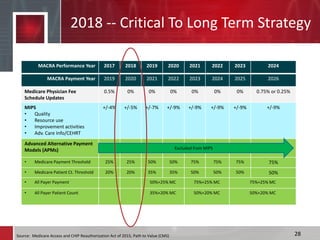
2018 -- Critical To Long Term Strategy
MACRA Performance Year 2017 2018 2019 2020 2021 2022 2023 2024
MACRA Payment Year 2019 2020 2021 2022 2023 2024 2025 2026
Medicare Physician Fee
Schedule Updates
0.5% 0% 0% 0% 0% 0% 0% 0.75% or 0.25%
MIPS
• Quality
• Resource use
• Improvement activities
• Adv. Care Info/CEHRT
+/-4% +/-5% +/-7% +/-9% +/-9% +/-9% +/-9% +/-9%
Advanced Alternative Payment
Models (APMs)
• Medicare Payment Threshold 25% 25% 50% 50% 75% 75% 75% 75%
• Medicare Patient Ct. Threshold 20% 20% 35% 35% 50% 50% 50% 50%
• All Payer Payment 50%+25% MC 75%+25% MC 75%+25% MC
• All Payer Patient Count 35%+20% MC 50%+20% MC 50%+20% MC
Excluded from MIPS
Source: Medicare Access and CHIP Reauthorization Act of 2015, Path to Value (CMS) 28
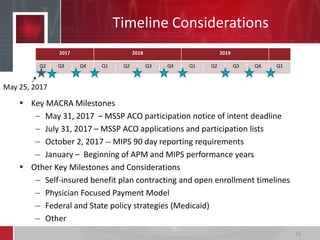
Timeline Considerations
 Key MACRA Milestones
– May 31, 2017 – MSSP ACO participation notice of intent deadline
– July 31, 2017 – MSSP ACO applications and participation lists
– October 2, 2017 -- MIPS 90 day reporting requirements
– January – Beginning of APM and MIPS performance years
 Other Key Milestones and Considerations
– Self-insured benefit plan contracting and open enrollment timelines
– Physician Focused Payment Model
– Federal and State policy strategies (Medicaid)
– Other
29
2017 2018 2019
Q2 Q3 Q4 Q1 Q2 Q3 Q4 Q1 Q2 Q3 Q4 Q1
May 25, 2017
MACRA Physician Focused
Payment Models
 Newly created APM models
– Must include Medicare as a payer
– Eligible clinician participants must play core role in implementing the APM
payment methodology
– Must target quality and costs of services that eligible clinicians provide,
order, or significantly influence
 Creation process
– Physician-Focused Payment Model Technical Advisory Committee (PTAC)
recommends testing based on priorities and various resources
– Should broaden or expand CMS APM portfolio
 Practical Considerations
– May include non-Medicare payers and non-physician eligible clinicians
– No specific process established for PTAC review
– Generally, CMS requires 18 months to develop an APM
30
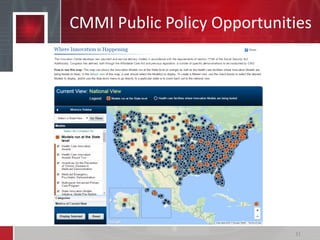
CMMI Public Policy Opportunities
31
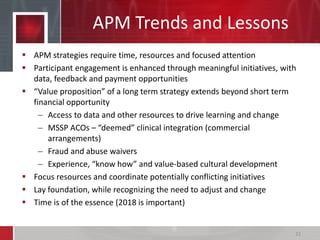
APM Trends and Lessons
 APM strategies require time, resources and focused attention
 Participant engagement is enhanced through meaningful initiatives, with
data, feedback and payment opportunities
 “Value proposition” of a long term strategy extends beyond short term
financial opportunity
– Access to data and other resources to drive learning and change
– MSSP ACOs – “deemed” clinical integration (commercial
arrangements)
– Fraud and abuse waivers
– Experience, “know how” and value-based cultural development
 Focus resources and coordinate potentially conflicting initiatives
 Lay foundation, while recognizing the need to adjust and change
 Time is of the essence (2018 is important)
32
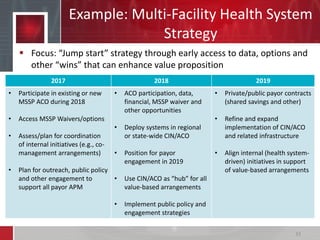
Example: Multi-Facility Health System
Strategy
 Focus: “Jump start” strategy through early access to data, options and
other “wins” that can enhance value proposition
33
2017 2018 2019
• Participate in existing or new
MSSP ACO during 2018
• Access MSSP Waivers/options
• Assess/plan for coordination
of internal initiatives (e.g., co-
management arrangements)
• Plan for outreach, public policy
and other engagement to
support all payor APM
• ACO participation, data,
financial, MSSP waiver and
other opportunities
• Deploy systems in regional
or state-wide CIN/ACO
• Position for payor
engagement in 2019
• Use CIN/ACO as “hub” for all
value-based arrangements
• Implement public policy and
engagement strategies
• Private/public payor contracts
(shared savings and other)
• Refine and expand
implementation of CIN/ACO
and related infrastructure
• Align internal (health system-
driven) initiatives in support
of value-based arrangements
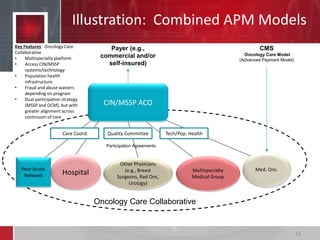
Illustration: Combined APM Models
CIN/MSSP ACO
Hospital
Payer (e.g.,
commercial and/or
self-insured)
CMS
Oncology Care Model
(Advanced Payment Model)
Med. Onc.Multispecialty
Medical Group
Other Physicians
(e.g., Breast
Surgeons, Rad Onc,
Urology)
Post-Acute
Network
Care Coord. Quality Committee Tech/Pop. Health
Participation Agreements
Oncology Care Collaborative
Key Features: Oncology Care
Collaborative
• Multispecialty platform
• Access CIN/MSSP
systems/technology
• Population health
infrastructure
• Fraud and abuse waivers
depending on program
• Dual participation strategy
(MSSP and OCM), but with
greater alignment across
continuum of care
34
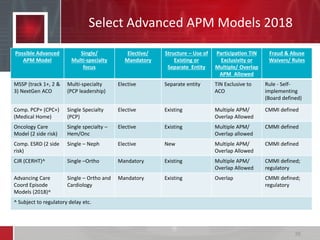
Select Advanced APM Models 2018
35
Possible Advanced
APM Model
Single/
Multi-specialty
focus
Elective/
Mandatory
Structure – Use of
Existing or
Separate Entity
Participation TIN
Exclusivity or
Multiple/ Overlap
APM Allowed
Fraud & Abuse
Waivers/ Rules
MSSP (track 1+, 2 &
3) NextGen ACO
Multi-specialty
(PCP leadership)
Elective Separate entity TIN Exclusive to
ACO
Rule - Self-
implementing
(Board defined)
Comp. PCP+ (CPC+)
(Medical Home)
Single Specialty
(PCP)
Elective Existing Multiple APM/
Overlap Allowed
CMMI defined
Oncology Care
Model (2 side risk)
Single specialty –
Hem/Onc
Elective Existing Multiple APM/
Overlap allowed
CMMI defined
Comp. ESRD (2 side
risk)
Single – Neph Elective New Multiple APM/
Overlap Allowed
CMMI defined
CJR (CERHT)^ Single –Ortho Mandatory Existing Multiple APM/
Overlap Allowed
CMMI defined;
regulatory
Advancing Care
Coord Episode
Models (2018)^
Single – Ortho and
Cardiology
Mandatory Existing Overlap CMMI defined;
regulatory
^ Subject to regulatory delay etc.
CIN/ACO/Multi-Provider
Network Options
 Example: MSSP Track 1 ACO, ending 2018 or 2019
 Internal
– Participants report/evaluated under APM/ACO rules (MIPS APM
Standard)
 External
– Strategic decision-making re Advanced APM/risk strategy (e.g.,
MSSP 1+, Track 2 or 3; NextGen)
– Potential “right sizing” of ACO participants in network (i.e., PCP
driven with select specialties)
– Plan/implement specialist engagement through other APM models
(Ortho, Cardiology, Oncology, etc.)
– Position for Advanced APM success with Medicare Advantage and
other at-risk programs to aggregate lives
– Consider external/regional/statewide partnering strategies
36
The Provider “Engagement”
Conundrum
 Structural (“all in” models)
– Employment and Professional Services Agreements
 Contractual (“part-way in” models)
– Co-management/medical leadership
– Clinically Integrated Network/ACO models
 Potential “joint venture”(JV) models
– JV physician practice with health system linkage (APM or other)
– JV managed care organization (MCO) entity with at-risk
arrangements
– JV episode bundle organizations
 Alternative financial and other incentive strategies
37
Dr.
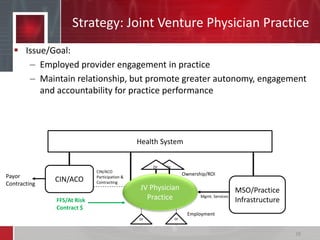
Strategy: Joint Venture Physician Practice
 Issue/Goal:
– Employed provider engagement in practice
– Maintain relationship, but promote greater autonomy, engagement
and accountability for practice performance
38
Mgmt. Services
CIN/ACO
Participation &
ContractingCIN/ACOPayor
Contracting
Dr.
MSO/Practice
Infrastructure
Ownership/ROI
Dr
.
Dr
.
JV Physician
Practice
Employment
Health System
FFS/At Risk
Contract $
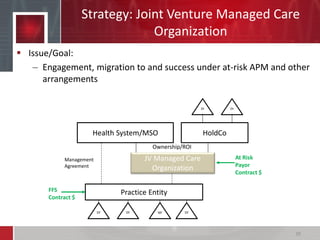
Strategy: Joint Venture Managed Care
Organization
39
FFS
Contract $
Dr
.
Dr
.
NP
Management
Agreement
Dr
.
At Risk
Payor
Contract $
Dr
.
Ownership/ROI
Dr
.
JV Managed Care
Organization
Practice Entity
Health System/MSO
 Issue/Goal:
– Engagement, migration to and success under at-risk APM and other
arrangements
HoldCo
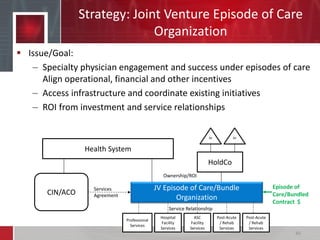
Strategy: Joint Venture Episode of Care
Organization
40
Services
Agreement
Episode of
Care/Bundled
Contract $
Dr
.
Ownership/ROI
Dr
.
Professional
Services
 Issue/Goal:
– Specialty physician engagement and success under episodes of care
Align operational, financial and other incentives
– Access infrastructure and coordinate existing initiatives
– ROI from investment and service relationships
HoldCo
JV Episode of Care/Bundle
Organization
Hospital
Facility
Services
ASC
Facility
Services
Post-Acute
/ Rehab
Services
Post-Acute
/ Rehab
Services
Service Relationship
CIN/ACO
Health System
Understanding MACRA’s Strategic and
Compliance Implications
 Bipartisan solution to reimbursement problem
 MIPS operational and compliance considerations in near term
 APM longer-term strategic considerations
 Keys to success:
– Near term actions impact long-term options
– Participant engagement through real initiatives with data, feedback
and payment opportunities
– Choose your partners carefully
– Lay foundation, but plan for adaptation and change
– Time is of the essence
41
Questions?
42
Contact Information
 Bruce A. Johnson
– Shareholder; Denver
– bjohnson@polsinelli.com
– 303.583.8203
 Cybil G. Roehrenbeck
– Counsel; Washington, D.C.
– croehrenbeck@polsinelli.com
– 202.777.8931
 Marissa R. Urban
– Associate; Denver
– murban@polsinelli.com
– 303.256.2750
43
Resources
Articles
– http://www.polsinelli.com/intelligence/ealert-making-
sense-of-macra-final-rule
– http://www.polsinelli.com/intelligence/ealert-macra-final-
rule-part-2
– http://www.polsinelli.com/intelligence/ealert-macra-part-3
CMS
– https://qpp.cms.gov/
AMA “STEPS Forward”
– https://www.stepsforward.org/
44

Understanding MACRA's Strategic and Compliance Considerations

  • 1.
    Understanding MACRA’s Strategicand Compliance Considerations May 25, 2017 Bruce A. Johnson, Shareholder Cybil G. Roehrenbeck, Counsel Marissa R. Urban, Associate
  • 2.
    Agenda  MACRA PaymentReform – Merit-Based Incentive Payment System (MIPS) – Alternative Payment Models (APM)  Compliance and operational considerations  Strategic considerations, options and ideas  Q&A 2
  • 3.
    Health Care in2017  “Volume to Value” migration  Payment system change and pressure – MACRA – “zero sum” MIPS; risk-based APMs – Financial and strategic implications of MACRA timeline  Coverage – Medicaid expansion – Affordable Care Act uncertainty – Expansion realities  Themes: – Patients – Access to care – Public and private sector payors – Improve quality, reduce cost and assume risk . . . with fewer resources and greater uncertainty 3
  • 4.
    MACRA Overview 4  MedicareAccess and CHIP Reauthorization Act of 2015 – Bipartisan legislation enacted April 16, 2015  CMS Quality Payment Program focused on value/outcomes: – Merit-based Incentive Payment System (MIPS) – Alternative Payment Models (APMs) – Final Rule Published November 4, 2016 – Anticipation of 2018 Rule – any day!  HHS Secretary Tom Price – Voted for legislation; expressed concerns regarding implementation burden
  • 5.
    MACRA Goals andMajor Changes  Improve care, produce better outcomes, decrease burden and preserve independent practice  Encourage alternative payment models that align incentives across healthcare stakeholders  Advance delivery system reform by unifying legacy programs  Major Changes: – Repeal Sustainable Growth Rate – Modify/consolidate Medicare quality programs – Apply value-based payment to traditional Medicare FFS – Align Medicare FFS with commercial and Medicaid – Migrate to risk 5
  • 6.
    MACRA Timeline 6Source: TheMedicare & CHIP Reauthorization Act of 2015 Path to Value (CMS)
  • 7.
    MACRA Overview --Merit-Based Incentive Payment System (MIPS)  MIPS is default payment system applicable to “MIPS eligible clinicians” – Physicians, PAs, NPs, CNSs, CRNAs, and groups including such clinicians who bill Medicare Part B – unless excluded in 2019 – CMS can add others through rulemaking in 2021 (PT, OT, Speech)  MIPS exclusions during applicable performance year – Not required to report: • Low-volume threshold clinicians (billing < $30,000 or < 100 beneficiaries during performance period) including “non-patient- facing MIPS eligible clinicians” • Newly-enrolled Medicare participants • CMS notification letters to exempt clinicians (approx. 800k) – Not subject to MIPS payment adjustments: • Qualifying Advanced APM participants 7
  • 8.
    MACRA Overview --MIPS Reporting Options 8 No Excluded clinicians may “Voluntarily Report” to gain experience with MIPS MIPS Eligible Clinicians • Individual or • Group Reporting MIPS Eligible Clinician? (Yes or No) Yes • Health IT vendor • Qualified Registry • Qualified Clinical Data Registry • CMS Approved Survey vendors • Claims-based • Administrative claims (limited) • CMS web-interface (Groups of 25+) Either Group Only APM APM-Specific Reporting requirements (e.g., MSSP or other) APM? 2017 Performance Year Reporting: • MIPS reporting period through Dec. 31, 2017 • Data submission period generally Jan. 2, 2018 through March 31, 2018 • Oct. 2, 2017 (last day to start 90 day reporting period)
  • 9.
    MACRA Overview --MIPS Categories and Methodology 9 Quality 60%^ Advancing Care Information 25%^ Clinical Practice Improvement Activities 15%^ Resource Use 0%^ Performance Year 2017 “MIPS Score” and “Adjustment Factor” used to Determine Medicare FFS Payment Adjustment -4%* Neutral Neutral + 4% (subject to budget neutrality)* 2019 Payment ^Weights change annually *Adjustments change annually: 2019 = 4%; 2020 = 5%; 2021 = 7%; 2022+ = 9% Example: 99213 adjusted from $75.85 to $72.82 (-4%)
  • 10.
    MACRA Overview --2017 “Pick Your Pace” MIPS Transition 10 •One quality measure, or one improvement activity, or meet base ACI requirements •No penalty, but no payment incentive Minimum -- Report “Some” Data •Report on at least 90 days of data for more than one quality measure, more than one improvement activity or meet base ACI requirements and at least one additional measure •No penalty, and potential incentive (not guaranteed) Partial - Report Minimum Required Data •Report data on at least 90 days of 6 quality measures (including one outcome); high and medium weight improvement activity; and base ACI plus additional measures •Maximizes opportunity for incentive payment Full -- Report All Required Data (At least 90 days) Fail to report one MIPS measure or activity Maximum -4% MIPS payment adjustment in 2019
  • 11.
    MACRA Overview --Advanced APM 11 This track moves Medicare away from FFS and closer to a system tying payment to patient outcomes and population health and episodes of care Lump-sum 5% bonus payment for Base Year Part B professional services. Exemption from MIPS reporting and payment adjustments Higher Medicare Physician Fee Schedule base rates beginning in 2026 (+.75% for APMs; +.25% MIPS) ADVANCED APM INCENTIVES
  • 12.
    MACRA Overview --Advanced APM Requirements  Advanced APM requirements: 1. Use Certified EHR technology (CEHRT) 2. Professional service payments linked to quality measures 3. APM must bear financial risk or involve a medical home model (e.g., MSSP ACO, Track 2 or 3, NextGen ACO, CPC+ etc.), with other payers in 2021. 4. Payment or patient count thresholds assigned to particular year ^Additional “All Payer Combination” Options begin in 2021 with minimum Medicare (MC) Portion each year 12 Threshold Payment Year 2019-2020 Payment Year 2021-2022^ Payment Year 2023 + Medicare Only Payment 25% 50% 75% Medicare Only Patient 20% 35% 50% All Payer Combination Payment NA 50% + 25% MC^ 75% + 25% MC^ All Payer Combination Patient NA 35% + 20% MC^ 50% + 20% MC^
  • 13.
  • 14.
    MIPS Compliance Considerations Significant practice operational implications based on MACRA, including importance of CEHRT to success  Selection and reporting of quality and other metrics – Individual vs. group reporting – Provider performance, attestation and audit process  Aligning practice operations with quality attestations  Timelines to achieve strategic goals (i.e., optimize performance)  “Traditional” Medicare compliance concerns (e.g., False Claims Act, attestation, fraud and abuse, etc.)  Implications for physician and other provider compensation 14
  • 15.
     APMs –Subject to multiple regulatory regimes – MACRA (including MIPS compliance if fail to qualify as “Advanced APM”) – Traditional Medicare fee for service requirements and APM variations (e.g., post-acute services) – Each APM has its own complex regulatory compliance requirements (and potential pitfalls)  APM fraud and abuse waivers (and potential loss of waivers) – General or model-specific waivers under applicable APM program – Enforcement currently unclear APM Compliance Considerations 15
  • 16.
    APM Compliance Considerations Medicare Shared Savings Program Fraud and Abuse Waivers – Extensive laws, regulatory language, Federal Register commentary, and sub-regulatory guidance – 10 year document retention requirements – “Self-implementing” by ACO governing body determination that arrangement is “reasonably related to the purposes of the Shared Savings Program” – Pre-participation and Participation waivers – Board fiduciary duties and obligations  Center for Medicare & Medicaid Innovation (CMMI) APMs – ESRD, Oncology Care Model and other program-specific waivers – Narrow /limited waiver scope, with CMS definitions 16
  • 17.
    MACRA Operational/ Contractual Implications Considerations for provider compensation policies – Linkage of compensation to individual/group performance? – Employee receipt of earned upside compensation and limits? – Fraud and abuse waivers vs. employer entity policies?  Employed physician (and other provider) contracts and renewal terms – “Best efforts” in public and private value-based arrangements (MACRA, MIPS, APM etc.) – Individual vs. group reporting and measurement – Representations/warranties and attestations  Linking MACRA payment adjustments to provider compensation – Adjusting existing plans and/or planning for new 17
  • 18.
    The Incentive Conundrum InternalCompensation Model (Prof. Svs) Consideration of Practice Costs Primary Incentive/ What’s Rewarded Works Best With External Payment Model • $ wRVU • % Prof. Colls None FFS production FFS • $wRVU + Quality Metrics None FFS /some quality FFS w/ value-based • % Prof. Colls + Quality & Financial Surplus Possible (surplus) FFS, quality and cost (possible) FFS w/ limited risk and value-based • Hourly None Hours worked FFS, risk (with uncertain patient volume) • Revenues - Expense (private practice and virtual private practice models) • Base + Incentive Possible (surplus) FFS, quality, cost and performance under risk FFS and risk 18 Observation: Few incentive models directly “align” provider incentives with external payment models by focusing provider attention on practice cost (operational and medical), financial success, quality and other “at-risk” success variables
  • 19.
    MACRA Employed Physician CompensationImplications  Lag time issues – MIPS and APM performance year is 2 years prior to payment year • Existing employees • New hires (with legacy performance that follows them) • Acquisition due diligence and post-acquisition comp plan  MIPS/APM +/- and FMV requirements (Stark, AKS etc.)  Valuation and FMV considerations – External surveys lag 1+ years – In-exact – personally performed, wRVU modifiers etc. – “Personal performance” under value-based arrangements 19
  • 20.
  • 21.
    MACRA Goals andChanges  Improve care, produce better outcomes, decrease burden and preserve independent practice  Encourage adoption of Alternative Payment Models that align incentives across healthcare stakeholders  Major Changes: – Replace Sustainable Growth Rate with financial carrots and sticks – Apply value-based payment to traditional Medicare FFS – Align Medicare FFS with commercial and Medicaid – Migrate to and succeed under at-risk arrangements (APM) 21
  • 22.
    Strategy 22 strat·e·gy noun  A planof action or policy designed to achieve a major or overall aim  A careful plan or method for achieving a particular goal usually over a long period of time MACRA strategy  Goals and current position will influence available options and strategies  MACRA timelines and requirements are critical to strategic decision- making
  • 23.
    Current Position, Optionsand Strategic Considerations 23 Independent Practice Physician Network Health Systems (Hospitals and Other) CIN/ACO/Multi- Provider Network
  • 24.
    Independent Practice Options Goals – Preserve independence and autonomy – Position for financial success  Options/considerations – MIPS track – “zero sum” in 2017 and future – APM track – specialty and partnering strategy • Primary care – Medical home, CPC+ and ACOs • Specialist – Disease specific episodes or population health • Multispecialty – Combined models – Success variables • Initiatives • CEHRT and other resources • Business model alignment with value-based care 24
  • 25.
    Independent Practice –Potential Roadmap  2017 – Succeed under MIPS – Report “some” data (to avoid penalty) – Report data for 90 days (commence reporting by October 2, 2017) to be eligible for incentive payments – Examine broader APM and/or Advanced APM participation strategies – Consider participation in APM or Advanced APM • Costs and benefits of APM participation and reporting • MIPS APMs subject to MIPS APM reporting standard • AAPMs exempt from MIPS • Program participation deadlines  Plan for strategic reporting under MIPS in 2018 – Assess practice to identify problematic performance areas – Select measures that will result in greatest incentives • Avoid “topped-out” measures 25
  • 26.
    Physician Network Options Examples -- IPAs, MSOs, MCOs etc.  Goals -- Support participating practice success; maintain relevance  Options/considerations – MIPS track • Support participating practice performance education and guidance • Infrastructure development and deployment – CEHRT, population health and other – APM track • Migrate to APM • Support participants or others (i.e., ACO, CIN, etc.) – Success variables • Existing care management and other managed care “know how” • Financial and other resources 26
  • 27.
    Health System Strategies (Hospitaland Other)  Examples – Sole/multi-hospital health systems, for-profit practice models (private equity and other)  2017 – Internal focus: – MIPS – avoid penalty; pursue broader incentive (90 day reporting) – Internal – Consider provider contract and compensation strategy • Participation requirements – individual and group reporting • Compensation model -- Incremental or major overhaul – Plan for MIPS reporting in 2018 – address weaknesses, plan for future success  2017 and 2018 – External focus: – Map out longer-term MIPS vs. APM participation strategy – Create vs. partner considerations – APM participation and other timelines 27
  • 28.
    2018 -- CriticalTo Long Term Strategy MACRA Performance Year 2017 2018 2019 2020 2021 2022 2023 2024 MACRA Payment Year 2019 2020 2021 2022 2023 2024 2025 2026 Medicare Physician Fee Schedule Updates 0.5% 0% 0% 0% 0% 0% 0% 0.75% or 0.25% MIPS • Quality • Resource use • Improvement activities • Adv. Care Info/CEHRT +/-4% +/-5% +/-7% +/-9% +/-9% +/-9% +/-9% +/-9% Advanced Alternative Payment Models (APMs) • Medicare Payment Threshold 25% 25% 50% 50% 75% 75% 75% 75% • Medicare Patient Ct. Threshold 20% 20% 35% 35% 50% 50% 50% 50% • All Payer Payment 50%+25% MC 75%+25% MC 75%+25% MC • All Payer Patient Count 35%+20% MC 50%+20% MC 50%+20% MC Excluded from MIPS Source: Medicare Access and CHIP Reauthorization Act of 2015, Path to Value (CMS) 28
  • 29.
    Timeline Considerations  KeyMACRA Milestones – May 31, 2017 – MSSP ACO participation notice of intent deadline – July 31, 2017 – MSSP ACO applications and participation lists – October 2, 2017 -- MIPS 90 day reporting requirements – January – Beginning of APM and MIPS performance years  Other Key Milestones and Considerations – Self-insured benefit plan contracting and open enrollment timelines – Physician Focused Payment Model – Federal and State policy strategies (Medicaid) – Other 29 2017 2018 2019 Q2 Q3 Q4 Q1 Q2 Q3 Q4 Q1 Q2 Q3 Q4 Q1 May 25, 2017
  • 30.
    MACRA Physician Focused PaymentModels  Newly created APM models – Must include Medicare as a payer – Eligible clinician participants must play core role in implementing the APM payment methodology – Must target quality and costs of services that eligible clinicians provide, order, or significantly influence  Creation process – Physician-Focused Payment Model Technical Advisory Committee (PTAC) recommends testing based on priorities and various resources – Should broaden or expand CMS APM portfolio  Practical Considerations – May include non-Medicare payers and non-physician eligible clinicians – No specific process established for PTAC review – Generally, CMS requires 18 months to develop an APM 30
  • 31.
    CMMI Public PolicyOpportunities 31
  • 32.
    APM Trends andLessons  APM strategies require time, resources and focused attention  Participant engagement is enhanced through meaningful initiatives, with data, feedback and payment opportunities  “Value proposition” of a long term strategy extends beyond short term financial opportunity – Access to data and other resources to drive learning and change – MSSP ACOs – “deemed” clinical integration (commercial arrangements) – Fraud and abuse waivers – Experience, “know how” and value-based cultural development  Focus resources and coordinate potentially conflicting initiatives  Lay foundation, while recognizing the need to adjust and change  Time is of the essence (2018 is important) 32
  • 33.
    Example: Multi-Facility HealthSystem Strategy  Focus: “Jump start” strategy through early access to data, options and other “wins” that can enhance value proposition 33 2017 2018 2019 • Participate in existing or new MSSP ACO during 2018 • Access MSSP Waivers/options • Assess/plan for coordination of internal initiatives (e.g., co- management arrangements) • Plan for outreach, public policy and other engagement to support all payor APM • ACO participation, data, financial, MSSP waiver and other opportunities • Deploy systems in regional or state-wide CIN/ACO • Position for payor engagement in 2019 • Use CIN/ACO as “hub” for all value-based arrangements • Implement public policy and engagement strategies • Private/public payor contracts (shared savings and other) • Refine and expand implementation of CIN/ACO and related infrastructure • Align internal (health system- driven) initiatives in support of value-based arrangements
  • 34.
    Illustration: Combined APMModels CIN/MSSP ACO Hospital Payer (e.g., commercial and/or self-insured) CMS Oncology Care Model (Advanced Payment Model) Med. Onc.Multispecialty Medical Group Other Physicians (e.g., Breast Surgeons, Rad Onc, Urology) Post-Acute Network Care Coord. Quality Committee Tech/Pop. Health Participation Agreements Oncology Care Collaborative Key Features: Oncology Care Collaborative • Multispecialty platform • Access CIN/MSSP systems/technology • Population health infrastructure • Fraud and abuse waivers depending on program • Dual participation strategy (MSSP and OCM), but with greater alignment across continuum of care 34
  • 35.
    Select Advanced APMModels 2018 35 Possible Advanced APM Model Single/ Multi-specialty focus Elective/ Mandatory Structure – Use of Existing or Separate Entity Participation TIN Exclusivity or Multiple/ Overlap APM Allowed Fraud & Abuse Waivers/ Rules MSSP (track 1+, 2 & 3) NextGen ACO Multi-specialty (PCP leadership) Elective Separate entity TIN Exclusive to ACO Rule - Self- implementing (Board defined) Comp. PCP+ (CPC+) (Medical Home) Single Specialty (PCP) Elective Existing Multiple APM/ Overlap Allowed CMMI defined Oncology Care Model (2 side risk) Single specialty – Hem/Onc Elective Existing Multiple APM/ Overlap allowed CMMI defined Comp. ESRD (2 side risk) Single – Neph Elective New Multiple APM/ Overlap Allowed CMMI defined CJR (CERHT)^ Single –Ortho Mandatory Existing Multiple APM/ Overlap Allowed CMMI defined; regulatory Advancing Care Coord Episode Models (2018)^ Single – Ortho and Cardiology Mandatory Existing Overlap CMMI defined; regulatory ^ Subject to regulatory delay etc.
  • 36.
    CIN/ACO/Multi-Provider Network Options  Example:MSSP Track 1 ACO, ending 2018 or 2019  Internal – Participants report/evaluated under APM/ACO rules (MIPS APM Standard)  External – Strategic decision-making re Advanced APM/risk strategy (e.g., MSSP 1+, Track 2 or 3; NextGen) – Potential “right sizing” of ACO participants in network (i.e., PCP driven with select specialties) – Plan/implement specialist engagement through other APM models (Ortho, Cardiology, Oncology, etc.) – Position for Advanced APM success with Medicare Advantage and other at-risk programs to aggregate lives – Consider external/regional/statewide partnering strategies 36
  • 37.
    The Provider “Engagement” Conundrum Structural (“all in” models) – Employment and Professional Services Agreements  Contractual (“part-way in” models) – Co-management/medical leadership – Clinically Integrated Network/ACO models  Potential “joint venture”(JV) models – JV physician practice with health system linkage (APM or other) – JV managed care organization (MCO) entity with at-risk arrangements – JV episode bundle organizations  Alternative financial and other incentive strategies 37
  • 38.
    Dr. Strategy: Joint VenturePhysician Practice  Issue/Goal: – Employed provider engagement in practice – Maintain relationship, but promote greater autonomy, engagement and accountability for practice performance 38 Mgmt. Services CIN/ACO Participation & ContractingCIN/ACOPayor Contracting Dr. MSO/Practice Infrastructure Ownership/ROI Dr . Dr . JV Physician Practice Employment Health System FFS/At Risk Contract $
  • 39.
    Strategy: Joint VentureManaged Care Organization 39 FFS Contract $ Dr . Dr . NP Management Agreement Dr . At Risk Payor Contract $ Dr . Ownership/ROI Dr . JV Managed Care Organization Practice Entity Health System/MSO  Issue/Goal: – Engagement, migration to and success under at-risk APM and other arrangements HoldCo
  • 40.
    Strategy: Joint VentureEpisode of Care Organization 40 Services Agreement Episode of Care/Bundled Contract $ Dr . Ownership/ROI Dr . Professional Services  Issue/Goal: – Specialty physician engagement and success under episodes of care Align operational, financial and other incentives – Access infrastructure and coordinate existing initiatives – ROI from investment and service relationships HoldCo JV Episode of Care/Bundle Organization Hospital Facility Services ASC Facility Services Post-Acute / Rehab Services Post-Acute / Rehab Services Service Relationship CIN/ACO Health System
  • 41.
    Understanding MACRA’s Strategicand Compliance Implications  Bipartisan solution to reimbursement problem  MIPS operational and compliance considerations in near term  APM longer-term strategic considerations  Keys to success: – Near term actions impact long-term options – Participant engagement through real initiatives with data, feedback and payment opportunities – Choose your partners carefully – Lay foundation, but plan for adaptation and change – Time is of the essence 41
  • 42.
  • 43.
    Contact Information  BruceA. Johnson – Shareholder; Denver – bjohnson@polsinelli.com – 303.583.8203  Cybil G. Roehrenbeck – Counsel; Washington, D.C. – croehrenbeck@polsinelli.com – 202.777.8931  Marissa R. Urban – Associate; Denver – murban@polsinelli.com – 303.256.2750 43
  • 44.
    Resources Articles – http://www.polsinelli.com/intelligence/ealert-making- sense-of-macra-final-rule – http://www.polsinelli.com/intelligence/ealert-macra-final- rule-part-2 –http://www.polsinelli.com/intelligence/ealert-macra-part-3 CMS – https://qpp.cms.gov/ AMA “STEPS Forward” – https://www.stepsforward.org/ 44