Scott Clay, Consulting Principal
Alabama Hospital Association
Annual Meeting
June 10, 2016
TIMING IS EVERYTHING
Pacing the Volume-to-Value
Transition
Prepared for Alabama Hospital Association Page 1
The Dilemma
Prepared for Alabama Hospital Association Page 2
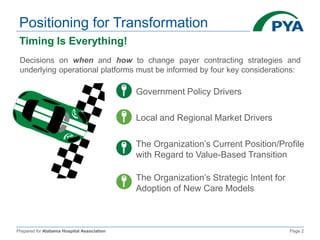
Positioning for Transformation
Timing Is Everything!
Decisions on when and how to change payer contracting strategies and
underlying operational platforms must be informed by four key considerations:
Government Policy Drivers
Local and Regional Market Drivers
The Organization’s Current Position/Profile
with Regard to Value-Based Transition
The Organization’s Strategic Intent for
Adoption of New Care Models
Prepared for Alabama Hospital Association Page 3
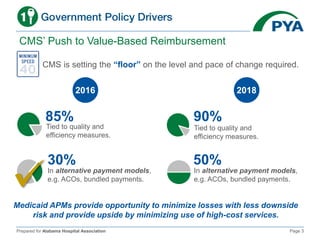
CMS’ Push to Value-Based Reimbursement
CMS is setting the “floor” on the level and pace of change required.
2016 2018
30%
In alternative payment models,
e.g. ACOs, bundled payments.
50%
In alternative payment models,
e.g. ACOs, bundled payments.
85%
Tied to quality and
efficiency measures.
90%
Medicaid APMs provide opportunity to minimize losses with less downside
risk and provide upside by minimizing use of high-cost services.
Tied to quality and
efficiency measures.
Prepared for Alabama Hospital Association Page 4
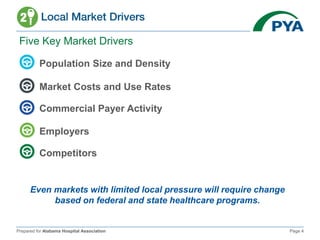
Five Key Market Drivers
Population Size and Density
Market Costs and Use Rates
Commercial Payer Activity
Employers
Competitors
Even markets with limited local pressure will require change
based on federal and state healthcare programs.
Prepared for Alabama Hospital Association Page 5
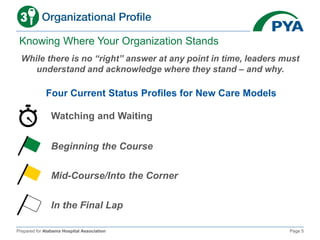
Knowing Where Your Organization Stands
While there is no “right” answer at any point in time, leaders must
understand and acknowledge where they stand – and why.
Four Current Status Profiles for New Care Models
Watching and Waiting
Beginning the Course
Mid-Course/Into the Corner
In the Final Lap
Prepared for Alabama Hospital Association Page 6
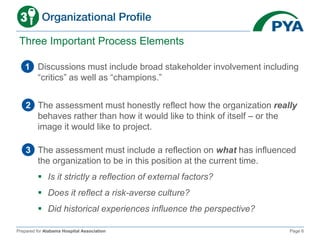
Three Important Process Elements
1 Discussions must include broad stakeholder involvement including
“critics” as well as “champions.”
2 The assessment must honestly reflect how the organization really
behaves rather than how it would like to think of itself – or the
image it would like to project.
3 The assessment must include a reflection on what has influenced
the organization to be in this position at the current time.
 Is it strictly a reflection of external factors?
 Does it reflect a risk-averse culture?
 Did historical experiences influence the perspective?
Prepared for Alabama Hospital Association Page 7
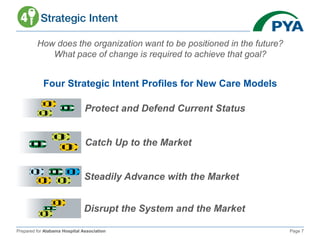
How does the organization want to be positioned in the future?
What pace of change is required to achieve that goal?
Four Strategic Intent Profiles for New Care Models
Protect and Defend Current Status
Steadily Advance with the Market
Catch Up to the Market
Disrupt the System and the Market
Prepared for Alabama Hospital Association Page 8
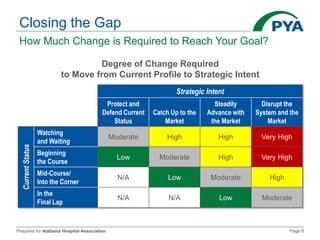
Closing the Gap
How Much Change is Required to Reach Your Goal?
Degree of Change Required
to Move from Current Profile to Strategic Intent
Strategic Intent
Protect and
Defend Current
Status
Catch Up to the
Market
Steadily
Advance with
the Market
Disrupt the
System and the
Market
CurrentStatus
Watching
and Waiting
Moderate High High Very High
Beginning
the Course
Low Moderate High Very High
Mid-Course/
Into the Corner
N/A Low Moderate High
In the
Final Lap
N/A N/A Low Moderate
Prepared for Alabama Hospital Association Page 9
Monitoring Market Movement
Monitor to Determine Optimal Timing for Key Initiatives
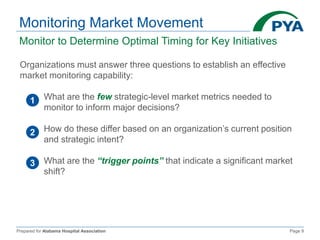
Organizations must answer three questions to establish an effective
market monitoring capability:
What are the few strategic-level market metrics needed to
monitor to inform major decisions?
How do these differ based on an organization’s current position
and strategic intent?
What are the “trigger points” that indicate a significant market
shift?
1
2
3
Prepared for Alabama Hospital Association Page 10
Monitoring Market Movement
Common Market Metrics to Track Pace of Change
Metrics can serve as trigger points that indicate significant market
shift demanding immediate action.
 Population Size and Density
 Market Costs and Use Rates
 Payer Activity
 Employers
 Competitors
Prepared for Alabama Hospital Association Page 11
Across the Finish Line
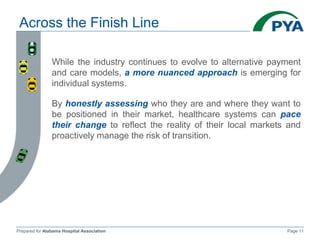
While the industry continues to evolve to alternative payment
and care models, a more nuanced approach is emerging for
individual systems.
By honestly assessing who they are and where they want to
be positioned in their market, healthcare systems can pace
their change to reflect the reality of their local markets and
proactively manage the risk of transition.
PERSHING YOAKLEY & ASSOCIATES, P.C.
800.270.9629 | www.pyapc.com
Scott Clay
Principal
SClay@pyapc.com

Pacing Volume-to-Value Transition

  • 1.
    Scott Clay, ConsultingPrincipal Alabama Hospital Association Annual Meeting June 10, 2016 TIMING IS EVERYTHING Pacing the Volume-to-Value Transition
  • 2.
    Prepared for AlabamaHospital Association Page 1 The Dilemma
  • 3.
    Prepared for AlabamaHospital Association Page 2 Positioning for Transformation Timing Is Everything! Decisions on when and how to change payer contracting strategies and underlying operational platforms must be informed by four key considerations: Government Policy Drivers Local and Regional Market Drivers The Organization’s Current Position/Profile with Regard to Value-Based Transition The Organization’s Strategic Intent for Adoption of New Care Models
  • 4.
    Prepared for AlabamaHospital Association Page 3 CMS’ Push to Value-Based Reimbursement CMS is setting the “floor” on the level and pace of change required. 2016 2018 30% In alternative payment models, e.g. ACOs, bundled payments. 50% In alternative payment models, e.g. ACOs, bundled payments. 85% Tied to quality and efficiency measures. 90% Medicaid APMs provide opportunity to minimize losses with less downside risk and provide upside by minimizing use of high-cost services. Tied to quality and efficiency measures.
  • 5.
    Prepared for AlabamaHospital Association Page 4 Five Key Market Drivers Population Size and Density Market Costs and Use Rates Commercial Payer Activity Employers Competitors Even markets with limited local pressure will require change based on federal and state healthcare programs.
  • 6.
    Prepared for AlabamaHospital Association Page 5 Knowing Where Your Organization Stands While there is no “right” answer at any point in time, leaders must understand and acknowledge where they stand – and why. Four Current Status Profiles for New Care Models Watching and Waiting Beginning the Course Mid-Course/Into the Corner In the Final Lap
  • 7.
    Prepared for AlabamaHospital Association Page 6 Three Important Process Elements 1 Discussions must include broad stakeholder involvement including “critics” as well as “champions.” 2 The assessment must honestly reflect how the organization really behaves rather than how it would like to think of itself – or the image it would like to project. 3 The assessment must include a reflection on what has influenced the organization to be in this position at the current time.  Is it strictly a reflection of external factors?  Does it reflect a risk-averse culture?  Did historical experiences influence the perspective?
  • 8.
    Prepared for AlabamaHospital Association Page 7 How does the organization want to be positioned in the future? What pace of change is required to achieve that goal? Four Strategic Intent Profiles for New Care Models Protect and Defend Current Status Steadily Advance with the Market Catch Up to the Market Disrupt the System and the Market
  • 9.
    Prepared for AlabamaHospital Association Page 8 Closing the Gap How Much Change is Required to Reach Your Goal? Degree of Change Required to Move from Current Profile to Strategic Intent Strategic Intent Protect and Defend Current Status Catch Up to the Market Steadily Advance with the Market Disrupt the System and the Market CurrentStatus Watching and Waiting Moderate High High Very High Beginning the Course Low Moderate High Very High Mid-Course/ Into the Corner N/A Low Moderate High In the Final Lap N/A N/A Low Moderate
  • 10.
    Prepared for AlabamaHospital Association Page 9 Monitoring Market Movement Monitor to Determine Optimal Timing for Key Initiatives Organizations must answer three questions to establish an effective market monitoring capability: What are the few strategic-level market metrics needed to monitor to inform major decisions? How do these differ based on an organization’s current position and strategic intent? What are the “trigger points” that indicate a significant market shift? 1 2 3
  • 11.
    Prepared for AlabamaHospital Association Page 10 Monitoring Market Movement Common Market Metrics to Track Pace of Change Metrics can serve as trigger points that indicate significant market shift demanding immediate action.  Population Size and Density  Market Costs and Use Rates  Payer Activity  Employers  Competitors
  • 12.
    Prepared for AlabamaHospital Association Page 11 Across the Finish Line While the industry continues to evolve to alternative payment and care models, a more nuanced approach is emerging for individual systems. By honestly assessing who they are and where they want to be positioned in their market, healthcare systems can pace their change to reflect the reality of their local markets and proactively manage the risk of transition.
  • 13.
    PERSHING YOAKLEY &ASSOCIATES, P.C. 800.270.9629 | www.pyapc.com Scott Clay Principal SClay@pyapc.com