PROGRAMMING CRASH COURSE
KEDS BIODESIGNS
WEEK :111
CLASS : 8
SESSION : LOGISTIC REGRESSION & SVM
INTRODUCTION TO LOGISTIC REGRESSION
 Logistic regression is a supervised learning classification algorithm used to predict the probability of a
target variable. The nature of target or dependent variable is dichotomous, which means there would be
only two possible classes.
 In simple words, the dependent variable is binary in nature having data coded as either 1 (stands for
success/yes) or 0 (stands for failure/no).
 Mathematically, a logistic regression model predicts P(Y=1) as a function of X. It is one of the simplest
ML algorithms that can be used for various classification problems such as spam detection, Diabetes
prediction, cancer detection etc
TYPES OF LOGISTIC REGRESSION
Generally, logistic regression means binary logistic regression having binary target variables, but there can
be two more categories of target variables that can be predicted by it. Based on those number of
categories, Logistic regression can be divided into following types
 Binary or Binomial
 Multinomial
 Ordinal
Binary or Binomial
 In such a kind of classification, a dependent variable will have only two possible types either 1 and 0.
example, these variables may represent success or failure, yes or no, win or loss etc.
Multinomial
 In such a kind of classification, dependent variable can have 3 or more possible unordered types or
types having no quantitative significance. For example, these variables may represent “Type A” or
B” or “Type C”.
Ordinal
 In such a kind of classification, dependent variable can have 3 or more possible ordered types or the
types having a quantitative significance. For example, these variables may represent “poor” or “good”,
“very good”, “Excellent” and each category can have the scores like 0,1,2,3.
LOGISTIC REGRESSION ASSUMPTIONS
 Before diving into the implementation of logistic regression, we must be aware of the following
assumptions about the same.
 In case of binary logistic regression, the target variables must be binary always and the desired outcome
is represented by the factor level 1.
 There should not be any multi - collinearity in the model, which means the independent variables must
be independent of each other.
 We must include meaningful variables in our model.
 We should choose a large sample size for logistic regression.
REGRESSION MODELS
 Binary Logistic Regression Model − The simplest form of logistic regression is binary or binomial logistic
regression in which the target or dependent variable can have only 2 possible types either 1 or 0.
 Multinomial Logistic Regression Model − Another useful form of logistic regression is multinomial
logistic regression in which the target or dependent variable can have 3 or more
possible unordered types i.e. the types having no quantitative significance.
INTRODUCTION TO SVM
 Support Vector Machine (SVM) was first heard in 1992, introduced by Boser, Guyon, and Vapnik in
COLT-92. ... In another terms, Support Vector Machine (SVM) is a classification and regression prediction
tool that uses machine learning theory to maximize predictive accuracy while automatically avoiding
over-fit to the data.
 Support vector machines (SVMs) are powerful yet flexible supervised machine learning algorithms which
are used both for classification and regression. But generally, they are used in classification problems. In
1960s, SVMs were first introduced but later they got refined in 1990. SVMs have their unique way of
implementation as compared to other machine learning algorithms. Lately, they are extremely popular
because of their ability to handle multiple continuous and categorical variables.
WORKING OF SVM
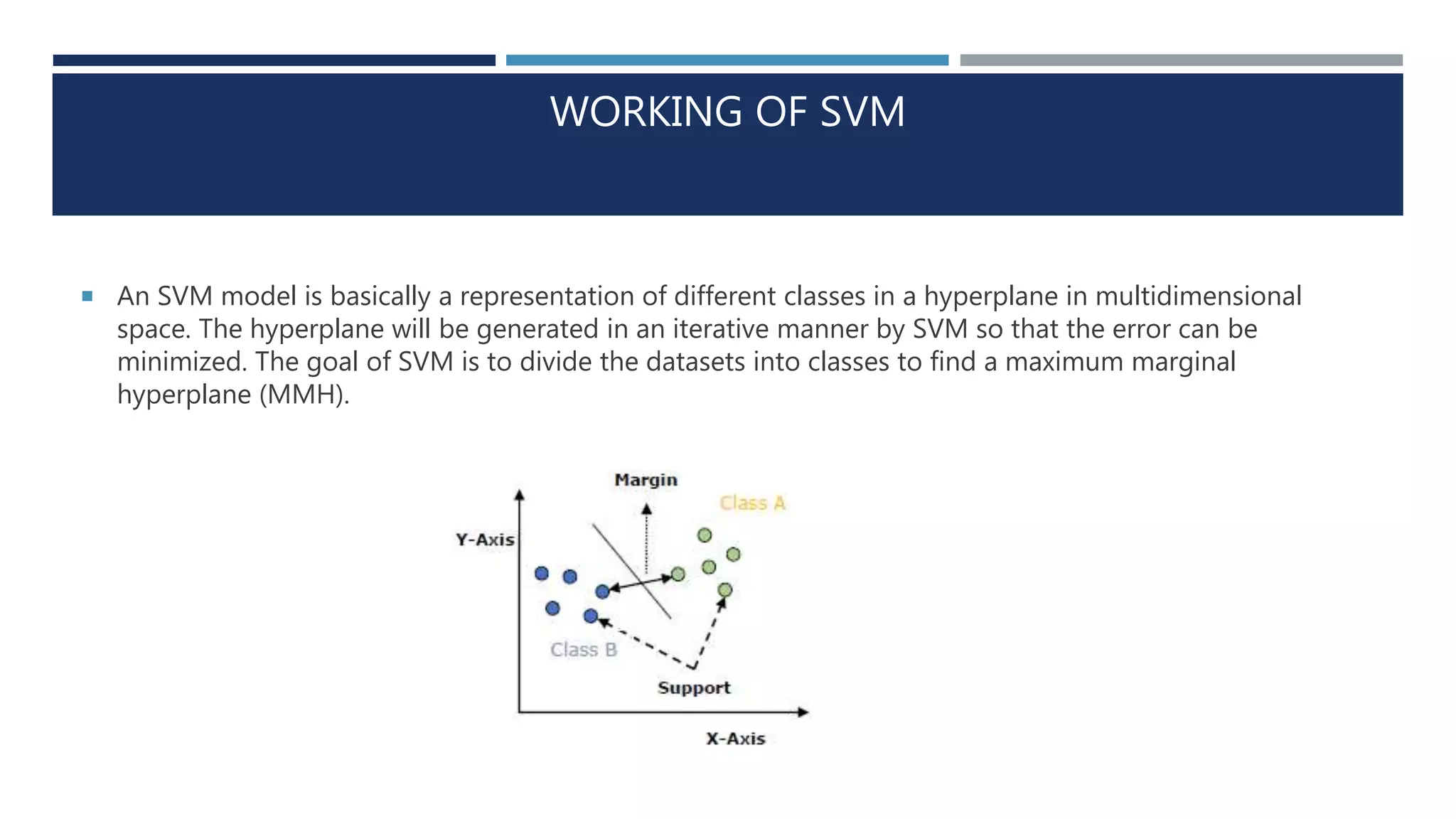
 An SVM model is basically a representation of different classes in a hyperplane in multidimensional
space. The hyperplane will be generated in an iterative manner by SVM so that the error can be
minimized. The goal of SVM is to divide the datasets into classes to find a maximum marginal
hyperplane (MMH).
CONCEPTS IN SVM
 Support Vectors − Data points that are closest to the hyperplane is called support vectors. Separating
line will be defined with the help of these data points.
 Hyperplane − As we can see in the above diagram, it is a decision plane or space which is divided
between a set of objects having different classes.
 Margin − It may be defined as the gap between two lines on the closet data points of different classes.
It can be calculated as the perpendicular distance from the line to the support vectors. Large margin is
considered as a good margin and small margin is considered as a bad margin.
 The main goal of SVM is to divide the datasets into classes to find a maximum marginal hyperplane
(MMH) and it can be done in the following two steps −
 First, SVM will generate hyper planes iteratively that segregates the classes in best way.
 Then, it will choose the hyperplane that separates the classes correctly.
VIDEO ABOUT MACHINE LEARNING
NEXT SESSION
IMPLEMENTING SVM IN PYTHON

Machine learning session 8

  • 1.
    PROGRAMMING CRASH COURSE KEDSBIODESIGNS WEEK :111 CLASS : 8 SESSION : LOGISTIC REGRESSION & SVM
  • 2.
    INTRODUCTION TO LOGISTICREGRESSION  Logistic regression is a supervised learning classification algorithm used to predict the probability of a target variable. The nature of target or dependent variable is dichotomous, which means there would be only two possible classes.  In simple words, the dependent variable is binary in nature having data coded as either 1 (stands for success/yes) or 0 (stands for failure/no).  Mathematically, a logistic regression model predicts P(Y=1) as a function of X. It is one of the simplest ML algorithms that can be used for various classification problems such as spam detection, Diabetes prediction, cancer detection etc
  • 3.
    TYPES OF LOGISTICREGRESSION Generally, logistic regression means binary logistic regression having binary target variables, but there can be two more categories of target variables that can be predicted by it. Based on those number of categories, Logistic regression can be divided into following types  Binary or Binomial  Multinomial  Ordinal
  • 4.
    Binary or Binomial In such a kind of classification, a dependent variable will have only two possible types either 1 and 0. example, these variables may represent success or failure, yes or no, win or loss etc. Multinomial  In such a kind of classification, dependent variable can have 3 or more possible unordered types or types having no quantitative significance. For example, these variables may represent “Type A” or B” or “Type C”. Ordinal  In such a kind of classification, dependent variable can have 3 or more possible ordered types or the types having a quantitative significance. For example, these variables may represent “poor” or “good”, “very good”, “Excellent” and each category can have the scores like 0,1,2,3.
  • 5.
    LOGISTIC REGRESSION ASSUMPTIONS Before diving into the implementation of logistic regression, we must be aware of the following assumptions about the same.  In case of binary logistic regression, the target variables must be binary always and the desired outcome is represented by the factor level 1.  There should not be any multi - collinearity in the model, which means the independent variables must be independent of each other.  We must include meaningful variables in our model.  We should choose a large sample size for logistic regression.
  • 6.
    REGRESSION MODELS  BinaryLogistic Regression Model − The simplest form of logistic regression is binary or binomial logistic regression in which the target or dependent variable can have only 2 possible types either 1 or 0.  Multinomial Logistic Regression Model − Another useful form of logistic regression is multinomial logistic regression in which the target or dependent variable can have 3 or more possible unordered types i.e. the types having no quantitative significance.
  • 7.
    INTRODUCTION TO SVM Support Vector Machine (SVM) was first heard in 1992, introduced by Boser, Guyon, and Vapnik in COLT-92. ... In another terms, Support Vector Machine (SVM) is a classification and regression prediction tool that uses machine learning theory to maximize predictive accuracy while automatically avoiding over-fit to the data.  Support vector machines (SVMs) are powerful yet flexible supervised machine learning algorithms which are used both for classification and regression. But generally, they are used in classification problems. In 1960s, SVMs were first introduced but later they got refined in 1990. SVMs have their unique way of implementation as compared to other machine learning algorithms. Lately, they are extremely popular because of their ability to handle multiple continuous and categorical variables.
  • 8.
    WORKING OF SVM An SVM model is basically a representation of different classes in a hyperplane in multidimensional space. The hyperplane will be generated in an iterative manner by SVM so that the error can be minimized. The goal of SVM is to divide the datasets into classes to find a maximum marginal hyperplane (MMH).
  • 9.
    CONCEPTS IN SVM Support Vectors − Data points that are closest to the hyperplane is called support vectors. Separating line will be defined with the help of these data points.  Hyperplane − As we can see in the above diagram, it is a decision plane or space which is divided between a set of objects having different classes.  Margin − It may be defined as the gap between two lines on the closet data points of different classes. It can be calculated as the perpendicular distance from the line to the support vectors. Large margin is considered as a good margin and small margin is considered as a bad margin.  The main goal of SVM is to divide the datasets into classes to find a maximum marginal hyperplane (MMH) and it can be done in the following two steps −  First, SVM will generate hyper planes iteratively that segregates the classes in best way.  Then, it will choose the hyperplane that separates the classes correctly.
  • 10.
  • 11.