Support Vector Machine
Dr. Muhammad
Farhan Hanif
What is support vector?
• “Support Vector Machine” (SVM) is a supervised
machine learning algorithm which can be used
for both classification or regression challenges.
However, it is mostly used in classification
problems.
• In this algorithm, we plot each data item as a
point in n-dimensional space (where n is number
of features you have) with the value of each
feature being the value of a particular
coordinate.
• Then, we perform classification by finding the
hyperplane that differentiate the two classes
very well.
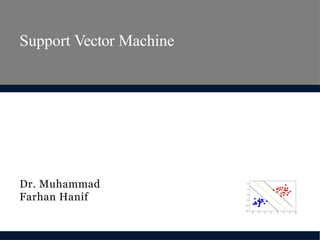
Support Vector Machine
• Generally, Support Vector Machines is considered to
be a classification approach, it but can be employed in
both types of classification and regression problems.
• It can easily handle multiple continuous and
categorical variables.
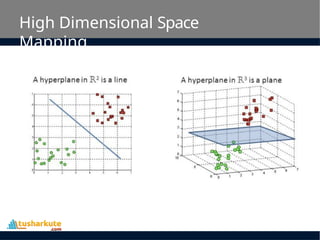
• SVM constructs a hyperplane in multidimensional
space to separate different classes. SVM generates
optimal hyperplane in an iterative manner, which is
used to minimize an error.
• The core idea of SVM is to find a maximum
marginal hyperplane(MMH) that best divides
the dataset into classes.
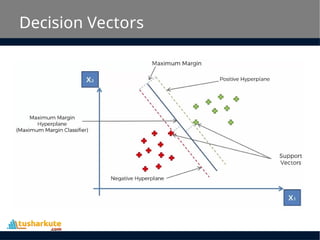
Decision Vectors
Definitions
• Support Vectors
– Support vectors are the data points, which are
closest to the hyperplane. These points will
define the separating line better by
calculating margins.
These points are more relevant to the
construction of the classifier.
Hyperplane
– A hyperplane is a decision plane which
separates between a set of objects having
different class memberships.
•
Definitions
• Margin
– A margin is a gap between the two lines on
the closest class points.
– This is calculated as the perpendicular
distance from the line to support vectors or
closest points.
– If the margin is larger in between the
classes, then it is considered a good
margin, a smaller margin is a bad margin.
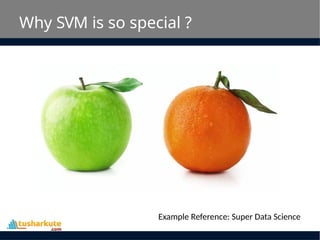
Why SVM is so special ?
Example Reference: Super Data Science
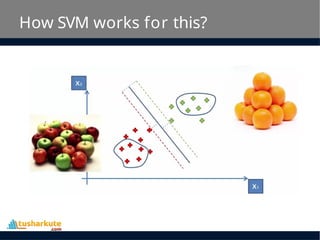
How SVM works for this?
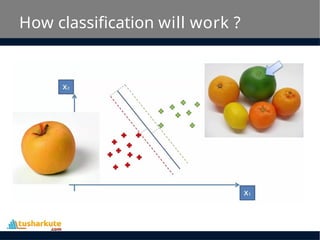
How classification will work ?
How SVM works ?
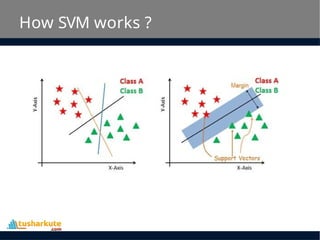
• The main objective is to segregate the given
dataset in the best possible way.
• The distance between the either nearest points is
known as the margin.
• The objective is to select a hyperplane with the
maximum possible margin between support
vectors in the given dataset. SVM searches for the
maximum marginal hyperplane in the following
steps:
– Generate hyperplanes which segregates the classes in
the best way.
– Select the right hyperplane with the maximum
segregation from the either nearest data points.
How SVM works ?
Non-linear and inseparable
planes
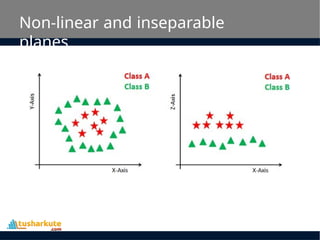
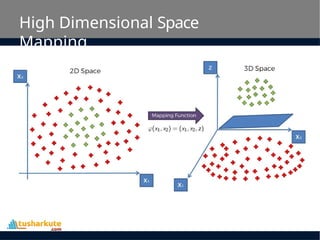
• Some problems can’t be solved using
linear hyperplane.
• In such situation, SVM uses a kernel trick
to transform the input space to a
higher dimensional space as shown on
the right.
• The data points are plotted on the x-axis
and z- axis (Z is the squared sum of both x
and y: z=x^2=y^2).
• Now you can easily segregate these points
using linear separation.
Non-linear and inseparable
planes
High Dimensional Space
Mapping
High Dimensional Space
Mapping
SVM Kernels
• The SVM algorithm is implemented in practice using
a kernel. A kernel transforms an input data space
into the required form.
• SVM uses a technique called the kernel trick. Here,
the kernel takes a low-dimensional input space and
transforms it into a higher dimensional space.
• In other words, you can say that it converts non-
separable problem to separable problems by adding
more dimension to it.
• It is most useful in non-linear separation problem.
Kernel trick helps you to build a more accurate
classifier.
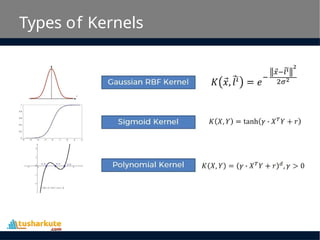
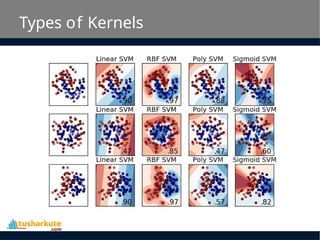
Kernel Types
• Linear Kernel
• Polynomial Kernel
• Radial Basis Function
Kernel
• Sigmoid Kernel
Radial Basis Function Kernel
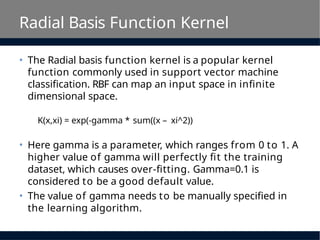
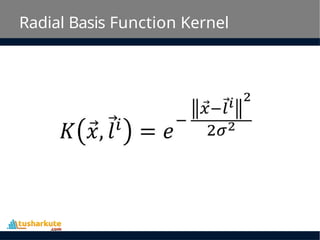
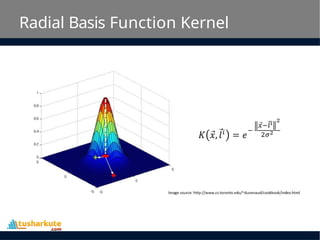
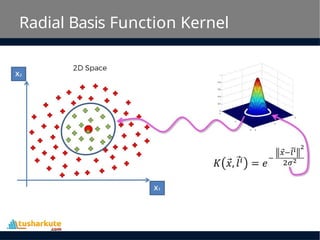
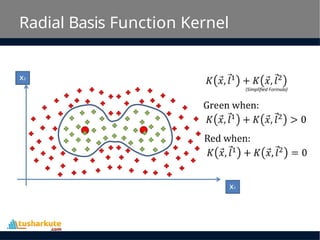
• The Radial basis function kernel is a popular kernel
function commonly used in support vector machine
classification. RBF can map an input space in infinite
dimensional space.
K(x,xi) = exp(-gamma * sum((x – xi^2))
• Here gamma is a parameter, which ranges from 0 to 1. A
higher value of gamma will perfectly fit the training
dataset, which causes over-fitting. Gamma=0.1 is
considered to be a good default value.
• The value of gamma needs to be manually specified in
the learning algorithm.
Radial Basis Function Kernel
Types of Kernels
Types of Kernels
Example:
OCR
Example: Image Processing
• Image processing is a difficult task for many
types of machine learning algorithms.
• The relationships linking patterns of pixels to
higher concepts are extremely complex and hard
to define.
• For instance, it's easy for a human being to
recognize a face, a cat, or the letter "A", but
defining these patterns in strict rules is difficult.
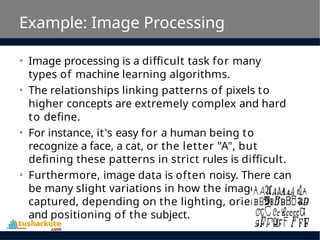
• Furthermore, image data is often noisy. There can
be many slight variations in how the image was
captured, depending on the lighting, orientation,
and positioning of the subject.
Example: Data Collection
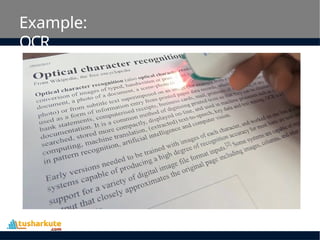
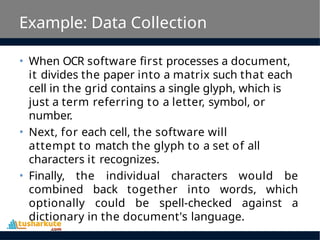
• When OCR software first processes a document,
it divides the paper into a matrix such that each
cell in the grid contains a single glyph, which is
just a term referring to a letter, symbol, or
number.
• Next, for each cell, the software will
attempt to match the glyph to a set of all
characters it recognizes.
• Finally, the individual characters would be
combined back together into words, which
optionally could be spell-checked against a
dictionary in the document's language.
The Dataset
• We'll use a dataset donated to the UCI
Machine Learning Data Repository (
http://archive.ics.uci.edu/ml ) by W. Frey and
D. J. Slate.
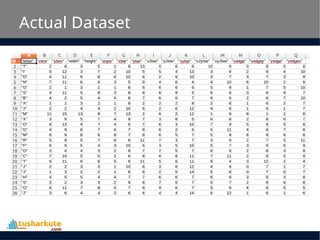
• The dataset contains 20,000 examples of 26 English
alphabet capital letters as printed using 20 different
randomly reshaped and distorted black and white
fonts.
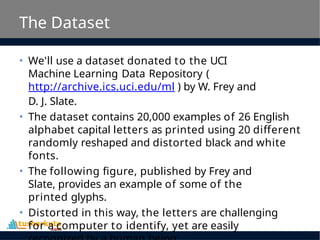
• The following figure, published by Frey and
Slate, provides an example of some of the
printed glyphs.
• Distorted in this way, the letters are challenging
for a computer to identify, yet are easily
Actual Dataset
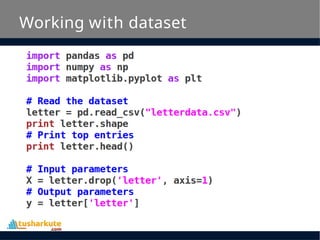
Working with dataset
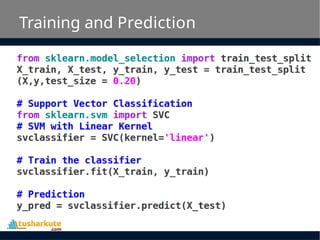
Training and Prediction
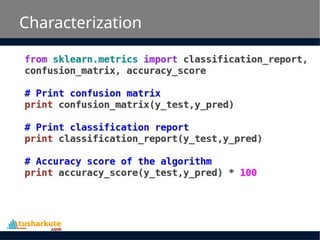
Characterization
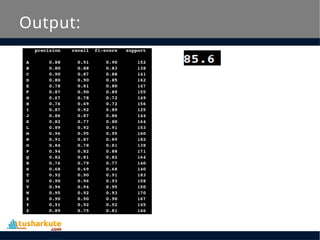
Output:
References:
• https://mitu.co.in
• https://superdatascience.com
• https://stackabuse.com/
• https://jakevdp.github.io
• https://towardsdatascience.co
m
• https://www.datacamp.com
• http://scikit-learn.org/

Support-Vector-Machine (Supervised Learning).pptx

  • 1.
    Support Vector Machine Dr.Muhammad Farhan Hanif
  • 2.
    What is supportvector? • “Support Vector Machine” (SVM) is a supervised machine learning algorithm which can be used for both classification or regression challenges. However, it is mostly used in classification problems. • In this algorithm, we plot each data item as a point in n-dimensional space (where n is number of features you have) with the value of each feature being the value of a particular coordinate. • Then, we perform classification by finding the hyperplane that differentiate the two classes very well.
  • 3.
    Support Vector Machine •Generally, Support Vector Machines is considered to be a classification approach, it but can be employed in both types of classification and regression problems. • It can easily handle multiple continuous and categorical variables. • SVM constructs a hyperplane in multidimensional space to separate different classes. SVM generates optimal hyperplane in an iterative manner, which is used to minimize an error. • The core idea of SVM is to find a maximum marginal hyperplane(MMH) that best divides the dataset into classes.
  • 4.
  • 5.
    Definitions • Support Vectors –Support vectors are the data points, which are closest to the hyperplane. These points will define the separating line better by calculating margins. These points are more relevant to the construction of the classifier. Hyperplane – A hyperplane is a decision plane which separates between a set of objects having different class memberships. •
  • 6.
    Definitions • Margin – Amargin is a gap between the two lines on the closest class points. – This is calculated as the perpendicular distance from the line to support vectors or closest points. – If the margin is larger in between the classes, then it is considered a good margin, a smaller margin is a bad margin.
  • 7.
    Why SVM isso special ? Example Reference: Super Data Science
  • 8.
    How SVM worksfor this?
  • 9.
  • 10.
    How SVM works? • The main objective is to segregate the given dataset in the best possible way. • The distance between the either nearest points is known as the margin. • The objective is to select a hyperplane with the maximum possible margin between support vectors in the given dataset. SVM searches for the maximum marginal hyperplane in the following steps: – Generate hyperplanes which segregates the classes in the best way. – Select the right hyperplane with the maximum segregation from the either nearest data points.
  • 11.
  • 12.
    Non-linear and inseparable planes •Some problems can’t be solved using linear hyperplane. • In such situation, SVM uses a kernel trick to transform the input space to a higher dimensional space as shown on the right. • The data points are plotted on the x-axis and z- axis (Z is the squared sum of both x and y: z=x^2=y^2). • Now you can easily segregate these points using linear separation.
  • 13.
  • 14.
  • 15.
  • 16.
    SVM Kernels • TheSVM algorithm is implemented in practice using a kernel. A kernel transforms an input data space into the required form. • SVM uses a technique called the kernel trick. Here, the kernel takes a low-dimensional input space and transforms it into a higher dimensional space. • In other words, you can say that it converts non- separable problem to separable problems by adding more dimension to it. • It is most useful in non-linear separation problem. Kernel trick helps you to build a more accurate classifier.
  • 17.
    Kernel Types • LinearKernel • Polynomial Kernel • Radial Basis Function Kernel • Sigmoid Kernel
  • 18.
    Radial Basis FunctionKernel • The Radial basis function kernel is a popular kernel function commonly used in support vector machine classification. RBF can map an input space in infinite dimensional space. K(x,xi) = exp(-gamma * sum((x – xi^2)) • Here gamma is a parameter, which ranges from 0 to 1. A higher value of gamma will perfectly fit the training dataset, which causes over-fitting. Gamma=0.1 is considered to be a good default value. • The value of gamma needs to be manually specified in the learning algorithm.
  • 19.
  • 20.
  • 21.
  • 22.
  • 23.
  • 24.
  • 25.
  • 26.
    Example: Image Processing •Image processing is a difficult task for many types of machine learning algorithms. • The relationships linking patterns of pixels to higher concepts are extremely complex and hard to define. • For instance, it's easy for a human being to recognize a face, a cat, or the letter "A", but defining these patterns in strict rules is difficult. • Furthermore, image data is often noisy. There can be many slight variations in how the image was captured, depending on the lighting, orientation, and positioning of the subject.
  • 27.
    Example: Data Collection •When OCR software first processes a document, it divides the paper into a matrix such that each cell in the grid contains a single glyph, which is just a term referring to a letter, symbol, or number. • Next, for each cell, the software will attempt to match the glyph to a set of all characters it recognizes. • Finally, the individual characters would be combined back together into words, which optionally could be spell-checked against a dictionary in the document's language.
  • 28.
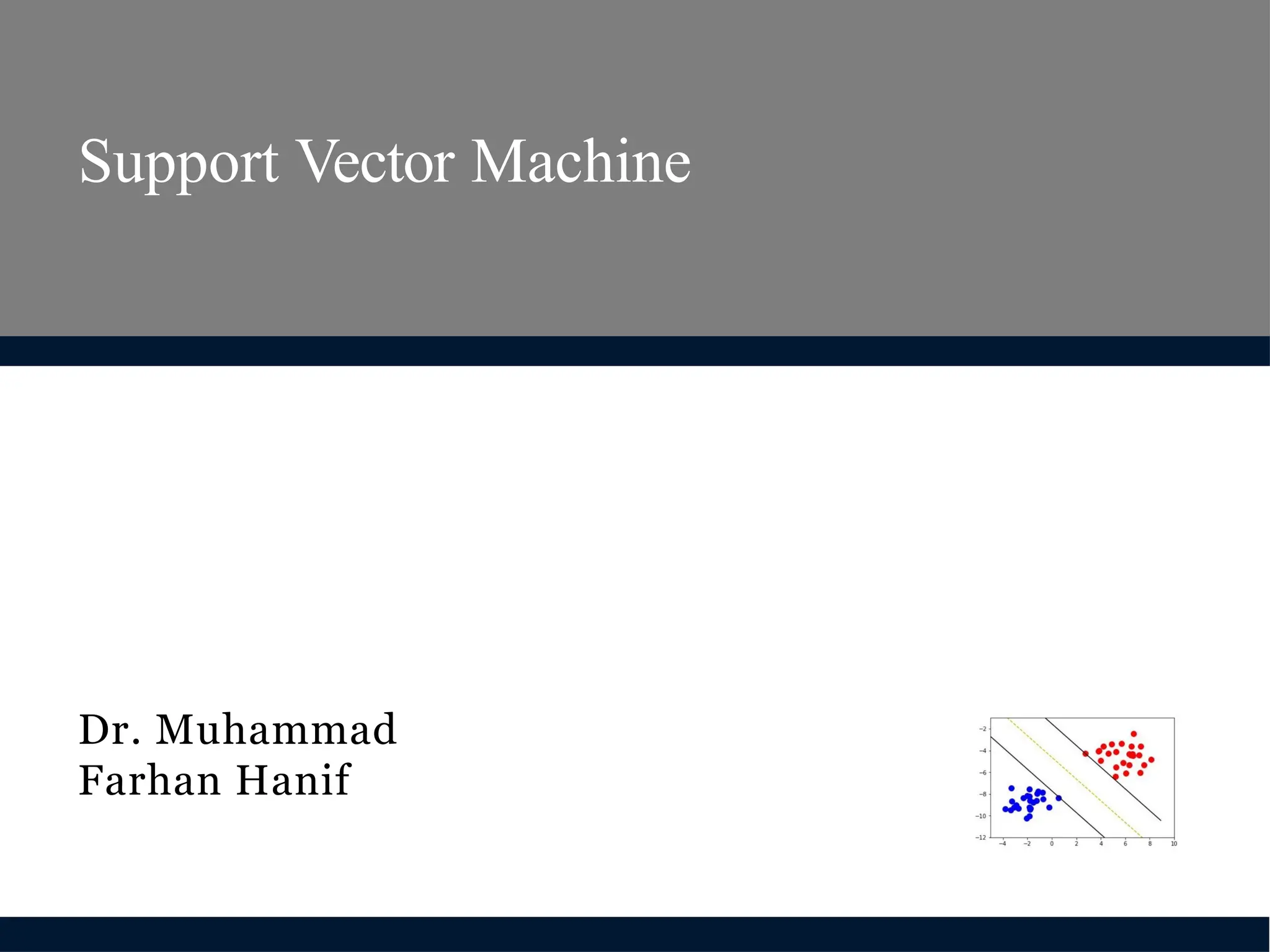
    The Dataset • We'lluse a dataset donated to the UCI Machine Learning Data Repository ( http://archive.ics.uci.edu/ml ) by W. Frey and D. J. Slate. • The dataset contains 20,000 examples of 26 English alphabet capital letters as printed using 20 different randomly reshaped and distorted black and white fonts. • The following figure, published by Frey and Slate, provides an example of some of the printed glyphs. • Distorted in this way, the letters are challenging for a computer to identify, yet are easily
  • 29.
  • 30.
  • 31.
  • 32.
  • 33.
  • 34.
    References: • https://mitu.co.in • https://superdatascience.com •https://stackabuse.com/ • https://jakevdp.github.io • https://towardsdatascience.co m • https://www.datacamp.com • http://scikit-learn.org/