Machine Learning
                                Martin Sewell
                        Department of Computer Science
                            University College London

                April 2007 (last updated January 2009)


1    Introduction
Machine learning is an area of artificial intelligence concerned with the study
of computer algorithms that improve automatically through experience. In
practice, this involves creating programs that optimize a performance criterion
through the analysis of data. Machine learning can be viewed as an attempt to
automate ‘doing science’. For introductory texts, see Langley (1996), Mitchell
(1997), Alpaydin (2004) and Bishop (2006). Mitchell has long been considered
the ‘bible’, but is now slightly dated. Bishop (2006) is the first textbook on pat-
tern recognition to present the Bayesian viewpoint. For introductory books on
computational learning theory (which emphasizes the ‘probably approximately
correct’ (PAC) model of learning (Valiant 1984)), see Anthony and Biggs (1992)
and Kearns and Vazirani (1994). As the following taxonomy shows, machine
learning algorithms may be categorised in at least six ways.


2    Taxonomy
    • Model type
     probabilistic Build a full or partial probability model.
     non-probabilistic Find a discriminant/regession function directly.
    • Type of reasoning

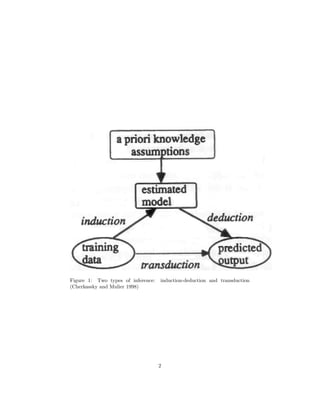
     Induction Reasoning from observed training cases to general rules, which
         are then applied to the test cases.
     Transduction Reasoning from observed, specific (training) cases to spe-
         cific (test) cases. Figure 1 (page 2) shows the relationship between
         induction and transduction.

    • Type of machine learning


                                        1
Figure 1: Two types of inference:   induction-deduction and transduction
(Cherkassky and Mulier 1998)


                                    2
Supervised learning The algorithm is first presented with training data
        which consists of examples which include both the inputs and the
        desired outputs, thus enabling it to learn a function. The learner
        should then be able to generalize from the presented data to unseen
        examples. In situations where there is a cost to labeling data, a
        method known as active learning may be used, where the learner
        chooses which data to label.
     Unsupervised learning The algorithm is presented with examples from
        the input space only and a model is fit to these observations. For
        example, a clustering algorithm would be a form of unsupervised
        learning.
     Reinforcement learning An agent explores an environment and at the
         end receives a reward, which may be either positive or negative. In
         effect, the agent is told whether he was right or wrong, but is not
         told how. Examples include playing a game of chess (you don’t know
         whether you’ve won or lost until the very end) or a waitress in a
         restaurant (she has to wait for the end of the meal before she finds
         out whether or not she receives a tip).
    • The manner in which the training data are presented to the
      learner
     Batch All the data are given to the learner at the start of learning.
     On-line The learner receives one example at a time, and gives an esti-
         mate of the output, before receiving the correct value. The learner
         updates its current hypothesis in response to each new example and
         the quality of learning is assessed by the total number of mistakes
         made during learning.

    • Task
     Classification May be binary or multi-class.
     Regression Real-valued targets (generalizes classification).
    • Classification model type

     generative model Defines the joint probability of the data and latent
         variables of interest, and therefore explicitly states how the observa-
         tions are assumed to have been generated.
     discriminative model Focuses only on discriminating one class from
          another.


3    Desirable Features
Desirable features of a machine learning algorithm:


                                      3
• Simple solutions are appropriately favoured over complicated ones.
• Powerful enough to learn the solution to a given problem.
• Stable to parameter variations.
• Converges in finite time.

• Scales reasonably with the number of training examples, the number of
  input features and the number of test examples.


                                    4
References
ALPAYDIN, Ethem, 2004. Introduction to Machine Learning. Adaptive Com-
 putation and Machine Learning. Cambridge, MA: The MIT Press.
ANTHONY, Martin, and Norman BIGGS, 1992. Computational Learning The-
 ory. Volume 30 of Cambridge Tracts in Theoretical Computer Science. Cam-
 bridge: Cambridge University Press.

BISHOP, Christopher M., 2006. Pattern Recognition and Machine Learning.
  Information Science and Statistics. New York: Springer.
CHERKASSKY, Vladimir, and Filip MULIER, 1998. Learning from Data: Con-
 cepts, Theory, and Methods. Adaptive and Learning Systems for Signal Pro-
 cessing, Communications and Control Series. New York: Wiley.

KEARNS, Michael J., and Umesh V. VAZIRANI, 1994. An Introduction to
 Computational Learning Theory. Cambridge, MA: The MIT Press.
LANGLEY, Pat, 1996. Elements of Machine Learning. San Francisco, CA:
  Morgan Kaufmann.

MITCHELL, Tom M., 1997. Machine Learning. New York: McGraw-Hill.
VALIANT, L. G., 1984. A Theory of the Learnable. Communications of the
 ACM, 27(11), 1134–1142.


                                    5

Machine Learning

  • 1.
    Machine Learning Martin Sewell Department of Computer Science University College London April 2007 (last updated January 2009) 1 Introduction Machine learning is an area of artificial intelligence concerned with the study of computer algorithms that improve automatically through experience. In practice, this involves creating programs that optimize a performance criterion through the analysis of data. Machine learning can be viewed as an attempt to automate ‘doing science’. For introductory texts, see Langley (1996), Mitchell (1997), Alpaydin (2004) and Bishop (2006). Mitchell has long been considered the ‘bible’, but is now slightly dated. Bishop (2006) is the first textbook on pat- tern recognition to present the Bayesian viewpoint. For introductory books on computational learning theory (which emphasizes the ‘probably approximately correct’ (PAC) model of learning (Valiant 1984)), see Anthony and Biggs (1992) and Kearns and Vazirani (1994). As the following taxonomy shows, machine learning algorithms may be categorised in at least six ways. 2 Taxonomy • Model type probabilistic Build a full or partial probability model. non-probabilistic Find a discriminant/regession function directly. • Type of reasoning Induction Reasoning from observed training cases to general rules, which are then applied to the test cases. Transduction Reasoning from observed, specific (training) cases to spe- cific (test) cases. Figure 1 (page 2) shows the relationship between induction and transduction. • Type of machine learning 1
  • 2.
    Figure 1: Twotypes of inference: induction-deduction and transduction (Cherkassky and Mulier 1998) 2
  • 3.
    Supervised learning Thealgorithm is first presented with training data which consists of examples which include both the inputs and the desired outputs, thus enabling it to learn a function. The learner should then be able to generalize from the presented data to unseen examples. In situations where there is a cost to labeling data, a method known as active learning may be used, where the learner chooses which data to label. Unsupervised learning The algorithm is presented with examples from the input space only and a model is fit to these observations. For example, a clustering algorithm would be a form of unsupervised learning. Reinforcement learning An agent explores an environment and at the end receives a reward, which may be either positive or negative. In effect, the agent is told whether he was right or wrong, but is not told how. Examples include playing a game of chess (you don’t know whether you’ve won or lost until the very end) or a waitress in a restaurant (she has to wait for the end of the meal before she finds out whether or not she receives a tip). • The manner in which the training data are presented to the learner Batch All the data are given to the learner at the start of learning. On-line The learner receives one example at a time, and gives an esti- mate of the output, before receiving the correct value. The learner updates its current hypothesis in response to each new example and the quality of learning is assessed by the total number of mistakes made during learning. • Task Classification May be binary or multi-class. Regression Real-valued targets (generalizes classification). • Classification model type generative model Defines the joint probability of the data and latent variables of interest, and therefore explicitly states how the observa- tions are assumed to have been generated. discriminative model Focuses only on discriminating one class from another. 3 Desirable Features Desirable features of a machine learning algorithm: 3
  • 4.
    • Simple solutionsare appropriately favoured over complicated ones. • Powerful enough to learn the solution to a given problem. • Stable to parameter variations. • Converges in finite time. • Scales reasonably with the number of training examples, the number of input features and the number of test examples. 4
  • 5.
    References ALPAYDIN, Ethem, 2004.Introduction to Machine Learning. Adaptive Com- putation and Machine Learning. Cambridge, MA: The MIT Press. ANTHONY, Martin, and Norman BIGGS, 1992. Computational Learning The- ory. Volume 30 of Cambridge Tracts in Theoretical Computer Science. Cam- bridge: Cambridge University Press. BISHOP, Christopher M., 2006. Pattern Recognition and Machine Learning. Information Science and Statistics. New York: Springer. CHERKASSKY, Vladimir, and Filip MULIER, 1998. Learning from Data: Con- cepts, Theory, and Methods. Adaptive and Learning Systems for Signal Pro- cessing, Communications and Control Series. New York: Wiley. KEARNS, Michael J., and Umesh V. VAZIRANI, 1994. An Introduction to Computational Learning Theory. Cambridge, MA: The MIT Press. LANGLEY, Pat, 1996. Elements of Machine Learning. San Francisco, CA: Morgan Kaufmann. MITCHELL, Tom M., 1997. Machine Learning. New York: McGraw-Hill. VALIANT, L. G., 1984. A Theory of the Learnable. Communications of the ACM, 27(11), 1134–1142. 5