ICT-Pedagogy
Integration in
Language
Learning Plan
KMJC
REPORTERS
Kim Valeri
Tampon
Michael Jee
Tudtud
Jomarie
Pregoner
Cherelyn
Mendoza
INTRODUCTION
3
Teaching has always been a challenging profession since
knowledge has been expanding and essential skills have been increasing
and changing. With these challenges, teachers need to engage educational
technologies to assist them in the teaching-learning process. Engaging
educational technologies in teaching are founded on principles and
philosophies. Understanding these will help you successfully integrate
technologies to allow your students to demonstrate the intended learning
outcomes of your field of specialization.
Integrating
Technology in
Instruction
Various educators and researchers
provided the following concepts and
principles about integrating technology in
instruction:
John Pisapia (1994)
▸ Integrating Technology with teaching means the
use of learning technologies to introduce,
reinforce, supplement and extend skills. For
example, if a Teacher merely tells a student to
read a book without any preparation for follow
up activities that put the book in a pedagogical
context, the book is not integrated.
5
▸ In the same way, if the teacher uses the computer
to reward children by allowing them to play a game,
the computer is not integrated.
On the other hand, integrating technology into
curricula can mean different things:
1.) computer science courses, computer assisted
instruction, and/or computer enhanced or enriched
instruction
2.) matching software with basic skills competencies,
and
3.) keyboarding with word processing followed up
with presentation tools
6
International Society
for Technology in
Education (ISTE)
Effective integration of Technology is achieved when students are
able to select technology tools to help them obtain information in a
timely manner, analyze and synthesize the information, and present it
professionally. The Technology should become an integral part of how
the classroom functions—as accessible as all other classroom tools.
7
“
ICT integration encompasses an
integral part of broader curriculum
reforms which include both
infra-structural as well as
pedagogical considerations that are
changing not only how learning
occurs but what is learned.
8
MARGARET LLOYD (2005)
Integrating Information and Communication
(ICT) into teaching and learning is a growing
area that has attracted many educators’ effort
in recent years. Based on the scope of content
covered, ICT integration can happen in three
different areas: curriculum, topic, and lesson.
Qiyun Wang and
Huay Lit Woo (2007)
9
Bernard Bahati (2010)
The process of integrating ICT in teaching
and learning has to be done at both
pedagogical and technological levels with
much emphasis put on pedagogy. ICT
integration into teaching and learning has
to be underpinned by sound pedagogical
principles.
ICT integration is not merely mastering
the hardware and software skills.
Teachers need to realize how to organize
the classroom to structure the learning
tasks so that ICT resources become
automatic and natural response to the
requirements for learning environments
in the same way as teachers use
markers and whiteboards in the
classroom.
10
UNESCO (2005)
Using ICT Integration
Frameworks in
Language Education
Learning Plans
There a lot of concepts provided
by experts relevant to
integrating technology in
instruction apart from the above
citations.
11
Using ICT Integration
Frameworks in
Language Education
Learning Plans
These concepts are very helpful
to clarify lingering issues on how
technologies are properly
integrated in the teaching-
learning process.
12
Using ICT Integration
Frameworks in
Language Education
Learning Plans
It must be noted that there are
possible instances when
technologies are used in the
classroom but the way they are
used does not promote learning
and does not help facilitate the
attainment of the intended
learning outcomes set for a class.
13
A.) Conversational Framework
of Laurillard (2002)
14
The teaching-learning process poses very complex tasks to allow
learners to understand their lessons and master the skills they are
expected to demonstrate. Thus, it will be reassuring if teachers will
explore on engaging various media to support various learning
activities in classrooms. This is how the Conversational Framework
(Laurillard, 2002) may support. The framework postulates a way of
presenting teaching and learning in terms of events
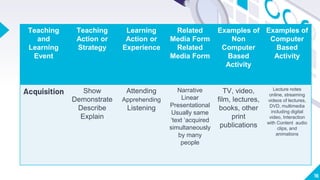
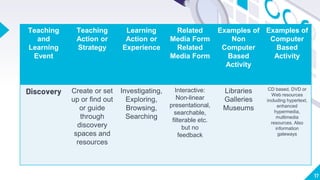
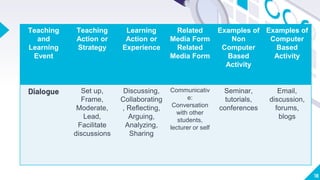
These are five (5) key teaching and learning
events in the framework which are
identified as:
15
16
Teaching
and
Learning
Event
Teaching
Action or
Strategy
Learning
Action or
Experience
Related
Media Form
Related
Media Form
Examples of
Non
Computer
Based
Activity
Examples of
Computer
Based
Activity
Acquisition Show
Demonstrate
Describe
Explain
Attending
Apprehending
Listening
Narrative
Linear
Presentational
Usually same
‘text ‘acquired
simultaneously
by many
people
TV, video,
film, lectures,
books, other
print
publications
Lecture notes
online, streaming
videos of lectures,
DVD, multimedia
including digital
video, Interaction
with Content audio
clips, and
animations
17
Teaching
and
Learning
Event
Teaching
Action or
Strategy
Learning
Action or
Experience
Related
Media Form
Related
Media Form
Examples of
Non
Computer
Based
Activity
Examples of
Computer
Based
Activity
Discovery Create or set
up or find out
or guide
through
discovery
spaces and
resources
Investigating,
Exploring,
Browsing,
Searching
Interactive:
Non-linear
presentational,
searchable,
filterable etc.
but no
feedback
Libraries
Galleries
Museums
CD based, DVD or
Web resources
including hypertext,
enhanced
hypermedia,
multimedia
resources. Also
information
gateways
18
Teaching
and
Learning
Event
Teaching
Action or
Strategy
Learning
Action or
Experience
Related
Media Form
Related
Media Form
Examples of
Non
Computer
Based
Activity
Examples of
Computer
Based
Activity
Dialogue Set up,
Frame,
Moderate,
Lead,
Facilitate
discussions
Discussing,
Collaborating
, Reflecting,
Arguing,
Analyzing,
Sharing
Communicativ
e:
Conversation
with other
students,
lecturer or self
Seminar,
tutorials,
conferences
Email,
discussion,
forums,
blogs
19
Teaching
and
Learning
Event
Teaching
Action or
Strategy
Learning
Action or
Experience
Related
Media Form
Related
Media Form
Examples of
Non
Computer
Based
Activity
Examples of
Computer
Based
Activity
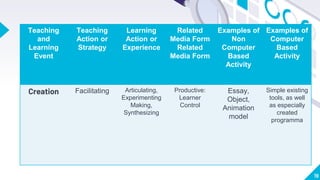
Creation Facilitating Articulating,
Experimenting
Making,
Synthesizing
Productive:
Learner
Control
Essay,
Object,
Animation
model
Simple existing
tools, as well
as especially
created
programma
B. Three Fundamental Elements
of ICT Integration by Wang (2008)
20
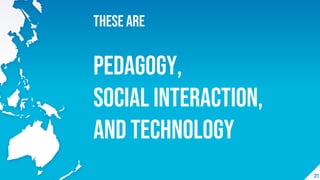
Wang in 2008 posited that integration of ICT consists of three
fundamental elements.
21
These are
pedagogy,
social interaction,
and technology
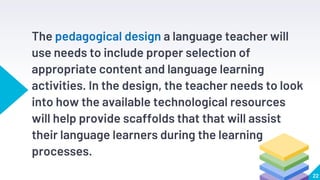
The pedagogical design a language teacher will
use needs to include proper selection of
appropriate content and language learning
activities. In the design, the teacher needs to look
into how the available technological resources
will help provide scaffolds that that will assist
their language learners during the learning
processes.
22
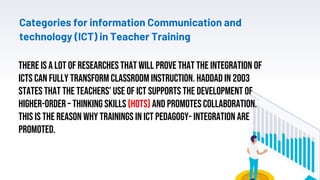
Categories for information Communication and
technology (ICT) in Teacher Training
23
There is a lot of researches that will prove that the integration of
ICTs can fully transform classroom instruction. Haddad in 2003
states that the teachers’ use of ICT supports the development of
higher-order – thinking skills (HOTS) and promotes collaboration.
This is the reason why trainings in ICT pedagogy- integration are
promoted.
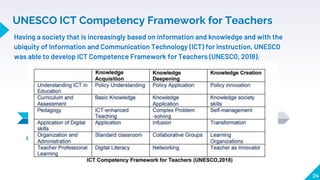
UNESCO ICT Competency Framework for Teachers
24
Lorem Ipsum
Having a society that is increasingly based on information and knowledge and with the
ubiquity of Information and Communication Technology (ICT) for instruction, UNESCO
was able to develop ICT Competence Framework for Teachers (UNESCO, 2018).
Lorem Ipsum Lorem Ipsum Lorem Ipsum
The framework also specifically aims to equip teachers to be
able to do their roles achieving the following societal goals:
Build workforces that have information and communications
technology (ICT) skills and are reflective, creative and adopt at
problem-solving in order to generate knowledge;
Enable people to be knowledgeable and resourceful so they are
able to make informed choices, manage their lives effectively
and realize their potential;
Encourage all members of society irrespective of gender,
language, age, background, location and differing abilities to
participate fully in society and influence the decisions that
affect their lives and Foster cross-cultural understanding,
tolerance and the peaceful resolution of conflict
25
26
Here is a sample of ICT
Integrated Learning Plan
27
THANK
YOU!
Any questions?
Report prepared by GROUP 2

GROUP-2-KMJC-REPORT-FOR-TUESDAYblablabla.pptx

  • 1.
  • 2.
  • 3.
    INTRODUCTION 3 Teaching has alwaysbeen a challenging profession since knowledge has been expanding and essential skills have been increasing and changing. With these challenges, teachers need to engage educational technologies to assist them in the teaching-learning process. Engaging educational technologies in teaching are founded on principles and philosophies. Understanding these will help you successfully integrate technologies to allow your students to demonstrate the intended learning outcomes of your field of specialization.
  • 4.
    Integrating Technology in Instruction Various educatorsand researchers provided the following concepts and principles about integrating technology in instruction:
  • 5.
    John Pisapia (1994) ▸Integrating Technology with teaching means the use of learning technologies to introduce, reinforce, supplement and extend skills. For example, if a Teacher merely tells a student to read a book without any preparation for follow up activities that put the book in a pedagogical context, the book is not integrated. 5
  • 6.
    ▸ In thesame way, if the teacher uses the computer to reward children by allowing them to play a game, the computer is not integrated. On the other hand, integrating technology into curricula can mean different things: 1.) computer science courses, computer assisted instruction, and/or computer enhanced or enriched instruction 2.) matching software with basic skills competencies, and 3.) keyboarding with word processing followed up with presentation tools 6
  • 7.
    International Society for Technologyin Education (ISTE) Effective integration of Technology is achieved when students are able to select technology tools to help them obtain information in a timely manner, analyze and synthesize the information, and present it professionally. The Technology should become an integral part of how the classroom functions—as accessible as all other classroom tools. 7
  • 8.
    “ ICT integration encompassesan integral part of broader curriculum reforms which include both infra-structural as well as pedagogical considerations that are changing not only how learning occurs but what is learned. 8 MARGARET LLOYD (2005)
  • 9.
    Integrating Information andCommunication (ICT) into teaching and learning is a growing area that has attracted many educators’ effort in recent years. Based on the scope of content covered, ICT integration can happen in three different areas: curriculum, topic, and lesson. Qiyun Wang and Huay Lit Woo (2007) 9
  • 10.
    Bernard Bahati (2010) Theprocess of integrating ICT in teaching and learning has to be done at both pedagogical and technological levels with much emphasis put on pedagogy. ICT integration into teaching and learning has to be underpinned by sound pedagogical principles. ICT integration is not merely mastering the hardware and software skills. Teachers need to realize how to organize the classroom to structure the learning tasks so that ICT resources become automatic and natural response to the requirements for learning environments in the same way as teachers use markers and whiteboards in the classroom. 10 UNESCO (2005)
  • 11.
    Using ICT Integration Frameworksin Language Education Learning Plans There a lot of concepts provided by experts relevant to integrating technology in instruction apart from the above citations. 11
  • 12.
    Using ICT Integration Frameworksin Language Education Learning Plans These concepts are very helpful to clarify lingering issues on how technologies are properly integrated in the teaching- learning process. 12
  • 13.
    Using ICT Integration Frameworksin Language Education Learning Plans It must be noted that there are possible instances when technologies are used in the classroom but the way they are used does not promote learning and does not help facilitate the attainment of the intended learning outcomes set for a class. 13
  • 14.
    A.) Conversational Framework ofLaurillard (2002) 14 The teaching-learning process poses very complex tasks to allow learners to understand their lessons and master the skills they are expected to demonstrate. Thus, it will be reassuring if teachers will explore on engaging various media to support various learning activities in classrooms. This is how the Conversational Framework (Laurillard, 2002) may support. The framework postulates a way of presenting teaching and learning in terms of events
  • 15.
    These are five(5) key teaching and learning events in the framework which are identified as: 15
  • 16.
    16 Teaching and Learning Event Teaching Action or Strategy Learning Action or Experience Related MediaForm Related Media Form Examples of Non Computer Based Activity Examples of Computer Based Activity Acquisition Show Demonstrate Describe Explain Attending Apprehending Listening Narrative Linear Presentational Usually same ‘text ‘acquired simultaneously by many people TV, video, film, lectures, books, other print publications Lecture notes online, streaming videos of lectures, DVD, multimedia including digital video, Interaction with Content audio clips, and animations
  • 17.
    17 Teaching and Learning Event Teaching Action or Strategy Learning Action or Experience Related MediaForm Related Media Form Examples of Non Computer Based Activity Examples of Computer Based Activity Discovery Create or set up or find out or guide through discovery spaces and resources Investigating, Exploring, Browsing, Searching Interactive: Non-linear presentational, searchable, filterable etc. but no feedback Libraries Galleries Museums CD based, DVD or Web resources including hypertext, enhanced hypermedia, multimedia resources. Also information gateways
  • 18.
    18 Teaching and Learning Event Teaching Action or Strategy Learning Action or Experience Related MediaForm Related Media Form Examples of Non Computer Based Activity Examples of Computer Based Activity Dialogue Set up, Frame, Moderate, Lead, Facilitate discussions Discussing, Collaborating , Reflecting, Arguing, Analyzing, Sharing Communicativ e: Conversation with other students, lecturer or self Seminar, tutorials, conferences Email, discussion, forums, blogs
  • 19.
    19 Teaching and Learning Event Teaching Action or Strategy Learning Action or Experience Related MediaForm Related Media Form Examples of Non Computer Based Activity Examples of Computer Based Activity Creation Facilitating Articulating, Experimenting Making, Synthesizing Productive: Learner Control Essay, Object, Animation model Simple existing tools, as well as especially created programma
  • 20.
    B. Three FundamentalElements of ICT Integration by Wang (2008) 20 Wang in 2008 posited that integration of ICT consists of three fundamental elements.
  • 21.
  • 22.
    The pedagogical designa language teacher will use needs to include proper selection of appropriate content and language learning activities. In the design, the teacher needs to look into how the available technological resources will help provide scaffolds that that will assist their language learners during the learning processes. 22
  • 23.
    Categories for informationCommunication and technology (ICT) in Teacher Training 23 There is a lot of researches that will prove that the integration of ICTs can fully transform classroom instruction. Haddad in 2003 states that the teachers’ use of ICT supports the development of higher-order – thinking skills (HOTS) and promotes collaboration. This is the reason why trainings in ICT pedagogy- integration are promoted.
  • 24.
    UNESCO ICT CompetencyFramework for Teachers 24 Lorem Ipsum Having a society that is increasingly based on information and knowledge and with the ubiquity of Information and Communication Technology (ICT) for instruction, UNESCO was able to develop ICT Competence Framework for Teachers (UNESCO, 2018). Lorem Ipsum Lorem Ipsum Lorem Ipsum
  • 25.
    The framework alsospecifically aims to equip teachers to be able to do their roles achieving the following societal goals: Build workforces that have information and communications technology (ICT) skills and are reflective, creative and adopt at problem-solving in order to generate knowledge; Enable people to be knowledgeable and resourceful so they are able to make informed choices, manage their lives effectively and realize their potential; Encourage all members of society irrespective of gender, language, age, background, location and differing abilities to participate fully in society and influence the decisions that affect their lives and Foster cross-cultural understanding, tolerance and the peaceful resolution of conflict 25
  • 26.
    26 Here is asample of ICT Integrated Learning Plan
  • 27.