International Journal on Cybernetics & Informatics (IJCI) Vol. 12, No.3, June 2023
David C. Wyld et al. (Eds): SCDD, CIOS, EDUR, CSEAI -2023
pp. 15-22, 2023. IJCI – 2023 DOI:10.5121/ijci.2023.120302
TEACHING AND LEARNING WITH ICT TOOLS:
ISSUES AND CHALLENGES
Kamaljit Kaur
Department of Computer Science Khalsa College, Garhdiwala
ABSTRACT
The students nowadays are more friendly with tech devices. So, to make it less boring need to start
innovative ways that involve technology. Teaching via ICT tools have the potential to make a change in the
academic sector. It is a dynamic learning method. It provides more benefits as compared to the traditional
blackboard and chalks learning. The whole process of education can sometimes feel tedious for students. In
this digital era, ICT use in the classroom is important for giving students opportunities to learn and apply
the required 21st century skills. Hence studying the issues and challenges related to ICT use in teaching
and learning can assist teachers in overcoming the obstacles and become successful technology users. With
the advent of Information and Communications Technologies (ICT) in education, teachers form their own
beliefs about the role of ICT as a teaching tool, the value of ICT for student learning outcomes and their
own personal confidence and competency. Barriers exist in integrating ICT in teaching and learning. The
barriers are extrinsic to the teacher and include lack of resources, time, access and technical support.
KEYWORDS
ICT Tools, Teaching and Learning Technology , Issues and Challenges
1. INTRODUCTION
The rapidly changing the nature of computer technology continues to a wide range of resources
available for any subject-specific learning. Technology has an important role in every aspect of
modern life. The technological device finds its usage every day. The use of Information and
Communication Technologies (ICT) has become universal. Information and Communication
Technology (ICT) is connected with various fields like business, transport, schools, etc. It uses
Blogs, social websites, web pages and so on. It supported that majority of present day‟s formal
learning is delivered using one or more of the following methods; a) the classroom model of
learning, b) technology-based learning and c) blended learning.
2. ICT TOOLS
The ICT devices are the latest tools, concepts and techniques used in student-to-teacher, student-
to-student interaction for example: - clicker devices, mobile applications, flipped classroom for
information and communication technology.
International Journal on Cybernetics & Informatics (IJCI) Vol. 12, No.3, June 2023
16
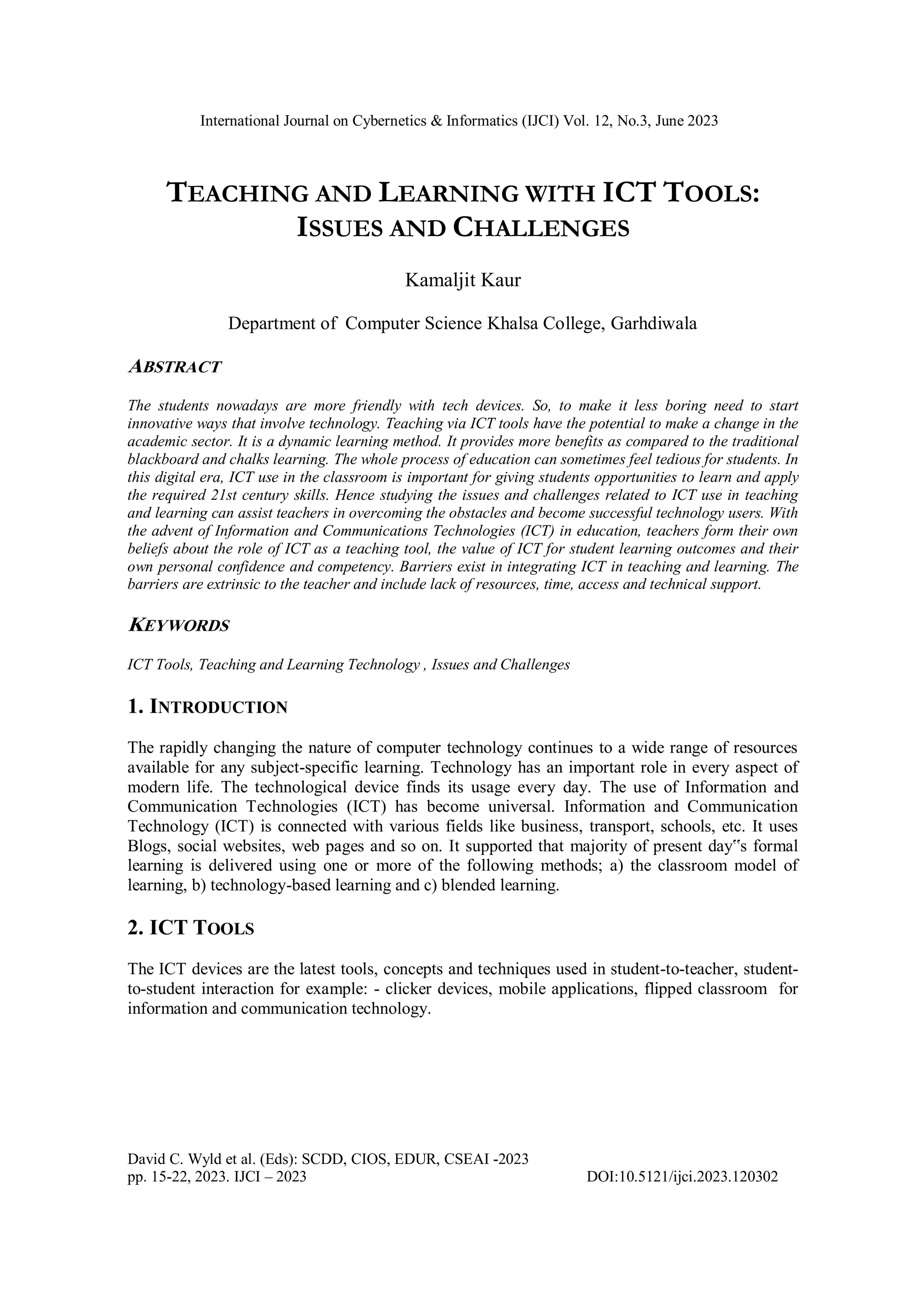
To unlock the potential of technologies to use in the classroom, we need to do the following:
• Establish a starting point for the ICT learning of each student and integrate formative
evaluation into key learning areas like literacy and numeracy in a primary school.
• Planning for progress in ICT learning progress in the learning curriculum of the Australian
curriculum.
• Evidence-based on ICT learning along with the subject learning.
Information and Communication Technology (ICT) in Teaching and Learning Child
development is the most general educational goal for early childhood teachers. ICT can be used
to support the learning and development of both literacy and language in early year‟s education.
This is mostly conducted through collaboration with other children around computers where the
quality of discussions can be quite interesting.
• Computers offer a „print-rich‟ learning environment for young children. You will most
likely find that there is a lot more attention to detail in their conversations than in other
situations. Some believe that this may to do with the abstraction the computer provides as it
allegedly forces children to talk more and physically do less.
• Developmentally appropriate programs - There are a few things that you need to
remember in terms of choosing the most developmentally appropriate programs. It is
important that you look for programs that promote speaking, listening, reading, and
writing. There are programs that can record children‟s voices. The Gruffalo App is one
such example that allows children to record their voices in time with the story being told.
They can then listen to their own voice throughout the story as it is being told.
• Internet - The Internet can also help children learn literacy skills in their home language
and in the language of their friends.
• Word processors - these offer possibilities for children to compose and write without
needing to have mastered the production of letters by hand. ICT learning tools for early
childhood education offers such a variety of ways for children and photos and videos is
another method to develop literacy and language skills. The reason why this is the number
one activity for this is that it allows children to weave together words and pictures.
International Journal on Cybernetics & Informatics (IJCI) Vol. 12, No.3, June 2023
17
There are other tools such as multi-link headphones, digital cameras, webcams, audio
recording software, walkie-talkies, telephones that also encourage the development of speaking
and listening skills. Interactive whiteboards and smart boards promote writing skills on a large
scale. However, these are mostly used in collaboration with the ones I discussed earlier. There are
many ICT tools that can be implemented successfully in a learning environment. Learning
environments in early childhood can now be indoor and outdoor, so these tools can have quite an
extensive range.
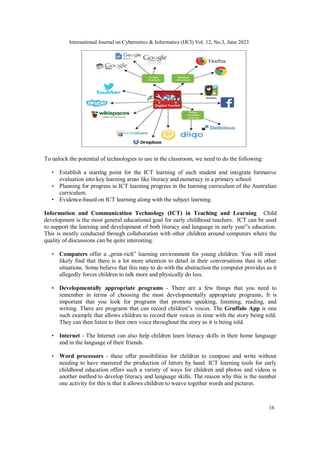
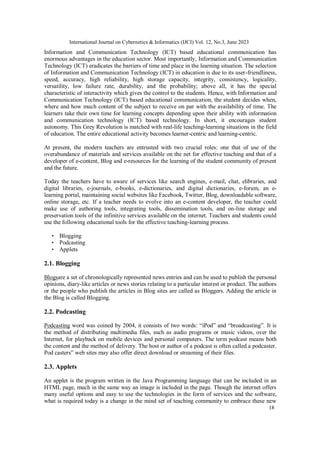
Roles of ICT in school Examples of how to use ICT in school
Children using ICT in their play or learning Children using computers to play games,
(alone, with peers, or with adults). listen to stories, or draw pictures.
Children using ICT equipment in games or role-play
activities.
Children and practitioners using ICT together to
scaffold children‟s learning.
Using the Internet to locate information or resources,
sparked by children‟s interest in a particular topic or
idea.
Children and practitioners using ICT together to
document and reflect on children‟s learning, or to
share children‟s learning with parents, or other
practitioners.
Taking digital photos, videos, or audio recordings of
activities in the early childhood education setting and
reviewing these together, or sharing them with
parents.
Practitioners and children using ICT to build
portfolios of children‟s work, to use for evaluating
progress in children‟s learning and development.
Practitioners using ICT for planning, administration,
and information management.
Teachers developing individual learning plans for
children, or using computer-based templates to plan
or document children‟s learning (e.g. using learning
stories templates or inserting relevant concepts into
children‟s learning records). Creating databases to
keep track of important information about children
and their families.
Teachers or teachers-in-training learning to use ICT,
or learning through ICT.
Teachers-in-training learning to use ICT in their
initial teacher education courses. Distance-learning
teachers-in-training using ICT to learn to become
early childhood teachers.
Teachers-in-training learning to use technology with
children in their practicum placements.
Teachers using ICT to document and reflect on their
practice, or using ICT as part of a professional
development programme.
Children and practitioners using ICT to communicate
or exchange ideas or information with other
practitioners, parents, or researchers.
Using videoconferencing, online discussion
communities, or email, to communicate with other
practitioners, parents, or researchers, or to share
news and information about what‟s happening in the
early childhood education centre. Children and
practitioners using telephones, email, or fax to keep
in touch with parents who are not able to come to the
early childhood education centre (e.g. parents who
are at work during the day). Using telephones, email,
or fax to keep in touch with children and their
families in distant or rural communities (e.g.
Correspondence School early childhood education
programme).
International Journal on Cybernetics & Informatics (IJCI) Vol. 12, No.3, June 2023
18
Information and Communication Technology (ICT) based educational communication has
enormous advantages in the education sector. Most importantly, Information and Communication
Technology (ICT) eradicates the barriers of time and place in the learning situation. The selection
of Information and Communication Technology (ICT) in education is due to its user-friendliness,
speed, accuracy, high reliability, high storage capacity, integrity, consistency, logicality,
versatility, low failure rate, durability, and the probability; above all, it has the special
characteristic of interactivity which gives the control to the students. Hence, with Information and
Communication Technology (ICT) based educational communication, the student decides when,
where and how much content of the subject to receive on par with the availability of time. The
learners take their own time for learning concepts depending upon their ability with information
and communication technology (ICT) based technology. In short, it encourages student
autonomy. This Grey Revolution is matched with real-life teaching-learning situations in the field
of education. The entire educational activity becomes learner-centric and learning-centric.
At present, the modern teachers are entrusted with two crucial roles: one that of use of the
overabundance of materials and services available on the net for effective teaching and that of a
developer of e-content, Blog and e-resources for the learning of the student community of present
and the future.
Today the teachers have to aware of services like search engines, e-mail, chat, elibraries, and
digital libraries, e-journals, e-books, e-dictionaries, and digital dictionaries, e-forum, an e-
learning portal, maintaining social websites like Facebook, Twitter, Blog, downloadable software,
online storage, etc. If a teacher needs to evolve into an e-content developer, the teacher could
make use of authoring tools, integrating tools, dissemination tools, and on-line storage and
preservation tools of the infinitive services available on the internet. Teachers and students could
use the following educational tools for the effective teaching-learning process.
• Blogging
• Podcasting
• Applets
2.1. Blogging
Blogsare a set of chronologically represented news entries and can be used to publish the personal
opinions, diary-like articles or news stories relating to a particular interest or product. The authors
or the people who publish the articles in Blog sites are called as Bloggers. Adding the article in
the Blog is called Blogging.
2.2. Podcasting
Podcasting word was coined by 2004, it consists of two words: “iPod” and “broadcasting”. It is
the method of distributing multimedia files, such as audio programs or music videos, over the
Internet, for playback on mobile devices and personal computers. The term podcast means both
the content and the method of delivery. The host or author of a podcast is often called a podcaster.
Pod casters‟ web sites may also offer direct download or streaming of their files.
2.3. Applets
An applet is the program written in the Java Programming language that can be included in an
HTML page, much in the same way an image is included in the page. Though the internet offers
many useful options and easy to use the technologies in the form of services and the software,
what is required today is a change in the mind set of teaching community to embrace these new
International Journal on Cybernetics & Informatics (IJCI) Vol. 12, No.3, June 2023
19
technologies and make the best of it not only for the larger benefit of the learning community but
also for the professional and the personal enrichment. “It is true that the technology cannot
replace a teacher, but it is also true that a teacher who does not use the technology will be
replaced by the website”.
3. ISSUES AND CHALLENGES
Information and Communication Technology (ICT) increase motivation, achievement and
students‟ learning opportunity. Information and Communication Technology (ICT) can also assist
the students in acquiring essential occupational skills. The use of computers in the learning
environment has been growing and its applications are indispensable to computers in education
today and into the future. Information and Communication Technology (ICT) is changing the face
of the contemporary World. Liberalization, Privatisation, Globalization are closely related to the
Information and Communication Technology (ICT) and its strategy of a nation is very crucial to
put it on a global map. Introducing Information and Communication Technologies into a rural
area though got disrupted at times, happened smoothly at every site. Though India is all set to
widely utilize the Information and Communication Technology (ICT) related services, there are a
few crucial aspects to be improved;
• The requirement of paying the attention to e-securityin India that covers the cyber
forensics, computer, and cyber security, etc.
• The cyber law in India also imposes certain restrictions and their violations could take the
form of offenses and the contraventions.
• The establishment of a digital evidencing base is the absolute requirement in India. The
same is missing for the time being.
• There is also a need for judicial reforms in India keeping in mind the requirements of
information and communication technology.
With respect to barriers to computer and ICT usage, no factor has the supreme majority for
limiting the use of ICT in teaching-learning process in technical and higher educational
institutions , this means all factors depicted below greatly limit the use of ICT in educational
institutions.
3.1. Lack of Software Problem
This was one of the major factors that made difficulties in use of ICT. There were unreliable and
pirated software that had been frequently changed in the computer labs which were difficult to
use properly inteaching-learning process. In majority of the cases it had been found that the ICT
facilities were limited for both the teachers and students and they had to share with other teachers.
Inaccessibility of ICT resources is not always merely due to the non-availability of the hardware
and software or other ICT materials within the institution. It may be the result of one of a number
of factors such as poor organization of resources, poor quality hardware, inappropriate software,
or lack of personal access for teachers.
3.2. Lack of Sufficient Training
Most of the teachers lack the skill to use the ICT in teaching-learning process because they did
not get enough training opportunities. Teachers were rarely seen using ICT in a classroom
environment because most of the teachers were reluctant to use new technology. New
technologies need to be integrated in the classroom and teachers have to be trained in the use of
these ICT in particular. In this regard some initial training is needed for teachers to develop
International Journal on Cybernetics & Informatics (IJCI) Vol. 12, No.3, June 2023
20
appropriate skills, knowledge, and attitudes regarding the effective use of computers to support
learning. One of the top three problems to teachers‟ use of ICT in teaching was the lack of
training. The issue of training is certainly complex because it is important to consider several
components to ensure the effectiveness of the training. These were time for training, pedagogical
training, skills training, and ICT use in initial teacher training. Providing pedagogical training for
teachers, rather than simply training them to use ICT tools, is an important issue.
3.3. Lack of Learning Equipment Tools and Resources
It was found that most of the institutions had computers. But the computers were very few and
most of the time they were being used by students who were offering computers science and
information technology (IT) leaving the rest of the students and teachers in dilemma. Various
research studies indicated several reasons for the lack of access to technologies. Teachers
identified lack of insufficient numbers of computers, insufficient peripherals, and insufficient
numbers of copies of software, and insufficient simultaneous internet access as the main obstacles
to the implementation of ICT in educational institutions.
3.4. Teachers’ Reluctance to New Technology
One of the problems in the implementation of computers in teaching-learning was teachers‟
acceptance, which is in turn was influenced by their attitudes towards these media. Teachers‟
attitudes have been found to be the major predictors of the use of new technologies in
instructional settings; the successful use of new technology in the classroom depends largely on
the teachers‟ attitudes toward these tools. In fact, teachers‟ attitudes towards computers affect
their use of computers in the classroom and the likelihood of their benefiting from training. Many
researches into the problems of integrating ICT in education found that teachers‟ reluctant to new
technology was a significant problem.
3.5. Lack of Skilled Personnel
It has been observed that the teachers were lacking in the knowledge and skills; and they were
reluctant about the changes and incorporation of extra learning associated with computers into
their teaching practices. Hence there is a problem of teachers‟ acceptance and adoption of ICT.
Accordingly, teachers who do not use computers in classrooms claim that “lack of skills” is a
constraining factor preventing them from using ICT. It was also found that teachers‟ lack of
knowledge and skills in teaching was a serious obstacle of using ICT in technical and higher
educational institutions.
3.6. Time Limitation
The study reveals that many teachers have skills in using computers in the classroom, but they
still make little use of technologies because they did not have enough time. A significant number
of teachers identified time limitations as one of the difficulties in scheduling enough computer
time for classes as a problem in their use of ICT in their teaching-learning. Some of the teachers
who participated specifically mentioned that they need time to locate internet information,
prepare lessons, explore and practice using the technology, deal with technical problems, and
receive adequate training. Recent studies show that lack of time is an important factor affecting
the application of new technologies in ICT.
International Journal on Cybernetics & Informatics (IJCI) Vol. 12, No.3, June 2023
21
3.7. Lack of Confidence
One of the problems that prevent teachers from using ICT in their teaching is lack of confidence.
The study investigated the reasons for teachers‟ lack of confidence with the use of ICT and found
that due to fear of failure‟ many teachers do not consider themselves to be well skilled in using
ICT and feel anxious about using ICT in front of a class.
3.8. Lack of Knowledge
Another problem, which is directly related to teacher confidence is- teachers‟ lack of knowledge
in integrating ICT into pedagogical practice. Lack of ICT skills is a serious obstacle to the
integration of technologies into classroom teaching and learning.
4. CONCLUSION
The aim of this paper was to provide information of finding on the difficulties that teachers faced
in using ICT in their teaching-learning process. The findings of this study indicate that teachers
have a strong desire for the integration of ICT into education but they encountered many barriers
to it. These findings therefore have implications for training the teachers to become regular users
of ICT focusing on acquiring basic IT skills. Since confidence, competence and accessibility have
been found to be critical components for technology integration in institutions, ICT resources
including software and hardware, effective professional development, sufficient time, proper
training and technical support need to be provided to teachers. No component in itself is sufficient
to produce good teaching. However, the presence of all components increases the probability of
excellent integration of ICT in teachinglearning process. Therefore the training of teachers in the
pedagogical issues should increase if teachers are to be convinced of the value of using ICT in
their teachinglearning process. Teachers need to take advantage of ICT resources offered at
institutions. They need to be prepared before joining the teaching profession. Where training is
absent, teachers can prepare themselves by enrolling in private sessions or by self-training. They
should open minded towards new approaches of teaching. Where support is lacking, they need to
find ways to be able to solve problems involving their use of ICT in Institutions. Finally, teachers
should acquire skills of self-organization which will help them a great deal in conducting their
classes when using ICT.
REFERENCES
[1] Jonassen, D.H., & Reeves, T.C. (1996). Learning with Technology: Using Computers as Cognitive
Tools. In D.H Jonassen (Ed.), Handbook of research for educational communication and technology
(pp. 693-719). New York. Simon and Schuster. http://treeves.coe.uga.edu/edit6100/jonassen.pdf,
Accessed 13 June, 2012
[2] Drent, M., &Meelissen, M. (2007).Which Factors Obstruct or Stimulate Teacher Educators to Use
ICT Innovatively? Journal of Computers &Education,51(1), 187-199
[3] Plomp, T., ten Brummelhis, A.C.A., &Rapmund, R. (1996).Teaching and Learning for the Future.
Report of the Committee on Multimedia in Teacher Training (COMMITT). Den Haag:
SDU.www.eric.ed.gov/ERICWebPortal/recordDetail?ac cno=ED402899, Accessed 23 June, 2012
[4] Pelgrum, W. J. (2001). Obstacles to the integration of ICT in education: results from a worldwide
educational assessment. Computers & Education, 37, 163-178
[5] Schoepp, K. (2005). Barriers to technology integration in a technology-rich environment. Learning
and Teaching in Higher Education: Gulf Perspectives, 2(1), 124.
[6] Albirini, A. (2006). Teachers' attitudes toward information and communication technologies: The
case of Syrian EFL teachers. Computers & Education, 47, 373-398
International Journal on Cybernetics & Informatics (IJCI) Vol. 12, No.3, June 2023
22
[7] UNESCO. (2002). Information and Communication Technology in Education: A Curriculum for
Schools and Programme of Teacher Development (Edited by J. Anderson and T. van Weert).
UNESCO: Paris.
[8] Wood, D., Underwood, J. and Avis, P. (1999). Integrated learning systems in the classroom.
Computers and Education, 33, 91-108.
[9] Yelland, N. (2001). Teaching and Learning with Information and Communication Technologies
(ICT) for Numeracy in Early Childhood and Primary Years of Schooling. Canberra:DETYA.
[10] Zhao, Y. and Frank, K. (2003). Factors affecting technology uses in schools: an ecological
perspective. American Research Journal, 40(4), 807-840.
[11] Swati Desai (2010), Role of Information Communication Technology in education, 4th
National
Conference: INDIACom-2010, Computing for Nation Development, swati.desai99@gmail.com,
[12] Sogol Talebian, Hanid Movahed Mohammadi, Ahmad Rezvanfar (2014) Information and
Communication Technology (CT) in Higher Education: Advantages, Disadvantages, Conveniences
and Limitations of Applying E- Learning to Agriculture Students in Iran, ERPA
Congress 2014, DOI:10.1016/j.sbspro.2014.09.199, www.sciencedirect.com,
[13] UNESCO (2002) Information and Communication Technology in Education: A curriculums for
Schools and Programme of Teacher Development. UNESCO, available at:
http://unesdoc.unesco.org/images/0012/001295/129538e.pdf.
[14] Adedapo, A. (2007). Designing a MIS for effective secondary school administration in Nigeriain
special education on information communications technology (ICT IKEJE 138-143).
[15] Adegun, O. A. (2002). Communication and administrative effectives of principals of secondary
schools in Sewth Western, Nigeria” unpublished PhD Thesis University of Ado-Ekiti Nigeria 86-
102.
[16] Adeyemi, T.O. (2011). Impact of information and communications technology (ICT) on the
effective management of universities in south-west Nigeria http://www.scihub. org/AJSMS
AUTHOR
Er. Kamaljit Kaur, Assistant Professor, Bachelor in Computer Science and Engineering

TEACHING AND LEARNING WITH ICT TOOLS: ISSUES AND CHALLENGES

  • 1.
    International Journal onCybernetics & Informatics (IJCI) Vol. 12, No.3, June 2023 David C. Wyld et al. (Eds): SCDD, CIOS, EDUR, CSEAI -2023 pp. 15-22, 2023. IJCI – 2023 DOI:10.5121/ijci.2023.120302 TEACHING AND LEARNING WITH ICT TOOLS: ISSUES AND CHALLENGES Kamaljit Kaur Department of Computer Science Khalsa College, Garhdiwala ABSTRACT The students nowadays are more friendly with tech devices. So, to make it less boring need to start innovative ways that involve technology. Teaching via ICT tools have the potential to make a change in the academic sector. It is a dynamic learning method. It provides more benefits as compared to the traditional blackboard and chalks learning. The whole process of education can sometimes feel tedious for students. In this digital era, ICT use in the classroom is important for giving students opportunities to learn and apply the required 21st century skills. Hence studying the issues and challenges related to ICT use in teaching and learning can assist teachers in overcoming the obstacles and become successful technology users. With the advent of Information and Communications Technologies (ICT) in education, teachers form their own beliefs about the role of ICT as a teaching tool, the value of ICT for student learning outcomes and their own personal confidence and competency. Barriers exist in integrating ICT in teaching and learning. The barriers are extrinsic to the teacher and include lack of resources, time, access and technical support. KEYWORDS ICT Tools, Teaching and Learning Technology , Issues and Challenges 1. INTRODUCTION The rapidly changing the nature of computer technology continues to a wide range of resources available for any subject-specific learning. Technology has an important role in every aspect of modern life. The technological device finds its usage every day. The use of Information and Communication Technologies (ICT) has become universal. Information and Communication Technology (ICT) is connected with various fields like business, transport, schools, etc. It uses Blogs, social websites, web pages and so on. It supported that majority of present day‟s formal learning is delivered using one or more of the following methods; a) the classroom model of learning, b) technology-based learning and c) blended learning. 2. ICT TOOLS The ICT devices are the latest tools, concepts and techniques used in student-to-teacher, student- to-student interaction for example: - clicker devices, mobile applications, flipped classroom for information and communication technology.
  • 2.
    International Journal onCybernetics & Informatics (IJCI) Vol. 12, No.3, June 2023 16 To unlock the potential of technologies to use in the classroom, we need to do the following: • Establish a starting point for the ICT learning of each student and integrate formative evaluation into key learning areas like literacy and numeracy in a primary school. • Planning for progress in ICT learning progress in the learning curriculum of the Australian curriculum. • Evidence-based on ICT learning along with the subject learning. Information and Communication Technology (ICT) in Teaching and Learning Child development is the most general educational goal for early childhood teachers. ICT can be used to support the learning and development of both literacy and language in early year‟s education. This is mostly conducted through collaboration with other children around computers where the quality of discussions can be quite interesting. • Computers offer a „print-rich‟ learning environment for young children. You will most likely find that there is a lot more attention to detail in their conversations than in other situations. Some believe that this may to do with the abstraction the computer provides as it allegedly forces children to talk more and physically do less. • Developmentally appropriate programs - There are a few things that you need to remember in terms of choosing the most developmentally appropriate programs. It is important that you look for programs that promote speaking, listening, reading, and writing. There are programs that can record children‟s voices. The Gruffalo App is one such example that allows children to record their voices in time with the story being told. They can then listen to their own voice throughout the story as it is being told. • Internet - The Internet can also help children learn literacy skills in their home language and in the language of their friends. • Word processors - these offer possibilities for children to compose and write without needing to have mastered the production of letters by hand. ICT learning tools for early childhood education offers such a variety of ways for children and photos and videos is another method to develop literacy and language skills. The reason why this is the number one activity for this is that it allows children to weave together words and pictures.
  • 3.
    International Journal onCybernetics & Informatics (IJCI) Vol. 12, No.3, June 2023 17 There are other tools such as multi-link headphones, digital cameras, webcams, audio recording software, walkie-talkies, telephones that also encourage the development of speaking and listening skills. Interactive whiteboards and smart boards promote writing skills on a large scale. However, these are mostly used in collaboration with the ones I discussed earlier. There are many ICT tools that can be implemented successfully in a learning environment. Learning environments in early childhood can now be indoor and outdoor, so these tools can have quite an extensive range. Roles of ICT in school Examples of how to use ICT in school Children using ICT in their play or learning Children using computers to play games, (alone, with peers, or with adults). listen to stories, or draw pictures. Children using ICT equipment in games or role-play activities. Children and practitioners using ICT together to scaffold children‟s learning. Using the Internet to locate information or resources, sparked by children‟s interest in a particular topic or idea. Children and practitioners using ICT together to document and reflect on children‟s learning, or to share children‟s learning with parents, or other practitioners. Taking digital photos, videos, or audio recordings of activities in the early childhood education setting and reviewing these together, or sharing them with parents. Practitioners and children using ICT to build portfolios of children‟s work, to use for evaluating progress in children‟s learning and development. Practitioners using ICT for planning, administration, and information management. Teachers developing individual learning plans for children, or using computer-based templates to plan or document children‟s learning (e.g. using learning stories templates or inserting relevant concepts into children‟s learning records). Creating databases to keep track of important information about children and their families. Teachers or teachers-in-training learning to use ICT, or learning through ICT. Teachers-in-training learning to use ICT in their initial teacher education courses. Distance-learning teachers-in-training using ICT to learn to become early childhood teachers. Teachers-in-training learning to use technology with children in their practicum placements. Teachers using ICT to document and reflect on their practice, or using ICT as part of a professional development programme. Children and practitioners using ICT to communicate or exchange ideas or information with other practitioners, parents, or researchers. Using videoconferencing, online discussion communities, or email, to communicate with other practitioners, parents, or researchers, or to share news and information about what‟s happening in the early childhood education centre. Children and practitioners using telephones, email, or fax to keep in touch with parents who are not able to come to the early childhood education centre (e.g. parents who are at work during the day). Using telephones, email, or fax to keep in touch with children and their families in distant or rural communities (e.g. Correspondence School early childhood education programme).
  • 4.
    International Journal onCybernetics & Informatics (IJCI) Vol. 12, No.3, June 2023 18 Information and Communication Technology (ICT) based educational communication has enormous advantages in the education sector. Most importantly, Information and Communication Technology (ICT) eradicates the barriers of time and place in the learning situation. The selection of Information and Communication Technology (ICT) in education is due to its user-friendliness, speed, accuracy, high reliability, high storage capacity, integrity, consistency, logicality, versatility, low failure rate, durability, and the probability; above all, it has the special characteristic of interactivity which gives the control to the students. Hence, with Information and Communication Technology (ICT) based educational communication, the student decides when, where and how much content of the subject to receive on par with the availability of time. The learners take their own time for learning concepts depending upon their ability with information and communication technology (ICT) based technology. In short, it encourages student autonomy. This Grey Revolution is matched with real-life teaching-learning situations in the field of education. The entire educational activity becomes learner-centric and learning-centric. At present, the modern teachers are entrusted with two crucial roles: one that of use of the overabundance of materials and services available on the net for effective teaching and that of a developer of e-content, Blog and e-resources for the learning of the student community of present and the future. Today the teachers have to aware of services like search engines, e-mail, chat, elibraries, and digital libraries, e-journals, e-books, e-dictionaries, and digital dictionaries, e-forum, an e- learning portal, maintaining social websites like Facebook, Twitter, Blog, downloadable software, online storage, etc. If a teacher needs to evolve into an e-content developer, the teacher could make use of authoring tools, integrating tools, dissemination tools, and on-line storage and preservation tools of the infinitive services available on the internet. Teachers and students could use the following educational tools for the effective teaching-learning process. • Blogging • Podcasting • Applets 2.1. Blogging Blogsare a set of chronologically represented news entries and can be used to publish the personal opinions, diary-like articles or news stories relating to a particular interest or product. The authors or the people who publish the articles in Blog sites are called as Bloggers. Adding the article in the Blog is called Blogging. 2.2. Podcasting Podcasting word was coined by 2004, it consists of two words: “iPod” and “broadcasting”. It is the method of distributing multimedia files, such as audio programs or music videos, over the Internet, for playback on mobile devices and personal computers. The term podcast means both the content and the method of delivery. The host or author of a podcast is often called a podcaster. Pod casters‟ web sites may also offer direct download or streaming of their files. 2.3. Applets An applet is the program written in the Java Programming language that can be included in an HTML page, much in the same way an image is included in the page. Though the internet offers many useful options and easy to use the technologies in the form of services and the software, what is required today is a change in the mind set of teaching community to embrace these new
  • 5.
    International Journal onCybernetics & Informatics (IJCI) Vol. 12, No.3, June 2023 19 technologies and make the best of it not only for the larger benefit of the learning community but also for the professional and the personal enrichment. “It is true that the technology cannot replace a teacher, but it is also true that a teacher who does not use the technology will be replaced by the website”. 3. ISSUES AND CHALLENGES Information and Communication Technology (ICT) increase motivation, achievement and students‟ learning opportunity. Information and Communication Technology (ICT) can also assist the students in acquiring essential occupational skills. The use of computers in the learning environment has been growing and its applications are indispensable to computers in education today and into the future. Information and Communication Technology (ICT) is changing the face of the contemporary World. Liberalization, Privatisation, Globalization are closely related to the Information and Communication Technology (ICT) and its strategy of a nation is very crucial to put it on a global map. Introducing Information and Communication Technologies into a rural area though got disrupted at times, happened smoothly at every site. Though India is all set to widely utilize the Information and Communication Technology (ICT) related services, there are a few crucial aspects to be improved; • The requirement of paying the attention to e-securityin India that covers the cyber forensics, computer, and cyber security, etc. • The cyber law in India also imposes certain restrictions and their violations could take the form of offenses and the contraventions. • The establishment of a digital evidencing base is the absolute requirement in India. The same is missing for the time being. • There is also a need for judicial reforms in India keeping in mind the requirements of information and communication technology. With respect to barriers to computer and ICT usage, no factor has the supreme majority for limiting the use of ICT in teaching-learning process in technical and higher educational institutions , this means all factors depicted below greatly limit the use of ICT in educational institutions. 3.1. Lack of Software Problem This was one of the major factors that made difficulties in use of ICT. There were unreliable and pirated software that had been frequently changed in the computer labs which were difficult to use properly inteaching-learning process. In majority of the cases it had been found that the ICT facilities were limited for both the teachers and students and they had to share with other teachers. Inaccessibility of ICT resources is not always merely due to the non-availability of the hardware and software or other ICT materials within the institution. It may be the result of one of a number of factors such as poor organization of resources, poor quality hardware, inappropriate software, or lack of personal access for teachers. 3.2. Lack of Sufficient Training Most of the teachers lack the skill to use the ICT in teaching-learning process because they did not get enough training opportunities. Teachers were rarely seen using ICT in a classroom environment because most of the teachers were reluctant to use new technology. New technologies need to be integrated in the classroom and teachers have to be trained in the use of these ICT in particular. In this regard some initial training is needed for teachers to develop
  • 6.
    International Journal onCybernetics & Informatics (IJCI) Vol. 12, No.3, June 2023 20 appropriate skills, knowledge, and attitudes regarding the effective use of computers to support learning. One of the top three problems to teachers‟ use of ICT in teaching was the lack of training. The issue of training is certainly complex because it is important to consider several components to ensure the effectiveness of the training. These were time for training, pedagogical training, skills training, and ICT use in initial teacher training. Providing pedagogical training for teachers, rather than simply training them to use ICT tools, is an important issue. 3.3. Lack of Learning Equipment Tools and Resources It was found that most of the institutions had computers. But the computers were very few and most of the time they were being used by students who were offering computers science and information technology (IT) leaving the rest of the students and teachers in dilemma. Various research studies indicated several reasons for the lack of access to technologies. Teachers identified lack of insufficient numbers of computers, insufficient peripherals, and insufficient numbers of copies of software, and insufficient simultaneous internet access as the main obstacles to the implementation of ICT in educational institutions. 3.4. Teachers’ Reluctance to New Technology One of the problems in the implementation of computers in teaching-learning was teachers‟ acceptance, which is in turn was influenced by their attitudes towards these media. Teachers‟ attitudes have been found to be the major predictors of the use of new technologies in instructional settings; the successful use of new technology in the classroom depends largely on the teachers‟ attitudes toward these tools. In fact, teachers‟ attitudes towards computers affect their use of computers in the classroom and the likelihood of their benefiting from training. Many researches into the problems of integrating ICT in education found that teachers‟ reluctant to new technology was a significant problem. 3.5. Lack of Skilled Personnel It has been observed that the teachers were lacking in the knowledge and skills; and they were reluctant about the changes and incorporation of extra learning associated with computers into their teaching practices. Hence there is a problem of teachers‟ acceptance and adoption of ICT. Accordingly, teachers who do not use computers in classrooms claim that “lack of skills” is a constraining factor preventing them from using ICT. It was also found that teachers‟ lack of knowledge and skills in teaching was a serious obstacle of using ICT in technical and higher educational institutions. 3.6. Time Limitation The study reveals that many teachers have skills in using computers in the classroom, but they still make little use of technologies because they did not have enough time. A significant number of teachers identified time limitations as one of the difficulties in scheduling enough computer time for classes as a problem in their use of ICT in their teaching-learning. Some of the teachers who participated specifically mentioned that they need time to locate internet information, prepare lessons, explore and practice using the technology, deal with technical problems, and receive adequate training. Recent studies show that lack of time is an important factor affecting the application of new technologies in ICT.
  • 7.
    International Journal onCybernetics & Informatics (IJCI) Vol. 12, No.3, June 2023 21 3.7. Lack of Confidence One of the problems that prevent teachers from using ICT in their teaching is lack of confidence. The study investigated the reasons for teachers‟ lack of confidence with the use of ICT and found that due to fear of failure‟ many teachers do not consider themselves to be well skilled in using ICT and feel anxious about using ICT in front of a class. 3.8. Lack of Knowledge Another problem, which is directly related to teacher confidence is- teachers‟ lack of knowledge in integrating ICT into pedagogical practice. Lack of ICT skills is a serious obstacle to the integration of technologies into classroom teaching and learning. 4. CONCLUSION The aim of this paper was to provide information of finding on the difficulties that teachers faced in using ICT in their teaching-learning process. The findings of this study indicate that teachers have a strong desire for the integration of ICT into education but they encountered many barriers to it. These findings therefore have implications for training the teachers to become regular users of ICT focusing on acquiring basic IT skills. Since confidence, competence and accessibility have been found to be critical components for technology integration in institutions, ICT resources including software and hardware, effective professional development, sufficient time, proper training and technical support need to be provided to teachers. No component in itself is sufficient to produce good teaching. However, the presence of all components increases the probability of excellent integration of ICT in teachinglearning process. Therefore the training of teachers in the pedagogical issues should increase if teachers are to be convinced of the value of using ICT in their teachinglearning process. Teachers need to take advantage of ICT resources offered at institutions. They need to be prepared before joining the teaching profession. Where training is absent, teachers can prepare themselves by enrolling in private sessions or by self-training. They should open minded towards new approaches of teaching. Where support is lacking, they need to find ways to be able to solve problems involving their use of ICT in Institutions. Finally, teachers should acquire skills of self-organization which will help them a great deal in conducting their classes when using ICT. REFERENCES [1] Jonassen, D.H., & Reeves, T.C. (1996). Learning with Technology: Using Computers as Cognitive Tools. In D.H Jonassen (Ed.), Handbook of research for educational communication and technology (pp. 693-719). New York. Simon and Schuster. http://treeves.coe.uga.edu/edit6100/jonassen.pdf, Accessed 13 June, 2012 [2] Drent, M., &Meelissen, M. (2007).Which Factors Obstruct or Stimulate Teacher Educators to Use ICT Innovatively? Journal of Computers &Education,51(1), 187-199 [3] Plomp, T., ten Brummelhis, A.C.A., &Rapmund, R. (1996).Teaching and Learning for the Future. Report of the Committee on Multimedia in Teacher Training (COMMITT). Den Haag: SDU.www.eric.ed.gov/ERICWebPortal/recordDetail?ac cno=ED402899, Accessed 23 June, 2012 [4] Pelgrum, W. J. (2001). Obstacles to the integration of ICT in education: results from a worldwide educational assessment. Computers & Education, 37, 163-178 [5] Schoepp, K. (2005). Barriers to technology integration in a technology-rich environment. Learning and Teaching in Higher Education: Gulf Perspectives, 2(1), 124. [6] Albirini, A. (2006). Teachers' attitudes toward information and communication technologies: The case of Syrian EFL teachers. Computers & Education, 47, 373-398
  • 8.
    International Journal onCybernetics & Informatics (IJCI) Vol. 12, No.3, June 2023 22 [7] UNESCO. (2002). Information and Communication Technology in Education: A Curriculum for Schools and Programme of Teacher Development (Edited by J. Anderson and T. van Weert). UNESCO: Paris. [8] Wood, D., Underwood, J. and Avis, P. (1999). Integrated learning systems in the classroom. Computers and Education, 33, 91-108. [9] Yelland, N. (2001). Teaching and Learning with Information and Communication Technologies (ICT) for Numeracy in Early Childhood and Primary Years of Schooling. Canberra:DETYA. [10] Zhao, Y. and Frank, K. (2003). Factors affecting technology uses in schools: an ecological perspective. American Research Journal, 40(4), 807-840. [11] Swati Desai (2010), Role of Information Communication Technology in education, 4th National Conference: INDIACom-2010, Computing for Nation Development, swati.desai99@gmail.com, [12] Sogol Talebian, Hanid Movahed Mohammadi, Ahmad Rezvanfar (2014) Information and Communication Technology (CT) in Higher Education: Advantages, Disadvantages, Conveniences and Limitations of Applying E- Learning to Agriculture Students in Iran, ERPA Congress 2014, DOI:10.1016/j.sbspro.2014.09.199, www.sciencedirect.com, [13] UNESCO (2002) Information and Communication Technology in Education: A curriculums for Schools and Programme of Teacher Development. UNESCO, available at: http://unesdoc.unesco.org/images/0012/001295/129538e.pdf. [14] Adedapo, A. (2007). Designing a MIS for effective secondary school administration in Nigeriain special education on information communications technology (ICT IKEJE 138-143). [15] Adegun, O. A. (2002). Communication and administrative effectives of principals of secondary schools in Sewth Western, Nigeria” unpublished PhD Thesis University of Ado-Ekiti Nigeria 86- 102. [16] Adeyemi, T.O. (2011). Impact of information and communications technology (ICT) on the effective management of universities in south-west Nigeria http://www.scihub. org/AJSMS AUTHOR Er. Kamaljit Kaur, Assistant Professor, Bachelor in Computer Science and Engineering