Comarch M2M Transaction Gateway

Introduction to M2M
Machine-to-machine (M2M) traffic can provide additional revenue sources for operators
struggling against reduced revenues from voice services. When compared to human-initiated
traffic, individual M2M events contain a lesser amount of data, lower ARPU and reduced
bandwidth requirements.

The number of connectable machines is 5 times greater than the amount of humans (source:
ETSI), and the number of machines currently connected is extremely low. Gartner predicts that
the level of mobile M2M modules is growing at a rate of 28% CAGR up until 2011.

As the level of M2M traffic grows and M2M devices become more common, the prices of
individual M2M hardware components fall, boosting M2M popularity even further. An additional
bonus for the M2M business originates from the falling prices of data services. Together these
two issues render an increasing amount of M2M business cases viable – scenarios that a couple of
years ago were deemed useless, due to the higher costs related to them.

Comarch is able to offer support to companies looking to enter the M2M business, through
providing the Comarch M2M Transaction Gateway, a tool capable of processing high amounts of
data for charging and rating purposes, and which is suitable for multiple types of industries and
business models.
Comarch M2M Transaction Gateway - Overview
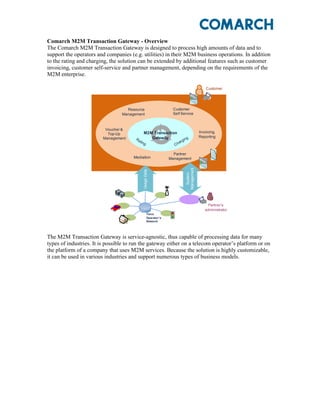
The Comarch M2M Transaction Gateway is designed to process high amounts of data and to
support the operators and companies (e.g. utilities) in their M2M business operations. In addition
to the rating and charging, the solution can be extended by additional features such as customer
invoicing, customer self-service and partner management, depending on the requirements of the
M2M enterprise.

                                                                                            Customer


                                   Resource                      Customer
                                 Management                      Self Service


                          Voucher &
                                             M2M Transaction                            Invoicing,
                           Top-Up
                         Management             Gateway                                 Reporting
                                       Ra                                   ng
                                          ting                          r gi
                                                                  C   ha

                                                                  Partner
                                      Mediation                 Management


                                                                           Management
                                            Usage Data


                                                                             System


                                                                                            Partner’s
                                                                                           administrator
                                                   Telco
                                                   Operator’s
                                                   Network


The M2M Transaction Gateway is service-agnostic, thus capable of processing data for many
types of industries. It is possible to run the gateway either on a telecom operator’s platform or on
the platform of a company that uses M2M services. Because the solution is highly customizable,
it can be used in various industries and support numerous types of business models.
Comarch M2M Transaction Gateway – Features
The Comarch M2M Transaction Gateway is a central component of the solution, specialized in
processing information about various transaction types. Processing can be configured using rules
and may include configuration for data loading, pre-processing, rating, aggregating, statistics
building, correlating with other events and storing in the database.


                                                Configuration
                                                                Rated
                         Event                 M2M
                                                                Event
                         Data               Transaction
                                                                Data
                         Records             Gateway
                                                                Records
                                                Statistics


Extensive configuration possibilities render the solution useful for various industries. The types
of services do not limit the use of the platform - when it comes to its most commonly used feature
– rating, the M2M Transaction Gateway supports multiple pricing models:

    •   From flat-fee to usage-based fees,
    •   From market segmentation to custom pricing,
    •   Product bundling,
    •   Cross- and volume discounting,
    •   Rule-based models for custom pricing scenarios.

In many cases, event processing is connected with rating, although the component may perform
many additional, user-defined calculations, which are not solely connected with calculating the
price for events but may for example correlate events, calculate taxes or make other decisions
based on decision trees.

The M2M Transaction Gateway is optimized for high volumes of mass data and has no technical
limitations in transactions per second. The scalability of the M2M Transaction Gateway makes
the solution suitable for small and large enterprises.
Comarch M2M Transaction Gateway - Benefits

   •   Capability to process vast amounts of data:
           o Mass and real-time, rule-based data processing;
   •   Single platform for various type of services:
           o Service-agnostic data processing for multiple types of industries;
   •   Flexible integration with external systems:
           o Standardized interfaces;
           o Modern and open technology;
   •   Stability:
           o Due to advanced technologies, development and testing practices;
   •   Deployment flexibility.

M2 M Transaction Gateway

  • 1.
    Comarch M2M TransactionGateway Introduction to M2M Machine-to-machine (M2M) traffic can provide additional revenue sources for operators struggling against reduced revenues from voice services. When compared to human-initiated traffic, individual M2M events contain a lesser amount of data, lower ARPU and reduced bandwidth requirements. The number of connectable machines is 5 times greater than the amount of humans (source: ETSI), and the number of machines currently connected is extremely low. Gartner predicts that the level of mobile M2M modules is growing at a rate of 28% CAGR up until 2011. As the level of M2M traffic grows and M2M devices become more common, the prices of individual M2M hardware components fall, boosting M2M popularity even further. An additional bonus for the M2M business originates from the falling prices of data services. Together these two issues render an increasing amount of M2M business cases viable – scenarios that a couple of years ago were deemed useless, due to the higher costs related to them. Comarch is able to offer support to companies looking to enter the M2M business, through providing the Comarch M2M Transaction Gateway, a tool capable of processing high amounts of data for charging and rating purposes, and which is suitable for multiple types of industries and business models.
  • 2.
    Comarch M2M TransactionGateway - Overview The Comarch M2M Transaction Gateway is designed to process high amounts of data and to support the operators and companies (e.g. utilities) in their M2M business operations. In addition to the rating and charging, the solution can be extended by additional features such as customer invoicing, customer self-service and partner management, depending on the requirements of the M2M enterprise. Customer Resource Customer Management Self Service Voucher & M2M Transaction Invoicing, Top-Up Management Gateway Reporting Ra ng ting r gi C ha Partner Mediation Management Management Usage Data System Partner’s administrator Telco Operator’s Network The M2M Transaction Gateway is service-agnostic, thus capable of processing data for many types of industries. It is possible to run the gateway either on a telecom operator’s platform or on the platform of a company that uses M2M services. Because the solution is highly customizable, it can be used in various industries and support numerous types of business models.
  • 3.
    Comarch M2M TransactionGateway – Features The Comarch M2M Transaction Gateway is a central component of the solution, specialized in processing information about various transaction types. Processing can be configured using rules and may include configuration for data loading, pre-processing, rating, aggregating, statistics building, correlating with other events and storing in the database. Configuration Rated Event M2M Event Data Transaction Data Records Gateway Records Statistics Extensive configuration possibilities render the solution useful for various industries. The types of services do not limit the use of the platform - when it comes to its most commonly used feature – rating, the M2M Transaction Gateway supports multiple pricing models: • From flat-fee to usage-based fees, • From market segmentation to custom pricing, • Product bundling, • Cross- and volume discounting, • Rule-based models for custom pricing scenarios. In many cases, event processing is connected with rating, although the component may perform many additional, user-defined calculations, which are not solely connected with calculating the price for events but may for example correlate events, calculate taxes or make other decisions based on decision trees. The M2M Transaction Gateway is optimized for high volumes of mass data and has no technical limitations in transactions per second. The scalability of the M2M Transaction Gateway makes the solution suitable for small and large enterprises.
  • 4.
    Comarch M2M TransactionGateway - Benefits • Capability to process vast amounts of data: o Mass and real-time, rule-based data processing; • Single platform for various type of services: o Service-agnostic data processing for multiple types of industries; • Flexible integration with external systems: o Standardized interfaces; o Modern and open technology; • Stability: o Due to advanced technologies, development and testing practices; • Deployment flexibility.