www.comarch.com
The Magazine of Comarch
Telecommunications
Business Unit
no2/2010
[12]
In this issue:
	 OSS/BSS Features
	 M2M Market Trends: Overview
Of The M2M Value Chain
	How Exactly Will You Benefit From Automating
Field Services In Your Company
	 Customer Spotlight
	 Bouygues Telecom Achieves the Right Balance
	 Thanks to Comarch BSS Suite
	 Technology & Innovation
	 Comarch Tests at the IBM Innovation
Center
Personalize your customer
experience
Transform seamlessly to new
business models
Ensure the highest quality of
delivered services
Take full control of your network
Meet with Comarch experts face to face at the MobileWorldCongress2011
14 – 17 Februaryat Fira de Barcelona, in Barcelona, Spain – 1F20, Hall 1
Preface 3
	 piotr machnik
	 Comarch SA
	 Vice President, Product
Management & Marketing
	 Telecommunications
Business Unit
Editor-in-Chief: Katarzyna Gajewska
katarzyna.gajewska@comarch.com
Layout & DTP: Jakub Malicki
Photos: www.fotolia.com
Proofreader: Martin Jones
Publisher: Comarch SA
Al. Jana Pawła II 39a, 31-864 Kraków
Tel. +48 12 64 61 000, Fax: +48 12 64 61 100
www.comarch.com
Print: Skleniarz Printing House
ul. J. Lea 118, 31-033 Kraków
Circulation: 1 500
Technology Review is a free publication available
by subscription. The articles published here can be
copied and reproduced only with the knowledge and
consent of the editors. The names of products and
companies mentioned are trade marks and trade
names of their producers.
To receive your subscription to the electronic
version or see the previous issues, please visit:
tr.comarch.com
Comarch’s offices in Poland: Krakow
(HQ), Warsaw, Gdansk, Wroclaw, Poznan,
Katowice, Lodz, Lublin
Worldwide Offices:
Americas
	 Panama | Panamá
	 United States of America | Chicago
Europe
	 Austria | Wien
	 Belgium | Brussels
	 Finland | Espoo
	 France | Lille, Grenoble
	 Lithuania | Vilnius
	 Germany | Dresden, Frankfurt/Main,
Munich, Hamburg, Berlin, Muenster,
Duesseldorf, Bremen
	 Russia | Moscow
	 Slovakia | Bratislava
	 Ukraine | Kyiv, Lviv
Middle East
	 United Arab Emirates | Dubai
Asia
	 China | Shanghai
	 Vietnam | Ho Chi Minh City
Comarch Technology Review is a publication created by Comarch experts and specialists. It is created
to assist our customers and partners in obtaining in-depth information about market trends and
developments, and the technological possibilities of addressing the most important issues.
ne of the world’s most renowned inventors,
Sir Faraday, was asked by the Minister of the
Treasury who was visiting Faraday’s lab „What
benefits would people have from these experiments with
electricity?” „I don’t know,” he said, “but I’m sure your
government will be collecting taxes from these results in
the future”. The same answer can probably be given to us
today by this year’s Nobel Prize laureate in Physics. Many
interesting and revolutionary technologies are waiting for
business opportunity to make them profitable and begin
entirely new revenue streams. Market innovation combines
technology with business modeling and extensive work
from engineers and marketing specialists.
Gartner’s report, Hype Cycle for Emerging Technologies
2010, published in October, points out that almost all the
analyzed IT technologies are related to user experience, new
interfaces or user interaction methods.
The Web phenomenon has been moving from PC’s to
other devices such as smart phones, TV’s, flat panels in
automobiles, public transport and retail. New interaction
styles based on accelerometers and location services,
which made no sense for PC’s, are boosting the sales
of intelligent terminals. User experience as well as new
interaction styles, such as gesture recognition and tangible
user interfaces, simplify communication between the
application and the user and make our handsets more
intelligent and more personal.
Location based services, previously forecasted as a trigger
for location based ads, has become very popular because of
applications from iPhone Android using our position to define
a context for smart applications.Users are becoming more
accustomed to positioning information required by applications
and will be more open for mobile ads in the future.
Cloud computing is growing in the context of the expansion
of mobile application shops which has to find storage and
resources to support relatively small and smart applications
on smart phones with which the user is still moving from
place to place with.
Web cloud computing, location services and multi-screen
interfaces in the connected world are good examples of the
adoption of new business and revenue models, rather than
simply the adoption of the newest technology.
From the perspective of communication service providers, one
of the most important challenges in the Connected World is
how to ready infrastructure and business processes for new
interaction methods, new business models like revenue and
infrastructure sharing, direct and indirect sales models, quality
driven by customer experience and multi-technology service
fulfillment and assurance.This edition of Technology Review
demonstrates how Comarch analysts, solution managers and
developers approach the Connected World trend.
Enjoy reading.
What will surprise us
in the near future?
O
table ofcontents4
Comarch Technology Review   02/2010
	16	 Business Cases ForPolicy Management
Some years ago, policy management did not
constitute a hot topic. Today, policy management
is becoming an essential tool for operators in
managing network traffic, based on policies
and improving service offerings simultaneously.
Operators can adjust their service offerings using
various parameters, such as service type, time of
day, customer location and data volumes.
	19	 M2M Market Trends
		 Overview Of The M2M Value Chain
The Machine-to-Machine (M2M) business,
related to the communication between machines
and other traditionally non-computing remote
devices or sensors, is attaining a global presence.
According to The European Telecommunications
Standards Institute (ETSI), the M2M market has
the potential to connect up to 50 billion machines
today, and even more in the near future.
	23	From Circuit To Soft (Packet)-Switching
Not so long ago, as the traditional Public Switched
Telephone Network (PSTN) evolved from analog to
digital (thanks to digital Time-Division Multiplexing
technology), we entered the era of NGN networks,
based on Internet protocols such as IP (Internet
Protocol) and MPLSs (Multi-protocol Label
Switching). Therefore, next generation networks
are often named “all-IP” networks, to emphasize
the transformation towards IP protocol.
	26	Knowledge TransferOrChange
Announcement?
Every company requires an ongoing
communications and training program. They should
be designed to ensure that all employees, full time
and temporary, as well as contractors understand
the enterprise’s policies, processes and software
and know how to follow and use them properly.
	28	Boosting Service Innovation
		 Getting Through The Jungle Of Buzzwords:
SDP, Service Broker, Orchestration, SOA,
Service Composition…
Communication Service Providers (CSP) strive
to boost service innovation to augment basic
connectivity services. They are aware that they
may need new tools to realize this goal, but are
bombarded with buzzwords, by many claiming
they have the right solution. This article suggests
taking the problem-centric approach, to avoid
being drawn into the flood of new buzzwords.
news
	 5	What’s New
Customer Spotlight
	 6	Case Study:
Bouygues Telecom Achieves the
Right Balance between Flexibility and
Maintainability Thanks to Comarch BSS Suite
Bouygues Telecom required a platform to support
the company’s business development strategy of
supplying additional mobile services to end users
through SMS, Voice, MMS, WAP and I-Mode™, in
collaboration with a growing number of content
and service providers. This approach demanded a
sophisticated billing system capable of handling
the complex accounting processes between the
French mobile operator and its partners.
	 8	 Case Study:
How Cablevisión de Saltillo Entered a New
Market while Minimizing Costs
Comarch offered a pre-integrated billing, customer
care and network management solution that
supported all of Cablevisión’s business lines,
including telephony. Additionally, the solution
included a prepaid module that allowed
Cablevisión to offer prepaid services and an
interpartner billing module to efficiently handle the
company’s agreements with other carriers.
OSS/BSS Features
	10	 How Cablecos Can Get Ahead Of Their
Competition
		 The Critical Role Of Next Generation BSS/OSS
In Cable Providers’ Business
On today’s cable market, there is an ongoing
race among operators towards the valued goal
of becoming an MSsO (Multi-Sservice Operator).
Although TV services still remain the main and
most stable revenue stream, significant income
growth originates from high-speed Internet and
telephony services, and the importance of these
will continue to increase.
	13	 How Exactly Will You Benefit From
Automating Field Services In YourCompany
Field Service Management tools are solutions that
are primarily deployed by companies in order to
achieve certain business improvement goals. The
most popular and commonly requested client
goals in FSM systems include decreasing costs,
minimizing risks, and maximizing the profitability
of their services.
	30	Bright Future ForIPTV – Are You Ready?
By the end of 2010, Vodafone will present its
proprietary IPTV offer, named Vodafone TV, at IFA.
Based on a hybrid approach, satellite and cable
signals are processed via a platform developed
by Vodafone Germany. Following Telekom and
Alice, Vodafone will now be the third provider of IP
television in Germany.
	34	Why Use Plain Old Inventory Management
If You No LongerSell Plain Old Telephone
Services?
If we look to the future of Communications Service
Providers, we will see LTE technologies emerging
with constantly increasing power.Among others, the
new technologies were designed to make networks
more flexible, adaptable and cheaper to deploy. The
time required for enabling new services shrinks from
weeks to days, and maybe even hours.
Telcosphere blog
	38	Unlimited Data Plans – Disappearing Into
Extinction
	39	Murphy’s Law In 21st Century
Telecommunications
40Why Doing YourLaundry Can Be A Lot Like
Talking On The Phone
Technology & Innovation
42	Performance In Action
Customers require a better quality of software.
They also need improved performance of
business processes. High availability is a standard
requirement. It calls for more and more testing.
How do you perform increased testing in a more
diversified test environment?
44	Improving The Scalability Of Modern Web-
Based Software System
Nowadays, the scalability of software systems,
considered as their ability to handle growing
amounts of work, is of great importance. Modern,
web-based applications should often handle
thousands of requests per second, and it’s
impossible to achieve this throughput without
rapidly-operating hardware and well-designed
systems with the ability to be enlarged.
Commentary
46Relation afterComarch BSS/CRM/OSS
Workshops in Stockholm
NEWS 5
Comarch Technology Review   02/2010
For more information, go to:
www.press.comarch.com
What’s New
Recent Product Launches:
05 | 08 | 10
	 Comarch introduces a new product to its
offerfortelecom operators – Comarch Bill
Shock Prevention
The growing usage of data services among
mobile subscribers has led to the surfacing of
a brand new problem that operators worldwide
have to face – the so called ‘bill shock’.
Comarch’s response is an addition to the broad
scope of its offer for telecom operators – the
Comarch Bill Shock Prevention solution.
29 | 07 | 10
	 Comarch launches new end-to-end solution
forCloud Service Management and Billing
As Cloud Computing and Cloud
Services increase in popularity on the
telecommunications market, Comarch
responds with a comprehensive solution for
managing and billing cloud services.
Comarch is Building its own
Data Center Abroad:
17 | 05 | 10
	 In 2010, Comarch plans to open a Data
Centerin Lille, France, with the next one
planned forGermany
Currently, Comarch has two modern Comarch
Data Centers in both Cracow and Warsaw,
with an additional facility in Cracow currently
under construction.
Recent Contracts:
15 | 09 | 10
	KPN optimizes multinational corporate
customermanagement with a Comarch
solution
Comarch delivers a comprehensive set of BSS
modules to help KPN lower operational costs,
improve customer satisfaction and launch
new services faster.
18 | 08 | 10
	 The E-Plus Group selects Comarch as
a strategic partner forNext Generation
Network Planning
Comarch provides a solution supporting
planning and configuration of Radio Access,
Transport and Core Networks. This innovative
platform, delivered in the Managed Service
model, improves the efficiency of network
planning and, in particular, supports the
accelerated roll-out of the high-speed E-Plus
data network.
14 | 07 | 10
	 Comarch implements an innovative class
5 service platform at Telefonia DIALOG,
Poland
Comarch has signed a comprehensive
contract with Telefonia DIALOG, one of
the biggest independent telecom service
providers in Poland for the provisioning,
installation and implementation of a service
platform based on class 5 Soft Switches.
Latest Award:
01 | 07 | 10
	 Comarch NGNP receives 2010 Next
Generation Network Leadership Award
Comarch Next Generation Network
Planning was awarded by NGN Magazine
in the category of Network Technology, in
recognition of its outstanding innovation.
Customer Spotlight6
Comarch Technology Review   02/2010
Customer Spotlight6
he advent of newly developed accounting models
and the introduction of an extensive number of
novel mobile services prompted Bouygues Telecom,
in 2004, to replace its partner billing tool with a systematic
and rule-based system capable of managing the consequent
growth of increasingly complex revenue-sharing agreements
with content providers.
The Business Need
Bouygues Telecom required a platform to support the
company’s business development strategy of supplying
additional mobile services to end users through SMS, Voice,
MMS, WAP and I-Mode™, in collaboration with a growing
number of content and service providers. This approach
demanded a sophisticated billing system capable of
handling the complex accounting processes between the
French mobile operator and its partners.
The Approach
Comarch provided Bouygues Telecom with a convergent and
agnostic billing and rating solution for postpaid and prepaid
services, including discounting and threshold charging.
Acquiring separate modules from different vendors would
have been an extremely complicated process, involving
signing and maintaining a number of contracts. Additionally,
the integration of these modules could have been extremely
difficult, adding to ongoing implementation risks.
The Approach
Comarch offered a pre-integrated billing, customer care
and network management solution that supported all of
Bouygues business lines, including telephony.
Bouygues Telecom, with over 10 million subscribers (March
2010), manages numerous products such as voice, SMS,
MMS, data, internet, etc. and has to manage content and
service provider billing for various products and services
(premium SMS, WAP, vote+ etc.).The solution is interfaced
with their own central Partner DB, backup and many other
interfaces within their information system.
Why Comarch?
In addition to Gartner assessments of the performance of
Comarch BSS, Bouygues Telecom conducted a detailed
T
Bouygues Telecom achieves the right balance
between flexibility and maintainability
thanks to Comarch BSS Suite
“We were looking
for a billing system
that was able to
keep up with the
frantic pace at
which we were
expanding, while
ensuring increased
revenues for
content providers
and Bouygues
Telecom”
stated Emmanuel
Micol, Access
and Interconnect
Director, Bouygues
Telecom.
Customer Spotlight 7
Comarch Technology Review   02/2010
Comarch
product:
  InterPartner Billing
	 The industrialization and integration aspect of
this project plays a prominent role. As an example,
Bouygues Telecom’s CRM is interfaced with
Comarch Partner Care for automatic provisioning
of subscriptions. In addition, the system has been
adapted to all maintenance and usability constraints
imposed on any application in production at Bouygues
Telecom. In particular, the InterPartner Billing system
can be monitored using remote central monitoring,
and billing-specific processes can be initiated from
Bouygues Telecom’s central scheduling system. This
enables streamlining operating tasks, optimizing costs
and efficiency, as well as increasing the reliability of the
solution.
	 “Our solution for partnership management offers far
more than simply sharing money among companies.
We created a business solution based on a thorough
understanding of the nature of relationship building. We
are confident that our system will enable our client to
concentrate exclusively on their core business activities
and strengthen their competitive advantage”, explained
Tymoteusz Wrona, Head of BSS Solution Management.
	 “The system has been up and running for several years,
and it allows us to respond effectively and rapidly to
emerging market demands”, stated Emmanuel Micol,
Access and Interconnect Director, Bouygues Telecom.
study of various solutions on the market supported by
a POC (Proof of Concept). The billing and partner relationship
modules stood out due to their ability to elaborate and
handle reconciliation and mass processing, as well as their
capability to manage the complex partnership between
Bouygues Telecom and its partners responsible for content
and service provision.
“We chose Comarch InterPartner Billing over several other
rating engines as it enabled us to achieve the right balance
between flexibility and maintainability. This allows Comarch
to provide superior service and content delivery to mobile
customers, as well as revenue sharing in a highly dynamic
market where innovations arising every few months is
paramount”, explained Emmanuel Micol, Access and
Interconnect Director, Bouygues Telecom.
The Result
	 Comarch deployed a specially designed IT solution
for gathering information related to customer service
usage and computing the complicated revenue-sharing
rules that arise between Bouygues Telecom and its
partners. The system generates all the necessary
financial documentation and statistical reports, which
are then loaded into a dedicated data-mart and
transferred to SAP financial applications for further
processing.
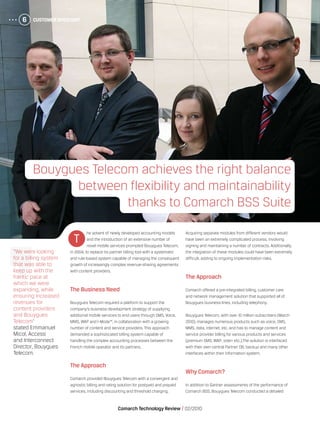
  Figure 1.
Content -based
services
Content
partners
Payment &
Charging
Requests
Revenue
Sharing
Products & Prices
Management
Partner
Management
Usage Data
Adapters
Partner
Self Care
Invoicing
Payment &
Charging
Gateway
Revenue
Sharing
Partner’s
administrator
Service
Usage
Data
Invoices
Premium
services,
VAS
Telco
Partners
Customer
Bouygues
Telecom
Industry
Communications
Founded in 1994,
Bouygues Telecom
has 10,352,000 mobile
subscribers, 311,000
fixed customers
and employs 9000
members of staff.
The company aims to
“become the preferred
brand of mobile and
fixed communication
services as well as
of TV and Internet
provision”, and looks
to provide users
with more freedom
when using their
mobile phones - with
an emphasis on
hospitality, service
and support for its
customers.
Customer Spotlight8
Comarch Technology Review   02/2010
Customer Spotlight8
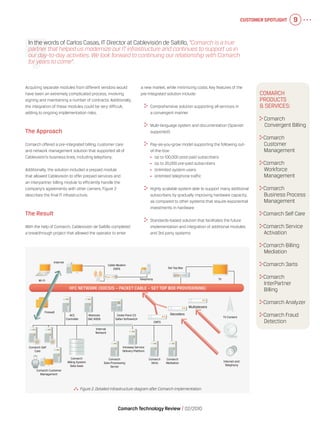
  Figure 1.Target IT infrastructure diagram
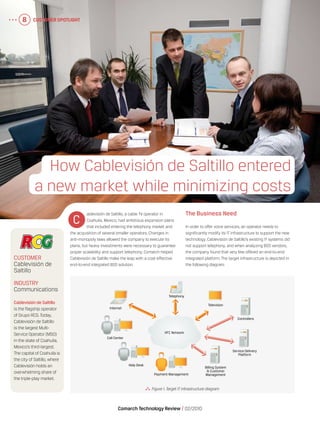
ablevisión de Saltillo, a cable TV operator in
Coahuila, Mexico, had ambitious expansion plans
that included entering the telephony market and
the acquisition of several smaller operators. Changes in
anti-monopoly laws allowed the company to execute its
plans, but heavy investments were necessary to guarantee
proper scalability and support telephony. Comarch helped
Cablevisión de Saltillo make the leap with a cost-effective
end-to-end integrated BSS solution.
The Business Need
In order to offer voice services, an operator needs to
significantly modify its IT infrastructure to support the new
technology. Cablevisión de Saltillo’s existing IT systems did
not support telephony, and when analyzing BSS vendors,
the company found that very few offered an end-to-end
integrated platform. The target infrastructure is depicted in
the following diagram:
How Cablevisión de Saltillo entered
a new market while minimizing costs
C
Customer
Cablevisión de
Saltillo
Industry
Communications
Cablevisión de Saltillo
is the flagship operator
of Grupo RCG.Today,
Cablevisión de Saltillo
is the largest Multi-
Service Operator (MSO)
in the state of Coahuila,
Mexico’s third-largest.
The capital of Coahuila is
the city of Saltillo, where
Cablevisión holds an
overwhelming share of
the triple-play market.
Internet
Telephony
Television
Controllers
Service Delivery
Platform
Billing System
& Customer
ManagementPayment Management
HFC Network
Help Desk
Call Center
Customer Spotlight 9
Comarch Technology Review   02/2010
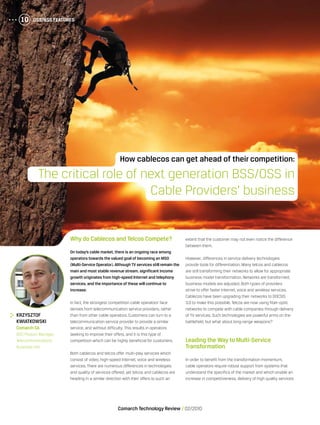
  Figure 2.Detailed infrastructure diagram after Comarch implementation
Acquiring separate modules from different vendors would
have been an extremely complicated process, involving
signing and maintaining a number of contracts. Additionally,
the integration of these modules could be very difficult,
adding to ongoing implementation risks.
The Approach
Comarch offered a pre-integrated billing, customer care
and network management solution that supported all of
Cablevisión’s business lines, including telephony.
Additionally, the solution included a prepaid module
that allowed Cablevisión to offer prepaid services and
an interpartner billing module to efficiently handle the
company’s agreements with other carriers. Figure 2
describes the final IT infrastructure.
The Result
With the help of Comarch, Cablevisión de Saltillo completed
a breakthrough project that allowed the operator to enter
a new market, while minimizing costs. Key features of the
pre-integrated solution include:
	 Comprehensive solution supporting all services in
a convergent manner
	 Multi-language system and documentation (Spanish
supported)
	 Pay-as-you-grow model supporting the following out-
of-the-box:
	 Up to 100,000 post-paid subscribers
	 Up to 20,000 pre-paid subscribers
	 Unlimited system users
	 Unlimited telephone traffic
	 Highly scalable system able to support many additional
subscribers by gradually improving hardware capacity,
as compared to other systems that require exponential
investments in hardware
	 Standards-based solution that facilitates the future
implementation and integration of additional modules
and 3rd party systems
Comarch
products
& Services:
	Comarch
Convergent Billing
	Comarch
Customer
Management
	Comarch
Workforce
Management
	Comarch
Business Process
Management
	Comarch Self Care
	Comarch Service
Activation
	Comarch Billing
Mediation
	Comarch 3arts
	Comarch
InterPartner
Billing
	Comarch Analyzer
	Comarch Fraud
Detection
In the words of Carlos Casas, IT Director at Cablevisión de Saltillo, “Comarch is a true
partner that helped us modernize our IT infrastructure and continues to support us in
our day-to-day activities.We look forward to continuing our relationship with Comarch
for years to come”.
Internet
Telephony
Set Top Box
TVWI-FI
Firewall
ACC
Controller
Internal
Network
Motorola
DAC 6000
Cedar Point C3
Safari Softswitch
CMTS
Decoders
Multiplexers
TV Content
Internet and
Telephony
Comarch
Data Processing
Server
Comarch
Billing System
Data base
Intraway Service
Delivery Platform
Comarch Customer
Management
Comarch Self
Care
Comarch
3Arts
Comarch
Mediation
Cable Modem
EMTA
HFC NETWORK (DOCSIS – PACKET CABLE – SET TOP BOX PROVISIONING)
OSS/BSS Features10
Comarch Technology Review   02/2010
OSS/BSS Features10
Why do Cablecos and Telcos Compete?
On today’s cable market, there is an ongoing race among
operators towards the valued goal of becoming an MSO
(Multi-Service Operator).Although TV services still remain the
main and most stable revenue stream, significant income
growth originates from high-speed Internet and telephony
services, and the importance of these will continue to
increase.
In fact, the strongest competition cable operators’ face
derives from telecommunication service providers, rather
than from other cable operators. Customers can turn to a
telecommunication service provider to provide a similar
service, and without difficulty. This results in operators
seeking to improve their offers, and it is this type of
competition which can be highly beneficial for customers.
Both cablecos and telcos offer multi-play services which
consist of video, high-speed Internet, voice and wireless
services. There are numerous differences in technologies
and quality of services offered, yet telcos and cablecos are
heading in a similar direction with their offers to such an
extent that the customer may not even notice the difference
between them.
However, differences in service delivery technologies
provide tools for differentiation. Many telcos and cablecos
are still transforming their networks to allow for appropriate
business model transformation. Networks are transformed,
business models are adjusted. Both types of providers
strive to offer faster Internet, voice and wireless services.
Cablecos have been upgrading their networks to DOCSIS
3.0 to make this possible. Telcos are now using fiber-optic
networks to compete with cable companies through delivery
of TV services. Such technologies are powerful arms on the
battlefield, but what about long-range weapons?
Leading the Way to Multi-Service
Transformation
In order to benefit from the transformation momentum,
cable operators require robust support from systems that
understand the specifics of the market and which enable an
increase in competitiveness, delivery of high quality services
	 Krzysztof
Kwiatkowski
	 Comarch SA
	 BSS Product Manager,
Telecommunications
Business Unit
How cablecos can get ahead of their competition:
The critical role of next generation BSS/OSS in
Cable Providers’ business
OSS/BSS Features 11
Comarch Technology Review   02/2010
Ideas in brief:
	Why cablecos
and telcos have
to compete
	Why do
operators need
to transform
their business
towards multi-
service
	What to
consider when
looking for a
perfect solution
to support your
cable business
	How does
Comarch
respond to the
needs of Cable
providers
and rises in revenue per subscriber. Furthermore, there must
also be a continuous focus on the customer.
BSS and OSS systems can be the key factors in an operator’s
successful business model transformation or lack thereof,
and constitute the long-range weapon in the battle between
cablecos and telcos. These systems must be focused on
increasing competitiveness, raising revenue per subscriber
and should be prepared for the future expansion of the
operator. To facilitate excelling at customer orientation
strategy, it must allow for creating personalized offers
according to the individual preferences of customers, and
ensure the high quality of delivered services. To shorten the
time-to-market and increase profitability, the solution should
provide multi-level convergence through the entire BSS and
OSS, as well as automation of field forces.
What to Look for in a Solution for Cable
TV Operators
Unlimited marketing creativity and customer
orientation
A product catalog with flexible definition of novel products,
services and bundles creation, personalized price plans and
discounts is the key factor for providing the differentiation
tool for marketing departments.
The usage of best-practices and pre-configured processes
dedicated to multi-service and traditional cable TV operators,
enables achieving this goal.
Market transformation
Readiness for the transformation means being well-prepared
for such mergers and acquisitions, as well as adapting to the
different characteristics of operations in various regions.
Transformation creates a set of requirements for BSS
such as multi-tenancy with support for multiple billing,
product, network and payment providers, and also sales
partners. In the BSS sphere, it requires the consolidation of
customer information resulting from multiple billing and CRM
systems. Additionally, a modern multi-service operator has
to cooperate with various partners and content providers,
and this must be supported by the BSS platform with, at a
minimum, B2B connectivity, multi-party billing and revenue
sharing.
Complete control and security of financial
operations
Bundles, personalized offers and discounts require the
complete control and security of financial operations. This is
even more pertinent in the case of Multi-Service Operators
in comparison to traditional operators. This area should
Cable TV operators
often comprise
of various
acquisitions and
mergers, and some
carry such an
approach forward
in combination
with the multi-
service strategy.
Readiness for the
transformation
means being
well-prepared for
such mergers and
acquisitions, as
well as adapting
to the different
characteristics
of operations in
various regions.
be fully managed by BSS, with an integrated sub-ledger
interfacing with G/L, comprehensive payment collection with
support for numerous payment methods, managing and
clearing financial documents, and bad debt collection and
configurable dunning scenarios. Furthermore, this should all
be carried out whilst supporting Sarbanes-Oxley, SAS-70 and
PCI compliance.
Successful business model transformation
BSS and OSS solutions must also provide flexibility and
stability for IT departments. These departments implement all
ideas and business requirements as ready-to-sell products,
integrate and manage networks and provide efficient
maintenance processes. Multi-Service Operators require
robust support for the creation and maintenance of a vast
number of individual price plans and discounts.
Network integration and management
The network integration challenge of Multi-Service Operators
is connected to simultaneous multi-network integration with
cross-network mediation and provisioning. It also touches
on service-agnostic billing and active mediation capabilities
with data format independence, high configurability and
support for industry standard interfaces and file formats.
There is a requirement for cable-TV-specific inventory with
the usage of HFC Network Hierarchy data models and
mechanisms of serviceability checking, with the possibility to
maintain precise information related to equipment at remote
sites and cable layouts needed to support technicians
working in the field.
Fault management capabilities should allow planned
outages and detect service interruptions. The new element
for cable TV operators can be connected with service quality
management which, together with managing congestion
issues via early detection of network problems and
identification of the impact on services, must be handled in
order to acquire heightened customer experience.
Convergence requires real-time processing of network
events via mediation and a billing system. This is why all
modules used in the real-time processing chain must have
the capabilities for upgrade without impacting service
continuity.
Process management
MSO complexity requires efficient business process
management, integrated with the entire multi-domain IT
ecosystem. Such integration and process management
has to be handled by BSS and OSS domains with built-in,
configurable order management, business process
execution monitoring and advanced task scheduling that are
open for integration.
OSS/BSS Features12
Comarch Technology Review   02/2010
Comprehensive customer service
Minimizing costs and maintaining comprehensive customer
service, requires the automation of field forces. Intelligent
scheduling and dispatching of technicians, automated task-
resource matching based on technician availability, skills and
location, and leveraging data stored in the network inventory
in order to support technicians working in the field, may
provide significant cost savings and increased customer
satisfaction. The latter is especially important during
primary contact with the operator, occurring when the first
technicians visit the customer’s home.
Summary
The multi-service approach changes the way in which
customers perceive their communication service providers.
Today, Multi-Service Operators represent a major gateway
to entertainment and communication services. Creating
positive relations with customers is the task of the marketing
department, but improving their overall experience requires
the collaboration of other departments, such as network,
billing, customer service, and even field technicians.
The advantage of the Comarch solution for cable TV
operators is that it transforms the broad communication
experience into a multi-service business and provides next
generation BSS and OSS tools to enable maximum efficiency
of operations and business model transformation.
The full article can be found at:
http://cable.comarch.com
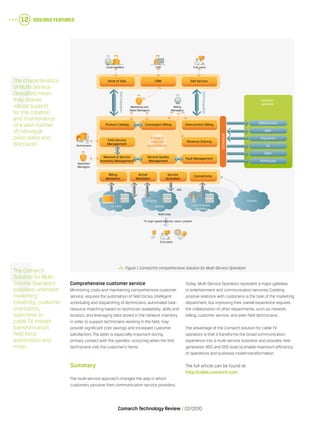
The Comarch
Solution for Multi-
Service Operators
provides: unlimited
marketing
creativity, customer
orientation,
openness to
cable TV market
transformation,
field force
automation and
more…
The characteristics
of Multi-Service
Operators mean
they require
robust support
for the creation
and maintenance
of a vast number
of individual
price plans and
discounts.
  Figure 1.Comarch’s comprehensive solution for Multi-Service Operators
external
systems
Marketing and
Sales Managers
Operation
Managers
Technicians
Local resellers CSR End users
Billing
Managers
SOAIntegration
DATAIntegration
Interfaces
Field Service
Management
Revenue Sharing
Billing
Mediation
Active
Mediation
Service
Activation
Connectivity
Network & Service
Inventory Management
Service Quality
Management
Fault Management
Convergent Billing Interconnect Billing DMS/Archive
MNP
Payments
GL
DWH
Printhouse
Product Catalog
CRM Self ServicePoint of Sale
Business
Process
Management
TV / IPTV DOCSIS
TV, high-speed Internet, voice, content
End users
Multi-play
HFC
Fixed & Mobile
Telephony
Content
OSS/BSS Features 13
Comarch Technology Review   02/2010
ield Service Management tools are solutions that
are primarily deployed by companies in orderto
achieve certain business improvement goals. The
most popularand commonly requested client goals in FSM
systems include decreasing costs, minimizing risks, and
maximizing the profitability of theirservices.
In most cases the main goal of the project is achieved
(FSM projects are less risky in comparison with other
telecommunication projects) and the influence of these
improvements in the organization of technicians’ work is
visible throughout the entire company.
In this article I will discuss several job functions in
a telecommunications company and will demonstrate that
each and every employee benefits from an investment such
as the Field Service Management system.
Customer Technical Support and
Network Maintenance
If you are a FS Dispatcher/Scheduler
As a dispatcher/scheduler in the Customer Technical Support
or Network Maintenance department, your scope of duties
involves numerous important activities within the order
fulfillment process.
If your company does not deploy any tool for improving
your job, you are probably the busiest person and at
the end of the day you are being blamed for all the
organizational problems in your department. This is
not a normal situation. Field Service Management may
make your job easier and will certainly increase your
effectiveness. Why? A number of FSM modules align to
help you carry out your responsibilities, they include:
F
OSS/BSS Features 13
How exactly will you benefit from automating
field services in your company
	Szymon Uczciwek
	 Comarch SA
	 BSS/OSS Solutions
Consultant
and Product Manager,
Telecommunications
Business Unit
OSS/BSS Features14
Comarch Technology Review   02/2010
Scheduling tools
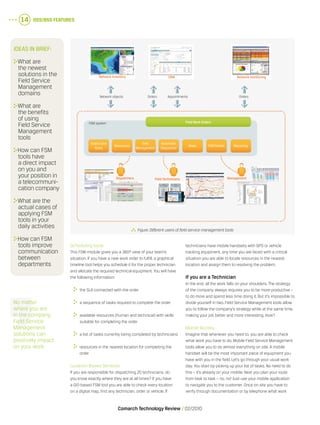
This FSM module gives you a 360º view of your team’s
situation. If you have a new work order to fulfill, a graphical
timeline tool helps you schedule it for the proper technician
and allocate the required technical equipment. You will have
the following information:
	 the SLA connected with the order
	 a sequence of tasks required to complete the order
	 available resources (human and technical) with skills
suitable for completing the order
	 a list of tasks currently being completed by technicians
	 resources in the nearest location for completing the
order
Location-Based Services
If you are responsible for dispatching 20 technicians, do
you know exactly where they are at all times? If you have
a GIS-based FSM tool you are able to check every location
on a digital map, find any technician, order or vehicle. If
technicians have mobile handsets with GPS or vehicle
tracking equipment, any time you are faced with a critical
situation you are able to locate resources in the nearest
location and assign them to resolving the problem.
If you are a Technician
In the end, all the work falls on your shoulders. The strategy
of the company always requires you to be more productive –
to do more and spend less time doing it. But it’s impossible to
divide yourself in two. Field Service Management tools allow
you to follow the company’s strategy while at the same time,
making your job better and more interesting. How?
Mobile Access
Imagine that whenever you need to, you are able to check
what work you have to do. Mobile Field Service Management
tools allow you to do almost everything on site. A mobile
handset will be the most important piece of equipment you
have with you in the field. Let’s go through your usual work
day. You start by picking up your list of tasks. No need to do
this – it’s already on your mobile. Next you plan your route
from task to task – no, no! Just use your mobile application
to navigate you to the customer. Once on site you have to
verify through documentation or by telephone what work
  Figure.Different users of field service management tools
Ideas in brief:
	What are
the newest
solutions in the
Field Service
Management
domains
	What are
the benefits
of using
Field Service
Management
tools
	How can FSM
tools have
a direct impact
on you and
your position in
a telecommuni-
cation company
	What are the
actual cases of
applying FSM
tools in your
daily activities
	How can FSM
tools improve
communication
between
departments
Network Inventory CRM Network monitoring
FSM system Field Work Orders
Orders and
Tasks
Resources
Time
Management
Automatic
Dispatcher
Maps FSM Mobile Reporting
ManagementField TechniciansDispatchers
Network
objects Orders OrdersAppointments
No matter
where you are
in the company,
Field Service
Management
solutions can
positively impact
on your work
OSS/BSS Features 15
Comarch Technology Review   02/2010
you have to carry out – but with your mobile you already
have all this information on the screen, along with the
procedure of how to accomplish it and with remote network
measurement tools. What’s next? Usually you have to fill out
some paperwork with the customer, but now you enter all
this data into the mobile handset and capture the customer’s
signature.
Optimization tools
“Optimization” sounds like a nice, but very often it means that
your limits of petrol per mile are cut again and again.But this
is not the kind of optimization that Field Service Management
tools carry out.FSM optimization tools try to find the most
optimal organization of your work, minimizing route distances
between task sites.This is possible thanks to information from
GIS systems like Google Maps.
Spare Parts Management
There are cables, modems, set top boxes and many other tools
you have to carry in your vehicle.And even if you have tons of
stuff in the truck, there always seems to be a problem with a
certain piece of equipment that wasn’t taken.What do you do
in such a situation? One solution is to go to the warehouse and
come back with the spare part for the customer.However this
is not only problematic for you, but also creates measurable
additional costs for the company, not to mention the effect it
has on the KPIs in your department.But even this problematic
situation can be resolved thanks to Field Service Optimization
tools.With information about your daily tasks you have precise
data about what you need to take with you in order to complete
all your daily tasks.
Knowledge Base
When a network element or customer is not in a standard
location (multi-story buildings, mountains or underground
locations) having every available piece of additional
information shown in the order context is particularly useful.
The Knowledge Base in FSM tools will add a description and
pictures to your order’s details and thus shorten your time
spent on that difficult order.
Customer Service
The impact of deploying Field Service Management tools
is not only limited to the main beneficiaries such as field
service departments. It has a much broader influence on the
entire telecommunication department environment.
If you are a CSR
You are responsible for resolving customer problems as
quickly as possible and the optimal situation is when
the problem can be resolved from the first attempt. But what
if it is not possible to give the customer actual information
about a technician’s visit? What if you have to call the
customer after some discussions with the field service team
or maybe even worse, leave it to them to call the customer
to make an appointment? Such a situation is confusing not
only for you, but probably even more so for your customer.
Field Service Management tools are able to provide you with
instant information about free resources and about available
time slots for technical service on a customer’s site.
Sales
According to Gartner research in the area of Field Service
Management (e.g. Magic Quadrant for Field Service
Management from 17th July 2010) one of the critical elements
of the Field Service Management Life Cycle that has to
be supported by FSM tools is customer management
capabilities including accountancy and sales.
If you are a salesperson
Typically the worst part of a sales specialist’s work is
unsuccessful interaction with customers, as well as
gathering all the required sales process documents. It is
problematic to hold a customer’s attention while going
through all the procedures with him needed for completing
a sale. The second thing is collecting all the required
documents from the customer, such as signed contracts,
updates etc. FSM functionalities allow transferring certain
sales activities to technicians. They can play a significant role
in customer contact by delivering documents and collecting
required signatures. This may even include preparing
invoices for the customer, and executing sales, thanks to the
cross- and up-selling functions of the mobile application. The
sales process will be fully aligned with market expectations.
Now, your sales team will be supported by valuable
representatives, and no opportunity will be wasted.
Summary
Synergy is still one of the leading optimization strategies.
Improvements are made by unifying and synchronizing
the entire company to achieve the same business goals.
Consider Field Service Management systems as the next
element of a department’s synergy and communication
improvement. It is an element which leaves behind the
traditional method of managing technical resources and
puts into practice a customer-centric strategy, using
improvements in customer service processes, service
convergence (the system allows managing all field service
activities not limited to special domains and services)
and cost savings by optimization as well as benefits from
outsourcing field services.
The full article can be found at:
http://field-service.comarch.com
Glossary:
	FSM – Field
Service
Management
	KPI – Key
Performance
Indicator
	GIS - Geographic
Information
System
	SLA – Service
Level Agreement
When you are
a new employee
at a company.
Usually, at the
beginning, it takes
a significant
amount of
your time to
understand all
the procedures
and tools used by
your department.
The Mobile FSM
application with
all its details
about orders,
order sites, routes
and additional
descriptions from
the knowledge
base allows you to
start your normal
job right from the
very first day.
OSS/BSS Features16
Comarch Technology Review   02/2010
OSS/BSS Features16
S
ome years ago, policy management did
not constitute a hot topic. One of the first
cases in which the issue received extensive
publicity, was in accordance with when P2P file sharing
applications were considered problematic – not only from
the legal perspective (copyright issues), but also because
of network congestion. Today, policy management is
becoming an essential tool for operators in managing
network traffic, based on policies and improving service
offerings simultaneously. Operators can adjust their
service offerings using various parameters, such as
service type, time of day, customer location and data
volumes. Policy management combines a mixture of
underlying network, subscriber data and service delivery
into a single entity.
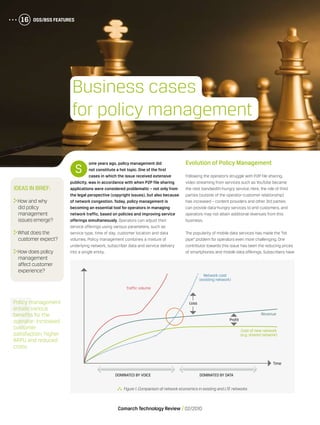
  Figure 1.Comparison of network economics in existing and LTE networks
Policy management
entails various
benefits for the
operator: increased
customer
satisfaction, higher
ARPU and reduced
costs.
Evolution of Policy Management
Following the operator’s struggle with P2P file sharing,
video streaming from services such as YouTube became
the next bandwidth-hungry service. Here, the role of third
parties (outside of the operator-customer relationship)
has increased – content providers and other 3rd parties
can provide data-hungry services to end customers, and
operators may not attain additional revenues from this
business.
The popularity of mobile data services has made the “bit
pipe” problem for operators even more challenging. One
contributor towards this issue has been the reducing prices
of smartphones and mobile data offerings. Subscribers have
Ideas in brief:
	How and why
did policy
management
issues emerge?
	What does the
customer expect?
	How does policy
management
affect customer
experience?
Business cases
for policy management
Dominated by voice Dominated by data
Time
Traffic volume
Network cost
(existing network)
Cost of new network
(e.g. shared network)
Revenue
Profit
Loss
OSS/BSS Features 17
Comarch Technology Review   02/2010
OSS/BSS Features 17
been able to purchase unlimited data plans for a fixed fee
per month. However, the problem is that the revenues from
mobile data services do not cover the costs of network
investments. Many operators have already announced that
they will stop offering unlimited data plans for mobile users,
and will instead provide various tariff plans with different
monthly data quotas.
The introduction of LTE improves mobile network efficiency,
and data traffic growth does not increase CAPEX to the
same level as it does in 3G networks. Thus, operators
are more able to increase their revenues without the
continuous need to upgrade network capacity. Figure 1
[source: Analysys Mason, 2010] presents the effect of
network maintenance costs on the operator’s bottom-line
results, between legacy and LTE networks. Notice how traffic
volume growth in existing networks correlates with network
costs. After LTE, operators still require tools for managing
the policies, in order to take full advantage of the revenue
opportunities.
Policy Management from the Customer
Perspective
A typical customer wants to pay as little as possible for the
services he is using.Similarly, he also wants to receive as
much value as possible for his money – this means that
he wants to attain the maximum amount of minutes and
megabytes.From the operator’s perspective, this becomes a
dilemma – the operator wants to acquire as much money from
the customer as possible, and simultaneously, the customer
should consume as few network resources as possible.
The customer can reap the benefits of the personalized
services offered by the operator. Fundamentally, each
customer has their own service usage habits, such as
web browsing, viewing video (e.g. YouTube) and gaming.
For each type of end customer, the operator can tailor
individual pricing plans and customize the service level. For
example, a customer who likes to play multiplayer games
on the Internet would appreciate higher service levels for
this particular type of service, in this case meaning lower
latencies for the game data traffic.
Customers may be interested in purchasing value-added
services (such as better QoS levels) for an additional fee.
An example case can be a business customer who needs
high bandwidth for the corporate VPN services he is using.
Another example can be a private customer who would like
to watch a football match with guaranteed bandwidth and
reduced latency. This type of user can buy e.g. a temporary
4-hour “bandwidth boost” from the operator for an additional
fee, using the self service portal for the subscription.
It can be summarized that customer experience is
heightened with policy management – network congestion
is reduced, customers receive more individualized tariff
plans and customers feel that they are getting more value
for their money. Thus, moving from the flat rate, unlimited
tariff plans to more individual types, can actually become an
advantage for the customer.
Why operators should invest in Policy
Management
From the operator’s perspective, policy management is not
only about throttling the bandwidth from high bandwidth
consumers. Policy management entails various benefits for
the operator: increased customer satisfaction, higher ARPU
and reduced costs.
The typical
customer wants
to attain the
maximum amount
of minutes and
megabytes for
as little money
as possible. The
operator, on the
other hand, would
like to acquire
as much money
from the customer
as he can, and
simultaneously
have the customer
consume as few
network resources
as possible.
	Pekka Valitalo
	 Comarch SA
	 BSS Market Analyst,
Telecommunications
Business Unit
OSS/BSS Features18
Comarch Technology Review   02/2010
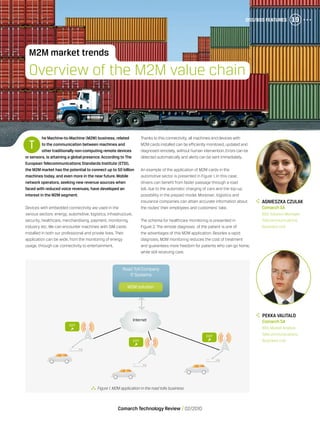
  Figure 2.Comarch Policy Management solution
With more individual tariff plans, the operator can up-sell
and cross-sell more for existing customers, and increase
ARPU in this way. An additional advantage is, of course,
the lower costs for network investments and maintenance
– due to restricting heavy bandwidth consumers. Network
congestion can be controlled, for example, by dynamically
allowing only specific types of services on the network
(e.g. web surfing is allowed, but video streaming or P2P
file sharing is not), in temporary situations where network
bandwidth is reducing.
The operator is able to increase the segmentation of
customers, basing on their individual habits. Various
parameters can be used for this segmentation, such as
service type, location, subscriber status (e.g. basing on
ARPU), device type and age. The policy management engine
can make dynamic decisions basing on the parameters, and
this extends the operator’s role from a mere bit pipe, towards
a more customer-focused service provider.
The policies can be applied dynamically and without
individual configuration for each customer, by the policy
management engine. The information about individual
subscribers can be used for allocating customers between
various tiers. For example, customers with high ARPU from
the previous two months may be automatically allocated to
a higher tier for the ensuing month. Individual tiers can have
different service allowances and quality of service levels.
The customer can be informed of the new service tier e.g. by
The figure presents a general
architecture of the Comarch
Policy Management solution,
situated between the billing/
CRM and network layer.The
solution is integrated with the
underlying network elements
to enforce the policies, and
can also be integrated with
the external billing and CRM
systems, instead of using its
own online/offline charging
functionalities and the
subscription profile repository.
The supported interfaces not
only follow 3GPP standards
(Gx, Gy), but also provide
additional interfaces and
APIs for integration with
the network environment
and external systems, making
it usable for multiple types
of Communication Service
Providers.
SMS, and it is also possible for him to purchase an increased
tier for the ensuing months, for an additional fee, in the case
that the conditions (such as specific level of ARPU) from the
previous months are not met.
The self service portal of the operator can be used in various
business scenarios for policy management – from defining
the service limits (e.g. service type or specific URL/domain)
in parental control scenarios, to defining consumption
restrictions, and time-of-day limits. This reduces the risk of
bill shocks and also provides more choice for end customers
to define the appropriate service allowance.
Conclusions
The scope of policy management is extending from
traditional usage of network throttling towards value-added
services, by using subscriber and service data available
for the decisions that have an effect on the services that
the subscriber is using. Operators are able to use policy
management for the offering of personalized services and
tariffs to their customers.
The Comarch Policy Management solution enables
Communication Service Providers to control their
network, service sessions and subscriber access, and
simultaneously provide subscribers with differentiated
services and improved customer experience.
The policy
management
engine can make
dynamic decisions
basing on the
parameters, and
this extends the
operator’s role from
a mere bit pipe,
towards a more
customer-focused
service provider.
CRM
Partners
Content
Billing
Online and Offline
Charging System
Comarch Policy Management
Application
Function
Subscribe Profile
Repository
Online and Offline
Charging System
Service Control
Policy and Charging
Rules Function
Web Services
Gx, Gy Diameter, RADIUS API Provisioning
Web Services
HTTP
Various network types
IP, IMS, NGNFixed, Cable Mobile
OSS/BSS Features 19
Comarch Technology Review   02/2010
he Machine-to-Machine (M2M) business, related
to the communication between machines and
othertraditionally non-computing remote devices
or sensors, is attaining a global presence. According to The
European Telecommunications Standards Institute (ETSI),
the M2M market has the potential to connect up to 50 billion
machines today, and even more in the nearfuture. Mobile
network operators, seeking new revenue sources when
faced with reduced voice revenues, have developed an
interest in the M2M segment.
Devices with embedded connectivity are used in the
various sectors: energy, automotive, logistics, infrastructure,
security, healthcare, merchandising, payment, monitoring,
industry etc. We can encounter machines with SIM cards
installed in both our professional and private lives. Their
application can be wide, from the monitoring of energy
usage, through car connectivity to entertainment.
Thanks to this connectivity, all machines and devices with
M2M cards installed can be efficiently monitored, updated and
diagnosed remotely, without human intervention.Errors can be
detected automatically and alerts can be sent immediately.
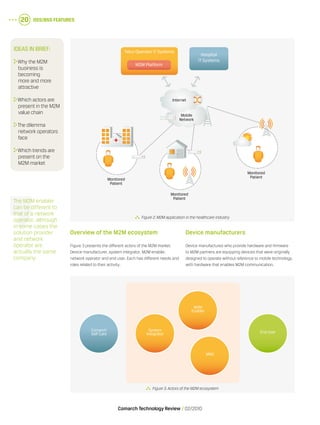
An example of the application of M2M cards in the
automotive sector is presented in Figure 1. In this case,
drivers can benefit from faster passage through a road
toll, due to the automatic charging of cars and the top-up
possibility in the prepaid model. Moreover, logistics and
insurance companies can attain accurate information about
the routes’ their employees and customers’ take.
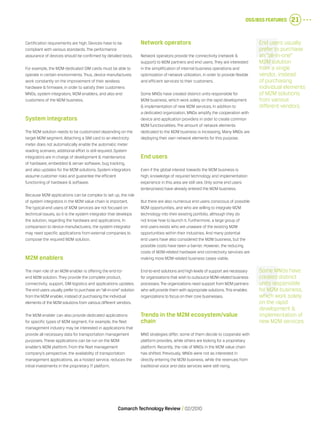
The schema for healthcare monitoring is presented in
Figure 2. The remote diagnosis of the patient is one of
the advantages of this M2M application. Besides a rapid
diagnosis, M2M monitoring reduces the cost of treatment
and guarantees more freedom for patients who can go home,
while still receiving care.
T
OSS/BSS Features 19
M2M market trends
Overview of the M2M value chain
	 Agnieszka Czulak
	 Comarch SA
	 BSS Solution Manager,
Telecommunications
Business Unit
  Figure 1.M2M application in the road tolls business
	Pekka Valitalo
	 Comarch SA
	 BSS Market Analyst,
Telecommunications
Business Unit
Road Toll Company
IT Systems
M2M solution
Internet
EXIT
EXIT
EXIT
OSS/BSS Features20
Comarch Technology Review   02/2010
Overview of the M2M ecosystem
Figure 3 presents the different actors of the M2M market:
Device manufacturer, system integrator, M2M enabler,
network operator and end user. Each has different needs and
roles related to their activity.
Device manufacturers
Device manufactures who provide hardware and firmware
to M2M partners are equipping devices that were originally
designed to operate without reference to mobile technology,
with hardware that enables M2M communication.
The M2M enabler
can be different to
that of a network
operator, although
in some cases the
solution provider
and network
operator are
actually the same
company.
Ideas in brief:
	Why the M2M
business is
becoming
more and more
attractive
	Which actors are
present in the M2M
value chain
	The dilemma
network operators
face
	Which trends are
present on the
M2M market
  Figure 2.M2M application in the healthcare industry
  Figure 3.Actors of the M2M ecosystem
Comarch
Self Care
System
Integrator
M2M
Enabler
MNO
End User
Telco Operator IT Systems
Hospital
IT Systems
M2M Platform
Internet
Mobile
Network
Monitored
Patient
Monitored
Patient
Monitored
Patient
OSS/BSS Features 21
Comarch Technology Review   02/2010
Certification requirements are high. Devices have to be
compliant with various standards. The performance
assurance of devices should be confirmed by detailed tests.
For example, the M2M-dedicated SIM cards must be able to
operate in certain environments. Thus, device manufactures
work constantly on the improvement of their wireless
hardware & firmware, in order to satisfy their customers:
MNOs, system integrators, M2M enablers, and also end
customers of the M2M business.
System integrators
The M2M solution needs to be customized depending on the
target M2M segment. Attaching a SIM card to an electricity
meter does not automatically enable the automatic meter
reading scenario; additional effort is still required. System
integrators are in charge of development & maintenance
of hardware, embedded & server software, bug tracking,
and also updates for the M2M solutions. System integrators
assume customer risks and guarantee the efficient
functioning of hardware & software.
Because M2M applications can be complex to set up, the role
of system integrators in the M2M value chain is important.
The typical end users of M2M services are not focused on
technical issues, so it is the system integrator that develops
the solution, regarding the hardware and applications. In
comparison to device manufacturers, the system integrator
may need specific applications from external companies to
compose the required M2M solution.
M2M enablers
The main role of an M2M enabler is offering the end-to-
end M2M solution. They provide the complete product,
connectivity, support, SIM logistics and applications updates.
The end users usually prefer to purchase an “all-in-one” solution
from the M2M enabler, instead of purchasing the individual
elements of the M2M solutions from various different vendors.
The M2M enabler can also provide dedicated applications
for specific types of M2M segment. For example, the fleet
management industry may be interested in applications that
provide all necessary data for transportation management
purposes. These applications can be run on the M2M
enabler’s M2M platform. From the fleet management
company’s perspective, the availability of transportation
management applications, as a hosted service, reduces the
initial investments in the proprietary IT platform.
Network operators
Network operators provide the connectivity (network &
support) to M2M partners and end users. They are interested
in the simplification of internal business operations and
optimization of network utilization, in order to provide flexible
and efficient services to their customers.
Some MNOs have created distinct units responsible for
M2M business, which work solely on the rapid development
& implementation of new M2M services. In addition to
a dedicated organization, MNOs amplify the cooperation with
device and application providers in order to create common
M2M functionalities. The amount of network elements
dedicated to the M2M business is increasing. Many MNOs are
deploying their own network elements for this purpose.
End users
Even if the global interest towards the M2M business is
high, knowledge of required technology and implementation
experience in this area are still rare. Only some end users
(enterprises) have already entered the M2M business.
But there are also numerous end users conscious of possible
M2M opportunities, and who are willing to integrate M2M
technology into their existing portfolio, although they do
not know how to launch it. Furthermore, a large group of
end users exists who are unaware of the existing M2M
opportunities within their industries. And many potential
end users have also considered the M2M business, but the
possible costs have been a barrier. However, the reducing
costs of M2M-related hardware and connectivity services are
making more M2M-related business cases viable.
End-to-end solutions and high levels of support are necessary
for organizations that wish to outsource M2M-related business
processes.The organizations need support from M2M partners
who will provide them with appropriate solutions.This enables
organizations to focus on their core businesses.
Trends in the M2M ecosystem/value
chain
MNO strategies differ; some of them decide to cooperate with
platform provides, while others are looking for a proprietary
platform. Recently, the role of MNOs in the M2M value chain
has shifted. Previously, MNOs were not as interested in
directly entering the M2M business, while the revenues from
traditional voice and data services were still rising.
End users usually
prefer to purchase
an “all-in-one”
M2M solution
from a single
vendor, instead
of purchasing
individual elements
of M2M solutions
from various
different vendors.
Some MNOs have
created distinct
units responsible
for M2M business,
which work solely
on the rapid
development &
implementation of
new M2M services.
OSS/BSS Features22
Comarch Technology Review   02/2010
The growing revenue forecasts for the M2M business have
pushed MNOs to enter the M2M market more directly. Figure
4 presents this type of scenario, where the MNO also takes
the role of M2M enabler.
The MNO can deploy additional network elements (e.g. HLR
and GGSN) that are dedicated to M2M traffic. This can also be
carried out by the M2M enabler that uses the same masts as
the MNO, but sets up its own network elements. For the MNO,
the usage of separate network elements enables the MNO to
use the network resources more efficiently and reduces the
internal bureaucracy. For the M2M enabler, the proprietary
network elements grant more independence from the MNOs,
and better flexibility for provisioning activities and error
diagnostics.
Depending on the type of M2M segment, the MNO may wish
to cooperate with niche M2M enablers focused on a specific
M2M segment. For example, the M2M enablers that focus on
fleet management hardware and applications can help the
transport companies to focus on their core businesses, thus
creating a win-win situation for both. These niche companies
are able to provide a complete end-to-end solution for the
fleet management industry, starting from hardware delivery,
to providing a hosted platform with fleet management
applications. These kinds of end-to-end offerings can be too
narrowly focused for a large MNO, meaning it can be a more
suitable business case for a smaller scale M2M enabler,
instead. Figure 5 presents this type of business case.
MNOs can also provide additional services for increasing
revenues, such as design, deployment and support of M2M
solutions for enterprises, although these types of services
are more commonly offered by a smaller business unit within
the MNO organization. These business units can set up the
partnerships with device and application manufacturers
more rapidly, to provide complete end-to-end solutions.
Conclusions
Which approach should the MNO consider: cooperation with
an M2M enabler, or setting up a proprietary M2M platform?
No unique strategy exists for MNOs that is optimal for all
types of M2M business cases. Many different approaches
are possible, and the individual MNOs should evaluate
which is the best strategy for them. The ongoing trend of
MNOs entering the M2M market more directly transforms
the revenue stream towards MNOs. The smaller players will
still have business opportunities on the market, but they will
need to focus on more niche segments, while MNOs focus on
the areas that have the highest volumes.
  Figure 5.Cooperation with an M2M enabler
  Figure 4.MNO as an M2M enabler
Device
Manufacturer
System
Integrator
MNO, M2M
Enabler End User
Device
Manufacturer
System
Integrator
M2M
Enabler
MNO
End User
MNO dilemma: is
it better to use an
external solution
provider (e.g. M2M
enabler) that
provides a hosted
M2M solution for
end users, or to set
up a proprietary
M2M platform?
OSS/BSS Features 23
Comarch Technology Review   02/2010
hen, in 1876, Alexander Graham Bell was awarded
a patent for the electric telephone by the United
States Patent and Trademark Office (USPTO),
nobody, including Bell, nor any other inventors for that
matter, could envisage the future of voice transmission.
Not so long ago, as the traditional Public Switched
Telephone Network (PSTN) evolved from analog to digital
(thanks to digital Time-Division Multiplexing (TDM)
technology), we entered the era of NGN networks (Next
Generation Network), based on Internet protocols such
as IP (Internet Protocol) and MPLS (Multi-protocol Label
Switching). Therefore, next generation networks are often
named “all-IP” networks, to emphasize the transformation
towards IP protocol. Packet-based NG networks are able to
provide data, text, fax and numerous types of multimedia
such as video, in addition to the traditional landline
telephone system (POTS – Plain Old Telephone Service).
The rapid development of broadband Internet access in the
early years of the 21st century accelerated the growth of
services supported by VoIP (Voice over Internet Protocol).
The standardization of IP-based signaling protocols such
as H.323 or SIP (Session Initiation Protocol) raised voice
services migration from circuit-switched architecture (PSTN)
to VoIP. And so the era of Internet telephony has begun.
Softswitch technology’s evolution to an
IMS architecture
The necessity for voice transformation from circuit-switched
(PSTN, SS7) to packet-based form (IP) initiated the evolution
of softswitch technology.In telecommunications networks,
softswitch is a software-based central device responsible
for VoIP call control and integration with the PSTN network.In
the early stages of softswitch technology development, the
solution architecture was based on a Call Agent, responsible
for call control, call routing and signaling and a Media Gateway
responsible for end-to-end media (voice, data) streaming.The
Call Agent would control several Media Gateways interfaced into
PSTN or IP networks.In modern softswitch-based architecture,
the Call Agent is separated from the Media Gateway.Due
to the immaturity of the technology, various definitions of
softswitches have been used by different manufacturers.
With the development of NG networks, softswitch technology
matured and was standardized as an IMS (IP Multimedia
Subsystem) architecture by the 3GPP (3rd Generation
Partnership Project) and ETSI (European Telecommunication
Standards Institute).Within the IMS architecture, the role of the
softswitch is performed by an MGC (Media Gateway Controller)
using MGCP protocol (Media Gateway Control Protocol) or H.248
protocol (also known as Megaco).
Where does Unified Communication fit in?
NG network convergence introduced VoIP technology into
fixed and mobile networks. Softswitch technology was
designed to provide voice and data services, while the IMS is
focused on all multimedia and IP network features, offering
the customers of fixed, mobile and cable providers’ access to
multiple services such as:
	 Voice and video telephony
	 IP PBX, hosted PBX (Private Branch Exchange)
	 Automated Attendants, receptionist
W
From circuit
to soft (packet)-switching
“...the era of
Internet telephony
has begun
	 Lukasz Grodzki
	 Comarch SA
	 BSS Solution Manager,
Telecommunications
Business Unit
OSS/BSS Features 23
OSS/BSS Features24
Comarch Technology Review   02/2010
  Figure 2.International voice IP traffic growth
	 VMS (Voice Mail System) and IVR (Interactive Voice
Response)
	 Enhanced phonebook, with a presence feature
	 Enhanced messaging, with chat and history features
	 Enriched call, with multimedia content-sharing during
voice sessions
This set of multimedia services is usually referred to as
Unified Communication (UC). The advantage of UC is that
it enables providing services through multiple devices
and media types anytime, anywhere and in any way. It
allows service providers to offer fixed-mobile convergence
(FMC) without any other additional equipment. Mobile
communication services such as enhanced phonebook,
enhanced messaging or enriched call are known as
a Rich Communication Suite (RCS). RCS is an IMS-based
specification of communication services, developed by the
consortium of mobile manufacturers and operators, such
as AT&T, Ericsson, Motorola, Nokia, Samsung, SonyEricsson,
T-Mobile and many others.
The benefits of IMS and Unified
Communications
IMS, as the advanced carrier-grade service delivery platform,
enables operators to deliver innovative real-time and non
real-time services or Web 2.0 applications to demanding
customers through a unified platform, thus lowering
costs. The idea of Unified Communication is to deliver
communication services seamlessly to any device, across
any access network. Fixed and mobile convergence can
benefit both residential and corporate customers with new
services, its simplification and unification.
The main advantages of a mature IMS architecture delivered
through packet-switched technology are:
	 IP-based NGN architecture (well-defined modularity and
interfaces)
	 Common media control and network management
functions
	 Lower OPEX through remote and centralized
management, and common network infrastructure
Ideas in brief:
	What are the
trends in mod-
ern telecommu-
nications?
	What are the
benefits of voice
transmission
through IP pro-
tocol?
	How to under-
stand Unified
Communication
	Why Internet
Protocol seems
to be the future
of convergent
communication
  Figure 1.IMS Functional architecture
The migration from
circuit-switched to
packet-switched
technology seems
to be inevitable.
The evolution of
IMS stimulates
the growth of
mobile and fixed
telecommunication
networks.
Service / Application Plane
Control / Signaling Plane
Media / Transport Plane
CSCF
MRF
R7: Broadband
R6: WiFi
R5: GPRS/UMTS
Signaling
Media
SCIM
Application
Servers
(AS)
S-CSCF
HSS
P-CSCF
I-CSCF
(S)PDFA-RACSNASS
RACS
BAS /
A=BGF
MRCF
MRFP
I-BCF /
SIP ALG
BGCF
MGCF
SGCF
MGW
DSLAMUE
UE
UE SGSN
WAG
RAN
PDG
GGSN Core
Network
I-BGF /
TrGW
IPv6
Network
IPv4
Network
PSTN
20000
0
2001
MillionsofMinutes
11021
2002
18502
2003
28706
2004
46057
2005
68900
2006
97567
2007
123974
2000
5544traffic
40000
60000
80000
100000
120000
140000
OSS/BSS Features 25
Comarch Technology Review   02/2010
  Figure 4.Mobile technologies evolution
	 Decreased CAPEX through scalable server-based
hardware architecture (multiple hardware platforms
supported) and user-based licensing
	 Revenue-generating services
generation network). The main advantages of LTE are high
throughput, low latency and flat architecture, which imply
minimal operating costs. The first LTE services are available in
Scandinavia (opened by TeliaSonera in Stockholm and Oslo),
and shortly operators will announce the running of all-IP
based LTE networks. Global mobile operators and device
manufacturers support VoLTE (Voice over LTE), an initiative
announced in February 2010 and adopted by GSMA (GSM
World). The purpose of VoLTE is to standardize the method of
delivering voice and messaging services in the future for LTE,
using IMS specifications developed by 3GPP. GSMA VoLTE is
built upon the following principles:
	 Single implementation promotes scale - single
technology being used across all networks, phones and
devices
	 Single implementation reduces complexity
	 Single implementation enables roaming
The prognosis states that the top 25 LTE operators will attain
200 million subscribers by 2015.
What’s next?
Migration from circuit-switched GSM and 3G networks to
IP-based LTE networks won’t happen overnight. Operators will
need to provide service continuity. However, besides all of
the challenges, operators have no other choice. IMS in mobile
networks is materializing. By 2011, 80% of service providers
will deliver voice over IMS. What’s next? LTE Advanced, the
younger brother of LTE, will emerge in the second decade of
the 21st century, with the benefits of a throughput rate level
of 1 Gbit/s, and low power nodes such as pico or femtocells.
What is beyond this? The human need for communication –
the only consistent factor stimulating technologies to evolve
to bring communications to us more cheaply, simply and at
a higher standard
  Figure 3.NGN Network benefits
Glossary:
	HD - High Density
	LTE –Long-Term
Evolution
	VoIP - Voice over IP
Protocol
	USPTO - United
States Patent and
Trademark Office
	PSTN - Public
Switched Telephone
Network
	TDM - Time-Division
Multiplexing
	MGC - Media
Gateway Controller
	POTS – Plain Old
Telephone Service
	SIP - Session
Initiation Protocol
	PBX - Private Branch
Exchange
	VMS - Voice Mail
System
	IVR - Interactive
Voice Response
	FMC - Fixed-mobile
convergence
	UC - Unified
Communication
	RCS - Rich
Communication
Suite
	3GPP - 3rd
Generation
Partnership Project
	ETSI - European
Telecommunication
Standards Institute
LTE – the future of IMS - VoIP goes HD
and wireless
VoIP traffic is constantly growing in international networks,
replacing TDM international networks. TDM traffic has
noted negative growth since 2004. Nowadays, billions of
minutes of international long distance calls are transferred
over IP via wholesale carriers or global voice providers.
The evolution of IMS stimulates the growth of mobile and
fixed telecommunication networks. Third generation mobile
networks (3G) provide a High Density (HD) of voice and video,
with an elevated quality of service (QoS). The migration
from circuit-switched to packet-switched technology
seems to be inevitable for both fixed and mobile networks.
Mature 3G networks, such as UMTS (Universal Mobile
Telecommunication System), which is a combination of
circuit- and packet-switching technology, will be replaced
by all-IP flat networking architecture. The way to achieve
this is LTE (3GPP Long-Term Evolution), also called 4G (fourth
WCDMA
Rel-99
Excellent Mobile Broadband Today
Voice and full Range of IP Services
Enhanced User Experience
LTE leverages news, wider and TDD
spectrum
2009 – 2010 2011+ ---------->
Improved voice and data capability
HSPA
Rel-99
HSPA+
Rel-8
(HSPA Envolved)
Rel-9 & beyond
Rel-9
LTE
Rel-8
LTE-A
Rel-10
Rel-5 Rel-7
Legacy NextGen
Source:CIBC120%
100%
80%
60%
40%
20%
0%
Network Equipment
Physical Facilities
Fiber
Operations
10% 7%
20%
20%
25%
15%
45%
25%
OSS/BSS Features26
Comarch Technology Review   02/2010
OSS/BSS Features26
Knowledge transfer
or change announcement?
very company requires an ongoing
communications and training program. They should
be designed to ensure that all employees, full
time and temporary, as well as contractors understand the
enterprise’s policies, processes and software and know
how to follow and use them properly.
Imagine the following situation: new software has just
been implemented and we have several or a few dozen
employees that must be trained to use it. There is always
reluctance to change at work, always thoughts of: “there
will be reductions”, “I won’t be needed any more”, “I will have
more problems now”, “I liked the old way better”, and these
types of sentiments can be multiplied. How can an employee
be convinced that this change will have a positive affect
and how can the training be made more effective for the
company? Here are some tips to do just that.
Don’t hide anything
According to Murphy’s law, when everything is well organized
and every detail has been perfectly arranged, something
always happens to ruin the ‘happy ending’.This is exactly why it
is best to reveal each and every stage of a new project to those
who it may concern.Starting from the context of the change,
its strategy and ending with the contact peoples’ names or the
exact dates of the implementation.If any threats to the project
exist, it is in the company’s best interest to raise the awareness
of the team responsible, in order to make them more focused
on the given problem.In the end, this new software may not
meet all requirements and expectations due to various reasons.
It is better to disclose this at the beginning, rather than to wait
until the last minute, and make the issue seem like a bolt from
the blue for system users.
E
Ideas in brief:
	Different training
methods for
different types
of users and
systems
	Scheduling - one
of the keys to
success
	Not only teach,
but also listen
OSS/BSS Features 27
Comarch Technology Review   02/2010
	Katarzyna
Gajewska
	 Comarch SA
	 Marketing&PR Specialist,
Telecommunications
Business Unit
Consult new features
Every employee will feel appreciated if you are informing
her/him about planned changes. This is especially true if
it concerns the job that they perform. Usually a delegated
team is responsible for First Site Application (FSA) tests
and the final user may not have much in common with the
new features being planned for the next release. Imagine
how they would react when coming back from holidays:
they read an email explaining how a new version of the
software was installed and the interface has changed.
Frustration along with many raised eyebrows would be
common. Questions would be asked such as: “Our bosses
don’t use this software on a daily basis! What do they
know about it?” or “On which basis was this change
requested? What for?” There are ways that may bring you
benefits while keeping end users satisfied: a Mailing list,
a dedicated website or a meeting with several agenda
points. New software should have features that the old
system did not have, features that allow users to work
faster, more effectively and most of all, make their life
easier. There is no better way to obtain this information
than from the end users themselves!
Proper communication
Everybody wants to be well informed about impending
changes. Remember that decisions should be sent in
advance. The type of application, the sophistication of
the end-user audience and the geographic distribution of
the users will create all kinds of demands. In addition to
standard classroom training, just–in-time-training cannot be
overlooked. Every training delivery mechanism is specific to
certain situations, and always comes with advantages as
well as disadvantages. In general, the entire set of training
mechanisms, as shown on the table below, is required.
Source: Gartner [Toolkit Best Practices: Training End Users].
Consult changes with engaged
employees
A training plan cannot be taken from a template. It must
be well-suited to the scheduled training. It must literally be
“tailored” to the specific needs of the customer. Off-the-shelf
training is usually a very fundamental mistake. Of course for
products which are standard and unchangeable, this course
of action may be appropriate. However, in the real world of IT
projects, such a situation is like discovering a unicorn. Project
leaders should discuss use cases with workers and after the
first training sessions, the training plan should be adjusted.
Maintaining and measuring workshop effectiveness is also
very important. Ideally, workers should be able to use at least
80% of the system’s functionalities. If there are many teams
to be trained, managers must measure this effectiveness
and make corrections for subsequent groups.
Constant improvement based on
feedback
Getting feedback from training participants is vital in the
process of constant improvement. Effective communication
between a trainer and system users will benefit both sides.
Using feedback forms and questionnaires after every training
is a great practice. This can help highlight issues that may
have been overlooked during the training planning phase or
topics that users are not concerned with.
Worst-case scenario
The worst-case scenario is providing no training at all. Poorly
trained or untrained users will cost the company significantly
more to support than well-trained employees. Workers who
are devoid of training, who spend a significant portion of their
time away from the office, and who often have networking
questions from multiple remote locations, are generally the
most expensive to support.
  Figure 1.Training Method Comparison
E-training is a cost-
effective approach
for off-the-shelf
applications. Users
can work on their
own schedules
and pick the
appropriate level of
difficulty.
In most cases,
a user’s attention
span drops
significantly during
training that lasts
more than half
a day. For mobile
field workers who
work in vehicles or
outside all day, the
attention span can
be as low as 30
minutes.
Type of Training New Employees
White-Collar
Mobile Workers
Blue-Collar
Mobile Filed
Workers
Skills Training
Vertical
Applications
Immediate
Response
Classroom √ √ √ √
Web-Based Virtual
Classes
√ √ √ √
Personal Trainer √ √ √
E-Training Modules √ √ √
Cheat Sheets √ √ √ √
Help Desk Training
Modules
√ √
JITT Embedded in
the Application
√ √ √ √
√ = Appropriate to user or application
OSS/BSS Features28
Comarch Technology Review   02/2010
OSS/BSS Features28
ommunication Service Providers (CSP) strive
to boost service innovation to augment basic
connectivityservices.Theyare aware that theymay
need new tools to realize this goal, but are bombarded with
buzzwords, bymanyclaiming theyhave the right solution.
This article suggests taking the problem-centric approach, to
avoid being drawn into the flood of new buzzwords.
Currently, CSPs face two main challenges: firstly, they are
pushed by Internet players, Google, Apple and alike, which may
result in rendering CSPs as dumb pipe providers.Secondly,
CSPs do not receive proportional compensation for the costs
inflicted by the serge in data consumed by customers.The
latter change makes the effect of the first even more severe.
As a remedy, CSPs aim to refocus more on customer
applications and end customer services, instead of
purely on communication services. This also leads to the
introduction of new business models, which allow CSPs to
assume a central role in the value chain. (This subject I have
discussed in blog post [1]).
To realize this trend, CSPs need to boost the service innovation
rate, and this may require novel tools.This demand has been
recognized by many who claim to have the right tools for CSPs.
The problem is that in order to market these new tools, many
buzzwords have been created.There is nothing wrong with
new terms introduction, as long as they help us to understand
and solve problems, but quite often they are simply used as
marketing ploys to convince CSPs to buy tools which sport the
longest list of popular buzzwords.
SOA, reusability, components, mash-ups…
Service Oriented Architecture (SOA) is not a product, but
a concept. Even the best tool will not guarantee the benefits
of SOA - it can only help you to employ this architecture.
For me, SOA is all about reusability, realized by component-
based service creation. In other words, the concept that
you can create new services from reusable building blocks.
This is, in fact, also the main concern of mash-ups. Newly
created (assembled) services can be used farther for
composing higher level services. This may lead to confusion,
as many tools assisting service composition may operate at
a different level of service composition.
Why does understanding service component granularity
matter to CSPs? CSPs are unlikely to want to compete with
developers, or even force them to change their favored
development environments, but on the contrary, aim to
leverage the creativity of a developer’s work. This means
that what, from a CSP perspective, should be treated as
an atomic service component, might, from the developer’s
viewpoint, represent a coarse-grained composite service
component. An example could be an augmented reality
application, which when simplifying, can be perceived as
composed from: a geolocation service, image recognition,
customer preference services, searching information and
overlaying the found information on top of other original
images. From the developers perspective, searching can be
a complex service leveraging indexing, key matching and
a rating service.
What is also worth realizing, is that the more fine grained
a component is, the more complicated service assembly
is. ‘Complicated’ in this context refers to requiring more IT
expertise. Although implementing SOA means replacing
cumbersome, monolithic services with composite services
built up from more fine-grained components, it does not
mean that service components should be broken down into
tiny pieces. The CSPs should only tackle service composition
which does not require programming skills, leaving more
fined grained types to developers.
C
Ideas in brief:
	SOA is a concept,
tools can only
help CSPs to
realize it
	Right level
of service
composition is
key for effective
service reusability
	Service
component
granularity should
match CSPs
expertise
	Service catalog-
driven fulfillment
and service
execution is an
answer
	CSPs require
use cases
demonstrating
how to quickly
introduce new
services, not new
buzzwords
Boosting service innovation
– getting through the jungle of buzzwords:
SDP, service broker, orchestration,
SOA, service composition…
OSS/BSS Features 29
Comarch Technology Review   02/2010
Fulfillment and execution time
orchestration
New service introduction must comprise three main areas:
service fulfillment, service assurance and service execution.
The first two areas are well-defined process verticals on
the eTOM map. Service execution is simply the period when
a service (after it has been ordered) is used by a customer.
Introducing the SOA service composition concept also means
bringing in the term “orchestration”. If a service is composed
of smaller pieces, delivering a service means leveraging
the functionality of these components. Orchestration is
focused on employing the functionality of these components.
We can identify two types of orchestration: fulfillment
orchestration, and orchestration at the point of execution.
Fulfillment orchestration is also related to the term “order
decomposition”, when the initial customer offers’ are
decomposed down to orders, against the components from
which a service is built up. From a technical point of view,
orchestration refers to invoking the service management
API of the service component. Execution time orchestration
accounts for invoking the functional API of the component
when a customer uses a service (during a call). These two
methods of orchestration should naturally relate to each
other, as the service execution must comply with what
a customer has ordered. This leads to the concept of the
common model for the fulfillment and execution environment.
Service catalog-driven composition
To really enable CSPs to rapidly introduce new services,
there should be a single location where service composition
is controlled. Ideally, it ought to be a service catalog which
drives service order fulfillment, and by orchestrating service
components, management API should define execution
orchestration. What is important is that the granularity of
the components managed by the service catalog should
be limited to the level where composition does not require
programming skills, and ought to enable CSP product
managers to introduce new services to the market. This
concept is described in my whitepaper [2].
SDP, NGSDP, service brokers…
The Service Delivery Platform was initially touted as
a complete solution for CSPs to rapidly introduce new
services. The problem is that many SDPs turned out to
be stove-pipe SDPs, and as a result CSPs would require
a constellation of SDPs, and so the issue of reusing service
components implemented on different SDPs remained.
Then, the term “Next Generation SDP” appeared, and this
defines a solution which may be perceived as the “SDP” of
“SDPs”, meaning the introduction of a horizontal service layer
promising to diminish the silos problem. Another hyped term
is “Service Broker”. This name is defined by 3GPP, but there
are extensions to the 3GPP definition which add additional
roles, like Reverse IM-SSF and even Web 2.0 gateway.
The former is to enable IN applications to leverage new
components developed on the IMS platform. The Web 2.0
gateway includes the role of Network APIs (reference to blog
post “Network API – Business Models”) for web developers to
leverage network assets. To depict how service broker refers
to NGSDP would be a subject for a dedicated article.
Conclusion – practical approach for
CSPs
Understanding what buzzwords really mean and how
different terms relate to each other may be somewhat
challenging, especially when quite often there are no
common definitions for them. The practical approach CSPs
can take when evaluating different solutions, is to simply ask
for a use case for introducing a new service. The use case
should demonstrate the whole process and cover:
	 where service composition is controlled
	 what granularity of service composition is intended to
be managed by the CSP
	 what skills are required – how complex composition/
orchestration definition is
	 whether it embraces service fulfillment, execution and
service assurance
	 if it is integrated with the service catalog which drives
customer order management
	 how easily I can reuse my existing services, and what
is required to make them service components
	 whether it is accompanied with design patterns
This article may prove to be controversial, and so I encourage
further discussion on my blog, where the article is also
published.
References:
[1] “Seeking New Revenue Opportunities – Application
Platform Wars” Comarch blog:
www.telcosphere.comarch.com
[2] “Fulfilling the Promise of Component-Based Service
Creation” – Comarch whitepaper
The practical
approach CSPs
can take when
evaluating different
solutions, is to
simply ask for a use
case for introducing
a new service.
What is important
is that the
granularity of
the components
managed by the
service catalog
should be limited
to the level where
composition
does not require
programming
skills, and ought
to enable CSP
product managers
to introduce new
services to the
market.
	 Lukasz Mendyk
	 Comarch SA
	 OSS Product Manager,
Telecommunications
Business Unit
OSS/BSS Features30
Comarch Technology Review   02/2010
OSS/BSS Features30
y the end of 2010, Vodafone will present its
proprietary IPTV offer, named Vodafone TV, at IFA.
Based on a hybrid approach, satellite and cable
signals are processed via a platform developed by Vodafone
Germany. Following Telekom and Alice, Vodafone will now be
the third providerof IP television in Germany.
In light of the growing competition, the market
research enterprise Canalys sees the conventional
telecommunications providers as under pressure to clearly
increase their average revenue per user (ARPU). According to
Canalys, many of these companies may resort to IPTV. In the
future, IPTV will be an inherent part of complete service offers
to consumers.
The growing competition is primarily provoked by cable
network providers that retrofit their cable networks for
broadband Internet, and who now want to join in the large
telecommunications market as quadruple players. Kabel
Deutschland (KDG), the German cable network operator, is
one example here. KDG already offers analog / digital cable
TV, broadband Internet, fixed-line telephony via Voice over IP,
as well as mobile telephony via the Telefónica O2 network.
This way, the operative business of cable TV operators and
conventional telecommunications providers equals more and
more.
Normally, IPTV is offered by a telecommunications provider
via its broadband network, with defined quality (QoS) and
fixed program bouquets, which reflect TV contents that can
be subscribed to by certain users.
The strongest motor for the spread of internet-based TV is
most definitely the development of broadband connections,
such as DSL, ADSL2, or VDSL promoted in recent years.
The transmission of TV contents in PAL or SDTV (Standard
Definition Television) quality requires a data rate with an
average of 2-6 Mbit/s. HDTV even requires bandwidths with
an average of 6-16 Mbit/s. Furthermore, it must be possible
to operate several TV sets in each household at the same
time, which would cause a respective multiplication of the
bandwidth required. Therefore, IPTV supporters forecast
B
Ideas in brief:
	What is IPTV
nowadays
	Requirements and
offerings of IPTV
	The basic
structure of an
IPTV headend
	Comarch’s
proposal for IPTV
operators
In the future, IPTV
will be an inherent
part of complete
service offers to
consumers.
  Figure 1.Convergence of Telecommunications and CATV providers
Bright future for IPTV
– are you ready?
Internet
Telephony
Mobile Communications
Television
ISDN, DSL, ADSL, VDSL Internet over Cable
VoIP
GSM, GPRS, UMTS
TV, HbbTV
ISDN, PSTN
GSM, GPRS, UMTS
IPTV
Telecommunications
Provider
CATV
ProviderMVNO
OSS/BSS Features 31
Comarch Technology Review   02/2010
future demand for Internet bandwidth to reach a rate of at
least 30-50 Mbit/s per household.
However, new technologies and improved coding procedures
such as, for example, H.264/MPEG-4 AVC – a standard
for highly efficient video compression – help to minimize
required data rates and to optimally use existing bandwidths.
So why do conventional telecommunications providers
increasingly include IPTV in their service portfolio, and
thus take the plunge into the television world when facing
competition from cable network operators?
So is there a future for IPTV?
While the bandwidths of Internet still grant ample scope both
in telecommunications and cable networks, the question that
remains unanswered is: which TV medium will dominate in
the future – conventional analog / digital TV or IPTV?
IPTV normally requires a broadband Internet connection,
whereas its bandwidth and the signal form (SD or HD) restrict
the simultaneous broadcast of several television channels, and
thus also the operation of various TV sets.Moreover, the image
quality is often of lower quality than that of conventional analog
/ digital TV a typical television consumer is used to.
However, IPTV currently offers viewers more than traditional
television image transmission. Due to the integral return
channel of IPTV, a variety of new functions and services
opens up like, for example:
	 Searching for video clips or TV channels via clear-text
queries
	 Generating TV contents based on user preferences and/
or viewer profiles
	 Video on Demand enables playing any video clip at any
time
	 Hooking up multiple audio programs, foreign language
channels, subtitles
	 Interactive television (hypervideos)
	 Purchase transactions and T-commerce
	 Web 2.0 functions
In fact, conventional television also tries to enhance its
functional range by means of Internet or newly established
standards, in order to offer viewers not only the broadcasting
of TV channels, but also innovative services. HbbTV (hybrid
broadcast TV) represents a new international standard, on
which leading European TV operators and companies of the
electronics industry agreed. This expansion of television
connects broadcasting and Internet contents, and offers,
amongst others, the following services:
	 Integrating media libraries of TV channels and Video on
Demand
	 Integration of HTML pages
	 Transparent overlay presentation on the current
television image (interactive text and image information,
menu functions, news tickers)
	 Improved options for teletext, like high resolution
presentation of pictures and graphics
	 Combination of previous TV services such as the
Electronic Program Guide (EPG), current Internet offers
of TV broadcasters, videotext
	 Daniel Kloppich	
Comarch SA
	 OSS Consultant,
Telecommunications
Business Unit
OSS/BSS Features 31
Conventional
television also
tries to enhance
its functional
range by means
of Internet or
newly established
standards, in order
to offer viewers
not only the
broadcasting of TV
channels, but also
innovative services.
OSS/BSS Features32
Comarch Technology Review   02/2010
Signal processing in IPTV headends
The reception and processing of TV channels, as well as conversion for Internet, take place in so-called “headends”. An
example of signal processing by resources of an IPTV headend is given in Figure 2.
Broadcasters (television stations or their service providers) deliver the signal either via satellite or cable connection
(e.g. glass fiber). Direct delivery is primarily used for adequate HD signals. The L-band matrix enables the flexible
interconnection of any inputs and outputs, so that diverse satellite signals will be transmitted to connected receivers or
IRDs (Integrated Receiver Decoder).
IRDs receive and decode the satellite signals. Since some channels are delivered in a scrambled form, additional
descrambling is required, using a CA (Conditional Access) module. IRDs provide two different output signals. On the one
hand, a SDI (Serial Digital Interface) signal is generated with an uncompressed audio/video signal, and on the other
hand, a compressed ASI (Asynchronous Serial Interface) signal is generated. In addition to audio and video, the ASI signal
includes, for example, signal streams for service information and teletext. Direct delivery over cable can take place via
various signal streams, which are then connected to different devices for further signal processing. In part, these signals
are conducted through IRDs, as they have to be decoded.
An SDI signal delivered over cable can be directly transferred as well. For further audio/video processing, the SDI signal
enters into the SDI router either from an IRD or from direct delivery. This router enables switching from inputs to outputs
without changes being necessary to the wiring. In the audio leveling system, the audio signal is separated from the SDI
signal (de-embedding) and the sound level is adjusted. Depending on the type of signal, additional processing steps
are required. In contrast to simple stereo signals, Dolby Digital signals (e.g. AC3) have to be decoded before leveling, and
encoded again afterwards. The SDI signal is passed on from audio leveling, over an encoder router, to an encoder that
corresponds to the video format (SD or HD). The encoder converts the signal within a multiplexing process and generates
a MPEG4/AVC transport stream. This stream includes audio and video, but the EIT (Event Information Table) data required for
the EPG (Electronic Program Guide) are still missing.
Parallel to the audio/video processing, the ASI (Asynchronous Serial Interface) signal is conducted from the IRD to
a corresponding multiplexer, in which only the SI data are processed and summarized as signals with several SI streams.
These signals are analyzed in the SI subsystem, and the EIT data included in them are processed. If the TV channel
does not contain any embedded SI data, such data can be uploaded via external data sources also. The SI subsystem
processes all kinds of information and provides the necessary EIT data as an output signal. The EIT data and the MPEG4/
AVC stream are combined in an IP multiplexer. The complete transport stream is conducted over an IP switch to the
distribution platform (e.g. Microsoft Mediaroom), and from there it is distributed to customers.
Comarch offers
a comprehensive
solution for efficient
and centralized
IPTV channel
management.
This solution
supports IPTV
service providers
with connecting,
managing and
planning several
hundred TV
programs, as
well as with
inventorying and
configuring the
headend devices
involved.
  Figure 2.Service tree of a full Transmission Path
SDI
Router
SD
Encoder
Stereo
Levelling
ASI
Router
SI
Subsystem
ASI
MUX
IP
MUX
IP
Switch
Distribution
Server RouterSDI
Router
Receiving System Audio Leveling Encoding
SAT IRD
L-Band
Matrix
SI Data Processing Multiplexing IP Routing Backbone
Connection
Access
Connection
Delivery Platorm Distirbution PlatormTV Channel
Transmission Path
DSLAM CPE
InternalServicesResource-
facing
Services
Customer-
facing
Services
Resources
Headend Core Network Access Network
OSS/BSS Features 33
Comarch Technology Review   02/2010
IPTV channel management – Comarch’s
approach
TV signals are predominantly delivered by broadcasters in
various ways. They can differ, for example, with regard to
signal source, coding, scrambling, or video format. For this
reason, diverse technical devices, connections, and software
packages are applied within a headend, and connected to
each other as transmission paths for TV programs, according
to specific channels.
Comarch offers a comprehensive solution for efficient
and centralized IPTV channel management. This solution
supports IPTV service providers with connecting, managing
and planning several hundred TV programs, as well as
with inventorying and configuring the headend devices
involved. In the Comarch Resource Inventory, all headend
devices, their parameters, software licenses, as well as
physical connections between the devices, are stored and
managed. In addition to these physical objects, broadcaster
information, as well as the profile data of the TV channel
(e.g. name, language, genre, etc.) are saved. The Comarch
Service Inventory stores the structure of TV channels as
service templates. A service template is modeled with
regard to the channel characteristics and groups the various
devices required for realizing a channel type. Based on these
service templates, new TV channels can be easily created
as a service in the system. Furthermore, Comarch’s solution
supports the IPTV operator with planning new TV channels,
as well as with the required headend equipment.
The configuration of headend equipment is guaranteed by
Comarch Configuration Management.Device configurations are
also saved and managed in the form of templates.This way,
different templates can be created for one device and assigned
to TV channels.Thus, it is possible, for example, to allocate
a template to the encoder of a sports channel with its specific
configuration parameters.The respective configuration of the
devices is transferred to such devices using the Comarch
Mediation Platform.This way, the system can automatically
carry out a complete channel connection and the adequate
configuration of the devices required for the respective
channel in the headend.Furthermore, the actual configuration
of devices can be gathered and compared with the target
configuration stored in the system, in order to resultantly detect
discrepancies and avoid misconfiguration of the TV channel.
Comarch OSS Process Management automates the different
operations with respect to channel connection, channel
deactivation, and the transfer of configurations.
Additionally, Comarch’s IPTV Channel Management solution
can be upgraded with the Service Assurance solution. In
doing so, the Comarch Mediation Platform collects alarm
signals and performance data from headend equipment, and
informs the administrator about possible service impact, in
order to ensure the proper broadcasting of TV programs.
  Figure 3.Comarch’s solution for IPTV Channel Management
Comarch OSS
Mediation PlatforM
(CORBA,JDBC, SNMP, XML, Proprietary)
3rd
party systemEMS
IRD Encoder Switch
Network EnvironmentHeadend devices
Other systems
Mediation
Device
Mediation
Device
Mediation
Device
Mediation
Device
Mediation
Device
Enhanced Communication Bus
Authentication
Service
System
Repository &
Configuration
Notification
& Escalation
Service
Reusable components of
Comarch OSS
KnowHow
Database
Trouble Ticketing
system (3rd party)
BSS (3rd party)
Comarch Service
Inventory Management
Comarch Resource
Inventory Management
Network Provisioning & Reconciliation
Comarch Planning
Module
Comarch Configuration
Management
Reporting
Service
Comarch OSS
& WEB Console
Comarch OSS Process management
...
...
... ...
Glossary:
	ADSL2 –
Asymmetrical Digital
Subscriber Line 2
	ARPU – Average
Revenue per User
	ASI – Asynchronous
Serial Interface
	CA – Conditional
Access
	CATV – Cable TV
	DSL – Digital
Subscriber Line
	EIT– Event
Information Table
	EPG – Electronic
Program Guide
	H.264/MPEG-4 AVC
– Advanced Video
Coding
	HbbTV – Hybrid
Broadcast TV
	HDTV – High
Definition TV
	IPTV – Internet
Protocol Television
	IRD – Integrated
Receiver Decoder
	PAL – Phase
Alternating Line
	SDTV – Standard
Definition Television
	SDI – Serial Digital
Interface
	VDSL – Very High
Speed Digital
Subscriber Line
OSS/BSS Features34
Comarch Technology Review   02/2010
f we look to the future of Communications Service
Providers, we will see LTE technologies emerging
with constantly increasing power. Among others,
the new technologies were designed to make networks
more flexible, adaptable and cheaperto deploy. The time
required forenabling new services shrinks from weeks to
days, and maybe even hours.
Delivering services to the customer requires several coarsely
grained steps being performed through different operations
departments. These departments use dedicated systems,
usually from different vendors, to perform their tasks. That’s
for today’s future. Today’s past relates to how all these
sophisticated and full-featured systems do not integrate
seamlessly. Each stores its own data (often relating to the
same things) in separate databases and in different formats.
Interfaces cut out advanced functionalities, simply because
they are not flexible enough. The data exchange is often a
(inverted) trade-off between complexity and reliability - less
complexity, less reliability.
Future-proof inventory management
We live in exciting times, when some terms require
redefinition. The plain old inventory management systems,
seen as databases storing network element configurations
and network topology, decorated with some wizards and
consistency checks, simply do not fit anymore.
The following questions will help us to draw borders, for what
is future-proof inventory management.
Do you know your network?
What You See Is What You (have) Got. This well-known
acronym describes a system in which content displayed
during editing appears within the final output. In the case
of an inventory system, this applies to systems, accurately
reflecting important network and service structures.
Unfortunately, synchronizing the state of the real network
with its virtual representation in the inventory is not a trivial
I
The plain old
inventory
management
systems, seen as
databases storing
network element
configurations and
network topology,
decorated with
some wizards
and consistency
checks, simply do
not fit anymore.
OSS/BSS Features34
Why use Plain Old Inventory Management if you
no longer sell Plain Old Telephone Services?
OSS/BSS Features 35
Comarch Technology Review   02/2010Comarch Technology Review   01/2010
Ideas in brief:
	Why the
‘inventory
management
system’ term
needs to be
redefined
	Some useful
questions that
will help you
recognize future-
proof inventory
management
systems
	What builds
the perfect
ecosystem for
inventory data
Do you control your network?
We do not only create plans, we also execute them. Some
plans deal with hardware to be added or dismissed, others
with software or hardware configurations. Networks are
heterogeneous organisms, built from thousands of elements
from different vendors. The manifold of networks creates
problems with many vendor-specific configurations, and the
only effective way to cope with it, is to configure network
using generic models, and let the system translate it to
vendor-specific parlance.
Can you do so in a consistent and automated way?
Are you aware of the details for introducing a new base
station? Finding the location, leasehold, construction,
hardware/software deployment, configuration etc. - single
tasks performed by operations departments which comprise
a greater process. You should be able to define, manage,
automate and optimize network and service processes,
according to business and technical rules.
task, for it usually involves thousands of elements being
scanned, and their model representation created and
compared with corresponding data in the inventory. And still,
this is the only way.
Can you plan your network?
Every day, engineers must plan network development.
They try to predict the future to satisfy growing customer
demands, or to prepare for large-scale events lasting several
days. In each case, they need to try out new configurations
in connection to the current network state, although not
influencing it. The plans also need to be validated, yet the
character of the plans differs from that of the operational
data. Plans can be incomplete, even invalid – that’s perfectly
fine. There still, however, must be a degree of validation
allowing planners to work efficiently.
	Paweł Sabina	
Comarch SA
	 OSS Solution Manager,
Telecommunications
Business Unit
OSS/BSS Features 35
OSS/BSS Features36
Comarch Technology Review   02/2010
Comarch Inventory ecosystem
With Comarch OSS Suite modules composed together, you can reply YES to all these questions. The unique combination of the
following Comarch OSS Suite components: Reconciliation, Inventory Management, Planning and Provisioning & Configuration
Management, build the perfect ecosystem for your inventory data.
And this is how:
  Figure 1.Comarch Inventory ecosystem
Each stores its own
data in separate
databases and in
different formats.
Interfaces cut
out advanced
functionalities,
simply because
they are not flexible
enough.
Reconciliation
Inventory planningInventory management
Conversion
VendorspecificdataGenericmodel+vendor-specificdata
Process Technician
Inventory
Operational
Data
Network
State Delta
Plan
Live Network
State
(Generic)
Live Network
State (Vendor
specific)
Network
Scanning
Provisioning&
Configuration
Management
The unique
combination of
the following
Comarch OSS
Suite components:
Reconciliation,
Inventory
Management,
Planning and
Provisioning
& Configuration
Management,
build the perfect
ecosystem for your
inventory data.
OSS/BSS Features 37
Comarch Technology Review   02/2010
Knowing the network…
To know the network, means to have an insight into its very
workings. Comarch’s Reconciliation component is able to
scan the network, employing a rich mediation layer.
Accurate inventory requires continuous scanning of the
network in search of changes. Indeed, LTE claims network
equipment of the future will report their statuses over the
common Northbound Interface. At this moment, however –
and in the near future – we will still rely on network scanning.
Comarch reconciliation employs powerful multi-vendor
mediation, so you will never need to work with an outdated
network inventory. This also has business implications.
Accurate inventory leads to reduced OPEX, through better
organization of tasks and limiting unnecessary onsite visits.
Planning the network…
Comarch OSS Planning seamlessly integrates with inventory
components. This means you can plan using accurate data
from an operational inventory. Moreover, planned executions
can be verified (and measured), because the inventory
always contains accurate data – thanks to the Reconciliation
component.
Planning is a long-running process, and you can expect
incomplete or even invalid data within them. On the other
hand, plans are made on an operational inventory, which
treats invalid data as errors. To cope with this dual-opposing
assumption, Comarch Inventory employs multilevel
validation; a configurable set of check-rules reporting issues
depending on the network context (operational, planning,
strategic).
Controlling the network…
Controlling a network, consisting of thousands of network
elements, from different vendors, in a consistent way is only
possible using umbrella systems. Such systems employ
dedicated mediators for particular network element types.
This seems like the perfect solution, yet to be so, another
level of abstraction is needed. Furthermore, bringing all the
mediators under the hut is surely cost-effective, but it doesn’t
necessarily resolve the problem of many vendor-specific
configurations. In the case of Comarch Reconciliation and
Provisioning & Configuration Management, it does. These
modules work with two layers of element parameters:
generic – homogenous for the given element type, and
vendor-specific. In this way, inventory management tasks
can be performed the same way, regardless of who delivers
the equipment. Such generic parameters are automatically
transformed to vendor-specific configuration. In this way,
inventory management tasks can be performed the same
way, regardless of who delivers the equipment. Nevertheless,
specific vendor configurations are also stored in the
inventory, and thus are accessible if needed. The necessary
simplifications are introduced on purpose: resignation of
some vendor-specific attributes helps achieving business
benefits: reduced CAPEX - no need to buy separate vendor-
specific software; reduced OPEX - due to less onsite visits
and simplified configuration.
In an automated and controlled way
All the aforementioned components of the Comarch
OSS Suite cooperate perfectly, in terms of data flow, and
the natural consequence of this is wrapping all these
components (and activities) with processes. OSS processes
are, by nature long-running - lasting hours, days, months
or in many cases, years. Their elements vary from highly
detailed tasks manipulating data in the inventory, to coarsely
grained types, like invoking services to tasks performed by
humans. Comarch’s processes integrate seamlessly with all
Comarch OSS Suite components, acting as a central point
of management and automation. And from the business
perspective, you should be able to remove ‘the integration
tax’ (cost and time inefficiencies created by disintegrated
systems) from business processes, and provide enhanced
integration and improved efficiency of these processes. No
more forgotten tasks, nor work duplication.
Inventory management system revisited
This paper highlights that we can no longer refer to an
inventory management system as a slightly more intelligent
database for network element configurations. The bleeding
edge inventory system is merely an organism of perfectly
connected components, building a data ecosystem. This is
especially valid in the context of upcoming LTE deployments
which, to fully exploit their features, will require powerful
Operation Support Systems.
You should be
able to define,
manage, automate
and optimize
network and
service processes,
according to
business and
technical rules.
Comarch Inventory employs multilevel validation; a configurable set of check-rules reporting
issues depending on the network context (operational, planning, strategic).
Telcosphere blog38
Comarch Technology Review   02/2010
While traffic expansion for mobile data services can reach
50% CAGR until the year 2014, the actual revenue growth from
data services may only amount to 13% CAGR for the same
time period (source: OVUM).
The subscribers already used to the “freedom” of unlimited
data plans may of course be annoyed by such a change
(e.g. no more video streaming). Despite the fact that
current contracts will not usually be affected (thus, existing
customers still have the chance to benefit from limitless data
usage until the end of the contract period), new subscribers
will have the “privilege” of choosing a new, limited data plan,
and will potentially have to change their usage habits.
Introduction of a monthly data quota will also have an
effect on the businesses of third party service providers.
For example, streaming services such as YouTube and
Spotify will suffer from the data caps, because subscribers
will have to pay more attention to their mobile data usage.
Of course, third party service providers can cooperate
with the operators (e.g. video on-demand with guaranteed
bandwidth) via a revenue-sharing scenario, where the
operator charges a specific fee from the service provider.
On the other hand, the removal of unlimited data plans brings
additional revenue opportunities for operators. Mobile data
offerings can be customized, basing on individual subscriber
habits. For example, expect to see the following types of
promotions in the near future: “6 hours of smartphone web
surfing for 10 EUR per month”, “Facebook-only mobile data
services for 5 EUR per month” and “2 hours of YouTube
viewing (with high bandwidth and no latency) for 8 EUR
per month”. These examples can be offered as an add-on
service, or as an individual data service. A customer may
only be interested in using his smartphone for updating his
Facebook status, as opposed to using it for visiting other
websites too.
Are you willing to pay extra for your favorite services? Will
the removal of unlimited data plans affect your smartphone
usage habits?
	Pekka Valitalo
	 Comarch SA
	 BSS Market Analyst,
Telecommunications
Business Unit
Many operators have already removed their offerings of unlimited mobile data plans, and
replaced them with new plans that have a monthly data quota (in the case that the quota
is exceeded by the subscriber, an additional fee is paid to the operator). The reason for the
removal of such unlimited data plans, is because data service revenues are not covering the
network investment and maintenance costs for handling the growing amount of traffic.
Unlimited data plans
– disappearing into extinction?
Telcosphere blog 39
Comarch Technology Review   02/2010
After perhaps 30 or 40 seconds, his connection was lost.As
this was a live event, I had to take over and continue with his
slides until the end of the show.It was an exciting experience.
Thank goodness I had reviewed the slides beforehand.
Afterwards, I had an afterthought:
	 Murphy’s Law is alive and well – always be prepared for
the least probable occurrence. Fight the thinking: it’s so
unlikely to happen, not now, not today, not to me
	 21st century communications is great – take online
meetings – people from different countries and time
zones can gather, share thoughts and exchange ideas,
without even leaving their desk. I do think, however,
that the webinar formula should be developed and
made more interactive (as it stands, the typical webinar
format is one-to-many communication, with questions
from the audience posed via chat)
	 Alas, 21st century communications is still surprisingly
far from being perfect. Connections are lost. Trust gets
undermined. I’m not surprised webinar organizers
conservatively require the call to be made on a fixed,
non-VoIP phone, due to the required high reliability and
extensive quality. Think about it when you have an
important call to make
Have you ever had a similar experience? What is your view on
this matter?
A thought-provoking thing occurred during the TM Forum webinar I led last week on
a cloud computing CRM solution. Both I and the other moderators were dialed-in to
a conference bridge, each of us calling from a different country (the audience was
connected via a live audio stream). When I finished my segment of the presentation,
the other presenter started his part.
Murphy’s Law in 21st century
telecommunications
	Pawel Lamik
	 Comarch SA
	 CRM and Self Care
Product Manager,
Telecommunications
Business Unit
Telcosphere blog40
Comarch Technology Review   02/2010
Companies representing the energy industry are focusing more and more on
telecommunications, including us and the things we do.One might think that our industry
fascinates them, because as their sector develops, they begin to see similarities between
their own business and the world of telecommunications.You may be wondering: how does
voice even remotely relate to electricity? Where are the similarities?
Yet there are many. Even if you are not currently able to see
them very clearly, they may well soon emerge.
We all realize how vast the industry related to production,
transmission and retail of electrical energy is. Everybody
both benefits from and pays for it. Sometimes these bills are
higher than those you receive from your telecom operator.
We turn on the light or the TV and everything works. The
electrical meter rotates more quickly or slowly, yet we do
not analyze it or view it as a complicated process. Beyond
individual users, there are larger consumers of energy,
such as factories, supermarkets and various others.
Large enterprises do not use the same amount of energy
all the time, either. All of this leads to the point that the
	 Krzysztof
Kwiatkowski
	 Comarch SA
	 BSS Product Manager,
Telecommunications
Business Unit
Why doing your laundry
can be a lot like talking on the phone
Telcosphere blog 41
Comarch Technology Review   02/2010
overall consumption of energy, on a nationwide scale,
is highly changeable. One day it may increase, and the
next decrease. It also differs from one time of the day to
another. However, power plants produce energy relatively
steadily, and turning its individual grids on and off is in fact
complicated and costly. Therefore, there are some attempts
to predict energy consumption for the following day. Various
factors are taken into account, even the weather forecasts.
It’s quite obvious - when the weather is cloudy or it rains,
people turn the lights on, when it is hot, they turn on the
air conditioning. Nonetheless, there are always some
shortages or surpluses of energy on the market. Both cause
enormous losses, because the surplus of electrical energy
cannot be cumulated and used when faced with shortages.
Furthermore, gigantic batteries do not exist.
This leads on to the concept that scientists are currently
working on entitled “smart grids”. These are somewhat
substantial revolutionary measures for the entire system of
transmitting and receiving energy, which I will not describe
in detail. For many energy recipients in Europe, the first
perceptible symptom of introducing smart grids is the
exchange of electrical meters for so called smart meters.
These are electrical meters that measure the usage of
energy at a given moment, and then send this information to
a central device. As a result, people or companies are able to
pay for energy usage according to their exact consumption
(as opposed to the current situation – according to certain
annual estimates). Also, it will enable the diversification of
energy prices depending on the time of day.
And it is here where the first similarity to the
telecommunications world is visible.
Have you ever wondered why operators never offer “cheap
Wednesday” tariffs, whilst they do advertise “cheap
weekends” or “cheap evenings”? Initially, this was due to the
fact that the network was not being used by large companies
at these times, meaning they could be offered to private
customers – and at the same time it encouraged them to
use the network at these specific times more frequently
than during the day. Further down the line, network usage
problems were no longer a problem and it evolved into a
purely marketing-driven activity. I mean, who would decide to
go for a tariff with “cheap Wednesdays”?
Introducing this novel means of measuring energy usage
could render it possible (through the diversification of prices)
to encourage people to e.g. do their washing at the weekend
and save energy during the week, thus allowing companies
to use it during the working week. How it will actually affect
the balancing of energy usage remains to be seen. There is
one more thing, however.
The second similarity lies in the introduction of new
regulations for the energy industry by the EU. It creates clear
segmentation into energy manufacturers, energy network
operators and energy suppliers, who sell energy. When
discussing the similarity to the world of telecommunications,
I was referring to the latter. Energy suppliers purchase
energy from the manufacturers and transmit it via a “rented”
network. The deregulation means that new suppliers can be
established freely, and can compete with each other on the
common market. There is a similarity here, as deregulation
of the telecom market led to increased competition among
operators, also.
It would be fairly difficult to convince someone that “our
electricity is better”. The main factor will be the price; or
rather its adjustment to our individual needs through special
offers/discounts, or weekend and evening rates etc. When
this finally happens, the offers of energy suppliers may well
become more comparable to those of telecom operators,
will come in packages and will be customized to consumers’
needs. Perhaps one day we will receive free energy minutes
for doing our laundry at the weekend? Almost everything
that goes on in relation to formulating private and corporate
offers in telecommunications is closely monitored by energy
suppliers.
How the market will develop and how we will pay for energy
usage, will depend on development in each country,
individually.
For example, in Italy, smart metering has been working
for some time now for the majority of the population, with
an energy provider capable of remotely turning the power
on and off for the customer, detecting service outage or
unauthorized usage of electricity, setting the maximum
amount of energy that the customer may consume at any
time, and remotely switching price plans between credit,
prepaid, flat-rate and others. Doesn’t it remind you of the
telecommunications sphere?
In addition, similarities are also visible in the technologies
employed, for example, the idea to use telecommunications
signaling (SIP, to be specific) as “signaling for electricity”.
These are, in fact, not only ideas – there are numerous
studies on this topic and a vast array of real cases. However,
there are technical issues that require discussion elsewhere.
Telco Sphere blog - a place to share ideas on the developments in the telecom world:
telcosphere.comarch.com
Technology & Innovation42
Comarch Technology Review   02/2010
Performance in action
Technology & Innovation42
It is highly important that the architecture of the Comarch
BSS Suite platform allows scalability. However, it is also
important to analyze the system periodically. When
it is growing, new processes are designed and new
functionalities are added, and the architects of the
platform have to think about how to avoid degradation
of performance. Comarch performs such monitoring
and analyzes even the smallest changes to hardware
configuration and the data model.
Paweł Kasza
Senior BSS Engineer
Comarch
ustomers require a betterquality of software.
They also need improved performance of business
processes. High availability is a standard
requirement. It calls formore and more testing. How do
you perform increased testing in a more diversified test
environment?
For Comarch, it is of paramount importance to provide bug-
free software to its customers. Any qualified specialist in the
software testing industry could tell you that this is impossible
without increasing the costs of testing to the highest level.
This is true. However, we are obliged to search for the most
effective method of system testing, every day.
In July 2010, in accordance with this concept, Comarch
ran a set of tests at the IBM Innovation Center, on the key
elements of the Comarch BSS Suite platform.
The tests performed on the Linux platform, incur the following
conclusions:
	 Low-cost hardware suffices (and is ready
for use on an enterprise level) for typical
Tier 1 and Tier 2 communication service providers.
The tested hardware configuration displayed
a significant margin of performance
•	 Tests were performed using low-cost servers, typical
of most data centers currently operating: HS22 Blade
Servers (2x X5570 processors) with Linux as an
operating system. The servers were equipped with
only 25% of possible RAM
•	 The virtual storage used for testing was based on
the IBM® XIV Storage System®, which was equipped
with only 72 discs (180 discs being the possible
maximum). Testing utilized only 15% of the maximum
I/O performance available for this configuration
C
	Sylwester
Oskwarek
	 Comarch SA
	 User Experience Manager,
	 Business Development
Center
Technology & Innovation 43
Comarch Technology Review   02/2010
when Comarch CRM for Telecoms is loaded by hundreds
of concurrent users, whilst simultaneously rating the
processes of tens of millions of subscribers’ when Comarch
Convergent Billing is running. For testing, we defined a typical
configuration of tariff plans with voice, SMS, MMS and data
for both corporate and individual customers, including
roaming and non-roaming events.
We value the concept of the IBM Innovation Centers, which
states: “Test with us, not on the customer”. We tested the
Comarch BSS Suite platform with several different hardware
configurations and levels of data in the databases.
We also tested the high availability under the huge load of
the system. For example, we tested crashing of the master
server of Comarch Real Time Charging and switchover to the
replica. Following the crash of the server, we measured the
time required for system recovery. Also, after the restart, we
tested the switchover from replica to master server again.
During these tests, the replica was loaded continuously by
thousands of transactions per second. The results were
as expected. The master server was restarted and the
thousands of calls were switched from replica to the master.
When the tests ran within normal operation of the system
incurred acceptable results, we started to measure system
performance and scalability when the amount of data to
be processed was increased.It is a common situation in
the software industry that the performance of the system
calibrated at the beginning decreases as the amount of data
grows.The algorithms have to process more data, the functions
in the systems are executed significantly more times, and the
final result is that the system works more slowly.Therefore, this
test is very important in a real life scenario.
	 The whole billing cycle (five substantial processes) was
tested for 2, 5, 10 and 20 million postpaid subscribers.
Process performance showcased linearscalability
	 Testing highlighted that excessive billing cycle
processing (20 million subscribers) has no impact
on the CRM system. The response times of the CRM
screens for when the billing processes were running
and were stopped, were identical
	 For 400 concurrent sessions, all average response
times for the CRM screens were below 0.5 seconds
(the results were irrespective of the number of
subscribers in the database)
	 The performance of real-time charging did not indicate
a dependence on the number of prepaid subscribers in
the system, however it showcased linearscalability
	 One HS22 server (2x X5570 processors, 24GB RAM)
sufficed for processing 5 million subscribers at
a speed of 5200 transactions per second. To process
more subscribers using the same performance, it
was sufficient to extend RAM without changing the
processors
	 The BHCA1
for real-time charging was 9.36 million
How the tests were performed?
Prior to testing at the IBM Innovation Center we ran a set of
in-house tests. These indicated that an extremely low-cost
solution, for1 million subscribers, is possible using Comarch
Convergent Billing and that the entire billing cycle, with
PC-class computer, lasts no more than 24 hours. The solution
is sufficient for most start-up operators.
It was very important for us to run the tests with complex
architecture and configuration. We wanted to ensure for
our customers that there is no impact on performance
When the new version of the system is tested, it can be
assumed with very high certainty that hidden problems
will start to reveal themselves. A more diverse test
environment increases the likelihood of their detection.
Therefore, following our own testing at the Comarch Data
Center we ran heavy load and performance tests at the
IIC. The probability of finding a bug in Comarch Real Time
Charging has to be decreased to an absolute minimum.
Krzysztof Kwiatkowski
Product Manager of the Comarch BSS Suite,
Comarch
IBM Innovation
Center (IIC) in
Warsaw offers a
wealth of resources
including technical
expertise, marketing
and sales facilities
and skills, access
to IBM hardware
and software, as
well as training
opportunities.
Business partners
and customers
can visit IIC to host
lead generation
and sales closure
meetings,
collaborate
with local IBM
sales teams, IT
consultants and
industry subject
matter experts, who
are ready to provide
hands-on support
for the development
projects.
ibm.com/pl/iic
1
BHCA – Busy Hours Call Attempts
Comarch’s engineers spent 6 weeks at the IBM Innovation Centerrunning hundreds of
tests. The support of the IBM hardware specialists was invaluable. Furthermore, all of the
work carried out forthe customerensured the quality of the system, which guaranteed
smoothness and performance management by parameters, thus minimizing the possibilities
of over-scaled infrastructure.
Tested platform: Comarch BSS Suite
Tested elements of the platform:
	 Comarch Convergent Billing
	 Comarch Real Time Charging
	 Comarch CRM for Telecoms
Technology & Innovation44
Comarch Technology Review   02/2010
Technology & Innovation44
Vertical scaling
is highly limited
(because of
Moore’s law), so
to achieve true
scalability, the
system must
be designed to
work on many
physical machines
with multiple
processors.
  Figure 1.Difference between the scalable and non-scalable architecture.
Non scalable architecture scalable architecture
owadays, the scalability of software systems,
considered as their ability to handle growing
amounts of work, is of great importance. Modern,
web-based applications should often handle thousands
of requests per second, and it’s impossible to achieve this
throughput without rapidly-operating hardware and well-
designed systems with the ability to be enlarged. Methods
of adding more hardware resources for use by applications,
fall into two categories: improving one physical node by
replacing a processor with the most rapid version and
adding more memory (which is known as vertical scaling
or scale-up) and augmenting more physical nodes to the
system, or increasing the number of processors on every
node (horizontal scaling or scale-out). Vertical scaling is
highly limited (because of Moore’s law), so to achieve true
scalability, the system must be designed to work on many
physical machines with multiple processors. There are
many concepts regarding how to cluster applications and
allow them to grow in response to the greater demands
of processing throughput. Some of them include scalable
programming language, an event-driven concurrency model
(actor model), distributed task execution and dispersed data
storage.
Scala – a scalable language
Scala is a modern, multi-paradigm programming language
designed to ease the writing of highly-concurrent applications.
It was created in 2001, by Martin Odersky, and its popularity
among Java programmers is rising.Scala programs are
compiled to Java classes, and run on JVM.Scala code can
be invoked from Java and vice versa, which allows seamless
integration of Scala modules in existing Java applications, and
using well-known Java libraries in Scala.
Scala was designed to express common programming
patterns in a concise, elegant and type-safe way. It supports
multiple inheritance (by using mixin classes – traits), has
mechanisms for avoiding nulls, a great collections library,
powerful implicit conversions and many other improvements.
Also, Scala as a hybrid object-functional language, grants
N
Improving the scalability of modern
web-based software systems
	 Wojciech
Durczyński
	 Comarch SA
	 Software Developer,
	 Telco BSS R&D
Relational DB
Application
node
Reverse
proxy
IMDG
Application nodes
Technology & Innovation 45
Comarch Technology Review   02/2010
If an application
is written in
a scalable and
distributed format,
usually one
bottleneck remains
– a database.
the ability to define functions as variables, pass functions
to other functions as arguments, and to take advantage
of pattern matching. All these features of Scala make
programming easier, and allow for shorter and simpler code.
The concurrency model in Scala is based on Erlang’s actor
model, which treats “actors” as the universal primitives
of concurrent digital computation. “Actors” share no state
information with each other. Instead, they communicate by
exchanging immutable messages. By eliminating the need to
synchronize access to shared, mutable states, it is far easier
to write robust, concurrent applications.
Akka – powerful actor model
Another powerful implementation of the actor model is
contained in Akka. Akka extends Scala’s actor model and
allows for fine-tuning actors in a desirable manner. Some of
the new additions that Akka provides include supervision
of actors (restarting them in the case of failure), changing
actors’ behavior in response to messages, and load
balancing messages between actors grouped in a pool.
Akka also enables creating remote actors transparently,
and contains an implementation of Software Transactional
Memory (STM) based on Multiverse. STM turns a Java heap
into a transactional data set, and assures atomic and
consistent modifications of it. Akka provides API in Scala and
in Java, and so can be used successfully, even without Scala.
Distributed Databases – the best way of
storing huge amounts of data
If an application is written in a scalable and distributed
format, usually one bottleneck remains - a database.
Very often, all data is stored in one place (for example, in
an Oracle database) and cannot be easily divided into
unrelated pieces, mostly because of aggregated queries
used in reporting. Even if the database server is extremely
fast, it can’t process queries as quickly as distributed data
storage would. To bypass this restriction some distributed
databases were implemented. The most important of these
are Cassandra (used by Facebook, open source), BigTable
(based on the Google File System and used by Google,
proprietary) and HBase (based on the Hadoop File System,
open source). These databases are designed to work in
a fail-safe manner, among many physical nodes, and using
them significantly improves the scalability of applications.
Distributed databases are usually non-sql databases, and
provide a map-like interface for reading and writing data.
They also commonly provide map-reduce implementations
for fast aggregation queries involving all data. Using
distributed databases allows storing petabytes of data on
thousands of physical nodes, which is impossible to achieve
with relational sql-based databases.
In Memory Data Grids – extremely rapid
data access
Another solution enabling data distribution is In Memory
Data Grids (IMDG). They are very similar to distributed
databases, but hold the data in memory. This allows them
to be extremely rapid, but restricts data size to the amount
of RAM on all physical nodes that create an IMDG cluster.
The most interesting distributed memory databases are
Oracle Coherence (commercial), Hazelcast (open source)
and JBoss Infinispan (open source). IMDG nodes can usually
be embedded in an application, and do not require separate
dedicated servers. Besides providing quick data access,
IMDG often provides additional functionality. For example,
Hazelcast provides the implementation of a distributed
Executor Service, easy-to-use http session clustering, and
encrypted communication between nodes.
Reverse Proxy – load balancing and
security for web applications
Last, but not least, for a solution that helps improving
the scalability of web-based software systems a reverse
proxy can be used. If the system is composed of many
nodes, the proxy allows balancing the load between them,
and automatically switches HTTP traffic to a different
node when one goes down. This allows disabling certain
application nodes, and upgrades them unnoticeably. Proxy
also improves security by separating applications from the
Internet, and providing numerous security improvements
like: introducing HTTPS, recognition of SQL Injection, DoS
and other popular attacks, access filtering based on IP or
geographical location of the client, and many others. One
of the most powerful reverse proxy implementations is
embedded in the Apache Http Server (open source).
There are other ways of improving the scalability of web-
based applications, in addition to the aforementioned. Their
usefulness depends on the chosen application model. For
small, real-time web systems, considerable improvements
include IMDG for improving data access speed, and a reverse
proxy for heightening reliability. For large, multi-user systems
with many physical nodes and high amounts of data, using
a distributed database seems a wise choice. Scalable
language and the actor model improve the readability and
supportability of any application, and are undoubtedly
recommended.
REFERENCES:
	Scala
	 http://www.scala-lang.
org/
	Akka
	 http://akkasource.org/
	Apache
	 Cassandra
	 http://cassandra.
apache.org/
	HBase
	 http://hbase.apache.
org/
	Google BigTable
	 http://labs.google.com/
papers/bigtable.html
	Hazelcast
	 http://www.hazelcast.
com/
	JBoss Infinispan
	 http://www.jboss.org/
infinispan/
	Oracle Coherence
	 http://www.oracle.
com/us/products/
middleware/coherence/
index.html
	Apache Http Server
	 http://httpd.apache.org/
COMMENTARY46
Comarch Technology Review   02/2010
Local workshops presenting a vendor’s portfolio and
capabilities are a great supplement to global events such
as trade shows or forums (like Mobile World Congress or
Telemanagement World in Nice). Considering that global
events limit the number of participants (usually targeting the
CXO level, or being either too big or too general), the focus of
presentations is often quite diversified. On the other hand,
local events offer the possibility to invite engineers interested
in a particular subject matter and provide a way to overcome
logistical obstacles (meetings organized in an operator’s city,
no travel restrictions).
Workshops were organized for the first time on the
Scandinavian market and took place in the spring of 2010 in
Stockholm. The agenda, divided into two separate sessions
(OSS on the first day and BSS/CRM on the second day),
allowed Comarch to introduce its portfolio, focus on specific
business cases and present how the design of particular
modules can suit various business cases. Such an approach
helped participants better understand the capabilities of
our solutions, the experience of engineers, and allowed
participants to consider new challenges and possibilities
in the telecommunications market. This professional and
technical focus involved participants in active discussions
and served to help identify services for future elaboration.
From the OSS point of view, the most interesting technical
issues for future discussions were related to comprehensive
Next Generation Network & Service Management systems
as well as the Service Assurance approach and QoS policies
for mobile traffic. In turn, the BSS session exposed areas of
interest such as Master Resource Management and Central
Product Catalogue, solutions for supporting M2M business
cases and Convergent CRM.
Furthermore, attendance by customers using Comarch
solutions and services was very helpful for the rest of
the participants, as it gave them an opportunity to verify
Comarch’s quality of cooperation with its business partners.
The workshops in Scandinavia have certainly helped us
to improve the processes involved in making such events
more efficient and interesting for technical engineers.
Such an approach is being continued this year in the DACH
and Benelux regions. Following a positive feedback from
participants, we will endeavor to organize a second edition of
the workshops in Scandinavia next year.
	 Marcin Mizgalski
	 Comarch SA
	 Business Development
Manager,
Telecommunications
Business Unit
Relation after Comarch BSS/CRM/OSS
Workshops in Stockholm
Resources
HotTopics
CaseStudies
The ideas and insights of Comarch
experts that make us one
of the industry’s thought leaders.
telecoms.comarch.com
Browse online the recent white papers,
watch the webcasts and tune to our blog.
The communications market is constantly changing – there are more and more areas in your business that require
professional support. With 17 years of experience Comarch is able to help you answer the current challenges and address
them with a solution that is best suited to a particular area. Our OSS/BSS systems have already helped many operators
worldwide. We will assist you with managing all your business areas so you can stay focused on your customers.
COMARCH – solutions focused on customers
telecom-solutions.comarch.com
Dont’ lose focus on what is REALLY important
– YOUR CUSTOMERS
your
customers
Showing ROI on
3G investments
Service
bundling
Showing return
on short-term
investments
Increase
ARPU
M2M
Managing new
services
PricingDealing with excessive
data consumption
Mobile
broadband
Managing
B2B
partnerships
Cost
reduction
Migration
to 4G/LTE

Comarch Technology Review magazine

  • 1.
    www.comarch.com The Magazine ofComarch Telecommunications Business Unit no2/2010 [12] In this issue: OSS/BSS Features M2M Market Trends: Overview Of The M2M Value Chain How Exactly Will You Benefit From Automating Field Services In Your Company Customer Spotlight Bouygues Telecom Achieves the Right Balance Thanks to Comarch BSS Suite Technology & Innovation Comarch Tests at the IBM Innovation Center
  • 2.
    Personalize your customer experience Transformseamlessly to new business models Ensure the highest quality of delivered services Take full control of your network Meet with Comarch experts face to face at the MobileWorldCongress2011 14 – 17 Februaryat Fira de Barcelona, in Barcelona, Spain – 1F20, Hall 1
  • 3.
    Preface 3 piotrmachnik Comarch SA Vice President, Product Management & Marketing Telecommunications Business Unit Editor-in-Chief: Katarzyna Gajewska katarzyna.gajewska@comarch.com Layout & DTP: Jakub Malicki Photos: www.fotolia.com Proofreader: Martin Jones Publisher: Comarch SA Al. Jana Pawła II 39a, 31-864 Kraków Tel. +48 12 64 61 000, Fax: +48 12 64 61 100 www.comarch.com Print: Skleniarz Printing House ul. J. Lea 118, 31-033 Kraków Circulation: 1 500 Technology Review is a free publication available by subscription. The articles published here can be copied and reproduced only with the knowledge and consent of the editors. The names of products and companies mentioned are trade marks and trade names of their producers. To receive your subscription to the electronic version or see the previous issues, please visit: tr.comarch.com Comarch’s offices in Poland: Krakow (HQ), Warsaw, Gdansk, Wroclaw, Poznan, Katowice, Lodz, Lublin Worldwide Offices: Americas Panama | Panamá United States of America | Chicago Europe Austria | Wien Belgium | Brussels Finland | Espoo France | Lille, Grenoble Lithuania | Vilnius Germany | Dresden, Frankfurt/Main, Munich, Hamburg, Berlin, Muenster, Duesseldorf, Bremen Russia | Moscow Slovakia | Bratislava Ukraine | Kyiv, Lviv Middle East United Arab Emirates | Dubai Asia China | Shanghai Vietnam | Ho Chi Minh City Comarch Technology Review is a publication created by Comarch experts and specialists. It is created to assist our customers and partners in obtaining in-depth information about market trends and developments, and the technological possibilities of addressing the most important issues. ne of the world’s most renowned inventors, Sir Faraday, was asked by the Minister of the Treasury who was visiting Faraday’s lab „What benefits would people have from these experiments with electricity?” „I don’t know,” he said, “but I’m sure your government will be collecting taxes from these results in the future”. The same answer can probably be given to us today by this year’s Nobel Prize laureate in Physics. Many interesting and revolutionary technologies are waiting for business opportunity to make them profitable and begin entirely new revenue streams. Market innovation combines technology with business modeling and extensive work from engineers and marketing specialists. Gartner’s report, Hype Cycle for Emerging Technologies 2010, published in October, points out that almost all the analyzed IT technologies are related to user experience, new interfaces or user interaction methods. The Web phenomenon has been moving from PC’s to other devices such as smart phones, TV’s, flat panels in automobiles, public transport and retail. New interaction styles based on accelerometers and location services, which made no sense for PC’s, are boosting the sales of intelligent terminals. User experience as well as new interaction styles, such as gesture recognition and tangible user interfaces, simplify communication between the application and the user and make our handsets more intelligent and more personal. Location based services, previously forecasted as a trigger for location based ads, has become very popular because of applications from iPhone Android using our position to define a context for smart applications.Users are becoming more accustomed to positioning information required by applications and will be more open for mobile ads in the future. Cloud computing is growing in the context of the expansion of mobile application shops which has to find storage and resources to support relatively small and smart applications on smart phones with which the user is still moving from place to place with. Web cloud computing, location services and multi-screen interfaces in the connected world are good examples of the adoption of new business and revenue models, rather than simply the adoption of the newest technology. From the perspective of communication service providers, one of the most important challenges in the Connected World is how to ready infrastructure and business processes for new interaction methods, new business models like revenue and infrastructure sharing, direct and indirect sales models, quality driven by customer experience and multi-technology service fulfillment and assurance.This edition of Technology Review demonstrates how Comarch analysts, solution managers and developers approach the Connected World trend. Enjoy reading. What will surprise us in the near future? O
  • 4.
    table ofcontents4 Comarch TechnologyReview   02/2010 16 Business Cases ForPolicy Management Some years ago, policy management did not constitute a hot topic. Today, policy management is becoming an essential tool for operators in managing network traffic, based on policies and improving service offerings simultaneously. Operators can adjust their service offerings using various parameters, such as service type, time of day, customer location and data volumes. 19 M2M Market Trends Overview Of The M2M Value Chain The Machine-to-Machine (M2M) business, related to the communication between machines and other traditionally non-computing remote devices or sensors, is attaining a global presence. According to The European Telecommunications Standards Institute (ETSI), the M2M market has the potential to connect up to 50 billion machines today, and even more in the near future. 23 From Circuit To Soft (Packet)-Switching Not so long ago, as the traditional Public Switched Telephone Network (PSTN) evolved from analog to digital (thanks to digital Time-Division Multiplexing technology), we entered the era of NGN networks, based on Internet protocols such as IP (Internet Protocol) and MPLSs (Multi-protocol Label Switching). Therefore, next generation networks are often named “all-IP” networks, to emphasize the transformation towards IP protocol. 26 Knowledge TransferOrChange Announcement? Every company requires an ongoing communications and training program. They should be designed to ensure that all employees, full time and temporary, as well as contractors understand the enterprise’s policies, processes and software and know how to follow and use them properly. 28 Boosting Service Innovation Getting Through The Jungle Of Buzzwords: SDP, Service Broker, Orchestration, SOA, Service Composition… Communication Service Providers (CSP) strive to boost service innovation to augment basic connectivity services. They are aware that they may need new tools to realize this goal, but are bombarded with buzzwords, by many claiming they have the right solution. This article suggests taking the problem-centric approach, to avoid being drawn into the flood of new buzzwords. news 5 What’s New Customer Spotlight 6 Case Study: Bouygues Telecom Achieves the Right Balance between Flexibility and Maintainability Thanks to Comarch BSS Suite Bouygues Telecom required a platform to support the company’s business development strategy of supplying additional mobile services to end users through SMS, Voice, MMS, WAP and I-Mode™, in collaboration with a growing number of content and service providers. This approach demanded a sophisticated billing system capable of handling the complex accounting processes between the French mobile operator and its partners. 8 Case Study: How Cablevisión de Saltillo Entered a New Market while Minimizing Costs Comarch offered a pre-integrated billing, customer care and network management solution that supported all of Cablevisión’s business lines, including telephony. Additionally, the solution included a prepaid module that allowed Cablevisión to offer prepaid services and an interpartner billing module to efficiently handle the company’s agreements with other carriers. OSS/BSS Features 10 How Cablecos Can Get Ahead Of Their Competition The Critical Role Of Next Generation BSS/OSS In Cable Providers’ Business On today’s cable market, there is an ongoing race among operators towards the valued goal of becoming an MSsO (Multi-Sservice Operator). Although TV services still remain the main and most stable revenue stream, significant income growth originates from high-speed Internet and telephony services, and the importance of these will continue to increase. 13 How Exactly Will You Benefit From Automating Field Services In YourCompany Field Service Management tools are solutions that are primarily deployed by companies in order to achieve certain business improvement goals. The most popular and commonly requested client goals in FSM systems include decreasing costs, minimizing risks, and maximizing the profitability of their services. 30 Bright Future ForIPTV – Are You Ready? By the end of 2010, Vodafone will present its proprietary IPTV offer, named Vodafone TV, at IFA. Based on a hybrid approach, satellite and cable signals are processed via a platform developed by Vodafone Germany. Following Telekom and Alice, Vodafone will now be the third provider of IP television in Germany. 34 Why Use Plain Old Inventory Management If You No LongerSell Plain Old Telephone Services? If we look to the future of Communications Service Providers, we will see LTE technologies emerging with constantly increasing power.Among others, the new technologies were designed to make networks more flexible, adaptable and cheaper to deploy. The time required for enabling new services shrinks from weeks to days, and maybe even hours. Telcosphere blog 38 Unlimited Data Plans – Disappearing Into Extinction 39 Murphy’s Law In 21st Century Telecommunications 40Why Doing YourLaundry Can Be A Lot Like Talking On The Phone Technology & Innovation 42 Performance In Action Customers require a better quality of software. They also need improved performance of business processes. High availability is a standard requirement. It calls for more and more testing. How do you perform increased testing in a more diversified test environment? 44 Improving The Scalability Of Modern Web- Based Software System Nowadays, the scalability of software systems, considered as their ability to handle growing amounts of work, is of great importance. Modern, web-based applications should often handle thousands of requests per second, and it’s impossible to achieve this throughput without rapidly-operating hardware and well-designed systems with the ability to be enlarged. Commentary 46Relation afterComarch BSS/CRM/OSS Workshops in Stockholm
  • 5.
    NEWS 5 Comarch TechnologyReview   02/2010 For more information, go to: www.press.comarch.com What’s New Recent Product Launches: 05 | 08 | 10 Comarch introduces a new product to its offerfortelecom operators – Comarch Bill Shock Prevention The growing usage of data services among mobile subscribers has led to the surfacing of a brand new problem that operators worldwide have to face – the so called ‘bill shock’. Comarch’s response is an addition to the broad scope of its offer for telecom operators – the Comarch Bill Shock Prevention solution. 29 | 07 | 10 Comarch launches new end-to-end solution forCloud Service Management and Billing As Cloud Computing and Cloud Services increase in popularity on the telecommunications market, Comarch responds with a comprehensive solution for managing and billing cloud services. Comarch is Building its own Data Center Abroad: 17 | 05 | 10 In 2010, Comarch plans to open a Data Centerin Lille, France, with the next one planned forGermany Currently, Comarch has two modern Comarch Data Centers in both Cracow and Warsaw, with an additional facility in Cracow currently under construction. Recent Contracts: 15 | 09 | 10 KPN optimizes multinational corporate customermanagement with a Comarch solution Comarch delivers a comprehensive set of BSS modules to help KPN lower operational costs, improve customer satisfaction and launch new services faster. 18 | 08 | 10 The E-Plus Group selects Comarch as a strategic partner forNext Generation Network Planning Comarch provides a solution supporting planning and configuration of Radio Access, Transport and Core Networks. This innovative platform, delivered in the Managed Service model, improves the efficiency of network planning and, in particular, supports the accelerated roll-out of the high-speed E-Plus data network. 14 | 07 | 10 Comarch implements an innovative class 5 service platform at Telefonia DIALOG, Poland Comarch has signed a comprehensive contract with Telefonia DIALOG, one of the biggest independent telecom service providers in Poland for the provisioning, installation and implementation of a service platform based on class 5 Soft Switches. Latest Award: 01 | 07 | 10 Comarch NGNP receives 2010 Next Generation Network Leadership Award Comarch Next Generation Network Planning was awarded by NGN Magazine in the category of Network Technology, in recognition of its outstanding innovation.
  • 6.
    Customer Spotlight6 Comarch TechnologyReview   02/2010 Customer Spotlight6 he advent of newly developed accounting models and the introduction of an extensive number of novel mobile services prompted Bouygues Telecom, in 2004, to replace its partner billing tool with a systematic and rule-based system capable of managing the consequent growth of increasingly complex revenue-sharing agreements with content providers. The Business Need Bouygues Telecom required a platform to support the company’s business development strategy of supplying additional mobile services to end users through SMS, Voice, MMS, WAP and I-Mode™, in collaboration with a growing number of content and service providers. This approach demanded a sophisticated billing system capable of handling the complex accounting processes between the French mobile operator and its partners. The Approach Comarch provided Bouygues Telecom with a convergent and agnostic billing and rating solution for postpaid and prepaid services, including discounting and threshold charging. Acquiring separate modules from different vendors would have been an extremely complicated process, involving signing and maintaining a number of contracts. Additionally, the integration of these modules could have been extremely difficult, adding to ongoing implementation risks. The Approach Comarch offered a pre-integrated billing, customer care and network management solution that supported all of Bouygues business lines, including telephony. Bouygues Telecom, with over 10 million subscribers (March 2010), manages numerous products such as voice, SMS, MMS, data, internet, etc. and has to manage content and service provider billing for various products and services (premium SMS, WAP, vote+ etc.).The solution is interfaced with their own central Partner DB, backup and many other interfaces within their information system. Why Comarch? In addition to Gartner assessments of the performance of Comarch BSS, Bouygues Telecom conducted a detailed T Bouygues Telecom achieves the right balance between flexibility and maintainability thanks to Comarch BSS Suite “We were looking for a billing system that was able to keep up with the frantic pace at which we were expanding, while ensuring increased revenues for content providers and Bouygues Telecom” stated Emmanuel Micol, Access and Interconnect Director, Bouygues Telecom.
  • 7.
    Customer Spotlight 7 ComarchTechnology Review   02/2010 Comarch product:   InterPartner Billing The industrialization and integration aspect of this project plays a prominent role. As an example, Bouygues Telecom’s CRM is interfaced with Comarch Partner Care for automatic provisioning of subscriptions. In addition, the system has been adapted to all maintenance and usability constraints imposed on any application in production at Bouygues Telecom. In particular, the InterPartner Billing system can be monitored using remote central monitoring, and billing-specific processes can be initiated from Bouygues Telecom’s central scheduling system. This enables streamlining operating tasks, optimizing costs and efficiency, as well as increasing the reliability of the solution. “Our solution for partnership management offers far more than simply sharing money among companies. We created a business solution based on a thorough understanding of the nature of relationship building. We are confident that our system will enable our client to concentrate exclusively on their core business activities and strengthen their competitive advantage”, explained Tymoteusz Wrona, Head of BSS Solution Management. “The system has been up and running for several years, and it allows us to respond effectively and rapidly to emerging market demands”, stated Emmanuel Micol, Access and Interconnect Director, Bouygues Telecom. study of various solutions on the market supported by a POC (Proof of Concept). The billing and partner relationship modules stood out due to their ability to elaborate and handle reconciliation and mass processing, as well as their capability to manage the complex partnership between Bouygues Telecom and its partners responsible for content and service provision. “We chose Comarch InterPartner Billing over several other rating engines as it enabled us to achieve the right balance between flexibility and maintainability. This allows Comarch to provide superior service and content delivery to mobile customers, as well as revenue sharing in a highly dynamic market where innovations arising every few months is paramount”, explained Emmanuel Micol, Access and Interconnect Director, Bouygues Telecom. The Result Comarch deployed a specially designed IT solution for gathering information related to customer service usage and computing the complicated revenue-sharing rules that arise between Bouygues Telecom and its partners. The system generates all the necessary financial documentation and statistical reports, which are then loaded into a dedicated data-mart and transferred to SAP financial applications for further processing.   Figure 1. Content -based services Content partners Payment & Charging Requests Revenue Sharing Products & Prices Management Partner Management Usage Data Adapters Partner Self Care Invoicing Payment & Charging Gateway Revenue Sharing Partner’s administrator Service Usage Data Invoices Premium services, VAS Telco Partners Customer Bouygues Telecom Industry Communications Founded in 1994, Bouygues Telecom has 10,352,000 mobile subscribers, 311,000 fixed customers and employs 9000 members of staff. The company aims to “become the preferred brand of mobile and fixed communication services as well as of TV and Internet provision”, and looks to provide users with more freedom when using their mobile phones - with an emphasis on hospitality, service and support for its customers.
  • 8.
    Customer Spotlight8 Comarch TechnologyReview   02/2010 Customer Spotlight8   Figure 1.Target IT infrastructure diagram ablevisión de Saltillo, a cable TV operator in Coahuila, Mexico, had ambitious expansion plans that included entering the telephony market and the acquisition of several smaller operators. Changes in anti-monopoly laws allowed the company to execute its plans, but heavy investments were necessary to guarantee proper scalability and support telephony. Comarch helped Cablevisión de Saltillo make the leap with a cost-effective end-to-end integrated BSS solution. The Business Need In order to offer voice services, an operator needs to significantly modify its IT infrastructure to support the new technology. Cablevisión de Saltillo’s existing IT systems did not support telephony, and when analyzing BSS vendors, the company found that very few offered an end-to-end integrated platform. The target infrastructure is depicted in the following diagram: How Cablevisión de Saltillo entered a new market while minimizing costs C Customer Cablevisión de Saltillo Industry Communications Cablevisión de Saltillo is the flagship operator of Grupo RCG.Today, Cablevisión de Saltillo is the largest Multi- Service Operator (MSO) in the state of Coahuila, Mexico’s third-largest. The capital of Coahuila is the city of Saltillo, where Cablevisión holds an overwhelming share of the triple-play market. Internet Telephony Television Controllers Service Delivery Platform Billing System & Customer ManagementPayment Management HFC Network Help Desk Call Center
  • 9.
    Customer Spotlight 9 ComarchTechnology Review   02/2010   Figure 2.Detailed infrastructure diagram after Comarch implementation Acquiring separate modules from different vendors would have been an extremely complicated process, involving signing and maintaining a number of contracts. Additionally, the integration of these modules could be very difficult, adding to ongoing implementation risks. The Approach Comarch offered a pre-integrated billing, customer care and network management solution that supported all of Cablevisión’s business lines, including telephony. Additionally, the solution included a prepaid module that allowed Cablevisión to offer prepaid services and an interpartner billing module to efficiently handle the company’s agreements with other carriers. Figure 2 describes the final IT infrastructure. The Result With the help of Comarch, Cablevisión de Saltillo completed a breakthrough project that allowed the operator to enter a new market, while minimizing costs. Key features of the pre-integrated solution include: Comprehensive solution supporting all services in a convergent manner Multi-language system and documentation (Spanish supported) Pay-as-you-grow model supporting the following out- of-the-box: Up to 100,000 post-paid subscribers Up to 20,000 pre-paid subscribers Unlimited system users Unlimited telephone traffic Highly scalable system able to support many additional subscribers by gradually improving hardware capacity, as compared to other systems that require exponential investments in hardware Standards-based solution that facilitates the future implementation and integration of additional modules and 3rd party systems Comarch products & Services: Comarch Convergent Billing Comarch Customer Management Comarch Workforce Management Comarch Business Process Management Comarch Self Care Comarch Service Activation Comarch Billing Mediation Comarch 3arts Comarch InterPartner Billing Comarch Analyzer Comarch Fraud Detection In the words of Carlos Casas, IT Director at Cablevisión de Saltillo, “Comarch is a true partner that helped us modernize our IT infrastructure and continues to support us in our day-to-day activities.We look forward to continuing our relationship with Comarch for years to come”. Internet Telephony Set Top Box TVWI-FI Firewall ACC Controller Internal Network Motorola DAC 6000 Cedar Point C3 Safari Softswitch CMTS Decoders Multiplexers TV Content Internet and Telephony Comarch Data Processing Server Comarch Billing System Data base Intraway Service Delivery Platform Comarch Customer Management Comarch Self Care Comarch 3Arts Comarch Mediation Cable Modem EMTA HFC NETWORK (DOCSIS – PACKET CABLE – SET TOP BOX PROVISIONING)
  • 10.
    OSS/BSS Features10 Comarch TechnologyReview   02/2010 OSS/BSS Features10 Why do Cablecos and Telcos Compete? On today’s cable market, there is an ongoing race among operators towards the valued goal of becoming an MSO (Multi-Service Operator).Although TV services still remain the main and most stable revenue stream, significant income growth originates from high-speed Internet and telephony services, and the importance of these will continue to increase. In fact, the strongest competition cable operators’ face derives from telecommunication service providers, rather than from other cable operators. Customers can turn to a telecommunication service provider to provide a similar service, and without difficulty. This results in operators seeking to improve their offers, and it is this type of competition which can be highly beneficial for customers. Both cablecos and telcos offer multi-play services which consist of video, high-speed Internet, voice and wireless services. There are numerous differences in technologies and quality of services offered, yet telcos and cablecos are heading in a similar direction with their offers to such an extent that the customer may not even notice the difference between them. However, differences in service delivery technologies provide tools for differentiation. Many telcos and cablecos are still transforming their networks to allow for appropriate business model transformation. Networks are transformed, business models are adjusted. Both types of providers strive to offer faster Internet, voice and wireless services. Cablecos have been upgrading their networks to DOCSIS 3.0 to make this possible. Telcos are now using fiber-optic networks to compete with cable companies through delivery of TV services. Such technologies are powerful arms on the battlefield, but what about long-range weapons? Leading the Way to Multi-Service Transformation In order to benefit from the transformation momentum, cable operators require robust support from systems that understand the specifics of the market and which enable an increase in competitiveness, delivery of high quality services Krzysztof Kwiatkowski Comarch SA BSS Product Manager, Telecommunications Business Unit How cablecos can get ahead of their competition: The critical role of next generation BSS/OSS in Cable Providers’ business
  • 11.
    OSS/BSS Features 11 ComarchTechnology Review   02/2010 Ideas in brief: Why cablecos and telcos have to compete Why do operators need to transform their business towards multi- service What to consider when looking for a perfect solution to support your cable business How does Comarch respond to the needs of Cable providers and rises in revenue per subscriber. Furthermore, there must also be a continuous focus on the customer. BSS and OSS systems can be the key factors in an operator’s successful business model transformation or lack thereof, and constitute the long-range weapon in the battle between cablecos and telcos. These systems must be focused on increasing competitiveness, raising revenue per subscriber and should be prepared for the future expansion of the operator. To facilitate excelling at customer orientation strategy, it must allow for creating personalized offers according to the individual preferences of customers, and ensure the high quality of delivered services. To shorten the time-to-market and increase profitability, the solution should provide multi-level convergence through the entire BSS and OSS, as well as automation of field forces. What to Look for in a Solution for Cable TV Operators Unlimited marketing creativity and customer orientation A product catalog with flexible definition of novel products, services and bundles creation, personalized price plans and discounts is the key factor for providing the differentiation tool for marketing departments. The usage of best-practices and pre-configured processes dedicated to multi-service and traditional cable TV operators, enables achieving this goal. Market transformation Readiness for the transformation means being well-prepared for such mergers and acquisitions, as well as adapting to the different characteristics of operations in various regions. Transformation creates a set of requirements for BSS such as multi-tenancy with support for multiple billing, product, network and payment providers, and also sales partners. In the BSS sphere, it requires the consolidation of customer information resulting from multiple billing and CRM systems. Additionally, a modern multi-service operator has to cooperate with various partners and content providers, and this must be supported by the BSS platform with, at a minimum, B2B connectivity, multi-party billing and revenue sharing. Complete control and security of financial operations Bundles, personalized offers and discounts require the complete control and security of financial operations. This is even more pertinent in the case of Multi-Service Operators in comparison to traditional operators. This area should Cable TV operators often comprise of various acquisitions and mergers, and some carry such an approach forward in combination with the multi- service strategy. Readiness for the transformation means being well-prepared for such mergers and acquisitions, as well as adapting to the different characteristics of operations in various regions. be fully managed by BSS, with an integrated sub-ledger interfacing with G/L, comprehensive payment collection with support for numerous payment methods, managing and clearing financial documents, and bad debt collection and configurable dunning scenarios. Furthermore, this should all be carried out whilst supporting Sarbanes-Oxley, SAS-70 and PCI compliance. Successful business model transformation BSS and OSS solutions must also provide flexibility and stability for IT departments. These departments implement all ideas and business requirements as ready-to-sell products, integrate and manage networks and provide efficient maintenance processes. Multi-Service Operators require robust support for the creation and maintenance of a vast number of individual price plans and discounts. Network integration and management The network integration challenge of Multi-Service Operators is connected to simultaneous multi-network integration with cross-network mediation and provisioning. It also touches on service-agnostic billing and active mediation capabilities with data format independence, high configurability and support for industry standard interfaces and file formats. There is a requirement for cable-TV-specific inventory with the usage of HFC Network Hierarchy data models and mechanisms of serviceability checking, with the possibility to maintain precise information related to equipment at remote sites and cable layouts needed to support technicians working in the field. Fault management capabilities should allow planned outages and detect service interruptions. The new element for cable TV operators can be connected with service quality management which, together with managing congestion issues via early detection of network problems and identification of the impact on services, must be handled in order to acquire heightened customer experience. Convergence requires real-time processing of network events via mediation and a billing system. This is why all modules used in the real-time processing chain must have the capabilities for upgrade without impacting service continuity. Process management MSO complexity requires efficient business process management, integrated with the entire multi-domain IT ecosystem. Such integration and process management has to be handled by BSS and OSS domains with built-in, configurable order management, business process execution monitoring and advanced task scheduling that are open for integration.
  • 12.
    OSS/BSS Features12 Comarch TechnologyReview   02/2010 Comprehensive customer service Minimizing costs and maintaining comprehensive customer service, requires the automation of field forces. Intelligent scheduling and dispatching of technicians, automated task- resource matching based on technician availability, skills and location, and leveraging data stored in the network inventory in order to support technicians working in the field, may provide significant cost savings and increased customer satisfaction. The latter is especially important during primary contact with the operator, occurring when the first technicians visit the customer’s home. Summary The multi-service approach changes the way in which customers perceive their communication service providers. Today, Multi-Service Operators represent a major gateway to entertainment and communication services. Creating positive relations with customers is the task of the marketing department, but improving their overall experience requires the collaboration of other departments, such as network, billing, customer service, and even field technicians. The advantage of the Comarch solution for cable TV operators is that it transforms the broad communication experience into a multi-service business and provides next generation BSS and OSS tools to enable maximum efficiency of operations and business model transformation. The full article can be found at: http://cable.comarch.com The Comarch Solution for Multi- Service Operators provides: unlimited marketing creativity, customer orientation, openness to cable TV market transformation, field force automation and more… The characteristics of Multi-Service Operators mean they require robust support for the creation and maintenance of a vast number of individual price plans and discounts.   Figure 1.Comarch’s comprehensive solution for Multi-Service Operators external systems Marketing and Sales Managers Operation Managers Technicians Local resellers CSR End users Billing Managers SOAIntegration DATAIntegration Interfaces Field Service Management Revenue Sharing Billing Mediation Active Mediation Service Activation Connectivity Network & Service Inventory Management Service Quality Management Fault Management Convergent Billing Interconnect Billing DMS/Archive MNP Payments GL DWH Printhouse Product Catalog CRM Self ServicePoint of Sale Business Process Management TV / IPTV DOCSIS TV, high-speed Internet, voice, content End users Multi-play HFC Fixed & Mobile Telephony Content
  • 13.
    OSS/BSS Features 13 ComarchTechnology Review   02/2010 ield Service Management tools are solutions that are primarily deployed by companies in orderto achieve certain business improvement goals. The most popularand commonly requested client goals in FSM systems include decreasing costs, minimizing risks, and maximizing the profitability of theirservices. In most cases the main goal of the project is achieved (FSM projects are less risky in comparison with other telecommunication projects) and the influence of these improvements in the organization of technicians’ work is visible throughout the entire company. In this article I will discuss several job functions in a telecommunications company and will demonstrate that each and every employee benefits from an investment such as the Field Service Management system. Customer Technical Support and Network Maintenance If you are a FS Dispatcher/Scheduler As a dispatcher/scheduler in the Customer Technical Support or Network Maintenance department, your scope of duties involves numerous important activities within the order fulfillment process. If your company does not deploy any tool for improving your job, you are probably the busiest person and at the end of the day you are being blamed for all the organizational problems in your department. This is not a normal situation. Field Service Management may make your job easier and will certainly increase your effectiveness. Why? A number of FSM modules align to help you carry out your responsibilities, they include: F OSS/BSS Features 13 How exactly will you benefit from automating field services in your company Szymon Uczciwek Comarch SA BSS/OSS Solutions Consultant and Product Manager, Telecommunications Business Unit
  • 14.
    OSS/BSS Features14 Comarch TechnologyReview   02/2010 Scheduling tools This FSM module gives you a 360º view of your team’s situation. If you have a new work order to fulfill, a graphical timeline tool helps you schedule it for the proper technician and allocate the required technical equipment. You will have the following information: the SLA connected with the order a sequence of tasks required to complete the order available resources (human and technical) with skills suitable for completing the order a list of tasks currently being completed by technicians resources in the nearest location for completing the order Location-Based Services If you are responsible for dispatching 20 technicians, do you know exactly where they are at all times? If you have a GIS-based FSM tool you are able to check every location on a digital map, find any technician, order or vehicle. If technicians have mobile handsets with GPS or vehicle tracking equipment, any time you are faced with a critical situation you are able to locate resources in the nearest location and assign them to resolving the problem. If you are a Technician In the end, all the work falls on your shoulders. The strategy of the company always requires you to be more productive – to do more and spend less time doing it. But it’s impossible to divide yourself in two. Field Service Management tools allow you to follow the company’s strategy while at the same time, making your job better and more interesting. How? Mobile Access Imagine that whenever you need to, you are able to check what work you have to do. Mobile Field Service Management tools allow you to do almost everything on site. A mobile handset will be the most important piece of equipment you have with you in the field. Let’s go through your usual work day. You start by picking up your list of tasks. No need to do this – it’s already on your mobile. Next you plan your route from task to task – no, no! Just use your mobile application to navigate you to the customer. Once on site you have to verify through documentation or by telephone what work   Figure.Different users of field service management tools Ideas in brief: What are the newest solutions in the Field Service Management domains What are the benefits of using Field Service Management tools How can FSM tools have a direct impact on you and your position in a telecommuni- cation company What are the actual cases of applying FSM tools in your daily activities How can FSM tools improve communication between departments Network Inventory CRM Network monitoring FSM system Field Work Orders Orders and Tasks Resources Time Management Automatic Dispatcher Maps FSM Mobile Reporting ManagementField TechniciansDispatchers Network
objects Orders OrdersAppointments No matter where you are in the company, Field Service Management solutions can positively impact on your work
  • 15.
    OSS/BSS Features 15 ComarchTechnology Review   02/2010 you have to carry out – but with your mobile you already have all this information on the screen, along with the procedure of how to accomplish it and with remote network measurement tools. What’s next? Usually you have to fill out some paperwork with the customer, but now you enter all this data into the mobile handset and capture the customer’s signature. Optimization tools “Optimization” sounds like a nice, but very often it means that your limits of petrol per mile are cut again and again.But this is not the kind of optimization that Field Service Management tools carry out.FSM optimization tools try to find the most optimal organization of your work, minimizing route distances between task sites.This is possible thanks to information from GIS systems like Google Maps. Spare Parts Management There are cables, modems, set top boxes and many other tools you have to carry in your vehicle.And even if you have tons of stuff in the truck, there always seems to be a problem with a certain piece of equipment that wasn’t taken.What do you do in such a situation? One solution is to go to the warehouse and come back with the spare part for the customer.However this is not only problematic for you, but also creates measurable additional costs for the company, not to mention the effect it has on the KPIs in your department.But even this problematic situation can be resolved thanks to Field Service Optimization tools.With information about your daily tasks you have precise data about what you need to take with you in order to complete all your daily tasks. Knowledge Base When a network element or customer is not in a standard location (multi-story buildings, mountains or underground locations) having every available piece of additional information shown in the order context is particularly useful. The Knowledge Base in FSM tools will add a description and pictures to your order’s details and thus shorten your time spent on that difficult order. Customer Service The impact of deploying Field Service Management tools is not only limited to the main beneficiaries such as field service departments. It has a much broader influence on the entire telecommunication department environment. If you are a CSR You are responsible for resolving customer problems as quickly as possible and the optimal situation is when the problem can be resolved from the first attempt. But what if it is not possible to give the customer actual information about a technician’s visit? What if you have to call the customer after some discussions with the field service team or maybe even worse, leave it to them to call the customer to make an appointment? Such a situation is confusing not only for you, but probably even more so for your customer. Field Service Management tools are able to provide you with instant information about free resources and about available time slots for technical service on a customer’s site. Sales According to Gartner research in the area of Field Service Management (e.g. Magic Quadrant for Field Service Management from 17th July 2010) one of the critical elements of the Field Service Management Life Cycle that has to be supported by FSM tools is customer management capabilities including accountancy and sales. If you are a salesperson Typically the worst part of a sales specialist’s work is unsuccessful interaction with customers, as well as gathering all the required sales process documents. It is problematic to hold a customer’s attention while going through all the procedures with him needed for completing a sale. The second thing is collecting all the required documents from the customer, such as signed contracts, updates etc. FSM functionalities allow transferring certain sales activities to technicians. They can play a significant role in customer contact by delivering documents and collecting required signatures. This may even include preparing invoices for the customer, and executing sales, thanks to the cross- and up-selling functions of the mobile application. The sales process will be fully aligned with market expectations. Now, your sales team will be supported by valuable representatives, and no opportunity will be wasted. Summary Synergy is still one of the leading optimization strategies. Improvements are made by unifying and synchronizing the entire company to achieve the same business goals. Consider Field Service Management systems as the next element of a department’s synergy and communication improvement. It is an element which leaves behind the traditional method of managing technical resources and puts into practice a customer-centric strategy, using improvements in customer service processes, service convergence (the system allows managing all field service activities not limited to special domains and services) and cost savings by optimization as well as benefits from outsourcing field services. The full article can be found at: http://field-service.comarch.com Glossary: FSM – Field Service Management KPI – Key Performance Indicator GIS - Geographic Information System SLA – Service Level Agreement When you are a new employee at a company. Usually, at the beginning, it takes a significant amount of your time to understand all the procedures and tools used by your department. The Mobile FSM application with all its details about orders, order sites, routes and additional descriptions from the knowledge base allows you to start your normal job right from the very first day.
  • 16.
    OSS/BSS Features16 Comarch TechnologyReview   02/2010 OSS/BSS Features16 S ome years ago, policy management did not constitute a hot topic. One of the first cases in which the issue received extensive publicity, was in accordance with when P2P file sharing applications were considered problematic – not only from the legal perspective (copyright issues), but also because of network congestion. Today, policy management is becoming an essential tool for operators in managing network traffic, based on policies and improving service offerings simultaneously. Operators can adjust their service offerings using various parameters, such as service type, time of day, customer location and data volumes. Policy management combines a mixture of underlying network, subscriber data and service delivery into a single entity.   Figure 1.Comparison of network economics in existing and LTE networks Policy management entails various benefits for the operator: increased customer satisfaction, higher ARPU and reduced costs. Evolution of Policy Management Following the operator’s struggle with P2P file sharing, video streaming from services such as YouTube became the next bandwidth-hungry service. Here, the role of third parties (outside of the operator-customer relationship) has increased – content providers and other 3rd parties can provide data-hungry services to end customers, and operators may not attain additional revenues from this business. The popularity of mobile data services has made the “bit pipe” problem for operators even more challenging. One contributor towards this issue has been the reducing prices of smartphones and mobile data offerings. Subscribers have Ideas in brief: How and why did policy management issues emerge? What does the customer expect? How does policy management affect customer experience? Business cases for policy management Dominated by voice Dominated by data Time Traffic volume Network cost (existing network) Cost of new network (e.g. shared network) Revenue Profit Loss
  • 17.
    OSS/BSS Features 17 ComarchTechnology Review   02/2010 OSS/BSS Features 17 been able to purchase unlimited data plans for a fixed fee per month. However, the problem is that the revenues from mobile data services do not cover the costs of network investments. Many operators have already announced that they will stop offering unlimited data plans for mobile users, and will instead provide various tariff plans with different monthly data quotas. The introduction of LTE improves mobile network efficiency, and data traffic growth does not increase CAPEX to the same level as it does in 3G networks. Thus, operators are more able to increase their revenues without the continuous need to upgrade network capacity. Figure 1 [source: Analysys Mason, 2010] presents the effect of network maintenance costs on the operator’s bottom-line results, between legacy and LTE networks. Notice how traffic volume growth in existing networks correlates with network costs. After LTE, operators still require tools for managing the policies, in order to take full advantage of the revenue opportunities. Policy Management from the Customer Perspective A typical customer wants to pay as little as possible for the services he is using.Similarly, he also wants to receive as much value as possible for his money – this means that he wants to attain the maximum amount of minutes and megabytes.From the operator’s perspective, this becomes a dilemma – the operator wants to acquire as much money from the customer as possible, and simultaneously, the customer should consume as few network resources as possible. The customer can reap the benefits of the personalized services offered by the operator. Fundamentally, each customer has their own service usage habits, such as web browsing, viewing video (e.g. YouTube) and gaming. For each type of end customer, the operator can tailor individual pricing plans and customize the service level. For example, a customer who likes to play multiplayer games on the Internet would appreciate higher service levels for this particular type of service, in this case meaning lower latencies for the game data traffic. Customers may be interested in purchasing value-added services (such as better QoS levels) for an additional fee. An example case can be a business customer who needs high bandwidth for the corporate VPN services he is using. Another example can be a private customer who would like to watch a football match with guaranteed bandwidth and reduced latency. This type of user can buy e.g. a temporary 4-hour “bandwidth boost” from the operator for an additional fee, using the self service portal for the subscription. It can be summarized that customer experience is heightened with policy management – network congestion is reduced, customers receive more individualized tariff plans and customers feel that they are getting more value for their money. Thus, moving from the flat rate, unlimited tariff plans to more individual types, can actually become an advantage for the customer. Why operators should invest in Policy Management From the operator’s perspective, policy management is not only about throttling the bandwidth from high bandwidth consumers. Policy management entails various benefits for the operator: increased customer satisfaction, higher ARPU and reduced costs. The typical customer wants to attain the maximum amount of minutes and megabytes for as little money as possible. The operator, on the other hand, would like to acquire as much money from the customer as he can, and simultaneously have the customer consume as few network resources as possible. Pekka Valitalo Comarch SA BSS Market Analyst, Telecommunications Business Unit
  • 18.
    OSS/BSS Features18 Comarch TechnologyReview   02/2010   Figure 2.Comarch Policy Management solution With more individual tariff plans, the operator can up-sell and cross-sell more for existing customers, and increase ARPU in this way. An additional advantage is, of course, the lower costs for network investments and maintenance – due to restricting heavy bandwidth consumers. Network congestion can be controlled, for example, by dynamically allowing only specific types of services on the network (e.g. web surfing is allowed, but video streaming or P2P file sharing is not), in temporary situations where network bandwidth is reducing. The operator is able to increase the segmentation of customers, basing on their individual habits. Various parameters can be used for this segmentation, such as service type, location, subscriber status (e.g. basing on ARPU), device type and age. The policy management engine can make dynamic decisions basing on the parameters, and this extends the operator’s role from a mere bit pipe, towards a more customer-focused service provider. The policies can be applied dynamically and without individual configuration for each customer, by the policy management engine. The information about individual subscribers can be used for allocating customers between various tiers. For example, customers with high ARPU from the previous two months may be automatically allocated to a higher tier for the ensuing month. Individual tiers can have different service allowances and quality of service levels. The customer can be informed of the new service tier e.g. by The figure presents a general architecture of the Comarch Policy Management solution, situated between the billing/ CRM and network layer.The solution is integrated with the underlying network elements to enforce the policies, and can also be integrated with the external billing and CRM systems, instead of using its own online/offline charging functionalities and the subscription profile repository. The supported interfaces not only follow 3GPP standards (Gx, Gy), but also provide additional interfaces and APIs for integration with the network environment and external systems, making it usable for multiple types of Communication Service Providers. SMS, and it is also possible for him to purchase an increased tier for the ensuing months, for an additional fee, in the case that the conditions (such as specific level of ARPU) from the previous months are not met. The self service portal of the operator can be used in various business scenarios for policy management – from defining the service limits (e.g. service type or specific URL/domain) in parental control scenarios, to defining consumption restrictions, and time-of-day limits. This reduces the risk of bill shocks and also provides more choice for end customers to define the appropriate service allowance. Conclusions The scope of policy management is extending from traditional usage of network throttling towards value-added services, by using subscriber and service data available for the decisions that have an effect on the services that the subscriber is using. Operators are able to use policy management for the offering of personalized services and tariffs to their customers. The Comarch Policy Management solution enables Communication Service Providers to control their network, service sessions and subscriber access, and simultaneously provide subscribers with differentiated services and improved customer experience. The policy management engine can make dynamic decisions basing on the parameters, and this extends the operator’s role from a mere bit pipe, towards a more customer-focused service provider. CRM Partners Content Billing Online and Offline Charging System Comarch Policy Management Application Function Subscribe Profile Repository Online and Offline Charging System Service Control Policy and Charging Rules Function Web Services Gx, Gy Diameter, RADIUS API Provisioning Web Services HTTP Various network types IP, IMS, NGNFixed, Cable Mobile
  • 19.
    OSS/BSS Features 19 ComarchTechnology Review   02/2010 he Machine-to-Machine (M2M) business, related to the communication between machines and othertraditionally non-computing remote devices or sensors, is attaining a global presence. According to The European Telecommunications Standards Institute (ETSI), the M2M market has the potential to connect up to 50 billion machines today, and even more in the nearfuture. Mobile network operators, seeking new revenue sources when faced with reduced voice revenues, have developed an interest in the M2M segment. Devices with embedded connectivity are used in the various sectors: energy, automotive, logistics, infrastructure, security, healthcare, merchandising, payment, monitoring, industry etc. We can encounter machines with SIM cards installed in both our professional and private lives. Their application can be wide, from the monitoring of energy usage, through car connectivity to entertainment. Thanks to this connectivity, all machines and devices with M2M cards installed can be efficiently monitored, updated and diagnosed remotely, without human intervention.Errors can be detected automatically and alerts can be sent immediately. An example of the application of M2M cards in the automotive sector is presented in Figure 1. In this case, drivers can benefit from faster passage through a road toll, due to the automatic charging of cars and the top-up possibility in the prepaid model. Moreover, logistics and insurance companies can attain accurate information about the routes’ their employees and customers’ take. The schema for healthcare monitoring is presented in Figure 2. The remote diagnosis of the patient is one of the advantages of this M2M application. Besides a rapid diagnosis, M2M monitoring reduces the cost of treatment and guarantees more freedom for patients who can go home, while still receiving care. T OSS/BSS Features 19 M2M market trends Overview of the M2M value chain Agnieszka Czulak Comarch SA BSS Solution Manager, Telecommunications Business Unit   Figure 1.M2M application in the road tolls business Pekka Valitalo Comarch SA BSS Market Analyst, Telecommunications Business Unit Road Toll Company IT Systems M2M solution Internet EXIT EXIT EXIT
  • 20.
    OSS/BSS Features20 Comarch TechnologyReview   02/2010 Overview of the M2M ecosystem Figure 3 presents the different actors of the M2M market: Device manufacturer, system integrator, M2M enabler, network operator and end user. Each has different needs and roles related to their activity. Device manufacturers Device manufactures who provide hardware and firmware to M2M partners are equipping devices that were originally designed to operate without reference to mobile technology, with hardware that enables M2M communication. The M2M enabler can be different to that of a network operator, although in some cases the solution provider and network operator are actually the same company. Ideas in brief: Why the M2M business is becoming more and more attractive Which actors are present in the M2M value chain The dilemma network operators face Which trends are present on the M2M market   Figure 2.M2M application in the healthcare industry   Figure 3.Actors of the M2M ecosystem Comarch Self Care System Integrator M2M Enabler MNO End User Telco Operator IT Systems Hospital IT Systems M2M Platform Internet Mobile Network Monitored Patient Monitored Patient Monitored Patient
  • 21.
    OSS/BSS Features 21 ComarchTechnology Review   02/2010 Certification requirements are high. Devices have to be compliant with various standards. The performance assurance of devices should be confirmed by detailed tests. For example, the M2M-dedicated SIM cards must be able to operate in certain environments. Thus, device manufactures work constantly on the improvement of their wireless hardware & firmware, in order to satisfy their customers: MNOs, system integrators, M2M enablers, and also end customers of the M2M business. System integrators The M2M solution needs to be customized depending on the target M2M segment. Attaching a SIM card to an electricity meter does not automatically enable the automatic meter reading scenario; additional effort is still required. System integrators are in charge of development & maintenance of hardware, embedded & server software, bug tracking, and also updates for the M2M solutions. System integrators assume customer risks and guarantee the efficient functioning of hardware & software. Because M2M applications can be complex to set up, the role of system integrators in the M2M value chain is important. The typical end users of M2M services are not focused on technical issues, so it is the system integrator that develops the solution, regarding the hardware and applications. In comparison to device manufacturers, the system integrator may need specific applications from external companies to compose the required M2M solution. M2M enablers The main role of an M2M enabler is offering the end-to- end M2M solution. They provide the complete product, connectivity, support, SIM logistics and applications updates. The end users usually prefer to purchase an “all-in-one” solution from the M2M enabler, instead of purchasing the individual elements of the M2M solutions from various different vendors. The M2M enabler can also provide dedicated applications for specific types of M2M segment. For example, the fleet management industry may be interested in applications that provide all necessary data for transportation management purposes. These applications can be run on the M2M enabler’s M2M platform. From the fleet management company’s perspective, the availability of transportation management applications, as a hosted service, reduces the initial investments in the proprietary IT platform. Network operators Network operators provide the connectivity (network & support) to M2M partners and end users. They are interested in the simplification of internal business operations and optimization of network utilization, in order to provide flexible and efficient services to their customers. Some MNOs have created distinct units responsible for M2M business, which work solely on the rapid development & implementation of new M2M services. In addition to a dedicated organization, MNOs amplify the cooperation with device and application providers in order to create common M2M functionalities. The amount of network elements dedicated to the M2M business is increasing. Many MNOs are deploying their own network elements for this purpose. End users Even if the global interest towards the M2M business is high, knowledge of required technology and implementation experience in this area are still rare. Only some end users (enterprises) have already entered the M2M business. But there are also numerous end users conscious of possible M2M opportunities, and who are willing to integrate M2M technology into their existing portfolio, although they do not know how to launch it. Furthermore, a large group of end users exists who are unaware of the existing M2M opportunities within their industries. And many potential end users have also considered the M2M business, but the possible costs have been a barrier. However, the reducing costs of M2M-related hardware and connectivity services are making more M2M-related business cases viable. End-to-end solutions and high levels of support are necessary for organizations that wish to outsource M2M-related business processes.The organizations need support from M2M partners who will provide them with appropriate solutions.This enables organizations to focus on their core businesses. Trends in the M2M ecosystem/value chain MNO strategies differ; some of them decide to cooperate with platform provides, while others are looking for a proprietary platform. Recently, the role of MNOs in the M2M value chain has shifted. Previously, MNOs were not as interested in directly entering the M2M business, while the revenues from traditional voice and data services were still rising. End users usually prefer to purchase an “all-in-one” M2M solution from a single vendor, instead of purchasing individual elements of M2M solutions from various different vendors. Some MNOs have created distinct units responsible for M2M business, which work solely on the rapid development & implementation of new M2M services.
  • 22.
    OSS/BSS Features22 Comarch TechnologyReview   02/2010 The growing revenue forecasts for the M2M business have pushed MNOs to enter the M2M market more directly. Figure 4 presents this type of scenario, where the MNO also takes the role of M2M enabler. The MNO can deploy additional network elements (e.g. HLR and GGSN) that are dedicated to M2M traffic. This can also be carried out by the M2M enabler that uses the same masts as the MNO, but sets up its own network elements. For the MNO, the usage of separate network elements enables the MNO to use the network resources more efficiently and reduces the internal bureaucracy. For the M2M enabler, the proprietary network elements grant more independence from the MNOs, and better flexibility for provisioning activities and error diagnostics. Depending on the type of M2M segment, the MNO may wish to cooperate with niche M2M enablers focused on a specific M2M segment. For example, the M2M enablers that focus on fleet management hardware and applications can help the transport companies to focus on their core businesses, thus creating a win-win situation for both. These niche companies are able to provide a complete end-to-end solution for the fleet management industry, starting from hardware delivery, to providing a hosted platform with fleet management applications. These kinds of end-to-end offerings can be too narrowly focused for a large MNO, meaning it can be a more suitable business case for a smaller scale M2M enabler, instead. Figure 5 presents this type of business case. MNOs can also provide additional services for increasing revenues, such as design, deployment and support of M2M solutions for enterprises, although these types of services are more commonly offered by a smaller business unit within the MNO organization. These business units can set up the partnerships with device and application manufacturers more rapidly, to provide complete end-to-end solutions. Conclusions Which approach should the MNO consider: cooperation with an M2M enabler, or setting up a proprietary M2M platform? No unique strategy exists for MNOs that is optimal for all types of M2M business cases. Many different approaches are possible, and the individual MNOs should evaluate which is the best strategy for them. The ongoing trend of MNOs entering the M2M market more directly transforms the revenue stream towards MNOs. The smaller players will still have business opportunities on the market, but they will need to focus on more niche segments, while MNOs focus on the areas that have the highest volumes.   Figure 5.Cooperation with an M2M enabler   Figure 4.MNO as an M2M enabler Device Manufacturer System Integrator MNO, M2M Enabler End User Device Manufacturer System Integrator M2M Enabler MNO End User MNO dilemma: is it better to use an external solution provider (e.g. M2M enabler) that provides a hosted M2M solution for end users, or to set up a proprietary M2M platform?
  • 23.
    OSS/BSS Features 23 ComarchTechnology Review   02/2010 hen, in 1876, Alexander Graham Bell was awarded a patent for the electric telephone by the United States Patent and Trademark Office (USPTO), nobody, including Bell, nor any other inventors for that matter, could envisage the future of voice transmission. Not so long ago, as the traditional Public Switched Telephone Network (PSTN) evolved from analog to digital (thanks to digital Time-Division Multiplexing (TDM) technology), we entered the era of NGN networks (Next Generation Network), based on Internet protocols such as IP (Internet Protocol) and MPLS (Multi-protocol Label Switching). Therefore, next generation networks are often named “all-IP” networks, to emphasize the transformation towards IP protocol. Packet-based NG networks are able to provide data, text, fax and numerous types of multimedia such as video, in addition to the traditional landline telephone system (POTS – Plain Old Telephone Service). The rapid development of broadband Internet access in the early years of the 21st century accelerated the growth of services supported by VoIP (Voice over Internet Protocol). The standardization of IP-based signaling protocols such as H.323 or SIP (Session Initiation Protocol) raised voice services migration from circuit-switched architecture (PSTN) to VoIP. And so the era of Internet telephony has begun. Softswitch technology’s evolution to an IMS architecture The necessity for voice transformation from circuit-switched (PSTN, SS7) to packet-based form (IP) initiated the evolution of softswitch technology.In telecommunications networks, softswitch is a software-based central device responsible for VoIP call control and integration with the PSTN network.In the early stages of softswitch technology development, the solution architecture was based on a Call Agent, responsible for call control, call routing and signaling and a Media Gateway responsible for end-to-end media (voice, data) streaming.The Call Agent would control several Media Gateways interfaced into PSTN or IP networks.In modern softswitch-based architecture, the Call Agent is separated from the Media Gateway.Due to the immaturity of the technology, various definitions of softswitches have been used by different manufacturers. With the development of NG networks, softswitch technology matured and was standardized as an IMS (IP Multimedia Subsystem) architecture by the 3GPP (3rd Generation Partnership Project) and ETSI (European Telecommunication Standards Institute).Within the IMS architecture, the role of the softswitch is performed by an MGC (Media Gateway Controller) using MGCP protocol (Media Gateway Control Protocol) or H.248 protocol (also known as Megaco). Where does Unified Communication fit in? NG network convergence introduced VoIP technology into fixed and mobile networks. Softswitch technology was designed to provide voice and data services, while the IMS is focused on all multimedia and IP network features, offering the customers of fixed, mobile and cable providers’ access to multiple services such as: Voice and video telephony IP PBX, hosted PBX (Private Branch Exchange) Automated Attendants, receptionist W From circuit to soft (packet)-switching “...the era of Internet telephony has begun Lukasz Grodzki Comarch SA BSS Solution Manager, Telecommunications Business Unit OSS/BSS Features 23
  • 24.
    OSS/BSS Features24 Comarch TechnologyReview   02/2010   Figure 2.International voice IP traffic growth VMS (Voice Mail System) and IVR (Interactive Voice Response) Enhanced phonebook, with a presence feature Enhanced messaging, with chat and history features Enriched call, with multimedia content-sharing during voice sessions This set of multimedia services is usually referred to as Unified Communication (UC). The advantage of UC is that it enables providing services through multiple devices and media types anytime, anywhere and in any way. It allows service providers to offer fixed-mobile convergence (FMC) without any other additional equipment. Mobile communication services such as enhanced phonebook, enhanced messaging or enriched call are known as a Rich Communication Suite (RCS). RCS is an IMS-based specification of communication services, developed by the consortium of mobile manufacturers and operators, such as AT&T, Ericsson, Motorola, Nokia, Samsung, SonyEricsson, T-Mobile and many others. The benefits of IMS and Unified Communications IMS, as the advanced carrier-grade service delivery platform, enables operators to deliver innovative real-time and non real-time services or Web 2.0 applications to demanding customers through a unified platform, thus lowering costs. The idea of Unified Communication is to deliver communication services seamlessly to any device, across any access network. Fixed and mobile convergence can benefit both residential and corporate customers with new services, its simplification and unification. The main advantages of a mature IMS architecture delivered through packet-switched technology are: IP-based NGN architecture (well-defined modularity and interfaces) Common media control and network management functions Lower OPEX through remote and centralized management, and common network infrastructure Ideas in brief: What are the trends in mod- ern telecommu- nications? What are the benefits of voice transmission through IP pro- tocol? How to under- stand Unified Communication Why Internet Protocol seems to be the future of convergent communication   Figure 1.IMS Functional architecture The migration from circuit-switched to packet-switched technology seems to be inevitable. The evolution of IMS stimulates the growth of mobile and fixed telecommunication networks. Service / Application Plane Control / Signaling Plane Media / Transport Plane CSCF MRF R7: Broadband R6: WiFi R5: GPRS/UMTS Signaling Media SCIM Application Servers (AS) S-CSCF HSS P-CSCF I-CSCF (S)PDFA-RACSNASS RACS BAS / A=BGF MRCF MRFP I-BCF / SIP ALG BGCF MGCF SGCF MGW DSLAMUE UE UE SGSN WAG RAN PDG GGSN Core Network I-BGF / TrGW IPv6 Network IPv4 Network PSTN 20000 0 2001 MillionsofMinutes 11021 2002 18502 2003 28706 2004 46057 2005 68900 2006 97567 2007 123974 2000 5544traffic 40000 60000 80000 100000 120000 140000
  • 25.
    OSS/BSS Features 25 ComarchTechnology Review   02/2010   Figure 4.Mobile technologies evolution Decreased CAPEX through scalable server-based hardware architecture (multiple hardware platforms supported) and user-based licensing Revenue-generating services generation network). The main advantages of LTE are high throughput, low latency and flat architecture, which imply minimal operating costs. The first LTE services are available in Scandinavia (opened by TeliaSonera in Stockholm and Oslo), and shortly operators will announce the running of all-IP based LTE networks. Global mobile operators and device manufacturers support VoLTE (Voice over LTE), an initiative announced in February 2010 and adopted by GSMA (GSM World). The purpose of VoLTE is to standardize the method of delivering voice and messaging services in the future for LTE, using IMS specifications developed by 3GPP. GSMA VoLTE is built upon the following principles: Single implementation promotes scale - single technology being used across all networks, phones and devices Single implementation reduces complexity Single implementation enables roaming The prognosis states that the top 25 LTE operators will attain 200 million subscribers by 2015. What’s next? Migration from circuit-switched GSM and 3G networks to IP-based LTE networks won’t happen overnight. Operators will need to provide service continuity. However, besides all of the challenges, operators have no other choice. IMS in mobile networks is materializing. By 2011, 80% of service providers will deliver voice over IMS. What’s next? LTE Advanced, the younger brother of LTE, will emerge in the second decade of the 21st century, with the benefits of a throughput rate level of 1 Gbit/s, and low power nodes such as pico or femtocells. What is beyond this? The human need for communication – the only consistent factor stimulating technologies to evolve to bring communications to us more cheaply, simply and at a higher standard   Figure 3.NGN Network benefits Glossary: HD - High Density LTE –Long-Term Evolution VoIP - Voice over IP Protocol USPTO - United States Patent and Trademark Office PSTN - Public Switched Telephone Network TDM - Time-Division Multiplexing MGC - Media Gateway Controller POTS – Plain Old Telephone Service SIP - Session Initiation Protocol PBX - Private Branch Exchange VMS - Voice Mail System IVR - Interactive Voice Response FMC - Fixed-mobile convergence UC - Unified Communication RCS - Rich Communication Suite 3GPP - 3rd Generation Partnership Project ETSI - European Telecommunication Standards Institute LTE – the future of IMS - VoIP goes HD and wireless VoIP traffic is constantly growing in international networks, replacing TDM international networks. TDM traffic has noted negative growth since 2004. Nowadays, billions of minutes of international long distance calls are transferred over IP via wholesale carriers or global voice providers. The evolution of IMS stimulates the growth of mobile and fixed telecommunication networks. Third generation mobile networks (3G) provide a High Density (HD) of voice and video, with an elevated quality of service (QoS). The migration from circuit-switched to packet-switched technology seems to be inevitable for both fixed and mobile networks. Mature 3G networks, such as UMTS (Universal Mobile Telecommunication System), which is a combination of circuit- and packet-switching technology, will be replaced by all-IP flat networking architecture. The way to achieve this is LTE (3GPP Long-Term Evolution), also called 4G (fourth WCDMA Rel-99 Excellent Mobile Broadband Today Voice and full Range of IP Services Enhanced User Experience LTE leverages news, wider and TDD spectrum 2009 – 2010 2011+ ----------> Improved voice and data capability HSPA Rel-99 HSPA+ Rel-8 (HSPA Envolved) Rel-9 & beyond Rel-9 LTE Rel-8 LTE-A Rel-10 Rel-5 Rel-7 Legacy NextGen Source:CIBC120% 100% 80% 60% 40% 20% 0% Network Equipment Physical Facilities Fiber Operations 10% 7% 20% 20% 25% 15% 45% 25%
  • 26.
    OSS/BSS Features26 Comarch TechnologyReview   02/2010 OSS/BSS Features26 Knowledge transfer or change announcement? very company requires an ongoing communications and training program. They should be designed to ensure that all employees, full time and temporary, as well as contractors understand the enterprise’s policies, processes and software and know how to follow and use them properly. Imagine the following situation: new software has just been implemented and we have several or a few dozen employees that must be trained to use it. There is always reluctance to change at work, always thoughts of: “there will be reductions”, “I won’t be needed any more”, “I will have more problems now”, “I liked the old way better”, and these types of sentiments can be multiplied. How can an employee be convinced that this change will have a positive affect and how can the training be made more effective for the company? Here are some tips to do just that. Don’t hide anything According to Murphy’s law, when everything is well organized and every detail has been perfectly arranged, something always happens to ruin the ‘happy ending’.This is exactly why it is best to reveal each and every stage of a new project to those who it may concern.Starting from the context of the change, its strategy and ending with the contact peoples’ names or the exact dates of the implementation.If any threats to the project exist, it is in the company’s best interest to raise the awareness of the team responsible, in order to make them more focused on the given problem.In the end, this new software may not meet all requirements and expectations due to various reasons. It is better to disclose this at the beginning, rather than to wait until the last minute, and make the issue seem like a bolt from the blue for system users. E Ideas in brief: Different training methods for different types of users and systems Scheduling - one of the keys to success Not only teach, but also listen
  • 27.
    OSS/BSS Features 27 ComarchTechnology Review   02/2010 Katarzyna Gajewska Comarch SA Marketing&PR Specialist, Telecommunications Business Unit Consult new features Every employee will feel appreciated if you are informing her/him about planned changes. This is especially true if it concerns the job that they perform. Usually a delegated team is responsible for First Site Application (FSA) tests and the final user may not have much in common with the new features being planned for the next release. Imagine how they would react when coming back from holidays: they read an email explaining how a new version of the software was installed and the interface has changed. Frustration along with many raised eyebrows would be common. Questions would be asked such as: “Our bosses don’t use this software on a daily basis! What do they know about it?” or “On which basis was this change requested? What for?” There are ways that may bring you benefits while keeping end users satisfied: a Mailing list, a dedicated website or a meeting with several agenda points. New software should have features that the old system did not have, features that allow users to work faster, more effectively and most of all, make their life easier. There is no better way to obtain this information than from the end users themselves! Proper communication Everybody wants to be well informed about impending changes. Remember that decisions should be sent in advance. The type of application, the sophistication of the end-user audience and the geographic distribution of the users will create all kinds of demands. In addition to standard classroom training, just–in-time-training cannot be overlooked. Every training delivery mechanism is specific to certain situations, and always comes with advantages as well as disadvantages. In general, the entire set of training mechanisms, as shown on the table below, is required. Source: Gartner [Toolkit Best Practices: Training End Users]. Consult changes with engaged employees A training plan cannot be taken from a template. It must be well-suited to the scheduled training. It must literally be “tailored” to the specific needs of the customer. Off-the-shelf training is usually a very fundamental mistake. Of course for products which are standard and unchangeable, this course of action may be appropriate. However, in the real world of IT projects, such a situation is like discovering a unicorn. Project leaders should discuss use cases with workers and after the first training sessions, the training plan should be adjusted. Maintaining and measuring workshop effectiveness is also very important. Ideally, workers should be able to use at least 80% of the system’s functionalities. If there are many teams to be trained, managers must measure this effectiveness and make corrections for subsequent groups. Constant improvement based on feedback Getting feedback from training participants is vital in the process of constant improvement. Effective communication between a trainer and system users will benefit both sides. Using feedback forms and questionnaires after every training is a great practice. This can help highlight issues that may have been overlooked during the training planning phase or topics that users are not concerned with. Worst-case scenario The worst-case scenario is providing no training at all. Poorly trained or untrained users will cost the company significantly more to support than well-trained employees. Workers who are devoid of training, who spend a significant portion of their time away from the office, and who often have networking questions from multiple remote locations, are generally the most expensive to support.   Figure 1.Training Method Comparison E-training is a cost- effective approach for off-the-shelf applications. Users can work on their own schedules and pick the appropriate level of difficulty. In most cases, a user’s attention span drops significantly during training that lasts more than half a day. For mobile field workers who work in vehicles or outside all day, the attention span can be as low as 30 minutes. Type of Training New Employees White-Collar Mobile Workers Blue-Collar Mobile Filed Workers Skills Training Vertical Applications Immediate Response Classroom √ √ √ √ Web-Based Virtual Classes √ √ √ √ Personal Trainer √ √ √ E-Training Modules √ √ √ Cheat Sheets √ √ √ √ Help Desk Training Modules √ √ JITT Embedded in the Application √ √ √ √ √ = Appropriate to user or application
  • 28.
    OSS/BSS Features28 Comarch TechnologyReview   02/2010 OSS/BSS Features28 ommunication Service Providers (CSP) strive to boost service innovation to augment basic connectivityservices.Theyare aware that theymay need new tools to realize this goal, but are bombarded with buzzwords, bymanyclaiming theyhave the right solution. This article suggests taking the problem-centric approach, to avoid being drawn into the flood of new buzzwords. Currently, CSPs face two main challenges: firstly, they are pushed by Internet players, Google, Apple and alike, which may result in rendering CSPs as dumb pipe providers.Secondly, CSPs do not receive proportional compensation for the costs inflicted by the serge in data consumed by customers.The latter change makes the effect of the first even more severe. As a remedy, CSPs aim to refocus more on customer applications and end customer services, instead of purely on communication services. This also leads to the introduction of new business models, which allow CSPs to assume a central role in the value chain. (This subject I have discussed in blog post [1]). To realize this trend, CSPs need to boost the service innovation rate, and this may require novel tools.This demand has been recognized by many who claim to have the right tools for CSPs. The problem is that in order to market these new tools, many buzzwords have been created.There is nothing wrong with new terms introduction, as long as they help us to understand and solve problems, but quite often they are simply used as marketing ploys to convince CSPs to buy tools which sport the longest list of popular buzzwords. SOA, reusability, components, mash-ups… Service Oriented Architecture (SOA) is not a product, but a concept. Even the best tool will not guarantee the benefits of SOA - it can only help you to employ this architecture. For me, SOA is all about reusability, realized by component- based service creation. In other words, the concept that you can create new services from reusable building blocks. This is, in fact, also the main concern of mash-ups. Newly created (assembled) services can be used farther for composing higher level services. This may lead to confusion, as many tools assisting service composition may operate at a different level of service composition. Why does understanding service component granularity matter to CSPs? CSPs are unlikely to want to compete with developers, or even force them to change their favored development environments, but on the contrary, aim to leverage the creativity of a developer’s work. This means that what, from a CSP perspective, should be treated as an atomic service component, might, from the developer’s viewpoint, represent a coarse-grained composite service component. An example could be an augmented reality application, which when simplifying, can be perceived as composed from: a geolocation service, image recognition, customer preference services, searching information and overlaying the found information on top of other original images. From the developers perspective, searching can be a complex service leveraging indexing, key matching and a rating service. What is also worth realizing, is that the more fine grained a component is, the more complicated service assembly is. ‘Complicated’ in this context refers to requiring more IT expertise. Although implementing SOA means replacing cumbersome, monolithic services with composite services built up from more fine-grained components, it does not mean that service components should be broken down into tiny pieces. The CSPs should only tackle service composition which does not require programming skills, leaving more fined grained types to developers. C Ideas in brief: SOA is a concept, tools can only help CSPs to realize it Right level of service composition is key for effective service reusability Service component granularity should match CSPs expertise Service catalog- driven fulfillment and service execution is an answer CSPs require use cases demonstrating how to quickly introduce new services, not new buzzwords Boosting service innovation – getting through the jungle of buzzwords: SDP, service broker, orchestration, SOA, service composition…
  • 29.
    OSS/BSS Features 29 ComarchTechnology Review   02/2010 Fulfillment and execution time orchestration New service introduction must comprise three main areas: service fulfillment, service assurance and service execution. The first two areas are well-defined process verticals on the eTOM map. Service execution is simply the period when a service (after it has been ordered) is used by a customer. Introducing the SOA service composition concept also means bringing in the term “orchestration”. If a service is composed of smaller pieces, delivering a service means leveraging the functionality of these components. Orchestration is focused on employing the functionality of these components. We can identify two types of orchestration: fulfillment orchestration, and orchestration at the point of execution. Fulfillment orchestration is also related to the term “order decomposition”, when the initial customer offers’ are decomposed down to orders, against the components from which a service is built up. From a technical point of view, orchestration refers to invoking the service management API of the service component. Execution time orchestration accounts for invoking the functional API of the component when a customer uses a service (during a call). These two methods of orchestration should naturally relate to each other, as the service execution must comply with what a customer has ordered. This leads to the concept of the common model for the fulfillment and execution environment. Service catalog-driven composition To really enable CSPs to rapidly introduce new services, there should be a single location where service composition is controlled. Ideally, it ought to be a service catalog which drives service order fulfillment, and by orchestrating service components, management API should define execution orchestration. What is important is that the granularity of the components managed by the service catalog should be limited to the level where composition does not require programming skills, and ought to enable CSP product managers to introduce new services to the market. This concept is described in my whitepaper [2]. SDP, NGSDP, service brokers… The Service Delivery Platform was initially touted as a complete solution for CSPs to rapidly introduce new services. The problem is that many SDPs turned out to be stove-pipe SDPs, and as a result CSPs would require a constellation of SDPs, and so the issue of reusing service components implemented on different SDPs remained. Then, the term “Next Generation SDP” appeared, and this defines a solution which may be perceived as the “SDP” of “SDPs”, meaning the introduction of a horizontal service layer promising to diminish the silos problem. Another hyped term is “Service Broker”. This name is defined by 3GPP, but there are extensions to the 3GPP definition which add additional roles, like Reverse IM-SSF and even Web 2.0 gateway. The former is to enable IN applications to leverage new components developed on the IMS platform. The Web 2.0 gateway includes the role of Network APIs (reference to blog post “Network API – Business Models”) for web developers to leverage network assets. To depict how service broker refers to NGSDP would be a subject for a dedicated article. Conclusion – practical approach for CSPs Understanding what buzzwords really mean and how different terms relate to each other may be somewhat challenging, especially when quite often there are no common definitions for them. The practical approach CSPs can take when evaluating different solutions, is to simply ask for a use case for introducing a new service. The use case should demonstrate the whole process and cover: where service composition is controlled what granularity of service composition is intended to be managed by the CSP what skills are required – how complex composition/ orchestration definition is whether it embraces service fulfillment, execution and service assurance if it is integrated with the service catalog which drives customer order management how easily I can reuse my existing services, and what is required to make them service components whether it is accompanied with design patterns This article may prove to be controversial, and so I encourage further discussion on my blog, where the article is also published. References: [1] “Seeking New Revenue Opportunities – Application Platform Wars” Comarch blog: www.telcosphere.comarch.com [2] “Fulfilling the Promise of Component-Based Service Creation” – Comarch whitepaper The practical approach CSPs can take when evaluating different solutions, is to simply ask for a use case for introducing a new service. What is important is that the granularity of the components managed by the service catalog should be limited to the level where composition does not require programming skills, and ought to enable CSP product managers to introduce new services to the market. Lukasz Mendyk Comarch SA OSS Product Manager, Telecommunications Business Unit
  • 30.
    OSS/BSS Features30 Comarch TechnologyReview   02/2010 OSS/BSS Features30 y the end of 2010, Vodafone will present its proprietary IPTV offer, named Vodafone TV, at IFA. Based on a hybrid approach, satellite and cable signals are processed via a platform developed by Vodafone Germany. Following Telekom and Alice, Vodafone will now be the third providerof IP television in Germany. In light of the growing competition, the market research enterprise Canalys sees the conventional telecommunications providers as under pressure to clearly increase their average revenue per user (ARPU). According to Canalys, many of these companies may resort to IPTV. In the future, IPTV will be an inherent part of complete service offers to consumers. The growing competition is primarily provoked by cable network providers that retrofit their cable networks for broadband Internet, and who now want to join in the large telecommunications market as quadruple players. Kabel Deutschland (KDG), the German cable network operator, is one example here. KDG already offers analog / digital cable TV, broadband Internet, fixed-line telephony via Voice over IP, as well as mobile telephony via the Telefónica O2 network. This way, the operative business of cable TV operators and conventional telecommunications providers equals more and more. Normally, IPTV is offered by a telecommunications provider via its broadband network, with defined quality (QoS) and fixed program bouquets, which reflect TV contents that can be subscribed to by certain users. The strongest motor for the spread of internet-based TV is most definitely the development of broadband connections, such as DSL, ADSL2, or VDSL promoted in recent years. The transmission of TV contents in PAL or SDTV (Standard Definition Television) quality requires a data rate with an average of 2-6 Mbit/s. HDTV even requires bandwidths with an average of 6-16 Mbit/s. Furthermore, it must be possible to operate several TV sets in each household at the same time, which would cause a respective multiplication of the bandwidth required. Therefore, IPTV supporters forecast B Ideas in brief: What is IPTV nowadays Requirements and offerings of IPTV The basic structure of an IPTV headend Comarch’s proposal for IPTV operators In the future, IPTV will be an inherent part of complete service offers to consumers.   Figure 1.Convergence of Telecommunications and CATV providers Bright future for IPTV – are you ready? Internet Telephony Mobile Communications Television ISDN, DSL, ADSL, VDSL Internet over Cable VoIP GSM, GPRS, UMTS TV, HbbTV ISDN, PSTN GSM, GPRS, UMTS IPTV Telecommunications Provider CATV ProviderMVNO
  • 31.
    OSS/BSS Features 31 ComarchTechnology Review   02/2010 future demand for Internet bandwidth to reach a rate of at least 30-50 Mbit/s per household. However, new technologies and improved coding procedures such as, for example, H.264/MPEG-4 AVC – a standard for highly efficient video compression – help to minimize required data rates and to optimally use existing bandwidths. So why do conventional telecommunications providers increasingly include IPTV in their service portfolio, and thus take the plunge into the television world when facing competition from cable network operators? So is there a future for IPTV? While the bandwidths of Internet still grant ample scope both in telecommunications and cable networks, the question that remains unanswered is: which TV medium will dominate in the future – conventional analog / digital TV or IPTV? IPTV normally requires a broadband Internet connection, whereas its bandwidth and the signal form (SD or HD) restrict the simultaneous broadcast of several television channels, and thus also the operation of various TV sets.Moreover, the image quality is often of lower quality than that of conventional analog / digital TV a typical television consumer is used to. However, IPTV currently offers viewers more than traditional television image transmission. Due to the integral return channel of IPTV, a variety of new functions and services opens up like, for example: Searching for video clips or TV channels via clear-text queries Generating TV contents based on user preferences and/ or viewer profiles Video on Demand enables playing any video clip at any time Hooking up multiple audio programs, foreign language channels, subtitles Interactive television (hypervideos) Purchase transactions and T-commerce Web 2.0 functions In fact, conventional television also tries to enhance its functional range by means of Internet or newly established standards, in order to offer viewers not only the broadcasting of TV channels, but also innovative services. HbbTV (hybrid broadcast TV) represents a new international standard, on which leading European TV operators and companies of the electronics industry agreed. This expansion of television connects broadcasting and Internet contents, and offers, amongst others, the following services: Integrating media libraries of TV channels and Video on Demand Integration of HTML pages Transparent overlay presentation on the current television image (interactive text and image information, menu functions, news tickers) Improved options for teletext, like high resolution presentation of pictures and graphics Combination of previous TV services such as the Electronic Program Guide (EPG), current Internet offers of TV broadcasters, videotext Daniel Kloppich Comarch SA OSS Consultant, Telecommunications Business Unit OSS/BSS Features 31 Conventional television also tries to enhance its functional range by means of Internet or newly established standards, in order to offer viewers not only the broadcasting of TV channels, but also innovative services.
  • 32.
    OSS/BSS Features32 Comarch TechnologyReview   02/2010 Signal processing in IPTV headends The reception and processing of TV channels, as well as conversion for Internet, take place in so-called “headends”. An example of signal processing by resources of an IPTV headend is given in Figure 2. Broadcasters (television stations or their service providers) deliver the signal either via satellite or cable connection (e.g. glass fiber). Direct delivery is primarily used for adequate HD signals. The L-band matrix enables the flexible interconnection of any inputs and outputs, so that diverse satellite signals will be transmitted to connected receivers or IRDs (Integrated Receiver Decoder). IRDs receive and decode the satellite signals. Since some channels are delivered in a scrambled form, additional descrambling is required, using a CA (Conditional Access) module. IRDs provide two different output signals. On the one hand, a SDI (Serial Digital Interface) signal is generated with an uncompressed audio/video signal, and on the other hand, a compressed ASI (Asynchronous Serial Interface) signal is generated. In addition to audio and video, the ASI signal includes, for example, signal streams for service information and teletext. Direct delivery over cable can take place via various signal streams, which are then connected to different devices for further signal processing. In part, these signals are conducted through IRDs, as they have to be decoded. An SDI signal delivered over cable can be directly transferred as well. For further audio/video processing, the SDI signal enters into the SDI router either from an IRD or from direct delivery. This router enables switching from inputs to outputs without changes being necessary to the wiring. In the audio leveling system, the audio signal is separated from the SDI signal (de-embedding) and the sound level is adjusted. Depending on the type of signal, additional processing steps are required. In contrast to simple stereo signals, Dolby Digital signals (e.g. AC3) have to be decoded before leveling, and encoded again afterwards. The SDI signal is passed on from audio leveling, over an encoder router, to an encoder that corresponds to the video format (SD or HD). The encoder converts the signal within a multiplexing process and generates a MPEG4/AVC transport stream. This stream includes audio and video, but the EIT (Event Information Table) data required for the EPG (Electronic Program Guide) are still missing. Parallel to the audio/video processing, the ASI (Asynchronous Serial Interface) signal is conducted from the IRD to a corresponding multiplexer, in which only the SI data are processed and summarized as signals with several SI streams. These signals are analyzed in the SI subsystem, and the EIT data included in them are processed. If the TV channel does not contain any embedded SI data, such data can be uploaded via external data sources also. The SI subsystem processes all kinds of information and provides the necessary EIT data as an output signal. The EIT data and the MPEG4/ AVC stream are combined in an IP multiplexer. The complete transport stream is conducted over an IP switch to the distribution platform (e.g. Microsoft Mediaroom), and from there it is distributed to customers. Comarch offers a comprehensive solution for efficient and centralized IPTV channel management. This solution supports IPTV service providers with connecting, managing and planning several hundred TV programs, as well as with inventorying and configuring the headend devices involved.   Figure 2.Service tree of a full Transmission Path SDI Router SD Encoder Stereo Levelling ASI Router SI Subsystem ASI MUX IP MUX IP Switch Distribution Server RouterSDI Router Receiving System Audio Leveling Encoding SAT IRD L-Band Matrix SI Data Processing Multiplexing IP Routing Backbone Connection Access Connection Delivery Platorm Distirbution PlatormTV Channel Transmission Path DSLAM CPE InternalServicesResource- facing Services Customer- facing Services Resources Headend Core Network Access Network
  • 33.
    OSS/BSS Features 33 ComarchTechnology Review   02/2010 IPTV channel management – Comarch’s approach TV signals are predominantly delivered by broadcasters in various ways. They can differ, for example, with regard to signal source, coding, scrambling, or video format. For this reason, diverse technical devices, connections, and software packages are applied within a headend, and connected to each other as transmission paths for TV programs, according to specific channels. Comarch offers a comprehensive solution for efficient and centralized IPTV channel management. This solution supports IPTV service providers with connecting, managing and planning several hundred TV programs, as well as with inventorying and configuring the headend devices involved. In the Comarch Resource Inventory, all headend devices, their parameters, software licenses, as well as physical connections between the devices, are stored and managed. In addition to these physical objects, broadcaster information, as well as the profile data of the TV channel (e.g. name, language, genre, etc.) are saved. The Comarch Service Inventory stores the structure of TV channels as service templates. A service template is modeled with regard to the channel characteristics and groups the various devices required for realizing a channel type. Based on these service templates, new TV channels can be easily created as a service in the system. Furthermore, Comarch’s solution supports the IPTV operator with planning new TV channels, as well as with the required headend equipment. The configuration of headend equipment is guaranteed by Comarch Configuration Management.Device configurations are also saved and managed in the form of templates.This way, different templates can be created for one device and assigned to TV channels.Thus, it is possible, for example, to allocate a template to the encoder of a sports channel with its specific configuration parameters.The respective configuration of the devices is transferred to such devices using the Comarch Mediation Platform.This way, the system can automatically carry out a complete channel connection and the adequate configuration of the devices required for the respective channel in the headend.Furthermore, the actual configuration of devices can be gathered and compared with the target configuration stored in the system, in order to resultantly detect discrepancies and avoid misconfiguration of the TV channel. Comarch OSS Process Management automates the different operations with respect to channel connection, channel deactivation, and the transfer of configurations. Additionally, Comarch’s IPTV Channel Management solution can be upgraded with the Service Assurance solution. In doing so, the Comarch Mediation Platform collects alarm signals and performance data from headend equipment, and informs the administrator about possible service impact, in order to ensure the proper broadcasting of TV programs.   Figure 3.Comarch’s solution for IPTV Channel Management Comarch OSS Mediation PlatforM (CORBA,JDBC, SNMP, XML, Proprietary) 3rd party systemEMS IRD Encoder Switch Network EnvironmentHeadend devices Other systems Mediation Device Mediation Device Mediation Device Mediation Device Mediation Device Enhanced Communication Bus Enhanced Communication Bus Authentication Service System Repository & Configuration Notification & Escalation Service Reusable components of Comarch OSS KnowHow Database Trouble Ticketing system (3rd party) BSS (3rd party) Comarch Service Inventory Management Comarch Resource Inventory Management Network Provisioning & Reconciliation Comarch Planning Module Comarch Configuration Management Reporting Service Comarch OSS & WEB Console Comarch OSS Process management ... ... ... ... Glossary: ADSL2 – Asymmetrical Digital Subscriber Line 2 ARPU – Average Revenue per User ASI – Asynchronous Serial Interface CA – Conditional Access CATV – Cable TV DSL – Digital Subscriber Line EIT– Event Information Table EPG – Electronic Program Guide H.264/MPEG-4 AVC – Advanced Video Coding HbbTV – Hybrid Broadcast TV HDTV – High Definition TV IPTV – Internet Protocol Television IRD – Integrated Receiver Decoder PAL – Phase Alternating Line SDTV – Standard Definition Television SDI – Serial Digital Interface VDSL – Very High Speed Digital Subscriber Line
  • 34.
    OSS/BSS Features34 Comarch TechnologyReview   02/2010 f we look to the future of Communications Service Providers, we will see LTE technologies emerging with constantly increasing power. Among others, the new technologies were designed to make networks more flexible, adaptable and cheaperto deploy. The time required forenabling new services shrinks from weeks to days, and maybe even hours. Delivering services to the customer requires several coarsely grained steps being performed through different operations departments. These departments use dedicated systems, usually from different vendors, to perform their tasks. That’s for today’s future. Today’s past relates to how all these sophisticated and full-featured systems do not integrate seamlessly. Each stores its own data (often relating to the same things) in separate databases and in different formats. Interfaces cut out advanced functionalities, simply because they are not flexible enough. The data exchange is often a (inverted) trade-off between complexity and reliability - less complexity, less reliability. Future-proof inventory management We live in exciting times, when some terms require redefinition. The plain old inventory management systems, seen as databases storing network element configurations and network topology, decorated with some wizards and consistency checks, simply do not fit anymore. The following questions will help us to draw borders, for what is future-proof inventory management. Do you know your network? What You See Is What You (have) Got. This well-known acronym describes a system in which content displayed during editing appears within the final output. In the case of an inventory system, this applies to systems, accurately reflecting important network and service structures. Unfortunately, synchronizing the state of the real network with its virtual representation in the inventory is not a trivial I The plain old inventory management systems, seen as databases storing network element configurations and network topology, decorated with some wizards and consistency checks, simply do not fit anymore. OSS/BSS Features34 Why use Plain Old Inventory Management if you no longer sell Plain Old Telephone Services?
  • 35.
    OSS/BSS Features 35 ComarchTechnology Review   02/2010Comarch Technology Review   01/2010 Ideas in brief: Why the ‘inventory management system’ term needs to be redefined Some useful questions that will help you recognize future- proof inventory management systems What builds the perfect ecosystem for inventory data Do you control your network? We do not only create plans, we also execute them. Some plans deal with hardware to be added or dismissed, others with software or hardware configurations. Networks are heterogeneous organisms, built from thousands of elements from different vendors. The manifold of networks creates problems with many vendor-specific configurations, and the only effective way to cope with it, is to configure network using generic models, and let the system translate it to vendor-specific parlance. Can you do so in a consistent and automated way? Are you aware of the details for introducing a new base station? Finding the location, leasehold, construction, hardware/software deployment, configuration etc. - single tasks performed by operations departments which comprise a greater process. You should be able to define, manage, automate and optimize network and service processes, according to business and technical rules. task, for it usually involves thousands of elements being scanned, and their model representation created and compared with corresponding data in the inventory. And still, this is the only way. Can you plan your network? Every day, engineers must plan network development. They try to predict the future to satisfy growing customer demands, or to prepare for large-scale events lasting several days. In each case, they need to try out new configurations in connection to the current network state, although not influencing it. The plans also need to be validated, yet the character of the plans differs from that of the operational data. Plans can be incomplete, even invalid – that’s perfectly fine. There still, however, must be a degree of validation allowing planners to work efficiently. Paweł Sabina Comarch SA OSS Solution Manager, Telecommunications Business Unit OSS/BSS Features 35
  • 36.
    OSS/BSS Features36 Comarch TechnologyReview   02/2010 Comarch Inventory ecosystem With Comarch OSS Suite modules composed together, you can reply YES to all these questions. The unique combination of the following Comarch OSS Suite components: Reconciliation, Inventory Management, Planning and Provisioning & Configuration Management, build the perfect ecosystem for your inventory data. And this is how:   Figure 1.Comarch Inventory ecosystem Each stores its own data in separate databases and in different formats. Interfaces cut out advanced functionalities, simply because they are not flexible enough. Reconciliation Inventory planningInventory management Conversion VendorspecificdataGenericmodel+vendor-specificdata Process Technician Inventory Operational Data Network State Delta Plan Live Network State (Generic) Live Network State (Vendor specific) Network Scanning Provisioning& Configuration Management The unique combination of the following Comarch OSS Suite components: Reconciliation, Inventory Management, Planning and Provisioning & Configuration Management, build the perfect ecosystem for your inventory data.
  • 37.
    OSS/BSS Features 37 ComarchTechnology Review   02/2010 Knowing the network… To know the network, means to have an insight into its very workings. Comarch’s Reconciliation component is able to scan the network, employing a rich mediation layer. Accurate inventory requires continuous scanning of the network in search of changes. Indeed, LTE claims network equipment of the future will report their statuses over the common Northbound Interface. At this moment, however – and in the near future – we will still rely on network scanning. Comarch reconciliation employs powerful multi-vendor mediation, so you will never need to work with an outdated network inventory. This also has business implications. Accurate inventory leads to reduced OPEX, through better organization of tasks and limiting unnecessary onsite visits. Planning the network… Comarch OSS Planning seamlessly integrates with inventory components. This means you can plan using accurate data from an operational inventory. Moreover, planned executions can be verified (and measured), because the inventory always contains accurate data – thanks to the Reconciliation component. Planning is a long-running process, and you can expect incomplete or even invalid data within them. On the other hand, plans are made on an operational inventory, which treats invalid data as errors. To cope with this dual-opposing assumption, Comarch Inventory employs multilevel validation; a configurable set of check-rules reporting issues depending on the network context (operational, planning, strategic). Controlling the network… Controlling a network, consisting of thousands of network elements, from different vendors, in a consistent way is only possible using umbrella systems. Such systems employ dedicated mediators for particular network element types. This seems like the perfect solution, yet to be so, another level of abstraction is needed. Furthermore, bringing all the mediators under the hut is surely cost-effective, but it doesn’t necessarily resolve the problem of many vendor-specific configurations. In the case of Comarch Reconciliation and Provisioning & Configuration Management, it does. These modules work with two layers of element parameters: generic – homogenous for the given element type, and vendor-specific. In this way, inventory management tasks can be performed the same way, regardless of who delivers the equipment. Such generic parameters are automatically transformed to vendor-specific configuration. In this way, inventory management tasks can be performed the same way, regardless of who delivers the equipment. Nevertheless, specific vendor configurations are also stored in the inventory, and thus are accessible if needed. The necessary simplifications are introduced on purpose: resignation of some vendor-specific attributes helps achieving business benefits: reduced CAPEX - no need to buy separate vendor- specific software; reduced OPEX - due to less onsite visits and simplified configuration. In an automated and controlled way All the aforementioned components of the Comarch OSS Suite cooperate perfectly, in terms of data flow, and the natural consequence of this is wrapping all these components (and activities) with processes. OSS processes are, by nature long-running - lasting hours, days, months or in many cases, years. Their elements vary from highly detailed tasks manipulating data in the inventory, to coarsely grained types, like invoking services to tasks performed by humans. Comarch’s processes integrate seamlessly with all Comarch OSS Suite components, acting as a central point of management and automation. And from the business perspective, you should be able to remove ‘the integration tax’ (cost and time inefficiencies created by disintegrated systems) from business processes, and provide enhanced integration and improved efficiency of these processes. No more forgotten tasks, nor work duplication. Inventory management system revisited This paper highlights that we can no longer refer to an inventory management system as a slightly more intelligent database for network element configurations. The bleeding edge inventory system is merely an organism of perfectly connected components, building a data ecosystem. This is especially valid in the context of upcoming LTE deployments which, to fully exploit their features, will require powerful Operation Support Systems. You should be able to define, manage, automate and optimize network and service processes, according to business and technical rules. Comarch Inventory employs multilevel validation; a configurable set of check-rules reporting issues depending on the network context (operational, planning, strategic).
  • 38.
    Telcosphere blog38 Comarch TechnologyReview   02/2010 While traffic expansion for mobile data services can reach 50% CAGR until the year 2014, the actual revenue growth from data services may only amount to 13% CAGR for the same time period (source: OVUM). The subscribers already used to the “freedom” of unlimited data plans may of course be annoyed by such a change (e.g. no more video streaming). Despite the fact that current contracts will not usually be affected (thus, existing customers still have the chance to benefit from limitless data usage until the end of the contract period), new subscribers will have the “privilege” of choosing a new, limited data plan, and will potentially have to change their usage habits. Introduction of a monthly data quota will also have an effect on the businesses of third party service providers. For example, streaming services such as YouTube and Spotify will suffer from the data caps, because subscribers will have to pay more attention to their mobile data usage. Of course, third party service providers can cooperate with the operators (e.g. video on-demand with guaranteed bandwidth) via a revenue-sharing scenario, where the operator charges a specific fee from the service provider. On the other hand, the removal of unlimited data plans brings additional revenue opportunities for operators. Mobile data offerings can be customized, basing on individual subscriber habits. For example, expect to see the following types of promotions in the near future: “6 hours of smartphone web surfing for 10 EUR per month”, “Facebook-only mobile data services for 5 EUR per month” and “2 hours of YouTube viewing (with high bandwidth and no latency) for 8 EUR per month”. These examples can be offered as an add-on service, or as an individual data service. A customer may only be interested in using his smartphone for updating his Facebook status, as opposed to using it for visiting other websites too. Are you willing to pay extra for your favorite services? Will the removal of unlimited data plans affect your smartphone usage habits? Pekka Valitalo Comarch SA BSS Market Analyst, Telecommunications Business Unit Many operators have already removed their offerings of unlimited mobile data plans, and replaced them with new plans that have a monthly data quota (in the case that the quota is exceeded by the subscriber, an additional fee is paid to the operator). The reason for the removal of such unlimited data plans, is because data service revenues are not covering the network investment and maintenance costs for handling the growing amount of traffic. Unlimited data plans – disappearing into extinction?
  • 39.
    Telcosphere blog 39 ComarchTechnology Review   02/2010 After perhaps 30 or 40 seconds, his connection was lost.As this was a live event, I had to take over and continue with his slides until the end of the show.It was an exciting experience. Thank goodness I had reviewed the slides beforehand. Afterwards, I had an afterthought: Murphy’s Law is alive and well – always be prepared for the least probable occurrence. Fight the thinking: it’s so unlikely to happen, not now, not today, not to me 21st century communications is great – take online meetings – people from different countries and time zones can gather, share thoughts and exchange ideas, without even leaving their desk. I do think, however, that the webinar formula should be developed and made more interactive (as it stands, the typical webinar format is one-to-many communication, with questions from the audience posed via chat) Alas, 21st century communications is still surprisingly far from being perfect. Connections are lost. Trust gets undermined. I’m not surprised webinar organizers conservatively require the call to be made on a fixed, non-VoIP phone, due to the required high reliability and extensive quality. Think about it when you have an important call to make Have you ever had a similar experience? What is your view on this matter? A thought-provoking thing occurred during the TM Forum webinar I led last week on a cloud computing CRM solution. Both I and the other moderators were dialed-in to a conference bridge, each of us calling from a different country (the audience was connected via a live audio stream). When I finished my segment of the presentation, the other presenter started his part. Murphy’s Law in 21st century telecommunications Pawel Lamik Comarch SA CRM and Self Care Product Manager, Telecommunications Business Unit
  • 40.
    Telcosphere blog40 Comarch TechnologyReview   02/2010 Companies representing the energy industry are focusing more and more on telecommunications, including us and the things we do.One might think that our industry fascinates them, because as their sector develops, they begin to see similarities between their own business and the world of telecommunications.You may be wondering: how does voice even remotely relate to electricity? Where are the similarities? Yet there are many. Even if you are not currently able to see them very clearly, they may well soon emerge. We all realize how vast the industry related to production, transmission and retail of electrical energy is. Everybody both benefits from and pays for it. Sometimes these bills are higher than those you receive from your telecom operator. We turn on the light or the TV and everything works. The electrical meter rotates more quickly or slowly, yet we do not analyze it or view it as a complicated process. Beyond individual users, there are larger consumers of energy, such as factories, supermarkets and various others. Large enterprises do not use the same amount of energy all the time, either. All of this leads to the point that the Krzysztof Kwiatkowski Comarch SA BSS Product Manager, Telecommunications Business Unit Why doing your laundry can be a lot like talking on the phone
  • 41.
    Telcosphere blog 41 ComarchTechnology Review   02/2010 overall consumption of energy, on a nationwide scale, is highly changeable. One day it may increase, and the next decrease. It also differs from one time of the day to another. However, power plants produce energy relatively steadily, and turning its individual grids on and off is in fact complicated and costly. Therefore, there are some attempts to predict energy consumption for the following day. Various factors are taken into account, even the weather forecasts. It’s quite obvious - when the weather is cloudy or it rains, people turn the lights on, when it is hot, they turn on the air conditioning. Nonetheless, there are always some shortages or surpluses of energy on the market. Both cause enormous losses, because the surplus of electrical energy cannot be cumulated and used when faced with shortages. Furthermore, gigantic batteries do not exist. This leads on to the concept that scientists are currently working on entitled “smart grids”. These are somewhat substantial revolutionary measures for the entire system of transmitting and receiving energy, which I will not describe in detail. For many energy recipients in Europe, the first perceptible symptom of introducing smart grids is the exchange of electrical meters for so called smart meters. These are electrical meters that measure the usage of energy at a given moment, and then send this information to a central device. As a result, people or companies are able to pay for energy usage according to their exact consumption (as opposed to the current situation – according to certain annual estimates). Also, it will enable the diversification of energy prices depending on the time of day. And it is here where the first similarity to the telecommunications world is visible. Have you ever wondered why operators never offer “cheap Wednesday” tariffs, whilst they do advertise “cheap weekends” or “cheap evenings”? Initially, this was due to the fact that the network was not being used by large companies at these times, meaning they could be offered to private customers – and at the same time it encouraged them to use the network at these specific times more frequently than during the day. Further down the line, network usage problems were no longer a problem and it evolved into a purely marketing-driven activity. I mean, who would decide to go for a tariff with “cheap Wednesdays”? Introducing this novel means of measuring energy usage could render it possible (through the diversification of prices) to encourage people to e.g. do their washing at the weekend and save energy during the week, thus allowing companies to use it during the working week. How it will actually affect the balancing of energy usage remains to be seen. There is one more thing, however. The second similarity lies in the introduction of new regulations for the energy industry by the EU. It creates clear segmentation into energy manufacturers, energy network operators and energy suppliers, who sell energy. When discussing the similarity to the world of telecommunications, I was referring to the latter. Energy suppliers purchase energy from the manufacturers and transmit it via a “rented” network. The deregulation means that new suppliers can be established freely, and can compete with each other on the common market. There is a similarity here, as deregulation of the telecom market led to increased competition among operators, also. It would be fairly difficult to convince someone that “our electricity is better”. The main factor will be the price; or rather its adjustment to our individual needs through special offers/discounts, or weekend and evening rates etc. When this finally happens, the offers of energy suppliers may well become more comparable to those of telecom operators, will come in packages and will be customized to consumers’ needs. Perhaps one day we will receive free energy minutes for doing our laundry at the weekend? Almost everything that goes on in relation to formulating private and corporate offers in telecommunications is closely monitored by energy suppliers. How the market will develop and how we will pay for energy usage, will depend on development in each country, individually. For example, in Italy, smart metering has been working for some time now for the majority of the population, with an energy provider capable of remotely turning the power on and off for the customer, detecting service outage or unauthorized usage of electricity, setting the maximum amount of energy that the customer may consume at any time, and remotely switching price plans between credit, prepaid, flat-rate and others. Doesn’t it remind you of the telecommunications sphere? In addition, similarities are also visible in the technologies employed, for example, the idea to use telecommunications signaling (SIP, to be specific) as “signaling for electricity”. These are, in fact, not only ideas – there are numerous studies on this topic and a vast array of real cases. However, there are technical issues that require discussion elsewhere. Telco Sphere blog - a place to share ideas on the developments in the telecom world: telcosphere.comarch.com
  • 42.
    Technology & Innovation42 ComarchTechnology Review   02/2010 Performance in action Technology & Innovation42 It is highly important that the architecture of the Comarch BSS Suite platform allows scalability. However, it is also important to analyze the system periodically. When it is growing, new processes are designed and new functionalities are added, and the architects of the platform have to think about how to avoid degradation of performance. Comarch performs such monitoring and analyzes even the smallest changes to hardware configuration and the data model. Paweł Kasza Senior BSS Engineer Comarch ustomers require a betterquality of software. They also need improved performance of business processes. High availability is a standard requirement. It calls formore and more testing. How do you perform increased testing in a more diversified test environment? For Comarch, it is of paramount importance to provide bug- free software to its customers. Any qualified specialist in the software testing industry could tell you that this is impossible without increasing the costs of testing to the highest level. This is true. However, we are obliged to search for the most effective method of system testing, every day. In July 2010, in accordance with this concept, Comarch ran a set of tests at the IBM Innovation Center, on the key elements of the Comarch BSS Suite platform. The tests performed on the Linux platform, incur the following conclusions: Low-cost hardware suffices (and is ready for use on an enterprise level) for typical Tier 1 and Tier 2 communication service providers. The tested hardware configuration displayed a significant margin of performance • Tests were performed using low-cost servers, typical of most data centers currently operating: HS22 Blade Servers (2x X5570 processors) with Linux as an operating system. The servers were equipped with only 25% of possible RAM • The virtual storage used for testing was based on the IBM® XIV Storage System®, which was equipped with only 72 discs (180 discs being the possible maximum). Testing utilized only 15% of the maximum I/O performance available for this configuration C Sylwester Oskwarek Comarch SA User Experience Manager, Business Development Center
  • 43.
    Technology & Innovation43 Comarch Technology Review   02/2010 when Comarch CRM for Telecoms is loaded by hundreds of concurrent users, whilst simultaneously rating the processes of tens of millions of subscribers’ when Comarch Convergent Billing is running. For testing, we defined a typical configuration of tariff plans with voice, SMS, MMS and data for both corporate and individual customers, including roaming and non-roaming events. We value the concept of the IBM Innovation Centers, which states: “Test with us, not on the customer”. We tested the Comarch BSS Suite platform with several different hardware configurations and levels of data in the databases. We also tested the high availability under the huge load of the system. For example, we tested crashing of the master server of Comarch Real Time Charging and switchover to the replica. Following the crash of the server, we measured the time required for system recovery. Also, after the restart, we tested the switchover from replica to master server again. During these tests, the replica was loaded continuously by thousands of transactions per second. The results were as expected. The master server was restarted and the thousands of calls were switched from replica to the master. When the tests ran within normal operation of the system incurred acceptable results, we started to measure system performance and scalability when the amount of data to be processed was increased.It is a common situation in the software industry that the performance of the system calibrated at the beginning decreases as the amount of data grows.The algorithms have to process more data, the functions in the systems are executed significantly more times, and the final result is that the system works more slowly.Therefore, this test is very important in a real life scenario. The whole billing cycle (five substantial processes) was tested for 2, 5, 10 and 20 million postpaid subscribers. Process performance showcased linearscalability Testing highlighted that excessive billing cycle processing (20 million subscribers) has no impact on the CRM system. The response times of the CRM screens for when the billing processes were running and were stopped, were identical For 400 concurrent sessions, all average response times for the CRM screens were below 0.5 seconds (the results were irrespective of the number of subscribers in the database) The performance of real-time charging did not indicate a dependence on the number of prepaid subscribers in the system, however it showcased linearscalability One HS22 server (2x X5570 processors, 24GB RAM) sufficed for processing 5 million subscribers at a speed of 5200 transactions per second. To process more subscribers using the same performance, it was sufficient to extend RAM without changing the processors The BHCA1 for real-time charging was 9.36 million How the tests were performed? Prior to testing at the IBM Innovation Center we ran a set of in-house tests. These indicated that an extremely low-cost solution, for1 million subscribers, is possible using Comarch Convergent Billing and that the entire billing cycle, with PC-class computer, lasts no more than 24 hours. The solution is sufficient for most start-up operators. It was very important for us to run the tests with complex architecture and configuration. We wanted to ensure for our customers that there is no impact on performance When the new version of the system is tested, it can be assumed with very high certainty that hidden problems will start to reveal themselves. A more diverse test environment increases the likelihood of their detection. Therefore, following our own testing at the Comarch Data Center we ran heavy load and performance tests at the IIC. The probability of finding a bug in Comarch Real Time Charging has to be decreased to an absolute minimum. Krzysztof Kwiatkowski Product Manager of the Comarch BSS Suite, Comarch IBM Innovation Center (IIC) in Warsaw offers a wealth of resources including technical expertise, marketing and sales facilities and skills, access to IBM hardware and software, as well as training opportunities. Business partners and customers can visit IIC to host lead generation and sales closure meetings, collaborate with local IBM sales teams, IT consultants and industry subject matter experts, who are ready to provide hands-on support for the development projects. ibm.com/pl/iic 1 BHCA – Busy Hours Call Attempts Comarch’s engineers spent 6 weeks at the IBM Innovation Centerrunning hundreds of tests. The support of the IBM hardware specialists was invaluable. Furthermore, all of the work carried out forthe customerensured the quality of the system, which guaranteed smoothness and performance management by parameters, thus minimizing the possibilities of over-scaled infrastructure. Tested platform: Comarch BSS Suite Tested elements of the platform: Comarch Convergent Billing Comarch Real Time Charging Comarch CRM for Telecoms
  • 44.
    Technology & Innovation44 ComarchTechnology Review   02/2010 Technology & Innovation44 Vertical scaling is highly limited (because of Moore’s law), so to achieve true scalability, the system must be designed to work on many physical machines with multiple processors.   Figure 1.Difference between the scalable and non-scalable architecture. Non scalable architecture scalable architecture owadays, the scalability of software systems, considered as their ability to handle growing amounts of work, is of great importance. Modern, web-based applications should often handle thousands of requests per second, and it’s impossible to achieve this throughput without rapidly-operating hardware and well- designed systems with the ability to be enlarged. Methods of adding more hardware resources for use by applications, fall into two categories: improving one physical node by replacing a processor with the most rapid version and adding more memory (which is known as vertical scaling or scale-up) and augmenting more physical nodes to the system, or increasing the number of processors on every node (horizontal scaling or scale-out). Vertical scaling is highly limited (because of Moore’s law), so to achieve true scalability, the system must be designed to work on many physical machines with multiple processors. There are many concepts regarding how to cluster applications and allow them to grow in response to the greater demands of processing throughput. Some of them include scalable programming language, an event-driven concurrency model (actor model), distributed task execution and dispersed data storage. Scala – a scalable language Scala is a modern, multi-paradigm programming language designed to ease the writing of highly-concurrent applications. It was created in 2001, by Martin Odersky, and its popularity among Java programmers is rising.Scala programs are compiled to Java classes, and run on JVM.Scala code can be invoked from Java and vice versa, which allows seamless integration of Scala modules in existing Java applications, and using well-known Java libraries in Scala. Scala was designed to express common programming patterns in a concise, elegant and type-safe way. It supports multiple inheritance (by using mixin classes – traits), has mechanisms for avoiding nulls, a great collections library, powerful implicit conversions and many other improvements. Also, Scala as a hybrid object-functional language, grants N Improving the scalability of modern web-based software systems Wojciech Durczyński Comarch SA Software Developer, Telco BSS R&D Relational DB Application node Reverse proxy IMDG Application nodes
  • 45.
    Technology & Innovation45 Comarch Technology Review   02/2010 If an application is written in a scalable and distributed format, usually one bottleneck remains – a database. the ability to define functions as variables, pass functions to other functions as arguments, and to take advantage of pattern matching. All these features of Scala make programming easier, and allow for shorter and simpler code. The concurrency model in Scala is based on Erlang’s actor model, which treats “actors” as the universal primitives of concurrent digital computation. “Actors” share no state information with each other. Instead, they communicate by exchanging immutable messages. By eliminating the need to synchronize access to shared, mutable states, it is far easier to write robust, concurrent applications. Akka – powerful actor model Another powerful implementation of the actor model is contained in Akka. Akka extends Scala’s actor model and allows for fine-tuning actors in a desirable manner. Some of the new additions that Akka provides include supervision of actors (restarting them in the case of failure), changing actors’ behavior in response to messages, and load balancing messages between actors grouped in a pool. Akka also enables creating remote actors transparently, and contains an implementation of Software Transactional Memory (STM) based on Multiverse. STM turns a Java heap into a transactional data set, and assures atomic and consistent modifications of it. Akka provides API in Scala and in Java, and so can be used successfully, even without Scala. Distributed Databases – the best way of storing huge amounts of data If an application is written in a scalable and distributed format, usually one bottleneck remains - a database. Very often, all data is stored in one place (for example, in an Oracle database) and cannot be easily divided into unrelated pieces, mostly because of aggregated queries used in reporting. Even if the database server is extremely fast, it can’t process queries as quickly as distributed data storage would. To bypass this restriction some distributed databases were implemented. The most important of these are Cassandra (used by Facebook, open source), BigTable (based on the Google File System and used by Google, proprietary) and HBase (based on the Hadoop File System, open source). These databases are designed to work in a fail-safe manner, among many physical nodes, and using them significantly improves the scalability of applications. Distributed databases are usually non-sql databases, and provide a map-like interface for reading and writing data. They also commonly provide map-reduce implementations for fast aggregation queries involving all data. Using distributed databases allows storing petabytes of data on thousands of physical nodes, which is impossible to achieve with relational sql-based databases. In Memory Data Grids – extremely rapid data access Another solution enabling data distribution is In Memory Data Grids (IMDG). They are very similar to distributed databases, but hold the data in memory. This allows them to be extremely rapid, but restricts data size to the amount of RAM on all physical nodes that create an IMDG cluster. The most interesting distributed memory databases are Oracle Coherence (commercial), Hazelcast (open source) and JBoss Infinispan (open source). IMDG nodes can usually be embedded in an application, and do not require separate dedicated servers. Besides providing quick data access, IMDG often provides additional functionality. For example, Hazelcast provides the implementation of a distributed Executor Service, easy-to-use http session clustering, and encrypted communication between nodes. Reverse Proxy – load balancing and security for web applications Last, but not least, for a solution that helps improving the scalability of web-based software systems a reverse proxy can be used. If the system is composed of many nodes, the proxy allows balancing the load between them, and automatically switches HTTP traffic to a different node when one goes down. This allows disabling certain application nodes, and upgrades them unnoticeably. Proxy also improves security by separating applications from the Internet, and providing numerous security improvements like: introducing HTTPS, recognition of SQL Injection, DoS and other popular attacks, access filtering based on IP or geographical location of the client, and many others. One of the most powerful reverse proxy implementations is embedded in the Apache Http Server (open source). There are other ways of improving the scalability of web- based applications, in addition to the aforementioned. Their usefulness depends on the chosen application model. For small, real-time web systems, considerable improvements include IMDG for improving data access speed, and a reverse proxy for heightening reliability. For large, multi-user systems with many physical nodes and high amounts of data, using a distributed database seems a wise choice. Scalable language and the actor model improve the readability and supportability of any application, and are undoubtedly recommended. REFERENCES: Scala http://www.scala-lang. org/ Akka http://akkasource.org/ Apache Cassandra http://cassandra. apache.org/ HBase http://hbase.apache. org/ Google BigTable http://labs.google.com/ papers/bigtable.html Hazelcast http://www.hazelcast. com/ JBoss Infinispan http://www.jboss.org/ infinispan/ Oracle Coherence http://www.oracle. com/us/products/ middleware/coherence/ index.html Apache Http Server http://httpd.apache.org/
  • 46.
    COMMENTARY46 Comarch Technology Review  02/2010 Local workshops presenting a vendor’s portfolio and capabilities are a great supplement to global events such as trade shows or forums (like Mobile World Congress or Telemanagement World in Nice). Considering that global events limit the number of participants (usually targeting the CXO level, or being either too big or too general), the focus of presentations is often quite diversified. On the other hand, local events offer the possibility to invite engineers interested in a particular subject matter and provide a way to overcome logistical obstacles (meetings organized in an operator’s city, no travel restrictions). Workshops were organized for the first time on the Scandinavian market and took place in the spring of 2010 in Stockholm. The agenda, divided into two separate sessions (OSS on the first day and BSS/CRM on the second day), allowed Comarch to introduce its portfolio, focus on specific business cases and present how the design of particular modules can suit various business cases. Such an approach helped participants better understand the capabilities of our solutions, the experience of engineers, and allowed participants to consider new challenges and possibilities in the telecommunications market. This professional and technical focus involved participants in active discussions and served to help identify services for future elaboration. From the OSS point of view, the most interesting technical issues for future discussions were related to comprehensive Next Generation Network & Service Management systems as well as the Service Assurance approach and QoS policies for mobile traffic. In turn, the BSS session exposed areas of interest such as Master Resource Management and Central Product Catalogue, solutions for supporting M2M business cases and Convergent CRM. Furthermore, attendance by customers using Comarch solutions and services was very helpful for the rest of the participants, as it gave them an opportunity to verify Comarch’s quality of cooperation with its business partners. The workshops in Scandinavia have certainly helped us to improve the processes involved in making such events more efficient and interesting for technical engineers. Such an approach is being continued this year in the DACH and Benelux regions. Following a positive feedback from participants, we will endeavor to organize a second edition of the workshops in Scandinavia next year. Marcin Mizgalski Comarch SA Business Development Manager, Telecommunications Business Unit Relation after Comarch BSS/CRM/OSS Workshops in Stockholm
  • 47.
    Resources HotTopics CaseStudies The ideas andinsights of Comarch experts that make us one of the industry’s thought leaders. telecoms.comarch.com Browse online the recent white papers, watch the webcasts and tune to our blog.
  • 48.
    The communications marketis constantly changing – there are more and more areas in your business that require professional support. With 17 years of experience Comarch is able to help you answer the current challenges and address them with a solution that is best suited to a particular area. Our OSS/BSS systems have already helped many operators worldwide. We will assist you with managing all your business areas so you can stay focused on your customers. COMARCH – solutions focused on customers telecom-solutions.comarch.com Dont’ lose focus on what is REALLY important – YOUR CUSTOMERS your customers Showing ROI on 3G investments Service bundling Showing return on short-term investments Increase ARPU M2M Managing new services PricingDealing with excessive data consumption Mobile broadband Managing B2B partnerships Cost reduction Migration to 4G/LTE