CONCEPT MAPPING                                         Beck, English
  Joseph Novak, inventor of concept mapping, defines concepts as “perceived regularities in events or
objects” that have been given a label or name. Concept maps are graphical displays in which the more
general, inclusive concepts are at the highest levels, with progressively more specific, less inclusive
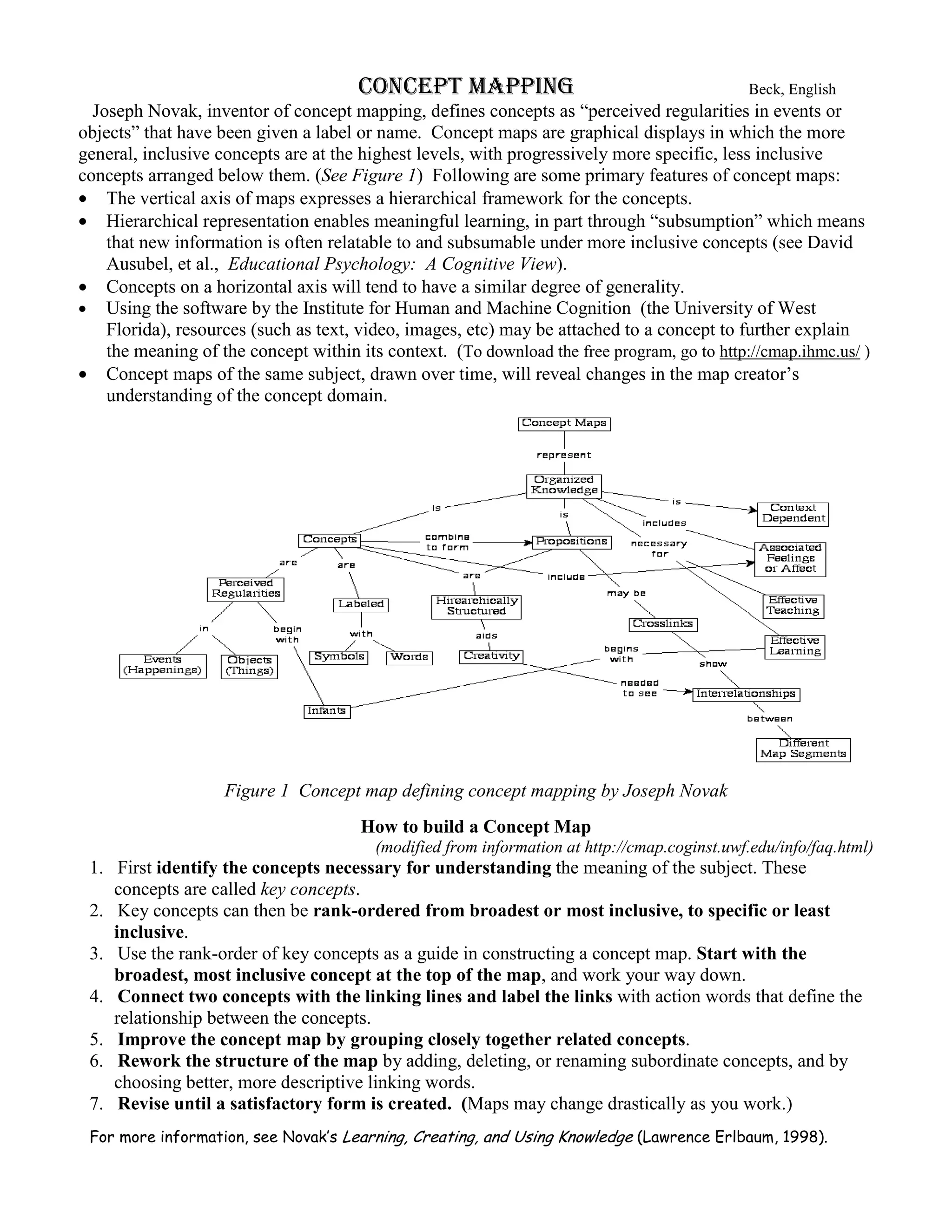
concepts arranged below them. (See Figure 1) Following are some primary features of concept maps:
• The vertical axis of maps expresses a hierarchical framework for the concepts.
• Hierarchical representation enables meaningful learning, in part through “subsumption” which means
    that new information is often relatable to and subsumable under more inclusive concepts (see David
    Ausubel, et al., Educational Psychology: A Cognitive View).
• Concepts on a horizontal axis will tend to have a similar degree of generality.
• Using the software by the Institute for Human and Machine Cognition (the University of West
    Florida), resources (such as text, video, images, etc) may be attached to a concept to further explain
    the meaning of the concept within its context. (To download the free program, go to http://cmap.ihmc.us/ )
• Concept maps of the same subject, drawn over time, will reveal changes in the map creator’s
    understanding of the concept domain.


                    Figure 1 Concept map defining concept mapping by Joseph Novak
                                       How to build a Concept Map
                                         (modified from information at http://cmap.coginst.uwf.edu/info/faq.html)
 1. First identify the concepts necessary for understanding the meaning of the subject. These
    concepts are called key concepts.
 2. Key concepts can then be rank-ordered from broadest or most inclusive, to specific or least
    inclusive.
 3. Use the rank-order of key concepts as a guide in constructing a concept map. Start with the
    broadest, most inclusive concept at the top of the map, and work your way down.
 4. Connect two concepts with the linking lines and label the links with action words that define the
    relationship between the concepts.
 5. Improve the concept map by grouping closely together related concepts.
 6. Rework the structure of the map by adding, deleting, or renaming subordinate concepts, and by
    choosing better, more descriptive linking words.
 7. Revise until a satisfactory form is created. (Maps may change drastically as you work.)
 For more information, see Novak’s Learning, Creating, and Using Knowledge (Lawrence Erlbaum, 1998).

Cmapping how to

  • 1.
    CONCEPT MAPPING Beck, English Joseph Novak, inventor of concept mapping, defines concepts as “perceived regularities in events or objects” that have been given a label or name. Concept maps are graphical displays in which the more general, inclusive concepts are at the highest levels, with progressively more specific, less inclusive concepts arranged below them. (See Figure 1) Following are some primary features of concept maps: • The vertical axis of maps expresses a hierarchical framework for the concepts. • Hierarchical representation enables meaningful learning, in part through “subsumption” which means that new information is often relatable to and subsumable under more inclusive concepts (see David Ausubel, et al., Educational Psychology: A Cognitive View). • Concepts on a horizontal axis will tend to have a similar degree of generality. • Using the software by the Institute for Human and Machine Cognition (the University of West Florida), resources (such as text, video, images, etc) may be attached to a concept to further explain the meaning of the concept within its context. (To download the free program, go to http://cmap.ihmc.us/ ) • Concept maps of the same subject, drawn over time, will reveal changes in the map creator’s understanding of the concept domain. Figure 1 Concept map defining concept mapping by Joseph Novak How to build a Concept Map (modified from information at http://cmap.coginst.uwf.edu/info/faq.html) 1. First identify the concepts necessary for understanding the meaning of the subject. These concepts are called key concepts. 2. Key concepts can then be rank-ordered from broadest or most inclusive, to specific or least inclusive. 3. Use the rank-order of key concepts as a guide in constructing a concept map. Start with the broadest, most inclusive concept at the top of the map, and work your way down. 4. Connect two concepts with the linking lines and label the links with action words that define the relationship between the concepts. 5. Improve the concept map by grouping closely together related concepts. 6. Rework the structure of the map by adding, deleting, or renaming subordinate concepts, and by choosing better, more descriptive linking words. 7. Revise until a satisfactory form is created. (Maps may change drastically as you work.) For more information, see Novak’s Learning, Creating, and Using Knowledge (Lawrence Erlbaum, 1998).