TUMOR BOARD
DR. R. RAJKUMAR D.M.
CONSULTANT MEDICAL ONCOLOGIST
VELAMMAL MEDICAL COLLEGE &
SPECIALITY HOSPITALS
CASE DISCUSSION
21 YRS OLD
C/O LOOSE STOOLS - 2 MONTHS
SEVERE ABD PAIN
BLEEDING P/R – ONE EPISODE
CASE DISCUSSION
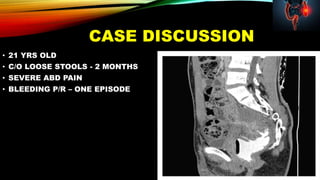
• 21 YRS OLD
• C/O LOOSE STOOLS - 2 MONTHS
• SEVERE ABD PAIN
• BLEEDING P/R – ONE EPISODE
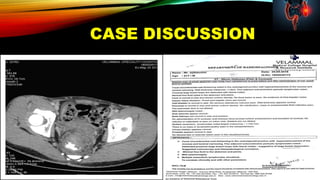
CASE DISCUSSION
CASE DISCUSSION
QUESTIONS
WHAT PERCENTAGE OF YOUR PATIENTS R EARLY
ONSET COLORECAL CANCER?
A. 10
B. 16
C. 25
D. NONE
QUESTIONS
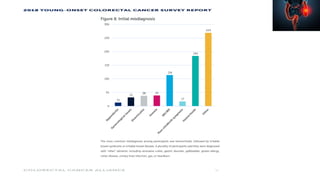
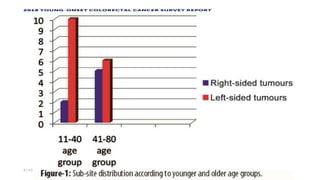
EARLY ONSET COLORECTAL CANCERS – COMMON
SITE?
A. PROXIMAL COLON
B. DISTAL COLON
C. RECTUM
D. ALL THE ABOVE
QUESTIONS
WHAT PERCENT OF YOUR PATIENTS R RAS WILD TYPE?
1. 10%
2. 20%
3. 30%
4. 40%
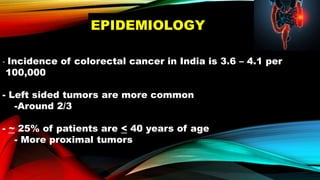
EPIDEMIOLOGY
- Incidence of colorectal cancer in India is 3.6 – 4.1 per
100,000
- Left sided tumors are more common
-Around 2/3
- ~ 25% of patients are < 40 years of age
- More proximal tumors
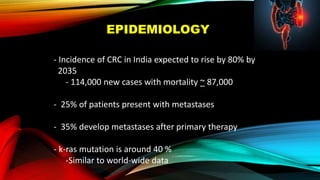
EPIDEMIOLOGY
- Incidence of CRC in India expected to rise by 80% by
2035
- 114,000 new cases with mortality ~ 87,000
- 25% of patients present with metastases
- 35% develop metastases after primary therapy
- k-ras mutation is around 40 %
-Similar to world-wide data
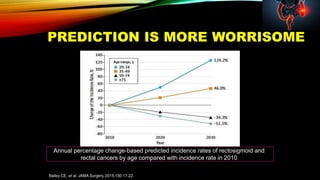
PREDICTION IS MORE WORRISOME
Annual percentage change-based predicted incidence rates of rectosigmoid and
rectal cancers by age compared with incidence rate in 2010
Bailey CE, et al. JAMA Surgery. 2015;150:17-22.
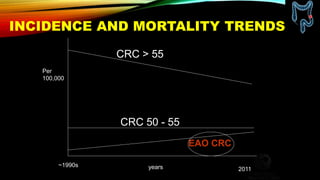
CRC > 55
INCIDENCE AND MORTALITY TRENDS
~1990s
2011
CRC 50 - 55
EAO CRC
Per
100,000
years
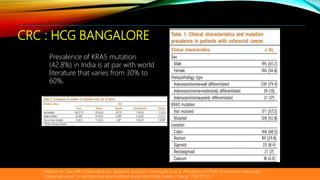
CRC : HCG BANGALORE
Veldore VH, Rao MR, Prabhudesai SA, Tejaswi R, Kakara S, Pattanayak S, et al. Prevalence of KRAS mutations in metastatic
colorectal cancer: A retrospective observational study from India. Indian J Cancer 2014;51:531-7.
Prevalence of KRAS mutation
(42.8%) in India is at par with world
literature that varies from 30% to
60%.
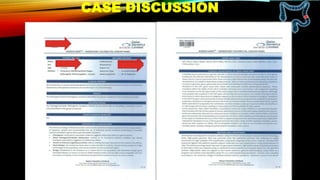
CASE DISCUSSION
CASE DISCUSSION
MADURAI 625009
TAMIL NADU INDIA
0452-2510000 8248883595
CLIENT CODE : C000051601
CLIENT'S NAME AND ADDRESS :
VELAMMAL MEDICAL COLLEGE HOSPITAL & RESEARCH INSTITUTE
VELLAMMAL VILLAGE, MADURAI-TUTICORIAN RING ROAF, ANUPPANADI,
DIAGNOSTIC REPORT
SRL LIMITED
PRIME SQUARE BUILDING,PLOT NO 1,GAIWADI INDUSTRIAL
ESTATE,S.V. ROAD,GOREGAON (W)
MUMBAI, 400062
MAHARASHTRA, INDIA
Tel : 1-800-222-000, Fax : 022 - 67801212
CIN - U74899PB1995PLC045956
Email : connect@srl.in
PATIENT ID :PATIENT NAME : AJITH KUMAR
ACCESSION NO : 0002RJ073694 AGE : 21 Years SEX : Male DATE OF BIRTH :
DRAWN : 27/10/2018 16:00 RECEIVED : 29/10/2018 07:12 REPORTED : 03/11/2018 15:39
REFERRING DOCTOR : CLIENT PATIENT ID : 1805030173
Final ResultsTest Report Status Units
KRAS MUTATION DETECTION
KRAS MUTATION AT CODON 12 (EXON 2)
NOT DETECTED
DETECTED
KRAS MUTATION AT CODON 13 (EXON 2)
NOT DETECTED
DETECTED
BLOCK IDENTIFICATION NUMBER S-3175/18-A10
Interpretation(s)
KRAS MUTATION DETECTION-
Background: Somatic mutations of KRAS gene represent the most common alterations currently known in colon rectal cancer (CRC). In addition, subsets of NSCLC patients
also harbour KRAS mutation especially who have EGFR widltype genotype. KRAS mutation is found to be reported in 30-45 % of CRC patients, has shown to be a predictive
biomarker of resistance to anti-EGFR antibody therapy [Loupakis F et al 2009 Soeda H et al 2013].
Clinical utility: KRAS codons 12 and 13 mutations predict resistance to anti-EGFR monoclonal antibodies in metastatic colorectal cancer.
Test method: Pyrosequencing.
Result interpretation:
A)Positive: The result indicates that the patient’s tumor sample shows either KRAS codon 12 or codon 13 mutation. Presence of KRAS mutation in codon 12 or 13 is useful in
identifying patients who are likely to show resistance to anti-EGFR therapy in metastatic colorectal cancer. Based on American Society of Clinical Oncology Provisional Clinical
Opinion, treatment with anti-EGFR monoclonal antibody therapy is not recommended for patients harboring codon 12 or 13 mutation in the KRASgene.
B) Negative: The result indicates that the patient’s tumor sample do not show KRAS codon 12 and 13 mutation.
Limitations:
PCR is highly sensitive technique however inherent PCR inhibitors in the specimen may result into amplification failure.
Pyrosequencing has a sensitivity of 10% mutant allele. Tissues with less than 20% of tumor cells may not be detect mutation in KRAS codon 12 and 13.
The test will detect most common mutations in codon 12 and 13 of the KRAS gene. Mutations in other locations within the KRAS gene will not be detected.
References:
Loupakis F1, Ruzzo A, Cremolini C et al (2009). KRAS codon 61, 146 and BRAF mutations predict resistance to cetuximab plus irinotecan in KRAS codon 12 and 13 wild-type
metastatic colorectal cancer. Br J Cancer. Aug 18 101(4):715-21.
Soeda H, Shimodaira H, Watanabe M, et al (2013). Clinical usefulness of KRAS, BRAF, and PIK3CA mutations as predictive markers of cetuximab efficacy in irinotecan- and
oxaliplatin-refractory Japanese patients with metastatic colorectal cancer. Int J Clin Oncol. Aug 18(4):670-7.
**End Of Report**
Please visit www.srlworld.com for related Test Information for this accession
Dr. Firoz Ahmad,PhD
Research Scientist and Senior
Manager - R&D
Dr. B. R. Das, PhD
Advisor and Mentor
R&D & Molecular Diagnostics
Dr. (COL) Prabal Deb
Director (Lab Operations) &
Chief Histopathologist
Page 1 Of 2
CASE DISCUSSION
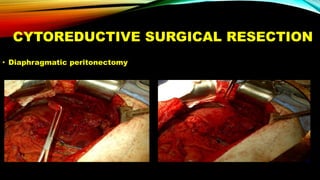
CYTOREDUCTIVE SURGICAL RESECTION
• Diaphragmatic peritonectomy
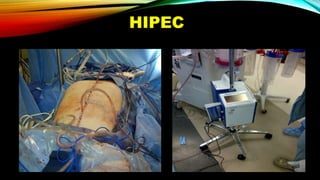
HIPEC
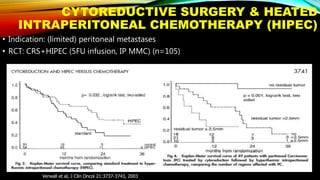
CYTOREDUCTIVE SURGERY & HEATED
INTRAPERITONEAL CHEMOTHERAPY (HIPEC)
• Indication: (limited) peritoneal metastases
• RCT: CRS+HIPEC (5FU infusion, IP MMC) (n=105)
Verwall et al, J Clin Oncol 21:3737-3743, 2003
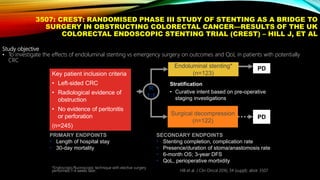
3507: CREST: RANDOMISED PHASE III STUDY OF STENTING AS A BRIDGE TO
SURGERY IN OBSTRUCTING COLORECTAL CANCER—RESULTS OF THE UK
COLORECTAL ENDOSCOPIC STENTING TRIAL (CREST) – HILL J, ET AL
Study objective
• To investigate the effects of endoluminal stenting vs emergency surgery on outcomes and QoL in patients with potentially
CRC
*Endoscopic/fluoroscopic technique with elective surgery
performed 1–4 weeks later. Hill et al. J Clin Oncol 2016; 34 (suppl): abstr 3507
R
1:1
PD
Stratification
• Curative intent based on pre-operative
staging investigations
Endoluminal stenting*
(n=123)Key patient inclusion criteria
• Left-sided CRC
• Radiological evidence of
obstruction
• No evidence of peritonitis
or perforation
(n=245)
PRIMARY ENDPOINTS
• Length of hospital stay
• 30-day mortality
SECONDARY ENDPOINTS
• Stenting completion, complication rate
• Presence/duration of stoma/anastomosis rate
• 6-month OS; 3-year DFS
• QoL, perioperative morbidity
PD
Surgical decompression
(n=122)
3507: CREST: RANDOMISED PHASE III STUDY OF STENTING AS A BRIDGE TO
SURGERY IN OBSTRUCTING COLORECTAL CANCER—RESULTS OF THE UK
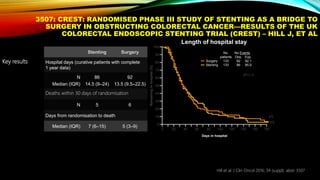
COLORECTAL ENDOSCOPIC STENTING TRIAL (CREST) – HILL J, ET AL
Key results
Hill et al. J Clin Oncol 2016; 34 (suppl): abstr 3507
Remaininginhospital(%)
0
10
20
30
40
50
60
70
80
90
100
0
Days in hospital
20 40 60 80 100 120 140 160 180
Surgery
Stenting
No.
patients
133
133
Obs.
92
86
No Events
Exp.
92.1
85.9
2P=1.0
3%
4%
Stenting Surgery
Hospital days (curative patients with complete
1 year data)
N
Median (IQR)
86
14.5 (9–24)
92
13.5 (9.5–22.5)
Deaths within 30 days of randomisation
N 5 6
Days from randomisation to death
Median (IQR) 7 (6–15) 5 (3–9)
Length of hospital stay
3507: CREST: RANDOMISED PHASE III STUDY OF STENTING AS A BRIDGE TO
SURGERY IN OBSTRUCTING COLORECTAL CANCER—RESULTS OF THE UK
COLORECTAL ENDOSCOPIC STENTING TRIAL (CREST) – HILL J, ET AL
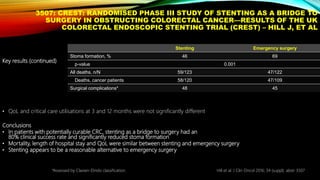
Key results (continued)
• QoL and critical care utilisations at 3 and 12 months were not significantly different
Conclusions
• In patients with potentially curable CRC, stenting as a bridge to surgery had an
80% clinical success rate and significantly reduced stoma formation
• Mortality, length of hospital stay and QoL were similar between stenting and emergency surgery
• Stenting appears to be a reasonable alternative to emergency surgery
*Assessed by Clavien-Dindo classification. Hill et al. J Clin Oncol 2016; 34 (suppl): abstr 3507
Stenting Emergency surgery
Stoma formation, % 46 69
p-value 0.001
All deaths, n/N 59/123 47/122
Deaths, cancer patients 58/120 47/109
Surgical complications* 48 45
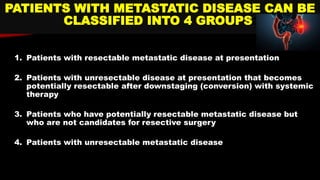
1. Patients with resectable metastatic disease at presentation
2. Patients with unresectable disease at presentation that becomes
potentially resectable after downstaging (conversion) with systemic
therapy
3. Patients who have potentially resectable metastatic disease but
who are not candidates for resective surgery
4. Patients with unresectable metastatic disease
PATIENTS WITH METASTATIC DISEASE CAN BE
CLASSIFIED INTO 4 GROUPS:
CASE DISCUSSION
WHAT IS YOUR PREFERRED CHOICE OF TREATMENT?
1. CHEMOTHERAPY
2. CHEMO + Mab
3. IMMUNOTHERAPY
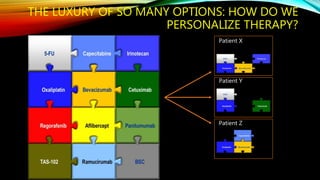
THE LUXURY OF SO MANY OPTIONS: HOW DO WE
PERSONALIZE THERAPY?
Patient X
Patient Y
Patient Z
CASE DISCUSSION
CASE DISCUSSION
CASE DISCUSSION
CASE DISCUSSION
CASE DISCUSSION
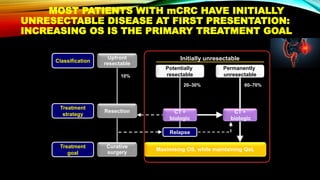
Resection
Maximising OS, while maintaining QoL
Treatment
strategy
Treatment
goal
Curative
surgery
10%
Classification
Upfront
resectable
MOST PATIENTS WITH mCRC HAVE INITIALLY
UNRESECTABLE DISEASE AT FIRST PRESENTATION:
INCREASING OS IS THE PRIMARY TREATMENT GOAL
20–30% 60–70%
Potentially
resectable
Permanently
unresectable
CT +
biologic
CT +
biologic
Relapse
Initially unresectable
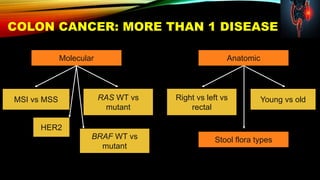
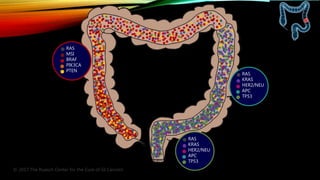
COLON CANCER: MORE THAN 1 DISEASE
MSI vs MSS RAS WT vs
mutant
Right vs left vs
rectal
Young vs old
Stool flora typesBRAF WT vs
mutant
HER2
Molecular Anatomic
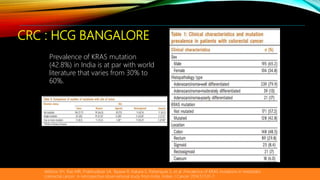
CRC : HCG BANGALORE
Veldore VH, Rao MR, Prabhudesai SA, Tejaswi R, Kakara S, Pattanayak S, et al. Prevalence of KRAS mutations in metastatic
colorectal cancer: A retrospective observational study from India. Indian J Cancer 2014;51:531-7.
Prevalence of KRAS mutation
(42.8%) in India is at par with world
literature that varies from 30% to
60%.
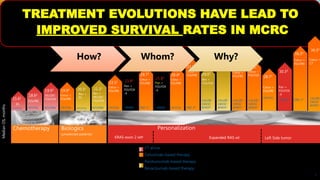
19.92
Cetux +
FOLFIRI
20.31
Bev +
IFL
21.33
Bev +
XELOX/
FOLFOX
CRYSTAL NO16966AVF2107g
23.52
Cetux +
FOLFIRI
23.84
Pan +
FOLFOX
-4
28.75
Cetux +
FOLFIRI
FIRE-3*CRYSTAL PRIME
28.46
Cetux +
FOLFIRI
33.15
Cetux +
FOLFIRI
25.84
Pan +
FOLFOX
-4
CRYSTAL
32.57
Cetux +
FOLFOX
CALGB/
SWOG
80405†FIRE-3*
29.07
Bev +
FOLFOX
CALGB/
SWOG
80405†
32.07
Cetux +
FOLFIRI
CALGB/
SWOG
80405†
35.27
Bev +
FOLFIRI
CALGB/
SWOG
80405†PRIME
Biologics
(unselected patients)
MedianOS,months
30
20
9
Personalization
KRAS exon 2 wt‡ Expanded RAS wt
CT alone
Cetuximab-based therapy
Panitumumab-based therapy
Bevacizumab-based therapy
19.93
XELOX/
FOLFOX15.61
IFL
18.62
FOLFIRI
NO16966AVF2107g CRYSTAL
Chemotherapy
.
TREATMENT EVOLUTIONS HAVE LEAD TO
IMPROVED SURVIVAL RATES IN MCRC
Left Side tumor
40
28.79
Cetux +
FOLFIRI
30.39
Pan +
FOLFOX
-4
38.39
Cetux +
FOLFIRI
FIRE-3*
CRYSTAL
PRIME
39.39
Cetux +
CT
CALGB/
SWOG
80405†
How? Whom? Why?
RAS
MSI
BRAF
PIK3CA
PTEN
RAS
KRAS
HER2/NEU
APC
TP53
RAS
KRAS
HER2/NEU
APC
TP53
© 2017 The Ruesch Center for the Cure of GI Cancers
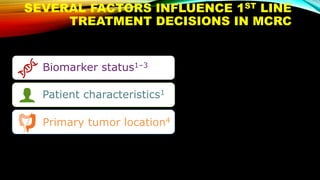
SEVERAL FACTORS INFLUENCE 1ST LINE
TREATMENT DECISIONS IN MCRC
1. et al. Lancet 2016;17:1426–1434; 4. Arnold D, et al. Ann Oncol 2017; doi: 10.1093.
Biomarker status1–3
Patient characteristics1
Primary tumor location4
SEVERAL FACTORS INFLUENCE 1ST LINE
TREATMENT DECISIONS IN MCRC
1. Van Cutsem E, et al. Ann Oncol 2016;27:1386–1422; 2. Lenz H-J, et al. Ann Oncol 2014;25 (suppl 4; Abstract No. 501O); 3. Stintzing S, et al.
Lancet 2016;17:1426–1434; 4. Arnold D, et al. Ann Oncol 2017; doi: 10.1093; 5. Heinemann V, et al. Lancet Oncol 2014;15:1065–1075; 6.
Venook A, et al. JAMA 2017;317:2392–2401.
*FIRE-3 did not meet its primary endpoint of significantly improving overall response rate (ORR) based on investigators’ read in
patients with KRAS (exon 2) wt mCRC;5 †CALGB/SWOG 80405 study did not meet its primary endpoint of significantly
improving overall survival in the cetuximab + CT arm vs bevacizumab + CT arm in patients with KRAS (exon 2) wt mCRC.6
CT, chemotherapy
• Including BRAF, MSI and RAS status1
• RAS status predicts outcomes with
anti-EGFR therapies1
• In RAS wt mCRC, cetuximab + CT is
associated with greater
improvements in ORR, OS and PFS
over bevacizumab + CT2,3*† [CALGB
SWOG/80405, FIRE-3]
Biomarker status1–3
Patient characteristics1
Primary tumor location4
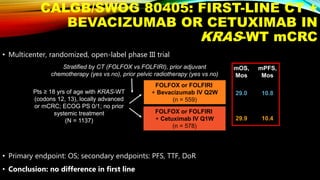
CALGB/SWOG 80405: FIRST-LINE CT +
BEVACIZUMAB OR CETUXIMAB IN
KRAS-WT mCRC
• Multicenter, randomized, open-label phase III trial
• Primary endpoint: OS; secondary endpoints: PFS, TTF, DoR
• Conclusion: no difference in first line
Pts ≥ 18 yrs of age with KRAS-WT
(codons 12, 13), locally advanced
or mCRC; ECOG PS 0/1; no prior
systemic treatment
(N = 1137)
FOLFOX or FOLFIRI
+ Bevacizumab IV Q2W
(n = 559)
FOLFOX or FOLFIRI
+ Cetuximab IV Q1W
(n = 578)
29.0
29.9
10.8
10.4
mOS,
Mos
mPFS,
Mos
Stratified by CT (FOLFOX vs FOLFIRI), prior adjuvant
chemotherapy (yes vs no), prior pelvic radiotherapy (yes vs no)
100
80
60
40
20
0
0 12 24 36 48 60 72 84 96 108
Mos From Study Entry
EventFree(%)
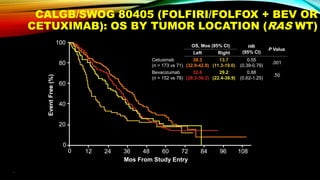
CALGB/SWOG 80405 (FOLFIRI/FOLFOX + BEV OR
CETUXIMAB): OS BY TUMOR LOCATION (RAS WT)
Bevacizumab
(n = 152 vs 78)
32.6
(28.3-36.2)
29.2
(22.4-36.9)
0.88
(0.62-1.25)
.50
OS, Mos (95% CI) HR
(95% CI)
P Value
Left Right
Cetuximab
(n = 173 vs 71)
39.3
(32.9-42.9)
13.7
(11.3-19.0)
0.55
(0.39-0.79)
.001
.
2014.
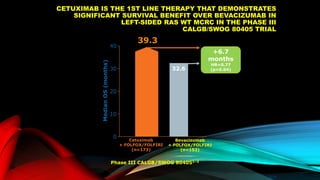
CETUXIMAB IS THE 1ST LINE THERAPY THAT DEMONSTRATES
SIGNIFICANT SURVIVAL BENEFIT OVER BEVACIZUMAB IN
LEFT-SIDED RAS WT MCRC IN THE PHASE III
CALGB/SWOG 80405 TRIAL
40
30
20
0
MedianOS(months)
Phase III CALGB/SWOG 804051–3
10
39.3
32.6
+6.7
months
HR=0.77
(p=0.04)
Bevacizumab
+ FOLFOX/FOLFIRI
(n=152)
Cetuximab
+ FOLFOX/FOLFIRI
(n=173)
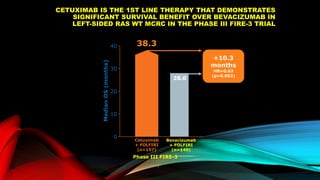
CETUXIMAB IS THE 1ST LINE THERAPY THAT DEMONSTRATES
SIGNIFICANT SURVIVAL BENEFIT OVER BEVACIZUMAB IN
LEFT-SIDED RAS WT MCRC IN THE PHASE III FIRE-3 TRIAL
38.3
Bevacizumab
+ FOLFIRI
(n=149)
Cetuximab
+ FOLFIRI
(n=157)
40
30
20
0
MedianOS(months)
Phase III FIRE-3
)
28.0
10
+10.3
months
HR=0.63
(p=0.002)
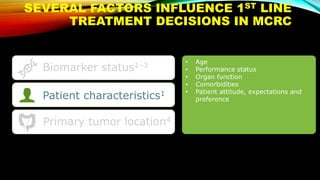
SEVERAL FACTORS INFLUENCE 1ST LINE
TREATMENT DECISIONS IN MCRC
1. Van Cutsem E, et al. Ann Oncol 2016;27:1386–1422; 2. Lenz H-J, et al. Ann Oncol 2014;25 (suppl 4; Abstract No. 501O);
3. Stintzing S, et al. Lancet 2016;17:1426–1434; 4. Arnold D, et al. Ann Oncol 2017.
Biomarker status1–3
Primary tumor location4
• Age
• Performance status
• Organ function
• Comorbidities
• Patient attitude, expectations and
preferencePatient characteristics1
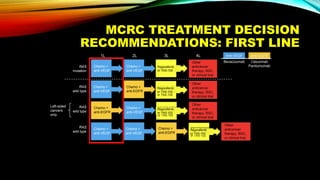
MCRC TREATMENT DECISION
RECOMMENDATIONS: FIRST LINE
2L1L 3L 4L
RAS
mutation
RAS
wild type
RAS
wild type
RAS
wild type
Chemo +
anti-VEGF
Chemo +
anti-VEGF
Chemo +
anti-VEGF
Chemo +
anti-VEGF
Chemo +
anti-VEGF
Chemo +
anti-EGFR
Chemo +
anti-EGFR
Chemo +
anti-VEGF
Chemo +
anti-EGFR
Other
anticancer
therapy, BSC,
or clinical trial
Other
anticancer
therapy, BSC,
or clinical trial
Other
anticancer
therapy, BSC,
or clinical trial
Other
anticancer
therapy, BSC,
or clinical trial
REGORAFENI
B
or TAS-102
REGORAFENI
B
or TAS-102
REGORAFENI
B
or TAS-102
Left-sided
cancers
only
Anti-VEGF Anti-EGFR
Bevacizumab Cetuximab
PanitumumabRegorafenib
or TAS-102
Regorafenib
or TAS-102
Regorafenib
or TAS-102
Regorafenib
or TAS-102
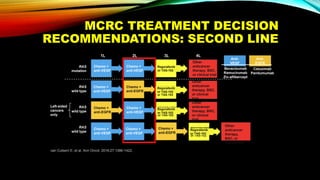
MCRC TREATMENT DECISION
RECOMMENDATIONS: SECOND LINE
2L1L 3L 4L
RAS
mutation
RAS
wild type
RAS
wild type
RAS
wild type
Chemo +
anti-VEGF
Chemo +
anti-VEGF
Chemo +
anti-VEGF
Chemo +
anti-VEGF
Chemo +
anti-VEGF
Chemo +
anti-EGFR
Chemo +
anti-EGFR
Chemo +
anti-VEGF
Chemo +
anti-EGFR
Other
anticancer
therapy, BSC,
or clinical trial
Other
anticancer
therapy, BSC,
or clinical
trial
Other
anticancer
therapy, BSC,
or clinical
trial
Other
anticancer
therapy,
BSC, or
clinical trial
REGORAFENI
B
or TAS-102
REGORAFENI
B
or TAS-102
REGORAFENI
B
or TAS-102
Left-sided
cancers
only
Anti-
VEGF
Anti-
EGFR
Bevacizumab
Ramucirumab
Ziv-aflibercept
Cetuximab
Panitumumab
van Cutsem E, et al. Ann Oncol. 2016;27:1386-1422.
Regorafenib
or TAS-102
Regorafenib
or TAS-102
Regorafenib
or TAS-102
Regorafenib
or TAS-102
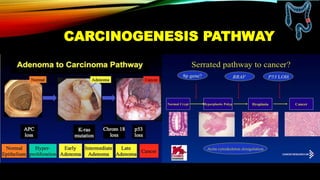
CARCINOGENESIS PATHWAY
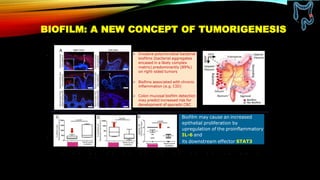
BIOFILM: A NEW CONCEPT OF TUMORIGENESIS
Biofilm may cause an increased
epithelial proliferation by
upregulation of the proinflammatory
IL-6 and
its downstream effector STAT3
 Invasive polymicrobial bacterial
biofilms (bacterial aggregates
encased in a likely complex
matrix) predominantly (89%)
on right-sided tumors
 Biofims associated with chronic
inflammation (e.g. CID)
 Colon mucosal biofilm detection
may predict increased risk for
development of sporadic CRC
E-cadherin P-STAT3IL-6
Tumor board
Tumor board
Tumor board

Tumor board

  • 1.
    TUMOR BOARD DR. R.RAJKUMAR D.M. CONSULTANT MEDICAL ONCOLOGIST VELAMMAL MEDICAL COLLEGE & SPECIALITY HOSPITALS
  • 2.
    CASE DISCUSSION 21 YRSOLD C/O LOOSE STOOLS - 2 MONTHS SEVERE ABD PAIN BLEEDING P/R – ONE EPISODE
  • 3.
    CASE DISCUSSION • 21YRS OLD • C/O LOOSE STOOLS - 2 MONTHS • SEVERE ABD PAIN • BLEEDING P/R – ONE EPISODE
  • 4.
  • 5.
  • 6.
    QUESTIONS WHAT PERCENTAGE OFYOUR PATIENTS R EARLY ONSET COLORECAL CANCER? A. 10 B. 16 C. 25 D. NONE
  • 7.
    QUESTIONS EARLY ONSET COLORECTALCANCERS – COMMON SITE? A. PROXIMAL COLON B. DISTAL COLON C. RECTUM D. ALL THE ABOVE
  • 8.
    QUESTIONS WHAT PERCENT OFYOUR PATIENTS R RAS WILD TYPE? 1. 10% 2. 20% 3. 30% 4. 40%
  • 9.
    EPIDEMIOLOGY - Incidence ofcolorectal cancer in India is 3.6 – 4.1 per 100,000 - Left sided tumors are more common -Around 2/3 - ~ 25% of patients are < 40 years of age - More proximal tumors
  • 10.
    EPIDEMIOLOGY - Incidence ofCRC in India expected to rise by 80% by 2035 - 114,000 new cases with mortality ~ 87,000 - 25% of patients present with metastases - 35% develop metastases after primary therapy - k-ras mutation is around 40 % -Similar to world-wide data
  • 11.
    PREDICTION IS MOREWORRISOME Annual percentage change-based predicted incidence rates of rectosigmoid and rectal cancers by age compared with incidence rate in 2010 Bailey CE, et al. JAMA Surgery. 2015;150:17-22.
  • 12.
    CRC > 55 INCIDENCEAND MORTALITY TRENDS ~1990s 2011 CRC 50 - 55 EAO CRC Per 100,000 years
  • 21.
    CRC : HCGBANGALORE Veldore VH, Rao MR, Prabhudesai SA, Tejaswi R, Kakara S, Pattanayak S, et al. Prevalence of KRAS mutations in metastatic colorectal cancer: A retrospective observational study from India. Indian J Cancer 2014;51:531-7. Prevalence of KRAS mutation (42.8%) in India is at par with world literature that varies from 30% to 60%.
  • 22.
  • 23.
  • 24.
    MADURAI 625009 TAMIL NADUINDIA 0452-2510000 8248883595 CLIENT CODE : C000051601 CLIENT'S NAME AND ADDRESS : VELAMMAL MEDICAL COLLEGE HOSPITAL & RESEARCH INSTITUTE VELLAMMAL VILLAGE, MADURAI-TUTICORIAN RING ROAF, ANUPPANADI, DIAGNOSTIC REPORT SRL LIMITED PRIME SQUARE BUILDING,PLOT NO 1,GAIWADI INDUSTRIAL ESTATE,S.V. ROAD,GOREGAON (W) MUMBAI, 400062 MAHARASHTRA, INDIA Tel : 1-800-222-000, Fax : 022 - 67801212 CIN - U74899PB1995PLC045956 Email : connect@srl.in PATIENT ID :PATIENT NAME : AJITH KUMAR ACCESSION NO : 0002RJ073694 AGE : 21 Years SEX : Male DATE OF BIRTH : DRAWN : 27/10/2018 16:00 RECEIVED : 29/10/2018 07:12 REPORTED : 03/11/2018 15:39 REFERRING DOCTOR : CLIENT PATIENT ID : 1805030173 Final ResultsTest Report Status Units KRAS MUTATION DETECTION KRAS MUTATION AT CODON 12 (EXON 2) NOT DETECTED DETECTED KRAS MUTATION AT CODON 13 (EXON 2) NOT DETECTED DETECTED BLOCK IDENTIFICATION NUMBER S-3175/18-A10 Interpretation(s) KRAS MUTATION DETECTION- Background: Somatic mutations of KRAS gene represent the most common alterations currently known in colon rectal cancer (CRC). In addition, subsets of NSCLC patients also harbour KRAS mutation especially who have EGFR widltype genotype. KRAS mutation is found to be reported in 30-45 % of CRC patients, has shown to be a predictive biomarker of resistance to anti-EGFR antibody therapy [Loupakis F et al 2009 Soeda H et al 2013]. Clinical utility: KRAS codons 12 and 13 mutations predict resistance to anti-EGFR monoclonal antibodies in metastatic colorectal cancer. Test method: Pyrosequencing. Result interpretation: A)Positive: The result indicates that the patient’s tumor sample shows either KRAS codon 12 or codon 13 mutation. Presence of KRAS mutation in codon 12 or 13 is useful in identifying patients who are likely to show resistance to anti-EGFR therapy in metastatic colorectal cancer. Based on American Society of Clinical Oncology Provisional Clinical Opinion, treatment with anti-EGFR monoclonal antibody therapy is not recommended for patients harboring codon 12 or 13 mutation in the KRASgene. B) Negative: The result indicates that the patient’s tumor sample do not show KRAS codon 12 and 13 mutation. Limitations: PCR is highly sensitive technique however inherent PCR inhibitors in the specimen may result into amplification failure. Pyrosequencing has a sensitivity of 10% mutant allele. Tissues with less than 20% of tumor cells may not be detect mutation in KRAS codon 12 and 13. The test will detect most common mutations in codon 12 and 13 of the KRAS gene. Mutations in other locations within the KRAS gene will not be detected. References: Loupakis F1, Ruzzo A, Cremolini C et al (2009). KRAS codon 61, 146 and BRAF mutations predict resistance to cetuximab plus irinotecan in KRAS codon 12 and 13 wild-type metastatic colorectal cancer. Br J Cancer. Aug 18 101(4):715-21. Soeda H, Shimodaira H, Watanabe M, et al (2013). Clinical usefulness of KRAS, BRAF, and PIK3CA mutations as predictive markers of cetuximab efficacy in irinotecan- and oxaliplatin-refractory Japanese patients with metastatic colorectal cancer. Int J Clin Oncol. Aug 18(4):670-7. **End Of Report** Please visit www.srlworld.com for related Test Information for this accession Dr. Firoz Ahmad,PhD Research Scientist and Senior Manager - R&D Dr. B. R. Das, PhD Advisor and Mentor R&D & Molecular Diagnostics Dr. (COL) Prabal Deb Director (Lab Operations) & Chief Histopathologist Page 1 Of 2
  • 25.
  • 28.
    CYTOREDUCTIVE SURGICAL RESECTION •Diaphragmatic peritonectomy
  • 29.
  • 30.
    CYTOREDUCTIVE SURGERY &HEATED INTRAPERITONEAL CHEMOTHERAPY (HIPEC) • Indication: (limited) peritoneal metastases • RCT: CRS+HIPEC (5FU infusion, IP MMC) (n=105) Verwall et al, J Clin Oncol 21:3737-3743, 2003
  • 31.
    3507: CREST: RANDOMISEDPHASE III STUDY OF STENTING AS A BRIDGE TO SURGERY IN OBSTRUCTING COLORECTAL CANCER—RESULTS OF THE UK COLORECTAL ENDOSCOPIC STENTING TRIAL (CREST) – HILL J, ET AL Study objective • To investigate the effects of endoluminal stenting vs emergency surgery on outcomes and QoL in patients with potentially CRC *Endoscopic/fluoroscopic technique with elective surgery performed 1–4 weeks later. Hill et al. J Clin Oncol 2016; 34 (suppl): abstr 3507 R 1:1 PD Stratification • Curative intent based on pre-operative staging investigations Endoluminal stenting* (n=123)Key patient inclusion criteria • Left-sided CRC • Radiological evidence of obstruction • No evidence of peritonitis or perforation (n=245) PRIMARY ENDPOINTS • Length of hospital stay • 30-day mortality SECONDARY ENDPOINTS • Stenting completion, complication rate • Presence/duration of stoma/anastomosis rate • 6-month OS; 3-year DFS • QoL, perioperative morbidity PD Surgical decompression (n=122)
  • 32.
    3507: CREST: RANDOMISEDPHASE III STUDY OF STENTING AS A BRIDGE TO SURGERY IN OBSTRUCTING COLORECTAL CANCER—RESULTS OF THE UK COLORECTAL ENDOSCOPIC STENTING TRIAL (CREST) – HILL J, ET AL Key results Hill et al. J Clin Oncol 2016; 34 (suppl): abstr 3507 Remaininginhospital(%) 0 10 20 30 40 50 60 70 80 90 100 0 Days in hospital 20 40 60 80 100 120 140 160 180 Surgery Stenting No. patients 133 133 Obs. 92 86 No Events Exp. 92.1 85.9 2P=1.0 3% 4% Stenting Surgery Hospital days (curative patients with complete 1 year data) N Median (IQR) 86 14.5 (9–24) 92 13.5 (9.5–22.5) Deaths within 30 days of randomisation N 5 6 Days from randomisation to death Median (IQR) 7 (6–15) 5 (3–9) Length of hospital stay
  • 33.
    3507: CREST: RANDOMISEDPHASE III STUDY OF STENTING AS A BRIDGE TO SURGERY IN OBSTRUCTING COLORECTAL CANCER—RESULTS OF THE UK COLORECTAL ENDOSCOPIC STENTING TRIAL (CREST) – HILL J, ET AL Key results (continued) • QoL and critical care utilisations at 3 and 12 months were not significantly different Conclusions • In patients with potentially curable CRC, stenting as a bridge to surgery had an 80% clinical success rate and significantly reduced stoma formation • Mortality, length of hospital stay and QoL were similar between stenting and emergency surgery • Stenting appears to be a reasonable alternative to emergency surgery *Assessed by Clavien-Dindo classification. Hill et al. J Clin Oncol 2016; 34 (suppl): abstr 3507 Stenting Emergency surgery Stoma formation, % 46 69 p-value 0.001 All deaths, n/N 59/123 47/122 Deaths, cancer patients 58/120 47/109 Surgical complications* 48 45
  • 34.
    1. Patients withresectable metastatic disease at presentation 2. Patients with unresectable disease at presentation that becomes potentially resectable after downstaging (conversion) with systemic therapy 3. Patients who have potentially resectable metastatic disease but who are not candidates for resective surgery 4. Patients with unresectable metastatic disease PATIENTS WITH METASTATIC DISEASE CAN BE CLASSIFIED INTO 4 GROUPS:
  • 35.
    CASE DISCUSSION WHAT ISYOUR PREFERRED CHOICE OF TREATMENT? 1. CHEMOTHERAPY 2. CHEMO + Mab 3. IMMUNOTHERAPY
  • 36.
    THE LUXURY OFSO MANY OPTIONS: HOW DO WE PERSONALIZE THERAPY? Patient X Patient Y Patient Z
  • 37.
  • 38.
  • 39.
  • 40.
  • 41.
  • 42.
    Resection Maximising OS, whilemaintaining QoL Treatment strategy Treatment goal Curative surgery 10% Classification Upfront resectable MOST PATIENTS WITH mCRC HAVE INITIALLY UNRESECTABLE DISEASE AT FIRST PRESENTATION: INCREASING OS IS THE PRIMARY TREATMENT GOAL 20–30% 60–70% Potentially resectable Permanently unresectable CT + biologic CT + biologic Relapse Initially unresectable
  • 43.
    COLON CANCER: MORETHAN 1 DISEASE MSI vs MSS RAS WT vs mutant Right vs left vs rectal Young vs old Stool flora typesBRAF WT vs mutant HER2 Molecular Anatomic
  • 44.
    CRC : HCGBANGALORE Veldore VH, Rao MR, Prabhudesai SA, Tejaswi R, Kakara S, Pattanayak S, et al. Prevalence of KRAS mutations in metastatic colorectal cancer: A retrospective observational study from India. Indian J Cancer 2014;51:531-7. Prevalence of KRAS mutation (42.8%) in India is at par with world literature that varies from 30% to 60%.
  • 45.
    19.92 Cetux + FOLFIRI 20.31 Bev + IFL 21.33 Bev+ XELOX/ FOLFOX CRYSTAL NO16966AVF2107g 23.52 Cetux + FOLFIRI 23.84 Pan + FOLFOX -4 28.75 Cetux + FOLFIRI FIRE-3*CRYSTAL PRIME 28.46 Cetux + FOLFIRI 33.15 Cetux + FOLFIRI 25.84 Pan + FOLFOX -4 CRYSTAL 32.57 Cetux + FOLFOX CALGB/ SWOG 80405†FIRE-3* 29.07 Bev + FOLFOX CALGB/ SWOG 80405† 32.07 Cetux + FOLFIRI CALGB/ SWOG 80405† 35.27 Bev + FOLFIRI CALGB/ SWOG 80405†PRIME Biologics (unselected patients) MedianOS,months 30 20 9 Personalization KRAS exon 2 wt‡ Expanded RAS wt CT alone Cetuximab-based therapy Panitumumab-based therapy Bevacizumab-based therapy 19.93 XELOX/ FOLFOX15.61 IFL 18.62 FOLFIRI NO16966AVF2107g CRYSTAL Chemotherapy . TREATMENT EVOLUTIONS HAVE LEAD TO IMPROVED SURVIVAL RATES IN MCRC Left Side tumor 40 28.79 Cetux + FOLFIRI 30.39 Pan + FOLFOX -4 38.39 Cetux + FOLFIRI FIRE-3* CRYSTAL PRIME 39.39 Cetux + CT CALGB/ SWOG 80405† How? Whom? Why?
  • 46.
  • 47.
    SEVERAL FACTORS INFLUENCE1ST LINE TREATMENT DECISIONS IN MCRC 1. et al. Lancet 2016;17:1426–1434; 4. Arnold D, et al. Ann Oncol 2017; doi: 10.1093. Biomarker status1–3 Patient characteristics1 Primary tumor location4
  • 48.
    SEVERAL FACTORS INFLUENCE1ST LINE TREATMENT DECISIONS IN MCRC 1. Van Cutsem E, et al. Ann Oncol 2016;27:1386–1422; 2. Lenz H-J, et al. Ann Oncol 2014;25 (suppl 4; Abstract No. 501O); 3. Stintzing S, et al. Lancet 2016;17:1426–1434; 4. Arnold D, et al. Ann Oncol 2017; doi: 10.1093; 5. Heinemann V, et al. Lancet Oncol 2014;15:1065–1075; 6. Venook A, et al. JAMA 2017;317:2392–2401. *FIRE-3 did not meet its primary endpoint of significantly improving overall response rate (ORR) based on investigators’ read in patients with KRAS (exon 2) wt mCRC;5 †CALGB/SWOG 80405 study did not meet its primary endpoint of significantly improving overall survival in the cetuximab + CT arm vs bevacizumab + CT arm in patients with KRAS (exon 2) wt mCRC.6 CT, chemotherapy • Including BRAF, MSI and RAS status1 • RAS status predicts outcomes with anti-EGFR therapies1 • In RAS wt mCRC, cetuximab + CT is associated with greater improvements in ORR, OS and PFS over bevacizumab + CT2,3*† [CALGB SWOG/80405, FIRE-3] Biomarker status1–3 Patient characteristics1 Primary tumor location4
  • 49.
    CALGB/SWOG 80405: FIRST-LINECT + BEVACIZUMAB OR CETUXIMAB IN KRAS-WT mCRC • Multicenter, randomized, open-label phase III trial • Primary endpoint: OS; secondary endpoints: PFS, TTF, DoR • Conclusion: no difference in first line Pts ≥ 18 yrs of age with KRAS-WT (codons 12, 13), locally advanced or mCRC; ECOG PS 0/1; no prior systemic treatment (N = 1137) FOLFOX or FOLFIRI + Bevacizumab IV Q2W (n = 559) FOLFOX or FOLFIRI + Cetuximab IV Q1W (n = 578) 29.0 29.9 10.8 10.4 mOS, Mos mPFS, Mos Stratified by CT (FOLFOX vs FOLFIRI), prior adjuvant chemotherapy (yes vs no), prior pelvic radiotherapy (yes vs no)
  • 50.
    100 80 60 40 20 0 0 12 2436 48 60 72 84 96 108 Mos From Study Entry EventFree(%) CALGB/SWOG 80405 (FOLFIRI/FOLFOX + BEV OR CETUXIMAB): OS BY TUMOR LOCATION (RAS WT) Bevacizumab (n = 152 vs 78) 32.6 (28.3-36.2) 29.2 (22.4-36.9) 0.88 (0.62-1.25) .50 OS, Mos (95% CI) HR (95% CI) P Value Left Right Cetuximab (n = 173 vs 71) 39.3 (32.9-42.9) 13.7 (11.3-19.0) 0.55 (0.39-0.79) .001 .
  • 51.
    2014. CETUXIMAB IS THE1ST LINE THERAPY THAT DEMONSTRATES SIGNIFICANT SURVIVAL BENEFIT OVER BEVACIZUMAB IN LEFT-SIDED RAS WT MCRC IN THE PHASE III CALGB/SWOG 80405 TRIAL 40 30 20 0 MedianOS(months) Phase III CALGB/SWOG 804051–3 10 39.3 32.6 +6.7 months HR=0.77 (p=0.04) Bevacizumab + FOLFOX/FOLFIRI (n=152) Cetuximab + FOLFOX/FOLFIRI (n=173)
  • 52.
    CETUXIMAB IS THE1ST LINE THERAPY THAT DEMONSTRATES SIGNIFICANT SURVIVAL BENEFIT OVER BEVACIZUMAB IN LEFT-SIDED RAS WT MCRC IN THE PHASE III FIRE-3 TRIAL 38.3 Bevacizumab + FOLFIRI (n=149) Cetuximab + FOLFIRI (n=157) 40 30 20 0 MedianOS(months) Phase III FIRE-3 ) 28.0 10 +10.3 months HR=0.63 (p=0.002)
  • 53.
    SEVERAL FACTORS INFLUENCE1ST LINE TREATMENT DECISIONS IN MCRC 1. Van Cutsem E, et al. Ann Oncol 2016;27:1386–1422; 2. Lenz H-J, et al. Ann Oncol 2014;25 (suppl 4; Abstract No. 501O); 3. Stintzing S, et al. Lancet 2016;17:1426–1434; 4. Arnold D, et al. Ann Oncol 2017. Biomarker status1–3 Primary tumor location4 • Age • Performance status • Organ function • Comorbidities • Patient attitude, expectations and preferencePatient characteristics1
  • 54.
    MCRC TREATMENT DECISION RECOMMENDATIONS:FIRST LINE 2L1L 3L 4L RAS mutation RAS wild type RAS wild type RAS wild type Chemo + anti-VEGF Chemo + anti-VEGF Chemo + anti-VEGF Chemo + anti-VEGF Chemo + anti-VEGF Chemo + anti-EGFR Chemo + anti-EGFR Chemo + anti-VEGF Chemo + anti-EGFR Other anticancer therapy, BSC, or clinical trial Other anticancer therapy, BSC, or clinical trial Other anticancer therapy, BSC, or clinical trial Other anticancer therapy, BSC, or clinical trial REGORAFENI B or TAS-102 REGORAFENI B or TAS-102 REGORAFENI B or TAS-102 Left-sided cancers only Anti-VEGF Anti-EGFR Bevacizumab Cetuximab PanitumumabRegorafenib or TAS-102 Regorafenib or TAS-102 Regorafenib or TAS-102 Regorafenib or TAS-102
  • 55.
    MCRC TREATMENT DECISION RECOMMENDATIONS:SECOND LINE 2L1L 3L 4L RAS mutation RAS wild type RAS wild type RAS wild type Chemo + anti-VEGF Chemo + anti-VEGF Chemo + anti-VEGF Chemo + anti-VEGF Chemo + anti-VEGF Chemo + anti-EGFR Chemo + anti-EGFR Chemo + anti-VEGF Chemo + anti-EGFR Other anticancer therapy, BSC, or clinical trial Other anticancer therapy, BSC, or clinical trial Other anticancer therapy, BSC, or clinical trial Other anticancer therapy, BSC, or clinical trial REGORAFENI B or TAS-102 REGORAFENI B or TAS-102 REGORAFENI B or TAS-102 Left-sided cancers only Anti- VEGF Anti- EGFR Bevacizumab Ramucirumab Ziv-aflibercept Cetuximab Panitumumab van Cutsem E, et al. Ann Oncol. 2016;27:1386-1422. Regorafenib or TAS-102 Regorafenib or TAS-102 Regorafenib or TAS-102 Regorafenib or TAS-102
  • 56.
  • 57.
    BIOFILM: A NEWCONCEPT OF TUMORIGENESIS Biofilm may cause an increased epithelial proliferation by upregulation of the proinflammatory IL-6 and its downstream effector STAT3  Invasive polymicrobial bacterial biofilms (bacterial aggregates encased in a likely complex matrix) predominantly (89%) on right-sided tumors  Biofims associated with chronic inflammation (e.g. CID)  Colon mucosal biofilm detection may predict increased risk for development of sporadic CRC E-cadherin P-STAT3IL-6