Carcinoma rectum Dr. vinayak lokare JMMC & RI
 
Etiology  average lifetime risk  -  6% risk increases two- to fourfold  history of or a first-degree relative with colorectal cancer. Inflammatory bowel disease (IBD) Genetics – familial adenomatous polyposis (FAP)  -  APC  gene on chromosome 5q21 hereditary nonpolyposis colorectal cancer (HNPCC)
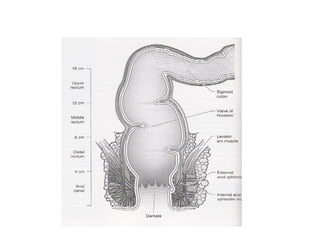
Anatomy  divided into three portions  lower rectum -3 to 6 cm from the anal verge midrectum -  5 to 6 to 8 to 10 cm upper rectum -  8 to 10 to 12 to 15 cm determination of the location of the boundary between rectum and sigmoid colon is important in defining adjuvant therapy
anatomy upper extent of the rectum can be identified where the tenia spread to form a longitudinal coat of muscle The distance from the anal sphincter musculature is clinically of more importance than the distance from the anal verge, as it has implications for the ability to perform sphincter-sparing surgery
 
Lymphatic drainage  Upper rectum - follows the course of the superior hemorrhoidal artery toward the inferior mesenteric artery Middle rectum - follow the middle hemorrhoidal artery lesions occur below the dentate line, the lymphatic drainage is via the inguinal nodes and external iliac chain
Types  Macroscopic Proliferative  Ulcerative Tubular  Microscopic  Adenocarcinoma  Colloid carcinoma Squamous cell carcinoma
Clinical features Bleeding per rectum – mucous +/- Alteration of bowel habits – increasing constipation, early morning diarrhoea Sense of incomplete defeacation Intestinal obstruction Pain Loss of appetite ,weight loss , joundice , ascitis
Investigations  USG abdomen Proctosigmoidoscopy / biopsy  Colonoscopy  contrast CT of the pelvis and the abdomen Endoscopic USG
Chest X-ray Liver function tests Renal function tests Baseline CEA levels
staging Dukes’ staging A- limited to bowel wall B-spread outside the bowel wall C-involvement of lymph nodes Astler- Coller modification B1-infiltration into muscularis propria B2- infiltration beyond muscularis propria into serosa
C1- lymph node involvement but did not penetrate the entire bowel wall  C2- tumors that invaded lymph nodes and did penetrate the entire wall (C2).
TNM staging  TX- Primary tumor cannot be assessed  T0 - No evidence of primary tumor  Tis  - Carcinoma in situ: intraepithelial or invasion of lamina propria [*]   T1 - Tumor invades submucosa  T2 - Tumor invades muscularis propria  T3-  Tumor invades through the muscularis propria into the subserosa, or into nonperitonealized pericolic or perirectal tissues  T4 Tumor directly invades other organs or structures and/or perforates visceral peritoneum [†]
NX-  Regional lymph nodes cannot be assessed N0-  No regional lymph node metastasis N1 - Metastasis in 1 to 3 regional lymph nodes  N2-  Metastasis in 4 or more regional lymph nodes
MX Distant metastasis cannot be assessed  M0 - No distant metastasis  M1 - Distant metastasis
STAGE  T  N  M  DUKES [§]   MAC [§] 0  Tis  N0  M0     I  T1  N0  M0  A  A     T2  N0  M0  A  B1  IIA  T3  N0  M0  B  B2  IIB  T4  N0  M0  B  B3  IIIA  T1-T2  N1  M0  C  C1  IIIB  T3-T4  N1  M0  C  C2 IIIC  Any T  N2  M0  C  C1/C2 IV  Any T  Any N  M1    D
Treatment  Stage 1 TEM EUS- T1, T2 <40% circumference involvement Well- mod. Differentiated HPR – no lymphatic / venous invasion
posterior proctotomy- Kraske procedure  large posterior lesions allows for the mobilization of the rectum and a full-thickness local excision T2  lesions- Adjuvant  chemoradiation
Endocavitary radiation therapy T1 or T2 tumors less than 3 cm, not poorly differentiated,  with no evidence of nodal involvement four rounds of 2,500 to 3,000 cGy each with 2 to 3 weeks between treatments
Stage 2 and stage 3 Preoperative   Chemo therapy – 5-FU(350mg/m2/day) for 5 days Leucovorin(20mg/m2) for 5 days 2cycles Radiotherapy 5000cGy  Surgery after 4-6 wks
Surgery  Upper rectum – anterior resection Middle rectum – low anterior resection Low rectum - low anterior resection / APR Adjuvant  chemotherapy 5-FU + leucovorin – 4 cycles
Stage 4 Preoperative chemo radiation APR Post operative chemo / RT
radiotherapy Proximal – sacral prmontary Distal – 2 cm below primary tumor mass Lateral – pelvic wall Posterior – sacrum  Anterior – posterior border of vagina / prostate
5-FU based adjuvant chemotherapy has been the standard of care for advanced rectal cancer 5-FU treats micrometastases – 5-FU acts as a radiosensitizer Continuous infusion has shown improved survival and increased time to relapse when compared to bolus therapy

Carcinoma rectum

  • 1.
    Carcinoma rectum Dr.vinayak lokare JMMC & RI
  • 2.
  • 3.
    Etiology averagelifetime risk - 6% risk increases two- to fourfold history of or a first-degree relative with colorectal cancer. Inflammatory bowel disease (IBD) Genetics – familial adenomatous polyposis (FAP) - APC gene on chromosome 5q21 hereditary nonpolyposis colorectal cancer (HNPCC)
  • 4.
    Anatomy dividedinto three portions lower rectum -3 to 6 cm from the anal verge midrectum - 5 to 6 to 8 to 10 cm upper rectum - 8 to 10 to 12 to 15 cm determination of the location of the boundary between rectum and sigmoid colon is important in defining adjuvant therapy
  • 5.
    anatomy upper extentof the rectum can be identified where the tenia spread to form a longitudinal coat of muscle The distance from the anal sphincter musculature is clinically of more importance than the distance from the anal verge, as it has implications for the ability to perform sphincter-sparing surgery
  • 6.
  • 7.
    Lymphatic drainage Upper rectum - follows the course of the superior hemorrhoidal artery toward the inferior mesenteric artery Middle rectum - follow the middle hemorrhoidal artery lesions occur below the dentate line, the lymphatic drainage is via the inguinal nodes and external iliac chain
  • 8.
    Types MacroscopicProliferative Ulcerative Tubular Microscopic Adenocarcinoma Colloid carcinoma Squamous cell carcinoma
  • 9.
    Clinical features Bleedingper rectum – mucous +/- Alteration of bowel habits – increasing constipation, early morning diarrhoea Sense of incomplete defeacation Intestinal obstruction Pain Loss of appetite ,weight loss , joundice , ascitis
  • 10.
    Investigations USGabdomen Proctosigmoidoscopy / biopsy Colonoscopy contrast CT of the pelvis and the abdomen Endoscopic USG
  • 11.
    Chest X-ray Liverfunction tests Renal function tests Baseline CEA levels
  • 12.
    staging Dukes’ stagingA- limited to bowel wall B-spread outside the bowel wall C-involvement of lymph nodes Astler- Coller modification B1-infiltration into muscularis propria B2- infiltration beyond muscularis propria into serosa
  • 13.
    C1- lymph nodeinvolvement but did not penetrate the entire bowel wall C2- tumors that invaded lymph nodes and did penetrate the entire wall (C2).
  • 14.
    TNM staging TX- Primary tumor cannot be assessed T0 - No evidence of primary tumor Tis - Carcinoma in situ: intraepithelial or invasion of lamina propria [*] T1 - Tumor invades submucosa T2 - Tumor invades muscularis propria T3- Tumor invades through the muscularis propria into the subserosa, or into nonperitonealized pericolic or perirectal tissues T4 Tumor directly invades other organs or structures and/or perforates visceral peritoneum [†]
  • 15.
    NX- Regionallymph nodes cannot be assessed N0- No regional lymph node metastasis N1 - Metastasis in 1 to 3 regional lymph nodes N2- Metastasis in 4 or more regional lymph nodes
  • 16.
    MX Distant metastasiscannot be assessed M0 - No distant metastasis M1 - Distant metastasis
  • 17.
    STAGE T N M DUKES [§] MAC [§] 0 Tis N0 M0     I T1 N0 M0 A A  T2 N0 M0 A B1 IIA T3 N0 M0 B B2 IIB T4 N0 M0 B B3 IIIA T1-T2 N1 M0 C C1 IIIB T3-T4 N1 M0 C C2 IIIC Any T N2 M0 C C1/C2 IV Any T Any N M1   D
  • 18.
    Treatment Stage1 TEM EUS- T1, T2 <40% circumference involvement Well- mod. Differentiated HPR – no lymphatic / venous invasion
  • 19.
    posterior proctotomy- Kraskeprocedure large posterior lesions allows for the mobilization of the rectum and a full-thickness local excision T2 lesions- Adjuvant chemoradiation
  • 20.
    Endocavitary radiation therapyT1 or T2 tumors less than 3 cm, not poorly differentiated, with no evidence of nodal involvement four rounds of 2,500 to 3,000 cGy each with 2 to 3 weeks between treatments
  • 21.
    Stage 2 andstage 3 Preoperative Chemo therapy – 5-FU(350mg/m2/day) for 5 days Leucovorin(20mg/m2) for 5 days 2cycles Radiotherapy 5000cGy Surgery after 4-6 wks
  • 22.
    Surgery Upperrectum – anterior resection Middle rectum – low anterior resection Low rectum - low anterior resection / APR Adjuvant chemotherapy 5-FU + leucovorin – 4 cycles
  • 23.
    Stage 4 Preoperativechemo radiation APR Post operative chemo / RT
  • 24.
    radiotherapy Proximal –sacral prmontary Distal – 2 cm below primary tumor mass Lateral – pelvic wall Posterior – sacrum Anterior – posterior border of vagina / prostate
  • 25.
    5-FU based adjuvantchemotherapy has been the standard of care for advanced rectal cancer 5-FU treats micrometastases – 5-FU acts as a radiosensitizer Continuous infusion has shown improved survival and increased time to relapse when compared to bolus therapy