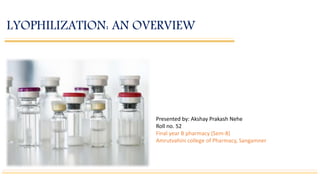
LYOPHILIZATION: AN OVERVIEW
Presented by: Akshay Prakash Nehe
Roll no. 52
Final year B pharmacy (Sem-8)
Amrutvahini college of Pharmacy, Sangamner
Why drying ?
1. Degradation
2. Improves stability
3. Improves solubility
Drying at very low temp., can be
Used for thermolabile products.
Meg la torre, Lyophilization: The basics, Pharmaceutical processing vol 32, no.1 January/February 2017 16 June 2021
LYOPHILIZATION
FD or lyophilization or sublimation drying or cold drying is a stabilizing process in which a
substance is first frozen and then the quantity of solvent is reduced, first by sublimation (Primary
drying) and then by desorption (Secondary drying), to a value which will no longer support
biological activity or chemical reactions.
Lyophilization – Process to produce a product that “loves the dry state”
LYOPHILIZATION FREEZE DRYING CRYO DESICATION
• The common application of pharmaceutical freeze drying is in production of;
- Injectable dosage form,
- Diagnostics,
- For oral solid dosage forms.
Tushar R. Jadhav, R. S. Moon, Review on lyophilization technique @WJPPS April 2015 16 June 2021
Principle
• Main principle in freeze drying- Sublimation
Normal state - SOLID LIQUID GASES
Sublimation - SOLID GASES
• Sublimation- of water can take place at pressures and temperature below triple point
i. e- 4.579 mm of Hg and 0.0099 degree Celsius
Phase Diagram of Water
Tushar R. Jadhav, R. S. Moon, Review on lyophilization technique @WJPPS April 2015 16 June 2021
Process overview
Vials are aseptically filled with solution/
suspension and partially stoppered
Aseptically transferred in freeze dryer
Trays of product are placed on shelves
containing internal channels allowing circulation
of silicone oil or another heat transfer fluid.
The product is first frozen to low enough
temperature to allow complete solidification of
content of each vial.
16 June 2021
Tushar R. Jadhav, R. S. Moon, Review on lyophilization technique @WJPPS April 2015 16 June 2021
Process overview
Then, the chamber is evacuated until the pressure is less than the vapor pressure of the ice
at the temperature of the product.
After this pressure is reached, heat is applied to the shelves to provide the energy
required for sublimation of ice
As drying proceeds, a receding boundary can be observed in the vial as the frozen
level decreases in thickness and the thickness of partially dried solids increases.
Tushar R. Jadhav, R. S. Moon, Review on lyophilization technique @WJPPS April 2015 16 June 2021
• Pretreatment
• Concentrating the product.
• Formulation revision: Addition of components to increase stability
and/or improve processing i.e. add cryoprotectants
• Increasing SA
The Freezing process
(SOLIDIFICATION)
• Freezing is reduction of the temperature of the product to induce crystallization of the bulk
of the contained water before primary drying.
• The freezing can have a very important effect on the appearance and the properties of the
final product.
• The crystal size formed during freezing can significantly affect the dissolution rate of the
dried material
• Freezing is critical step in freeze drying process, since the microstructure ( of both ice and
solute ) formed during freezing determines both;
• The quality of the final product
• The processing characteristics such as the rates of primary and secondary drying.
Shivanand A. Sayanthan Mukhopadhyay, S.G.R.R.I.T.S, A review on lyophilization techno9logy- 2017 16 June 2021
PRIMARY DRYING (SUBLIMATION)
• After completion of product freezing phase, primary drying phase starts, in which ice can be
removed from the frozen product via sublimation, resulting in dry, structurally intact product.
• In this phase chamber pressure is lowered, and enough heat is supplied to the product for the
sublimation of the ice.
• The chamber is evacuated until the pressure is less than the vapor pressure of ice, after this
pressure is reached heat is applied to shelves to provide energy required for sublimation of ice
• During this drying, temperature should not cross the critical temp, which otherwise leads to
‘meltback’ and ‘collapse’ phenomenon
• Primary drying is complete when all frozen bulk (unbound/loose) water is removed via
sublimation, at this point product contain some bound unfrozen water that has to be removed
by desorption at higher temperatures during secondary drying.
• The time at which there is no more frozen layer is taken to represent the end of primary
drying stage.
Shivanand A. Sayanthan Mukhopadhyay, S.G.R.R.I.T.S, A review on lyophilization techno9logy- 2017 16 June 2021
SECONDARY DRYING (DESORPTION)
• After primary drying phase completion, secondary drying phase started.
• In this phase, bound water (moisture) which was not removed during primary
drying, shall be removed by desorption.
• This process is called “Isothermal desorption” as the bound water is desorbed
from the product, desorption drying is facilitated by raising shelf temperature
and reducing chamber pressure to a minimum.
• Secondary drying is usually carried out for approximately 1/3 or ½ the time
required for primary drying
Shivanand A. Sayanthan Mukhopadhyay, S.G.R.R.I.T.S, A review on lyophilization techno9logy- 2017 16 June 2021
Types of freeze dryers
Bench-top freeze dryer Pilot freeze dryer
Production freeze dryer
Gerald D. J. Adams, The principles of freeze drying Chap-4 @Springer science, 2018 16 June 2021
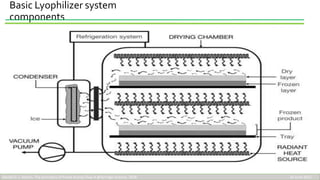
Basic Lyophilizer system
components
• Vacuum Pump: Vacuum is the drying force for change in pressure which is the driving force for
freeze drying. A high vacuum and low pressure system to be created inside the chamber.
• Temperature controlled shelves: Shelves with thermal fluid to control, monitor temperature.
• Condenser (External or Internal): A coil or a plate that is very cold and lower than product
temperature kept some where away from the product. The water generated during freeze drying
process is migrated down the condenser and collected.
• Compressible shelves: To load the vials and also to full stopper the lyophilized vials
• Temperature monitoring devices: sensors (RTD, Thermocouples, Thermistors)
• Vacuum monitoring devices: (Capacitance manometers, Pirani gauge)
• Bleed valve: To control chamber pressure, for very precise pressure/ vacuum level
• Data recording device
Gerald D. J. Adams, The principles of freeze drying Chap-4 @Springer science, 2018 16 June 2021
# What can be freeze-dried?
• Non- biological products
Heat labile chemicals
• Non-living bio products (majority)
Enzymes, hormones, antibiotics, vitamins, blood products, antibodies, vaccines,
pharmaceuticals bone and body tissues for surgical/medical use, foodstuffs
• Miscellaneous materials- Museum specimens/Taxidermy
• Living organisms- Seed cultures
# What can’t be freeze-dried?
• Oil rich products
• Sugar rich products
• High salt containing products (Tg’ suppressing substances)
Gannu kumar, Nooka prashanth, fundamentals & applications of lyophilization @JAPR oct-2011 16 June 2021
Merits of freeze drying
Gannu kumar, Nooka prashanth, fundamentals & applications of lyophilization @JAPR oct-2011 16 June 2021
• Compatible with aseptic operations
• Ideal drying technique for heat sensitive products
• Lyophilized products sensitive to oxygen can be stopper and sealed within
an inert atmosphere (i.e. nitrogen) to minimize detrimental effects
• Drying takes place at low temperatures compared to conventional drying:
minimizes chemical decomposition
Limitations of freeze-drying
- Drug may not be stable as a freeze dried solid
- Example- many cephalosporins
- Time consuming process
- Many biological molecules are damaged by the stresses associated with freezing, freeze-
drying, or both
- Not all materials can be freeze dried to form a pharmaceutically acceptable cake
- Cost?- A bit expensive
Gannu kumar, Nooka prashanth, fundamentals & applications of lyophilization @JAPR oct-2011 16 June 2021
Case study
• DACARBAZINE is an alkylating agent administered as a first line treatment for
metastatic melanoma. As the stability of dacarbazine in aqueous solution form
was unstable so it was formulated as Lyophilized product
• To develop a stable lyophilized formulation of drug dacarbazine for injection
(200mg/vial)
• Dacarbazine[DBZ] has been administered as a first-line drug treatment for
metastatic malignant melanoma and Hodgin’s disease
• Also used with other drugs for soft tissue sarcoma
• DBZ is supplied as a sterile, lyophilized powder that can be reconstituted for IV
injection.
Acceptance criteria for the evaluation of Dacarbazine 200 mg Injection
Parameter Limit
Appearance Cake form: A lyophilized mass contains in amber USP type-1 glass vial with
lyophilized rubber stopper and red colored flip-off sealed down aluminium cap
After reconstitution: 19.7 ml of WFI , a colorless clear solution appears that must
be free from any visible foreign particles
Moisture content Not more than 1.5%
Pressure rise test (PRT) 10ubar in 1 minute
pH 3.0-4.0
Assay Content of DBZ per vial: 180.0 mg to 220.0 mg
Particulate matter Particle size >= 10um: 6000 particles/vial
Particle size >=25um:600 particles/vial
Sterility Must be sterile
Accelerated stability study: The product was subjected to accelerated stability study at 25 deg C +-2 C/65% +-5% RH for
6 months
Freq of testing within 0,1,2,3,6 months & long term study at 2 to 8 deg C for 12 months
Thank you

Lyophilization

  • 1.
    LYOPHILIZATION: AN OVERVIEW Presentedby: Akshay Prakash Nehe Roll no. 52 Final year B pharmacy (Sem-8) Amrutvahini college of Pharmacy, Sangamner
  • 2.
    Why drying ? 1.Degradation 2. Improves stability 3. Improves solubility Drying at very low temp., can be Used for thermolabile products. Meg la torre, Lyophilization: The basics, Pharmaceutical processing vol 32, no.1 January/February 2017 16 June 2021
  • 3.
    LYOPHILIZATION FD or lyophilizationor sublimation drying or cold drying is a stabilizing process in which a substance is first frozen and then the quantity of solvent is reduced, first by sublimation (Primary drying) and then by desorption (Secondary drying), to a value which will no longer support biological activity or chemical reactions. Lyophilization – Process to produce a product that “loves the dry state” LYOPHILIZATION FREEZE DRYING CRYO DESICATION • The common application of pharmaceutical freeze drying is in production of; - Injectable dosage form, - Diagnostics, - For oral solid dosage forms. Tushar R. Jadhav, R. S. Moon, Review on lyophilization technique @WJPPS April 2015 16 June 2021
  • 4.
    Principle • Main principlein freeze drying- Sublimation Normal state - SOLID LIQUID GASES Sublimation - SOLID GASES • Sublimation- of water can take place at pressures and temperature below triple point i. e- 4.579 mm of Hg and 0.0099 degree Celsius Phase Diagram of Water Tushar R. Jadhav, R. S. Moon, Review on lyophilization technique @WJPPS April 2015 16 June 2021
  • 5.
    Process overview Vials areaseptically filled with solution/ suspension and partially stoppered Aseptically transferred in freeze dryer Trays of product are placed on shelves containing internal channels allowing circulation of silicone oil or another heat transfer fluid. The product is first frozen to low enough temperature to allow complete solidification of content of each vial. 16 June 2021 Tushar R. Jadhav, R. S. Moon, Review on lyophilization technique @WJPPS April 2015 16 June 2021
  • 6.
    Process overview Then, thechamber is evacuated until the pressure is less than the vapor pressure of the ice at the temperature of the product. After this pressure is reached, heat is applied to the shelves to provide the energy required for sublimation of ice As drying proceeds, a receding boundary can be observed in the vial as the frozen level decreases in thickness and the thickness of partially dried solids increases. Tushar R. Jadhav, R. S. Moon, Review on lyophilization technique @WJPPS April 2015 16 June 2021
  • 7.
    • Pretreatment • Concentratingthe product. • Formulation revision: Addition of components to increase stability and/or improve processing i.e. add cryoprotectants • Increasing SA
  • 8.
    The Freezing process (SOLIDIFICATION) •Freezing is reduction of the temperature of the product to induce crystallization of the bulk of the contained water before primary drying. • The freezing can have a very important effect on the appearance and the properties of the final product. • The crystal size formed during freezing can significantly affect the dissolution rate of the dried material • Freezing is critical step in freeze drying process, since the microstructure ( of both ice and solute ) formed during freezing determines both; • The quality of the final product • The processing characteristics such as the rates of primary and secondary drying. Shivanand A. Sayanthan Mukhopadhyay, S.G.R.R.I.T.S, A review on lyophilization techno9logy- 2017 16 June 2021
  • 9.
    PRIMARY DRYING (SUBLIMATION) •After completion of product freezing phase, primary drying phase starts, in which ice can be removed from the frozen product via sublimation, resulting in dry, structurally intact product. • In this phase chamber pressure is lowered, and enough heat is supplied to the product for the sublimation of the ice. • The chamber is evacuated until the pressure is less than the vapor pressure of ice, after this pressure is reached heat is applied to shelves to provide energy required for sublimation of ice • During this drying, temperature should not cross the critical temp, which otherwise leads to ‘meltback’ and ‘collapse’ phenomenon • Primary drying is complete when all frozen bulk (unbound/loose) water is removed via sublimation, at this point product contain some bound unfrozen water that has to be removed by desorption at higher temperatures during secondary drying. • The time at which there is no more frozen layer is taken to represent the end of primary drying stage. Shivanand A. Sayanthan Mukhopadhyay, S.G.R.R.I.T.S, A review on lyophilization techno9logy- 2017 16 June 2021
  • 10.
    SECONDARY DRYING (DESORPTION) •After primary drying phase completion, secondary drying phase started. • In this phase, bound water (moisture) which was not removed during primary drying, shall be removed by desorption. • This process is called “Isothermal desorption” as the bound water is desorbed from the product, desorption drying is facilitated by raising shelf temperature and reducing chamber pressure to a minimum. • Secondary drying is usually carried out for approximately 1/3 or ½ the time required for primary drying Shivanand A. Sayanthan Mukhopadhyay, S.G.R.R.I.T.S, A review on lyophilization techno9logy- 2017 16 June 2021
  • 11.
    Types of freezedryers Bench-top freeze dryer Pilot freeze dryer Production freeze dryer Gerald D. J. Adams, The principles of freeze drying Chap-4 @Springer science, 2018 16 June 2021
  • 12.
    Basic Lyophilizer system components •Vacuum Pump: Vacuum is the drying force for change in pressure which is the driving force for freeze drying. A high vacuum and low pressure system to be created inside the chamber. • Temperature controlled shelves: Shelves with thermal fluid to control, monitor temperature. • Condenser (External or Internal): A coil or a plate that is very cold and lower than product temperature kept some where away from the product. The water generated during freeze drying process is migrated down the condenser and collected. • Compressible shelves: To load the vials and also to full stopper the lyophilized vials • Temperature monitoring devices: sensors (RTD, Thermocouples, Thermistors) • Vacuum monitoring devices: (Capacitance manometers, Pirani gauge) • Bleed valve: To control chamber pressure, for very precise pressure/ vacuum level • Data recording device Gerald D. J. Adams, The principles of freeze drying Chap-4 @Springer science, 2018 16 June 2021
  • 14.
    # What canbe freeze-dried? • Non- biological products Heat labile chemicals • Non-living bio products (majority) Enzymes, hormones, antibiotics, vitamins, blood products, antibodies, vaccines, pharmaceuticals bone and body tissues for surgical/medical use, foodstuffs • Miscellaneous materials- Museum specimens/Taxidermy • Living organisms- Seed cultures # What can’t be freeze-dried? • Oil rich products • Sugar rich products • High salt containing products (Tg’ suppressing substances) Gannu kumar, Nooka prashanth, fundamentals & applications of lyophilization @JAPR oct-2011 16 June 2021
  • 15.
    Merits of freezedrying Gannu kumar, Nooka prashanth, fundamentals & applications of lyophilization @JAPR oct-2011 16 June 2021 • Compatible with aseptic operations • Ideal drying technique for heat sensitive products • Lyophilized products sensitive to oxygen can be stopper and sealed within an inert atmosphere (i.e. nitrogen) to minimize detrimental effects • Drying takes place at low temperatures compared to conventional drying: minimizes chemical decomposition
  • 16.
    Limitations of freeze-drying -Drug may not be stable as a freeze dried solid - Example- many cephalosporins - Time consuming process - Many biological molecules are damaged by the stresses associated with freezing, freeze- drying, or both - Not all materials can be freeze dried to form a pharmaceutically acceptable cake - Cost?- A bit expensive Gannu kumar, Nooka prashanth, fundamentals & applications of lyophilization @JAPR oct-2011 16 June 2021
  • 17.
    Case study • DACARBAZINEis an alkylating agent administered as a first line treatment for metastatic melanoma. As the stability of dacarbazine in aqueous solution form was unstable so it was formulated as Lyophilized product • To develop a stable lyophilized formulation of drug dacarbazine for injection (200mg/vial) • Dacarbazine[DBZ] has been administered as a first-line drug treatment for metastatic malignant melanoma and Hodgin’s disease • Also used with other drugs for soft tissue sarcoma • DBZ is supplied as a sterile, lyophilized powder that can be reconstituted for IV injection.
  • 18.
    Acceptance criteria forthe evaluation of Dacarbazine 200 mg Injection Parameter Limit Appearance Cake form: A lyophilized mass contains in amber USP type-1 glass vial with lyophilized rubber stopper and red colored flip-off sealed down aluminium cap After reconstitution: 19.7 ml of WFI , a colorless clear solution appears that must be free from any visible foreign particles Moisture content Not more than 1.5% Pressure rise test (PRT) 10ubar in 1 minute pH 3.0-4.0 Assay Content of DBZ per vial: 180.0 mg to 220.0 mg Particulate matter Particle size >= 10um: 6000 particles/vial Particle size >=25um:600 particles/vial Sterility Must be sterile Accelerated stability study: The product was subjected to accelerated stability study at 25 deg C +-2 C/65% +-5% RH for 6 months Freq of testing within 0,1,2,3,6 months & long term study at 2 to 8 deg C for 12 months
  • 20.