1
Stage 2: Validating Your Business
Model
Lesson 2: Creating a Minimum Viable
Minimum Viable Product
workshop agenda
01 Review
02 Learning Objectives
03 Examples of MVPs
04 Create your MVP
05 Workshop your MVP
06 Key learnings and next steps
01
review
Customer Discovery Process
1. State your assumptions/hypotheses
2. Test your assumption/hypotheses
3. Test your product concept
4. Evaluate; next steps
Debrief customer interviews
01 How many customer interviews did you
do? With who?
02 What did they say?
03 What did you learn?
How has your thinking evolved around key assumptions /
hypotheses around risks:
• PRODUCT RISK: What are you solving? (problem)
• How might customers perceive the your problem(s) compared with how you thought of
them?
• MARKET RISK: Who is the competition? (existing alternatives)
• How do customers solve these problems today?
• CUSTOMER RISK: Who has the pain? (customer segments)
• Is this a viable customer segment?
Maurya, Running Lean, p. 83, 84 6
Debrief customer interviews
Customer Discovery in Context
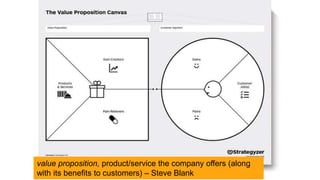
value proposition, product/service the company offers (along
with its benefits to customers) – Steve Blank
http://www.peterjthomson.com/value-proposition-canvas-questions/
https://steveblank.com/2015/05/06/build-measure-learn-throw-things-against-the-wall-and-see-if-they-work/
Or,
something
else where
coding not
needed
02
learning objectives
What is a Minimum
Viable Product?
by the end of lesson 2 you will
– Understand the concept of a Minimum
Viable Product (MVP)
– Create a plan to make your own MVP
– Get feedback from your peers on your MVP
MVP: What? Why?
A Minimum Viable Product is that version of a new
product which allows a team to collect the maximum
amount of validated learning about customers with
the least effort. - Ries
A Minimum Viable Product is the
smallest thing you can build that
delivers customer value (and as a
bonus captures some of that value
back). - Maurya
Simplest thing you can show to customers
to get the most learning at that point in
time -- Blank.
MVP videos
Your MVP should only do one thing – April 6, 2016:
http://bit.ly/1Nb5cwL
Chris Castig
http://learn.onemonth.com/mvp
Rapid Prototyping Google Glass with Tom Chi (first 5 minutes)
http://blog.ted.com/google-glass-prototyped-using-binder-clips-and-clay/
• Feature set for MVP
• Validated learning
• Pivots
Problem worth solving? Built something people want? How accelerate growth?
Ideal time to
raise funding Concept Source: Blank Four Stages
to the Epiphany; Maurya, Running Lean
Image Source: Startitup
03
Examples of MVPs
• low fidelity
• high fidelity
04
Workshop your MVP
What we will be doing
• 5 minutes to think about and note
down possible MVP
• Take turns presenting to class – class
will brainstorm and give feedback on
your MVP ideas.
• What is the value proposition in your business model?
• What is a way you can ‘hack’ or ‘bootleg’ just this aspect of in
the most basic way possible?
• What are you testing for? Does this test that?
MVP considerations
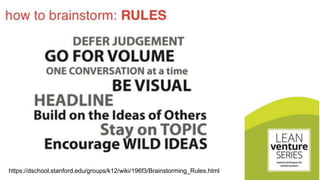
https://dschool.stanford.edu/groups/k12/wiki/196f3/Brainstorming_Rules.html
1 Does this test the core concept of their business model?
2 Can he/she do this cheaply?
3 Any other way they could approach this?
Questions for the Group
05
summary and next steps
05 questions
• What is a startup?
• What is the difference between idea and
hypothesis?
• What is a minimum viable product (MVP)?
• What is the importance of the MVP?
• How does an MVP evolve or change?
05
Summary and Next Steps
• What is the one thing you can do to start making
your minimum viable product happen by next class?
• Lesson 3??
questions?
review material for next session
28

Lean Venture Series - Stage 2 Lesson 2 Slides

  • 1.
    1 Stage 2: ValidatingYour Business Model Lesson 2: Creating a Minimum Viable Minimum Viable Product
  • 2.
    workshop agenda 01 Review 02Learning Objectives 03 Examples of MVPs 04 Create your MVP 05 Workshop your MVP 06 Key learnings and next steps
  • 3.
  • 4.
    Customer Discovery Process 1.State your assumptions/hypotheses 2. Test your assumption/hypotheses 3. Test your product concept 4. Evaluate; next steps
  • 5.
    Debrief customer interviews 01How many customer interviews did you do? With who? 02 What did they say? 03 What did you learn?
  • 6.
    How has yourthinking evolved around key assumptions / hypotheses around risks: • PRODUCT RISK: What are you solving? (problem) • How might customers perceive the your problem(s) compared with how you thought of them? • MARKET RISK: Who is the competition? (existing alternatives) • How do customers solve these problems today? • CUSTOMER RISK: Who has the pain? (customer segments) • Is this a viable customer segment? Maurya, Running Lean, p. 83, 84 6 Debrief customer interviews
  • 7.
  • 8.
    value proposition, product/servicethe company offers (along with its benefits to customers) – Steve Blank
  • 9.
  • 10.
  • 11.
  • 12.
    What is aMinimum Viable Product?
  • 13.
    by the endof lesson 2 you will – Understand the concept of a Minimum Viable Product (MVP) – Create a plan to make your own MVP – Get feedback from your peers on your MVP
  • 14.
    MVP: What? Why? AMinimum Viable Product is that version of a new product which allows a team to collect the maximum amount of validated learning about customers with the least effort. - Ries A Minimum Viable Product is the smallest thing you can build that delivers customer value (and as a bonus captures some of that value back). - Maurya Simplest thing you can show to customers to get the most learning at that point in time -- Blank.
  • 15.
    MVP videos Your MVPshould only do one thing – April 6, 2016: http://bit.ly/1Nb5cwL Chris Castig http://learn.onemonth.com/mvp Rapid Prototyping Google Glass with Tom Chi (first 5 minutes) http://blog.ted.com/google-glass-prototyped-using-binder-clips-and-clay/
  • 16.
    • Feature setfor MVP • Validated learning • Pivots Problem worth solving? Built something people want? How accelerate growth? Ideal time to raise funding Concept Source: Blank Four Stages to the Epiphany; Maurya, Running Lean Image Source: Startitup
  • 18.
    03 Examples of MVPs •low fidelity • high fidelity
  • 19.
  • 20.
    What we willbe doing • 5 minutes to think about and note down possible MVP • Take turns presenting to class – class will brainstorm and give feedback on your MVP ideas.
  • 21.
    • What isthe value proposition in your business model? • What is a way you can ‘hack’ or ‘bootleg’ just this aspect of in the most basic way possible? • What are you testing for? Does this test that? MVP considerations
  • 22.
  • 23.
    1 Does thistest the core concept of their business model? 2 Can he/she do this cheaply? 3 Any other way they could approach this? Questions for the Group
  • 24.
  • 25.
    05 questions • Whatis a startup? • What is the difference between idea and hypothesis? • What is a minimum viable product (MVP)? • What is the importance of the MVP? • How does an MVP evolve or change?
  • 26.
    05 Summary and NextSteps • What is the one thing you can do to start making your minimum viable product happen by next class? • Lesson 3??
  • 27.
  • 28.

Editor's Notes

  • #7 We asked to you identify assumptions around key risks for a target market segment, then develop some interview questions and practice getting out of the building.
  • #8 A living breathing document Your roadmap to creating a viable business model You have the canvas, but its not enough, you have to get out of the building. Why?
  • #15 NOT JUST A CHEAP VERSION OF THE PRODUCT GOAL IS LEARNING MVPs EVOLVE OVER TIME BLANK – COULD BE A POWERPOINT SLIDE DURING A SOLUTION INTERVIEW Maurya’s definition is stricter in that it requires getting some value back: https://leanstack.com/minimum-viable-product/ Simplest thing you can show to customers to get the most learning at that point in time. In product development, the minimum viable product (MVP) is a product which has just enough features to gather validated learning about the product and its continued development.
  • #19 Chris Castig http://learn.onemonth.com/mvp Rapid Prototyping Google Glass with Tom Chi http://blog.ted.com/google-glass-prototyped-using-binder-clips-and-clay/ (first 5 minutes)
  • #23 http://hrweb.mit.edu/learning-development/learning-topics/meetings/articles/brainstorming https://dschool.stanford.edu/groups/k12/wiki/196f3/Brainstorming_Rules.html
  • #26 Blank: A startup is a temporary organization used to search for a repeatable and scalable business model.