Minimum Viable Product (MVP)
For Effective Product Marketing
From:
appICE
The marketing field has always been
growing and improving every day. To
flourish as a reputed brand in this
competitive field has become
challenging, so staying in line with the
latest trends and technology is
inevitable.
Minimum Viable Product is one such
vital aspect for product success.
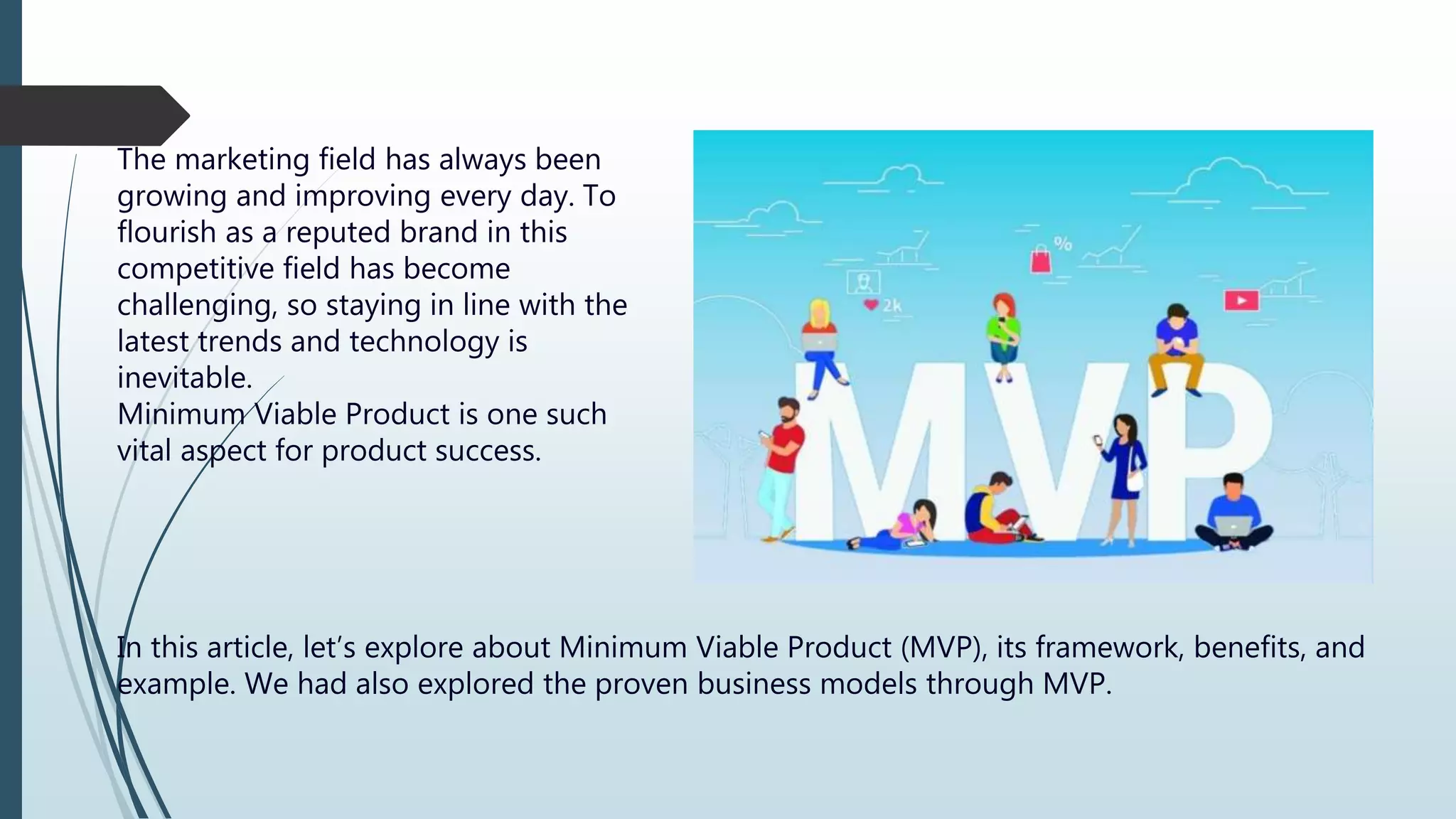
In this article, let’s explore about Minimum Viable Product (MVP), its framework, benefits, and
example. We had also explored the proven business models through MVP.
A brief on Minimum Viable Product
Minimum Viable Product is a common approach to marketing that is built on the project
management and business practices. These techniques are then applied to various
marketing functions. In technical terms, the MVP should prove two key concepts.
 The Proof of Concept: This determines if the challenges can be solved and generally
comes before MVP.
 The willingness of the customers to pay for this app.
The key idea of the MVP is that when a brand produces an actual product or a service
that has an appearance of the automation that you can provide to your consumers and
understand their actual reactions and behavior of the users. Witnessing what users actually
do with your product is much more reliable and informative than asking people about
what they do.
The framework of Minimum Viable Marketing
 Measuring and Learning. From the experiences you make and the results particularly,
you can take on the best ideas you have forward. Greater budget control is allowed as
continuous measuring and learning from outcomes entails you to foresee and calculate
easily the next steps.
 There is always room for improvement. Looking into the areas that did not do well, you
improve them gradually, also monitoring if these adjustments improve the whole
campaign. You are given a chance to explore more innovative ideas and use your
creativity. Having a controlled framework in MVM, you can see the aspects that
definitely need improvement.
 Validation Process: This includes testing and validating concepts and marketing
propositions. In terms of the MVM, the validation of the proposition or the campaign
concept is done with minimum people. This is to avoid the wastage of resources if it
performs poorly.
 Measure the impact: Gathered data is analyzed for measuring the campaign impact.
This is completely result-driven, so it enables you to continuously boost the results in
process. As there is only a minimum level of activity.
 Apply the learning: From the previous experience you get and the results you obtained,
you can take on the perfect ideas. Greater budget constraint is allowed as consistent
measuring and learning from results includes you to foresee and calculate easily.
 Continuous improvement: It enables you to take a glance at the areas that you did not
look earlier. You can improve them slowly, also monitoring these adjustments enhance
the outcome of the whole campaign. By this approach, you are given an opportunity to
explore more creative ideas and implement innovation.
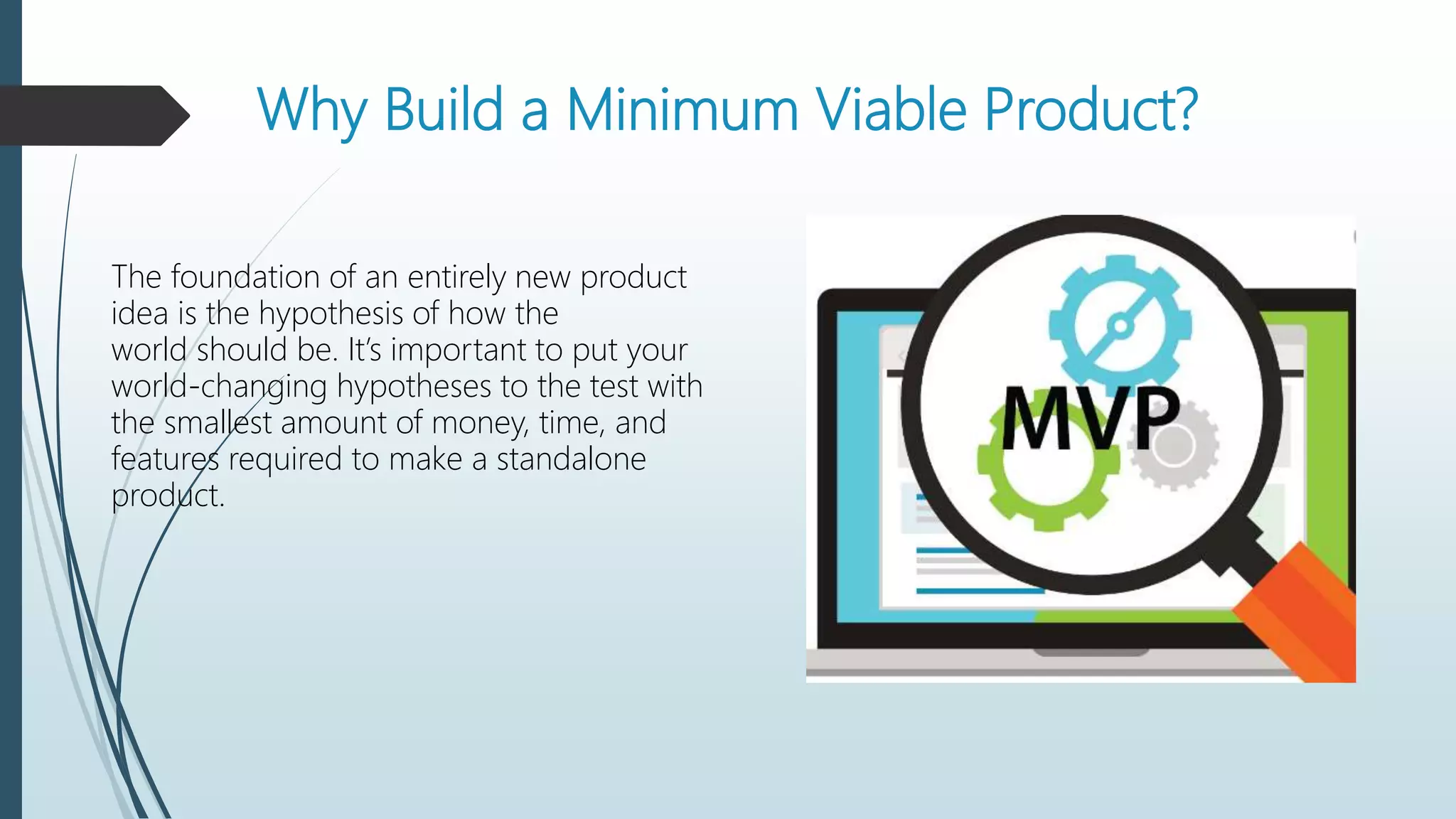
Why Build a Minimum Viable Product?
The foundation of an entirely new product
idea is the hypothesis of how the
world should be. It’s important to put your
world-changing hypotheses to the test with
the smallest amount of money, time, and
features required to make a standalone
product.
Expected Benefits
The primary benefit of an MVP is you can gain an understanding of your customers’
in your product without fully developing the product. The sooner you can find out
your product will appeal to customers, the less effort and expense you spend on a
that will not succeed in the market.
Here are the main benefits of building an MVP:
1. Prevent waste from building something nobody wants
2. Get the product into the hands of users quickly
3. Quickly prove or disprove your thesis
Common Pitfalls
 Teams use the term MVP, but don’t fully understand its intended use or meaning. Often
this lack of understanding manifests in believing that an MVP is the smallest amount of
functionality they can deliver, without the additional criteria of being sufficient to learn
about the business viability of the product.
 Teams stress the minimum part of MVP to the exclusion of the viable part. The product
delivered is not sufficient quality to provide an accurate assessment of whether
customers will use the product.
Minimum Viable Product Methodologies
The methodologies behind building an MVP are meant to be quite simple and
straightforward. It’s essential to build the bare minimum and measure the actual
performance. There is no better stress test for a product than actual usage or lack thereof.
the MVP is not finding success in the hands of users, it can be natural for the creator to
make excuses for its failure.
 Address the core problem
 Incorporate KPI analytics from day 1
 Learn from your users
Minimum Viable Product Examples
How are these principles being practiced in the real world? Let’s explore some examples of
minimum viable products that evolved into valuable product-driven businesses.
 Airbnb
The founders of Airbnb were short on rent money and had an idea to make
accommodations for an oversold conference with all hotels booked in their city. Their idea
was to host guests in their apartment on air beds.
This truly bare-bones minimum viable product was enough to signal that their solution
aligned with a common problem. Airbnb’s short-term rental MVP worked well enough for
customers to pay for it and provide valuable insights into future features.
 Instagram
 Kevin Systrom developed and raised funding for his mobile app Burbn. The idea was to
enable people to check-in and share their experiences at various locations with friends.
 The app was not an instant success and in fact, many people found it confusing to use.
The Burbn team decided to pivot and focus on a single feature: photo-sharing. We all
know how this story turns out — Instagram was born.
 This story highlights how easy it can be to build complexity into your product before it’s
really necessary but it also shows how real-world usage can shatter all preconceived
expectations about your value proposition. Kevin Systrom’s advises entrepreneurs and
product managers to keep it simple.
 Although all of these examples resulted in minimum viable product validation, many
more examples exist where the MVP was proven unsuccessful and the company moved
on to a new strategy.
 This is also a perfect chance to touch on a common misconception around minimum
viable products: are they for companies at every stage?
Takeaway
Ultimately, the article highlights the importance of the MVP and its benefits.
As a takeaway, you should remember that the most significant features that
have to be built are the key problem-solving abilities or functionalities. The
prominent, although less urgent, can be considered for future
implementations. Features or characteristics of less significant, although
urgent, can be fulfilled by a third-party’s item whenever possible. Finally, the
least important, or less urgent features can be eliminated to prevent feature
creep.
To know more about latest technology in market, visit: https://www.appice.io/blog/

MVP slideshare

  • 1.
    Minimum Viable Product(MVP) For Effective Product Marketing From: appICE
  • 2.
    The marketing fieldhas always been growing and improving every day. To flourish as a reputed brand in this competitive field has become challenging, so staying in line with the latest trends and technology is inevitable. Minimum Viable Product is one such vital aspect for product success. In this article, let’s explore about Minimum Viable Product (MVP), its framework, benefits, and example. We had also explored the proven business models through MVP.
  • 3.
    A brief onMinimum Viable Product Minimum Viable Product is a common approach to marketing that is built on the project management and business practices. These techniques are then applied to various marketing functions. In technical terms, the MVP should prove two key concepts.  The Proof of Concept: This determines if the challenges can be solved and generally comes before MVP.  The willingness of the customers to pay for this app. The key idea of the MVP is that when a brand produces an actual product or a service that has an appearance of the automation that you can provide to your consumers and understand their actual reactions and behavior of the users. Witnessing what users actually do with your product is much more reliable and informative than asking people about what they do.
  • 4.
    The framework ofMinimum Viable Marketing  Measuring and Learning. From the experiences you make and the results particularly, you can take on the best ideas you have forward. Greater budget control is allowed as continuous measuring and learning from outcomes entails you to foresee and calculate easily the next steps.  There is always room for improvement. Looking into the areas that did not do well, you improve them gradually, also monitoring if these adjustments improve the whole campaign. You are given a chance to explore more innovative ideas and use your creativity. Having a controlled framework in MVM, you can see the aspects that definitely need improvement.  Validation Process: This includes testing and validating concepts and marketing propositions. In terms of the MVM, the validation of the proposition or the campaign concept is done with minimum people. This is to avoid the wastage of resources if it performs poorly.
  • 5.
     Measure theimpact: Gathered data is analyzed for measuring the campaign impact. This is completely result-driven, so it enables you to continuously boost the results in process. As there is only a minimum level of activity.  Apply the learning: From the previous experience you get and the results you obtained, you can take on the perfect ideas. Greater budget constraint is allowed as consistent measuring and learning from results includes you to foresee and calculate easily.  Continuous improvement: It enables you to take a glance at the areas that you did not look earlier. You can improve them slowly, also monitoring these adjustments enhance the outcome of the whole campaign. By this approach, you are given an opportunity to explore more creative ideas and implement innovation.
  • 6.
    Why Build aMinimum Viable Product? The foundation of an entirely new product idea is the hypothesis of how the world should be. It’s important to put your world-changing hypotheses to the test with the smallest amount of money, time, and features required to make a standalone product.
  • 7.
    Expected Benefits The primarybenefit of an MVP is you can gain an understanding of your customers’ in your product without fully developing the product. The sooner you can find out your product will appeal to customers, the less effort and expense you spend on a that will not succeed in the market. Here are the main benefits of building an MVP: 1. Prevent waste from building something nobody wants 2. Get the product into the hands of users quickly 3. Quickly prove or disprove your thesis
  • 8.
    Common Pitfalls  Teamsuse the term MVP, but don’t fully understand its intended use or meaning. Often this lack of understanding manifests in believing that an MVP is the smallest amount of functionality they can deliver, without the additional criteria of being sufficient to learn about the business viability of the product.  Teams stress the minimum part of MVP to the exclusion of the viable part. The product delivered is not sufficient quality to provide an accurate assessment of whether customers will use the product.
  • 9.
    Minimum Viable ProductMethodologies The methodologies behind building an MVP are meant to be quite simple and straightforward. It’s essential to build the bare minimum and measure the actual performance. There is no better stress test for a product than actual usage or lack thereof. the MVP is not finding success in the hands of users, it can be natural for the creator to make excuses for its failure.  Address the core problem  Incorporate KPI analytics from day 1  Learn from your users
  • 10.
    Minimum Viable ProductExamples How are these principles being practiced in the real world? Let’s explore some examples of minimum viable products that evolved into valuable product-driven businesses.  Airbnb The founders of Airbnb were short on rent money and had an idea to make accommodations for an oversold conference with all hotels booked in their city. Their idea was to host guests in their apartment on air beds. This truly bare-bones minimum viable product was enough to signal that their solution aligned with a common problem. Airbnb’s short-term rental MVP worked well enough for customers to pay for it and provide valuable insights into future features.
  • 11.
     Instagram  KevinSystrom developed and raised funding for his mobile app Burbn. The idea was to enable people to check-in and share their experiences at various locations with friends.  The app was not an instant success and in fact, many people found it confusing to use. The Burbn team decided to pivot and focus on a single feature: photo-sharing. We all know how this story turns out — Instagram was born.  This story highlights how easy it can be to build complexity into your product before it’s really necessary but it also shows how real-world usage can shatter all preconceived expectations about your value proposition. Kevin Systrom’s advises entrepreneurs and product managers to keep it simple.  Although all of these examples resulted in minimum viable product validation, many more examples exist where the MVP was proven unsuccessful and the company moved on to a new strategy.  This is also a perfect chance to touch on a common misconception around minimum viable products: are they for companies at every stage?
  • 12.
    Takeaway Ultimately, the articlehighlights the importance of the MVP and its benefits. As a takeaway, you should remember that the most significant features that have to be built are the key problem-solving abilities or functionalities. The prominent, although less urgent, can be considered for future implementations. Features or characteristics of less significant, although urgent, can be fulfilled by a third-party’s item whenever possible. Finally, the least important, or less urgent features can be eliminated to prevent feature creep. To know more about latest technology in market, visit: https://www.appice.io/blog/