ARCH 322
PRINCIPLES OF PLANNING I
1st Lecture
New Urbanism
September 2, 2022
Soma A. Kareem
Soma Abdulsalam Kareem
September 2, 2022
Soma A. Kareem
Syllabus
September 2, 2022
Soma A. Kareem
Syllabus
September 2, 2022
Soma A. Kareem
Urbanism
New Urbanism
September 2, 2022
Soma A. Kareem
Urbanism
•The characteristic way of life of city dwellers.
•The study of the physical needs of urban societies.
New Urbanism
is an Urban design movement which promotes walk-able
neighborhoods containing a range of housing and job types. It arose
in the United States in the early 1980s, and has gradually influenced
many aspects of real estate development, urban planning, and
municipal land-use strategies.
September 2, 2022
Soma A. Kareem
Principles of New Urbanism
The principles of New Urbanism can be applied increasingly to
projects at the full range of scales from a single building to an entire
community.
1. Walkability
2. Connectivity
3. Mixed-Use & Diversity
4. Mixed Housing
5. Quality Architecture & Urban Design
6. Traditional Neighborhood Structure
7. Increased Density
8. Smart Transportation
9. Sustainability
10. Quality of Life
September 2, 2022
Soma A. Kareem
Principles of New Urbanism
1. Walkability
• Most things within a 10-minute walk of home and work.
• Pedestrian friendly street design (buildings close to street;
porches, windows & doors; tree-lined streets; on street parking;
hidden parking lots; garages in rear lane; narrow, slow speed
streets).
• Pedestrian streets free of cars in special cases.
September 2, 2022
Soma A. Kareem
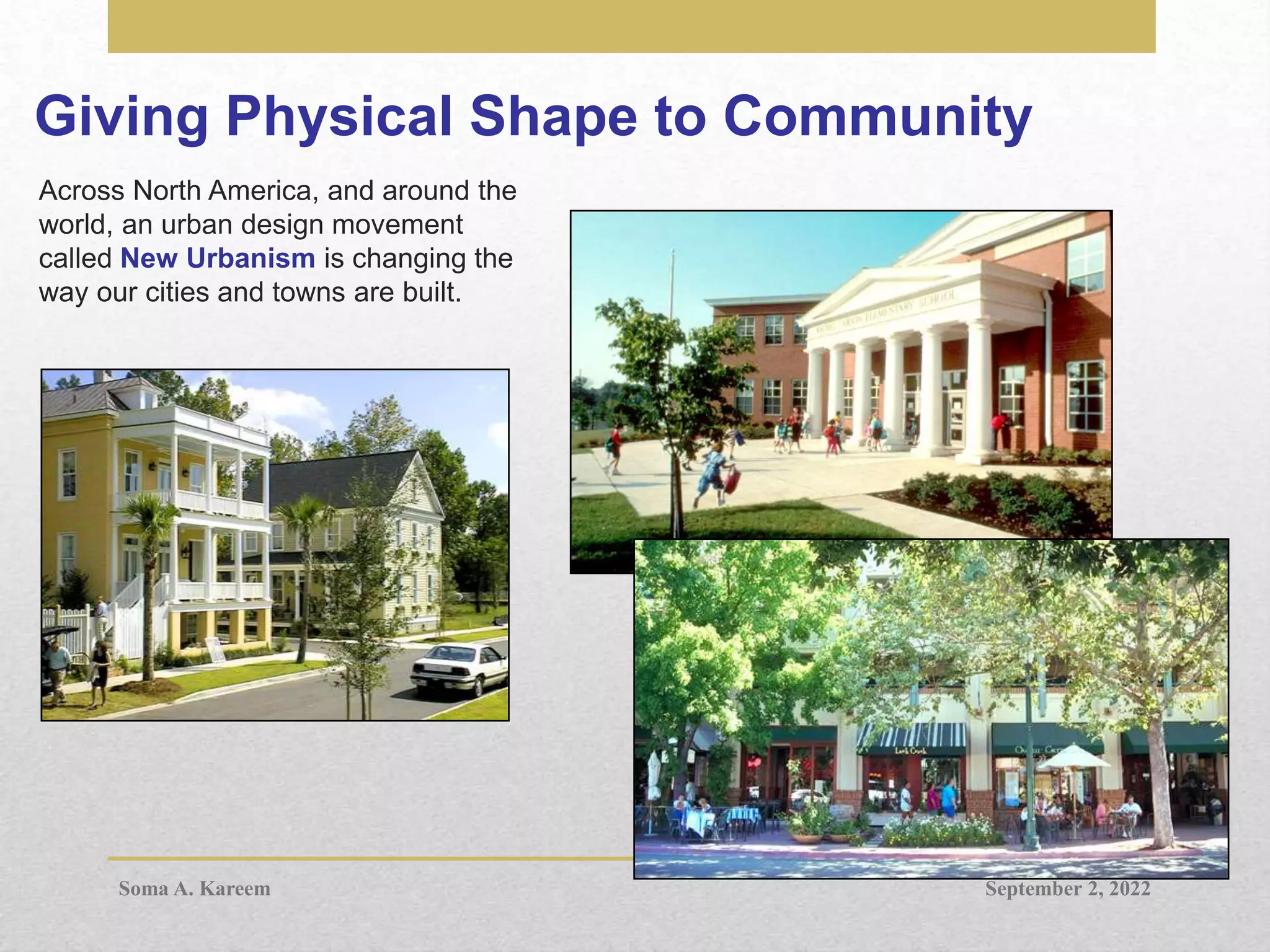
Across North America, and around the
world, an urban design movement
called New Urbanism is changing the
way our cities and towns are built.
Giving Physical Shape to Community
September 2, 2022
Soma A. Kareem
Giving Physical Shape to Community
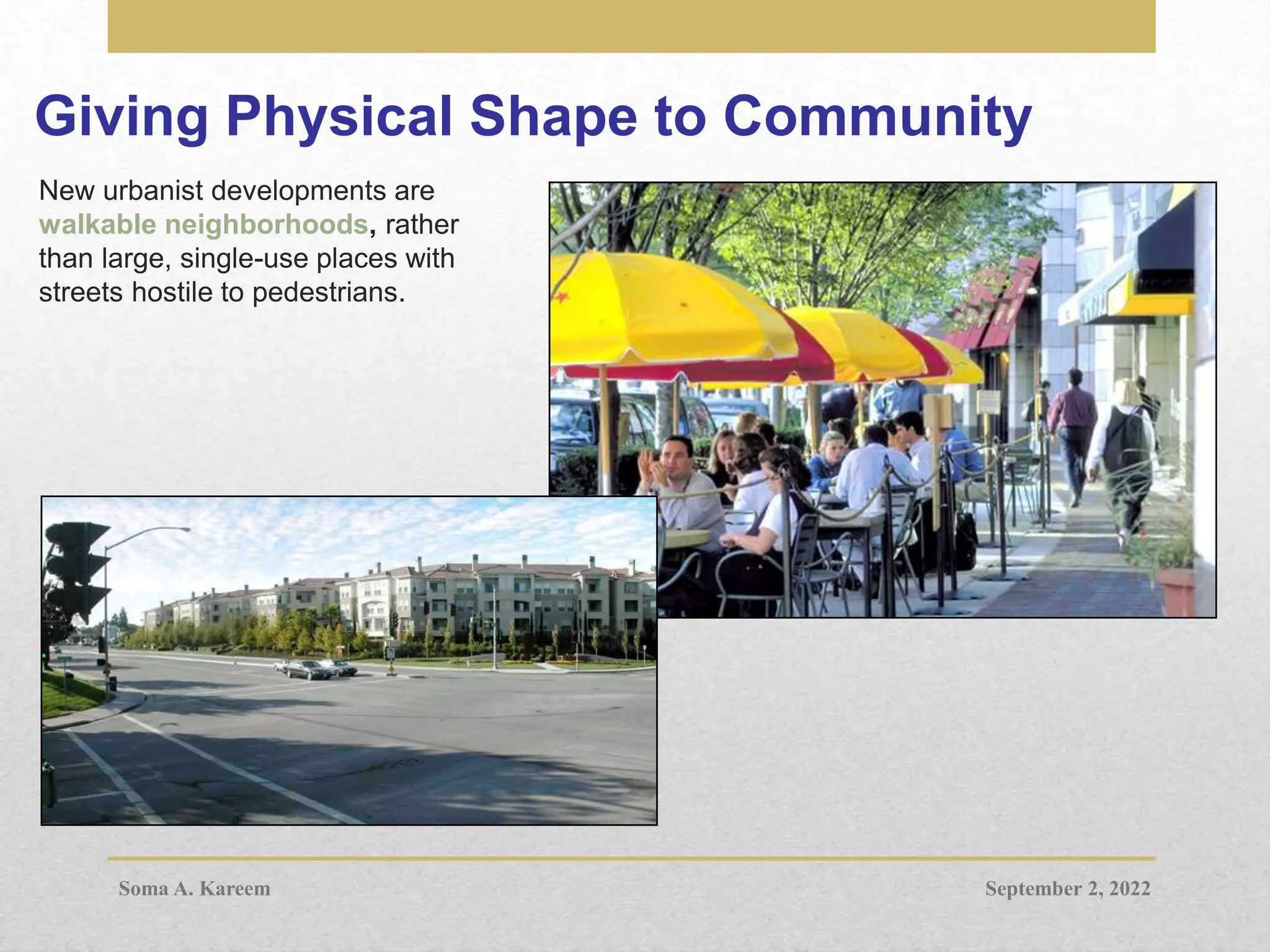
New urbanist developments are
walkable neighborhoods, rather
than large, single-use places with
streets hostile to pedestrians.
September 2, 2022
Soma A. Kareem
Principles of New Urbanism
2. Connectivity
• Interconnected street grid network disperses traffic & eases
walking.
• A hierarchy of narrow streets, boulevards, and alleys.
• High quality pedestrian network and public realm makes
walking pleasurable
September 2, 2022
Soma A. Kareem
Giving Physical Shape to Community
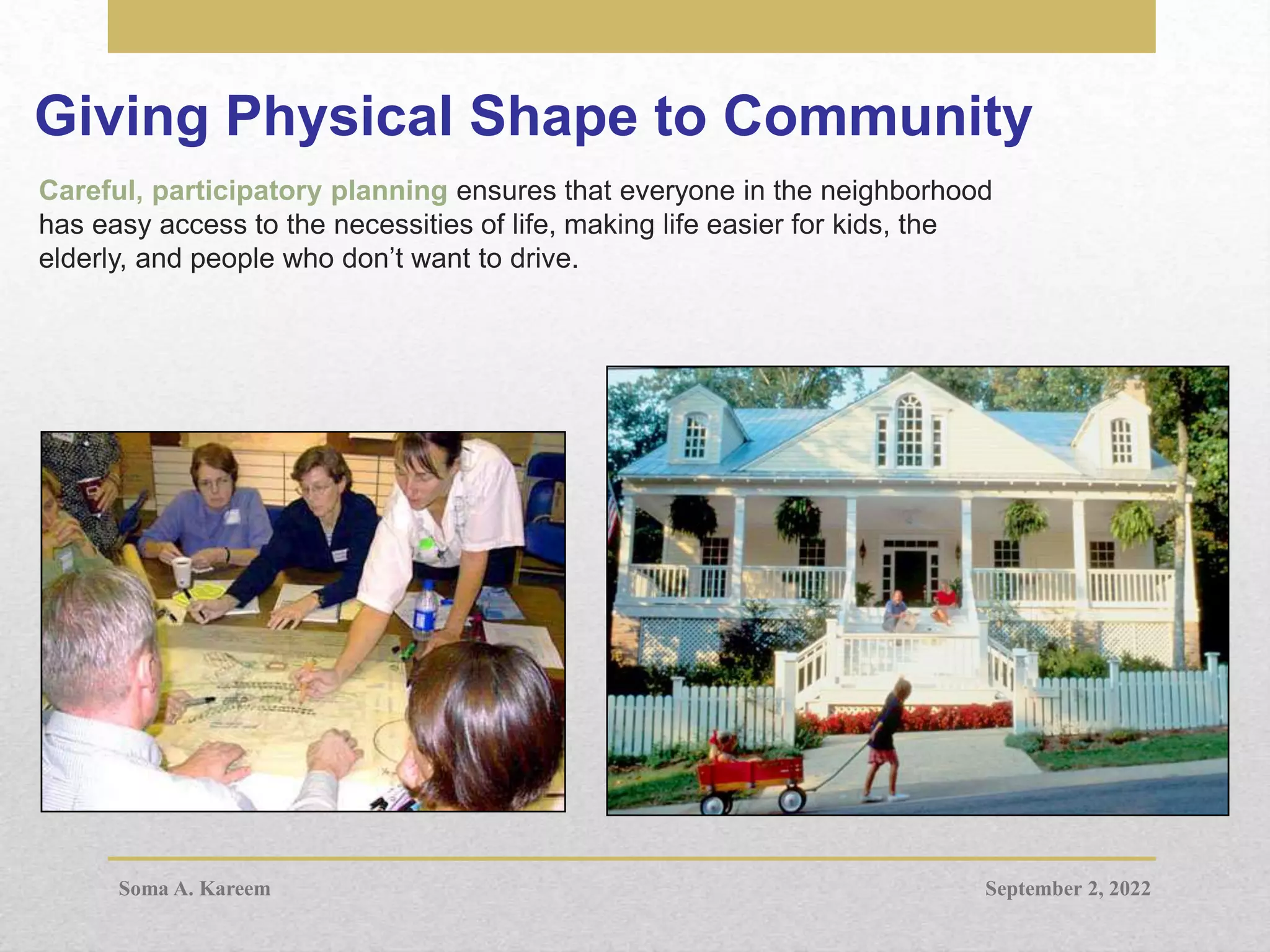
Careful, participatory planning ensures that everyone in the neighborhood
has easy access to the necessities of life, making life easier for kids, the
elderly, and people who don’t want to drive.
September 2, 2022
Soma A. Kareem
Principles of New Urbanism
3. Mixed-Use & Diversity
• A mix of shops, offices, apartments, and homes on site. Mixed-
use within neighborhoods, within blocks, and within buildings.
• Diversity of people - of ages, income levels, cultures, and races.
4. Mixed Housing
• A range of types, sizes and prices in closer proximity
September 2, 2022
Soma A. Kareem
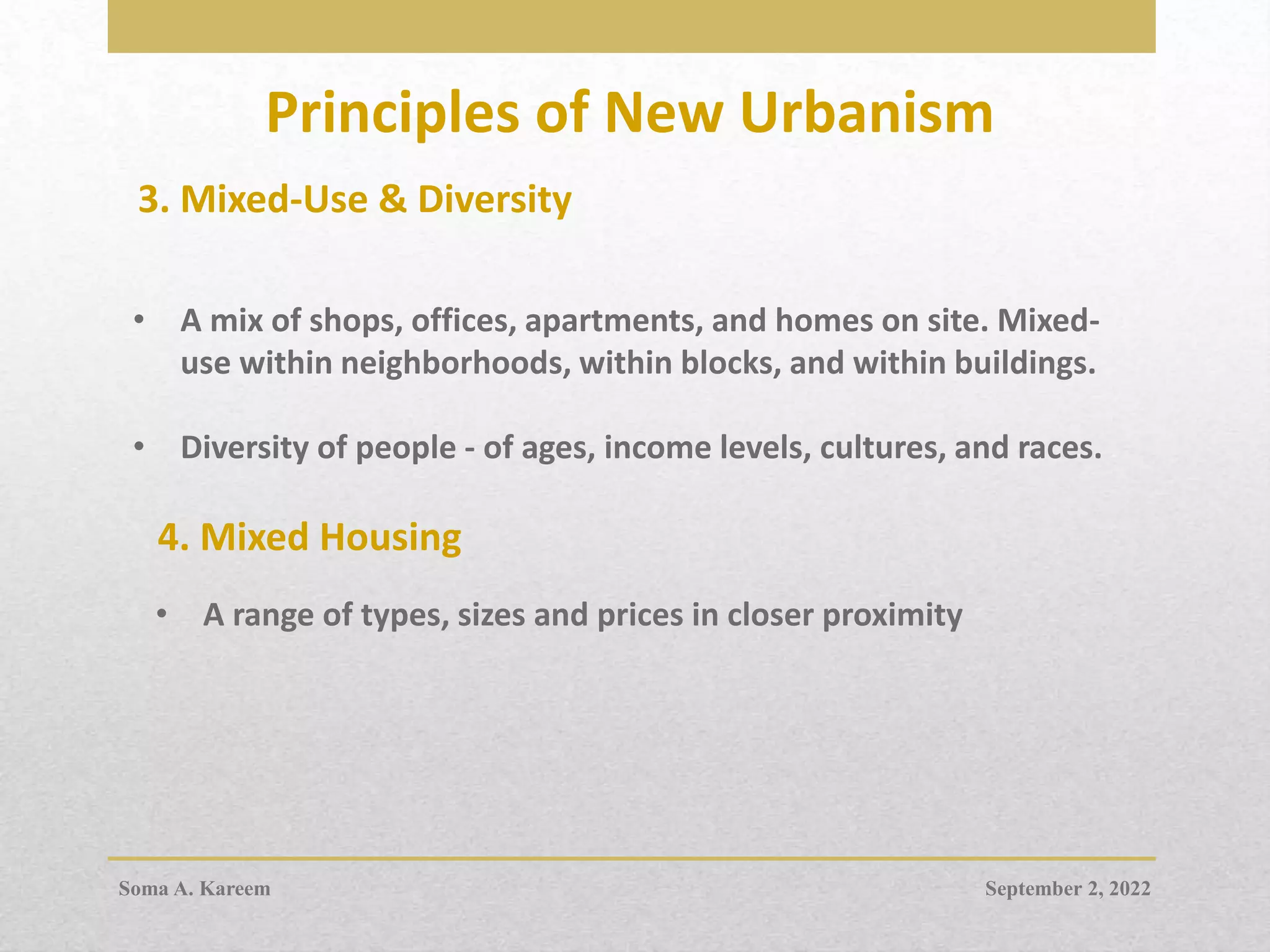
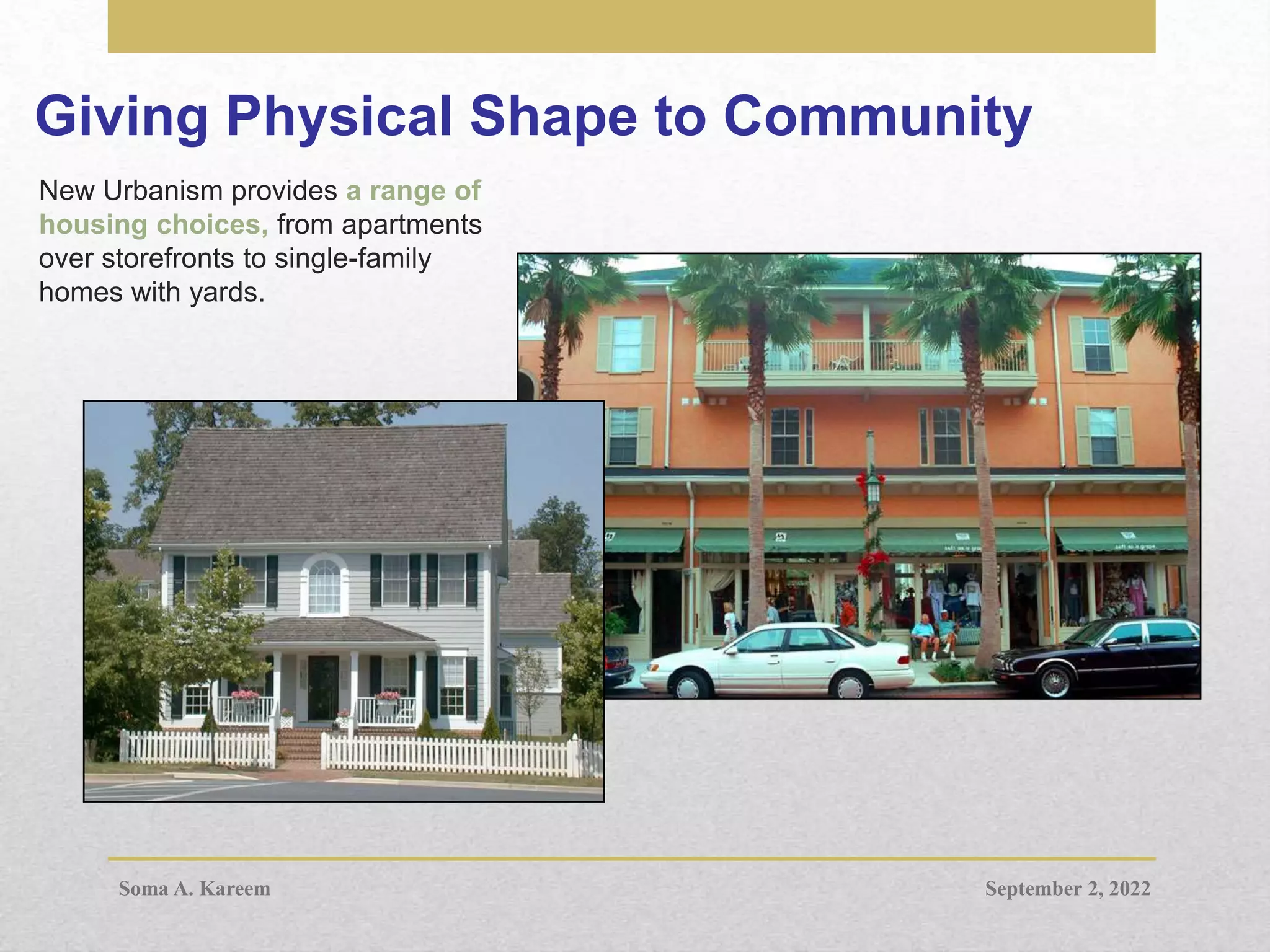
Giving Physical Shape to Community
New Urbanism provides a range of
housing choices, from apartments
over storefronts to single-family
homes with yards.
September 2, 2022
Soma A. Kareem
Principles of New Urbanism
5. Quality Architecture & Urban Design
• Emphasis on beauty, aesthetics, human comfort, and creating a
sense of place; Special placement of civic uses and sites within
community. Human scale architecture & beautiful surroundings
nourish the human spirit
September 2, 2022
Soma A. Kareem
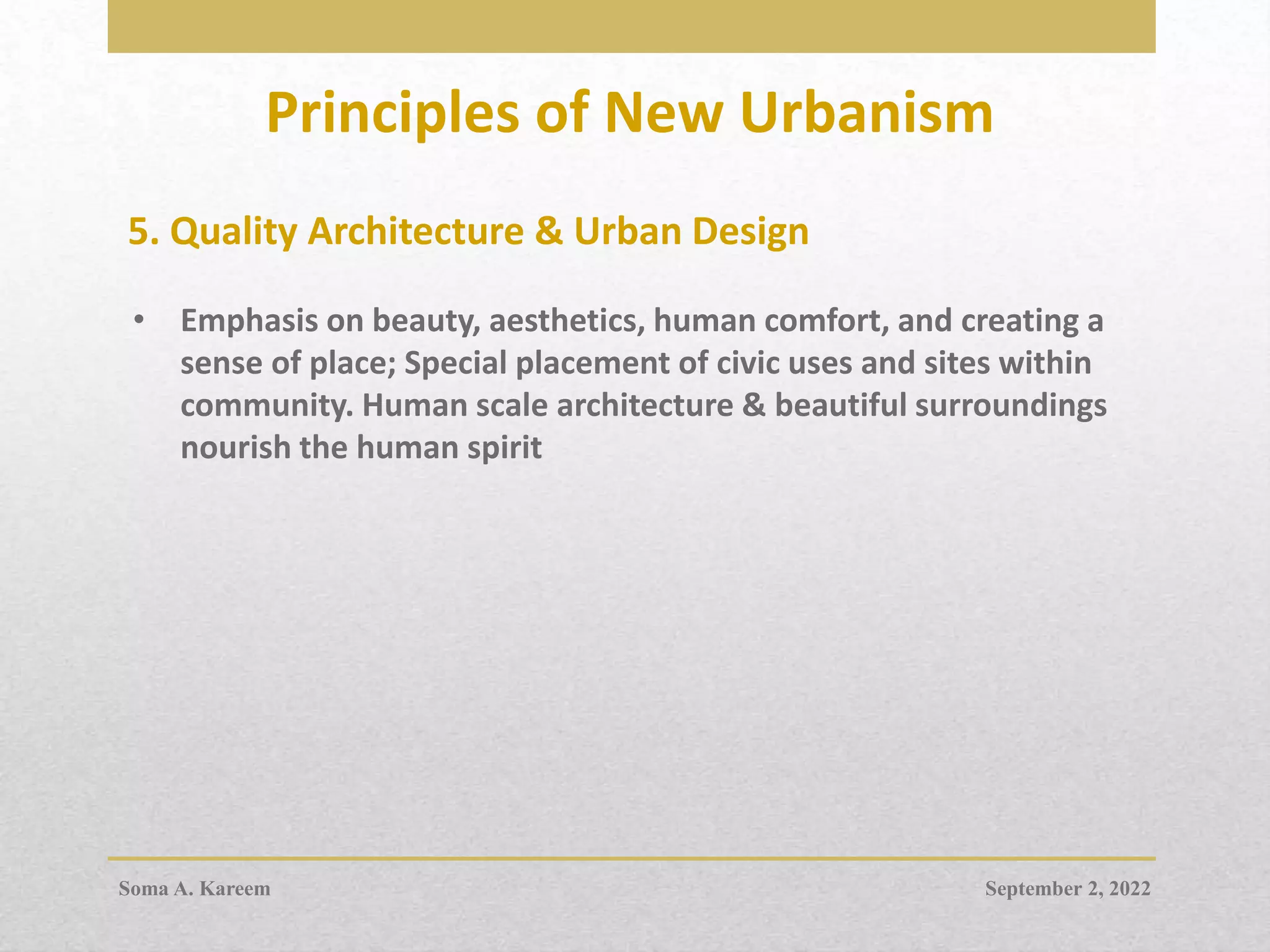
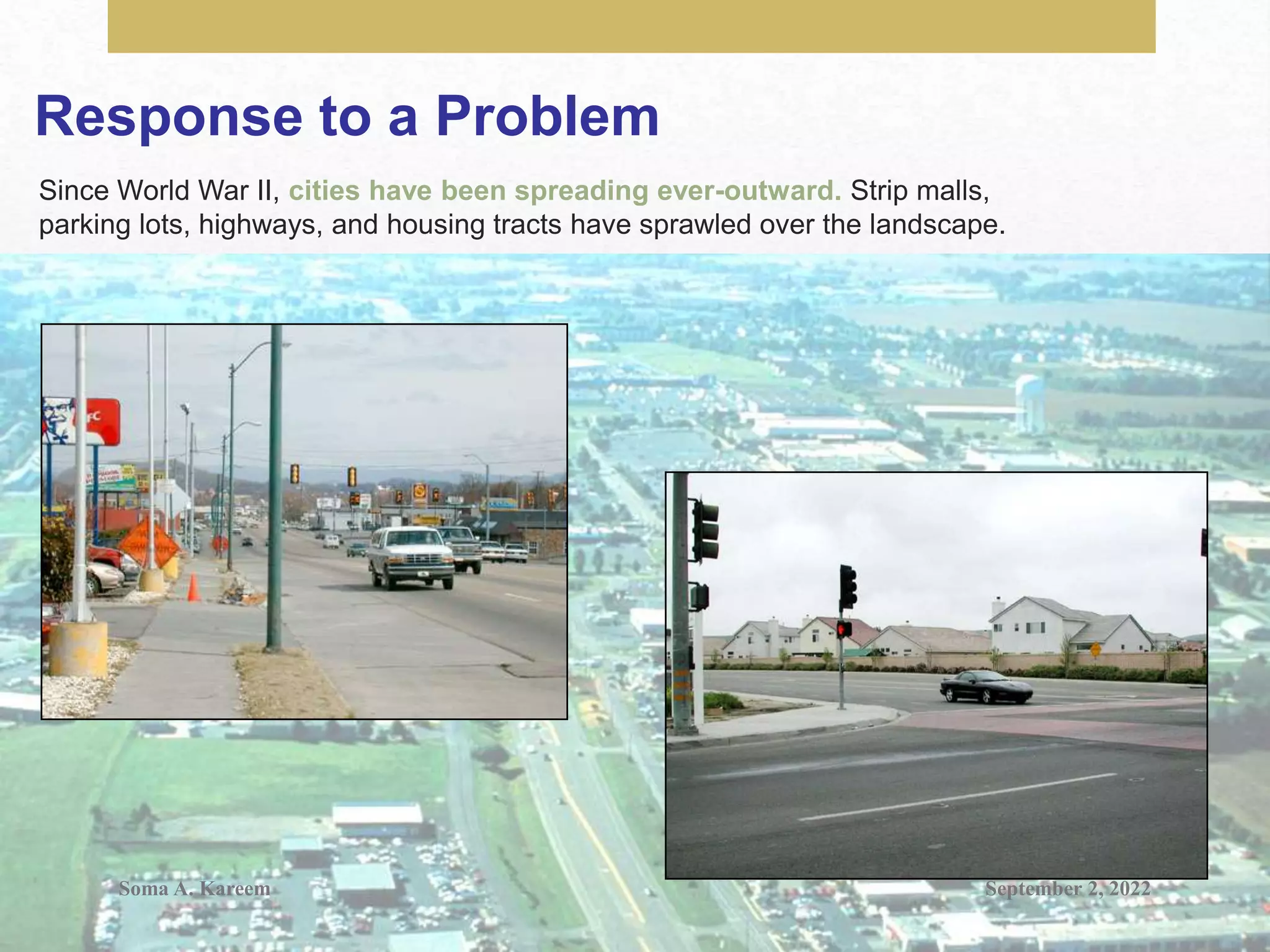
Response to a Problem
Since World War II, cities have been spreading ever-outward. Strip malls,
parking lots, highways, and housing tracts have sprawled over the landscape.
September 2, 2022
Soma A. Kareem
Principles of New Urbanism
6. Traditional Neighborhood Structure
• Center and edge.
• Public space at center.
• Importance of quality public realm; public open space designed
as civic art.
• Contains a range of uses and densities within 10-minute walk
September 2, 2022
Soma A. Kareem
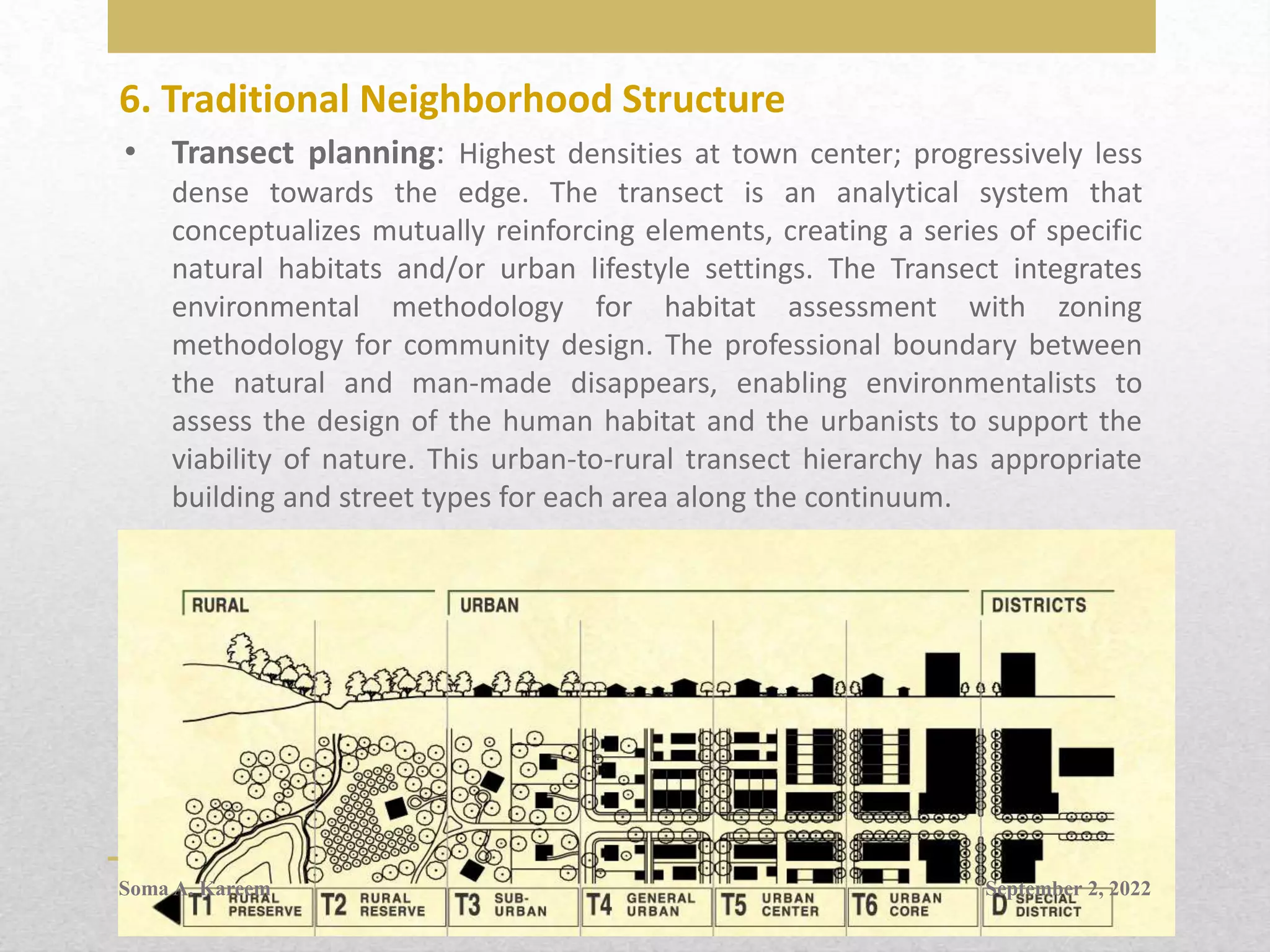
6. Traditional Neighborhood Structure
• Transect planning: Highest densities at town center; progressively less
dense towards the edge. The transect is an analytical system that
conceptualizes mutually reinforcing elements, creating a series of specific
natural habitats and/or urban lifestyle settings. The Transect integrates
environmental methodology for habitat assessment with zoning
methodology for community design. The professional boundary between
the natural and man-made disappears, enabling environmentalists to
assess the design of the human habitat and the urbanists to support the
viability of nature. This urban-to-rural transect hierarchy has appropriate
building and street types for each area along the continuum.
September 2, 2022
Soma A. Kareem
Principles of New Urbanism
7. Increased Density
• More buildings, residences, shops, and services closer together
for ease of walking, to enable a more efficient use of services
and resources, and to create a more convenient, enjoyable place
to live.
• New Urbanism design principles are applied at the full range of
densities from small towns, to large cities.
• A network of high-quality trains connecting cities, towns, and
neighborhoods together.
• Pedestrian-friendly design that encourages a greater use of
bicycles, rollerblades, scooters, and walking as daily
transportation.
8. Smart Transportation
September 2, 2022
Soma A. Kareem
Principles of New Urbanism
9. Sustainability
• Minimal environmental impact of development and its operations
• Eco-friendly technologies, respect for ecology and value of natural
systems
• Energy efficiency
• Less use of finite fuels
• More local production
• More walking, less driving
• Taken together these add up to a high quality of life well worth living,
and create places that enrich, uplift, and inspire the human spirit.
10. Quality of Life
September 2, 2022
Soma A. Kareem
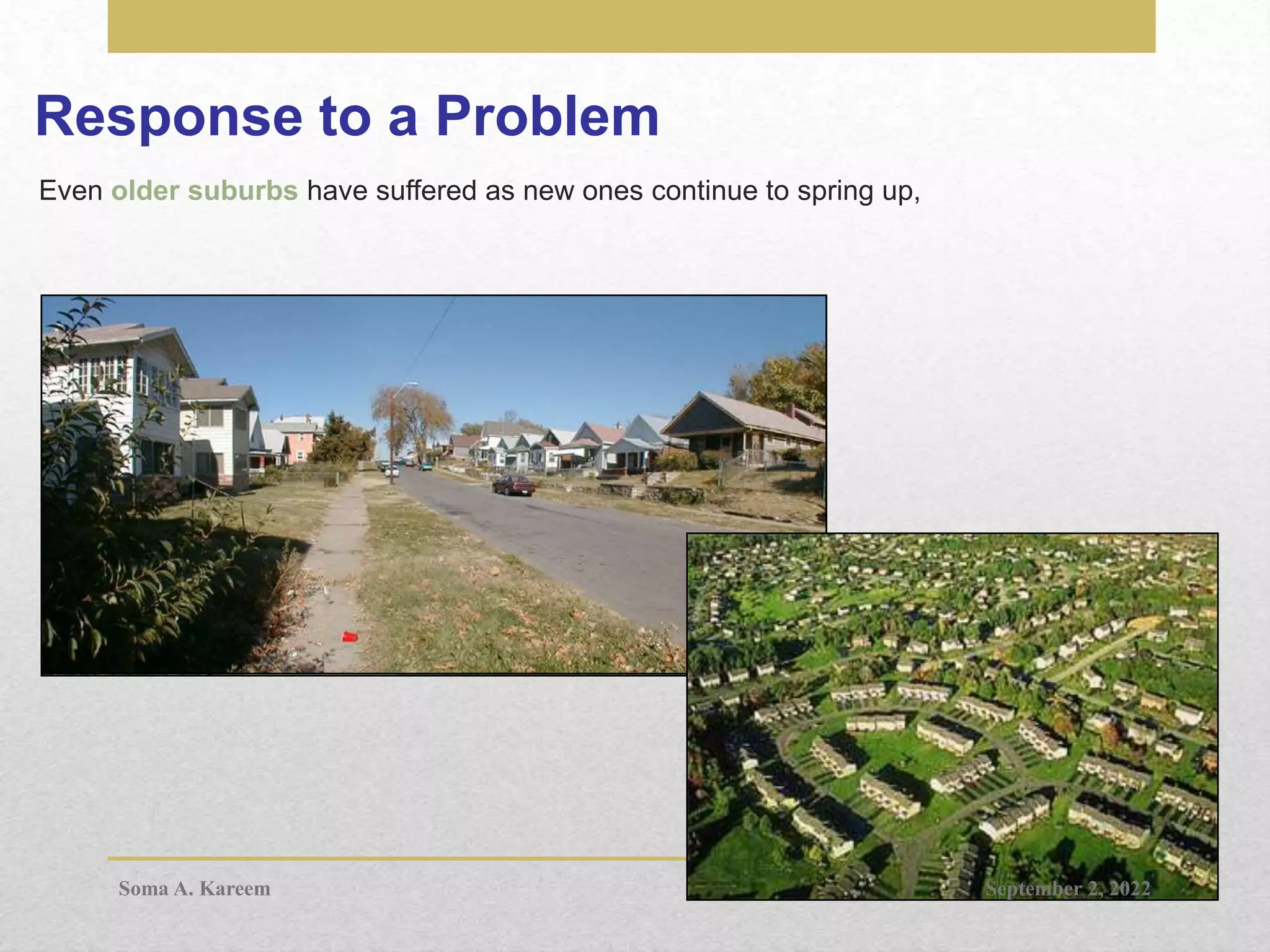
Response to a Problem
Even older suburbs have suffered as new ones continue to spring up,
September 2, 2022
Soma A. Kareem
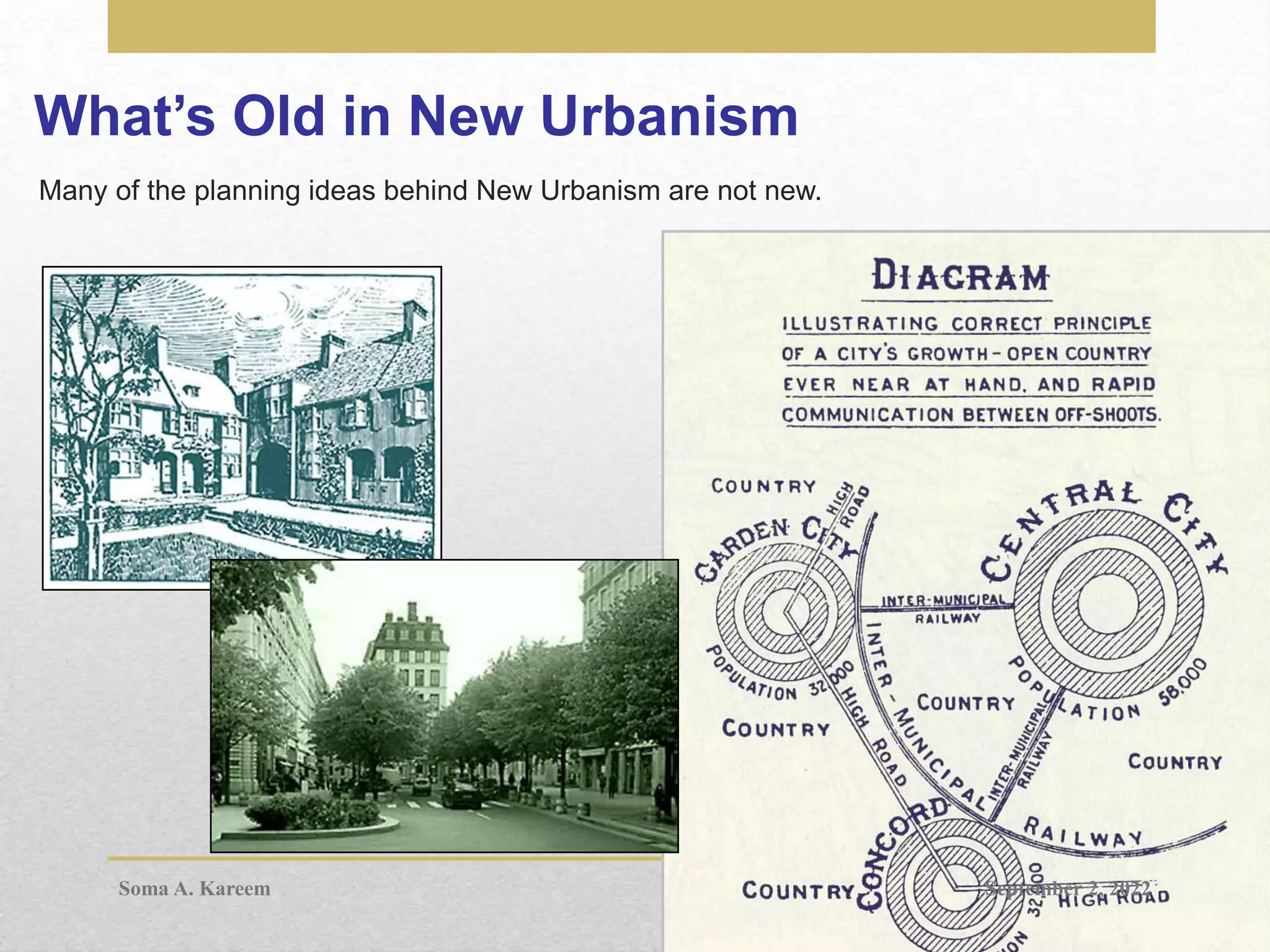
What’s Old in New Urbanism
Many of the planning ideas behind New Urbanism are not new.
September 2, 2022
Soma A. Kareem
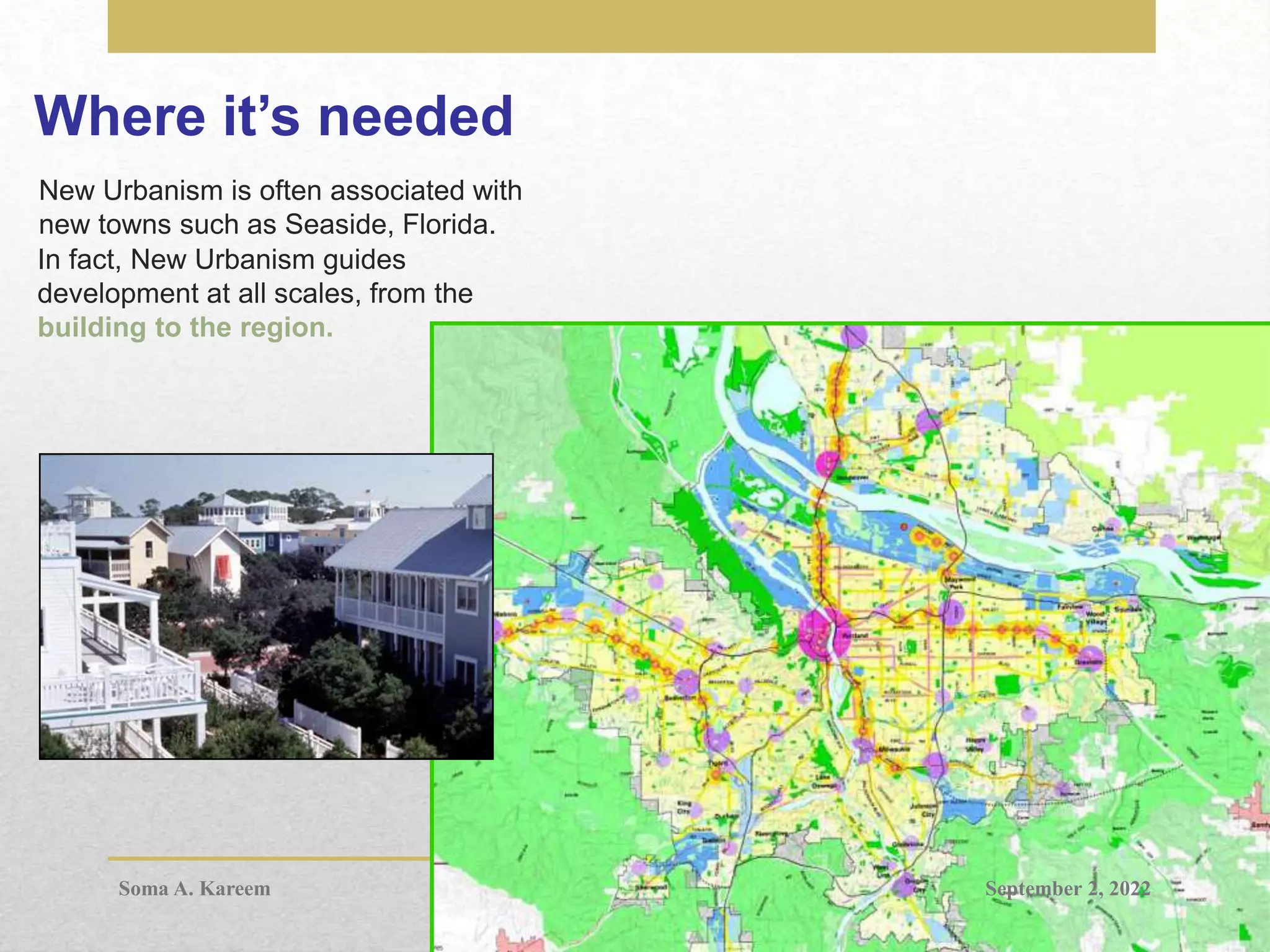
Where it’s needed
In fact, New Urbanism guides
development at all scales, from the
building to the region.
New Urbanism is often associated with
new towns such as Seaside, Florida.
September 2, 2022
Soma A. Kareem
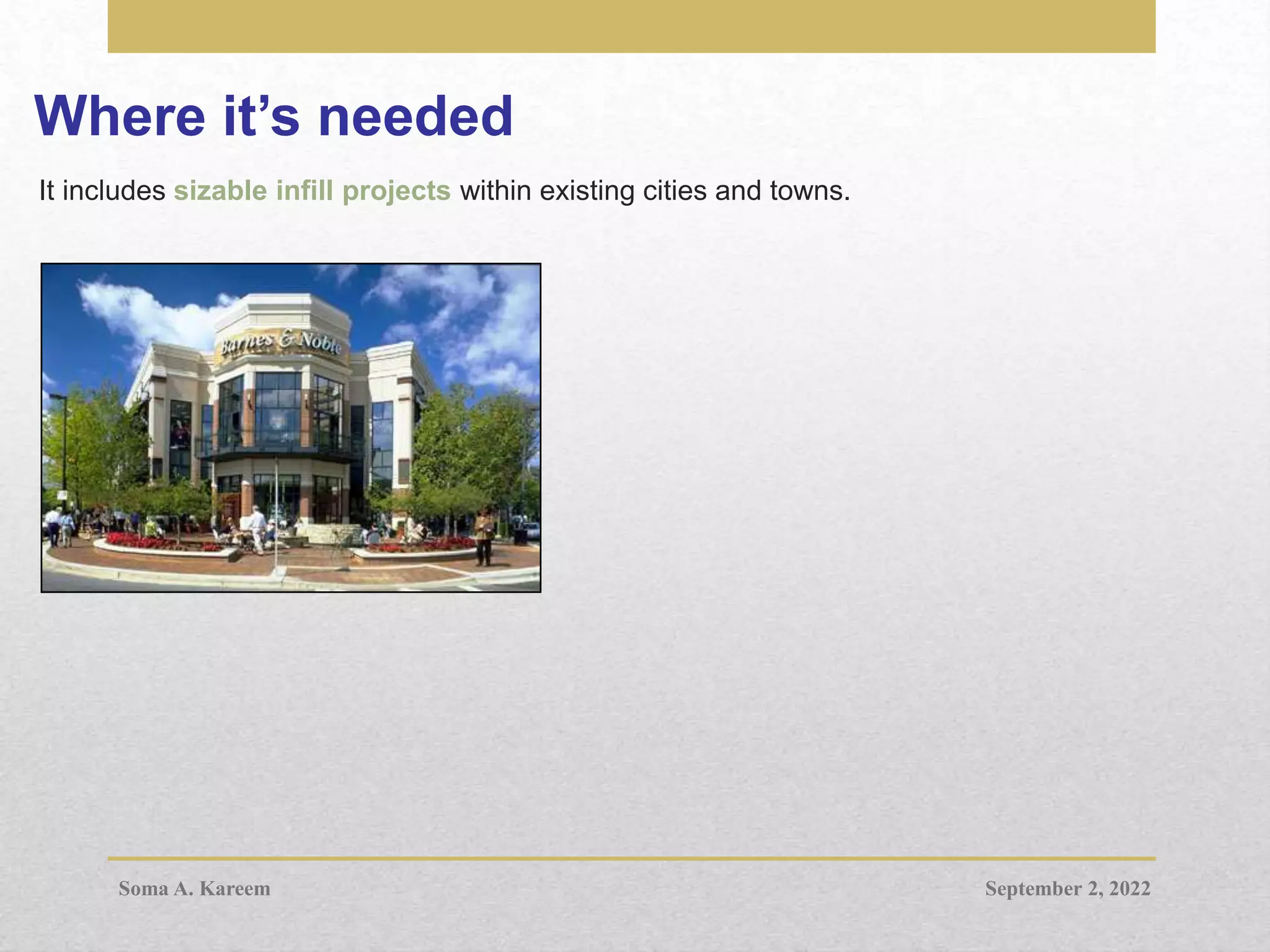
Where it’s needed
It includes sizable infill projects within existing cities and towns.
September 2, 2022
Soma A. Kareem
Where it’s needed
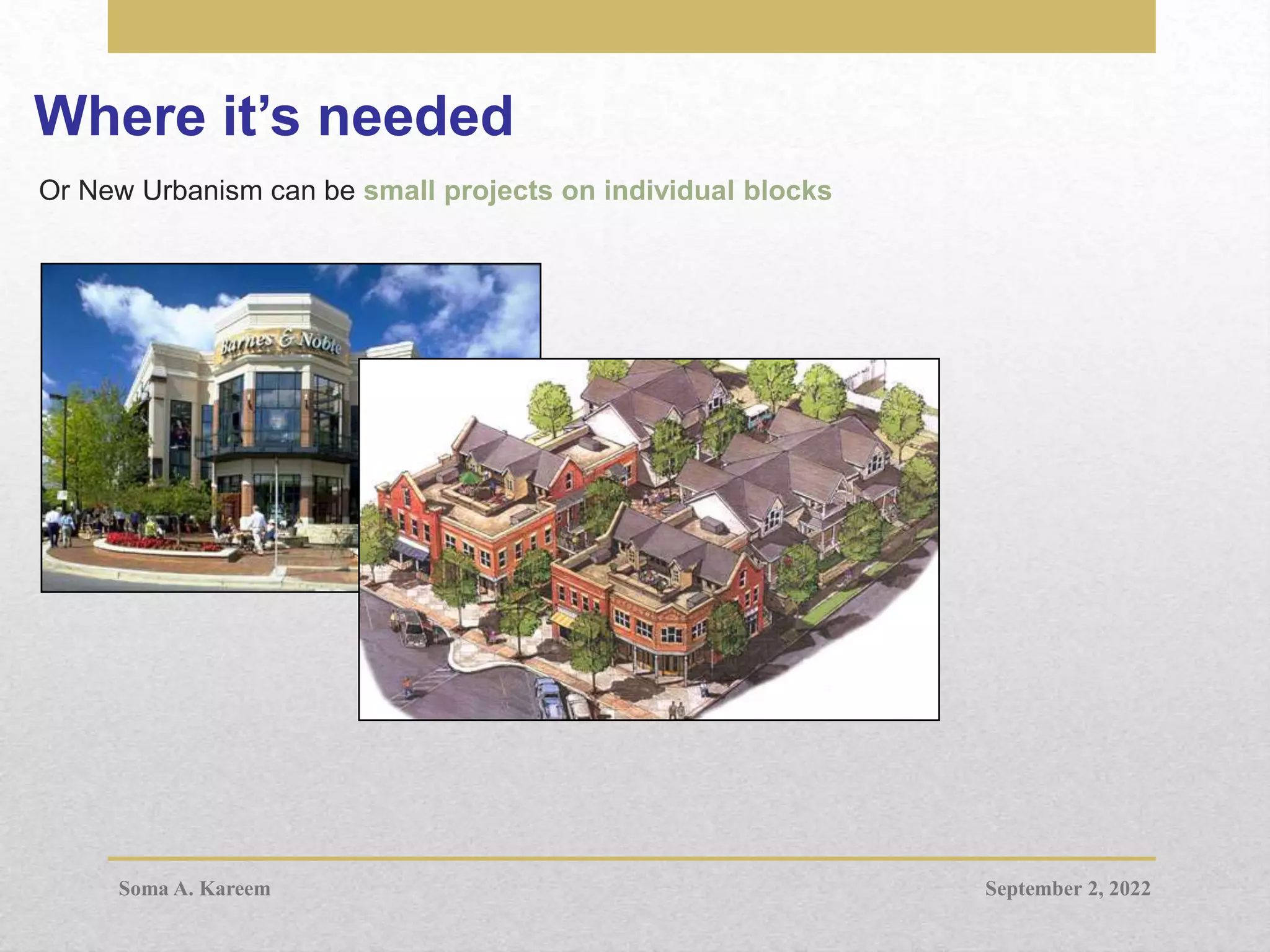
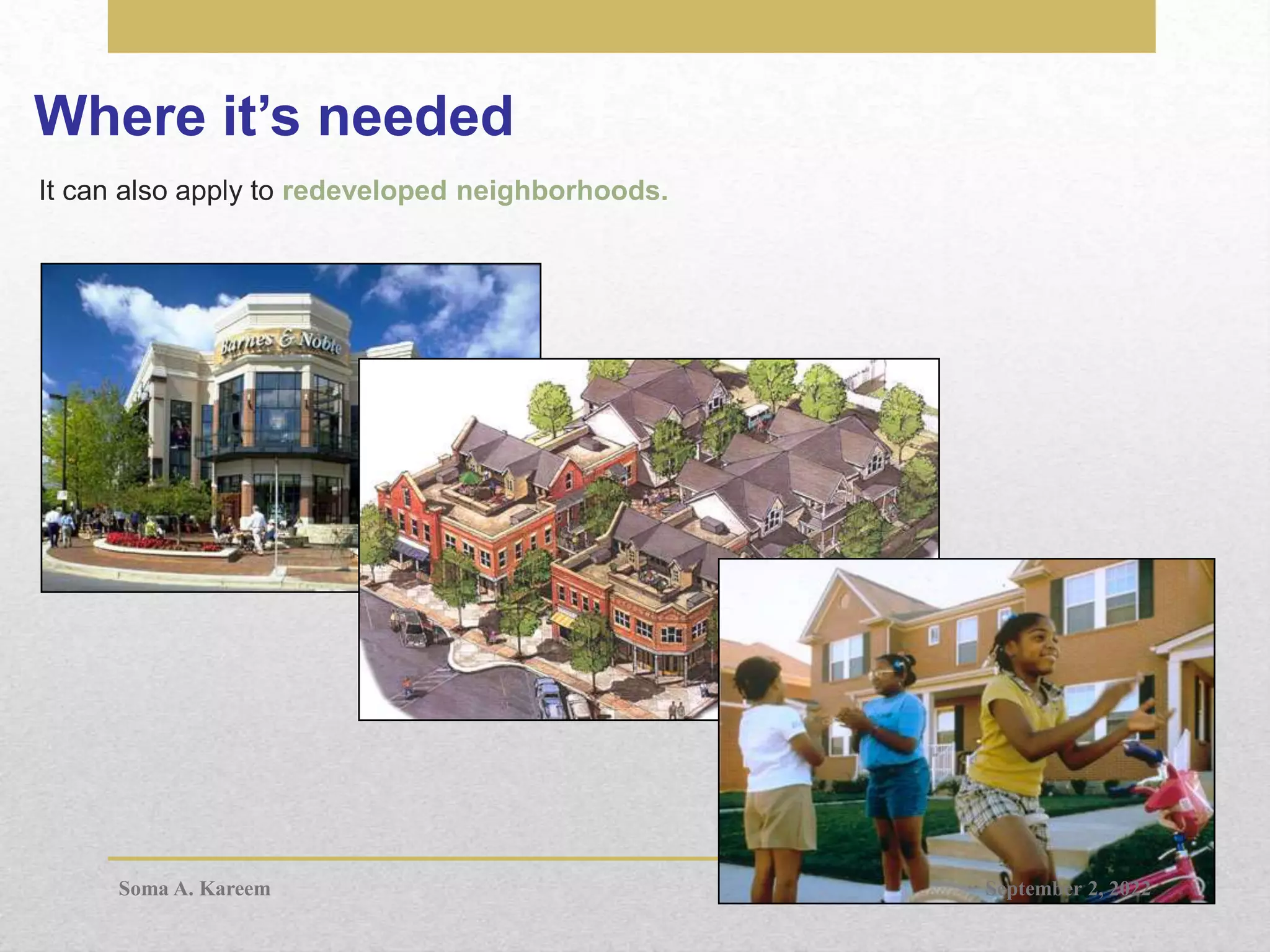
Or New Urbanism can be small projects on individual blocks
September 2, 2022
Soma A. Kareem
Where it’s needed
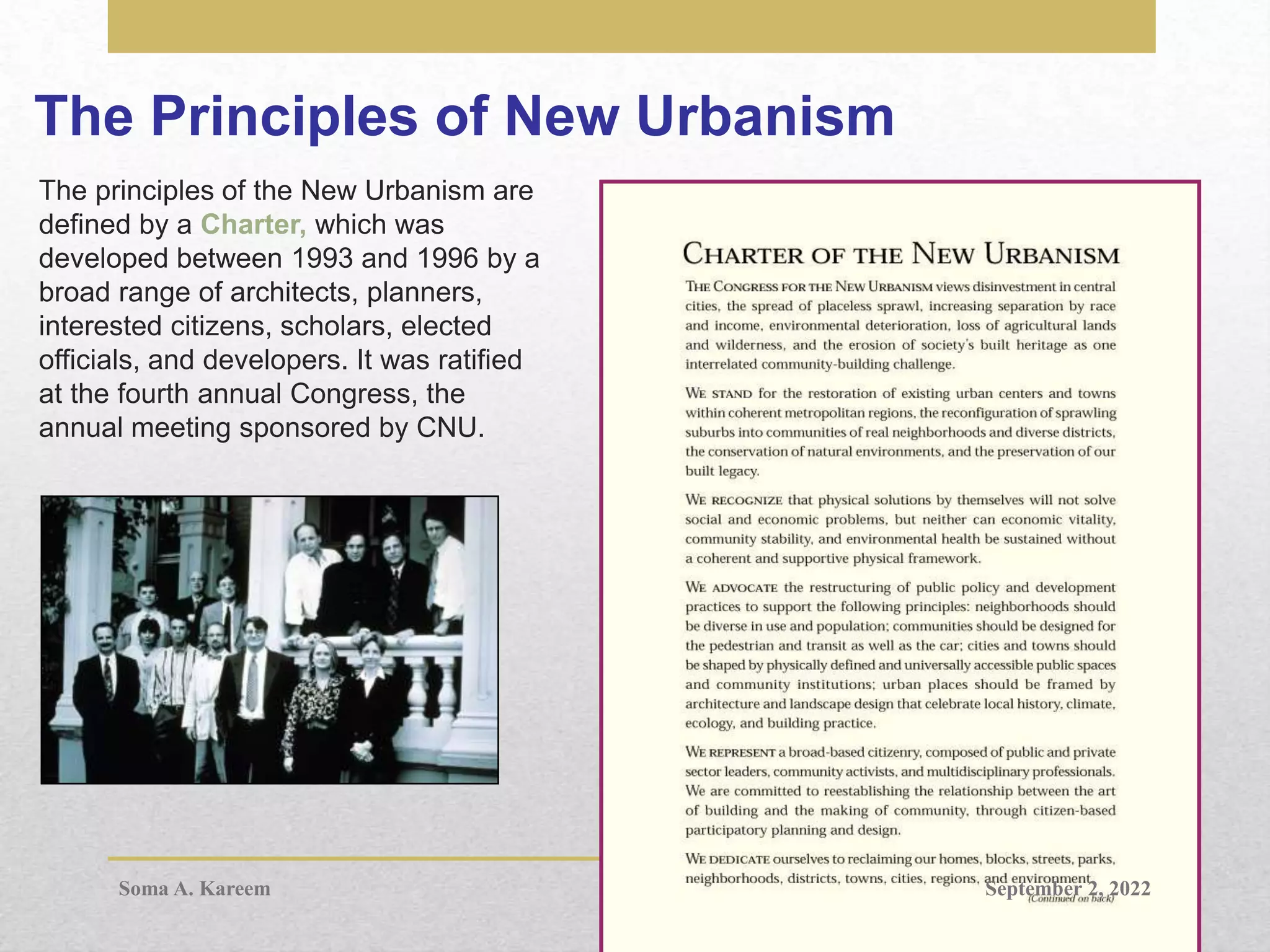
It can also apply to redeveloped neighborhoods.
September 2, 2022
Soma A. Kareem
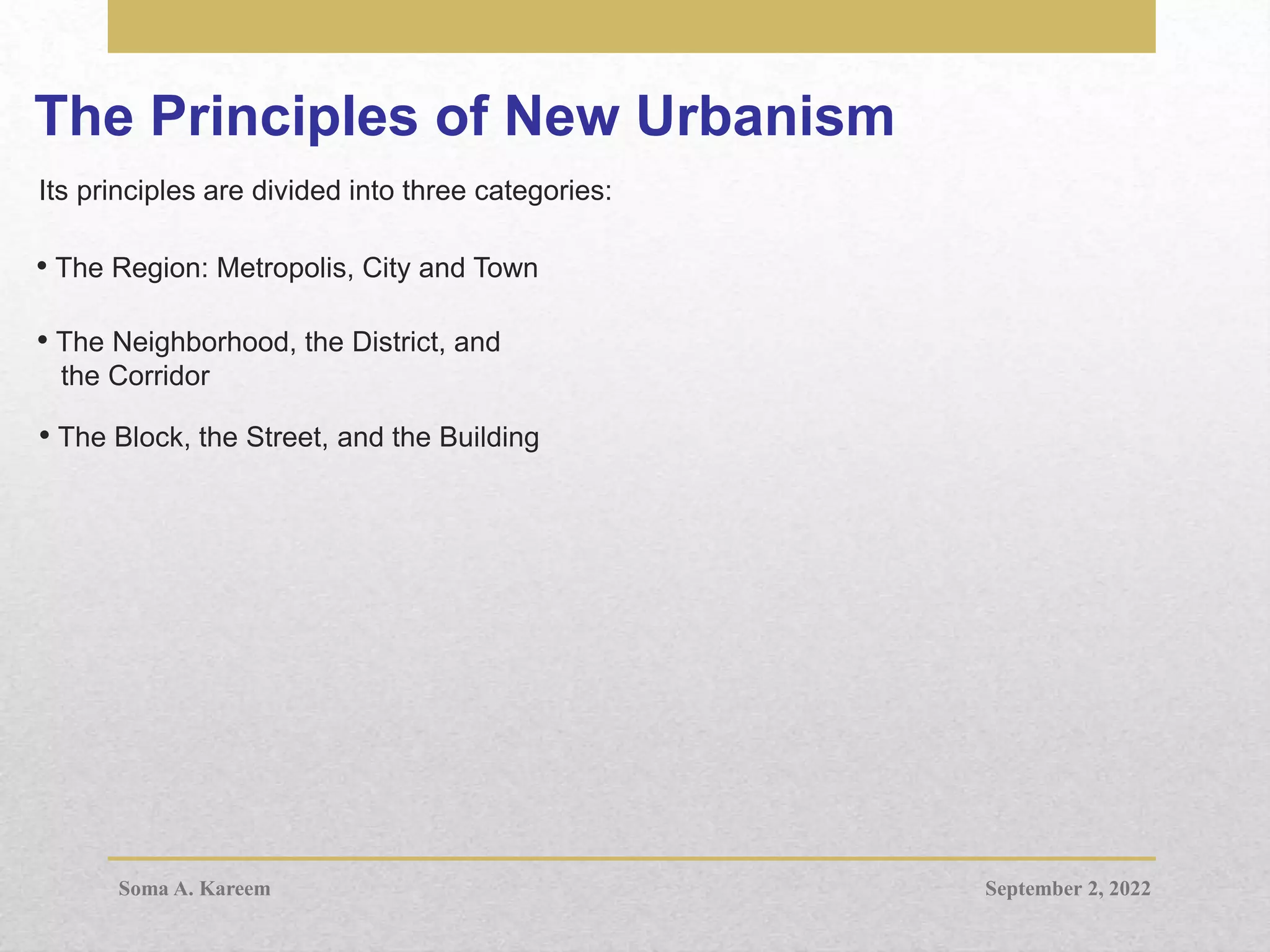
The Principles of New Urbanism
The principles of the New Urbanism are
defined by a Charter, which was
developed between 1993 and 1996 by a
broad range of architects, planners,
interested citizens, scholars, elected
officials, and developers. It was ratified
at the fourth annual Congress, the
annual meeting sponsored by CNU.
September 2, 2022
Soma A. Kareem
The Principles of New Urbanism
Its principles are divided into three categories:
• The Region: Metropolis, City and Town
• The Neighborhood, the District, and
the Corridor
• The Block, the Street, and the Building
September 2, 2022
Soma A. Kareem
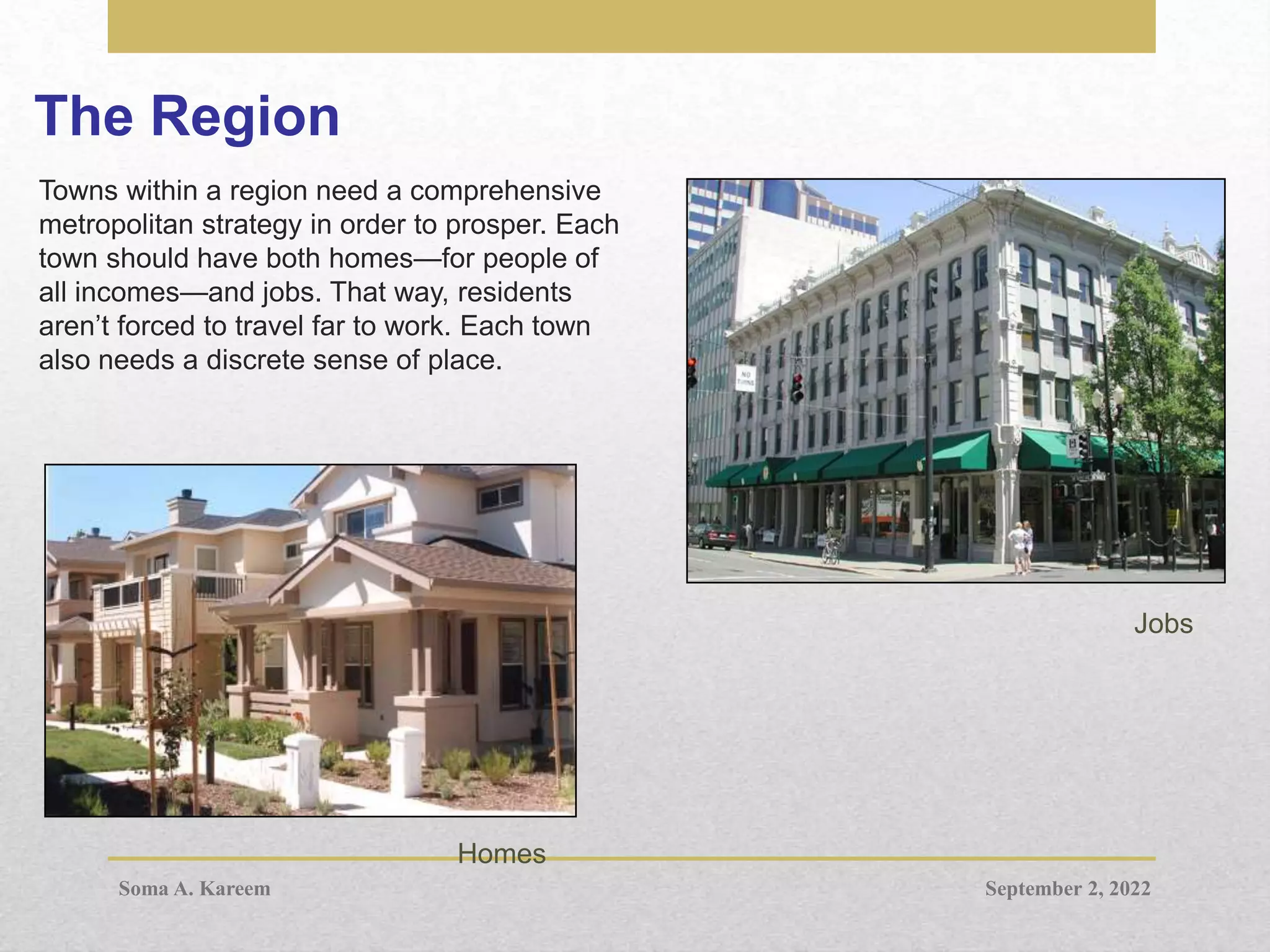
The Region
Towns within a region need a comprehensive
metropolitan strategy in order to prosper. Each
town should have both homes—for people of
all incomes—and jobs. That way, residents
aren’t forced to travel far to work. Each town
also needs a discrete sense of place.
Homes
Jobs
September 2, 2022
Soma A. Kareem
The Region
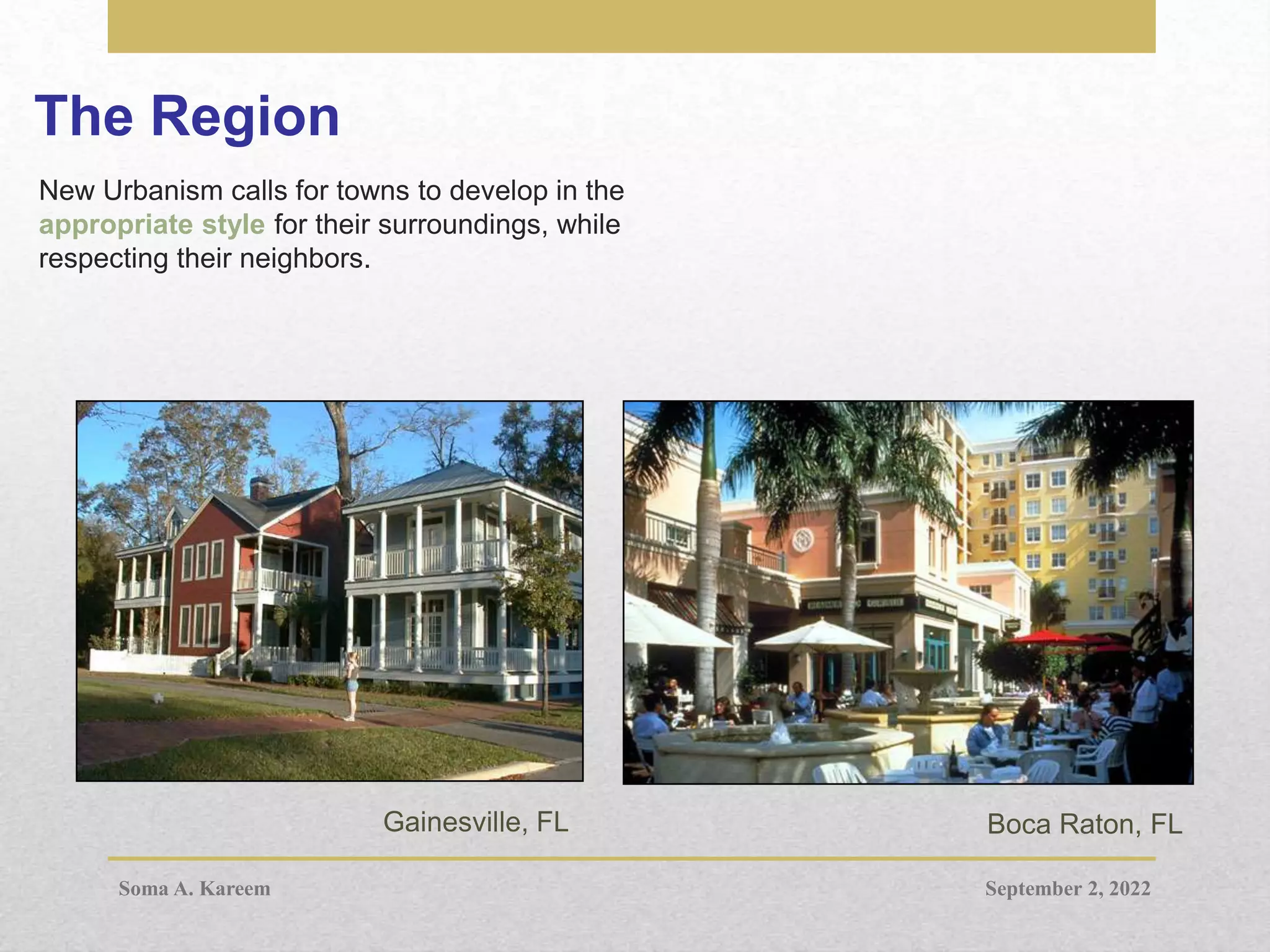
New Urbanism calls for towns to develop in the
appropriate style for their surroundings, while
respecting their neighbors.
Gainesville, FL Boca Raton, FL
September 2, 2022
Soma A. Kareem
The Region
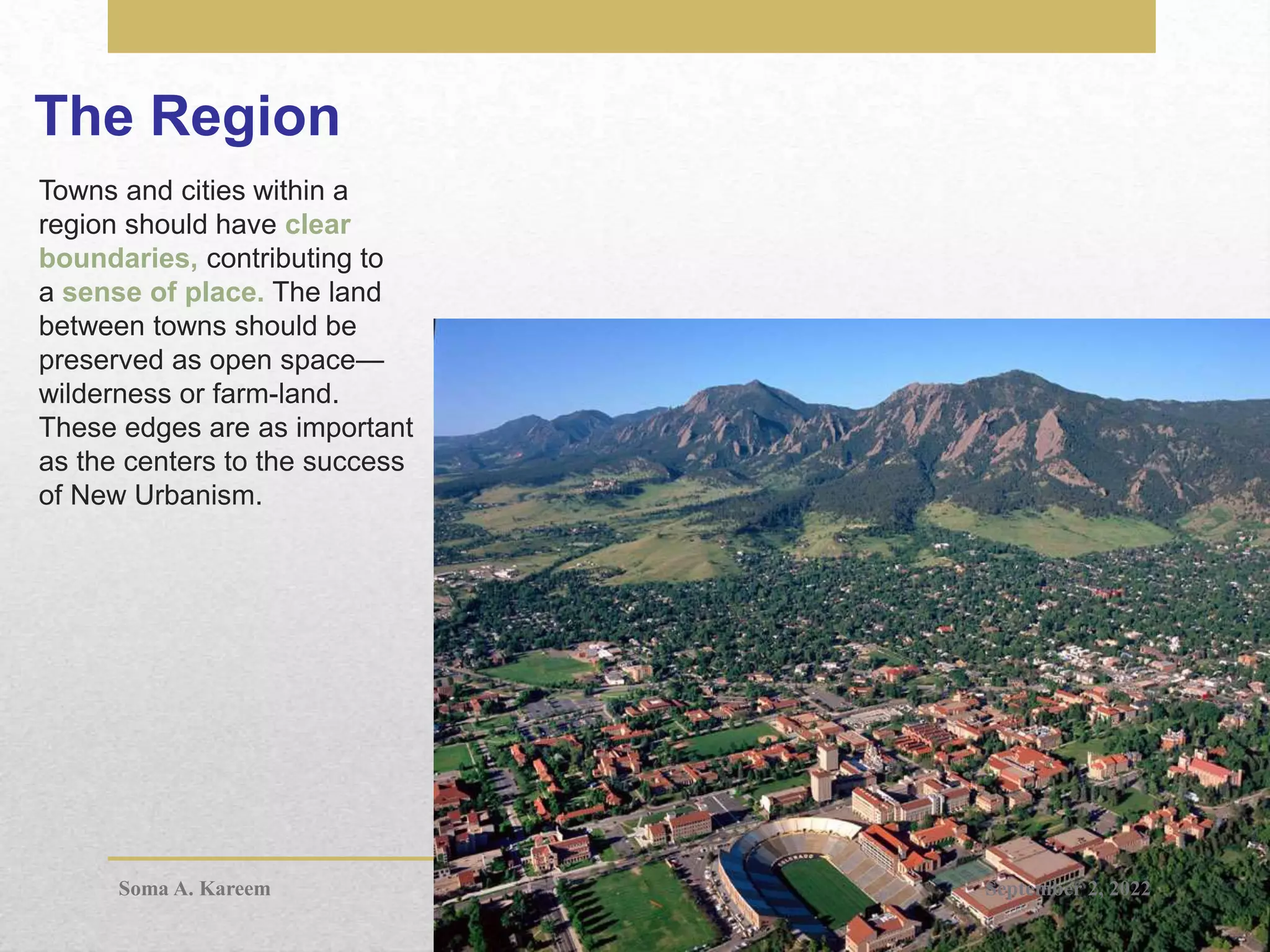
Towns and cities within a
region should have clear
boundaries, contributing to
a sense of place. The land
between towns should be
preserved as open space—
wilderness or farm-land.
These edges are as important
as the centers to the success
of New Urbanism.
September 2, 2022
Soma A. Kareem
The Region
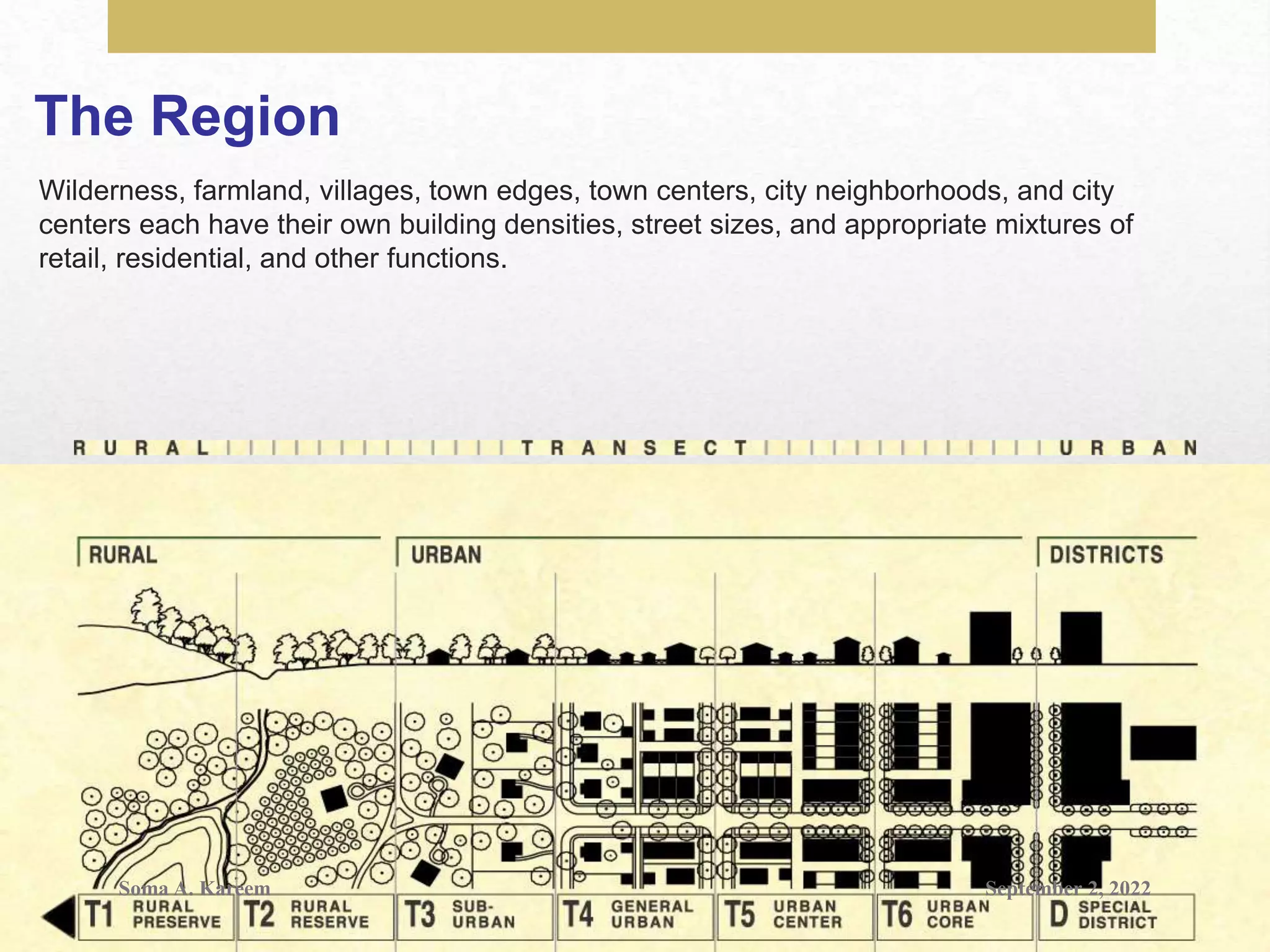
Wilderness, farmland, villages, town edges, town centers, city neighborhoods, and city
centers each have their own building densities, street sizes, and appropriate mixtures of
retail, residential, and other functions.
September 2, 2022
Soma A. Kareem
The Neighborhood
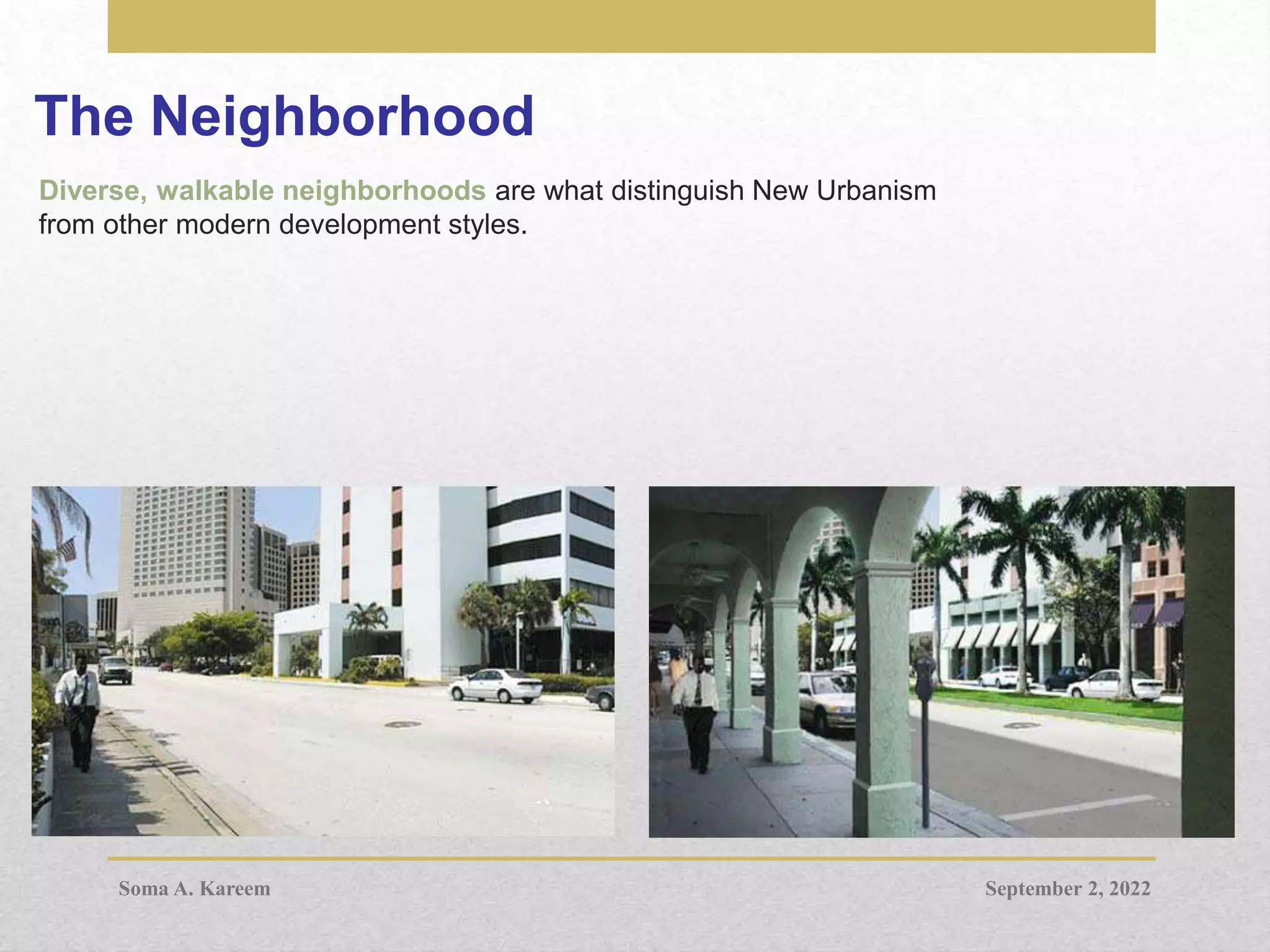
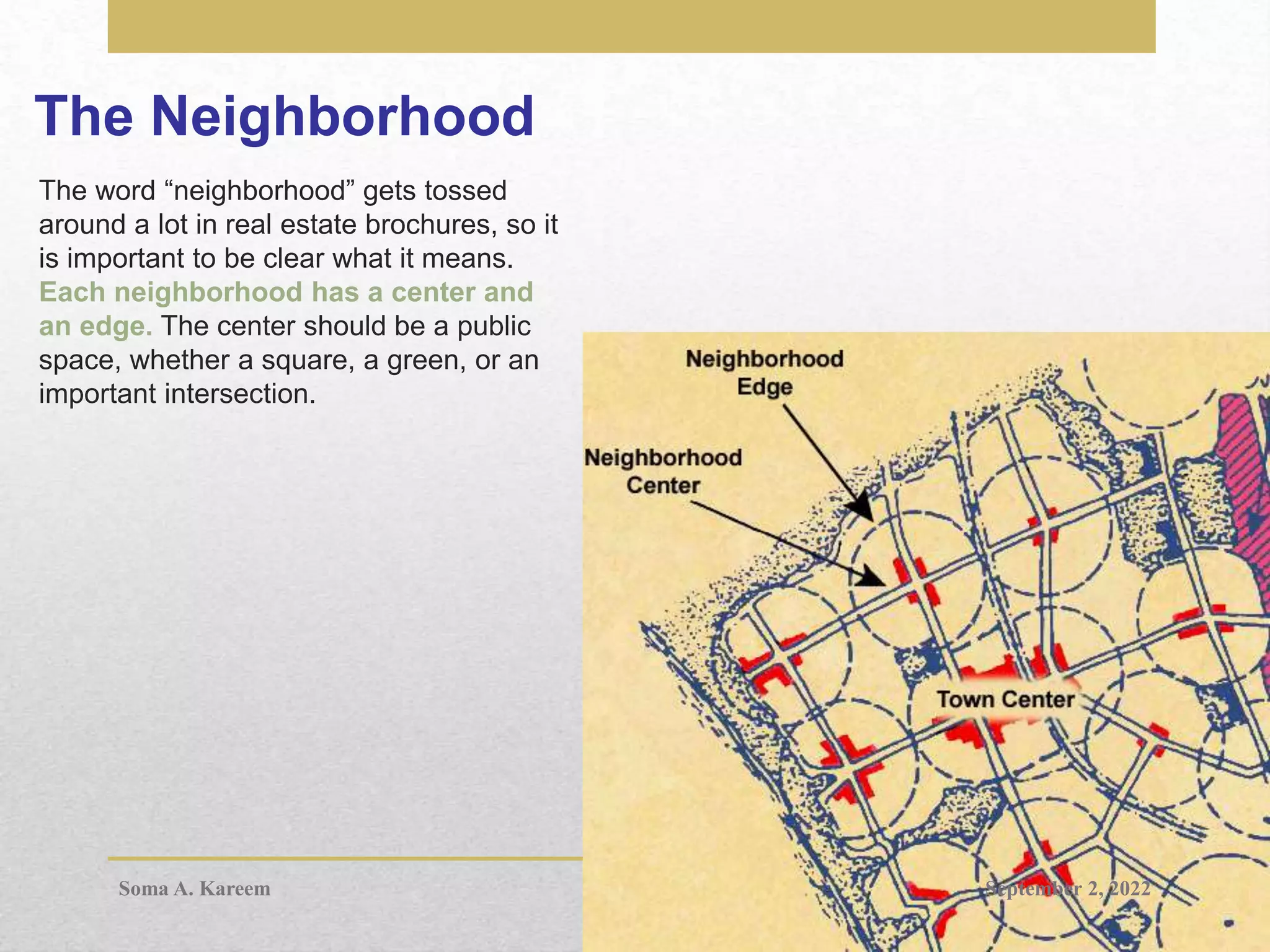
Diverse, walkable neighborhoods are what distinguish New Urbanism
from other modern development styles.
September 2, 2022
Soma A. Kareem
The Neighborhood
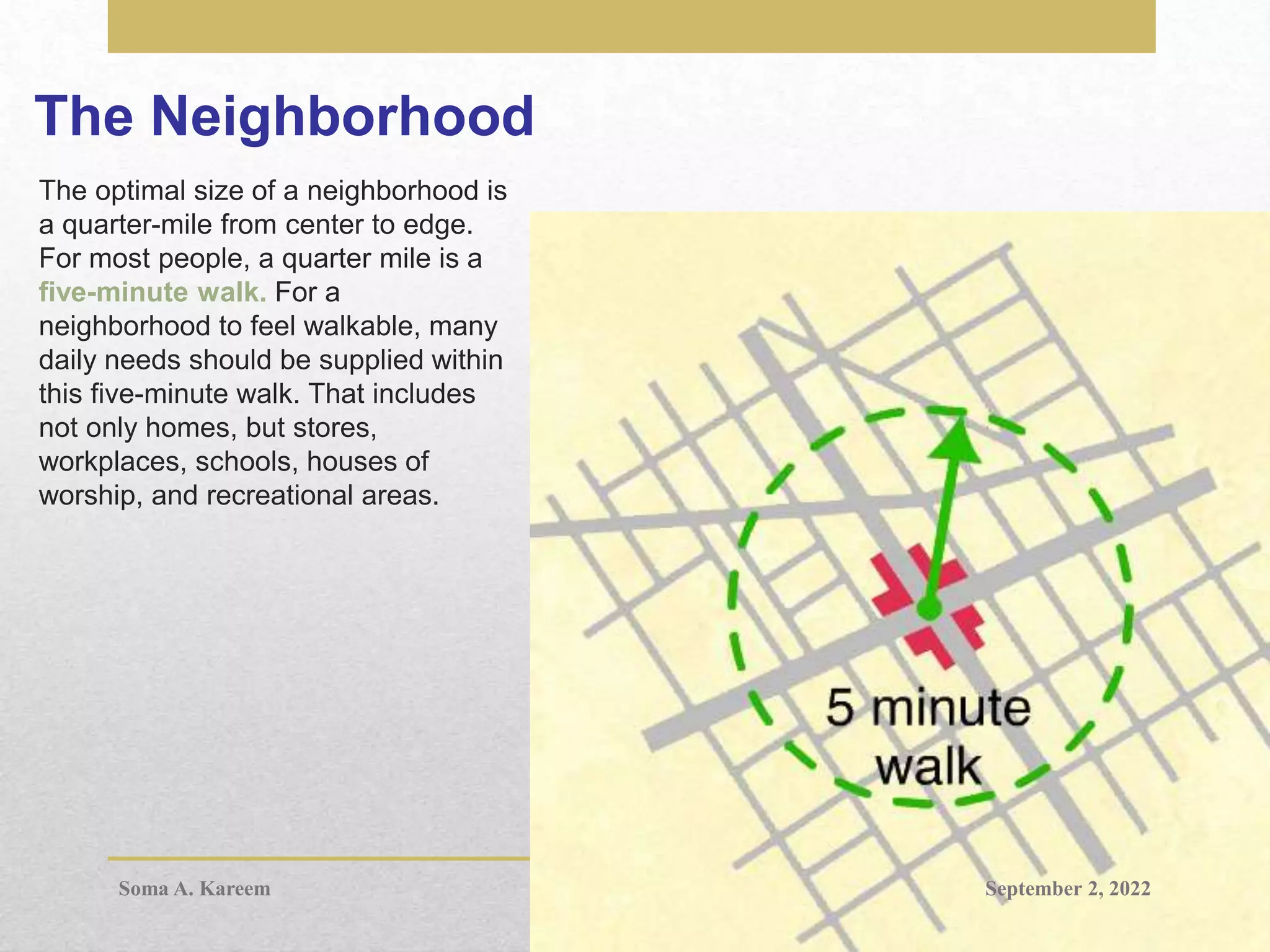
The word “neighborhood” gets tossed
around a lot in real estate brochures, so it
is important to be clear what it means.
Each neighborhood has a center and
an edge. The center should be a public
space, whether a square, a green, or an
important intersection.
September 2, 2022
Soma A. Kareem
The Neighborhood
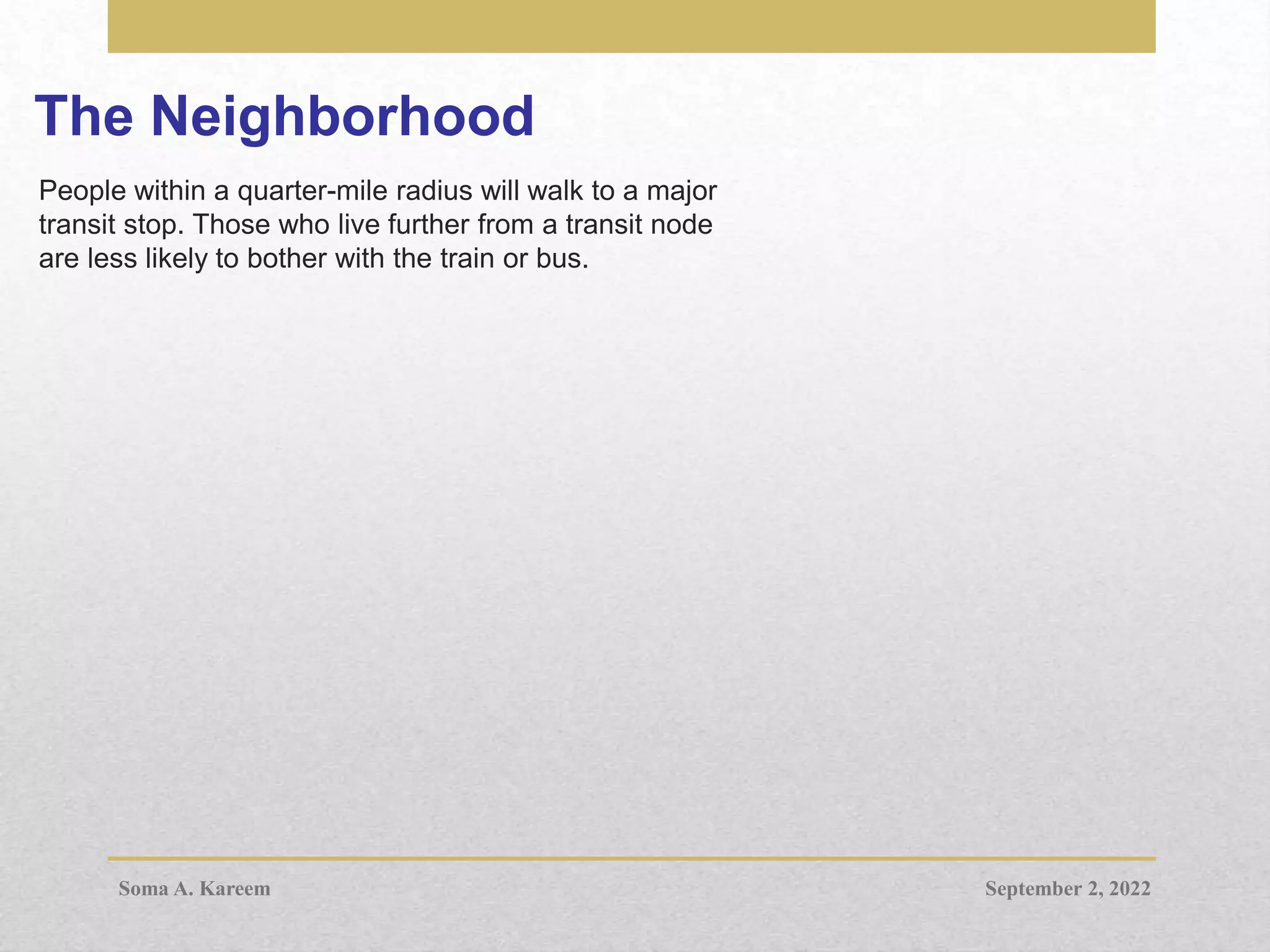
The optimal size of a neighborhood is
a quarter-mile from center to edge.
For most people, a quarter mile is a
five-minute walk. For a
neighborhood to feel walkable, many
daily needs should be supplied within
this five-minute walk. That includes
not only homes, but stores,
workplaces, schools, houses of
worship, and recreational areas.
September 2, 2022
Soma A. Kareem
The Neighborhood
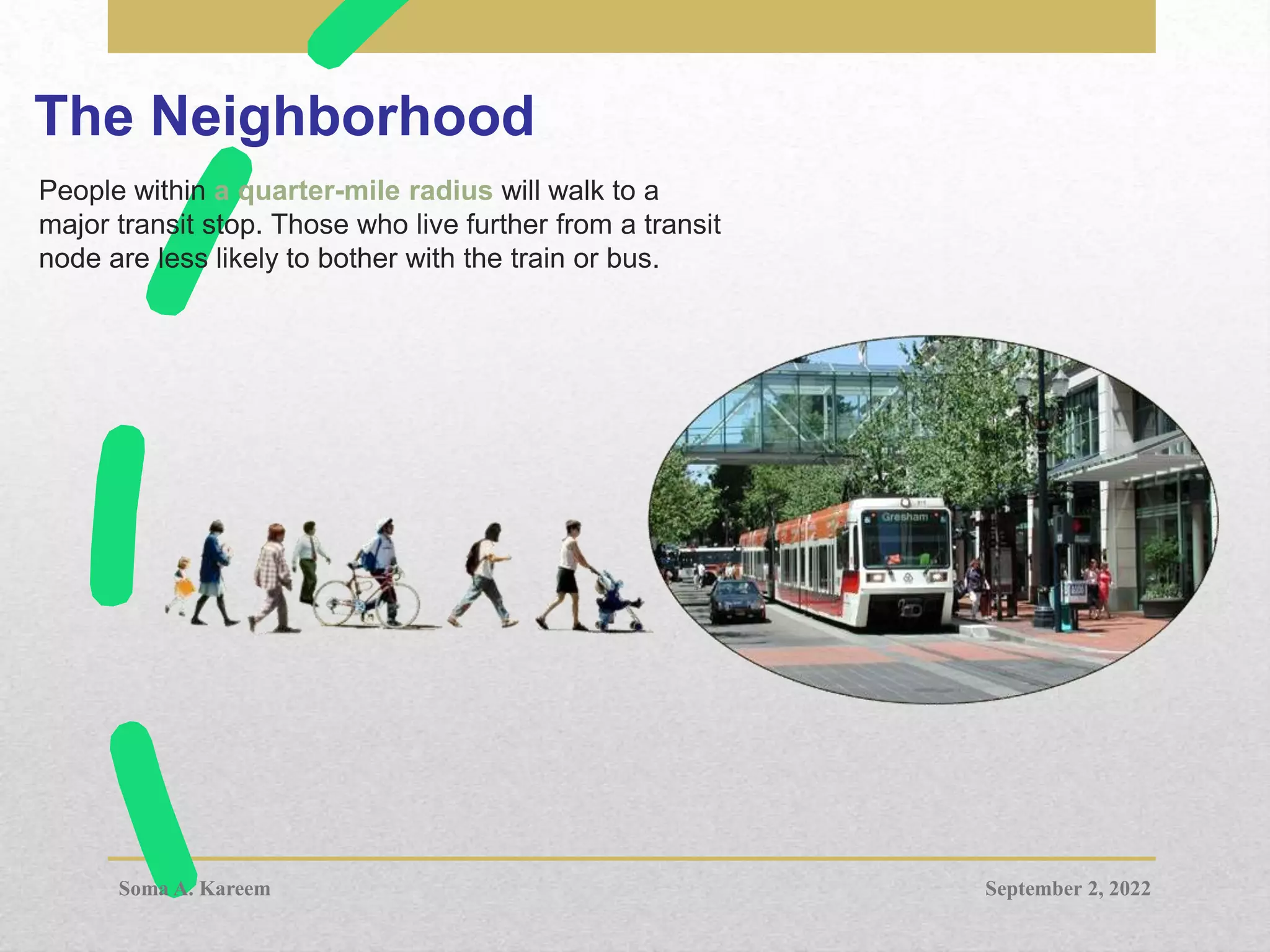
People within a quarter-mile radius will walk to a major
transit stop. Those who live further from a transit node
are less likely to bother with the train or bus.
September 2, 2022
Soma A. Kareem
The Neighborhood
People within a quarter-mile radius will walk to a
major transit stop. Those who live further from a transit
node are less likely to bother with the train or bus.
September 2, 2022
Soma A. Kareem
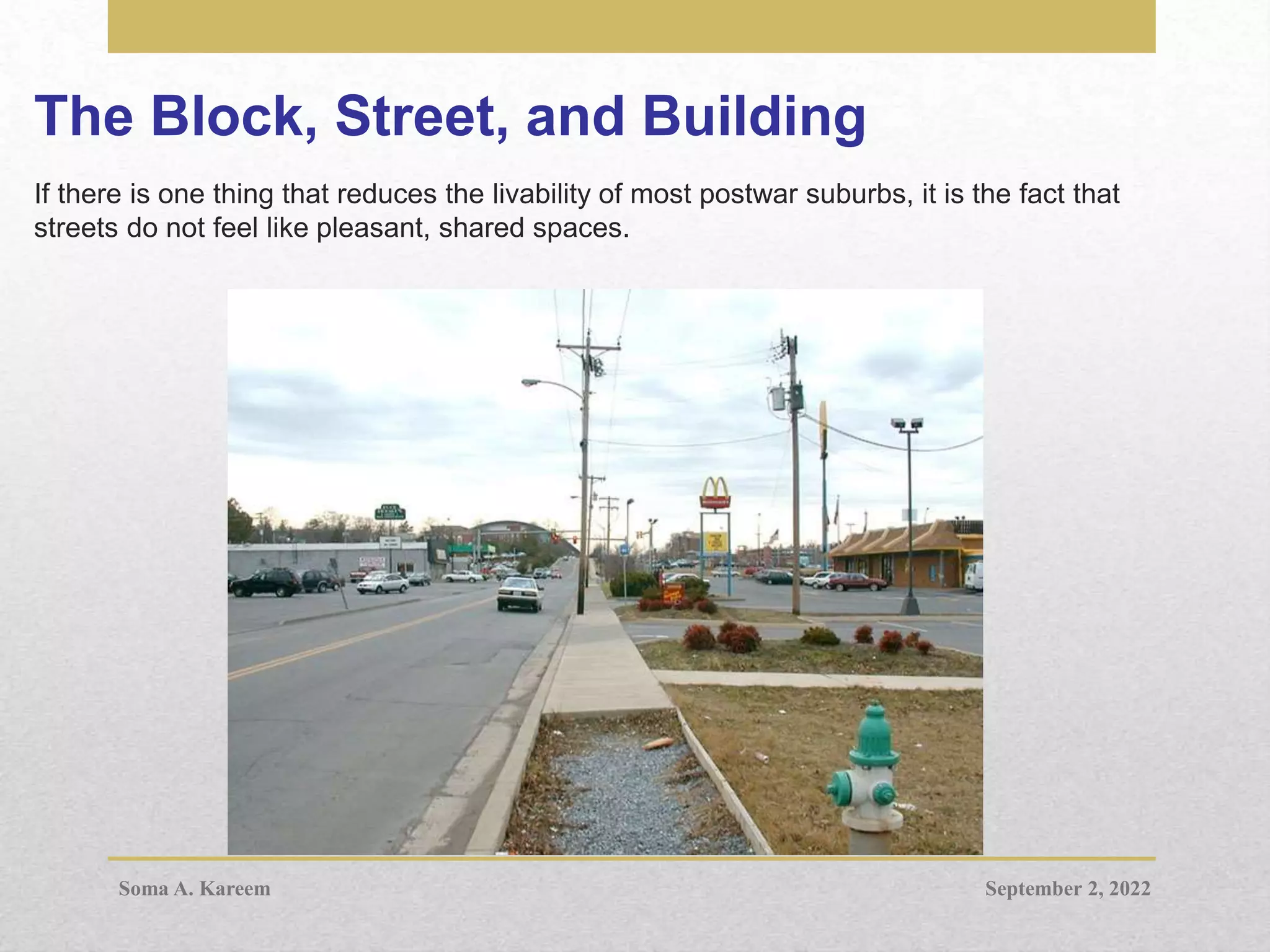
The Block, Street, and Building
If there is one thing that reduces the livability of most postwar suburbs, it is the fact that
streets do not feel like pleasant, shared spaces.
September 2, 2022
Soma A. Kareem
The Block, Street, and Building
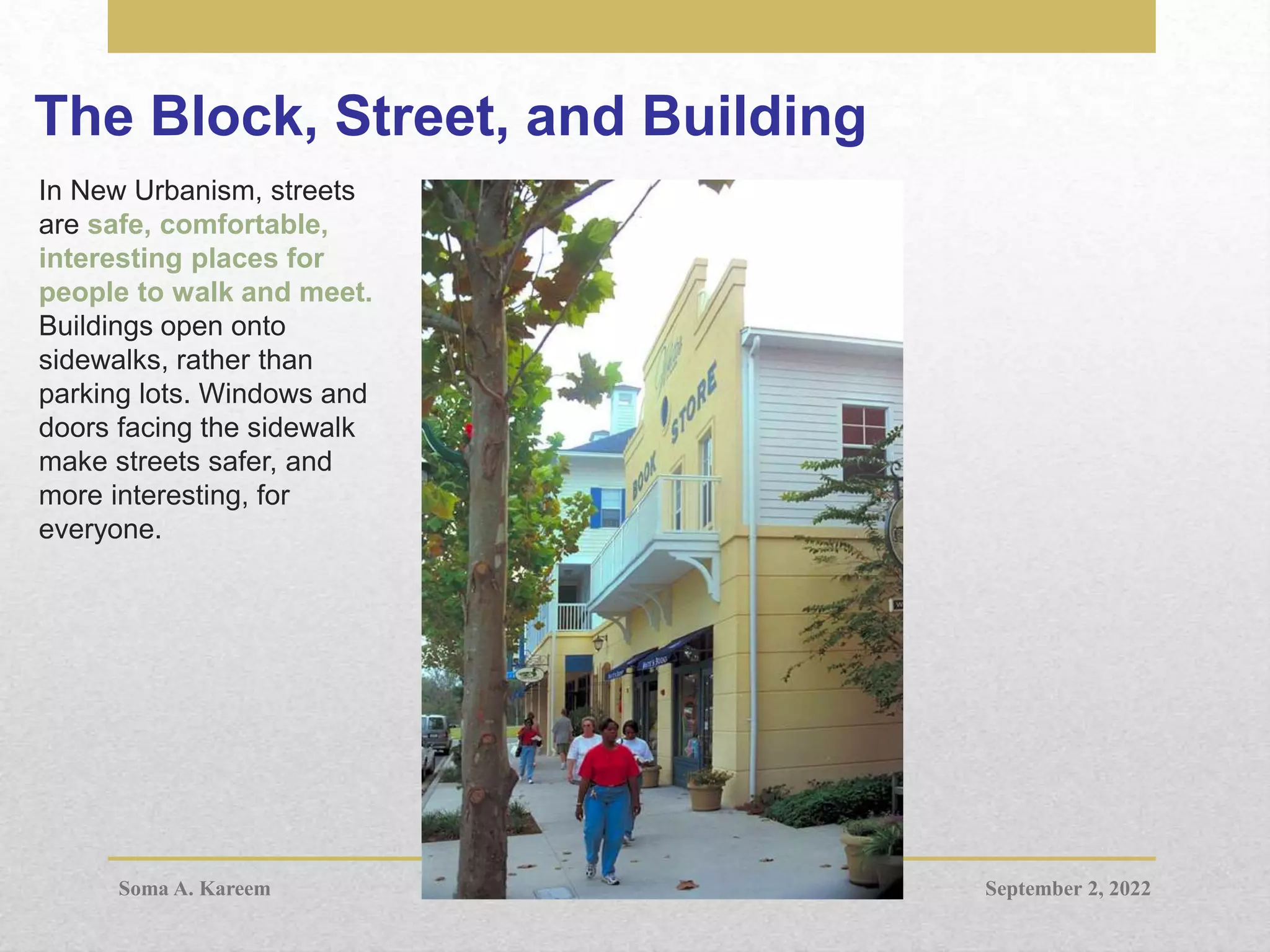
In New Urbanism, streets
are safe, comfortable,
interesting places for
people to walk and meet.
Buildings open onto
sidewalks, rather than
parking lots. Windows and
doors facing the sidewalk
make streets safer, and
more interesting, for
everyone.
September 2, 2022
Soma A. Kareem
The Block, Street, and Building
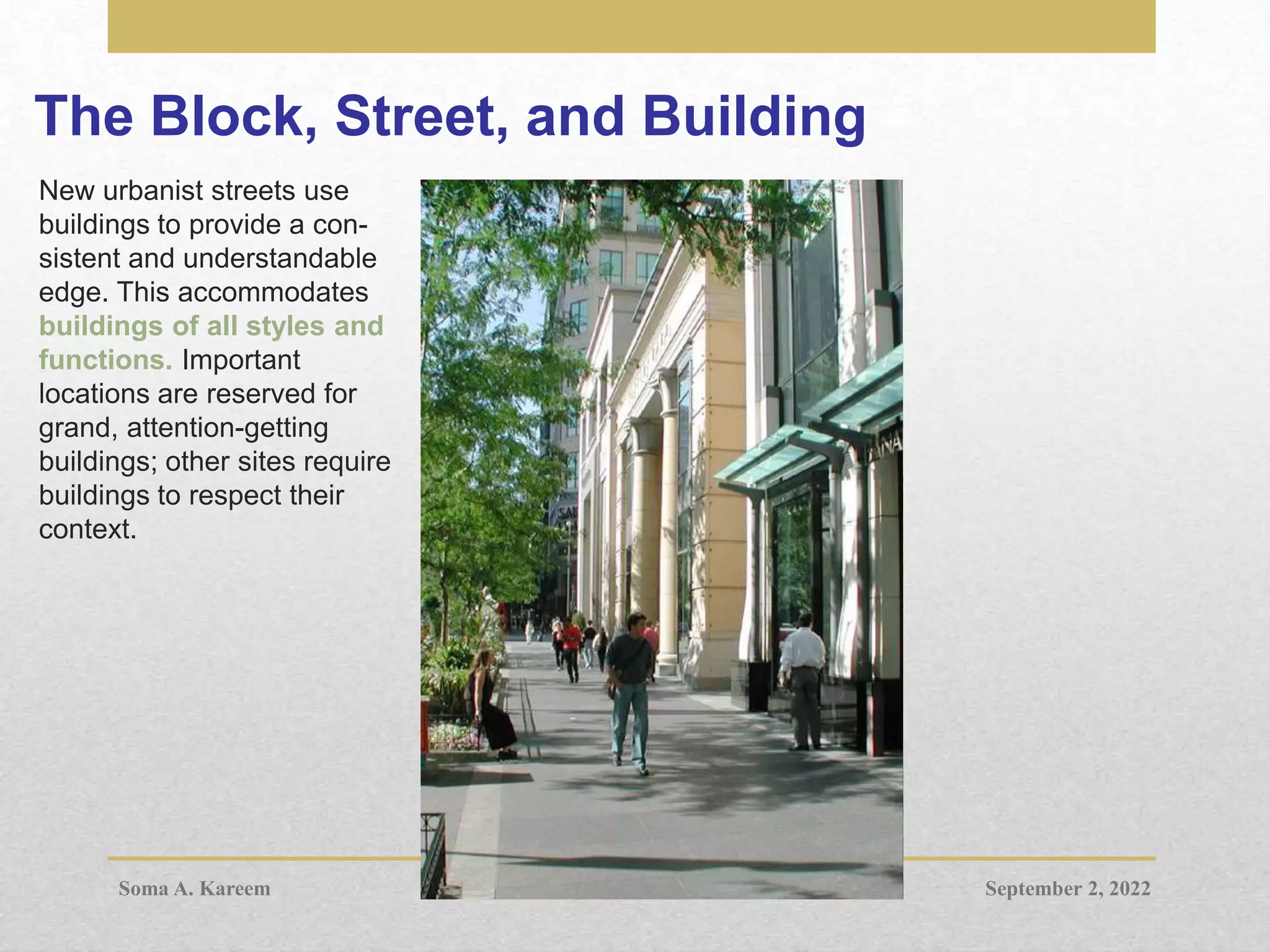
New urbanist streets use
buildings to provide a con-
sistent and understandable
edge. This accommodates
buildings of all styles and
functions. Important
locations are reserved for
grand, attention-getting
buildings; other sites require
buildings to respect their
context.
September 2, 2022
Soma A. Kareem
The Block, Street, and Building
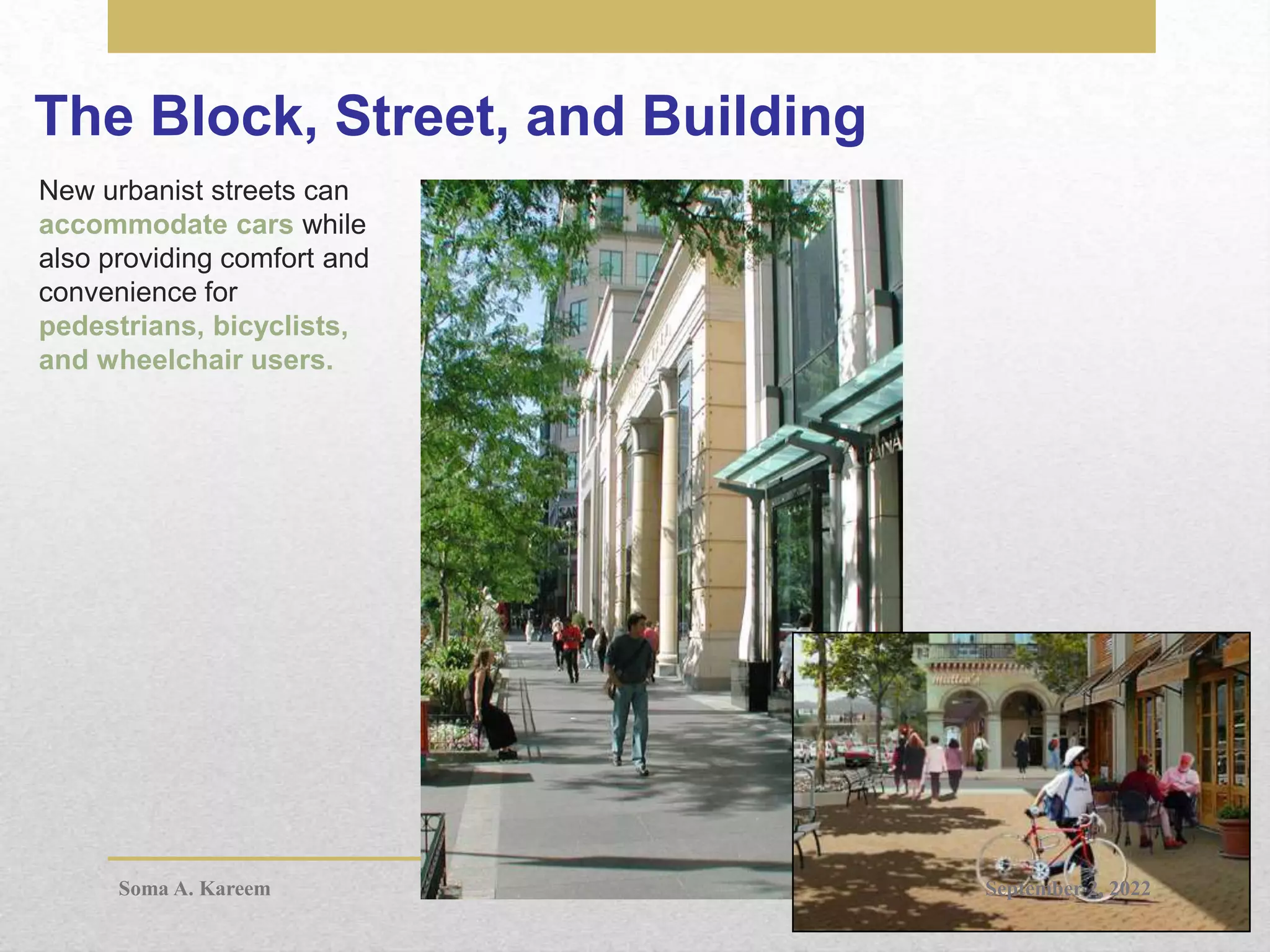
New urbanist streets can
accommodate cars while
also providing comfort and
convenience for
pedestrians, bicyclists,
and wheelchair users.
September 2, 2022
Soma A. Kareem
Early Efforts
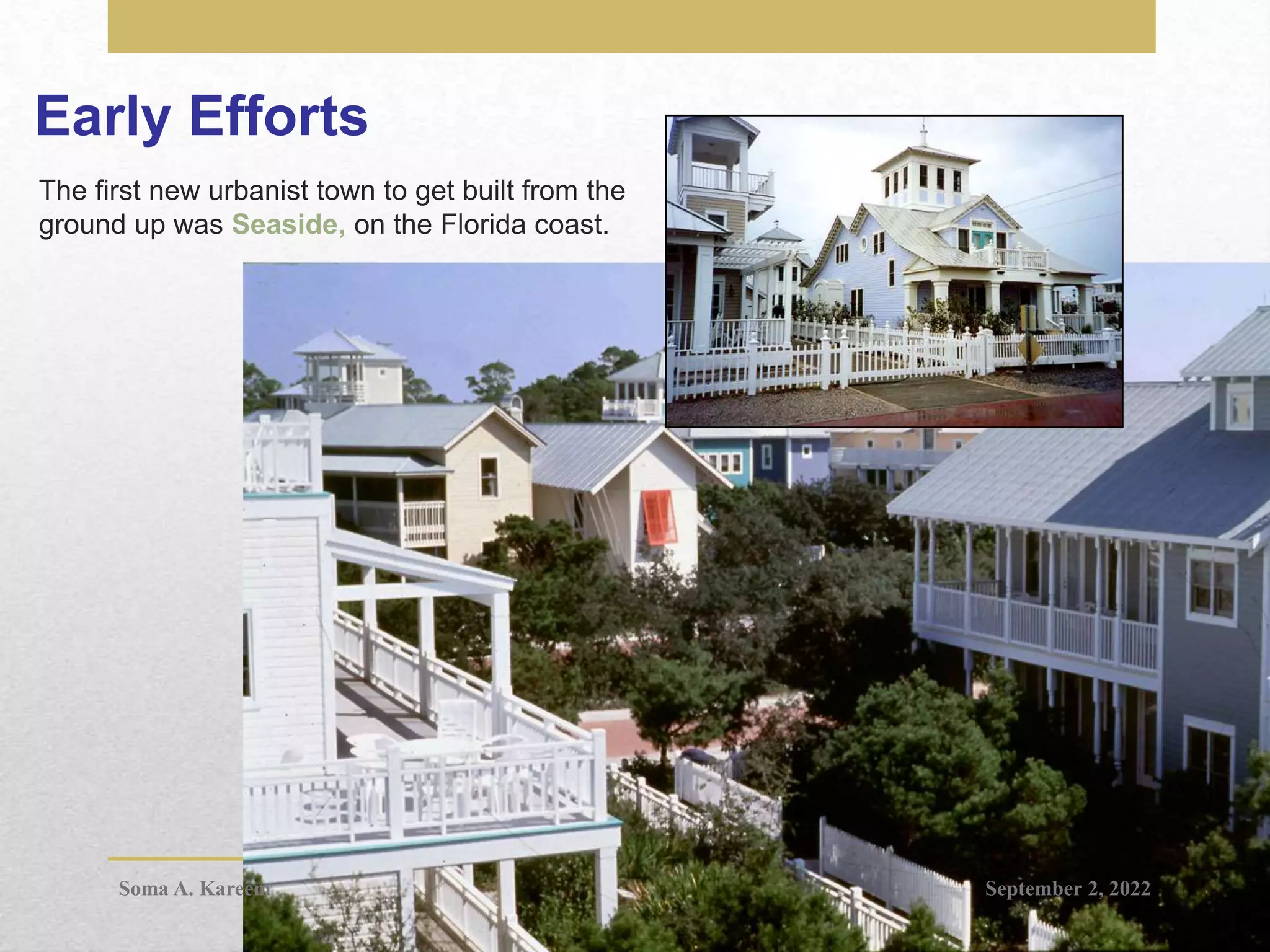
The first new urbanist town to get built from the
ground up was Seaside, on the Florida coast.
September 2, 2022
Soma A. Kareem
Early Efforts
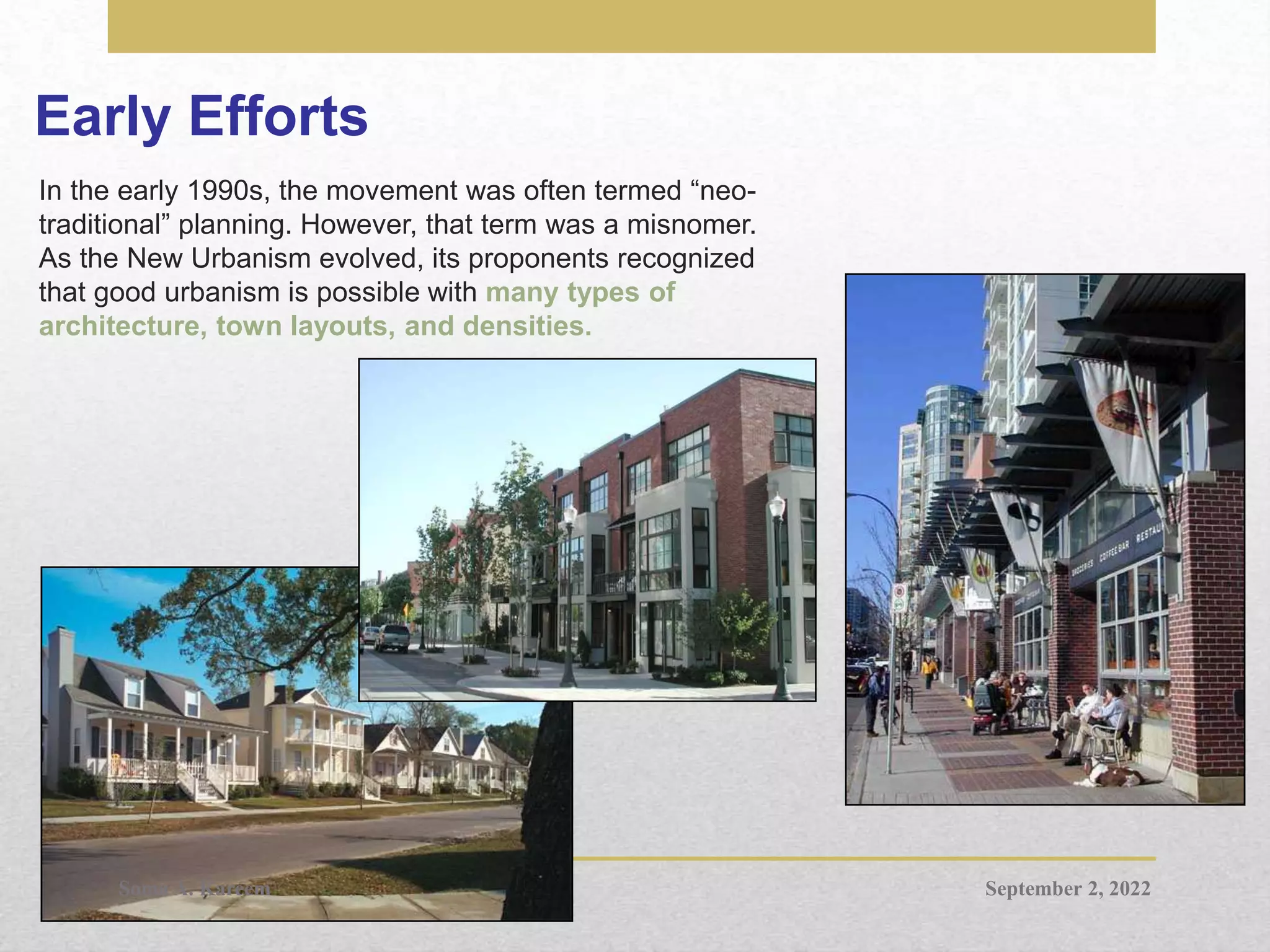
In the early 1990s, the movement was often termed “neo-
traditional” planning. However, that term was a misnomer.
As the New Urbanism evolved, its proponents recognized
that good urbanism is possible with many types of
architecture, town layouts, and densities.
September 2, 2022
Soma A. Kareem
Progress in the Suburbs
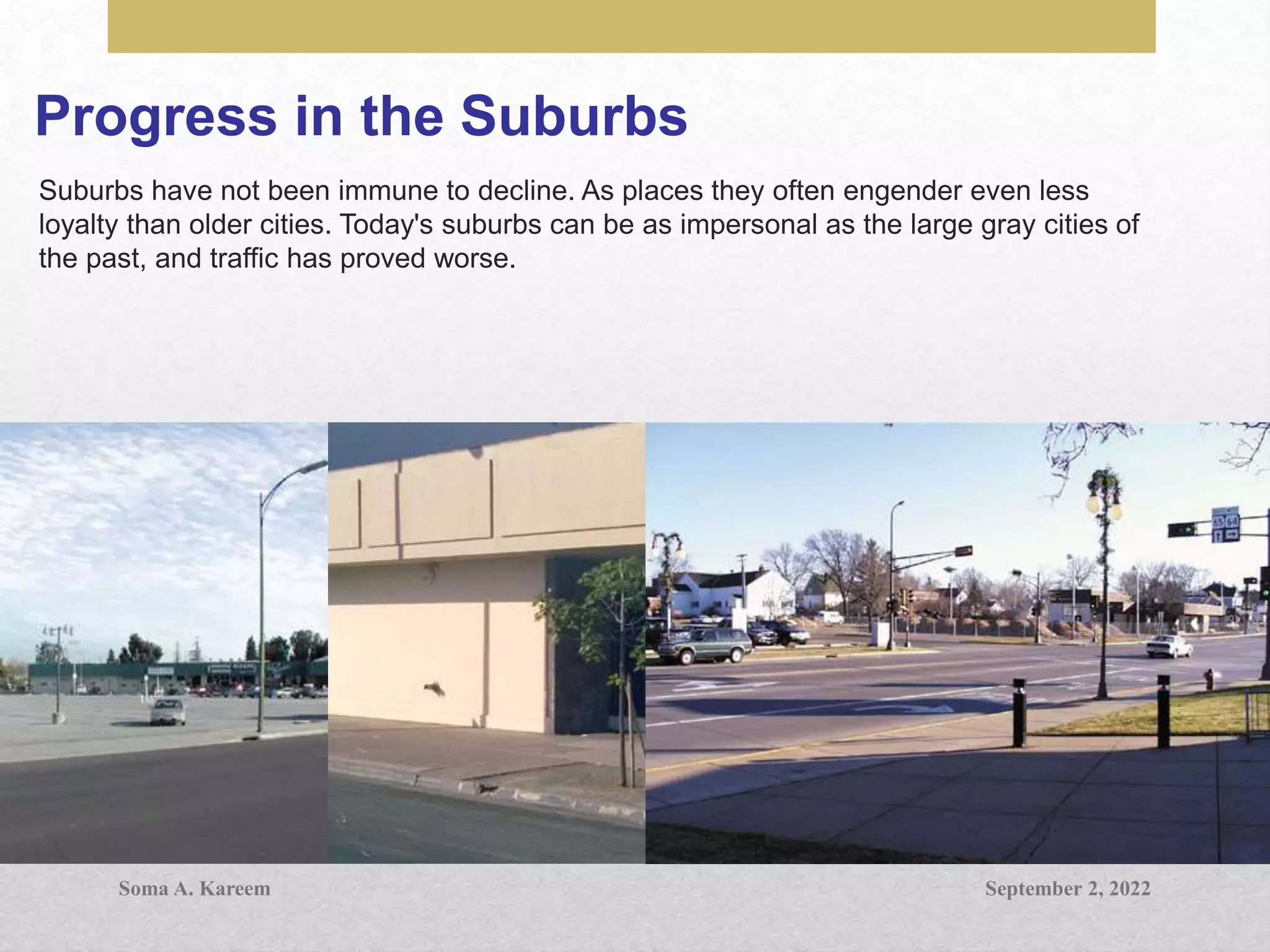
Suburbs have not been immune to decline. As places they often engender even less
loyalty than older cities. Today's suburbs can be as impersonal as the large gray cities of
the past, and traffic has proved worse.
September 2, 2022
Soma A. Kareem
Progress in the Suburbs
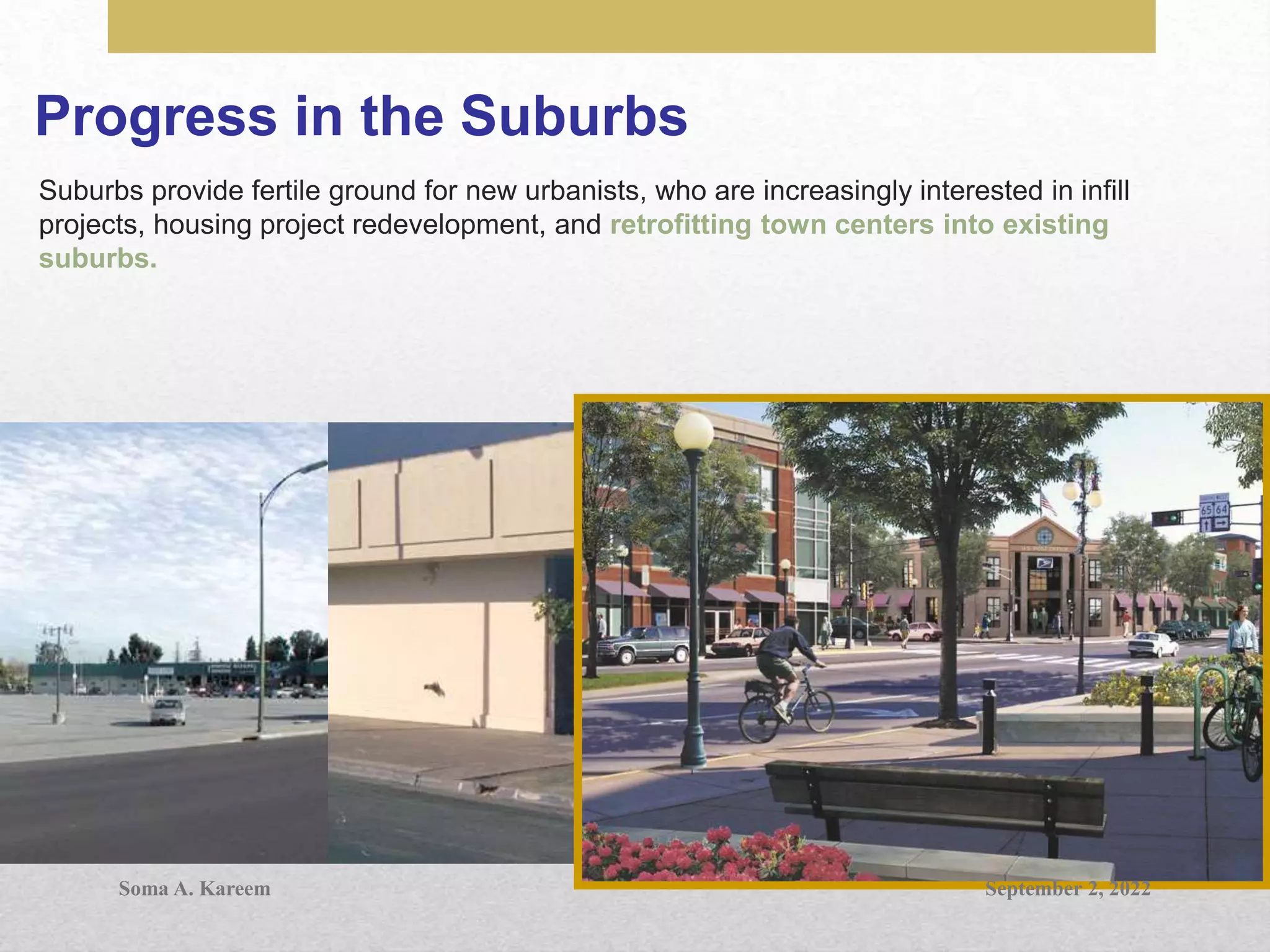
Suburbs provide fertile ground for new urbanists, who are increasingly interested in infill
projects, housing project redevelopment, and retrofitting town centers into existing
suburbs.
September 2, 2022
Soma A. Kareem
Progress in the Suburbs
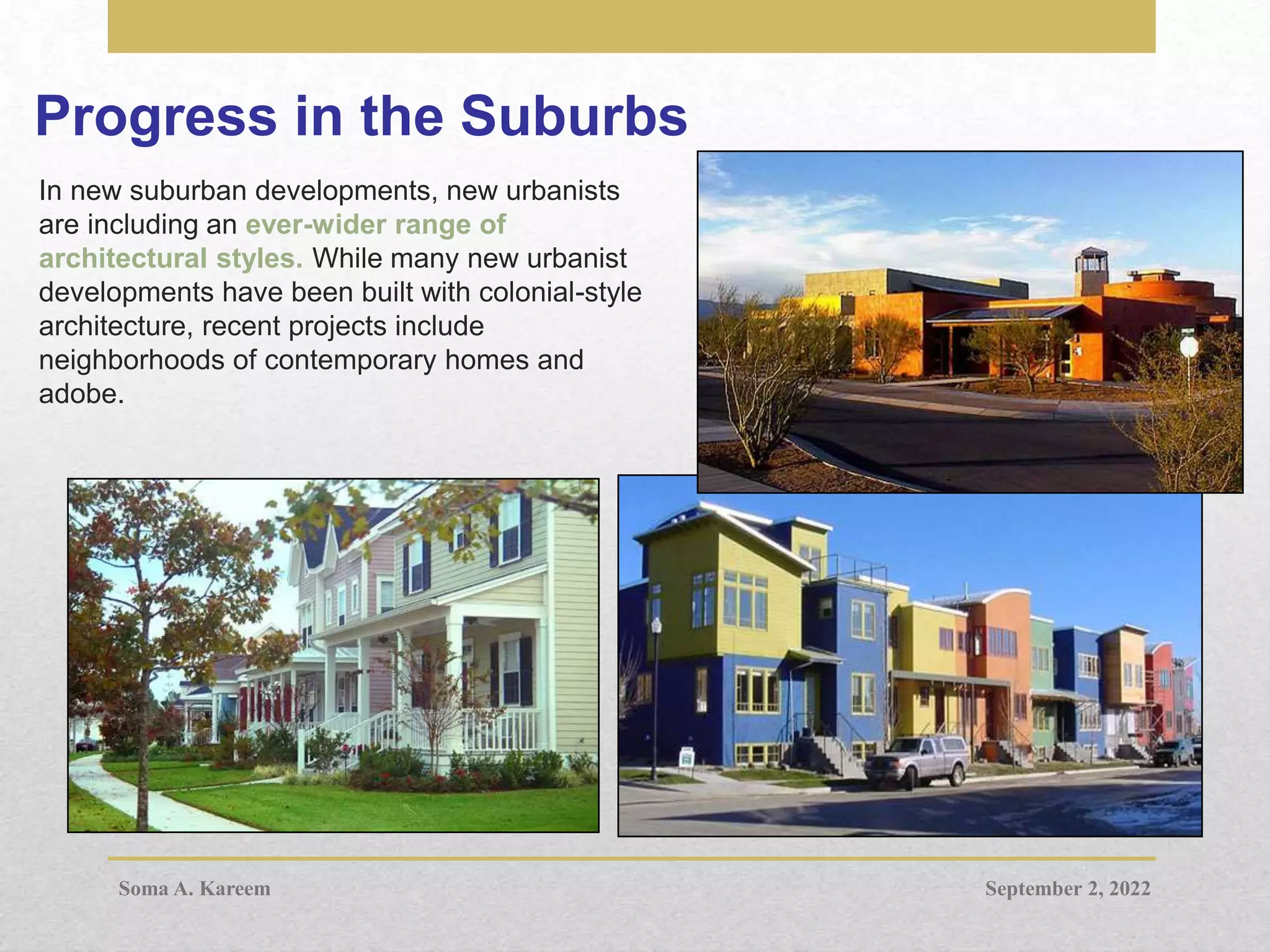
In new suburban developments, new urbanists
are including an ever-wider range of
architectural styles. While many new urbanist
developments have been built with colonial-style
architecture, recent projects include
neighborhoods of contemporary homes and
adobe.
September 2, 2022
Soma A. Kareem
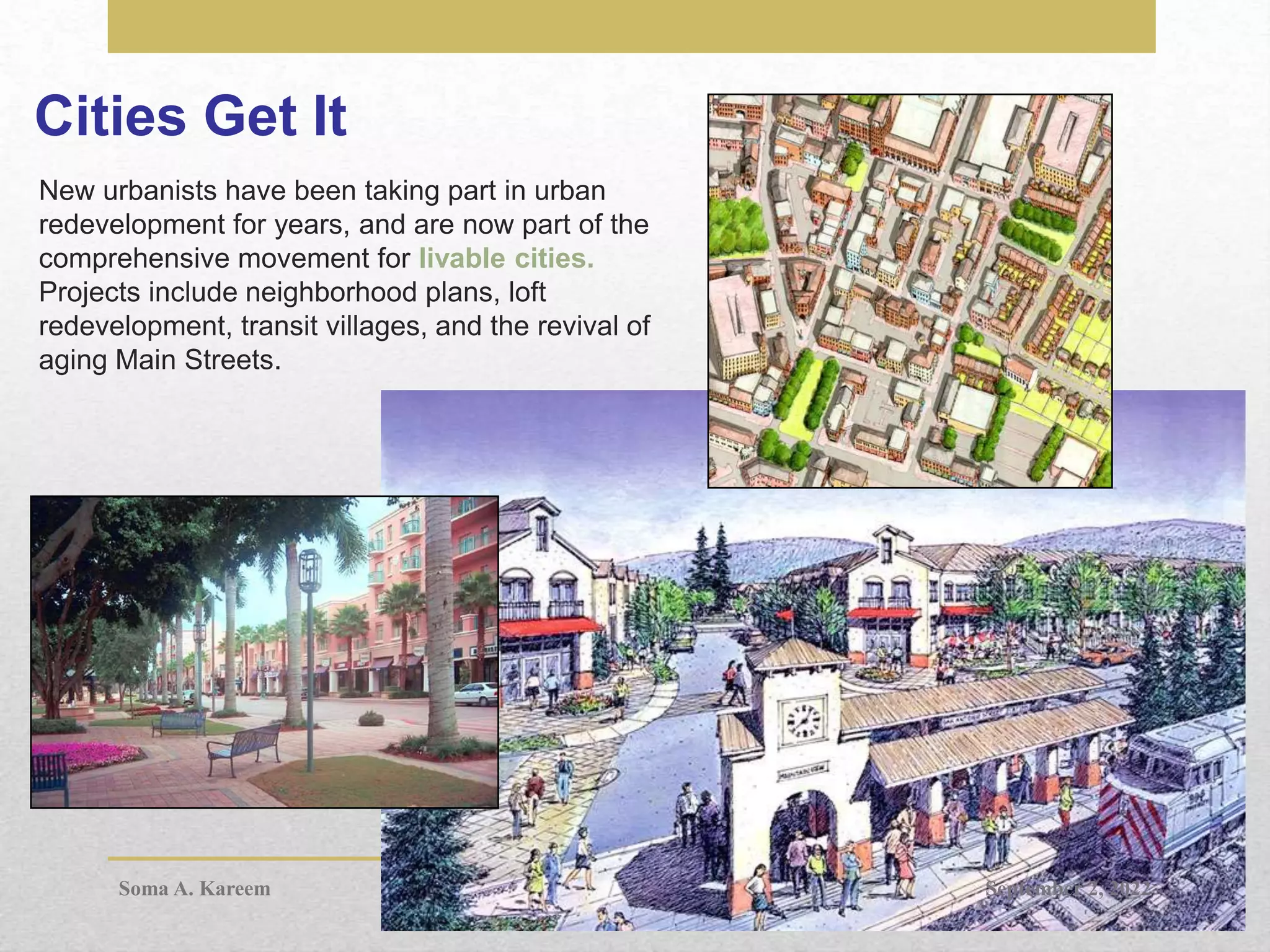
Cities Get It
New urbanists have been taking part in urban
redevelopment for years, and are now part of the
comprehensive movement for livable cities.
Projects include neighborhood plans, loft
redevelopment, transit villages, and the revival of
aging Main Streets.
September 2, 2022
Soma A. Kareem
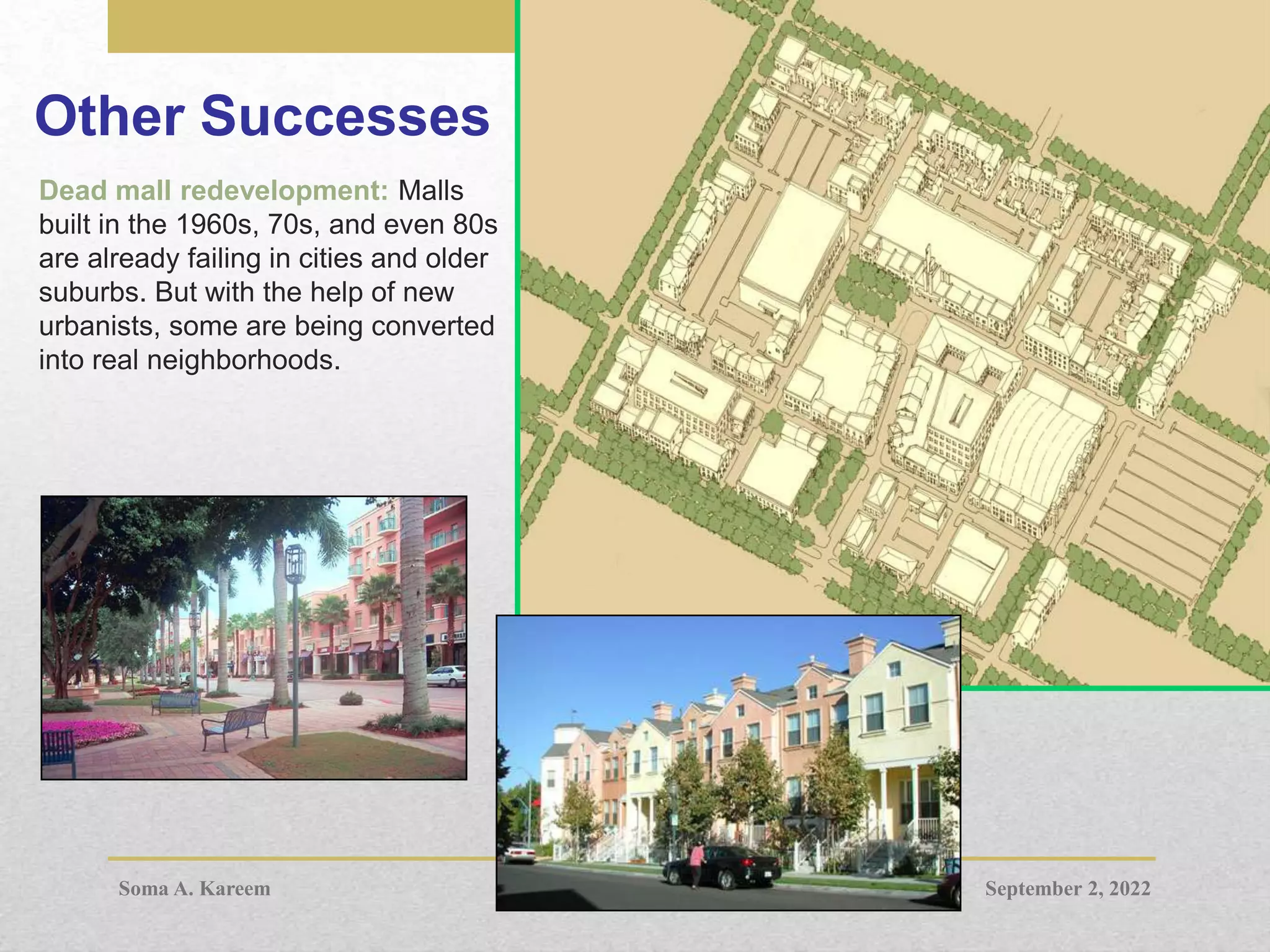
Other Successes
Dead mall redevelopment: Malls
built in the 1960s, 70s, and even 80s
are already failing in cities and older
suburbs. But with the help of new
urbanists, some are being converted
into real neighborhoods.
September 2, 2022
Soma A. Kareem
Thank you for your attention…
September 2, 2022
Soma A. Kareem

principles-of-planning-2019-2nd- (2).ppt

  • 1.
    ARCH 322 PRINCIPLES OFPLANNING I 1st Lecture New Urbanism September 2, 2022 Soma A. Kareem Soma Abdulsalam Kareem
  • 2.
    September 2, 2022 SomaA. Kareem Syllabus
  • 3.
    September 2, 2022 SomaA. Kareem Syllabus
  • 4.
  • 5.
  • 6.
    Urbanism •The characteristic wayof life of city dwellers. •The study of the physical needs of urban societies. New Urbanism is an Urban design movement which promotes walk-able neighborhoods containing a range of housing and job types. It arose in the United States in the early 1980s, and has gradually influenced many aspects of real estate development, urban planning, and municipal land-use strategies. September 2, 2022 Soma A. Kareem
  • 7.
    Principles of NewUrbanism The principles of New Urbanism can be applied increasingly to projects at the full range of scales from a single building to an entire community. 1. Walkability 2. Connectivity 3. Mixed-Use & Diversity 4. Mixed Housing 5. Quality Architecture & Urban Design 6. Traditional Neighborhood Structure 7. Increased Density 8. Smart Transportation 9. Sustainability 10. Quality of Life September 2, 2022 Soma A. Kareem
  • 8.
    Principles of NewUrbanism 1. Walkability • Most things within a 10-minute walk of home and work. • Pedestrian friendly street design (buildings close to street; porches, windows & doors; tree-lined streets; on street parking; hidden parking lots; garages in rear lane; narrow, slow speed streets). • Pedestrian streets free of cars in special cases. September 2, 2022 Soma A. Kareem
  • 9.
    Across North America,and around the world, an urban design movement called New Urbanism is changing the way our cities and towns are built. Giving Physical Shape to Community September 2, 2022 Soma A. Kareem
  • 10.
    Giving Physical Shapeto Community New urbanist developments are walkable neighborhoods, rather than large, single-use places with streets hostile to pedestrians. September 2, 2022 Soma A. Kareem
  • 11.
    Principles of NewUrbanism 2. Connectivity • Interconnected street grid network disperses traffic & eases walking. • A hierarchy of narrow streets, boulevards, and alleys. • High quality pedestrian network and public realm makes walking pleasurable September 2, 2022 Soma A. Kareem
  • 12.
    Giving Physical Shapeto Community Careful, participatory planning ensures that everyone in the neighborhood has easy access to the necessities of life, making life easier for kids, the elderly, and people who don’t want to drive. September 2, 2022 Soma A. Kareem
  • 13.
    Principles of NewUrbanism 3. Mixed-Use & Diversity • A mix of shops, offices, apartments, and homes on site. Mixed- use within neighborhoods, within blocks, and within buildings. • Diversity of people - of ages, income levels, cultures, and races. 4. Mixed Housing • A range of types, sizes and prices in closer proximity September 2, 2022 Soma A. Kareem
  • 14.
    Giving Physical Shapeto Community New Urbanism provides a range of housing choices, from apartments over storefronts to single-family homes with yards. September 2, 2022 Soma A. Kareem
  • 15.
    Principles of NewUrbanism 5. Quality Architecture & Urban Design • Emphasis on beauty, aesthetics, human comfort, and creating a sense of place; Special placement of civic uses and sites within community. Human scale architecture & beautiful surroundings nourish the human spirit September 2, 2022 Soma A. Kareem
  • 16.
    Response to aProblem Since World War II, cities have been spreading ever-outward. Strip malls, parking lots, highways, and housing tracts have sprawled over the landscape. September 2, 2022 Soma A. Kareem
  • 17.
    Principles of NewUrbanism 6. Traditional Neighborhood Structure • Center and edge. • Public space at center. • Importance of quality public realm; public open space designed as civic art. • Contains a range of uses and densities within 10-minute walk September 2, 2022 Soma A. Kareem
  • 18.
    6. Traditional NeighborhoodStructure • Transect planning: Highest densities at town center; progressively less dense towards the edge. The transect is an analytical system that conceptualizes mutually reinforcing elements, creating a series of specific natural habitats and/or urban lifestyle settings. The Transect integrates environmental methodology for habitat assessment with zoning methodology for community design. The professional boundary between the natural and man-made disappears, enabling environmentalists to assess the design of the human habitat and the urbanists to support the viability of nature. This urban-to-rural transect hierarchy has appropriate building and street types for each area along the continuum. September 2, 2022 Soma A. Kareem
  • 19.
    Principles of NewUrbanism 7. Increased Density • More buildings, residences, shops, and services closer together for ease of walking, to enable a more efficient use of services and resources, and to create a more convenient, enjoyable place to live. • New Urbanism design principles are applied at the full range of densities from small towns, to large cities. • A network of high-quality trains connecting cities, towns, and neighborhoods together. • Pedestrian-friendly design that encourages a greater use of bicycles, rollerblades, scooters, and walking as daily transportation. 8. Smart Transportation September 2, 2022 Soma A. Kareem
  • 20.
    Principles of NewUrbanism 9. Sustainability • Minimal environmental impact of development and its operations • Eco-friendly technologies, respect for ecology and value of natural systems • Energy efficiency • Less use of finite fuels • More local production • More walking, less driving • Taken together these add up to a high quality of life well worth living, and create places that enrich, uplift, and inspire the human spirit. 10. Quality of Life September 2, 2022 Soma A. Kareem
  • 21.
    Response to aProblem Even older suburbs have suffered as new ones continue to spring up, September 2, 2022 Soma A. Kareem
  • 22.
    What’s Old inNew Urbanism Many of the planning ideas behind New Urbanism are not new. September 2, 2022 Soma A. Kareem
  • 23.
    Where it’s needed Infact, New Urbanism guides development at all scales, from the building to the region. New Urbanism is often associated with new towns such as Seaside, Florida. September 2, 2022 Soma A. Kareem
  • 24.
    Where it’s needed Itincludes sizable infill projects within existing cities and towns. September 2, 2022 Soma A. Kareem
  • 25.
    Where it’s needed OrNew Urbanism can be small projects on individual blocks September 2, 2022 Soma A. Kareem
  • 26.
    Where it’s needed Itcan also apply to redeveloped neighborhoods. September 2, 2022 Soma A. Kareem
  • 27.
    The Principles ofNew Urbanism The principles of the New Urbanism are defined by a Charter, which was developed between 1993 and 1996 by a broad range of architects, planners, interested citizens, scholars, elected officials, and developers. It was ratified at the fourth annual Congress, the annual meeting sponsored by CNU. September 2, 2022 Soma A. Kareem
  • 28.
    The Principles ofNew Urbanism Its principles are divided into three categories: • The Region: Metropolis, City and Town • The Neighborhood, the District, and the Corridor • The Block, the Street, and the Building September 2, 2022 Soma A. Kareem
  • 29.
    The Region Towns withina region need a comprehensive metropolitan strategy in order to prosper. Each town should have both homes—for people of all incomes—and jobs. That way, residents aren’t forced to travel far to work. Each town also needs a discrete sense of place. Homes Jobs September 2, 2022 Soma A. Kareem
  • 30.
    The Region New Urbanismcalls for towns to develop in the appropriate style for their surroundings, while respecting their neighbors. Gainesville, FL Boca Raton, FL September 2, 2022 Soma A. Kareem
  • 31.
    The Region Towns andcities within a region should have clear boundaries, contributing to a sense of place. The land between towns should be preserved as open space— wilderness or farm-land. These edges are as important as the centers to the success of New Urbanism. September 2, 2022 Soma A. Kareem
  • 32.
    The Region Wilderness, farmland,villages, town edges, town centers, city neighborhoods, and city centers each have their own building densities, street sizes, and appropriate mixtures of retail, residential, and other functions. September 2, 2022 Soma A. Kareem
  • 33.
    The Neighborhood Diverse, walkableneighborhoods are what distinguish New Urbanism from other modern development styles. September 2, 2022 Soma A. Kareem
  • 34.
    The Neighborhood The word“neighborhood” gets tossed around a lot in real estate brochures, so it is important to be clear what it means. Each neighborhood has a center and an edge. The center should be a public space, whether a square, a green, or an important intersection. September 2, 2022 Soma A. Kareem
  • 35.
    The Neighborhood The optimalsize of a neighborhood is a quarter-mile from center to edge. For most people, a quarter mile is a five-minute walk. For a neighborhood to feel walkable, many daily needs should be supplied within this five-minute walk. That includes not only homes, but stores, workplaces, schools, houses of worship, and recreational areas. September 2, 2022 Soma A. Kareem
  • 36.
    The Neighborhood People withina quarter-mile radius will walk to a major transit stop. Those who live further from a transit node are less likely to bother with the train or bus. September 2, 2022 Soma A. Kareem
  • 37.
    The Neighborhood People withina quarter-mile radius will walk to a major transit stop. Those who live further from a transit node are less likely to bother with the train or bus. September 2, 2022 Soma A. Kareem
  • 38.
    The Block, Street,and Building If there is one thing that reduces the livability of most postwar suburbs, it is the fact that streets do not feel like pleasant, shared spaces. September 2, 2022 Soma A. Kareem
  • 39.
    The Block, Street,and Building In New Urbanism, streets are safe, comfortable, interesting places for people to walk and meet. Buildings open onto sidewalks, rather than parking lots. Windows and doors facing the sidewalk make streets safer, and more interesting, for everyone. September 2, 2022 Soma A. Kareem
  • 40.
    The Block, Street,and Building New urbanist streets use buildings to provide a con- sistent and understandable edge. This accommodates buildings of all styles and functions. Important locations are reserved for grand, attention-getting buildings; other sites require buildings to respect their context. September 2, 2022 Soma A. Kareem
  • 41.
    The Block, Street,and Building New urbanist streets can accommodate cars while also providing comfort and convenience for pedestrians, bicyclists, and wheelchair users. September 2, 2022 Soma A. Kareem
  • 42.
    Early Efforts The firstnew urbanist town to get built from the ground up was Seaside, on the Florida coast. September 2, 2022 Soma A. Kareem
  • 43.
    Early Efforts In theearly 1990s, the movement was often termed “neo- traditional” planning. However, that term was a misnomer. As the New Urbanism evolved, its proponents recognized that good urbanism is possible with many types of architecture, town layouts, and densities. September 2, 2022 Soma A. Kareem
  • 44.
    Progress in theSuburbs Suburbs have not been immune to decline. As places they often engender even less loyalty than older cities. Today's suburbs can be as impersonal as the large gray cities of the past, and traffic has proved worse. September 2, 2022 Soma A. Kareem
  • 45.
    Progress in theSuburbs Suburbs provide fertile ground for new urbanists, who are increasingly interested in infill projects, housing project redevelopment, and retrofitting town centers into existing suburbs. September 2, 2022 Soma A. Kareem
  • 46.
    Progress in theSuburbs In new suburban developments, new urbanists are including an ever-wider range of architectural styles. While many new urbanist developments have been built with colonial-style architecture, recent projects include neighborhoods of contemporary homes and adobe. September 2, 2022 Soma A. Kareem
  • 47.
    Cities Get It Newurbanists have been taking part in urban redevelopment for years, and are now part of the comprehensive movement for livable cities. Projects include neighborhood plans, loft redevelopment, transit villages, and the revival of aging Main Streets. September 2, 2022 Soma A. Kareem
  • 48.
    Other Successes Dead mallredevelopment: Malls built in the 1960s, 70s, and even 80s are already failing in cities and older suburbs. But with the help of new urbanists, some are being converted into real neighborhoods. September 2, 2022 Soma A. Kareem
  • 49.
    Thank you foryour attention… September 2, 2022 Soma A. Kareem