Lupus&theEye
Jonathan D. Solomon, M.D.
Refractive/Cataract Director, Solomon Eye Physicians &
Surgeons
Director of Research, Bowie Vision Institute Dimensions Health
Campus
Director of Lens-based Surgery, TLC Laser Eye Centers
Medical Scientific Advisory Council DC/MD/VA Chapter Lupus
Foundation of America
 3rd Leading cause of blindness
worldwide
 Incidence 15:100,000 U.S.
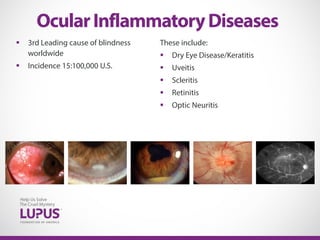
OcularInflammatoryDiseases
These include:
 Dry Eye Disease/Keratitis
 Uveitis
 Scleritis
 Retinitis
 Optic Neuritis
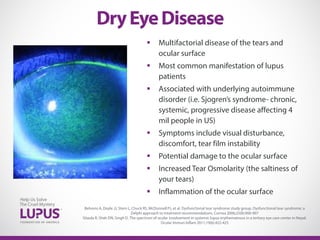
 Multifactorial disease of the tears and
ocular surface
 Most common manifestation of lupus
patients
 Associated with underlying autoimmune
disorder (i.e. Sjogren’s syndrome- chronic,
systemic, progressive disease affecting 4
mil people in US)
 Symptoms include visual disturbance,
discomfort, tear film instability
 Potential damage to the ocular surface
 Increased Tear Osmolarity (the saltiness of
your tears)
 Inflammation of the ocular surface
DryEyeDisease
Behrens A, Doyle JJ, Stern L, Chuck RS, McDonnell PJ, et al. Dysfunctional tear syndrome study group. Dysfunctional tear syndrome: a
Delphi approach to treatment recommendations. Cornea 2006;25(8):900-907
Sitaula R, Shah DN, Singh D. The spectrum of ocular involvement in systemic lupus erythematosus in a tertiary eye care center in Nepal.
Ocular Immun Inflam 2011;19(6):422-425
 Dry eye is also referred to as ocular
surface disease, dysfunctional tear
syndrome (DTS), or
keratoconjunctivitis sicca
 Dry eye is accompanied by
inflammation of the ocular surface
 Dry eye is common (10% US
Population; 23-30 Million Dry Eye
patients)
 Often under diagnosed
DryEyeDisease
 Dry eye impacts vision quality and
can cause blurred vision, fluctuations,
light sensitivity, and glare.
 Quality of life and activities can be
greatly impacted by dry eye
symptoms, with significant
psychological impact.
 Patients have reported willingness to
trade years at the end of life to be free
of dry eyes.
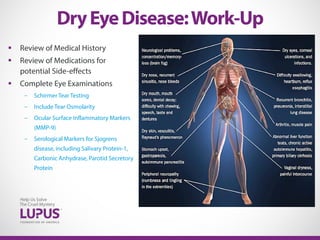
 Review of Medical History
 Review of Medications for
potential Side-effects
 Complete Eye Examinations
- Schirmer Tear Testing
- Include Tear Osmolarity
- Ocular Surface Inflammatory Markers
(MMP-9)
- Serological Markers for Sjogrens
disease, including Salivary Protein-1,
Carbonic Anhydrase, Parotid Secretory
Protein
DryEyeDisease:Work-Up
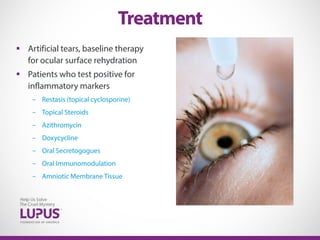
 Artificial tears, baseline therapy
for ocular surface rehydration
 Patients who test positive for
inflammatory markers
- Restasis (topical cyclosporine)
- Topical Steroids
- Azithromycin
- Doxycycline
- Oral Secretogogues
- Oral Immunomodulation
- Amniotic Membrane Tissue
Treatment
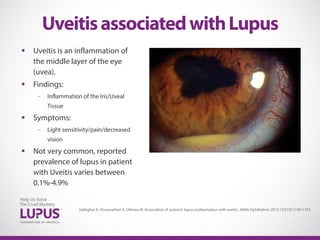
 Uveitis is an inflammation of
the middle layer of the eye
(uvea).
 Findings:
- Inflammation of the Iris/Uveal
Tissue
 Symptoms:
- Light sensitivity/pain/decreased
vision
 Not very common, reported
prevalence of lupus in patient
with Uveitis varies between
0.1%-4.9%
UveitisassociatedwithLupus
Gallagher K, Viswanathan A, Okhravi N. Association of systemic lupus erythematous with uveitis. JAMA Ophthalmic 2015;133(10):1190-1193
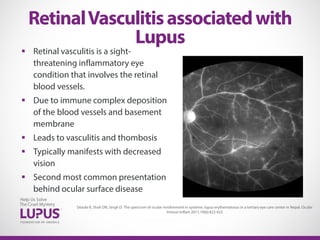
 Retinal vasculitis is a sight-
threatening inflammatory eye
condition that involves the retinal
blood vessels.
 Due to immune complex deposition
of the blood vessels and basement
membrane
 Leads to vasculitis and thombosis
 Typically manifests with decreased
vision
 Second most common presentation
behind ocular surface disease
RetinalVasculitisassociatedwith
Lupus
Sitaula R, Shah DN, Singh D. The spectrum of ocular involvement in systemic lupus erythematosus in a tertiary eye care center in Nepal. Ocular
Immun Inflam 2011;19(6):422-425
Complicationsrelatedtospecific
treatmentsforlupus
representthethirdmostcommon
ocularmanifestation
Sitaula R, Shah DN, Singh D. The spectrum of ocular involvement in systemic lupus erythematosus in a tertiary eye care
center in Nepal. Ocular Immun Inflam 2011;19(6):422-425
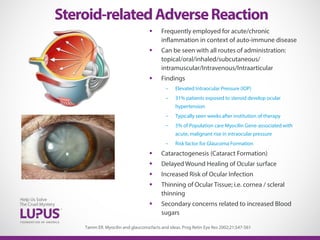
 Frequently employed for acute/chronic
inflammation in context of auto-immune disease
 Can be seen with all routes of administration:
topical/oral/inhaled/subcutaneous/
intramuscular/Intravenous/Intraarticular
 Findings
- Elevated Intraocular Pressure (IOP)
- 31% patients exposed to steroid develop ocular
hypertension
- Typically seen weeks after institution of therapy
- 5% of Population care Myocilin Gene-associated with
acute, malignant rise in intraocular pressure
- Risk factor for Glaucoma Formation
 Cataractogenesis (Cataract Formation)
 Delayed Wound Healing of Ocular surface
 Increased Risk of Ocular Infection
 Thinning of Ocular Tissue; i.e. cornea / scleral
thinning
 Secondary concerns related to increased Blood
sugars
Steroid-relatedAdverseReaction
Tamm ER. Myocilin and glaucoma:facts and ideas. Prog Retin Eye Res 2002;21:547-561
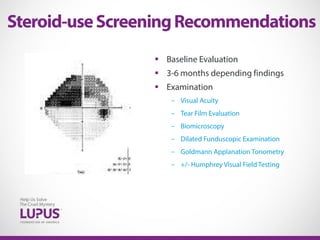
 Baseline Evaluation
 3-6 months depending findings
 Examination
- Visual Acuity
- Tear Film Evaluation
- Biomicroscopy
- Dilated Funduscopic Examination
- Goldmann Applanation Tonometry
- +/- Humphrey Visual Field Testing
Steroid-useScreeningRecommendations
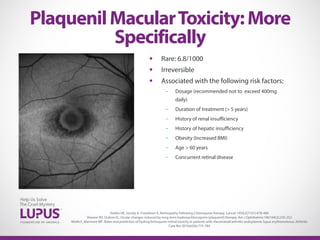
 Rare: 6.8/1000
 Irreversible
 Associated with the following risk factors:
- Dosage (recommended not to exceed 400mg
daily)
- Duration of treatment (> 5 years)
- History of renal insufficiency
- History of hepatic insufficiency
- Obesity (Increased BMI)
- Age > 60 years
- Concurrent retinal disease
PlaquenilMacularToxicity:More
Specifically
Hobbs HE, Sorsby A, Freedman A. Retinopathy following Chloroquine therapy. Lancet 1959;2(7101):478-480
Shearer RV, Dubois EL, Ocular changes induced by long-term hydroxychloroquine (plaquenil) therapy. Am J Ophthalmic1967:64(2):245-252
Wolfe F, Marmore MF. Rates and predictors of hydroychrlroquine retinal toxicity in patients with rheumatoid arthritis andsystemic lupus erythematosus. Arhtritis
Care Res 2010;62(6):775-784
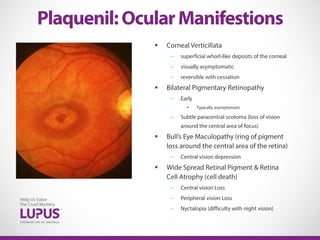
 Corneal Verticillata
- superficial whorl-like deposits of the corneal
- visually asymptomatic
- reversible with cessation
 Bilateral Pigmentary Retinopathy
- Early
 Typically asymptomatic
- Subtle paracentral scotoma (loss of vision
around the central area of focus)
 Bull’s Eye Maculopathy (ring of pigment
loss around the central area of the retina)
- Central vision depression
 Wide Spread Retinal Pigment & Retina
Cell Atrophy (cell death)
- Central vision Loss
- Peripheral vision Loss
- Nyctalopia (difficulty with night vision)
Plaquenil:OcularManifestions
 Baseline exam prior to institution of therapy
 Screening after 5 years of treatment, if no high risk
characteristics
 Screening sooner with high risk characteristics.
 Examination includes:
- Biomicroscope,
- 10-2 Humphrey Visual Field
- Fundus Autofluorescence
- Spectral Domain-OCT imaging
- Multifocal-Electroretinogram
AmericanAcademyofOphthalmology
PlaquenilScreeningRecommendation
(2011)
Marmor MF, Kellner U, Lai TY, Lyons JS, Mieler WF. Revised recommendations on screening for chloroquine andhydroxychloroquine retinopathy. Ophthalmology
2011;118(2):415-22
Marmor MF, Melles MB. Disparity between visual fields and optical coherent tomography in hydroxychloroquine toxicity.Ophthalmology 2014;121:1657-1662
 Newer studies demonstrate Plaquenil® at“safe doses”can still lead to toxicity
 Emphasis is on prevention of rare cases of toxicity
 Identify pre-existing retinal disease
 Early identification of symptoms
 Focus on preservation of function/limit potential visual deficit
AmericanAcademyofOphthalmology
PlaquenilScreeningRecommendation
(2011)
Michaelides M, Stover NB, Francis PJ, Weleber RG. Retinal toxicity associated with hydroxychloroquine and chloroquine: risk factors, screening, and progression
despite cessation of therapy. Arch Ophthalmol 2011;129(1):30-39
Lupus and the Eye

Lupus and the Eye

  • 1.
    Lupus&theEye Jonathan D. Solomon,M.D. Refractive/Cataract Director, Solomon Eye Physicians & Surgeons Director of Research, Bowie Vision Institute Dimensions Health Campus Director of Lens-based Surgery, TLC Laser Eye Centers Medical Scientific Advisory Council DC/MD/VA Chapter Lupus Foundation of America
  • 2.
     3rd Leadingcause of blindness worldwide  Incidence 15:100,000 U.S. OcularInflammatoryDiseases These include:  Dry Eye Disease/Keratitis  Uveitis  Scleritis  Retinitis  Optic Neuritis
  • 3.
     Multifactorial diseaseof the tears and ocular surface  Most common manifestation of lupus patients  Associated with underlying autoimmune disorder (i.e. Sjogren’s syndrome- chronic, systemic, progressive disease affecting 4 mil people in US)  Symptoms include visual disturbance, discomfort, tear film instability  Potential damage to the ocular surface  Increased Tear Osmolarity (the saltiness of your tears)  Inflammation of the ocular surface DryEyeDisease Behrens A, Doyle JJ, Stern L, Chuck RS, McDonnell PJ, et al. Dysfunctional tear syndrome study group. Dysfunctional tear syndrome: a Delphi approach to treatment recommendations. Cornea 2006;25(8):900-907 Sitaula R, Shah DN, Singh D. The spectrum of ocular involvement in systemic lupus erythematosus in a tertiary eye care center in Nepal. Ocular Immun Inflam 2011;19(6):422-425
  • 4.
     Dry eyeis also referred to as ocular surface disease, dysfunctional tear syndrome (DTS), or keratoconjunctivitis sicca  Dry eye is accompanied by inflammation of the ocular surface  Dry eye is common (10% US Population; 23-30 Million Dry Eye patients)  Often under diagnosed DryEyeDisease  Dry eye impacts vision quality and can cause blurred vision, fluctuations, light sensitivity, and glare.  Quality of life and activities can be greatly impacted by dry eye symptoms, with significant psychological impact.  Patients have reported willingness to trade years at the end of life to be free of dry eyes.
  • 5.
     Review ofMedical History  Review of Medications for potential Side-effects  Complete Eye Examinations - Schirmer Tear Testing - Include Tear Osmolarity - Ocular Surface Inflammatory Markers (MMP-9) - Serological Markers for Sjogrens disease, including Salivary Protein-1, Carbonic Anhydrase, Parotid Secretory Protein DryEyeDisease:Work-Up
  • 6.
     Artificial tears,baseline therapy for ocular surface rehydration  Patients who test positive for inflammatory markers - Restasis (topical cyclosporine) - Topical Steroids - Azithromycin - Doxycycline - Oral Secretogogues - Oral Immunomodulation - Amniotic Membrane Tissue Treatment
  • 7.
     Uveitis isan inflammation of the middle layer of the eye (uvea).  Findings: - Inflammation of the Iris/Uveal Tissue  Symptoms: - Light sensitivity/pain/decreased vision  Not very common, reported prevalence of lupus in patient with Uveitis varies between 0.1%-4.9% UveitisassociatedwithLupus Gallagher K, Viswanathan A, Okhravi N. Association of systemic lupus erythematous with uveitis. JAMA Ophthalmic 2015;133(10):1190-1193
  • 8.
     Retinal vasculitisis a sight- threatening inflammatory eye condition that involves the retinal blood vessels.  Due to immune complex deposition of the blood vessels and basement membrane  Leads to vasculitis and thombosis  Typically manifests with decreased vision  Second most common presentation behind ocular surface disease RetinalVasculitisassociatedwith Lupus Sitaula R, Shah DN, Singh D. The spectrum of ocular involvement in systemic lupus erythematosus in a tertiary eye care center in Nepal. Ocular Immun Inflam 2011;19(6):422-425
  • 9.
    Complicationsrelatedtospecific treatmentsforlupus representthethirdmostcommon ocularmanifestation Sitaula R, ShahDN, Singh D. The spectrum of ocular involvement in systemic lupus erythematosus in a tertiary eye care center in Nepal. Ocular Immun Inflam 2011;19(6):422-425
  • 10.
     Frequently employedfor acute/chronic inflammation in context of auto-immune disease  Can be seen with all routes of administration: topical/oral/inhaled/subcutaneous/ intramuscular/Intravenous/Intraarticular  Findings - Elevated Intraocular Pressure (IOP) - 31% patients exposed to steroid develop ocular hypertension - Typically seen weeks after institution of therapy - 5% of Population care Myocilin Gene-associated with acute, malignant rise in intraocular pressure - Risk factor for Glaucoma Formation  Cataractogenesis (Cataract Formation)  Delayed Wound Healing of Ocular surface  Increased Risk of Ocular Infection  Thinning of Ocular Tissue; i.e. cornea / scleral thinning  Secondary concerns related to increased Blood sugars Steroid-relatedAdverseReaction Tamm ER. Myocilin and glaucoma:facts and ideas. Prog Retin Eye Res 2002;21:547-561
  • 11.
     Baseline Evaluation 3-6 months depending findings  Examination - Visual Acuity - Tear Film Evaluation - Biomicroscopy - Dilated Funduscopic Examination - Goldmann Applanation Tonometry - +/- Humphrey Visual Field Testing Steroid-useScreeningRecommendations
  • 12.
     Rare: 6.8/1000 Irreversible  Associated with the following risk factors: - Dosage (recommended not to exceed 400mg daily) - Duration of treatment (> 5 years) - History of renal insufficiency - History of hepatic insufficiency - Obesity (Increased BMI) - Age > 60 years - Concurrent retinal disease PlaquenilMacularToxicity:More Specifically Hobbs HE, Sorsby A, Freedman A. Retinopathy following Chloroquine therapy. Lancet 1959;2(7101):478-480 Shearer RV, Dubois EL, Ocular changes induced by long-term hydroxychloroquine (plaquenil) therapy. Am J Ophthalmic1967:64(2):245-252 Wolfe F, Marmore MF. Rates and predictors of hydroychrlroquine retinal toxicity in patients with rheumatoid arthritis andsystemic lupus erythematosus. Arhtritis Care Res 2010;62(6):775-784
  • 13.
     Corneal Verticillata -superficial whorl-like deposits of the corneal - visually asymptomatic - reversible with cessation  Bilateral Pigmentary Retinopathy - Early  Typically asymptomatic - Subtle paracentral scotoma (loss of vision around the central area of focus)  Bull’s Eye Maculopathy (ring of pigment loss around the central area of the retina) - Central vision depression  Wide Spread Retinal Pigment & Retina Cell Atrophy (cell death) - Central vision Loss - Peripheral vision Loss - Nyctalopia (difficulty with night vision) Plaquenil:OcularManifestions
  • 14.
     Baseline examprior to institution of therapy  Screening after 5 years of treatment, if no high risk characteristics  Screening sooner with high risk characteristics.  Examination includes: - Biomicroscope, - 10-2 Humphrey Visual Field - Fundus Autofluorescence - Spectral Domain-OCT imaging - Multifocal-Electroretinogram AmericanAcademyofOphthalmology PlaquenilScreeningRecommendation (2011) Marmor MF, Kellner U, Lai TY, Lyons JS, Mieler WF. Revised recommendations on screening for chloroquine andhydroxychloroquine retinopathy. Ophthalmology 2011;118(2):415-22 Marmor MF, Melles MB. Disparity between visual fields and optical coherent tomography in hydroxychloroquine toxicity.Ophthalmology 2014;121:1657-1662
  • 15.
     Newer studiesdemonstrate Plaquenil® at“safe doses”can still lead to toxicity  Emphasis is on prevention of rare cases of toxicity  Identify pre-existing retinal disease  Early identification of symptoms  Focus on preservation of function/limit potential visual deficit AmericanAcademyofOphthalmology PlaquenilScreeningRecommendation (2011) Michaelides M, Stover NB, Francis PJ, Weleber RG. Retinal toxicity associated with hydroxychloroquine and chloroquine: risk factors, screening, and progression despite cessation of therapy. Arch Ophthalmol 2011;129(1):30-39