



Learn How You Earn…
Understanding Your Business Accounts
June 2013
Nicky Dargie
Been in business for 12+ years.
• I am not an Accountant.
– Work with Accountants.
• A QBE – Qualified by Experience
• Take a Holistic Approach.
• Problem Solver.
• I Love Training!!!
Our Mission
To Support New Zealand Businesses
to
Develop, Manage and Grow.
We specialise in…
Working as an Extension of Our
Clients Team!!!
We started as an Outsourced Credit Control
Company
Now offer a full range of back office services:
• Debtor Management
• Book-keeping
• Payroll Services
• Business Support
• Strategic Services
• Training
Your Business Accounts
(aka Financial Statements)
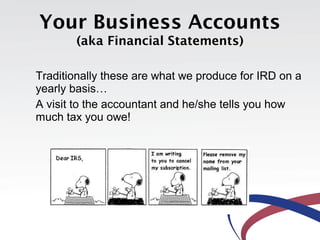
Traditionally these are what we produce for IRD on a
yearly basis…
A visit to the accountant and he/she tells you how
much tax you owe!
Your Business Accounts
(aka Financial Statements)
What can they include:
• Disclaimer
• Company Directory
• Directors Annual Report
• Profit and Loss (Financial Performance)
• Balance Sheet (Financial Position)
• Schedule of Current Accounts
• Notes to the Financial Statements
Management Accounts
These are the accounts that, as business owners,
we should use on a regular basis to ascertain
how well our business is going, and where we
need to adjust.
• Cashflow Report
• Budget vs Actual
• Profit and Loss (Financial Performance)
• Balance Sheet (Financial Position)
• Accounting Ratios
Cashflow Report
Your accountant and Bank manager will want
these are done on a Monthly basis, and are
used to look at the big picture.
If money is tight, this should be done on a daily
basis, in conjunction with your daily bank
reconciliations!!
Budget vs Actual
Process:
• 1st
you write down your business plans for the
next year (these must align with your long term goals!)
• Identify the associated costs.
• Create your budget for the year – use the same
coding as your chart of accounts as the coding
system.
Note: Create a written record of every decision
you have made in your budget.
Profit and Loss Report
Income - Cost of Goods Sold + Expenses
•Tracks the viability of the business.
•Tracking against budget allows you to identify
area’s of concern.
Eg: Higher than expected staff costs, Supplier
costs increasing…
•Does not show cash-flow issues, drawings,
capital expenses
Lets have a look now…
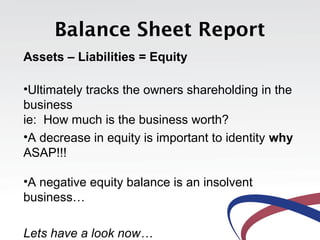
Balance Sheet Report
Assets – Liabilities = Equity
•Ultimately tracks the owners shareholding in the
business
ie: How much is the business worth?
•A decrease in equity is important to identity why
ASAP!!!
•A negative equity balance is an insolvent
business…
Lets have a look now…
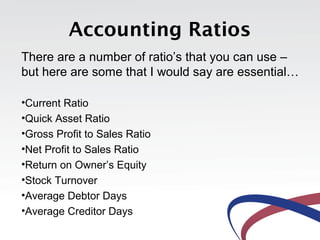
Accounting Ratios
There are a number of ratio’s that you can use –
but here are some that I would say are essential…
•Current Ratio
•Quick Asset Ratio
•Gross Profit to Sales Ratio
•Net Profit to Sales Ratio
•Return on Owner’s Equity
•Stock Turnover
•Average Debtor Days
•Average Creditor Days
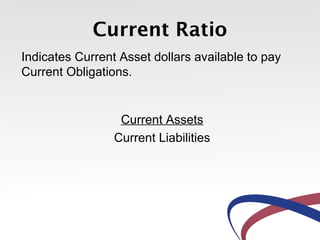
Current Ratio
Indicates Current Asset dollars available to pay
Current Obligations.
Current Assets
Current Liabilities
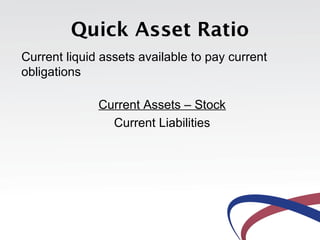
Quick Asset Ratio
Current liquid assets available to pay current
obligations
Current Assets – Stock
Current Liabilities
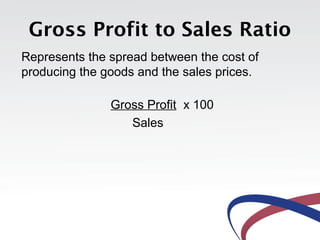
Gross Profit to Sales Ratio
Represents the spread between the cost of
producing the goods and the sales prices.
Gross Profit x 100
Sales
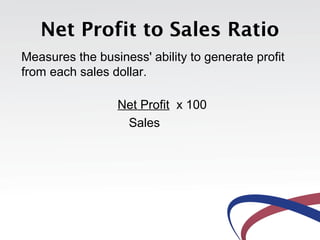
Net Profit to Sales Ratio
Measures the business' ability to generate profit
from each sales dollar.
Net Profit x 100
Sales
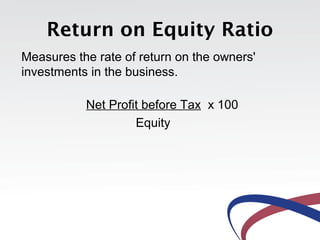
Return on Equity Ratio
Measures the rate of return on the owners'
investments in the business.
Net Profit before Tax x 100
Equity
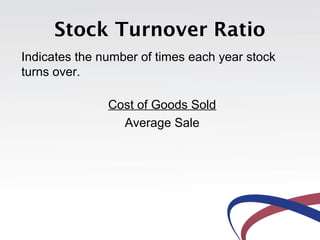
Stock Turnover Ratio
Indicates the number of times each year stock
turns over.
Cost of Goods Sold
Average Sale
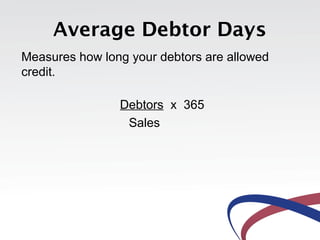
Average Debtor Days
Measures how long your debtors are allowed
credit.
Debtors x 365
Sales
Average Creditor Days
Measures trade creditor financing of stock.
Creditors x 365
Cost of goods sold
In Conclusion
Go back to your business,
and start NOW finding out
how well you are doing!!!
Our offers for today
• Keep Your Finger on the Pulse course –
$295 + GST – running July
• One-to-one time with me in your business
$55.00 per hour + GST
• One-to-one training to help you set up a
Daily Cash-flow reporting system - $195 +
GST

Lunchbox Learning: Learn How You Earn June 2013

  • 1.
    Learn How YouEarn… Understanding Your Business Accounts June 2013
  • 2.
    Nicky Dargie Been inbusiness for 12+ years. • I am not an Accountant. – Work with Accountants. • A QBE – Qualified by Experience • Take a Holistic Approach. • Problem Solver. • I Love Training!!!
  • 3.
    Our Mission To SupportNew Zealand Businesses to Develop, Manage and Grow. We specialise in… Working as an Extension of Our Clients Team!!!
  • 4.
    We started asan Outsourced Credit Control Company Now offer a full range of back office services: • Debtor Management • Book-keeping • Payroll Services • Business Support • Strategic Services • Training
  • 5.
    Your Business Accounts (akaFinancial Statements) Traditionally these are what we produce for IRD on a yearly basis… A visit to the accountant and he/she tells you how much tax you owe!
  • 6.
    Your Business Accounts (akaFinancial Statements) What can they include: • Disclaimer • Company Directory • Directors Annual Report • Profit and Loss (Financial Performance) • Balance Sheet (Financial Position) • Schedule of Current Accounts • Notes to the Financial Statements
  • 7.
    Management Accounts These arethe accounts that, as business owners, we should use on a regular basis to ascertain how well our business is going, and where we need to adjust. • Cashflow Report • Budget vs Actual • Profit and Loss (Financial Performance) • Balance Sheet (Financial Position) • Accounting Ratios
  • 8.
    Cashflow Report Your accountantand Bank manager will want these are done on a Monthly basis, and are used to look at the big picture. If money is tight, this should be done on a daily basis, in conjunction with your daily bank reconciliations!!
  • 9.
    Budget vs Actual Process: •1st you write down your business plans for the next year (these must align with your long term goals!) • Identify the associated costs. • Create your budget for the year – use the same coding as your chart of accounts as the coding system. Note: Create a written record of every decision you have made in your budget.
  • 10.
    Profit and LossReport Income - Cost of Goods Sold + Expenses •Tracks the viability of the business. •Tracking against budget allows you to identify area’s of concern. Eg: Higher than expected staff costs, Supplier costs increasing… •Does not show cash-flow issues, drawings, capital expenses Lets have a look now…
  • 11.
    Balance Sheet Report Assets– Liabilities = Equity •Ultimately tracks the owners shareholding in the business ie: How much is the business worth? •A decrease in equity is important to identity why ASAP!!! •A negative equity balance is an insolvent business… Lets have a look now…
  • 12.
    Accounting Ratios There area number of ratio’s that you can use – but here are some that I would say are essential… •Current Ratio •Quick Asset Ratio •Gross Profit to Sales Ratio •Net Profit to Sales Ratio •Return on Owner’s Equity •Stock Turnover •Average Debtor Days •Average Creditor Days
  • 13.
    Current Ratio Indicates CurrentAsset dollars available to pay Current Obligations. Current Assets Current Liabilities
  • 14.
    Quick Asset Ratio Currentliquid assets available to pay current obligations Current Assets – Stock Current Liabilities
  • 15.
    Gross Profit toSales Ratio Represents the spread between the cost of producing the goods and the sales prices. Gross Profit x 100 Sales
  • 16.
    Net Profit toSales Ratio Measures the business' ability to generate profit from each sales dollar. Net Profit x 100 Sales
  • 17.
    Return on EquityRatio Measures the rate of return on the owners' investments in the business. Net Profit before Tax x 100 Equity
  • 18.
    Stock Turnover Ratio Indicatesthe number of times each year stock turns over. Cost of Goods Sold Average Sale
  • 19.
    Average Debtor Days Measureshow long your debtors are allowed credit. Debtors x 365 Sales
  • 20.
    Average Creditor Days Measurestrade creditor financing of stock. Creditors x 365 Cost of goods sold
  • 21.
    In Conclusion Go backto your business, and start NOW finding out how well you are doing!!!
  • 22.
    Our offers fortoday • Keep Your Finger on the Pulse course – $295 + GST – running July • One-to-one time with me in your business $55.00 per hour + GST • One-to-one training to help you set up a Daily Cash-flow reporting system - $195 + GST